Group Invariant Deep Representations for Image
Instance Retrieval
by
Olivier Morère, Antoine Veillard, Jie Lin,
Julie Petta, Vijay Chandrasekhar and Tomaso Poggio
Abstract
Most image instance retrieval pipelines are based on comparison of vectors known as global image descriptors between a query image and the database images. Due to their success in large scale image classification, representations extracted from Convolutional Neural Networks (CNN) are quickly gaining ground on Fisher Vectors (FVs) as state-of-the-art global descriptors for image instance re-trieval. While CNN-based descriptors are generally remarked for good retrieval performance at lower bitrates, they nevertheless present a number of drawbacks including the lack of robustness to common object transformations such as rotations compared with their interest point based FV counterparts.
In this paper, we propose a method for computing invariant global descriptors from CNNs. Our method implements a recently proposed mathematical theory for invariance in a sensory cortex mod-eled as a feedforward neural network. The resulting global descriptors can be made invariant to multi-ple arbitrary transformation groups while retaining good discriminativeness.
Based on a thorough empirical evaluation using several publicly available datasets, we show that our method is able to significantly and consistently improve retrieval results every time a new type of invariance is incorporated. We also show that our method which has few parameters is not prone to overfitting: improvements generalize well across datasets with different properties with regard to invariances. Finally, we show that our descriptors are able to compare favourably to other state-of-the-art compact descriptors in similar bitranges, exceeding the highest retrieval results reported in the literature on some datasets. A dedicated dimensionality reduction step –quantization or hashing– may be able to further improve the competitiveness of the descriptors.
This work was supported by the Center for Brains, Minds and
Ma-chines (CBMM), funded by NSF STC award CCF - 1231216.
Olivier Mor`ere
, Antoine Veillard
, Jie Lin
Julie Petta
3, Vijay Chandrasekhar
2, Tomaso Poggio
4Abstract—Most image instance retrieval pipelines are based on comparison of vectors known as global image descriptors between a query image and the database images. Due to their success in large scale image classification, representations extracted from Convolutional Neural Networks (CNN) are quickly gaining ground on Fisher Vectors (FVs) as state-of-the-art global descrip-tors for image instance retrieval. While CNN-based descripdescrip-tors are generally remarked for good retrieval performance at lower bitrates, they nevertheless present a number of drawbacks in-cluding the lack of robustness to common object transformations such as rotations compared with their interest point based FV counterparts.
In this paper, we propose a method for computing invariant global descriptors from CNNs. Our method implements a re-cently proposed mathematical theory for invariance in a sensory cortex modeled as a feedforward neural network. The resulting global descriptors can be made invariant to multiple arbitrary transformation groups while retaining good discriminativeness.
Based on a thorough empirical evaluation using several pub-licly available datasets, we show that our method is able to significantly and consistently improve retrieval results every time a new type of invariance is incorporated. We also show that our method which has few parameters is not prone to overfitting: improvements generalize well across datasets with different properties with regard to invariances. Finally, we show that our descriptors are able to compare favourably to other state-of-the-art compact descriptors in similar bitranges, exceeding the highest retrieval results reported in the literature on some datasets. A dedicated dimensionality reduction step –quantization or hashing– may be able to further improve the competitiveness of the descriptors.
Index Terms—Invariance theory, group invariance, deep learn-ing, convolutional neural networks, image instance retrieval, global image descriptors, compact descriptors.
I. INTODUCTION
Image instance retrieval is the discovery of images from a database representing the same object or scene as the one depicted in a query image. The first step of a typical retrieval pipeline starts with the comparison of vectors representing the image contents known asglobal image descriptors. Good qual-ity descriptors is key to achieving good retrieval performances. Deep learning neural networks are fast becoming the domi-nant approach for image classification due to their remarkable performance for large scale image classification [1], [2]. In their recent work, Babenko et al. [3] propose using represen-tations extracted from Convolutional Neural Nets (CNN) as
∗O. Mor`ere and A. Veillard contributed equally to this work.
1 Universit´e Pierre et Marie Curie 2 A*STAR Institute for Infocomm Research 3 CentraleSup´elec
4 CBMM, LCSL, IIT and MIT
a global descriptor for image retrieval, and show promising initial results for the approach. In our recent work [4], [5], we also show how stacked Restricted Boltzmann Machines (RBM) and supervised fine-tuning can be used for generating extremely compact hashes from global descriptors obtained from CNNs for large scale image-retrieval.
While CNN based descriptors are progressively replacing Fisher Vectors (FV) [6] as state-of-the-art descriptors for image instance retrieval, we have shown in our recent work thoroughly comparing both types of descriptors [7] that the use of CNNs still presents a number of significant drawbacks compared with FVs. One of them is the lack of invariance to transformations of the input image such as rotations: the performance of CNN descriptors quickly degrade when the objects in the query and the database image are rotated differently.
In this paper, we propose a method to produce global image descriptors from CNNs which are both compact and robust to such transformations. Our method is inspired from a recent invariance theory (subsequently referred to as i-theory) for information processing in sensory cortex [8], [9], [10]. The theory is an information processing model explaining how feedforward information processing in a sensory cortex can be made robust to various types of signal distorsions. In particu-lar, it provides a practical and mathematically proven way for computing invariant object representations with feedforward neural networks.
After showing that CNNs are compatible with thei-theory, we propose a simple and practical way to apply the theory to the construction of global image descriptors which are robust to various types of transformations of the input image at the same time. Through a thorough empirical evaluation based on multiple publicly available datasets, we show that our method is able to significantly consistently improve retrieval results while keeping dimensionality low. Rotations, translations and scale changes are studied in the scope of this paper but our approach is extensible to other types of transformations.
II. RELATEDWORK
Since the winning submission of Krizhevsky et al. in the ImageNet 2012 challenge [1], deep CNNs are now consid-ered as the mainstream go-to approach for large-scale image classification. They are also known to achieve state-of-the-art results with many other visual recognition tasks such as face recognition [11], [12], pedestrian detection [13] and pose estimation [14].
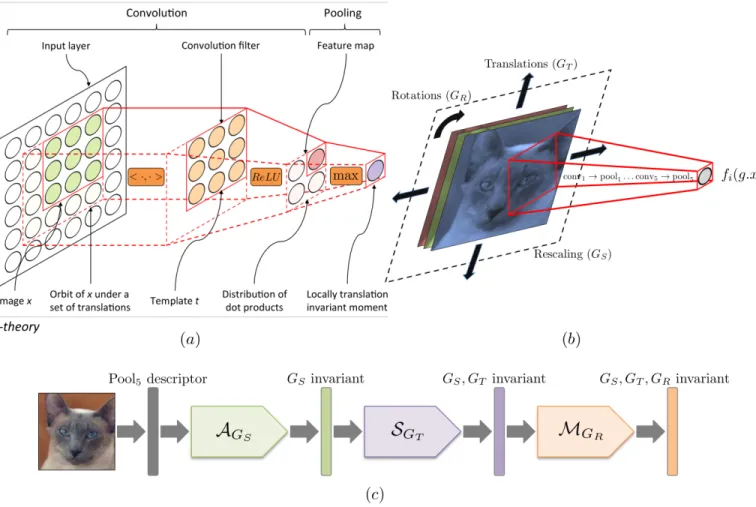
Fig. 1. (a) A single convolution-pooling operation from a CNN schematized for a single input layer and single output neuron. The parallel with i-theory
shows that the universal building block of CNNs is compatible with the incorporation of invariance to local translations of the input according to the theory. The network architecture is responsible for the invariance properties while back-propagation provides a practical way to learn the templates from data. (b) A specific succession of convolution and pooling operations learnt by the CNN (depicted in red) computes thepool5featurefifor each feature mapifrom the
RGB image data. A number of transformationsgcan be applied to the inputxin order to vary the responsefi(g.x). (c) Our method takes inspiration from
thei-theoryto create compact and robust global image descriptors from CNNs. Starting with rawpool5descriptors, it can be used to stack-up an arbitrary number of transformation group invariances while keeping the dimensionality under control. The particular sequence of transformation groups and statistical moments represented on the diagram was shown to produce the best performing hashes on average in our study but other arbitrary combinations are also able to improve retrieval results.
CNN began to be applied to the instance retrieval problem as well, although there is comparatively less work on CNN-based descriptors for instance retrieval compared to large-scale image classification. Razavian et al. [15] evaluate the performance of CNN model of [1] on a wide range of tasks including instance retrieval, and show initial promising results. Babenko et al. [3] show that a pre-trained CNN can be fine tuned with domain specific data (objects, scenes, etc.) to improve retrieval performance on relevant data sets. The authors also show that the CNN representations can be compressed more effectively than their FV counterparts for large-scale instance retrieval. In [4], [5], we show how sparse high-dimensional CNN representations can be hashed to very compact representations (32-1024 bits) for large scale image retrieval with little loss in matching performance.
Meanwhile, we showed in our recent evaluation work [7] that CNN-based descriptors still suffer from a number of drawbacks including the lack of robustness to certain trans-formations of the input data. The i-theory proposed as the
guideline method in this paper was recently used to success-fully compute robust representations for face recognition [16] and music classification [17].
The contributions of our work can be summarized as follows.
• A method based on i-theory for creating robust and
compact global image descriptors from CNNs.
• The ability to iteratively incorporate different group in-variances, each new addition leading to consistent and significant improvements in retrieval results.
• A set of highly competitive global descriptors for image instance retrieval compared with other state-of-the-art compact descriptors at similar bitrates.
• A low risk of overfitting: few parameters and many reasonable settings which can generalize well across all datasets.
• A thorough empirical study based on several publicly available datasets.
∈
and a group G of transformations acting over E with group actionG×E→E denoted with a dot (.). The orbit ofxbyG is the subset of E defined as Ox={g.x∈E|g∈G}. It can
be easily shown thatOx is globally invariant to the action of
any element of Gand thus any descriptor computed directly from Ox would be globally invariant toG.
Thei-theorypredicts that an invariant descriptor for a given object x ∈ E is computed in relation with a predefined template t ∈ E from the distribution of the dot products Dx,t ={< g.x, t >∈R|g ∈G} ={< x, g.t >∈R|g ∈ G}
over the orbit. One may note that the transformation can be applied either on the image or the template indifferently. The proposed invariant descriptor extracted from the pipeline should be a histogram representation of the distribution with a specific bin configuration. Such a representation is math-ematically proven to have proper invariance and selectivity properties provided that the group is compact or at least locally compact [8].
In practice, while a compact group (e.g. rotations) or locally-compact group (e.g. translations, scale changes) is required for the theory to be mathematically provable, the authos of [8] suggest that the theory extends well (with approximate invariance) to non-locally compact groups and even to continuous non-group transformations (e.g. out-of-plane rotations, elastic deformations) provided that proper class-specific templates can be provided. Recent work on face verification [16] and music classification [17] apply the theory to non-compact groups with good results. Additionally, the histograms can also be effectively replaced by statistical moments (e.g. mean, min, max, standard deviation, etc.).
B. CNNs are i-theory Compliant Networks
All popular CNN architectures designed for image clas-sification such as AlexNet [1] and OxfordNet [2] share a common building block: a succession of convolution-pooling operations designed to model increasingly high-level visual representations of the data. The highest level visual features may then be fed into fully connected layers acting as a classifiers.
As shown in detail on Figure 1 (a), the succession of convolution and pooling operations in a typical CNN is in fact a way to incorporate local translation invariance strictly compliant with the framework proposed by the i-theory. The network architecture provides the robustness such as predicted by the invariance theory while training via back propagation ensures a proper choice of templates. In general, multiple convolution-pooling steps are applied (5 times in bothAlexNet
and OxfordNet) resulting in increased robustness and higher level templates. Note that the iterative composition of local translation invariance approximately translates into robustness to local elastic distortions for the features at the pool5layer.
a way inspired fromi-theory.
C. Transformation Invariant CNN Descriptors
For every feature map i of the pool5 layer (0 ≤ i <512 in the case of the presently usedOxfordNet), we denotefi(x)
the corresponding feature obtained from the RGB image data through a succession of convolution-pooling operations. Note that the transformation fi is non-linear and thus not strictly
a mathematical dot product with a template but can still be viewed as an inner product.
In this study, we propose to further improve the invariance of pool5 CNN descriptors by incorporating global invariance to several transformation groups. The specific transformation groups considered in this study are translationsGT, rotations
GR and scale changes GS. As shown on Figure 1 (b),
transformations g are applied on the input image x varying the output of thepool5feature fi(g.x) accordingly.
The invariant statistical moments computed from the dis-tributions {fi(g.x)|g ∈ G} with G ∈ {GT, GR, GS} are
averages, maxima and standard deviations, respectively:
AG,i(x) = R 1 Gdg Z G fi(g.x)dg (1) MG,i(x) = max G (fi(g.x)) (2) SG,i(x) = 1 R Gdg s Z G fi(g.x)2dg−( Z G fi(g.x)dg)2 (3)
with corresponding global image descriptors obtained by sim-ply concatenating the moments for the individual features:
AG(x) = (AG,i(x))0≤i<512 (4) MG(x) = (MG,i(x))0≤i<512 (5) SG(x) = (SG,i(x))0≤i<512 (6)
In principle, G is always measurable and of finite measure as required since GT andGS must be restricted to compact
subsets due to image border effects.
An interesting aspect of the i-theory is the possibility in practice to chain multiple types of group invariances one after the other as already demonstrated in [17]. In this study, we construct descriptors invariant to several transformation groups by successively applying the method to different transforma-tion groups as shown on Figure 1 (c). For instance, following scale invariance with average by translation invariance with standard deviation for feature iwould correspond to:
max gt∈GT 1 R gs∈GSdgs Z gs∈GS fi(gtgs.x)dgs ! (7) One may note that the operations are sometimes commutable (e.g. AG and AG0) and sometimes not (e.g. AG and MG0)
IV. IMAGEINSTANCERETRIEVAL
A. Evaluation Framework
We evaluate our invariant image descriptors in the context of image instance retrieval. As our starting representation, we use the pool5 layer from the 16 layersOxfordNet [2] with a total dimensionality of 25088 organized in512 feature maps of size 7×7.
Similarly to our evaluation work in [7], the rotated input im-ages are padded with the mean pixel value from the ImageNet data set. The step size for rotations is 10 degrees yielding 36 rotated images per orbit. For scale changes, 10 different center crops geometrically spanning from 100% to 50% of the total image have been taken. For translations, the entire feature map is used for every feature, resulting in an orbit size of 7×7 = 49.
We evaluate the performances of the descriptors against four popular data sets: Holidays,Oxford buildings (Oxbuild),
UKBench (UKB) andGraphics. The four datasets are chosen for the diversity of data they provide:UKBenchandGraphics
are object-centric featuring close-up shots of objects in indoor environments.HolidaysandOxbuildare scene-centric datasets consisting primarily of outdoor buildings and scenes.
INRIA Holidays.The INRIA Holidays dataset [18] consist of personal holiday pictures. The dataset includes a large variety of outdoor scene types: natural, man-made, water and fire effects. There are 500 queries and 991 database images. Variations in lighting conditions are rare in this data set as the pictures from the same location are taken at the same time.
Oxbuild. The Oxford Buildings Dataset [19] consists of 5062 images collected from Flickr representing landmark buildings in Oxford. The collection has been manually anno-tated to generate a comprehensive ground truth for 11 different landmarks, each represented by 5 possible queries. Note that the set contains 55 queries only.
UKBench.The University of Kentucky (UKY) data set [20] consists of 2550 groups of common objects. There are 4 images representing each. Only the object of interest present in each image. Thus, there is no foreground or background clutter within this data set. All 10200 images are used as queries.
Graphics. The Graphics data set is part of the Stanford Mobile Visual Search data set [21], which notably was used in the MPEG standard: Compact Descriptors for Visual Search (CDVS) [22]. The data set contains different categories of objects like CDs, DVDs, books, software products, business cards, etc. The query images include foreground and back-ground clutter that would be considered typical in real-world scenarii, e.g., a picture of a CD might contain other CDs in the background. This data set distinguishes from the other ones as it contains images of rigid objects captured under widely varying lighting conditions, perspective distortion, foreground and background clutter. Query images are taken with hetero-geneous phone cameras. Each query has two relevant images. There are 500 unique objects, 1500 queries, and 1000 database images.
B. Pairwise Matching Distance
Image instance retrieval starts with the construction of a list of database images ordered according to their pairwise matching distance with the query image. With CNN descrip-tors, the matching distance is strongly affected by commonly encountered image transformations. As shown in our previous evaluation work [7], a rotation of the query image by 10 degrees or more causing a sharp drop in results. This particular issue is much less pronounced with the popular Fisher vectors, largely due to the use of interest point detectors.
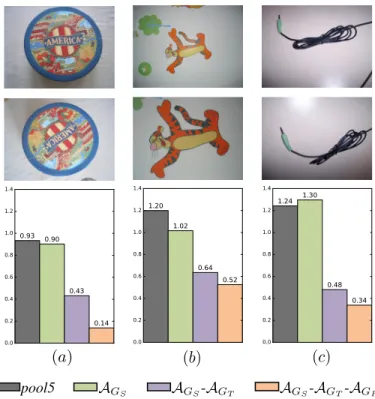
Figure 2 provides an insight on how adding different types of invariance with our proposed method will affect the match-ing distance on different image pairs of matchmatch-ing objects. With the incorporation of each new transformation group, we notice that the relative reduction in matching distance is the most significant with the image pair which is the most affected by the transformation group.
(
a
)
(
b
)
(
c
)
pool5 AGS AGS-AGT AGS-AGT-AGR
Fig. 2. Distances for 3 matching pairs fromUKBench. For each pair, 4 pair-wise distances (L2-normalized) are computed corresponding to the following
descriptors:pool5,AGS,AGS-AGT andAGS-AGT-AGR. Adding scale
invariance makes the most difference on (b), translation invariance on (c), and rotation on (a) which is consistent with the scenarii suggested by the images.
C. Transformations, Order and Moments
Our first set of results summarized in Table I study the effects of incorporating various transformation groups and using different moments. Pool5 which is the starting point of our descriptors and fc6 which is considered the best off-the-shelf descriptor [7], [15] are provided as baselines. Table I also provides results for all possible combinations of transformation groups for average pooling (order does not matter as averages commute) and for the single best performer which isAGS-SGT-MGR (order matters).
Oxbuild Holidays UKB Graphics pool5 25088 0.427 0.707 0.823(3.105) 0.315 fc6 4096 0.461 0.782 0.910(3.494) 0.312 AGS 25088 0.430 0.716 0.828(3.122) 0.394 AGT 512 0.477 0.800 0.924(3.564) 0.322 AGR 25088 0.462 0.779 0.954(3.718) 0.500 AGT-AGR 512 0.418 0.796 0.955(3.725) 0.417 AGT-AGS 512 0.537 0.811 0.931(3.605) 0.430 AGR-AGS 25088 0.494 0.815 0.959(3.752) 0.552 AGS-AGT-AGR 512 0.484 0.833 0.971(3.819) 0.509 AGS-SGT-MGR 512 0.592 0.838 0.975(3.842) 0.589 AGS-SGT-MGR 512bits 0.523 0.787 0.958(3.741) 0.552
Results are computed with the mean average precision (mAP) metric. For reference, 4×Recall@4 results are also provided for UKBench (between parentheses).GT,GR,GSdenote the groups of translations, rotations and
scale changes respectively. Note that averages commute with other averages so the sequence order of the composition does not matter when only averages are involved. Best results are achieved by choosing specific moments.AGS
-SGT-MGRcorresponds to the best average performer for which a binarized
version is also given.fc6andpool5are provided as a baseline.
1
2
3
Number of transformations
0
10
20
30
40
50
60
70
80
90
100
mAP mean error improvement over pool5 (%)
19.9 34.3 43.0 5.1 9.7 9.9 13.2 22.1 28.3 44.5 70.9 83.5
Oxbuild Holidays UKB Graphics
Fig. 3. Results from Table I for the 7 strategies using averages only (rows 3 to 9) expressed in terms of improvement in mAP overpool5, and aggregated by number of invariance groups. Improvements range from +5% on Oxbuild using 1 transformation to +83.5% on UKBench using 3 transformations. On all 4 datasets, results clearly improve with the amount of groups considered.
First, we can immediately point out the high potential of
pool5. Although it performs notably worse than fc6 as-is, a simple average pooling over the space of translations AGT
makes it both better and 8 times more compact than fc6. As shown in Figure 3, accuracy increases with the number of transformation groups involved. On average, single trans-formation schemes perform 21% better compared to pool5, 2-transformations schemes perform 34% better, and the 3-transformations scheme performs 41% better.
Selecting statistical moments different than averages can
AGT AGR AGS AGR AGT AGT AGS AGS AGR AGT AGR AGS AGS SGT MGR
Fig. 4. Results from Table I expressed in terms of improvement in mAP overpool5. Most strategies yield significant improvements overpool5on most datasets. The average improvement is 68% for the best strategy.
further improve the retrieval results. In Figure 4, we observe that AGS-SGT-MGR performs roughly 17% better (average
results over all datasets) than AGS-AGT-AGR. Notably, the
best combination corresponds to an increase in the orders of the moments: Abeing a first-order moment, S second order andM of infinite order. A different way of stating this fact is that a more invariant representation requires a higher order of pooling.
Overall, AGS-SGT-MGR improves results over pool5 by
29% (Oxbuild) to 86% (UKBench) with large discrepancies according to the dataset. Better improvements with UKBench can be explained with the presence of many rotations in the dataset (smaller objects taken under different angles) while Oxbuild consisting mainly of upright buildings is not significantly helped by incorporating rotation invariance.
D. Compact Binary Hashes
TABLE II
RETRIEVAL PERFORMANCE(MAP)COMPARING OUR METHOD TO OTHER STATE-OF-THE-ART METHODS.
METHOD REP.SIZE DATASET
#dim (size in bits) Oxbuild Holidays UKB
Our results 512 (512) 0.523 0.787 0.958 OxfordNet [23] 256 (1024) 0.533 0.716 0.842 OxfordNet [23] 256 (256) 0.436 0.578 0.693 T-embedding [24] 256 (2048) 0.472 0.657 0.863 T-embedding [24] 128 (1024) 0.433 0.617 0.850 VLAD+CSurf [25] 128 (1024) 0.293 0.738 0.830 mVLAD+Surf [25] 128 (1024) 0.387 0.718 0.875
As shown in Table I, a simple binarization strategy (thresh-olding at dataset mean) applied to our best performing de-scriptorAGS-SGT-MGR degrades retrieval performance only
very marginally and is in fact sufficient to produce a hash that compares favourably with other state-of-the-art methods. On average over the four datasets, the hash performs 39% better thanpool5, while having a 1568 times smaller representation size. Compared to fc6 feature, the hash performs 26% better while being 256 times smaller.
As mentioned, the invariant hash also performs well com-pared to other state-of-the-art. In Table II, we compare our invariant hash against other approaches designed to produce compact representations with comparable bit sizes, 512 being considered fairly compact by current standards [23]. In ad-dition, note that the hashing scheme used in this experiment is very naive and better hashes (better retrieval results and/or higher compression rates) could most certainly be obtained by applying more sophisticated hashing methods such as in our previous work [26], [5] based on stacked RBMs and metric finetuning.
V. CONCLUSION
We proposed a novel method based oni-theoryfor creating robust and compact global image descriptors from CNNs for image instance retrieval. Through a thorough empirical study, we show that the incorporation of every new group invariance property following the method leads to consistent and significant improvements in retrieval results.
Our method has a number of parameters (sequence of the invariances and choice of statistical moments) but experiments show that many default and reasonable settings produce results which can generalise well across all datasets meaning that the risk of overfitting is low.
This study also confirms the high potential of the fea-ture pyramid (pool5) as a starting representation for high-performance compact hashes instead of the more commonly used first fully connected layer (fc6). Our method produces a set of descriptors able to compare favourably with other state-of-the-art compact descriptors at similar bitrates even without dedicated compression/hashing step.
REFERENCES
[1] A. Krizhevsky, I. Sutskever, and G. E. Hinton, “ImageNet Classification with Deep Convolutional Neural Networks,” in Advances in neural information processing systems (NIPS), 2012, pp. 1–9.
[2] K. Simonyan and A. Zisserman, “Very Deep Convolutional Networks for Large-Scale Image Recognition,” inarXiv preprint arXiv:1409.1556, 2014, pp. 1–10.
[3] A. Babenko, A. Slesarev, A. Chigorin, and V. Lempitsky, “Neural Codes for Image Retrieval,” inProceedings of European Conference on Computer Vision (ECCV), 2014.
[4] V. Chandrasekhar, L. Jie, O. Mor`ere, A. Veillard, and H. Goh, “Compact Global Descriptors for Visual Search,” inProceedings of IEEE Data Compression Conference (DCC), Snowbird, Utah, March 2015. [5] J. Lin, O. Mor`ere, J. Petta, V. Chandrasekhar, and A. Veillard,
“Tiny descriptors for image retrieval with unsupervised triplet hashing,” CoRR, vol. abs/1511.03055, 2015. [Online]. Available: http://arxiv.org/abs/1511.03055
[6] F. Perronnin, Y. Liu, J. Sanchez, and H. Poirier, “Large-scale Image Retrieval with Compressed Fisher Vectors,” in Computer Vision and Pattern Recognition (CVPR), San Francisco, CA, USA, June 2010, pp. 3384–3391.
[7] V. Chandrasekhar, J. Lin, O. Mor`ere, H. Goh, and A. Veillard, “A practical guide to cnns and fisher vectors for image instance retrieval,” CoRR, vol. abs/1508.02496, 2015. [Online]. Available: http://arxiv.org/abs/1508.02496
[8] F. Anselmi, J. Z. Leibo, L. Rosasco, J. Mutch, A. Tacchetti, and T. Pog-gio, “Unsupervised learning of invariant representations in hierarchical architectures,”arXiv:1311.4158, 2013.
[9] F. Anselmi and T. Poggio, “Representation learning in sensory cortex: a theory.”CBMM memo n 26, 2010.
[10] F. Anselmi, J. Z. Leibo, L. Rosasco, J. Mutch, A. Tacchetti, and T. Poggio, “Magic materials: a theory of deep hierarchical architectures for learning sensory representations.”CBCL paper, 2013.
[11] Y. Taigman, M. Yang, M. Ranzato, and L. Wolf, “Deepface: Closing the gap to human-level performance in face verification,” inComputer Vision and Pattern Recognition (CVPR). IEEE, 2014, pp. 1701–1708. [12] Y. Sun, X. Wang, and X. Tang, “Deep learning face representation from predicting 10,000 classes,” inComputer Vision and Pattern Recognition (CVPR), 2014 Conference on. IEEE, 2014, pp. 1891–1898.
[13] W. Ouyang and X. Wang, “Joint deep learning for pedestrian detection,” inInternational Conference on Computer Vision (ICCV), Dec 2013, pp. 2056–2063.
[14] A. Toshev and C. Szegedy, “Deeppose: Human pose estimation via deep neural networks,” inComputer Vision and Pattern Recognition (CVPR), 2014 IEEE Conference on. IEEE, 2014, pp. 1653–1660.
[15] A. S. Razavian, H. Azizpour, J. Sullivan, and S. Carlsson, “Cnn features off-the-shelf: an astounding baseline for recognition,” in Computer Vision and Pattern Recognition Workshops (CVPRW). IEEE, 2014, pp. 512–519.
[16] Q. L. Liao, J. Z. Leibo, and T. Poggio, “Learning invariant representa-tions and applicarepresenta-tions to face verification,” inNIPS, 2013.
[17] C. Zhang, G. Evangelopoulos, S. Voinea, L. Rosasco, and T. Poggio, “A deep representation for invariance and music classification,” inICASSP, 2014.
[18] H. J´egou, M. Douze, and C. Schmid, “Hamming Embedding and Weak Geometric Consistency for Large Scale Image Search,” inProceedings of European Conference on Computer Vision (ECCV), Berlin, Heidelberg, October 2008, pp. 304–317.
[19] J. Philbin, O. Chum, M. Isard, J. Sivic, and A. Zisserman, “Object Re-trieval with Large Vocabularies and Fast Spatial Matching,” inComputer Vision and Pattern Recognition (CVPR), Minneapolis, Minnesota, June 2007, pp. 1–8.
[20] D. Nist´er and H. Stew´enius, “Scalable Recognition with a Vocabulary Tree,” inComputer Vision and Pattern Recognition (CVPR), New York, USA, June 2006, pp. 2161–2168.
[21] V. Chandrasekhar, D.M.Chen, S.S.Tsai, N.M.Cheung, H.Chen, G.Takacs, Y.Reznik, R.Vedantham, R.Grzeszczuk, J.Back, and B.Girod, “Stanford Mobile Visual Search Data Set,” in Proceedings of ACM Multimedia Systems Conference (MMSys), San Jose, California, February 2011, 2011.
[22] MPEG CDVS (Compact Descriptors for Visual Search) Benchmark. Stanford Digital Repository.
[23] A. Sharif Razavian, J. Sullivan, A. Maki, and S. Carlsson, “A baseline for visual instance retrieval with deep convolutional networks,” in
International Conference on Learning Representations, May 7-9, 2015, San Diego, CA. ICLR, 2015.
[24] H. J´egou and A. Zisserman, “Triangulation embedding and democratic aggregation for image search,” inComputer Vision and Pattern Recogni-tion (CVPR), 2014 IEEE Conference on. IEEE, 2014, pp. 3310–3317. [25] E. Spyromitros-Xioufis, S. Papadopoulos, I. Y. Kompatsiaris, G. Tsoumakas, and I. Vlahavas, “A comprehensive study over vlad and product quantization in large-scale image retrieval,”Multimedia, IEEE Transactions on, vol. 16, no. 6, pp. 1713–1728, 2014.
[26] J. Lin, O. Mor`ere, V. Chandrasekhar, A. Veillard, and H. Goh, “Deephash: Getting regularization, depth and fine-tuning right,”CoRR, vol. abs/1501.04711, 2015. [Online]. Available: http://arxiv.org/abs/ 1501.04711