LEARNING
JOURNAL
of
Volume 17, Number 10
The Importance of Self: Developing Students’ Self
Efficacy Through Work Integrated Learning
THE INTERNATIONAL JOURNAL OF LEARNING http://www.Learning-Journal.com
First published in 2010 in Champaign, Illinois, USA by Common Ground Publishing LLC www.CommonGroundPublishing.com.
© 2010 (individual papers), the author(s)
© 2010 (selection and editorial matter) Common Ground
Authors are responsible for the accuracy of citations, quotations, diagrams, tables and maps.
All rights reserved. Apart from fair use for the purposes of study, research, criticism or review as permitted under the Copyright Act (Australia), no part of this work may be reproduced without written permission from the publisher. For permissions and other inquiries, please contact
<[email protected]>. ISSN: 1447-9494
Publisher Site: http://www.Learning-Journal.com
THE INTERNATIONAL JOURNAL OF LEARNING is peer-reviewed, supported by rigorous processes of criterion-referenced article ranking and qualitative commentary, ensuring that only intellectual work of the greatest substance and highest significance is published.
Typeset in Common Ground Markup Language using CGCreator multichannel typesetting system
Brett Freudenberg, Griffith University, Queensland, Australia
Craig Cameron, Griffith University, Queensland, Australia
Mark Brimble, Griffith University, Queensland, Australia
Abstract: Studies have found that the use of professionals and industry representatives can enhance students’ confidence and their self-belief (Subramaniam & Freudenberg, 2007). Self-efficacy is an important measure of an individual's capacity to cope with learning and performing, whether at uni-versity or in the workplace. Bandura’s social cognitive theory defines self-efficacy as ‘beliefs in one’s capabilities to organize and execute the courses of action required to produce given attainments’ (Bandura, 1997, p.3). The importance of a person’s efficacy cannot be underestimated as it can influence the courses of action they choose to pursue as well as how much effort they will expend in given situ-ations. Prior studies have found that a student’s self-efficacy is correlated with various outcomes in-cluding self-regulatory behaviour (such as awareness of learning approach used and time taken), motivation constructs, and academic performance (Collins, 1982; Zimmermann, et al., 1992; Pajares, 1994; Keef and Roush,1997; Christensen, Fogarty and Wallace, 2002). In terms of improving and developing self-efficacy, studies indicate that self-efficacy can be enhanced in various ways, which includes work integrated learning (WIL) (Tucker & McCarthy, 2001; Subramaniam & Freudenberg, 2007). This paper reports how a Professional Development Program (PDP) with WIL characteristics was developed and integrated into an undergraduate degree to allow for the development of students’ self-efficacy through mastery experiences, modelling, social persuasion and physiological states. This paper details the procedures that have been developed, and provides preliminary evidence on the impact of the PDP in the 1st year of delivery and compares this with a control group from another campus without this program. We argue that the WIL program in an undergraduate degree in partnership with industry has assisted students in gaining a greater understanding of ‘self’ and improved their self-ef-ficacy.
Keywords: Self Efficacy, Work Integrated Learning, Motivation, Learning, Industry, Business, Ac-counting
Introduction
C
OMMENCING UNIVERSITY STUDY can be a challenging undertaking for students, as they are faced with the prospect of learning new technical skills and the developing of generic skills. The concern for students to successfully transition is represented by ongoing studies into the 1styear experience (James et al., 2010). A second transitional issue relates to the workplace. There is ongoing industry concern that universities are not equipping students with the generic skills necessary to successfully transition into the workplace (Business, Industry and Higher Education Collaboration Council, 2007, p 2).The International Journal of Learning
Volume 17, Number 10, 2010, http://www.Learning-Journal.com, ISSN 1447-9494
© Common Ground, Brett Freudenberg, Craig Cameron, Mark Brimble, All Rights Reserved, Permissions: [email protected]
Self-efficacy, being the students’ belief about their personal capabilities (Bandura, 1997), is a critical factor in skills development. Although universities may equip students with technical and generic skills, a lack of self-efficacy can inhibit students’ ability to perform tasks at university and in the workplace. As Bandura points out ‘a capability is only as good as its execution’ (Bandura, 1982, p 122).
A Professional Development Program (PDP), with Work Integrated Learning (WIL) components, was developed as part of the business discipline at an Australian university to address these transitional issues. Prior studies have demonstrated that WIL experiences can improve self-efficacy (Freudenberg et al., 2008; Subramaniam & Freudenberg, 2007). The PDP aimed to provide students with not only a greater understanding of how to be successful in their university studies but also the industry they would subsequently enter. The PDP also provided opportunities for students to participate in challenging activities that could improve their self-efficacy, through learning, experience and feedback (Gist & Mitchell, 1992).
This paper offers preliminary analysis of the PDP relying on self-reported measures of student self efficacy for two cohorts of business students in the first 12 months of their study at university. The remainder of this paper examines the theoretical basis of the potential WIL has on student self-efficacy. The design of the PDP as well as the research method is then discussed. This is followed by a discussion of the results. The final sections then consider limitations and the potential for further research before concluding.
Theoretical Background
The theoretical underpinning for this research relates to the work on self-efficacy, and the impact WIL may have on its development.
Self-efficacy
Self-efficacy refers to a person’s beliefs, thoughts, and feelings about their personal capab-ilities (Bandura, 1977, 1986). The literature divides self-efficacy into general and task-spe-cific dimensions. While generalised self-efficacy pertains to one’s confidence in one’s own coping skills which can be manifested in a wide range of challenging situations, task self-efficacy is more domain or context specific (Bandura, 1997). In a higher education context, the importance of self-efficacy is that it can determine student behaviour in a given situation. Self-efficacy is positively related to performance, satisfaction, academic persistence, choice of career opportunities and once the student enters the workplace – career competency (Bandura, 1982; Gist & Mitchell, 1992). For example, studies of first year university students in Australia have identified self-efficacy as a predictor of persistence and satisfaction with their studies (Quinn, 1999) and academic performance (McKenzie & Schweitzer, 2001).
A person’s self-efficacy is not stagnant and can be developed through mastery experiences, modelling, social persuasion and physiological states (Bandura, 1982; Gist, 1987; Wood & Bandura, 1989; Chowdhury et al., 2002). Mastery experiences are seen as the most effective way of developing self-efficacy and occur when a student is given the opportunity of mas-tering an idea or concept (Bandura, 1982; Chowdhury et al., 2002). WIL programs such as service learning and internships provide mastery experiences which enable students to apply the skills taught in class to complete a task (Coll et al., 2001; Tucker and McCarthy, 2001). Modelling also enhances self-efficacy through observation and social comparison (Tucker & McCarthy, 2001). With observation, students see how others have managed difficult
situations, whereas students engaged in social comparison can identify how similar individuals have succeeded.
Another way of developing self-efficacy is through social persuasion. Students receive realistic encouragement surrounding current and future task performance. The effectiveness of social persuasion is dependent on the credibility of the provider – more credible sources lead to better development of self-efficacy (Wood & Bandura, 1989). Finally, self-efficacy can be developed through student awareness of their physiological state when confronted with a task, as it can be a predicator for poor performance. Students can enhance self-efficacy by modifying their physiological state, such as reducing their stress levels (Wood & Bandura, 1989).
Self-efficacy and WIL
WIL is typically described as ‘educational programs which combine and integrate learning and its workplace application, regardless of whether this integration occurs in industry or whether it is real or simulated’ (Atchison et al., 2002, p. 3).1There are a number of WIL models, such as: Mentored Employment; University/Industry Research; Supervised Work Experience; Customised Accredited Workplace Learning; Enterprise Development and En-trepreneurial Programs; and Simulations (Atchison et al., 2002). Research has identified the benefits of WIL for student learning in terms of personal development and professional skills (Day et al., 1982; Harvey et al., 1999; Knight, 2007) and improved attitudes and behaviours towards work readiness (Hughes and Moore, 1999).
WIL programs can provide a platform for students to enhance their self-efficacy and thereby lead to the potential for greater task performance and career development (Lent & Hackett, 1987; Lent et al., 2002). WIL programs provide students with a history of varied experiences which may boost a student’s self-efficacy when encountering a variety of future situations (Sherer et al., 1982; Chen et al., 2001). Industry participation has been employed in WIL programs to improve self-efficacy. Students who can observe and obtain feedback from senior professionals in their field are likely to have significant effect on their self-efficacy (Coll et al., 2001) and provide students with a richer understanding of the key attributes of success (Harvey et al., 1997). Positive growth in students’ self-efficacy has been demonstrated with WIL experiences of a Student-Industry Conference and an Employment Ready Program (Freudenberg et al., 2008; Subramaniam & Freudenberg, 2007).
Drawing on the authors’ previous WIL experiences and the established literature, the PDP was created to develop students’ self-efficacy as well as other skills.
Design of the PDP
The PDP is integrated into a business degree which offers majors in accounting and financial planning. The PDP is designed for the systematic development of students’ learning, employ-ment and generic skills while providing students with industry knowledge and exposure to industry. The PDP achieves continuous orientation by scaffolding generic skills development,
1There are a number of terminologies used to describe WIL, including cooperative learning and service learning,
industry awareness and exposure prior to every trimester in each year of the degree and tailoring the program to the unique student life cycle within the business degree.
The PDP is delivered in the days prior to the start of each trimester (known respectively as PD#1, PD#2 and PD#3), in each of the students’ three years of study. A critical element to the success of the PDP is industry participation in the design and delivery of sessions within the PDP, thereby giving the PDP WIL characteristics. Industry representatives include practitioners, human resources staff, recent graduates and professional bodies related to ac-counting and financial planning. University staff (academic and non-academic) and external consultants conduct the remaining PD sessions.
The focus of this paper is on the activities of first year students as part of the PDP. Below is a detailed description of the PDP and what activities were involved to develop students’ self-efficacy, through Mastery, Modelling, Persuasion and Physiological.
First PD Days
The first PD Days are held at the end of January for three days in the week prior to the start of the 1sttrimester (PD#1). There is significant industry participation in PD#1, with approx-imately 40 industry representatives being involved at some time over the three days. In ad-dition to funding and attendance at the Industry Breakfast, industry delivered a number of sessions in PD#1 for the 1st year students including ‘personal planning’, ‘goal setting’, ‘professional presentation’ and ‘networking skills’. For commencing students the first PD Days were very much an integrated orientation program, but additional attributes of forming relationships with other new and established students (through Pod activities) and initial networking with industry. The PD#1 workshops address many of the generic skills required by students. Some of the more ‘traditional’ orientation activities covered included timetabling, library database, academic planning and counselling services. Also, learning services advisors conducted sessions on time management, academic writing and study skills. A number of these sessions included presentations by past students sharing their experiences [thus allowing Modelling to occur]. Teachers of first year students also facilitated modelling during a panel session discussion on ‘what makes a successful student’ [Modelling].
Students are allocated to Pod mentoring groups in PD#1. The idea of ‘Pods’ is based on the collective noun for a group of whales and consists of a collection of students, industry and academics. An individual Pod consists of approximately three 1styear students, three 2ndyear students and three 3rdyear students, at least one industry member, and an academic to help with facilitation. There are a number of formal and informal Pod activities designed to improve the relationship between members.
The formal Pod activities in PD #1 include a campus trivia tour, library trivia tour and study skills workshop – which allow 1styear students to hear about the experiences and techniques used by 2ndand 3rdyear students [Modelling]. An informal ‘mock networking’ session in Pod groups allows the 1styear students to practice and receive feedback about their networking skills prior to an Industry Breakfast [Mastery, Persuasion & Physiological]. The Industry Breakfast enables students and industry to talk to each other about university and the profession [Mastery] and students to observe the professional presentation and net-working skills of industry [Modelling]. The final Pod meeting which follows the Industry Breakfast involves the industry member, with discussion about the importance of ‘learning’ at work and at university [Modelling & Persuasion].
Second PD Days
The second instalment of the PDP (PD#2) is held over two days in the week prior to the start of the second trimester (May). Again there is a large industry involvement, with approximately 40 industry representatives being involved over the two days.
For 1styear students, PD#2 focused on improving their academic skills and preparing them for the job application and interview process. A workshop was conducted on advanced excel spread-sheeting skills to assist students with the software utilised in many of their business assignments [Mastery & Persuasion]. Career service advisors conducted sessions on CV writing, letter of application and interview skills, with a particular focus on accounting and financial planning. As part of these sessions, past students shared their experiences about the recruitment process and how to handle the potential stress involved [Mastery, Modelling & Physiological]. Learning advisors also conducted a session on oral presentation skills which would assist students in preparing for the Student-Industry Conference in PD#3 [Mastery].
Further Pod activities helped cement relationships developed in PD#1. The Pod activities in PD#2 included sessions on ‘confidence in drama’ and ‘mock interviewing’. These Pod sessions enabled students to practice key skills in a safe environment while still receiving feedback [Mastery, Modelling, Persuasion & Physiological]. The final Pod meeting with the industry member discussed ‘what graduates should do in the first 5 years of practice’ [Modelling].
In addition to funding, industry delivered a number of sessions for the 1st year students, including a HR Panel Session on ‘What firms are looking for in graduates’ [Modelling, Persuasion & Physiological]; ‘Professional Presentation’ [Modelling], ‘Different Roles in the Profession’ and ‘Internship: Opportunities and the Challenges’. This last session included past students talking about the challenges of studying and working part-time, as well as what to do if things get out of control [Modelling, Persuasion & Physiological]. The major industry session for PD#2 was a networking lunch, followed by ‘Speed Dating Interviews’ which allowed 1st year students to do a number of quick five minute interviews with industry to gain confidence with them, as well as enhance their knowledge about the profession and different firms. After each interview, industry provided feedback to students about their overall performance, their strengths and how they could improve next time [Mastery, Per-suasion & Physiological]
Third PD Days
The third instalment of the PDP (PD#3) occurred over two days in the week prior to the start of the third trimester (Sept). For 1styear students the first day of PD#3 focused on improving their technical skills and developing their generic skills, with sessions such as intermediate research skills [Mastery]. Industry assisted in the delivery of a number of sessions for the 1styear students, including ‘Professional Framework of Practice’ [Modelling], ‘Dealing with Clients’ [Modelling], ‘Relationship Building’, and ‘Professional Practice’.
Further Pod activities occurred to enhance relationships between students and industry. The Pod activities in PD#3 included a session on ‘practicing oral presentations’ [Mastery, Persuasion & Physiological] and a meeting with their industry member discussing
‘Sustain-ability the Professional Challenge’ and the importance of initiative in the workplace [Mod-elling].
The second day of PD#3 involved a showcase event, being the Student-Industry Confer-ence. The theme of the Conference was ‘Breaking the Drought: Sustainability - the Profes-sional Challenge’. There was a large industry representation, with approximately 22 industry representatives being involved with the Conference. The Student-Industry Conference provides an innovative learning experience for students during which students present an assignment from one of their courses, or on a topic related to the Conference theme, to an audience of peers, industry representatives and academics [Mastery]. Industry involvement included the assessment of student presentations with feedback [Persuasion & Physiological]. Students were also able to listen to industry presenting papers relevant to financial planning and accounting [Modelling].
Accordingly, it is argued that through involvement with the PDP there is the potential for the enhancement of students’ self-efficacy.
Research Method
This study employs a longitudinal survey methodology to examine the impact of the PDP on first year students (the PD Students). The instrument was administered at the start of the university year in ‘orientation week’ in an attempt to capture students prior to engaging ex-tensively with the university. The instrument was readministered 12 months later at the start of the students’ second year to gauge the level of student development. In addition, a control group (the Control Group) of students in a similar degree that does not include the PDP were surveyed at similar times as the primary sample. There are two cohorts of students who to date have been surveyed, being those students who commenced in 2008 (referred to as the 1stCohort), and those commencing in 2009 (referred to as the 2ndCohort).
Survey Instrument
The survey instrument developed included four sections. The first contained standard demographic questions, with remaining sections containing questions about the students’ satisfaction, perceptions of self-efficacy and generic skills. The focus of this paper is students’ self-efficacy. In formulating the survey instrument to measure students’ self-efficacy the prior work which has focused on task-specific as well as generalised self-efficacy was utilised (Bosscher & Smit, 1998; Chen & Gully, 1997; Kirk & Brown, 2003; Subramaniam & Freudenberg, 2007).2Consequently, a 21 item measure of self-efficacy was adopted, com-prising both task specific items and generalised measures. Students rated their self-efficacy on a five point scale from ‘not confident at all’ (1) to ‘very confident’ (5).
2General self-efficacy scales have demonstrated valid associations with initiation and persistency in behaviour
(Sherer et al., 1982). However, it is argued that task-specific items will better predict individual behaviour at work. For instance, Wang and Richarde (1998) provide empirical support indicating that task-specific measures could outperform a general efficacy scale in the prediction of performance on cognitive tasks.
Descriptive Statistics
For Cohort 1, a total of 178 useable student surveys resulted from this process (it was not mandatory for students to participate). Of these, 67 were from the PD Students in 1styear and 35 in the 2ndyear. For the Control Group there were 27 and 49 respondents in the 1st and 2ndyear surveys respectively. For Cohort 2, a total of 203 student surveys were obtained, with 93 from PD Students (65 1styear and 28 2ndyear), and 110 from the Control Group (86 1styear and 24 2ndyear). Summary descriptive statistics for the samples are provided in Table 1.
While the demographics of the PD Students are similar between the two Cohorts, there are some differences with the Control Group – especially the age spread. Between the PD Students and the Control Group there are also differences in terms of the population of international students, as there is a greater percentage within the Control Group.
Results and Discussion
Summary survey data presented in Table 2 provides evidence to support the notion that participation in the PDP had a positive impact on students’ self-efficacy.
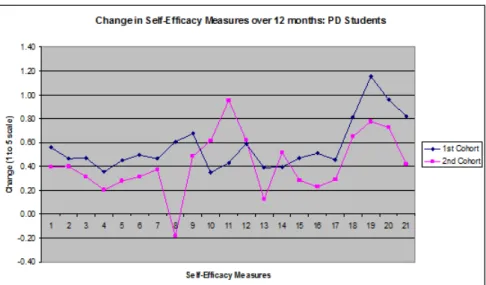
For the 1stand 2nd Cohort of PD Students the greatest improvement with self-efficacy were measures #18, #19 and #20 which relate to career, networking skills and the job interview process. This result suggests that the workshops which are geared towards recruitment in PD#2 are having a significant positive effect on student self-efficacy with this process. At the other end of the spectrum, consistently the smallest growth in self-efficacy relates to measures #4 (obtaining outcomes that are important to the individual) and #13 (listen effect-ively to gain information) – although these measures are still positive over the 12 month period.
Indeed for all measures of self-efficacy both the Cohorts of PD Students have positive growth, with the exception of measure #8 for the 2nd Cohort (complete most tasks very well compared to other people). This negative movement may relate to a degree of over confidence by these students or that they underestimated the academic quality of their colleagues at the beginning of their degree. The change in self-efficacy for the PD Students is illustrated in Figure 1.
Figure 1: Change in Self-Efficacy: PD Students
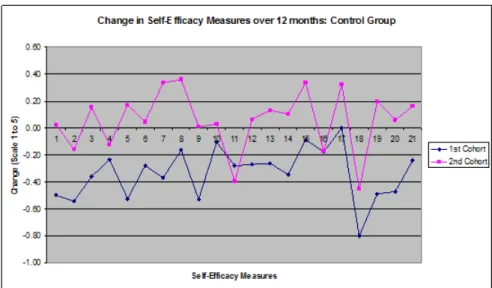
The change in self-efficacy for the Control Group is illustrated in Figure 2. Measures #15 (function well at work even when faced with personal difficulties) and #17 (invent new ways of doing things) produced the greatest positive growth in self-efficacy for the 2ndCohort and the lowest negative growth for the 1stCohort. Consistently the greatest negative change in self-efficacy for the Control Group is measure #18 (begin a career in the Degree that you are studying) which contrasts dramatically with the PD Students. This result is of particular importance to the second transitional issue identified in this paper – from university to the workplace. Whilst students may possess the necessary technical and generic skills, a lack of self-efficacy in commencing their career may affect their ability to apply those skills in executing tasks.
For the 1stCohort of the Control Group there was negative movement for all measures, except measure #17 (invent new ways of doing things) which had a zero change over the 12 month period. While the 2ndCohort did not experience the same negative impact on self-efficacy, there was still negative movement in five of the measures. Indeed both cohorts for the Control Group suffered declines in measures: #2 (achieve most career goals that you have been able to set for yourself), #4 (obtain outcomes that are important to you), #11 (know how things ‘really work’ inside an organisation), #16 (manage conflict among group mem-bers), and #18 (begin a career in the Degree that you are studying). It is evident that most of these negative measures relate to future employment – and may demonstrate how tradi-tional university studies do not sufficiently meet or give students the confidence for their upcoming careers.
Figure 2: Change in Self-Efficacy: Control Group
When the ‘change’ is expressed as a percentage, for the 1stCohort of PD Students they ex-perienced greater than 5% change in all measures (and indeed ten measures had greater than 10% change). For the 2ndCohort of PD Students they had equal to or greater than 5% change in 18 of the 21 measures (with 8 measures having 10% or greater change). This data is presented in Figure 3. This, it is argued, demonstrates a consistent positive experience of students who participate in the PDP.
Figure 4 demonstrates the percentage change for the Control Group. With the 1stCohort, none of the measures had a 5% or greater improvement. Indeed, six of the measures had -10% or greater decrease over their first 12 months. For the 2ndCohort, only four of the measures had greater than 5% growth, with none experiencing 10% or greater growth in the first 12 months of study.
Figure 4: Change in Self-Efficacy as %: Control Group
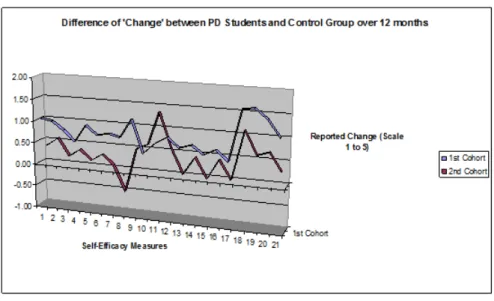
Figure 5 outlines the difference in change in self-efficacy involving the PD and Control Groups. The ‘difference in change’ is the ‘change’ experienced by the PD Students (Figure 1) less the ‘change’ experienced by the Control Group (Figure 2) for the 1stand 2ndCohorts. Even though there is some variation in experience between the two cohorts, in all measures of self-efficacy, except #8 (complete most tasks very well compared to other people), the PD Students have had a greater positive change over their first 12 months at university compared to the Control Group.
Figure 5: Difference in 'Change': PD Students & Control Group
To provide further evidence in support of the impact of the integrated WIL activities we offer quotes are drawn from the PD Students’ e-portfolios which are designed to engage them in a reflective learning process.3
A key message in the student e-portfolios was the impact of gaining an insight into the profession and how Modelling influenced their self-efficacy:
“At the start of the year I did not see perceive myself as a professional, this is because I did not know how a professional accountant looks or acts. Through my participation in the Professional development program I have met many different accountants and financial planners, this has allowed me to see how an accountant looks, behaves etc. It has also allowed me to compare the already professional accountants to myself so that I could see how pro-fessional I have been. In doing so I was able to start acting more like a propro-fessional accountant (or at least I think I was), this has improved my perception of myself as a professional. Al-though I do not believe that I am yet a professional I do believe that I am on the right track on becoming one and that my continuing participation in the professional development program will help me in one day becoming a professional.” (male).
The following quotes demonstrate the benefits students obtained through Mastery experi-ences in the PDP:
“Looking back to the first day of the first professional development week, I felt like a little kid playing dress ups. I did not clearly understand what being a professional was all about, however I was soon to find out. Throughout the next couple of days many industry repres-entatives spoke to us on the fundamentals of being a professional. We not only learnt how to present ourselves as a professional but how to produce documents in a professional manner. An example of this is seen as we constructed our own professional resumes. We had been taught the theoretical and now it was time for the practical. There were many opportunities
3
for us as students to network with industry representatives over the past year. Boosting our confidence as professionals and getting our foot in the door. I can now say at the end of the year I clearly understand what being a professional entails.” (Female).
Limitations and Future Research
The findings of this study should be viewed in light of several limitations including the preliminary nature of the evidence, its case study nature in terms of its external validity, and the short-time frame of the analysis. Further, the study involves ‘self reporting’ of self-efficacy and it may be that students over/underestimate themselves and that it is not until they enter the workplace they have a more accurate ascertainment of their self-efficacy.
Also the use of WIL may be more powerful for students in the business discipline as stu-dents enrolling in professional disciplines place a greater importance on ‘job prospects’ and ‘training for a specific job’ as the reason for enrolling at university (James et al., 2010, p 17-18). Consequently, the influence of WIL may not be as strong for non-professional dis-ciplines.
Additional research opportunities include examining the feasibility, through a cost-benefit analysis, and impact of the PDP on other professional disciplines at university (such as law).
Conclusion
Undertaking university study can present many challenges for students, whether it is because they are the first generation in their family to attend, work commitments and/or family commitments. However, it is argued that an important element in overcoming these challenges is one’s sense of self belief/self-efficacy. The PDP, a continuous orientation program with WIL characteristics, provides students with an opportunity to develop their self-efficacy through mastery, modelling, social persuasion and physiological awareness. This paper has demonstrated that students’ participation in the PDP has improved their self-efficacy, with the strongest growth in measures which relate to students’ transition from the classroom to the workplace, namely confidence in: beginning an accounting or financial planning career; networking with industry members; and job interviews. With such improved self-efficacy, students are better equipped to deal with the challenges of university study, as well as starting their subsequent careers. From a higher education perspective, the importance of ‘self’ when developing curriculum to equip students with technical and generic skills should not be un-derestimated.
Acknowledgements
The authors thank the many industry sponsors and participants of the PDP 2008 and 2009, and the tremendous efforts of Jo McConnell and Jennifer Wainwright. We also acknowledge the funding provided by the Griffith University Teaching and Learning Grants and the Griffith Business School Learning and Teaching Dean’s office in support of this project.
References
Atchison, M., Pollock, S., Reeders, E., & Rizzetti, J. (2002). Work integrated learning paper. Melbourne: RMIT University.
Bandura, A. (1977). Self-efficacy: Toward a unifying theory of behavioral change,Psychological Re-view, 84(2), 191-215.
Bandura, A. (1982). Self-efficacy mechanism in human agency,American Psychologist, 37(2), 122-147.
Bandura, A. (1997). Self Efficacy: The Exercise of Control. New York, NY: WH Freeman. Bosscher, R.J., & Smit J.H. (1998). Confirmatory factor analysis of the general self-efficacy scale,
Behaviour Research & Therapy, 36(3), 339.
Chen, G., & Gully, S.M. (1997,). Specific self-efficacy, general self-efficacy, and self-esteem: Are they distinguishable constructs? Paper presented at the 57th annual meeting of the Academy of Management. Boston.
Chowdhury, S., Endres, M., & Lanis, T.W. (2002). Preparing students for success in team work envir-onments: the importance of building confidence,Journal of Managerial Issues, 14(3), 346. Christensen, T.E., Fogarty, T.J., & Wallace, W.A. (2002). The Association between the Directional
Accuracy of Self-Efficacy and Accounting Course Performance,Issues in Accounting Edu-cation, 17(1), 1.
Coll, R.K., Lay, M., & Zegwaard, K. (2001). The influence of cooperative education on student self-efficacy towards practical science skills,Journal of Cooperative Education, 36(2), 58. Collins, J.L. (1982, March). Self-efficacy and ability in achievement behavior. Paper presented at the
annual meeting of the American Educational Research Association, New York City. Day, J., Kelly, M.J., Parker, D., & Parr, M.F. (1982). The role of industrial training in business studies
sandwich degrees,Business Education, Summer, 105-122.
Freudenberg, B., Brimble, M., Vyvyan, V., & Corby, D. (2008). “A Penny for Your Thoughts”: Can participation in a Student-Industry conference improve students’ presentation self-efficacy and more?The International Journal of Learning, 15 (5), 188-200.
Gist, M.E., & Mitchell, T.R. (1992). Self-efficacy: A theoretical analysis of its determinants and mal-leability,Academy of Management Review, 17, 183.
Harvey, L. (1999, August). New realties: The relationship between higher education and employment. Keynote presentation at the European Association of Institutional Research Forum, Lund, Sweden. Retrieved 15 May 2009 from http://www.shu.ac.uk/research/cre/publica-tions/eair99.pdf
Harvey, L., Moon, S., & Geall, V. (1997). Graduates’ work: Organisational change and students’ at-tributes. Centre for Research into Quality. Retrieved August 1st, 2006, from http:// www.uce.ac.uk/crq/publications/gw/gwcon.html
Hughes, K.L., & Moore, D.T. (1999). Pedagogical strategies for work-based learning. New York: Columbia Teachers College, IEE Working Paper No. 12.
James, R., Krause, K-L., & Jennings, C. (2010). The First Year Experience in Australian Universities: Findings from 1994 to 2009. Melbourne: The University of Melbourne & Griffith University. Keef, S., & Roush, M. (1997). New Zealand evidence on the performance of accounting students:
Race, gender and self-concept,Issues in Accounting Education, 12 (Fall): 315-330. Kirk, A.K., & Brown, D.F. (2003). Latent constructs of proximal and distal motivation predicting
performance under maximum test conditions,Journal of Applied Psychology, 88(1), 40. Knight, P. (2007). Fostering and assessing “wicked” competences. Retrieved 15 May 2009, from
ht-tp://www.open.ac.uk/cetl-workspace/cetlcontent/documents/460d1d1481d0f.pdf
Lent, R.W., Brown, S.D., Talleyrand, R., McPartland, E.B., Davis, T., Chopra, S.B., Alexander, M.S., Suthakaran, V., & Chai, C.M. (2002). Career Choice Barriers, Supports, and Coping Strategies: College Students’ Experiences,Journal of Vocational Behaviour, 60, 61-72.
Lent, R.W. & Hackett, G. (1987). Career Self-Efficacy: Empirical Status and Future Directions,
Journal of Vocational Behavior, 30, 347-382.
McKenzie, K., & Schweitzer, R. (2001). Who succeeds at university? Factors predicting academic performance in first year Australian university students,Higher Education Research & De-velopment, 20(1), 21-33.
Pajares, F. (1994). Inviting self-efficacy: The role of invitations in the development of confidence and competence in writing,Journal of Invitational Theory and Practice, 3(1):5-11.
Quinn, P. (1999) Self-Efficacy: A mediating role in agricultural study,Education in Rural Australia, 9(2), 27-41.
Sherer, M., Maddux, J.E., Mercandante, B., Prentice-Dunn, S., Jacobs, B., & Rogers, R.W. (1982). The selfefficacy scale: Construction and validation,Psychological Reports, 51, 663. Subramaniam, N., & Freudenberg, B. (2007). Preparing accounting students for success in the
profes-sional environment: enhancing self-efficacy through a work integrated learning program,
Asia-Pacific Journal of Cooperative Education, 8(1), 77-92.
Tucker, M.L., & McCarthy, A.M. (2001). Presentation self-efficacy: Increasing communication skills through service-learning,Journal of Managerial Issues, 13 (2), 227.
Wang, A.Y., & Richarde, R.S. (1988). Global versus task specific measures of self-efficacy,The Psy-chological Record. 38(4), 533-541.
Wood, R., & Bandura, A. (1989). Social cognitive theory of organizational management,Academy of Management Review, 14(3), 361.
Zimmerman, B.J., Bandura, A., & Martinez-Pons, M. (1992). Self-motivation for academic attainment: The role of self-efficacy beliefs and personal goal setting,American Educational Research Journal, 29(3): 663-676.
About the Authors
Dr. Brett Freudenberg
Brett Freudenberg is a currently a Senior Lecturer at the Griffith Business School within the Department of Accounting, Finance and Economics at Griffith University (Australia). In addition to his taxation teaching, Brett was recently awared his PhD for his dissertation fo-cusing on Tax Transparent Companies. In 2006 Brett received the Fulbright Award, which saw him conduct research at the University of Illinois to analyse the proliferation of new business forms in the United States and their potential for application to Australian businesses. Brett has received a number of teaching accolades, including as part of the team who received the award for Best Higher Education and Training Collaboration by the Business/Higher Education Round Table (B-HERT). Also in 2008 Brett received a teaching citation from the Australian Learning & Teaching Council for his outstanding contributions to student learning. In 2007, he was part of a team that was awarded Griffith University’s “Excellence in Teaching for Programs that Enhance Learning Category”; and individually Brett received a “Certification of Commendation for Excellence in Teaching”. Previously, in 2005 he was jointly awarded a Griffith Business School Teaching Citation and in 2003 Brett received the Early Career Award for Teaching Excellence from Griffith University. He has pursued the scholarship of learning and has presented his research at number of teaching conferences, as well as publishing in refereed teaching journals. Prior to commencing with Griffith Uni-versity, Brett was a senior taxation consultant with KPMG and a solicitor with Corrs Chambers Westgarth.
Craig Cameron
Griffith University, Australia Assoc. Prof. Mark Brimble Griffith University, Australia
Bill Cope, University of Illinois, Urbana-Champaign, USA.
EDITORIALADVISORYBOARD
Michael Apple, University of Wisconsin, Madison, USA. David Barton, Lancaster University, Milton Keynes, UK. Mario Bello, University of Science, Cuba.
Manuela du Bois-Reymond, Universiteit Leiden, Leiden, The Netherlands. Robert Devillar, Kennesaw State University, Kennesaw, USA.
Daniel Madrid Fernandez, University of Granada, Spain. Ruth Finnegan, Open University, Milton Keynes, UK. James Paul Gee, University of Wisconsin, Madison, USA. Juana M. Sancho Gil, University of Barcelona, Barcelona, Spain. Kris Gutierrez, University of California, Los Angeles, USA.
Anne Hickling-Hudson, Queensland University of Technology, Kelvin Grove, Australia. Roz Ivanic, Lancaster University, Lancaster, UK.
Paul James, RMIT University, Melbourne, Australia.
Carey Jewitt, Institute of Education, University of London, London, UK. Andeas Kazamias, University of Wisconsin, Madison, USA.
Peter Kell, University of Wollongong, Wollongong, Australia. Michele Knobel, Montclair State University, Montclair, USA.
Gunther Kress, Institute of Education, University of London, London, UK. Colin Lankshear, James Cook University, Cairns, Australia.
Kimberly Lawless, University of Illinois, Chicago, USA. Sarah Michaels, Clark University, Worcester, USA.
Jeffrey Mok, Miyazaki International College, Miyazaki, Japan.
Denise Newfield, University of Witwatersrand, Johannesburg, South Africa. Ernest O’Neil, Ministry of Education, Sana’a, Yemen.
José-Luis Ortega, University of Granada, Granada, Spain.
Francisco Fernandez Palomares, University of Granada, Granada, Spain. Ambigapathy Pandian, Universiti Sains Malaysia, Penang, Malaysia. Miguel A. Pereyra, University of Granada, Granada, Spain.
Scott Poynting, Manchester Metropolitan University, Manchester, UK. Angela Samuels, Montego Bay Community College, Montego Bay, Jamaica. Michel Singh, University of Western Sydney, Sydney, Australia.
Helen Smith, RMIT University, Melbourne, Australia. Richard Sohmer, Clark University, Worcester, USA. Brian Street, University of London, London, UK.
Giorgos Tsiakalos, Aristotle University of Thessaloniki, Thessaloniki, Greece. Salim Vally, University of Witwatersrand, Johannesburg, South Africa.
Gella Varnava-Skoura, National and Kapodistrian University of Athens, Athens, Greece. Cecile Walden, Sam Sharpe Teachers College, Montego Bay, Jamaica.
Nicola Yelland, Victoria University, Melbourne, Australia. Wang Yingjie, Beijing Normal University, Beijing, China. Zhou Zuoyu, Beijing Normal University, Beijing, China.
www.Arts-Journal.com www.Book-Journal.com www.Climate-Journal.com www.ConstructedEnvironment.com www.Design-Journal.com www.Diversity-Journal.com www.GlobalStudiesJournal.com www.Humanities-Journal.com www.OnTheImage.com www.Learning-Journal.com www.Management-Journal.com www.Museum-Journal.com www.ReligionInSociety.com www.Science-Society.com http://www.SocialSciences-Journal.com www.SpacesAndFlows.com www.SportAndSociety.com www.Sustainability-Journal.com www.Technology-Journal.com www.ULJournal.com www.Universities-Journal.com
FOR SUBSCRIPTION INFORMATION, PLEASE CONTACT