FINGERPRINT RECOGNITION: A HISTOGRAM
ANALYSIS BASED FUZZY C-MEANS MULTILEVEL
STRUCTURAL APPROACH
Mohamed Ahmed Wahby Shalaby
A Thesis
in
The Department
of
Electrical and Computer Engineering
Presented in Partial Fulfillment of the Requirements
for the Degree of Doctor of Philosophy at
Concordia University
Montreal, Quebec, Canada
March 2012
CONCORDIA UNIVERSITY SCHOOL OF GRADUATE STUDIES
This is to certify that the thesis prepared
By: Mohamed Ahmed Wahby Shalaby
Entitled: Fingerprint Recognition: A Histogram Analysis Based Fuzzy
C-Means Multilevel Structural Approach
and submitted in partial fulfillment of the requirements for the degree of
DOCTOR OF PHILOSOPHY (Electrical & Computer Engineering)
complies with the regulations of the University and meets the accepted standards with respect to originality and quality.
Signed by the final examining committee:
Chair Dr. M. Elektorowicz External Examiner Dr. D. Zhang External to Program Dr. R. Ganesan Examiner Dr. W.E. Lynch Examiner Dr. M.N.S. Swamy Examiner Dr. W-P. Zhu Supervisor Dr. M.O. Ahmad
Approved by Chair of Department or Graduate Program Director Dr. J.X. Zhang, Graduate Program Director
April 20, 2012
ABSTRACT
Fingerprint Recognition: A Histogram Analysis Based Fuzzy
C-Means Multilevel Structural Approach
Mohamed Ahmed Wahby Shalaby, Ph.D. Concordia University, 2012.
In order to fight identity fraud, the use of a reliable personal identifier has become a necessity. Fingerprints are considered one of the best biometric measurements and are used as a universal personal identifier. There are two main phases in the recognition of personal identity using fingerprints: 1) extraction of suitable features of fingerprints, and 2) fingerprint matching making use of the extracted features to find the correspondence and similarity between the fingerprint images. Use of global features in minutia-based fingerprint recognition schemes enhances their recognition capability but at the expense of a substantially increased complexity. The recognition accuracies of most of the fingerprint recognition schemes, which rely on some sort of crisp clustering of the fingerprint features, are adversely affected due to the problems associated with the behavioral and anatomical characteristics of the fingerprints. The objective of this research is to develop efficient and cost-effective techniques for fingerprint recognition, that can meet the challenges arising from using both the local and global features of the fingerprints as well as effectively deal with the problems resulting from the crisp clustering of the fingerprint features. To this end, the structural information of local and
matching in a multilevel hierarchical framework. The problems associated with the crisp clustering of the fingerprint features are addressed by incorporating the ideas of fuzzy logic in developing the various stages of the proposed fingerprint recognition scheme.
In the first part of this thesis, a novel low-complexity multilevel structural scheme for fingerprint recognition (MSFR) is proposed by first decomposing fingerprint images into regions based on crisp partitioning of some global features of the fingerprints. Then, multilevel feature vectors representing the structural information of the fingerprints are formulated by employing both the global and local features, and a fast multilevel matching algorithm using this representation is devised.
Inspired by the ability of fuzzy-based clustering techniques in dealing more effectively with the natural patterns, in the second part of the thesis, a new fuzzy based clustering technique that can deal with the partitioning problem of the fingerprint having the behavioral and anatomical characteristics is proposed and then used to develop a fuzzy based multilevel structural fingerprint recognition scheme. First, a histogram analysis fuzzy c-means (HA-FCM) clustering technique is devised for the partitioning of the fingerprints. The parameters of this partitioning technique, i.e., the number of clusters and the set of initial cluster centers, are determined in an automated manner by employing the histogram of the fingerprint orientation field. The development of the HA-FCM partitioning scheme is further pursued to devise an enhanced HA-HA-FCM (EAH-FCM) algorithm. In this algorithm, the smoothness of the fingerprint partitioning is improved through a regularization of the fingerprint orientation field, and the computational complexity is reduced by decreasing the number of operations and by increasing the convergence rate of the underlying iterative process of the HA-FCM
technique. Finally, a new fuzzy based fingerprint recognition scheme (FMSFR), based on the EHA-FCM partitioning scheme and the basic ideas used in the development of the MSFR scheme, is proposed.
Extensive experiments are conducted throughout this thesis using a number of challenging benchmark databases. These databases are selected from the FVC2002, FVC2004 and FVC2006 competitions containing a wide variety of challenges for fingerprint recognition. Simulation results demonstrate not only the effectiveness of the proposed techniques and schemes but also their superiority over some of the state-of-the-art techniques, in terms of the recognition accuracy and the computational complexity.
ACKNOWLEDGEMENTS
It is my pleasure to express my deep gratitude and thanks to my thesis supervisor Professor M.O. Ahmad for his continuous guidance and support throughout the course of this research. His valuable suggestions and positive responses have been very useful, and were among the major reasons that enabled me to pursue my research. I consider my experience with him, as my supervisor, a very rich one, from which I have learned a lot, and I would like to thank him especially for that.
Special thanks to my dear parents, who are the first inspiration for me in the field of research work. I am grateful for what they taught me about hard work and perseverance which are particularly essential in conducting research. I am grateful for their continuous support and prayers for me, which eased a lot of the hardships that faced. I would like to dedicate this thesis to the soul of my dear father who passed away months before finishing this work.
Special thanks are due to my dear wife and my dear kids for their patience and encouragement. I am also grateful for their continuous support and prayers for me. Actually, without their unlimited support I would not be able to pursue my work. Dear wife, there are no enough words to describe my appreciation for you.
I would like also to thank all my other family members, my friends and my colleagues who supported me and were always available in times of need.
I would like to thank the Egyptian government for their partial financial support of this research.
TABLE OF CONTENTS
TABLE OF CONTENTS ...vii
LIST OF FIGURES ... xi
LIST OF TABLES ... xvi
LIST OF SYMBOLS ...xviii
LIST OF ABBRIVIATIONS ... xxi
CHAPTER 1: Introduction ... 1
1.1 Fingerprint Based Biometric Systems...1
1.2 Challenges in Fingerprint Recognition ...4
1.3 Existing Schemes of Fingerprint Recognition: A Literature Review ...7
1.3.1 Techniques based on the local and global features of minutiae ...8
1.3.2 Minutiae features combined with global fingerprint features ... 10
1.4 Research Objectives and Approach ... 14
1.5 Organization of the Thesis ... 15
CHAPTER 2: Background Material ... 17
2.1 Introduction ... 17
2.2 Automated Fingerprint Verification/Identification Systems ... 17
2.3 Fingerprint Representation and Matching ... 21
2.3.1 Fingerprint representation ... 21
2.3.2 Fingerprint matching ... 27
2.6 A Fuzzy-based Clustering Technique ... 32
2.6.1 Standard FCM algorithm ... 33
2.6.2 An illustrative numerical example ... 35
2.7 Summary ... 38
CHAPTER 3: Fingerprint Decomposition ... 40
3.1 Introduction ... 40
3.2 The Global Features of the Fingerprint: A Comparative Study ... 41
3.3 Fingerprint Image Partitioning Schemes ... 45
3.3.1 Partitioning schemes based on the singular points ... 45
3.3.2 Partitioning schemes based on the orientation field ... 48
3.4 The Proposed Fingerprint Decomposition Algorithm ... 49
3.5 Summary ... 56
CHAPTER 4: A Multilevel Fingerprint Representation and Matching... 58
4.1 Introduction ... 58
4.2 Multilevel Fingerprint Representation ... 58
4.2.1 Formulation of multilevel feature vectors ... 59
4.2.2 Core detection using FV2 ... 64
4.3 Multilevel Matching ... 65
4.4 Experimental Results and Comparisons... 73
4.4.1 Databases ... 74
4.4.2 Parameters Selection and Performance ... 76
4.4.3 Comparisons with Previous Works ... 78
CHAPTER 5: A Histogram Analysis Fuzzy C-Means Based Technique for Fingerprint Partitioning and its Application for Singular Point
Detection ... 87
5.1 Introduction ... 87
5.2 HA-FCM Based Technique for Fingerprint Image Partitioning ... 89
5.2.1 Standard FCM algorithm ... 90
5.2.2 The proposed scheme for determining the number of clusters and their initial centers for fingerprint partitioning ... 93
5.2.3 The proposed HA-FCM fingerprint partitioning scheme ... 102
5.3 Singular Point Detection Based on the HA-FCM Fingerprint Partitioning Scheme ... 111
5.3.1. Cluster distributions for fingerprint ridge structures ... 113
5.3.2. The proposed HA-FCM-based scheme for singular points detection ... 115
5.3.3 Experimental results and comparisons ... 120
5.3 Summary ... 127
CHAPTER 6: An Enhanced HA-FCM Partitioning Scheme... 130
6.1 Introduction ... 130
6.2 An Enhanced HA-FCM Technique for Fingerprint Image Partitioning ... 130
6.2.1 Regularization of the orientation field... 131
6.2.2 Reduction of the computational complexity ... 136
6.2.3 EHA-FCM fingerprint partitioning algorithm ... 141
6.3 Experimental Results and Comparisons... 143
CHAPTER 7: A Multilevel Structural Fingerprint Recognition Based on the
EHA-FCM Partitioning Scheme ... 151
7.1 Introduction ... 151
7.2 EHA-FCM Based Fingerprint Decomposition Algorithm ... 152
7.3 Fuzzy-based Multilevel Fingerprint Representation ... 155
7.4 Fuzzy-based Multilevel Matching ... 161
7.5 Experimental Results and Comparisons... 169
7.5.1 Selection of parameters ... 169
7.5.3 Performance results and comparisons ... 171
7.6 Summary ... 177
CHAPTER 8: Conclusion ... 179
8.1 Concluding Remarks ... 179
8.2 Scope for Future Work ... 184
List of Figures
Figure 1.1: Examples of the biometrics (a) anatomical (fingerprint and palmprint) and (b) behavioral biometrics (signature and voice) [1, 2] ... 2 Figure 1.2: Six images represent the same fingerprint with different qualities, rotation
angels and portions of this fingerprint ... 6 Figure 2.1: General architecture for the main parts of the fingerprint recognition
system (a) Enrollment operation, (b) Verification operation, and (c) Identification operation ... 20 Figure 2.2: Fingerprint image shows the different global features ... 23 Figure 2.3: Fingerprint patterns as they appear at a coarse level: (a) tented arch, (b)
arch, (c) right loop, (d) left loop, and (e) whorl ... 23 Figure 2.4: Fingerprint and its orientation image ... 25 Figure 2.5: Fingerprint and its frequency image [37] ... 25 Figure 2.6: Fingerprint and its curvature map and the orientation image [18, 38] ... 26 Figure 2.7: Minutiae types: Ridge endings and ridge bifurcations ... 27 Figure 2.8: FMR and FNMR, for a given threshold t, are displayed over the genuine
and impostor score distributions [1] ... 30 Figure 3.1: Two fingerprint images taken for the same finger (a, b) with their
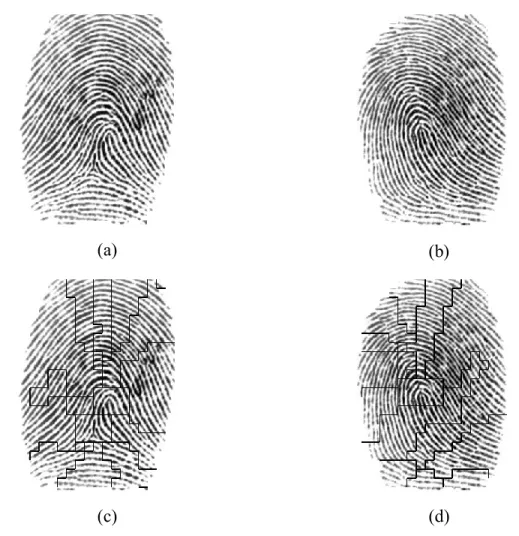
orientation fields (b, c) and their ridge density maps (e, f) ... 43 Figure 3.2: Flow diagram of the multi-channel approach to fingerprint classification
[13] ... 47 Figure 3.3: A fingerprint image tessellated around the core point into a predefined
Figure 3.4: An example of two fingerprint images taken from the same finger (a, b), and the resulting decomposed images (b, c) ... 55 Figure 3.6: An example of two fingerprint images taken from different fingers (a, b),
and the resulting decomposed images (b, c) ... 56 Figure 4.1: Coordinates system defined based on Core... 61 Figure 4.2: Two examples of fingerprint images (a) Core with undesirable noise. (b)
Incomplete core located at the image borders ... 65 Figure 4.3: ROC curves for FVC2002 DB1 obtained by using the proposed MSFR
scheme, the Tico et al.scheme [17] and Qi et al.scheme [18] ... 79 Figure 4.4: ROC curves for FVC2002 (a) DB3 and (b) DB4 obtained with the
proposed MSFR scheme and Gu et al.scheme [27]... 80 Figure 4.5: ROC curves for FVC2004 DB1 obtained with the proposed MSFR scheme
and Shi et al.scheme [28]. ... 82 Figure 5.1: Different examples of fingerprint images with the histograms of their OF ... 95 Figure 5.2: (a) the original fingerprint image, (b) the orientation image, (c) the FCOI
obtained by the FCM using 8 clusters, and (d) the FCOI obtained by the proposed HA-FCM, by which the number of clusters are found to be only 6. It is clear that the proposed HA-FCM provides smoother partitions .. ... 108 Figure 5.3: (a) A set of three fingerprint images. (b) The orientation images. (c) Images partitioned using the quantization. (d) Images partitioned using the proposed HA-FCM. ... 109
Figure 5.4: (a) Another set of three fingerprint images. (b) The orientation images. (c) Images partitioned using the quantization. (d) Images partitioned using the proposed HA-FCM. ... 110 Figure 5.5: The different possible types of singular points: (a) upper core, (b) lower core, (c) whorl, (d) twin loops, (e) delta, and (f) arch ... 111 Figure 5.6: Typical ridge flows and the corresponding cluster distribution around the different types of singular points: (a) upper core, (b) lower core, and (c) delta ... 114 Figure 5.7: The ridge flows and the corresponding cluster distribution around: (a) a plain region, (b) a plain region with ridge deformation, (c) a plain region with noise, and (d) a plain region with ridge cut ... 115 Figure 5.8: (a) An example of a fingerprint image contains upper core (), lower core () and right delta (+). (b) The corresponding FCOI with the candidate blocks corresponding to the upper core (i.e. the vertical rectangle), the lower core (i.e. two small squares) and the delta (i.e. the big square) .... 117 Figure 5.9: (a) An example of two upper () and two lower () cores obtained by stage 1, and their calculated orientations indicated by the bright lines. (b) An example of two upper () cores obtained by stage 1, and their calculated orientations indicated by the dark lines. (c) Correctly detected upper and lower cores in the fingerprint of (a) by stage 2. (d) Correctly detected an upper core in the fingerprint of (b) by stage 2 ... 119 Figure 5.10: (a) An example of a spurious lower core and a left delta detected by stage 1 due to the effect of blurring. (b) Removal of the spurious singular points
in (a) by stage 2. (c) An example of a spurious right delta detected by stage 1 due to the effect of ridge cuts. (d) Removal of the spurious right delta in (c) by stage 2 ... 119 Figure 5.11: Performance measures of singular point detection using the proposed scheme and the technique of Park et al [39] on FVC2002 Db1. (a) Recall, (b) Precision and (c) F-measure ... 123 Figure 5.12: Performance measures of singular point detection using the proposed scheme and the techniques of Park et al [39] and Jirachaweng et al [40] on FVC2004 Db1. (a) Recall, (b) Precision and (c) F-measure ... 124 Figure 5.13: Performance measures of singular point detection using the proposed scheme and the technique of Park et al [39] on FVC2006 Db1. (a) Recall, (b) Precision and (c) F-measure ... 125 Figure 6.1: (a) A set of three fingerprint images. (b) Their orientation images. (c) Images partitioned using the HA-FCM. (d) Images partitioned using the RHA-FCM ... 134 Figure 6.2: (a) Another set of three fingerprint images. (b) Their orientation images. (c) Images partitioned using the HA-FCM. (d) Images partitioned using the RHA-FCM ... 135 Figure 6.3: The gradient of the objective function J versus the number of iterations: (a) n10, (b) n100 and (c) n1000 based on Monte Carlo simulation ... 140 Figure 6.4: (a) A set of three fingerprint images. (b) Images partitioned using the RDRHA-FCM. (c) Images partitioned using the EHA-FCM ... 147
Figure 6.5: (a) Another set of three fingerprint images. (b) Images partitioned using the RDRHA-FCM. (c) Images partitioned using the EHA-FCM ... 148 Figure 7.1: Coordinates system defined based on Core... 158 Figure 7.2: ROC curves obtained by using the FMSFR and MSFR techniques for the database FVC2002 DB1 ... 172 Figure 7.3: ROC curves obtained by using the FMSFR and MSFR techniques for the database FVC2002 DB3 ... 173 Figure 7.4: ROC curves obtained by using the FMSFR and MSFR techniques for the database FVC2002 DB4 ... 173 Figure 7.5: ROC curves obtained by using the FMSFR and MSFR techniques for the database FVC2004 DB1 ... 174 Figure 7.6: ROC curves obtained by using the FMSFR and MSFR techniques for the database FVC2004 DB2 ... 175 Figure 7.7: ROC curves obtained by using the FMSFR and MSFR techniques for the database FVC2006 DB1 ... 174
List of Tables
Table 2.1: Summary of the benchmark FVC2000 databases [4243] ... 32
Table 2.2: Summary of the benchmark FVC2002 databases [44] ... 32
Table 2.3: Summary of the benchmark FVC2004 databases [41] ... 32
Table 2.4: Summary of the benchmark FVC2006 databases [45, 46] ... 32
Table 2.5: A given set of ages of different persons in the illustrative numerical example. ... 36
Table 2.6: The clustering solution obtained using the quantization technique ... 36
Table 2.7: The clustering solution obtained using the K-means technique ... 37
Table 2.8: The clustering solution obtained using the FCM technique ... 37
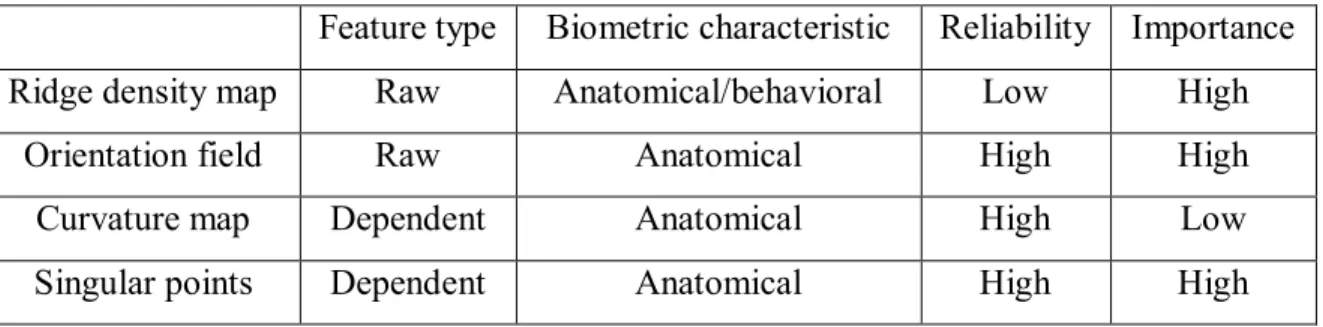
Table 3.1: The attributes of the global features of the fingerprint ... 45
Table 4.1: Summary of the databases selected for experimentation ... 75
Table 4.2: The values of the weights used for the selected databases ... 77
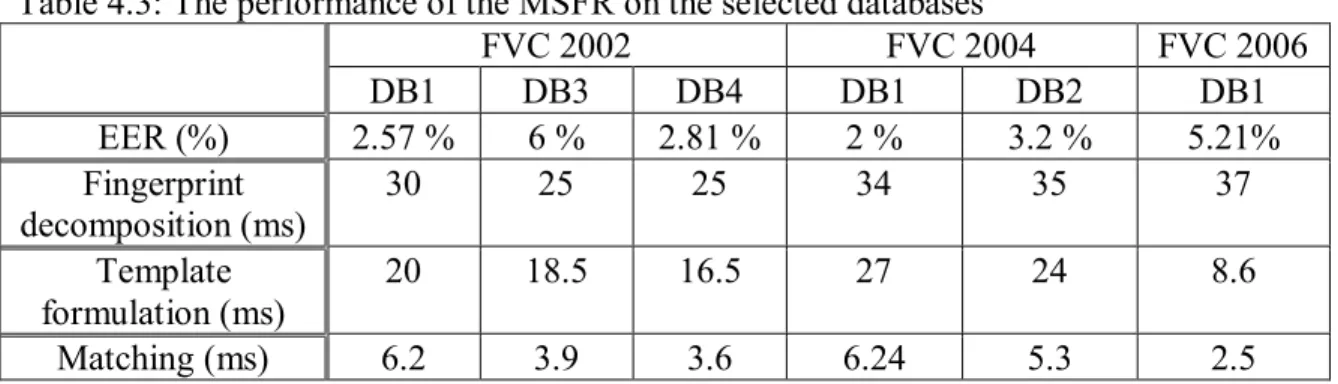
Table 4.3: The performance of the MSFR on the selected databases ... 78
Table 4.4: Comparison with previous works in terms of template size ... 83
Table 4.5: Requirements of the light category for FVC2004 and FVC2006 competitions ... 83
Table 4.6: Comparison with FVC2004 results ... 84
Table 4.7: Comparison with FVC2006 results ... 84
Table 5.1: An illustrative numerical example ... 93
Table 5.2: Comparisons between the HA-FCM and the FCM techniques... 106
Table 5.3: The performance measures of the proposed scheme and the techniques in [39] and [92] using FVC2002 DB1 ... 126
Table 5.4: The performance measures of the proposed scheme and the techniques in [39] and [67] using FVC2004 DB1 ... 126 Table 5.5: The performance measures of the proposed scheme and the technique in [39] using FVC2006 DB1 ... 126 Table 5.6: Accuracy measure of the calculated core orientation ... 127 Table 6.1: Average number of data items belonging to the sets X and X~ ... 138 Table 6.2: Average number of iterations required by the HA-FCM, RHA-FCM, RDRHA-FCM and EHA-FCM techniques using different databases ... 144 Table 6.3: Average processing times (in ms) required by the HA-FCM, RHA-FCM, RDRHA-FCM and EHA-FCM techniques using different databases ... 145 Table 6.4: Average values of the metrics (in percentage) representing the quality of the solution obtained by EHA-FCM techniques over that obtained by RDRHA-FCM for various databases... 146 Table 7.1: The values of the weights used in (7.20) for the selected databases ... 170 Table 7.2: EER (%) of the MSFR and FMSFR techniques... 171 Table 7.3: The number of regions provided and the template sizes (in bytes) required by the FMSFR and MSFR techniques ... 175 Table 7.4: CPU times (ms) for the fingerprint decomposition, template formulation and matching of the MSFR and FMSFR techniques ... 177
List of Symbols
c Number of clusters
c Pre-initial number of clusters
D Set of effective sub-ranges of the orientation values l
d lth effective sub-range
FCOF Set of fuzzy clustered orientation field FMR False match rate
FMFV Fuzzy-based multilevel feature vector FNMR False non-match rate
1
FV First- level feature vector, i.e., global features
2
FV Second-level feature vector, i.e., neighborhood features
3
FV Third-level feature vector, i.e., local features HOF Histogram of orientation field
I Input template for recognition
j
I jth plain region of Ith fingerprint template
MFV Multilevel feature vector i
Minu Minutiae set of ith plain region
n Number of data items (i.e., number of patterns)
O Orientation field matrix q
O Quantized orientation field matrix Set of decomposed regions
i
P
Plain region
Center P_
Geometrical center of a plain region
S
Singular region
S Set of segments of orientation values m
s mth segment of orientation values
T Reference (i.e., stored) fingerprint template of a person
i
T ith plain region of fingerprint template T
U Membership matrix of size nc
ij
u Membership degree for pattern i with respect to cluster j
V Set of cluster centers j
v Center of jth cluster )
0 (
V Initial set of cluster centers
) 0 (
V Pre-initial set of cluster centers
X Pattern vector of size n
i
x ith data item (pattern)
X Regularized data set X~ Reduced data set
i
x Regularized data item
l
x
~ lth distinct orientation value in data set X~ Quantization step
l
n
Adaptive threshold parameter used in the stopping criteria of the iterative EHA-FCM algorithm.
i
Curvature of a ith plain region
l
Number of blocks in an image having orientation value equal to ~ xl
Core
Average orientation of the core region
1
S i
Orientation of ith plain region
ij
Relative orientation of jth plain region with respect to that of given ith plain region
Core P
Perpendicular orientation to Core
R
Dominant direction of the fingerprint ridges contained in the image block
Core
Relative orientation of a region with respect to Core
ij
Relative position of geometrical center of jth plain region with respect to that of given ith plain region
l
Degree of belonging of the lth plain region to its associated cluster
Type and position of a region
r
List of Abbreviations
2D Two dimensional
AFIS Automatic fingerprint identification system AFVS Automatic fingerprint verification system
DORIC Differences of the orientation values along a circle EHA-FCM Enhanced histogram analysis fuzzy c-means
ERR Equal error rate
FAR False acceptance rate
FCM Fuzzy c-means
FCOF Fuzzy clustered orientation field FCOI Fuzzy clustered orientation images FCP Fuzzy-based clustering problems FCR Fingerprint correct rate
FMC Fuzzy-based measure of the correctness
FMFV Fuzzy-based multilevel feature vector FMLM Fuzzy-based multilevel matching
FMR False match rate
FMSFR Fuzzy-based multilevel structural fingerprint recognition
FN False negative
FNMR False non-match rate
FP False positive
FRR False rejection rate
HA Histogram analysis
HA-FCM Histogram analysis fuzzy c-means
ID Identification
MFV Multilevel feature vector
MLM Multilevel matching
MR Magnetic resonance
MSFR Multilevel structural fingerprint recognition
OF Orientation field
OMC Oriented minutia code
PIN Personal identification number
RDRHA-FCM Reduced-data regularized histogram analysis fuzzy c-means RHA-FCM Regularized histogram analysis fuzzy c-means
ROC Receiver operating characteristic SP Singular point
SVM Support vector machine
CHAPTER 1
Introduction
In recent years, the use of personal identification/authentication to fight identity fraud has become one of the most important problems to be solved using automated systems. It is quite important to make the computer to be able to achieve successful answers to the questions “Who is she/he?” or “Does this person have the claimed identity?”. Personal identity could be verified using different methods such as username and password, personal identification number (PIN), personal cards with photos (e.g. medical card and driving license) and biometric (body) measurements such as, face, iris, signature, and fingerprints. The personal identities that do not depend on the body measurements may be stolen or shared. Moreover, it is very unlikely and theoretically impossible that two persons would have the same body measurements.
The biometric measurements have been used for criminal investigations and personal identification for quite some time. Among all the known body measurements, human fingerprints have been found to be one of the most distinctive personal identifiers [1]. This fact shows the importance of using human fingerprints as a universal identifier.
1.1 Fingerprint Based Biometric Systems
A biometric recognition system makes use of the anatomical characteristics, e.g. fingerprints, face, and palmprint of a human being, or the behavioral characteristics, e.g. handwriting, signature, and voice, for manually or automatically recognizing individuals.
These characteristics are called biometric identifiers, or simply biometrics. Figure 1.1 shows a few typical examples of biometrics. In Figure 1.1(a), two examples of anatomical characteristics have been shown, which are a fingerprint and palmprint. In addition, Figure 1.1(b) shows two examples of behavioral characteristics, which are a signature and voice. Some of the biometrics may be considered as a combination of anatomical and behavioral characteristics. For example, even though a fingerprint is considered as an anatomical characteristic in nature, the usage of the input device to capture it (e.g., how a user presents a finger to the fingerprint scanner) depends on the person’s behavior.
(a) (b)
Figure 1.1: Examples of the biometrics (a) anatomical (fingerprint and palmprint) and (b) behavioral biometrics (signature and voice) [1, 2].
In order for a biometric measurement to be chosen as an identifier, it should satisfy the following requirements: universality, distinctiveness, permanence and ease of collectability. A biometric system to be considered as a practical recognition system, there are a number of issues that should be addressed [1]:
Performance; It refers to the achievable recognition accuracy, the response time, and the resource requirements. It is noted that the operational and the environmental factors affect the performance metrics.
Acceptability; It indicates the extent to which individuals are willing to accept a particular biometric identifier in their daily lives.
Circumvention; It refers to the simplicity to deceive the system by fraudulent methods.
The fingerprint, which is a graphical ridge/valley pattern of a human finger, has been found to be the most suitable biometric for the personal identification applications. This has been supported by a comparative study of different human biometric measurements with respect to the above requirements [1]. This study shows that among the various human biometric measures, fingerprint is the one that has a good compromise among all the desirable features:
Universality; The majority of the population has legible fingerprints.
Distinctiveness; It has been found that, each person has his/her own distinctive fingerprint. Even the identical twins can be identified successfully based on their fingerprints; meanwhile some other biometrics such as the face would fail.
Permanence; Fingerprints are formed during the fetal stage and remain structurally unchanged throughout the life of a person.
Collectability; Fingerprint can be collected easily and measured quantitatively. High Performance; The fingerprint recognition systems are able to achieve a
higher accuracy compared to other biometric systems.
Since the fingerprint recognition system can be viewed as a pattern recognition system, the system should be designed to be capable of extracting salient features from fingerprints and matching them in a robust way [1]. Based on the application, a
fingerprint recognition system may be classified as either an automatic fingerprint
verification system (AFVS) or an automatic fingerprint identification system (AFIS). The AFVS conducts a one-to-one comparison to verify the claimed identity, whereas the AFIS conducts one-to-many comparisons to establish the identity of the individual. Fingerprint representation, i.e., the feature extraction and template formulation, and fingerprint matching are considered to be the core modules of an automated fingerprint recognition (verification/identification) system. These two modules are the most expensive parts, in terms of the computational complexity, within the system. Therefore, these two modules need to be designed as simple as possible in order to achieve the required accuracy at a reasonable cost. Based on the information (features) associated with the fingerprint’s ridge/valley pattern of a human finger, a template could be formulated to represent the fingerprint. These features are traditionally categorized as the global features, such as ridge orientations, and the local features, such as minutiae and pores [1, 38]. It has been found that the local features (minutiae) provide highly distinctive information about the fingerprint. Therefore, they have been traditionally used for fingerprint representation and matching [1]. On the other hand, the global features have been used generally for the fingerprint image enhancement at the preprocessing stage [9], for classification (indexing) of fingerprints [1013] and for fingerprint image partitioning [14].
1.2 Challenges in Fingerprint Recognition
Despite decades of a research work in the fingerprint recognition problem, it is still considered as a challenging and important pattern recognition problem to be solved [1].
to depend on the opinion of a human expert, which makes the process rather expensive. Hence, there is still a compelling need to have an efficient and inexpensive automated fingerprint recognition system with acceptable recognition accuracy.
As mentioned earlier, a fingerprint is considered to have a combination of the anatomical and behavioral characteristics of the person in a question. Even though the ridge/valley structure and minutiae distribution are the unique identifier of a person, the extraction of this information, and therefore the recognition/identification becomes challenging, since the fingerprints of the person are affected due to his/her anatomical and behavioral characteristics. Furthermore, the requirements (e.g. the accuracy and the time limit) and the working conditions (e.g. the scanner capability and the storage limit) of the fingerprint applications pose additional challenges. For example, a door lock system should be able to provide a very high accuracy with a short response time, while using a small area scanner with a limited space of the storage.
The challenges in fingerprint recognition could be categorized as follows: 1) Challenges due to behavioral characteristics
a) Incomplete and rotated fingerprint images: This situation arises due to the person’s lack of experience in using fingerprint scanners; or from the fingerprint images received from the crime scenes.
b) Poor quality fingerprint image: The fingerprint images with low quality are mainly due to the capability of the input device, the pressure of the fingertip on the input device or the condition of the skin.
c) Deformation of the fingerprint ridges: The fingerprint images of the same person may have some differences in their ridge thicknesses or shapes, which is
mainly due to different forces by the same person’s finger against the input device.
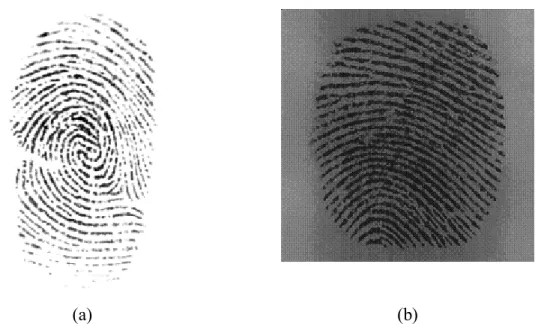
Due to the above mentioned behavioral-based problems, the fingerprint images taken from the same finger may sometimes look quite different, which is known as intra-class variability. Figure 1.2 contains six images represent the same fingerprint with different qualities, rotation angels and portions of this finger. It is seen from this figure that it is very difficult to decide whether all these images represent the same finger or not.
Figure 1.2: Six images represent the same fingerprint with different qualities, rotation angels and portions of this fingerprint.
2) Challenges due to anatomical characteristics
a) Distortion of the fingerprint ridges: Some changes of the fingerprint ridges shapes due to some natural life events, such as cuts and burns.
b) Inter-class similarity: The fingerprints from different fingers may appear naturally quite similar.
3) Challenges due to application requirements
a) Fingerprint template size: Some fingerprint applications, such as door lock, have a limitation on the storage space. Accordingly, it is a challenge to formulate a suitable template to represent the fingerprint image within the determined size. b) Response time: The response time of a fingerprint recognition system consists
mainly of scanning of the image, pre-processing, representation and matching modules. Some recent fingerprint applications to be accepted by the customers, such as banking systems, require a very short response time.
1.3 Existing Schemes of Fingerprint Recognition: A Literature Review
Over the last forty years, the majority of fingerprint recognition schemes have been developed based on the matching of the local features of the extracted minutiae. Despite the highly distinctive feature and storage efficiency of minutiae, it is extremely difficult to extract and represent them accurately. This difficulty which arises mainly due to the anatomical and behavioral-based challenges mentioned in Section 1.2, affects on the overall performance of the fingerprint recognition scheme. In order to overcome the problem of the effect of the inaccurate minutia extraction on the fingerprint recognition accuracy, a number of fingerprint recognition schemes have recently been proposed. These techniques can be classified into two broad categories: 1) the techniques that are based on the local and global features of minutiae, and 2) those that are based on the global structure of the fingerprint ridge pattern and the local minutiae features.1.3.1 Techniques based on the local and global features of minutiae
Originally, the minutiae-based fingerprint recognition schemes used only the local attributes of the minutiae (i.e., position, direction, and type) for fingerprint representation and matching. In view of the above mentioned anatomical and behavioral-based challenges, the use of these local minutiae attributes is not reliable enough. Therefore, the main idea in the first category is in devising a minutia descriptor in which the local minutiae attributes are combined with some global minutiae features. Accordingly, the fingerprint representation based on this descriptor should be more immune than the traditional minutia descriptors against some of the above mentioned challenges. In the following, some of the recently developed schemes based on this idea are reviewed.
a) Willis and Myers [15] investigated the development of a robust algorithm allowing a good recognition of low-quality fingerprints with inexpensive hardware. They proposed a new approach called a wedge ring overlay minutia detector that is particularly robust to imperfections. The main drawbacks for this scheme are: 1) The fingerprint images have to be enhanced prior to the representation. 2) There is a high degree of computational complexity associated with their feature extraction algorithm.
b) Ceguerra and Koprinska [16] proposed a new approach for combining minutia’s local and global features by using the matched local features as the reference axis for generating shape signature as a global feature. The dependence on minutiae to generate a shape signature is the main weakness of the approach.
c) Tico and Kuosmannen [17] proposed a new representation for the fingerprint minutiae, which consisted of the local minutiae attributes and a local orientation-based minutia descriptor. The proposed minutiae descriptor matching fails when two minutiae
are close to each other, since their descriptors in this case would be very similar. In addition, this technique has a high computational complexity especially when the number of minutiae is large.
d) Qi et al. [18] modified the minutia descriptor proposed in [17] by using the curvature map instead of using the orientation field in constructing the minutia descriptor. They have shown that their scheme provides a higher accuracy than that provided by the scheme of [17]. However, this scheme has even higher computational complexity resulting from the curvature map construction.
e) Jea and Venu [19] presented an approach that uses localized secondary features derived from the relative minutiae information. Due to the nature of minutiae distribution inside the fingerprint images, this secondary feature might misinform the matcher.
f) Jia et al. [20] proposed an improved fingerprint matching technique using both the weighting method and the support vector machine (SVM). A new weighting feature based on the distance between minutiae is introduced to supplement the minutiae information. A pre-processing stage of image enhancement to reduce the possibility of detecting the false minutiae is required. Therefore, the proposed technique requires a high computational complexity.
g) Feng [21] has proposed a combination of two different minutiae descriptors. The two descriptors that have been used are a texture-based descriptor and a minutiae-based descriptor, to provide more accurate matching results. In [22] a genetic algorithm for fingerprint matching has been developed based on the modification of these
descriptors. Both the schemes require a high computational complexity for fingerprint representation.
From the above review it is seen that the fingerprint recognition schemes, which are based on the use of a minutia descriptor in which the local minutiae attributes are combined with some global minutiae features, were always able to achieve a higher accuracy than that provided by the traditional only minutiae-based schemes. The main drawback of the algorithms in this category is that since the fingerprint recognition schemes are totally dependent on the extracted minutiae, a false extraction of a minutia (i.e., spurious minutia) may greatly affect the recognition accuracy. Consequently, some of these schemes have used a pre-processing stage of image enhancement to reduce the possibility of detecting the spurious minutiae [15], [17], [18], [20].
1.3.2 Minutiae features combined with global fingerprint features
Researchers in the fingerprint recognition community have recently started paying attention to the use of some distinct characteristics of the fingerprint global features that traditionally belonged only to the domain of fingerprint classification and indexing [2335]. The main reasons for looking for some distinguishing features of the fingerprint other than the minutiae are as follows: 1) A reliable detection of minutiae is difficult in poor-quality fingerprint images, especially without the use of a pre-processing step for image enhancement. 2) The formulation of a robust minutia descriptor is a time-consuming process. 3) The use of additional information gathered from the global features in conjunction with the local minutiae features might increase the recognition accuracy and robustness. Even though the global features of the fingerprint ridge pattern, such as ridge orientation and frequency, ridge shape, and texture information, may be
extracted more reliably than minutiae, their distinctiveness is generally lower than the minutiae attributes. Accordingly in the second category of fingerprint recognition schemes, fingerprint recognition is carried out based on the use of both the local minutiae features and the global features for fingerprint representation and matching. In the following, some of these schemes are reviewed.
a) Jain et al. [23] proposed a filter-based algorithm that uses a bank of Gabor filters to capture both local and global details in a fingerprint as a compact fixed-length FingerCode [13]. This technique is suitable for matching as well as storage on a smartcard. They have shown that the matching performance can be improved by combining the decisions of the matchers based on complementary (minutiae-based and filter-based) fingerprint information. This technique has some limitations, such as, the reference point localization and the recourse to the fingerprint pre-alignment stage. Accordingly, it is not suitable for poor quality and incomplete fingerprint images.
b) Ross et al. [24, 25] have developed a hybrid fingerprint matching scheme that uses both the minutiae and a ridge texture map. First of all a set of local minutiae features are extracted from the fingerprint image. This minutiae feature vector is used for estimating the transformation parameters, which are required to align the ridge feature maps of the two fingerprint images. Therefore, in order to avoid the effect of spurious minutiae, a fingerprint enhancement step is necessary, thus adding to the processing time. Unfortunately, the proposed technique has not been tested using a benchmark database.
c) Krivec et al. [26] proposed a method, which due to its compressibility, can be applied in memory constrained environments. This is important for applications, such as smartcards and independent identification modules, which have recently gained
popularity. The hybrid fingerprint matchers are well known as a powerful tool for high-security applications, where the reliability of a single fingerprint characteristic is not high enough for intended applications. The proposed method uses minutia point matcher as the first stage of matching and after successfully completing this stage, a second stage of matching is carried out based on the homogeneity of the direction map of the reference image. The direction map is compressed using a quad tree. However since, the method depends on the minutiae features as a first stage of matching, so it fails if many false minutiae have been detected.
d) Jinwei et al. [27] have proposed the use of a model-based fingerprint orientation field, as a global feature, in combination with the extracted minutiae set for the matching purpose. For the global feature, two different model-based orientation fields have been used. The first one is suitable when the singular point is detected. The second one, which is a modified model, is more useful in situations when there is a difficulty in detecting the singular points. Unfortunately, the latter one does not perform as well as the former one at the regions around the singular points. In either case, the final matching score is obtained by combining results from the local and global matchers. The results have been presented to show that the use of the two matchers provides higher recognition accuracy. However, the scheme suffers from a high computational complexity, due to the use of model-based orientation field, and the need of performing a pre-alignment step before the matching step.
e) Shi et al. [28] proposed a fingerprint representation, in which the information about the singular point has been combined with its neighborhood minutiae. In this scheme, the computational complexity of the matching has been reduced since the
number of candidate minutiae required for identification has been decreased. This approach assumes the existence of singular points (especially the core point), thus it is not suitable for fingerprint images without a detected core pint.
f) Nanni and Lumini [29] have presented a hybrid wavelet-based fingerprint matcher, with the need to perform an enhancement step before the extraction of minutiae set, and to do a pre-alignment step before applying a 2D wavelet transform on the image’s sub-windows. Since the method depends on an accurate extraction of the minutiae set to perform a pre-alignment step, it would fail in the cases of poor-quality or incomplete fingerprint images.
g) Benhammadi et al. [30], based on the reuse of the FingerCode technique [13], have proposed a new hybrid fingerprint matching technique, which depends on the minutiae texture maps. This method has essentially three drawbacks: (i) This approach consumes more time in the enrolment and matching processes. (ii) Since each minutia has its own oriented minutia code (OMC) feature vector, this requires a large template size compared with the original FingerCode method. (iii) The recognition accuracy of this method is affected by the presence of spurious minutiae.
It is seen from the above review that the idea of combining local feature (minutiae) with the global fingerprint features is a promising methodology and helpful to overcome the problems associated with the minutia-based techniques. Furthermore, it is also seen from this review that the choice of the global feature(s) is crucial and has a significant impact on the overall performance of the fingerprint recognition scheme [2334]. This has also been supported by a comparative study of the impact of combining multiple features on the recognition accuracy [35]. This study has concluded that a larger
improvement can usually be obtained as more features are combined; however, a combination of more than four features results only in a marginal performance improvement [35].
1.4 Research Objectives and Approach
The use of both the local and global features of a fingerprint in a technique of the either category described above for fingerprint recognition is quite useful in solving the problems that arise from the behavioral and anatomical characteristics such as ridge pattern deformation, translation and/or rotation, incomplete fingerprint, etc., of fingerprints. However, there is set of other problems that arise from the basic idea of using both the local and global features of a fingerprint in fingerprint recognition techniques: 1) The usage of fingerprint’s global and local features necessitates a larger template to represent a fingerprint, especially for techniques using complicated minutia descriptor. 2) The extraction and usage of the global features makes the overall computational complexity of the technique high. 3) Most of these techniques require a step of pre-alignment, which depends mainly on the minutiae, prior to carrying out the matching process. Thus, a technique requiring such a pre-alignment suffers from the effect of the spurious minutiae. Further, most of the fingerprint recognition schemes rely on some sort of crisp clustering of the fingerprint features. The recognition accuracies of such schemes are adversely affected for fingerprints with behavioral or anatomical characteristics.
The objective of this research is to develop efficient and cost-effective techniques for fingerprint recognition that can meet not only the challenges arising from using both the local and global features of the fingerprints but also deal effectively with the
problems resulting from the crisp clustering of the features when the fingerprints are marred with the behavioral or anatomical characteristics. To this end, the structural information of local and global features of fingerprints are used for their decomposition, representation and matching in a multilevel hierarchical framework. The problems associated with the crisp clustering of the fingerprint features are also addressed in this thesis by incorporating the ideas of fuzzy logic in developing the various stages of the proposed fingerprint recognition scheme.
1.5 Organization of the Thesis
The thesis is organized as follows.In Chapter 2, the background material necessary for the work undertaken in this thesis is presented. The main parts of the fingerprint recognition systems, the performance metrics, and the benchmark databases used for examining the performance of fingerprint recognition systems are discussed. The fuzzy clustering techniques and their important role in the pattern recognition field are also briefly discussed.
In Chapter 3, the first stage of the proposed multilevel structural approach for fingerprint recognition, i.e., the decomposition of the fingerprint image into regions using the global features, is developed. In this chapter, the traditional crisp techniques for both singular point detection and partitioning of the orientation field are used. The proposed multilevel structural scheme for fingerprint representation and matching is then presented in Chapter 4. A multilevel feature vector is first formulated by employing the structural information of the local and global features of each region with a view of obtaining a fingerprint representation that is less variant to the displacement, rotation and
which the correspondence problem is dealt with by making use of the global features and the similarity problem is taken care by employing both the global and local features, is devised.
In Chapter 5, the idea of fuzzy logic to cluster the fingerprint features is introduced in order to overcome the limitation of crisp clustering in effectively dealing with the problems arising from the behavioral and anatomical characteristics of fingerprints. A new fingerprint partitioning scheme based on the fuzzy c-means clustering technique is developed. In this technique, the number of clusters and the set of the initial cluster centers are determined in a rational and automated manner through an analysis of the orientation field histogram. Moreover, by using this fuzzy-based partitioning scheme, a new technique for detecting the singular points of the fingerprint is developed. In this technique, singular points are determined by certain cluster distributions that characterize different types of singular points. In Chapter 6, the fuzzy-based partitioning scheme is further modified in order to enhance the smoothness of the fingerprint partitions and to reduce the computational complexity. In Chapter 7, this enhanced partitioning scheme is then used to develop a fuzzy-based fingerprint recognition scheme relying on the basic ideas of the multilevel structural scheme presented in Chapters 3 and 4. Finally, Chapter 8 concludes the thesis by summarizing the research work undertaken in this thesis and highlighting the contributions made.
CHAPTER 2
Background Material
2.1 Introduction
In this chapter, the required background material for the work undertaken in this thesis is presented. In Section 2.2, the different types of fingerprint recognition systems are first described. In Section 2.3, the main modules of these recognition systems, namely fingerprint representation and matching, are discussed in details. In Section 2.4, the most important metrics to measure the performance of fingerprint recognition systems are presented. In order to examine and compare the performance of a fingerprint recognition system there is a need to use a benchmark fingerprint database; in Section 2.5 some of the benchmark fingerprint databases, used in the literature, are reviewed. Finally, in Section 2.6, the fuzzy clustering techniques and their important role in the pattern recognition field are briefly discussed.
2.2 Automated Fingerprint Verification/Identification Systems
As mentioned in chapter 1, a fingerprint recognition system may be classified as either an automatic fingerprint verification system (AFVS) or an automatic fingerprint
identification system (AFIS) as specified below:
(i) The verification system (AFVS) authenticates a person’s identity by comparing the captured biometric characteristic with the person’s own biometric template(s),
determine whether the identity claimed by the individual is true. Accordingly, a verification system accepts the person’s request as a genuine template, or rejects it as an imposter template.
(ii) The identification system (AFIS) recognizes an individual by searching the entire templates database for a match. Therefore, AFIS conducts one-to-many comparisons to establish the identity of the individual. Accordingly, the identification system accepts the person’s request as a genuine template if a match has been found; otherwise the request will be rejected as an imposter template. For either system there is an important common operational mode:
Enrollment mode: to insert a new identity template for a new person in the system’s database as shown in Figure 2.1(a). This enrollment mode is required once at the time of system installation (e.g. Airport security check) or once for each new identity registration (e.g. Bank system).
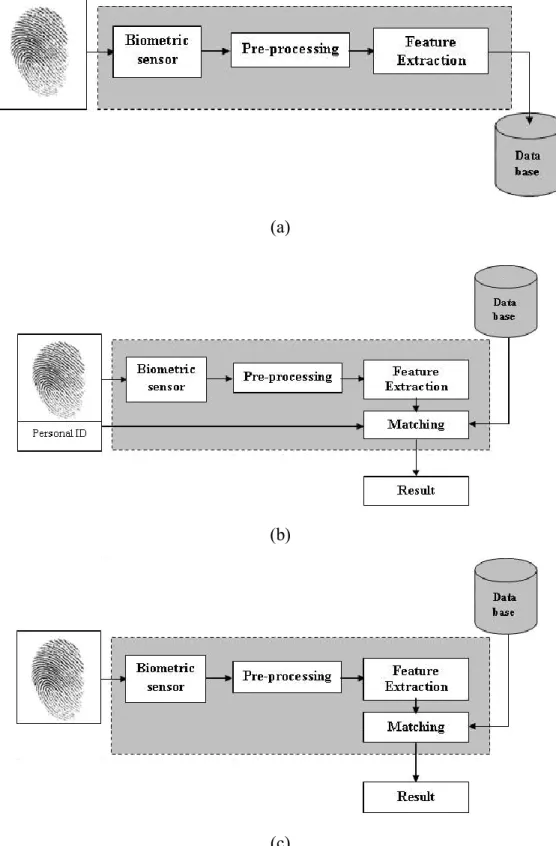
The verification task is responsible for verifying individuals at the point of access. During the operation phase the personal ID is required to be entered. As shown in Figure 2.1(a, b), an automatic fingerprint verification system (AFVS) consists mainly of four modules:
Data Acquisition: By which the fingerprint image is acquired in a digital format using a biometric sensor, such as a scanner.
Pre-processing: Sometimes it is required to apply some pre-processing algorithms (e.g. noise rejection, edge enhancement). In fact, the need for this step depends mainly on the quality of the acquired fingerprint images; which
is affected by the scanning process and the surrounding working environment. Therefore, some AFVS dose not need the pre-processing step.
Feature Extraction: to extract the required salient features from a fingerprint image, and to formulate the template (to enroll or to verify).
Matching: to compare the extracted fingerprint template against the reference template retrieved from the system database based on the entered personal ID. Accordingly, it makes a final decision (matched or non-matched).
Although, an automatic fingerprint identification system (AFIS) also consists of the same four modules mentioned above, the difference between AFIS and AFVS is in the matching module. In the identification task, no personal ID is provided and the system compares the extracted fingerprint template against all reference templates of the personal identities enrolled in the system database. Therefore, the AFIS matching module conducts a one-to-many comparison to establish the identity of the individual, as shown in Figure 2.1(c). In the case of the identification systems with large databases, the AFIS matching module is computationally expensive. Thus, the fingerprint classification and indexing techniques are often deployed to limit the number of templates that have to be matched against the input [1].
(a)
(b)
(c)
Figure 2.1: General architecture for the main parts of the fingerprint recognition system (a) Enrollment operation, (b) Verification operation, and (c) Identification operation.
2.3 Fingerprint Representation and Matching
Fingerprint representation, i.e. the features extraction and template formulation, and fingerprint matching are considered the core modules of the automated fingerprint recognition (verification/identification) systems. Since these two modules are the most complicated parts within the system, they have to be designed as perfect as possible in order to meet the performance requirements of an automatic fingerprint recognition system.
2.3.1 Fingerprint representation
The importance of the fingerprint representation module arises from two facts: First, the original fingerprint images can not be saved directly in the system database, since it requires a large amount of storage space. Second, the objective in devising a suitable fingerprint representation is to provide a high accuracy in fingerprint recognition with a reasonable complexity, i.e. the fingerprint matching module could be simplified without affecting the accuracy of the matching results based on a suitable method to represent a fingerprint image in the system database. Thus, the problem of fingerprint representation is to determine a measurement (feature) space, in which fingerprint images taken from a specific finger form a compact cluster different from those of other fingers from the stand point of these features.
The fingerprints are the graphical ridge/valley patterns of human fingers; hence a fingerprint is mainly represented by using the information (features) associated with its ridges. These features are traditionally categorized as the global features and the local features. Normally, for these features (known as the feature vector) to be considered as a
1. Saliency: the feature vector should represent distinctive information about the fingerprint.
2. Extractability: these features can be easily detected.
3. Compactness: the feature vector could be stored in a compact form (to save the storage space)
4. Usefulness: the feature vector should to be formulated such that it becomes useful for the matching step.
- Global Features
The global features represent the overall ridges pattern. As shown in Figure 2.2, the pattern of the ridges flow of the fingerprint has a smooth curvature everywhere, except nearby some regions which are called singular regions. In addition, the density of the ridges varies based on their locations with respect to theses singular regions. Based on these different characteristics of the ridge pattern, many global features have been defined to be used for fingerprint recognition systems as follows:
1. Singular points, called loop and delta, are a sort of control (reference) points around which the ridge lines are wrapped [1]. It has been found that, the human fingerprint has at most four singular points (i.e. two loops and two deltas), as shown in Figure 2.2, or at least one singular point which is the upper loop (the core). Since there are many different fingerprints that contain the same singular points topology, this feature is not sufficient for verification or identification purposes. Nevertheless, this feature is helpful as it is used to prealign fingerprint images that need to be matched. In fact, most of the matching algorithms need a pre-alignment step. Usually, the pre-alignment
depends on the core point as a center reference point. Another popular use of fingerprints’ singular points is to determine the fingerprint category (i.e. fingerprint classes) as shown in Figure 2.3.
Figure 2.2: Fingerprint image shows the different global features.
(a) (b) (c) (d) (e) Figure 2.3: Fingerprint patterns as they appear at a coarse level: (a) tented arch, (b) arch, (c) right loop, (d) left loop, and (e) whorl.
2. Local ridge orientation, which is known as the orientation field or the directional image of the fingerprint (Figure 2.4). There are many techniques have been proposed to calculate the local ridge orientation [1]. The most natural approach for estimating the local ridge orientation is based on the computation of gradients in the fingerprint image [36]. In practical, a ridge Upper loop
Lower loop
Right delta Left delta
assigned an orientation value R in the interval [0,) that corresponds to the most dominant direction of the ridges contained therein. The orientation values are calculated with respect to the horizontal border of the image (2.1). The orientation field O can then be considered as a matrix whose (k,l)th element represents the orientation value of the (k,l)th block.
N i N j y x y N i N j x R j i G j i G j i G j i G 1 1 2 2 1 1 1 ) ) , ( ) , ( ( ) , ( ) , ( 2 tan 2 1 (2.1)where Gx(i,j)and Gy(i,j) are the values of the gradients at pixel(i,j)in the x and y directions, respectively, using 33 Sobel mask.
3. Local ridge frequency, which is known as the frequency image or the ridge density map of the fingerprint (Figure 2.5) [9, 37]. The local ridge frequency of the (k,l)th block is defined as the number of the ridges per unit length along a segment orthogonal to the local ridge orientation R [1]. It has been noticed that, the ridge density varies across different parts of the same fingerprint (Figure 2.5). In addition, different fingerprints have been found to have naturally different ridge density maps [1].
4. Local ridge curvature, which is known as the curvature map of the fingerprint (Figure 2.6). Qi et al [18, 38] have been proposed the use of the orientation field of the fingerprint image to construct the curvature map. The curvature of the (k,l)th block is defined as the half of the difference between
the orientations of the two neighboring blocks to which the direction of the )
,
(k l th block.
The global features of the fingerprint, especially the first three global features, have been traditionally used for image enhancement at a preprocessing stage [9], for classification (indexing) of fingerprint [1013], for fingerprint image partitioning [14], and for singular points detection [3940]. Even though, the global features of the fingerprint are not considered as a completely distinctiveness features, they might be used with the local features to enhance the accuracy of the fingerprint matching, as mentioned in Section 1.3.
Figure 2.5: Fingerprint and its frequency image [37]. Figure 2.4: Fingerprint and its orientation image.
- Local Features
The local features represent the small details of the ridges, which normally can not be seen by the human eyes. These features have been reported as the highest distinctiveness characteristics of the fingerprint [1]. Traditionally, the local ridge characteristics, called minute details (shortly called minutiae), are widely used for the fingerprint representation and matching. These small details are found to remain in the fingerprint pattern unchanged over an individual’s lifetime [1]. The two most prominent minutiae are: ridge ending and ridge bifurcation (see Figure 2.7). A ridge ending is defined as the ridge point where a ridge ends abruptly. A ridge bifurcation is defined as the ridge point where a ridge forks or diverges into branch ridges. The FBI minutiae coordinate model considers only termination and bifurcations: each minutia is denoted by its type, the x and y coordinates and the angle between the tangent to the ridge line at the minutia position and the horizontal axis [1]. The minutiae can be extracted, in general, either through a binarization process of the fingerprint ridges or directly from the gray-scale fingerprint image [1].
Figure 2.7: Minutiae types: Ridge endings and ridge bifurcations. 2.3.2 Fingerprint matching
The process of fingerprint matching is to compare the fingerprint templates by using a set of similarity measures of the corresponding features in these templates. And thus the matching scheme returns a score between 0 and 1 representing the degree of similarity between the two fingerprint images, or a binary score of 0 or 1 indicating whether or not the fingerprint under consideration is the same as the reference fingerprint. The accuracy of the final decision and the response time are the two main concerns of a matching scheme. However, the requirements on the degree of accuracy and the response time of a matching scheme vary from one application to another. Although this matching process seems easy to do, it is an extremely difficult problem to solve due to the challenges associated with the behavioral and anatomical characteristics of fingerprints.
2.4 Performance Metrics
Each fingerprint application has its own requirement. Examples of such requirements are the degree of accuracy required, and the speed of the system’s response. Thus, practical
Ridge endings
Ridge bifurcations
performance requirements of a biometric system are very much application dependent. Three main factors are used in evaluating the performance of a fingerprint recognition system:
1- Fingerprint system’s decision accuracy, i.e., the recognition accuracy.
2- The computational complexity of the feature extraction, template formulation and matching modules.
3- The size of the resultant features vector (i.e., template), and whether this template has a fixed or variable size.
In order to measure the decision accuracy of the fingerprint recognition system, the fingerprint verification problem is defined as follows [1]. Let the stored fingerprint template of a person be represented with T, and the acquired input for recognition be represented with I . Then the null and alternate hypotheses are:
T I
H0: , input I is not from the same person as the original template.
T I
H1: , input I is from the same person as the original template. The associated decisions are:
:
0
D The person is not who she/he claims to be. :
1
D The person is who she/he claims to be.
The verification involves matching T and I using a similarity measure S(T,I). If the matching score is less than the system threshold t, then decide D0, else decide D1. Accordingly, the testing formulation inherently contains two types of errors:
Type B: false non-match (D0 is decided when H1 is true).
False match rate (FMR) is the probability of type A error (also called false acceptance rate (FAR)); and false non-match rate (FNMR) is the probability of type B error (also called false rejection rate (FRR)):
) | (D1 H0 true p FMR (2


![Figure 2.8: FMR and FNMR, for a given threshold t, are displayed over the genuine and impostor score distributions [1]](https://thumb-us.123doks.com/thumbv2/123dok_us/781528.2598834/52.918.301.661.137.406/figure-fnmr-given-threshold-displayed-genuine-impostor-distributions.webp)
![Figure 3.2: Flow diagram of the multi-channel approach to fingerprint classification [13]](https://thumb-us.123doks.com/thumbv2/123dok_us/781528.2598834/69.918.269.711.550.1003/figure-flow-diagram-multi-channel-approach-fingerprint-classification.webp)
![Table 4.1 provides a summary in terms of the fingerprint size, resolution and the source of acquisition of the selected databases [41, 4446]](https://thumb-us.123doks.com/thumbv2/123dok_us/781528.2598834/97.918.154.822.907.1055/table-provides-summary-fingerprint-resolution-acquisition-selected-databases.webp)