Bernalillo County
Department of
Substance Abuse
Programs: Assessment
Center Review
July 2014
Dan Cathey, MPA
Craig Pacheco, BA
Prepared for:
Bernalillo County Department of
Substance Abuse Programs
Introduction
In March 2012, the Bernalillo County Department of Substance Abuse Program’s (DSAP) began an “Assessment Center” process to identify individuals and the appropriate DSAP or contracted treatment service for the individual’s needs. The Assessment Center in Albuquerque is designed to function as a first point of contact, identifying the level of service and dosage of treatment required for the applicant. In 2012, the DSAP Assessment Center (AC) began piloting a process to provide ‘treatment triage’ and ‘treatment placement’ to all participants of the Metropolitan Detention Center Community Custody program (CCP). Clients are assessed to measure factors consistent with filtering clients to services
appropriate to their level of treatment need, with consideration to length of time in a security program (for providing duration support and decreasing violation potentiality), and adherence to funding guidelines, and placed in programs within the range of services supported by the Bernalillo County Government. The Assessment Center states,
“Accountability for inappropriate service placement and the fiscal irresponsibility tied to one-size-fits-all treatment service approaches is the obligation of all members of the public safety arena as the funding for these initiatives are publically supported. Providing an individual too much, too little, or a service that does not address their actual issue is tantamount to not providing a service at all when it comes to the quality of care needed to achieve a desired treatment effect. For this reason, proper assessment of individual need is vital to the process of treatment service recommendation.”
This report reviews the Bernalillo County DSAP Assessment Center, its processes, the population it manages, the program options available to individuals coming to the Assessment Center, and a sample of cases assessed and referred by the AC to its program treatment options. The report makes several
observations and recommendations for the AC to enjoin in its pilot program. Additionally, the report reviews programs around the nation using similar admissions or receiving processes, and reviews the design of an effective workflow process borrowed from the field of business process management and matched to the accessing and referring tasks the Assessment Center handles.
Background
Treatment/prevention intervention with criminal justice offender populations is beneficial to the
individual and can have a positive impact on reducing crime in the community. (Beattie, Nguyen, 2003; Drake, 2012; Aos, et al, 2012). Additionally, components of the treatment/prevention continuum and the criminal justice continuum often work at cross-purposes, and it has been the exception rather than the rule when the criminal justice and Alcohol and Other Drug Use (AOD) systems work well together (Vigdal, 1995). Our review of one-entry point workflow process found they are easier to coordinate and there are beneficial economies of scale associated with a single entry point (Hammer & Champy, 1993). We discovered several examples around the country that use a single point or entry process to administer coordinated social services.
Triage Workflow
A triage process in community social services may result in determining the order and priority of treatment, the order and priority of transport, or the transport destination for a client. The principle of triage is the same whether in a hospital emergency room or the AC Office. In the AC Office, the
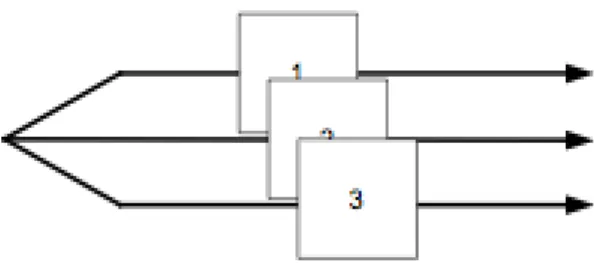
individual scoring highest on the Triage Tool is routed to the highest level of care. Individuals with less critical needs are routed to a lower level of care (See Appendix A for a copy of the DSAP Triage Form). From the field of business workflow processes, (Hajo, 2002) we characterize the intake process of the AC as a Triage workflow. The primary function of the triage workflow is to: consider the case intake task of the AC office into two or more alternative tasks (see Figure 1). Individuals are interviewed at the furthest point on the left in Figure 1. From this point a determination for treatment is made and the individual is routed to one of the three available options, (i.e., Community Partner Program, Community Addiction Program, and NM Highlands CCTP).
The Community Addiction Program provides clients who have been identified to have addiction treatment needs with evidence-based addiction treatment services after their release from the Bernalillo County Metropolitan Detention Center (MDC) to the Community Custody Program (CCP) or clients who have been referred from other DSAP programs for support as part of a continuum of care for those requiring further assistance with maintaining a substance-abuse-free lifestyle.
The New Mexico Highlands University Community Clinical Treatment Program (CCPT) provides an evidence based substance abuse treatment service to DWI offenders incarcerated during the year in the CCP through a 16-week intensive outpatient program (IOP) using the Matrix Model. Services include: individual intake and assessment services, relapse prevention, psycho-educational group therapy and individual therapy through an individual treatment plan.
The Community Partner Program is a list of existing community service providers that clients who come through the Assessment Center and do not score into a Level 1 treatment service (DSAP CAP) or a Level 2 treatment service (MN Highlands CCTP) can still be referred to and receive services.
When applying the triage workflow, it is possible to design tasks that are better aligned with the
capabilities of resources and the characteristics of the treatment options. Both of these improve the quality of the workflow. Distinguishing alternative tasks also facilitates a better utilization of resources, with obvious cost and time advantages. On the other hand, too much specialization can make a triage workflow become less flexible, less efficient, and cause monotonous work with repercussions for quality. This can be addressed by using a special form of the basic triage workflow.
The special form of the basic triage workflow divides a task into similar instead of alternative tasks for different subcategories of the case type. For example, a special interviewer may be created for clients with expected high needs and extra processing time requirements.
For this study, the description of the AC process uses the triage workflow and is joined in the task of routing clients to the three current treatment options by another business strategy called Trusted Party. Instead of determining information oneself, the provider uses the results of a trusted party to select
appropriate clients. An example of how the trusted party strategy could work is in the determination of the appropriateness of a client that treatment provider ‘A’ would accept. If a potential client can present a recent assessment from the Assessment Center, then treatment provider ‘A’ will accept the assessment and the client. The trusted party strategy reduces cost for provider ‘A’ and may even reduce throughput time from assessment to treatment. On the other hand, the quality and appropriateness of clients for the treatment providers becomes dependent on the quality of the Assessment Center’s work. Some
coordination effort with trusted parties is also likely to be required.
Currently, the Assessment Center refers clients to providers that are subsidized in some way by the DSAP or Bernalillo County. The trusted party strategy has the potential for ‘growing’ the Assessment Center program outside this pool of providers. The number of providers that would accept the trusted party’s assessments is limited by the expertise of the trusted party and the number of potential clients coming to the trusted party for an assessment.
Assessment and Receiving Centers in other States Santa Clara County’s Gateway
The Santa Clara Valley Health and Hospital System and the County of Santa Clara California maintain a gateway or single point of entry for individuals applying for substance abuse treatment. Once an
individual is in the system, moving between programs is seamless, since each program uses the same admission information and the program uses standardized forms. A coordinated system with a single point of entry is not a panacea, difficulties continue with any system dealing with important community programs, however the single admissions point, like DSAP’s Assessment Center, offers a means of better organizing and coordinating its broad range of programs. Regardless of where the individual is coming from the Santa Clara Gateway helps them find what they need in the system.
The Gateway Program is the point-of-entry to the full spectrum of Department of Alcohol & Drug Services (DADS) Adult Managed Care Services. Prospective clients are screened and promptly authorized for treatment. Gateway also provides information and referrals twenty-four hours a day. Gateway is staffed by a skilled, multidisciplinary team with Spanish and Vietnamese language speakers. Most callers seek information and referrals to self-help groups, emergency shelters, prevention resources, and other local medical and mental health agencies. Callers who need treatment answer preliminary questions, including a brief crisis assessment, medical history, tuberculosis screening, and a substance abuse history. Screeners ask about previous treatment and current motivation to get help, and obtain the caller’s consent to share the preceding information with the treatment provider. After callers complete a Level of Care Assessment, clinicians determine which services are most appropriate, and callers get an Intake appointment for an Intake within 72 hours of the first call to Gateway. Treatment providers are located throughout Santa Clara County. In addition to assessment, other services offered include: prevention, detoxification, and outpatient or residential, depending on need. The Gateway Program collaborates with the Department of Mental Health, Health and Hospital System, Social Services Agency, Criminal Justice System, local service providers, and DADS managed care to provide services (County of
Santa Clara, 2014). The Santa Clara County system has been evaluated and has been found to be a successful system, providing treatment to the appropriate population (Beattie, Nguyen, 2003) Dallas County’s Comprehensive Assessment and Treatment Services (CATS)
In Dallas County Texas, CATS provides substance abuse and mental health services in the County’s community service corrections department (i.e., probation department). CATS provides pre-assessment screening, assessment, crisis intervention, and individual/group counseling. Residential substance abuse treatment is provided with a CATS referral to contracted vendors and other state-funded programs. CATS provides mental health services through community-based agencies. The CATS clinical staff varies with regard to degree and experience but includes staff from the field of psychology, social work, licensed professional counseling, and licensed chemical dependency counseling. All have masters or doctoral degrees. CATS technicians have associates or bachelors degrees and are trained in identifying signs of substance abuse and psychological distress. Clerical staff manages the demand for information and coordinates scheduling of assessment and treatment services. A 2010 evaluation of the impact of three programs in three counties in Texas reported the CATS had a positive impact on the severity of criminal charges against the mentally ill offenders in Dallas County (Carmichael and Marchbanks, 2010).
According to the Dallas County District Attorney’s Office website, the CATS claims to have a reduction in recidivism of 70%. This finding is better than that of the general jail population in Dallas
(https://www.dallasda.com/mental-health).
CATS is divided into three units: Intake, Assessment, and Counseling/Treatment. These units are further divided into specialty teams. Clients are referred to the Intake unit for pre-assessment screening by the courts and probation officers. The screenings consist of self-report questionnaires designed to gather psychosocial information, measure of substance abuse history, and mental health history. The self-report portion of the screening is followed by face-to-face interview with a technician. The primary purpose of the screening is to determine the need for further evaluation. A secondary purpose of the screening is to collect data to improve the accuracy of clinical prediction and decision-making. Any observations or other signs of crisis or emergency are immediately reported to a clinical supervisor for intervention. Otherwise, if further evaluation is indicated, appointments are scheduled with the appropriate assessment staff.
Intake staff validates the client’s personal information and confirm their history, their legal status, and either intentional or inadvertent misinformation. The staff also manages the flow of information through CATS, between CATS and other probation offices, and between CATS and external agencies. CATS maintains a dedicated referral system that consists of a scheduling coordinator who triages all referrals for CATS services, a data system clerk who serves as the data system administrator, and a computer network that links electronically with all providers. The data system administrator produces both routine reports to assist in the day-to-day management of the program and specialty reports for further analysis.
The Assessment Department of CATS provides information to the courts and probation staff regarding clients' social history, personality, psychological and chemical dependency issues, other factors (including motivation and readiness for change), treatment needs, and recommended supervision strategies, as well as responses to other specific referral questions. This department of CATS also provides crisis
is utilized in order to establish a close relationship between the courts and the CATS assessors. Most services are provided in both English and Spanish.
Specifically, CATS provides drug and alcohol assessments, psychological assessments, dual diagnosis assessments, lethality assessments and crisis intervention, case staffing and consultation with the courts. Additionally, the CATS Assessment Department conducts substance abuse and psychological evaluations with clients who are incarcerated and who can be pre-or-post-sentence.
The CATS Counseling Services division provides counseling interventions to probationers through groups and individual sessions, including working with families. A variety of outpatient counseling services is offered including: intensive outpatient group, dual diagnosis group, anger management group, and individual counseling.
Maricopa County Adult Probation Assessment and Referral Center (ARC)
In Maricopa County Arizona, the Assessment and Referral Center (ARC) screens and assesses probationers after sentencing either immediately if out of custody, in custody if eligible to be released early, or upon release from custody to determine risk level and various needs for the purpose of community supervision. ARC makes recommendations or referrals to help ease the transition into probation – from jail to the community.
The majority of ARC clients walk into the office immediately after sentencing at the court. The ARC completes a substance abuse assessment and facilitates early release to treatment for probationers serving a condition of jail who meet certain criteria and are eligible for early release to treatment or to substance abuse treatment.
The ARC team consists of probation officers, screeners, clinical assessors, and support staff. They accomplish the ARC mission using an empirically validated substance use test and a clinical consult/interview as necessary.
The current screenings and assessments the Assessment and Referral Center completes include: Offender Screening Tool (OST), Adult Substance Use Survey (ASUS), DNA testing sample, and the Arizona Sex Offender Assessment Screening Profile for Regulatory Community Notification (Maricopa County, 2014).
The DSAP Assessment Center
For the first 12 months of its existence, the DSAP Assessment Center received referrals from the Metropolitan Detention Center Community Custody Program (CCP). Beginning in April 2013, AC started receiving referrals from the District and Metropolitan Court. This addition to referral sources doubled the number of referrals coming to AC. In the first month, the number of referrals increased from 88 in March 2013 to 161 in April 2013.
The Assessment Center Process
Individuals who are out of custody receive a referral to AC from either the CCP or the Court, (i.e., judge or pretrial services). At the AC office the individual is interviewed. The AC staff fills out a five-question ‘triage’ form with the individual. The form was created in-house by DSAP staff. The five questions address:
1. Length of time the individual has remaining on supervision; 2. Individual’s length of habitual drug use;
3. Number of attempts the individual was on outpatient treatment and the ability to remain abstinent;
4. Conviction for a DWI within the last 5 years; and
5. Reasons to “Override” the recommendation based on the first four questions.
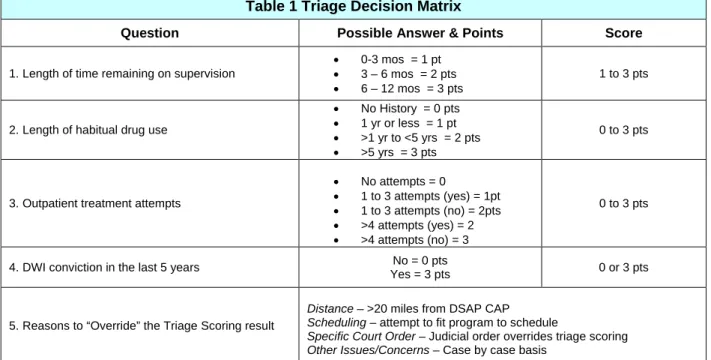
Each question is weighted using a points scale. For instance, the first question regarding, ‘time remaining on supervision’ scores 1 point if the individual has 1 to 90 days remaining, 2 points for 91 to 180 days, and 3 points for 181 to 364 days. Points are totaled for each question and the individual is referred to one of the three treatment programs depending on the total points. Table 1 shows the matrix of points for each question. Questions are scored depending on the individual’s answers. Individuals scoring 1 to 4 points are assigned to the Community Partners Programing (CPP); persons with a score of 5 to 8 points are assigned to the DSAP Community Addiction Program (CAP; and individuals scoring 9 to 12 points are assigned to the NM Highlands Community Clinical Treatment Program (CCTP).
The DSAP Assessment Center refers clients to three different options of treatment: DSAP Community Addiction Program (CAP), which is rated an American Society of Addiction Medicine (ASAM) Level 1 treatment model, NMHU Community Clinical Treatment Program (CCPT), which is a Level 2 treatment program, and A community partner/existing service provider referral (CPP).
Description of the 3 Assessment Center Referral Options
DSAP Community Addiction Program (CAP)
The goal of this program is to provide clients who have been identified to have addiction treatment needs with evidence-based addiction treatment services after their release from the MDC to the CCP or clients
Table 1 Triage Decision Matrix
Question Possible Answer & Points Score
1. Length of time remaining on supervision
• 0-3 mos = 1 pt
• 3 – 6 mos = 2 pts
• 6 – 12 mos = 3 pts
1 to 3 pts
2. Length of habitual drug use
• No History = 0 pts
• 1 yr or less = 1 pt
• >1 yr to <5 yrs = 2 pts
• >5 yrs = 3 pts
0 to 3 pts
3. Outpatient treatment attempts
• No attempts = 0 • 1 to 3 attempts (yes) = 1pt • 1 to 3 attempts (no) = 2pts • >4 attempts (yes) = 2 • >4 attempts (no) = 3 0 to 3 pts
4. DWI conviction in the last 5 years No = 0 pts
Yes = 3 pts 0 or 3 pts
5. Reasons to “Override” the Triage Scoring result
Distance – >20 miles from DSAP CAP
Scheduling – attempt to fit program to schedule
Specific Court Order – Judicial order overrides triage scoring
who have been referred from other DSAP programs for support as part of a continuum of care for those requiring further assistance with maintaining a substance-abuse-free lifestyle.
CAP is an American Society of Addiction Medicine Level I outpatient program. The CAP Level I
outpatient service can provide up to 24 weeks of structured treatment that increases in intensity the longer a participant is assigned to services. The CAP offers a tiered system that provides one of four participant levels to individuals based upon their Assessment Center recommendation of treatment need. Level I treatment consists of 6 weeks of programming, Level II has 12 weeks, Level III has 18 weeks, and Level IV is a full 24 weeks of programming. CAP promoters feel that the ability to match an individual’s treatment need to their treatment intensity makes CAP an efficient and cost effective service. Community Reinforcement Approach (CRA) is the treatment modality utilized by DSAP for all its programming. CRA is an evidence-based, broad spectrum, comprehensive behavioral program for treating alcohol or drug abuse problems. DSAP has developed curriculum and supporting materials for up to 26 weeks of programming which have been reviewed and approved by Dr. Robert Meyers of Addictions (CASAA) at the University of New Mexico, also the founder of CRA. The material developed by DSAP staff to provide CRA treatment and covers all CRA core concepts and includes supplementary instruction. CAP has a design capacity of 200 clients.
CRA attempts to increase clients’ access to positive activities and makes involvement in these activities contingent on abstinence (Azrin et al., 1982). This approach combines many of the components of other behavioral approaches, including monitored disulfiram, behavior contracting, behavioral marital therapy, social skills training, motivational counseling and mood management. Some of the largest treatment effects in the literature have been associated with the community reinforcement approach (Miller et al., 1995). Compared to more traditional treatment approaches, the CRA has been shown to be more
successful in helping inpatient or outpatient alcoholics remain sober and employed. Although community reinforcement is a more intense treatment approach, it is consistent with the basic philosophy of several other effective approaches. The ability to establish rewarding relationships, to focus on changing the social environment so that positive reinforcement is available, and to reduce reinforcement for drinking are emphasized with the community reinforcement and other approaches. The key appears to be helping the client to find and become involved in activities that are more rewarding than drinking.
CRA was adopted by DSAP due to its evidence-based treatment of AOD. CRA provides a broad-spectrum behavioral program for treating substance abuse problems in a variety of settings through core skills training. CRA is based on the belief that environmental contingencies can play a powerful role in encouraging or discouraging drinking or drug use. It utilizes social, recreational, familial, and vocational reinforcers to assist clients in the recovery process. CRA has been empirically supported with inpatients (Azrin, 1976; Hunt & Azrin, 1973), outpatients (Azrin, Sisson, Meyers, & Godley, 1982; Mallams, Godley, Hall, & Meyers, 1982; Miller, Meyers, Tonigan, & Grant, 2001), and homeless populations (Smith, Meyers, & Delaney, 1998). In addition, three recent meta-analytic reviews cited it as one of the most cost-effective alcohol treatment programs currently available (Finney & Monahan, 1996; Holder, Longbaugh, Miller, & Rubonis, 1991; Miller et al., 1995) (http://casaa.unm.edu/crainfo.html).
New Mexico Highlands University Community Clinical Treatment Program (CCTP)
NMHU provides an evidence based substance abuse treatment service to 100 DWI offenders incarcerated during the year in the CCP through a 16-week intensive outpatient program (IOP) using the Matrix
Model. Services include: individual intake and assessment services, relapse prevention, psycho-educational group therapy and individual therapy through an individual treatment plan. In May 2010-2013, CCTP became the only IOP Matrix program certified by the Matrix Institute in the State of New Mexico.
Matrix IOP Model and an integration of other evidence based practices: Seeking Safety, Brief
Interventions, Behavioral Contracting, Motivational Interviewing, Stages of Change Theory, Contingency Management and Motivational Enhancement, Sequence of Recovery Stages, 12-step facilitation, CRA, Case Management, and Systems Treatments
The Matrix Model, developed by the University of California Los Angeles (UCLA), is designed to treat substance abusers in an Intensive Outpatient setting. It is endorsed by NIDA and CSAT. The Matrix Model is a 16-week intensive outpatient treatment approach for stimulant abuse and dependence that was developed through 20 years of experience in real-world treatment settings. The intervention consists of relapse-prevention groups, education groups, social-support groups, individual counseling, and urine and breath testing delivered over a 16-week period. Patients learn about issues critical to addiction and relapse, receive direction and support from a trained therapist, become familiar with self-help programs, and are monitored for drug use by urine testing. The program includes education for family members affected by the addiction. The therapist functions simultaneously as teacher and coach, fostering a positive, encouraging relationship with the patient and using that relationship to reinforce positive behavior change. The interaction between the therapist and the patient is realistic and direct, but not confrontational or parental. Therapists are trained to conduct treatment sessions in a way that promotes the patient's self-esteem, dignity, and self-worth.
A community partner/existing service provider referral (CPP)
“At the point of referral, there is both an opportunity to address a client's unmet needs and a potential danger of losing the client. Collaboration is crucial for preventing clients from "falling through the cracks" among independent and autonomous agencies.” (SAMHSA/CSAT, Treatment Improvement Protocols, No. 38; 2000)
The community partner/existing service provider referral is in place for clients who come through the Assessment Center and do not score into a Level 1 treatment service (DSAP CAP) or a Level 2 treatment service (MN Highlands CCTP). These clients score a 1-4 on the Assessment Center Triage form and are referred to a Community Partner Program and can obtain services at a treatment provider of their choice. It is also in place for those clients who are already engaged in ongoing substance abuse treatment at an existing treatment service provider. This is important so the bond already in place between the client and their existing treatment service provider is not broken and they are not forced to start treatment at a new agency.
Method
The methodology used for this report was to review data from the DSAP Assessment Center. We obtained Assessment Center Triage forms for the months of July, August, and November of 2013. This produced a sample of 543 clients. DSAP Assessment Center staff provided access to client files. We made copies of all the triage forms, and then returned the originals to the AC office. The data from the triage forms were then entered into a secure data entry system at ISR. This constitutes Phase 1 of this study.
Phase 2 will consist of further analysis using data collected from client files at CAP, CCTP, and the CPP. The client files sampled for Phase 2 of the study are the 543 clients whose Assessment Center Triage forms were used for the analysis in Phase 1. CAP, CCTP, and the CPP (through CCP) all provided access to files. To collect client data, we designed data entry forms for each treatment program to collect the information we wanted from the sample of client files. Data from client files has been collected from CAP and CCTP. We are currently collecting data from the Community Partner Program at CCP. This data will be entered into a secure data entry system at ISR. It will be analyzed to provide further detail on whether clients went to the treatment program they were placed in by the Assessment Center and if they were successful or not in completing the program.
Results
Table 2 reports how referrals came to the Assessment Center and the number of referrals from each source. The majority of referrals came from MDC-CCP (45.3%), followed by Metro Court Probation (13.1%). District Court (i.e., District Court Judge, District Pre-Trial Services, PV Judge/Pro Tem) referred approximately 32%, and Metro Court (i.e., Bernalillo County Metropolitan Court Probation and
Bernalillo County Metropolitan Court Judge) referred 22.8% of the total sample we reviewed. Fifteen of the 528 clients were missing this information.
Table 2 Governing Security Body
Governing Security Body Count Percent
District Court Judge 67 12.7%
District Pre-Trial Services 38 7.2%
MDC-CCP 239 45.3%
Metro Court Probation 69 13.1%
Metro Court Judge 51 9.7%
PV Judge/Pro Tem 64 12.1%
Total 528 100%
Table 3 reports the recommended program placement of the clients who went through the DSAP AC. The highest number of clients were recommended to the DSAP CAP program (63.4%), followed by the Community Partner Program (21%) and NM Highlands CCTP (15.7%).
Table 3 Recommended Placement
Program Count Percent
DSAP Community Addiction Program 344 63.4%
NM Highlands CCTP 85 15.7%
Community Partner Program 114 21%
Table 4 reports which treatment program clients were referred to by the Governing Security Body (i.e., referring agency). Of the clients being supervised by MDC-CCP, more than half were referred to the Community Partner Program (53.4%). Of the clients who were referred from a PV Judge/Pro Tem, the majority was referred to CAP (87.5%). It was also the case that the majority of clients referred from the
District Court Judge (65.7%), District Pre-Trial Services (73.1%), Metro Court Probation (50.7%), Metro Court Judge (60.8%) all were referred to CAP.
Table 4 Treatment Program Referred To by Governing Security Body
Governing Security Body
Total Treatment Program District Court Judge District Pre-Trial Services MDC-CCP Metro Court Probation Metropolitan Court Judge PV Judge/Pro Tem Community Partner Program Count 14 2 127 5 16 5 169 % 20.9% 5.3% 53.4% 7.2% 31.4% 7.8% 32.1% DSAP Community Addiction Program Count 44 28 93 35 31 56 287 % 65.7% 73.7% 39.1% 50.7% 60.8% 87.5% 54.5% NM Highlands CCTP Count 9 8 18 29 4 3 71 % 13.4% 21.1% 7.6% 42% 7.8% 4.7% 13.5% Total Count 67 38 238 69 51 64 527 % 100% 100% 100% 100% 100% 100% 100%
Table 5 reports on the length of time – from ‘0’ to 12 months – remaining on supervision score by the Governing Security Body. Of the clients referred from MDC-CCP, over half (56.5%) scored 2 points (i.e., 3 to 6 months). The majority of clients who had 6 to 12 months remaining on supervision (3 points), came from PV Judge/Pro Tem (56 clients), Metro Court Probation (49 clients), and MDC-CCP (48 clients).
Table 5 Length of Time Remaining on Supervision Score by Governing Security Body
Governing Security Body
Total Points District Court Judge District Pre-Trial Services MDC-CCP Metro Court Probation Metropolitan Court Judge PV Judge/Pro Tem 0 Points Count 0 0 0 0 1 0 1 % 0% 0% 0% 0% 2% 0% 0.2% 1 Point (0-3 mos) Count 11 3 56 6 32 1 109 % 16.4% 7.9% 23.4% 8.7% 62.7% 1.6% 20.6% 2 Points (3-6 mos) Count 28 27 135 14 9 7 220 % 41.8% 71.1% 56.5% 20.3% 17.6% 10.9% 41.7% 3 Points (6-12 mos) Count 28 8 48 49 9 56 198 % 41.8% 21.1% 20.1% 71% 17.6% 87.5% 37.5% Total Count 67 38 239 69 51 64 528 % 100% 100% 100% 100% 100% 100% 100%
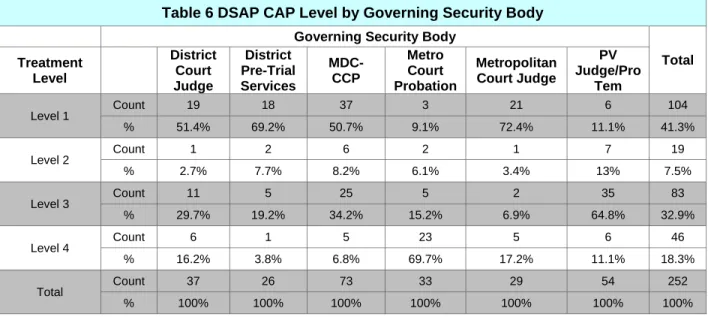
As shown earlier in Table 3, 63.4% of the client’s sampled were recommended to DSAP Community Addiction Program. Table 6 further reports the detail of the DSAP CAP clients by level by the Governing Security Body (i.e., referring agency). The majority of DSAP CAP clients scored into Level 1 treatment (41.3%), followed by Level 3 treatment (32.9%). Only 18.3% scored into Level 4 treatment and 7.5% scored into Level 2.
Table 6 DSAP CAP Level by Governing Security Body
Governing Security Body
Total Treatment Level District Court Judge District Pre-Trial Services MDC-CCP Metro Court Probation Metropolitan Court Judge PV Judge/Pro Tem Level 1 Count 19 18 37 3 21 6 104 % 51.4% 69.2% 50.7% 9.1% 72.4% 11.1% 41.3% Level 2 Count 1 2 6 2 1 7 19 % 2.7% 7.7% 8.2% 6.1% 3.4% 13% 7.5% Level 3 Count 11 5 25 5 2 35 83 % 29.7% 19.2% 34.2% 15.2% 6.9% 64.8% 32.9% Level 4 Count 6 1 5 23 5 6 46 % 16.2% 3.8% 6.8% 69.7% 17.2% 11.1% 18.3% Total Count 37 26 73 33 29 54 252 % 100% 100% 100% 100% 100% 100% 100%
Table 7 reports on the frequency of scores of ‘3’ on the triage decision matrix questions. They are “Length of time remaining on supervision,” “length of habitual use history,” and “outpatient treatment attempts.” For length of time remaining on supervision, there were 229 clients who scored 2 points and 201 who scored 3 points, making up the majority of the responses, 79.2% combined. The largest number and percent of clients (42.2%) scored 2 points, meaning they had 3 to 6 months left on supervision. This was followed by clients who scored 3 points (37%), which means they had 6 to 12 months remaining on supervision. Treatment can be challenging for clients with 3 to 6 months left on supervision. For length of habitual use history, almost half of clients scored 3 points (45.3%), meaning they have had longer than 5 years of habitual use history. For outpatient treatment attempts, there were 46% who had no outpatient treatment attempts in the past 5 years. This was followed closely by clients who had 1 to 3 attempts in the past 5 years and were able to remain substance free for a period of 6 months after any of those attempts (44.2%). If a client scored a 3 on length of habitual use history and a 0 on outpatient treatment attempts, this could indicate the client has been abusing substances the for the past 5 years or longer, and never attempted treatment, which could indicate a higher need for a more intensive outpatient treatment referral.
Table 7 Total Scores for Triage Decision Matrix
Points Length of time remaining on supervision Length of Habitual Use History Outpatient Treatment Attempts 0 points Count 1 29 250 % 0.2% 5.3% 46% 1 point Count 112 92 240 % 20.6% 16.9% 44.2% 2 points Count 229 176 53 % 42.2% 32.4% 9.8% 3 points Count 201 246 0 % 37% 45.3% 0% Total Count 543 543 543 % 100% 100% 100%
Table 8 reports how many clients who went through the Assessment Center had a DWI conviction within the last 5 years. This information is self-reported to the Assessment Center Triage personnel. There were 43.6% who did have a DWI conviction within the past 5 years, and there were 56.4% who did not.
Table 8 DWI Conviction Within The Last 5 Years
Count Percent
0 points 306 56.4%
3 points 237 43.6%
Table 9 shows a comparison of total clients who came through the Assessment Center from 2012 to 2013. The numbers for 2012 were obtained from the DSAP Assessment Center, and the 2013 numbers are the numbers of files we were given from DSAP that are included in the sample for this research study. The numbers for July increased by 334%, from 49 clients to 213 and the numbers for August increased by 210%, from 70 clients to 217. The November numbers stayed relatively the same, from 86 clients in 2012 to 91 in 2013.
Table 9 FY 2012 to 2013 Comparison (Total)
2012 2013
July 49 213
August 70 217
November 86 91
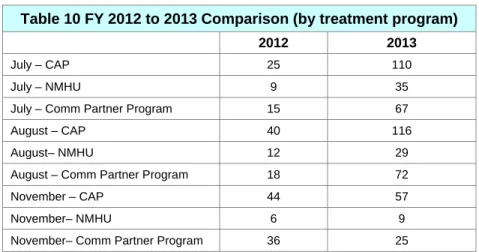
Table 10 further breaks down the 2012 and 2013 comparison by treatment program for each month. In July of 2012 there were 25 clients referred to DSAP CAP and in July of 2013 it increased to 110. NM Highlands CCTP for that same month rose from 9 to 35 and the Community Partner Program increased from 15 to 67. In August of 2012 there were 40 clients referred to DSAP CAP and in August 2013 in increased to 116. NM Highlands CCTP for that same month increased from 12 to 29 and the Community Partner Program increased from 18 to 72. In November of 2012 there were 44 clients referred to DSAP CAP and in July of 2013 it increased to 57. NM Highlands CCTP for that same month rose from 6 to 9. The Community Partner Program was the only one that showed a decline, decreasing from 36 in 2012 to 25 in 2013.
Table 10 FY 2012 to 2013 Comparison (by treatment program)
2012 2013
July – CAP 25 110
July – NMHU 9 35
July – Comm Partner Program 15 67
August – CAP 40 116
August– NMHU 12 29
August – Comm Partner Program 18 72
November – CAP 44 57
November– NMHU 6 9
Overall, 400 out of the 543 clients in the sample were placed in the program they scored into based on the Assessment Center Triage form. Of the 172 clients who scored into the CPP, the Assessment Center staff placed 50% of these clients actually into the CPP. Of the 293 clients who scored into CAP, 85.3% were actually placed in that program and the 77 clients who scored into NM Highlands CCTP (83.1%) were actually placed in CCTP.
Table 11 reports how many overrides there were in this sample and where the overrides were referred. There were 86 clients who scored into the CPP and were referred to the CPP. There were 27 clients who were referred to CAP who were overridden to the CPP and 1 client who was referred to CCTP who was overridden to the CPP. There were 250 clients who scored into CAP and were referred to CAP. There were 81 clients who scored into CPP and were overridden to CAP and 12 clients who scored into CCTP and were overridden to CAP. Finally there were 64 clients who scored into CCTP and were referred to CCTP. There were 16 clients who scored into CAP and were overridden into CCTP and 5 clients who scored into CPP and were overridden into CCTP.
Table 11 Overrides
Scored Into
Placement Community Partner Program DSAP Comm Addiction Program
NM Highlands CCTP
Community Partner Program 86 27 1
DSAP Comm. Addiction Program 81 250 12
NM Highlands CCTP 5 16 64
Total 172 293 77
Conclusion
The majority of referrals to the AC came from CCP (45.3%). These cases originate in the Courts, but we were not able to determine the Court of origin. After CCP, the largest contributor to the AC was the District Court, which referred approximately 32%. Bernalillo County Metropolitan Court referred 22.8% of the total sample we reviewed.
The AC recommended clients most often to the DSAP CAP program (63.4%), followed by the Community Partner Program (21%), and NM Highlands CCTP (15.7%).
Clients from the District Court Judges (65.7%), District Pre-Trial Services (73.1%), Bernalillo County Metropolitan Court Probation (50.7%), and Metro Court Judge (60.8%) all were referred to CAP. The Metro Court Probation referred the largest percentage of clients to CCTP, (i.e., 42% of the total sent to CCTP). The majority of clients who had the largest amount of time remaining (6 to 12 months) came from the District Court PV Judge/Pro Tem (56 clients), followed by clients from Metro Court Probation (49 clients), and MDC-CCP (48 clients).
A closer look at the questions that affect the triage decision matrix, (i.e., Length of time remaining on supervision, Length of habitual use history, and Outpatient treatment attempts) showed most clients (42.2%) had 3 to 6 months left on supervision. Treatment can be challenging for clients with 3 to 6 months left on supervision
Almost half of clients (45.3%), had longer than 5 years of habitual use history and 46% reported they had no attempt in the past 5 years at outpatient treatment. A client scoring a ‘3’ on length of habitual use history and a ‘0’ on outpatient treatment attempts, would seem to indicate the client has been abusing substances for more than 5 years and never attempted treatment, which could indicate a higher need for a more intensive outpatient treatment referral.
Approximately, 44% of the applicants in the sample had a DWI conviction within the past 5 years, while 56% did not have a DWI conviction.
Overall, 400 out of the 543 clients in the sample were placed in the program they scored into on the Assessment Center Triage form. The greatest number of overrides involved 81 clients who scored into CPP and were overridden to the CAP, 27 clients were referred to CAP but were overridden to the CPP, and 12 CCPT clients were overridden to the CAP.
Our review of the Assessment Center indicates it is working as designed. Using a very limited number of questions on the triage form, the AC staff is able to guide the client referral to the proper treatment provider. This simple but elegant process follows the best evidence practices used by more sophisticated assessment and referral systems and agencies (e.g., Santa Clara California’s Gateway, Dallas County’s CATS, and the Maricopa County ARC).
Using business workflow terminology, we found the use of a triage ‘single-point of entry’ like the DSAP Assessment Center is an effective method for identifying and placing the right client into the right program. The system is also efficient and has potential for growth without losing effectiveness. From our research, an example of the efficiency of a well-funded ‘single-point’ process is the Dallas CATS program. This program has professional staff capable of assessing psychiatric referrals, mid-level staff assessing addictions, and staff scheduling referrals and appointments. The ‘single-point’ reduces the need that each treatment provider should spend a great deal of time and budget, assessing clients when the DSAP Assessment Center can be the ‘trusted partner’ which tests and makes the appropriate referral. Our review will continue in a second phase to determine what is happening to the client after the referral is made to the Highland’s CCTP, CAP, or Community Partner. Identifying the referral process at AC was straightforward. Identifying the treatment and the outcomes of the clients referred to CCPT, CAP, and the Community Partners is not as transparent but understanding the types of treatment, dosage, and rate of success enjoyed by the AC referrals will be very helpful in justifying future support for the DSAP initiatives.
References
Aos, LS., Drake, E., Pennucci, A., Klima, T., Miller, M., Anderson, L., Mayfield, J., & Burley, M. (2012). Return on investment: Evidence-based options to improve statewide outcomes (12-04-1201). Olympia: Washington State Institute for Public Policy.
Azrin, N.H. Improvements in the community-reinforcement approach to alcoholism. Behavior Research and Therapy. 1976: 14 (5): 339-348.
Azrin NH, Sisson RW, Meyers R, Godley M. Alcoholism treatment by disulfiram and community reinforcement therapy. J Behav Ther Exp Psychiatry. 1982; 13:105-112.
Beattie, MC., & Nguyen, H. (2003). Outcome Evaluation of The Department Of Alcohol And Drug Services Using Performance Indicators From Secondary Data. Alcohol and Drug Services Research Institute. California Department of Alcohol and Drug Services Administration.
Beattie, MC., & Wiley, D. (2002). Central Treatment & Recovery Outpatient Facility: Outcome Evaluation. Alcohol and Drug Services Research Institute. California Department of Alcohol and Drug Services Administration.
Carmichael, D., Marchbanks, MP., (2010). Representing the Mentally Ill Offender: An Evaluation of Advocacy Alternatives. Texas Task Force on Indigent Defense, Office of Court Administration. Texas A&M Public Policy Research Institute. College Station, TX.
Center for Substance Abuse Treatment. Integrating Substance Abuse Treatment and Vocational Services. Rockville (MD): Substance Abuse and Mental Health Services Administration (US); 2000. (Treatment Improvement Protocol (TIP) Series, No. 38.).
County of Santa Clara Department of Alcohol and Drug Services. (2014).
http://www.sccgov.org/sites/dads/Pages/Department-of-Alcohol-and-Drug-Services.aspx.
Drake, E. (2012). Chemical Dependency Treatment for Offenders: A Review of the Evidence and Benefit-Cost Findings (Document No. 12-12-1201). Olympia: Washington State Institute for Public Policy. Finney JW, Monahan SC. The cost-effectiveness of treatment for alcoholism. J Stud Alcohol. 1996; 57:229- 243.
Hajo, R.A. (2002). Design and Control of Workflow Processes Business Process Management for the Service Industry. Eindhoven : Technische Universiteit Eindhoven. Eindhoven University Press Facilities. Brown, J.M. (2004). The Effectiveness of Treatment. In Heather, N. & Stockwell, T. The Essential Handbook of Treatment and Prevention of Alcohol Problems. (pp. 10-20). John Wiley & Sons Ltd. Hammer, M, Champy, J. Reengineering the Corporation; A Manifesto for Business Revolution. Harper Business, New York, 1993.
Holder, H.D., Longabaugh, R., Miller, W.R. & Rubonis, A.V. The cost-effectiveness of treatment for alcoholism: a first approximation. Journal of Studies on Alcohol, 1991; 52: 517–540.
Hunt, G.M. & Azrin, N.H. A community reinforcement approach to alcoholism. Behavior Research and Therapy, 1973: 11(1): 91-104.
Maricopa County Assessment and Referral Center. (2014).
http://www.superiorcourt.maricopa.gov/AdultProbation/AdultProbationInformation/Referral/Index.asp. Miller, W.R., Brown, J.M., Simpson, T.L., Handmaker, N.S., Bien, T.H., Luckie, L.F., Montgomery, H.A., Hester, R.K. & Tonigan, J.S. (1995). What works? A methodological analysis of the alcohol treatment outcome literature. In R.K. Hester & W.R. Miller (Eds), Handbook of Alcoholism Treatment Approaches: Effective Alternatives, 2nd edn (pp. 12– 44). Needham Heights, MA: Allyn and Bacon. Miller, W.R., Meyers, R.J., Tonigan, J.S., & Grant, K.A. (2001). Community reinforcement and
traditional approaches: Findings of a controlled trial. In R.J. Meyers & W.R. Miller (Eds.), A community reinforcement approach to addition treatment (pp. 79-103). Cambridge UK: Cambridge University Press. Smith, J.E., Meyers, R.J. & Delaney, H.D. The community reinforcement approach with homeless alcohol-dependent individuals. Journal of Consulting and Clinical Psychology. 1998; 66: 541-548. Vigdal, G.L. (1995). Planning for Alcohol and Other Drug Abuse Treatment for Adults in the Criminal Justice System Treatment Improvement Protocol (TIP) Series 17. U.S. Department Of Health And Human Services - Public Health Service. Substance Abuse and Mental Health Services Administration Center for Substance Abuse Treatment. Rockwall II, 5600 Fishers Lane. Rockville, MD 20857. DHHS Publication No. (SMA) 95-3039.