Prediction of Antimicrobial Peptides using
Hyperparameter Optimized Support Vector
Machines
Musa Nur Gabere
Thesis presented in fulfillment of the requirements for the Degree of Doctor Philosophiae
at the South African National Bioinformatics Institute Faculty of Natural Sciences, University of the Western Cape
Advisors: Prof. Vladimir Bajic and Prof. Alan Christoffels.
September 6, 2011
Declaration
I declare that “Prediction of Antimicrobial Peptides using Optimized Hyperparameters of Support Vector Machine” is my own work, that it has not been submitted for degree or examination at any other university, and that all the resources I have used or quoted, and all work which was the result of joint effort, have been indicated and acknowledged by complete references.
Signed September 6, 2011 i
Abstract
Antimicrobial peptides (AMPs) play a key role in the innate immune response. They can be ubiquitously found in a wide range of eukaryotes including mammals, amphibians, insects, plants, and protozoa. In lower organisms, AMPs function merely as antibiotics by permeabilizing cell membranes and lysing in-vading microbes. Prediction of antimicrobial peptides is important because experimental methods used in characterizing AMPs are costly, time consuming and resource intensive and identification of AMPs in insects can serve as a template for the design of novel antibiotic. In order to fulfil this, firstly, data on antimicrobial peptides is extracted from UniProt, manually curated and stored into a centralized database called dragon antimicrobial peptide database (DAMPD). Secondly, based on the curated data, models to predict antimicrobial peptides are created using support vector machine with optimized hyperparameters. In particular, global optimization methods such as grid search, pattern search and derivative-free methods are utilised to optimize the SVM hyperparameters. These models are useful in characterizing unknown antimicrobial peptides. Finally, a webserver is created that will be used to predict antimicrobial peptides in haemotophagous insects such as Glossina morsitan and Anopheles gambiae.
Keywords: antimicrobial peptides, innate immune, machine learning, pattern search, simulated annealing, support vector machine, global optimization, database, insect, Glossina morsistan.
ii
Dedication
Dedicated to my Mum and Dad
Mariam Elmi Hassan
&
Nur Gabere Muhammed
iii
Acknowledgement
Make it a habit to tell people thank you. To express your appreciation, sincerely and without the expectation of anything in return. Truly appreciate those around you, and you’ll soon find many others
around you. Truly appreciate life, and you’ll find that you have more of it.
Ralph Marston.
First and foremost, I give my appreciation to ALLAH (swt), the Cherisher and Sustainer of the Worlds for His Infinite Blessings and Guidance in my life.
I would like to express my sincere gratitude to my advisors, Prof Vladimir Bajic, Prof Alan Christoffels and our collaborator Prof William Noble, who have put their enormous effort and time in the supervision of this thesis. They have helped me to develop the research skills necessary to produce this document. Their innumerable and insightful suggestions have ultimately shaped this document.
Special thanks goes to the DAMPD database team members, namely Minna, Sundar, Ashley and Saleem. Also a million thanks to Mushal, who managed to convince me to use bibtex and also for ex-plaining immunological concepts.
Warm thanks to the fantastic five, Ferial, Maryam, Junita, Fungiwe and Samantha for their excellent assistance regarding student finance and admin work. To the computer gurus, thanks to Peter and Dale for their technical assistance. I also thank my colleagues who have helped me at every step of the way. Special thanks goes to Sarah, Mario, Sumir, Direko, Oreetseng, Samuel, Monique, Zahra, Edwin, Ruben, Adugna, James, Simon, Junaid, Nicki and Gordon.
I cannot miss to mention the love, support and devotion of my family. They have given me the strength and encouragement, that made me complete my studies. Many thanks goes to my Mum, Mariam, my Dad, Nur, my sisters, Shugri and Amina and all my brothers, Mahammed, Abdi, Hassan, Abdihakin and Bashir I, Hussein, Bashir II, Mahammud and Mustaf. Special thanks goes to my elder brother, Mahammed, for
iv
v his constant communication and encouragement.
Lastly, my special gratitude goes to the SANBI, National Research Fund (NRF) for their financial support towards my research. Also thanks to MRC for the travelling fellowship to Mali, Bamako.
Nomenclature
Acronyms
AMP Antimicrobial peptide
PAMP Pathogen associated molecular patterns DAMPD Dragon antimicrobial peptide database
HAPP Heamatophagous antimicrobial peptide predictor
GS Grid search
PS Pattern search
DFSA Derivative free simulated annealing
SVM Support vector machine
GS-SVM Grid search support vector machine PS-SVM Pattern search support vector machine
DFSA-SVM Derivative-free simulated annealing support vector machine
TP True positive
FP False positive
TN True negative
FN False negative
RBF Radial basis function
PEP Posterior error probability
Superscripts used throughout this thesis k Iteration counter sa Simulated annealing t Temperature counter vi
vii General symbols
Ω Search region
N Sample size
n Dimension of the problem
f Objective function
x A vector
min/max Minimize/Maximize
xi Theithcomponent of the vectorx
li Lower bound in theithdimension
ui Upper bound in theithdimension
Symbols related to pattern search x(k) kthiterate ofx.
∆k Step size parameter at iteratek ∇ First order derivative
D The set of positive spanning directions
Symbols related to derivative-free simulated annealing χ Acceptance ratio
m0 Number of trial points
m1 Number of successful trial points
m2 Number of unsuccessful trial points
δ Cooling rate control parameter εs Stop parameter
RD Random direction M C Markov chain
∆sa
0 Initial step size parameter used inside SA
viii Symbols related to support vector machine
#»
xi Input vector of features (patterns)
yi Target values (classes)
C Learner (classifier) δ Margin of hyperplane
#»xT Transpose of vector#»x
R Set of real numbers X Feature space
|X| Cardinality of set X
log Natural logarithm
n Dimensionality of the input space
Contents
1 Introduction 1
1.1 Biophysical characteristics of antimicrobial peptide activity . . . 3
1.2 Mode of action of AMPs . . . 4
1.3 Approaches to characterize AMPs . . . 5
1.4 Classification paradigm . . . 6
1.5 Rationale of the thesis . . . 8
1.6 The structure of the thesis . . . 10
2 Antimicrobial peptide database: A collection of manually curated antimicrobial peptides 11 2.1 Introduction . . . 12
2.2 Characteristics of the Database . . . 13
2.3 Material and methods . . . 20
2.4 Future work . . . 25
2.5 Summary . . . 25
3 Prediction of AMPs using parameter optimized support vector machines 26 3.1 Introduction . . . 27 3.2 Algorithm . . . 28 3.3 Material . . . 44 ix
CONTENTS x 3.4 Numerical Results . . . 49 3.5 Discussion . . . 65 3.6 Summary . . . 71 4 HAPP webserver 72 4.1 Introduction . . . 73 4.2 Methods . . . 74
4.3 Estimation of statistical confidence measures . . . 74
4.4 Results and Discussion . . . 78
4.5 Description of the webserver . . . 84
4.6 Summary . . . 87
5 Conclusion and future work 88 5.1 Research contribution and limitations . . . 88
Appendix 90
A Supplementary material for Chapter 2 90
B Supplementary material for Chapter 3 94
References 98
List of Figures
1.1 Mechanism of peptide action . . . 5
2.1 Histogram of peptide distribution in the DAMPD database. . . 14
2.2 PHP retrieves MySQL data to produce Web pages. . . 15
2.3 An example of DAMPD entry . . . 17
2.4 Flowchart describing the procedure for DAMPD database . . . 21
2.5 Annotation error in a peptide with accession number P83141 . . . 23
3.1 Schematic of SVM classification . . . 30
3.2 A non-separable one-dimensional problem . . . 31
3.3 Separating the non-separable one-dimensional problem . . . 31
3.4 A mesh plot of the hyperparameterscandσagainst the accuracy (f) using grid search . . 33
3.5 Grid Search in a two dimensional optimization problem . . . 34
3.6 System architecture of the proposed optimization of SVM hyperparameters . . . 39
3.7 Histogram of sequence length distribution . . . 45
3.8 Confusion matrix . . . 48
3.9 Confusion matrix for prediction of amphibian AMPs using GS-SVM . . . 56
3.10 Confusion matrix for prediction of amphibian AMPs using PS-SVM . . . 57
3.11 Confusion matrix for prediction of amphibian AMPs using DFSA-SVM . . . 58
xi
LIST OF FIGURES xii
4.1 Confusion matrix for prediction of insects AMPs using GS model . . . 79
4.2 Confusion matrix for prediction of insecta AMPs using PS model . . . 80
4.3 Confusion matrix for prediction of insecta AMPs using SAPS model . . . 81
4.4 The figure represents the distribution of 1284 SVM scores for mixed and null peptides. . . 83
4.5 PEP and q-values . . . . 84
4.6 The input interface to the HAPP webserver . . . 86
4.7 Prediction results of HAPP webserver . . . 86
A.1 ClustalW results of AMP family page . . . 90
A.2 Classification results of a query sequence usingα-defensin HMM profile. . . 91
A.3 Hydrocalculator results ofα-defensin sequence . . . 92
A.4 SignalP results ofα-defensin sequence . . . 93
B.1 Figures (a)-(h) shows how the POLL steps works in the PS method. . . 95
B.2 Figure shows how the Grid Search works in a two dimensional optimization problem . . . 96
List of Tables
2.1 Amino acid frequency in the DAMPD database . . . 14
2.2 Comparison of DAMPD database with other databases . . . 20
3.1 PS-SVM parameters . . . 50
3.2 DFSA-SVM parameters . . . 50
3.3 Performance of GS-SVM, PS-SVM and DFSA-SVM models in classification of actinopterygii AMPs 52 3.4 Performance of GS-SVM, PS-SVM and DFSA-SVM models in classification of amphibian AMPs. 52 3.5 Performance of GS-SVM, PS-SVM and DFSA-SVM models in classification of arachnida AMPs . 52 3.6 Performance of GS-SVM, PS-SVM and DFSA-SVM models in classification of bacteria AMPs . . 52
3.7 Performance of GS-SVM, PS-SVM and DFSA-SVM models in classification of crustacea AMPs . 53 3.8 Performance of GS-SVM, PS-SVM and DFSA-SVM models in classification of insecta AMPs . . 53
3.9 Performance of GS-SVM, PS-SVM and DFSA-SVM models in classification of mammalia AMPs. 53 3.10 Performance of GS-SVM, PS-SVM and DFSA-SVM models in classification of merostomata AMPs 53 3.11 Performance of GS-SVM, PS-SVM and DFSA-SVM models in classification of plant AMPs . . . 53
3.12 Classification of actinopterygii antimicrobial peptides into AMP families . . . 54
3.13 Classification of amphibian antimicrobial peptides into AMP families. . . 59
3.14 Classification of arachnida antimicrobial peptides into AMP families . . . 60
3.15 Classification of bacteria antimicrobial peptides into AMP families . . . 60
xiii
LIST OF TABLES xiv
3.16 Classification of insecta antimicrobial peptides into AMP families . . . 61
3.17 Classification of mammalia antimicrobial peptides into AMP families. . . 62
3.18 Classification of merostomata antimicrobial peptides into AMP families . . . 62
3.19 Classification of plant antimicrobial peptides into AMP families . . . 63
3.20 Classification of crustacea antimicrobial peptides into AMP families . . . 63
3.21 Average performance comparison of the three hybrid methods (generalized AMP model) . . . 64
3.22 Average performance comparison of the three hybrid methods (specialised AMP models) . . . 64
4.1 Performance comparison of the three methods in prediction of Insecta AMPs . . . 78
Chapter 1
Introduction
Multicellular organisms defend themselves against invasion by pathogens by mounting immune responses. An immune system is a network of cells, tissues and organs that work together to defend the organism against attacks by microbes and is divided into two categories namely adaptive immunity and innate im-munity (Brahmachary et al., 2004).
Adaptive immunity refers to antigen-dependent immune response. The exposure in adaptive immunity results in immunology memory and there is a lag time between exposure and maximal response. The receptors in adaptive immunity recognize a particular part of the an antigen (epitope) to which an antibody binds. On the other hand, innate immunity refers to nonspecific defense mechanisms that come into play immediately after the appearance of an antigen in the body. The response of innate immunity is immediate, antigen-independent and the repercussion of the exposure is immunologically memoryless. The receptors in innate immunity have a broad specificity i.e., recognize many related molecular structures called pathogen associated molecular patterns (PAMPs). PAMPs are polysaccharides that vary little from one pathogen to another but are not found in the host. The defense mechanism in innate immunity involves physical, chemical and cellular approaches such as the use of antimicrobial peptides, phagocytosis and melanization (Yassine and Osta, 2010). All metazoans have inborn defense mechanisms that constitute innate immunity. Vertebrates have not only innate immunity but also an adaptive immunity (Steiner et al., 1981).
Antimicrobial peptides (AMPs) is a subset of proteins that plays an essential role in an innate immunity system. They are the first line of defense and widely distributed in plants, invertebrates and vertebrates and show activity against a broad spectrum of pathogens. They have antibacterial, antifungal, antiviral
1
Introduction 2 and even antiprotozoal activities. Their resistance to pathogens has certainly contributed to their diversity and survival. Many similar AMPs have been identified from different organisms, proving their evolution-ary importance in the defense mechanism. They are mostly cationic (positively charged), however there are examples of anionic peptides which also kill pathogens. Examples of cationic AMPs include but not restricted to cecropin, andropin, drosocin, metchnikowin, attacin, abaecin,α-defensin,β-defensin, penaei-din, drosomycin and gambicin. On other hand, maximins, dermicidin enkelytin, lactoferrin, hemocyanin, N-β-alanyl-5-S-glutathionyl-3,4-dihydroxyphenylalanine are examples of non-cationic AMPs (Vizioli and Salzet, 2002). The antimicrobial peptides selectively target the microbial membrane and takes advantage of the inherent difference between microbial cell membrane and multicellular plants and animals. The outer membrane of the microbe is composed of negatively charged phospholipids, whereas the outer membrane of plant and animal is populated with neutral lipids (Zasloff, 2002).
Antimicrobial peptides have 50% hydrophobic residues within a peptide and this feature enhances membrane permeabilization of the microbial. They are usually less than 100 amino acid residues in length (Hancock and Diamond, 2000). Many of these peptides are gene-encoded and synthesized by ribosomes (Tossi et al., 2002) though some are derived as cleaved sections from larger proteins such as lactoferrin (Bellamy et al., 1992) and buforin II from histone 2A (Park et al., 1998). Most of AMPs are generated from larger precursors that include a signal portion. They undergo post-translational modifications that involve proteolytic processing such as glycosylation (Bulet et al., 1993), carboxyl terminal amidation and amino-acid isomerization and halogenation (Zasloff, 2002).
These peptides are known to be so diverse that the same peptide sequence is rarely recovered from two different species of animal, even those closely related (Maxwell et al., 2003). Exceptions include peptides cleaved from highly conserved proteins, such as buforin II (Zasloff, 2002). However, within the antimicrobial peptides from a single species, and between certain classes of different peptides from diverse species, significant conservation of amino-acid sequences can be recognized in the pre-proregion of the precursor molecules (Simmaco et al., 1998). This suggests that the pre-proregion is probably conserved, as they are involved in secretion and intracellular trafficking of the peptide. The precursor molecule consists of the pre-proregion (signal peptides and preprotein sequences) and the matured peptides. It is in the mature peptide sequence that results in diversity in the AMPs structure and functions. The highly diverse nature of antimicrobial peptides arises from the need of each organism to adapt and survive in different microbial environments. Hence, even single mutations can dramatically alter the biological activity of these peptides (Boman, 2000).
1.1 Biophysical characteristics of antimicrobial peptide activity 3 This research is concerned with the characterization of antimicrobial peptides using machine learning. A number of methods have been implemented to characterize AMP by either using experimental or com-putational approaches. We will review these approaches later in the chapter. In the next section, we will present the biophysical properties, mode of action of AMPs and application of AMPs in medicine.
1.1
Biophysical characteristics of antimicrobial peptide activity
Despite the diversity of antimicrobial peptides in various organisms, many of them share common bio-physical properties that endow them with the power to attack the microbial target. These properties in-clude amphipathicity, charge (cationicity), hydrophobicity and conformation. We discuss these properties separately though they function holistically (Yount et al., 2006).
• Amphipathicity (A): Amphipathicity is a measure of abundance of hydrophobic and hydrophilic domains in a protein and is calculated using a hydrophobic moment (MH). Amphipathicity enables
permeabilization of the peptide against the microbial target (Yeaman and Yount, 2003).
• Charge (Q): Many of the antimicrobial peptides are cationic with a net positive charge ranging from +2 to +9. This is due to the fact that cationic peptides are rich in positively charged residues such as arginine and lysine. Cationicity plays an important role in the initial electrostatic attrac-tion of antimicrobial peptides to negatively charged phospholipid membranes of bacteria and other microorganisms (Giangaspero et al., 2001; Yeaman and Yount, 2003).
• Hydrophobicity (H): Peptide hydrophobicity is the percentage of hydrophobic residues within a peptide. It is on average 50% for most antimicrobial peptides. Hydrophobicity is an essential property for antimicrobial peptide membrane interactions, as it enhances effective membrane per-meabilization and also governs the extent to which a peptide can partition into the lipid bilayer of target membranes (Yeaman and Yount, 2003).
• Conformation (χ): Although antimicrobial peptides differ widely in primary sequence and source, AMPs assume a variety of secondary structures. Majority of the peptides haveα-helical andβ-sheet structures, whereas the remaining peptides can be classified as those that are enriched in one or more amino acid residues e.g., proline-arginine or tryptophan-rich. Peptides withα-helical structure and two antiparallelβ-sheets are very active (Yeaman and Yount, 2003).
1.2 Mode of action of AMPs 4
1.2
Mode of action of AMPs
Antimicrobial peptides act by targeting only the microbial membranes which have a clearcut difference from the membranes found in multicellular animals. The outermost leaflet of the microbial membrane bilayer, which is an exposed surface, is densely populated with lipids which have negatively charged phospholipids head groups. In comparison, the outer leaflet of the membranes of plants and animals are composed of neutral charged lipids (Matsuzaki, 1999). The antimicrobial interaction initially starts by disruption of the target membranes resulting into changed membrane potential, metabolite leakage and ultimately cell death (Carter and Hurd, 2010). Three mechanism have been proposed for antimicrobial peptide membrane permeabilization, namely, barrel stave, carpet and torroid-pore as shown in Figure 1.1.
1.2.1 Barrel stave mechanism
In this model, the peptides bind to the membrane through electrostatic interactions. The peptides will take up anα-helical structure and grouped into bundles on the surface of the membrane. The bundles are inserted into the membrane bilayer such that the hydrophobic peptide regions are facing the lipid core of the membrane and the interior of the pore is formed by hydrophilic regions of the peptide. Continuous recruitment of additional peptide monomers leads to an increase in the size of the pore, ultimately resulting to leakage of intracellular components via these pores and subsequently leading to cell death (van ’t Hof et al., 2001). Alamenthicin peptide is an AMP that kills microbes using a barrel stave model (Brogden, 2005).
1.2.2 Toroidal pore mechanism
This model is similar to the barrel stave model, but there is no formation of bundle. Throughout the whole process, the hydrophilic surface of the peptide is in contact with the hydrophilic head groups of the cell membrane. The peptides and lipids bend inwards together to form well-defined pores. Examples of peptides that employs the toroidal pore mechanism are magainin, protegrin and melittin (Brogden, 2005).
1.2.3 Carpet mechanism 5
1.2.3 Carpet mechanism
The carpet model proposes that the AMP clusters cover the surface of the membrane like a carpet. The membrane then collapses at the point of saturation of the concentration of the AMPs. Within a short span of time, wormholes are formed all over the membrane leading to an abrupt lysis of the microbial cell. The lipid layer bends back on itself like the inside of a torus. The lateral expansions in the polar head group region of the bilayer are filled up by individual peptide molecules (Shai, 2002). This model has been the proposed mechanism for dermaseptin, cecropin, melittin, caerin and olispirin (Brogden, 2005).
Figure 1.1: Mechanism of peptide action.The three main modes of action for peptide interaction with target membranes are: (a) Barrel stave. (b) Torroidal pore. (c) Carpet mechanism (Carter and Hurd, 2010).
1.3
Approaches to characterize AMPs
Antimicrobial peptides have either antifungal, antibacterial, antiviral or antiprotozoal activities. The de-termination of the activities of an antimicrobial peptide can be assayed in vivo or predicted in-silico, i.e., classified into experimental approaches and computational approaches.
Experimental approaches for determining antimicrobial peptide activity include microscopy, floures-cent dyes, ion channel formation, circular dichroism and oriented circular dichroism, solid-state NMR spectroscopy and neutron diffraction. Microscopy is used to visualize the effects of antimicrobial pep-tides on microbial cells. Fluorescent dyes measures the extent at which antimicrobial peppep-tides perme-abilize membrane vesicles of microbial targets. Ion channel formation assess the formation and stability of an antimicrobial peptide induced pore. Circular dichroism and orientated circular dichroism measures the orientation and secondary structure of an antimicrobial peptide bound to a lipid bilayer. Solid-state NMR spectroscopy measures the secondary structure, orientation and penetration of antimicrobial peptides
1.4 Classification paradigm 6 into lipid bilayers. Finally, neutron diffraction quantifies the diffraction patterns of peptide-induced pores within membranes in oriented multilayers or liquids (Brogden, 2005). Although, experimental methods are getting more sophisticated to determine the antimicrobial peptide activities, computational methods take important precedence because of their inherent advantages. Currently, computational methods not only work as necessary supplements for experimental methods but also work as validation methods to remove false positive antimicrobial peptides verified through experimental approaches. Computational methods can be categorised using different approaches. These approaches include similarity search based techniques BLAST (Altschul et al., 1990) and PSI-BLAST (Altschul et al., 1997), profile search meth-ods (profile hidden Markov model) and multivariate classification methmeth-ods. Both similarity and profile search methods fail to predict new protein when query protein does not have significant similarity with the database proteins. In order to overcome this problem, we developed a support vector machine (SVM) based prediction method in this thesis. The machine learning technique called SVM was used because it extract complex patterns from biological sequence data. These techniques are highly successful for residue state prediction where fixed pattern length is used (Yang, 2004). In addition, SVM gives the best predic-tion performance because SVMs are designed to maximize the margin to separate two classed so that the trained model generalizes well on unseen data. Nonetheless, SVMs are able to minimize the structural risk by finding a unique hyperplane with maximum margin to separate the data from two classes. Because of this, SVM classifiers provide the best generalized ability to classified unseen data compared with oter classifiers (Yang, 2004).
1.4
Classification paradigm
Classification is an important research area. It involves classifying samples according to a multivariate data by assigning each one of them a defined class. The objective in classification is to infer a classification rule from a sample of labelled training examples so that it classifies new examples with high accuracy. More formally, the classifierCis given a training sampletrainofnexamples, i.e.,
(#»x
1, y1),· · ·,(#»xn, yn). (1.1)
drawn independently and identically distributed (i.i.d). Each example consists of the vector #»x and the
class labely. The vector #»x describes the problem. The form of the class label depends on the type of
classification task, and is divided into two main groups namely single-label classification and multi-label
1.4 Classification paradigm 7 classification (Joachims, 1998).
Single-label classification is concerned with learning from a set of examples that are associated with a single labellfrom a set of disjoint labelsL, where|L|>1. If|L|= 2, then the learning problem is called a binary classification problem while if|L|> 2, then it is called a multi-class classification problem. In binary classification, there are exactly two classes. For example, these two classes can be ”normal” and ” abnormal“. This implies that the class labely has only two possible values. For notational convenience, let these values be +1 and -1. So y ∈ {−1,+1}. Example of binary classification include but are not restricted to classification of drug-likeness and agrochemical-likeness for a large compound collections (Zernov et al., 2003), classification of HIV-1 coreceptor usage i.e., CCR5 or CXCR4 which is useful in developing novel drug class of coreceptor antagonists (Sander et al., 2007). On the other hand multi-class classification involves more than two classes. For example, classifying unknown protein to one out of the ten protein families. This means that the class label y can assume 10, or in general l different values. So without loss of generality, y ∈ 1,· · · , l. The reduction of a multi-class problem intolbinary tasks is often called a one-versus-rest (OVR) strategy. In OVR, the simplest approach is to reduce the problem of classifying amongkclasses intokbinary problems, where each problem discriminates a given class from the otherk−1classes (Statnikov et al., 2005). For this approach, we requirekbinary classifiers, where the kthclassifier is trained with positive examples belonging to the class kand negative examples belonging
to the other k−1 classes. When testing an unknown example, the classifier producing the maximum output is considered the winner, and this class label is assigned to that example. Another multi-class approach is all-versus-all (AVA). In this approach, each class is compared to each other class (Statnikov et al., 2005). A binary classifier is built to discriminate between each pair of classes, while discarding the rest of the classes. This requires building k(k−2 1) binary classifiers. In testing a new example, a voting is performed among the classifiers and the class with the maximum number of votes wins. Multi-class Multi-classification as been used to Multi-classify microarray gene expression for cancer diagnosis (Statnikov et al., 2005) and classification of diabetic retinopathy stages into normal retina, non-proliferative diabetic retinopathy, proliferative diabetic retinopathy and macular edema (Acharya et al., 2011). In addition, it as been implemented to identify the states of histidines and cysteines (Passerini et al., 2006).
In multi-label classification, the examples are associated with a set of labels Y ⊆ L. Unlike in the single-label case, there is no one-to-one correspondence between class and examples in multi-label clas-sification. Instead, for a fixed number lof categories, each example can be in multiple, exactly one or no category at all. For example, in medical diagnosis, a patient may belong to more than one conceptual
1.5 Rationale of the thesis 8 class. For example, a patient may be suffering from diabetes and high blood pressure. Example of multi-label classification include predicting gene function using hierarchical multi-multi-label decision tree ensembles (Schietgat et al., 2010), hierarchical multi-label prediction of gene function (Barutcuoglu et al., 2006) and multi-label literature classification based on the gene ontology graph (Jin et al., 2008).
Multivariate classification methods are divided into two main branches, namely, multivariate statis-tics and machine learning. Multivariate statisstatis-tics is where mathematical models are built to relate data to specific patterns of interest. The main disadvantage of statistical methods is that they are too restrictive and they rely on strict assumptions about the data being analysed. In particular, statistical methods tend to be tailored to modelling linear relationships. As opposed to these methods, machine learning simply learn a mathematical relationship that relates one set of data (the inputs) to another (the outputs). They are not statistically based and make no assumption about the data being analysed. For this reason, in this thesis, we concentrate on machine learning methods, especially support vector machine with hybridized optimization methods. Examples of multivariate statistics methods includek-nearest neighbour approach (Korn et al., 2007), linear discriminant analysis (Ye et al., 2005), principal component analysis (Tipping and Bishop, 1999), Na¨ıve Bayes (Zhang et al., 2005), logistic regression (Popescul et al., 2003) random forest (Breiman, 2001). Examples of machine learning methods include artificial neural networks (Simp-son, 1990) and support vector machines (Boser et al., 1992; Vapnik, 2000).
1.5
Rationale of the thesis
The rationale of the thesis derives from the following gaps in the literature, that is,
• The number of uncurated antimicrobial peptides is increasing and therefore there is need to clean and store these peptides. Efforts has been made to create AMP database to act as a repository for AMPs. Some of these databases on AMPs include APD (Wang et al., 2009; Wang and Wang, 2004), AMSdb (http://www.bbcm.units.it/ tossi/amsdb.html), bactibase (Hammami et al., 2009, 2007) and defensin knowledgebase (Seebah et al., 2007; Verma et al., 2007), ANTIMIC (Brahmachary et al., 2004), PenBase (Gueguen et al., 2006), peptaibol (Whitmore et al., 2003), SAPD (Wade and Englund, 2002), AMPer (Fjell et al., 2007), BAGEL (de Jong et al., 2010, 2006) CAMP (Thomas et al., 2010) CyBase (Mulvenna et al., 2006; Wang et al., 2008a) and PhytAMP (Hammami et al., 2009). These databases have some inherent limitations. Firstly, some of the AMP databases are specialized such as PenBase (penaedin), Cybase (cyclic protein), BAGEL (bacteriocin) and efensin knowledgebase
1.5 Rationale of the thesis 9 (defensin). Secondly, they contain few analytical tools to aid in the analysis of AMPs. Thirdly, these databases are not updated on a regular basis. Lastly, they do not contain curated data on experimentally validated AMPs, for example, CAMP contains experimental AMPs, where some of them contain antitumor activities.
• Several computational approaches have been implemented to classify or rather characterize novel antimicrobial peptides from protein sequences. Recently, random forest, SVM and discriminant analysis has been applied in predicting antimicrobial peptides (Thomas et al., 2010). Artificial Neu-ral Networks (ANN), Quantitative Matrices (QM) and Support Vector Machines (SVM) has been designed to predict antibacterial peptides (Lata et al., 2010, 2007). Quadratic discriminant analysis was used in classification of antimicrobial peptides using diversity measure with quadratic discrim-inant analysis (Chen and Luo, 2009). Fourier transform based method with property based coding strategy could be used to scan the peptide space for discovering new potential antimicrobial peptides (Nagarajan et al., 2006). Decision trees have been developed in for classification of antimicrobial peptides (Lee et al., 2004).
• Characterization of antimicrobial peptides in most of the insects have been well experimented and documented. However, there is less characterization of AMPs in the ongoing genome for Glossina morsitans (Tsetse fly) (Hu and Aksoy, 2005; Wang et al., 2008b). Tsetse flies are the medically and agriculturally important vectors of African trypanosomes. Nevertheless, no resource exist to predict antimicrobial peptides with statistical confidence measure in haemotophagous insect.
In order to fill these gaps, we have made a first step towards extracting and curating antimicrobial pep-tide sequences into a centralized database. This forms a basis for further analysis. Information gained from such analysis is useful for developing models for predicting novel antimicrobial sequences. In summary, the objectives of the thesis is to:
1. build a database of antimicrobial peptides with integrated query, extraction and sequence analysis tools,
2. design a methodology for predicting families of antimicrobial peptides using hybrid of SVM, pattern search and derivative-free simulated annealing method, and
3. create a web server for predicting antimicrobial peptides in haemotophagous (blood feeding insects), coupled with statistical confidence measure.
1.6 The structure of the thesis 10
1.6
The structure of the thesis
The rest of the thesis is organized as follows. Chapter 2, presents the database for antimicrobial peptides termed as Dragon Antimicrobial Peptide Database (DAMPD).
Chapter 3 proposes two new hybrid methods to predict AMPs. This methods are based on the pattern search method and the simulated annealing method for optimizing the hyperparameters of the support vector machine.
Chapter 4 implements a specialized webserver called HAPP which is based on support vector machine to predict antimicrobial peptides in insects. We also discuss methodology for complementing SVM scores with statistical confidence measure, which forms the heart of this chapter.
Chapter 5 summarizes the work in this thesis and propose further avenues to extend and enhance this research. Finally, we give a description of the pattern search method, grid search method, keyword for negative set and feature indices in the appendices.
Chapter 2, 3 and 4 are in the process of being submitted to scholarly journals. In addition, the work presented in this thesis has been presented in the following workshop and conferences:
• Oral presentation on DAD: A database of antimicrobial peptides. Second Southern African Bioin-formatics Workshop held in Johannesburg, Johhanesburg, South Africa, 2009.
• Poster on In-silico prediction of antimicrobial peptides in Tsetse fly using profile hidden Markov model and support vector machine. ISCB Africa ASBCB joint conference on Bioinformatics of Infectious Diseases, Bamako, Mali, 2009.
• Oral presentation on Dragon antimicrobial peptide database: A collection of manually curated an-timicrobial peptides. 22ndInternational CODATA Conference, South Africa, Stellenbosch, 2010.
• Poster on Happ: Haemotophagous antimicrobial peptide predictor. ISCB Africa ASBCB Conference on Bioinformatics, Cape Town, South Africa, 2011.
Chapter 2
Antimicrobial peptide database: A
collection of manually curated
antimicrobial peptides
Abstract
Background: Antimicrobial peptides (Amps) are important components of the innate immune system widely distributed in prokaryote and eukaryotes. The interest in (AMPs) is increasing due to an increased tolerance of pathogens to conventional antibiotics.
Methods: The number of AMPs in public databases are not highly curated. In this study, over 4000 AMPs are extracted from UniProt and these peptides are manually curated.
Description: Manually curated 1232 experimentally validated AMPs are contained in the database. An integrated online user interface allows for querying along six search possibilities (taxonomy, species, family, citation, keyword and advance search). Tools such as BLAST, ClustalW, HMMER, hydrocalculator, SignalP, and Graphical views are integrated into the database to augment biological analysis of AMPs. The resulting database is called DAMPD. Conclusion: This resource will serve as a useful complement to the existing public resources and as a good start-ing point for researchers interested in AMPs. DAMPD is freely accessible to academic and non-profit users at http://apps.sanbi.ac.za/dampd. DAMPD will be updated twice a year.
11
2.1 Introduction 12
2.1
Introduction
Antimicrobial peptides (AMPs) are known for their significant role in the innate immune defense for all species of life. AMPs are found in eukaryotes, including mammals, amphibians, insects and plants, as well as in prokaryotes (Cole and Ganz, 2000; Garcia-Olmedo et al., 1998; Hancock and Diamond, 2000; Hoffmann and Hetru, 1992; Lehrer and Ganz, 2002; Rinaldi, 2002). A range of properties have been reported for AMPs including signaling molecular activity, low toxicity to mammals, broad target spectrum, and they may represent natural templates for anti-infectious agents in humans, since many microbes are showing resistance to current antibiotics (Hancock and Lehrer, 1998; Kamysz et al., 2003; van ’t Hof et al., 2001). Microbial resistance to AMPs is highly reduced, as it would prove considerably difficult for microbes to modify their cell wall composition or each of the multiple targets of AMPs. Apart from naturally occurring AMPs, the design of novel peptides is receiving increased attention. The synthetic peptides are designed to have specific and enhanced activity in combating infectious agents.
AMPs vary in their mode of action as well as their biological activity. AMPs can cause cell death either by disruption of the microbial cell membrane, inhibiting extracellular polymer synthesis or intracellular functions (Hancock and Diamond, 2000). Studies on AMPs have shown that they are mostly cationic with length ranging from 6 to 100 amino acids with a few exceptions like maximin H5, dermcidin and enkelytin that has been shown to be anionic in nature (Brogden, 2005). AMPs also exhibit a high composition of hydrophobic residues. The majority of AMPs are amphipathic in nature with hydrophilic domain on one side and hydrophobic domain on the other. (Yeaman and Yount, 2003). It is proposed that the interaction of AMPs with the microbial cell membranes leading to cell permeation and lysis, can be attributed to their positive charge, hydrophobic nature and amphipathicity (Yeaman and Yount, 2003; Zasloff, 2002).
The number of uncurated antimicrobial peptides is increasing and therefore there is need to clean and store these peptides. Efforts has been made to create AMP database to act as a repository for AMPs. Some of these databases on AMPs include APD (Wang et al., 2009; Wang and Wang, 2004), AMSdb (http://www.bbcm.units.it/ tossi/amsdb.html), bactibase (Hammami et al., 2009, 2007) and de-fensin knowledgebase (Seebah et al., 2007; Verma et al., 2007), ANTIMIC (Brahmachary et al., 2004), PenBase (Gueguen et al., 2006), peptaibol (Whitmore et al., 2003), SAPD (Wade and Englund, 2002), AMPer (Fjell et al., 2007), BAGEL (de Jong et al., 2010, 2006) CAMP (Thomas et al., 2010) CyBase (Mulvenna et al., 2006; Wang et al., 2008a) and PhytAMP (Hammami et al., 2009). These databases have some inherent limitations. Firstly, some of the AMP databases are specialized such as PenBase
(pe-
2.2 Characteristics of the Database 13 naedin), Cybase (cyclic protein), BAGEL (bacteriocin) and efensin knowledgebase (defensin). Secondly, they contain few analytical tools to aid in the analysis of AMPs. Thirdly, this databases are not updated on a regular basis. Lastly, they do not contain curated data on experimentally validated AMPs, for example, CAMP contains experimental AMPs, where some of them contain antitumor activities. For these reason, a Dragon AntiMicrobial Peptide Database (DAMPD) is created. It is a comprehensive and manually curated database of experimentally verified AMPs coupled with analytical bioinformatics tools.
This chapter is organized as follows: Section 2.2 gives the description of the database. Section 2.3 presents the methodology employed to build the database. Finally, future work and conclusion are made in section 2.4 and 2.5 respectively.
2.2
Characteristics of the Database
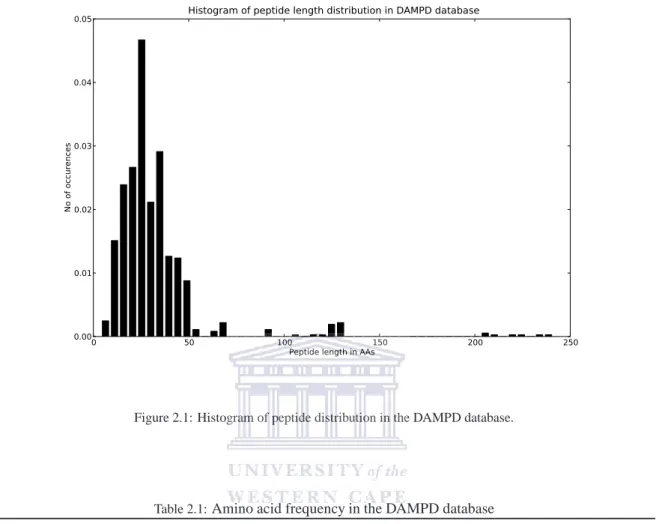
The DAMPD database is the most elaborate repository of experimentally validated AMPs to date that has been manually curated. The database currently has 1232 number of entries (last updated on6thof April, 2011), extracted from UniProt. The entries contain peptides ranging from both eukaryotic and prokaryotic organisms. The motivation for creating the database is to get reliable data that can be used for modeling of AMPs into their respective families. This database is useful as it will form the dataset used in the modeling processes of chapter 3 and 4.5. In addition to the peptide information, DAMPD database has utilities which assist in searching for AMPs such as species search, families search, taxonomy search, keyword search, citation search and advance search. It has an integrated analytical tools such as BLAST, ClustalW, hydrocalculator, SignalP and HMMER. These tools enhances analysis and classification of AMPs. Figure 2.1 and Table 2.1 and gives the statistics of the data stored in DAMPD database. Figure 2.1, shows that most of the peptides have amino acid sequence length varying from 20 to 50 residues. Table 2.1 summarizes the amino acid percentages where glycine (10.44%) is most abundant amino acid followed by leucine (9.16%).
The characteristics of the database namely, its architecture, organization, utilities, graphical views and tools are presented in subsection 2.2.1, 2.2.2, 2.2.3 and 2.2.5 respectively. Comparison of DAMPD database with existing databases is discussed in section 2.2.6.
2.2 Characteristics of the Database 14
0 50 100Peptide length in AAs150 200 250
0.00 0.01 0.02 0.03 0.04 0.05 No of occurences
Histogram of peptide length distribution in DAMPD database
Figure 2.1: Histogram of peptide distribution in the DAMPD database.
Table 2.1:Amino acid frequency in the DAMPD database
Amino acid Number of residues % of total residues
C (Cysteine) 213 2.63 G (Glycine) 847 10.44 P (Proline) 417 5.14 A (Alanine) 860 10.6 V (Valine) 523 6.45 L (Leucine) 743 9.16 I (Isoleucine) 396 4.88 M (Methionine) 138 1.70 F (Phenylalanine) 367 4.52 Y (Tryrosine) 166 2.05 W (Tryptophan) 84 1.04 H (Histidine) 229 2.82 K (Lysine) 566 6.98 R (Arginine) 396 4.88 Q (Glutamine) 330 4.07 N (Asparagine) 428 5.27 E (Glutamic acid) 298 3.67 D (Aspatic acid) 298 3.67 S (Serine) 434 5.35 T (Threonine) 381 4.70
2.2.1 Database architecture 15 2.2.1 Database architecture
The dampd database is built on a linux operating system using the Apache web server, perl, python, PHP and MySQL relational database system. This architecture is shown in Figure 2.2, where PHP retrieves MySQL data.
Web Server: Apache
PHP script PHP MySQL Data Obtain Dynamic page Page Request
Figure 2.2: PHP retrieves MySQL data to produce Web pages.
2.2.2 Database organization
Each DAMPD entry includes a description of the sequence, i.e., the entry information, name and origin, bibliography, comments, cross-references, DAMPD annotation and sequence information. An example of an entry in DAMPD database is shown in Figure 2.3. The annotation of each entry in the database con-tains the following fields. A unique DAMPD accession number that defines each record in the DAMPD database. Next, the protein name field gives the name of the peptide according to UniProt nomenclature. The field Entry date identifies the date when the entry was made and the description of the protein is given in protein description field. The organism source of AMPs can be found in the species field and its respective taxonomy is shown in the taxonomy field. The field protein existence gives proof of protein’s existence be it at protein level, transcript level, inferred from homology or predicted . The bibliography field contains the literature references of the peptide in question. Relevant comments or remarks can be found in the comment field. The field comments gives the antimicrobial activity (antifungal, antibacterial, antiviral, antiprotozoal), subcellular location and AMP family of the peptide. In cross reference section,
2.2.3 Catalogue utilities 16 the accession number used in UniProt to identify a given protein together with the hyperlink of the cor-responding entry. In addition it provides useful links such as gene ontology (GO) and, other family and domain databases. The DAMPD curated keyword together with its reference is given in DAMPD manual curation field. The details of the sequence regarding the features, length, information (molecular weight) and the peptide sequence is given in the fields “features”, “length”, “sequence info” and “sequence” re-spectively.
2.2.3 Catalogue utilities
The DAMPD database contains several catalogues and integrated tools to help in data extraction and anal-ysis of AMP sequence. One can extract peptides from the database using the following catalogues namely, taxonomy catalogue, species catalogue, citation catalogue, keyword catalogue, family catalogue and ad-vance search catalogue. This catalogues have vocabulary of terms whereby the entries in the database is retrieved. It also have additional functionality, which allows the user to choose individual entries from a search pool. That is, after generating a search result, the user can select individual records [from the result pool] for further processing.
In taxonomy catalogue, each peptide entry has a corresponding taxonomical classification, where each catalogue is made up of unique classification along with its corresponding total number of peptides en-closed in bracket. In the species catalogue, each peptide entry comes from a specific species and this is stored with its corresponding peptide ID with its corresponding peptide ID and a catalogue is made with to-tal numbers shown in bracket. As for keyword cato-talogue, one can extract peptides using certain keywords given in the catalogue. In the family catalogue, one can search peptides using different AMPs sub-classes. The citation catalogue traces back all database entries to the original references. It is sub-divided into title (RA), journal (RL), author (RA) and year of publication (YR). Hence users can track the contribution of authors of a specific sequenced peptide. In advance search catalogue, there is a selection of search terms where the user chooses his own variable. It also allows user to query the database using field names, which are not listed in the other catalogues. For instance, one can search the entries in the database with the term experimental in the comment field.
2.2.4 Graphical views
The graphical views menu gives an external links to different databases of the query sequence and outputs the results in a graphical way. It furnishes additional information regarding a particular peptide. The
fol-
2.2.4 Graphical views 17
Figure 2.3: An example of DAMPD entry
lowing graphical views are integrated: ProtParam computes the physico-chemical properties of a peptide sequence (Gasteiger et al., 2005). Compute Pl/MW allows user to compute isoelectric point and molecular weight (Bjellqvist et al., 1994). ProtScale generates a profile of each amino acid on a selected protein
2.2.5 Tools 18 (Gasteiger et al., 2005). PeptideMass computes the masses of the generated peptides and also returns the-oretical isoelectric point and mass values for the protein of interest (Wilkins et al., 1997). PeptideCutter predicts potential cleavage sites cleaved by proteases on a given protein sequence (Gasteiger et al., 2005). ModBase is a database of predicted protein structure models (Pieper et al., 2009). SMART a (Simple Mod-ular Architecture Research Tool) that maps a protein sequence to its catalogue of target domains (Letunic et al., 2009). InterPro uses a host of member databases to generate protein signatures, which are used as a basis to identify distant relationships between potentially novel sequences (Apweiler et al., 2000). Pfam is a database of protein family classification, protein domain data and multiple sequence alignments generated using Hidden Markov models (Finn et al., 2010). Prosite is a database, which contains descrip-tions and documentation relating to amino acid profiles, protein domains, families and functional sites (Sigrist et al., 2010). ProtoNet is a database of computationally derived protein structures, which have been clustered and then hierarchically structured using data, derived from UniProt/TrEMBL (Sasson et al., 2003).
2.2.5 Tools
The DAMPD database contains the following tools to assist in the analysis of AMP sequences, namely BLAST (Altschul et al., 1990) and ClustalW (Thompson et al., 1994), NJplot (Perri´ere and Gouy, 1996), HMMER (Eddy, 1998) and Hydrocalculator (Tossi et al., 2002) and SignalP (Bendtsen et al., 2004). They are integrated in the system and can be accessed either from the tool page or from the catalogue results page.
Catalogue-integrated tool
Each catalogue page (taxonomy, species etc) contains integrated tools such as BLAST, ClustalW, HM-MER, hydrocalculator and SignalP. When the user performs a search, the result page shows the summary of the peptides and the user can choose to analyse (using tools) the entire result set or chosen set of se-quences from the total set.
Standalone tool
The DAMPD database tools can also operate on a standalone basis, which is located on the tool menu. That is, the user can process sequences contained in the database or any other sequences. For example, one can perform multiple alignment of antimicrobial sequences using ClustalW and in addition, one can
2.2.6 Comparison of DAMPD database with existing databases 19 view phylogenetic tree of the aligned sequence generated by ClustalW using NJplot. HMMER allows user to tentatively classify unknown sequences into a particular antimicrobial family using two ways: (i) the user can either use 27 predefined antimicrobial library of profiles or (ii) use their own generated profiles. The physicochemical properties of the peptides such as hydrophobicity, net charge, percentage of hydrophobic residues, mean hydrophobicity and mean hydrophobic moment can be calculated using the hydrocalculator tool. SignalP can be used to predict the signal cleavage site of a peptide. The results page for ClustalW, HMMER, hydrocalculator, signalP are given in the Appendix A.1, A.2, A.3 and A.4 respectively.
2.2.6 Comparison of DAMPD database with existing databases
Several database has been created to store AMPs. For example, in APD2 (Antimicrobial Peptide Database) (Wang et al., 2009), the quality of annotation is poor in terms of function and the database does not have links to other databases. CAMP (collection of Anti-Microbial Peptides) database (Thomas et al., 2010) has quite good quality of functional annotation in the entries but not all entries have been fully anno-tated. It contains 1216 experimentally verified proteins, but at least a hundred of their entries include proteins that are annotated wrongly, or have antitumor activities only. AMSDb (Antimicrobial Sequences Database)http://www.bbcm.units.it/˜tossi/amsdb.htmlis another simplified mini-versions of entries found in UniProt. The number of peptide entries has not been updated for the last seven years. There is no analytical tools in this database. Defensin knowledgebase (defensin) (Seebah et al., 2007; Verma et al., 2007) bactibase (bacteriocin) (Hammami et al., 2009, 2007), PenBase (penaeidin) (Gueguen et al., 2006), peptaibol Database (peptaibols) (Whitmore et al., 2003), SAPD (Synthetic Antibiotic Pep-tides Database) (Wade and Englund, 2002), CyBase (cyclic protein) (Mulvenna et al., 2006; Wang et al., 2008a), BAGEL (bacteriocins) (de Jong et al., 2010, 2006) and PhytAMP (plant ) (Hammami et al., 2009) are specialised database and not regularly updated. DAMPD database is the most elaborative warehouse of natural AMPs to date, which has been manually curated. It contains 1232 antimicrobial peptides that have entries obtained from UniProt. The entries come from both eukaryotic and prokaryotic organisms. Nonetheless, the database has utilities and integrated data extraction tools such as search utilities (taxon-omy, classification, keyword, citation, families and advance search), graphical views and analytical tools. It is updated after six months. Comparison of DAMPD database with other databases is shown in Table 2.2.
2.3 Material and methods 20
Table 2.2:Comparison of DAMPD database with other databases
Features Nature # of Expt. AMPs Search tools Analytical tools Graphical views AMP Prediction
Defensin Specific 363 Absent Absent Absent Absent
PenBase Specific 29 Absent Absent Absent Absent
Peptaibol Specific 317 Absent Absent Absent Absent
AMSDb Specific 895 Absent Present Absent Absent
SAPD Specific 200 Absent Present Absent Absent
APD General 1502 Absent Present Absent Based on similarity
approach
PhytAMP Specific 273 Present Absent Present Based on HMM
pro-files
CAMP General 1216 Present Absent Absent Based on SVM,
ran-dom forest, discrimi-nant analysis
DAMPD General 1232 Present Present Present Based on HMM and
SVM model
2.3
Material and methods
The Dragon antimicrobial peptide database was created on6thof April, 2011 with 1232 curated AMP that
have been experimentally validated. The schematic flowchart for building the database is given in Figure 2.4. The process for obtaining the DAMPD peptides involve extraction and curation. Then the clean data is coupled with search and analytical tools.
2.3.1 Data extraction
The raw data was retrieved from UniProt database by using the search term “antimicrobial [KW-0929]”. Entries that had been assigned either to protein existence level “evidence at protein level” or ”evidence at transcript level” were concentrated on. The extracted raw data from UniProt contains misannotation and hence there is need to curate them.
2.3.2 Data curation
The exponential growth in the amount of biological data means that revolutionary measures are needed for data management, analysis and accessibility. Due to rapid release of new data from genome sequencing projects, the majority of protein sequences in public databases have not been experimentally characterized; rather, sequences are annotated using computational analysis. The level of misannotation and the types of misannotation in large public databases are currently unknown and have not been analyzed in depth (Harris, 2003; Schnoes et al., 2009). For example the entries in UniProtKB should be of high quality
2.3.2 Data curation 21
UniProt
Data extraction using keyword search
Uncurated data
Biocuration
DAMPD Database
Search tools Graphical view Analytical tools
taxonomy search species search keyword search citation search Advance search BLAST ClustalW HMMER Hydrocalculator SignalP
Figure 2.4: Flowchart describing the procedure for DAMPD database
annotation before they are made public. However, there are mistakes and some of these include but not limited to
• wrong keywords, e.g. antibiotic or fungicide tagged in an entry where they should not be,
• incorrect function annotation of a particular entry, and
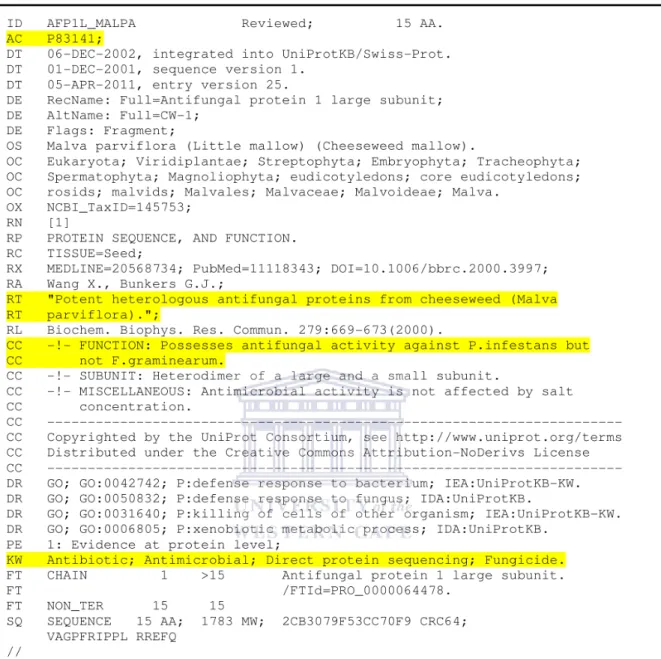
2.3.3 Building HMMER profiles for prediction of AMPs 22 One strategy to correct inconsistencies and errors in data representation is through biocuration process. Biocuration is the activity of organizing, representing and making biological information accessible to both humans and computers (Howe et al., 2008). For this purpose, the raw (uncurated) data extracted from UniProt was checked manually to ensure that they have the correct annotation by searching the lit-erature. Some of the entries extracted from UniProt have wrong annotation attached to them especially the keyword. An example of an entry in UniProt with wrong keyword (KW) annotation is located at
http://www.uniprot.org/uniprot/P83141. This is shown in Figure 2.5, where the KW line has the
keyword antibiotic but the function line denoted by RT only mentions activity against Phytophthora infes-tans(fungi) but mentions nothing about activity against bacteria. The RT line talks about potent antifungal proteins, meaning that the protein has been experimented on, and the paper only proves antifungal activity but says nothing about the antibacterial activity. Another example of an entry in UniProt with wrong func-tion annotafunc-tion is of conolysin-Mt1 peptide (http://www.uniprot.org/uniprot/P0C8S6). This peptide has the following error in the function tag of the entry, i.e., the curators have introduced the term ”Michael Jackson” which is not listed in the original article.
.. Intracranial injection causes mice to shuffle backward until the encounter an obstacle, at which time the mouse jump into the air. The backward shuffle is reminiscent to the signature dance ’moonwalk’ that gained widespread popularity after being performed by Michael Jackson
Each annotation of the raw data was verified for its antimicrobial activity using published work. The final curated data set was used as an input for the MySQL database and the online version of the DAMPD database was uploaded in the link http://apps.sanbi.ac.za/dampd/. Supplementary material on biocuration of AMPs is found in the link http://apps.sanbi.ac.za/dampd/biocuration.xls. The data in the DAMPD database was complemented by additional functionalities to aid in analysis. This include graphical views, search utilities (keyword, family, taxonomy, species, citation, advance) and analytical tools (BLAST, ClustalW, HMMER and hydrocalculator). The process for creating the models using HMMER is discussed in the next section 2.3.3.
2.3.3 Building HMMER profiles for prediction of AMPs
An integrated antimicrobial peptide analysis tool called HMMER is created with the objective to infer AMP family of a query sequence. The HMMER program has three functionalities namely hmmbuild, hmmcalibrate and hmmsearch (Eddy, 1998). The HMMER tool has precompiled libraries of AMP family profiles by using “HMMER: Query Profile” option. Nevertheless, user can build tailored profiles based on
2.3.3 Building HMMER profiles for prediction of AMPs 23
Figure 2.5: Annotation error in a peptide with accession number P83141
their own sequences by choosing the option “HMMER: Build Profile”. HMMER profiles has been created out of mature peptide for different families. The procedure involved in building profiles is described as follows:
• each family protein sequence are aligned using ClustalW (Thompson et al., 1994).
• build HMM profile from the aligned sequences using hmmbuild module.
2.3.4 Methodology for hydrocalculator tool 24
• calibrate the profile HMM using hmmcalibrate modules in order to increase sensitivity of the database search.
The profiles from the above procedure is saved as a specific AMP family library, for example defensin.hmm, brevinin.hmm etc.
2.3.4 Methodology for hydrocalculator tool
The hydrophobic residues are I, V, L, F, C, M, A and W. The percentage of hydrophobic residues of a peptide sequence (seq) is
%of hydrophobic residues= Number of hydrophobic residues inseq
Length of the sequence(seq) (2.1)
The positively charged residues are I, V, L, F, C, M, A, W, R, H and K. The negatively charged residues are D and E. The remaining of the 20 amino acid residues are neutral. The net chargeQof a sequence is the summation of charges of each its residues.
Hydropobicity is a fundamental attributes of amino acid residues that determines protein folding, pro-tein subunits interactions binding to receptors and interactions of propro-teins and peptides with biological membranes (Tossi et al., 2002). The mean hydrophobicityH¯ of a sequence is given by
¯ H = n X i=1 fk(i) n , (2.2) where
• nis the length of the primary protein sequence,
• itheithamino acid
• fk(i)is the value of theithamino acid of the respectivekthamino acid property,
The hydrophobic moment of a sequence seq gives an indication as to how the hydrophobicities of its constituent residues if a particular segement of the the sequences happens to be folded into particular conformation, i,e,α-helix orβ-helix. The hydrophobic moment of a sequence is given by
MH = (" X residue n Hnsin(nσ) #2 + " X residue n Hncos(nσ) #2)12 (2.3) where
2.4 Future work 25
• P
residue nis the summation over all residues of the sequence, • Hnis the hydrophobicity of thenthresidue,
• σis the angle at which successive side chains emerge from the central axis of the secondary structure segment whereσ = 100forα-helix (Tossi et al., 2002).
The mean hydrophobic moment isMH/sequence length.
2.4
Future work
Antimicrobial database is important for scientists in academia and industry. In order for the database to maintain its usefulness, regular updating and data enrichment with additional information on AMP is crucial. Nonetheless, more analytical tools inform experimentalist is needed. Therefore, some of the future work entails:
• furnishing information on promoter and transcription of AMP immunity genes
• including robust methods such as machine learning approach to aid in classification of AMPs into distinct families.
2.5
Summary
DAMPD is a database that has been built with the aim of making a comprehensive repository of experi-mentally validated AMPs complemented by search and analytical tools to help in extraction and analysis of AMPs. DAMPD has useful tools such as BLAST, ClustalW, SignalP, hydrocalculator and HMMER. The HMMER query profile module, enables users to predict the AMP families of a query sequence. It also assists in capturing of new peptide homologs from other public databases and laboratories.
Chapter 3
Prediction of AMPs using parameter
optimized support vector machines
Abstract
Background: Antimicrobial peptides (AMPs) are important components of the innate immune systems of many species. The peptides can serve as a natural templates for the design of novel antibiotics. The number of unchar-acterized proteins are increasing, there is need to develop robust computational techniques that can be used to mine new potential AMPs from the protein universe.
Methods: Support vector machine (SVM) is a classification technique that highly depends on certain hyperparam-eters that affects the classification accuracy. The aim of this study is to obtain the best hyperparameter values of SVM. In particular, three optimization methods, namely grid search (GS), pattern search (PS) and derivative-free simulated annealing (DFSA) are used to select SVM hyperparameters, denoted by GS-SVM, PS-SVM and DFSA-SVM respectively.
Results: The SVM models were created using two experiments, first based on the whole AMPs of a particular tax-onomy (generalized model), second, based on family classification of each taxtax-onomy (specialised model). Results indicates that DFSA-SVM method was the best overall with an accuracy of 97.95% using generalized model while PS-SVM is the overall best method with an accuracy of 99.25% using specialized model.
Conclusion: The selection of SVM hyperparameters is important in order to get useful models to predict AMPs. Prediction of AMPs using specialized models is more robust than generalized models.
26
3.1 Introduction 27
3.1
Introduction
Antimicrobial peptides (AMPs) are an important component of the natural defense system of most living organisms against invading pathogens. They are widely distributed in eukaryotes and prokaryotes, such as bacteria, insects, plants, amphibians and viruses. They are relatively small in size, less than 10 kDa in size. These peptides either have cationic or amphiphatic forms with variable length, sequence and structures which contribute to the diversity of the AMPs. They play an important role in innate immunity and are the first line of defense (Hancock and Chapple, 1999; Wang and Wang, 2004).
The number of AMPs is increasing and there are well over four thousand peptides in UniProtKB (Bairoch and Apweiler, 2000) of which only 1232 are experimentally validated AMPs found in dragon antimicrobial peptide database (see chapter 2). Experimental methods used in characterizing AMPs are costly, time consuming and resource intensive. Thus, there is need to develop computational tool for predicting AMPs, in order to inform experimental approaches. Furthermore, identification of AMPs can serve as a natural template for designing novel antibiotics useful in combating or controlling diseases.
In the past, computational approaches have been designed to predict novel antimicrobial peptide from protein sequences. Recently, random forest has been applied in predicting antimicrobial peptides (Thomas et al., 2010). Artificial Neural Networks (ANN), Quantitative Matrices (QM) and Support Vector Machines (SVM) has been designed to predict antibacterial peptides (Lata et al., 2010, 2007). Quadratic discrimi-nant analysis was used in classification of antimicrobial peptides using diversity measure with quadratic discriminant analysis (Chen and Luo, 2009). Fourier transform based method with property based coding strategy could be used to scan the peptide space for discovering new potential antimicrobial peptides (Na-garajan et al., 2006). Decision trees have been developed for classification of antimicrobial peptides (Lee et al., 2004).
To identify the AMPs computationally, a support vector machine (SVM) (Boser et al., 1992; Vapnik, 2000) is implemented. The SVM learn patterns based on examples and creates a model that classifies the positive and negative AMPs. The discriminative quality of the model depends on two hyperparameters of the SVM namely, trade off (c) and RBF kernel parameter (σ) (Duan et al., 2003). SVM has been used to predict AMPs as mentioned above. Nonetheless, no effort has been made to optimize the hyperparameters of the SVM, that ultimately improves the classification accuracy.
Several optimization methods have been suggested to select SVM model hyperparameters. For exam-ple, a hybrid of SVM with a genetic algorithm (Samanta et al., 2006) and simulated annealing (Lin et al.,
3.2 Algorithm 28 2008). However, these approaches are computationally expensive and suffer from slow convergence. In addition, direct search methods such as Nelder and Mead (Dama˘sevi˘cius, 2010) have been employed. One of the disadvantages of this method is that it lacks mathematical proof for convergence. Grid search has also been used to select SVM hyperparameters (Samanta et al., 2006). Grid search is computation-ally expensive for a larger number of parameters and the solution depends upon the coarseness of grid. Nonetheless, it lacks optimality criteria for solution (Dama˘sevi˘cius, 2010).
To ameliorate the above limitations of selecting hyperparameters, two approaches are utilized namely pattern search (PS) (Abramson et al., 2004; Audet et al., 2008; Kolda et al., 2003) and derivative-free simulated annealing (DFSA) (Gabere, 2007). Both PS and DFSA are recent direct search methods for local and global optimization respectively. The important feature of these methods, is that they guarantee mathematical convergence (Gabere, 2007; Torczon, 1991).
In this chapter, SVM is hybridized with three different optimization methods namely, GS, PS and DFSA, where the fundamental structure of SVM is kept intact. These hybrid methods are denoted as GS-SVM, PS-SVM and DFSA-SVM and are used to predict antimicrobial peptides in various taxa. The proposed hybrid methods, GS-SVM, PS-SVM and DFSA-SVM methods are shown to be efficient methods in predicting AMPs.
The chapter is organized as follows. Section 3.2 presents the algorithm, that is, support vector machine and proposed algorithms for optimizing SVM hyperparameters. Section 3.3 discusses the material used that is, dataset, multi-class strategy, feature representation, scaling and performance measure. Results are presented in section 3.4 followed by discussion in section 3.5. Finally, summary is made in section 3.6.
3.2
Algorithm
3.2.1 Support vector machines
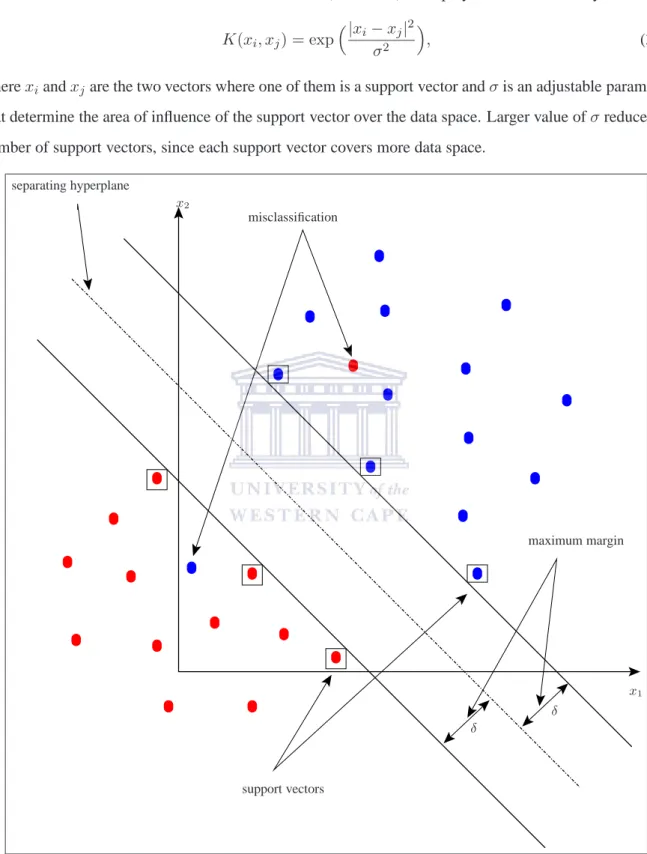
The Support vector machine is a modeling technique that performs data classification by constructing ann−dimensional hyperplane that optimally separates the data into two classes (Cristianini and Shawe-Taylor, 2001; Vapnik, 2000). The input of an SVM is a training set
S= (x# »1, y1),· · · ,(x# »n, yn)
3.2.1 Support vector machines 29 of vector of featuresx#»i ∈ X together with their known classes yi ∈ {−1,