DRAFT
COMMITTEE T1 – TELECOMMUNICATIONS
Working Group T1M1.5
T1M1.5/2003-007R5
May 24, 2003
DOCUMENT TYPE: DRAFT AMERICAN NATIONAL STANDARD TITLE: Baseline Security Requirements for the Management Plane SOURCE*: T1M1.5 Security Requirements Ad Hoc Group
PROJECT: Management Services, TMN
_______________________________ ABSTRACT
This contribution is a revision to T1M1.5/2003-007R4. It captures changes agreed to during the second LB117 default letter ballot. Since the ATIS/T1 Chief Editor will remove and replace any table of contents supplied by the Editor and since the Chief Editor has requested that auto-numbering headers not be used in draft standards, no table of contents is supplied at this time with this draft standard.
NOTICE
This is a draft document and thus, is dynamic in nature. It does not reflect a consensus of Committee
T1-Telecommunications and it may be changed or modified. Neither ATIS nor Committee T1 makes any representation or warranty, express or implied, with respect to the sufficiency, accuracy or utility of the information or opinion contained or reflected in the material utilized. ATIS and Committee T1 further expressly advise that any use of or reliance upon the material in question is at your risk and neither ATIS nor Committee T1 shall be liable for any damage or injury, of whatever nature, incurred by any person arising out of any utilization of the material. It is
T1M1.5/2003-007R5
Draft proposed American National Standard
for Telecommunications
Operations, Administration, Maintenance, and
Provisioning Security Requirements for the Public
Telecommunications Network: A Baseline of Security
Requirements for the Management Plane
Secretariat
Alliance for Telecommunications Industry Solutions
Approved Month__, 20__
American National Standards Institute, Inc.
Abstract
This standard contains a set of baseline security requirements for the management plane. The President’s National Security Telecommunications Advisory Committee Network Security Information Exchange (NSIE) and Government NSIE jointly established a Security Requirements Working Group (SRWG) to examine the security requirements for controlling access to the public switched network, in particular with respect to the emerging next generation network. In the telecommunications industry, this access incorporates operation, administration, maintenance, and provisioning for network elements and various supporting systems and databases. Members of the SRWG, from a cross-section of telecommunications carriers and vendors, developed an initial list of security requirements that would allow vendors, government departments and agencies, and service providers to implement a secure telecommunications network management infrastructure. This initial list of security requirements was submitted as a contribution to Committee T1 – Telecommunications, Working Group T1M1.5 for consideration as a standard. The requirements outlined in this document will allow vendors, government departments and agencies, and service providers to implement a secure telecommunications network management infrastructure.
Foreword
The information contained in this foreword is not part of this American National Standard (ANS) and has not been processed in accordance with the American National Standards Institute’s requirements for an ANS. As such, the foreword may contain material that has not been subjected to public review or a consensus process. In addition, it does not contain requirements necessary for conformance to the standard.
Executive Orders and Presidential directives and commissions have identified eight infrastructures as critical national assets necessary for the defense and economic security of the United States. Telecommunications is one of these critical infrastructures. The President’s National Security Telecommunications Advisory Committee Network Security and Information Exchange (NSIE) and Government NSIE established a Security Requirements Working Group (SRWG) to examine the security requirements for controlling access to the public switched network, in particular with respect to the emerging next generation network. In the telecommunications industry, this access incorporates operation, administration, maintenance, and provisioning for network elements and various supporting systems and databases (i.e., operational support system).
Members of the SRWG, from a cross-section of telecommunications carriers and vendors, developed an initial list of security requirements that would allow vendors, government departments and agencies, and service providers to implement a secure telecommunications network management infrastructure. This initial list of security requirements was submitted as a contribution to Committee T1 – Telecommunications, Working Group T1M1.5 for consideration as a standard.
Although these requirements employ telecommunications terms and formats, the underlying principles should apply equally to the management of computing elements in the other infrastructures. Other infrastructures may wish to modify and apply these recommendations as appropriate to their respective infrastructure.
This document is entitled Operations, Administration, Maintenance, and Provisioning Security Requirements for the Public Telecommunications Network: A Baseline of Security Requirements for the Management Plane. There are three annexes in this standard that are informative and are not considered part of this standard. Footnotes are not officially part of this standard.
Future control of this document will reside with Accredited Standards Committee – Telecommunications, T1. This control of additions to the specification, such as protocol evolution, new applications, and operational requirements, will permit compatibility among U.S. networks. Such additions will be incorporated in an orderly manner with due consideration to the International Telecommunication Union – Telecommunications Sector layered model principles, conventions, and functional boundaries.
Suggestions for improvement of this standard are welcome. These should be sent to the Alliance for Telecommunications Industry Solutions, T1 Secretariat, 1200 G Street, NW, Suite 500, Washington, DC 20005.
T1M1.5 Committee members list:
Working Group T1M1.5 – Security Requirements Ad Hoc Group developed this standard. Over the course of its development, the following individuals participated in the group's discussion and made significant contributions to the standard:
Michael McGuire, Chair Tom Grim, Vice Chair
Stuart Jacobs, Technical Editor Michael Lee, Technical Editor Greg Shannon, Technical Editor Marcia McGowan, Editorial Editor
Andrea Livero-Scott, Editorial Editor Contributors: Brennan Baybeck Bob Beeman Kathy Blasco David Dumas Jack Edwards Renee Esposito Mike Fargano Mike Frank Richard Graveman Martin Hogg Frank Horsfall George Jones John Kimmins Hing-Kam Lam Christopher Lonvick Hank Mauldin Kevin McMahon Lakshmi Raman Moshe Rozenblit Jim Stanco Fred Staples Rod Wallace Joe Wolfkiel Bob Wright
Table of Contents Table of Tables Table of Figures
AMERICAN NATIONAL STANDARD T1M1.5/2003-007R5
Draft proposed American National Standard for Telecommunications –
Operations, Administration, Maintenance, and
Provisioning Security Requirements for the Public
Telecommunications Network: A Baseline of Security
Requirements for the Management Plane
0 Introduction
Executive Orders and Presidential directives and commissions have identified telecommunications as a critical infrastructure, necessary for the defense and economic security of the United States of America. Appropriate security for the network management functions controlling this infrastructure is essential. Many standards for network management security exist. However, compliance is low and implementations are inconsistent across the various telecommunications equipment and software components. This document identifies a minimum set of requirements to allow vendors, Government departments and agencies, and service providers to implement a secure network management infrastructure. Although the present baseline represents the current understanding of the state of the art, technologies will advance and conditions will change. To be successful, this document must evolve as conditions warrant. This document is intended as a foundation. Service providers may include unique requirements to meet specific needs over and above those in this baseline.
1 Scope, Purpose, and Application
In some telecommunications networks, management traffic is often transmitted on a separate network from that carrying the service provider's end-user traffic. In these networks, security threats to the management plane are completely isolated from any malicious activity on the end-user plane. The management plane is relatively easy to secure because access to this plane is restricted to known administrators and traffic is restricted to known management activities. However, in some cases management traffic is combined on a single network with the service provider's end-user traffic. Combining traffic in this manner minimizes costs by requiring only a single integrated network infrastructure; however, many new security challenges are introduced. Threats in the end-user plane now become threats to the management and control planes. The management plane now becomes accessible to the multitude of end-users and many types of malicious activities become possible. The purpose of this document is to recommend minimum baseline security mechanisms to help mitigate security risks in the management of telecommunications networks.
To provide a complete end-to-end solution, all security measures (e.g., access control, authentication) should be applied to each type of network activity (i.e., management plane activity, control plane activity, and end user plane activity) for the network infrastructure, network services, and network applications. This document focuses specifically on the security aspect of the management plane for network elements (NE) and management systems (MS), which are part of the network infrastructure. As such, the document addresses only one aspect of an overall end-to-end security solution, but may be used as a starting point for subsequent documents addressing the security of “control” and “end user” planes, as appropriate.
The requirements in this standard are applicable to NEs and MSs to be deployed in the future. For NEs in the network that do not meet all the mandatory security requirements, the overall security requirements at the network architecture design should be supported. This document addresses security for NE, MS,
and element management system (EMS) equipment, and does not specifically address security for other equipment such as customer premise equipment (e.g., voice over Internet Protocol [IP] telephones) or independent test gear. For suchother equipment, all mandatory requirements in this document should be considered objective recommendations.
1.1 Framework and Model
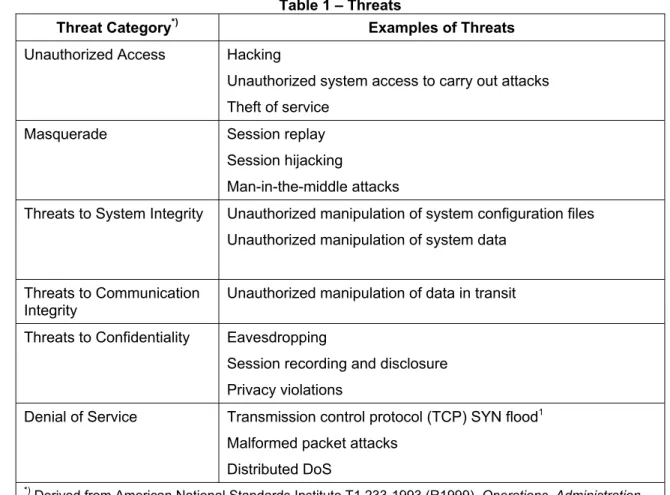
In the context of this document, to secure something means to protect it (i.e., computers, networks, data, or other resources) from unauthorized access, use, or activity. Loss of data, denial of service (DoS), theft of service, and loss of customer confidence are only some of the results of security incidents. System and network administrators need to protect systems and their component elements from users and from attackers. Although security is multifaceted (spanning operations, physical, communications, processing, and personnel), of concern here are security problems resulting from weaknesses inherent in commonly employed configurations and technology. A threat consists of, but is not limited to, disclosure, unauthorized use, change, and denial of service. Table 1 lists some security threats.
Table 1 – Threats
Threat Category*) Examples of Threats
Unauthorized Access Hacking
Unauthorized system access to carry out attacks Theft of service
Masquerade Session replay
Session hijacking
Man-in-the-middle attacks
Threats to System Integrity Unauthorized manipulation of system configuration files Unauthorized manipulation of system data
Threats to Communication Integrity
Unauthorized manipulation of data in transit Threats to Confidentiality Eavesdropping
Session recording and disclosure Privacy violations
Denial of Service Transmission control protocol (TCP) SYN flood1
Malformed packet attacks Distributed DoS
*) Derived from American National Standards Institute T1.233-1993 (R1999), Operations, Administration,
Maintenance, and Provisioning—Security Framework for Telecommunications Management Network Interfaces and International Organization of Standardization (ISO) 7498-2: 1989 Information Processing Systems—Open Systems Interconnection Basic Reference Model—Part 2: Security Architecture.
These security threats may be minimized or mitigated within a network system or NE platform or application by inclusion of security services (as defined in ISO 7498-2:1989 Information Processing Systems—Open Systems Interconnection Basic Reference Model—Part 2: Security Architecture) to enforce the following:
• Identification and AUTHENTICATION
• Authorization and ACCESS CONTROL Level
• Data Integrity
• Privacy and Confidentiality
• Nonrepudiation.
This document addresses security for the management plane—that is, security features to ensure that the network can be administered and managed in a secure manner. Some vulnerability may still exist, even after following the recommendations contained in this document. The following risks are among those with the capability to compromise the management plane:
• Inappropriate actions by authorized users. These actions can be either malevolent or accidental.
• Security for the control plane (e.g., signaling, routing, naming, and discovery protocols) and the end-user plane.
• The effects of vulnerabilities in specific protocols.
• Malware (e.g., viruses, Trojan horses, worms, or other embedded code). Once malware successfully compromises any NE/MS, the malware may use the secure network communication links to transmit attacks to other NE/MS components. These attacks may continue until network managers detect the attack and take action to eliminate it.
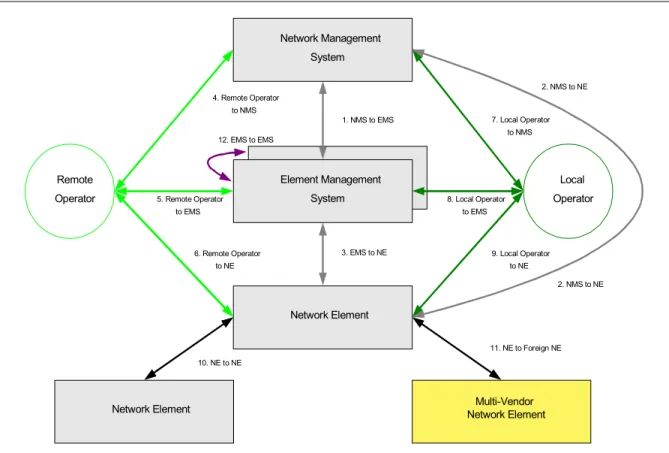
This document is concerned with the security of management traffic, especially when it traverses networks mixed with end-user traffic. Figure 1 illustrates a reference model that is used to specify network management security solutions. This model is used to examine logical communication paths within the entire network and quantify which protocols are used for communications on each path. Using this model, threats and vulnerabilities can be examined for each path, and appropriate security mechanisms can be applied.
Multivendor NEs are shown at the bottom of the model in figure 1. EMSs that provide specific management functions for the particular NE are illustrated above the NE. The network management system (NMS) itself is at the top of the model. The NMS provides overall management to the NE and EMS, and contains the specific service management applications and the business management applications, such as configuration and billing systems. Remote and local operators are also shown in the model and communication paths are shown with all other system elements.
Network Management System Network Element Remote Operator Local Operator
Network Element Network ElementMulti-Vendor 2. NMS to NE 1. NMS to EMS 3. EMS to NE 4. Remote Operator to NMS 5. Remote Operator to EMS 6. Remote Operator to NE 7. Local Operator to NMS 9. Local Operator to NE 8. Local Operator to EMS 10. NE to NE 11. NE to Foreign NE 2. NMS to NE Element Management System Element Management System 12. EMS to EMS
Figure 1 – Network management security reference model
The Security Reference Model (figure 1) may also be useful in correlating telecommunications management network (TMN)-defined interfaces to the security model. The TMN is defined in International Telecommunication Union – Telecommunications Sector (ITU-T) Recommendation M.3010,
Principles for a telecommunications management network. It is defined as an architecture for management, including planning, provisioning, installation, maintenance, operations, and administration of telecommunications equipment, networks, and services.
In the TMN standard, against which service providers have indicated they will standardize, it is identified that multiple network infrastructures and multiple TMNs may exist. In fact, the management of NEs by their associated MSs in the typical service provider environment may traverse numerous data communications networks (DCN). This management traffic may need to negotiate several access control mechanisms (e.g., firewall devices or router access lists, and/or network connections and interconnections) in order to get to the NE in question. NEs must traverse many of the same networks and interconnections for return traffic. As such, vendors should know and understand the possible latency issues and work towards delivering solutions to address those issues.
1.2 Design Guidelines
Table 2 presents design guideline objectives that attempt to satisfy the requirements in clause 5 to mitigate the threats proposed in Table 1.
Table 2 – Design Guidelines Considered
Guideline Description
Guideline Description
Effective Security Policies Requirements and supporting architectures must allow for policies that are definable, flexible, enforceable, auditable, verifiable, reliable, and usable
Strong
AUTHENTICATION, Authorization, and Accounting (AAA)
Two-factor and cryptographically secure AAA
Highest Benefit for a
Given Cost Improve security by implementing security mechanisms that have widely available implementations and wide spread deployment, so that use histories allow security mechanisms to be reviewed
Path for Improvement Consider next steps for enhancing and improving network management security to further satisfy given requirements with evolving technology and mechanisms or to satisfy newly defined security requirements
Technical Feasibility Requirements must be satisfied with products, solutions, and/or technologies available today
Housekeeping Requirements should be consistent with standard operating procedures of well-run network management operations
Open Standards Use ideas and concepts that are already standardized (e.g., IP security [IPsec], digital signatures). All aspects of the open standards should be addressed including system, protocols, modes, algorithm, option, key size, and encoding
1.3 Applicability of this document to the TMN
This document applies to the entirety of the TMN covering both circuit-based NEs and packet-based NEs. Circuit-based NEs provide multiple logical interfaces between switches, transmission elements, signaling elements, and other special-purpose elements that are designed and developed to support traditional telephony services. The packet-based NE model has migrated from the centralized system where all functions were hosted on one platform to a more distributed system where functions may be hosted by multiple platforms coupled together to form a complete system. These functions can be service or operations related. This document provides a security framework to protect all of the facilities of the NE/MS that are exposed to various threats and risks. This includes platforms, visible interfaces, and associated functions, applications, and services. To provide equal protection to all types of NE/MS, the total overall system security features should be the same for all types of NE/MS. However, depending on the architecture of the resident and distributed features and the available processing capabilities, the implementation scheme of the security features in NE/MS may be different in its details.
Some NE/MS will have the capacity to incorporate security features within themselves. They can fully implement all of the mandatory security requirements in this document. Other NE/MS will not have the capacity to incorporate all of the mandatory security features defined in this document within them. It may be unrealistic to ask for all security features to be embedded within the NE/MS operating system (OS) or application layers of these devices. For these types of devices that exist in or are placed into a network their security properties should be augmented so that the system meets the requirements of this standard. As an example, if a MS cannot provide STRONG ENCRYPTION for MANAGEMENT ACTIONS over a TRUSTED PATH, then an auxiliary device may be placed in the network path so that MANAGEMENT COMMUNICATIONS passing through this device may be performed over an encrypted SESSION. As another example, if an NE cannot directly enforce COMPLEX PASSWORDS, then it may utilize an ACCESS CONTROL server (ACS) that can.
2 Normative References
The following standards contain provisions, which, through reference in this text, constitute provisions of this American National Standard (ANS). At the time of publication, the edition indicated was valid. All standards are subject to revision, and the parties to agreements based on this ANS are encouraged to investigate the possibility of applying the most recent edition of the standard indicated below.
ANSI X9.52-1998, Triple Data Encryption Algorithm Modes of Operation. (available from the ANSI X9 Electronic Standards Store, http://webstore.ansi.org/ansidocstore/dept.asp?dept_id=80)
ANSI X9.62-1998, Public Key Cryptography for the Financial Services Industry: The Elliptic Curve Digital Signature Algorithm (ECDSA), (available from the ANSI X9 Electronic Standards Store, http://webstore. ansi.org/ansidocstore/dept.asp?dept_id=80)
Federal Information Processing Standards (FIPS) Publication 46-3, Data Encryption Standard, National Institute of Standards and Technology, October 1999, (available at http://csrc.nist.gov/publications/fips/ fips46-3/fips46-3.pdf)
FIPS Publication 81, Data Encryption Standard Modes of Operation, National Institute of Standards and Technology, December 1980, (available at http://www.itl.nist.gov/fipspubs/fip81.htm)
FIPS Publication 180-1, Secure Hash Standard, National Institute of Standards and Technology, April 1995, (available at http://www.itl.nist.gov/fipspubs/fip180-1.htm)
FIPS Publication 186-2, Data Signature Standard, National Institute of Standards and Technology, January 2000.
FIPS Publication 197, Advanced Encryption Standard, National Institute of Standards and Technology, November 2001, (available at http://csrc.nist.gov/publications/fips/fips197/fips-197.pdf)
Internet Engineering Task Force (IETF) Request for Comment (RFC) 1321. The MD5 Message-Digest Algorithm. R. Rivest, April 1992, (available at http://www.ietf.org/rfc/rfc1321.txt?number=1321)
IETF RFC 1750. Randomness Recommendations for Security. D. Eastlake, S. Crocker, and J. Schiller, December 1994, (available at http://www.ietf.org/rfc/rfc1750.txt?number=1750)
IETF RFC 2104. Hashed Message Authentication Code: Keyed-Hashing for Message Authentication. H. Krawczyk, M. Bellare, and R. Canetti. February 1997.
IETF RFC 2403. The Use of Hashed Message Authentication Code with Message Digest 5-96 within the Encapsulating Security Payload and the Authentication Header. C. Madson, R. Glenn, November 1998, (available at http://www.ietf.org/rfc/rfc2403.txt?number=2403)
IETF RFC 2404. The Use of Hashed Message Authentication Code with Secure Hash Algorithm 1-96 within the Encapsulating Security Payload and the Authentication Header. C. Madson, R. Glenn, November 1998, (available at http://www.ietf.org/rfc/rfc2404.txt?number=2404)
IETF RFC 2409, The Internet Key Exchange [IKE]. D. Harkins and D. Carrel. November 1998 (available at http://www.ietf.org/rfc/rfc2409.txt?number=2409)
IETF RFC 2437. PKCS #1: Rivest, Shamir, and Adleman Cryptography Specifications Version 2.0. B. Kaliski, J. Staddon. October 1998, (available at http://www.ietf.org/rfc/rfc2437.txt?number=2437)
IETF RFC 2459. Internet Public Key Infrastructure: Part I: X.509 Certificate and Certificate Revocation List Profile. Housley, R., W. Ford, W. Polk, and D. Solo, January 1999, (available at
http://www.ietf.org/rfc/rfc2459.txt?number=2459).
IETF RFC 2945. The SRP Authentication and Key Exchange System. T. Wu. September 2000, (available at http://www.ietf.org/rfc/rfc2945.txt?number=2945).
IETF RFC 1305. Authentication Issues, Appendix C. D. Mills. March 1992, (available at http://www.ietf.org/rfc/rfc1305.txt?number=1305).
ITU-T Recommendation G.8080/Y.1304. Architecture for the Automatically Switched Optical Network (ASON). November 2001, (available at ITU Electronic Bookshop)
ITU-T Recommendation X.500. The Directory: Overview of Concepts, Models and Service, (available at ITU Electronic Bookshop)
ITU-T Recommendation X.509. Information Technology - Open Systems Interconnection: The Directory: Authentication Framework, August 1997, (available at ITU Electronic Bookshop)
National Institute of Standards and Technology Special Publication 800-38A, Recommendation for Block Cipher Modes of Operation: Methods and Techniques, December 2001 (available at
http://cs-www.ncsl.nist.gov/publications/nistpubs/800-38a/sp800-38a.pdf) 3 Definitions
The following terms appear in capital letters when they are used in a requirement statement.
3.1 Access Control: The prevention of unauthorized use of a resource including the prevention of use of a resource in an unauthorized manner.2
3.2 Application Administrator: A role responsible for the proper activation, maintenance, and usage of an NE/MS application. Application administration tasks include upgrading application software.3
3.3 Application Security Administrator: A role responsible for the proper activation, maintenance, and usage of the application layer security features of a NE/MS. Represents the highest level of security authority for a NE/MS application instance. Tasks include:
• • • • • •
Define and assign new user and group privileges at the application level Maintain a record of all requests for login IDs to the application
Add and delete users at the application level Monitor all application security logs
Configure application security logging and alarms Manage application security logging processes
2 Taken from ANSI T1.233-1993 (R1999), Operations, Administration, Maintenance, and Provisioning—Security
Framework for Telecommunications Management Network Interfaces, Clause 3.1.
3 This task may be a function of the SYSTEM ADMINISTRATOR, if SUPERUSER authority is necessary to complete
• • • • • • • • •
Terminate any user application session
3.4 Application User/Operator: A role that has authorization to access business and management functions provided by the NE/MS but has no authorization to access any system administration or security administration operations within a system other than changing one’s own password.
3.5 Authentication: AUTHENTICATION is the act of verifying a claimed identity.
3.6 Complex Passwords: A password is characterized as “complex” when it has some combination of alphabetic, numeric, and special characters.
3.7 Control Plane: The CONTROL PLANE performs call control and connection control functions. Through signaling, the CONTROL PLANE sets up and releases connections, and may restore a connection in case of a failure.4
3.8 Critical Security Administration Actions: A SYSTEM SECURITY ADMINISTRATOR is responsible for the proper activation, maintenance, and usage of the security features of a system (NE/MS). CRITICAL SECURITY ADMINISTRATION ACTIONS include, but not limited to:
Define and assign user privileges Add and delete user IDs
Disable the use of specific user IDs as login IDs Initialize and reset login passwords
Initialize and change cryptographic keys
Set the system’s aging threshold for login passwords
Set the system’s limit on the number of failed logins for each login ID Remove a lockout, or change the system’s lockout timer value
• Set the system’s inactivity timer value
• Set system security logging and alarm configuration
• Manage the security logging processes
• Upgrade security software
• Terminate any user or system session
3.9 Disable/Disabled: When referring to a user ID, a state in which the user ID cannot be used for login until the ID has been enabled by specific action from another user ID with the appropriate authorization privileges (e.g. SYSTEM SECURITY ADMINISTRATOR or APPLICATION SECURITY ADMINISTRATOR).
4 ITU-T Recommendation G.8080/Y.1304. Architecture for the Automatically Switched Optical Network, November
3.10 Key Strength: Different cryptographic algorithms have varying degrees of security depending on how difficult they are to break. A cryptographic algorithm is considered strong if it is computationally infeasible to break—that is, it has sufficient complexity that it cannot be broken with available resources either currently or in the foreseeable future. Computational complexity is most often measured in terms of processing complexity, or the amount of time and memory space needed to perform an attack. Although the complexity of an attack remains constant for a particular algorithm and key size, computing power is constantly increasing. Good cryptosystems are designed to be infeasible to break with the computing power that is expected to evolve many years in the future. As a result of the rapid development of new technology and cryptanalytic methods, the correct key size for a particular application is continuously changing.
3.11 Lockout/Locked Out: When referring to a user ID, a state in which the user ID cannot be used for login until the lockout state has been removed by one or more appropriate actions. Appropriate actions include, but are not limited to:
• Automatic reset after a threshold period of time has elapsed (e.g., after 60 minutes),
• Automatic reset after successful completion of a predefined reset process (e.g., after the owner correctly answers a scripted set of questions), or
• Reset by specific action from another user ID with the appropriate authorization privileges (e.g. SYSTEM SECURITY ADMINISTRATOR or APPLICATION SECURITY ADMINISTRATOR). 3.12 Management Action: Actions undertaken by or on behalf of the SYSTEM ADMINISTRATOR. 3.13 Management Communication: Any communication of a MANAGEMENT ACTION.
3.14 Management Plane: The MANAGEMENT PLANE performs management functions for the TRANSPORT PLANE, the CONTROL PLANE, and the system as a whole. It also provides coordination between all the planes. Performance, fault, configuration, accounting, and security management functional areas identified in ITU-T Recommendation M.3010, Principles for a Telecommunications Management Network are performed in the MANAGEMENT PLANE.5
3.15 Network Element/Management System: A collective term used to describe the entirety of elements within a telecommunications network including NEs, EMSs, NMSs, and OSSs.
3.16 Network System: Encompasses embedded software and databases including adjuncts, intelligence peripherals, and EMSs. May perform a wide range of functions related to the NE environment.
3.17 Protected Authentication: Includes STRONG AUTHENTICATION, TWO-FACTOR AUTHENTICATION, TRUSTED PATH AUTHENTICATION, cryptographic third-party authentication (e.g., Kerberos), or one-time passwords.
3.18 Session: A sequence of operations, either machine-to-machine or human-to-machine, that are associated with a unique process or user ID.
5The TMN architecture is described in ITU-T Recommendation M.3010, Principles for a Telecommunication
Management Network and additional details regarding the MANAGEMENT PLANE are provided in the M series recommendations. ITU-T Recommendation G.8080/Y.1304, Architecture for the Automatically Switched Optical Network, November 2001 (available at ITU Electronic Bookshop)
3.19 Strong Authentication: AUTHENTICATION that relies on the use of cryptographic techniques (e.g., public key encryption, symmetric key encryption, digital signatures, digital hashing techniques).6
STRONG AUTHENTICATION should include two-way authentication, which can be used to prevent active attacks.
3.20 Strong Encryption: A brute force attack occurs when an attacker tries all possible key combinations using available computing resources. In this fashion, the correct key can be found on average after one-half of all possible key combinations have been tried. The expected time to test one half of the key combinations is a measure of the strength of the encryption. Therefore, at any given time, STRONG ENCRYPTION mechanisms use algorithms and keys such that it would take any attacker more than 2 years to break.
3.21 SuperUser: A role, which has complete access to all resources within a system and the applications residing on that system (e.g. “root” for UNIX systems). SUPERUSER roles can be used during installation, but should be used only in emergency situations for operational systems.
3.22 System Administrator: A role responsible for OS level processes and procedures pertaining to installation, operations, and maintenance of the operating platform; installation of software on the platform; and control of SUPERUSER authority. Tasks include:
• Coordinate the installation of a new platform
• Define and assign new user and group privileges at the OS level
• Maintain a record of all requests for login IDs to the OS
• Add and delete users at the OS level
• Disable the use of specific IDs as login IDs (bin, sys, uucp)
• Install OS upgrades and patches
• Install application and database software to the OS
• Monitor all system logs
• Maintain and monitor access and changes to SUPERUSER password
• Control access to the SUPERUSER account, allowing appropriate access as the business requires
• Manage system logging processes
• Delegate administration authorizations to specific persons in other roles, including APPLICATION ADMINISTRATORS
• Terminate any user or system session
6 American National Standards Institute T1.243-1995, Operations, Administration, Maintenance, and Provisioning—
Baseline Security Requirements for the Telecommunications Management Network. Also refer to International Organization of Standards/International Electrotechnical Commission 9594-8, Information Technology—Open Systems Interconnection—The Directory: Authentication Framework, 1998 (available at International Organization of Standards Online Store)
3.23 System Security Administrator: A role that is responsible for the proper activation, maintenance, and usage of the system security features of a NE/MS. Represents the highest level of security authority for a system/application instance. Tasks include:
• • • • • • • • • • • • • •
Define and assign new user and group privileges at the OS level Maintain a record of all requests for login IDs to the OS
Add and delete users at the OS level
Disable the use of specific IDs as login IDs (bin, sys, uucp) Monitor all system security logs
Initialize and change cryptographic keys
Set the system’s aging threshold for login passwords
Set the system’s limit on the number of failed logins for each login ID Remove a lockout or changing the system’s lockout timer value Set the system’s inactivity timer value
Configure system logging and alarms Manage system security logging processes
Delegate security authorizations to specific persons in other roles, including APPLICATION SECURITY ADMINISTRATORS
Terminate any user or system session
3.24 Transport Plane: The TRANSPORT PLANE provides bi-directional or unidirectional transfer of user information from one location to another. It can also provide transfer of some control and network management information. The TRANSPORT PLANE is layered; it is equivalent to the transport network defined in ITU-T Recommendation G.8080/Y.1304, Architecture for the Automatically Switched Optical Network.7
3.25 Trusted Path: A mechanism by which any user/operator-to-system or system-to-system interactions with a system are secured. This mechanism can be activated only by the user/operator or system and cannot be imitated. A TRUSTED PATH can either be a dedicated physical path (i.e., a terminal directly connected to the system) or an encrypted pathway, which includes integrity and replay protection (e.g., “secured” virtual private network, Secure Socket Layer [SSL] tunnel, Secure Shell [SSH]).8
7 ITU-T Recommendation G.8080/Y.1304, Architecture for the Automatically Switched Optical Network, November
2001 (available at ITU Electronic Bookshop).
8 Adapted from National Computer Security Center, NCSC-TG-004-88, Glossary of Computer Security Terms,
3.26 Two-Factor Authentication: TWO-FACTOR AUTHENTICATION is a commonly used term to describe an AUTHENTICATION process that requires two components: possession of a physical entity (e.g., token or card), and knowledge of a secret (e.g., password or passphrase).
4 Abbreviations
AAA Authentication, Authorization, and Accounting
ACS Access Control Server
AES Advanced Encryption Standard
ALE Annualized Loss Expectancy
ANS American National Standard
ANSI American National Standards Institute
CALEA Communications Assistance for Law Enforcement Act
CO Central Office
CORBA Common Object Request Broker Architecture
COTS Commercial Off-the-Shelf
CSI Common Secure Interoperability
DCN Data Communication Network
DES Data Encryption Standard
DNS Domain Name System
DoS Denial of Service
DSA Digital Signature Algorithm
ECC Elliptic Curve Cryptography
EMS Element Management System
FCC Federal Communications Commission
FIPS Federal Information Processing Standards
FTP File Transfer Protocol
HAZMAT Hazardous Materials
HMAC-MD5-96 Hashed Message Authentication Code with Message Digest 5 HMAC-SHA-1-96 Hashed Message Authentication Code with Secure Hash Algorithm 1 HTTP Hypertext Transfer Protocol
IETF Internet Engineering Task Force
IKE Internet Key Exchange
ILEC Incumbent Local Exchange Carrier
IP Internet Protocol
IPsec Internet Protocol Security
ISO/IEC International Organization for Standardization/International Electrotechnical Commission
ITU-T International Telecommunication Union – Telecommunications Sector LAES Lawfully Authorized Electronic Surveillance
MS Management System; any EMS, NMS, or OSS9
NE Network Element
NE/MS NE or MS
NIST National Institute of Standards and Technology
NMS Network Management System
OAM&P Operations, Administration, Maintenance and Provisioning
OASIS Organization for the Advancement of Structured Information Standards
OEM Original Equipment Manufacturer
ORB Object Request Broker
OS Operating System
OSI Open Systems Interconnect
OSS Operations Support System
PPP Point-to-Point Protocol
RFC Request for Comment
RMAC Randomized Message Authentication Code
RSA Rivest, Shamir, and Adleman
SAML Security Assertion Markup Language
9 OSSs generally can be used in the same context as MSs on any layer of the telecommunications management
SNMP Simple Network Management Protocol
SOAP Simple Object Access Protocol
SSH Secure Shell
SSL Secure Socket Layer
TCP Transmission Control Protocol
TDEA Triple Data Encryption Algorithm
TLS Transport Layer Security
TMN Telecommunications Management Network
TRA Telecommunications Reform Act
UDP User Datagram Protocol
XML Extensible Markup Language
5 Security Requirements
This clause contains the specific baseline requirements for operations, administration, maintenance, and provisioning (OAM&P) and operations support system (OSS) security as they specifically apply to MANAGEMENT PLANE security for infrastructure, services, and applications.
This clause addresses six essential principles of OAM&P security:
• Secure management traffic with STRONG ENCRYPTION and AUTHENTICATION
• Authenticate and attribute all MANAGEMENT ACTIONS
• Manage security resources and configurations with integrity
• Maintain logs for all of the above
• Support least privilege
• Support security alarms
NOTE – Security alarms are an area for further study. The following table outlines the organization of this clause.
Clause Contents
Clause 5.1 Discusses required security (cryptographic) algorithms and lays out key length and key management requirements
Clause 5.2 Discusses requirements for AUTHENTICATION Clause 5.3 Discusses requirements for administration
Clause 5.4 Describes specific security requirements for the management of NE/MS Clause 5.5 Lays out requirements for OAM&P communications (i.e., physical or virtual
management of communications networks, also known as DCN in some companies)
Clause 5.6 Discusses requirements for NE/MS development and delivery
All requirements outlined in this clause that have a prefix of M-xxx are mandatory and must be met by available components. All requirements that have a prefix of O-xxx are considered to be objectives. Objective requirements need additional examination; however, it is likely that in the future, industry will coalesce around them and develop standards to address the requirements.
5.1 Cryptographic Algorithms and Keys
This clause specifies requirements for cryptographic algorithms, key lengths, and key management to help ensure system and network security. Symmetric algorithms are normally used for both confidentiality and integrity services. The keys for symmetric algorithms should normally be exchanged in a process tightly bound to authentication, lest an attacker get between the authentication and key distribution processes. Asymmetric algorithms can also be used in support of authentication and key exchange services. The methods used to generate, store, distribute, destroy, and revoke these keys are of paramount importance. In addition, factors such as key length, key selection, and algorithm selection have a direct bearing on the amount of security a cryptosystem provides. Key lengths recommended in this clause are appropriate at present; however, increases in key lengths will be required in the future. Cryptographic algorithms may need to be updated in the future to ensure STRONG ENCRYPTION will be provided.
PROTECTED AUTHENTICATION and data confidentiality can bebased on a cryptographic foundation. Cryptography uses special algorithms that are and should be standards-based and publicly available thereby allowing for widespread scrutiny and ease of implementation. The “strength” of this concept is in the keys (i.e., strength refers to the amount of time required to reverse engineer [i.e., find or guess] the key value(s) being used with a specific algorithm).
Security protocols (e.g., IPsec, SSL, SSH) typically provide AUTHENTICATION, integrity, and confidentiality. Security extensions to other protocols such as Simple Network Management Protocol Version 3 [SNMPv3]10, Common Object Request Broker Architecture [CORBA], Border Gateway Protocol,
and Open Shortest Path First are designed to provide AUTHENTICATION and integrity. PROTECTED AUTHENTICATION and integrity are essential between NE/MS and, where deemed appropriate, confidentiality is also required.
5.1.1 Symmetric Encryption Algorithms
Symmetric, or secret key encryption, refers to a cryptographic system where enciphering and deciphering keys are the same. Symmetric cryptosystems require that initial arrangements be made for the individuals to share a unique secret key. The key must be distributed to the individuals via a secure means, because knowledge of the enciphering key implies knowledge of the deciphering key and vice-versa.
For symmetric encryption, 128-bit Advanced Encryption Standard (AES) should be used. AES with greater than 128-bit key length (i.e., 192- or 256-bit key AES) may also be used. Fifty-six (56)-bit Data Encryption Standard (DES) has keys that are considered to be too short to be effective and should not be used for any purpose unless required for export. Three key triple data encryption algorithm (TDEA)11 is
10 SNMPv3 may also provide confidentiality.
11 TDEA is specified in Federal Information Processing Standard (FIPS) Publication 46-3, Data Encryption Standard,
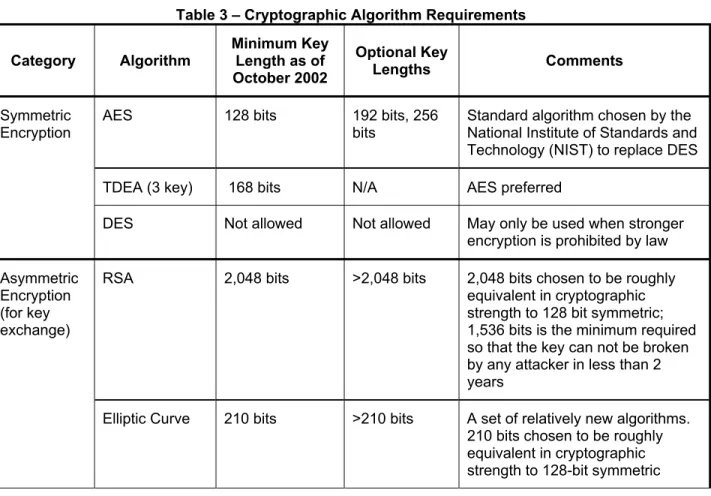
acceptable but is not recommended if AES is available. Key length may not be indicative of actual key strength.12 For clarity, this information is presented in tabular format in Table 3. Other considerations that
impact the level of security for encryption including the mode of operation, initialization vector, rekeying intervals, padding, and integrity checks also need to be addressed to provide robust confidentiality. These considerations are outside the scope of this document; however, they are addressed in references cited in clause 2 and annex C.
M-1.
M-2.
M-3.
For all symmetric encryption applications, algorithms with strengths similar to AES or TDEA shall be used. DES may be used where law prohibits longer algorithms.
5.1.2 Asymmetric Encryption Algorithms
An asymmetric encryption system is one in which the enciphering and deciphering keys are related but different. One is made public, whereas the other is kept secret. The public key is different from the private key, and no feasible way is known for deriving the private key from the public key. Public keys are distributed widely; however, the private key is always kept secret. The use of asymmetric encryption is usually limited to the encryption of symmetric keys for key exchange and the signing of message digests for digital signatures. In key exchange, the recipient’s public key is used and in the signing of message digests the signer’s private key is used.
For asymmetric encryption, the Rivest, Shamir, Adleman (RSA) algorithm is recommended to be used with a key length of 2,048 bits or greater, which is roughly equivalent in cryptographic strength to the 128-bit symmetric key encryption. The Diffie-Hellman key agreement algorithm with a prime group of 2,048 bits or greater may also be used (e.g., as employed in the IKE protocol). Elliptic Curve Cryptography (ECC) is a new method of performing public key cryptography (i.e., comparable to the RSA algorithm). With ECC, an elliptic curve is defined over a certain field; then, the elliptic curve discrete logarithm problem is solved over this field. The main advantage of ECC as compared to other public-key algorithms is the key size. A 160-bit ECC key is approximately equivalent in security to a 1,024-bit RSA algorithm key, and a 210-bit ECC key is approximately equivalent to a 2,048-bit RSA algorithm. The smaller ECC key results in less computational overhead and a more efficient cryptosystem.13 For clarity,
this information is presented in tabular format in Table 3. Issues such as formatting, padding, handling error conditions, and choosing appropriate primes and the size of the public exponent, and in the case of ECC, base field and curve must also be considered; however, these issues are outside the scope of this document. References in clause 2 and annex C address them in detail.
For all asymmetric encryption applications, algorithms with strengths similar to the RSA 2,048-bit key algorithm shall be used.
For all key exchange applications, algorithms with strengths similar to 2,048-bit RSA or Diffie-Hellman algorithms with a prime group of 2,048 bits shall be used.
5.1.3 Data Integrity Algorithms
Keyed message digest algorithms combined with hashing functions are used to ensure data integrity for arbitrary length messages. For symmetric data integrity where the sender and receiver have the same key, the Hashed Message Authentication Code with Message Digest 5 (HMAC-MD5-96)14 algorithm or 12 TDEA can be performed using either two independent 56-bit keys or three independent 56-bit keys, which could be
expected to have a strength of 112 bits and 168 bits, respectively. However, TDEA is subject to the “meet in the middle” attack, which can reduce two key 3DES strength to only 57 bits rather than the expected 112 bits. The same attack can render three key TDEA strength to only 112 bits rather than the expected 168 bits. Thus, TDEA should be used with three independent keys and the worst case strength should be assumed to be 112 bits. Source: Bruce Schneier, Applied Cryptography, Second Edition, 1996, John Wiley & Sons, Chapter 15.2, p. 358.
13 See Digital Signature Standard, November 2002, (available at http://csrc.nist.gov/cryptval/dss.htm) for additional
details on RSA, Diffie-Hellman, and ECC algorithms.
14 Internet Engineering Task Force Request for Comment 2403, The Use of HMAC-MD5-96 within ESP and AH, C.
the Hashed Message Authentication Code with Secure Hash Algorithm 1 (HMAC-SHA-1-96)15 algorithm
is acceptable. M-4.
M-5.
M-6.
For all symmetric secure data integrity applications, algorithms with strengths similar to HMAC-MD5-96 with 128-bit keys, HMAC-SHA-1-96 with 160-bit keys, or AES-based randomized message authentication code (RMAC) shall be used.
The Digital Signature Algorithm (DSA), with a key length of 1,024 bits or greater in length, and the RSA algorithm are standards for asymmetric data integrity where public-private key pairs are used.
For all asymmetric secure data integrity applications, an algorithm at least as strong as DSA or the RSA algorithm shall be used.
5.1.4 Keys for Cryptographic Algorithms
According to current best practices for KEY STRENGTH, when a key is chosen, it should be expected that it can not be broken by any attacker in less than 2 years. The key length recommendations in this clause are made with this in mind.
Any key for encryption or data integrity shall have a KEY STRENGTH that takes any attacker at least 2 years to break using known technology when first provided or used. Weaker keys may be used only when stronger encryption is prohibited by law.
Table 3 – Cryptographic Algorithm Requirements Category Algorithm Minimum Key Length as of
October 2002
Optional Key
Lengths Comments
AES 128 bits 192 bits, 256
bits Standard algorithm chosen by the National Institute of Standards and Technology (NIST) to replace DES
TDEA (3 key) 168 bits N/A AES preferred
Symmetric Encryption
DES Not allowed Not allowed May only be used when stronger encryption is prohibited by law RSA 2,048 bits >2,048 bits 2,048 bits chosen to be roughly
equivalent in cryptographic strength to 128 bit symmetric; 1,536 bits is the minimum required so that the key can not be broken by any attacker in less than 2 years Asymmetric Encryption (for key exchange)
Elliptic Curve 210 bits >210 bits A set of relatively new algorithms. 210 bits chosen to be roughly equivalent in cryptographic strength to 128-bit symmetric
15 Internet Engineering Task Force Request for Comment 2404, The Use of HMAC-SHA-1-96 within ESP and AH, C.
Category Algorithm Minimum Key Length as of October 2002 Optional Key Lengths Comments Diffie-Hellman (for key agreement) 2,048-bit mod p**)group, 256 bit exponent >2,048-bit mod p group, >256 bit exponent
2,048 bits chosen to be roughly equivalent in cryptographic strength to 128-bit symmetric DSA
(Asymmetric) 1,024 bits >1,024 bits 1,024 bits mandated by NIST
***)
HMAC-MD5-96
(Symmetric) 128 bits N/A Hashed message authentication code with message digest 5 Message
Verification
HMAC-SHA-1-96
(Symmetric)
160 bits N/A Hashed message authentication
code with secure hash algorithm 1
**) Mod p stands for modulo p
***) FIPS 186-2 Digital Signature Standard,January 2000, Clause 2
5.1.5 Cryptographic Key Management
Properly managing cryptographic key material is difficult and often complex. IETF RFC 1750,
Randomness Recommendations for Security, provides additional guidance. Below are a few requirements that any effective key management system must satisfy. However, the requirements do not assure the security of the key management system, method, or process.
Secure methods, at a minimum, include not sending keys over a communication medium in the clear and not storing keys in the clear in persistent system memory or storage media. These requirements apply to symmetric encryption keys, message authentication code keys, and asymmetric private keys.
M-7.
M-8.
The NE/MS supplier shall provide capabilities for secure key generation, distribution, storage, and replacement/recovery, as defined in ITU-T Recommendations X.500 and X.509.
Keys used for symmetric encryption and symmetrically based digital signatures shall be distributed out of band or by secure cryptographic processes.
5.2 Authentication
AUTHENTICATION has two purposes in securing the MANAGEMENT PLANE: (1) it ensures the identity of communications parties, which provides a basis for setting up private communications with full data integrity between two systems; and (2) it provides a basic mechanism for logging and auditing the management activities on any system.
5.2.1 System-to-System Process Authentication
Process AUTHENTICATION provides AUTHENTICATION during data communications between systems (e.g., system-to-system, application-to-application), and is the basisfor setting up private communications with full data integrity. During data communications, AUTHENTICATION of the sending entity allows the receiver of a message to ascertain the origin of the message. Within a secure communication channel, cryptographic AUTHENTICATION should be associated with each message to bind the sending entity’s identity to the message. The receiver will check the cryptographic information supplied with the message to verify the true identity of the sending entity.
M-9. M-10. M-11. M-12. M-13. M-14.
System-to-system process AUTHENTICATION for communications shall use certificate-based AUTHENTICATION or PROTECTED AUTHENTICATION.
Certificate-based AUTHENTICATION shall be X.509-based certificate systems.
STRONG AUTHENTICATION exchanges between systems shall be protected in compliance with M-6.
5.2.2 User Authentication, Passwords, and User IDs
User AUTHENTICATION concerns the AUTHENTICATION of clients involved in the management of the network. In this case, AUTHENTICATION involves proving the true identity of the legitimate user and preventing masquerading by illegitimate imposters. With proper AUTHENTICATION, it is possible to track activities and restrict users to pre-authorized activities or roles as discussed in clause 5.3.
The minimum requirements for AUTHENTICATION are the use of a user ID and static COMPLEX PASSWORD. Other mechanisms may be used as long as the administrators of the NE/MS are confident that the security level is at least as great as that provide by a user ID and static COMPLEX PASSWORD. Other mechanisms that may be considered include:
• A user ID and TWO-FACTOR AUTHENTICATION using a one-time password generator,16 and
• TWO-FACTOR AUTHENTICATION using a smart-card with credentials stored on it in a protected manner.
Client AUTHENTICATION for logging in, logging, and auditing on each NE/MS shall be at least as strong as a user ID with a COMPLEX PASSWORD over a previously established TRUSTED PATH.
M-12 presents the baseline security requirement. It is expected that AUTHENTICATION techniques and single sign-on technologies will continue to improve.
O-1 represents an objective requirement that anticipates standardization around single sign-on and digital certificates.
O-1. Client AUTHENTICATION should support methods for secure single sign-on and X.509 public key infrastructure.
In secure single sign-on, the protocol still challenges the entity(s) for credentials; however, a user may not have to enter the credentials because they are securely cached in some way (e.g., Kerberos).
The following requirements help maintain password complexity and are useful for auditing and logging. Each NE/MS shall automatically enforce COMPLEX PASSWORDS.
Minimum complexity rules for COMPLEX PASSWORDS shall be as follows:
• Passwords must be a minimum of eight characters long.
• Passwords must not be a repeat or the reverse of the associated user ID.
• Passwords must be no more than three of the same characters used consecutively.
16 This clause does not discuss dynamic passwords as those are considered to be outside of the scope of this
• Passwords must contain at least three of the following combinations: • Alpha characters – at least one lower case alpha character • Alpha characters – at least one upper case alpha character • Numeric characters – at least one numeric character • Special characters – at least one special character M-15. M-16. M-17. M-18. M-19. M-20. M-21. M-22. M-23.
The NE/MS shall require the entry of the old password to prevent another user from changing a logged-on user’s password without their knowledge.
Each NE/MS shall automatically ensure that each new login password differs from the previous password. The degree of difference shall be configurable, with a default difference in at least two character positions.
Because passwords are typically stored via one-way encryption, the entry of the old password is also required to allow the NE/MS to determine the degree of difference between the old and new passwords.
Each NE/MS shall support a password history to prevent password reuse. The parameters shall be configurable with a default of at least the past five password iterations and at least 180 days.
Each user ID shall have its own settable login password.
Passwords shall be user changeable at the user’s discretion, following a configurable minimum interval since the last change. The default shall be one day.
Each NE/MS shall identify at least one, and not more than two, specific SYSTEM SECURITY ADMINISTRATOR accounts that cannot be LOCKED OUT due to password aging.
A common implementation of M-20 allows the SYSTEM SECURITY ADMINISTRATOR to login from the console with no restrictions on the number of failed logins. Alternatively, that user can have a retry timer (e.g., 60 minutes). If no retry timer is used for non-console attempts, then the password for that user ID is vulnerable to a brute force password attack.
Each NE/MS shall identify at least one, and not more than two, specific SYSTEM SECURITY ADMINISTRATOR account(s) that cannot be LOCKED OUT due to login failures.
Each NE/MS shall store user IDs in a nonvolatile manner.
Each NE/MS shall store login passwords in a nonvolatile and one-way encrypted manner. As an exception to one-way encryption, symmetrically encrypted passwords may be used for passwords that need to be decrypted for internal, transient use in trusted system-to-system communication or single sign-on.17
5.3 Administration
Each NE/MS must support the concept of “least privilege” (i.e., a person will have a role and will have authorization to view data, modify data, or initiate MANAGEMENT ACTIONS only for those functions
allowed by that role). This clause defines basic requirements for implementing “least privilege” through good system security administration.
5.3.1 Security Administration
Each NE/MS must ensure that only authorized users are allowed to manage system security resources. All administrative actions are linked to specific individuals. Though only five types of users are discussed, many other types of users with varying degrees of privileges may exist, especially with respect to critical security MANAGEMENT ACTIONS. The goal is to ensure that only authorized, privileged users can manage critical security resources.
M-24.
M-25. M-26.
M-27.
Each NE/MS shall have at least five types of user roles: a SYSTEM SECURITY ADMINISTRATOR, an APPLICATION SECURITY ADMINISTRATOR, a SYSTEM ADMINISTRATOR, an APPLICATION ADMINISTRATOR, and an APPLICATION USER/OPERATOR. In the case of embedded systems without a separation of system and application, the NE shall support at least three types of user roles: a combined SYSTEM SECURITY ADMINISTRATOR and APPLICATION SECURITY ADMINISTRATOR, a combined SYSTEM ADMINISTRATOR and APPLICATION ADMINISTRATOR, and an APPLICATION USER/OPERATOR.
The default user type on each NE/MS shall be the APPLICATION USER/OPERATOR. Each NE/MS shall support the following CRITICAL SECURITY ADMINISTRATION ACTIONS:
• Define and assign user privileges.
• Add and delete user IDs.
• DISABLE/enable the use of specific user IDs as login IDs.
• Initialize and reset login passwords.
• Initialize and change cryptographic keys.
• Set the system’s aging threshold for login passwords.
• Set the system’s limit on the number of failed logins for each login ID.
• Remove a lockout or change the system’s LOCKOUT timer value.
• Set the system’s inactivity timer value.
• Set system security logging and alarm configuration.
• Manage system security logging processes.
• Upgrade security software.
• Terminate any user or system session.
On each NE/MS, a SYSTEM SECURITY ADMINISTRATOR shall be able to execute all of the CRITICAL SECURITY ADMINISTRATION ACTIONS.
M-28. M-29. • • • • • • • M-30. M-31. M-32. M-33. M-34.
On each NE/MS, a role other than the SYSTEM SECURITY ADMINISTRATOR shall NOT be able to execute any of the CRITICAL SECURITY ADMINISTRATION ACTIONS unless a SYSTEM SECURITY ADMINISTRATOR has delegated these specific authorizations.
Each NE/MS shall support the following application security MANAGEMENT ACTIONS: Define and assign new user and group privileges at the application level.
Maintain a record of all requests for login IDs to the application. Add and delete users at the application level.
Monitor all application security logs.
Configure application security logging and alarms. Manage application security logging processes. Terminate any user application session.
On each NE/MS, an APPLICATION SECURITY ADMINISTRATOR shall be able to execute all of the application security MANAGEMENT ACTIONS defined in M-29.
5.3.2 Authentication Defaults
The proper use of default passwords has been discussed at length in security literature. Historically, default passwords ranged from hard coded in the program to a default associated with each software release or upgrade. The following are AUTHENTICATION default requirements.
One of the following shall apply:
• The configuration software shall create a unique initialization password for each application in the new release or upgrade18 of the software.
• If a default password is used, the system shall require the replacement of the default password with a unique password before the device goes into service.
• If a device is delivered without a password or a null password, a unique password shall be assigned during the installation process before the device goes into service.
The system age threshold for login passwords shall be configurable by the SYSTEM SECURITY ADMINISTRATOR or by the APPLICATION SECURITY ADMINISTRATOR if the functionality is also built into the application. The default shall be 90 days.
The system inactivity timer value shall be configurable by the SYSTEM SECURITY ADMINISTRATOR or by the APPLICATION SECURITY ADMINISTRATOR if the functionality is also built into the application. The default shall be 60 minutes.
The system limit on consecutive failed logins for a given user ID shall be configurable by the SYSTEM SECURITY ADMINISTRATOR or the APPLICATION SECURITY ADMINISTATOR if the functionality is also built into the application. The default shall be five.
18 This is similar to the practice in which each commercially purchased compact disk carries a unique enabling
5.3.3 Security Audit Logging
It is important that each NE/MS provide adequate capabilities to allow investigation, audit, and real-time detection and analysis activities, so that proper remedial actions can be taken. This clause considers security audit logs; however, the specific details of the content and format of the security audit logs are beyond the scope of this document.
Note that investigation and forensic analysis activities may include investigation of non-security related OAM&P messages as well as the information stored in the security audit logs described in this section. Logging of non-security related OAM&P messages, sometimes referred to as “recent change” messages, is beyond the scope of this document.
M-35. M-36. M-37. M-38. M-39. M-40.
Each NE/MS shall be able to log any action that changes the security attributes and services, access controls, or other configuration parameters of the devices; each login attempt and its result; and each logout or SESSION termination (whether remote or console).
O-2. Each NE/MS should provide the capability to configure those CRITICAL SECURITY ADMINISTRATION ACTIONS that are to be included in the security log.
It is recommended that audit log entries be sent to an unalterable audit server after being sequence labeled and cryptographically authenticated (signed) by the NE/MS.
Each NE/MS shall be capable of remote logging over a TRUSTED PATH. Each log entry shall contain the following information:
• A description of the action or the actual action that is being logged
• The identity and security level of the user or process that initiated the action
• The date and time the action occurred
• Network source and destination information, if applicable (e.g., when logging in)
• An indication of the success or failure of the activity.
Additional information on logging may be found in ANSI T1.243-1995 (R1999), Operations, Administration, Maintenance, and Provisioning—Baseline Security Requirements for the Telecommunications Management Network.
5.4 NE/MS Use and Operation
The requirements in this clause apply to both remote and console access to a NE/MS. These mandatory requirements represent a baseline for NE/MS that actually store user IDs and passwords. Many NE/MS reference a centralized ACS to store user IDs and passwords. The mandatory requirements expressed throughout this document apply to a NE/MS if it holds user IDs and passwords and the user IDs and passwords stored on the ACS.
Each of the NE/MS shall synchronize time in an authenticated manner (e.g., NTP Version 3). For each NE/MS, each MANAGEMENT ACTION shall be associated with a single authorized SESSION.
Each SESSION shall be established via proper AUTHENTICATION as detailed in requirement M-12.