Procedia Engineering 41 ( 2012 ) 224 – 229
1877-7058 © 2012 Published by Elsevier Ltd. doi: 10.1016/j.proeng.2012.07.166
International Symposium on Robotics and Intelligent Sensors 2012 (IRIS 2012)
A comparison study of classifier algorithms for mobile-phone’s
accelerometer based activity recognition
Media Anugerah Ayu
a*, Siti Aisyah Ismail
a, Ahmad Faridi Abdul Matin
a,
Teddy Mantoro
baIntelligent Environment Research Group (INTEG Lab), Faculty of Information and Communication Technology, International Islamic University Malaysia, 53100 Kuala Lumpur,Malaysia
b
Advanced Informatics School, Semarak International Campus,
Universiti Teknologi Malaysia, 53000 Kuala Lumpur,Malaysia
Abstract
Nowadays, many mobile phones have been equipped with sensors to enable the delivery of advanced features/services to the users. Accelerometer is one of the sensors that embedded to several types of mobile phones. Our earlier research has shown that data from mobile-phone embedded accelerometer can be used for activity recognition purpose [1]. As a continuation of the research towards the search for a suitable and reliable algorithm for real-time activity recognition using mobile phone, an evaluation and comparison study of the performance of seven different categories of classifier algorithms in classifying user activities were conducted. Five basic human activities (jogging, jumping, sitting, standing, and walking) were tested. The training and testing data were done using Weka 3.6.6 data mining tool. The overall accuracy rate for classifier training managed to exceed 96% and exceeded 90% for classifier testing, which are very encouraging results.
© 2012 The Authors. Published by Elsevier Ltd. Selection and/or peer-review under responsibility of the Centre of Humanoid Robots and Bio-Sensor (HuRoBs), Faculty of Mechanical Engineering, Universiti Teknologi MARA.
Keywords: Activity recognition; Accelerometer; Classifier algorithms; Activity-aware; Accelerometer based mobile phone
1. Introduction
Activity recognition involving mobile phone aims in making mobile phones able to identify what activities or actions are performed by the users for various purposes. Nowadays, this goal is possible to be achieved with the availability of built-in accelerometer that comes together with most smart phones. Compared to using body-worn sensor, the use of embedded accelerometer in mobile phone for human activity recognition purpose is more natural and practical, since user does not have to carry extra sensor and it is much preferable to bring mobile phone wherever we go.
In general, the data acquired from an accelerometer needs to go through two different processes before the user activities are able to be recognized. The two aforementioned processes are the feature extraction and classification process [1]. For the latter, the difficulty lies in the process of finding or developing an algorithm which can still give accurate result despite the
* Corresponding author. Tel.: +6-036-196-5632; fax: +6-036-196-5179.
E-mail address: [email protected]. Open access under CC BY-NC-ND license.
noises and ambiguous data produced by the sensor [2]. Besides the accuracy rate, the computation time required to build or train the model is equally important, especially in a real life and real time applications [3].
Many studies have been performed in regards to this area and promising results were achieved on different types of classifier algorithm tested. Inspired by the positive outcomes, in this paper we present our comparison study on different categories of classifier algorithms available on Weka 3.6.6 workbench, a collection of state-of-the-art machine learning algorithms and data pre-processing tools [4]. The algorithms were trained and tested using datasets of two different positions (hand palm and shirt pocket), gathered from a HTC mini mobile phone accelerometer. Some of the algorithms tested, like Naïve Bayes [1][2][5][6], Multilayer Perceptron [3][7][8], Sequential Minimal Observation (SMO) [6] [8], LogitBoost [8], J48(C4.5 Decision Tree) [2][3][7][9], Random Forest [10], Bayes Network [3][6][8], Jrip [6], k-Nearest-Neighbor [2][3][5][6][9][11] and many others have been discussed and used in other related works, however, prior to our knowledge, there is not yet a detailed comparison study done on the same datasets that covers thoroughly different categories of classifier algorithms available in Weka.
In the next section of this paper, we will first discuss related works that have been done previously by other researchers involving classifier algorithms for activity recognition. A discussion on the methodology is presented in Section 3, followed by results and discussion, then conclusion and the future work.
2. Related Work
In the previous work, many attempts have been done to discover whether data from accelerometer embedded inside mobile phone can be used for recognizing activities [1][6][12]. Different methods of feature extraction and classification algorithm have been tested on different data sets, and various results were produced by each. Some of the works like by Ayu et al. [1], Lau & David [6] and Das et al. [5] selected their classification algorithms based on previous encouraging results reported, and managed as well to get good results from the experiment.
For accelerometer based activity classification in general, Companjen [13] has done a good job in summarizing some previous works and their detailed results. S. Knoop et al. [14] on their Cogniron project explained their human activity recognition work in detail, in which the recognition process is done through 3-step approaches which are feature extraction, evaluation, and classification using Feed Forward Neural Network (FFNN) classifier.
Other work by Zhao et al. in two different papers [15] and [16], have looked at cross-mobile and cross-people activity recognition by proposing their own algorithm for each, called TransEMDT (Transfer learning Embedded Decision Tree) and TransELMAR (Transfer learning and Extreme Learning Machine based Activity Recognition), which are the integrations of several existing machine learning algorithms.
Furthermore, Prekopcsák et al. [11] have published their work on activity recognition using accelerometer embedded in phone with a focus on personal time management, and managed to test LogitBoost algorithm during their work and came out with accuracy exceeding 99%.
A similar work has been done by Maguire and Frisby [9], but instead of using accelerometer data alone, heart rate data of the test subjects were also considered for the activity recognition. In this paper, they compared the performance of two classifier, kNN and J48 and tested the effects of removing certain features to the classifier accuracy.
Uwe et al. [17] developed a wearable sensor device call eWatch and tested it for location and activity recognition monitoring. For the activity recognition, they tested the effect of different feature sets and sampling rates toward recognition accuracy and computational time. They also evaluated the accuracy of the sensor on different positions of the body (the belt, shirt pocket, trouser pocket, backpack, and necklace), and compared the performance of different classifiers (Decision Trees (C4.5 algorithm), k-Nearest Neighbor (k-NN), Naïve Bayes and the Bayes Net) before coming down to Decision Tree as the preferred classifier.
3. Methodology
This comparison study is our starting point towards finding a suitable and reliable algorithm for real-time human activity recognition based on built-in mobile phone accelerometer data. The experiment was done using a HTC Mini smart phone with Windows mobile operating system for the accelerometer data collection, and Weka 3.6.6 for the classifier training and testing purpose. Weka 3.6.6 has listed eight different classifier packages which are available in the Weka Explorer mode. The classifiers are categorized into Bayes, Functions, Lazy, Meta, Mi, Misc, Rules, and Trees. In our comparison study, we tested seven out of these eight packages (Mi is excluded). Table 1 summarizes the algorithms that we have tested in this comparison study, and more details about each of the algorithm can be found in [4]. Whereas the steps involved in completing this comparison study are depicted in the diagram presented in Fig 1.
Table 1. List of algorithms tested according to category
Classifier Category Tested Algorithms
Bayes BayesNet, NaïveBayes, NaiveBayesSimple, NaiveBayesUpdateable
Functions Logistic, MultilayerPerceptron, RBFNetwork (Radial Basis Function Network), SimpleLogistic, SMO
Lazy IB1 (Instance-Based 1), IBk (Instance-Based k), KStar, Locally Weighted Learning (LWL)
Meta
AttributeSelectedClassifier, Bagging, ClassificationViaRegression, Dagging, Decorate, END, FilteredClassifier, LogitBoost, MultiClassClassifier, OrdinalClassClassifer, RandomCommittee, RandomSubSpace, RotationForest
Misc VFI (Voting Feature Intervals)
Rules DecisionTable, DTNB (Decision Table Naïve Bayes Hybrid), JRip, NNge(Non-Nested Generalized Exemplars), OneR, PART, Ridor
Trees
BFTree(Best-First Decision Tree), FT(Functional Tree), J48, J48graft, LADTree (LogitBoost Alternating Decision Tree), LMT(Logistic Model Tree), NBTree(NaïveBayes Tree), RandomForest, RandomTree, REPTree (Reduced-Error Pruning tree), SimpleCart
3.1. Data acquisition/collection
This step was performed by gathering raw accelerometer data (x, y, and z values) from a HTC Mini mobile phone placed in two varying positions; on the hand palm and in the shirt pocket. The data were stored in the phone in text format by the assistance of an in-house application developed previously [1].
During the data collection for palm’s position, the device was positioned horizontally on the palm of the user’s hand. Five basic activities were performed (jogging, jumping, sitting, standing, and walking). Each activity was conducted non-stop for about 15-25 minutes depending on the physical intensity of the activity (except for jumping where it was conducted in 4 sessions).
During the data collection for pocket’s position, the device was vertically placed in the left pocket of a shirt, with the screen facing inwards to the body. Four basic activities were performed (jogging, sitting, standing, and walking). Jumping was excluded for this position due to the physical constraint of the test subject during the experimentation. Each activity was conducted non-stop for about 15-25 minutes depending on the physical intensity of the activity.
3.2. Feature extraction
This step was performed by extracting the means and standard deviations from the raw accelerometer data acquired during the data collection process. The extracted features were then saved in two different .arff files according to the positions of the mobile phone they represented.
3.3. Classification
For the hand palm’s position, 500 instances were produced, with 100 instances for each activity. For the shirt pocket position, 400 instances were produced, with 100 instances per activity as well. The instances were then separated into 2 different datasets with 20%:80% margin, where 20% belongs to the untrained dataset used for testing the classifiers, and 80% belongs to the dataset used for training the classifiers. The trainings for both positions were conducted using the 10-fold cross-validation method. Testings were then performed using the untrained datasets to test the accuracy of the trained classifiers.
4. Result and Discussion
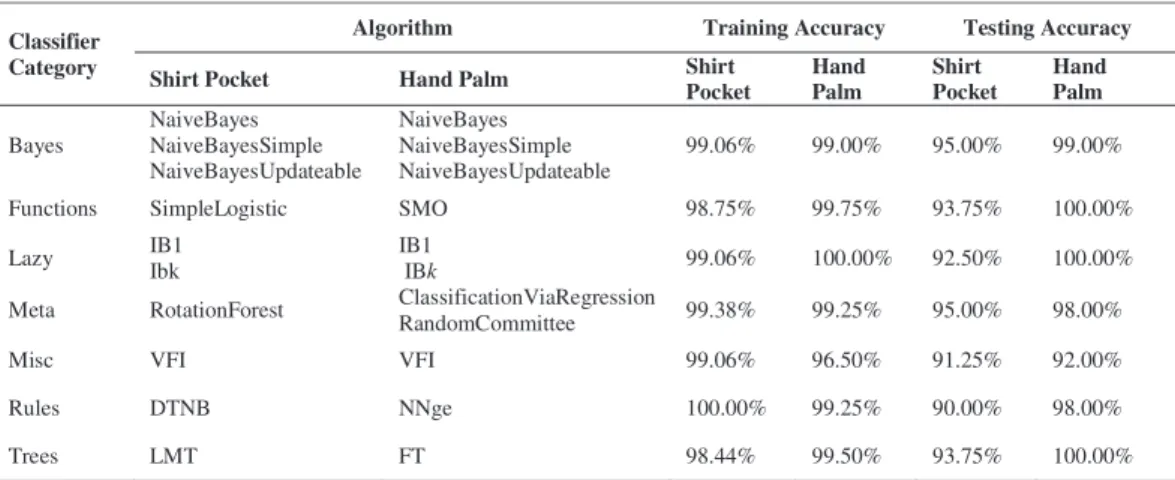
The results presented in this section are based on the training performed on all classifier algorithms available in the Explorer mode of Weka 3.6.6. Based on the training results, only 45 algorithms from seven categories mentioned in Section 3 (Table 1) were then shortlisted for testing. Then, from the 45 algorithms selected, the results were narrowed down to only 1 to 3 classifier algorithms from each category with the best accuracy rate for both training and testing. The overall result for the hand palm’s position and shirt pocket’s position are presented in Table 2. Please note that the algorithms were trained and tested using default Weka Explorer mode settings.
According to the results in Table 2, the best algorithm performance in terms of overall classification accuracy rate for hand palm’s position is given by IB1and IBk algorithms from Lazy classifier category, with both getting 100% accuracy for classification training and testing. The time taken to build both models during the experiment was also acceptable. IBk algorithm is a k-Nearest-Neighbor classifier, which has been proven to be giving good result in terms of classification accuracy rate (>90%) for activity classification [5][11][6][9]. SMO and FT classifier are also showing high classification accuracy, but IB1and IBk are still leading in both computation time in building their models and accuracy factors. VFI algorithm from Misc classifier comes last with an average of 94.25% for both accuracy rates.
Table 2. Classifier evaluation for shirt pocket’s position and hand palm’s position
Classifier Category
Algorithm Training Accuracy Testing Accuracy
Shirt Pocket Hand Palm Shirt
Pocket Hand Palm Shirt Pocket Hand Palm Bayes NaiveBayes NaiveBayesSimple NaiveBayesUpdateable NaiveBayes NaiveBayesSimple NaiveBayesUpdateable 99.06% 99.00% 95.00% 99.00%
Functions SimpleLogistic SMO 98.75% 99.75% 93.75% 100.00%
Lazy IB1
Ibk
IB1
IBk 99.06% 100.00% 92.50% 100.00%
Meta RotationForest ClassificationViaRegression
RandomCommittee 99.38% 99.25% 95.00% 98.00%
Misc VFI VFI 99.06% 96.50% 91.25% 92.00%
Rules DTNB NNge 100.00% 99.25% 90.00% 98.00%
Trees LMT FT 98.44% 99.50% 93.75% 100.00%
For shirt pocket’s position, RotationForest algorithm from Meta classifier has the best classification accuracy for both training and testing with an average of 97.19%. The computation time taken to build model is also satisfactory. Following RotationForest is the 3 Bayes classifiers; NaiveBayes, NaiveBayesSimple, and NaiveBayesUpdateable with an average of 97.03%. They achieved a slightly lower accuracy of 99.06% compared to RotationForest (99.38%) during the training, but their computation time is faster. Naïve Bayes algorithm performance has been discussed and used in some of the previous works [1][2][5][6], and showed positive results.
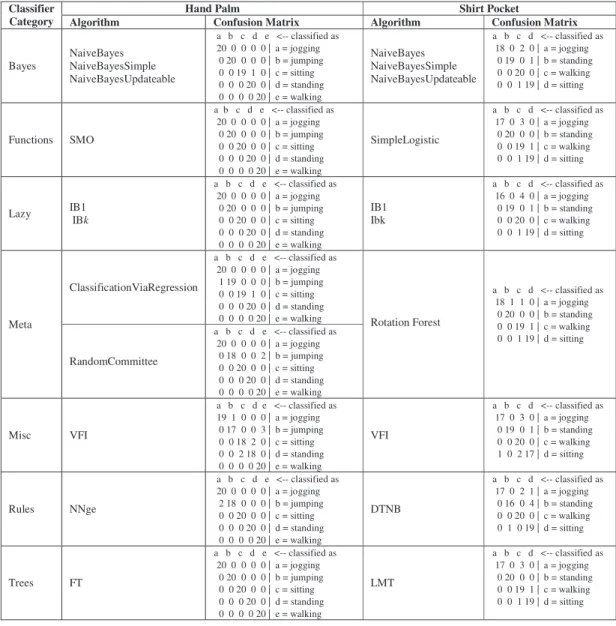
Overall, hand palm’s position shows better accuracy during testing compared to shirt pocket’s position for each of the classifier category. The confusion matrix for each of the classifier in Table 2 is displayed in Table 3.
According to Table 3 (hand palm’s position) Bayes classifiers show only a small confusion between sitting and standing. This confusion could be the result of the hand’s level which was about the same while performing both actions. The same confusion goes to ClassificationViaRegression classifier, but with additional same amount of confusion between jumping and jogging. This could be because both actions have similarity in the gravitational data (z axis data). Confusion matrix for NNge shows only 10% of jumping was incorrectly classified as jogging, while RandomCommittee shows 10% confusion
where jumping was confused as walking. VFI classifier shows the highest confusion between jumping and walking with 15% of jumping activity was incorrectly classified as walking, 5% of jogging activity was incorrectly classified as jumping, and 10% of sitting and standing were confused between each other.
The confusion matrices for shirt pocket’s position show more confusion compared to the hand palm’s position. For shirt pocket’s position, Lazy classifiers (IB1 and IBk) shows 20% of jogging activity was incorrectly classified as walking. This could be due to the varying pace used while jogging was performed. SimpleLogistic, VFI, and LMT also show the same amount of confusion between jogging and walking, but with 5% less compared to the Lazy Classifiers. For sitting activity, VFI incorrectly classified 10% of it as walking, and 5% as jogging. Further study is needed to verify why such confusion occurred, since walking and jogging are very distinguishable from sitting. DTNB classifier shows the highest confusion rate with 10% of jogging incorrectly classified as walking, 5% as sitting, 20% of standing was incorrectly regarded as sitting, and 5% of sitting was mistakenly classified as standing.
Table 3. Confusion matrices for hand palm’s and shirt pocket’s positions Classifier
Category
Hand Palm Shirt Pocket
Algorithm Confusion Matrix Algorithm Confusion Matrix
Bayes NaiveBayes NaiveBayesSimple NaiveBayesUpdateable a b c d e <-- classified as 20 0 0 0 0 | a = jogging 0 20 0 0 0 | b = jumping 0 0 19 1 0 | c = sitting 0 0 0 20 0 | d = standing 0 0 0 0 20 | e = walking NaiveBayes NaiveBayesSimple NaiveBayesUpdateable a b c d <-- classified as 18 0 2 0 | a = jogging 0 19 0 1 | b = standing 0 0 20 0 | c = walking 0 0 1 19 | d = sitting Functions SMO a b c d e <-- classified as 20 0 0 0 0 | a = jogging 0 20 0 0 0 | b = jumping 0 0 20 0 0 | c = sitting 0 0 0 20 0 | d = standing 0 0 0 0 20 | e = walking SimpleLogistic a b c d <-- classified as 17 0 3 0 | a = jogging 0 20 0 0 | b = standing 0 0 19 1 | c = walking 0 0 1 19 | d = sitting Lazy IB1 IBk a b c d e <-- classified as 20 0 0 0 0 | a = jogging 0 20 0 0 0 | b = jumping 0 0 20 0 0 | c = sitting 0 0 0 20 0 | d = standing 0 0 0 0 20 | e = walking IB1 Ibk a b c d <-- classified as 16 0 4 0 | a = jogging 0 19 0 1 | b = standing 0 0 20 0 | c = walking 0 0 1 19 | d = sitting Meta ClassificationViaRegression a b c d e <-- classified as 20 0 0 0 0 | a = jogging 1 19 0 0 0 | b = jumping 0 0 19 1 0 | c = sitting 0 0 0 20 0 | d = standing
0 0 0 0 20 | e = walking Rotation Forest
a b c d <-- classified as 18 1 1 0 | a = jogging 0 20 0 0 | b = standing 0 0 19 1 | c = walking 0 0 1 19 | d = sitting RandomCommittee a b c d e <-- classified as 20 0 0 0 0 | a = jogging 0 18 0 0 2 | b = jumping 0 0 20 0 0 | c = sitting 0 0 0 20 0 | d = standing 0 0 0 0 20 | e = walking Misc VFI a b c d e <-- classified as 19 1 0 0 0 | a = jogging 0 17 0 0 3 | b = jumping 0 0 18 2 0 | c = sitting 0 0 2 18 0 | d = standing 0 0 0 0 20 | e = walking VFI a b c d <-- classified as 17 0 3 0 | a = jogging 0 19 0 1 | b = standing 0 0 20 0 | c = walking 1 0 2 17 | d = sitting Rules NNge a b c d e <-- classified as 20 0 0 0 0 | a = jogging 2 18 0 0 0 | b = jumping 0 0 20 0 0 | c = sitting 0 0 0 20 0 | d = standing 0 0 0 0 20 | e = walking DTNB a b c d <-- classified as 17 0 2 1 | a = jogging 0 16 0 4 | b = standing 0 0 20 0 | c = walking 0 1 0 19 | d = sitting Trees FT a b c d e <-- classified as 20 0 0 0 0 | a = jogging 0 20 0 0 0 | b = jumping 0 0 20 0 0 | c = sitting 0 0 0 20 0 | d = standing 0 0 0 0 20 | e = walking LMT a b c d <-- classified as 17 0 3 0 | a = jogging 0 20 0 0 | b = standing 0 0 19 1 | c = walking 0 0 1 19 | d = sitting
5. Conclusion and Future Work
In this comparison study, the performances of classifier algorithms available in Weka benchmark have been explored. The exploration was done using data from mobile phone embedded accelerometer, by locating the phone at two different positions and performing 4-5 basic human activities. Our finding has concluded that the accuracy rates of the algorithms for
classification training are very good with all exceeding 96% of accuracy. After the trained classifier models were tested using untrained dataset, most of the classifiers experienced a slight decrease of accuracy rate, but still managed to maintain 90% accuracy and above. The computation times to build the models are overall satisfactory, given the size of the datasets. However, the time may vary on different machines or devices, especially for real-time implementation, since it will be depending on the resources available.
From this study, it is also verified that the size of the dataset used does affect the accuracy rates of the classifiers, with larger dataset most likely to produce higher accuracy rates. This is also discussed in [9]. Apart from the dataset size, the location of where the accelerometer is positioned is also an important factor to be considered. From this comparison study, it can be concluded that hand palm’s position has overall higher accuracy in correctly classifying activities compared to shirt pocket’s position. However, since our focus is more towards mobile phone embedded accelerometer, natural locations where a mobile phone device is usually placed should be further explored in the future works. Maurer et al. emphasized the importance of this in their paper [17], especially in studying the relationship between classification performance and the device’s position.
Our further work will look into how these classifiers can be effectively used for real-time human activity recognition on mobile devices, especially mobile phone. The challenges will be on maintaining good accuracy and computation time of the algorithm used, without exhausting the device resources. Larger number of test subjects and dataset should also be used to examine the performance of the algorithms on different variables.
Acknowledgements
Part of this work was supported by a research grant project EDW B11-110-0588 from the Research Management Centre (RMC) of the International Islamic University Malaysia.
References
[1] Ayu M. A., Mantoro T., Abdul Matin A. F., Basamh S. S. O., “Recognizing user activity based on accelerometer data from a mobile phone,” in Proc. 2011 IEEE Symp. on Computers and Informatics, Kuala Lumpur, Malaysia, 2011, pp.617-621.
[2] Bao L., Intille S.S, “Activity recognition from user annotated acceleration data,” in Proc. 2nd Int. Conf. on Pervasive Computing, 2004, pp 1-17. [3] Andreu J., Angelov P. “Real-time human activity recognition from wireless sensors using evolving fuzzy systems,” in Proc. 2010 IEEE World Congress
on Computational Intelligence, 2010, pp 2652-2659.
[4] Witten I. H., Frank E., Hall M. A. Author, “The explorer,” in Data Mining Practical Machine Learning Tools and Techniques, 3rd ed. United States: Morgan Kaufmann, 2011, ch.11, p. 445-479.
[5] Das S., Green L., Perez B., Murphy M., “Detecting user activities using the accelerometer on Android smartphones,” July 2010.
[6] Lau S. L., David K., “Movement recognition using the accelerometer in smartphones,” in Proc. Future Network & Mobile Summit 2010, 2010, pp.1-9. [7] Kwapisz J. R., Weiss G. M., Moore S., "Activity recognition using cell phone accelerometers", presented at SIGKDD Explorations, 2010, pp.74-82. [8] Chen C., Das B., Cook D. J., “A data mining framework for activity recognition in smart environments,” in Proc. of the Sixth Int. Conf. on Intelligent
Environments, 2010, pp. 80-83.
[9] Maguire D., Frisby R., “Comparison of feature classification algorithms for activity recognition based on accelerometer and heart rate data,” in 9th IT and T Conference in Dublin Institute of Technology, 2009.
[10] Casale P., Pujol O., Radeva P., “Human activity recognition from accelerometer data using a wearable device,” in Iberian Conference on Pattern Recognition and Image Analysis (IbPRIA), 2011, pp. 289-296.
[11] Prekopcsák Z., Soha S., Henk T., Gáspár-Papanek C., “Activity recognition for personal time management,” in 3rd European Conference on Ambient Intelligence (AmI-2009), Salzburg, Austria, 2009.
[12] Sun L., Zhang D., Li B., Guo B., Li S., Mokhtari M., “Activity recognition on an accelerometer-embedded mobile phone with varying positions and orientations,” in 7th Int. Conf. on Ubiquitous Intelligence and Computing (UIC 2010), Xi'an, China, 2010.
[13] Companjen B., “Classification methods for activity recognition,” in Proc. Twente Student Conference on IT, 2009.
[14] Knoop S., Vacek S., Dillmann R., Brännström S., Christensen H. I., “Extraction, evaluation, selection and classification of motion features for human activity recognition,” Universität Karlsruhe, Internal Report, 2005.
[15] Zhao Z., Chen Y., Liu J., Liu M., "Cross-mobile ELM based activity recognition," Int. Journal of Engineering and Industries, vol. 1, no. 1, pp. 30-38, December 2010.
[16] Zhao Z., Chen Y., Liu J., Shen Z. and Liu M., "Cross-people mobile-phone based activity recognition," in Proc. Twenty-Second Int. Joint Conf. on Artificial Intelligence, 2011, pp. 2545-2550.
[17] Maurer U., Smailagic A., Siewiorek D., Deisher M., “Activity recognition and monitoring using multiple sensors on different body positions,” in Proc. Int. Workshop Wearable and Implantable Body Sensor Networks, 2006.