OGSA-DAI extensions
for executing distributed data mining workflows
Ǧorgi Kakaševski1, Armey Krause21 Faculty of Informatics, FON University,
bul. Vojvodina b.b. 1000 Skopje, R. Macedonia {gorgik}@fon.edu.mk
2 EPCC, University of Edinburgh,
James Clerk Maxwell Building, Mayfield Road, Edinburgh EH9 3JZ, UK {a.krause}@epcc.ed.ac.uk
Abstract. Because of the nature of Grid to be heterogeneous and distributed environment, the database systems which should work on Grid must support this architecture. OGSA-DAI is an example of such extensible service-based framework that allow data resources to be incorporated into Grid fabrics. On the other side, new trends in databases and data mining acquire tightly-coupled integration between raw data and patterns (mined data). Inductive databases are concept that allows this and users can query both data and patterns with query languages like SQL. For that reason, we propose OGSA-DAI extension for distributed data mining. In this paper, we introduce heterogeneous and distributed databases, then we discuss inductive databases, distributed data mining and our proposed model.
Keywords: Grid computing, heterogeneous distributed databases, OGSA-DAI.
1 Introduction
The computational needs of today’s science and engineering are constantly increasing. The Grid provides both computational and storage resources to the scientific applications [1]. E-Science is computationally intensive science that is carried out in highly distributed network environments, or science that uses immense data sets [2]. Digital data play major role in e-Science applications, from small projects [3] to The Large Hadron Collider [4]. Grid computing is one of the most exploited platforms for e-Science and provide computational and data resources. Significant effort is made in developing of Grid infrastructure in South-Eastern Europe region [5].
Because of mainly file-based organization of Grid data, there is a need how to use data which are originally organized as shared and structured collections, stored in relational databases, or in some cases in structured documents or in assemblies of binary files. These requirements of Grid applications require developers of Grid systems to provide practical implementations of "relational Grid databases" (or data access and integration [6]). One of the widely used middleware for heterogeneous and
distributed database is OGSA-DAI [7] build on WS-DAI standards for data access and integration. While other Grid middleware's use data in file based manner, OGSA-DAI workflows consists of activities that use relational databases.
Databases and data mining algorithms have two-way connection. Modern databases have needs from advanced data analysis, and on the other side data mining algorithms should be tightly integrated with data. Even when using databases, most of the current data mining applications have a loose connection with them. They treat database simply as a container from which data is extracted directly to the main memory of the computer responsible for running the data mining algorithm, just before the main execution begins. This approach limits the amount of data that can be used, forcing applications to filter information, and use only a part of it to discover patterns. In [8] are proposed inductive databases where data and patterns are stored together and user can query both of them with query language. We want to extend this concept for distributed databases.
The goal of this paper is to present architecture for execution distributed data mining algorithms and easily querying the data and the patterns. With this upgrade, in OGSA-DAI can be added more complex algorithms for data analyze, for example, calculations for OLAP cube or association rules, which are not supported in databases by default.
The rest of the paper is organized as follow. In Section 2 we describe standards for data access and integration which are key concepts for practical implementations of relational database middleware for Grid. We described OGSA-DAI, a practical release of WS-DAI specifications in Section 3. In Section 4 we discuss inductive databases, distributed data mining and we present extension of OGSA-DAI that we propose. We conclude the paper and give recommendations for future work in Section 5.
2 Data Access and Integration
Grid is made of different type of resources with different characteristics, and as whole must act as one system. For example, on the Grid we can find two clusters with different type of processors or installed software, even on the same cluster we can find machines with different resources. This property is true for databases. There are several types of databases which can be used in applications: relational, XML, even CSV files or just files. But the Grid users (applications, clients) must see data as one integrated part, no matter where they are located or which their physical form is.
Another key moment in organizing databases on Grid is the service-oriented architecture of Grid and Grid services, defined by Open Grid Service Architecture (OGSA) [9]. OGSA has a one of the central roles in Grid computing, because it simplifies the development of secure, robust systems and enable the creation of interoperable, portable, and reusable components. The main idea of transient Grid services is to extend well-defined Web service standards (WSDL, XML schemas, SOAP, etc.), to support basic Grid behaviors. These standards are proposed by Open
OGF issued the Web Service Data Access and Integration (WS-DAI) family of specifications [11]. This specifications defines web service interfaces to data resources, such as relational or XML databases. In particular, the WS-DAI specifications are part of a wide ranging activity to develop the Open Grid Services Architecture (OGSA) within the OGF. The specification WS-DAI is on the top level and it defines the core data access services which are web service interfaces to data resources.
WS-DAI specifications have five main components: interfaces, data services, properties, messages and data resources. Interfaces are used to interact with data services. Data services are web services that implements interfaces to access distributed data resources. Properties describe data services, messages are sent to data services and data resources are system that can act as a source of data. Data resources are already existent database management systems, for example, MySQL, and this system has no real connection with WS-DAI specifications.
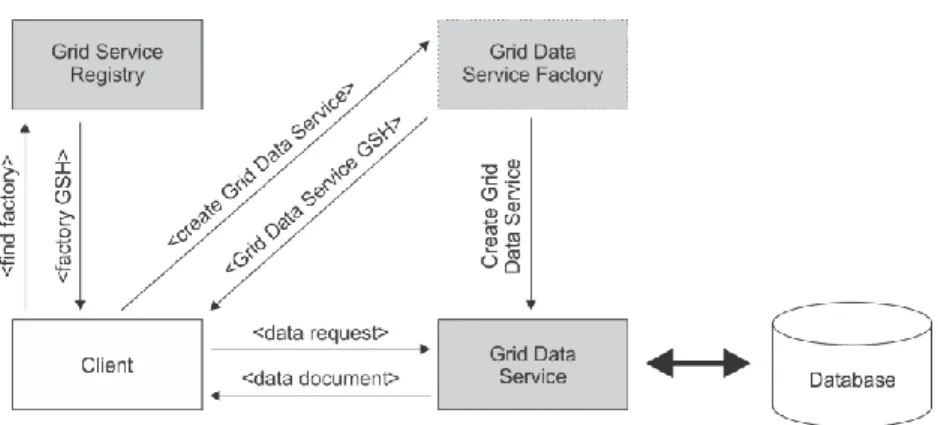
In Fig. 1 is given the proposed messages flow between client and data stored on Grid, by Open Grid Forum. This scheme enables clients to access or modify the data and their organization through Grid data service.
In order to implement these specifications on real system, in Fig. 2 is given proposed architecture of Grid database system [12]. During the fact that these traditional DBMSs exist for many years and are well developed and tested, in this case can be used some of the existing. On top of this system Grid Data Services must be implemented, as part of the middleware that is responsible for communications among heterogeneous distributed database.
Grid Data Service Middleware is one kind of transparent wrapper for complex Grid database. Transparency refers to: location, name of database, distribution, replication, ownership and cost, heterogeneity and schema. Clients exchange data with Grid database, even if they don't know where that data are stored or in which format. Important for client is that in Grid database must be implemented all (or common) functionalities of regular, mainly relational, database management systems and in natural way. That ensures that clients (users, software developers) can easily use Grid database and easily adapt their applications with new kind of database.
Ideally, the database vendors would themselves agree on, and support, such a standard. This would remove the need for third parties to provide wrappers for each different DBMS, and would also open the way for internal performance optimizations, e.g. in generating XML result sets directly from the internal representation [13].
As a conclusion, a heterogeneous distributed database system (or simply Grid database) should provide service-based access to existing relational database management systems that are located on Grid nodes. This database will be some form of virtual database and clients will access to data on transparent way no mater of physical organization of data [12].
Fig. 1. Accessing and modifying data stored on Grid using a Grid Data Service
Fig. 2. Architecture of Grid Database System
3 OGSA-DAI Heterogeneous Distributed Databases
OGSA-DAI stands for Open Grid Services Architecture - Data Access and Integration. It is a Java open source project and it is a one of the most comprehensive heterogeneous database system, which can be used in Grid.
One of the primary goals of data access and integration is to treat these data, whatever their origin, within a uniform framework. OGSA-DAI make the DBMSs, which can be heterogeneous and distributed on Grid, transparent to the users [14]. It hides the underlying drivers that are needed to communicate with the database management and as name tells, OGSA-DAI provide service-oriented interface to the clients. This process naturally will add some overhead on top of the communication itself but it is not that significant [15].
It supports several kinds of databases: relational (Oracle, DB2, SQL server, MySQL, Postgress), XML databases like xindice and eXist and files. There is an opportunity for programmers to develop new drivers for DBMS which are not supported in original version. Acting in the top of local DMBS that are located on
Today, OGSA-DAI has a several thousand users and a lot of scientific projects that are using it as a Grid database (i.e. ADMIRE1, BIRN2, GEO Grid [16], MESSAGE [17], BEinGRID5, LaQuAT6, Database Grid7, mantisGRID [18] etc.). List of most important projects can be found in [19].
Architecture of OGSA-DAI is in compliance with needs described in Section 2. In OGSA-DAI, data resource represents externally managed database system and data service provide interface to access to this data resources. A data request execution resource (DRER) executes OGSA-DAI workflows (and termed requests) provided by clients. A DRER can execute a number of such requests concurrently and also queue a number more. An OGSA-DAI server must have at least one DRER. Clients execute
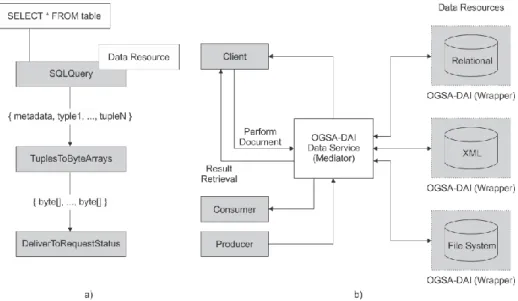
workflows using OGSA-DAI as follows: a client submits their workflow (or request) to a data request execution service (DRES). This is a web service which provides access to a DRER. A workflow consists of a number of units called activities. An activity is an individual unit of work in the workflow and performs a well-defined data-related task such as running an SQL query, performing a data transformation or delivering data. Activities are connected. The outputs of activities connect to the inputs of other activities. Data flows from activities to other activities and this is in one direction only. Different activities may output data in different formats and may expect their input data in different formats [20]. Main activities are organized in three types: Statement Activity, Translation Activity and Delivery Activity. In Fig. 3 a) is shown example of OGSA-DAI workflow with three activities. The interaction between client and data through DRES, is shown in Fig. 3 b).
Fig. 3. a)Example of OGSA-DAI query-transform-deliver workflow. b) Interaction between client and data.
4 Model for Implementation of Virtual Mining Views
In our recent work [21] we proposed and implement computational resources as an extension to OGSA-DAI. The aim of this extension was to use other computational resources, such as, clusters, desktop computers, servers, or Grid nodes, in OGSA-DAI workflows. With this extension part of OGSA-DAI workflow can be executed on machines which don’t have OGSA-DAI installation. In practice, this extension can be very useful because on real and already installed platforms (systems) is difficult to install OGSA-DAI.
In this section we will give brief overview of inductive databases, ideas and current implementations of data mining querying languages and virtual mining views, distributed data mining, and idea for implementation of virtual mining views in OGSA-DAI in distributed way.
4.1 Inductive Databases
In the 90’s with the development of the algorithms for data mining and the systems for implementation of database management systems, especially the SQL language, there is need of data integrating closer to the mining algorithms i.e. in the databases itself. The first steps for this kind of integrating are made in [8] where the authors define the concept for inductive database, where the data and the patterns will be held together. Then with knowledge discovery query language, the information will easily be retrieved.
This kind of KDD query language has to be formally defined, then query optimization tools would be developed to compile queries into reasonably efficient execution plans. This execution plans will include existing inductive learning and statistical data analysis algorithms and may include new inductive tools. The idea for this kind of language comes from the excellent capabilities of SQL, and like SQL should follow the closure principle i.e. input and output of queries are relations.
As an example, the user may state that he or she wants to see all rules about a patient with heart disease such that the consequent of the rule says something about the age of the patient, there are at least 1,000 cases which the rule body applies, and the confidence of the rule is at least 65%. In the M-SQL language [22] this rule query would be represented as follows:
Select
From Mine(T): R
Where R.Consequent = {(Age =*) R.Support > 1000
R.Confidence > 0.65
Several data mining query languages are defined up till now: DMQL [23], MINE Rule [24] etc. But main disadvantage is that users must learn new more complicated
“syntactic sugar” over the algorithms. Standardization of these languages is difficult to perform.
Rather than defining new query language in [25] is proposed concept of virtual mining views. Virtual mining views are empty tables with pre-defined columns which depend of mining algorithms in which are “stored” patterns. The main benefit is that users can use standard SQL language to query patterns from these views. When user retrieve data from these virtual views, in background, algorithm for data mining is activated and patterns are generated and filed in virtual views. After retrieving patterns, data from these views are deleted. This approach is more appropriate and more natural to the concepts of databases. In their research, authors proposed virtual mining views for association rules mining and decision trees.
4.2 Distributed Data Mining
The distributed data mining is a kind of widening of the actual distributed databases. The data which are stored distributed need further analyses. The selection of data or the simple data searching are not enough, just because of this, the data mining is used. Even though the mining algorithms are mostly developed when the data is located on one place, there are many prerequisites because of which the data mining should be used. Here we can mention that databases are distributed, they are large, heterogeneous or they have privacy restrictions. Because of the privacy restrictions and the high communication costs, which are not involved in the standard data mining, creation of database at one place where the algorithm will be executed is not possible. Another restriction is that the databases can be large and with that they cannot be located on one computer only. Moreover, in Grid computing we should also not forget that Grid consists of many desktop computers organized in clusters which do not have enough main memory.
Today there are many algorithms for distributed data mining and the most important can be found in [26]. They cover all the categories of algorithms which are used for sequential mining: association rules, clustering, classification etc. The objective of DDM is to perform the data mining operations based on the type and availability of the distributed resources. Distributed architecture for data mining is likely to reduce the communication load and processing are done near to data and local model was build. After that only data from local models are exchanged to be created a final model with aggregation of local models.
Moreover, there are many data mining systems on Grid [27][28][29]. These systems do not represent distributed databases and the data integration is separated, which is different from our case. In their case the main point is given on computing and processing elements in the system. The integration of the data is done with text data which is algorithms input. This kind of access does not meet the standards for Data Access and Integration described in Section 2.
4.3 Virtual Mining Views in OGSA-DAI
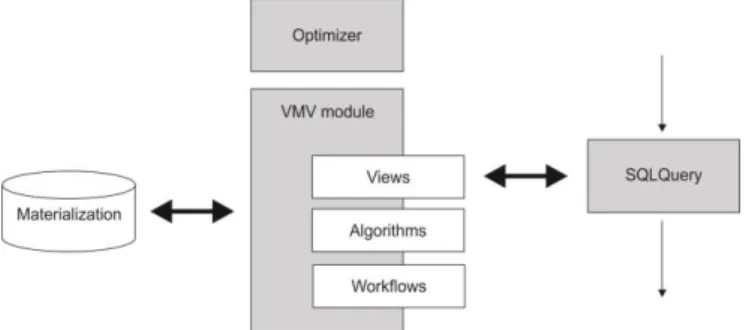
Our main idea is to propose distributed virtual mining views and architecture of OGSA-DAI extension for their implementation. As described above, virtual mining views are proposed in [25] but not in distributed way. The concept of views is not new in OGSA-DAI [30], but these views are standard views which can be defined in every relational database, and they are not virtual mining views. Elements of proposed architecture are shown in Fig. 4.
Fig. 4. Architecture of proposed model for virtual mining views
In focus is Virtual mining views module with these functionalities (which are previously defined by the administrator):
- Defined virtual mining views which are named and consist of fields with predefined types.
- There is a pool of algorithms which are used for data retrieving.
- Defined workflows which use the algorithms and the input data and
materialize the virtual mining views. Because of the usage of the workflows (in OGSA-DAI manner), the administrators are given wide area for implementation of different algorithms in diverse set environments.
The working procedure is the following: The user calls the SQLQuery activity as part of their workflow, then the VMV module checks if there is any virtual mining view included in SQL query. If the virtual mining view is included in, depending on the parameters, the appropriate workflow will be selected, which will activate the algorithms after that. The views are going to be materialized (filled) and the results are returned to the activity. Furthermore, the VMV module should have optimizer which will define the parameters for algorithm activation. These parameters are selected from the SQL query and are really important just because small differences and constraints in the mining algorithms can lead to drastically changed number of the generated mining data.
Gird applications. Today there are many efforts to enable organizing and querying data in Grid environment. OGSA-DAI is a good example. But there is still need of a way how to incorporate distributed data mining algorithms.
Our proposed model is based on inductive database and virtual mining views. One of the logical problems which can be met in this kind of distributed environment is the communication cost between the nodes. This means that the generating of the virtual mining views will last longer which can make the workflow (from which the data should be selected) execute slower. One of the solutions which can be given is that we can use incremental mining, where new patterns are added to the old one. Further practical implementation will find problems that can occur in such architecture.
References
1. I. Foster, C. Kesselman. The Grid: Blueprint for a New Computing Infrastructure. Elsevier, (2004)
2. J. Taylor, Defining e-Science, http://www.nesc.ac.uk/nesc/define.html (2013)
3. G. Kakasevski, et al., Grid enabled system for gathering and retrieving images from WEB, ETAI (2007)
4. The Large Hadron Collider Homepage. http://lhc.web.cern.ch/lhc/ (2013)
5. A. Balaz, O. Prnjat, D. Vudragovic, V. Slavnic, I. Liabotis, E. Atanassov, B. Jakimovski and M. Savic: Development of Grid E-Infrastructure in South-Eastern Europe, J. Grid Comput. 9, 135-154 (2011)
6. N.P.C. Hong, et al., Grid Database Service Specification, GGF Informational Document (2003)
7. M. Antonioletti, M. Atkinson, R. Baxter, A. Borley, N. Hong, B. Collins, N. Hardman, A. Hume, A. Knox, M. Jackson, et al., “The design and implementation of Grid database services in OGSA-DAI,” Concurrency and Computation: Practice and Experience, vol. 17, no. 2-4, pp. 357–376 (2005)
8. Imielinski, T. and Mannila, H. A database perspective on knowledge discovery. Coomunications of the ACM, 39(11):58–64, November (1996)
9. I. Foster, C. Kesselman, J. M. Nick, and S. Tuecke, “The physiology of the grid: An open grid services architecture for distributed systems integration,” in Open Grid Service Infrastructure WG, Global Grid Forum, vol. 22, pp. 1–5, Edinburgh (2002)
10. Open Grid Forum - community of users, developers, and vendors for standardization of Grid computing; http://www.ogf.org/ (2013)
11. Atkinson, M.P., Dialani, V., Guy, L., Narang, I., Paton, N.W., Pearson, D., Storey, T. and Watson, P. Grid Database Access and Integration: Requirements and Functionalities, DAIS-WG, Global Grid Forum Informational Document (2003)
12. A. Lee, J. Magowan, P. Dantressangle and F. Bannwart. Bridging the Integration Gap, Part 1: Federating Grid Data. IBM Developer Works (2005)
13. Paul Watson: Databases in Grid Applications: Locality and Distribution. BNCOD 1-16 (2005)
14. Jackson, M. et al. OGSA-DAI 3.0–the whats and the whys. In Proc. UK e-Science All Hands Q6 Meeting pp. 158–165 (2007)
15. Kumar Abhinav. Evaluation of Grid Middleware OGSA-DAI. School of Computing Science, Vellore Institute of Technology, Deemed University (2006)
16. Tanimura Y, Yamamoto N, Tanaka Y, Iwao K, Kojima I, Nakamura R, Tsuchida S and Sekiguchi S. Evaluation of Large-Scale Storage Systems for Satellite Data in GEO GRID.
The International Archives of the Photogrammetry, Remote Sensing and Spatial Information Sciences. Vol. XXXVII. Part B4. pp 1567-1574. Beijing (2008)
17. MESSAGE (Mobile Environmental Sensing System Across Grid Environments) Project. http://bioinf.ncl.ac.uk/message/ (2010)
18. Garcia Ruiz, M., Garcia Chaves, A., Ruiz Ibañez, C., Gutierrez Mazo, J.M., Ramirez Giraldo, J.C., Pelaez Echavarria, A., Valencia Diaz, E., Pelaez Restrepo, G., Montoya Munera, E.N., Garcia Loaiza, B. and Gomez Gonzalez, S. mantisGRID: A Grid Platform for DICOM Medical Images Management in Colombia and Latin America. J Digit Imaging. Feb (2010)
19. OGSA-DAI open source project publications. http://sourceforge.net/apps/trac/ogsa-dai/wiki/Publications (2013)
20. OGSA-DAI user documentation.
http://sourceforge.net/apps/trac/ogsa-dai/wiki/UserDocumentation (2013)
21. G. Kakasevski et al.; OGSA-DAI Extension for Executing External Jobs in Workflows; ICT Innovations; Ohrid Macedonia (2012)
22. Imielinski, T., Virmani, A.: Msql: A query language for database mining. Data Mining Knowledge Discovery 3(4) 373–408 (1999)
23. Han, J., Fu, Y., Wang, W., Koperski, K., Zaiane, O.: DMQL: A data mining query language for relational databases. In: ACM SIGMOD Workshop on Data Mining and Knowledge Discovery (DMKD) (1996)
24. Meo, R., Psaila, G., Ceri, S.: An extension to sql for mining association rules. Data Mining and Knowledge Discovery 2(2) 195–224 (1998)
25. Blockeel, H., Calders, T., Fromont, E., Goethals, B., Prado, A.: An inductive database prototype based on virtual mining views. In: Proc. ACM SIGKDD Int. Conf. on Knowledge Discovery in Databases. (2008)
26. Bhaduri, Kanishka, et al. "Distributed data mining bibliography." 2009-05-07)[2011-01-03]. http://www. cs. uinbc. edu/-hillol/DDM-BIB (2011)
27. V. Stankovski, et al., Grid-enabling data mining applications with DataMiningGrid: An architectural perspective, Future Generation Computer Systems (2007)
28. Peter Brezany, Ivan Janciak and A. Min Tjoa; GridMiner: An advanced support for e-science analytics; Data Mining Techniques in Grid Computing Environments (2008) 29. Rahul Ramachandran, Sara Graves, John Rushing, Ken Keizer, Manil Maskey, Hong Lin
and Helen Conover; ADaM services: Scientific data mining in the service-oriented architecture paradigm; Data Mining Techniques in Grid Computing Environments (2008) 30. B. Dobrzelecki et al.; Integrating distributed data sources with OGSA–DAI DQP and