HOW DOES HEDGING AFFECT FIRM VALUE – EVIDENCE FROM THE U.S. AIRLINE INDUSTRY
Mengdong He
A Thesis
In
The John Molson School of Business
Presented in Partial Fulfillment of the Requirements for the Degree of Master of Science in
Administration (Finance) at Concordia University
Montreal, Quebec, Canada
August 2015
CONCORDIA UNIVERSITY School of Graduate Studies This is to certify that the thesis prepared
By: Mengdong He
Entitled:HOW DOES HEDGING AFFECT FIRM VALUE – EVIDENCE FROM THE U.S.
AIRLINE INDUSTRY
and submitted in partial fulfillment of the requirements for the degree of MASTER OF SCIENCE IN ADMINISTRATION
(FINANCE)
complies with the regulations of this University and meets the accepted standards with respect to originality and quality.
Signed by the final examining committee:
Chair Dr. M. Sharma Examiner Dr. F. Davis Examiner Dr. R. Mateti Thesis Supervisor Dr. T. Walker Approved by ___________________________________ Graduate Program Director
________________2015 __________________________ Dean of School
ABSTRACT
How Does Hedging Affect Firm Value – Evidence from the U.S. Airline Industry
Mengdong He
This study examines the relation between jet fuel hedging and firm value using a sample of 36 publicly-traded U.S. airlines over the period 1992 to 2013. We find a positive hedging premium which suggests that jet fuel hedging adds value to airlines. We then focus our analyses on the specific ways in which jet fuel hedging by airlines can affect firm value. Specifically, we investigate the effect of jet fuel hedging on firm value based on different hedging levels, different levels of jet fuel exposures, different hedger types, different operating costs spent on jet fuel, and different levels of jet fuel price volatility. Our results suggest that airlines can maximize their firm value by increasing the hedged proportion of next year's jet fuel requirements hedged, particularly when they are at a medium level (between 11% and 36%). Next, we find evidence which suggests that selective hedging strategies can help increase an airline’s firm value. In addition, our results suggest that airlines can increase their firm value significantly by increasing the amount of jet fuel hedged if the amount of their operating costs spent on jet fuel is high (> 27%). Fourthly, our results show that investors appear to value jet fuel hedging more in periods of high jet fuel price volatility. For different levels of jet fuel exposures, we find no evidence that the effect of jet fuel hedging on firm value will show any significant differences based on different levels of jet fuel exposures.
ACKNOWLEDGEMENTS
I would like to express my sincerely thanks to my supervisor, Dr. Thomas Walker, for his great support of my master study. Without his incredible patience, guidance, and encouragement throughout this research, I could not conquer the difficulties and finish this thesis. It has been my great honor to study and research with him.
Also, I would like to express my thanks to my parents. They give me great support during my study and my entire life.
Last but not the least, I would like to thank all of my friends. They provided me with assistance, company, and encouragement, which helped me defeat all difficulties in the process of the research.
Contents
1. Introduction ... 1
2. Literature review ... 3
2.1 Hedging and firm value ... 3
2.2 Jet fuel hedging in the airline industry ... 5
3. Data ... 6
4. Methodology ... 7
4.1 The relation between hedging and firm value of airlines ... 8
4.1.1 Measuring an airline’s jet fuel exposure ... 8
4.1.2 Determinants of jet fuel hedging by airlines ... 10
4.1.3 Firm value and hedging ... 13
4.2 How does hedging affect firm value of airlines specifically ... 15
4.2.1 The effect of change in hedging on change in firm value at different hedging levels ... 15
4.2.2 The effect of hedging and exposure on firm value ... 17
4.2.3 The effect of hedging on firm value for different hedger types ... 18
4.2.4 The effect of hedging on firm value at different levels of the average percentage of operating costs spent on jet fuel ... 19
4.2.5 The effect of hedging on firm value at different levels of jet fuel price volatility ... 20
5. Result analysis ... 21
5.1 Results of the relation between jet fuel hedging and firm value of airlines ... 21
5.1.1 Analysis of airline jet fuel exposures ... 21
5.1.2 Analysis of the determinants of jet fuel hedging by airlines ... 24
5.1.3 Analysis of the effect of hedging on firm value ... 26
5.2 Results of how hedging affect firm value of airlines specifically ... 28
5.2.1 Analysis of the effect of jet fuel hedging on firm value at different hedging levels ... 28
5.2.2 Analysis of the effect of hedging and exposure on firm value ... 29
5.2.4 Analysis of the effect of hedging on firm value at different levels of the average percentage of operating costs spent on jet fuel ... 31 5.2.5 Analysis of the effect of hedging on firm value at different levels of jet fuel price volatility .... 32 6. Conclusion ... 33
Reference ... 36
1.
Introduction
The relation between a firm’s hedging behavior and its firm value has been a focus of many studies in corporate finance. For example, Allayannis and Weston (2001) examine the relation between firm’s hedging activities using foreign currency derivatives and firm value using Tobin’s Q as a proxy. They find a significant and positive relation between foreign currency hedging and firm value. Yet, very little research focuses on the question in what specific ways a firm’s hedging behaviors affect firm value. Many researchers conclude that hedging is associated with higher firm value, but most of them do not examine if firm value can be increased “magically” by increasing the amount of hedging. Similarly, some research studies investigate whether firms’ operating or financial exposures are affected by hedging, but few of them examine if the impact of hedging on firm value appears to vary with the operating or financial exposures.
In our study, we use a sample of 36 publicly-traded U.S. airlines during the period from 1992 to 2013 to investigate the relation between jet fuel hedging and firm value and, more importantly, how jet fuel hedging behaviors by airlines affect firm value specifically. We choose the U.S. airline industry because it offers an excellent environment for studying hedging behaviors. Firstly, publicly-traded U.S. airlines typically report the percentage of next year's fuel requirements hedged, which can be used as a hedging proxy, in their 10-K reports. This provides an easy and reliable way of getting hedging proxy data. Secondly, jet fuel is an important input commodity for the operating process of airlines. In our sample, the average percentage of operating costs that are spent on jet fuel is about 20%. Since jet fuel is an input commodity for airlines rather than a product of the firm such as oil & gas and gold, it creates a risk based on the costs rather than the revenue of the airlines. Thirdly, jet fuel prices are much more volatile than many other commodity prices such as foreign currencies and gold.
In our research, we first calculate the jet fuel price exposure of airlines and analyze the characteristics of the airlines’ jet fuel price exposure before we investigate the impact of the airlines’
jet fuel hedging behaviors and how the effects of airlines’ jet fuel hedging activities on firm value are different based on the jet fuel price exposures. Our results suggest that the jet fuel exposures of airlines are positively correlated with the jet fuel price and the rising direction of the jet fuel price and negatively correlated with the volatility of jet fuel prices.
Next, we investigate the relation between the hedging activities and firm value of airlines to check if hedging can add value to firms. We find evidence supporting our hypothesis that hedging activities can add firm value to airlines. We find that the natural log of Tobin's Q for airlines using jet fuel derivatives for hedging is 26.41% greater than that for airlines which do not use jet fuel hedging derivatives. Our results suggest that a 1% increase in the hedging of next year's fuel requirement appears to increase the natural log of Tobin's Q by about 0.21%.
In the last and most important part of our study, we explore in what specific ways hedging affects the firm value of airlines. Moreover, we investigate the effect of jet fuel hedging on the firm value of airlines based on different hedging levels and different jet fuel exposure levels. We also analyze the effect of different types of hedgers’ jet fuel hedging behavior on firm value and explore how the relative size of jet fuel costs to total operating costs can affect the hedging behavior by airlines. Finally, we examine if the effect of hedging on firm value varies based on different levels of jet fuel price volatility. Our research aims to provide guidelines to airlines when and to what extent they should use jet fuel hedging derivatives. Based on our results, when the percent of next year's jet fuel requirements hedged is in a medium range (11% < PerHedg <= 36%), airlines experience the greatest and most significant increase in firm value which means that firm value cannot be increased sustainably simply by increasing the amount of hedging. We find no significant joint effect of jet fuel hedging and fuel price exposure on firm value which suggests that investors do not value hedging more because of a higher jet fuel price exposure. We find evidence that selective hedging by airlines can help increase firm value significantly. We explore how different levels of operating costs spent on jet fuel affect a firm’s hedging and find that when the level is above 27%, hedging helps increase the firm value. Our research also presents evidence that airlines can increase firm value by increasing the percentage of next year's fuel requirement hedged in periods of volatile
jet fuel prices. However, during periods of low jet fuel price volatility, an increase in jet fuel hedging has no significant effect on the firm value of airlines.
2.
Literature review
2.1 Hedging and firm value
There are many previous studies that investigate firm’s hedging behavior, firm performance, and firm value, but the results from these studies are mixed.
Allayannis and Weston (2001) examine the impact of the use of foreign currency derivatives on firm value using a sample of 720 large U.S. nonfinancial firms during the period from 1990 to 1995. They use Tobin’s Q as a proxy for firm value and find that firms using foreign currency derivatives to hedge their currency risk are valued significantly higher (4.87%) than firms that do not use foreign currency derivatives. Thus, their findings are consistent with the theory that hedging increase firm value.
Kim et al. (2004) investigate the interrelationship between operational and financial hedging activities and the effects of firms’ hedging strategies on foreign exchange risk exposure and firm value using a sample of 212 non-operationally hedged firms and 212 operationally hedged firms that are matched based on size and industry. In their study, they regress the natural log of Tobin's Q against the financial derivatives user proxy and operational hedging proxy. They find that both operational and financial hedging strategies can reduce foreign exchange risk exposure and enhance firm value significantly.
Lookman (2004) investigates whether hedging activities can increase firm value by examining whether the hedging premium is larger for firms that hedge a primary versus a secondary risk. In his research, he regresses firm value against the hedging proxies for primary and secondary risk hedged using a sample of oil and gas producing firms. He finds that hedging is associated with
hedging is associated with higher firm value for diversified firms with an E&P segment. Taken together, these results are not consistent with the hypothesis that hedging can increase firm value. Callahan (2002) investigate if the hedging behaviors of 20 firms in the North American gold mining industry lead to sustainable benefits for the firms’ shareholders. In their study, they regress the volatility of the stock price against the hedging factor to check the relation between hedging and stock price performance. They find that hedging activities can significantly reduce the stock price volatility of gold mining firms which indicates that shareholders can benefit from firm’s hedging behavior.
Smithson and Simkins (2005) examine if risk management can increase firm value using a survey method. In their research, they investigate the relation between financial price risk and share price behavior, the relation between the use of derivatives and reduced risk, the relation between cash flow volatility and firm value, and the relation between the use of risk management and the value of the firm. They argue that although there is some evidence that risk management increases the value of the firm, the evidence is fairly limited. They also question in which ways the use of derivatives might be adding firm value and the effect of active risk management and recommend further research on the topic.
Nelson et al. (2005) investigate the impact of hedging on the market value of equity using a sample of approximately 5,700 U.S. firms over the period from 1995 to 1999. They find consistent evidence that firms that hedge outperform firms that do not hedge by 4.3% per year on average. However, the better stock market performance of firms that use derivatives is limited to companies that hedge foreign currency risk. There are no abnormal returns for firms using interest rate derivatives and commodity price derivatives. In their research, they also compare the relative valuation of hedging firms and firms that do not hedge. They find that large firms that use currency hedgers have higher relative valuations than non-hedge firms, a result that is consistent with Allayannis and Weston (2001). However, for smaller currency hedgers and other types of hedgers, they find lower relative valuations.
Jin and Jorion (2006) investigate the relation between hedging and firm value according to the hedging activities of 119 U.S. oil and gas producers during the sample period from 1998 to 2001. In their research, they examine the effect of a firm’s hedging behavior on its stock return sensitivity to oil and gas prices and find that oil and gas hedging can help reduce the sensitivity of a firm’s stock return to oil and gas prices. In addition, they investigate the effect of hedging on firm value. However, they find no significant difference between the firm value of hedgers and that of non-hedgers.
Bartram et al. (2011) examine the effect of the derivative use on firm risk and value using a large sample of 6,888 nonfinancial firms from 47 countries including the United States. In their study, they find that firms that use derivatives appear to have lower cash flow volatility, idiosyncratic volatility, and systematic risk than firms that do not use derivatives, which suggests that nonfinancial firms use derivatives to reduce their risk. Their results also demonstrate that derivative users appear to have significantly higher value, abnormal returns, and larger profits than firms that do not use derivatives.
2.2 Jet fuel hedging in the airline industry
There are several prior studies which focus on the jet fuel hedging behaviors in the airline industry, For instance, Rao (1999) investigates whether hedging fuel price risk using heating oil futures contracts can reduce the volatility of an airline’s pretax income effectively based on a sample of 10 large U.S. airlines over the period from 1988 to 1997. He finds that jet fuel hedging can reduce the unexplained volatility of the average airline’s quarterly income by over 23% after controlling for trend, seasonality, and persistence of shocks, which suggests that the usefulness of jet fuel hedging is not restricted to protecting weak airlines that cannot withstand an increase in fuel prices. Carter et al. (2006) investigate the impact of jet fuel hedging behavior on firm value using a sample of U.S. airlines during the period from 1992 to 2003. In their research, they regress firm value against the hedging proxy and find that airlines’ jet fuel hedging behaviors are significantly and
positively related to firm value. They find that the hedging premium of their sample airlines is as large as 10%. They also examine if the hedging premium is related to investment opportunities and find that the positive relation between hedging and value increases with the ratio of capital expenditures to sales, which suggests that investors tend to value hedging behaviors more as they expect these hedging activities to protect their ability to invest during bad times.
Sturm (2009) examines if selective hedging strategies according to the price behavior of jet fuel spot, crude oil spot, and crude oil futures can increase the firm value of airlines. In his research, he applies an event-study methodology to test for abnormal price behavior using monthly spot price data obtained from the U.S. Department of Energy during the period from March 1990 to December 2005. He finds that jet fuel prices show a strong seasonal tendency during the second half of the calendar year. Moreover, he estimates the potential value to the airline industry and finds that airlines can add value by selectively cross-hedging their exposure to jet fuel prices in the crude oil futures markets.
Treanor et al. (2014) investigate the relation between jet fuel price exposures and the percentage of next year's fuel requirements hedged and how they affect on airline’s firm value using a sample of U.S. airlines in the period from 1994 to 2008. In their research, they regress the natural log of Tobin's Q against the percentage of next year's fuel requirements hedged and the product of the percentage of next year's fuel requirements hedged and the jet fuel exposure coefficient. They find that hedging can increase an airline’s firm value, but the hedging premium does not increase with the jet fuel price exposures of airlines.
3.
Data
Our sample consists of 36 publicly-traded U.S. airline firms with SIC codes equal to 4512 or 4513 (scheduled air transportation) during the period from 1992 to 2013. Firstly, we obtain a list of 45 publicly-traded U.S. airlines from Compustat, but some of them have limited data during our
sample period. After excluding airlines that have little useful data for our analyses such as PAN AM CORP, which only has data for 1996 in Compustat, we have 36 publicly-traded U.S. airlines for the analyses in our paper.
To estimate the jet fuel price exposure for each airlines in the first part of our analyses, we retrieve daily returns for each airline and equally-weighted market returns from the Center for Research in Stock Prices (CRSP) and then calculate jet fuel returns using U.S. Gulf Coast spot jet fuel prices which we obtain from the Department of Energy Information Administration's website (http://www.eia.doe.gov/).
We collect financial data such as the book value of total assets, long-term debt, and capital expenditures for each airline from Compustat. We will review these variables in more detail in Section 4.1.2.
To proxy for jet fuel hedging, we collect the percentage of next year's jet fuel requirements hedged from the 10-K reports for each airline. This variable is important and widely used in studies that explore jet fuel hedging behaviors in the airline industry. Another variable that is also collected from 10-K reports is the percentage of operating costs that are spent on jet fuel. This variable appears in some previous research such as Carter et al. (2006), but they only provide summary statistics for it and do not use it in the core part of analyses. In our research, we specifically use this variable.
4.
Methodology
In this paper, we investigate the hedging activities and firm value of airlines. In the first part of our study, we examine the relation between hedging activities and firm value to confirm whether hedging can add value to airlines. In the second part, we explore in what specific ways hedging affects the firm value of airlines.
4.1 The relation between hedging and firm value of airlines
In this section, we first investigate the jet fuel exposures of airlines because one of the most important objectives of hedging next year's jet fuel requirements by airlines is to reduce the exposure to jet fuel price risk. Afterwards, we test the determinants of jet fuel hedging to check which factors affect an airline’s hedging activities (e.g., whether airlines with more jet fuel exposure choose to hedge more of next year’s fuel requirements). Finally, we examine how jet fuel hedging affects airlines’ firm value directly.
4.1.1 Measuring an airline’s jet fuel exposure
The first step of our analysis is to measure each airline’s exposure to jet fuel over time. First, we employ standard methodology to estimate the risk exposure of jet fuel prices following some previous studies (e.g., Jorion (1990), Bartov and Bodnar (1994), Petersen and Thiagarajan (2000), and Carter et al. (2006)). Specifically, we regress the daily returns for each airline on the equally-weighted market returns and jet fuel returns in a two-factor market model as shown in Eq. (1) below:
Ri,t = αi+βi,q*Rmkt,t+γi,q*RJet Fuel,t+εi,t , (1) where Ri,t is the daily stock price return of of airline i on day t as gathered from CRSP, Rmkt,t is the CRSP equally-weighted market portfolio return for day t, RJet Fuel,t is the daily return on the Gulf Coast spot jet fuel prices for day t, and εi,t is the residual for airline i and day t. For each firm, the estimated coefficient, γ, is a measure of the airline’s jet fuel exposure. When aggregating the coefficients by quarter, there are 1,599 quarterly estimated jet fuel exposure coefficients after excluding firm-quarter observations for which stock price data is missing in our sample. Because higher jet fuel prices tend to increase the operating costs of airlines and thus lead to lower returns of airlines, we expect airlines to be negatively exposed to the price of jet fuel.
Treanor et al. (2014) argue that the reaction of airlines’ stock prices to variations in jet fuel prices likely affects a firm's hedging policy and potentially the hedging premium. In this paper, we
estimate a series of models to investigate the stability of an airline’s jet fuel exposure coefficients in various regimes following their methodology. The models are as follows:
R𝑖,𝑡=αi+ βiRmkt,t +∑ γjR Jet Fuel, j, t n
j=1 + 𝜀𝑖,𝑡 (2)
where Ri,t is the daily stock price return for airline i on day t, Rmkt,t is the CRSP equally-weighted market portfolio return for day t, RJet Fuel,j,t is the daily return on the Gulf Coast spot jet fuel prices for day t during regime j, βm is the market risk factor which indicates the market risk exposure, γj is the jet fuel risk factor for regime j which indicates the jet fuel risk exposure, and εi,t is the residual for airline i and day t.
We follow Treanor et al. (2014) and employ three different regimes to investigate the stability of airlines' jet fuel exposure coefficients. The first regime is based on the price level of jet fuel. Specifically, we regress the returns of airlines against the returns of jet fuel prices during different fuel price levels to estimate airline exposure coefficients based on differing fuel price levels: Ri,t = α0 + β1Rmkt,t +γ1Jet Fueli(l) + γ2Jet Fueli(m) + γ3Jet Fueli(h) + ei,t (3) where Jet Fueli(l) is the daily return of the jet fuel price when the jet fuel price is below the 25th percentile, otherwise zero. Jet Fueli(m) is the daily return of the jet fuel price when the jet fuel price is between the 25th and 75th percentiles, otherwise zero. Jet Fueli(h) is the daily return of the jet fuel price when the jet fuel price is above the 75th percentile, otherwise zero.
The second regime we investigate is based on the general direction of jet fuel prices. Specifically, we examine whether there is any difference between an airline’s exposure to fuel prices in rising and falling fuel price periods. We thus regress the returns of airlines against the returns of jet fuel prices during periods of rising and falling fuel prices. The model is as follows:
Ri,t = α0 + β1Rmkt,t +γ1Jet Fueli(r) + γ2Jet Fueli(f) + ei,t (4) where Jet Fuel(r) is the daily jet fuel return in fuel prices during quarters when the average daily return of jet fuel prices is positive, otherwise zero; Jet Fuel(f) is the daily jet fuel return during
quarters when the average daily return of jet fuel prices is negative, otherwise zero.
In addition, we conduct a test based on the volatility of jet fuel prices. Treanor et al. (2014) find no significant difference between the exposure coefficients during periods of volatile jet fuel prices and those in periods of stable jet fuel prices. However, in some previous studies that explored the relationship between the exposure coefficients and price volatility, researchers found that the exposure coefficient is negatively related to the price volatility (e.g., Brennan and Schwartz (1995) and Hong and Sarkar (2008)). In our research, we use the following model to test the relation between the exposure coefficients and price volatility:
Ri,t = α0 + β1Rmkt,t +γ1Jet Fuel Voli(l) + γ2Jet Fuel Voli(m) + γ3Jet Fuel Voli(h) + ei,t (5)
where Jet Fuel Voli(l) is the daily return of the jet fuel price when the standard deviation of the jet fuel price is in the first quartile, otherwise zero. Jet Fuel Voli(m) is the daily return of jet fuel price when the standard deviation of the jet fuel price is in the second and third quartiles, otherwise zero. Jet Fuel Voli(h) is the daily return of the jet fuel price when the standard deviation of the jet fuel price is in the fourth quartile, otherwise zero.
4.1.2 Determinants of jet fuel hedging by airlines
In this section, we analyze which factor affect an airline’s jet fuel hedging. There are several theories in corporate risk management that can be used to explain hedging. The first theory states that hedging activities can reduce a firm’s expected financial distress costs and lead to higher firm value. The second theory argues that hedging can help reduce corporate income taxes. The third theory suggests that risk aversion leads managers to carry out hedging activities to reduce firm risk. Before testing the effect of airlines’ hedging activities on firm value, we first take a look at the effect of different kinds of factors on airlines’ hedging activities.
To investigate whether airlines modify their hedging activities in response to their exposure to fuel prices, corporate income taxes, or financial constraints, we propose the following function.
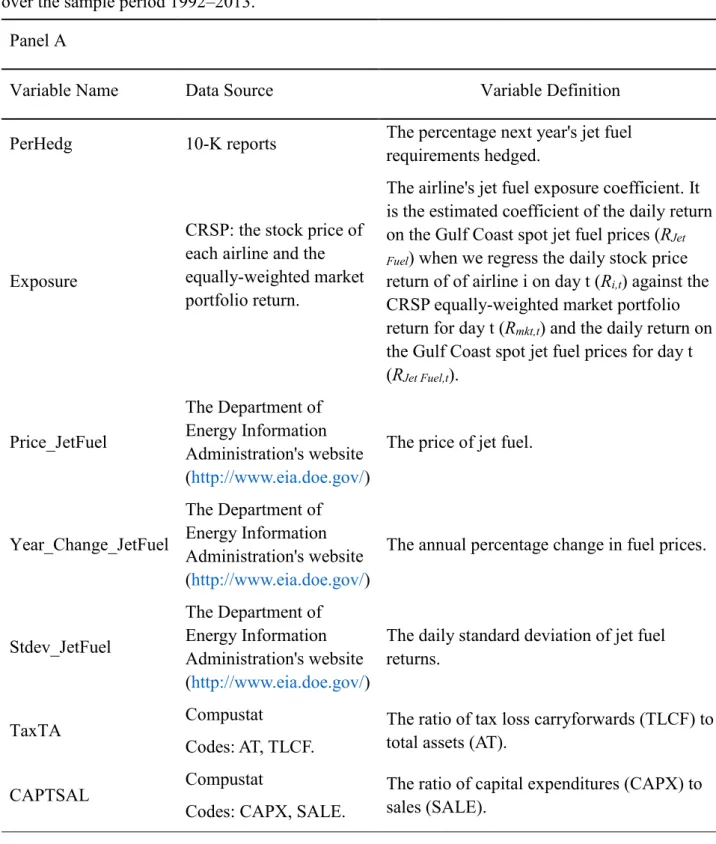
PerHedgi,y = f (Exposure proxies, Tax proxy, Financial constraint proxies) (6) Because the dependent variable (PerHedgi,y) equals to zero for non-hedgers and is greater than zero but less than or equal to one for hedgers, we use a Tobit model instead of a linear regression model to estimate the function. In the model, PerHedgi,y is the percentage of next year's jet fuel requirements hedged by airline i in year y; Exposure proxies include the airline's jet fuel exposure coefficient (Exposure), the price of jet fuel (Price_JetFuel), the annual percentage change in fuel prices (Year_Change_JetFuel), and the daily standard deviation of jet fuel returns (Stdev_JetFuel). We use the ratio of tax loss carryforwards to total assets (TaxTA) to proxy for a firm’s tax burden following Carter et al. (2006).
We also follow Carter et al. (2006) when defining our financial constraints proxies. First, we include the ratio of capital expenditures to sales (CAPTSAL) and the natural log of Tobin's Q (LnQ) as explanatory variables to control for investment opportunities. Froot et al. (1993) and Geczy et al. (1997) argue that a firm’s hedging activities tend to be positively correlated with its investment opportunities. Firms are hypothesized to hedge more with higher CAPTSAL or higher Tobin's Q, i.e. higher levels of investment and higher values placed on future investment. Carter et al. (2006) show a positive but insignificant relation between capital expenditures and hedging while Treanor et al. (2014) observe a positive and significant relation between them. In this study, we estimate Tobin's Q using the simple approximation approach proposed by Chung and Pruitt (1994) (note that the same approach is used by Carter et al, 2006). Treanor et al. (2014) report that hedging is positively affected by LnQ, but the effect of LnQ is insignificant. On the other hand, Carter et al. (2006) show a positive and significant effect of Tobin’s Q on hedging.
Then, we include the long-term debt to total assets ratio (LTDTA) and the natural logarithm of the book value of total assets (LnTass) to control for expected financial distress cost arguments for hedging. Since most researchers suggest that the hypothesized relation between expected financial distress costs and hedging is positive, the standard expectation in a hedging regression is a positive coefficient on LTDTA and a negative coefficient on LnTass. For the long-term debt to total assets
ratio (LTDTA), an indicator of leverage, Haushalter (2000) and Graham and Rogers (2002) find that firms with a higher level of debt in their capital structure, and hence, a higher probability of financial distress tend to hedge more. However, in several prior studies, the researchers find the relation between expected financial distress costs and hedging is opposite of these predictions. For the natural logarithm of the book value of total assets (LnTass), an indicator of firm size, Nance et al. (1993), Mian (1996), and Géczy et al. (1997) have found that large firms are more likely to use derivatives due to the high start-up costs necessary to develop a hedging program. Carter et al. (2006) report a negative relation between debt and hedging and a positive relation between firm size and hedging. They suggest that firms in the airline industry facing greater distress costs if distress is incurred will choose lower debt ratios. Treanor et al. (2014) also find a negative relation between debt and hedging and a positive relation between firm size and hedging, and both of them are significant relations.
Next, we control for the proxies of cash. The ratio of cash flow to sales (Cash Flow) and the ratio of cash holdings to sales (Cash) are the two proxies we used in our research. According to Myers and Majluf (1984), cash can provide a financial buffer for firms that view internal financing as less costly than external financing. Thus firms that generate or hold greater cash flow are less likely to face binding constraints in financing investment, and these two cash proxies are included as inverse proxies for financial constraints. Carter et al. (2006) find a negative but insignificant effect of Cash and a positive effect of Cash Flow on hedging. However, in the research of Treanor et al. (2014), they show a negative but insignificant relation between Cash Flow and hedging, and the relationship between Cash and hedging is positive but insignificant when using Exposure as the proxy for jet fuel price risk.
Since the effect of bankruptcy is also an important financial constraint, we also include the S&P credit ratings from Compustat (S&P Credit) and Altman’s Z-score. In Compustat, S&P is numerically scaled from 2 to 27, and lower numbers reflect higher credit ratings. For the airlines which have no credit rating, we code them with a value of 30 for this variable as in Carter et al. (2006) and Treanor et al. (2014). Altman’s Z-score is calculated as introduced in Altman (1968).
Both Carter et al. (2006) and Treanor et al. (2014) find a negative and significant relation between credit ratings and hedging. In the research of Carter et al. (2006), they find no statistically significant relation between Z-score and jet fuel hedging.
Next, we include some variables which are indicators of alternative hedging activities. Fuel through indicator (Fuel_Pass) is a dummy variable which equals to one for firms that a fuel pass-through agreement is reported in the company's 10-K filing, otherwise zero. When a fuel pass through arrangement occurs, one airline is essentially flying aircraft on behalf of another party and fuel costs are simply passed along by the airline operating the aircraft. According to Carter et al. (2006) and Treanor et al. (2014), a fuel pass-through agreement provides an alternative risk management strategy for fuel price risk, so we assume a negative relation between PerHedg and Fuel_Pass. Charter indicator (Charter) is a dummy variable which equals to one when firms disclose that chartering is a significant part of their businesses, otherwise zero. The foreign currency derivative indicator (Foreign_Currency) and the interest rate derivative indicator (Interest_Rate) are the dummy variables for firms’ use of foreign currency derivative and interest rate derivative, respectively. Carter et al. (2006) find a negative and significant relation between Fuel_Pass and PerHedg as well as a positive and significant relation between the interest rate derivative indicator and PerHedg.
Finally, we also include the dividend indicator (Dividend) and the ratio of advertising to sales (AdvTSales). These two variables show some explanations of the firm value in the next step of the analysis in both research of Carter et al. (2006) and Treanor et al. (2014). Since both of them can be viewed as expenses that reduce firms’ cash, we want to investigate whether they will affect firms’ hedging activities as we assume for the proxies of cash before.
4.1.3 Firm value and hedging
After the investigation of the determinants of jet fuel hedging activities by airlines, we then exam the effect of jet fuel hedging activities on firm value. We use Tobin's Q as our proxy for firm value,
and there are 407 firm-year observations for the 36 airline companies during the sample period from 1992 to 2013. We regress the natural logarithm of Tobin's Q against the jet fuel hedging indicators. At first, we estimate the relationship between firm value and the hedge dummy (Hedger). From this estimation, we want to check if there is a significant difference between hedgers and non-hedgers of jet fuel. The model is as following:
LnQi,y = α + β1 ∗ Hedger + β2–16(Control Variablesi,y) + ei,y (7) where LnQi,y is the natural logarithm of Tobin's Q for airline i in year y; Hedger is the hedge dummy which equals to one if firm hedge any portion of its next year’s jet fuel requirements, otherwise zero. The control variables are the same as we use in the estimation of Eq. (6). They include the ratio of capital expenditure to sales (CAPTSAL), the long-term debt to total assets ratio (LTDTA), the natural logarithm of the book value of total assets (LnTass), the ratio of cash flow to sales (Cash Flow), the ratio of cash holdings to sales (Cash), the S&P credit ratings from Compustat (S&P Credit), Altman’s Z-score, the fuel pass-through indicator (Fuel_Pass), charter indicator, foreign currency derivative indicator, interest rate derivative indicator, the dividend indicator (Dividend), the ratio of advertising to sales (AdvTSales) and the ratio of tax loss carryforwards to total assets (TaxTA). These control variables are used in many previous studies such as Allayannis and Weston (2001) and Carter et al. (2006). Moreover, we also include the average percentage of operating costs that are spent on jet fuel (JetfuelTOpeExp) to investigate if there is a significant relation between the operating costs spent on jet fuel and firm value. We expect a significant and positive coefficient of the hedger dummy according to the results of research by Carter et al. (2006). Next, we regress firm value against the percent of next year's jet fuel requirements hedged (PerHedg) to check the effect of the amount of jet fuel hedged on firm value. The model is as following:
LnQi,y = α + β1 ∗ PerHedgi,y + β2–16(Control Variablesi,y) + ei,y (8) where LnQi,y is the natural logarithm of Tobin's Q for airline i in year y; PerHedgi,y is the percentage of next year's jet fuel requirements hedged for airline i in year y; Control Variables is the other firm
control variables used in Eq. (6). Here, we also expect a significant and positive coefficient β1 of the percentage of next year's jet fuel requirements hedged (PerHedg) which indicate that jet fuel hedging will increase firm value of airlines according to the results of research by Carter et al. (2006).
When analyzing the results of Eq. (6) and Eq. (9), we may face a question of causality whether firms with higher value tend to hedge more or hedging more of the jet fuel costs will increase firm value. Thus, we use an alternative method to avoid the problem of endogeneity as Carter et al. (2006) did in their research. We regress the change of firm value against the firm’s hedging percentage. This type of regression is less likely to suffer from a question of causality when we analyze the results of the estimation of Eq. (9). It will help us to confirm the effect of jet fuel hedging on firm value. The regression model is as following:
∆LnQi,y = α + β1 ∗ ∆Hedgeri,y + β2–16(∆Control Variablesi,y) + ei,y (9)
∆LnQi,y = α + β1 ∗ ∆PerHedgi,y + β2–16(∆Control Variablesi,y) + ei,y (10)
where ∆LnQi,y is the change of the natural logarithm of Tobin's Q for airline i in year y; ∆Hedgeri,y is the first difference of the hedger dummy for airline i in year y; ∆PerHedgi,y is the first difference of the percentage of next year's jet fuel requirements hedged for airline i in year y; ∆Control Variables is the first difference of the other firm control variables used in Eq. (8).
4.2 How does hedging affect firm value of airlines specifically
After estimating the relation between the jet fuel hedging and firm value of airlines to investigate if hedging can add value to firms, we, then, explore in what specific ways jet fuel hedging affects firm value of airlines in this section.
There are many previous studies about the relation between hedging activities and firm value, but few of them focus on how the hedging activities affect the firm value of airlines specifically. In this paper, firstly, we investigate the effect that jet fuel hedging brings to the firm value of airlines in different hedging levels. Since we face a question about multicollinearity if we divide the percent of next year's jet fuel requirements hedged into different tertiles and then run a regression between them and the natural logarithm of Tobin's Q, we apply an alternative method using the first difference of the variables. This method can help us avoid the problem of multicollinearity and investigate the effect of hedging on firm value in different hedging levels. We divide the change in the percentage of next year's jet fuel requirements hedged into different tertiles and then regress the change in the natural logarithm of Tobin's Q against the change in the percentage of next year's jet fuel requirements hedged at different hedging levels. The model is as following:
∆LnQi,y = α + β1 ∗ ∆PerHedg_l + β2 ∗∆PerHedg_m+ β3 ∗∆PerHedg_h +β4–17(∆Control
Variablesi,y) + ei,y (11) where ∆LnQi,y is the change in the natural logarithm of Tobin's Q for airline i in year y; ∆PerHedg_l is the change in percentage of next year's jet fuel requirements hedged (∆PerHedg) when the percentage of next year's jet fuel requirements hedged (PerHedg) is in the lower tertile, otherwise zero; ∆PerHedg_m is the change in percentage of next year's jet fuel requirements hedged (∆PerHedg) when the percentage of next year's jet fuel requirements hedged (PerHedg) is between the lower tertile and the upper tertile, otherwise zero; ∆PerHedg_h is the change in percentage of next year's jet fuel requirements hedged (∆PerHedg) when the percentage of next year's jet fuel requirements hedged (PerHedg)is in the upper tertile, otherwise zero; ∆Control Variables is the first difference of the other firm control variables used in Eq. (8). Since our null hypothesis is that jet fuel hedging can increase firm value, we expect a significant and positive coefficient β3 which should be larger than β2 as well as β1. These results indicate that higher level of jet fuel hedging increase the firm value of airlines more than the lower level of jet fuel hedging does.
4.2.2 The effect of hedging and exposure on firm value
In the research of Treanor et al. (2014), they investigate the joint effect of jet fuel hedging and fuel price exposure using the product of the variables PerHedg and Exposure, and they find no significant joint effect of jet fuel hedging and fuel price exposure on the firm value of airlines. Since they are the first to regress the joint variable of jet fuel hedging and fuel price exposure against firm value, we use an alternative method in our research to check if their results about the joint effect of jet fuel hedging and fuel price exposure on firm value are reliable. We, firstly, classify the percentage of next year's jet fuel requirements hedged according to the different quartiles of exposure coefficient (Exposure). Then, we regress the natural logarithm of Tobin's Q (LnQ) against the percentage of next year's jet fuel requirements hedged at different jet fuel exposure levels. The model is as following:
LnQi,y = α + β1 ∗ PerHedg_expL + β2 ∗ PerHedg_expM + β3∗ PerHedg_expH + β4–
17(Control Variablesi,y) + ei,y (12) where LnQi,y is the natural logarithm of Tobin's Q for airline i in year y; PerHedg_expL is the percentage of the fuel requirements hedged when exposure coefficient is above the 75th quartile, otherwise zero. PerHedg_expM is the percentage of the fuel requirements hedged when exposure coefficient is between the 25th and 75th quartiles, otherwise zero. PerHedg_expH is the percentage of the fuel requirements hedged when exposure coefficient is below the 25th quartile, otherwise zero. The quartiles are determined over the period 1992–2013. The 25th and 75th quartiles are -0.2561 and 0.0072, respectively. Control Variables is the other firm control variables used in Eq. (8). Since lower (more negative) exposure coefficient indicates higher fuel price exposure, and according to Treanor et al. (2014), they assume investors tend to value hedging more with higher jet fuel exposure, we expect the coefficient of the percentage of the fuel requirements hedged when exposure coefficient is below the 25th quartile, β
4.2.3 The effect of hedging on firm value for different hedger types
Adam and Fernando (2006) and Brown et al. (2006) investigate the gold mining firms and find that the economic gains from selective hedging appear to be small. Treanor et al. (2014) also explore the effect of selective hedging on firm value in the airline industry, they find that selective hedging strategies may do more harm than good to firm value. In their research, they use the standard deviation of the PerHedg variable alone as an indicator of hedger type, which do not reflect their definition of selective hedgers clearly in our opinion. According to their definition, selective hedgers are those firms whose standard deviation of the PerHedg variable is in the upper tertile, and passive hedgers are those firms whose standard deviation of the PerHedg variable is in the lower tertile. In our study, we apply an alternative method which we think will show us a more specific view of the effect of hedging on firm value in different hedger types. We combine the percentage of the fuel requirements hedged together with the firm’s hedger type, and investigate the joint effect of them to the firm value of airlines. The model is as following:
LnQi,y = α + β1 ∗ PerHedg_P + β2 ∗ PerHedg_N + β3∗ PerHedg_S + β4–17 (Control Variablesi,y) + ei,y (13) where LnQi,y is the natural logarithm of Tobin's Q for airline i in year y; PerHedg_P is the percentage of the fuel requirements hedged when the airline is classified as passive hedger as its standard deviation of the PerHedg variable is in the lower tertile, otherwise zero. PerHedg_N is the percentage of the fuel requirements hedged when the airline is classified as neutral hedger as its standard deviation of the PerHedg variable is between the lower tertile and the upper tertile, otherwise zero. PerHedg_S is the percentage of the fuel requirements hedged when the airline is classified as selective hedger as its standard deviation of the PerHedg variable is in the upper tertile, otherwise zero. Control Variables is the other firm control variables used in Eq. (8). Here, our null hypothesis is that selective hedging can help increase firm value, so we expect the coefficient of the percentage of the fuel requirements hedged when the airline is classified as selective hedger, β3, is significant and positive, and it should be larger than β1 and β2.
4.2.4 The effect of hedging on firm value at different levels of the average percentage of operating costs spent on jet fuel
In the first part of our research, we add the ratio of jet fuel costs over the total operating costs (JetfuelTOpeExp) in our regression to check if the portion of jet fuel costs in the firm’s overall capital structure will affect the firm value of airlines. In this sector, we want to investigate if the effect of the percentage of the fuel requirements hedged on firm value will show any differences based on the level of the operating costs spent on jet fuel. Thus, we classify the percentage of next year's jet fuel requirements hedged based on the different levels of the average percentage of operating costs spent on jet fuel. The model is as following:
LnQi,y = α + β1 ∗ PerHedg_jetL + β2 ∗ PerHedg_jetM + β3∗ PerHedg_jetH +
β4–17 (Control Variablesi,y) + ei,y (14) where LnQi,y is the natural logarithm of Tobin's Q for airline i in year y; PerHedg_jetL is the percentage of the fuel requirements hedged when the average percentage of operating costs spent on jet fuel is below the 25th quartile, otherwise zero. PerHedg_jetM is the percentage of the fuel requirements hedged when the average percentage of operating costs spent on jet fuel is between the 25th and 75th quartiles, otherwise zero. PerHedg_jetH is the percentage of the fuel requirements hedged when the average percentage of operating costs spent on jet fuel is above the 75th quartile, otherwise zero. The quartiles are determined over the period 1992–2013. The 25th and 75th quartiles are 0.126 and 0.270, respectively. Control Variables is the other firm control variables used in Eq. (8). Since we assume larger portion of jet fuel costs in the firm’s overall capital structure, which means jet fuel expense is a more important part of the firm’s overall business, will help increase the firm value of airlines, we expect a significant and positive coefficient of the percentage of the fuel requirements hedged when the average percentage of operating costs spent on jet fuel is above the 75th quartile, β
4.2.5 The effect of hedging on firm value at different levels of jet fuel price volatility
Then, we investigate if hedging in periods of different levels of jet fuel price volatility will affect firm value differently. We include a year dummy for periods of high jet fuel price volatility (HighVol) which equals to one when the jet fuel price volatility is high during the year, otherwise zero. And we also include a year dummy for periods of low jet fuel price volatility (LowVol) which equals to one when the jet fuel price volatility is low during the year, otherwise zero. For the definition of the periods of high jet fuel price volatility and low jet fuel price volatility, we calculate the yearly standard deviation of the daily jet fuel price. We define years with yearly standard deviation greater than the mean yearly standard deviation of the daily jet fuel price over the sample periods (0.1628) as the periods of high jet fuel price volatility which include years from 2004 to 2009, 2011 and 2012. The rest years are defined as the periods of low jet fuel price volatility.
(Insert Figure 1 here) (Insert Figure 2 here)
Since the jet fuel prices are high in the periods of high jet fuel price volatility which we can see from Figure 1, and higher jet fuel prices mean higher costs for airlines and will lead to lower firm value. The lower firm value can be confirmed by the average yearly Tobin’s Q of airlines shown in Figure 2. If we regress firm value against the percentage of the fuel requirements hedged in periods of different levels of jet fuel price volatility, we will face a problem that firm values are always lower during the periods of high jet fuel price volatility, and this result will affect our analysis of the impact of hedging on firm value in periods of different levels of jet fuel price volatility. To avoid the problem brought by the initial relation between the firm value and level of jet fuel price volatility, we use an alternative method in which we regress the change in the natural logarithm of Tobin's Q against the change in the percentage of the fuel requirement hedged at different levels of jet fuel price volatility instead. The model is as following:
∆LnQi,y = α + β1 ∗ ∆PerHedgXLowVol + β2 ∗ ∆PerHedgXHighVol +
where ∆LnQi,y is the change in the natural logarithm of Tobin's Q for airline i in year y; ∆PerHedgXLowVol is the change in the product of the percentage of next year's jet fuel requirements hedged and the year dummy for periods of low jet fuel price volatility (LowVol); ∆PerHedgXHighVol is the change in percentage of next year's jet fuel requirements hedged (∆PerHedg) multiplied by the year dummy for periods of high jet fuel price volatility (HighVol). ∆Control Variables is the first difference of the other firm control variables used in Eq. (8). Since we assume hedging can help airlines improve their firm value more in periods of high level of jet fuel price volatility, we expect a significant and positive coefficient for the product of ∆PerHedg and HighVol, β3.
5.
Result analysis
5.1 Results of the relation between jet fuel hedging and firm value of airlines
5.1.1 Analysis of airline jet fuel exposures
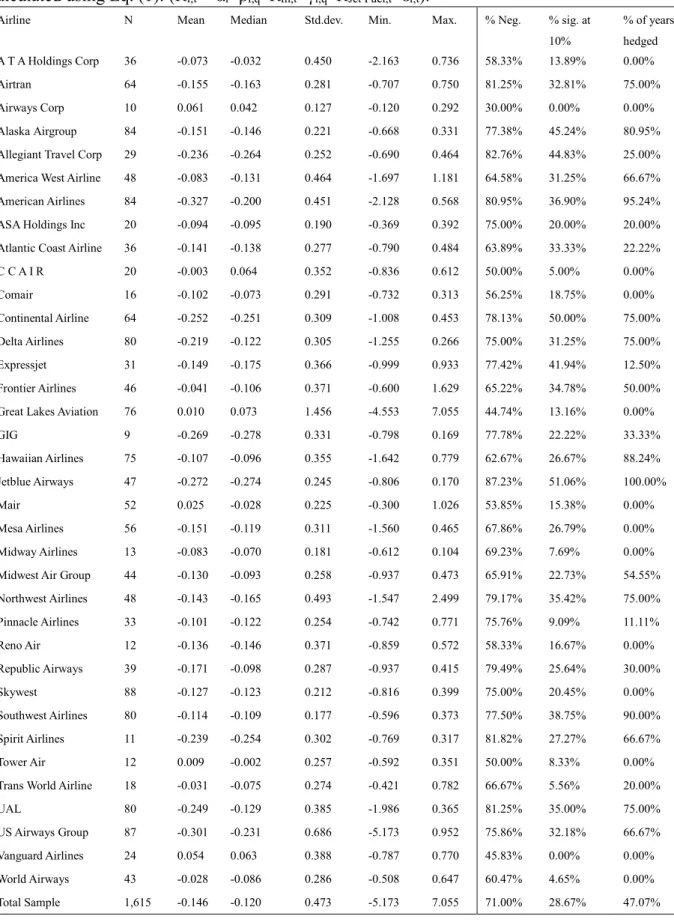
(Insert Table 1 here)
To capture the airlines’ jet fuel exposures, as we introduce in Section 4.1.1, we estimate a two-factor market model on a quarterly basis using daily returns for each airline and the equally-weighted market returns. Table 1 presents the descriptive results for the coefficients of the airlines’ jet fuel exposures in Eq. (1). It shows the mean, median, standard deviation, minimum, maximum, the percentage of negative values, the percentage of jet fuel exposure coefficients that are significant at the 10% level for each airline in our sample and also the proportion of years in which each airline reported hedging of jet fuel. From the result shown in Table 1, we can find that 31 out of the 36 airlines have negative mean jet fuel exposure coefficients in our sample. This result is consistent with our null hypothesis that higher jet fuel prices will lead to lower returns of airlines. In our sample, 13 out of the 36 airlines do not hedge any of their next year's jet fuel requirements
except perhaps that non-hedgers typically exhibit lower exposure. The average coefficient for jet fuel exposures of non-hedgers is -0.042 while the average coefficient for jet fuel exposures of hedgers is -0.173.
In the total sample, there are 1,615 quarterly estimated coefficients of the airlines’ jet fuel exposures. The average coefficient is −0.1461, and 28.67% of those are significant using a one-sided t-test at the 10% significance level. The average coefficient is very similar in magnitude to the −0.11 airline industry fuel exposure coefficient computed from the 1992–2003 monthly data in Carter et al. (2006), as well as the −0.1179 average airline fuel exposure coefficient computed from the 1994– 2008 quarterly basis data in Treanor et al. (2014).
To check whether the reaction of airline stock prices to the varying jet fuel prices over the sample period affects the firm's hedging policy and potentially the hedging premium as what Treanor et al. (2014) find in their research, we firstly estimate airline exposure coefficients based on differing fuel price levels with Eq. (3). The quartiles for jet fuel price data are determined based on daily data of jet fuel prices between January 1992 and December 2013. The 25th and 75th quartiles are 55.10 and 206.60 cents per gallon, respectively.
(Insert Table 2 here)
The results shown in Table 2 reports the estimation of Eq. (3) and illustrates that the higher costs of jet fuel make airlines experience much greater exposures. Columns 1 of Table 2 show the results using an OLS model while Columns 2 reports the results using a firm fixed effects model. Column 3 shows the results for estimating the regression for each firm and reports the mean, median, and standard deviations for the coefficients of airline jet fuel exposures. We can find both Column 1 and Column 2 of Table 2 show that higher jet fuel prices lead to greater exposures for airlines. More specifically, the exposure coefficient during periods of high jet fuel price (׀γ3׀=0.216) is almost four times greater than the exposure coefficient during periods of low jet fuel price (׀γ1׀=0.056).
then examine the difference between airline exposures to fuel prices for periods of rising and falling fuel prices. We regress the returns of the airlines against the returns of jet fuel prices during periods of rising and falling fuel prices with Eq. (4).
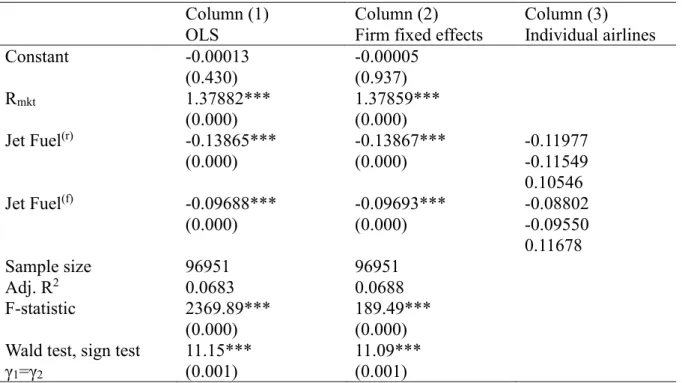
(Insert Table 3 here)
Table 3 presents the results from estimating Eq. (4). As the same as in Table 2, Column 1 and Column 2 report parameter estimates using OLS model and firm fixed effects model, respectively. Column 3 shows the mean, median, and the standard deviation of exposure coefficients for the individual airlines. As we can find in Column 1 that during the periods when jet fuel prices are rising, the airlines’ exposure coefficient is −0.139 rather than the −0.097 for falling jet fuel prices. The results are very similar in magnitude to the -0.135 for periods of rising jet fuel prices and the -0.091 for periods of falling jet fuel prices in Treanor et al. (2014). Moreover, the result of the Wald test (H0: γ1=γ2) shows that differences in the coefficients are statistically significant (p value= 0.001) which indicates that jet fuel exposures during periods when jet fuel price is rising are significantly greater than jet fuel exposures during periods when jet fuel price is falling. We can also find that the results remain unchanged when we use a firm fixed effect model in Column (2). Column 3 shows the summary statistics for individual airline’s jet fuel risk exposure. The average coefficient for airline jet fuel exposure during quarters of increasing jet fuel prices is −0.120 (γ1) versus the −0.088 (γ2) for periods of decreasing jet fuel prices.
The last regime in our exposure analysis is the one based on the volatility of jet fuel prices. We regress the returns of the airlines against the returns of jet fuel prices during different fuel prices volatility periods with Eq. (5).
(Insert Table 4 here)
From the results presented in Table 4, we find that the exposure coefficients during periods of high fuel price volatility are significantly lower than those in periods of low fuel price volatility. The estimation method is the same as those for the other two regimes. Columns 1 and Columns 2 of Table 4 show the results using OLS and firm fixed effects, respectively. Column 3 presents the
results for estimating the regression for the individual firm and reports the mean, median, and standard deviations for the airline exposure coefficients. Both Column 1 and Column 2 of Table 4 illustrate that the exposure coefficient during periods of low fuel price volatility (׀γ1׀=0.242) is more than three times greater than the exposure coefficient during periods of high fuel price volatility (׀γ3׀=0.080). Our result is different from Treanor et al. (2014), who find that there is no significant difference between the exposure coefficients during periods of high fuel price volatility and those in periods of low fuel price volatility. However, our result is consistent with Hong and Sarkar (2008) who indicate that commodity beta is predicted to be a decreasing function of the company’s volatility of reversion of the commodity price. They argue that a higher volatility will move the default boundary of the commodity option further which will decrease default risk and thus will result in lower sensitivity (exposure).
5.1.2 Analysis of the determinants of jet fuel hedging by airlines (Insert Table 5 here)
After investigating the airline jet fuel exposures, we examine the determinants of jet fuel hedging by airlines. Firstly, we do a descriptive statistics for the variables used in the next few regression models of our research. The results are shown in Table 5. On average, airlines in our sample hedge 11.6% of their next year's fuel requirements. The average hedge percentage of their next year's fuel requirements is very similar in magnitude to the 10.9% hedge of next year's fuel requirements computed from the 1992–2003 monthly data in Carter et al. (2006), as well as the 14% computed from the 1994–2008 quarterly basis data in Treanor et al. (2014). The average exposure coefficient is −0.1461 which is similar in magnitude to the −0.11 airline industry fuel exposure coefficient in Carter et al. (2006), as well as the −0.1179 in Treanor et al. (2014). The average of the natural logarithm of the Tobin’s Q is −0.276 which is also similar in magnitude to the −0.231 in Treanor et al. (2014). The average percentage of operating costs that are spent on jet fuel during the sample period is 19.9% which is larger in magnitude than the 13.75% in Carter et al. (2006).
(Insert Table 6 here)
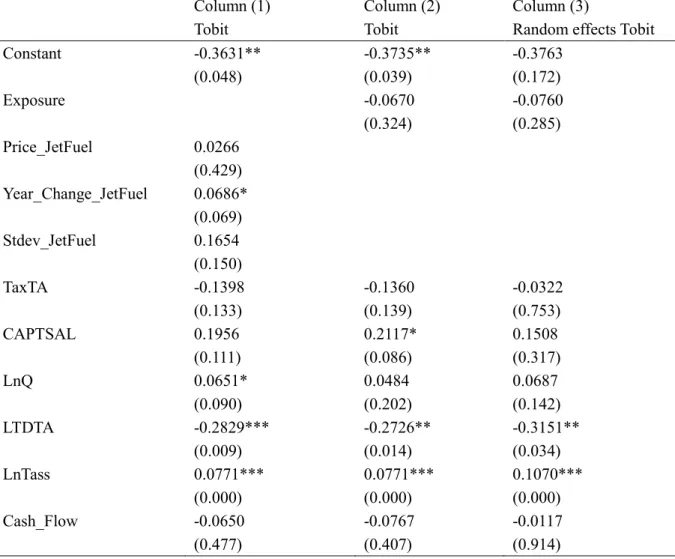
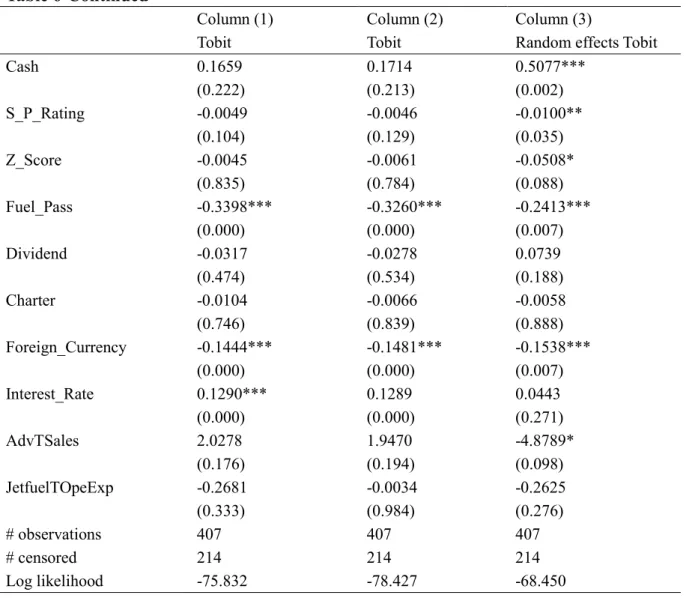
Then, to investigate whether an airline’s hedging activity is modified in response to its exposure to fuel prices, the corporate income taxes or other firm fundamental variables that are measures of financial constraints, we regress the percentage of next year's jet fuel requirements hedged (PerHedg) against the indicators of these three types of factors in Eq. (6). Moreover, the results from estimating of Eq. (6) are reported in Table 6. In Column 1, we estimate a Tobit model using price of jet fuel (Price_JetFuel), annual percentage change in fuel prices (year_change_JetFuel), and the daily standard deviation of jet fuel returns (Stdev_JetFuel) as the exposure variables. In Columns 2, we use Exposure, the average coefficient of each airline's quarterly exposure to fuel prices which is computed based on Eq. (1), as the exposure variables to run a Tobit model. In Columns 3, we estimate a random effects Tobit model using Exposure.
From the results presented in Table 6, we can find that both of the control variables for expected financial distress cost show a significant relation with the percentage of next year's jet fuel requirements hedged (PerHedg). Moreover, the long-term debt to total assets ratio (LTDTA) shows a significant and negative relation with PerHedg while the natural logarithm of the book value of total assets (LnTass) shows a significant and positive relation with PerHedg, and these results are the same as the results in Carter et al. (2006) and Treanor et al. (2014). Since this result is generally inconsistent with the financial constraints argument which assumes that firms with greater expected financial distress costs tend to hedge more, Carter et al. (2006) suggest that airlines with greater distress costs choose to apply lower debt ratios and the positive relation between firm size (LnTass) and jet fuel hedging is the result of applying economies of scale to driving future jet fuel hedging decisions.
Unlike the result in Treanor et al. (2014), we find no significant relation between the jet fuel hedging activities and the exposure coefficients. This result indicates that an airline’s hedging activity may not be modified in response to its exposure to fuel prices. For the ratio of tax loss carryforwards to total assets (TaxTA), the explanatory variables to control for investment opportunities (CAPTSAL and LnQ), the proxies of cash (Cash Flow and Cash), the indicator for
the effect of bankruptcy (S&P Credit and Z-Score), we do not find any significant result which is reliable. Among the indicators of alternative hedging activities, we find that the fuel pass-through indicator (Fuel_Pass) and foreign currency derivative indicator (Foreign_Currency) show a significant and negative relation with jet fuel hedging activities. For the portion of jet fuel costs in the firm’s overall capital structure (JetfuelTOpeExp), we find that all the coefficients for the three variables are negative but none of them is significant.
Another importance of estimating Eq. (6) is that it can be seen as a test for the question about causality when we investigate whether hedging activities affect the firm value of airlines or not in our following research. As shown in Columns 2 and 3 of Table 6, we can find that firm value (LnQ) does not affect airlines’ hedging activities since both the coefficients of LnQ are not significant. It means that there is no issue of endogeneity when we investigate the relationship between hedging activities and firm value in the opposite way later.
5.1.3 Analysis of the effect of hedging on firm value (Insert Table 7 here)
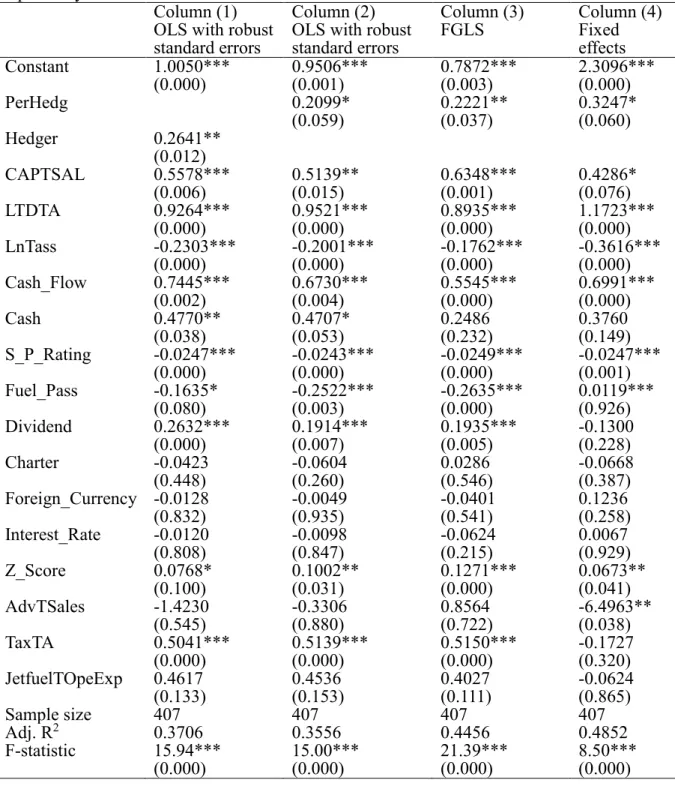
In this section, we analyze the effect of jet fuel hedging on airline’s firm value. We regress the natural logarithm of Tobin's Q (LnQ) against the hedge dummy (Hedger) and the percentage of next year's jet fuel requirements hedged (PerHedg) in Eq. (7) and Eq. (8), respectively. The results of these two estimations are shown in Table 7. Columns 1 of Table 7 reports the result of the OLS regression with robust standard errors using the hedge dummy (Hedger). We can find that the coefficient of the hedge dummy (Hedger), 0.2641, is positive and significant which indicate that the firm values of jet fuel hedgers are greater than the firm values of non-hedgers. Moreover, the magnitude is much greater than the one reported by Carter et al. (2006) which is 0.0442. Columns 2 of Table 7 shows the result of the OLS regression with robust standard errors using the percentage of next year's jet fuel requirements hedged (PerHedg). We can find that the portion of airline’s jet fuel hedging has a significant and positive effect on firm value. This result is consistent with
previous researches such as Carter et al. (2006) and Treanor et al. (2014). In Columns 3 and Columns 4 of Table 7, we use a time-series feasible generalized least squares (FGLS) model and a firm fixed effects model to control for heteroskedasticity and the firm fixed effects, respectively. Both of the coefficients of the percentage of next year's jet fuel requirements hedged (PerHedg) are positive and significant. Moreover, both of the coefficients, 0.2221 and 0.3247, are similar in magnitude to the 0.2770 and 0.3323 in Carter et al. (2006). This result is consistent with our hypothesis that jet fuel hedging will increase the firm value of airlines.
For the average percentage of operating costs that are spent on jet fuel (JetfuelTOpeExp) which we add to the models to investigate if there is a significant relation between the operating costs spent on jet fuel and firm value, we can find that the coefficients of the first three models are positive but none of the coefficients is significant. This result suggests that the operating costs spent on jet fuel do not affect the firm value significantly.
(Insert Table 8 here)
In our research, the results in Table 6 and Table 7 seem not face the problem of endogeneity, because we find no significant evidence that firm value do affect airline’s jet fuel hedging activities while we find that airline’s jet fuel hedging activities increase firm value significantly. To confirm the effect of airline’s jet fuel hedging activities on firm value, we estimate Eq. (9) and Eq. (10) using an alternative method that is based on the change in firm value and the change in the firm’s hedging behavior. According to previous research, this type of regression is less likely to suffer from a question of causality. The results are shown in Table 8. In Columns 1 and Columns 2 of Table 8, we regress the change in firm value (∆LnQ) on the change in the hedger dummy (∆Hedger) using a pooled OLS model and an OLS with firm fixed effects model, respectively. We can find both the results in Columns 1 and Columns 2 of Table 8 show a positive and significant relation between the changes in firm value (∆LnQ) and the change in the hedger dummy (∆Hedger). In Columns 3 and Columns 4 of Table 8, we regress the changes in firm value (∆LnQ) on the change in percentage of next year's jet fuel requirements hedged (∆PerHedg) using a pooled OLS model and an OLS with firm fixed effects model, respectively. We get positive and significant coefficients
for the hedging behavior. All the results in Table 8 help us confirm the significant and positive effect of airline’s hedging behavior on the firm value which is shown by the results in Table 7.
5.2 Results of how hedging affect firm value of airlines specifically
5.2.1 Analysis of the effect of jet fuel hedging on firm value at different hedging levels (Insert Table 9 here)
To explore in what specific ways jet fuel hedging does affect the firm value of airlines, we, firstly, investigate if the effect jet fuel hedging on firm value of airlines varies based on different hedging levels. We estimate Eq. (11) by regressing the change in the natural logarithm of Tobin's Q against the change in the percentage of next year's jet fuel requirements hedged in different hedging levels. Table 9 presents the results for the estimation of Eq. (11). In Column 1 of Table 9, we use an OLS model with robust standard errors. We can find that the coefficients for the change in percentage of next year's jet fuel requirements hedged when the percentage of next year's jet fuel requirements hedged is in the lower tertile (∆PerHedg_l) and the change in percentage of next year's jet fuel requirements hedged when the percentage of next year's jet fuel requirements hedged is between the lower tertile and the upper tertile (∆PerHedg_m) are both positive and significant, while the coefficient for the change in percentage of next year's jet fuel requirements hedged when the percentage of next year's jet fuel requirements hedged is in the upper tertile (∆PerHedg_h) is positive but insignificant. For the magnitude of the coefficients, the one of ∆PerHedg_m (0.4996) is greater than that of ∆PerHedg_l (0.2971) and ∆PerHedg_h (0.2846). This result suggests that hedging behavior of airlines when the percentage of next year's jet fuel requirements hedged is low (PerHedg <= 11%) or the percentage of next year's jet fuel requirements hedged is in a medium range (11% < PerHedg <= 36%) show positive and significant effect on firm value, while hedging behavior of airlines when the percentage of next year's jet fuel requirements hedged is high (PerHedg > 36%) do not show significant effect on firm value. Moreover, airlines will experience the greatest increase in firm value when they increase their hedging percentage of next year's jet
fuel requirements when it is at the medium level (11% < PerHedg <= 36%). This result is inconsistent with our null hypothesis that higher level of jet fuel hedging will increase the firm value of airlines more than the lower level of jet fuel hedging does.
In Columns 2 and Column 3 of Table 9, we use a time-series feasible generalized least squares (FGLS) model and a firm fixed effects model, respectively. The results shown in Columns 2 and Column 3 of Table 9 are the same as that in Column 1 of Table 9. These results suggest that hedging behaviors of airlines when the percentage of next year's jet fuel requirements hedged is in lower level (PerHedg <= 11%) and in a medium range (11% < PerHedg <= 36%) are better for the firm value than hedging behaviors when the percentage of next year's jet fuel requirements hedged is in higher level (PerHedg > 36%).
5.2.2 Analysis of the effect of hedging and exposure on firm value
In this section, we analyze the joint effect of jet fuel hedging and fuel price exposure on firm value. We estimate Eq. (12) by regressing the natural logarithm of Tobin's Q (LnQ) against the percentage of next year's jet fuel requirements hedged in different jet fuel exposure levels. Table 10 reports the results of our estimation of Eq. (12).
(Insert Table 10 here)
As the same as in Table 9, Column 1 of Table 10 shows the results of an OLS model with robust standard errors, while Column 2 and Column 3 of Table 10 present the results of a time-series feasible generalized least squares (FGLS) model and a firm fixed effects model, respectively. From the results shown in Table 10, we can find that jet fuel hedging behaviors of airlines based on the different levels of jet fuel price exposures do not affect the firm value significantly. Although, some coefficients for the different levels of jet fuel price exposures show a significant result in one of the three models, none of them shows any significant effect on firm value over the three models. These results suggest that there is no significant joint effect of jet fuel hedging and fuel price exposure on firm value. The airlines will not be valued more based on the jet fuel hedging behaviors