Being a ‘Self-help Supporter’: recognising the roles that community practitioners
can adopt in supporting self-help groups
Carol Munn-Giddings1, Mark Avis2, Melanie Boyce3, Sarah Chaudhary4 and Patience Seebohm5
1 Professor of Participative Inquiry and Collaborative Practices, Anglia Ruskin University 2 Emeritus Professor of Social Contexts of Health, Nottingham University
3 Senior Research Fellow, Anglia Ruskin University 4 Researcher, Lincolnshire County Council
5 Independent Researcher, London
__________________________________________________________________________ Abstract
Recent policies on self-care and personalisation have a strong focus on the value of peers as a means through which understanding and knowledge can be conveyed. This opens up new opportunities for community practitioners to work with groups run for and by peers who share the same health or social situation.
Selected findings are presented from a three year Big Lottery funded project ‘ESTEEM’ (2010-13) conducted in two locations in England, focusing on the ways in which community practitioners can best support the ethos and practice of peer led self-help groups in the community. The study involved a sample of 21 self-help groups (SHGs) and 26 practitioners who contributed to semi-structured interviews, group interviews and workshops which shaped online national resources and subsequent training programmes.
The findings explore the types of relationships and core activities that practitioners have with SHGs; suggesting a nuanced picture of practitioner support to groups in three main areas of activity: organisational development, nurturing members and processes and enhancing and sharing expertise. Building on the findings the discussion considers how practitioners can best support SHGs, whilst crucially respecting the autonomy and integrity of the groups. Five roles that practitioners can adopt as a ‘Self-help Supporter’ are identified.
Keywords: Peer led self-help groups, practitioner roles with self-help groups, citizen participation
Introduction
Until recently, little policy attention was given to the role and importance of peer led self-help/ mutual aid groups (SHGs)1 in the UK. Although diverse in their form and function key characteristics of SHGs are: that members share a similar health or social situation; come together for mutual support; control and own the group; and that membership is voluntary (Wilson, 1995; Elsdon et al., 2000). Recent policies on self-care and personalisation have a strong focus on the value of peers as a means through which understanding and knowledge can be conveyed. This opens up new opportunities for community practitioners to work with SHGs but also brings risks to groups who may become diverted from their core purpose and be used instrumentally by policymakers or service providers to fulfil their own objectives.
This article draws on selected findings from the ESTEEM study, conducted with SHGs and practitioners during 2010-13, identifying the most effective roles practitioners can adopt to support the development and maintenance of SHGs whilst crucially respecting the autonomy and integrity of groups. The study built on Wilson’s 1995 study that identified the ‘two worlds’
1
Although the term ‘self-help / mutual aid group’ is felt to be the most appropriate, as it brings together self-responsibility with the reciprocity (mutuality) among group members that enables individuals to help themselves, for greater readability it is abbreviated throughout the remainder of the article to ‘self-help group’.
Research, Policy and Planning Vol. 32 No. 2 © Social Services Research Group 2016/17 all rights reserved
that professional services and SHGs potentially occupy in relation to values, structures and sources of knowledge. The findings provide an illustration of the practical steps that the ‘Self-help Supporter’ can take in working to support SHGs and develops five potential roles practitioners could adopt to best support the practice of self-help in the community.
Self-help groups (SHGs) are not a new phenomenon. Their roots can be traced back to the mutual and friendly society movements in the 19th century (Munn-Giddings, 2003). Other forms of SHG emerged from civil rights movements in the 1960s and 1970s (Borkman, 1999). It has been observed that SHGs now exist to address ‘every conceivable condition’ (Jacobs & Goodman, 1989). There is substantial evidence of wide-ranging benefits attributed to SHG membership, such as increased self-esteem, improved relationships, better ability to cope and decreased levels of isolation (Gray et al., 1997; Seebohm et al., 2013). There is also an indication that SHG membership can lead to improved health outcomes and more efficient use of health and social care services (Kyrouz & Humphreys, 2002; Pistrang et al., 2008).
However, in defining and classifying SHGs there remain contested issues due to the variety in form, function and focus that groups can take. Furthermore, members of the same group may not concur about the group’s primary purpose (Radin, 2006). Additionally, while SHGs are often distinguished from groups led by professionals, often referred to as ‘support groups’, it is recognised that this distinction is not always clear and peer led groups may evolve from a group originally instigated by a professional (Oka & Borkman, 2011).
Despite their long history, interactions between SHGs and health and social care professionals (practitioners) have been the subject of limited research, particularly in the UK (Munn-Giddings, 2003). It has been recognised that the ethos of self-help is responsive to the political and economic context in which it develops (Karlsson et al., 2002); due, in part, to the influence of national and local policies for health and social care as well as the training and values of state and public agencies (Munn-Giddings, 2003). In recent years a number of health and social care policies in the UK have begun to encroach on areas traditionally occupied by SHGs. Policies such as Self Care (DH, 2005), the Expert Patients Programme (DH, 2001), and the move towards increasing choice through personal budgets (DH, 2009), are stated to be based on ideas of empowerment, choice and peer support that have hitherto been seen as the normative foundations of SHGs (Hatzidimitriadou, 2002). For example, The Expert Patients Programme (DH, 2001), a programme of courses run by people with long term health conditions, draws on the same process of peers exchanging knowledge for better self-management that has been one of the defining characteristics of SHGs. Furthermore, health and social care policy in the UK has espoused an aim of diversifying provision through the commissioning of services from community based providers, such as voluntary organisations or social enterprises that operate at a local level (DH, 2007). An approach that recognises the possibility that SHGs have a role to play in the delivery of public services. Finally, successive UK governments have promoted the idea of public involvement in local decision making through participation in consultation forums and planning processes (Department for Communities & Local Government, 2005). Unsurprisingly, these procedures have often made use of SHGs as a convenient means of obtaining lay and service user input into their discussions (Godin et al., 2007). Therefore, the current political and economic context in the UK suggests a range of ways in which practitioners will find themselves coming into contact with SHGs. In some instances, practitioners will be trying to achieve policy or professional aims through their work with SHGs.
Two decades ago, Judy Wilson raised a concern that practitioners and SHGs work in ‘two worlds’ each with separate and distinct values, structures, and sources of knowledge which, she claimed, could lead the former to misunderstand the purpose and role of the latter (Wilson, 1995). In their recent reflections on peer led self-help and professionally led support, Oka & Borkman (2011) also drew attention to differences between members’ and professionals’ ways of conceptualising health and social problems, and SHG members’ rejection of a ‘pathologization’ of their concerns. As noted earlier, a changing political context has led to considerable increase in the contact between SHGs and practitioners since the publication of
Wilson’s study. However, there remains limited evidence regarding the best means to build bridges between the ‘two worlds’ (Stewart, 1990; Adamsen & Rasmussen, 2001). A helpful theoretical discussion by Oka & Borkman (2011) introduced the concept of a practitioner as ‘Self-help Supporter’; a professional, official, or anyone who is not a peer member of a self-help group but who ‘respects the autonomy and integrity of the group and works as the members’ wish’ (p.16). The aim of this paper is to reflect on the nature and role of the ‘Self-help Supporter’ in an English context, using selected findings of the ESTEEM project to provide illustration of the practical steps that the ‘Self-help Supporter’ can take in working to support SHGs.
Methods
The evidence on which this paper is based was obtained as part of the ESTEEM study, an action research project carried out in Essex and Nottingham between May 2010 and June 2012 (http://www.selfhelp.org.uk/research/). Here we draw on the qualitative fieldwork data on participating SHG members’ beliefs and values about the group membership and their views on relationships with practitioners from external agencies. In addition, qualitative data was obtained from practitioners, some of whom were associated with the participating SHGs, regarding their motivation and experience of working with SHGs. Follow up interviews and workshops produced evidence from SHG members and practitioners on constructive practice in the support of SHGs.
The project was participatory in nature with SHG members, professionals, commissioners and others coming together to plan and review the research throughout its progress. In addition, a Project Advisory Group, comprising the project team and additional representatives from the Department of Health, health and social care commissioners, practitioners, academics and self-helpers, met every four months to monitor the study and advise on issues arising. This approach is valued for the way it helps to bring about research that has a practical impact and relevance.
Identifying the samples
In Nottingham a local database (Self Help UK) of self-help was used to identify over 200 SHGs that were suitable for inclusion, but in Essex, where no such database existed, researchers had to draw on a range of databases, websites and professional contacts to achieve a sampling frame of 24 suitable groups. The final sample of 21 groups (ten in Nottingham and eleven in Essex) was purposively selected to include a range of health and social issues, established and new groups (not more than two years old), groups that were affiliated to a national organisation and independent groups, and groups run by and for people from Black, Asian and minority ethnic (BAME) communities.
In addition, a sample of twelve expert practitioners who were working with SHGs was identified for inclusion by the Project Management and Advisory Groups with additional suggestions from the participating SHGs. This sample included practitioners from national charities with local affiliated groups, voluntary sector agencies working with community groups and SHGs, a service user network for people from Black, Asian and minority ethnic communities and community development agencies. In a subsequent stage, a further 14 practitioners who had worked closely with some of the participating SHGs were identified for inclusion as they had offered constructive support to a SHG during their development.
Ethical approval was given by the Research Ethics Committees at Anglia Ruskin University. A key challenge was gaining consent from SHGs; this was done by first gaining the coordinators’
agreement to see whether members of their group wished to take part in the study, and if the answer was affirmative conducting interviews after the main business of the group was complete so that members could individually decide and consent whether they wished or otherwise to contribute to the research.
Data collection
Semi-structured individual interviews lasting between 45-120 minutes were conducted with consenting SHG coordinators and the identified practitioners. Group discussions of 45-90 minutes were undertaken with SHG members at a group meeting, following agreement of group members. The interview schedules were developed on the basis of an analysis of existing literature and in consultation with the Project Advisory Group. Findings from each stage of the research informed subsequent stages, e.g. findings from the interviews with SHGs informed the schedules for practitioners. The topics covered in the individual interviews and group discussions included:
• Experiences of SHGs (e.g. types of practitioner contact with SHGs)
• Practitioner input to SHGs (e.g. types of role practitioners could play in the development of SHGs/ the range of support that practitioners can offer a SHG/ types of knowledge and skills required/ what contributes to a positive relationship between groups and practitioners)
• Responding to challenges (e.g. tensions with and boundaries to practitioners’ role with SHGs)
• Ideas on capacity and training (e.g. kinds of training and support needs that SHGs might have)
• Reflections on funding and accountability (e.g. issues the SHGs face in meeting funders’ requirements in relation to accounting, monitoring and evaluation)
• Promoting SHGs (e.g. most effective ways of promoting groups to potential new members and practitioners?)
• Thoughts about future developments (e.g. how might SHGs develop in the future? How might current policy context affect SHGs?).
Informed consent was obtained prior to each interview or group discussion. All interviews and discussions were taped and fully transcribed except for five groups who requested that contemporaneous written notes were taken instead.
Data analysis
The data from all the interviews and group discussions were thematically analysed following steps outlined by Mason (2002). Preliminary themes and findings were shared and discussed with the whole research team and the Project Advisory Group. Preliminary findings and ideas were also shared at a number of consultative workshops in Essex and Nottingham with invited SHG members and local practitioners, who had previously been interviewed as part of the project, in order to refine the analysis and assist in the formulation of good practice.
Findings
The themes present the types of relationships and core activities that SHGs and practitioners in the study described in interviews and workshops. Practitioner sample transcripts are given the letter A and B (follow up interviews) and the SHG sample transcripts are given the letter C.
Theme one: practitioners’ involvement with and understanding of SHGs
On the whole, practitioners supported groups because they saw it as part of their job at an individual or wider organisational level. They spoke of a mutual benefit from their involvement in groups.
There are always things that you can learn from groups like that... I would say [it] is a two way process of giving and receiving information from both parties. (B3)
They valued the opportunity to meet people in a less formal setting and to increase their awareness of issues of importance to people directly affected by a health or social condition.
They saw SHGs as a means of consolidating and enhancing the beneficial effects of health and social care services, and some believed SHGs could potentially save service costs.
We know the benefits of self-help groups regarding people coming together and sharing experiences that’s reduced isolation and it’s reducing admissions as well in cases to hospitals. (B8)
Most practitioners recognised that mutual support was a defining feature of SHGs; that it was the process through which many of the benefits associated with group membership were realised.
These are all people in the same boat just getting on with it and supporting each other to get on with it. (B5)
SHGs emphasised the importance of practitioners respecting the collective experiential knowledge that developed over time in a group.
She [practitioner] always says ‘you’re the experts’. (C16)
Practitioners noted that SHG members did more than share information amongst themselves and that they also participated in consultation forums that aimed to influence statutory services. At a wider level, they could also have a direct impact on the community through re-engaging people, especially those within traditionally excluded populations.
... so they’re actually feeding in now – when anyone comes to me needing some Patient Public Involvement then that’s the sort of group that I would offer them, which is really useful. (B5)
The extent of the practitioners’ involvement in SHGs varied widely. Most stressed the need for groups to be independent and member-led. They felt that their level of involvement should, as far as possible, reflect the needs of the groups as perceived by the members themselves.
Doing it for people doesn’t help them in any way. Do it with them. (B12)
I also don’t sit in on the group... The only times I do is if I’m invited to come and do something specific. And I will do the something specific then leave. (A6)
Data from both SHGs and practitioners identified three distinct areas of activity that practitioners carried out in supporting SHGs: organisational development; nurturing members and process; and enhancing and sharing expertise.
Theme two: organisational development
There were as many models of organisation as there were SHGs, some had no formal structure and others were constituted as charities. All groups had someone, or a small core group of people, who, with differing levels of formality, fulfilled a leadership or coordinating role. The extent of collective responsibility for undertaking group tasks varied widely. In some groups there were high levels of member input but, in others, group coordinators found their role burdensome due to members’ reluctance or inability to assist with running the group. Most groups needed some funds to cover their running costs; these were generally obtained through member contributions. The biggest expense was for meeting premises. Although some groups stated that they did not require much money, many were struggling due to a lack of funds.
Practitioners provided assistance to SHGs with practical issues such as printing leaflets, organising events, borrowing technical equipment, and supplying guides and advice booklets on community groups and other printed resources. Most practitioners felt that groups needed
particularly high levels of support during the starting up stage, and a more directive approach was sometimes needed. Groups were particularly appreciative of ‘starter packs’ and ‘starter grants’. However, for most groups their most pressing need was for practical help to find affordable and appropriate venues for their meetings. For many SHGs assistance with applying for and dealing with small grants to support their activities was critical:
They [CVS] invited us to do these courses… where to put your account, how to reconcile the banking, it’s very, very new and it drives us crazy, so it’s this kind of help… even if I go at the last minute they would help me… (C8)
However, it was a concern for all practitioners to achieve the right balance between sufficient ‘hands-on’ practical support for survival and avoiding dependency.
The administrative side was never ending... it’s almost as if the success of winning money with and for them, bred its own dependencies... you get into helping them resourcing and there’s just a whole field of dependency around that. (A9)
Theme three: nurturing members and group processes
Many practitioners equated their activities in support of the group with support for the group leader. Practitioners offered mentoring to group leaders or directed them to leadership training events and ‘key-members’ days offered by national or local charities. Practitioners agreed that a group leader was best supported by an actively involved membership, and, in some cases, practitioners intervened to promote active member involvement.
That would be part of my role to help them try and come to an agreement and find peace again and work together, and usually that resolves itself... They would just come to me for support and guidance and help with sorting it out. (A3)
For SHGs having the support of a practitioner who knows the ‘system’ could be beneficial to both individuals within the group and to the group processes as a whole.
Without [specialist nurse] we would be in a mess… she knows her way around the NHS that’s for sure. She’s got lots of ideas [about running groups] and little things we might like to be doing. (C18)
Practitioners also helped to develop a group’s capacity by adopting an informal position as a ‘critical friend’. This allowed them to offer constructive but not prescriptive suggestions and raise challenging issues.
Just having an outside perspective really... being that independent, but yet confidential ear, if you like. It’s easy for me because I’m not directly involved in the personalities to actually sit with a group of two or three and say, had you thought about this, had you thought about that? (B7)
Practitioners also directed members to training events that would support self-reliance, such as listening, assertiveness, confidentiality, book-keeping, marketing, computer and English language skills. Practitioners with wide-ranging networks helped groups to access local resources, for instance around funding and training opportunities. Tailoring this information and signposting to the specific needs of each group was regarded as important:
Identifying areas of interest is key... It’s about making sure again that you are responding to the individual needs of that group and then linking them up with services that may support them. (B2)
A perception amongst some group members that practitioners did not actively support recruitment of new group members was a source of some frustration.
I feel most of the professionals are caring, they do want to help their patients, but I can’t understand why they don’t have the confidence in peer groups. (C10)
The ability of a group to attract new members was often seen to be dependent upon practitioners informing others who might be interested. Practitioners were usually willing to help groups with producing literature but they were aware that such information would have limited effect on groups’ membership and needed to engage in broader discussions about attracting new members. The nature of SHGs meant that a group facing closure or winding up is not unusual. There was little clarity about whether practitioners should help group members bring about closure or strive to keep groups going.
Theme four: networking and reciprocal advice
A common way of achieving exchange of information was for practitioners to use their contacts to access and arrange for speakers at the groups’ request. Practitioners also gave advice, provided information in more informal ways to individuals at group meetings or, occasionally, outside meetings. Health and social care practitioners emphasised the reciprocal nature of the learning.
He does quite often, well, sometimes, just give me a ring or send an email about something that’s come his way that he doesn’t really understand and thinks that I might – and vice versa. (B5)
They stressed that they learnt about group members and the problems they experienced as well as the strategies they employed to deal with them, which, in turn, could inform service development.
SHGs valued the ways in which some practitioners enabled them to access and build useful relationships with appropriate people in the local community and they were also in a position to highlight the work of groups within their local communities. Practitioners recognised that many groups, although not all, wanted to be involved in public and patient involvement processes and to influence health and social care services.
With the help of [practitioner]... we’re linked to the national group but we’re also linked to a lot of local groups, so we are much stronger in that way... we developed community status and now we’re involved in lots of things. (C7)
To make them aware of opportunities that they could really provide important feedback... [name of group] have become involved with the patient and public engagement forums with our GP consortia as a result of finding out about it through our networks. (B2)
We’re setting up new citizen reference panels which feed into the clinical commissioning group boards. (B8)
Theme five: working with self-help groups successfully
Supporting SHGs successfully required a recognition of the tensions that could arise. Practitioners were aware that their ways of working often diverged from those of SHGs, noting the informal meeting structure of groups, the timing of meetings organised around members’ circumstances or infrequent meetings leading to a slow response when practitioners are under pressure to meet targets.
If you need to consult properly with the community sector then you need two or three months... some groups only meet once a month, so to consult, you know, you’ve got to get the information out, and you may have just missed a meeting, so you’ve got a month to wait and it may be... the end of the following month before they get any replies back. So if they don’t allow that time then they’re not going to get meaningful results. (B8)
Practitioners, particularly those in the health sector, also identified that their work with SHGs could raise concern over boundaries and limits to professional responsibility, with ambiguities over confidentiality and sharing information.
There are risks, if there’s something that you think would be a real cause for concern, you wouldn’t be able to get involved with that, we do have statutory obligations, and also to point out, you know, if people are doing any kind of risky sort of business. (B13)
There’s these sort of governance issues that hit you because you’re working in it and I sometimes think I don’t really want to be sent a list of everyone’s names and addresses, because it’s automatic for them to do it and it’s OK for that group, but it goes against my grain to have all that information, and I don’t really want it, and I don’t like to say, please don’t send it to me, because then that sounds like you don’t want to play that game... this is their group but it’s being held on NHS premises... It is difficult, but you have to get a bit pragmatic about it otherwise these things won’t happen. I mean it’s not dangerous in that remit and I do always point out, this is my difficulty, and I can’t involve myself with that conversation. (B5)
Practitioners believed that the most effective way of managing and maintaining boundaries and avoiding this type of confusion was to be clear from the outset about what they could offer to groups and the limits to their relationship.
The importance of trust between practitioners and SHGs was identified from both perspectives as crucial to developing good working relations. There was broad agreement amongst practitioners that to work effectively with groups they need to recognise and value the benefits associated with peers supporting one another. The key points that practitioners provided on how to work successfully with SHGs could be summarised:
• be clear about your role and its limits
• help groups get a local profile and credibility
• value different kinds of expertise and support
• be friendly, approachable, non-judgmental and flexible
• be positive; assess the risks and take a ‘leap of faith’. Discussion
A picture emerges of a range of activities by which practitioners contribute to SHGs. The manner in which these activities are performed may raise questions about ownership and control of groups, and also whether practitioners are supporting group leaders or helping the membership to run their group themselves. A prescriptive approach to leadership or members’ roles may risk undermining a delicate balance that is unique to each group’s circumstances (ESTEEM, 2012; Visram et al., 2012; Boyce, 2016). Literature about SHGs tends to stress a fundamental difference between those groups instigated by practitioners and those organised by people with a condition or social issue around which the group was focused (Oka & Borkman, 2011). However, practitioners’ accounts presented above indicate a more nuanced picture of their involvement with SHGs, where practitioners may help to set up, support transition, or facilitate groups but usually with the intention that they could become, or remain, member-led.
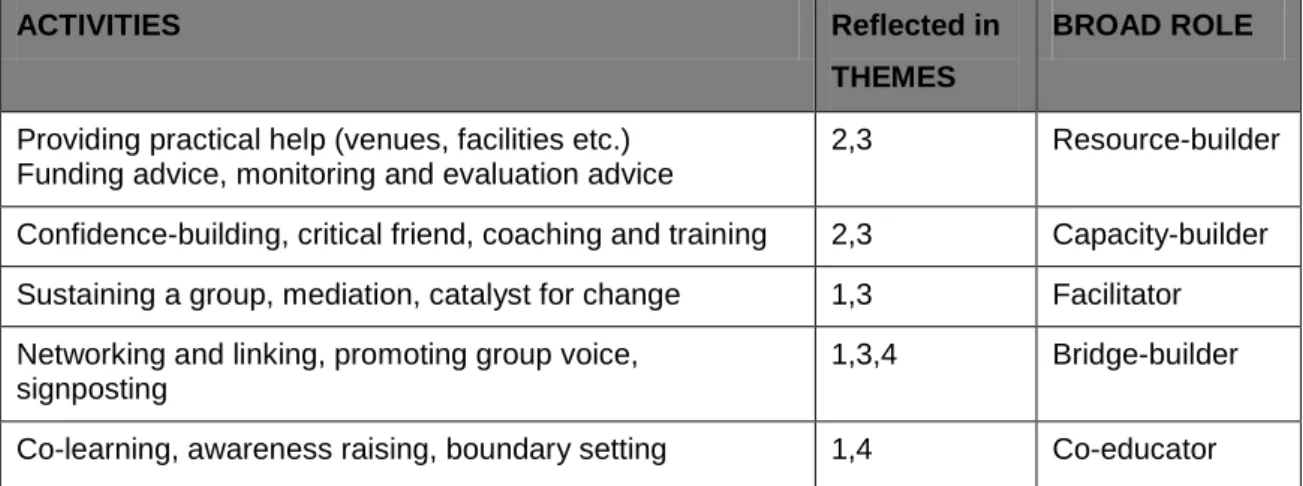
In Oka & Borkman’s (2011) discussion of the concept of the ‘Self-help Supporter’, they stress the importance of practitioners taking account of the values and diversity of self-help and the nature of SHGs as a community of support. Drawing on the findings presented above, practitioners’ activities in support of SHGs can be collated into a defined set of roles that expand on this idea of the ‘Self-help Supporter’ (Table 1). These roles extend Wilson’s earlier work (1995), where she argued that practitioners working with SHGs must be clear about the role they are taking within a group and recognise how this role might need to change over time. These identified roles can be transitory, they are not mutually exclusive and responsive to the needs of the group at a particular time.
Table 1.Activities and role of practitioners in relation to SHGs.
ACTIVITIES Reflected in
THEMES
BROAD ROLE
Providing practical help (venues, facilities etc.) Funding advice, monitoring and evaluation advice
2,3 Resource-builder
Confidence-building, critical friend, coaching and training 2,3 Capacity-builder
Sustaining a group, mediation, catalyst for change 1,3 Facilitator
Networking and linking, promoting group voice, signposting
1,3,4 Bridge-builder
Co-learning, awareness raising, boundary setting 1,4 Co-educator
(Themes: Involvement with and Understanding (1); Organisational Development (2); Nurturing Members and Group Processes (3); Networking and Reciprocal Advice (4); Successful Work with Groups (5)).
These roles indicate how practitioners can form relationships with SHGs in order to build a bridge between the two worlds of professional practice and self-help. For example, as a
Resource-builder: the practitioner can offer a range of practical help making resources they
have access to available to groups such as finding rooms to meet. This role, particularly for practitioners in the voluntary sector, may also involve helping to identify, secure and account for suitable funding. As a Capacity-builder: the practitioner works with a group or key members to bolster a group’s confidence and assist them with developing the skills to sustain the running of the group. This role is likely to be a longer term commitment for practitioners and may involve identifying training opportunities or taking a coaching role. Another approach could be to become a critical friend to the groups, where practitioners encourage group members to reflect on alternative ways of doing things. In the role as Facilitator practitioners may work in a one-off capacity or over time to help a SHG through periods of difficulty, struggle or conflict, including coming to a close if necessary. Differing types of support may be needed throughout the life cycle of a group. Sometimes ‘facilitators’ could act as a mediator in response to deteriorating group member relationships. A core role for practitioners is as Bridge-builder putting people, groups and agencies in touch with each other and helping people from different sectors to understand each other. This role could be especially useful in the NHS where groups sometimes struggle to be heard and respected. Finally, a role that encapsulates respect for the collective experiential knowledge groups build is the Co-educator where practitioners work with groups to support the peer to peer learning activities that underpin successful self-help, embracing that they have as much to learn from the group members as to give. This approach to mutual learning would provide a solid foundation to ‘co-production’ approaches currently promoted in service development. It is suggested that these five roles can develop the practice of the practitioner as a ‘Self-help Supporter’. They provide a practical dimension to the values outlined by Oka & Borkman (2011) whereby practitioners demonstrate a sympathetic attitude to
the ethos of the SHG, respect for collective wisdom of the group and willingness to learn from them, and sensitivity to the diversity of self-help and the idiosyncratic organisation and character of each SHG.
By involving practitioners and SHG members at core points in the research process, the suggested roles are grounded in the day-to-day practice of both practitioners and SHGs. Outcomes of the study have been subsequently tested in workshops and training programmes delivered by Self Help UK and have demonstrated a high degree of robustness. Although this was a national study we acknowledge that the overall sample was relatively small and that the findings, in keeping with the qualitative methodology, are more likely to be transferable rather than generalizable. The particular policy context of England, UK will impact on the data, however, the findings both resonate and reinforce the broader global literature which explores the relationship between professionals and SHGs (Oka & Borkman, 2011) and gives practical guidance for practitioners in becoming a ‘Self-help Supporter’.
However, cultural socio-political and historical context is an important influence on determining the types of relationships that are possible between practitioners and SHG members (Munn-Giddings, 2012) and it may be that the process of this project rather than the findings have a greater currency in developing the role of the ‘Self-help Supporter’ in a particular country context. We have argued elsewhere that peer led SHGs offer a unique form of social support to their members but they are not a replacement for statutory services (Munn-Giddings & McVicar, 2007; Seebohm et al., 2013; Boyce, 2016). However, current neo-liberal health and social care policies that focus on self-help as a way to replace rather than complement services can create tensions or divisions between practitioners and self-helpers that can put in jeopardy the trust and equality required for practitioners to be a genuine ‘Self-help Supporter’.
Conclusion
The diverse range of practitioners that contributed to this study highlights the various ways that practitioners are supporting SHGs. Practitioner and group member accounts illustrate both the possibility of and range of benefits arising from partnership working, such as the facilitation of mutual learning and networking opportunities. Similarly, distinct areas of tensions and challenges were also raised. Recognising roles that practitioners can adopt to sustain the member-led character of SHGs was often key to managing these tensions. The roles presented above can be effective ways to becoming a ‘Self-help Supporter’, enabling practitioners to work with SHGs in support of mutuality and the sharing of the collective wisdom of group members with practitioners and wider communities.
Acknowledgements
The ESTEEM study was funded by the Big Lottery.
With thanks to our project partners Sarah Collis (Director) and Caroline Bell (Development Officer) at Self Help UK. Thanks also to all the research participants and members of the advisory board on the ESTEEM project.
References
Adamsen L. & Rasmussen, M. (2001) ‘Sociological perspectives on Self Help Groups: reflections on conceptualisation and social processes’, Journal of Advanced Nursing, 35(6), pp. 909-917.
Borkman, T. (1999) Understanding Self-help/Mutual Aid: Experiential Learning in the Commons, New Brunswick, NJ: Rutgers University Press.
Boyce, M. (2016) It’s a safe space: The role of self-harm self-help/mutual aid groups, PhD Thesis, Anglia Ruskin University, accessed at: http://arro.anglia.ac.uk/700655/1/Boyce2016.pdf
Boyce, M., Munn-Giddings, C., Seebohm, P., Chaudhary, S. & Avis, M. (2014) ‘Use of social media by self-help and mutual aid groups’, Groupwork, 24(2), pp. 26-44.
DH (2001) The Expert Patient: A New Approach to Chronic Disease Management for the 21st Century, London: Department of Health.
DH (2005) Self-care – A Real Choice: Self-care Support – A Practical Approach, London: Department of Health.
DH (2006) Our Health, Our Care, Our Say: A New Direction for Community Services, White paper, London: HMSO.
DH (2007) Commissioning Framework for Health and Wellbeing, London: HMSO.
DH (2009) Understanding Personal Health Budgets, London: HMSO guidance document. DH (2011) Healthy Lives, Healthy People: Update and Way Forward, London: HMSO.
DH (2011b) No Health Without Mental Health: A Cross-Government Mental Health Outcomes Strategy for People of All Ages, London: HMSO.
Department for Communities and Local Government (2005) New Localism; Citizen Engagement, Neighbourhoods and Public Services, London: HMSO.
Elsdon, K., Reynolds, J. & Stewart, S. (2000) Sharing Experience, Living and Learning: A Study of Self Help Groups, London: Community Matters.
ESTEEM (2012) Project Summaries and Resources, accessed at:
http://www.selfhelp.org.uk/research/
Godin, P., Davies, J., Heyman, B., Reynolds, L., Simpson, A. & Floyd, M. (2007) ‘Opening communicative space: a Habermasian understanding of a user-led participatory research project’, The Journal of Forensic Psychiatry and Psychology, 18(4), pp. 452-469.
Gray, R., Fitch, M., Davis, C. & Phillips, C. (1997) ‘A qualitative study of breast cancer self-help groups’, Psycho-Oncology, 6(4), pp. 279-289.
Hatzidimitriadou, E. (2002) ‘Political ideology, helping mechanisms and empowerment of mental health self-help/ mutual aid groups’, Journal of Community and Applied Social Psychology, 12(4), pp. 271-285.
Jacobs, M. & Goodman, G. (1989) ‘Psychology and Self Help Groups: predictions on a partnership’, American Psychologist, 44(3), pp. 536-545.
Karlsson, M., Jeppsson Grassman, E. & Hansson, J. (2002) ‘Self Help Groups in the welfare state: treatment program or voluntary action?’, Non-Profit Management and Leadership, 13(2), pp. 155-167.
Kyrouz, E., Humphreys, K. & Loomis, C. (2002) ‘A review of research on the effectiveness of self-help mutual aid groups’, in B.J. White & E.J. Madara (eds.), The Self help Sourcebook: Your Guide to Community and Online Support Groups (7th edition), Denville, NJ: American Self-help Group Clearinghouse.
Mason, J. (2002) Qualitative Researching, London: SAGE Publications Ltd.
Munn-Giddings, C. (2003) Mutuality and Movement: An Exploration of the Relationship of Self-help/ Mutual Aid to Social Policy, PhD thesis, Loughborough University, accessed at: https://dspace.lboro.ac.uk/dspace-jspui/browse?type=author&value=Munn-Giddings%2C+Carol
Munn-Giddings, C. & McVicar, A. (2007) ‘Self-help groups as mutual support: what do carers value?’, Health and Social Care in the Community, 15(1), pp. 26-34.
Munn-Giddings, C. & Stokken, R. (2012) ‘Self-help/mutual aid in Nordic countries: introduction to the special issue’, International Journal of Self-Help and Self-Care, 6(1), pp. 3-9.
Oka, T. & Borkman, T. (2011) ‘SHGs, Self-help Supporters and social work: a theoretical discussion with some case illustrations of family survivors of suicide in Japan’, Studies on Social Work, 37(3), pp. 168-183.
Pistrang, N., Barker, C. & Humphreys, K. (2008) ‘Mutual Help Groups for mental health problems: a review of effectiveness studies’, American Journal of Community Psychology, 42, pp. 110-121.
Radin, P. (2006) ‘To me it’s my life: medical communication, trust and activism in cyberspace’, Social Science and Medicine, 62, pp. 591-601.
Seebohm, P., Munn-Giddings, C. & Brewer, P. (2010) ‘What’s in a name? A discussion paper on the labels and location of self-organising community groups with particular reference to mental health and Black groups’, Mental Health & Social Inclusion, 14(3), pp. 23-29.
Seebohm, P., Avis, M., Chaudhary, S., Avis, M. & Munn-Giddings, C. (2013) ‘The contribution of self-help/mutual aid groups to mental wellbeing’, Health & Social Care in the Community, 12(4), pp. 391-401.
Stewart, M.J. (1990) ‘Professional interface with mutual aid self-help groups: a review’, Social Science and Medicine, 31(10), pp. 1143-1158.
Visram, N., Roberts, A., Seebohm, P., Boyce, M. & Chaudhary, S. (2012) ‘The role of self-help groups in promoting wellbeing: experiences from a cancer self-help group’, Mental Health and Social Inclusion, 16(3), pp. 139-146.
Wilson, J. (1995) Two Worlds:Self Help Groups and Professionals. Social Care Research 60, York: Joseph Rowntree Foundation.
Winter, R. & Munn-Giddings, C. (2001) A Handbook for Action Researchers in Health and Social Care, London: Routledge.
Notes on Contributors
Professor Carol Munn-Giddings (PhD, MA, BA (Hons), FHEA)
Carol’s research focuses on ways in which citizens and citizen groups with a direct experience of a health or social situation can inform the development of appropriate health and social care services. Her current research includes work with self-help/mutual aid groups in the community, training and supporting citizen researchers and, more recently, how the use of participatory arts can improve wellbeing in a variety of health contexts.
Professor Mark Avis (MA, BA (Hons))
Mark is Emeritus Professor at Nottingham University. At the time of the ESTEEM project Mark was Head of the School of Nursing, Midwifery and Physiotherapy. His nursing experience is in mental health and care of the older adult. His academic background is medical sociology and his research programme has focused on people’s experience of health and health services including the contribution of self-help groups to health and wellbeing.
Dr Melanie Boyce (PhD, MSc, BA (Hons))
Melanie is a Senior Research Fellow whose research areas of interest and expertise are community groups, peer support and service user involvement and engagement using qualitative and participatory approaches. Melanie has a particular interest in gender and mental health issues and is currently undertaking research related to gender and wellbeing. Her doctorate is related to the role of self-help groups for people who self-harm.
Dr Sarah Chaudhary (PhD, MA, BA (Hons))
Sarah is currently working in the Public Health Directorate of Lincolnshire County Council where she leads and contributes to a variety of community health and wellbeing projects. Sarah has expertise in qualitative research, social policy and social theory. Sarah has a particular interest in Habermasian deliberative democracy and used this perspective to explore self-help groups as sites of active citizenship in her doctoral study.
Dr Patience Seebohm (PhD, MA, BA (Hons))
Patience has worked in statutory, not for profit, community and academic organisations. Most of her work has focused on increasing the voice, employment and housing opportunities for people experiencing mental distress. Since 2008 much of this work has involved participatory action research with different ethnic and social groups. Patience’s doctoral study focused on community development with black mental health peer led self-help groups.
Correspondence
Professor Carol Munn-Giddings Anglia Ruskin University
Faculty of Health, Social Care and Education School of Education and Social Care
William Harvey Building, 4th Floor Chelmsford Campus
Bishop Hall Lane Chelmsford CM1 1SQ
E: [email protected] T: 08451 964 101