EXTERNAL FACTORS AFFECTING THE PERFORMANCE
OF MICRO
AND SMALL ENTERPRISES
(MSES): A STUDY ON SELECTED MSEs IN
BEDELETOWN
A THESIS SUBMITTED TO POST GRADUATE PROGRAM IN PARTIAL
FULFILLMENT
OF THE REQUIREMENTS
FOR THE DEGREE OF
MASTER OF BUSINESS ADMINISTRATION
(MBA)
BY
LENSE GETACHEW
OD~~671
l
(
MAIN ADVISOR: - AREGA SEYOUM (Ph D) CO-ADVISOR:-TAYE AMOGNE (MBA)
JIMMA UNIVERSITY
COLLEGE OF BUSINESS AND ECONOMICS SCHOOL OF GRADUATE STUDIES
MASTERS OF BUSINESS ADMINISTRATION PROGRAM
lID 2346
.K4 .L46
Declaration
I, the under signed, declared that this thesis is my original work and has not been presented for a degree in any other university, and that all sources of materials used for this research are duly acknowledged.
Name: Lense Getachew
Signature: ----~~':f=-/---Date:
2
S
/06//1
OOH672I
t
I
JU - LIBRARY SYSTEM Tel.: 0471112119 378, Jirnma, Ethiopia1111111111111111111111111
0194141Approval
sheet
Jimma University
College of Business and Economics
Postgraduate
Program
Title: External
Factors Affecting
the
Performance of Micro and
'.
Small
Enterprises
in Bedele Town
By: Le
n
se Ge
t
ac
h
ew
Approved by board of examiners
Main adviser signature date
Co-adviser signature date
Examiner (external) signature date
2
.
rJObll'{
Abstract
The study was designed to assess the external factors affecting the performance of Micro and Small Enterprises (MSEs) in Bedele town. A sample of 297 operators or owners of the enterprises engaged in five sectors was taken for the study using stratified random sampling technique. The head of Bedele micro and small enterprises development agency was purposely selected for the interview. From the distributed 297 questionnaires 269 were returned. The data collected through questionnaire is analyzed using both descriptive and inferential analysis (Pearson's product moment correlation coefficient and Multiple Linear Regression Model). Besides, the interview questions were analyzed using descriptive narrations. The empirical finding elucidated that factors affect the performance of MSEs which include; accessibility of external source of finance, accessibility of business development services and marketing factors are significantly affect the performance of micro and small enterprises in Bedele town. While, government policy and bureaucracy and infrastructure are found to be insignificantly explaining the performance of MSEs. The finding further indicate that, the existence of linear and positive significant, ranging from weak to strong relationship was found between independent variables and dependent variable. Based on the findings
recommendations to stakeholders, to operators of MSEs and suggestions for further researchers are forwarded.
Acknowledgement
First and for most, 1 would like to thank my beloved parents, specially my mother and my father, for their immeasurable pray, encouragement, moral and financial assistance and for
everything they have done for me during my entire period of my studies.
My deepest gratitude goes to my Advisors, Arega Seyoum(PhD) and Mr. Taye Amogne, for their constructive comments and suggestions during the course of this study. Besides their contribution to this thesis, 1 also like to thank their profound contributions to my stock of knowledge. Both of them have been so resourceful that their comments and advices have improved the quality of my work and contributed profoundly to my stock of knowledge.
1would like to take this opportunity to thank my friend, Kumeshi Tadele, for helping me get through some of the difficult times. She is the best friend of mine who provided me all the sisterly support, entertainment and care in the due course of accomplishing this study. Let God bless her entire life.
Finally, 1 would like to acknowledge all respondents in Bedele town MSE operators for their willingness in filling and returning my questionnaires; and 1 also thank the head of Bedele MSEs development agency for giving me an interview of all the relevant information on the operation of MSEs in Bedele town.
Above all, 1 praise my Lord God for keeping me from all possible dangers, guiding, and helping me to be healthy throughout all my study time and enabling me to complete my work in time.
Table of contents
Contents
Abstract iii
Acknowledgement. iv
Table of contents v
List of figures viii
List of tables ix
List of abbreviation and acronyms x
CHAPTER ONE 1
1. INTRODUCTION 1
1.I. Background of the Study 1
1.2. Statement of the Problem 4
1.3. Objective of the Study 5
1.3.1.General Objective 5
1.3.2.Specific Objectives 5
1.4.Significance of the Study 6
1.5.Scope of the Study 6
1.6. Limitations ofthe Study 7
1.7.Operational definitions 7
1.8. Organization of the Study 9
CHAPTER TWO 10
2.REVIEW OF RELATED LITERATURE 10
2.1. Theoretical Literature 10
2.1.1. Definition of Micro and Small Enterprises 10
2.1.2. The Concept ofBusiness Performance 12
2.1.3. The Micro and Small Enterprise Sector inEthiopia 13
2.104. Concept of Business Environment 16
2.1.5. External Factors affecting thePerformance of MSEs 16
2.2 Empirical Literature 22 2.2.1. Conclusions and knowledge Gaps Emerged from Survey of Related Studies 24
2.3 Conceptual Framework 25
CHAPTER TlIREE 27
3. RESEARCH DESIGN AND METHODOLOGy 27
3.1Research Design 27
3.2. Source of Data and Method of Data Collection 27
3.2.1. Source ofData 27
3.2.1. Method of Data Collection 27
3.3. Description of the study area 28
304. Population, Sample and Sampling Technique 29
304.1. Study Population 29
304.2. Sample and Sampling Technique 29
3.5. Data Processing and Analysis Techniques 31
3.5.1 Data Processing 31
3.5.2. Data Analysis 31
3.6. Variables and Measurements 33
CHAPTER FOUR 35
4. DATA PRESENTATION, ANALYSIS AND 35
DISCUSSION OF RESULTS 35
4.1. Introduction 35
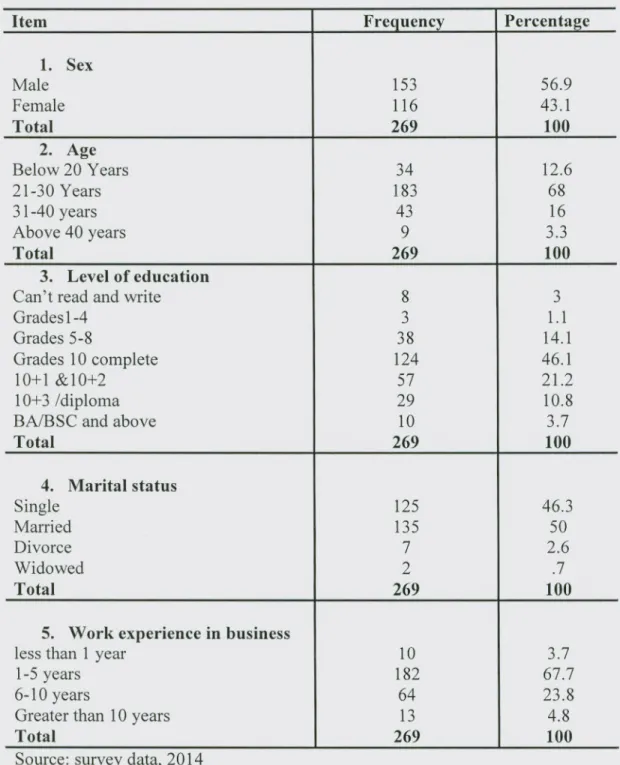
4.2. Demographic profile ofthe respondents 36
4.3. General information about the enterprises 37
4.3.1. Legal ownership status ofthe enterprises 37
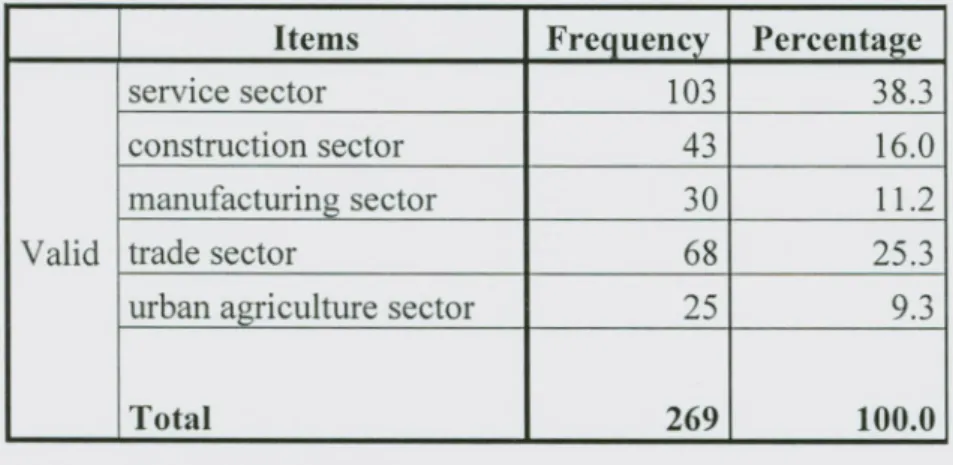
4.3.2. Sectors Respondents Engaged In 38
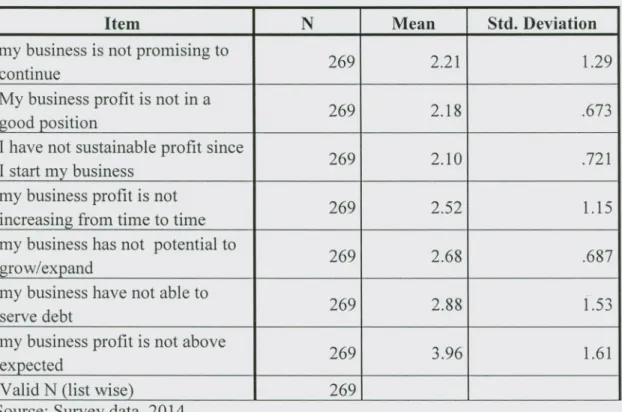
4.4. Performance Measurement. 39
4.5. External Factors Affecting the Performance of MSEs 40
4.5.1. Financial factors 41
4.5.2. Accessibility of Business Development Services Factors 42
4.5.3. Marketing factors 44
4.504. Government policy and bureaucracy .45
4.6. Results of Inferential Statistics 47 4.6.1. Pearson's product moment correlation coefficient.. 47 4.6.2. Multiple Regressions Analysis and Findings 48
2.7. Discussion of the result 50
CHAPTER FIVE 52
5. SUMMARY, CONCLUSIONS AND RECOMMENDATIONS 52
5.1. Introduction 52 5.2. Summary of Major Findings 52 5.3. Conclusion 54 5.4. Recommendations 56 References 58 Appendix 1 vii
Figure No.
List of figures
Title of Figure Page
List of tables
Table No. Title of tables Page
Table 3.1 Sampling frame 31
Table 4.1 Respondents demographic profile 34
Table 4.2 Legal ownership status ofthe enterprises 38
Table 4.3 Sectors respondents engaged in 38
Table 4.4 Performance measurement 39
Table 4.5 Financial factors .41
Table 4.6 BDS factors .42
Table 4.7 Marketing factors .43
Table 4.8 Government policies and bureaucracy .45
Table 4.9 Infrastructural factors .46
Table 4.10 Results of the Pearson's product moment correlation coefficient .47
Table 4.11 The performance model summary .48
Art BDS CSA ETB FeMSEDA GTP ILO MFI M MSEs MoTI MSEDA MSED MSEDS MWUD NGOs NMSEDPS NBSSI OCSSCO OUPI ReMSEDAs SD SPSS TVET UNIDO
List of abbreviation and acronyms
Article
Business Development Service Ethiopian Central Statistics Authority Ethiopian birr (Local currency)
Federal Micro and Small Enterprises Development Agency Growth and Transformation Plan
International Labor Organization Microfinance Institutions
Mean
Micro and Small Enterprises Ministry of Trade and Industry
Micro and Small Enterprises Development Agencies Micro and small Enterprise Development
Micro and Small Enterprise Development Strategy Ministry of Work and Urban Development
Non Governmental Organizations
National Micro and Small Enterprises Development Promotion Strategy National Board for Small Scale Industries
Oromia Credit and Saving Share Company Oromia Urban planning institute
Regional Micro and Small Enterprise Development Agencies Standard Deviation
Statistical Package for Social Science
Technical and Vocational Education and Training United Nations Industrial Development Organization
CHAPTER ONE
1.
INTRODUCTION
1.1.Background of the Study
Micro and small enterprise (MSE) sector is highly diversified sector and plays a predominant role in the economy of developing countries (Kokobe, 2013). This is because Micro and small enterprises are an important source of job opportunity and income for many people in most developing countries (Hibret, 2009).
In developing countries, MSEs by virtue of their size, capital investment and their capacity to generate greater employment, have demonstrated their powerful propellant effect for rapid economic growth. The MSE sector has also been instrumental in bringing about economic transition by providing goods and services, which are of adequate quality and reasonably priced,
to a large number of people, and by effectively using the skills and talents of a large number of people without requiring high-level of training, large sums of capital or sophisticated technology
( ILO, 2008).
MSE sector is described as the natural home of entrepreneurship for it provides an ideal
environment that enable entrepreneurs to exercise their talents to fill and attain their goals. Due
to these, MSEs are recognized as a real engine of economic growth and technological progress
(Carrier, 2008 and Mulhern, 1995). Moreover, MSEs exert a very strong influence on economic
growth of all countries over the world (Aharoni, 1994 and Drillhon et.al, 1994).This is implied by the important role they play in unemployment reduction, income generation and equitable
income distribution, import substitution, innovation, poverty alleviation. And also they play an important part in the provision of services in the community and they can make an important contribution to regional development programs. The county's urban development policy
document also states the role of MSE in reducing urban poverty, strengthening rural-urban linkage, and source of entrepreneurs for private sector development (MWUD, 2006).
According to Sievers and Vandenberg(2007), the MSE activities can contribute to increasing tax-incomes for the government and enable the government in the long run to invest the money and also strengthening and the expansion of existing MSEs and the support of new enterprises can contribute to fulfill social objectives, attract considerable foreign reserves into a country and have a clear importance in providing employment, meaning they are the backbone of the private sectors in developing countries.
Despite their important role in economic development, most MSEs are affected by both internal and external factors. The external factors affecting the performance of MSEs are related to marketing, technology, access to capital or finance, training or education facilities, institutional or government support, other barriers to trade and competition from large scale which have a significant impact on their performance and influence the continuity and success of the enterprises (Mohammed, 2012). Internal factors are derived from the external ones and include lack of entrepreneurial and management skill, lack of marketing knowledge, marketing strategies, innovation level and investments on technology due to absence of training (Eveliina and Labinot, 2011).
Empirically, the ILO (2000), report shows the institutional, regulatory and legal frameworks in these days are the important pillars shaping business environments. Institutional frameworks determine effectiveness and efficiency of key business infrastructures such as business development support (BDS), micro-finance institutions, marketing and research and development. A good institutional framework enables access of these services to the needy with minimum cost.
This being the case, however, most MSEs have limited access to external source of financing. As a result, they depend mainly on their internal resources to finance investment. Thus, low profit may imply limited internal resources, which may in turn limit firms' capacities to upgrade their investments (Ishengoma, 2005 and Reinikka et.al, Arimah and Muguma et.al, (2001).
Another factor hindering the growth potential of MSEs, is their limited access to business development services (BDSs) (viz., marketing information, networking, short-term training,
counseling and consultancy services).It is also obvious that the inadequacy of education and training leads to improper record keeping or rather say no record keeping at all (Ishengoma et.al, 2007 and Nkonoki, 2010).
In Ethiopia, the government has recognized and paid due attention to the promotion and development of MSEs for they are important vehicles to address the challenges of unemployment, economic growth and equity in the country. As claimed by the government of Ethiopia, that the MSEs sectors is'a prime strategy to economic development in urban and rural areas of the nation. To this effect, it has formulated a National MSE Development and Promotion Strategy in 1997, which enlightens a systematic approach to alleviate the problems and promote the growth of MSEs (NMSEDS, 1997).
A national survey conducted by Central Statistics Agency (CSA) in 2007 indicates that more than 1.3 million people in the country are engaged in MSE sector and this makes the MSEs the second largest employment generating sector next to agriculture in the country. But, a large number of MSEs are unable to grow and remain to be survival (non-growing) type which cannot provide enough employment. It is found that 69% 1000 MSEs in the country are found in a survival status. This is because they produce largely for the low income group and employ lower levels of techniques. Many of them are self-employed type with a low transformation rate into higher SIze categories and, thus, their innovative activities are limited (Gebreeyesus, 2007).
The need for economic development and expansion of Bedele town are growing from time to time mainly due to the population increase as a result of immigration from surrounding rural areas. In Bedelc town, the MSEs sectors have been increased from time to time following the extensive growth of the number of graduate from technical and vocational schools but many of MSEs found at Bedele town have not been successful and they have not grown into medium and large scale enterprises (OUPI, 2011).
According to the data obtained from Bedele MSEs report (2005), the current capital and number of the enterprises dramatically decreased and shows minimum growth rate. The growth rate of both the number of enterprises and capital shows the sector exhibits a negative growth rate to the
minimum of 59.69 below zero in the fiscal year 2003 and also shows a minimum growth rate in the fiscal year 2005.
According to structure plan study report (2011), the major constraints that affect MSEs performance in the town are lack of integration among sectors, shortage of working capital, lack of motivation, lack of managerial skills, inability to compete with the large sectors, high ambition for profit in short time, lack of capacity to bring commodities from Addis Ababa by owners. So that,these structure plan study report more emphasize the internal factors that affect the performance of MSEs in the town. To fill in this gap, this study tried to assess the external factors affecting the performance of MSEs in Bedele town (Access to external source of finance, access to business development services, marketing, government policy and bureaucracy and infrastructure) because the study assumes that these are the most relevant external factors influencing small business performance.
1.2. Statement of the Problem
Micro and Small businesses play a vital role in poverty reduction, employment generation as well as economic development of both developed and developing countries. Some of the MSE have grown extremely large and profitable and on the other hand, many others have failed or have not been as successful as they might have been (Tirune, 2011). In most developing countries, MSEs face constraints both at start up phases and after their establishment. Owing to their small size, these enterprises are severely affected by both internal and external factors.
As in other developing countries, different scholars have studied the performance of the MSE sector in Ethiopia. According to the CSA Report (1994-1995), the major obstacles experienced by MSEs were lack of access to finance, working premises, infrastructure, information and marketing. These problems result in failure of these businesses to expand and have the effect on their performance to grow. Belay (2012), stated that these environmental/external factor are influencing small business success in the context of developing countries like Ethiopia.
In recent times, a lot of scholars and researchers have identified the factors that affect the performance of micro and small enterprises on different areas throughout the country. Most of
these studies indicate that the sector faces a range of financial, managerial, demographic back ground and firm characteristics that influence MSEs performance. However, only few
researchers have been conducted study on external factors affecting the performance of MSEs like corruption, technology, market fluctuation, competition, political factors and access to finance. Recognizing this gap, therefore, this study tried to assess the impact of poor infrastructure, inadequate access to business development services, marketing and access to external source of finance, government policy and bureaucracy on the performance of MSEs in Bedele town. To achieve the objectives of this study, the investigator put forward the following basic research questions:
~ What problems are MSEs facing related with access to external source of finance in Bedele town?
~ What problems are MSEs facing related with access to Business development services in Bedele town?
~ What marketing problems are affecting the performance ofMSEs in Bedele town? ~ What government policy and bureaucracy issues are affecting the performance of MSEs
in Bedele town?
~ What infrastructural problems are affecting the performance of MSEs in Bedele town? ~ Is there any relationship between external factors and performance of MSEs in Bedele
town?
1.3. Objective of the Study
Like most other studies, this study has both general and specific objectives. 1.3.1. General Objective
The general objective of the study is to assess the external factors affecting the performance of microand small enterprises in Bedele town.
1.3.2. Specific Objectives
The specific objectives of the study are:
-~ To identify the problem related with access to external source of finance that affects the performance of MSE in Bedele town
~ To identify the problem related with access to business development service that affects
~-.•...
the performance of MSEs in Bedele town. .
(
.~ To identify the problem related with government policy and bureaucracy that affects the performance of MSEs in Bedele town.
~ To identify marketing problem that affects performance ofMSEs in Bedele town.
~ To identify infrastructural problem that affects the performance ofMSEs in Bedele town.
~ To determine the relationship between external factors and performance of MSEs in Bedele town
1.4. Significance of the Study
The findings of this study will be useful for the following stakeholders:
~ Findings from this study will assist researchers or academicians to provide a deeper understanding of the key external factors that affect the performance of MSEs.
~ This study will also be a guideline and springboard for upcoming researchers in the area
~ The study will help Bedele MSEs Development Agency to understand the external factors affecting the performance of MSEs and to identify the area that need improvement in order to overcome the effect of external factors with the support of FMSEDEregarding withcritical finance, marketing, work premises, infrastructure and other external factors that affect the performance of MSEs.
~ The study will also be useful for micro and small business owners to know what and now an external environment affect their business and tackle failure of their business by suggesting some possible solution.
1.5. Scope of the Study
Among the different types of business classification based on their size, this paperfocuses on micro and small business enterprises. The study focuseson the assessment of external factors affecting the performance of micro and small enterprises in Oromia regional state Illu Abba Bor zone specifically in Bedele town urban area only. The study has been limited only to cities or urban area because many micro and small enterprises are actively concentrated in the town.
The data were collected from MSEs operates those engaged in business sector of Manufacturing,
The data were collected from MSEs operates those engaged in business sector of Manufacturing,
Construction, urban Agriculture, service, trade and from those are formally registered under
Bedele Micro and Small Enterprises office and Bedele Trade and Industry bureau.
There are different issues that can be researched in relation to MSEs but this study was assess
those external factors such as external source of finance, access to business development
services, government policy and bureaucracy, marketing and infrastructure factors affecting the
performance of MSEs.
1.6. Limitations of the Study
~ The survey in Bedele town was conducted in urban area only; therefore, it may not reflect
the views and practices of MSEs in rural area.
~ The characteristics of the owner managers, characteristics of the enterprises and any other
significant focus areas were not discussed in any detail in this study.
~ A comparative study between the sectors i.e. manufacturing, service, trade, urban
agriculture and construction sectors are not performed.
~ In this study while selecting the sample size, the researcher doesn't consider those MSEs
operators do not formally register under Bedele MSEDA and Bedele trade and industry
bureau.
1.7. Operational definitions
Business development service (BDS): is any non-financial service to business, offered on either
a formal or informal basis. These services include: training/skills development, network
brokering, business consultancy, market research, technical information.
Cooperatives: association of at least 10 individuals who are from the same area.
Enterprise: It refers to a unit of economic organization or activity whether public or
private engaged into different sectors of activities i.e. manufacturing sectors, construction
sectors, trade sectors, service sectors, urban agriculture sectors.
External Factors: External factor is a contributory aspect that emerge from outside of the
operator such as access to external source of finance, access to business development services,
government policy and bureaucracy, infrastructures and marketing influences that affect
External source of finance: in this paper external source of finance refers to the formal
institution that provides finance for MSEs i.e. Banks, NGOs, Micro finance institutions.
Formal TVEf: Currently, formal TVET in Ethiopia includes 10+1 to 10+3 programs,
which currently redesigned in to five levels (level I to V) provided by public and
private/government/non government institutions and finally accredited by the regional
Education bureau/TVET agency.
Initial paid-up capital: is that part of the issued capital of an establishment that has been paid by the owners to start the operation.
Manufacturing sectors:the enterprises engaged in food processing, preparing 'baltina' products and manufacture of bakery products, Manufacture of metal products, Manufacture of wood and
wood products i.e. manufacturing of furniture.
Micro enterprise: means commercial enterprise whose capital is not exceeding birr 20,000 other than high technology and consultancy services.
Micro finance: refers to the provision of financial services to low-income clients,
including consumers and the self-employed.
Partnership: involves two or more individuals who have a partnership agreement to
operate a business and share the earnings and liabilities of the venture.
Performance: in this paper performance defined in terms of profitability of the MSEs.
Respondent: respondents are those individuals who are owner managers or operators of an enterprise.
Small enterprise: means a business engaged in commercial activities whose capital is exceeding birr 20,000 and not exceeding 50,000 birr, other than high technology and consultancy service institutions.
Trade sector: the enterprises engaged in product wholesale and retail trade
Urban agriculture sector: the enterprises engaged on the practice of cultivating food, animal
1.8. Organization of the Study
This research report is organized into four chapters: Chapter one is the introductory chapter and presents the back ground of the study, statement of the problem, objectives of the study,
significance of the study, scope of the study, limitations of the study,definition of significant terms and the organization of the study. Chapter two contains the review of related theoretical and Empirical literature as well conceptual frameworks. Chapter three presents the methodology
that was used to answer the research questions and objectives. Chapter four contains data presentation, analysis and discussion of the result. Chapter five presents summary of the finding,
CHAPTER TWO
2. REVIEW OF RELATED LITERATURE
2.1. Theoretical Literature
2.1.1. Definition of Micro and Small Enterprises
Creating and implementing a worldwide multilateral definition of micro Small enterprises (MSE) quickly becomes very technical and challenging. Definitions vary between multilateral institutions like the World Bank and United Nations Development Program. Definitions also vary between countries, largely depending on geographic location and the size and scope of a nation (Bloem, 2012).
There is no universally accepted definition of MSEs. Egbuogu (2003), noted that definitions of SMEs vary both between countries and between continents. The major criteria use in the definitions according to Carpenter (2003), could include various combinations of the following:
Number of employees, financial strength, Sales volume, Relative size, Initial capital outlay and Types of industry.
Different regions or countries have defined MSEs based on local operations and conditions. It should be noted therefore that certain definitions may not be applicable in certain regions or settings. For instance the features and mode of operation of small businesses in Ghana makes the paper to adopt the definition by the NBSSI. The NBSSI (1998) cited by Daniel (2010), provided an operational definition of MSE to include the following: The micro enterprises employ up to 5 employees with fixed assets (excluding land and building) not exceeding the value of $10,000;
small enterprises are those employing between 6 and 29 employees or having fixed assets excluding land and building not exceeding$l 00,000.
United Nations Industrial Development Organizations (UNIDO) gives alternative definition for developing countries. Accordingly, it defines micro enterprises as the business firms with less than 5 employees and small enterprises as the business firms with 5-19 employees (UNIDO, 2002).
An MSE is thus defined as any enterprise, whether or not incorporated or registered under law, which consists mainly of persons carrying on small business concerns in any economic sector, or which has been established for the purpose of promoting the interests of small business concerns (National Small Business Act,1996).
In Kenya, MSEs defined as those non-primary enterprises (excluding agricultural production, animal husbandry, fishing, hunting, gathering and forestry), whether in the formal or informal sector which employ 1-50 people and More specifically, according to them, micro enterprises are those that employ 10 or fewer workers and small-scale enterprises are those that employ 11-50 workers. The same study argued that the above definitions are based on one of the three criteria mainly used in literature to define MSEs-number of employees. The second criterion relies solely on the degree of legal formality and is mainly used to distinguish between the formal and informal sectors. According to this criterion, MSEs are those enterprises that are not registered and do not comply with the legal obligations concerning safety, taxes and labor laws. The last criterion defines MSEs by their limited amounts of capital and skills per worker. The above indicated writers emphasized that the degree of informality and size of employment have perhaps been the two most readily accepted criteria on which classification of MSEs is based ;and lastly they claimed that the term MSE incorporates firms in both the formal and informal sectors (Ronge, 2002 cited in Admasu, 2012).
In Ethiopia, according to Ministry of Trade and Industry (1997) micro enterprises are those small business enterprises with a paid-up capital of not exceeding Ethiopian Birr (ETB) 20,000, and excluding high tech consultancy firms and other high tech establishments. While small enterprises are those business enterprises with a paid-up capital of and not exceeding ETB 500,000, and excluding high tech consultancy firms and other high tech establishments.
According to Ethiopian regulation, "micro enterprise" means an enterprise having a total capital, excluding building, not exceeding Birr 50,000 in the case of service sector or not
exceeding Birr 100,000 in the case of industrial sector and engages 5 workers including the owner, his family members and other employees (Art. 2(1)). The same regulation defines
"small enterprise" as an enterprise having a total capital, excluding building, from Birr 50,001 to 500,000 in the case of service sector or Birr 100,001 to Birr 1,500,000 in the case of industrial
sector and engages 6 to 30 workers including the owner his family members and other employees (Art.2(2)).
Micro and Small enterprises can be defined as one, which is independently owned and operated, and not dominant in its field of operation. It can also be defined in terms of sales volume and by the number of employees in the firm (Endalkachew,2008).
Micro and small Enterprises may be defined as businesses with the size or number of employees less than 11 workers and 11-50 workers relatively (Bloem, 2012).
2.1.2. The Concept of Business Performance
According to Martin (2010), performance is defined simply in terms of output terms such as quantified objectives or profitability. Performance has been the subject of extensive and increasing empirical and conceptual investigation In the small business literature (Bidzakin,2009). The Issues that remain unresolved are the goals against which performance should be assessed and from whose perspective the goals should be established.
The most commonly adopted definition of success [good performance] is financial growth with adequate profits. Other definitions of success [good performance] are equally applicable. For
example, some entrepreneurs regard success [good performance] as the job satisfaction they
derive from achieving desired goals. However, financial growth due to increasing profits
has been widely adopted by most researchers and practitioners in business performance models (Rami Alasadi and Ahmed Abdelrahim,2007).
Firm performance refers to the firm's success in the market, which may have different outcomes.
multidimensional phenomenon. Performance can be characterized as the firm's ability to create acceptable outcomes and actions (Aminul, 2010).
The measure of performance of MSEs are performance indicators which are commonly used to
help an organization define and evaluate how successfully it is, typically in terms
making progress towards its long term organizational objectives (Gibbson, 1990).They are
therefore quantifiable measurements agreed to beforehand, that reflectthe critical success factors
of an organization. Measurement of actual performance must be done in the same terms in which
standards have been laid down so that comparisons are easier and meaningful. MSEs
performance can be measured in monetary terms like profits, costs, incomes or revenue,
savings and value of assets held. It can also be measured quantitatively like units of production,
units of sales I percentage of market share and quantity of stock held. In terms of time
measurement, it includes man-hours or machine-hours. Performance of MSEs can also be
measured in terms of capital employed typically expressed in financial terms as rate of
return on investment or in terms of current ratio arrived by dividing current assets to current
liabilities (Ivancevich,1980).
2.1.3. The Micro and Small Enterprise Sector in Ethiopia
In Ethiopia, the idea of Micro and Small Enterprises (MSEs) development emerged as a
promising agenda in the 1980s. A variety of reasons have been cited for the surge of interest in
MSEs development, like:
1. MSEs are a better means for poverty reduction.
2. MSEs are a platform for sustainable developmentand productivity.
3. MSEs are important actors within the trade sector and a platform for economically
empowering women and men.
4. The MSE sector plays an important role in providing people with livelihood and
income generating opportunities, providing income and services to people who cannot get employment in the formal sector.
In Ethiopia, MSE sector plays pivotal roles in bringing about economic transition through
creating opportunities to use existing human and material resources; and through this
Particularly, the sector has crucial role in playing as a quick remedy for the increasing
unemployment problems in the country. Due to this the five-year Growth and Transformation
Plan (GTP) has given particular attention to the expansion and strengthening of micro and
small-scale enterprises (MWUD,2007).
According to MWUD (2007),the sector is believed to be the major source of employment and
income generation for a wider group of the society. The major objective of this program, which
is creating and promoting MSEs in urban areas, envisages reducing urban unemployment
rate.
2.1.3.1. Micro and Small Enterprise Development Strategy
In recognition of the important role MSEs have to play in creating income and
employment opportunities and reducing poverty, the government drafted its first Micro and
Small Enterprise Development Strategy in November, 1997 (NMSEDS, 1997).
Elements of the 1997 NMSEDS include measures with regard to creating an enabling legal
framework and streamlining regulatory conditions that hinder the establishment of new
and expansion of existing MSEs. In addition, specific support program also include measures
related to providing working premises, facilitating access to finance, provision of incentives,
promotion of partnerships, business skill development training, access to appropriate technology,
access to market, access to information and advice, infrastructure and institutional strengthening of the private sector associations and chambers of commerce.
The primary objective of the Ethiopian MSEs development strategy framework is to create an
enabling environment for MSEs. In addition to this it has specific objective which include;
Facilitating economic growth and bring equitable development, creating long-term jobs,
strengthening cooperation between MSEs, providing the basis for the Medium and Large Scale
Enterprises, balancing preferential treatment between MSEs and bigger enterprises and
Promoting export. The strategy outlines the policy framework and the institutional environment
for promoting and fostering the development of MSEs and stimulating the entrepreneurial drive
2.1.3.1.1. The Implementation Structure of the Strategy
The two most important institutions that are directly involved in the promotion of MSEs are MOTI and the newly established MSEDA. The latter is envisaged to operate the federal and regional level of government (NMSEDA, 1997).
The ministry of trade and industry has responsibility, as the organ of the federal government for the formulation of policies and strategies to promote the expansion of enterprises and to facilitate the provision of assistance to MSEs. The other duties given to the ministry is to support and create conducive environment for the development of private promotional institutions. Regional bureau of trade and industry were delegated to develop and promote the sector in their regions by coordinating regional activities and creating networks with business associations to strengthen the flow of information to MSEs (NMSEDA,
1997).
To further ensure the proper institutional coordination for MSE support functions, the government created the new Federal Micro and Small Enterprises Development Agency (FMSEDA) in 1998. In addressing above objectives, FMSEDA is expected to provide support to the Regional Micro and Small Enterprises Development Agencies (RMSEDA).
The FMSEDA provide leadership by delivering 'training the trainers' programs to equip regional agencies, business associations, and other professionals to deliver entrepreneurship training and facilitation services and BDS to MSEs; studying the problem of identifying viable markets for MSEs and addressing product quality issues; disseminating information to MSEs; and advising government on MSE policies and strategies. FMSEDA also operates skills and technology training facilities, much like incubators, where training is offered III woodworking, metalworking, garments making and handicrafts. It also provides a marketing outlet for MSE products in its sales and display centre and organizes MSE product exhibitions at national and local trade fairs (FMSEDA, 2006). The regional governments also provided for the establishment of RMSEDAs to provide extension services to MSEs at the regional, zonal and woreda level.
2.1.4. Concept of Business Environment
Business environment of an enterprise consists of the internal and external environment factors
affecting the performance of business enterprises. According to Delmar (2008), the business
environment has a significant impact on the performance of small business enterprises. Smith
(2007) defines business environment as all factors or variables, both inside and outside the
organization that may influenced the continued and successful existence of the organization.
2.1.5. External Factors affecting the Performance of MSEs
2.1.5.1. Access to external Finance
All business ventures regardless of SIze require finances from inception and throughout
their life cycles. The amount invested will influence greatly the size of the venture, which in
turn determines the early survival of an enterprise and Finance provides the enterprise with funds
for purchasing inputs and for general expansion. Finance, particularly the working capital,
supports the day-to-day activities of an enterprise (Orser, 2000).
Most of the funding of young firms came from own savings or money borrowed from relatives
and friends. However, the amount of cash needed to sustain or accelerate growth processes
usually exceeds these personal sources. Many growing firms relay on external sources of
finance to accelerate their growth perspectives ( Gilbert, 2006 cited by kokobe, 2012).
I
Both in the developing and developed world, small firms have been found to have less
access to external finance and to be more constrained in their operation and growth
(Berger and Udell, 1998, Galindo and Schantiarelli, 2003).
MSEs cite the lack of finance as the greatest constraint to their growth and development, whether
they are formally registered or not. The financial needs of different types of micro and small
enterprises vary widely, with access problems particularly severe for start-up enterprises (MOTI,
1997).
The financial constraints include those factors that prevent micro and small scale
enterprises (MSEs) from accessing funds easily, inadequate sources and supply of funds
has been a major setback to the realization of many brilliant business ideas and outward
inefficient financial market in terms of facilitating financial resources to entrepreneurs are the major obstacles in doing business. Access to finance is a major bottleneck for the rapid growth
and development of MSEs mainly due to targeted mechanism put in place to address the
financial needs of small scale enterprises. Most micro and small enterprises do not have access to
micro finance institutions and most banks are reluctant to avail credit facility to small
enterprises(CLEP, 2006). Their standards of operation, the long waiting time they take to
sanction loans, limited collateral requirements are some of the problems that are found to be
discouraging micro and small enterprises from approaching them ( MaTI, 1997).
2.1.5.2. Access to Business Development Services
Business Development Services are designed to help micro, small, and medium-sized
enterprises overcome barriers to increased profitability, by improving their productivity and
access to high value markets (Gibson, 2001).The service include training, consultancy
and advisory services, marketing assistance, information, technology development and
transfer, business linkage promotion, and linkages to finance and financial services.
Among the factors expected to hinder the performance of MSEs is their limited access to
business services (BSs) (viz., marketing information, networking, short-term training, counseling
and consultancy services) (Ishengoma and Kappel, 2007). Access to marketing information is
expected to increase MSEs' market knowledge about the behavior of their customers, price, and
the best sources of inputs. Through counseling and consultancy services, MSEs can solve some
of the technical problems they face. Their participation in networking activities may enable them
to obtain more technical and marketing information about the behavior of their customers, in
terms of honoring their debts; new customers; and business partners.
Lack of sufficient access to business supports that enterprises receive from local government bodies which are clearly mentioned both in the old and new MSEs strategies of the government
has impact on the performance of MSEs. Those include availing loan services, providing
working premises, trainings, and consultancies, organizing in clustering and others for to the
enterprises improved performances(MOTI, 1997). The acquisition of relevant vocational,
small enterprises. Lack of initial semmars offering advice and guidance for potential entrepreneurs, lack of training to help in the preparation of a business plan, financial record and house hold budgeting (MUDA, 2013). In addition, literacy and entrepreneurial awareness are seen as particularly important requirements to enable people to advance lower level activities
into larger and better earning enterprises.
Numerous public, private and non government agencies have been established programs to promoting and supporting enterprises development, specifically those who lack business experience and have poor access to resource (Richardson, Rhona and Gerry, 2004). Despite their support the effectiveness of their promotional activities may be questioned.
It should be clear that government funding will not be sufficient enough to support the
implementation of the strategy. Hence, in order to mobilize all the available resources and coordinate programs optimally, it will be necessary to closely work and cooperate with all stake
holders. This calls for close cooperation among federal and regional governments, NGOs, and the private sector at large (MOTI, 1997). Experiences have shown that government institutions engaged in supporting MSEs have succeeded in providing limited services due to resource
constraints. In order to solve the problems as exercised in other developing countries, (NGOs)
especially local ones, with funding coming from local or foreign sources will be encouraged to provide their support. Those wanting to be eligible for MSE support will be accredited with the
concerned organization.
2.1.5.2. Marketing
In the words of Stanton (1981), marketing is"The creation and delivery of a standard of living".
It includes; finding out what consumers want, planning and developing aproduct or service
that will satisfy those wants, determining the best way to price, promote and distribute that product or service. Fulop (1970), concurs with Stanton (1981), as he defines marketing as
"the making available of the product at the place, at the time and at the form in which
they are required by customers". It also includes provision of services as an integral accompaniment of products, investigation of customer needs, and initiation of the product of
All types of business enterprises face marketing problems, but these problems are more severe in
case of small scale units because of lack of knowledge, adequate funds and lack of experience.
Some of the marketing problems commonly faced by the small scale are;
Competition from
largescale sector: Because of scarcity of resources, small entrepreneurs usually use inferior
technology. As a result their products are not standardized. The obsolete technology used by
them gets translated into inferior quality of products. Lack of sufficient marketing and
promotional support: There are no sufficient institutional facilities that nurture the promotion,
growth and development of MSEs. And also marketing their products effectively as well as
accessing and acquiring information on business opportunities are the major bottlenecks that
small and micro entrepreneurs face all over the country ( CLEP, 2006 ).
Usually market constraints and the inability to sell their products and services are listed as
one of the most serious obstacles to the starting of business and growth beyond mere
subsistence level. The problem of demand or access to market is also another problem (Ageba,
2006). This demand problem has prevailed because of existence of weak or absence of inter
linkage mechanisms with other medium or large enterprises and existence of weak or
absence of appropriate marketing channels, open markets, exhibitions, trade fairs, displays
centers etc which MSEs would have used to market their outputs (CSA, 2003).
Business Premisesinwhich MSEs are to display and sell their products is also the major problem
affecting the performance of MSEs. Many may sell their products in someone else's shop
or from their home. Business location is also important to maximize on passing trade. If the
business is located far from the market the entrepreneur may rely on customers coming
to them or will have increased transportation costs to get their products to market (Kokobe,
2013).The enterprises may also have limited space available to them for both the
production and storage of their products, which will limit the amount they can produce.
The product line of MSE activities relatively similar there is Lack of product diversity, however,
2.1.5.4. Government Regulation and Bureaucracy
The government and its regulations are a major obstacle to MSEs operations (CLEP, 2006).
Among the problems in government regulations, getting license and regulation of obtaining
working premises were the major problems to start operation in this sector.
Absence of appropriate policy support and there still exists an overly bureaucratic government
system that often results in unnecessary delays in compliance and is excessively costly.
This includes a complex system, lengthy procedures and rules. For example, registration of a
business, getting working places, payment of stamp duty among others. For MSEs, lack of
premise and land is unquestionably a serious problem. The issue of acquisition and transaction
cost has become very prohibitive to the emergence of new enterprises and to the growth and
survival of existing ones. The issue of land provision and the land lease system has greatly constrained the chances of micro, small and medium enterprises who aspire to start up businesses (Syed, 2001).
2.1.5.5. Infrastructure
Infrastructure is one of the basic factors required to enhance the pace of industrialization in any
country. The development of business and industrial premises (shops, offices, factories, market
stands, etc.) and infrastructure facilities, mass transportation, water system, septic tank system,
solid squander organization, drainage and deluge safety, electric fitting, telecommunication
connections, sewage systems, etc. are crucial infrastructural facilities and utilities which warrant the growth and expansion of business enterprises (Fox, 1994) cited byMuneeb A,Ejaz A (2012).
The micro and small scale enterprises (MSEs) sector in developing countries operates in an
environment with very poor infrastructure which constitutes a barrier to entry and hinders
international competitiveness. In many developing country, nonexistent of infrastructure,
inability to access market, communication, power, water etc. prevent development of micro
and small scale enterprises (Osotimehin, 2012).
Well-developed physical structure that includes reliable transportation, warehousing and port
facilities and communications networks has an influence on MSEs development (Hallberg, 2000
2.1.6 Challenges of MSEs Development in Ethiopia
In Ethiopia, MSEs are confronted with various problems, which are of structural, institutional and economic in nature (MOTI, 1997). Lack of capital, working premises, marketing problems, shortage of supply of raw materials is the most pressing problems facing MSEs. Although the economic policy of Ethiopia has attached due emphasis to entrepreneurship values and appreciation of the sector's contribution to the economy, there are still constraints related to infrastructure, credit, working premises, extension service, consultancy, information provision,
prototype development, imbalance preferential treatment and many others, which therefore need proper attention and improvement.
In Ethiopia, although the number of financial institutions in the local credit market has increased since 1990, the degree of practical assistance provided by such financial institutions to MSEs has not improved much. The majority of small businesses and enterprises still have limited access to bank services that are essential for supporting their business initiatives (Ad era, 1995 and Age ba.et.al,2 006).
Small enterprises usually regard market constraints and the inability to sell their products and services as one of the most serious obstacles to the starting of businesses and growth beyond mere subsistence level. This assertion also holds true in the case of Ethiopian MSEs, as revealed from various studies undertaken concerning the MSE sector. Demand problem According to Ageba (2006), MSEs in Ethiopia, usually market constraints and the inability to sell their products and services are listed as one of the most serious obstacles to the starting of business and growth beyond mere subsistence level. The CSA (2003), report showed that 48% of the total establishments have faced a problem of demand or access to market. This demand problem has prevailed because of existence of weak or absence of inter linkage mechanisms with other medium or large enterprises and existence of weak or absence of appropriate marketing channels, open markets, exhibitions, trade fairs, displays centers etc which MSEs would have used to market their outputs (CSA, 2003).
Most Ethiopian MSEs lack adequate marketing channels through which they could market their outputs. Marketing channels could serve both as means through which marketing information is made available and sales outlets created for the products and services of MSEs. Like Chambers
of industry and trade, sectoral associations of MSEs, government promotional institutes, NGOs, etc (MaTI, 1997).
It is clearly indicated in the strategy that the government facilitates provisions of loan services at preferential interest rate to small and micro enterprises in the nation during the specified time. Though such instrument is very supportive for the growth of MSEs, availability and quality of this support instrument has its own impact on their performance (MaTI, 1997, Negash and Kena, 2003, Ageba et.al, 2006).
There are some enterprises complaining about the existing system, for instituting a number of different criteria on borrowers to be eligible for the service. For instance, since the new MSE strategy was issued, there are some Survey of MSEs in Selected Major Urban Areas of Ethiopia regions that oblige or force enterprises to save about 20 % of their revenue to be eligible for borrowing from micro financial institutions, which some found difficult to fulfill
.There are still others who mentioned number of members was the limit to get the intended loan. For instance, in cooperatives, the minimum number of members to be eligible both for getting loans and entering into any other legal relation with other institution is ten(Adera, 1995, Ageba and Amha,2006).
The physical infrastructure like mass transportation, water system, septic tank system, solid squander organization, drainage and deluge safety, electric fitting, telecommunication connections, sewage systems, etc are not adequately developed and expanded to meet the growing demand of business activities in Ethiopia (MaTI, 1997).
2.2 Empirical Literature
From the literature, various determinants of MSEs' growth and performance have been proposed and identified. Ishengoma and Kappel (2006), categorized factors hindering the performance of Micro and small enterprises into three, namely internal, external and inter firm. Fredland and Morris (2009), classifying causes as endogenous (internal to the firm and presumably within its control) and exogenous (external to the firm and beyond its control). Such a classification has the merit of providing a somewhat better policy handle since
if causes are endogenous, appropriate policy 'helps firms help themselves'; if exogenous, appropriate policy may seek to change the economic environment.
The study conducted in Kosovo reveal that external factors such as access to finance, competition, corruption, and government policies have very important impact in the development of MSEs. Another study carried out by (Mohammed, 2012) on Assessing the Influence of External Environmental Factors, on the Performance of Small Business Manufacturing enterprises in Bauchi state, Nigeria reveals that, capital access and government support were found to be significantly related to business performance of the enterprises. Njanja (2012),on his study of "The Effects of the External Environment on Internal Management Strategies within Micro, Small enterprises in Nairobi, Kenya" indicates the significant correlations between the management strategies and the environmental or external factors.
According to Mead and Liedholm (1998) and Swierczek et.al, (2003), the main factors that affect the performance of MSEs in developing countries is not their small size but their isolation, which hinders access to markets, as well as to information, finance and institutional support. The research undertaken in Tanzania by surveying 160 micro enterprises showed that high tax rates, corruption, and regulation in the form of licenses and permits, are found to be the most important constraints to business operations of micro enterprises(Fjeldstad et al., 2006 cited in Admasu,20 11).
In Ethiopian context, a study undertaken by (Endalkachew, 2008), stated that causes of small businesses failure are multidimensional and diverse. They include both internal and external factors. In practice, many of these are interrelated. The study established causes of micro and small businesses failure, among which are: lack of capital, lack of business plans, high taxes, lack of land and premises, and, poor market, high rent charges and wrong pricing in the study area.
Mulugeta (2011), has identified and categorized the critical problems of MSEs in to market-related problems, which are caused by poor market linkage and poor promotional efforts;
institution-related problems including bureaucratic bottlenecks, weak institutional capacity, lack
of awareness, failure to abide policies, regulations, rules, directives, absence of training to executives, and poor monitoring and follow-up; operator-related shortcomings like developing
a dependency tradition, extravagant and wasting behavior, and lack of vision and commitment from the side of the operators; MSE-related challenges including lack of selling place,
weak accounting and record keeping, lack of experience sharing, and lack of cooperation within and among the MSEs and finally society-related problems such as its distorted attitude about the operators themselves and their products.
Dereje (2008),also studied the nature, characteristics, economic performance, opportunities and challenges ofMSEs in the construction sector based on 125 sample enterprises. The results of the study revealed that the main constraints of the MSEs were shortage of capital, lack of raw materials, absence of government support, lack of market, lack of credit facilities and high interest rate. Studies were also made specifically with a purpose of identifying the problems that MSEs encounter. Workneh's (2007), research undertaken in Kolfe Keraneo sub-city of Addis Ababa indicated that lack of capital, lack of market, unfavorable policy, and inadequate infrastructure, absence of adequate and relevant training, bureaucratic structure and procedures are among constraints faced by MSEs.
2.2.1. Conclusions and knowledge Gaps Emerged from Survey of Related Studies
The significance of rapidly growing Micro and small enterprises in creating employment opportunity and in economic growth of a country is very obvious to many. Despite their role MSEs have constrained by different factors and different researchers have been conducting study related with factors that hinder the performance of MSEs.
The empirical literature presented in the above part indicates that, performances of MSEs are influenced by a range of internal factors; inter firm factors and external factors. Internal factors include demographic characteristic (i.e. age, gender, educational background, experience,
managerial skill, motivation), inter firm factors which include size of enterprises, type of business, age of the enterprises and external factors such as access to finance, competition,
corruption, and government policies, access to markets, institutional support, absence of training, and inadequate infrastructure.
The above empirical literature shows that most of the research findings give more focus on their internal factors rather than the external factors therefore this study is concern with the external
factors such as access to external source of finance, access to business development services, marketing, government policy and bureaucracy and infrastructure factors affecting the performance ofMSEs to fill the gap of previous study.
As the empirical literature indicate more of the researcheshave beenconducted in foreign country, in reality, literature on MSEs in Ethiopia is very little and most of the available studies were not conducted in line with performance aspects of micro and small enterprises. Even those studies conducted in Ethiopia were mainly focus on major urban area not on different town or wereda found in different regional states. However, this research tries to assess in a holistic way by targeting and investigating those operators engaged in Manufacturing, services,
construction, urban agriculture and trading sectors in Bedele town.
2.3Conceptual Framework
Conceptual framework means that concepts that relate to one another were used to explain the research problem. Since business performance is influenced by external factors, operators need to understand what influences businesses to reach peak performance. The contextual or external factors include finance, business development services, marketing, infrastructural, and government regulation and bureaucracy.
To align the conceptual framework with the research objectives, business performance is the dependent variable and whereas access to external source of finance, access to business development service, marketing, government regulation and bureaucracy and infrastructural factors are all independent variables. The independent variables are the factors which influence the performance of a small and micro enterprise.
In this study profitability were obtain to measure performance of these MSEs. This is mainly
because of the following reasons. First, as the previous study clearly indicates that these MSEs are more focusing on profitability than other modes of performance measures. Second, the MSEs were not applying balanced score card to measure their overall performance. Third, as recommended by Rami and Ahmed (2007) a profit has been widely adopted by most researchers and practitioners in business performance models
The relationship of independent and dependent variables can be expressed as
follow:-Figure 2.1. Conceptual framework of the study
Dependent variable Independent variables
Access to external finance
Access to business development serVIce
Marketing
Government regulation and bureaucracy
Infrastructure
Source: own model
Performance (Profitability)
CHAPTER THREE
3. RESEARCH DESIGN AND METHODOLOGY
3.1 Research Design
The research design is the general plan of how the researcher goes towards answering the research question. In other words, it is a master plan specifying the method and procedures for collecting and analyzing the needed information. According to kothari (1990),the research design is the conceptual structure within which research is conducted; it constitutes the blueprint for the collection, measurement and analysis of data.
To meet the objectives of the study, descriptive and analytical research design were employed. The descriptive research design is employed to describe the state of affairs as it exists at present while the analytical research design is used to explain the relationship between variables affecting performance of MSEs in Bedele town. In short, the combinations of qualitative and quantitative research approaches are used in this study.
3.2. Source of Data and Method of Data Collection 3.2.1. Source of Data
The study used both primary and secondary source of data. The secondary sources of data includedinformation obtained from different reports, books, and journals. The primary source of data was collected from randomly selected operators of MSEs and from the head of Bedele MSEs bureau.
3.2.1. Method of Data Collection
Gay (1996) explains that descriptive data are usually collected usmg questionnaires and interview. Similarly, Simon (1998), Cohen and Manion (1998) have also identified questionnaires and interview as crucial instrument of data collection in descriptive research. With this backdrop, the primary data for this study was collected by using questionnaire and semi structured interview.
The designed questionnaire has fCHJl' parts. The first part in close ended format and consists of the demographic profile of the respondents. The second part consists or general information about the enterprises. The third and the fourth parts are designed in the form of a Likert scale; and address issues relating to performance measurement and key external factors affecting the performance of Micro and Small Enterprises (MSEs) in the study area. The Likert scale ranges from 'strongly agree' to 'strongly disagree' (6 strongly agree 5- agree 4=-inclined to agree 3 -inclined to disagree 2 disagree 1- strongly disagree). In addition to Likert scale, the fourth part contains open ended questions in order to allow respondents to provide additional information related to the external factors affecting the performance of MSEs operating in the study area.
A Likert scale item is in fact a set of ordered categories; while technically the Likert scale item is ordered, using it in parametric tests is valid in some situations. According to Lubke & Muthen (2004); found that it is possible to find true parameter values with Likert scale data, it assumptions about Skev,ness, number of categories. etc., were met.
The questionnaire was primarily prepared in English language. Taking into account the respondent's educational background and to enhance understandability of the questions, the questionnaire was translated into Afan Ororno. Similarly, the semi-structured interview with the head of Bedele MSLs development agency was made in Afan Ororno.
3.3. Description of the study area
Bedele town is located in South Western part of Orornia National Regional State, lIu Ababora lone Bedele district. It is located at 480 krn from Addis Abeba. the capital city of Ethiopia. The town shares boundaries with surrounding peasant administrations (PAs); namely Mirga Mute from the north. Like and Kereno from the south, Bita Mute and Sidisa from the west and Odoo from the east. Bedele town have two urban and 42 rural kebeles.
According to the information obtained from the Topographic map of Bedele town the total area of the town is 2878.1 hector including the adjacent peasant administration as a part of the town administration. Astronomically the town is located approximately between 8°17' and 8° 37' N
latitude and 3()o 1:~'and 36° 19' F longitude. Bedele is found in the altitudinal range between
1800m at lowest to 2100m above mean sea level at the highest. The climate condition of the town is categorized under Woina Dega climate of warm and Humid class. The mean annual temperature or the town is around 27"c average annual maximum is 24.870whereas the average annual I1linimum is 12.820c.
According to CSA(2007), the total population of Bedele town is 25,987 and the town is the second most populous town in Ilu Ababora Zone following Gore and Kumbabe town.
3.4. Population, Sample and Sampling Technique 3.4.1. Study Population
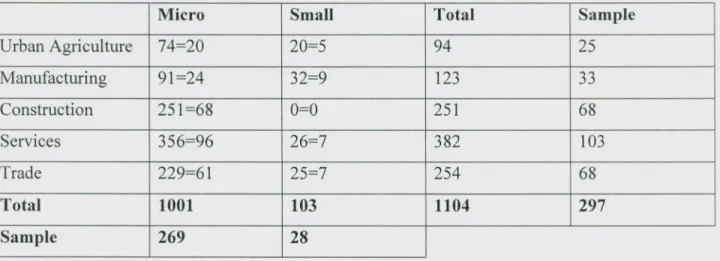
The population to be considered in this study is all MSEs currently operating and those engaged in manufacturing, construction, service, trade and urban agriculture sector in Bedele town urban area only and those formally registered by Bedele MSEs Bureau and Bedele Trade and Industry development bureau from 1997 to 2005 E.C. The total number of MSEs in the study area, according to Bedele MSEs Development Agency is, 1104 people which consists of 1001micro enterprises and 103 small enterprises which are engaged in urban Agriculture (74 micro and 20 small), Manufacturing (91 micro and 32 small), Construction (251 micro and 0 small), Service (356 micro and 26 small), and Trade (229 micro and 25 small) sectors are there (Bedele MSEs report, 2005 E.C).
3.4.2. Sample and Sampling Technique
The sample size of this study isdetermined to be297 MSE operators or owners in Bedele town. The respondents were selected from urban agriculture, manufacturing/processing, construction, service, and trade sectors on proportional basis. To select the sample size this study uses stratified random sampling technique. Stratified random sampling is modification of random sampling in which the population is divided into two or more relevant and significant strata based on one or more attributes. Each of the stratum to which the population is divided obtain an equal chance of being included in the sample.
Stratified random sampling has been used to get information from different sizes and sectors of the MSEs.This technique is preferred because it is used to assist in minimizing bias when dealing with the population. With this technique, the sampling frame can be organized into relatively homogeneous groups (strata) before selecting elements for the sample.According to Janet (2006), this step increases the probability that the final sample will be representative in terms of the stratified groups.