Department of Computer Science
PhD Thesis
Application of Power Laws to
Biometrics, Forensics and
Network Traffic Analysis
by
Aamo Iorliam
Supervisor: Prof. A.T.S. Ho
Co-supervisors: Dr. N. Poh, Dr. S. Li
Abstract
Tampering of biometric samples is becoming an important security concern. At-tacks can occur in behavioral modalities (e.g. keyboard stroke) as well. Besides biometric data, other important security concerns are related to network traffic data on the Internet. In this thesis, we investigate the application of Power laws for biometrics, forensics and network traffic analysis.
Passive detection techniques such as Benford’s law and Zipf’s law have not been investigated for the detection and forensic analysis of malicious and non-malicious tampering of biometric, keystroke and network traffic data. The Benford’s law has been reported in the literature to be very effective in detecting tampering of natural images.
In this thesis, our experiments show that the biometric samples do follow the Benford’s law; and that the highest detection and localisation accuracies for the biometric face images and fingerprint images are achieved at 97.41% and 96.40%, respectively.
The divergence values of Benford’s law are then used for the classification and source identification of fingerprint images with good accuracies between the range of 76.0357% and 92.4344%.
Another research focus in this thesis is on the application and analysis of the Benford’s law and Zipf’s law for keystroke dynamics to differentiate between the behaviour of human beings and non-human beings. The divergence values of the Benford’s law and the P-values of the Zipf’s law based on the latency values of the keystroke data can be used effectively to differentiate between human and non-human behaviours.
Finally, the Benford’s law and Zipf’s law are analysed for TCP flow size difference for the detection of malicious traffics on the Internet with AUC values between the range of 0.6858 and 1. Furthermore, the P-values of the Zipf’s law have also been found to differentiate between malicious and non-malicious network traffics, which can be potentially exploited for intrusion detection system applications.
First of all, I am very grateful to God Almighty for giving me the strength to pursue this PhD.
I wish to express my sincere gratitude to my supervisor Prof. Anthony T S Ho for his guidance, time, patience and vivid feedback throughout my PhD. I really appreciate your constant encouragement and careful review of my thesis in your busy schedule.
I would also like to thank my co-supervisors Dr. Norman Poh and Dr. Shu-jun Li for their valuable input into my research. Many thanks to Prof. Adrian Waller for his contributions to my PhD.
I would like to thank all the members of secure systems as well as the staff of Department of Computer Science for the friendly environment they provided for my research.
I would like to thank my Father and Mother for their prayers and uncondi-tional love. I also want to thank my brothers (Engr. Amos and Nguetar) and my sisters (Nguseer and Mamfe) for their moral and financial support. To my dear wife (Blessing) and daughter (Afam), I really appreciate your love and support. I will like to thank all my friends here in the UK and abroad. Especially Santosh Tirunagari who is always supportive. My friends Nyinoh Iveren, Shangbum Fav-eren, Oshido Barnabas, Ode Egena, Ikyanyon Darius, Leke Luther and Targema Msugh all encouraged me that I can make it.
Lastly, I would like to thank BSU Makurdi for funding and giving me the oppor-tunity to carryout this research.
Contents
Contents iii
List of Figures vii
List of Tables x
1 Introduction 1
1.1 Research Goal, Motivation and Questions . . . 5
1.2 Research Methodology . . . 6
1.3 Research Aims and Objectives . . . 7
1.4 Contributions . . . 7
1.4.1 Integrity of raw biometric images using Benford’s law . . . 9
1.4.2 Integrity of keystroke data using Benford’s law and Zipf’s law . . . 9
1.4.3 Network traffic data for IDS using Benford’s law and Zipf’s law . . . 10 1.5 Publications . . . 10 1.6 Thesis Structure . . . 11 2 Literature Review 12 2.1 Multimedia Security . . . 12 2.1.1 Active Approaches . . . 13 2.1.2 Passive Approaches . . . 16
2.1.3 Biometrics and Digital Tampering . . . 20
2.2 Forensic Biometrics . . . 21
2.3 Power laws and Image Processing . . . 23
2.3.1 Derivation of the Benford’s law and image analysis . . . 23
2.3.2 Benford’s law, other bases and scale invariance . . . 25
2.3.3 Transforms and the Benford’s law . . . 27
2.3.4 Relationship between Benford’s law and Zipf’s law . . . 29 iii
2.3.5 Keystroke Dynamics and Relevant Features . . . 32
2.3.6 Network Traffic Analysis State of the Art . . . 32
2.3.7 Anti-forensics and Anti-Anti-forensics . . . 33
2.4 Summary . . . 33
3 Benford’s Law Analysis for Biometric Recognition 34 3.1 Benford’s Law . . . 34
3.2 Block-DCT & JPEG Coefficients . . . 37
3.2.1 Quantization & Quality Factor . . . 39
3.3 Application to Biometric Images . . . 40
3.3.1 Experimental Setup . . . 40
3.3.2 Performance Evaluation of Detecting Single Compression and Double Compression . . . 44
3.4 Tampered Detection of Biometric Modalities . . . 48
3.4.1 Experimental Setup . . . 49
3.4.2 Mode Based First Digit Features . . . 51
3.5 Estimation of Block-level tampering for Biometric Images . . . 53
3.5.1 Results and Discussion . . . 58
3.5.2 Summary . . . 58
4 Power Laws for Physical Biometrics 59 4.1 Overview . . . 59
4.2 Introduction to Biometric Modalities . . . 59
4.3 Experimental Set-up . . . 60
4.3.1 Separation of different types of biometric images . . . 60
4.3.2 Data Sets . . . 61
4.3.3 Results for generalised Benford’s law . . . 61
4.3.4 Divergence metric and separability of biometric databases 62 4.4 Performance Evaluation for the Classification of Fingerprint Im-ages Using Benford’s law divergence . . . 64
4.4.1 Intra-Class Separability of Fingerprint Images . . . 64
4.4.2 Comparative Analysis of Intra-class Classification of Fin-gerprint Images . . . 64
4.5 Summary . . . 65
5 Data Forensic Techniques Using Benford’s Law and Zipf ’s Law for Keystroke Dynamics 67 5.1 Overview . . . 67
5.2 Introduction to Keystrokes Data . . . 67
5.3 Motivation for Zipf’s Law . . . 68
5.4 Fitting of Distribution of Data to Power Law . . . 69
CONTENTS v
5.5.1 Data Set . . . 71
5.6 Results for Standard and Generalised Benford’s Law . . . 72
5.7 Modeling and Analysis of Benford’s Law . . . 75
5.8 Results and Discussion . . . 76
5.9 Performance Evaluation of Detecting Keystroke Timing Features . 77 5.10 Summary . . . 79
6 Power Laws for Network Traffic Analysis 80 6.1 Introduction . . . 80
6.2 Network Traffic Analysis and IDS . . . 81
6.2.1 Flow Based IDS . . . 82
6.3 Network Flows and TCP Flows . . . 83
6.4 Application to Network Traffic Analysis . . . 84
6.4.1 Method Description . . . 84
6.4.2 The Metrics . . . 85
6.4.3 From Flows to Flow Windows . . . 87
6.4.4 Analysis on Different Flow Ordering Options . . . 87
6.4.5 Divergences and Distances . . . 88
6.5 Experimental Setup and Results . . . 89
6.5.1 Datasets Used for Our Experiments . . . 89
6.5.2 Flow Size or Flow Size Difference . . . 91
6.5.3 How to Determine Flow Window Size . . . 91
6.5.4 TCP Flow Ordering . . . 92
6.5.5 More Results on Different Datasets . . . 92
6.6 IDS Performance Evaluation . . . 93
6.6.1 Datasets Used . . . 95
6.6.2 Dataset Pre-Processing . . . 95
6.6.3 Benchmarking Metric . . . 96
6.6.4 Experimental Results . . . 96
6.7 Discussion and Future Work . . . 97
6.8 Zipf’s law for Network Traffic Analysis . . . 102
6.8.1 Zipf’s law for malicious, non-malicious, mixture of mali-cious and non-malimali-cious network traffic . . . 102
6.8.2 Comparative Analysis of Zipf’s law and Benford’s law with Implications . . . 103
6.9 Summary . . . 106
7 Conclusion and Future Work 108 7.1 Future Work . . . 109
7.1.1 Combining Benford’s law and Zipf’s law . . . 109
7.1.2 Power laws investigation for mixture of network traffic data 109 7.1.3 Power laws and Active Forensic Analysis . . . 109
7.1.4 Anti-forensic Techniques . . . 109
List of Figures
1.1 Eight possible attack points in a generic biometrics-based system [1] . 2 1.2 Hierarchy of Digital Image Forensics, Biometrics, Network Traffic
Analysis with a highlight on the contribution of this thesis . . . 8
2.1 Multimedia Security and Forensics . . . 13
2.2 Generic Watermarking Algorithm . . . 15
2.3 Classification of Image Forensic Techniques . . . 17
2.4 Uses of Forensic Biometric Evidence [2] . . . 23
2.5 (a) Arithmetic scale; (b) logarithmic scale. . . 25
2.6 2 levels DWT decomposition . . . 28
2.7 log(f) vs log(r) . . . 30
3.1 The first digit probability distribution of Benford’s law . . . 35
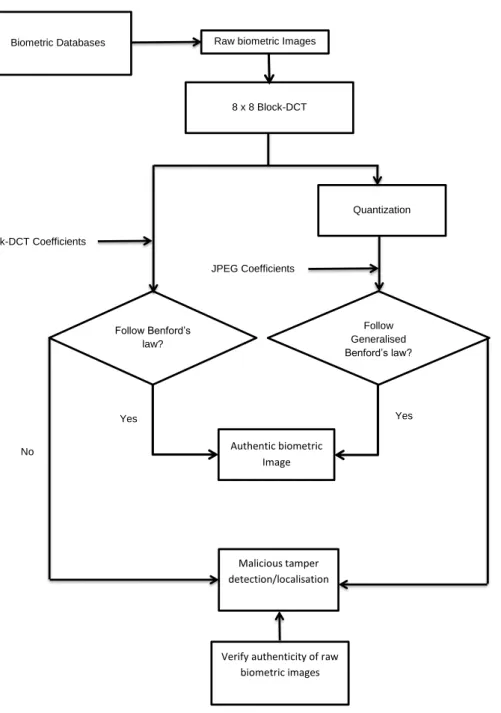
3.2 Schematic diagram for our proposed application of Benford’s law to raw biometric data for processing, tamper detection and localisation . 38 3.3 Block-DCT coefficients closely follow Benford’s law for: (a) face im-ages, (b) DB1 fingerprint imim-ages, (c) DB2 fingerprint imim-ages, (d) DB3 fingerprint images, (e) DB4 fingerprint images. . . 42
3.4 JPEG coefficients closely follow generalised Benford’s law at QF=100 for: (a) face images, (b) DB1 fingerprint images, (c) DB2 fingerprint images, (d) DB3 fingerprint images, (e) DB4 fingerprint images. . . 43
3.5 The pdf of the divergence of: (a) single compressed face images of QF=100 versus the pdf of other QFs from 90 to 50 in step -10; (b) single compressed DB1 fingerprint images of QF=100 versus the pdf of other QFs from 90 to 50 in step -10. . . 45
3.6 The pdf of the divergence of: (a) double compressed face images of QF1=100, QF2=100 versus other QFs including QF1=55, 65, 75, 85 and QF2=70, 80, 90, 95; (b) double compressed DB1 fingerprint im-ages of QF1=100, QF2=100 versus other QFs including QF1=55, 65, 75, 85 and QF2=70, 80, 90, 95. . . 45
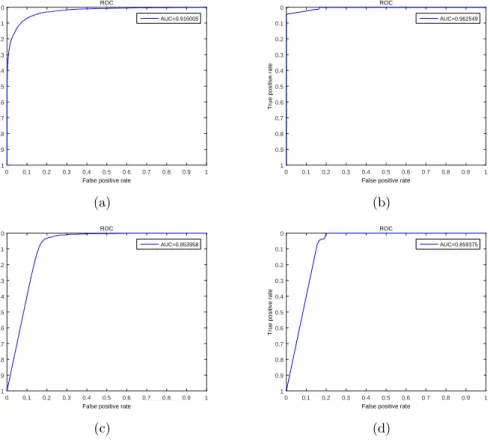
3.7 ROC curve for: (a) single compressed face images; (b) single com-pressed DB1 fingerprint images; (c) double comcom-pressed face images; (d) double compressed DB1 fingerprint images . . . 46 3.8 ROC curve for double compressed DB2 fingerprint images . . . 47 3.9 First digits distribution of single compressed fingerprints at QF1 =
80 follows the logarithmic law and double compressed fingerprints at
QF1= 50 andQF2= 80 violates the logarithmic law. . . 49 3.10 Face image of: (a) JPEG girl at QF=100, (b) JPEG boy at QF=100,
(c) Eyes and nose of (a) replaced with eyes and nose from (b). . . 50 3.11 Fingerprint image: (a) JPEG compressed at QF=80, (b) JPEG
com-pressed at QF=50, (c) center portion of (b) replaced with center por-tion from (a). . . 51 3.12 Schematic diagram for our proposed tamper detection and localisation
[3] . . . 53 3.13 Face image: (a) tampered; (b) detected; (c) tampered; (d) detected. . 56 3.14 Detection of: (a) uncompressed fingerprint (.tif) inserted into a
com-pressed fingerprint (QF=50) and the composite fingerprint saved at a QF=70; (b) uncompressed fingerprint (.tif) inserted into a compressed fingerprint (QF=60) and the composite fingerprint saved at a QF=75; (c) compressed fingerprint (QF=80) inserted into a compressed fin-gerprint (QF=50) and the composite finfin-gerprint saved at a QF=70; (d) compressed fingerprint (QF=50) inserted into a compressed fin-gerprint (QF=70) and the composite finfin-gerprint saved at a QF=70; (e) compressed fingerprint (QF=60) inserted into a compressed fin-gerprint (QF=75) and the composite finfin-gerprint saved at a QF=75; (f) uncompressed fingerprint (.tif) inserted into a compressed finger-print (QF=80) and the composite fingerfinger-print saved at a QF=70. (g-h) un-tampered JPEG fingerprints compressed at QF=70 and QF=100 respectively. Each square represents a 5×5 block. . . 57 4.1 JPEG coefficients of artificially printed contact-less acquired latent
fingerprints does not closely follow the generalized Benford’s law at QF=100 . . . 62 4.2 Box plot of the divergence for single compressed DB1, DB2, DB3,
DB4 and contact-less acquired latent fingerprints for a QF= 50 to 100 in step of 10 . . . 63 4.3 ROC curve for: (a) DB4 fingerprint images vs DB1 fingerprint images;
(b) DB4 fingerprint images vs DB2 fingerprint images; (c) DB4 finger-print images vs DB3 fingerfinger-print images; (d) DB4 fingerfinger-print images vs contact-less acquired fingerprint images . . . 65 5.1 Keystroke timing features . . . 71
LIST OF FIGURES ix
5.2 Keyup-Keydown (latency) follows standard Benford’s law, Keydown-Keydown follows Generalised Benford’s law, where as duration devi-ates from Benford’s law (CMU database [4]) . . . 72 5.3 Keyup-Keydown (latency) of the keystroke data follows Zipf’s law for
CMU database [4] . . . 73 5.4 Duration of the keystroke data does not follow Zipf’s law for CMU
database [4] . . . 73 5.5 Keydown-keydown of the keystroke data also follows Zipf’s law for
CMU database [4] . . . 74 5.6 Linear Regression of order n=1 and Polynomial Regression of order
n=3 . . . 76 6.1 Change of χ2 divergence w.r.t. flow window size W. . . 92 6.2 ROC curves of two settings for the KDD Cup 1999 dataset: (a) χ2
divergence, Tl= 1; (b) Euclidean distance, tl= 0.01. . . 98
6.3 ROC curves of two settings for the TRT dataset: (a) χ2 divergence, Tl= 500; (b) Euclidean distance,tl= 0.3. . . 99
6.4 ROC curves of two settings for the NSL-KDD 2009 dataset with χ2
divergence and tl= 0.5. . . 100
6.5 Differentiate Malicious Flows from Non-Malicious Flows using Zipf’s law . . . 103 6.6 Zipf’s law for the malicious flow size difference of: (a) capture the
hacker; (b) 2009 CDX dataset-35 dump; (c) 2009 CDX dataset-35 dump2. . . 104 6.7 Zipf’s law for the non-malicious flow size difference of: (a) LBNL and
ICSI dataset; (b) Traffic Lab at Ericsson Research in Hungary dataset 104 6.8 Zipf’s law for the mixture of malicious and non-malicious flow size
2.1 Benford’s law analysis in images. . . 26
2.2 Benford’s law probabilities for different bases. . . 27
2.3 Benford’s law analysis in different domains. . . 29
2.4 Zipf’s law application in different domains. . . 31
3.1 Model Parameters used for generalised Benford’s law [5] . . . 36
3.2 Divergence values for uncompressed biometric face images, DB1 fin-gerprints, DB2 finfin-gerprints, DB3 fingerprints and DB4 fingerprints images under different QF’s. . . 43
3.3 Divergence values for JPEG coefficients of face images, DB1 finger-prints, DB2 fingerfinger-prints, DB3 fingerprints and DB4 fingerprints under different QF’s. . . 44
3.4 AUC for single compressed fingerprints at QF=100 versus other QFs from 90 to 50 in step -10 . . . 47
3.5 AUC for double compressed fingerprints at QF1=100, QF2=100 ver-sus other QFs including QF1=55, 65, 75, 85 and QF2=70, 80, 90, 95 . . . 48
3.6 Tampered Blocks and the Detection Accuracy of Tampered Face images. 55 3.7 Tampered Blocks and the Detection Accuracy of Tampered Finger-print images. . . 55
5.1 Divergence values for Keystroke data . . . 74
5.2 P-value, Lower bound (xmin) and Scaling exponent (α) for Keystroke data . . . 74
5.3 AUC values for detecting keystroke timing features . . . 78
5.4 Comparison of Our Proposed Method With Three Existing Methods . 78 6.1 χ2 divergence values for flow size vs. flow size difference as the metric. 91 6.2 χ2 divergence values for datasets with non-malicious TCP flows. . . . 93
6.3 χ2 divergence values for datasets with malicious TCP flows. . . 94
LIST OF TABLES xi
6.4 χ2divergence values for datasets with mixed malicious and non-malicious
TCP flows. . . 94 6.5 Comparison between Zipf’s law and Benford’s law . . . 105
% E Percentage Error
χ2 Chi-square divergence AC Alternate Current
AFIs Automatic Fingerprint Identification systems AUC Area Under the Curve
CCA Chosen Cipher-text Attack CDF Cumulative Distribution Function CDX Cyber Defense Competition
CE Cross Entropy
CMU Carnegie Mellon University CPA Chosen Plain-text Attack
DC Direct Current
DCT Discrete Cosine Transform DDoS Distributed Denial of Service DFT Discrete Fourier Transform DWT Discrete Wave Transform EER Equal Error Rate
EMG Electromyograph FPR False Positive Rate
LIST OF TABLES xiii
IWBF International Workshop on Biometrics and Forensics IETF Internet Engineering Task Force
ID Intrusion Detection
IDS Intrusion Detection Systems
IPFIX Internet Protocol Flow Information Export JPEG Joint Photographic Expert Group
KDD Knowledge Discovery and Data Mining KLD Kullback-Leibler Divergence
KS Kolmogorov-Smirnov
LBNL Lawrence Berkeley National Laboratory LSB Least Significant Bits
MACCDC Mid-Atlantic Collegiate Cyber Defense Competition MBFDF Most Based First Digit Features
MLE Maximum Likelihood Estimators MSD Most Significant Digit
NFIQ NIST fingerprint Image Quality NSA National Security Agency PCAP Packet Capture
QF Quality Factor
RBF Radial Basis Function
ROC Receiver Operating Characteristic SSE Square Due to Error
SVM Support Vector Machine TCP Transmission Control Protocol
TLERH Traffic Lab at Ericsson Research in Hungary TPR True Positive Rate
TRT Thales Research & Technology UCID Uncompressed Image Database UDP User Datagram Protocol
Chapter 1
Introduction
Digital tampering is becoming more rampant recently because of the easy ac-cess to digital proac-cessing tools such as Photoshop [6]. The most common ma-nipulations that can likely be applied to raw biometric data (e.g. face image) include: copy-paste manipulation which has an inserted region that is uncom-pressed, but the composite raw biometric image is saved in a Joint Photographic Expert Group (JPEG) format; copy-paste manipulation which has an inserted region that is compressed and the composite raw biometric image is saved in a JPEG format; and inpainting manipulation of JPEG raw biometric image [3]. It is noted that JPEG is the most widely used image format [3]. It is also used as a storage format for raw face images, fingerprint images, vein wrist images and iris images. Another concern of biometrics is related to biometric sensors arising from replay-attack and print-attack, which are all spoofing approaches to fool biometric sensors, thus resulting in sensor tampering [7].
Biometrics can be defined as a set of automated methods used for the recog-nition of human beings, measuring and analyzing statistically their distinctive physical and behavioral traits [2]. Biometric modalities consist of face, finger-prints, iris, retina, teeth, hand geometry and skin when considering biological measurements, whereas when considering behavior information, the data consist of voice, gait, keyboard stroke, signature or other written scripts [2]. Biologically measured modalities (fingerprints, face, hand geometry, iris) and/or behavioral modalities (voice, signature, keyboard strokes) are used for biometric recognition purposes [8]. The recognition is carried out either for verification or identifi-cation [8]. Verifiidentifi-cation (1-to-1 matching) seeks to answer the question “Is this person who they say they are ?”. Whereas identification (1-to-many (n) match-ing) seeks to answer the question “Who is this person ?” or ”Who generated this biometric ?” [9].
Even though biometric systems have advantages, they are exposed to several attacks that may cause security concerns. Ratha et al. [1] noted that there are eight possible attack points in a generic biometric system as shown in Figure 1.1. These possible attacks on biometric systems are: (1) Fake biometric at the sen-sor; (2) Resubmission of old digitally stored biometric signal; (3) Override feature extract; (4) Tampering with the feature representation; (5) Override matcher; (6) Tampering with stored templates; (7) Channel attack between stored templates and the matcher; (8) Decision override.
Sensor
Feature extractor
Matcher Template database
6 7 Decision 4 2 3 1 5 8
Figure 1.1: Eight possible attack points in a generic biometrics-based system [1]
Biometric templates can be stored either locally or remotely in a database. Ac-cording to Bouridane [10], the maintenance of template data store or template database has frequently been overlooked. The raw biometric images are mainly stored for research and development applications whereas the feature sets are used for real-world application purposes [10]. The stored raw biometric data can be exposed to digital manipulation by attackers. As such, there is a need to analyse and confirm the authenticity of these data. Although there are ap-proaches [11] [12] proposed to detect and localise natural image tampering, such techniques are not focused on raw biometric images. For instance, Huynh et. al. [11] carried out a survey on natural image forgery detection techniques focus-ing on copy-move and splicfocus-ing images. Qazi et. al. [12] carried out a survey on several blind techniques used in detecting natural image forgery. They focused on copy/move, splicing and retouching forgery detection techniques. We are
there-3
fore concerned with analysing raw biometric images to protect against malicious tampering of stored raw biometric templates.
Both biologically measured and/or behavioral modalities are used for recogni-tion purposes, they both have advantages and disadvantages. For instance, in terms of the advantages, biologically measured modalities (e.g. fingerprints, face and iris) remain unchanged for a longer period of time as compared to behavioural modalities. They are also very unique and have high recognition accuracy [13]. The disadvantage of these modalities (especially fingerprints) is that when they are exposed to hackers, it is not possible to change them. Therefore, it is diffi-cult for these modalities to be revocable when compromised. The disadvantage associated with iris is that it has a low acceptance from the public due to how interfering the iris scanning process is carried out [13]. In contrast, behavioral modalities (e.g. keyboard stroke) are very economical and can easily be inte-grated into existing computer security systems. They can also be changed on a regular basis and can be cancelled even when exposed to hackers [13]. Behavioral modalities can also be used to potentially differentiate between keystrokes data generated by humans and non-humans.
Keystroke dynamics has been used to discriminate between individuals [4] [14] [15], on-line banking application [16], static authentication [17], and continuous authentication [18]. However, these keystroke dynamics can be attacked by vari-ous means such as human [4], synthetic and automatic attacks and forgeries [19]. In order to discriminate authentic keystrokes from keystrokes originating from synthetic forgeries or impostors, different methods have been proposed. Some of these methods use machine learning techniques [4] [19] [20] to discriminate authentic keystrokes from synthetic forgeries or impostors which are data depen-dent. Keystroke auditing or inspection is divided into active monitoring and pas-sive protection [21]. In active monitoring, administrators watch ongoing keystroke activities whereas, in passive protection, stored keystroke data are usually exam-ined for audit purposes [21]. Keystroke auditing has two issues, which handle the large amount of data generated and privacy [21]. However, for an organisa-tion/company that handles sensitive data, these two issues could be handled by providing sufficient storage space for the data captured and by ensuring such a company/organisation has proper policies in place and the employees are already aware of such policies [21] [22]. Keystroke monitoring is generally considered as a special case of audit trails [22] which is very important for forensic analysis, to protect systems and data from intruders [22].
It is reported [2] that the fields of biometrics and forensics can benefit from each other. Forensic science is defined as the body of scientific knowledge and
technical methods used to analyse and interpret traces, in legal and criminal processes for investigations [2]. The steps involved in a forensic process include crime scene investigation, trace analysis, evidence interpretation and case report-ing. The forensic science inferences are usually considered at the source level, activity level and offence level [2]. The origin of the trace is the focus when con-sidering source level inference, whereas when concon-sidering the activity that leads to the existence of a trace, it is referred to as activity level inference and lastly, when an offence is the focus, it is classified as offence level inference [2]. In this thesis, we are more concerned with the offence level inference (detection of digital tampering of raw biometric data and detection of keystrokes data generated by non-humans).
Besides biometric data (biologically measured and behavioral modalities), other important security concerns are related to network traffic data on the Internet. The emergence of networking technologies has brought about easy and afford-able connection to the Internet [23]. The Internet has been used for different purposes and has advantages such as online banking, online shopping, communi-cation and for research purposes. Internet acceptability has brought about sig-nificant increase in the amount of information for data transmission and storage. This information transmitted over the Internet has to be secured [24]. Network intrusions, however, pose the main challenge to securing information on the In-ternet [25] [26]. In order to defend against network attacks, there is a need for studies relating to network traffic analysis. Intrusion Detection Systems (IDS) are used in detecting attacks or abuse on the Internet [27]. Identifying and re-sponding to intrusions targeted at computing and network resources is the major objective of IDS [28]. IDS systems are basically classified into signature or misuse detection system, anomaly detection system and hybrid or compound detection system [29]. A signature or misuse detection system recognises attacked data based on a presumed set of attack signatures. Whereas anomaly detection system creates a standard profile for what is considered a normal system. Any deviation from this standard profile is considered a possible intrusion. A combination of signature detection system and anomaly detection system is considered as hybrid or compound detection system. Network traffic data if properly processed, could serve as evidence to tackle network offenders [30].
There are methods proposed to detect natural image forgery [11] [12], discrimi-nate authentic keystrokes from synthetic forgeries or impostors [4] [19] [20], and detect anomalies on the Internet [31] [32]. However, the attackers are constantly evolving and are able to bypass many of the existing methods. In this thesis, we propose the use of Power laws for the detection of malicious attacks in biomet-ric, forensic and network traffic data. A quantity is said to follow a Power law
1.1. RESEARCH GOAL, MOTIVATION AND QUESTIONS 5
when the probability of measuring a particular value of some quantity varies in-versely as a power of that value [33]. Two Power laws are analysed in this thesis: Benford’s law and Zipf’s law. There exists a relationship between Benford’s law and Zipf’s law which in most cases exhibit a power law like behaviour for most quantities considered [33] [34]. Chapter 2 gives more details about the Benford’s law and Zipf’s law.
1.1
Research Goal, Motivation and Questions
In this thesis, the application of Power laws will be investigated for the detec-tion and forensic analysis of malicious and non-malicious tampering of biometric, keystroke and network traffic data. Passive detection methods [3] [35] [36] have been developed to verify the authenticity and integrity of natural images. Li et al. [3] used the first digits of the alternate current modes and support vector machine (SVM) for the detection and localisation of tampered regions in natural images. Al-Qershi and Khoo [35] described copy-move detection methods used for natural image authentication. Bianchi et al. [36] discriminated original regions of natural images from forged regions based on a statistical test. They used the hypothesis that original regions of natural images are doubly compressed whereas that of the tampered regions are singly compressed. Although these techniques are proposed for verifying the integrity of natural images, they are not studied considering raw biometric images. Also, proposed techniques to tackle intrusions over the Internet and aid in monitoring keystroke data for forensic analysis can be bypassed by attackers.
It is therefore very important to develop effective techniques to address chal-lenges such as differentiating between tampered and un-tampered raw biometric data, keystrokes generated by humans and those originating from synthetic forg-eries or impostors, as well as detecting intrusions on network traffic data. The importance of verifying the authenticity and integrity of biometric data cannot be over emphasized. Biometric modalities are possessed by almost every individual. As such most countries keep individuals biometric data either for verification or identification. Biometric data such as fingerprints and photographs are used by most countries to prevent identity fraud and help in tracing criminals. However, hackers may illegally have access to these sensitive biometric data. Ratha et al.
[1] noted that templates stored in the database could be modified or removed, or new templates introduced in the database. This could cause illegal authorization of a fraudulent individual, or denial of service for the legitimate person whose template sample was modified. Therefore, there exist some real cases of digital tampering with biometric data in real-world applications. For example, a case in point, was the nine million stolen records of Israelis’ biometric information
which shocked the world in 2006, from the Israel’s primary national biometric database [37].
To the best of our knowledge, research has not been carried out in verifying the integrity, authenticity and reliability of raw biometric modalities using Power laws. In the case of keystroke data, most computers in an organisation use key-boards for login purposes. As such, it is important to differentiate authentic users from impostors. Otherwise, the impostors will succeed in posing a challenge of exposing or having illegal access to sensitive information.
Lastly, if a network is not protected from network intruders, it will result in non-secure transactions and open to attacks such as Distributed Denial of Service (DDoS). There are also methods [38] [39] developed for network traffic analysis. Draˇsar et al. [38] carried out a flow-based anomaly detection review. They also proposed a new network anomalies taxonomy and a classification of flow-based detection methods based on similarity-orientation. Sperotto et al. [39] detected anomalies in network traffic based on flow-based time series. The motivation of this thesis is based on these challenges explained above with the goal of inves-tigating how to analyse raw biometric data, keystroke data and network traffic data using Power laws for both security and forensic purposes. To achieve this goal, the following fundamental research questions will be investigated and anal-ysed in detail in this thesis:
Research question 1: Do biometric images follow Benford’s law? If yes, can Benford’s law assist in detecting and localising tampered biometric images? Research question 2: Is Benford’s law and Zipf’s law applicable to the latency or duration of keystroke data? How will they behave for the Benford’s law and Zipf’s law?
Research question 3: Is Benford’s law and Zipf’s law applicable to the TCP flow size difference of network traffic data? If yes, can they assist in detecting malicious traffic in the Internet?
1.2
Research Methodology
In this thesis, raw biometric images will be investigated to determine whether they follow Benford’s law or not. The Benford’s law is also referred to as the first digit law. Any deviation from the Benford’s law could indicate that such raw biometric images have been tampered with. The probability distribution of first digits of the block-Discrete Cosine Transform (DCT) coefficients of raw biometric
1.3. RESEARCH AIMS AND OBJECTIVES 7
coloured face images and biometric grayscale fingerprint images is performed to test whether they follow standard Benford’s law. We then analyse the probabil-ity distribution of first digits of the JPEG coefficients to determine whether they also follow generalized Benford’s law.
We use divergence metrics based on Benford’s law to assist in separating differ-ent fingerprint images. In addition, the first digits of the alternate currdiffer-ent modes and support vector machine are used to detect and localise tampering in raw biometric images.
Furthermore, we investigate keystroke dynamics by checking the conformity of keystroke data to these Power laws. A deviation could mean that an abnormal keystroke data is generated which could be from non-humans or impostors and hence there will be a need for a further investigation by the system analyst. We use latency, keydown-keydown and duration of keystroke datasets to test their conformity to standard Benford’s law, generalised Benford’s law and Zipf’s law. Lastly, we analyse network traffic data using Benford’s law and Zipf’s law to de-tect normal and abnormal network traffic flows. We test whether non-malicious flow size difference of network traffic data follow these Power laws and also whether malicious flow size difference deviates from these laws.
1.3
Research Aims and Objectives
The aims and objectives of this thesis are as follows:
Analyse raw biometric data and detect tampered data using Benford’s law and metrics based on divergence and distances
Investigate keystroke data using Benford’s law and Zipf’s law for keystroke dynamics to discriminate between authentic keystroke data and those gen-erated by non-humans or impostors
Propose the use of Benford’s law and Zipf’s law to analyse network traffic flow size difference for IDS based on divergence and distances
1.4
Contributions
The contributions in this thesis are mainly focused on statistical analysis of raw biometric data, keystroke data and network traffic data. We are focused more on passive detection methods rather than active detection methods.
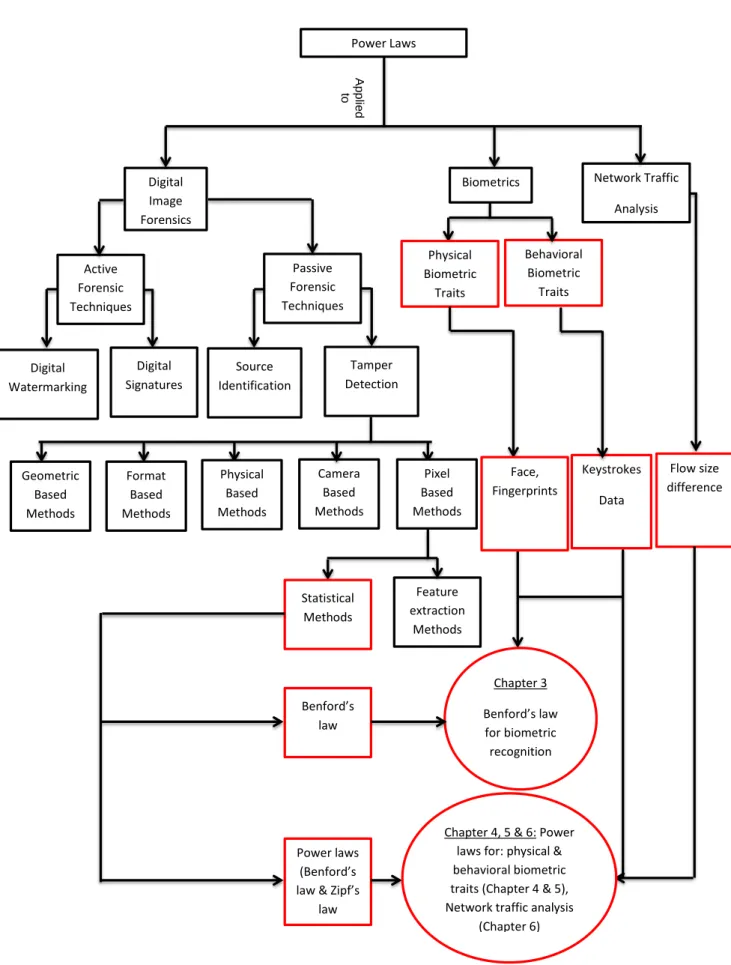
The subsections below discuss each of our contribution briefly. Figure 1.2 shows a hierarchical chart of digital image forensics, biometrics, network traffic analysis and highlight the contributions of this thesis (in red shapes).
Passive Forensic Techniques Feature extraction Methods Behavioral Biometric Traits Network Traffic Analysis Biometrics Physical Biometric Traits Keystrokes Data Digital Image Forensics Power Laws A pp lied to Active Forensic Techniques Digital Watermarking Digital Signatures Source Identification Tamper Detection Geometric Based Methods Format Based Methods Physical Based Methods Camera Based Methods Pixel Based Methods Statistical Methods Chapter 3 Benford’s law for biometric recognition Benford’s law Power laws (Benford’s law & Zipf’s
law
Chapter 4, 5 & 6: Power laws for: physical & behavioral biometric traits (Chapter 4 & 5), Network traffic analysis
(Chapter 6)
Flow size difference Face,
Fingerprints
Figure 1.2: Hierarchy of Digital Image Forensics, Biometrics, Network Traffic Analysis with a highlight on the contribution of this thesis
1.4. CONTRIBUTIONS 9
As shown in Figure 1.2, digital image forensics is divided into active forensic techniques and passive forensic techniques. As noted in [3], attention should be focused more on developing passive detection methods than active detection methods. This is because passive detection methods do not require any prior information about the image or quantity under investigation. In this thesis, we focus and investigate the area of tamper detection, using pixel based methods, which belongs to the passive forensics category. This is carried out in order to ver-ify the integrity and authenticity of raw biometric images. Power laws (Benford’s law and Zipf’s law) which are classified as statistical laws are investigated on bio-metric images, physical and behavioral biobio-metrics, and network traffic data for network traffic analysis. The physical biometric traits that are investigated using Benford’s law are face images and fingerprint images. Whereas for behavioural biometric traits, the keystroke data is investigated using the Power laws. Lastly, network traffic metric (flow size difference) is investigated using the Power laws.
1.4.1 Integrity of raw biometric images using Benford’s law
In this thesis, we propose the use of Benford’s law in investigating raw biometric images. We analyse the block-DCT coefficients of uncompressed biometric im-ages such as face and fingerprint imim-ages and show whether they closely follow the standard Benford’s law and whether the JPEG coefficients of these images also closely follow the generalized Benford’s law. We further investigate the novel use of Benford’s law on biometric modalities such as face images and fingerprints to determine whether such modalities are uncompressed or JPEG compressed im-ages based on a DCT transformation. For detection and localisation of tampered raw biometric images, we investigate the hypothesis whether the tampered re-gion has undergone a single JPEG compression and the un-tampered rere-gion has undergone a double JPEG compression [3]. This approach works considerably better in detecting tampered raw biometric images. For the classification and source identification of different types of fingerprint images considered in this thesis, fingerprint images will be investigated using metrics from the Benford’s law divergence values.
1.4.2 Integrity of keystroke data using Benford’s law and Zipf’s law
We seek to apply Benford’s Law and Zipf’s Law to keystroke data and to de-termine whether they follow these laws. We further investigate whether these laws can discriminate between humans using keystroke biometric systems from non-humans. For the keystrokes data, we specifically investigate the latency and the duration values of keystroke data from humans to see whether they follow the Benford’s law and Zipf’s law. We perform experiments and comparative analysis using the benchmark data set developed by Killourhy and Maxion, CMU [4]. We
investigate whether the latency of keystrokes can be used as a feature for auditing purposes to detect whether there exists anomalies during system logins by their employees.
1.4.3 Network traffic data for IDS using Benford’s law and Zipf’s law
We propose the use of Benford’s law and Zipf’s law on the TCP flow size difference to assist in detecting malicious traffic on the Internet. Experiments will be carried out on non-malicious traffic (Lawrence Berkeley National Laboratory (LBNL) and ICSI dataset, UNB ISCX 2012 Intrusion Detection Dataset, Traffic Lab at Ericsson Research in Hungary (TLERH) dataset, Other publicly available non-malicious traffic from Packet Capture (PCAP) traces [40]) will be analysed to see whether non-malicious network traffic follows the Benford’s law and Zipf’s law. Furthermore, experiments on malicious traffic (Capture hacker dataset, 2009 Inter-Service Academy Cyber Defense Competition (CDX) dataset, Mid-Atlantic collegiate cyber defense competition (MACCDC) dataset, Labeled dataset for intrusion detection, Kyoto University Benchmark Data) will be performed to show whether malicious traffic deviates from the Benford’s law and Zipf’s law. We will also investigate the Benford’s law to detect malicious traffic on labeled dataset from (Knowledge Discovery and Data Mining (KDD) Cup 1999 dataset [41], NLD-KDD 2009 dataset [42] and a private dataset provided by Thales Research & Technology (TRT) UK).
1.5
Publications
[1] A. Iorliam, A.T.S. Ho, N. Poh, and Y.Q. Shi, Do Biometric Images F ollow Benf ord0s Law? 2nd International Workshop on Biometrics and Forensics (IWBF2014), Malta, pages 1-6, 27-28th March, 2014.
[2] A. Iorliam, A.T.S. Ho, N. Poh, S. Tirunagari, and P. Bours, Data F orensic T echniques U sing Benf ord0s Law and Zipf0s Law. 3rd International Workshop on Biometrics and Forensics (IWBF2015), Norway, pages 1-6, 3rd-4th March, 2015.
[3] A. Iorliam, A.T.S. Ho, A. Waller, and X. Zhao, U sing Benf ord0s Law Divergence and N eural N etworks f or Classication and Source Identication of Biometric Images. 15th International Workshop on Digital-forensics and Watermarking (IWDW), China, 2016.
[4] S. Tirunagari, N. Poh, D. Windridge, A. Iorliam, N. Suki, and A.T.S. Ho,
Detection of F ace Spoof ing U sing V isual Dynamics. IEEE Transactions on Information Forensics and Security, 10(4):762-777, 2015.
1.6. THESIS STRUCTURE 11
[5] N. Poh, N. Suki, A. Iorliam, and A.T.S. Ho, Anti− f orensic resistant likelihood ratio computation:A case study using f ingerprint biometrics. Pro-ceedings of the 22nd European Signal Processing Conference (EUSIPCO), pages 1377-1381, 2014.
1.6
Thesis Structure
The thesis is organised as follows:
Chapter 2 describes the multimedia security domain, Power laws and the relationship that exists between Benford’s law and Zipf’s law. We briefly highlight the recent state-of-the-art techniques considering the area of bio-metrics, forensics and keystroke dynamics. Next, we review network traffic analysis and the state-of-the-art techniques used in the literature.
Chapter 3 investigates the use of Benford’s law for biometric recognition and their features to detect and localise tampered JPEG biometric images.
Chapter 4 provides a detailed analysis of Benford’s law for physical bio-metric traits. We use the Benford’s law divergence to detect different types of fingerprint images. Next, the classification and source identification of fingerprint images is achieved by using Benford’s law divergence.
Chapter 5 provides a detailed analysis of Power laws for behavioural bio-metric traits. Furthermore, Benford’s law and Zipf’s law are investigated on the latency of keystroke data to discriminate between humans using keystroke biometric systems from non-humans.
Chapter 6 provides a detailed analysis of Power laws for network traffic analysis. The TCP flow size difference is used with the Benford’s law and Zipf’s law to assist in detecting malicious traffic on the Internet.
Chapter 7 concludes and discusses future work in biometrics, forensics and network traffic analysis.
Literature Review
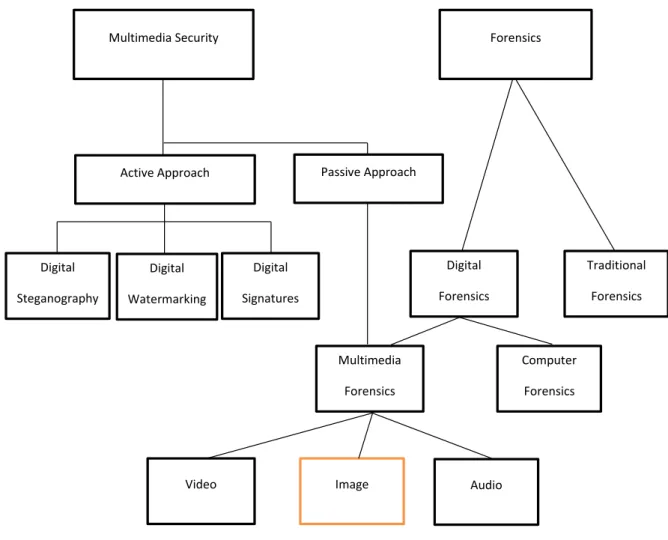
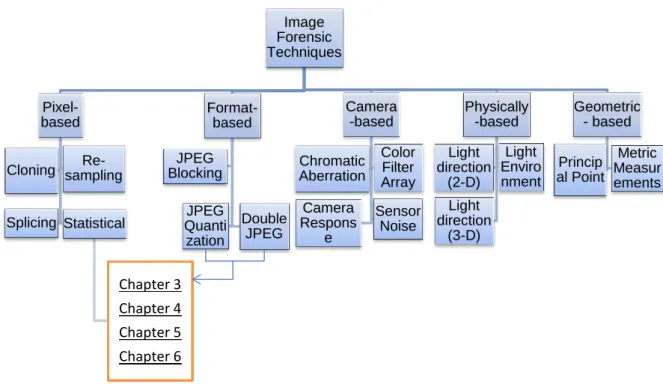
The first part of this chapter explains the relationship that exists between multi-media security, data hiding and forensics domains. Figure 2.1 shows a schematic representation of the relationship that exists between multimedia security and the forensics domain. The field of digital forensics which involves active and passive detection approaches is reviewed. Figure 2.3 shows a schematic diagram of image forensic techniques and highlights the relationship between the image forensic techniques and the thesis chapters. One of the focuses of this thesis is to verify the integrity of raw biometric data. In view of this, the field of biometrics is reviewed and how digital tampering could occur in raw biometric data is also explained. Furthermore, the field of biometrics and forensics benefit from each other and are combined to form forensic biometrics. Forensic Biometrics is con-cerned with the human-based automated methods used to analyse and interpret biometric data within several forensic applications. Evidence which is obtained from this field is useful for different purposes. Figure 2.4 shows the different uses of this evidence and highlights the offence level as the area of focus in this thesis. Also, Power laws are reviewed with a focus on image processing. Again, related work on the Benford’s law and Zipf’s law with respect to keystroke dynamics is reviewed. Lastly, network traffic analysis which is concerned with record-ing, reviewing and analysing network traffic patterns using manual or automatic methods is reviewed.
2.1
Multimedia Security
The field of digital multimedia security is concerned with protecting and vali-dating multimedia content which includes video, image and audio. This field is further divided into active and passive approaches. The schematic diagram of digital multimedia security, digital forensics and the relationship that exists
2.1. MULTIMEDIA SECURITY 13
tween these fields is shown in Figure 2.1. The application of multimedia forensics to an image is highlighted because one of our objectives in this thesis is focusing on biometric images. The next section describes these approaches in details.
Multimedia Security
Active Approach Passive Approach
Digital Steganography Digital Signatures Forensics Digital Forensics Traditional Forensics Multimedia Forensics Computer Forensics
Video Image Audio Digital
Watermarking
Figure 2.1: Multimedia Security and Forensics
2.1.1 Active Approaches
Active detection methods work by embedding prior information (e.g. serial num-ber) into an original media [43]. These methods include digital steganography, digital watermarking and digital signatures. Active detection methods (digital steganography and digital watermarking) are classified as data hiding techniques. This is because both approaches are aimed at embedding data into a digital me-dia. A closely related domain to the data hiding techniques is cryptography.
Fields belonging to cryptographic domain include digital signatures and encryp-tion. In this section, we describe in detail, the different types of data hiding techniques.
Digital Steganography and Steganalysis
The history of steganography dates back to 440 B.C. when Histiaeus tattooed a message on a trusted slave’s head after his hair was shaved [44]. When the hair had regrown, the servant was used to communicate the tattooed message to the desired destination without being noticed. Steganography embeds data into a media and conceals the existence of the embedded data so that it will not be detected by an attacker [44] [45]. As noted by Fridrich et al. [46], the purpose of steganography is for secure communication. Fridrich et al. [46] detected the least significant bit (LSB) steganography for both coloured and grayscale im-ages. They determined that for a safe LSB embedding, an upper bound of 0.005 bits/pixel was needed. Wang et al. [47] proposed a steganographic algorithm that could preserve the histogram of the cover images in the stego-images and also addressed the minimization of visual distortions. Li and Li [48] proposed the progressive exponential clustering steganographic method to increase the embed-ding capacity which is achieved by avoiembed-ding redundancy.
Steganalysis is concerned with detecting steganographic methods. Goljan et al. [49] proposed a colour rich model for detection of steganalysis for colour images. Pevn`yet al.[50] proposed a quantitative steganalyzer (which estimates the number of embedding changes due to embedding operations) which could be used as a blind detector. Sedighi and Fridrich [51] studied the effects of an im-precise selection channel on steganalysis and showed that it was better to use an imprecise selection channel instead of none. Furthermore, Shiet al.[52] proposed a steganalysis scheme for detection of advanced JPEG steganography. They used a Markov process based approach and showed that their proposed method out-performed existing techniques in attacking OutGuess, F5 and MB1.
Digital Watermarking
In 1954, electronic watermarking was invented by Frank [53]. This was pub-lished in the form of a patent that explained how to embed a code into music in order to establish ownership. Frank [53] stated that “The present invention makes possible the positive identification of the origin of a musical presentation and thereby constitutes an effective means of preventing such piracy, that is, it can be likened to a watermark in paper.” Digital watermarking as described by Barni and Bartolini [54] is an information hiding approach that embeds digital
2.1. MULTIMEDIA SECURITY 15
information inside a carrier signal.
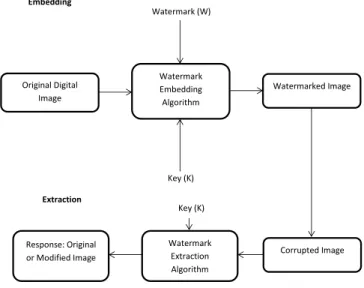
Generally, digital watermarking is classified into robust, fragile and semi-fragile. Robust watermarking is used for copyright protection and verification of own-ership of digital images. This watermarking approach is robust against signal operations and deliberate attacks. Fragile and semi-fragile watermarking are used for authentication of digital images. Any changes to the pixel values of a watermarked image can be detected using a fragile watermarking approach. Whereas, semi-fragile watermarking is used to verify contents that are tampered within an image. This approach is more robust against attacks and is used for verification of both malicious and non-malicious manipulations. The schematic diagram for a generic watermarking algorithm is shown in Figure 2.2.
Watermark Extraction Algorithm Key (K) Original Digital Image Watermark Embedding Algorithm Watermark (W) Watermarked Image Key (K) Corrupted Image Response: Original or Modified Image Embedding Extraction
Figure 2.2: Generic Watermarking Algorithm
The stages for watermarking systems generally include:
Embedding: This stage embeds a watermark to indicate copyright
Detection: This stage detects a watermark to prove ownership [55].
As shown in Figure 2.2, a watermark (W) is embedded inside an original digital image using a key (K). Any modification to the watermarked image results to a corrupted image. In order to verify the content of the received watermarked
image by the receiver, the extraction of the embedded watermark is performed. Using an extraction algorithm and key (K), the extraction process is performed to determine whether the received watermarked image is original or modified. When a received watermarked image is original (un-tampered), the embedded watermark inside the image is unchanged, otherwise, the embedded watermark has been modified.
Cox et al. [44] reviewed digital watermarking approaches. They noted that wa-termarking could be used for copyright control, resistance to tampering and for authentication. Barni et al. [56] presented a watermarking algorithm based on the wavelet domain. Their proposed method masked the watermark by using the human visual system characteristic. The maximum compression ratio the water-mark survived was 50:1, 100:1 and 25:1 for the JPEG, SPIHT and Despeckle + JPEG attacks, respectively. Also, the minimum size of the cropped area where the watermark was found was 32 X 32 for the cropping attack.
Fragile watermarking algorithms can be traced back to Walton [57] whose algo-rithm was based on inserting a checksum inside the least significant bits (LSB) of an image data. On the other hand, semi-fragile watermarking algorithms have been proposed by Lin and Chang [58], Ho et al. [59] and Zhao et al. [60]. Lin and Chang [58] proposed a semi-fragile watermarking approach using a prede-fined quality factor (QF) to authenticate JPEG visual content. Zhao et al. [60] adopted the semi-fragile sine transform method of Hoet al. [59], which used the slant transform.
In as much as active detection methods are useful, Li et al.[3] pointed out that attention should be paid more to passive detection methods than active detection methods, as passive detection methods do not require any prior information to be embedded into an original image, which is an advantage over the active detec-tion methods. However, the main focus of this thesis is not on active detecdetec-tion methods but on passive detection methods. As such, active detection algorithms are beyond the scope of this thesis. The next section reviews the state-of-the-art passive detection methods.
2.1.2 Passive Approaches
In passive detection techniques, the underlying statistics of a tampered image is considered to be different from that of an authentic image [6]. According to Farid [6], Liet al.[61], Luoet al.[62] and Popescu and Farid [63], image forensics techniques are generally classified into five categories as shown in Figure 2.3.
2.1. MULTIMEDIA SECURITY 17 Image Forensic Techniques Pixel-based
Cloning sampling
Re-Splicing Statistical Chapter 3 Chapter 4 Chapter 5 Chapter 6 Format-based JPEG Quanti zation Double JPEG JPEG Blocking Camera -based Chromatic Aberration Color Filter Array Camera Respons e Sensor Noise Physically -based Light direction (2-D) Light Enviro nment Light direction (3-D) Geometric - based Princip al Point Metric Measur ements
Figure 2.3: Classification of Image Forensic Techniques
Farid further explained the classification of image forensic techniques as follows:
Pixel-based techniques: Statistical anomalies introduced at the pixel level are detected using these techniques.
Format-based techniques: Statistical correlations introduced due to the dis-tinctive property of lossy compression scheme are used as an advantage when considering these techniques.
Camera-based techniques: Artifacts introduced by the camera lens, sensor, or on chip post-processing are exploited when considering these techniques.
Physically-based techniques: Modelling and detecting anomalies between physical objects, light and camera which are usually in a three-dimensional
interaction are used when dealing with physically-based techniques.
Geometric-based techniques: Measurements of objects, their positions in respect to the camera is used for these techniques [6] [61] [63].
The application of pixel-based and format-based techniques for biometrics data is one of our main objectives in this thesis. Over the years, these techniques have been used successfully on digital images to detect tampering. Image tampering via copy/paste (cloning) is commonly used to conceal an object of interest. This form of image manipulation is pixel-based and efficient techniques have been de-veloped to detect such manipulations [3] [64] [65]. Liet al.[3] combined machine learning and statistical properties of the first digits based on JPEG coefficients of individual AC modes to detect tampering in JPEG images. Fridrichet al.[64] detected copy-move attack in digital images by exploiting the correlation exist-ing between the segments of the original image and those of the tampered image. Mire et al. [65] proposed the use of first two digit’s probability distribution to detect tampering in JPEG images.
Another type of image tampering is performed by re-sampling the original image onto a new sampling lattice to produce a convincing composite image [6]. How-ever, the neighboring pixels usually contained specific periodic correlations which resulted in detection [63]. Digital forensic techniques have also been developed to detect this type of tampering [66] [67]. Mahdian and Saic [66] proposed a method which could detect re-sampling and interpolation by using interpolated signals and their derivatives. Qian et al. [67] proposed a rotation-tolerant re-sampling detection method by measuring the distance that existed between two re-sampled images.
Splicing is another form of pixel-based image manipulation, where two or more images are spliced into a single composite to conceal the borders between the spliced images, thus making it very difficult to be detected. Farid [6], Fu et al. [68] and Zhao et al. [69] [70] have shown that splicing could be detected us-ing the concept of disruptions in higher order Fourier statistics, Hilbert-Huang transform, colour space and 2-D noncausal Markov, respectively. Iulianiet al.[71] proposed an image splicing detection method that could work in a real world sce-nario such as Facebook and Twitter. They noted that under such conditions, the image under investigation goes through unknown processes apart from the splicing manipulation. Schetinger et al. [72] showed that digital image forensic techniques were capable of detecting advanced forms of image composition. By advanced image composition techniques, they referred to areas such as computer graphics, computational photography, image processing and computer vision that could be used for the modification of an image.
2.1. MULTIMEDIA SECURITY 19
Interestingly, statistical features of natural images are different when compared with tampered or manipulated images [3] [6]. A survey of statistical techniques was performed by Farid [6]. He also showed how effective statistical features could be used to detect manipulation or tampering in natural images. There has been a continuous development concerning the use of statistical approaches in detecting image manipulations. Huanget al.[73] applied the DCT on small fixed size image blocks to detect duplicated tampered regions. However, this method had a shortcoming if the tampered regions originated from a different image. Fu
et al. [5] used the quantized DCT coefficients to detect whether a bitmap image had previously undergone JPEG compression. Stamm and Liu [74] proposed a statistical method exploiting the difference in an image’s pixel value histogram, between authentic and tampered image regions.
Format-based techniques use JPEG quantization as a clue to identify the source device (camera make/model) of an image [6]. Double JPEG techniques are format-based techniques which can be used to detect manipulations in images due to the fact that the artifacts introduced in double compression are usually different from those introduced in a single compression. He et al. exploited the double JPEG technique [75] to detect the presence of these artifacts and used it to localize tampering in natural images. Furthermore, Bianchiet al.[36] used an improved DCT coefficient analysis to discriminate between original and forged re-gions in JPEG images. JPEG blocking is a type of format-based technique that uses the artifacts which usually appear at the border of neighboring blocks in the horizontal and vertical axes. When an image is manipulated, these blocking artifacts are usually disturbed [6] and such inconsistencies in blocking artifacts are used to detect localized tampering. Primary quantization step (Q1) and the portion of the modified region (α) are important parameters in separating a mix-ture of modified and unmodified components of a tampered image based on DCT coefficient analysis. Yu et al. [76] showed that these parameters (Q1 and α) could be improved for image tampering detection when using DCT coefficients for analysis. In Chapter 3, we investigate the use of Format-based techniques, such as double JPEG compression and JPEG quantization for raw biometric data verification.
Camera-based, physically-based and geometric-based techniques are camera de-pendent. As such they will not be discussed in this thesis. One of our objectives in this research is focusing on biometric data and whether these data may or may not have information about the camera that captured them. In the next section, we will discuss how digital tampering could occur in the biometrics domain.
2.1.3 Biometrics and Digital Tampering
When considering feature-based approaches for face recognition, distinctive fea-tures such as the eyes, mouth and nose have often been used [77]. Face recognition algorithms rely mainly on facial properties. As such, the identification accuracy of a tampered face image will not be the same as compared to an un-tampered face image [78]. Dantcheva et al. [78] performed experiments to determine how makeup face images affected the recognition accuracy of state-of-the-art recog-nition algorithms. They investigated the difference of before and after the ap-plication of makeup on a face image with respect to face recognition algorithms. They concluded that altering a face image with cosmetics negatively affected the recognition performance of the state-of-the-art algorithms.
Recently a number of active and passive forensic techniques have been applied to detect tampering in biometric data. Anitha and Velusamy [79] showed that digi-tal watermarking can be successfully used to detect tampering in biometric data. They showed through experiments that this method achieved 100% accuracy in detecting tampered watermarked biometric images. H¨ammerle-Uhl et al.[80] re-viewed digital watermarking techniques and explained that digital watermarking could be used for biometric sample tampering detection. Furthermore, Pankanti and Yeung [81] showed that an invisible fragile watermarking technique could be used to detect tampering in fingerprint images.
For the fingerprint modalities alteration, Yoonet al.[82] investigated obliteration (abrading, cutting, burning, transplanting smooth skin and using strong chem-icals), distortion (tips of fingerprints turned into non-natural format, removal of fingertips skin, grafting etc) and imitation (remove part of the fingerprint and stitch it in a different format). They detected such altered fingerprints by analysing the ridge orientation field and minutiae distribution of the fingerprints. They found that these alterations had a negative impact on the accuracy of the NIST fingerprint image quality (NFIQ) fingerprint matcher. They showed that by using NFIQ fingerprint matcher value of 5 to detect altered fingerprints, the software had 31.6% true positive rate and 2.1% false positive rate. Fenget al.[83] detected altered fingerprints based on ridge orientation and used reworld al-tered fingerprints and synthetically generated fingerprints to demonstrate the usefulness of their proposed technique. They showed that their proposed tech-nique had a false alarm rate of 2% but detected 92% of the altered fingerprints. They compared their detection rate to the NFIQ software and showed that the NFIQ software detected only 20% of the altered fingerprints. Tiribuzi et al. [84] used multiple kernel learning framework to enhance classification of altered fin-gerprints using SVM. Their proposed method achieved a mean detection accuracy of 90.4%.
2.2. FORENSIC BIOMETRICS 21
From our literature search, we observe that the altering of face images is mainly performed with colouring or by using disguised appearance. Also, we observe that many alterations have been carried out on a person’s fingerprint. In this thesis, we will focus on various tampering attacks of a biometric image database containing raw face images and fingerprint images. The reason for attackers to tamper with biometric modalities is to cause a denial of service to the right person or to implicate the wrong person.
2.2
Forensic Biometrics
Forensic biometrics dates as far back as the 19th century but was considered as multiple different fields. Forensic anthropology was concerned with the analysis of human skeletal remains resulting from unexplained deaths in a legal context [2]. Similar areas such as forensic dactyloscopy, which is a branch of forensics, con-cerned with the scientific investigation of fingerprints and toe or foot prints to identify the owner came into existence [2] [85]. Around the same time, French description referred to as le portrait parl which was initially considered to be a picture of a suspect in both front and profile views, but in recent times referred to as mug shot of a suspect came into existence [86]. Until the 1960s, there came the first application of forensic biometrics which was termed the automation of identity verification on the basis of ten prints cards as identified by Berry and Stoney in 2001 [87]. Meuwly and Veldhuis reported that forensic DNA profiling was being used in the 1980s. Whereas in the 1990s, voice, face and gait recogni-tion were of interest in the area of forensic biometrics [2]. In the same decade, Champod and Meuwly proposed to combine biometric technologies and Bayesian likelihood ratio inference model for evaluation of evidence [88].
Soft biometric modalities such as body measurements and proportions, gen-der, hair, skin colour and clothing characteristics were used for forensics around 2002 [89]. Due to challenges of limited distinctiveness and stability of these uni-modal features, multiuni-modal approaches providing two or more uni-modalities for ver-ification/identification have attracted a significant amount of attention from the research community [89]. Gofman and Mitra [90] showed that these approaches achieved an increase in accuracy as compared to the unimodal approaches. They performed experiments on unimodal features (face and voice) and multimodal ap-proaches (score-level and feature-level fusion). They obtained an EER of 27.17%, 41.44% and 25.70% for the face, voice and score-level fusion, respectively. Fur-thermore, they obtained an EER of 4.29%, 34.72% and 2.14% for the face, voice and feature-level fusion, respectively. In 2011, Jain et al.[91] considered some of the challenges of face recognition in forensics such as landmarks.
The field of forensic biometrics has recently attracted much attention. As such, the first international workshop on biometrics and forensics (IWBF 2013) was held in Portugal. Over the last 3 years, the IWBF has produced important re-search in the area of biometrics and forensics. For example, Vera-Rodriguez et al. [92] and Tome et al. [93] have published papers in the IWBF that are rele-vant to the contributions of this thesis. Vera-Rodriguez et al.[92] showed that a higher level of variability was observed for landmarks located on the outer part of the face as compared to landmarks located in the inner face. Also, Tome et al. [93] extracted different facial regions to study their discriminative power in a forensic scenario. They obtained an EER of 13.35%, 14.46% and 14.66% for the full face region of 200 mixed subjects (100 males, 100 females), 200 female subjects and 200 male subjects, respectively. Furthermore, they showed that the nose region had an EER of 17.22%, 17.73% and 15.78% for 200 mixed subjects (100 males, 100 females), 200 female subjects and 200 male subjects, respectively. The IWBF runs every year and the technical programs cover physical biometrics, behavioural biometrics and forensics domains.
Juneja et al. [94] in 2016 proposed the use of Ameloglyphics for person identi-fication. Their method proposed that tooth prints might be useful for person identification in harsh conditions. Such harsh conditions may occur when a vic-tim is exposed to high temperature and acid. The reason for choosing tooth prints is because it is resistant even when exposed to these harsh conditions. Evidence acquired by combining biometrics and forensics is termed forensic bio-metric evidence. Forensic biobio-metric evidence can be used for intelligence, inves-tigative and evaluative interpretation as shown in Figure 2.4. Trace analysis is an important technique used to obtain evidence in biometrics [2]. Trace analysis is carried out by extracting features from the test sample (trace) and the ref-erence sample (database sample). A comparison between the features obtained from the test sample against features obtained from the reference sample is car-ried out. This comparison produces evidence that could be used as evidence in a particular case under investigation [2]. Biometric traces are usually used in intelligence interpretation to link forensic cases together. Furthermore, to select a potential source of a biometric trace, an investigative interpretation is carried out on the biometric trace under investigation and a rank list is produced [2]. Again, there is every need to estimate the value of the evidence either at the source level, activity level or offence level. To achieve this process, the evaluative interpretation of such a biometric trace is carried out [2]. Our focus in this thesis is at the offence level as highlighted in Figure 2.4. Any alteration to this forensic biometric evidence either intentionally or un-intentionally will have a significant negative impact on forensic biometric evidence, which may lead to the evidence
2.3. POWER LAWS AND IMAGE PROCESSING 23
being void and unusable in the court of law.
Forensic Biometric Evidence Intelligence Interpretation Investigative Interpretation Evaluative Interpretation
Source level Activity level Offence level
Figure 2.4: Uses of Forensic Biometric Evidence [2]
2.3
Power laws and Image Processing
According to Adamic [95], a Power law means small occurrences are extremely common while large instances are uncommon. Pietronero et al.[96] showed that the Benford’s law and Zipf’s law are both Power laws.
In this section we review the following:
Derivation of the Benford’s law and image analysis.
Benford’s law, other bases and scale invariance.
Different transforms and the Benford’s law.
Relationship between Benford’s law and Zipf’s law.
Keystroke dynamics and relevant features.
Network traffic analysis state-of-the-art
2.3.1 Derivation of the Benford’s law and image analysis
Berger and Hill [97] stated that the Benford’s law occurs when the distribution of the first significant digit is not uniformly distributed but heavily skewed
to-wards the smaller digits. They stated that the Benford’s law has the following characteristics:
a unique scale-invariant probability distribution
a unique continuous base-invariant distribution.
These two characteristics will be explained in more details in Section 2.3.2. Berger and Hill [97] and Fewster [98] argued that there was no clear and generally ap-proved/accepted proof for the Benford’s law. Berger and Hill [97] stated that “The widely phenomenon called Benford’s law continues to defy attempts of an easy derivation.” They also noted that this law holds for real world distributions that spans across several orders of magnitude. They concluded that “There is no unified approach that simultaneously explains Benford’s law appearance in dynamical systems, number theory, statistics and real-world data.” Also, Few-ster [98] stated that “The ubiquity of Benford’s law especially in real-life data remains mysterious.”
The derivation of this law and how it works can be expressed mathematically as:
p(x) = log10(x+ 1) - log10(x) = log10(x+1x )
= log10(1 + 1x) where the leading digitx= 1, ...,9
When the distributions of the most significant digit (MSD) of logarithms of the numbers are uniformly or randomly distributed, the Benford’s law can be ex-pressed using the logarithm scale such that the space betweenxandx+ 1 on the logarithm scale tallies with the expected Benford’s law probability values. This implies that when considering values from 1 to 10 for a number say x, then for a number to start with digit 1 means that 1 6 x < 2. In the same way, when considering digit 9, it means 9 6 x < 10. When considering the log scale, this implies log 1 6logx <log 2 will obtain a digit that has the MSD as 1 and log 9 6logx <log 10 will obtain a digit that has the MSD as 9. When the arithmetic scale is compared with the logarithmic scale as shown in Figure 2.5, we see that the blocks in logarithm scale are spaced differently as compared to the equally spaced blocks of the arithmetic scale. One of the reasons for this can be explained that the intervals between the digits are not the same in the logarithmic scale. Whereas when considering the arithmetic scale, there are equal intervals between the digits. Thus, when we consider an interval say [log 1, log 2] it gives [0, 0.3010] as compared to an interval of say [log 9, log 10] which gives [0.9542425, 1].
![Figure 1.1: Eight possible attack points in a generic biometrics-based system [1]](https://thumb-us.123doks.com/thumbv2/123dok_us/1318844.2676282/17.892.217.680.373.741/figure-possible-attack-points-generic-biometrics-based.webp)