econ
stor
www.econstor.eu
Der Open-Access-Publikationsserver der ZBW – Leibniz-Informationszentrum Wirtschaft The Open Access Publication Server of the ZBW – Leibniz Information Centre for EconomicsNutzungsbedingungen:
Die ZBW räumt Ihnen als Nutzerin/Nutzer das unentgeltliche, räumlich unbeschränkte und zeitlich auf die Dauer des Schutzrechts beschränkte einfache Recht ein, das ausgewählte Werk im Rahmen der unter
→ http://www.econstor.eu/dspace/Nutzungsbedingungen nachzulesenden vollständigen Nutzungsbedingungen zu vervielfältigen, mit denen die Nutzerin/der Nutzer sich durch die erste Nutzung einverstanden erklärt.
Terms of use:
The ZBW grants you, the user, the non-exclusive right to use the selected work free of charge, territorially unrestricted and within the time limit of the term of the property rights according to the terms specified at
→ http://www.econstor.eu/dspace/Nutzungsbedingungen By the first use of the selected work the user agrees and declares to comply with these terms of use.
Aschhoff, Birgit; Sofka, Wolfgang
Working Paper
Successful Patterns of Scientific Knowledge
Sourcing: Mix and Match
ZEW Discussion Papers, No. 08-033 [rev.]
Provided in Cooperation with:
ZEW - Zentrum für Europäische Wirtschaftsforschung / Center for European Economic Research
Suggested Citation: Aschhoff, Birgit; Sofka, Wolfgang (2008) : Successful Patterns of Scientific Knowledge Sourcing: Mix and Match, ZEW Discussion Papers, No. 08-033 [rev.]
This Version is available at: http://hdl.handle.net/10419/27576
Dis cus si on Paper No. 08-033
Successful Patterns of
Scientific Knowledge Sourcing –
Mix and Match
Dis cus si on Paper No. 08-033
Successful Patterns of
Scientific Knowledge Sourcing –
Mix and Match
Birgit Aschhoff and Wolfgang Sofka
Die Dis cus si on Pape rs die nen einer mög lichst schnel len Ver brei tung von neue ren For schungs arbei ten des ZEW. Die Bei trä ge lie gen in allei ni ger Ver ant wor tung
der Auto ren und stel len nicht not wen di ger wei se die Mei nung des ZEW dar.
Dis cus si on Papers are inten ded to make results of ZEW research prompt ly avai la ble to other eco no mists in order to encou ra ge dis cus si on and sug gesti ons for revi si ons. The aut hors are sole ly
respon si ble for the con tents which do not neces sa ri ly repre sent the opi ni on of the ZEW. Download this ZEW Discussion Paper from our ftp server:
ftp://ftp.zew.de/pub/zew-docs/dp/dp08033.pdf
First Version: May, 2008 Revised Version: August, 2008
Non-technical Summary
Unique knowledge is a key factor for companies for generating new products, services and processes and thus, to remain competitive. It is increasingly emerging outside of firm boundaries. Universities and public research institutions have been identified as important sources of new knowledge. Academic knowledge spillovers appear especially promising as they usually have a high degree of novelty and therefore a large potential to generate important assets for differentiation in competition by creating radically new products and processes. Our goal is to provide a more detailed perspective on how firms can design their interactions with universities to acquire knowledge and apply it successfully. We extend existing research on industry-science interactions by moving from the effects of isolated types of interactions to combinations. We cover a broad set of potential interactions ranging from informal contacts and licensing to personnel exchange and joint research projects. First, we develop the concepts of breadth (diversity of interactions) and depth (intensity of interactions) in terms of the channels which are used by firms for knowledge acquisition from universities. Secondly, we condense both aspects into patterns of interactions arguing that different forms of interaction are complementary to one another. To test our theoretical framework empirically we use a survey of more than 800 firms from both manufacturing and services sectors in Germany and the way in which they organize their interactions with universities. This survey puts us in the position to relate these interaction strategies to innovation success which is directly based on university inputs.
We find that the firms that are able and willing to engage in various types of interactions (breadth) and highly developed interactions (depth) perform better with regard to innovation success. When we compare both effects we find that broadening a firm’s interaction approach with universities has stronger performance effects on innovation success (breadth) than strengthening the intensity of existing ones (depth). The explorative step of our analysis shows that interactions with universities can be grouped into four archetypical clusters. All clusters of interaction perform better than a sporadic one supporting our finding on the importance of broadening interaction approaches. Besides, we find that extensive strategies (combining all types of interactions) with high intensities outperform loose ones which focus on flexible and low commitment types like informal contacts. However, extensive strategies are not significantly more beneficial than the ones which are primarily based upon formal types like contract and joint research projects.
We conclude that firms may increase the returns from interactions with universities by engaging in a more diverse (or broader) spectrum of interactions. While loose interactions are not the optimal ones they may be easily achieved because they require less resource commitments than other forms. However, they should be considered as an intermediate step as the merits of this approach are limited. We suspect that this is due to a lack of opportunities for formalizing and legally appropriating the returns of joint research efforts. Formal types of interactions (joint/contract research) provide this kind of protection and it is not significantly more beneficial to engage in all other types on interactions at the same time.
Das Wichtigste in Kürze (Summary in German)
Einzigartiges Know-how wird zusehends zum zentralen Erfolgsfaktor für moderne Unternehmen. Ein wichtiges Element für die Generierung des zugrunde liegenden Wissens bildet die Identifikation und Integration von externem Wissen. Den Forschungsergebnissen von Universitäten und öffentlichen Forschungseinrichtungen kommt dabei besondere Bedeutung zu, da sie häufig grundlegend neues Wissen schaffen, das erhebliches Potential für wirtschaftliche Verwertung bietet. Auf der anderen Seite stellt der Zugang zu diesem Wissen erhebliche Herausforderungen an das Innovationsmanagement, den Wissenstransfer aus der akademischen Forschung anzustoßen und zu organisieren. An dieser Stelle setzt die vorliegende Analyse an. Sie untersucht eine breite Palette von potenziellen Zusammenarbeitsformen zwischen Unternehmen und der Wissenschaft. Diese reicht von informellen Kontakten und Lizenzverträgen bis hin zu befristetem Personalaustausch und Gemeinschaftsforschung. Der besondere Beitrag besteht darin, diese Zusammenarbeitsformen nicht isoliert zu betrachten, sondern umfassendere Interaktionsstrategien zu untersuchen, die sich aus mehreren Zusammenarbeitsformen zusammensetzen. Diesem Ansatz liegt die Annahme zugrunde, dass Unternehmen verschiedene Formen der Zusammenarbeit mit Unternehmen bündeln, um Schwächen einzelner Elemente durch andere zu kompensieren bzw. Synergiepotenzial zu nutzen.
In der Analyse werden dazu zunächst zwei Dimensionen der Zusammenarbeit konzeptionell abgeleitet. Auf der einen Seite steht die Breite der Zusammenarbeit mit Universitäten, d.h. wie viele verschiedene Typen kombiniert werden; auf der anderen Seite die Intensität dieser Zusammenarbeitsformen (Tiefe), d.h. wie intensiv der Austausch über die einzelnen Interaktionsformen betrieben wird. In einem weiterführenden, explorativen Analyseschritt werden Muster von Zusammenarbeitsformen identifiziert, die beide Dimensionen (Breite und Tiefe) kombinieren. Dieser konzeptionelle Rahmen wird anschließend empirisch daraufhin überprüft, inwiefern die einzelnen Zusammenarbeitsstrategien zum Innovationserfolg in Unternehmen basierend auf Impulsen aus der Wissenschaft beitragen. Diese quantitative Analyse kann auf Basis einer Befragung unter mehr als 800 Unternehmen in Deutschland durchgeführt werden.
Die Ergebnisse zeigen, dass sowohl breite als auch tiefe Zusammenarbeitsstrategien den Innovationserfolg (basierend auf Impulsen aus der Wissenschaft) steigern. Allerdings ist der Effekt der Verbreiterung der Interaktion signifikant stärker. Der explorative Schritt der Analyse zeigt, dass Unternehmen vier verschiedene Interaktionsmuster mit Universitäten wählen. Sporadische Zusammenarbeitsformen zeigen dabei den geringsten Effekt auf den Innovationserfolg. Lose Zusammenarbeitsformen (informelle Kontakte, wissenschaftliche Beratungsprojekte) steigern den Erfolg, jedoch in geringerem Maße als formale Formen der Zusammenarbeit (Auftrags-/Gemeinschaftsforschung) und extensive Formen über alle möglichen Interaktionsformen. Interessanterweise sind die Beiträge der beiden letztgenannten Formen nicht signifikant verschieden. Dies deutet den zentralen Beitrag von formalen Zusammenarbeitsformen an, die es Unternehmen erlauben, die Verwertung potenzieller Ergebnisse maßgeblich zu beeinflussen und vertraglich zu regeln. Basierend auf diesen
Successful Patterns of Scientific Knowledge Sourcing –
Mix and Match
Birgit Aschhoff and Wolfgang Sofka*
Centre for European Economic Research (ZEW), Mannheim, Germany
First version: May 2008 Revised version: August 2008
Abstract
Valuable knowledge emerges increasingly outside of firm boundaries, in particular in public research institutions and universities. The question is how firms organize their interactions with universities effectively to acquire knowledge and apply it successfully. Literature has so far largely ignored that firms may combine different types of interactions with universities for optimizing these knowledge sourcing strategies. We argue conceptually that firms need diverse (broad) and highly developed (deep) combinations of various interactions with universities to maximize returns from these linkages. Our empirical investigation rests upon a survey of more than 800 firms in Germany. We find that both the diversity and intensity of interactions with universities propel innovation success. However, broadening the spectrum of interactions is more beneficial with regard to innovation success. In an exploratory step we go beyond breadth and depth of interactions by identifying four distinct patterns of interaction. Our findings show that formal forms of interaction (joint/contract) research provide the best balance between joint knowledge development and value capture.
Keywords: Technology transfer, industry-science links, open innovation, university knowledge
JEL-Classification: O32, D83, C30
We would like to thank Christian Rammer for invaluable comments and discussions. Financial support by the Anglo-German Foundation (AGF) is gratefully acknowledged.
* Corresponding author: Centre for European Economic Research (ZEW), Department of Industrial Economics and International Management, P.O. Box 10 34 43, 68034 Mannheim, Germany, Tel. +49/621/1235-181, Fax. +49/621/1235-170, Email: [email protected]
1
Introduction
Knowledge is a key factor for companies for generating new products, services and processes and thus, to remain competitive. Valuable knowledge is increasingly emerging outside firm boundaries. Connecting their own in-house activities with external sources for innovation, like specialized suppliers, is crucial for firms to unlock the full potential of their R&D initiatives (Dodgson, 1994; OECD, 2000).
Within this open innovation paradigm (Chesbrough, 2003) universities and public research institutions have been identified as important sources of new knowledge (see for example Laursen and Salter, 2004; Perkmann and Walsh, 2007). Academic knowledge spillovers appear especially promising as they usually have a high degree of novelty and therefore a large potential to generate important assets for differentiation in competition by creating radically new products and processes. Indeed, university research has been found to be an important contributor to technological progress and industrial innovation, in varying degrees to different industries (Nelson and Rosenberg, 1993; Rothwell and Zegveld, 1981; Mansfield 1991; Owen-Smith et al., 2002; Pavitt, 1991).
However, accessing, evaluating and integrating scientific knowledge has been found to be difficult as university knowledge is often far from the actual application and channels for the transfer of knowledge have to be established (Link et al., 2006; Siegel, 2004). The question is how firms organize their interactions with universities effectively to acquire knowledge and apply it successfully. Literature has therefore focussed extensively on industry-university linkages. Important contributions have been made from the perspective of universities (for example, Colyvas et al., 2002; Schartinger et al., 2002), individual researchers (e.g. D'Este and Patel, 2007; Zucker et al., 2002) or intermediaries (Wright et al., 2008; Youtie and Shapira, 2008; Yusuf, 2008). Studies analysing industry-university interactions from firms’ point of view often focus either on university knowledge per se (but not how it was accessed) (Laursen and Salter, 2004) or focus only on specific types of interaction, like licensing, formal R&D collaboration, contract research, or citations of university publications in firms’ patents (see for example Thursby and Thursby, 2002; Markiewicz, 2003). Studies which include a variety of interaction types mostly assume a passive role of firms, focus on structural features like size and age (for example, Cohen et al., 2002; Fontana et al., 2006), or investigate their effects on firm’s innovation success separately for each type (see Arvanitis et al., 2008). We extend this stream of literature by allowing for an interplay between the different types of interaction through which firms interact with universities and research institutions, i.e. we don’t assume an isolated pursuit of individual university linkages by firms but the strategic use of a specific pattern of interactions. Our goal is to provide a more detailed perspective on how firms can design their interactions with universities to get the most out of their own innovation success. Our basic premises is that very little interaction
with universities would increase the risk of missing important opportunities while too much interaction would overstretch firm resources for managing and exploiting these inputs.
Our empirical investigation is based upon a survey of more than 800 firms from both manufacturing and services sectors in Germany and the way in which they organize knowledge interaction with universities. We apply a two-step approach in our analysis. First, we develop the concepts of breadth (diversity) and depth (intensity) of interaction regarding different modes which are used by firms for knowledge interaction with universities. Secondly, we condense both aspects into patterns of university interactions arguing that types of interaction are complementary to one another and may result in synergies. We relate both stages of the analysis directly back to the probability of the generation of product innovations based on university knowledge and the market success of these innovations. Based on these findings recommendations for both managers and policy makers can be derived.
Universities are a major pillar of academic knowledge production. We will use the term rather broadly in the subsequent sections for convenience in presentation. However, it should be kept in mind that we imply a broader scope of academic institutions like public research centers. The remainder of the paper is organized as follows. Section 2 presents our theoretical framework and develops it into hypotheses. The empirical study for testing them is the main topic of section 3 and section 4 presents its results. Finally, we draw conclusions and management recommendation in section 5 and directions for future research in section 6.
2
Theoretical framework
Literature review
Literature has found that the transfer of knowledge between firms and universities goes through a broad variety of interactions (Arundel and Geuna, 2004; D'Este and Patel, 2007), which normally includes informal meetings and conferences, consultancy and contract research, training, creation of physical facilities (labs) as well as joint research. Several dimensions for classifying various types of interactions with universities have been suggested. Schartinger et al. (2002) synthesize three dimensions: Formalization of interaction, transfer of tacit knowledge and personal (face-to-face) contact. A joint firm-university research program would for example require all three elements while a licensing agreement would simply constitute a formalized agreement. Similarly, D'Este and Patel (2007) highlight a number of distinct characteristics of knowledge transfer in the university-industry context. These vary with regard to the frequency and intensity of exchanges (for example, formal or through personnel exchanges), necessary resource commitments (for example, investments in specialized laboratories) and the requirements of predefined rules for intellectual property rights.
No single mode of knowledge interaction is superior to another per se (Cohen et al., 2002; Schartinger et al., 2002). From a firm perspective the choice of interaction depends primarily on the type of knowledge that has to be transferred and the opportunities for exploiting it. Informal contacts based on meetings and conferences provide firms with flexible opportunities for screening technological trends without significant resource commitments. Then again, these contacts remain superficial and imply a rather passive role of the firm. Licensing of university patents has also received much attention in recent academic discussion (see for example Shane, 2002; Thursby and Thursby, 2002). It also requires relatively low formalized and personnel commitments from firms but limits technological opportunities to acquiring existing knowledge. Patented knowledge is typically less novel, well codified and has a broad base of potential users (Saviotti, 1998), i.e. licenses may also be acquired and exploited by competitors. Research services like contract research or consulting allow firms to set targets and appropriate the results. However, it is unlikely that they would fully benefit from new impulses and insights associated with academic freedom (Perkmann and Walsh, 2007). The latter are more closely related to partnerships through joint research which in turn require substantial resource commitments of human and/or financial resources. These include specialized employees as their absorptive capacities are a prerequisite for a firm to identify, assimilate and exploit the jointly developed knowledge (Cohen and Levinthal, 1989; Fontana et al., 2006). Cockburn and Henderson (1998) show for the pharmaceutical sector that the “connectedness” of researchers between private and public sectors, i.e. active, reciprocal interaction in joint research activities, increases firm’s research productivity. This enables firms to access tacit knowledge with high degrees of novelty and set formal rules on how the mutually developed knowledge is protected which is an important element for market success because it limits competitor’s opportunities for imitation.
Analytical framework
We build upon this stream of literature by stressing the importance of combinations of different types of interaction with universities. First, we develop the concepts of breadth (diversity of interactions) and depth (intensity of interactions) in terms of the channels which are used by firms for knowledge interaction with universities. Secondly, we condense both aspects into patterns of interactions arguing that forms of linkages are complementary to one another, and may result in synergies.
We start out by introducing the rationales for the breadth and depth of interaction with universities. This approach relies heavily on the related conceptual breadth and depth framework by Laursen and Salter (2006). They investigate a broad set of potential knowledge sources while we focus more specifically on types of interaction with universities. Each type of interaction has its unique advantages and shortcomings. It is therefore not surprising that various types of interactions occur simultaneously and in succession (Perkmann and Walsh, 2007). We suggest that firms relying on multiple types of university interactions will perform better than firms with a more narrow set of interactions. Diversity of interaction types enables
firms to balance their needs for screening a broad set of potential technological opportunities (for example, through conferences and informal contacts), to engage early and selectively in the most promising fields with clearly defined rules on intellectual property rights protection (for example, through joint research) as well as complement and/or refine their existing knowledge stock (for example, through scientific consulting, licensing or contract research). We hypothesize:
Hypothesis I: Firms with a greater diversity of different types of interaction with universities are more successful in their innovation activities (Breadth).
However, more channels for interactions with universities must not automatically translate into more innovation success (Simard and West, 2006). Effective and efficient channels for knowledge transfers need to be established over time. This is associated with the development of mutual trust as well as shared language and practices (Laursen and Salter, 2006). Other studies have shown that firm size – typically associated with a broader availability of resources – propels industry-science linkages (for example, Cohen et al., 2002; Fontana et al., 2006). As resources have to be committed to develop certain types of industry-science interactions they limit the availability of overall funds. We follow Laursen and Salter (2006) closely in their theoretical argumentation on the need for focus in knowledge exchanges with external partners. Koput (1997) refers to the negative consequences of a lack of focus in knowledge sourcing as “over-searching.” Resources that are spread too thin across a multitude of ideas under evaluation lead to a lower average evaluation quality, missed opportunities or decisions that prevent ideas from reaching their full potential. This does not only apply to physical resources. The issue has also been addressed as part of the attention-based theory of the firm (Ocasio, 1997). It claims that managerial attention is a limited resource as managers need to concentrate their efforts and energy. Hence, we argue that innovation success from university linkages depends upon prioritizing certain types of interactions and investing consistently and selectively into their development. Firms with superior information on specific market/user needs may opt for explicitly targeted, scheduled and clearly managed contract research with universities to exploit them while firms engaged in basic research may create additional technological opportunities by performing it jointly with universities (D'Este and Patel, 2007; Laursen and Salter, 2004). We propose:
Hypothesis II: Firms with highly developed types of interaction with universities are more successful in their innovation activities (Depth).
In a second, more explorative step, we extend this line of reasoning by arguing that firms’
interactions with universities cannot only be described along the dimensions of breadth (diversity of interaction) and depth (intensity of interaction) but also through specific combinations of both. We draw theoretical arguments from the literature on complementarities in innovation strategies and production (see for example Milgrom and Roberts, 1990, 1995; Miravetew and Pernias, 2006). It follows the basic rational that business practices often appear in “clusters” instead of isolated management decisions (Athey and Stern, 2003). Milgrom and Roberts (1995) relate this finding of interconnectedness back to
“Edgeworth complements” of activities where an increase in the intensity of one activity increases the marginal returns from intensifying another activity. However, these effects may not necessarily stem from a single complement-activity but from a group of activities. Hence, complementarity within groups or clusters of activities can be defined by the fact that “… if the levels of any subset of activities are increased, then the marginal return to increases in any or all of the remaining activities rises” (Milgrom and Roberts, 1990: p.514).
In our case managers may achieve positive complementarity effects by combining multiple types of interactions with universities. As mentioned above the types of interactions vary across several dimensions. Licensing and contract research are more similar in terms of their formal character and access to codified knowledge when compared to informal contacts. Consequently, the accessible information and knowledge vary with the different types and might be rather complementary or substitutable. Simard and West (2006) recognize the interplay between various interaction types – not only for firm-university linkages but in general – and suggest that firms should balance deep and wide forms of interaction. We want to shed light on the question of the optimal mix of the diverse types of interorganizational ties and concentrate on firm-university linkages. In order to account for the interrelated types of interaction we do not analyze the types separately or just their overall depth or breadth but rather specific combinations. This approach can be compared with the basic idea of portfolio management in financial investments: An investment should not only be judged by its individual benefits but by its contribution to the collection of investments (portfolio) as a whole (Markowitz, 1991). The idea of interrelatedness has already been introduced to R&D decisions (see for example Girotra et al., 2007). We conclude that firm’s innovation success through linkages with universities may ultimately not depend upon the number or intensity of different types of interactions but that patterns can be identified which exploit complementarities and limit frictional losses and increase the odds of innovation success. Accordingly, we expect that specific patterns of interaction are not inferior to the intensive pursuit of all types of interaction with regard to their contribution to firm’s innovation success.
3
Empirical study
3.1 Data
For the empirical part of this analysis we use cross section data from a survey on the innovation activities of German enterprises called the “Mannheim Innovation Panel” (MIP). The survey is conducted annually by the Centre for European Economic Research (ZEW) on behalf of the German Federal Ministry of Education and Research. It is the German contribution to the Community Innovation Survey (CIS) of the European Union. Thus, the
methodology and questionnaire used fully comply with CIS standards. For our analysis we use the 2003 survey in which data was collected on the innovation activities of enterprises during the three-year period 2000-2002.1 Non-innovating firms were excluded from our analysis because most variables can only be constructed for firms with innovation activities. Furthermore, we concentrate on firms with at least one type of interaction with universities or research institutions to ensure that university knowledge is relevant for the firm. This could otherwise lead to a potential selection bias. The explicit goal of this approach is to investigate the merits of various types of interactions with universities given that firms had at least some form of interaction. Otherwise both effects (the benefits from having some interaction and the form of interaction) could not be disentangled. We find no reliable selection criteria within our dataset for applying a regression models with selection equation such as suggested by Heckman. Hence, we opt for condensing the sample. This limitation should be kept in mind when interpreting the results. Our empirical analysis rests upon 826 company observations from both manufacturing and service sectors for which all variables of our model are available.
CIS surveys are self-reported and represent subjective assessments which raise quality issues with regard to administration, non-response and response accuracy (for a recent discussion see Criscuolo et al., 2005). First, our CIS survey was administered via mail which prevents certain shortcomings and biases of telephone interviews (for a discussion see Bertrand and Mullainathan, 2001). The multinational application of CIS surveys adds extra layers of quality management and assurance. CIS surveys are subject to extensive pre-testing and piloting in various countries, industries and firms with regards to interpretability, reliability and validity (Laursen and Salter, 2006). Second, a comprehensive non-response analysis of more than 4,000 firms showed no systematic distortions between responding and non-responding firms with respect to their innovation activities. Third, the questionnaire contains detailed definitions and examples to increase response accuracy.
In conclusion, the major advantages of CIS surveys are that they provide direct, importance-weighted measures for a comprehensive set of interactions with universities (Criscuolo et al., 2005). On the downside, this information is self-reported. Heads of R&D departments or innovation management are asked directly if and how they are able to generate innovations. But this immediate information on processes and outputs has been used in the literature to complement traditional measures of innovation such as patents (see, for example, Kaiser, 2002; Laursen and Salter, 2006).
1
The sample was drawn using the stratified random sample technique. For a more detailed description of the dataset and the survey see Peters, 2008; Rammer et al., 2005.
3.2 Variables
Dependent variable
Research has discussed several concepts for measuring innovation success (for an overview see OECD, 2005). They range from measuring innovation inputs (R&D expenditures) to the outputs of innovation activities, for example, patents, new processes and products. We choose the latter construct while assessing the effectiveness of the different types of interaction with research institutions. We use two variables to measure innovation success. The first dependent variable is defined as the generation of a new product or service which was only made possible through new research results by universities or public research institutions.2 While each new product may be valuable in itself, firm success heavily depends on its market acceptance. Therefore, we use the share of sales achieved with these new products as a second dependent variable (see Beise and Stahl, 1999; also similar to Mansfield, 1991; 1998). The share of sales is split in four categories: 0%, 0.1%-5%, 6-15%, and 16-100%. In our sample about one fifth of the firms generated new products only due to new research results by universities or research institutions. 60% of these firms realized up to 5% of their sales with these products. In almost 10% of the firms these new products account for more than 15% of the sales. Hence, we are able to establish direct links between the generation of the new product or service and the necessity of new scientific knowledge.
Focus variables
The central goal of this analysis is to directly capture the impact of various approaches of knowledge interactions with universities on innovation success with product innovations triggered by academic impulses. Our survey provides us with the opportunity to identify a variety of different types of interactions of a firm with universities and research institutions. In detail, we consider seven types:
- Joint research
- Contract research
- Scientific consulting
- Purchase of licenses/technologies from research institutions
- Training of employees in research institutions
2
The relevant question in the questionnaire is part of a section that initially defines external sources for innovation as impulses that were indispensable for the firm’s new products, services or processes. The exact question is: “Have you introduced significantly improved products or services between 2000 and 2002 that were only made possible through new research results by universities or public research institutions.”
- Master/PhD theses in firm
- Informal contacts to research institutions.
This list of types mostly follows the major studies in this field, for example, Cohen at al. (2002), Schartinger et al. (2002). We have information on whether firms use several types of interaction and if this is the case, we know how the firms rank the different forms of access to knowledge by degree of importance (low, medium, high). We will utilize these variables to test our analytical framework. First, we condense them into indices of breadth and depth of interactions. Secondly, we will identify clusters or patterns of actually combined types of interactions. Both steps will be reflected in the estimation strategy.
In the first step we are interested in which general strategy is successful in sourcing knowledge and transferring it in the generation and sales of new products or services. For this purpose we generate two variables: Breadth and depth of the interactions with scientific institutions. The breadth of scientific interactions builds on the number of different university linkages a firm uses. Each linkage takes on the value 1 if it is used, 0 otherwise. The breadth is determined by the share of interaction types a firm uses, and hence lies between 0 and 1. If a firm uses all interaction types the breadth equals 1. The depth of scientific interactions is based on the importance of the used interaction types. Each type gets the value 1 if it has a high importance for the access to know-how of the research institutions. We construct the depth variable by dividing the number of highly important interaction types by the total of all interaction types used. The variable takes on values between 0 and 1. In the second, more explorative step we condense both aspects into patterns of interactions modes arguing that linkages are complementary to one another, and may result in synergies. In order to identify patterns of interaction types which are used by firms and assess their importance for the development and sale of new products a cluster analysis is conducted. A firm’s membership in one of the resulting clusters is taken as a measure for its interaction strategy.
Control variables
We add several control variables to our model to account for other factors influencing the generation of product innovations mainly based on new scientific knowledge. Most importantly, we control for differences in firm’s capabilities for identifying, assimilating and exploiting valuable knowledge in their environment. These so-called absorptive capacity (Cohen and Levinthal, 1989; 1990) are typically developed as a cumulative by-product of performing R&D activities. We capture their effect through the R&D expenditures as a fraction of sales as well as continuously conducted R&D activities (dummy variable) which is often times associated with having a dedicated R&D department. Besides, Rothwell and Dodgson (1991) stress the importance of employee education levels for absorbing external knowledge. We control for this factor through the share of employees with college education. Furthermore, we include a dummy variable addressing whether the firm has received public
R&D funding. In order to receive public funding for R&D in Germany a proposal has to be submitted earlier which is reviewed by a government agency. Thus the project should be promising.
Besides, we control for other structural features which may potentially influence innovation success (for an excellent overview see Ahuja et al., 2008): firm size (number of employees, in logarithms), firm age, location in East Germany (dummy), and internationalization (export share of sales). Finally, we add seven dummy variables controlling for industry effects: medium-low tech, medium-high tech, high tech, and other manufacturing and, distributive, knowledge intensive and technological services. Low tech manufacturing serves as the comparison group in all estimations. A detailed industry classification can be found in Table 3 in the appendix.
3.3 Descriptive statistics
The average firm in our sample has about 380 employees and is 17 years old. Since the sample is restricted to firms with innovation activities and some type of interaction with universities the absorptive capacity variables are higher than the German average. Firms spend on average 6% of their sales on R&D. About 80% of the firms conduct R&D on a continuous basis and almost one third of the workforce has a university degree. Half of the firms receive some kind of public financial support. 23% of the sales were exports and about one third of the firms are located in the former East Germany. The sample is characterized by a relatively high share of firms in the medium- and high-technological manufacturing or service sectors which is in line with comparable studies in the literature, for example, Laursen and Salter (2004). Detailed descriptive statistics can be found in Table 4 in the appendix.
The breadth and depth variables are based on seven types of interaction with universities. Table 1 shows the use of these types by firms and the perceived importance. Informal contacts are the most widespread mode and used by almost 90% of the firms. However, only 41% of them rated the accessed knowledge as highly important. Joint and contract research are used less often with 43% and 38%, respectively. But these types are rated almost half of the time as highly important. Licensing is the least prevalent and surprisingly, only about a quarter of them are highly important. This indicates that already available and not necessarily custom-made technologies are only smaller building blocks in the development of new products. Focusing on a firm’s overall interaction strategy rather than on isolated types of interaction, we construct the breadth and depth variables. The average firm uses 3.4 different types of interaction – which equals 48% of the maximum types – of which 35% are acknowledged as highly important. How these strategies affect firm’s innovation success is analyzed in a multivariate analysis.
Table 1: Types of interaction used and their significance (in %)
Type of interaction Used Highly important if used
Joint research 43.1 47.8
Contract research 37.7 44.4
Master/PhD thesis 62.2 23.5
Licensing 15.6 22.5
Training in research institutions 36.0 33.3
Scientific consulting 53.0 35.8
Informal contacts 89.0 41.0
3.4 Estimation strategy
Breadth and depth of interactions
Our first dependent variable is a binary variable indicating whether the firm introduced a product innovation which was made possible through new scientific knowledge. Thus we apply a binary probit model in order to investigate the role of the different interaction strategies. As a second dependent variable we consider the market success of these new products by means of the realized share of sales. Since the share is given as point (first category) and interval data (second to fourth category) we apply an ordered probit model where the boundaries are observed, i.e. the threshold values are known parameters and need not be estimated.3 Whereas the marginal effects in the binary probit model need to be calculated after the regression since the estimated coefficients are scaled by the unidentified variance, the estimated parameters in the ordered probit model can be interpreted directly as marginal effects like in a linear regression model. Thereby, marginal effects of the ordered probit model are related to the underlying ‘true’ latent model and not to the probability that an observation is in a particular class. In order to test the hypotheses we include the variables for the breadth and depth of interaction in the two models and examine the estimated effects.
Clusters of interactions
It is reasonable to assume that firms do not only decide the breadth and depth of the interactions with universities in general but that they might use different combinations of interaction types, for example, only a subsample of modes are used but each mode with a different intensity. Therefore, in the subsequent explorative step we search for subpopulations of firms with distinctive combinations of interaction modes which represent a firm’s scientific interaction strategy. For this purpose a latent class cluster analysis is conducted. This
3
As a consequence no normalization is needed on the variance of the error term and it can be estimated. For a more detailed description of ordered response models, see, for example, Verbeek (2004).
technique addresses some weaknesses of traditional cluster analytical methods (for example, K-Means). It is based on a formal statistical model which allows probability based classifications and variables of mixed scale type (Jensen et al., 2007; for a detailed discussion see Hagenaars and McCutcheon, 2002). It also provides criteria for determining the appropriate number of classes which tends to be challenging with conventional cluster techniques. Each additional cluster provides a better fitting solution (in its extreme form, each observation would be in its own cluster) but too many clusters make it hard to identify and interpret meaningful structures. Hence, a parsimonious solution is required. Due to the underlying statistical model the latent class cluster analysis provides quantitative indicators for choosing an appropriate number of clusters. This decision is typically based upon the Bayesian information criteria (BIC). It compares the exploratory power of models with one additional cluster to the number of parameters required to estimate it. Hence, these criteria should be minimised to indicate an appropriate number of clusters.
After having identified interaction patterns, we estimate their effects on the two dependent variables. We generate dummy variables for each cluster which take on the value 1 if the firm pursues the specific strategy. These dummy variables are included in the two models, binary and ordered probit model, so that we can test for the specific effect of the pattern and for differences between them.4
4
Results
Breadth and depth of interactions
Table 2 shows the results of the estimation procedure.5 Models 1 and 2 test hypotheses I and II and will be discussed in this section while Models 3 and 4 are part of the explorative analysis built around clusters of interactions and will be discussed in the subsequent section. Model 1 presents the results of a probit estimation on the probability of generating a product innovation triggered by university research results. Model 2 shows the results of an ordered probit model for estimating the generated sales from university-triggered product innovations.
4
Since we have seven different types of interaction the framework developed by Mohnen and Röller (2005) to testing for discrete complementarities cannot be applied in this analysis. This approach implies to check for 672 nontrivial inequality constraints which is not feasible. Instead, we identify the actual patterns of interactions and compare their effects.
5
A collinearity problem between the explanatory variables is not detected since the variance inflation factors of the variables are satisfactory (see Table 5 in the appendix). There are different rules-of-thumb regarding the cut-off points when multi-collinearity is a problem. The values range between 4 and 10. The highest factor in our study equals 3.65. For further description see, e.g., Neter et al. (1990), or Rabe-Hesketh and Everitt (2007). In addition, the correlations between the explanatory variables are shown in Table 6 in the appendix.
With regard to our focus variables breadth (diversity) and depth (intensity) of interactions with universities we find that both influence success with product innovations positively and significantly. This result holds consistently when we look at the probability of having a product innovation based on university inputs (Model 1) and selling it successfully on the market (Model 2). Hence, both hypotheses I and II are supported. We conduct additional t-tests on which effect is stronger. Our results show highly significant6 differences between both with breadth as the dominant factor (in both models). We conclude that both broadening a firm’s approach for interacting with universities as well as intensifying existing interactions have positive effects on innovation success. However, stronger performance effects arise from adding additional types of interaction to a firm’s spectrum of university linkages.
We did not develop a priori hypotheses on the relationship between the control variables and innovation success of university-triggered innovations. Nevertheless, they yield some interesting additional insights which will be discussed briefly. Almost all significant effects are related to a firm’s own R&D engagements. We suspect that this also generates absorptive capacities for identifying, assimilating and exploiting knowledge from universities (Cohen and Levinthal, 1989; 1990). Most consistently, the share of employees with a college education has positive effects on both dimensions of success with innovations stemming from university research results. These effects may not be limited to the development of technological absorptive capacities but also the establishment of social capital in university education which facilitates knowledge flows (Adler and Kwon, 2002). In contrast, continuous R&D activities (which is often associated with having a dedicated R&D department) as well as public funding for R&D propel the generation of new products based on university inputs but have no significant effect on its sales levels. The extent of R&D investments, though, has no significant effect on a product innovation having been built upon university knowledge but for generating high sales with it. We argue that firms investing in their own R&D activities are better prepared to adapt and transform university knowledge so that the new product fits the market’s needs. Apart from that we find a negative significant effect for firms located in East Germany with regard to generating sales from new products based on university inputs. This may reflect a less effective system of industry-science collaboration in a region which is generally challenged to generate market success with innovations.
6
Table 2: Regression results for the probability of product innovations due to new scientific knowledge and for share of sales due to these product innovations (marginal effects)
Model 1 Model 2 Model 3 Model 4
Breadth/Depth Cluster
Product inno. Share of sales Product inno. Share of sales
Focus variables
Breadth of scientific interact. (index) 0.34*** 1.92***
(0.05) (0.46)
Depth of scientific interact. (index) 0.12*** 0.76***
(0.03) (0.23) Extensive cluster (d) 0.24*** 1.41*** (0.04) (0.35) Formal cluster (d) 0.25*** 0.93** (0.06) (0.37) Loose cluster (d) 0.17*** 0.63** (0.06) (0.25) Control variables
Share of R&D of sales (ratio) 0.11 4.45** 0.10 4.46**
(0.12) (1.77) (0.12) (1.76)
Cont. R&D activities (d) 0.07** 0.09 0.08** 0.15
(0.03) (0.20) (0.03) (0.20)
Public R&D funding (d) 0.06** 0.21 0.06** 0.23
(0.03) (0.20) (0.03) (0.20) Share of empl. with college educ. (in
%) 0.00*** 0.02*** 0.00*** 0.02***
(0.00) (0.01) (0.00) (0.01)
No of employees (log) -0.00 0.00 -0.00 0.01
(0.01) (0.07) (0.01) (0.07)
Company age (years) -0.00 -0.01 -0.00 -0.01
(0.00) (0.01) (0.00) (0.01)
Export share of sales (ratio) -0.01 -0.11 -0.01 -0.14
(0.05) (0.32) (0.05) (0.32)
Location in East Germany (d) -0.00 -0.48** -0.00 -0.47**
(0.03) (0.21) (0.03) (0.22)
Part of company group (d) 0.01 -0.13 0.03 -0.11
(0.03) (0.20) (0.03) (0.20)
Constant -0.48 0.15
(0.41) (0.41) LR test on joint significance of seven
industry dummies (chi2) 5.54 12.26* 5.82 12.72*
Ln sigma 0.91*** 0.91*** (0.08) (0.08) Pseudo R2 0.16 0.15 N 826 826 826 826 Wald chi2 105.00*** 61.62*** 106.39*** 67.02*** Loglikelihood -341.07 -1730.17 -342.92 -1729.08 * p<0.10, ** p<0.05, *** p<0.01 Clusters of interactions
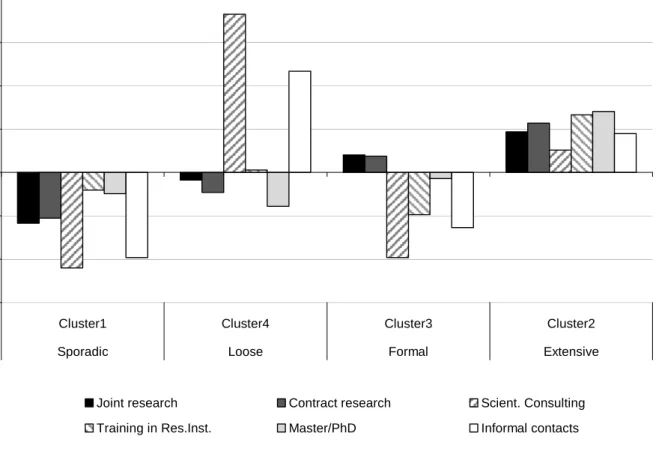
analysis for this purpose. Latent classes are unobservable (latent) subgroups or segments. The goal is to identify subpopulations of firms in our sample which are homogeneous with regard to their interactions with universities inside their cluster but heterogeneous compared with other clusters. It leads to four different clusters of scientific interactions.7 Latent class cluster analysis provides us with probability estimates for each type of interaction and allows us to assign a firm to one of four clusters. Table 6 in the appendix provides full latent class cluster estimation results. We conduct Wald tests on the significance effects of these coefficients and find that only six of the seven interaction types contribute significantly to cluster assignments. Interestingly, licensing does not significantly contribute to the clustering of firms. This does not imply that licensing is not important as a form for interacting with universities. Instead, other types of interactions prove more distinctive in defining clusters of interactions. Figure 1 illustrates the coefficients for convenience in interpretation. We will introduce each cluster briefly based on its significant modes of interaction and basic descriptive features such as size, industry and regional participation. Table 6 of the appendix provides descriptive statistics for each cluster.
7
We base this decision on the Baysen Information Criterium (BIC) which compares the reduction in log-likelihood to the number of parameters (loss of degrees of freedom) necessary for estimating it. It reaches its minimum for a 4 cluster solution.
Figure 1: Cluster profiles -1,50 -1,00 -0,50 0,00 0,50 1,00 1,50 2,00
Cluster1 Cluster4 Cluster3 Cluster2
Sporadic Loose Formal Extensive
Joint research Contract research Scient. Consulting
Training in Res.Inst. Master/PhD Informal contacts
Cluster 1 is the largest cluster in the sample covering roughly 61% of all observations. Firms in this cluster engage in relatively few (below average) interactions with universities across all potential types. We will subsequently refer to this cluster as “sporadic.” It will serve as the comparison group in all subsequent estimations. Firms in this cluster have on average 342 employees and are 17 years old. The cluster is characterized by firms from low tech manufacturing, distributive and knowledge-intensive services.
Cluster 2 consists of 19% of all observations. Firms in this cluster have very high probabilities to engage in scientific consulting and informal contacts for knowledge acquisition with universities. They stay away from joint and contract research as well as supporting Master or PhD projects. We will refer to this cluster of interactions as “loose.” Firms in the loose cluster are on average older and larger than firms in other clusters. They are more likely to come from medium-high and high tech manufacturing sectors.
Cluster 3 comprises just 10% of all firms in the sample making it the smallest. They focus heavily on joint and contract research in their scientific interactions and neglect all other forms of interaction. We will refer to this cluster of interactions as “formal.” These firms have on average 400 employees and are 16 years old. A disproportionally high share of
technological service firms are in this cluster but it also includes knowledge intensive services, medium- as well as high tech manufacturing firms.
Finally, almost 11% of all firms have above average probabilities to engage in all forms of interaction with universities. We will refer to this cluster 4 as “extensive.” These firms are comparatively small (250 employees) and medium-aged (16 years). Interestingly, they have higher probabilities to come from low-medium and high-medium tech manufacturing sectors.
The cluster analysis provides interesting insights into structures and patterns of interactions with universities. It supports the findings of Schartinger et al. (2002) that linkages with universities are not limited to high-tech sectors. However, it only captures the actual activities of a firm and not the best practices. Hence, we relate these clusters of interactions back to innovation success, i.e. the probability to generate product innovations is based on scientific impulses and sales generated from it. Therefore, we replace breadth and depth variables in the probit models estimated during the initial steps of the analysis with dummy variables indicating cluster membership. The sporadic interaction cluster will serve as the comparison group. Estimation results for these Models 3 and 4 can be found in the last columns of Table 2.
We find that all clusters of interaction have significant positive effects on innovation success based on university inputs compared to the sporadic pattern both in terms of generating new products (Model 3) and selling them on the market (Model 4). This result immediately supports the previous estimations using breadth and depth indicators. The marginal effects indicate that formal interaction approaches perform slightly better than extensive ones with regard to leading to product innovations (Model 3). Loose interaction approaches show the lowest effect. We perform t-tests to investigate whether these differences among interaction clusters are significant. Interestingly, we find no significant differences. Hence, there seems to be no single best practice when it comes to turning university knowledge into product innovations.
However, the differences between the clusters in sales with product innovations based on university knowledge seem to be more pronounced (Model 4). An extensive interaction strategy shows the highest impact, followed by formal and loose ones. Again, we conduct t-tests for the significance of these differences between coefficients. We find that extensive interactions outperform loose ones significantly8 but not formal ones. We conclude that generating higher sales with new products based on university knowledge does not necessarily require an extensive set of interactions with universities but the formal component seems to be an important element of success. This supports the findings of Cockburn and Henderson (1998) for the pharmaceutical sector on the crucial importance of active, collaborative engagements in joint research activities with universities for innovation success.
8
5
Conclusions
We conduct this study to extend existing research on industry-science interactions by moving from the effects of isolated types of interactions to combinations. We follow the basic rationale that each type of interaction has certain advantages but also shortcomings. Hence, firms should be better off by combining types of interactions into optimized strategies. Our theoretical framework suggests two major dimensions. On the one hand, firms may benefit from a broad variety of interactions with universities (breadth) to lower the risks of missing important technological trends. On the other hand, establishing multiple types of interaction requires substantial resource commitments over time. Hence, the best returns may stem from concentrating on in-depth relationships through selective types of interactions (depth). Additionally, we go beyond the dimensions of breadth and depth in industry-science interactions and trace actual combinations of interactions.
We benefit from an extensive dataset of German firms and a broad coverage of potential interactions with universities to test our theoretical framework empirically. This survey puts us in the position to connect various interaction strategies with innovation success which is directly related to university inputs. A large portion of firms in our dataset have limited or sporadic interactions with universities. We find that the ones that are able and willing to engage in various types of interactions (breadth) and highly developed interactions (depth) perform better with regard to innovation success. When we compare both effects we find that broadening a firm’s interaction approach with universities has stronger performance effects on innovation success (breadth) than strengthening the intensity of existing ones (depth). This implies with regard to management recommendations that firms should explore new types of interactions with universities instead of limiting their approaches to strengthening the ones already established.
The explorative step of our analysis shows that interactions with universities can be grouped into four archetypical clusters. We find firms with rather disengaged or sporadic approaches, loose ones which focus on flexible and low commitment types like informal contacts, formal ones primarily engaged in contract and joint research projects, and extensive ones combining all types of interactions with high intensities. All clusters of interaction perform better than the sporadic one supporting our finding on the importance of broadening interaction approaches. With respect to market success with product innovations based on university inputs we find that extensive strategy outperform loose ones but are not significantly more beneficial than formal ones.
Putting all of these results into context, we suggest that firms may increase the returns from interactions with universities by engaging in a more diverse (or broader) spectrum of interactions. While loose interactions are not the optimal ones they may be easily achieved because they require less resource commitments than other forms. Then again, they should be considered as an intermediate step as the merits of this approach are limited. We suspect that
this is due to a lack of opportunities for formalizing and legally appropriating the returns of joint research efforts. In other words, the results of loose interactions with universities may also be available to competitors. Hence, formal types of interactions (joint/contract research) provide this kind of protection and it is not significantly more beneficial to engage in all other types on interactions at the same time. Joint as well as contract research interactions apparently provide a promising balance between engagements in joint knowledge production while having rules in place for capturing at least some of this knowledge commercially.
With regards to policy recommendations these results suggest that supporting technology transfer from universities to private firms politically should be considered as a tailored, multi-step process. While formal forms of interactions (joint/contract research) should remain the ultimate goal they probably overstretch firms’ willingness and ability to engage in-depth with universities right away. Instead, our findings suggest that optimal technology transfer policies should encourage firms to build new interactions with universities and a continuous broadening of this collaboration through multiple types of interactions. Eventually, these interactions should be directed towards formal types for maximum effect.
6
Limitations and further research
Our study benefits from a comprehensive dataset covering a broad variety of potential interactions with universities. However, all studies have limitations especially on the quantitative side that may provide opportunities for future research. First, our results are limited to the German context. Comparative studies from developed but also developing countries with different institutions and cultural norms could provide valuable new insights. Secondly, we provide empirically reliable results on an abstract level. It would be interesting to generate more detailed insights into the interplay between the specific forms of interaction and their success from qualitative studies.
References
Adler, P.S. and S.-W. Kwon (2002), Social Capital: Prospects for a New Concept, Academy of Management Review 27 (1), 17-40.
Ahuja, G., C.M. Lampert and V. Tandon (2008), Moving Beyond Schumpeter: Management Research on the Determinants of Technological Innovation, The Academy of Management Annals 2, 1-98.
Arundel, A. and A. Geuna (2004), Proximity and the Use of Public Science by Innovative European Firms,Economics of Innovation & New Technology 13 (6), 559-580.
Arvanitis, S., N. Sydow and M. Woerter (2008), Do specific forms of university-industry knowledge transfer have different impacts on the performance of private enterprises? An empirical analysis based on Swiss firm data, Journal of Technology Transfer 33, 504-533.
Athey, S. and S. Stern (2003), An Empirical Framework for Testing Theories About Complementarity in Organizational Design, NBER Working Paper No. 6600, Boston.
Beise, M. and H. Stahl (1999), Public research and industrial innovations in Germany,
Research Policy 28, 397-422.
Bertrand, M. and S. Mullainathan (2001), Do People Mean What They Say? Implications for Subjective Survey Data,American Economic Review 91 (2), 67-72.
Chesbrough, H.W. (2003), Open Innovation - the New Imperative for Creating and Profiting from Technology, Boston.
Cockburn, I.M. and R.M. Henderson (1998), Absorptive Capacity, Coauthoring Behavior, and the Organization of Research in Drug Discovery, Journal of Industrial Economics 46 (2), 157-182.
Cohen, W.M. and D.A. Levinthal (1989), Innovation and Learning: The Two Faces of R&D, The Economic Journal 99, 569-596.
Cohen, W.M. and D.A. Levinthal (1990), Absorptive Capacity: A New Perspective on Learning and Innovation,Administrative Science Quarterly 35 (1), 128-153.
Cohen, W.M., R.R. Nelson and J.P. Walsh (2002), Links and Impacts: The Influence of Public Research on Industrial R&D,Management Science 48 (1), 1-23.
Colyvas, J., M. Crow, A. Gelijns, R. Mazzoleni, R.R. Nelson, N. Rosenberg and B.N. Sampat (2002), How Do University Inventions Get into Practice?, Management Science 48 (1), 61-72.
Criscuolo, C., J.E. Haskel and M.J. Slaughter (2005), Global Engagement and the Innovation Activities of Firms, NBER Working Paper No. 11479, Cambridge.
D'Este, P. and P. Patel (2007), University-Industry Linkages in the UK: What Are the Factors Underlying the Variety of Interactions with Industry?,Research Policy 36 (9), 1295-1313.
Fontana, R., A. Geuna and M. Matt (2006), Factors Affecting University-Industry R&D Projects: The Importance of Searching, Screening and Signalling,Research Policy 35 (2), 309-323.
Girotra, K., C. Terwiesch and K.T. Ulrich (2007), Valuing R&D Projects in a Portfolio: Evidence from the Pharmaceutical Industry,Management Science 53 (9), 1452-1466.
Hagenaars, J.A. and A.L. McCutcheon (2002), Applied Latent Class Analysis, Cambridge.
Jensen, M.B., B. Johnson, E. Lorenz and B.A. Lundvall (2007), Forms of Knowledge and Modes of Innovation,Research Policy 36 (5), 680-693.
Kaiser, U. (2002), An Empirical Test of Models Explaining Research Expenditures and Research Cooperation: Evidence for the German Service Sector,International Journal of Industrial Organization 20 (6), 747-774.
Koput, K.W. (1997), A Chaotic Model of Innovative Search: Some Answers, Many Questions,Organization Science 8 (5), 528-542.
Laursen, K. and A. Salter (2004), Searching High and Low: What Types of Firms Use Universities as a Source of Innovation?,Research Policy 33 (8), 1201-1215.
Laursen, K. and A. Salter (2006), Open for Innovation: The Role of Openness in Explaining Innovation Performance among U.K. Manufacturing Firms, Strategic Management Journal 27 (2), 131-150.
Link, A.N., D.S. Siegel and B. Bozeman (2006), An Empirical Analysis of the Propensity of Academics to Engage in Informal University Technology Transfer, Available at SSRN: http://ssrn.com/abstract=902207.
Mansfield, E. (1991), Academic research and industrial innovation, Research Policy 20, 1-12.
Mansfield, E. (1998), Academic research and industrial innovation: An update of empirical findings, Research Policy 26, 773-776.
Markiewicz, K.R. (2003), University Patenting and the Rate of Knowledge Exploitation, Academy of Management Best Papers and Proceedings, August 2003, Seattle.
Markowitz, H.M. (1991), Portfolio Selection: Efficient Diversification of Investments, New York.
Milgrom, P. and J. Roberts (1990), The Economics of Modern Manufacturing: Technology, Strategy, and Organization,American Economic Review 80 (3), 511-528.
Milgrom, P. and J. Roberts (1995), Complementarities and Fit Strategy, Structure, and Organizational Change in Manufacturing, Journal of Accounting and Economics 19 (2/3), 179-208.
Miravetew, E.J. and J.C. Pernias (2006), Innovation Complementarity and Scale of Production,Journal of Industrial Economics LIV (1), 1-29.
Mohnen., P. and L.-H. Röller (2005), Complementarities in innovation policy, European Economic Review 49 (6), 1431-1450.
Nelson, R.R. and N. Rosenberg (1993), Technical Innovation and National Systems, in: R.R. Nelson (ed.): National Innovation Systems: A Comparative Analysis, New York, 3-21.
Neter, J., W. Wasserman and M.H. Kutner (1990), Applied Linear Statistical Models: Regression, Analysis of Variance, and Experimental Designs, 3th ed., Homewood/Bosten.
Ocasio, W. (1997), Towards an Attention-Based View of the Firm, Strategic Management Journal 18, 187-206.
OECD (2005), Oslo Manual: Guidelines for Collecting and Interpreting Innovation Data, Paris.
Owen-Smith, J., M. Riccaboni, F. Pammolli and W.W. Powell (2002), A Comparison of U.S. And European University-Industry Relations in the Life Sciences, Management Science 48 (1), 24-43.
Pavitt, K. (1991), What makes basic research economically useful?, Research Policy 20, 109-119.
Perkmann, M. and K. Walsh (2007), University-Industry Relationships and Open Innovation: Towards a Research Agenda, International Journal of Management Reviews 9 (4), 259-280.
Peters, B. (2008), Innovation and Firm Performance. An Empirical Investigation for German Firms, ZEW Economic Studies 38, New York, Heidelberg.
Rabe-Hesketh, S. and B.S. Everitt (2007), A Handbook of Statistical Analyses Using Stata, 4th ed., Boca Raton/FL.
Rammer, C., B. Peters, T. Schmidt, B. Aschhoff, T. Doherr and H. Niggemann (2005),
Innovationen in Deutschland - Ergebnisse der Innovationserhebung 2003 in der deutschen Wirtschaft, ZEW Wirtschaftsanalysen 78, Baden-Baden.
Rothwell, R. and W. Zegveld (1981), Industrial Innovation and Public Policy: Preparing for the 1980s and the 1990s, London.
Rothwell, R. and M. Dodgson (1991), External Linkages and Innovation in Small and Medium-Sized Enterprises, R&D Management 21, 125-137.
Saviotti, P.P. (1998), On the Dynamics of Appropriability, of Tacit and of Codified,Research Policy 26 (7/8), 843-856.
Schartinger, D., C. Rammer, M.M. Fischer and J. Froehlich (2002), Knowledge Interactions between Universities and Industry in Austria: Sectoral Patterns and Determinants, Research Policy 31 (3), 303-328.
Shane, S. (2002), Selling University Technology: Patterns from Mit, Management Science 48 (1), 122-137.
Siegel, D.S., D.A. Waldman, L.E. Atwater and A.N. Link (2004), Toward a Model of the Effective Transfer of Scientific Knowledge from Academicians to Practitioners: Qualitative Evidence from the Commercialization of University Technologies, Journal of Engineering and Technology Management 21, 115-142.
Simard, C. and J. West (2006), Knowledge Networks and the Geographic Locus of Innovation, in: Chesbrough, H. W., W. Vanhaverbeke and J. West (eds.), Open Innovation: Researching a New Paradigm, Oxford, 220-240.
Thursby, J.G. and M.C. Thursby (2002), Who Is Selling the Ivory Tower? Sources of Growth in University Licensing,Management Science 48 (1), 90-104.
Verbeek, M. (2004), A Guide to Modern Econometrics, 2nd ed., Chichester.
Wright, M., B. Clarysse, A. Lockett and M. Knockaert (2008), Mid-Range Universities' Linkages with Industry: Knowledge Types and the Role of Intermediaries, Research Policy 37 (8), 1205-1223.
Youtie, J. and P. Shapira (2008), Building an Innovation Hub: A Case Study of the Transformation of University Roles in Regional Technological and Economic Development, Research Policy 37 (8), 1188-1204.
Yusuf, S. (2008), Intermediating Knowledge Exchange between Universities and Businesses,
Research Policy 37 (8), 1167-1174.
Zucker, L.G., M.R. Darby and J.S. Armstrong (2002), Commercializing Knowledge: University Science, Knowledge Capture, and Firm Performance in Biotechnology,
Appendix
Table 3: Industry classification
Industry NACE Code Industry Group
Mining and quarrying 10 – 14 Low tech manufacturing Food and tobacco 15 – 16 Low tech manufacturing Textiles and leather 17 – 19 Low tech manufacturing Wood / paper / publishing 20 – 22 Low tech manufacturing
Petroleum 23 Medium-low tech manufacturing Chemicals 24 High (244)/Medium-high tech
manufacturing
Plastic / rubber 25 Medium-low tech manufacturing Glass / ceramics 26 Medium-low tech manufacturing Metal 27 – 28 Medium-low tech manufacturing Manufacture of machinery and equipment 29 Medium-high tech manufacturing Manufacture of office machinery, computers,
radio, TV etc.
30, 32 High tech manufacturing
Manufacture of electrical machinery 31 Medium-high tech manufacturing Medical, precision and optical instruments 33 High-tech manufacturing
Manufacture of motor vehicles, other transport equipment
34 – 35 High (353)/Medium-high tech manufacturing
Manufacture of furniture, jewellery, sports equipment and toys; recycling
36 – 37 Low-tech manufacturing Electricity, gas and water supply 40 – 41 Other manufacturing
Construction 45 Other manufacturing Retail and motor trade 50, 52 Distributive services
Wholesale trade 51 Distributive services Transportation 60 – 63 + 64.1 Distributive services
Financial intermediation 65 – 67 Knowledge-intensive services Real estate activities and renting 70 – 71 Distributive services
ICT services 72, 64.3 Technological services Technical services 73, 74.2, 74.3 Technological services Consulting 74.1, 74.4 Knowledge-intensive services Other business-oriented services 74.5 – 74.8, 90 Distributive services