The University of Akron
IdeaExchange@UAkron
Honors Research Projects The Dr. Gary B. and Pamela S. Williams Honors
College
Spring 2016
Stress Corrosion Cracking Evaluation of Carbon
Steel in Biodiesel and the Effect of Ultrasonic
Nanocrystal Surface Modification (UNSM) on
304 Stainless Steel
Josh Geyer
University of Akron, [email protected]
Please take a moment to share how this work helps youthrough this survey. Your feedback will be important as we plan further development of our repository.
Follow this and additional works at:http://ideaexchange.uakron.edu/honors_research_projects
Part of thePetroleum Engineering Commons
This Honors Research Project is brought to you for free and open access by The Dr. Gary B. and Pamela S. Williams Honors College at IdeaExchange@UAkron, the institutional repository of The University of Akron in Akron, Ohio, USA. It has been accepted for inclusion in Honors Research Projects by an authorized administrator of
IdeaExchange@UAkron. For more information, please [email protected], [email protected]. Recommended Citation
Geyer, Josh, "Stress Corrosion Cracking Evaluation of Carbon Steel in Biodiesel and the Effect of Ultrasonic Nanocrystal Surface Modification (UNSM) on 304 Stainless Steel" (2016).Honors Research Projects. 353.
Stress Corrosion Cracking
Evaluation of Carbon Steel in
Biodiesel and the Effect of
Ultrasonic Nanocrystal
Surface Modification (UNSM)
on 304 Stainless Steel
Josh Geyer
1
Executive Summary
The aim to reduce the reliance on fossil fuels has resulted in an extensive search for alternative fuels. Biodiesel is an alternative fuel produced from renewable resources, such as vegetable oils and animal fats. Biodiesel is becoming more and more popular and may become more widely used in the future. With this in mind, it is crucial that biodiesel be characterized. The corrosion properties of biodiesel are being researched but there is still much to learn. The purpose of this study was to further that effort by using Slow Strain Rate Testing (SSRT) with carbon steel. This method will allow the characterization of the cracking mechanism of a metal when exposed to biodiesel. This is important because carbon steel is very popular in the
transportation industry and a better understanding of the properties will allow for better prevention of corrosion issues. This study used carbon steel and compared the effects of
petroleum diesel, biodiesel (B100) and an equal mixture of the two (B50) on the stress corrosion cracking (SCC) susceptibility of carbon steel.
This study also involved the testing of a new surface modification method, Ultrasonic Nanocrystal Surface Modification (UNSM). Surface modifications have been widely used to enhance the material properties of metals. This surface modification method is performed by using the impact of a vibrating ball to form a nanocrystal structure on the surface of a metal. The method will increase the strength of the material and also make it less susceptible to stress corrosion cracking because of the compressive stresses that are applied. The test was done using 304 stainless steel (304 SS) that was unmodified and modified by UNSM, both in air.
The results of the biodiesel testing yielded results that biodiesel has a large effect on the performance of carbon steel than petroleum diesel. Biodiesel is more corrosive than petroleum
2 diesel because it has a higher conductivity, higher water content and unsaturated fatty acids. This being said, the B50 mixture performed worse than the B100. The explanation for this can be attributed to the petroleum diesel reducing the ability of water to settle out of the mixture. In B100 the water is able to settle out to the bottom of the container rather easily. This leaves a small concentration of water still suspended in the biodiesel. The addition of petroleum diesel diminishes this and increases the water content in the solution. There was a decrease of 13.5% ductility in the B100 from the petroleum diesel and a 15% reduction in the B50 from the petroleum diesel. This indicates that there may be SCC, so an analysis was done with SEM images as well. These images revealed that only the B100 and B50 had signs of SCC. The edges of the crack tips (shaft) show signs of intergranular corrosion which would lead to SCC. The petroleum diesel only showed signs of ductile failure which signifies that no SCC was present.
The SSRT testing of the 304 SS samples yielded predicted results. The UNSM sample had a higher yield strength because of the nanocrystal layer. The yield strength of the unmodified 304 stainless steel sample was 85 ksi while the UNSM sample had a yield strength of 90 ksi. The other conclusion that was drawn from the testing was a clear decrease in ductility of the UNSM sample. When the yield strength of the metal was increased, the ductility was decreased. The nanocrystal surface layer was much stronger and more brittle as well. This was evident when the SEM analysis was done. The images revealed sharp edges of the UNSM samples while the unmodified sample had soft ductile features all around. The sharp edges are indicative of brittle fracture.
This work introduced me to a lot of new techniques and methods that I was not familiar with before. SSRT was something that I knew of but knew little about. I learned how to setup, run and analyze the results of this testing method and how valuable the data can be to industrial
3 uses. This study also introduced me to the process of ordering custom parts by using purchase orders and how to deal with people. Working with other people is key to being successful and getting my parts ordered involved a lot of it. I am more confident in communicating and being able to effectively work with others.
This experiment can definitely spark more interest in the effects of biodiesel. It is a topic that is being studied in small areas but the larger implications can be endless. The future may be biodiesel and that cannot happen until it is better understood. If biodiesel is to be used, the effects of it on engines and pipelines that transport are going to be crucial. As a replacement for fossil fuels, it would have to be able to fit right in with only few modifications to the
infrastructure of the industry.
With this preliminary study, more in-depth experiments can be run to better understand the mechanism. This study should be repeated with other biodiesels made from other bio-resources to ensure that this information is true for all biodiesel. Carbon steel is not the only metal in engines so testing biodiesel with all sorts of metals using SSRT would be very effective in predicting the future of its use.
Research experiments are a great way to connect class with industrial applications. SSRT testing in particular is a very severe method that can implicate whether or not failures can
actually happen in working conditions. Being thorough and diligent when doing research is also a key to it being successful. Small delays or mistakes can make a project much harder than it should be. I would definitely recommend doing some sort of research to really appreciate the work that goes into understanding the world around us.
4
Introduction
Biodiesel is slowly becoming the fuel of the future with an increased usage in
transportation. Today biodiesel is being mixed with petroleum diesel in different ratios. Common mixtures of biodiesel and petroleum diesel are B2, B5 and B20. These mixtures contain 2% biodiesel, 5% biodiesel and 20% biodiesel, respectively. B100 (100% biodiesel) is also in use but car manufacturers have warned about the use of high biodiesel blends. They may not be
compatible with the engine and could pose a threat to the integrity of the system5. There are many advantages and disadvantages of the use of biofuels. The biggest advantage of using biodiesel and biodiesel fuel blends is the reduced greenhouse gas emission. The use of biodiesel could reduce carbon dioxide emissions by 75% compared to petroleum diesel fuel5. With the emphasis on being more environmentally friendly, biodiesel can become a fuel that is much better for the environment in more than one way. Not only could biodiesel reduce greenhouse gas emissions, it is non-toxic and safer to handle and transport because of its higher flash point. Biodiesel can also produce more energy than fossil fuels. A study done by the USDA found that the fossil energy ratio of biodiesel is 4.5613. This would indicate that biodiesel produces 4.56 units of energy more than that of fossil fuels meaning that biodiesel is much more efficient fuel.
Biodiesel is also better for the economy because it can help to reduce the amount of waste. Since biodiesel is made from organic grease and oils, the used greases and oils can be converted into biodiesel instead of being thrown away. While this may not be a sustainable way to produce biodiesel to fuel the country, it is a great way to prevent waste. Biodiesel production can be done with the unused crops that farmers are unable to sell because of various reasons such as low demand, physical deformations or even being too small. While these products would normally go to waste, biodiesel operations could use them and prevent food waste along with helping the farmers make more money.
5 If biodiesel is to become the future of transportation then it will have to overcome some rather large deficiencies. To sustain a biodiesel economy, more and more food products will have to be consumed to make biodiesel. To be able to sustain the country a food shortage would surely ensue, which makes creating a sustainable biodiesel economy rather impossible right now14. The most reasonable solution would be to use a mixture of biodiesel and petroleum diesel. Biodiesel also possesses other negatives like water separation and engine issues. Biodiesel can readily absorb the moisture in the air and when allowed to settle, the water will separate. Water is a higher density liquid and therefore will fall to the bottom of the container. This is where the main corrosion concerns stem from. The water that settles out can cause corrosion of the steel gas tanks. This is of concern when using a pure biodiesel fuel but when petroleum diesel is combined with biodiesel there is less separation of the water14. With the water not able to settle at the bottom of the tank, the water is suspended in the fuel and can cause problems in the engine components. This is still a major problem that can potentially ruin an engine and can cost a user a significant amount of money and possible a new engine.
Another issue that can arise with biodiesel is the fact that it is more electrically
conductive than petroleum diesel12. The conductivity can lead to galvanic issues in the tanks and in engine components where dissimilar metals may be in contact. Biodiesels are made out of a vast array of oils and fats which means the quality of the biodiesel may not always be the same14. Biodiesel fuels can be made from vegetable oils, animal fats and other products all of which have different properties. For this reason ASTM released a standard to try and help make the
biodiesels similar even though they come from different products. ASTM D6751 lists
requirements for the biodiesel such as contaminant content, water volume limits, and corrosion limits2. This standard is a step in the right direction but there still needs to be work done to
6 unsure that biodiesels are as close to the same as possible. Lastly, biodiesels are great places for microorganisms to grow. The organic carbon is a food source for many types of microbes. Microbial Influenced Corrosion (MIC) is a huge problem in the corrosion industry. While these are some of the positives and negatives of biodiesel, there are still more that have not been mentioned.
The second part of the study was to analyze the effect of Ultrasonic Nanocrystal Surface Modification (UNSM) on the tensile properties of 304 stainless steel (304 SS). Surface
modifications have been used in many applications to improve the strength of the material. Shot peening and other variations of shot peening are more traditional methods to accomplish this strength modification18. These methods typically involve of small metallic balls that are sent at varying velocities to impact the surface of the metal.
UNSM is a new method that utilizes a tungsten carbide ball with an ultrasonic device attached that has a vibrating frequency of 10 – 30 kHz. The repetitive impact of the ball onto the surface causes severe plastic deformation which then leads to nanocrystallization. This process also introduces residual compressive stresses on the surface and beneath the surface18.
Background
Biodiesel could be the alternative fuel source for the future but before that time comes it needs to be better understood. Studies have proven that there is a corrosive effect of biodiesel on many metals and these results lead to the conclusion that we need to know more. A study was done on the effects of biodiesel on the components of an engine9. The study is evidence of the immediate concerns that industry wants to know. Biodiesel is being actively used and the effects of it on an engine are critical right now. Looking towards the future, biodiesel may need to be transported in other ways. For instance, pipelines may start to transport biodiesel and the
7 companies who run the pipelines will want to know the corrosive effects that the biodiesel will have on their pipelines. Stress corrosion cracking (SCC) is a current pipeline issue and a good way to analyze that mechanism is by using tensile testing at slow rates, also known as Slow Strain Rate Testing (SSRT). This testing technique can also be applicable to the engine components that are under a load while in use.
SSRT is a great way to characterize cracking mechanisms and can be very useful for fuels with the stresses that are usually present during their use. SSRT has been performed on fuel grade ethanol with carbon steel and the testing has varied certain aspects of the ethanol
chemistry, such as, oxygen content, chloride content and acid content4,7,8,11. Biodiesel has not had the same sort of testing and therefore the cracking effects of biodiesel are widely unknown. The need for SSRT of biodiesel with carbon steel is needed. When new research is done, the baselines need to be established so this is what was attempted. SSRT was done on biodiesel and compared with petroleum diesel and in air. Also, a common biodiesel and petroleum diesel mixture of 50/50 was tested.
Experimental Procedure
A polyethylene jar with a screw on lid was used to contain the environment that the tensile specimen was exposed to. The jar had compression fittings on the top and bottom to ensure the cell was water and air tight. The lid also contained additional holes and fittings for a reference electrode and counter electrode. The carbon steel sample was placed inside the jar and the compression fittings tightened. Round stainless steel components were attached to the sample and through clevice fittings, were attached to the actuator and frame. Figure 1 shows the actuator and frame setup and Figure 2 shows the tensile specimen in the jar and hooked up to be tested. The actuator used was a 5K Servo 32 bit Creep Controller made by Interactive Instruments. The
8 carbon steel specimens were machined to specific dimensions found in Figure 3. The carbon steel was a high strength steel used for drilling applications and is made by Vallourec. The specific material that was used was VM-165 DP. The chemical composition of the material is proprietary but the UTS of the material is 175 ksi. The air test was performed in open air without the jar attached. The biodiesel used was made from vegetable oil and received from Loyola
Figure 3: Tensile specimen dimensions13
Figure 1: Actuator and load frame Figure 2: Carbon steel specimen in petroleum diesel
9 University Chicago. The petroleum diesel used in the experiment was purchased from a local BP gas station. It is typical for diesel fuels to contain inhibitors to prevent corrosion which will lead to reduced corrosion and little to no SCC. The additives are proprietary for each company. Table 1 shows the differences in key characteristics between the petroleum diesel and biodiesel which both comply with the ASTM standards. The testing was done at a constant strain rate of 1 × 10⁻⁶ in/s according to the NACE standard16. All of the testing was done at room temperature and the samples were immersed in the diesel fuels and the test was started right away. With the stated rate, each test lasted for approximately 70 hours. During the testing, a Gamry potentiostat was used to measure the open circuit potential (OCP) of the carbon steel. The results from this measurement were not used because of the low conductivity of the biodiesel and diesel fuels. Table 2 shows the chemical composition of the 304 stainless steel that was used. The fracture surfaces of both carbon steel and 304 SS sample were examined using a TESCAN LYRA 3 field emission-scanning electron microscope (FE-SEM).
Table 1: Key characteristics of petroleum and biodiesel2,3
Property Petroleum Diesel Biodiesel
Sulfur % mass (ppm), max (15) .0015 (15)
Flash point °C 52 93
Water and sediment % volume, max .05 .050
Ash % mass, max .01 .020
Cetane number, min 40 47
Table 2: Stainless Steel Composition
C Cr Fe Mn Ni P S Si
304 Stainless Steel Composition (wt%)
10
Results and Discussion Carbon steel in diesel fuels
The best way to compare SSRT is by using stress-strain curve. It is the most common plot to evaluate the performance of a material in a cracking scenario. A stress-strain curve can
determine the yield strength and ultimate tensile strength (UTS) which are material properties. The alteration of the material properties can indicate a change in performance of the material. The stress-strain curve for this experiment revealed a clear difference in different cases. Figure 4
clearly shows that there was a reduction in performance for the carbon steel specimen in the biodiesel and B50 mixture. All of the curves did have a small bump in the stress around 140 ksi and 70 ksi which can be disregarded as an artifact of the equipment. The maximum loads,
stresses and strains are listed in Table 3. When compared to the given data for VM-165, the UTS for each test was slightly under the 175 ksi listed, but was very close. The UTS value for the
Figure 4: Slow strain rate test results for carbon steel in air, petroleum diesel, biodiesel and B50
11 samples were within 3% of each other. This confirms that the carbon steel properties are
consistent and the testing was consistent as well. Table 3: Slow strain rate testing material properties
Environment Air Petroleum Diesel Biodiesel 50/50 Mixture Maximum Load (lbs) 2293.8 2280.8 2271.8 2233.0 Ultimate Tensile Strength (ksi) 167.22 171.92 172.28 168.00 Maximum Strain (in/in) 0.22504 0.21834 0.18886 0.18562
The petroleum diesel did have a small effect on the performance of the carbon steel because the strain at failure was lower. This was to be expected because in previous studies comparing the corrosion rates of biodiesel and petroleum diesel there was a clear trend that petroleum diesel has a rate of about half that of biodiesel9. Another clear observation of the stress-strain curve is that the addition of biodiesel, whether it is B100 or B50, had a large impact on the performance of the carbon steel. There was a 13.5% reduction in ductility from the petroleum diesel to B100 and a 15% ductility reduction from petroleum diesel to B50. The B100 performance can be attributed to the corrosiveness of the biodiesel. The increased conductivity, fatty acids, water content and other impurities are the key components of the corrosive nature of the biodiesel. This result was expected, but the more interesting result was the B50 test. The B50 had the worst performance even though it was a 50/50 mixture of biodiesel and petroleum diesel. As previously stated, when water is absorbed into biodiesel it will settle at the bottom of the container because it is denser than biodiesel. When biodiesel is mixed with petroleum diesel, the ability for water to settle out is reduced14. This information can be used to explain the reduced performance of the B50. In an immersion test where the metal sample is at the bottom, B50 may perform better than B100 because of the reduced ability to separate out the water because there will be less water near the sample. In the case of the SSRT, the reduced ability of the water to
12 settle out means that there is more water in the mixture that can condense on the carbon steel and cause an increase in stress corrosion cracking. To investigate the cracking mechanism further, SEM images were taken.
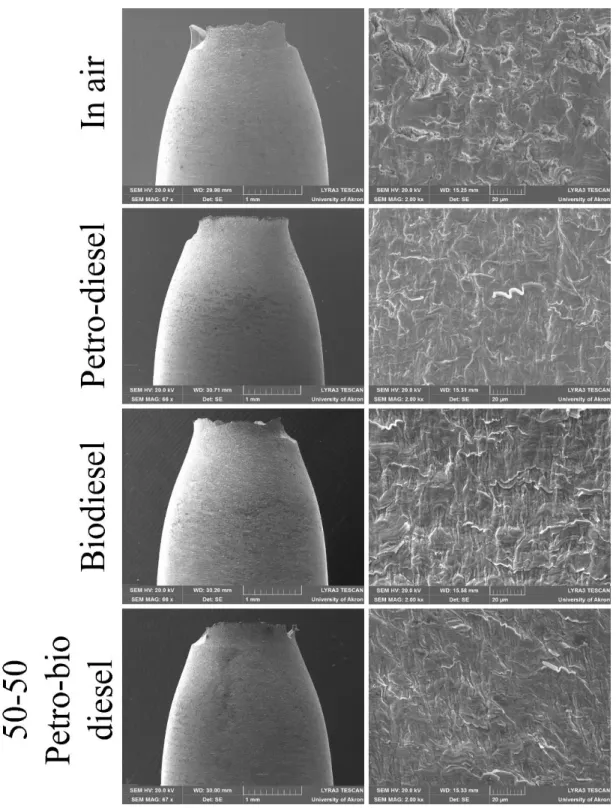
Figure 5: SEM images of the crack tip and a magnification of the crack tip
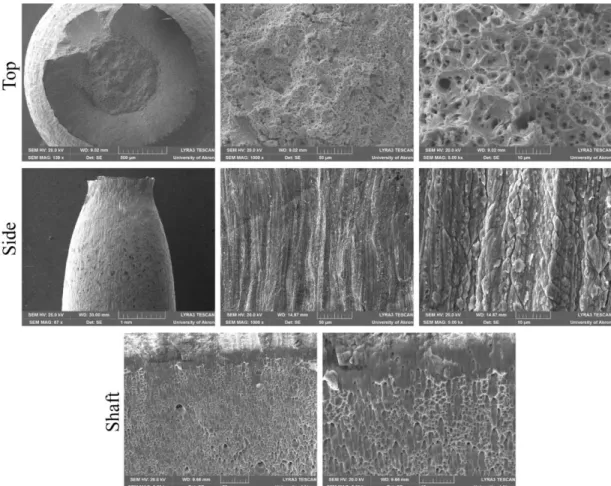
13 Figure 6: SEM images of the crack surface with magnifications of the surface
14 Figure 7: SEM images of the crack edges with the arrows signifying brittle cracking features.
15 The SEM images were able to reveal more information about the cracking mechanism that took place in the carbon steel. Figure 5 shows the SEM images of the crack tip and a magnified view of the side of the crack tip. These images show that there was no additional cracking around the point of failure. When cracks are present below the crack surface, it is indicative of SCC7. With no cracks present the crack surface was analyzed. Figure 6 shows the crack surfaces for each test and there appears to be one common theme from these images. There appears to only be evidence of ductile failure and no SCC. The most magnified images (far right) show signs of ductile fracture. With the center of the crack surface showing no details as to why the decrease in performance may have occurred, the crack surface edges were examined. In Figure 7 the edges are shown and the blue arrows indicate areas where there appears to be signs of brittle failure. These features are more defined and are grain-like which would be strong indication of intergranular cracking. This would then suggest that there was a small amount of SCC taking place.
304 SS-the effect of surface modification
The second part of the study was to analyze the effect of UNSM on 304 SS in air. Figure 8 shows the stress strain curves for the unmodified and UNSM samples. There are two noticeable differences between the two, the first being the difference in yield strength and the second is the reduction in strain at which the sample failed. The UNSM sample had a yield strength of about 90 ksi while the unmodified sample was 85 ksi. This difference was due to the nanocrystal surface layer hardening the surface and increasing the strength18.
The second feature of Figure 8 was the difference in the strain for the two samples. The lower strain means that the UNSM sample had lower ductility. This is because the nanocrystal layer has a high strength but low ductility18. Since UNSM is just a surface modification, the
16 interior of the stainless steel sample was left untouched which is why there was still a ductile nature to the failure. The hardness of the surface was increased as well. The hardness of the nanocrystal surface was over 3 times harder than the base metal18
.
The SEM images of the stainless steel samples tell the same story as the stress strain curves. Figure 9 shows the ductile nature of the unmodified sample with the smooth, curved lines on the crack surface. Figure 10, on the other hand, shows very sharp cracks on the sides of the crack surface. This is where the UNSM process was done and affects the metal. The sharp breaks indicate brittle failure which would be accurate with the higher strength of the surface after
Figure 8: Stress Strain curve for 304 stainless steel unmodified and with UNSM. The arrows point to the yield strength of the two samples.
17 treatment. Figure 10 was also used to measure the nanocrystal layer that was formed. The layer was measured to be approximately 10 microns.
18
Conclusions
With biodiesel becoming more popular it is crucial that the corrosive nature is well documented and understood. With the future leading towards the reduced reliance on fossil fuels, ensuring that the current infrastructure is ready to utilize biodiesel is very important. This study has shown that when carbon steel is exposed to biodiesel and putting under a constant stress rate, there is a clear decrease in the performance compared to petroleum diesel. This can be attributed to the increased conductivity, saturated fatty acids and water content of the biodiesel. When a B50 mixture is used there is a slight decrease in performance from the B100. This can be attributed to the decrease ability of the water to separate out of the mixture which is caused by the petroleum diesel. The SEM images confirm that there are areas of brittle fracture on the crack edges of samples from both B100 and B50 which leads to the conclusion that the decrease in the
19 performance was because of SCC. While the SCC is evident, the influence it has is rather small because of the severe nature of the testing method17.
The relatively new method of UNSM proved to be process that increases the strength of a metal surface. The data from the tensile testing shows that there was in increase in the yield strength of the metal. In this case, the tradeoff was a lower ductility. The stress strain curve shows a reduction in the strain and the SEM images confirm that the edges of the crack surface are very sharp and indicative of a more brittle fracture. The nanocrystalline layer that forms does have a significant effect on the strength of the material while still retaining some of the key properties like ductility.
20 1. "ASM Material Data Sheet." ASM Material Data Sheet. Aerospace Specification Metals,
n.d. Web. 27 Apr. 2016.
2. ASTM Standard D6751, 2016, "Standard Specification for Biodiesel Fuel Blend Stock (B100) for Middle Distillate Fuels," ASTM International, West Conshohocken, PA, 2003, DOI: 10.1520/C0033-03, www.astm.org.
3. ASTM Standard D975, 2010, "Standard Specification for Diesel Fuel Oils" ASTM International, West Conshohocken, PA, 2003, DOI: 10.1520/C0033-03, www.astm.org. 4. Beavers, J.a., F. Gui, and N. Sridhar. "Effects of Environmental and Metallurgical
Factors on the Stress Corrosion Cracking of Carbon Steel in Fuel-Grade Ethanol." Corrosion 67.2 (2011).
5. "Biodiesel Benefits and Considerations." Alternative Fuels Data Center: Biodiesel Benefits. United States Department of Energy.
6. "Biodiesel Production and Distribution." Alternative Fuels Data Center. United States Department of Energy.
7. Cao, Liu, G.s. Frankel, and N. Sridhar. "Effect of Chloride on Stress Corrosion Cracking Susceptibility of Carbon Steel in Simulated Fuel Grade Ethanol." Electrochimica
Acta 104 (2013): 255-66.
8. Cao, Liu, G. S. Frankel, and N. Sridhar. "Effect of Oxygen on Ethanol Stress Corrosion Cracking Susceptibility: Part 2-Dissolution-Based Cracking Mechanism." CORROSION Online. The Ohio State University, 16 Apr. 2013.
9. Fazal, M.a., A.s.m.a. Haseeb, and H.h. Masjuki. "Comparative Corrosive Characteristics of Petroleum Diesel and Palm Biodiesel for Automotive Materials." Fuel Processing Technology 91.10 (2010): 1308-315.
10.Hu, Enzhu, Yufu Xu, Xianguo Hu, Lijun Pan, and Shaotong Jiang. "Corrosion Behaviors of Metals in Biodiesel from Rapeseed Oil and Methanol." Renewable Energy 37.1 (2012): 371-78.
11.Lou, X., D. Yang, and P. M. Singh. "Effect of Ethanol Chemistry on Stress Corrosion Cracking of Carbon Steel in Fuel-Grade Ethanol."Corrosion 65.12 (2009): 785-97. 12.Maru, Marcia Marie, Marcia Maria Lucchese, Cristiano Legnani, Welber Gianini
Quirino, Andrea Balbo, Isabele Bulhões Aranha, Lílian Terezinha Costa, Cecília Vilani, Lídia Ágata De Sena, Jailton Carreteiro Damasceno, Talita Dos Santos Cruz, Leandro Reis Lidízio, Rui Ferreira E Silva, Ado Jorio, and Carlos Alberto Achete. "Biodiesel Compatibility with Carbon Steel and HDPE Parts." Fuel Processing Technology 90.9 (2009): 1175-182.
13.Pradhan, A., D. S. Shrestha, A. Mcaloon, W. Yee, M. Haas, and J. A. Duffield. "Energy Life-Cycle Assessment of Soybean Biodiesel Revisited." Transactions of the
ASABE 54.3 (2011): 1031-039. United States Department of Agriculture. United States Department of Agriculture, Sept. 2009.
14.Quigley, Robert. "Biodiesel: The Good, the Bad… and Additives." Biofuels International 1.1 (2007).
21 15."Standard Operating Procedure for Preparing & Evaluating Slow Strain Rate (SSR)
Specimens and for Performing Slow Strain Rate Tests." DNV GL 6 (2014).
16.Standard Test Method: Slow Strain Rate Test Method for Screening Corrosion-resistant Alloys (CRAs) for Stress Corrosion Cracking in Sour Oilfield Service. Houston, TX: NACE International, 2004.
17.Stress Corrosion Cracking. Teddington: National Physical Laboratory, 2000. Print. 18.Ye, Chang, Abhishek Telang, Amrinder S. Gill, Sergey Suslov, Yaakov Idell, Kai
Zweiacker, Jörg M.k. Wiezorek, Zhong Zhou, Dong Qian, Seetha Ramaiah Mannava, and Vijay K. Vasudevan. "Gradient Nanostructure and Residual Stresses Induced by
Ultrasonic Nano-crystal Surface Modification in 304 Austenitic Stainless Steel for High Strength and High Ductility." Materials Science and Engineering: A 613 (2014): 274-88.