MeMeA 2011, The 6 IEEE International Symp. on Medical Measurements and Applications, May 30th-31th 2011, Bari (Italy)
Use of the Choquet Integral for Combination of
Classifiers in P300 Based Brain-Computer Interface
Francesco Cavrini
Department of Computer Science, Systems and Production University of Rome “Tor Vergata”
Rome, Italy
Luigi Bianchi, Lucia Rita Quitadamo, Manuel Abbafati
Department of Neuroscience University of Rome “Tor Vergata”
Rome, Italy
Giovanni Saggio
Department of Electronic Engineering University of Rome “Tor Vergata”
Rome, Italy [email protected]
Luigi Bianchi, Lucia Rita Quitadamo Neuroelectrical Imaging and BCI Laboratory
Santa Lucia Foundation Rome, Italy
Luigi Bianchi, Lucia Rita Quitadamo, Manuel Abbafati Centro di biomedicina spaziale
University of Rome “Tor Vergata” Rome, Italy
Abstract—One of the key issues in the development of brain-computer interfaces (BCIs) is the improvement of their current information transfer rate. In order to achieve that objective at least two aspects of BCI design should be considered: classifica-tion accuracy and protocol specificaclassifica-tion. In this paper we show how combination of classifiers using fuzzy measures and the Choquet integral can be applied to the context of visual P300 BCI in order to lower the number of misclassifications. Results of an offline analysis are provided and possible benefits in terms of the information transfer rate are briefly discussed.
Keywords-Brain computer interfaces (BCIs), Combination of classifiers, Electroencephalography (EEG), Fuzzy integral, Fuzzy measure, P300
I. INTRODUCTION
A brain-computer interface (BCI) is a system that provides its user with the ability to communicate and act on the world using his brain activity only. At present, BCIs are valuable instruments for giving those with severe neuromuscular disord-ers basic communication and control capabilities [1]. Various methods for monitoring the brain activity can be used in the design of a BCI: electroencephalography (EEG), implanted electrodes, functional magnetic resonance, to cite a few. In this paper we focus on visual P300 BCI, which is an EEG-based BCI that utilizes P300 evoked potentials for detection of the user's intent. P300 evoked potentials are positive peaks in the EEG activity that are produced at about 300 ms after the pres-entation of particularly significant stimuli interspersed with routine ones.
Since the aim of a BCI is the translation of brain activity in-to commands in-to communicate or in-to control a device, pattern recognition plays a fundamental role in the BCI field. As pointed out by Wolpaw et al. [1], one of the crucial issues in the development of BCIs is the improvement of their informa-tion transfer rate (ITR). The achievement of this goal requires both the design of an appropriate communication protocol and an increase in the accuracy of classification. The proposed ap-proach takes into consideration those needs and aims at im-proving the ITR using combination of classifiers. Firstly, input vectors obtained from the EEG signals are processed by an ensemble of classifiers, each assigning an input vector to a class that represents the user intent. Afterwards, a decision-making strategy is used to aggregate the outputs of the afore-mentioned classifiers into a final response.
Although there is a general agreement on combination of classifiers improving robustness and accuracy of classification, it has drawn marginal interest in BCI research, which, howev-er, has extensively used many of the most known pattern rec-ognition techniques, e.g. Fisher's linear discriminant analysis, support vector machines, neural networks (see [2] for a recent review). In this paper we focus on fuzzy integrals, which con-stitute a vast family of aggregation operators suitable for com-bination of classifiers [3], [4] and, to our knowledge, have been applied to the context of BCI just by Shoaie et al. [5]. We con-centrate on the Choquet integral [6], the most natural fuzzy integral [7].
This paper is organized as follows: in section II we give some background information on combination of classifiers using fuzzy measures and fuzzy integrals; in section III we
MeMeA 2011, The 6 IEEE International Symp. on Medical Measurements and Applications, May 30th-31th 2011, Bari (Italy) describe the proposed approach; in section IV, we present the
results obtained in the offline analysis; then, in section V we discuss the effectiveness of our proposal and make some re-marks about future development.
II. COMBINATION OF CLASSIFIERS BY FUZZY INTEGRALS A. Definitions
Here we give definitions for some key concepts, i.e. fuzzy measure and Choquet integral, of the proposed approach. Since our perspective is combination of classifiers, we concentrate on finite spaces only. In what follows, ∅denotes the empty set and ℘
( )
X the power set of X, i.e. the set of all subsets of X.The concept of fuzzy measure has been introduced by Su-geno [8] as a solution to the rigidness problem of the ordinary, i.e. additive, measure. In fuzzy measures, additivity is substi-tuted by monotonicity, a weaker condition, thus reaching a higher level of flexibility.
Definition 1. Let X be a finite set. A fuzzy measure μ on X is a set function defined on ℘
( )
X satisfying the axioms:1. μ
( )
∅ =02. ∀A,B∈X:A⊆B⇒μ
( ) ( )
A ≤μ B .If, in addition, μ
( )
X =1 then the fuzzy measure is said to be normalized.The Choquet integral [6] can be regarded as a fuzzy integral, i.e. an integral defined with respect to a fuzzy measure [9]. It can be shown that the Choquet integral is a generaliza-tion of the Lebesgue integral and that it includes many widely used aggregation operators [10], [7], e.g. weighted arithmetic mean, ordered weighted average.
Definition 2. Let X be a finite set and let μ be a fuzzy measure onX. Let f be a function defined on X . Arrange the elements of X so that f
( )
x1 ≤ f( )
x2 ≤L≤ f( )
xn , where1
x denotes the first element of X, x2 the second, and so on. The Choquet integral of f with respect to μ is defined as:
( ) ( ) ( )
∫
∑
(
( ) ( )
) ( )
= − ⋅ − = n i i i i f x A x f x d x f C 1 1 μ μ where: • f( )
x0 =0 • Ai ={
x∈X| f( )
x ≥ f( )
xi}
.B. Combination of classifiers by fuzzy integrals
A fuzzy integral approach to combination of classifiers can be described as a pattern recognition technique involving two levels of classification. Let D=
{
D1,D2,K,Dk}
be an ensem-ble of classifiers and let C={
C1,C2,K,Cn}
be the set of classes of the classification task at hand. In the first level, theensemble is presented with an input vector x and each classifi-er Dj assigns it to a class Ci∈C or abstains from making a
decision (if valuable in the given scenario). In the second level, for each classifier Dj and for each class Ci a value representing the degree of membership of the input vector to class Ci is computed. We indicate that value with ϕDj,Ci
( )
x . Suppose that for each class Ci a fuzzy measure μCi on the ensemble of classifiers has been defined, with μCi( )
A representing the weight of the coalition A∈℘( )
X for recogni-tion of class Ci . Then, for each class Ci all the ϕDj,Ci( )
x ( j=1,2,K,k) are combined using a fuzzy integral with re-spect toi
C
μ . Finally, the class with the highest integral value is returned as the one to which the input vector is expected to belong or (if valuable) an abstention occurs.
The terminology introduced in this paragraph will be used hereafter.
C. How to choose the ensemble of classifiers
In a combination of classifiers strategy such as the one de-scribed before, it is important to have some criteria for choos-ing the classifiers of the ensemble; from the pattern recognition point of view, this is the well-known problem of feature selec-tion. Here we present two indexes that can be used to develop a classifier selection strategy based on the μCi (i=1,2,K,n).
The Shapley value [11] can be used to evaluate the impor-tance of each classifier for recognition of a certain class Ci [3]. Definition 3. Let μ be a fuzzy measure on a finite set
{
x x xn}
X = 1, 2,K, . The Shapley value, or importance index, i
x
v of element xi with respect to μ is defined as:
(
)
( )
{ }∑
⊆ Δ − − = i i i x X A x x n A A A n v / ! ! ! 1 where: • Δxi( )
A =μ(
A∪{ }
xi) ( )
−μ A• A indicates the number of elements of A • 0! =1, as usual.
It can be shown that the Shapley value defines a true sharing of the total importance of X, i.e.
( )
X v n i xi =μ∑
=1The interaction index [12] can be used to evaluate the de-gree of interaction between two classifiers in recognition of a certain class Ci [3].
MeMeA 2011, The 6 IEEE International Symp. on Medical Measurements and Applications, May 30th-31th 2011, Bari (Italy) Definition 4. Let μ be a fuzzy measure on a finite set
{
x x xn}
X = 1, 2,K, . The interaction index, Ixixj between two distinct elements xi and xj with respect to μ is defined as:
(
)
( )
{
}
∑
⊆ Δ − − = j i j i j i x x X A x x x x n A A A n I , / ! ! ! 2 where: •(
( )
{ }
)
(
{ }
)
(
{ }
)
( )
A x A x A x x A A j i j i x xi j μ μ μ μ + ∪ − ∪ − ∪ = Δ ,• A indicates the number of elements of A • 0! =1, as usual.
If Ixixj <0 then elements xi and xj are redundant, i.e. it is sufficient to use one of them. If =0
j ix
x
I then elements xi and xj are independent, i.e. both elements bring their contri-bution and they do not interact. If >0
j ix
x
I then elements xi
and xj are complementary, i.e. the combination of the two
elements must be used.
III. MATERIALS AND METHODS A. Protocol and EEG signals processing
In what follows we present the basics of the protocol that has been used.
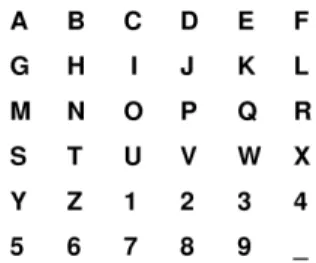
The subject faces a 6×6 matrix containing 36 symbols, as shown in Fig. 1, and he/she has to focus on the one he/she wants to communicate. Rows and columns flash randomly for a period of 100 ms and with an inter-stimulus interval of 180
ms. In a trial each row and column flash 15 times and the sub-ject is asked to count how many times his/her choice flashes. Rows and columns not containing the user's symbol are non-targets, i.e. their flashes are routine stimuli, while the row and column containing it are targets, i.e. their flashes are particular-ly significant stimuli. The responses to each row and column are measured and averaged and then, using a classifier, the target row and column are determined, and thus the desired symbol.
For the purpose of this study, EEG activity has been rec-orded using 61 sensors at a sampling rate of 256 Hz; refer-ence electrode was positioned between AFz and Fz and ground between Pz and POz. Afterwards, the data has been band-pass filtered between 0.5 and 30 Hz and artifacts, e.g. eye blinks, have been removed [13].
Figure 1. Alphanumeric matrix for the visual P300 BCI B. Proposed method
The proposed method is made up of three consecutive steps: initialization, classification and combination.
In the initialization step, after EEG signals acquisition, preprocessing and artifact removal, the following classifiers are trained and then given input vectors to classify: Bayesian Li-near Discriminant Analysis (BLDA), Artificial Neural Network (ANN), Fisher Linear Discriminant Analysis (FLDA), Support Vector Machine with Linear kernel (SVM-LIN), Support Vec-tor Machine with Radial-Basis kernel (SVM-RBF), Shrunken Regularized Linear Discriminant Analysis (SRLDA) and Stepwise Linear Discriminant Analysis (SWLDA), which are seven of the most popular classifiers in the BCI community suitable for the P300 paradigm [2], [14]. From the output of the classifiers, given the correct result for each trial, n fuzzy measures, i.e. one for each class, are learned by means of the heuristic algorithm proposed by Grabisch [15]. We have cho-sen a suboptimal but quick approach since, at this stage, only an estimate about the contribution of each classifier is needed. After that, the ensemble of classifiers to be used in the next step is identified by means of a strategy based on the algorithm for feature selection using the Shapley value and the interaction index proposed by Mikenina and Zimmermann [16]. In order to avoid excessive complexity we have considered an ensemble of four classifiers.
In the classification step the n new fuzzy measures μCi (i=1,2,K,n) on the ensemble of classifiers are learned from data by means of an approach grounded on least squares opti-mization [17], [18]. This algorithm, more memory and time consuming than the former, provides an optimal result. Then, each classifier Dj of the ensemble is presented with new trials. For each input vector x, the output of each classifier Dj is either the class to which x is expected to belong and, for each class Ci, a measurement value mDj,Ci
( )
x expressing the de-gree to which x belongs to Ci. This value is classifier-specific and does not necessarily represent an appropriate confidence value.In the combination step for each input vector x, each clas-sifier Dj and each class Ci, the membership of x to class Ci is calculated from the mDj,Ci
( )
x , i=1,2,K,n. This value,( )
x i j CD ,
ϕ , represents an appropriate confidence value and satisfies the following requirements:
MeMeA 2011, The 6 IEEE International Symp. on Medical Measurements and Applications, May 30th-31th 2011, Bari (Italy) 1. ∀Dj∈D,Ci∈C,x∈ℵ:ϕDj,Ci
( )
x ∈[ ]
0,1 2. , , :( )
1 1 , = ℵ ∈ ∈ ∈ ∀∑
= n i C D i j DC C j i D x ϕ xwhere C is the set of classes and ℵ is the input space.
Then, for each class Ci all the ϕDj,Ci
( )
x ( j=1,2,K,k) are combined using the Choquet integral with respect to μCi. Let S=[
s( ) ( )
C1 sC2 K s( )
Cn]
be the vector containing the outcome of the integration, with s( )
Ci denoting the value relative to class Ci. Let s( )
Cf and s( )
Cg be, respectively, thefirst and the second maximum of S . The output of the combi-nation step, i.e. the response of the proposed classification strategy, is:
• Cf if s
( ) ( )
Cf −sCg >T• an abstention if s
( ) ( )
Cf −sCg ≤T where T denotes the abstention threshold. C. Practical ImplementationFor EEG recording an EBNeuro Mizar System (Florence, Italy) has been used. EEG signals processing and the first level of classification have been performed using the NPXLab Suite 2010 [19]. The proposed method for selection and combination of classifiers has been implemented using the GNU R envi-ronment for statistical computing [20] and, in particular, the kappalab package [21].
D. Computational complexity
In what follows we make some considerations about com-putational complexity of the proposed approach. Our aim is not to provide a formal analysis of time and space requirements of our strategy but to show that even if algorithms dealing with fuzzy measures have, in general, a high complexity, in the framework of combination of classifiers this has little impact, thus allowing online use of the proposed strategy.
Firstly, we focus on the learning phase, which requires most of the time. As shown in previous sections, fuzzy meas-ures have a high descriptive power. Obviously, such a capabili-ty has its drawbacks in terms of complexicapabili-ty. Defining a fuzzy measure on a set X of n elements requires the identification of 2n−1 coefficients, which are the values of the measure for
every possible subset of X, except ∅. If the fuzzy measure is normalized it is known that μ
( )
X =1, but still 2n−2coeffi-cients have to be identified. Hence, theoretically, learning a fuzzy measure from data is a very time-consuming task. Al-though, in the framework of combination of classifiers, the aforementioned exponential complexity does not meaningfully influence the performance since n, i.e. the number of classifi-ers of the ensemble, is typically limited to a small value, e.g.
4
=
n in our approach. Roughly speaking, in the experimental tests we performed (see next section), identification of the
fuzzy measures required about 1 minute on a computer run-ning Windows 7 with an Intel Core i5 CPU.
Once the fuzzy measures have been learned, classification of a new trial requires a negligible computational time, thus making the proposed method suitable for an online BCI ses-sion.
IV. RESULTS
Three people (two man and one woman) were the BCI us-ers in this study. BCI sessions have been performed in a silent room and each user has been asked to select 36 different sym-bols. To train the first level classifiers, 6 symbols have been used. The dataset for selection and combination of classifiers was a randomized subset of the classifiers' output relative to the remaining 30 symbols and was made up of 1800 elements. To learn the fuzzy measures, the first sixth of the dataset has been used, and thus final classification involved the last 1500
elements.
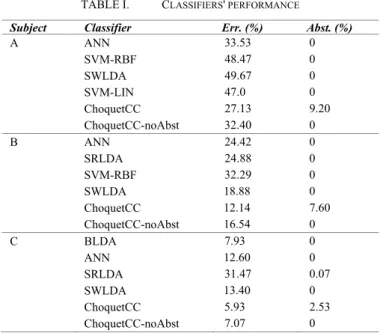
Table I shows the performance, in terms of error rate and abstention rate, of the proposed approach and of the classifiers of the ensemble. We denoted our method by ChoquetCC when abstention was allowed and by ChoquetCC-noAbst when it was not.
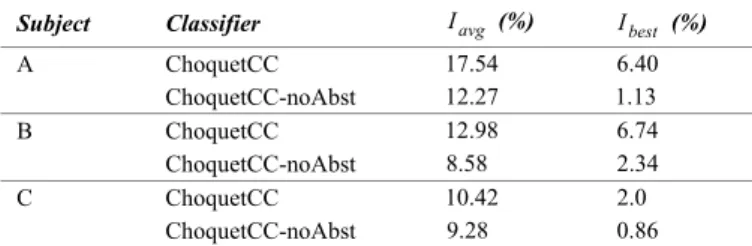
Table II summarizes the improvement in the error rate. The proposed strategy is compared to the best classifier of the en-semble (column Ibest) and to the entire ensemble by means of its average error rate (column Iavg).
V. DISCUSSION AND FUTURE WORK
We have shown how combination of classifiers based on fuzzy measures and the Choquet integral can be applied to vis-ual P300 BCI. Results of the offline analysis of experimental data relative to three subjects have been quite encouraging and proved the proposed method to be appropriate for this field.
TABLE I. CLASSIFIERS' PERFORMANCE
Subject Classifier Err. (%) Abst. (%)
A ANN 33.53 0 SVM-RBF 48.47 0 SWLDA 49.67 0 SVM-LIN 47 .0 0 ChoquetCC 27.13 209. ChoquetCC-noAbst 32.40 0 B ANN 24.42 0 SRLDA 24.88 0 SVM-RBF 32.29 0 SWLDA 18.88 0 ChoquetCC 12.14 607. ChoquetCC-noAbst 16.54 0 C BLDA 7.93 0 ANN 12.60 0 SRLDA 31.47 0.07 SWLDA 13.40 0 ChoquetCC 5.93 2.53 ChoquetCC-noAbst 7.07 0
MeMeA 2011, The 6 IEEE International Symp. on Medical Measurements and Applications, May 30th-31th 2011, Bari (Italy) TABLE II. IMPROVEMENT IN THE ERROR RATE
Subject Classifier Iavg (%) Ibest (%)
A ChoquetCC 17.54 6.40 ChoquetCC-noAbst 12.27 131. B ChoquetCC 12.98 6.74 ChoquetCC-noAbst 8.58 2.34 C ChoquetCC 10.42 02 . ChoquetCC-noAbst 9.28 0.86
One the major improvements made is related to the identi-fication of vague situations, which are often turned into absten-tions instead of resulting into misclassificaabsten-tions. Such a beha-vior is valuable since, in BCIs, correcting an error requires recognition of another command, i.e. the delete or back com-mand, and thus considerably lowers the information transfer rate (ITR). The proposed method is promising in order to im-prove the ITR and further investigation into this relationship is needed.
Although our approach is mainly intended for BCI proto-cols that allow abstention, also those one that do not permit that might take advantage of its application. In fact, results have shown that, even when abstention is not considered, the pro-posed strategy performs slightly better than the best classifier of the ensemble.
Finally, as only online experiments can provide a BCI tech-nique with final validation, future work should also aim at eva-luating the effectiveness of the proposed method within that context.
REFERENCES
[1] J.R. Wolpaw, N. Birbaumer, D.J. McFarland, G. Pfurtscheller, and T.M. Vaughan, “Brain–computer interfaces for communication and control,” Clinical neurophysiology, vol. 113, no. 6, pp. 767-791, 2002.
[2] F. Lotte, M. Congedo, A. Lécuyer, F. Lamarche, and B. Arnaldi, “A review of classification algorithms for EEG-based brain–computer interfaces,” Journal of Neural Engineering, vol. 4, no. 2, pp. R1-R13, 2007.
[3] M. Grabisch, “Fuzzy integral for classification and feature extraction,” in Fuzzy Measures and Integrals - Theory and Applications, M. Grabisch, T. Murofushi, M. Sugeno, and J. Kacprzyk, Eds., Heidelberg: Physica Verlag, 2000, pp. 415-434.
[4] A. Verikas, A. Lipnickas, K. Malmqvist, M. Bacauskiene, and A. Gelzinis, “Soft combination of neural classifiers: a comparative study,” Pattern Recognition Letters, vol. 20, no. 4, pp. 429–444, 1999.
[5] Z. Shoaie, M. Esmaeeli, and S.B. Shouraki, “Combination of multiple classifiers with fuzzy integral method for classifying the EEG signals in brain-computer interface,” International Conference on Biomedical and Pharmaceutical Engineering, 2006, Singapore, pp. 157-161.
[6] G. Choquet, “Theory of capacities,” Annales de l’Institute Fourier, vol. 5, pp. 131–295, 1953.
[7] T. Murofushi and M. Sugeno, “Fuzzy measures and fuzzy integrals,” in Fuzzy Measures and Integrals - Theory and Applications, M. Grabisch, T. Murofushi, M. Sugeno, and J. Kacprzyk, Eds., Heidelberg: Physica Verlag, 2000, pp. 3-41.
[8] M. Sugeno, “Theory of fuzzy integrals and its applications,” Ph.D. dissertation, Tokyo Institute of Technology, Tokyo, Japan, 1974. [9] T. Murofushi and M. Sugeno, “An interpretation of fuzzy measures and
the Choquet integral as an integral with respect to a fuzzy measure,” Fuzzy Sets and Systems, vol. 29, no. 2, pp. 201–227, 1989.
[10] M. Grabisch, S.A. Orlovski, and R.R. Yager, “Fuzzy aggregation of numerical preferences,” in Fuzzy sets in decision analysis, operations research and statistics, R. Slowiński, Ed., Norwell: Kluwer Academic, 1998, pp. 31–68.
[11] L.S. Shapley, “A value for n-person games,” in Contributions to the Theory of Games, Vol. II, H.W. Kuhn and A.W. Tucker, Eds., Princeton University Press, 1953, pp. 307–317.
[12] T. Murofushi and S. Soneda, “Techniques for reading fuzzy measures (iii): Interaction index,” Proceedings of the 9th Fuzzy Systems Symposium, Sapporo, Japan, 1993, pp. 693–696, in Japanese.
[13] L. Bianchi, S. Sami, A. Hillebrand, I.P. Fawcett, L.R. Quitadamo, and S. Seri, “Which physiological components are more suitable for visual ERP based brain-computer interface? A preliminary MEG/EEG study,” Brain Topography, vol. 23, no. 2, pp. 180-185, 2010.
[14] D.J. Krusienski, E.W. Sellers, F. Cabestaing, S. Bayoudh, D.J. McFarland, T.M. Vaughan, and J.R. Wolpaw, “A comparison of classification techniques for the P300 Speller,” Journal of Neural Engineering, vol. 3, no. 4, pp. 299-305, 2006.
[15] M. Grabisch, “A new algorithm for identifying fuzzy measures and its application to pattern recognition,” Proceedings of the 1995 IEEE International Conference on Fuzzy Systems. International Joint Conference of the Fourth IEEE International Conference on Fuzzy Systems and The Second International Fuzzy Engineering Symposium, Yokohama, Japan, 1995, pp. 145–150.
[16] L. Mikenina and H.-J. Zimmermann, “Improved feature selection and classification by the 2-additive fuzzy measure,” Fuzzy Sets and Systems, vol. 107, no. 2, pp. 197-218, 1999.
[17] P. Miranda and M. Grabisch, “Optimization issues for fuzzy measures,” International Journal of Uncertainty, Fuzziness and Knowledge-Based Systems, vol. 7, no. 6, pp. 545–560, 1999.
[18] M. Grabisch, H.T. Nguyêñ, and E.A. Walker, Fundamentals of uncertainty calculi with applications to fuzzy inference, Dordrecht: Kluwer Academic Publishers, 1995.
[19] L. Bianchi, L.R. Quitadamo, M. Abbafati, M.G. Marciani, and G. Saggio, “Introducing NPXLab 2010: a tool for the analysis and optimization of P300 based brain-computer interfaces,” 2nd International Symposium on Applied Sciences in Biomedical and Communication Technologies, Bratislava, Slovakia, 2009, pp. 1-4. [20] R Development Core Team, R: A Language and Environment for
Statistical Computing, Vienna, Austria: R Foundation for Statistical Computing, 2010. [Online]. Available: http://www.R-project.org [21] M. Grabisch, I. Kojadinovic, and P. Meyer, kappalab: Non-additive
measure and integral manipulation functions, 2009, R package version 0.4-4. [Online]. Available: http://ikojadin.perso.univ-pau.fr/kappalab