Working Paper
S e r i e s
Copyright © 2009 by the Peterson Institute for International Economics. All rights reserved. No part of this working paper may be reproduced or utilized in any form or by any means, electronic or mechanical, including
photocopying, recording, or by information storage or retrieval system, without permission from the Institute.
W P 0 9 - 1 3 N o v e m b e r 2 0 0 9
Mortgage Loan Modifications: Program Incentives
and Restructuring Design
Dan Magder
Abstract
Mortgage defaults and home foreclosures remain a growing problem that undermines the nascent US economic recovery. Delinquencies continue to skyrocket, up 300 percent since the beginning of the crisis, and the contagion has spread to prime loans where delinquencies have risen to over 11 percent of outstanding loans. The resulting foreclosures have broad consequences: Individuals lose their homes, banks take losses on the loans, neighbors suffer as area prices go down, and localities lose on property taxes. The economics of modifying loans to avoid defaults appear strong: Lenders lose an average of $145,000 during a foreclosure compared with less than $24,000 on a modified loan. Yet the track record of modification programs has been surprisingly poor. Potential lawsuits over modifying loans in securitization trusts may be a less important obstacle than many claim. More significant are misaligned incentives that put mortgage servicers in opposition to both investors and borrowers, conflicts between investors holding different tranches of mortgage-backed securities (MBS), operational impediments, and problems in loan modification design that contribute to redefaults. Policymakers should improve reporting metrics to highlight servicers’ conflicts of interest, shift the emphasis of loan modifications from short-term fixes to making the new loans more sustainable, and use government resources to drive operational/capacity improvements in the industry.
JEL Codes:E60, G01, G18, G21
Keywords: Mortgage Loan Modifications, Restructuring, Credit Crisis, HAMP
Dan Magder is director of investments at Lone Star Funds, a private equity firm. He has been an investment banker and
a director of corporate development at Capital One and also served as a research assistant at the Peterson Institute for International Economics from 1995 to 1996.
Author’s Note: I would like to thank Morris Goldstein for his ongoing support and encouragement, Jacob Kirkegaard, Gary Hufbauer, Steve Weisman, and Philip Henderson for feedback on earlier drafts, and Allyson Reynolds at Loan Performance for data updates. The views expressed are mine and do not represent the official position of Lone Star Funds or the Peterson Institute.
IntroductIon
Mortgage defaults and home foreclosures, the sparks that ignited the broader credit crisis, remain a growing problem that undermines the nascent US economic recovery. While “avoiding preventable foreclosures” has been the watchword for policy leaders from former Treasury Secretary Henry Paulson to President Barack Obama, Treasury Secretary Timothy Geithner, and even bank CEOs, focus on the problem has moderated as the banking sector appears increasingly stabilized. And yet delinquencies continue to skyrocket, up 300 percent since the beginning of the crisis. Worse yet, the contagion has spread to prime loans, where the delinquencies reached 11 percent in August, more than nine times the rate in mid-2007. The resulting foreclosures have broad consequences—individuals lose their homes, banks take losses on the loans, neighbors suffer as area prices go down, and localities lose on property taxes. The economics of modifying or restructuring loans to avoid defaults appear strong: Lenders lose an average of $145,000 during a foreclosure compared with less than $24,000 on a modified loan. Unfortunately, despite all the programs aimed at helping homeowners, the track record of modifications has been surprisingly poor.
For policymakers, mortgage restructuring has an additional dimension. Restructuring efforts must minimize the moral hazard issues that arise when borrowers and banks are encouraged to take or make risky loans, knowing that if their losses are large enough, the government will bail them out. An effective restructuring plan must address this issue while also being able to be implemented on a sufficiently wide scale to impact the broader economy.
Several commonly cited impediments to wide-scale modifications appear to be overstated while other issues receiving less attention still need to be addressed. Potential lawsuits over modifying loans in securitization trusts may be a less important obstacle than many claim. More significant are misaligned incentives that put servicers in opposition to both investors and borrowers, incentive mismatches between the investors holding different tranches of mortgage-backed securities (MBS), operational impediments to offering modifications, and problems in loan modification design that contribute to a high rate of redefaults. Finally, the difficulty that servicers and borrowers have in reaching each other continues to be a stumbling block to effective loan restructuring.
This paper outlines the current state of the mortgage market and reviews leading loan programs, evaluating them against a set of common sense criteria balancing costs and benefits among all
stakeholders. Based on this analysis, I recommend improving servicer reporting metrics to highlight conflicts of interest, shifting the emphasis in loan modifications from short-term fixes to those that make the new loans more sustainable, and using government resources to improve communication between borrowers and servicers as well as to drive operational/capacity improvements at servicers who are responsible for conducting loan modifications.
current MArket envIronMent
At the end of September 2009 an estimated 52.6 million mortgages were outstanding in the United States, of which 46.8 million, or 89 percent, were prime and 5.8 million, or 11.1 percent, were subprime (table 1).1
The overall rate of completed foreclosures rose dramatically from 42,000/month in July 2007, hitting a peak of 92,000 in July 2008 and falling temporarily before settling around 75,000 to 90,000 per month between May and September 2009 (figure 1). Alarmingly, the spike was worse for prime loans, where the rate of foreclosures rose to 55,000 in September 2009—over 2.5 times the rate at the start of the crisis. Subprime foreclosures peaked in May 2008 at 49,000 per month but fell to 34,000 in September 2009—still nearly 50 percent higher than the rate in July 2007. Data on foreclosure starts, which track properties initiating the foreclosure process, have continued to increase after a period of slowdown in late Q3/early Q4 2008, hovering near 240,000 per month since March 2009—for a total of 2.8 million in the 12 months ending September 2009.2 These data suggest that the pipeline is filled to
keep completed foreclosures going strong.
According to LoanPerformance, an industry data consortium, since the beginning of the mortgage crisis, 60+ day delinquency rates have jumped 275 percent to over 12 percent of all loans. The 60+ day delinquency rate for subprime loans had reached 31 percent by June 2008 and rose to 46 percent in August 2009 (figure 2). Prime loans went from a 60+ day delinquency rate of 1.3 percent in June 2007 to 8.3 percent just over two years later3 (figure 3). If we account for the number loans that have moved out
of the 60+ day category and on to foreclosure, delinquency rates in August reached a total of 11.1 percent for prime and an astounding 61 percent for subprime loans.
Delinquency rates are even more astonishing when broken down by vintage (year of initiation of the loan). Until 2004, prime 60+ day delinquencies at 24 months were less than 1.1 percent, and they increased to only 2.2 percent in 2005 (figure 4). By 2006 the rate was 8.4 percent and peaked just below 14 percent in 2007. The 2008 vintage jumped to over 6.5 percent delinquencies after only 15 months.
1. Hope Now Alliance, “National Data July07 to September09,” available at www.hopenow.com. The data are based on the Mortgage Bankers’ Association’s delinquency surveys, along with data compiled from the Hope Now Alliance of 27 major mortgage lenders accounting for a majority of the market. Nearly 1.5 million mortgages have disappeared from the peak of 54.1 million in 2007Q4, which is the result of a net reduction of 400,000 prime loans and 1.1 million subprime loans.
2. Similar data from First American CoreLogic’s LoanPerformance pegged foreclosure filings at an even higher 3.4 million for 2008, up 76 percent from 1.9 million in 2007 and an over 300 percent increase from 1.1 million in 2006 (First American CoreLogic Media Alert, January 26, 2009). Hope Now Alliance’s total for 2008 was 2.2 million foreclosure starts, a 33 percent increase over its count of 1.7 million in 2007. The difference between the two sources appears due to some double counting—filings may include foreclosures that are reported twice in cases where the loan was sold from its original holder or a foreclosure process that was stopped and restarted (conversation with Hope Now Alliance data analyst, May 15, 2009).
Subprime loans are showing similar deterioration at a more significant rate. Until 2004, 24-month delinquencies hovered around 10 to 14 percent, but they hit 23 percent in 2005, 39 percent in 2006, and nearly 50 percent in 2007 (figure 5). The 2008 vintage seems to be performing in line with 2007.4
At a more fundamental level, at the end of 2009Q2 an estimated 15.2 million mortgages, or 32.5 percent, of all home loans in the United States, were “under water”—where the borrower has negative equity since they owe more on their mortgage than their house is worth.5 If we include homes
with “near negative equity,” which is defined as being within 5 percent of a negative equity position, the total rises to 38 percent. Given geographical differences in the housing bubble, the share of negative equity reached nearly 66 percent in Nevada, 51 percent in Arizona, 49 percent in Florida, 48 percent in Michigan, and 42 percent in California.6 These trends are driven by the decline in home prices that
dropped 33 percent from their peak in July 2006 through April 2009, though have rebounded somewhat since, such that they are down only 29 percent in August.7
The good news is that not all borrowers with negative equity will necessarily default. Borrowers who can make their payments have an incentive to do so, since they cannot sell their homes and buy another without injecting new equity into the transaction. Many of them will continue to pay their loans, stay in their homes, keep their kids in the local schools etc., hoping the market comes back as they pay down some of their principal, so that they return to a positive equity position in a few years.
To estimate the value of “at risk” mortgages, we can make the simplifying assumption that prime and subprime loans have the same outstanding value on average. The amount of outstanding home mortgage debt as of 2009Q2 was $10.4 billion.8 Applying the different delinquency rates from
the two sources cited above, the amount of “at risk” loans ranges from approximately $687 billion to $1,292 billion.9 Of course, not all the 60+ day delinquent loans will default, in part because of existing
restructuring efforts. But significant losses are still to come.
High cost of defaults: Incentives for restructuring
The key rationale for restructuring mortgages is that the average economic benefits outweigh the costs— providing an apparently clear financial incentive for investors to offer modifications. The Mortgage Bankers Association suggests that the cost of foreclosures ranges from 30 to 60 percent of the loan
4. First American CoreLogic, LoanPerformance data, November 2009.
5. First American CoreLogic, “Summary of Second Quarter 2009 Negative Equity Data,” August 13, 2009. 6. Ibid.
7. S&P/Case-Shiller Home Price Index, Composite 20 through August 2009, published October 27, 2009. 8. Federal Reserve Flow of Funds Accounts, Table D3: Debt Outstanding by Sector, September 17, 2009.
9. Since prime borrowers are more likely to be eligible for larger loans including jumbos, the initial assumption overstates the estimate of at-risk loans. However, even if we assume prime loans account for 95 percent of the outstanding loan
amount and that the lender’s loss typically amounts to $50,000 or more.10 Costs include the general
decline in housing prices, foregone payments, court costs and related fees, and a loss on sale that can range from 5 to 30 percent.11 A study of mortgages modified in November 2008 found the average cost
of foreclosures was $145,000 for the lender, 55 percent of the average amount outstanding.12 By contrast,
the November loan study found that the average cost of principal and interest reductions in modifications was $23,600.13
Wide-scale restructuring is complicated by the need to sort through more than 40 million borrowers to identify those who are likely to default without a loan modification but could afford a new, lower-cost loan. Individual modification decisions are more complicated than the averages suggest, since they must account for local housing prices and resale trends, state regulations governing foreclosures and the expected time in that jurisdiction, likelihood of self-cure, etc. Servicers may also be concerned with the moral hazard involved in modifying loans that provides an incentive to default for borrowers who would otherwise self cure. However, even taking these factors into account, the wide difference in average costs appears to provide ample room for lenders and borrowers to reach mutually beneficial agreements that are better for both parties than foreclosures—at least in more cases than are currently happening.
Impediments to Modifying Loans
Misaligned Incentives
Given the seemingly straightforward financial benefits to all parties from restructuring mortgages, why aren’t more loans getting modified? The process is complicated by the large number of players involved and misaligned incentives between them.
Initially, analysts worried that servicers would hesitate to modify loans because their agreements with investors do not allow servicers to reduce the value of the securities owned by investors. They were also concerned that modifying too many loans might be considered active management, which could jeopardize the issuer’s ability to receive off–balance sheet treatment for the securitization trust under FASB140 accounting rules. A final concern is that in order to modify a first mortgage, servicers have to get agreement from the owners/investors in any second lien, e.g., home-equity loans, to resubordinate their claims. In many cases, particularly where the value of the home has fallen below the value of the mortgages, modifying the first loan would make it clear that the second lien was worthless. Holders of
10. Mortgage Bankers’ Association, “Lenders’ Cost of Foreclosure,” May 28, 2008.
11. See also Ben Bernanke, speech at the Federal Reserve System Conference on Housing and Mortgage Markets, December 4, 2008; and “A Promising New Solution for Homeowners Facing Foreclosure,” International Business Times, December 31, 2008.
12. Alan M. White, “Deleveraging the American Homeowner: The Failure of 2008 Voluntary Mortgage Contract Modifications” (January 9, 2009), Connecticut Law Review 41 (2009): 1107.
the second lien therefore would not agree to modifications unless they were able to extract value from the owner of the first mortgage.
The empirical data suggest that concerns over servicing agreements are overstated, and policymakers have rather clearly addressed the accounting issue. The issue of second liens is more complicated and ties to a more complex set of conflicts of interest that servicers face in modifying loans.
With regard to securitization agreements, most have provisions that allow servicers to undertake actions that maximize value to investors, providing justification for modifications. A study of 31 servicing agreements found that only two did not allow modifications when a default was reasonably likely, and that 12 had some sort of restrictions (percent of loans that could be modified, minimum interest rate, etc.).14 Another study by the Federal Reserve reviewed a servicer that operates under 500 different
contracts and reported that 48 percent have no restrictions on the servicer’s ability to maximize value to investors, 26 percent allowed modifications with prior approval of the trustee, 18 percent allow modifications except for those that extend the maturity of the loans beyond that of the mortgage pool, and only 4.5 percent prohibited any workouts, with an additional 3 percent prohibiting modifications other than those establishing a balloon payment. The authors further wrote: “servicers admitted that investors have rarely questioned a workout, or asked to see NPV spreadsheets, or threatened a lawsuit in the past.”15
Beyond that, the Obama administration passed a measure to provide safe harbor to servicers that undertake loan modifications. The provision was included in the broader Helping Families Save Their Homes Act, which passed in May 2009.16 Critics argued that the provision is too broad, limiting all legal
recourse investors may have against servicer misbehavior. Other analysts pointed out that the provision could lead servicers to benefit themselves at the expense of investors.17 Moreover, a recent lawsuit against
Bank of America has directly challenged the ability of servicers to invoke the legislation in order to avoid investor claims.18
14. Credit Suisse, “The Day After Tomorrow: Payment Shock and Loan Modifications,” April 5, 2007.
15. Larry Cordell et al., The Incentives of Mortgage Servicers: Myths and Realities, Finance and Economics Discussion Series, Divisions of Research & Statistics and Monetary Affairs, Federal Reserve Board, September 2008.
16. One more potential legal impediment had already been addressed by lawmakers. Borrowers generally face taxes on any debt forgiven, since the amount is considered income. This taxation provides a strong disincentive for borrowers to participate in mortgage restructuring that involves writing off part of their principal. However, Congress temporarily excluded taxing gains on mortgage debt forgiven through the Mortgage Debt Relief Act of 2007. Under the legislation, valid until December 2012, borrowers do not face taxes on debt that is forgiven as part of restructuring a loan on their primary residence.
17. For example, two lawyers for MBS investors point out that the top four banks, Bank of America, JP Morgan Chase, Wells Fargo, and Citigroup, hold over $440 billion of second mortgages but very few firsts—and that the four also service nearly half of first mortgages. That puts the servicers in a position to modify first mortgages in a way that can also benefit the secondary liens, even if the modification is not optimal from the perspective of the investor in the first mortgage. See Ric Brenner and Hamish Hume, “How Big Banks Want to Game the Mortgage Mess,” Wall Street Journal, May 4, 2009. 18. Under a December 2008 settlement made with several state attorneys general over charges of predatory lending,
A number of measures have been put into place to address other aspects of the servicers’ concerns. The American Securitization Forum came out with a Streamlined Framework that provides a fast-track procedure for modifying loans on first-lien subprime residential adjustable rate mortgages (ARMs) that originated between January 1, 2005 and July 31, 2007.19 In addition, in July 2007, Christopher Cox,
then chairman of the Securities and Exchange Commission (SEC), stated that modifications of loans facing likely default would not disqualify a pool from off–balance sheet treatment.20
The issue with second liens is more complex than it appears. One study argued, “it may be the case that senior lien holders are overestimating the risk that courts will consider them as subordinate following a modification. . . we have not found any instances in the current foreclosure episode of junior lien holders successfully promoting their claim over a senior lien holder, although many lawsuits have yet to work their way through the courts.”21 Moreover, as will be discussed further on, at least one major
servicer, Bank of America, has stated that second liens are not a major impediment for them in practice. But what may be more of a problem is that the top four servicers, Bank of America, JPMorgan Chase, Wells Fargo, and Citigroup, who service approximately 50 percent of all first mortgages for various investors, also own the majority of second liens themselves—approximately $400 billion in total. In modifying the first lien on any property where these servicers own the second, they severely undercut their own investment. This conflict of interest may be one of the most powerful impediments to loan modifications. In response, the Federal Financial Institutions Examination Council (FFIEC), a council made up of the Federal Reserve, Federal Deposit Insurance Corporation (FDIC), Office of Thrift Supervision (OTS), Office of the Comptroller of the Currency (OCC), and National Credit Union Association came out with a statement instructing servicers not to allow their decision whether to modify first loans to be influenced by any potential impact on a second lien.22 The statement specifically
mentioned that servicers with an ownership interest in a subordinate lien must not consider that interest when evaluating a first lien modification. However, the statement does not discuss penalties or
Bank of America, which acquired Countrywide Financial, agreed to modify approximately 400,000 loans made by Countrywide. The majority of the loans were in an investor trust, the terms of which explicitly required Countrywide to buy back any loans it modified. Bank of America has argued the Helping Families Save Their Homes Act supersedes the pooling and servicing agreement. The investors disagreed and sued. In mid-August the case was referred back from federal court to the New York State supreme court. See Gretchen Morgenson, “Countrywide Loses Ruling in Loan Suit,” New York Times, August 19, 2009.
19. American Securitization Forum, “Streamlined Foreclosure and Loss Avoidance Framework for Securitized Subprime Adjustable Rate Mortgage Loans,” issued December 6, 2007 and revised July 8, 2008.
20. SEC Chairman Cox’s response to a letter from House Financial Services Committee Chairman Barney Frank, available at http://financialservices.house.gov.
21. Larry Cordell et al., “The Incentives of Mortgage Servicers: Myths and Realities.”
22. FDIC, “FFIEC Support for Responsible Loss Mitigation Activities, Servicers’ Obligations to Lienholders on Modifying Loans,” Financial Institutions Letters, August 6, 2009.
consequences of noncompliance, and enforcement will likely be difficult since the regulators will face a challenge in proving servicers have acted in bad faith.
Even in cases where servicers do not own the second lien, other incentive mismatches can limit modifications. Servicer fees are based on a percentage of outstanding loan balance—usually 0.25 to 0.50 percent. They also get to keep 100 percent of late fees they collect, which can reach 6 percent of monthly payments—providing a meaningful source of revenue and therefore a significant disincentive to quick action, especially if they assume some of the loans will self-cure in the meantime. During a foreclosure proceeding, servicers can also make significant revenue through fees for insurance, appraisals, and title searches, which they funnel to their own subsidiaries.23
Indeed, a July study by the Federal Reserve found that over 30 percent of delinquent borrowers will self-cure, scraping together a way to make up their payments and thus undermining investor incentives to offer modifications.24 Interestingly, just the next month a Fitch study found that cure rates had
plummeted. Cure rates for prime loans dropped from around 45 percent between 2000 through 2006 to 6.6 percent in July 2009. Alt-A cure rates fell from 30.2 to 4.3 percent, and subprime cure rates fell from 19.4 to 5.3 percent.25 Some of these borrowers may not be able to afford their payments even with a
modification, but the trends in cure rates reinforce the notion that we will see accelerating delinquencies. Other incentive misalignments include the fact that servicers traditionally initiate foreclosure proceedings at the same time as evaluating a potential modification in case the latter falls through. As a result, servicers incur incremental costs of processing the modification in addition to the foreclosure— costs that they are unable to pass along to investors, despite the fact that expenses associated with a foreclosure are generally reimbursed.26 This is a particularly perverse incentive whereby servicers may
not undertake modifications that would result in a benefit to investors that is larger than the processing expenses. Compounding this phenomenon is the fact that in the event a modification fails, the servicers have not only incurred extra costs but also delayed the eventual foreclosure at a time when housing prices are falling.27 A related issue is that when a borrower first falls delinquent, servicers advance the missing 23. Peter Goodman, “Lucrative Fees May Deter Efforts to Alter Loans,” New York Times, July 30, 2009.
24. The authors also pointed to the high rate of redefaults as creating another group of borrowers to whom lenders would not want to offer modifications, leaving a small subset in between who would be able to continue payments with a temporary reduction in terms but not otherwise. Manuel Adelino, Kristopher Gerardi, and Paul S. Willen, Why Don’t Lenders Renegotiate More Home Mortgages? Redefaults, Self-Cures, and Securitization, NBER Working Paper 15159, July 2009, Cambridge, MA: National Bureau of Economic Research.
25. James R. Hagerty, “Fewer Catching Up on Lapsed Mortgages,” Wall Street Journal, August 25, 2009.
26. Another study highlighted the same issue, that servicers prefer foreclosures over modifications because they received fixed-rate compensation when they modify a loan but “unmonitored cost-plus compensation” in foreclosures. See Adam J. Levitin, “Helping Homeowners: Modification of Mortgages in Bankruptcy,” Harvard Law and Policy Review 3 (January 2009).
mortgage payments to investors and tax authorities. If they later modify the loan, they face a complicated task of settling up with each of the parties. These dynamics gave servicers additional incentives to move on foreclosures without exploring modifications, particularly in the early days of the current crisis.
Servicers also face competing pressure on modifications that differentially impact investors
depending on what tranche they hold in the MBS stack. Holders of AAA tranches may prefer foreclosures since they are shielded from any loss by their seniority. By contrast investors holding residual tranches are more likely to support modifications that offer them a chance to recoup some of their investment. This “tranche warfare” will at best slow servicers who need approval of investors to conduct modifications. It can also increase the threat of lawsuits if they favor the interest of one class of investors over another. At least one industry representative has indicated that several large investors with significant holdings of senior tranches of MBS are working quietly but aggressively (and effectively) behind the scenes to slow the progress of loan modifications.28
More recently, servicers may be getting encouragement from investors to keep loans that have become seriously delinquent in a kind of purgatory that is not quite foreclosure. With the buildup of foreclosure inventory, depressed home values, and a backlog in the courts that can reach 24 months, investors have no incentive for their servicers to foreclose and try to sell the home. Instead, in a strategy referred to by some as “defer and hope,” investors forestall the foreclosure, hoping the homeowner will self-cure or at least that they can hold off foreclosing until the market comes back. Even if the investor is forced to take the same loss later on, by not foreclosing they can defer the accounting recognition of the loss. This strategy is helped by unclear guidelines on accounting for delinquent loans. Partially in response, the OTS wrote in a letter to bank CEOs in May 2009 stating that “charg[ing]-off losses only at foreclosure or when deemed uncollectible” is “weak and do[es] not appear to be in accordance with GAAP and/or supervisory guidance.”29 Unfortunately, the language of the letter was not definitive and it did not
specify consequences for noncompliance. As a result, it is still a significant problem months later.30 Operational Impediments
Even if the conflict of interest problems could be solved, operational issues make it difficult for servicers to implement modifications. Servicers have traditionally focused on collecting money from borrowers and paying investors and are not set up to conduct loan modifications. They have collections teams, but generally they do not have sales teams capable of signing up new (or in this case existing) borrowers for
properties on the market, a different incentive may be emerging to forestall foreclosures until the market returns. 28. Author’s conversation with MBS investment professional, April 2009.
29. Department of Treasury, Office of Thrift Supervision, “ALLL—Observed Thrift Practices Including Sound Practices,” Memorandum for Chief Executive Officers, May 22, 2009.
modified loans. Simply reaching homeowners to discuss loan modifications is difficult—many borrowers cannot sift through the barrage of mail and phone calls they receive from collection agencies to realize they are being offered a beneficial deal (see the case study on Bank of America’s outbound efforts below). For their part, homeowners have difficulty getting through to lenders to talk about possible modifications: The day after the Obama administration announced further details about their loan program, JP Morgan Chase reported that call volume spiked 150 percent, and SunTrust saw calls increase 50 percent.31
Moreover, servicers do not typically have underwriting capability, including systems and staff needed to identify which borrowers qualify for loans and to set new terms. Underwriting loan modifications can be even more complex than underwriting traditional loans, due to the myriad of government programs and incentives, different eligibility requirements, and new tighter lending standards. In the words of one lender: “Right now, if I tried to refinance a loan that didn't have equity, our computer system wouldn't even allow it….”32 These operational factors are proving to be very real
impediments to getting loan restructuring underway.
Problem of redefaults and Modification design
A vexing problem with the concept of loan restructuring is the poor track record of borrowers complying with their new loan payments. And early study of loan modifications found that 58 percent of loans modified in 2008Q1 and 51 percent of loans modified in Q2 missed one payment within six months.33
Other analysis showed that modifications with interest rate reductions perform slightly better—in a sample of loans modified during 2009Q1, those with rate reductions had a 23 percent chance of missing two payments.34
Other research has shown that a homeowner’s equity position, along with affordability, is a key determinant of default rates—i.e., borrowers with negative equity are more likely to default.35 These
studies suggest that principal write-downs may be a critical element of making any loan modification program sustainable over the long term. And yet the study of modifications done in November 2008 found that the average restructuring in fact added over $10,000 to the principal of each loan— approximately 5 percent of the total loan outstanding, by capitalizing unpaid interest and fees. Only
31. “U.S. Launches Wide-Ranging Plan to Steady Housing Market,” Washington Post, March 5, 2009. 32. Ibid.
33. “Foreclosure Reduction Effort Yielding Mixed Results, Report Says,” Washington Post, December 9, 2008. The study, published in December, looked at a sample of 200,000 loans.
34. Credit Suisse study cited in “Foreclosure Reduction Effort Yielding Mixed Results, Report Says,” Washington Post, December 9, 2008.
35. Kristopher Gerardi, Adam Hale Shapiro, and Paul S. Willen, “Subprime Outcomes: Risky Mortgages,
Homeownership Experiences, and Foreclosures,” Federal Reserve Bank of Boston, May 2008; Shane M. Sherlund, “The Past, Present, and Future of Subprime Mortgages,” Federal Reserve Board, November 2008.
about 35 percent involved reducing the borrower’s monthly payment, 18 percent left it unchanged, and 47 percent of monthly payments actually increased.36 These trends contribute to the high rate of
redefaults and suggest that modifications must focus on bringing down payments to an affordable level so that they are sustainable in the long term.37 The picture improved for modifications done in 2009Q1,
where 54 percent reduced payments, though unfortunately 18 percent still increased payments. Data for modifications completed in 2009Q2 show that 78 percent reduced the borrowers’ monthly payments, while 17 percent increased them.38 The data also clearly show that modifications that reduced borrower
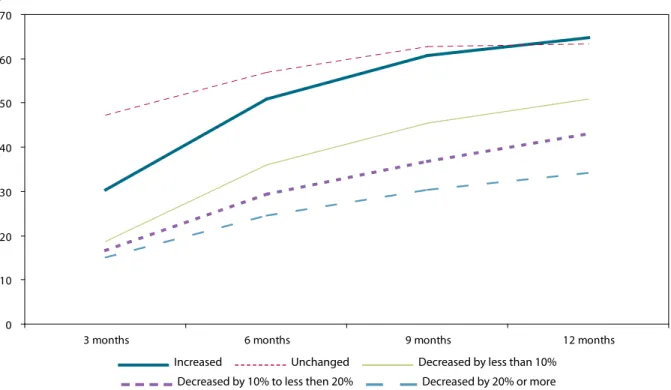
payments perform significantly better than those that increased payments or left them unchanged (figure 6). Loans where the payment was reduced 20 percent or more show nearly half the redefault rate of those where the payment was unchanged, and loans where the payment was reduced by an even smaller amount still show significantly lower redefault rates.39
Behavioral economics and Loan Modification: Loss Avoidance and collective Action
Reducing overall housing prices is an important element of any mortgage restructuring program because of the behavioral characteristics of homebuyers. Housing prices are highly sticky on the downside. Most sellers base their asking price on the nominal price they paid for their home and are unlikely to accept less than that amount, even when housing markets have fallen. This loss aversion keeps their asking prices high and increases the days on market of their properties, contributing to an overall increase in housing inventory.40 Moreover, a study of the Boston real estate market during the 1980s and 1990s showed that
individual homeowners exhibit twice as much loss aversion as real estate investors.41 Furthermore, as
Amos Tversky and Daniel Kahneman showed in their pioneering work on behavioral economics, people are much more sensitive to financial losses than to equivalent-sized gains.42 Therefore, at a time when a 36. White, “Deleveraging the American Homeowner.” Professor White looked at a sample of 3.5 million subprime and Alt-A mortgages, comprising 20 percent of all loans modified in November of 2008.
37. Interestingly, the FDIC has modeled a 40 percent redefault rate into their own projections, though they claim that even so loan modifications are worthwhile given the high cost of foreclosures. “Just a Band-Aid on the Foreclosure Problem?” Washington Post, February 3, 2009.
38. Office of the Comptroller of the Currency and Office of Thrift Supervision, “Mortgage Metrics Report for Second Quarter 2009,” September 2009.
39. According to the OCC/OTS report (ibid.) regarding the surprising finding that loans where the payment was unchanged evidenced worse performance than those that increased payment: “. . .one reason for this anomaly is that modifications in which payments are unchanged often result from freezing the interest rate on adjustable rate mortgages before the loans resetting to higher payments. While servicers determined that these borrowers were at risk of imminent default on the increased payment, the rate and payment were often frozen as part of a systemic program that did not involve a full assessment of the borrowers’ capacity to continue making their payments.”
40. David Genesove and Christopher Mayer, “Loss Aversion and Seller Behavior: Evidence from the Housing Market,” Quarterly Journal of Economics 116, no. 4 (2001): 1233–60.
41. Ibid.
42. Amos Tversky and Daniel Kahneman, “Loss Aversion in Riskless Choice: A Reference-Dependent Model,” Quarterly Journal of Economics 106, no. 4 (November 1991): 1039–61.
large portion of US mortgages are underwater, policies aimed at reducing the selling price of homes could have a greater “bang for the buck” than policies that provide the same dollar value of incentives to buyers.
A final impediment to mortgage restructuring is the result of collective action problems on the lender front. While foreclosures are more costly than successful loan modifications, in an environment of falling prices lenders who foreclose sooner can benefit incrementally as they minimize their loss on sale relative to lenders who wait and sell into a market with more inventory and further depressed prices. Each lender benefits from restructuring and all lenders benefit collectively from fewer foreclosures, but lenders who rush foreclosures through quickly can benefit. Thus in order for all lenders to participate effectively, programs that provide incentives for all lenders to act in concert, like standard modification guidelines and a moratorium on foreclosures, are important to solving this collective action problem and getting lenders focused on restructurings.
PrIncIPLes for An effectIve restructurIng PLAn
A common sense list of principles for designing an effective mortgage restructuring plan might include the following:
Principle rationale
Does the plan reduce defaults and foreclosures? Does it protect against redefaults?
This is the key to keeping people in their homes, reducing bank losses, and restoring investor confidence in the securities made of these mortgages.
How much does it cost and who pays? How are the costs allocated between borrowers, lenders, and investors? How are the benefits allocated?
All things equal, a lower-cost plan would be better—more easily approved by both parties in Congress, more acceptable to taxpayers, and more likely to gain the interest of private-sector players involved.
If borrowers, lenders, and investors are given support, particularly if that support comes from taxpayers, then taxpayers should also share in any potential upside. This will help minimize future moral hazard issues and also reward taxpayers for the risk they are taking.
How scalable is it? How quickly can it be implemented on a broad scale? And not just for subprime loans but for all mortgages?
Since the number of affected mortgages is large, an effective program must address a significant number of both prime and subprime loans quickly.
Does it support downward movement in housing prices? And does it help avoid a possibly disastrous overshoot on the downside?
Given wide-scale agreement that in the run-up to the crisis there was a housing asset bubble, programs should not artificially prop up the housing market, but minimize disruptions as prices settle down to a more sustainable level. Does it discriminate between truly needy borrowers and
those trying to game the system?
An effective program would help those who truly need help, not those who want to benefit from the program at taxpayers’ expense.
To what extent is it consistent with existing laws, regulations, and other legal constraints—i.e., rights of secondary lien holders and securitization agreements?
To be easily and broadly implemented, the restructuring program must avoid running into legal roadblocks from other players involved.
evALuAtIon of exIstIng MortgAge restructurIng ProPosALs fHAsecure
FHASecure was launched in August 2007 and then expanded in April 2008 by the Federal Housing Administration (FHA), a division of the US Department of Housing and Urban Development (HUD). The program was initially intended to provide FHA-insured refinancing and long-term fixed-rate mortgages to non-FHA ARM holders facing a rise in payments due to interest rate resets. To be eligible, borrowers needed at least 3 percent equity in the home, a history of on-time payments, and a solid employment history so as to be able to afford the new mortgage.43
The expanded program broadened eligibility to subprime ARM borrowers who had missed up to three monthly mortgage payments. For borrowers with two missed payments in 12 months, the lender was required to write down the loan to 97 percent of the current appraised value. Borrowers with three missed payments were eligible if their loans were at or written down to 90 percent or less of the current appraised value.44
Results
Between September 2007 and December 2008, 475,000 loans were modified through FHASecure. One hundred thousand loans were modified in the first six months of the program, another 100,000 in the next three months, and nearly 300,000 in the last seven months following the implementation of the program changes.45 However, the program reportedly refinanced only about 4,000 subprime borrowers.46
The program expired December 31, 2008, as the FHA shifted its focus to the Hope for Homeowners program.
Evaluation of FHASecure
Reducing Defaults: The program design initially targeted borrowers who had made consistent payments but were facing interest rate resets. This criterion selected people who were a good insurance risk and would likely continue making payments on their new loans. The expanded program gave it broader reach but opened it to a population that would have a higher risk of redefaulting.
43. US Department of Housing and Urban Development, “Bush Administration to Help Nearly One-Quarter of a Million Homeowners Refinance, Keep Their Homes: FHA to Implement New “FHASecure” Refinancing Product,” HUD press release 07-123, August 31, 2007, www.hud.gov.
44. US Department of Housing and Urban Development, “Bush Administration to Expand Mortgage Help for Struggling Families: Expanded FHASecure Able to Help Half a Million Homeowners Stay in Their Homes by Cutting Mortgage Payments,” HUD press release 08-050, www.hud.gov.
45. US Department of Housing and Urban Development, “Bush Administration’s FHASecure Refinances 200,000th Mortgage for American Families,” HUD press release 08-069, May 15, 2008, www.hud.gov and “Charting Your Course,” Washington Post, December 27, 2008.
Allocation of Costs and Benefits: In the original program the borrower benefited by getting refinanced into a loan with a fixed rate at a payment level they could afford, and the servicer benefited from having an FHA-insured loan. The FHA used risk-based pricing to set premiums, so that any payouts would be covered by the insurance and not by taxpayers. The story became more complicated when the program required servicers to write off a portion of the loans, providing more benefit to borrowers. Servicers still would not have participated if the program were not a financially attractive alternative to likely defaults. It is unclear whether the insurance payments were increased enough to cover the higher projected risks of redefaults—which is likely why the Hope for Homeowners program (described below) that followed FHASecure requires homeowners to share any future price appreciation with the FHA. Also, writing off a portion of the loans based on the current appraised value increases the cost for the servicer/lender, and it is unclear how many of the modified loans were processed after the expanded criteria went into effect.
Scalability: FHASecure had a fairly extensive reach in modifying loans. The rate of 30,000 to 50,000 loans modified per month is a sizable portion of the number of loans going into default during the same period.
Supporting Downward Housing Prices: The original program did not support any reduction in housing prices. By including principal forgiveness, the expanded program added an element to help realign home values.
Borrower Eligibility/Screening: The program’s original eligibility requirements targeted homeowners with a lower risk of redefault. While the expanded program targeted more needy borrowers—those who have defaulted on their loans already—those borrowers are also more likely to default in the future.
Legal Consistency: FHASecure did not explicitly address the second lien or servicer-agreement issues. The initial program refinanced up to 97 percent of the value of the home, enabling the borrower to pay off most secondary liens. With the expanded program, servicers could write down the amount owed to make the loan eligible, suggesting that they would have to accommodate the second-lien holder about any possible loss. Because the program helped servicers improve the value of loans with a high probability of default, it gave them a basis for meeting the requirements of their servicing agreements.
Overall Assessment: FHASecure was successful in reaching a sizeable number of mortgages and restructuring them. The next step in evaluating the program’s effectiveness will be to see how the new loans perform over time. Overall, the performance of FHA-insured loans has eroded, with defaults rising from 3 percent in 2006 to 4.31 percent in December 2008—though it is important to note that over the same time the agency’s share of new mortgages increased dramatically from 2 percent to 25 to
30 percent.47 However, loans modified under the original criteria will likely perform better than the
later ones, since they were limited to more solidly performing borrowers, suggesting the default rates will continue to rise. The new program was more generous to borrowers, which appears to be why Hope for Homeowners added value sharing so that borrowers do not benefit exclusively from future housing price appreciation. Value sharing also helps the FHA/taxpayers to be made whole for additional losses that are not covered by the insurance premiums. This is important as the FHA reserves available to cover losses, including those from this program, fell significantly year over year from 6 percent of the loans it guaranteed in September 2007 to 3 percent in September 2008.48
fdIc Mortgage restructuring Proposals
Perhaps one of the most vocal advocates of the government role in mortgage restructuring is Sheila Bair, chairman of the FDIC. In August of 2008 Bair offered a new loan modification program through IndyMac Federal Bank, the mortgage company taken over by the FDIC in July 2008 when its capital levels became unsustainable. IndyMac would modify loans so that payments are capped at 38 percent of a borrower’s income by extending the repayment period (up to 40 years), lowering the interest rate (as low as 3 percent), or forbearing or forgiving some of the principal.49 Modifications were made after verifying
the borrower’s income and ability to afford the new monthly payments and subject to the cost of the modification being lower than a net present value (NPV) calculation of estimated foreclosure costs.
The program offered a low initial interest rate to provide the borrower with immediate assistance in making their payments. Beginning in the sixth year of the new loan, the interest rate increased by 1 percent each year, capped at the current Freddie Mac Primary Mortgage Market Survey rate (initially 6.5 percent when the program was set up in August 2008, it had fallen to 5 percent by year end and hovered +/– 20 basis points through the beginning of October 2009).
In November, Bair encouraged other lenders to use the same guidelines and offered to pay servicers $1,000 for each modification. The FDIC would also insure the new loans for up to 50 percent of the loss lenders incurred in the event of a redefault.50 On New Year’s Eve 2008, a consortium agreed to 47. “Rate of Defaults Is Rising Among FHA-Backed Loans,” Washington Post, January 24, 2009.
48. FHA reserves are expected to fall below 2 percent at the end of September 2009, see “Housing Agency’s Cash Reserves Will Drop Below Requirement,” Washington Post, September 18, 2009. If the FHA’s reserves drop below 2 percent, the agency will be required to ask Congress for a bailout or increase its fees to borrowers. However, Commissioner David Stevens has said the agency will increase the capital holding requirements for lenders who seek FHA insurance to $1 million, to cover the increased incidence of fraud. The FHA will also hold lenders responsible for any fraud committed by their network of mortgage brokers.
49. FDIC, “Loan Modification Program for Distressed Indymac Mortgage Loans,” www.fdic.gov (accessed on December 15, 2008). See also “FDIC to Restructure IndyMac Loans,” TheStreet.com, August 8, 2008.
50. NPR, “FDIC’s Bair Offers Plan for Reworking Mortgages,” November 14, 2008 and “FDIC Details Plan To Alter Mortgages,” Washington Post, November 14, 2008. Also see the FDIC Loan Modification Program brochure, available at
buy IndyMac from the FDIC for $13.9 billion in a deal that closed on March 19, 2009. The newly recapitalized bank operates under the name OneWest Bank, and according to the deal press release it will “continue to modify mortgages in accordance with the program created by the FDIC.”51 However,
while it was listed as one of the servicers approved under the Home Affordable Modification Program52
in the September report, OneWest had not yet gotten up and running so there was no data on its recent modification activity.
Results
From September to December 2008, the FDIC/IndyMac program had modified 8,500 loans and at the end of the year had 9,500 more loans in the pipeline.53
Evaluation of the FDIC Proposals
Reducing Defaults: The 38 percent debt-to-income (DTI) target provided a clear target for making the new mortgages affordable. However, several commentators, including Federal Reserve Chairman Ben Bernanke, have suggested that DTI targets must be even lower, perhaps capped at 31 percent, for people to be able to afford their mortgages.54 Principal forbearance and temporary rate reductions alleviate
short-term payment pressure but may simply push off defaults to a later date.
Allocation of Costs and Benefits: The primary cost to the lender comes through any principal
forgiveness, which benefits the borrower directly and could benefit the lender through reduced defaults. For illustrative purposes, table 2 shows a hypothetical $250,000 mortgage with a 6 percent interest rate and 30-year term and size of loan forgiveness needed to hit a 38 percent DTI at various income levels. Achieving the target DTI may be significantly less costly to the lender than the cost of foreclosure, which as noted above can reach 20 to 60 percent of a loan. The FDIC guidelines encouraged servicers to search for borrowers for whom modifications would be profitable, and the incentive payments may have enabled them to make modifications that were otherwise on the margin.
Extending the repayment period could benefit both borrowers (lower monthly payments) and lenders (longer holding period for interest payments and reduced defaults). The program does not impose any costs on the borrower, such a value sharing, in exchange for the large subsidy they receive. Lower interest rates and caps on increases are also costs to lenders, particularly as rates rise in the future. When
www.fdic.gov.
51. “Investor Group Completes Acquisition of IndyMac Assets,” IndyMac/OneWest Bank press release, March 19, 2007, www.indymacbank.com.
52. The Obama administration’s Home Affordable Modification Program is detailed in a later section. 53. “Charting Your Course,” Washington Post, December 27, 2008.
the securitization markets eventually reopen, that interest rate risk would pass along to investors, who would presumably price in the additional cost of the longer amortization period to their own valuation considerations. Finally, lower interest rates clearly help the borrower in the short term but after rates begin to increase, could make the loan unsustainable.
Scalability: Fewer than 10,000 loans modified in three months compared with over 80,000 foreclosures/ month suggest that the program was not scalable on its own. Bair’s proposal to encourage other lenders to use the same guidelines in their own efforts indicates that she was aware of the limited reach of IndyMac and the need to dramatically expand the number of mortgage servicers putting efforts into the programs.
Supporting Downward Housing Prices: Loan forgiveness helps lower housing prices, while both lower interest rates and longer amortization periods are ways to help lower monthly payments while keeping the overall house price unchanged.
Borrower Eligibility/Screening: The guidelines suggest borrower eligibility should be focused on those who are 60+ days delinquent or where a default is “reasonably foreseeable.” The home must also be a primary residence, so that speculators and investors in rental properties are excluded.
The 60+ day delinquency criterion provides some incentive to borrowers to miss payments to improve their eligibility. However, judging when a default is “reasonably foreseeable” is much more subjective and thus open to abuse by lenders. Thus the 60-day rule provides a simplified way of identifying homeowners who are likely to default, and coupled with a review of the homeowners’ finances, should help avoid people who might otherwise afford their payments.
Legal Consistency: The FDIC guidelines specify that the lender/servicer undertake a transparent analysis to ensure that the cost of a specific loan modification is lower than the estimated cost of foreclosure. By showing that a modification provides a higher NPV to the investor, the servicer should fulfill the terms of most servicing agreements that enable servicers to maximize the value of their portfolios.
Overall Assessment: The general approach of the FDIC program seems on target. It focuses on making payments affordable in the near term and attempts to balance the costs and benefits among the parties involved. However, the longer-term rise in payments, though made explicit at the time of modification, sounds almost like an ARM, whose interest rate resets were one of the drivers of the current rash of defaults. Unless the other elements of loan modification (principal forgiveness, principal forbearance, and longer amortization) materially lower the payment for homeowners over the longer term, this design feature may end up simply pushing off defaults five or so years down the road. Furthermore, during that time, it is unlikely the borrower will build up a sizeable equity position to guard against future defaults— since over the first five years the majority of a loan payment is directed to interest payments, and it is unclear how much housing prices will rise if at all.
Hope for Homeowners (H4H)
Hope for Homeowners began as the Frank-Dodd legislation in 2007 and was ultimately authorized in the Housing and Economic Recovery Act in June 2008. H4H aims to refinance existing loans into FHA-insured 30- or 40-year fixed-rate loans. To qualify, the lender/servicer must write down the balance of the loan outstanding to 96.5 percent of the current appraised value to create some equity for the borrower and pay an up-front insurance premium of 3 percent. Furthermore, servicers must modify the loan so that payments do not exceed 31 percent mortgage-to-income and 43 percent debt-to-income. In exchange, the borrower is required to share with the government any appreciation of the home value. The government owns a sliding share of the initial homeowner equity, which decreases to 50 percent after five years, as well as sharing in 50 percent of any future price appreciation. To address subordinate liens, the program offers lien-holders either an up-front payment or an interest in the FHA’s share of the future appreciation of the property. Borrowers are eligible if they have paid at least six monthly payments in full, do not own any other real estate, and have not intentionally defaulted on any other debts.55
As part of its revised foreclosure prevention plan, on April 28 the Obama administration announced changes to the H4H program that would incorporate incentive payments to servicers and lenders. Those changes are discussed more below under the evaluation of the Obama plan.
Results
Initial participation was low, however, as lenders shied away from making large write-downs of
principal.56 As of late March 2009, the program had attracted only 752 applications, and only one loan
had been approved.57 The most recent public data appear to be from April, showing the number of
restructured loans had risen to 51.58
Evaluation of the Hope for Homeowners and the Proposed Program Reforms
Reducing Defaults: The 31 percent mortgage-to-income (MTI) target is similar to the FDIC proposal. By beginning with loan write-downs that provide borrowers with some equity, H4H addresses a key factor in reducing future defaults. However, the program is clearly ineffective; the low application rate points to overly stringent eligibility requirements, and the even lower number of completed modifications demonstrated little impact.
55. Hope for Homeowners, available on the HUD website, http://portal.hud.gov (accessed on December 26, 2008). See also “H4H Press Fact Sheet 2,” available on the same site.
56. The original H4H program required the servicer to forgive the loan to 90 percent of the appraised value. The program was modified by the Emergency Economic Stability Act, which authorized the Troubled Asset Relief Program (TARP) and was passed in October 2008.
57. “HOPE Prevents 1 Foreclosure,” CNNMoney, March 25, 2009.
Allocation of Costs and Benefits: H4H was designed to share costs and benefits among all parties. The FHA would insure the new loans against redefault, and in exchange both the lender and borrower must pay insurance premiums. Borrowers benefit from principal forgiveness and lowering their MTI but share any future appreciation with the government. Servicers trade principal forgiveness and other modified loan terms along with an insurance fee in exchange for an insured loan. Value sharing is an appealing conceptual design to limit the program to needy borrowers, reduce moral hazard, and provide an opportunity for the taxpayer to share in potential upside. However, it is unclear to what extent this value sharing has scared away potential applicants.
Scalability: The program’s track record demonstrates very little reach.
Supporting Downward Housing Prices: Loan forgiveness using the newly appraised home value helps bring prices down to the prevailing market levels. But without broader participation, the program is not having much impact.
Borrower Eligibility/Screening: Limiting participation to homeowners who have made a string of successful payments selects those who are likely to succeed with their new loans but screens out borrowers who are most at risk for foreclosure. Avoiding those who own other homes helps avoid speculators looking for an easy government bailout.
Legal Consistency: The H4H program explicitly addresses the second-lien holder issue by providing either up-front payments or share in the FHA’s portion of the house price appreciation.
Overall Assessment: H4H’s slow take-up rate suggests some fundamental design flaws. The program has been criticized for having fees that are too high, overly stringent restrictions on who qualifies, and inadequate incentives for lenders.59 Some have argued that it was limited in its effectiveness by an
administration and Congress that were unwilling to allocate money necessary to provide incentives to make the program work.60
glenn Hubbard and christopher Mayer Proposal
In late 2008, Glenn Hubbard, former chairman of the Council of Economic Advisers (CEA) under President George W. Bush and now dean of Columbia Business School, and Christopher Mayer, a finance and economics professor at Columbia Business School, proposed that the government offer fixed 4.5 percent mortgages to all new homebuyers in the United States. Their goal was to provide incentives
59. NPR, “Investors Support Overhauling Homeowner Program,” April 16, 2009.
60. While the Congressional Budget Office (CBO) initially estimated the Frank-Dodd approach would help
approximately 400,000 homeowners, Treasury officials looking at the requirement for lenders to write down principal without receiving government incentives apparently predicted the program would be a failure. See Phillip Swagel, The Financial Crisis: An Inside View, Brookings Papers on Economic Activity (Spring 2009).
for new buyers to enter the market by reducing the cost of monthly mortgage payments. They proposed that existing homeowners be given access to the lower-priced loans and estimated that over 40 million homeowners would qualify for the lower rate, which would reduce their average monthly mortgage payment by $424.
Results
The program received media attention since it was innovative and different than most other proposals but did not gain significant traction among policymakers.
Evaluation of the Hubbard-Mayer Proposal
Reducing Defaults: The Hubbard-Mayer proposal did not address the default/foreclosure problem directly. Presumably, Hubbard and Mayer believed the new loans would be less likely to default because they are more affordable. By lowering mortgage costs and increasing the demand for housing, their plan would support housing prices, mitigating further increases in negative equity. They calculated that refinancing would pay off $600 billion in jumbo loans and $260 billion in second liens that underlie MBS,61 which could make significant headway into cleaning up bank balance sheets and restoring
confidence in the banking system.
Allocation of Costs and Benefits: Hubbard and Mayer estimated taxpayers could make a profit given the spread between the 10-year T-bond yield (which averaged 2.4 percent in December 2008 when they made the proposal and had risen to 3.4 percent in September 2009) and the rate of the new mortgages. They pointed to the fact that the average historical default premium is 0.25 percent, so that even if it needs to be 0.75 percent in the current market, there is still room for profit.62 Furthermore, at a 4.5
percent interest rate, they argue that the risk of prepayments would be dramatically reduced to nearly zero.
Scalability: In theory, the proposal could be extended to the 40 million or so households suggested by Hubbard and Mayer, since each loan would be profitable on its own. However, a limiting factor for implementation would be the Treasury’s capability in underwriting and approving the new loans, an effort that would require the government to develop a massive new in-house capability or to outsource to a private-sector partner. In either case, refinancing even a portion of the 40 million mortgages would be a tremendous effort requiring significant manpower.
61. See R. Glenn Hubbard and Christopher Mayer, “Low Mortgage Rates: Fixing the Market,” February 2009, available at www4.gsb.columbia.edu.
62. Hubbard and Mayer consider that instead of offering a fixed 4.5 percent rate, the government could instead peg the rate to the 10-year Treasury yield to maintain the spread. However, they suggest that the benefits of having a program that is easy to describe may be more important than maintaining the spread.
Supporting Downward Housing Prices: When they initially made their proposal in 2008, Hubbard and Mayer argued that housing values had generally bottomed out, with the exception of some particularly overvalued locations like Miami, Phoenix, and Las Vegas. They were more concerned with preventing an overcorrection than in easing prices downwards, and therefore their proposal is designed to stimulate demand and support housing prices. However, since they made that argument, the Case-Shiller Index dropped an additional 7.5 percent before making up about half of that loss.63
Borrower Eligibility/Screening: Any borrower who could afford a loan at the 4.5 percent interest rate would be eligible. However, since the proposal did not address the issue of negative equity, some of the neediest and most at-risk borrowers would likely be unable to get a new loan under the program.
Legal Consistency: The proposal would provide new mortgages that enable borrowers to refinance their existing ones, eliminating the problem of modifying securitized loans. The plan did not directly address the second lien issue for borrowers who cannot refinance both loans together.
Overall Assessment: The proposal has the benefit of simplicity and avoids entanglements with servicing contracts by refinancing around them. However, by opening the program to the entire US homeowner population, the program would be so flooded with applications that the government would be
overwhelmed—and indeed as would any private-sector company that is contracted to assist it. Based on the experience of Bank of America in its restructuring program (see below), and even accounting for a much higher response rate to outbound solicitations that tripled the productivity of loan officers, it could take 50,000 officers to process 10 million loans each year.
The proposal makes no attempt to identify and prioritize borrowers who are most at risk for default. Instead, it focused on supporting housing prices and providing a consumer-spending stimulus to the overall economy. As such, the proposal does not seem to be a strong recipe for preventing defaults, though by supporting home values it would mitigate the trend towards negative equity.
federal reserve’s Proposals—January 2009
In January the Federal Reserve announced plans to restructure the mortgages that it holds as a result of the rescue of Bear Stearns and AIG. The Fed planned to work with third-party servicers to renegotiate loans that are in foreclosure or in danger of entering foreclosure, with a focus on those that are severely under water—i.e., where the loan value is more than 125 percent of the current value of the property. The plan will reduce borrowers’ MTI payments to a 38 percent target by reducing the loan’s interest rate, extending the amortization period, and postponing or forgiving principal.64
63. Case-Shiller Housing Price Index, Composite 20, published October 27, 2009.
Also beginning in January, the Fed began purchasing billions of dollars of Fannie Mae and Freddie Mac MBS on the open market with a goal of buying a total $1.25 trillion by year-end.65 The program is
aimed at driving down mortgage rates to make it easier for individuals to refinance their loans. Results
By the end of December 2008 the Fed claimed it had modified more than 11 percent of the delinquent loans in the asset pool from Bear Stearns.66 There does not appear to be any updated information about
the initiative.
Evaluation of the Fed Plan
Reducing Defaults: The Fed plan offers a mix of techniques to reduce monthly payments. Fed Chairman Bernanke has been one of the strongest advocates of forgiving principal to make new loans sustainable and in cautioning that negative equity causes homeowners to be at risk for default. Consistent with these positions, the Fed plan prioritizes principal reductions in cases where the loan balance is more than 125 percent of the home’s current appraised value. Surprisingly, the Fed plan aims for a 38 percent MTI target rather than the more borrower-friendly 31 percent that the FDIC and H4H programs target, even though the Fed might be expected to move more aggressively than private lenders who do not share the Fed’s public policy goals. This higher MTI target could make the Fed modifications less sustainable, though the long-term viability of these new loans will depend more on the mix of approaches used to lower the monthly payments and the Fed’s ability to identify borrowers who can reasonably be expected to stay with the program.
Scalability: The Fed program is aimed at adjusting mortgages among the approximately $70 billion of mortgage-related assets it owns through its AIG and Bear Stearns bailouts. If the Fed were to extend its loan modification efforts to all the mortgage assets it controls, the program could be quite far-reaching.
Allocation of Costs and Benefits: It is not clear from the Fed’s policy outline how borrowers would share in the cost of loan modification. The Fed may only modify loans where the expected value of the restructured loan exceeds the existing one, regardless of any value sharing with the government. While doing so would help taxpayers recoup as much of the Fed’s outlays as possible, there does not appear to be any measure to address the moral hazard issues involved.
Supporting Downward Housing Prices: To the extent that the program reduces outstanding principal, it will support downward movement in housing prices. Moreover, by focusing on those borrowers who
Reserve press release, January 30, 2009, www.federalreserve.gov.
65. See Federal Reserve Bank of New York, “FAQs: MBS Purchase Program,” www.newyorkfed.org.
are severely under water, the program more explicitly tries to address the problem of falling house values that do not support the loans written on them.
Borrower Eligibility/Screening: The Fed plan focuses on identifying at-risk borrowers before they enter foreclosure, starting with those that are 60 days delinquent, those that are facing a “known trigger event” such as an interest rate reset, or those that are facing a reduction in their income, for example, due to having lost their jobs. Priority goes to owner-occupied residential properties and those where the loan outstanding exceeds 125 percent of the current appraised home value. However, the Fed reserved the right to modify any loan where the expected value exceeded that of the original mortgage. The Fed’s proposal is therefore more proactive than many of the others, in that it attempts to identify loans that are at risk for delinquency and not just those that are already seriously behind on their payments.
Legal Consistency: In a situation where the loan the Fed wishes to modify is a subordinate lien, the Fed intends to work with the senior mortgage holder to make modifications. When the Fed’s loan is senior, it will modify the mortgage in ways that maximize value. As owner of the loans, the Fed eliminated any potential liability the servicer it chooses would face in modifying them.
Overall Assessment: The plan is a step forward in its borrower eligibility/proactive approach to identifying at-risk borrowers. The 38 percent MTI target seems less aggressive than plans that will go down as far as 31 percent, but the real measure of how sustainable the new loans are will be determined by the mix of methods used to reach that target—i.e., how much of it is done with long-term fixes and principal reductions in particular. Sustainability of the new loans along with the resources given to conduct outreach and actively modify loans will be key determinants of the program’s overall
effectiveness. The plan envisions working with an outside advisor/mortgage servicer to modify the loans it controls, but its ultimate reach will depend on the resources the Fed chooses to put behind the program and the capabilities of the advisor/servicer it selects.
obama Administration Plan: Homeowner Affordability and stability Plan
The administration’s homeowner relief plan, first announced on February 18, 2009 by President Obama, aims to help 7 million to 9 million families avoid foreclosure. The plan has three main elements. The first aims to make it easier for homeowners to refinance mortgages to the lower rates in today’s marketplace by increasing the conforming loan amounts eligible for Freddie Mac/Fannie Mae guarantees. The plan, called the Home Affordable Refinance Program (HARP), increased eligible loan-to value (LTV) first to 105 percent and more recently 125 percent to enable borrowers who are under water but current on their loans to participate in the program.
The second element provides $75 billion for the Home Affordable Modification Program (HAMP) to work with servicers to modify loans. The initiative offers a $1,000 incentive to servicers to modify