The Overview of the 4
th
Generation Mobile
Communication System
Toshio Miki, Tomoyuki Ohya, Hitoshi Yoshino and Narumi Umeda NTT DoCoMo Inc., Wireless Labs.
3-5 Hikari-no-oka, Yokosuka-shi, Kanagawa, 239-8536 Japan { mikito, ooyat, yoshinoh, umedan}@nttdocomo.co.jp
Abstract— In order to satisfy the expectation of the users to have more advanced wireless access even in the mobile environments, research and development efforts for realizing the Fourth-Generation (4G) mobile communication system has been discussed. This paper outlines the requirements for the system, technical challenges to be solved, and finally describes the activities related to the standardization of the 4G mobile communication system..
4G mobile communication system; standardization
I. INTRODUCTION
The users of the Third-Generation (3G) International Mobile Telecommunications-2000 (IMT-2000) [1] mobile communication services, which was launched in October 2001, has already reached about 34 million subscribers in Japan. The system provides a variety of advanced multimedia services such as video communications and high speed internet access. It is expected that this will lead to the mobile communication more important to our daily lives and will expand the role as a lifestyle basis in the next ten years. It is also expected that such an era requires a more advanced wireless communications system, such as the Fourth-Generation (4G) mobile communication system, which far surpasses the capability of the existing IMT-2000 as shown in Figure 1. The development process of the new mobile systems consists of developing the requirements, providing solutions satisfies the requirements, showing evidences for each technology to satisfy the requirements, as well as building international consensus through the standardization activities. In this article, we describe a basic approach to the technical issues and system
configuration involved in achieving the capability and performance required of the 4G system. We also describe the trends in standardization concerning mobile communication systems.
II. SYSTEM OBJECTIVES
A. Applications for 4G systems
The improvements in media communication quality have been one of the most perceptible advancements and only the perceptible advancements noted by the customers. For example, the size and resolution of LCD (Liquid Crystal Display) screens, the number of pixels in built-in camera, and the wide variety of ringer tones have been key to the popularity of mobile handsets. However, current mobile terminals still have much room in terms of improving communication reality. The ultimate objective of enhanced-reality media communications is to provide a transparent environment that is indistinguishable from face-to-face communications.
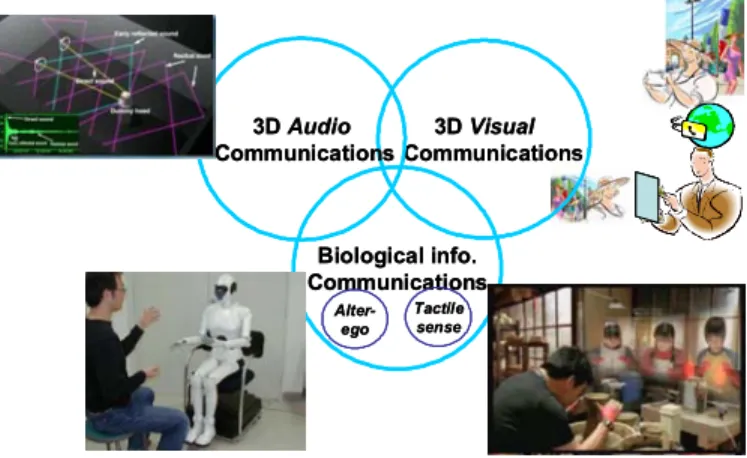
The applications, which require more advanced wireless capabilities, are discussed in [2]. In the article, three main directions for enhancing media communication reality, that is 3D audio communications, 3D visual communications and biological information communications, as shown in Figure 2, were analyzed, and as a conclusion, it is expected that the future customers will be able to full use of 1 Mbit/s to 100
Biological info. Communications Alter-ego Tactile sense 3D Visual Communications 3D Audio Communications Biological info. Communications Alter-ego Tactile sense 3D Visual Communications 3D Audio Communications
Figure 2. Three Main Targets for Enhanced-Reality Communications
2G 3G 4G Mobile Ubiquitous i-mode, SMS FOMA Mobile Multimedia Mobile Internet E-mail Web
browsing Video mailVisual phone
TV conference Personalized communications Reality communications Broadband & Ubiquitous Generation Media Services Digital Cellular
Internet High speed accessATM Network
Ultra high speed access Ubiquitous access
1990’s 2000’s 2010’s
Figure 1 Evolution of the Mobile Communications Systems
0-7803-9282-5/05/$20.00 ©2005 IEEE ICICS 2005
W2A.4
Mbit/s under the end-to-end latency of 5 msec to 50 msec as shown in Table I. This seems a reasonable motivation for discussing the necessity of the new mobile systems.
B. Requirements for 4G system
1) Broadband Wireless Access
The traffic carried by mobile communication systems until today was mainly for voice communications. The Second-Generation (2G) system, the Personal Digital Cellular (PDC)
system, introduced the i-mode services, which enabled the Internet access, electronic commerce and e-mail from mobile terminals, and mainly used for the text-based data communications. The IMT-2000 system offers high bit rate transmission service from 64 kbit/s to 384 kbit/s, and it is expected that the proportion of the amount of data traffic to the voice traffic would continue to increase. Moreover, the rising popularity of broadband services such as Asymmetric Digital Subscriber Line (ADSL) and optical fiber access systems and office or home LANs is likely to lead to a demand for comparable services in the mobile communication environment.
2) Low Cost
To make broadband services available to the user to exchange various kinds of information, it is necessary to lower charges dramatically in order to keep the cost at or below the cost of existing service. The IMT-2000 system aimed at lower bit cost and economical charge rates, however for the 4G system, a broadband channel and an even lower bit cost are both required.
3) Wide Area Coverage
One feature of mobile communications is that it is available for use anytime and anywhere. That advantage is important for future mobile communication as well. In particular, it is important to maintain the service area in which the terminals of the new system can be used during the transition from the existing system to a new system. It can be assumed that terminals that have relatively large display screens, such as Personal Digital Assistants (PDAs) or personal computers are used indoors rather than outdoors. Accordingly, better coverage of indoor service areas is needed.
4) Capable for Wide Variety of Services
Mobile communication is for various types of users. In the future, we expect to make the advanced system performance and functionality to introduce a variety of services not only the ordinary telephone service but to transfer information about the five sensual modes. Those services must be made easier for anyone to use.
C. Design Objectives
Considering that the video communications and data communications will be the main features, the 4G system must provide even higher transmission rate and higher capacity than IMT-2000. Also, considering that the video transmission quality in current broadcasting is achieved by the transmission rate of several megabits per second, the LAN transmission rates are from 10 Mbit/s to 100 Mbit/s, and the rate of ADSL is several megabits per second, the design objective is a transfer rate of about 100 Mbit/s for the outdoor mobile environment and gigabit class rates for indoors. It will not be possible to accommodate future mobile communication traffic unless a transmission capacity of at least ten times that IMT-2000 does attain as shown in Figure 4. To ensure throughput for communication between terminals and achieve highly real-time communication, it is necessary to realize the low transfer delay time of 50 ms and even lower, and low connection set up delay time of 500 ms or less. Also, assuming that the future services will be based on IP (Internet Protocol) networks, the efficient
TABLEI REQUIREMENTS FOR FUTURE NETWORKS (TENTATIVE)[1]
<10Mbps (Robotic I/F) < 1Gbps (Virtual avatar) < 100Mbps (Alter-ego existence) •Alter-ego robot <1sec < 10ms < 30ms < 5ms (Small and known jitter) Tele-existence N/A N/A <1sec <1sec Connection Latency
•Five sense sensors <50ms
< 1Mbps Five senses communications
•3D sound field control •High efficiency loud
speakers <50ms < 1 Mbps Speech/ 3D Audio •Eyeglass display •3D and multimodal UI << 50ms Should be predictable < 1Mbps Enhanced Reality
•Real time hologram <50ms 10Mbps (2D video) ~ 30Gbps (3D video) Video/ 3D video Terminal capabilities Delay Transmission speed Media <10Mbps (Robotic I/F) < 1Gbps (Virtual avatar) < 100Mbps (Alter-ego existence) •Alter-ego robot <1sec < 10ms < 30ms < 5ms (Small and known jitter) Tele-existence N/A N/A <1sec <1sec Connection Latency
•Five sense sensors <50ms
< 1Mbps Five senses communications
•3D sound field control •High efficiency loud
speakers <50ms < 1 Mbps Speech/ 3D Audio •Eyeglass display •3D and multimodal UI << 50ms Should be predictable < 1Mbps Enhanced Reality
•Real time hologram <50ms 10Mbps (2D video) ~ 30Gbps (3D video) Video/ 3D video Terminal capabilities Delay Transmission speed Media 3G Systems beyond 3G Cost 1/10 to 1/100 per bit
New service platform, which enables;
- rapid deployment of new services - easy development of new
services
Data rate:384kbps
Peak bit rate: 100Mbps with high mobility 1 Gbps in Hot-spots
System capacity
10 times higher
ATM(convergence of circuit- and packet-switched traffic)
IP-based packet in 3.5G
All - IP
-Can handle packet with various QoS requirements
Capability Performance improvements New capabilities Mobility :uniform control System control according to mobility
(the amount of control signals reduced to
1/10)
Transport:
Seamless networking among different radio access
techniques
Transmission delay Less than 50ms
For the development of new services Improvement of basic system performance Reduce of NW costs
Figure 3 Requirements for 4G system
Dat a sp e ed [b p s] 92 00 2G & 2.5G 2M 2M Peak 3G average MAX sepc. 2ndG band (800MHz PDC) 3rdG band (2GHz) 95 05 384k 2.4k PDC 9.6k PDC 28.8k PDC Packet 32k PHS PHS 2ndG band (1.9GHz PHS)
--BreakBreak--throughthroughin Radio Interfaces is needed,in Radio Interfaces is needed,
-Longer period of migrationLonger period of migrationfrom IMTfrom IMT--2000 to 2000 to systems beyond IMT
systems beyond IMT--2000 is forecasted,2000 is forecasted,
-InterInter--workworkwould be a solutionwould be a solution
10 4G 2005 in Urban area Need deployment to accommodate increasing traffic Break through W-CDMA 10M 1M 100k 10k 1k 100M 1G 64k Break through 100M – 1G Approx. 14M Super3G Reduced delay IP commonality HSDPA
transmission of IP packets between wireless terminals is also a necessity. While increased capacity is also effective in lowering bit cost, the cost per bit must be reduced to from 1/10 to 1/100 of the current levels by reduction of infrastructure equipment costs, operation costs and construction costs as well (Figure 3).
The design objectives described above aim at services that have higher performance than existing services, yet are easy to use. It is necessary to pioneer new markets, making use of the capabilities and performance of the 4G system such as integration with indoor wireless LAN and wired systems, and the implementation of a mechanism for introducing new services in a short time, etc.
III. APPROACH TO 4GSYSTEM CONFIGURATION
A. Technical Challenges
1) Technology for Implementing capacity and
High-rate Transmission
IMT-2000, which employs Wideband Code Division Multiple Access (W-CDMA), achieves a transmission rate of 2 Mbit/s with 5 MHz frequency bandwidth. Furthermore, technology for transmission at about 10 Mbit/s with the same
frequency bandwidth using multi-level adaptive modulation and demodulation is under development [3]. To achieve rates that are several times to several tens of times higher than that, it requires a new transmission systems that are suited to high-rate transmission.
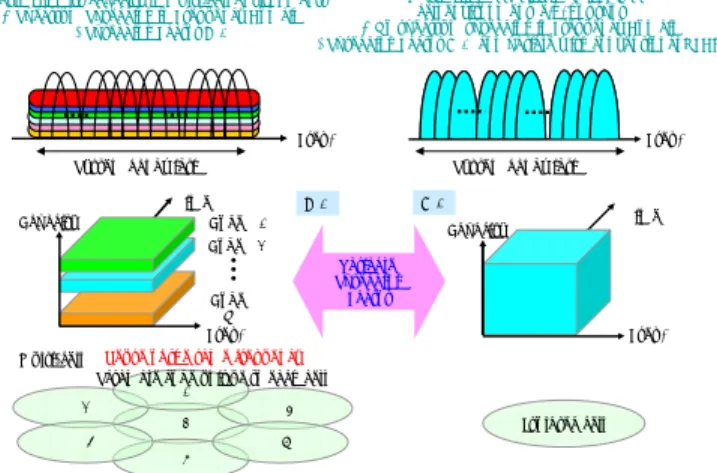
One of the candidate technologies that satisfies the requirements is Variable Spreading Factor Orthogonal Frequency and Code Division Multiplexing (VSF-OFCDM) [4], which is based on multi-career CDMA technologies with the variable spreading factor scheme for increasing the system capacity shown in Figure 5. The biggest advantage of the VSF-OFCDM is its flexibility in the spreading factor. When it is applied to isolated hot spots, we can achieve its highest capacity by choosing a spreading factor of one to be compatible with conventional OFDM. On the other hand, it works as a kind of CDMA with a spreading factor higher than one under multi-cell environments to enable the same frequency reuse. Then, a single air interface of VSF-OFCDM realizes capabilities of OFDM and CDMA in an adaptive manner according to environments. It was reported that success in 1 Gbps real-time packet in-lab transmission experiments in combination with MIMO technology was confirmed in Aug. 2004 [5], and also reported that the success of 1 Gbps real-time packet field transmission experiment was confirmed in June 2005 [6].
2) Technologies for Cost Reduction
The use of higher frequency band to achieve higher transmission rate with conventional system configuration technology generally reduces the radius of the cell that one base station can cover. To retain the original coverage area, more base stations are required and network cost is increased. To avert that problem, it is necessary to expand cell radii by means of higher performance radio transmission and circuit technology, such as improved modulation/demodulation techniques that can cope with low S/N, the use of adaptive array antennas, and low noise receivers. There is also a need to study diversified entrance links that connect base stations to the backbone network, autonomous base station control technology and multi-hop radio connection technology that employs simple relay stations, for further reduction in the costs of system construction and operation.
3) System Interconnection Technology Based on IP
Networking
When a new system is first introduced, it is generally difficult to fulfill the service area to the extent of the existing system. However, by implementing a terminal that has the capabilities of both the new system and the existing system, it is possible to cover both areas. Also, giving consideration to international roaming, a terminal that can be configured to work with multiple systems based on Software Defined Radio (SDR) technology is an effective way to cope with periods of system introduction and operating frequency bands that differ from country to country and region to region. Furthermore, future mobile communication services will be provided with interconnection and integrated with heterogeneous access technologies, including wired and indoor area, access based on IP networks. Accordingly, interconnection and handover
Isolated cell Variable Spreading Factor = 1 Capacity Freq. Time > 1 Freq. Time
zMaximizing capacity in an isolated cell environment, e.g. hot spot ⇒No spectrum spreading in Frequency Domain - Spreading Factor = 1, compatible with conventional OFDM
#3 #6 #2 #5 #4 #7 #1
Reuse of the same frequency
System bandwidth Freq. Code #1 Code #2 Code #N
zMaximizing its capacity in multi-cell environments ⇒Spectrum Spreading in Frequency Domain
- Spreading Factor > 1
Freq. System bandwidth
Multi-cell
Capacity
Scramble code unique to each cell
Figure 5 Variable Spreading Factor Orthogonal Frequency and Code Division Multiplexing (VSF-OFCDM)
Base Station Equipment Mobile Equip.
on vehicle Sector #1 Sector #2 NTT Kinugasa building (別館) Sector Kinugasa NTT Yokosuka branch building
Macro Diversity among multiple cells - Hand-over tests
Macro Diversity among multipe sectors -Hand-over tests
¾Basic Radio Access Tests;
Downlink: VSF-OFCDM Uplink: VSCRF-CDMA
- Test on targeted throughput Downlink : More than 100Mbps,
Uplink: more than 20 Mbps - Coverage aspects tests
¾Feasibility tests on key technologies in Transmission and MAC layers
¾Propagation measuring campaign
Field trials of broadband mobile access in Yokosuka-city, Japan
Figure 6 Field Experiment for VSF-OFDM
between such various access systems are required in addition to handover and roaming within one mobile communication system.
IV. STANDARDIZATION ACTIVITIES
A. Activities in ITU-R
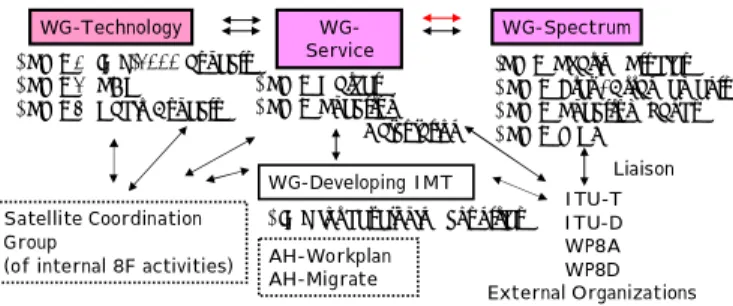
After the successful development of the IMT-2000 standards, the International Telecommunication Union (ITU) began research on the future development of IMT-2000 and systems beyond IMT-2000, and the Study Group 8 Working Party 8F (WP8F) was established in November 1999. At the World Radiocommunication Conference -2000 (WRC-2000) held in Istanbul in June 2000, ITU-R resolved to conduct research on the future systems, including spectrum requirements, to investigate the research situation at WRC-2003 and to review spectrum requirements at subsequent WRCs. As the first step, the ITU-R WP8F formulated a recommendation M.1645 [7] regarding the future vision to give direction to the future technological developments. The recommendation was approved at the February 2003 meeting of SG8. WP8F is currently studying spectrum related matters for systems beyond IMT-2000 in preparation for WRC-07 to be held in 2007 (Figure 7).
The ultimate goals set in the recommendation M.1645 were the system for anytime, for anywhere and for anyone. The systems beyond IMT-2000 has extended and enhanced capabilities to IMT-2000, which includes, “higher data rates,” “improved roaming,” and “true inter-system mobility management.” It is also expected that the greater flexibility to support many different types of services simultaneously (examples: symmetrical, asymmetrical & unidirectional services) should be possible [8].
The recommendation also analyzes the necessary data transmission rates. As the IMT-2000 original minimum requirements for radio technology evaluation were “144 kbit/s for vehicular high speed,” “384 kbit/s for medium speed,” and “2048 kbit/s for indoor and low speed.” However, currently the
IMT-2000 standards already support up to 10 Mbit/s, and further enhancements are being developed, possibly up to 30 Mbit/s by around 2005. So, the research targets for systems beyond IMT-2000 for deployment after 2010 were set as “100 Mbit/s for high mobility,” and “1 Gbit/s for low mobility,” as shown in Figure 8.
B. Activities in Japan
In Japan, in 2001, the committee of future mobile communication systems produced an action plan to realize the mobile IT environments, in response to the inquiry by the Minister of the Ministry of the Public Management, Home Affairs, Posts and Telecommunications(MPHPT: currently, Ministry of Internal Affairs and Communications(MIC)). This report analyzes the trend of mobile communication in the 21st century, presents a basic concept of future mobile communication systems, and shows a comprehensive strategy for promoting future mobile communication systems [9]. This report was the starting points for the discussion of systems beyond IMT-2000 in Japan.
Then, based on the report from the committee the mobile IT Forum (mITF) [10] was established in June 2001. In 2003, the forum completed a document named “Flying Carpet” [11], which envisions the future mobile society. This report identifies future applications and their requirements from the viewpoints of business, users, and social systems. It also identifies high level system requirements for the future mobile systems. The contents of this report have been used for the Japanese proposals to ITU-R through contribution documents, parts of which were included in the ITU-R Recommendation M.1645. Now, mITF is developing a reference model for future mobile systems, and also developing a new spectrum calculation methodology, part of which was proposed to WP8F.
The preparation group for WP8F in Japan is in the Association of Radio Industry and Businesses (ARIB), one of the standards development organizations (SDOs) in telecommunications. The group consists of members, mainly from mobile operators and manufacturers around the world. The group drafts Japanese contributions to ITU-R WP8F and examines other ITU-R contributions submitted to ITU-R from other ITU-R Members. The group is now preparing an answer to the questionnaires on market and services for future development of IMT-2000 and systems beyond IMT-2000, from WP8F. The group is also developing a spectrum calculation methodology in collaboration with the mITF Forum. C. Other Activities
The Wireless World Research Forum (WWRF), an organization of mainly European vendors, is also producing research results concerning a future vision for wireless communication [6], and new research projects are being organized on the basis of those results. Also, the 3rd Generation Partnership Project (3GPP), which created the IMT-2000 standard specifications through international cooperation, has produced a road map for future functional extension of IMT-2000. That road map includes study of a WG-Technology
Satellite Coordination Group
(of internal 8F activities)
WG-Service WG-Spectrum
WG-Developing IMT Liaison
ITU-T ITU-D WP8A WP8D External Organizations - SWG Market - SWG Spectrum Calculation - SWG1 (IMT-2000 aspects) - SWG2 (SDR) - SWG3 (Radio Aspects) -SWG Sharing Studies - SWG Freq. Arrangements - SWG Spectrum bands - SWG WRC AH-Workplan AH-Migrate
- IMT for developing countries
Figure 7 Structure of WP8F IMT-2000 Mobility Low High Enhanced IMT-2000 Enhancement IMT-2000 Mobility Low High
Area Wireless Access
Enhanced IMT-2000 Enhancement
New Nomadic / Local
Systems beyond IMT-2000 will encompass the
capabilities of previous
systems New capabilities of systems beyond
New Mobile Access
Dashed line indicates that the exact data rates associated with systems beyond
IMT-2000 are not yet determined Rec. ITU-R M.1645
schedule for functional extension according to the ITU-R vision recommendation.
V. CONCLUSION
This paper reported the 4G system objectives including potential applications and system requirements, technical challenges, and related standardization activities. Through the discussion, it has been revealed that the major feature of the 4G system capability should be its ultra high speed IP packet transmission with reduced delay to meet a variety of requirements derived from the two-way enhanced reality communications such as 3D-audio, 3D-video, and biological information media world.
It was also described that our technical challenges in radio communication fields are likely to provide breakthrough candidates to realize the above features. The local and international standardization activities indicate a global strong support toward this 4G direction.
ACKNOWLEDGEMENT
We would like to give our thanks to all the fellows in NTT DoCoMo Wireless Labs and Multimedia Labs for their fruitful suggestions and discussions.
REFERENCES
[1] http://www.itu.int/home/imt.html
[2] T. Ohya and T. Miki, “Enhanced Reality Multimendia Communications
for 4G Mobile Networks,” The First International Conference on Multimedia Services Access Networks (MSAN) 2005, Olrand, U.S.A., June 2005.
[3] F. Adachi and M Uesugi, “Latest Trends in CDMA Technology,” IEICE
Journal. Vol. 86, No.2, pp. 96-102, 2003
[4] M. Sawahashi, S. Abeta, H. Atarashi, K. Higuchi, M. Tanno and T. Ihara,
“Broadband Packet Wireless Access,” NTT DoCoMo Technical Journal, Vol. 11, No. 2, Jul., 2003.
[5] http://www.nttdocomo.com/presscenter/pressreleases/press/pressrelease.
html?param[no]=512
[6] http://www.nttdocomo.com/presscenter/pressreleases/press/pressrelease.
html?param[no]=564
[7] ITU-R Recommendation M.1645, “Framework and overall objectives of
the future development of IMT-2000 and systems beyond IMT-2000,” 2003.
[8] C. Cooke, “Systems beyond IMT-2000,” ITU-R SG8 Seminar, 9th
September, 2004
[9] http://www.soumu.go.jp/joho_tsusin/policyreports/joho_tsusin/bunkakai
/abstract.pdf (in Japanese)
[10] http://www.mitf.org/index_e.html
[11] http://www.mitf.org/public_e/archives/Flying_Carpet_Ver200.pdf
![TABLE I R EQUIREMENTS FOR F UTURE N ETWORKS (T ENTATIVE ) [1]](https://thumb-us.123doks.com/thumbv2/123dok_us/9817966.2474127/2.918.45.433.114.861/table-equirements-for-uture-etworks-entative.webp)