Helios: Web-based Open-Audit Voting
Ben Adida
ben [email protected]
Harvard University
Abstract
Voting with cryptographic auditing, sometimes called open-audit voting, has remained, for the most part, a the-oretical endeavor. In spite of dozens of fascinating pro-tocols and recent ground-breaking advances in the field, there exist only a handful of specialized implementations that few people have experienced directly. As a result, the benefits of cryptographically audited elections have remained elusive.
We present Helios, the first web-based, open-audit voting system.Heliosis publicly accessible today: any-one can create and run an election, and any willing ob-server can audit the entire process.Heliosis ideal for on-line software communities, local clubs, student govern-ment, and other environments where trustworthy, secret-ballot elections are required but coercion is not a serious concern. WithHelios, we hope to expose many to the power of open-audit elections.
1 Introduction
Over the last 25 years, cryptographers have developed election protocols that promise a radical paradigm shift: election results can be verified entirely by public ob-servers, all the while preserving voter secrecy. These protocols are said to provide two properties:ballot cast-ing assurance, where each voter gains personal assur-ance that their vote was correctly captured, anduniversal verifiability, where any observer can verify that all cap-tured votes were properly tallied. Some have used the term “open-audit elections” to indicate that anyone, even a public observer with no special role in the election, can act as auditor.
Unfortunately, there is a significant public-awareness gap: few understand that these techniques represent a fundamental improvement in how elections can be au-dited. Even voting experts who recognize that open-audit elections are “the way we’ll all vote in the future” seem
to envision adistantfuture, not one we should consider for practical purposes yet. The few implementations of open-audit elections that do exist [3, 2] have not had as much of an impact as hoped, in large part because they require special equipment and an in-person experience, thus limiting their reach.
We present Helios, a web-based open-audit voting system. Using a modern web browser, anyone can set up an election, invite voters to cast a secret ballot, com-pute a tally, and generate a validity proof for the entire process. Heliosis deliberately simpler than most com-plete cryptographic voting protocols in order to focus on the central property ofpublic auditability: any group can outsource its election toHelios, yet, even if Heliosis fully corrupt, the integrity of the election can be verified.
Low-Coercion Elections. Voting online or by mail is typically insecure in high-stakes elections because of the coercion risk: a voter can be unduly influenced by an at-tacker looking over her shoulder. Some protocols [13] attempt to reduce the risk of coercion by letting voters override their coerced vote at a later (or earlier) time. In these schemes, the privacy burden is shifted from vote casting to voter registration. In other words, no matter what,some truly private interactionis required for coer-cion resistance.
WithHelios, we do not attempt to solve the coercion problem. Rather, we posit that a number of settings— student government, local clubs, online groups such as open-source software communities, and others—do not suffer from nearly the same coercion risk as high-stakes government elections. Yet these groups still need voter secrecy and trustworthy election results, properties they cannot currently achieve short of an in-person, physically observable and well orchestrated election, which is often not a possibility. We producedHeliosfor exactly these groups with low-coercion elections.
Trust no one for integrity, trust Heliosfor privacy. In cryptographic voting protocols, there is an inevitable compromise: unconditional integrity, or unconditional privacy. When every component is compromised, only one of those two properties can be preserved. In this work, we hold the opinion that the more important prop-erty, the one that gets people’s attention when they under-stand open-audit voting, is unconditional integrity: even if all election administrators are corrupt, they cannot con-vincingly fake a tally. With this design decision made, privacy is then ensured by recruiting enough trustees and hoping that a minimal subset of them will remain honest. In the spirit of simplicity, and because it is difficult to explain to users how privacy derives from the acts of multiple trustees,Heliostakes an interesting approach: there is only one trustee, theHeliosserver itself. Pri-vacy is guaranteed only if you trustHelios. Integrity, of course, does not depend on trustingHelios: the election results can be fully audited even if all administrators – in this case the single Helios sever – is corrupt. Future versions ofHeliosmay support multiple trustees. How-ever, exhibiting the power of universal verifiability can be achieved with this simpler setup.
Our Contribution. In this work, we contribute the software design and an open-source, web-based imple-mentation ofHelios, as well as a running web site that anyone can use to manage their elections at http: //heliosvoting.org. We do not claim any cryp-tographic novelty. Rather, our contribution is a combina-tion of existing Web programming techniques and cryp-tographic voting protocols to provide the first truly acces-sible open-audit voting experience. We believeHelios
provides a unique opportunity to educate people about the value of cryptographic auditability.
Limitations. While every major feature is functional,
Heliosis currently alpha software. As such, it requires Firefox 2 (or later). In addition, some aspects of the user interface, especially for administrative tasks, require sig-nificant additional polish and better user feedback on er-ror. These issues are being actively addressed.
This Paper. In Section 2, we briefly review theHelios
protocol, based on the Benaloh vote-casting approach [5] and the Sako-Kilian mixnet [16]. In Section 3, we cover some interesting techniques used to implementHeliosin a modern Web browser. Section 4 covers the specifics of theHeliossystem and its use cases. We discuss, in Sec-tion 5, the security model, some performance metrics, and features under development. We reference related work in Section 6 and conclude in Section 7.
2
Helios
Protocol
This section describes the Helios protocol, which is most closely related to Benaloh’s Simple Verifiable Vot-ing protocol [5], which itself is partially inspired by the Sako-Kilian mixnet [16]. We claim no novelty, we only mean to be precise in the steps taken by voters, adminis-trators, and auditors, and we mean to provide enough de-tails for an able programmer to re-implement every por-tion of this protocol.
2.1 Vote Preparation & Casting
The key auditability feature proposed by Benaloh’s Sim-ple Verifiable Voting is the separation of ballot prepara-tion and casting. A ballot for an elecprepara-tion can be viewed and filled in by anyone at any time, without authentica-tion. The voter is authenticated only atballot casting time. This openness makes for increased auditability, sinceanyone, including an auditor not eligible to vote (e.g. someone from a political organization who has al-ready voted), can test the ballot preparation mechanism. The process is as follows between Alice, the voter, and the Ballot Preparation System (BPS):
1. Alice begins the voting process by indicating in which election she wishes to participate.
2. The BPS leads Alice through all ballot questions, recording her answers.
3. Once Alice has confirmed her choices, the BPS en-crypts her choices and commits to this encryption by displaying a hash of the ciphertext.
4. Alice can now choose toauditthis ballot. The BPS displays the ciphertext and the randomness used to create it, so that Alice can verify that the BPS had correctly encrypted her choices. If this option is se-lected, the BPS then prompts Alice to generate a new encryption of her choices.
5. Alternatively, Alice can choose toseal her ballot. The BPS discards all randomness and plaintext in-formation, leaving only the ciphertext, ready for casting.
6. Alice is then prompted to authenticate. If success-ful, the encrypted vote, which the BPS committed to earlier, is recorded as Alice’s vote.
Because we worry little about the possibility of co-ercion,Helioscan be simpler than the Benaloh system that inspired it. Specifically, the BPS does not sign the ciphertext before casting, and we do not worry about Al-ice seeing the actual hash commitment of her encrypted vote before sealing. (The subtle reasons why these can lead to coercion are explained in [6].)
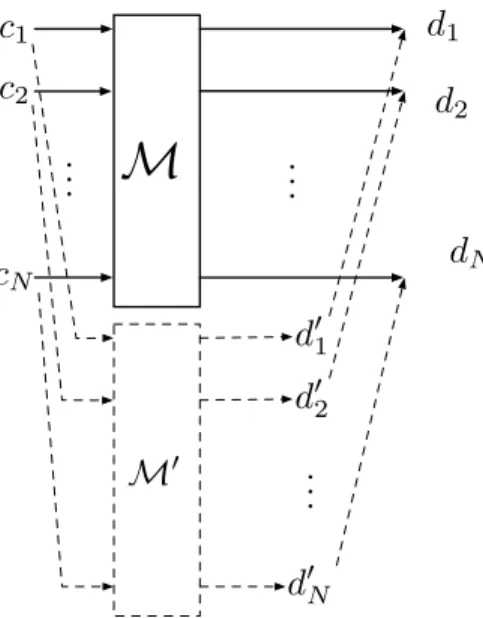
M
�.
.
.
.
.
.
.
.
.
M
c
1c
2c
Nd
1d
2d
Nd
� Nd
� 2d
� 1Figure 1: The “Shadow-Mix” Shuffle Proof. The mix server creates a secondary mix. If challenged with bit0, it reveals this
secondary mix. If challenged with bit1, it reveals the “differ-ence” between the two mixes.
Shamir heuristic [9]: the challenge bits are computed as the hash of all shadow mixes. Note how this approach is only workable if we have enough shadow mixes to pro-vide an overwhelming probability of integrity: if there is a non-negligible probability of cheating, a cheating prover can produce many shadow mixes until it finds a set whose hash provides just the right challenge bits to cheat.
Proof of Decryption. Once an El Gamal cipher-text is decrypted, this decryption can be proven using the Chaum-Pedersen protocol [8] for proving discrete-logarithm equality. Specifically, given a ciphertextc = (α, β)and claimed plaintext m, the prover shows that logg(y) =logα(β/m):
• The prover selectsw∈Zqand sendsA=gw, B=
αwto the verifier.
• The verifier challenges withc∈Zq.
• The prover responds witht=w+xc.
• The verifier checks that gt = Ayc and αt =
B(β/m)c.
It is clear that, givencandt,AandBcan be easily com-puted, thus providing for simulated transcripts of such proofs indicating Honest-Verifer Zero-Knowledge. It is also clear that, if one could rewind the protocol and ob-tains prover responses for two challenge values against
the sameAandB, the value ofxwould be easily solv-able, thus indicating that this is a proof of knowledge of the discrete log and thatlogg(y) =logα(β/m).
As this protocol is HVZK with overwhelming proba-bility of catching a cheating prover, it can be transformed safely into non-interactive form using the Fiat-Shamir heuristic. We do exactly this in Heliosto provide for non-interactive proofs of decryption that can be posted publicly and re-distributed by observers.
2.4 The Whole Process
The entireHeliosprotocol thus unfolds as follows: 1. Alice prepares and audits as many ballots as she
wishes, ensuring that all of the audited ballots are consistent. When she is satisfied, Alice casts an en-crypted ballot, which requires her to authenticate. 2. TheHeliosbulletin board posts Alice’s name and
encrypted ballot. Anyone, including Alice, can check the bulletin board and find her encrypted vote posted.
3. When the election closes, Helios shuffles all en-crypted ballots and produces a non-interactive proof of correct shuffling, correct with overwhelming probability.
4. After a reasonable complaint period to let auditors check the shuffling, Helios decrypts all shuffled ballots, provides a decryption proof for each, and performs a tally.
5. An auditor can download the entire election data and verify the shuffle, decryptions, and tally. If an election is made up of more than one race, then each race is treated as a separate election: each with its own bulletin board, its own independent shuffle and shuf-fle proof, and its own decryptions. This serves to limit the possibility of re-identifying voters given long ballots where any given set of answers may be unique in the set of cast ballots.
3 Web Components
We have clearly stated thatHeliosvalues integrity first, and voter privacy second. That said,Heliosstill takes great care to ensure voter privacy, using a combination of modern Web programming techniques. Once the bal-lot is loaded into the browser, all candidate selections are recorded within the browser’s memory, without any fur-ther network calls until the ballot is encrypted and the plaintext is discarded. In this section, we cover the Web components we use to accomplish this goal.
3.1 Single-Page Web Application
A number of Web applications today are called “single-page applications” in that the “single-page context and its URL never change. Gmail [10] is a prime example: clicks cause background actions rather than full-page loads. The technique behind this type of Web application is the use of JavaScript to handle user clicks:
<a onclick="do_stuff()" href="#">Do Stuff</a>
When a user clicks the “Do Stuff” link, no new page is loaded. Instead, the JavaScript functiondo stuff()
is invoked. This function may make network requests and update the page’s HTML, but, importantly, the page context, including its JavaScript scope, is preserved.
For our purposes, the key point is that, if all necessary data is pre-loaded, thedo stuff() function may not need to make any network calls. It can update some of its scope, read some of its pre-loaded data, and update the rendered HTML user interface accordingly. This is precisely the approach we use for our ballot preparation system: the browser loads all election parameters, then leads the voter through the ballot without making any additional network requests.
The jQuery JavaScript Library. Because we ex-pect auditors to take a close look at our browser-based JavaScript code, it is of crucial importance to make this code as concise and legible as possible. For this purpose, we use the jQuery JavaScript library, which provides flexible constructs for accessing and updating portions of the HTML Document Object Model (DOM) tree, ma-nipulating JavaScript data structures, and making asyn-chronous network requests (i.e. AJAX). An auditor is then free to compare the hash of the jQuery library we distribute with that of the official distribution from the jQuery web site.
JavaScript-based Templating. Also important to the clarity of our browser-based code is the level of inter-mixing of logic and presentation: when all logic is im-plemented in JavaScript, it is tempting to intermix small bits of HTML, which makes for code that is particularly difficult to follow. Instead, we use the jQuery JavaScript Templating library. Then, we can bind a template to a portion of the page as follows:
$("#main").setTemplateURL( "/templates/election.html" );
which connects to an HTML template with variable placeholders:
<p>
The election hash is {$T.election.hash}. </p>
The code can, at a later point, render this template with a parameter andwithoutany additional network access:
$("#main").processTemplate( {’election’: election_object} );
3.2 Cryptography in the Browser with
LiveConnect
JavaScript is a complete programming language in which it is possible to build a multi-precision integer library. Unfortunately, JavaScript performance for such compu-tationally intensive operations is poor. Thankfully, it is possible in modern browsers to access the browser’s Java Virtual Machine from JavaScript using a technology called LiveConnect. This is particularly straightforward in Firefox, where one can write the following JavaScript code:
var a = new java.math.BigInteger(42); document.write(a.toString());
and then, from JavaScript still, invoke all of Java’s
BigIntegermethods directly on the object. Modu-lar exponentiation is a single call,modPow(), and El-Gamal encryption runs fast enough that it is close to im-perceptible to the average user. LiveConnect is slightly more complicated to implement in Internet Explorer and Safari, though it can be done [18].
3.3 Additional Tricks
Data URIs. At times in theHeliosprotocol, we need to produce a printable receipt when the plaintext vote has not yet been cleared from memory. In order to open a new window ready for printing without network access, we use data URIs [14], URIs that contain information without requiring a network fetch:
<a target="_new"
href="data:text/plain,Your%20Receipt..."> receipt
Dynamic Windows. When data URIs are not available (e.g. Internet Explorer), we can open a new window us-ing JavaScript, set its MIME type totext/plain, and dynamically write its content from the calling frame.
var receipt = window.open();
receipt.document.open("text/plain"); receipt.document.write(content); receipt.document.close();
In Safari and Firefox, this approach yields a new window in a slightly broken state: the contents cannot be saved to disk. However, in Internet Explorer, the only browser that does not support Data URIs, the dynamic window creation works as expected. Thus, in Firefox and Safari,
Heliosuses Data URIs, and in Internet Explorer it uses dynamic windows.
JSON. As we expect that auditors will want to down-load election, voter, and bulletin board data for pro-cessing and verifying, we need a data format that is easy to parse in most programming languages, includ-ing JavaScript. XML is one possibility, but we found that JavaScript Object Notation (JSON) is easier to han-dle with far less parsing code. JSON allows for data rep-resentation using JavaScript lists and associative arrays. For example, a list of voters and their encrypted votes can be represented as:
[
{’name’ : ’Alice’, ’vote’ : ’23423....’},
{’name’ : ’Bob’, ’vote’ : ’823848....’}, ...
]
Libraries exist in all major programming languages for parsing and generating this data format. In particular, the format maps directly to arrays and objects in JavaScript, lists and dictionaries in Python, lists and hashes in Ruby.
4
Helios
System Description
We are now ready to discuss the details of theHelios sys-tem. We begin with a description of the back-end server architecture. We then consider the four use cases: creat-ing an election, votcreat-ing, tallycreat-ing, and auditcreat-ing.
4.1 Server Architecture
TheHeliosback-end is a Web application written in the Python programming language [17], running inside the CherryPy 3.0 application server, with a Lighttpd web server. All data is stored in a PostgreSQL database.
All server-side logic is implemented in Python, with HTML templates rendered using the Cheetah Templat-ing engine. Many back-end API calls return JSON data structures using the Simplejson library, and the voting booth server-side template is, in fact, a single-page web applications including JavaScript logic and jTemplate HTML/JavaScript templates.
Application Software. We use the Python Cryptogra-phy Toolkit for number theory utilities such as prime number and random number generation. We imple-mented our own version of El-Gamal in Python, given our specific need for re-encryption, which is typically not supported in cryptographic libraries. We note that improved performance could likely be gained from opti-mizing our first-pass implementation.
Server Hardware. We host an alpha version of the
Helios software at http://heliosvoting.org. The server behind that URL is a virtual Ubuntu Linux server operated by SliceHost. For the tests performed in Section 5.3, we used a small virtual host with 256 megabytes of RAM and only a fraction of a Xeon proces-sor, at a cost of $20/month. A larger virtual host would surely provide better performance, but we wish to show the practicality ofHelioseven with modest resources.
4.2 Creating an Election
Only registeredHeliosusers can create elections. Reg-istration is handled like most typical web sites:
• a user enters an email address, a name, and a desired
password.
• an email with an embedded confirmation link is sent to the given email address.
• the user clicks on the confirmation link to activate his account.
A registered user then creates an election with an elec-tion name, a date and time when voting is expected to begin, and a date and time when voting is expected to end. Upon creation,Heliosgenerates and stores a new El-Gamal keypair for the election. Only the public key is available to the registered user:Helioskeeps the private key secret. The user who created the election is consid-ered theadministrator.
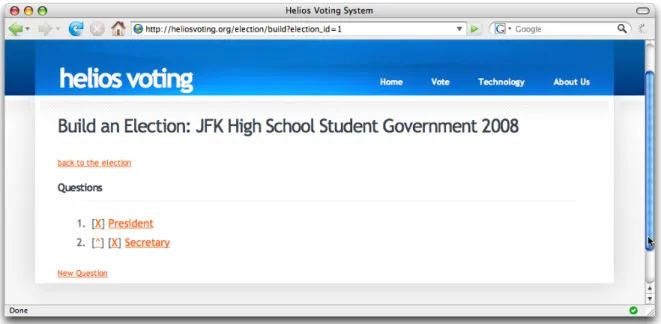
Setting up the Ballot. The election is then in “build mode,” where the ballot can be prepared, reviewed, and tweaked by the administrative user, as shown in Figure 2. The user can log back in over multiple days to adjust any aspect of the ballot.
Figure 2:The Helios Election Builder lets an administrative user create and edit ballot questions in a simple web-based interface. The administrative user can log out and back in at any time to update the election.
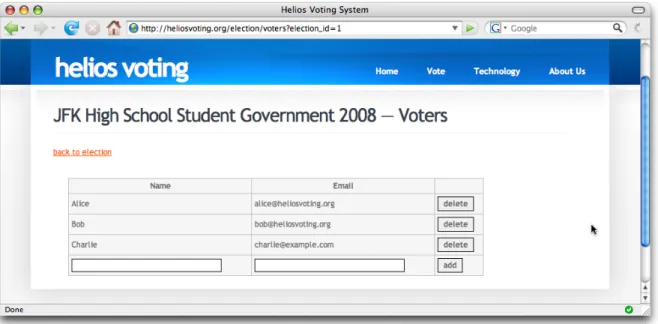
Managing Voters. The administrative user can add, update, and remove voters at will, as shown in Figure 3. A voter is identified by a name and an email address, and is specific to a given election. Heliosgenerates a ran-dom 10-character password automatically for each voter. At any time, the administrator can email voters using the
Heliosadministrative interface. These emails will au-tomatically contain the voter’s password, though the ad-ministrator will not see this password at any time. Freezing the Election. When ready, the administrative userfreezes the election, at which point the voter list, the election start and end dates, and the ballot details become immutable and available for download in JSON form. The administrative user receives an email fromHelios
with the SHA1 hash of this JSON object. The election is ready for voters to cast ballots. The administrative user will typically email voters using theHelios administra-tive interface to let them know that the polls are open.
4.3 Voting
Alice, a voter in aHelioselection, receives an email let-ting her know that the polls are open. This email con-tains her username (i.e. her email address), her election-specific password, the SHA1 hash of the election param-eters, and the URL that directs her to theHeliosvoting booth, as illustrated in Figure 4. It is important to note that this URL does not contain any identifying informa-tion: it only identifies the election, as per the vote-casting protocol in Section 2.1.
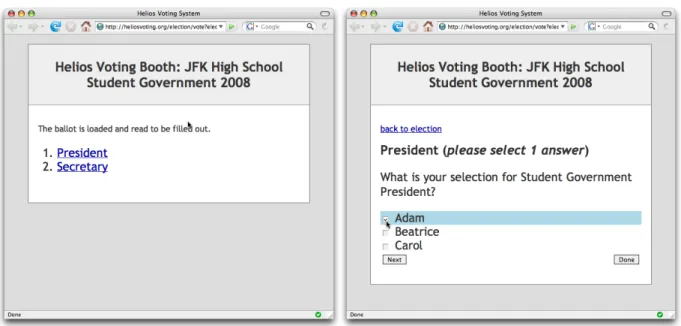
The Voting Booth. When Alice follows the voting booth URL, Helios responds with a single-page web application. This application, now running in Alice’s browser, displays a “loading...” message while it down-loads the election parameters and templates, including the El-Gamal public key and questions. The page then displays the election hash prominently, and indicates that no further network connections will be made until Alice submits her encrypted ballot. (Alice can set her browser to “offline” mode to enforce this.) Every transition is then handled by a local JavaScript function call and its associated templates. Importantly, the JavaScript code can decide precisely what state to maintain and what state to discard: the “back” button is not relevant. This is illustrated in Figure 5.
Filling in the Ballot. Alice can then fill in the bal-lot, selecting the checkbox by each desired candidate name, using the “next” and “previous” buttons to nav-igate between questions. Each click is handled by JavaScript code which records Alice’s choices in the lo-cal JavaScript scope. If Alice tries to close her browser or navigate to a different URL, she receives a warning that her ballot will be cleared.
Sealing. After Alice has reviewed her options, she can choose to “seal” her ballot, which triggers the JavaScript code to encrypt her selection with computationally inten-sive operations performed via LiveConnect. The SHA1 hash of the resulting ciphertext is then displayed, as shown in Figure 6.
Figure 3:The Helios voter management interface.
Figure 4:The administrative user can send emails to all voters. Each voter receives her password, which the administrative user does not see.
Figure 5:The Helios Voting Booth.
Auditing. Alice can opt to audit her ballot with the “Audit” button, in which case the JavaScript code reveals the randomness used in encrypting Alice’s choices. Alice can save this data to disk and run her own code to ensure the encryption was correct, or she can use the Python Ballot Encryption Verification (BEV) program provided byHelios.
Once Alice chooses to audit her ballot and the audit-ing information is rendered, the JavaScript code clears its encrypted ballot data structures and returns Alice to the confirmation screen, where she can either update her choices or choose to seal her options again with different randomness and thus a different ciphertext.
Casting. If Alice chooses instead to cast her ballot, the JavaScript code clears the plaintext and randomness from its scope, and presents Alice with a login prompt for her email address and password. (If Alice had set her browser to “offline” mode, she should bring it back on-line now that all plaintext information is cleared.) When Alice submits her login information, the JavaScript code intercepts the form submission and submits the email, password, and encrypted vote in a background call, so that any errors, e.g. a mistyped password, can be re-ported without clearing the JavaScript scope and thus the encrypted ballot. When a success code is returned by theHeliosserver, the JavaScript code can clear its entire scope and display a success message. On the server side,
Heliosemails Alice with a confirmation of her encrypted vote, including its SHA1 hash.
Coerce Me! As explained in Section 2, Helios pro-vides a “Coerce Me!” button to make it clear that online voting is inherently coercible. This button appears af-ter ballot sealing, next to the “audit” and “cast” options. When clicked, Heliosopens up a new window with a
mailto:URL that triggers Alice’s email client to open a composition window containing the entire ballot infor-mation, including plaintext and randomness that prove how the ciphertext was formed. Unlike the “Audit” step, which forces Alice to create a new ciphertext, “Coerce Me!” allows Alice to continue and cast that very same encrypted vote for which she obtained proof of encryp-tion. The distinction between these two steps highlights the difference between a coercion-free auditing process that could potentially be used with in-person voting, and the inherent coercibility of online-only voting which is made more explicit with the “Coerce Me!” button.
4.4 Anonymization
Once the voting period ends, Helios enables the anonymization, decryption, and proof features for the administrative user. Selecting “shuffle” will begin the
re-encryption and permutation process. Then, select-ing “shuffle proof” will trigger the mixnet proof with 80 shadow mixes. The administrative user can then opt for “decrypt”, which will decrypt the shuffled ciphertexts, and “decrypt proof”, which will generate proofs for each such decryption. Finally, the administrative user can se-lect “tally” to count up the decrypted votes.
All of these operations are performed on the server side, in Python code. The results are stored in the database and made available for download in JSON form. Once all proofs are generated and the result is tallied, the server deletes the permutation, randomness, and se-cret key for that election. All that is left is the encrypted votes, their shuffling, the resulting decryptions, and the publicly verifiable proofs of integrity. The entire elec-tion can still be verified, though no further proofs can be generated.
4.5 Auditing
Heliosprovides two verification programs, one for ver-ifying a single encrypted vote produced by the ballot preparation system with the “audit” option selected, and another for verifying the shuffling, decryption, and tally-ing of an entire election. Both programs are written in Python using the Simplejson library for JSON process-ing, but otherwise only raw Python operations.
Verifying a Single Vote. The Ballot Encryption Veri-fication program takes as input the JSON data structure returned by the voting booth audit process. This data structure contains a plaintext ballot, its ciphertext, the randomness used to encrypt it, and the election ID. The program downloads the election parameters based on the election ID and outputs:
• the hash of the election, which the voter can check against that displayed by the voting booth,
• the hash of the ciphertext, which the voter can check against the receipt she obtained before requesting an audit,
• the verified plaintext of the ballot.
Verifying an Election. The Election Tallying Verifica-tion program takes, as input, an elecVerifica-tion ID. It down-loads the election parameters, the bulletin board of cast votes, shuffled votes, shuffle proofs, decrypted votes, and decryption proofs. The verification program checks all proofs, then re-performs the tally based on the decryp-tions. It eventually outputs the list of voters and their re-spective encrypted ballot hashes, plus the verified tally. This information can be reposted by the auditor, so that
if enough auditors check and re-publish the cast ballot hashes and tally, participants can be confident that their vote was correctly captured, and that the tally was cor-rectly performed.
5 Discussion
Heliosis simpler than most cryptographic voting proto-cols because it focuses on proving integrity. As a com-promise,Heliosmakes weaker guarantees of privacy. In this section, we review in greater detail the type of elec-tion for which we expect this compromise to be appropri-ate, as well as the security model, performance metrics, and future extensions we can make to improveHelioson both fronts.
5.1 The Need for Verifying Elections with
Low Coercion Risk
It is legitimate to question whether there truly exist elec-tions that require the high levels of verifiability afforded by cryptography, while eschewing coercion-resistance altogether. In fact, we believe that, for a number of on-line communities that rarely or never meet in the same physical place:
1. coercion-resistance is futile from the start, given the remote nature of the voting process, and
2. cryptographic end-to-end verifiability is theonly vi-able means of ensuringanylevel of integrity. Specifically, with respect to the auditing argument, how could a community member remotely verify any-thing at all pertaining to the integrity of an election pro-cess? Open-source software is insufficient: the voter doesn’t knowwhichsoftware is actually running on the election server, short of deploying hardware-rooted attes-tation. Physical observation of a chain-of-custody pro-cess is already ruled out by the online-only nature of the community. Cryptographic verifiability, though it seems stronger than absolutely necessary, is the only viable option when only the public inputs and outputs—never the “guts”—of the voting process can be truly observed. Cryptographic auditing may be a big hammer, but it is the only hammer.
For the same reason, we believe the pedagogical value of a system likeHeliosis particularly strong. The con-trast between classic and open-audit elections is partic-ularly apparent in this online setting. WithHelios, the voter’s ability is transformed, from entirely powerless and forced to trust a central system, to empowered with the ability to ensure that one’s vote was correctly cap-tured and tallied, without trusting anyone.
5.2 Security Model & Threats
We accept the risk that, if someone compromises the He-liosserver before the end of an election, the secrecy of individual ballots may be compromised. On the other hand, we claim that, assuming enough auditors, even a fully corrupted Helioscannot cheat the election result without a high chance of getting caught. We now explore various attacks and how we expect them to be handled. Incorrect Shuffling or Decryption. A corruptHelios
server may attempt to shuffle votes incorrectly or de-crypt shuffled votes incorrectly. Given the overwhelming probability of catching these types of attacks via crypto-graphic verification, it takes only one auditor to detect this kind of tampering.
Changing a Ballot or Impersonating a Voter. A cor-ruptHeliosmay substitute a new ciphertext for a voter, replacing his cast vote or injecting a vote when a voter doesn’t cast one in the first place. Even if the ballot sub-mission server is eventually hosted separately and dis-tributed among trustees, a corrupt Heliosserver knows the username and password for all users, and can thus easily authenticate and cast a ballot on behalf of a user. In this case, all of the shuffling and decryption verifica-tions will succeed, because the corruption occurs before the encryption step.
In the current implementation ofHelios, we hope to counter these attacks through extensive auditing. Previ-ous analyses [7] have shown that it takes only a small random sample of voters who verify their vote to defeat this kind of attack. To encourage voters to audit their votes, we created the Election Tallying Verification pro-gram, available in well commented source form. The Election Tallying Verification program outputs a copy of all cast ballots, so that auditors can post this information independently. We expect multiple auditors to follow this route and re-publish the complete list of encrypted bal-lots along with their re-computed election outcome. This auditing may include re-contacting individual voters and asking them to verify the hash of their cast encrypted bal-lot. We also expect that a large majority of voters, maybe all voters, in fact, will answer at least one auditor who prompts them to verify their cast encrypted vote. Corrupting the Ballot. A corruptHeliosmay present a corrupt ballot to Alice, making her believe that she’s se-lecting one candidate when actually she is voting for an-other. This kind of attack would defeat the hashed-vote bulletin-board verification, even with multiple auditors, since Alice receives an entirely incorrect receipt during the ballot casting process. Heliosmitigates this risk by authenticating users onlyafterthe ballot has been filled
out, so users cannot be individually targeted with corrupt ballots as easily. However, a corruptHeliosmay authen-ticate voters first (voters may not notice), or use other information (e.g. IP address) to identify voters and target certain victims for ballot corruption.
To counter this attack, we provide the Ballot Encryp-tion VerificaEncryp-tion program, again in source form for au-ditors to verify. This program can be run by individual voters when they choose to audit a handful of votes be-fore they choose to truly cast one. Alternatively, auditors, even auditors who are not eligible to vote in the election, can prepare ballots and audit them at will.
Auditing is Crucial. It should be clear from these de-scriptions thatHelioscounters attacks through the power of auditing. In addition to the raw tally,Heliospublishes a list of voter names and corresponding encrypted votes.
Heliosthen provides supporting evidence for the tally, given the cast encrypted votes, in the form of a mixnet-and-decryption proof. Verification programs are avail-able in source form for anyone to review the integrity of the results.
However, only the individual voters can check the va-lidity of the cast encrypted ballots. It is expected that multiple auditors will check the proof and, when sat-isfied, republish the tally and the list of cast encrypted ballots, where voters can check that their ballot was cor-rectly recorded. Heliosensures that, if a large majority of voters verifies their vote, then the outcome is correct. However, if voters do not verify their cast ballot,Helios
does not provide any verification beyond classic voting systems.
These expectations are somewhat tautological: voter-verified elections function only when at least some frac-tion of the voters are willing to participate in the verifi-cation process made available to them. Elections can be madeverifiable, but only voters can actually verify that theirsecretballot was correctly recorded.
5.3 Performance
For all performance measurements, we used the server hardware described in the previous section, and, on the client side, a 2.2Ghz Macintosh laptop running Firefox 2 over a home broadband connection. We note that perfor-mance of Firefox 2 was greatly increased when running on virtualized Linux on the same laptop, indicating that our measurements are likely a worst-case scenario given platform-specific performance peculiarities of Firefox. Java Virtual Machine Startup. The Java Virtual Ma-chine requires startup time. Our rough measurements in-dicate anywhere between 500ms and 1.5s on our client machine. During this time, the browser appears to freeze
and user input is suspended. To an uninformed user, this is a usability impediment which will require further user testing. That said, it is a behavior we can easily warn users about before starting up the Ballot Preparation Sys-tem, and because this happens only once per user session – not once per ballot – it is not too onerous.
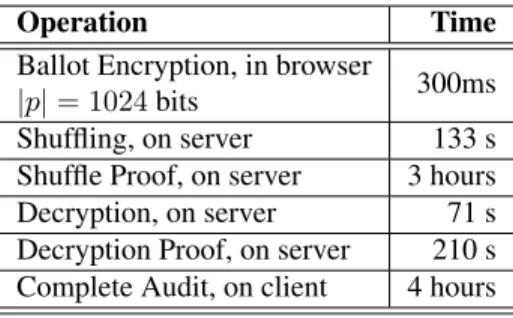
Timing Measurements. We experimented with a 2-question election and 500 voters. All timings were per-formed a sufficient number of times to obtain a stable average mostly free of testing noise. Note that time mea-surements that pertain to a set of ballots are expected to scale linearly with the number ballots and the number of questions in the election. Our results are presented in Figure 7.
Operation Time
Ballot Encryption, in browser 300ms |p|= 1024bits
Shuffling, on server 133 s Shuffle Proof, on server 3 hours Decryption, on server 71 s Decryption Proof, on server 210 s Complete Audit, on client 4 hours
Figure 7: Timing Measurements
The Big Picture. It takes only a few minutes of com-putation to obtain results for a 500-voter election. The shuffle proof and verification steps require a few hours, and are thus, by far, the most computation-intensive por-tions of the process. We note that both of these steps are highly parallelizable and thus could be significantly accelerated with additional hardware.
5.4 Extensions
There are many future directions forHelios.
Support for Other Types of Election. Helios cur-rently supports only simple elections where Alice selects 1 or more out of the proposed candidates. Adding write-ins and rank-based voting, as well as the associated tal-lying mechanisms, could prove useful.Heliosmay also eventually offer homomorphic-based tabulation, as they are often easier to explain and verify, though they would made greater demands of browser-based cryptography. Browser-Based Verification. The current verification process for the ballot encryption step is a bit tedious, re-quiring the use of a browser and a Python program. We could write a JavaScript-only verification program that
could be provided directly by auditors while running en-tirely in the voter’s browser to check thatHeliosis deliv-ering authentic ballots. There are some issues to deal with, notably cross-domain requests, but it does seem possible and desirable to accomplish browser-only bal-lot encryption verification.
Similarly, it is certainly possible to audit an entire elec-tion using JavaScript and LiveConnect for computaelec-tion- computation-ally intensive operations. Letting auditors deliver the source code for these verification programs would allow any voter to audit the entire process straight from their browser.
Distributing the Shuffling and Decryption. For im-proved privacy guarantees, Helios can be extended to support shuffling and decryption by multiple trustees. The Helios server would then only focus on provid-ing the bulletin board and votprovid-ing booth functionality. Trustees would be provided with standalone Python pro-grams that perform threshold key generation, partial shuffling and threshold decryption. They could individ-ually audit the program’s source code. With these exten-sions,Helioswould resemble classic cryptographic vot-ing protocols more closely, and would provide stronger privacy guarantees.
Improving Authentication. Currently, our protocol requires that most voters audit their cast ballot, otherwise theHeliosserver could impersonate voters and change the election outcome. Future version ofHeliosshould consider offloading authentication to a separate authenti-cation service. If feasible with browser-based cryptogra-phy,Heliosshould use digital signatures to authenticate each ballot in a publicly verifiable manner.
6 Related Work
There is a plethora of theoretical cryptographic voting work reviewed and cited in [11, 4]. We do not attempt to re-document this significant body of work here.
Open-audit voting implementations. There are only a small handful of notable open-audit voting implemen-tations. VoteHere’s advanced protocols for mixnets and coercion-free ballot casting [3] have been implemented and deployed in test environments. The Punchscan vot-ing system [2] has also been implemented and used in a handful of real student government elections, with video evidence available for all to see.
Browser-based cryptography. Cryptographic con-structs have been implemented in browser-side code in
many different settings. In the late 1990s, Hushmail be-gan providing web-based encrypted email using a Java applet. A couple of years later, George Danezis showed how to use LiveConnect for fast JavaScript-based cryp-tography, and the EVOX voting project [12] used similar technology to encrypt votes in a blind-signature-based scheme. The Stanford SRP project [18] also uses Live-Connect for browser-based cryptography and indicates how one can get LiveConnect to work in browsers other than Firefox. The recent Clipperz Crypto Library [1] provides web-based cryptography in pure JavaScript, in-cluding a multi-precision integer library.
7 Conclusion
Heliosis the first publicly available implementation of a web-based open-audit voting system. It fills an inter-esting niche: elections for small clubs, online communi-ties, and student governments need trustworthy elections without the significant overhead of coercion-freeness. We hope thatHelioscan be a useful educational resource for open-audit voting by providing a valuable service – outsourced, verifiable online elections – that could not be achieved without the paradigm-shifting contributions of cryptographic verifiability.
8 Acknowledgements
The author would like to thank Ronald L. Rivest, Shai Halevi, Chris Peikert, Susan Hohenberger, Alon Rosen, Steve Weis, and Greg Morrisett for alpha testing the
Helios system, Adam Barth for pointing out the dy-namic window creation technique for the Internet Ex-plorer work-around, and the Usenix Security reviewers for insightful suggestions in improving and crystalizing the presentation of this work.
References
[1] Clipperz.http://clipperz.org, last viewed on January 30th, 2008.
[2] PunchScan. http://punchscan.org, last viewed on January 30th, 2008.
[3] VoteHere. http://votehere.com, last viewed on January 30th, 2008.
[4] Ben Adida.Advances in Cryptographic Voting Sys-tems. PhD thesis, August 2006. http://ben. adida.net/research/phd-thesis.pdf. [5] Josh Benaloh. Simple Verifiable Elections. InEVT
Electronic Voting Technology Workshop, August 1st 2006, Vancouver, BC,Canada., 2006. Available on-line at http://www.usenix.org/events/ evt06/tech/.
[6] Josh Benaloh. Ballot Casting Assurance via Voter-Initiated Poll Station Auditing. In EVT ’07, Pro-ceedings of the Second Usenix/ACCURATE Elec-tronic Voting Technology Workshop, August 6th 2007, Boston, MA, USA., 2007. Available on-line at http://www.usenix.org/events/ evt07/tech/.
[7] C. Andrew Neff. Election Confidence.
http://www.votehere.com/papers/ ElectionConfidence.pdf, last viewed on January 30th, 2008.
[8] David Chaum and Torben P. Pedersen. Wallet databases with observers. In Ernest F. Brickell, edi-tor,CRYPTO, volume 740 ofLecture Notes in Com-puter Science, pages 89–105. Springer, 1992. [9] Amos Fiat and Adi Shamir. How to prove
your-self: Practical solutions to identification and sig-nature problems. In Andrew M. Odlyzko, editor, CRYPTO, volume 263 of Lecture Notes in Com-puter Science, pages 186–194. Springer, 1986. [10] Google. Gmail.http://gmail.com.
[11] Dimitris Gritzalis, editor.Secure Electronic Voting. Kluwer Academic Publishers, 2002.
[12] Mark Herschberg. Secure electronic voting over the world wide web. Master’s thesis, May 1997. http://groups.csail.mit.edu/ cis/voting/herschberg-thesis/. [13] Ari Juels, Dario Catalano, and Markus
Jakobs-son. Coercion-resistant electronic elections. In Vi-jay Atluri, Sabrina De Capitani di Vimercati, and Roger Dingledine, editors, WPES, pages 61–70. ACM, 2005.
[14] L. Masinter. The Data URL Scheme. http: //tools.ietf.org/html/rfc2397, last viewed on January 30th, 2008.
[15] C. Andrew Neff. A verifiable secret shuffle and its application to e-voting. InCCS 2001, Proceed-ings of the 8th ACM Conference on Computer and Communications Security. November 6-8, 2001, Philadelphia, Pennsylvania, USA., pages 116–125. ACM, 2001.
[16] Kazue Sako and Joe Kilian. Receipt-free mix-type voting scheme - a practical solution to the imple-mentation of a voting booth. In EUROCRYPT, pages 393–403, 1995.
[17] Guido van Rossum. The Python Programming Lan-guage. http://python.org, last viewed on January 30th, 2008.
[18] Thomas D. Wu. The secure remote password pro-tocol. InNDSS. The Internet Society, 1998.http: //srp.stanford.edu/, last visited on Jan-uary 30th, 2008.