Jurnal Pendidikan IPA Indonesia
http://journal.unnes.ac.id/index.php/jpii
IMPROVING THE VISUAL-SPATIAL INTELLIGENCE AND RESULTS OF
LEARNING OF JUNIOUR HIGH SCHOOL STUDENTS’ WITH
MULTIPLE INTELLIGENCES-BASED STUDENTS WORKSHEET
LEARNING ON LENS MATERIALS
A. Gani*, R. Safitri, M. Mahyana
Universitas Syiah Kuala, Banda Aceh, Indonesia
DOI: 10.15294/jpii.v6i1.9594
Accepted: February 30th 2017. Approved: March 4th 2017. Published: 30th April 2017
ABSTRACT
This research is done for the development of students’ worksheet (LKPD) about multiple intelligences-based lens materials for improving the students’ visual-spatial intelligence and results of learning of SMP N 2 Banda Aceh. This research uses a quasi-experimental design with pretest and posttest group. The sampling was done by purpo-sive sampling technique. The data collection was conducted with pretest and posttest for visual-spatial intelligence and learning outcomes. The questionnaire was used to determine the response of students after using students’ worksheet based on multiple bits of intelligence. The results of normality and homogenity test show that the data was homogen and normally distributed. Therefore, the average difference test against the N-gain visual-spatial in-telligence and learning outcomes between the two classes used t test and obtained a significant difference in learn-ing outcomes between the two classes. The average score of the N-gain visual-spatial intelligence and learnlearn-ing outcomes for both classes was in the middle category, where the experimental class is 0.65 (65%), while for class gained control is 0.46 (46%). Learners gave a positive response to the use of multiple intelligences-based students’ worksheet dealing with lens materials that can enhance their visual-spatial intelligence and learning outcomes.
© 2017 Science Education Study Program FMIPA UNNES Semarang
Keywords: students’ worksheet; multiple bits of intelligence; visual-spatial; learning outcomes
INTRODUCTION
Natural science education as one of the les-sons that are usually learned by mathematical ap-proach tends to be worried by the students. There are two intelligence standards used in the school for assesing students. They are linguistic intelli-gence and mathematic logics. In the learning pro-cess, teachers sometimes forget the eight kinds of intelligence so called multiple bits of intelligen-ce (MI). According to Delgoshaei & Delavari (2012), inside a child’s self, there is intelligence which can be more dominant than other intel-ligence. So, the child can easily understand the materials if the learning and teaching are done
by considering the intelligence. Many students’ failures in understanding the materials from the teacher caused by the teachers’ inappropriate te-aching style with the students’ learning style. A person’s intelligence inclination reflects his/her learning style. This makes the students unable to give a positive response in natural science te-aching and give effects to the lowness of learning outcomes (Wibowo & Suhandi, 2013).
According to the studies done by some re-searchers, teachers have tried best to teach all na-tural science materials, but there are some things missed, for example in visualizing the abstract of natural science concepts to the students. The available student’s worksheet cannot help them in understanding those concepts because it only contains fewer materials and tasks. This kind of
*Alamat korespondensi:
worksheet does not help students much in their intelligence. Inline with it, after this study is done, some images are obtained that the students in SMP N 2 Banda Aceh have various kinds of intelligence. This finding can be a foundation of teaching media development that can improve the students’ learning style and their intelligence. Armstrong (2004) asserted that students in eve-ry class have different skills (intelligence, talent, understanding speed). Teachers should pay atten-tion at the students’ intelligence besides paying attention to the materials.
Generally, students find themselves in a problem in learning natural science, especially in lens materials. Their difficulty is in differentiating kinds of lens and kinds of lens’ shadows. Besi-des, students felt difficult in understanding the formulas dealing with lens and applying them in exercises. The students’ weakness in mathema-tical skills automamathema-tically affects in natural scien-ce understanding. Sometimes, students cannot finish the tasks completely because they cannot understand or memorize the basic concept of na-tural science they ever learned. Moreover, their intelligence does get betterment. It means that the students who have intelligence in number and logic who can understand natural science materi-als well. This is the thing that affects the lowness of students’ learning outcomes. It is known from Natinal Examination (UN) data in 2013/2014 that the materials to determine light disposition related to mirror or lens or optic usage in daily life are lower than other natural science materials in 43.08.
This proves that there are many students who are not able to understand the concept of the lens. Considering the importance of this con-cept, it is important to present a better teaching method to motivate and provide the students in developing and increasing visual-spatial intelli-gence and their learning outcomes. One of the possible learning strategies developed to improve visual-spatial intelligence and learning outcomes in lens materials is the development of MI-based students’ worksheet. Learning with MI is plan-ning a series of learplan-ning activities designed by ad-justing the students’ intelligence. Gardner asserts that there are eight types of intelligence: linguis-tic intelligence, mathemalinguis-tics-logic, visual-spatial, musical, naturalist, intrapersonal, interpersonal and kinaesthetic (Sulaiman, et al., 2011; Ahvan dan Pour, 2016).
According to Wijayanti & Arif (2015), the development of IP-based LKS MI is based on the five dominant bits of intelligence of stu-dents, namely logical-mathematical intelligence,
physical-kinesthetic intelligence, visual-spatial in-telligence, interpersonal inin-telligence, and existen-tial-spiritual intelligence is feasible and effective use as a teaching material for junior high school students. Furthermore, Rizal (2012) explained that the development of MI-based students’ worksheet on optical tool materials could impro-ve students’ learning outcomes with an aimpro-verage value of 85.8 with a percentage of 81% comp-leteness. Then for total response interest of the student to LKS MI equal to 90,6%. Similarly, the research results Maulidah and Agus (2012) found that the constructive game given as a treatment to learners can improve their spatial-visual and interpersonal intelligence. In addition, MI-based students’ worksheet development received an ex-cellent assessment from all assessors overally got a moderate improvement with N-gain of 0.58 and students also responded well, meaning this students’ worksheet was acceptable. Based on the explanation above, it is necessary to develop te-aching materials that can improve visual-spatial intelligence and natural science learning out-comes, one of which is with MI-based students’ worksheet. Through this students’ worksheet, the students will easily understand the learning mate-rials, so the results will be more useful for them in their environment.
METHODS
The method used in this research is rese-arch and development (R & D) to identify stu-dents’ intelligence and teaching materials needs in SMP N 2 Banda Aceh through the develop-ment of MI-based students’ worksheet. The R & D method is a research approach to produce new products or refine existing products. The re-search design used was quasi-experimental. The study was conducted in three stages: (1) pretest, (2) learning implementation using MI-based dents’ worksheet for experimental class and stu-dents’ worksheet without MI without pictures for control class, (3) posttest.
The population in this study is all stu-dents of class VIII SMP N 2 Banda Aceh which consists of 224 students. The sample of the stu-dy consists of students of class VIII-2 and VIII-3 selected by purposive sampling technique based on certain inputs and considerations from the science teachers who taught in the classes. Class VIII-3 consists of 27 students as an experimental class, and VIII-2 consists of 25 students as cont-rol class. The data collection used five types of instruments, namely the tasks for the test, stu-dents’ worksheet validation sheet, spiritual and
social attitudes observation, test to determine the dominant intelligence of each student, and questionnaire for the students. Tasks to measure visual-spatial intelligence and students’ learning outcomes on lens materials both before and after learning in the class. The data analysis of pretest, posttest, and questionnaire results of learners’ learning on learning used MI-based students’ worksheet.
RESULTS AND DISCUSSION MI-based Students’ Worksheet
In the MI-based learning process, the first step taken is to conduct the intelligence test. The test is done in both classes to find out the domi-nant intelligence the learners have based on the questionnaire that has been shared. In the analy-sis phase, to determine the MI, each learner se-lected three types of intelligence with the highest score. In the process of data analysis, it is found that some learners have the same score on some types of intelligence. Especially for this situation, researchers determine the four dominant bits of intelligence. The students’ dominant intelligence is summed and then calculated with the percenta-ge so the intellipercenta-gence that dominates most in the class is obtained.
Results of Visual-Spatial Intelligence and Students’ Learning Outcomes
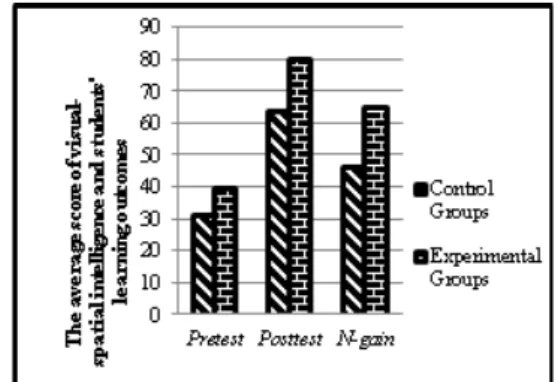
Results of visual-spatial intelligence and students’ learning outcomes on lens materials were measured by multiple choice tests consisting of 13 questions. The data comparison is the mean values of pretest, posttest, and N-gain (in percent) between the experimental class and the control class. The percentage comparison diagram of the average score of pretest, posttest, and N-gain bet-ween the control class and the experimental class is shown in Figure 1.
Figure 1. Average score comparison of pretest, posttest, dan N-gain
Figure 1 shows the percentage of the mean value of pretest result of the experimental class of 39.87 and the control class 31.06. Furthermo-re, the percentage of posttest average value in the experimental class is 80.04, and the control class is 63.67. N-gain of visual spatial intelligence sco-re and experimental class learning outcome is 65 and control class is 46. The N-gain average score of a control class and experimental class is in me-dium category although the N-gain of the experi-mental class is higher than the control class. Indi-vidually reviewed, the experimental class is better than the control class. Individual N-gain ratio of students can be seen in Figure 2.
Figure 2. Individual N-gain percentage compari-son.
Figure 2 shows that the percentage of nor-malized N-gain individually in the experimental class is categorized in a high category with 11 students (40.74%), the medium category is 16 students (59.25%), and there is no low N-gain in the experimental class. In the control class, the-re is no high category for N-gain. The moderate category consists of 21 students (84%), and low category consists of 4 students (16%). Further-more, the normality test of the distribution and homogeneity of visual-spatial intelligence data and learning outcomes on the lens materials of experimental class and experimental class were performed by Lilifors test using using Ms. Excel 2010 at 0.05 significance level. Based on the pre-test, postpre-test, and N-gain values of both classes, it is known that the data are normally distributed and homogeneous. The t-test results using inde-pendent sample test are presented in Table 1.
Based on the data in Table 1, it is known that the pretest score in two classes with tcount = 1.80 is smaller than the ttable = 2.01 with the sig-nificance level <0.05. It can be concluded that there is no significant difference before the lear-ning process using MI-based students’ worksheet. The posttest score is obtained from tcount > ttable (6,90 > 2,01) that shows there is an increase in visual-spatial intelligence after given a treatment
different angles, 3) having the ability to visualize something, create ideas visually and spatially (in the form of pictures or visible things), 4) having the sensitivity to colors, lines, shapes, spaces, and buildings. Seen from these results, the students’ learning outcomes can be known by looking at the results of changes that occur in the students’ ability. The results can be seen from the achieve-ment of visual-spatial intelligence and learning outcomes test that have been conducted.
Figure 3. Visual-spatial and learning outcomes average score.
The analysis of the observation data of learning activities with students’ worksheet shows that learning with students’ worksheet can be done well. The students follow every step of the learning activities diligently and passionately during the learning process. All learning activities show that the learning process was done lively and well. Successful use of students’ worksheet using MI-based students’ worksheet. After that,
the N-gain is obtained from tcount > ttable (3,10 > 2,01) that shows that there is an increase of visu-al-spatial intelligence and learning outcomes of students who got a teaching with students’ wotk-sheet which is higher than the learning process in control class. The results of the data analysis abo-ve show that MI-based students’ worksheet signi-ficantly influences the improvement of students’ visual-spatial intelligence and learning outcomes after being treated.
Students’ Skill Based on Visual-Spatial and Learning Outcomes Indicator
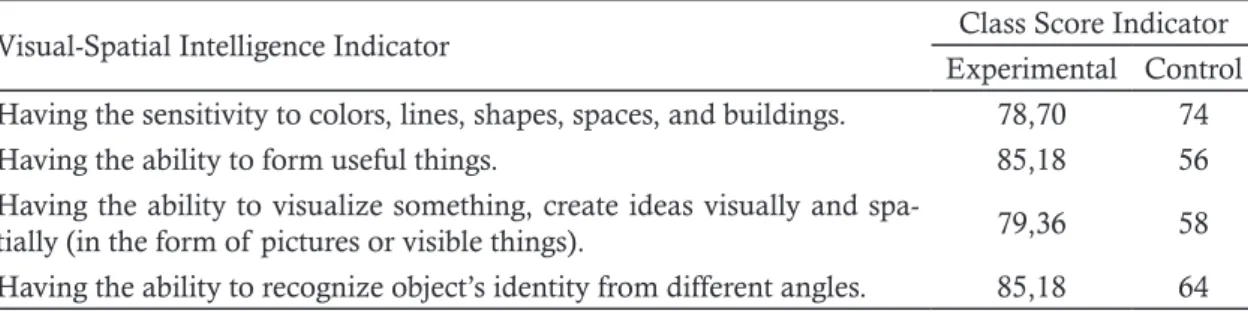
The data of visual-spatial intelligence and learning outcomes of experimental class and control class learners were obtained by providing pretest and posttest using four visual-spatial intel-ligence indicators and learning outcomes develo-ped into 13 questions. The tests were conducted in both experimental and control class. The ave-rage value data for each indicator is illustrated in Table 2 and Figure 3.
Based on the data of Table 2 and Figure 3, the level of visual-spatial intelligence and stu-dents’ learning outcomes in lens material with four indicators representing each concept has improved on all indicators. The experimental class students’ score is higher than the control class. The average score of experiments are based on the order of the high score to the low, i.e., 1) having the ability to form useful things, 2) having the ability to recognize the object’s identity from
Table 1. Visual-spatial intelligence and learning outcomes average difference test on lens materials Data
Source Class Average
Deviation
Standard tcount ttable Conclusion
Pretest Experimental 39,87 19,20 1,80 2,01 The difference is not
significant
Control 31,06 16,20
Posttest Experimental 80,04 8,32 6,90 2,01 The difference is
significant
Control 63,67 8,74
N-gain Experimental 0,65 0,16 3,10 2,01 The difference is
significant
Control 0,46 0,13
Table 2. Students’ visual-spatial intelligence and learning outcomes test score.
Visual-Spatial Intelligence Indicator Class Score Indicator
Experimental Control Having the sensitivity to colors, lines, shapes, spaces, and buildings. 78,70 74
Having the ability to form useful things. 85,18 56
Having the ability to visualize something, create ideas visually and
spa-tially (in the form of pictures or visible things). 79,36 58
by the students in learning is affected by students’ worksheet because it contains teaching materials simpler than the model, but more complex than the lesson books. Besides it can improve visual-spatial intelligence and learning outcomes, MI-based students’ worksheet also does not require students to get the same results in every aspect of assessment, but each aspect of the assessment is integrated to complement each other. So the students can grow in accordance with the skills they have. These results support the research con-ducted by Setyowati & Hinduan (2009) that says a student will easily understand the materials if the learning is done by paying attention to the intelligence of each student so that the learning outcomes can be better. Furthermore, it is also reinforced by research results of Arifah (2013) that says the provision of appropriate evaluation can optimize the intelligence the students have. The results of this study are also supported by Fitriyani (2014) which states that the increase of students’ visual-spatial intelligence gets better-ment after being given treatbetter-ment. The same thing is also found in research conducted by Margaret and Gatot (2015) that says students with high visual-spatial intelligence are more prominent in the ability to visualize, present ideas visually and spatially, and orientate themselves appropriately in solving problems.
Students’ attitudes were also observed by the observer during the learning process. The result of this value is used as an assessment of the students’ attitudes. The observed attitudes in the form of social attitudes are responsibility, honesty, and caring, while the spiritual attitudes consist of praying before doing something, giving thanks and greeting. Zakarian (2014) stated that the 2013 curriculum emphasizes the development of the character and personality of students. The attitude competence here refers to the application of the values or students’ world view and beha-vior. Marzuki (2012) stated that character edu-cation is not only about teaching students which one is right or wrong, but also teaching good behaviors and making them understand, do, and feel well.
Information is obtained from the observa-tion result of social attitude assessment that the average value of the attitude of responsibility is the highest among other observed attitudes. This character enhancement is obtained because stu-dents always follow every direction and step in students’ worksheet. This attitude is always instil-led by students during the learning activities. Students can carry out their duties and respon-sibilities as they should and in accordance with
their skills and abilities, and not only expect ot-her friends to complete the tasks (Cahyani, et al., 2014). They can participate in doing their tasks interpersonally and interpersonally. Students feel needed when they directly involve in conducting useful activities (Estrella, 2016). According to Welch (2010), students who are often involved in social activities will definitely understand what they will do in terms of establishing meaningful relationships. This is inline with the results of MI found in intrepersonal intelligence (Safitri, et al., 2013). Furthermore, Aryani (2014) emphasize that interpersonal intelligence will train students to socialize with others, because in reality, in inte-raction with others is very important.
The observation results on the honesty at-titude show that it increased and got betterment where the observed attitude assessment through the students’ actions in completing tasks given by the teacher independently. The results of this study are in line with a study done by Jaya et al. (2014) which found the development of a lear-ning tool by integrating the character values opti-mally in the learning activities can improve the at-titude aspects students and improve. In addition, the use of MI approach indicates a positive effect of thematic teaching on MI on learning outcome and student’s character. The average learning outcomes of the experimental group are higher than the control group. Significant positive corre-lation between spiritual intelligence and honesty values. Intelligence and character are important in education and can not be separated baecause intelligence character building are the main goals of education.
Observation on caring attitude shows that it also improves to betterment. Especially in the control class, students are constantly reminded to care and help each other during learning ac-tivities. The learning process that cultivates the aspects of caring can foster mutual help in doing positive things for students such as teaching a fri-end who has not understood the materials in the class. This is in line with a study conducted by Kalas (2013) that asserts the learning process that invites learners to be more active in discussing dif-ficult concepts with their friends tends to be very effective in improving the quality of learning. The obtained feedback will be very useful in imp-roving the quality of learning in accordance with the students’ needs. It also happens to three other attitude assesments in the praying before doing anything, be thankful when you’re done doing something, and greet before and after class or presentation altogether increased to betterment. This is inline with Munandar’s (2015) assertion
that students’ worksheet is able to contribute to the students’ character formation.
Each process of learning activities with students’ worksheet until the learning outcomes shows learning with it is in accordance with scien-tific and MI approach because in it there is a pro-cess of observing, asking, gathering information, processing, and communicating. This sequence is a process done by a scientist to gain knowledge and appreciate even the smallest intelligence that a student has.
Students’ Responses after Using MI-based Students’ Worksheet
The result of questionnaire data proces-sing shows that students mostly choose Yes ans-wer than the No ansans-wer with the average value for Yes on the questionnaire is 98.14% while the answer No is 1.851%. The most active require-ment of students’ worksheet is the variation of stimulus through student-centered activities. The diction used in students’ worksheet is easy to un-derstand, and interesting presentation makes stu-dents’ worksheet can be studied independently by students, but it can also arouse students’ in-terest if neatly arranged, systematic, easy to un-derstand, and interesting. This is inline with the results of Temur’s (2007), and Xie & Lin (2009) studies dealing with the MI application in lear-ning over traditional teaching methods. Thus, it can be concluded that using MI-based students’ worksheet on lens material made 27 students gave positive responses.
CONCLUSION
This result shows an increase in visual-spa-tial intelligence and learning outcomes for VIII students of SMP N 2 Banda Aceh on learning lens materials through learning using MI-based students’ worksheet and gave a significant inc-rease. In addition, the responses provided by the students were also positive after learning using MI-based students’ worksheet on lens materials.
REFERENCES
Ahvan, Y. R., & Pour, H. Z. (2016). The Correlation of Multiple Intelligences for the Achievements of Secondary Students. Educational Research and
Reviews, 11(4), 141-145.
Arifah, F. M. (2013). Optimalisasi inferior of intel-ligence siswa kelas viii melalui pendekatan contextual teaching and learning pada materi cermin dan lensa. Jurnal Mahasiswa Teknologi
Pendidikan, 2(3), 198-202.
Armstrong, T. (2004). Sekolah Para
Juara–Menerap-kan Multiple Intelligence Dalam Dunia Pen-didikan. Terjemahan oleh Yudhi Murtanto, Band-ung: Kaifa.
Aryani, A. D. (2014). Model pembelajaran berdasar-kan teori multiple intellegence yang dominan dalam kelas pada materi tekanan. EDUSAINS,
6(2), 129-136.
Cahyani, R., Rustaman, N. Y., Arifin, M., & Hendri-ani, Y. (2014). Kemampuan Kognisi, Kerja Il-miah dan Sikap Mahasiswa Non IPA Melalui Pembelajaran Inkuiri Berbantuan Multimedia.
Jurnal Pendidikan IPA Indonesia, 3(1), 1-4.
Delgoshaei, Y., & Delavari, N. (2012). Applying mul-tiple-intelligence approach to education and analyzing its impact on cognitive development of pre-school children. Procedia-Social and
Be-havioral Sciences, 32, 361-366.
Estrella, E. A. (2016). Multiple Intelligence and Work Performance of College Teachers. International
Journal of Educational Researchers, 7(1), 24-32.
Fitriyani, H. (2014). Penggunaan media puzzle tiga di-mensi untuk meningkatkan kecerdasan visual
spasial anak usia 5-6 tahun. Indonesian Journal
of Early Childhood Education Studies, 3(1), 45-52.
Jaya, I. M., Sadia, I. W., & Arnyana, I. B. P. (2014). Pengembangan perangkat pembelajaran bi-ologi bermuatan pendidikan karakter dengan setting guided inquiry untuk meningkatkan karakter dan hasil belajar siswa smp. Jurnal
pen-didikan IPA, 4(1), 1-14.
Kalas, P., O’Neill, A., Pollock, C., & Birol, G. (2013). Development of a meiosis concept inventory.
CBE-Life Sciences Education, 12(4), 655-664.
Margareta, M., & Gatot, S. (2015). Pengaruh ke-cerdasan visual-spasial terhadap hasil belajar matematika dalam problem based learning pada siswa SMA kelas X. Jurnal Ilmiah Edukasi
Matematika (JIEM), 1(1), 56-72.
Marzuki. (2012). Implementasi Pendidikan Karakter
Ber-basis Nilai Agama. Makalah yang disampaikan
pada Seminar dan Sarasehan Dosen dan Tutor Pendidikan Agama Islam di LPPMP UNY Yogyakarta, tanggal 3 Oktober 2012, (pp. 172-178)
Maulidah, N., & Santoso, A. (2014). Permainan kon-struktif untuk meningkatkan kemampuan multiple intelligence (visual-spasial dan inter-personal). Jurnal Bimbingan dan Konseling Islam,
2(1), 27-47
Munandar, H. (2015). Pengembangan Lembar Kerja Peserta Dididk (LKPD) Berorentasi Nilai Is-lam Guna Meningkatkan Pemahaman Konsep dan Karakter Peserta Didik Pada Materi Hi-drolisis Garam di SMA Negeri 11 Banda Aceh. (Tesis). Banda Aceh: Program Pascasarjana Universitas Syiah Kuala.
Rizal, M. (2012). Pengembangan LKS Fisika Berbasis Teori Kecerdasan Majemuk (Multiple Intelli-gence) Materi Alat Optik Pada Kelas VIII SMP Negeri 1 Madiun. Inovasi Pendidikan Fisika,
1(1), 120-127.
Pen-garuh Pendekatan Multiple Intelligences Me-lalui Model Pembelajaran Langsung Terhadap Sikap dan Hasil Belajar Kimia Peserta Didik di SMA Negeri I Tellu Limpoe. Jurnal Pendidikan
IPA Indonesia, 2(2), 156-160.
Setyowati, M. D., & Hinduan, A. A. (2012). Penerapan Kecerdasan Majemuk untuk Meningkatkan Hasil Belajar Fisika Peserta Didik di SMAN 2 Magelang, Jawa Tengah. Berkala Fisika Indone-sia, 1(2), 27-31.
Sulaiman, T., Hassan, A., & Yi, H. Y. (2011). An analysis of teaching styles in primary and sec-ondary school teachers based on the theory of multiple intelligences. Journal of Social Sciences,
7(3), 428-435.
Temur, O. D. (2007). The Effects of Teaching Activi-ties Prepared According to the Multiple Intel-ligence Theory on Mathematics Achievements and Permanence of Information Learned by 4th Grade Students. International Journal of
En-vironmental and Science Education, 2(4), 86-91.
Welch, A. G. (2010). Using the TOSRA to assess high
school students’ attitudes toward science after competing in the FIRST robotics competition: An exploratory study. Eurasia Journal of
Math-ematics, Science & Technology Education, 6(3),
187-197.
Wibowo, F. C., & Suhandi, A. (2013). Penerapan Mod-el Science Creative Learning (SCL) Fisika Ber-basis Proyek Untuk Meningkatkan Hasil Bela-jar Kognitif dan Keterampilan Berpikir Kreatif.
Jurnal Pendidikan IPA Indonesia, 2(1), 67-75.
Wijayanti, F., & Widiyatmoko, A. (2015). Pengemban-gan LKS IPA berbasis multiple intelligences pada tema energi dan kesehatan untuk menin-gkatkan kemampuan berpikir kreatif siswa.
Unnes Science Education Journal, 4(1), 772-779.
Xie, J.C. & Lin, R. (2009). Research on multiple intel-ligences teaching and assessment. Asian Journal
of Management and Humanity Sciences, 4(2-3),
106-124.
Zakarian, T.R. (2014). Pengembangan sikap spritual dan sikap sosial pada siswa dalam implementa-si kurikulum 2013. Buletin BSNP, 9(2), 126-460.