European Online Journal of Natural and Social Sciences 2015; www.european-science.com Vol.4, No.3 pp. 500-517
ISSN 1805-3602
Openly accessible at http://www.european-science.com 500
The Practice of Strategic Human Resource Management in a
Developing Country
Mourad MansourDepartment of Management and Marketing, King Fahd University of Petroleum and Minerals, PO Box 282, Dhahran 31261, Saudi Arabia
E-mail: [email protected] Received for publication: 07 March 2015.
Accepted for publication: 20 June 2015. Abstract
Firms are continuously improving their human resource management (HRM) practices in order to achieve sustainable competitive advantage and increase their profitability. These practices include employee involvement, training, empowerment, compensation and rewards, etc. The purpose of this research is to examine the relationship between human resource practices and firm performance. Using companies in Saudi Arabia, this study tests the proposition that HR practices (including training, job design, employee skills, employee attitudes, employee motivation, etc) has an impact on the performance of the different business units in this group.
Keywords: Human Resources Practices; Strategic Human Resource Management (SHRM); Performance
Introduction
Human resource management is defined as “a belief of people management on the idea that human resources are significant factors in maintaining the success of a business” (Price, 2004). He added that, by adopting an efficient usage of its personnel, a company can achieve a competitive advantage and reach its goals. In the last two decades, an increasing interest in explaining the impact of human resource management strategies on the organization’s performance has evolved in the HR research (Arthur, 1994; Becker and Gerhart, 1996; d’Arcimoles, 1997; Becker and Huselid, 1998, 2006; Bae et al., 2001; Björkman and Xiucheng, 2002; Boselie et al., 2003; Paauwe, 2004). As stated by March and Sutton (1997), explaining organizations’ performance variations remain one of the most enduring subjects of study. Since performance stands and remains as one the main objectives of any company, much research has been directed at explaining and understanding the relationship between human resources practices and firm performance. A number of studies (Becker and Gerhart, 1996; Mc Mahan et al., Dyer and Shafer, 1999) have recognized the existence of a close connection between HR practices and performance, yet, the linkage process is still enigmatic and remains a black box to be unlocked. Other studies (Welbourne and Andrews, 1996; Hoque, 1999; Harel and Tzafrir, 1999; Khatri, 2000) have linked the HR practices to different organizational outcomes such as productivity, quality, turnover, market value, ROI, and profits. All this concern about the relationship between HR practices and performance is justified; companies having long term objectives of sustained competitive advantage and high profitability should enhance their human capital through putting in place systems and practices as tools to attain those goals.
This study aims to explore the relationship between HR practices and firm performance and to understand how human resource decisions influence organizational performance.
Social science section
Openly accessible at http://www.european-science.com 501 The chapter that follows presents an analysis of the strategic human resource management (SHRM). At first, the various approaches to the theory of SHRM are synthesized. Then, a review of the SHRM and performance research will be introduced. Finally, some hypotheses will be developed to be tested by reference to the Data available. The next part is wholly devoted to the empirical study conducted from the collected Data. In the conclusion, findings of this piece of work are summarized. Appropriate recommendations are highlighted. Some limitations of this kind of research are also printed with further remarks and ideas for future work.
Literature Review
To respond to their customers’ needs and move forward in their business, companies should manage their employees’ special skills as they are viewed as an important source of competitive advantage. Succeeding to attract, retain and motivate a skilled workforce helps companies to improve their results. Companies are admitted to effectively manage their different HR activities such as recruiting, selecting, hiring, safety, wellness, training, organization development, communication and rewarding personnel to ensure they help positively in their financial growth and meet their challenges in a fast-changing business environment.
Companies are continuously facing new challenges due to the intense competitive environment and the globalization of marketplaces. They are increasingly asked to maintain a competitive advantage by either becoming a low cost leader or a differentiator. Companies build their strategies by determining their goals and objectives and looking at the different environments, external and internal. A highly committed and competent workforce helps companies succeeding these strategies and gain competitive advantage as long as these strategies are communicated and the workforce is involved in both the formulation and implementation phases. Leadership is also a very important factor in the success of strategies. As have been noted by the strategic management guru Michael Porter in his interview by Knowledge Wharton (2005) that “strategy is not something that is done in a bottom-up consensus process. The companies with really good strategy almost universally have a very strong CEO, somebody who is not afraid to lead, to make choices, to make decisions. Strategy is challenged every day, and only a strong leader can remain on course when confronted with well-intentioned ideas that would deviate from the company's strategy. You need a leader with a lot of confidence, a lot of conviction and a leader who is really good at communication." Moreover, as stated by Legge (1989), human resource policies should be integrated with business planning. So, it is important to integrate the HR policies with one another and with business planning more generally (Sisson, 1990). So, companies should consider people as assets rather than variable costs and that they are valuable and constitute a source of competitive advantage (Beer et al., 1984; Legge, 1995). As stated by Armstrong and Baron (2002) that “people and their collective skills, abilities and experience, coupled with their ability to deploy these in the interests of the employing organization, are now recognized as making a significant contribution to organizational success and as constituting a significant source of competitive advantage.” Also, as remarked by Baird and Meshoulam (1988) that “business objectives are accomplished when human resource practices, procedures and systems are developed and implemented based on organizational needs, that is, when a strategic perspective to human resource management is adopted.”
The socio-economic and political changes occurred in the last decades had increased the global competition and caused the rethink in the way organizations are managed (Baker, 1999). According to Mello (2006), technological advancement, increasing attention to ethical behavior, demographics and diversity, and globalization are critical trends that have affect the way how organizations are managing their employees and gave the surge of the strategic human resource management concept. According to Bratton and Gold (2007), strategic human resource management
Mourad Mansour
Openly accessible at http://www.european-science.com 502 is “the process of linking the human resource function with the strategic objectives of the organization in order to improve performance”. They added that SHRM is a managerial process requiring human resource policies and practices to be linked with the strategic objectives of the organization. Wright and McMahan (1992) define SHRM as “the pattern of planned human resource deployments and activities intended to enable an organization to achieve its goals.”
The SHRM literature is rooted in “Manpower Planning” (Bratton and Gold, 2007). However, the perspective of affirming the importance of the effective management of people as a source of competitive advantage, has encouraged the development of different frameworks that emphases the strategic role of the HR Function.
Strategic human resource management, therefore, can be defined as the process of linking the human resource function with the strategic objectives of the organization in order to improve performance. (Bratton and Gold, 2007)
There are considerable debate in the literature related to whether the SHRM and related HR strategies is an outcome or a process. For some academics such as Snell et al. (1996) the SHRM is an “outcome” where they view the SHRM as an organizational systems designed to achieve sustainable competitive advantage through people. While for others, it is a process of linking HR practices to business strategy (Ulrich, 1997). Similarly, Bamberger and Meshoulam (2000) describe SHRM as the process by which organizations seek to link the human, social, and intellectual capital of their members to the strategic needs of the firm’.
Another debate is on classification of SHRM as in terms of a proactive–reactive continuum. Thus, in the proactive orientation, The HR manager has a seat on the strategic table and active in the strategy formulation. Where is in the reactive one, the HR is concerned with the challenge of matching the philosophy, policies, programs, practices and processes (the Five Ps) in a way that will stimulate and reinforce the different employee role behaviors appropriate for each competitive strategy (Bratton and Gold, 2007).
Further, the issue of external context (the environment) is viewed important as a determinant of HR strategy and has been incorporated in some of the HR strategy models. Bamberger and Phillips’ (1991) model illustrates links between three poles: the environment, human resource strategy and the business strategy. Thus, this model implies that HR strategy is influenced by contextual variables such as markets, technology, national government policies, and trade unions. However, Purcell and Ahlstrand critic such models citing that they tend to lack ‘precision and detail’ in terms of the precise nature of the environment linkages, and that ‘much of the work on the linkages has been developed at an abstract and highly generalized level’ (Purcell and Ahlstrand (1994) quoted in Bratton and Gold (2007), p 36)
Another part of the strategic HRM debate has focused on the integration or ‘fit’ of business strategy with HR strategy. Such view is calling for the HR function to be ‘strategically integrated’, and depicts the need to establish a close two-way relationship or ‘fit’ between the external business strategy and the elements of the internal HR strategy.
However, there are two meaning of SHRM. While Snell et al. (1996) consider it as an outcome (organizational systems designed to achieve sustainable competitive advantage through people), others like Ulrich (1997) consider it as a process (linking HR practices to business strategy). Since firm performance is the major organizational goal, most of the studies have been directed at understanding the relationship between human resource practices and firm performance (Park et al., 2003).
Many researchers (Arthur, 1994; Huselid, 1995; Delaney and Huselid, 1996; Huselid et al., 1997; McMahan et al., 1999; Fey et al., 2000; Harris and Ogbonna, 2001; Huang, 2001; Fey and Björkman, 2001; Martin-Alcazar, 2005; Stavrou and Brewster, 2005; Christiansen and Higgs, 2008)
Social science section
Openly accessible at http://www.european-science.com 503 have suggested that company’s HRM practices contribute to increase its performance and thus help it to grow and gain sustainable competitive advantage (Wright et al., 1994). The concept of HR systems and/or practices as a strategic determinant of organizational performance has attracted considerable attention during the last two decades. These studies attempted to answer the question of whether or not human resource management practices have a crucial role in the creating a high financial performance and sustaining a competitive advantage in a fast changing environment. Traditionally, human resources have been viewed as a cost to be minimized (Becker and Gerhart, 1996) and subject to be downsized in order to reduce these costs, rather than a source of value creation and a strategic lever that can have economically significant effects on the firm’s performance (Becker and Gerhart, 1996). As mentioned by Becker and Huselid (1998), a skilled and motivated workforce can have a very important role to provide the necessary speed and flexibility to the organization to gain competitive advantage in a dynamic market environment where traditional sources of competitive advantage (quality, technology, economies of scale, etc.) have become easier to be imitated by the organization’s rivals. This interest in addressing the impact of human resource practices on firm performance has been widely studied following different approaches (e.g., resource-based view, contingency approach, universal approach, etc.) and within different location context (U.S., U.K., Netherlands, Russia, etc.).
Huselid (1995) studied the impact of HRM policies and practices on firm performance. He found that these practices have a significant impact on employee outcomes (turnover and productivity) and on the overall corporate performance.
Huselid et al. (1997) evaluated the impact of HR managers’ capabilities on HR effectiveness and the impact of the latter on the corporate financial performance using a sample of 293 U.S. firms. They found that effectiveness was associated with capabilities and attributes of HR staff and that there exists a relationship between HR management effectiveness and productivity, cash flow, and market value.
Wright et al. (1999) examined the impact of HR practices (selection, training, compensation and appraisal) and participation of the financial performance of 190 US petro-chemical refineries. Their results confirmed the existence of a direct relationship between training and compensation with workforce motivation. However, they found that only under highly participative systems, HR practices (selection, compensation and appraisal) are positively related to firm performance.
Wan et al. (2002) tested six strategic HR variables’ (training, staffing, empowerment, performance appraisal, job design, and performance-based pay) impact on firm performance and then examined how the combination or the bundle of such variables together affect this performance. Using a sample of 191 Singaporean companies, they found that effective implementation of the different strategic HR variables have a positive effect on organizational outcomes (especially to the firm HR performance-employee productivity, job satisfaction and commitment). They also found that performance appraisal and empowerment and training were very important issue to tackle by top management if they are interested to enhance their HR performance and hence the organization performance.
Bae and Lawler (2000) examined the effects of organizational strategic variables regarding HRM and the source of competitive advantage of 138 Korean firms. They found that firms with high-involvement HR strategies had better performance.
Batt (2002) examined the relationship between human resource practices, employee quit rates, and organizational performance in the service sector. His findings confirm that, firms emphasizing high skills, employee participation in decision making and in teams, and human resource incentives such as high relative pay and employment security, have lower quit rates and higher performance (sales growth).
Mourad Mansour
Openly accessible at http://www.european-science.com 504 Using a sample of 52 Japanese multinational corporation subsidiaries in the U.S. and Russia, Park et al. (2003) examined the impact of HR practices on firm performance. Their result confirmed the hypotheses that employee skills, attitudes and behaviors play a mediating role between HR systems and firm outcomes.
Paul and Anantharaman (2003) tested the causal model linking HRM with organizational performance. They found that practices like training, job design, compensation and incentives had a direct effect on the operational performance parameters.
Sing’s study (2003) tested and showed that there exists a significant relationship between strategic HR orientation of Indian firms and their performance. HR orientation was conceptualized as the alignment of HR planning, selection, evaluating, compensating, developing and staffing practices with the business strategies of the firm.
Using the Miles and Snow’s typology (1984), Rodriguez and Ventura (2003) analyzed the relationship between HRM systems and the performance of 120 Spanish firms. Their findings indicated that there’s a positive effect of HR systems on employee turnover and overall firm performance.
Similarly, Richard and Johnson’s study (2001) found that HR effectiveness significantly reduces employee turnover and increases overall market performance assessment. They conducted their study on a sample of 323 banks in the U.S. using the resource-based view of the firm.
In his study of 194 Singaporean companies from different industries, Khatri (2000) found that there’s a strong direct influence of HR practices on firm profitability. Although their findings suggest that the role of HR function in Singapore companies still remains secondary, they stated that encouraging signs suggest that HR activities are increasingly being aligned and integrated with the organization’s overall strategy.
For their contribution to the existing literature on SHRM, Bae et al. (2003) have chosen a sample of 680 firms in the Pacific Rim countries (Korea, Taiwan, Singapore, and Thailand) to measure the effects of high-performance work system (HPWS) on perceived financial performance. The HPWS includes a significant delegation of authority to lower-level employees (empowerment), extensive training and development of these employees, reliance on pay-for-performance, broadly defined job responsibilities, and employee participation in non-work aspects of organizational decision making. They found that the HPWS exerted a generally positive impact on perceived performance in this region.
Other studies have examined the relationship between HR practices and organizational performance in different locations and found positive results includes: Bjorkman and Xiucheng (2002) and Li (2003) in China; Fey and Bjorkman (2001) and Fey et al. (2000) in Russia; Boselie et al. (2001) in Netherlands; and Huang (1997, 2000) in Taiwan.
More recently, Wattanasupachoke (2009) had explored the relationship between HR strategies and the performance of 124 Thai companies and found that the extra pay and profit sharing is the only factor group that has a statistically important correlation with the companies’ financial performances such as sales, profits and liquidities.
As a result of the above, an extensive body of literature about the impact of HR practices on firm performance had emerged as a dominant research issue in the HRM field (Fey et al., 2000). The results of these studies confirm the dependency of firm success on the caliber of its employees and how effectively they are managed (Cheng and Brown, 1998).
As mentioned by Panayotopoulou et al. (2003), in the study of the relationship between HRM and performance, some researchers have focused on a single or several HR practices (e.g., Abowd et al., 1990; Gerhart and Milkovich, 1990; Leonard, 1990; Terpestra and Rozell, 1993; Banker et al., 1996; Delaney and Huselid, 1996; Delery and Doty, 1996; Koch and McGrath, 1996;
Social science section
Openly accessible at http://www.european-science.com 505 Khatri, 2000), while others have studied the effect of a bundle of HR practices on performance (e.g., Arthur, 1994; Huselid, 1995; MacDuffie, 1995; Youndt et al., 1996; Becker et al., 1997; Ichniowski et al., 1997; Huang, 1998; Hoque, 1999).
Previous researchers have associated human resource practices to high performance (Snell and Dean, 1992; Huselid, 1995; Delaney and Huselid, 1996; Guthrie, 2001; Hartog and Verburg, 2004).
For the purpose of this study, the following hypotheses have been formulated: HR Planning
Bratton and Gold (2007, page 197) define HR planning as ‘the process of systematically forecasting the future demand and supply for employees and deployment of their skills within the strategic objectives of the organization’. According to Werner and DeSimone (2006, page 10), human resource planning helps companies predict how changes in their strategy will affect their HR needs. Planning the workforce needs of any company is very critical and important especially in the rapid changes in external market demands. Koch and McGrath (1996) found a positive relationship between HR planning and labor productivity.
Hypothesis 1: Effective human resource planning is positively associated with organizational performance
Recruitment and Selection
According to Bratton and Gold (2007, page 239), recruitment is ‘the process of generating a pool of capable people to apply to an organization for employment’ and selection is ‘the process by which managers and others use specific instruments to choose from a pool of applicants the person(s) most likely to succeed in the job(s), given management goals and legal requirements. Companies using a good selectivity in the hiring process ensure getting the right skilled and qualified people for the right job (Pfeffer, 1994; Huselid, 1995). According to Koch and McGrath (1996), there exists a positive relationship between HR recruitment and selection and labor productivity.
Hypothesis 2: Good selectivity in the hiring process is positively associated with organizational performance
Training and Development
Companies intending to gain a sustained competitive advantage should help their employees raise their skills by receiving continuous training so that they can learn new things need to ensure quality improvement of the products and services of the company.
Hypothesis 3: The amount of training is positively associated with the performance
Participation and Involvement
Companies intending to gain a sustained competitive advantage should help their employees participate actively decision-making processes and involve them in the day-to-day problems. Putting in place employee involvement program afford employees with opportunities to reflect their own attitudes and work experiences, as well as their own hopes for the future (Bratton and Gold, 2007). Batt (2002) states that high-involvement practices may influence organizational performance and that employees’ involvement in problem-solving and self-directed teams may increase autonomy and satisfaction.
Hypothesis 4: The greater participation of employees in decision making is positively associated with performance
Mourad Mansour
Openly accessible at http://www.european-science.com 506
Performance Appraisal
The measurement of employees’ performance allows the company to provide compensation fairly to the deserving individuals according to certain predetermined criteria like employee competency, teamwork ability, initiative, soft skills and ethics (Messmer, 2004).
Hypothesis 5: Performance appraisal is positively associated with performance
Compensation and Benefits
Bratton and Gold (2007, p 358) state that reward refers to ‘all of the monetary, non-monetary and psychological payments that an organization provides for its employees in exchange for the work they perform’. Motivating employees through a good reward system constitutes a difficult and challenging task for general managers as it can positively affect employees’ behavior toward their jobs and increase their commitment and thus their performance. Armstrong and Murlis (2007, p 34) states that reward strategies are an important part of an organization’s HR strategy and should be bundled with other HR strategies so that they complement and reinforce one another. Arthur (1994), Huselid (1995) found that motivation through a good reward system can lead to an increase in employees’ productivity. Kalleberg and Moody (1994) states that some forms of compensation such as profit sharing is used as a strategic variable to improve firm competitiveness because it ties the interests of workers more closely to that of the organization and thus enhance their efforts and lead to better performance.
Hypothesis 6: Performance-based compensation is positively associated with performance In conclusion, many studies (e.g., MacDuffie, 1995; Delaney and Huselid, 1996; Huselid et al., 1997) have shown a positive relationship between the different HR practices and firm performance. MacDuffie (1995) has carried out one of the first studies on an HR bundle of HR practices and found that it affects performance not individually but as a group.
Table 1 Summary of selected research studies
HR practices Authors
Planning Bae et al. (2003), Chang and Chen (2002) Recruitment and Selection Agarwala (2003), Ahmad and Schroeder (2003) Training and Development Appleyard and Brown (2003), Arthur (1994)
Participation and Involvement Addison and Belfield (2001), Bacon and Blyton (2001) Performance Appraisal Batt (1999), Batt et al. (2002)
Compensation and Benefits Arthur (1994), Bacon and Blyton (2001) Methodology
This study examines whether there exists a relationship between human resource practices and systems and the corporate performance of companies in Saudi Arabia.
Data
The data used in this research was collected primarily from a questionnaire developed from the previous literature (information on strategic HR effectiveness) and secondary data information sources (measures of performance). The study of Khatri (2000) was the primary source of the questionnaire statements. The surveys were administered in English to individuals with principal administrative responsibilities. They were asked to indicate the extent to which their company used the following HR practices: planning, recruitment and selection, training and development, participation and involvement, performance appraisal, and compensation and benefits. A total of 70 surveys were collected.
Social science section
Openly accessible at http://www.european-science.com 507 Dependent Variable
As mentioned by Lumpkin and Dess (1996), including multiple performance measures in testing the research hypotheses will avoid any misleading descriptive and normative theory building. In this study, two types of performance measurement were collected. The first type includes the opinion of the respondents concerning rate of the company’s performance over the past three years compared to other companies in the industry. The second type was the sales growth and profit growth.
Independent Variables
The items of the questionnaire were developed on the basis of literature review and studying some previous questionnaires. A five point Likert-type scale was used as the response format for the variables, with assigned values ranging from 1 being "Strongly disagree" to 5 being "Strongly agree". The titles of the items (HR practices) were not revealed to the respondents. The items of our questionnaire are grouped into six HR practices as follows:
HR Planning includes eight statements (1 to 8). It represents the importance of HR planning in the company. The scale exhibited a coefficient of reliability Cronbach Alpha of .935.
Recruitment and Selection includes three statements (9 to 11). It represents the extensive of the selection process. The scale exhibited a coefficient of reliability Cronbach Alpha of .610.
Training and Development includes five statements (12 to 16). It represents the importance of employees' training, its needs and evaluation of its effectiveness. The scale exhibited a coefficient of reliability Cronbach Alpha of .922.
Participation and Involvement includes six statements (17 to 22). It represents the employees' participation degree in decisions and the effectiveness of communication within the company. The scale exhibited a coefficient of reliability Cronbach Alpha of .879.
Performance Appraisal includes six statements (23 to 28). It represents the effectiveness of the performance appraisal procedure within the company and the degree of involving the employee in this process. The scale exhibited a coefficient of reliability Cronbach Alpha of .919.
Compensation and Benefits includes nine statements (29 to 37). It represents the effectiveness of the compensation procedure within the company and the degree of involving the employee in this process. The scale exhibited a coefficient of reliability Cronbach Alpha of .923.
Empirical Findings
Descriptive Statistics
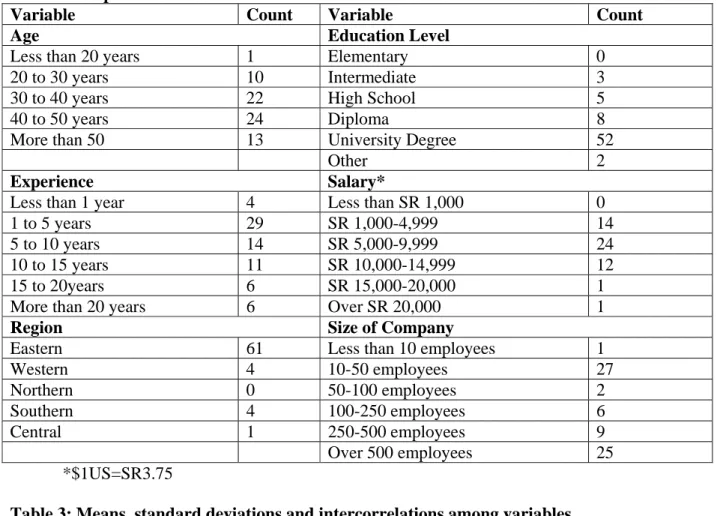
Table 2 shows the distribution of respondents by age, length of service, education level and salary. Of the 70 respondents, 33 (47%) were below forty years old. The distribution by education level shows that most respondents (74%) have a university degree. Concerning the monthly salary, 38 respondents (54%) have a salary less than SR 10,000. Table 2 also shows that 67% of the respondents have less than 10 years experience with the company. Most of the respondents are located in the Eastern province of Saudi Arabia where the headquarters are located. The majority of the companies where the respondents work are of small and medium size (less than 500 employees)
Table 3 displays the means, standard deviations and intercorrelations among the variables representing the different HR practices, namely, planning, recruitment and selection, training and development, participation and involvement, performance appraisal, and compensation and benefits. It is clear that employees are agreeing that these practices are well-established in the different business units of the company. This result can be considered as a good sign that the different practices are communicated companywide and recognized by the different managerial positions.
Mourad Mansour
Openly accessible at http://www.european-science.com 508 Table 2: Respondents Details
Variable Count Variable Count
Age Education Level
Less than 20 years 1 Elementary 0
20 to 30 years 10 Intermediate 3
30 to 40 years 22 High School 5
40 to 50 years 24 Diploma 8
More than 50 13 University Degree 52
Other 2
Experience Salary*
Less than 1 year 4 Less than SR 1,000 0
1 to 5 years 29 SR 1,000-4,999 14
5 to 10 years 14 SR 5,000-9,999 24
10 to 15 years 11 SR 10,000-14,999 12
15 to 20years 6 SR 15,000-20,000 1
More than 20 years 6 Over SR 20,000 1
Region Size of Company
Eastern 61 Less than 10 employees 1
Western 4 10-50 employees 27 Northern 0 50-100 employees 2 Southern 4 100-250 employees 6 Central 1 250-500 employees 9 Over 500 employees 25 *$1US=SR3.75
Table 3: Means, standard deviations and intercorrelations among variables
Variable Mean SD 1 2 3 4 5 6 1 Planning 3.4696 1.02315 1 2 Recruitment 3.5476 .92215 .614** 1 3 Training 3.2543 1.08744 .567** .654** 1 4 Participation 3.3167 .92694 .399** .526** .731** 1 5 Performance 3.2071 1.01297 .244* .300* .491** .249* 1 6 Compensation 3.2238 .98285 .495** .558** .634** .450** .470** 1 Notes: N=70
**. Correlation is significant at the 0.01 level (2-tailed) *. Correlation is significant at the 0.05 level (2-tailed).
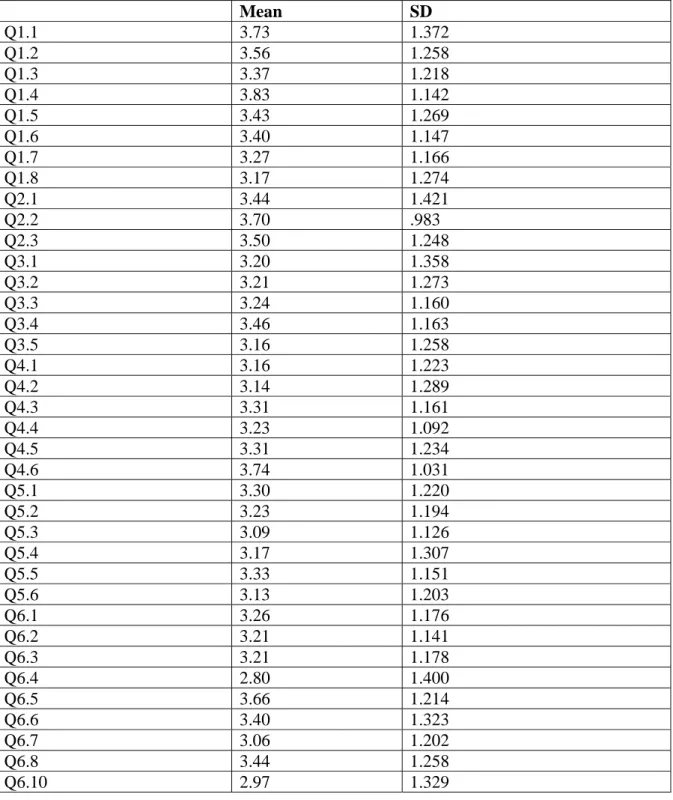
In turn, Table 4 displays the mean and SD of the different HR practices taken in detail as appear in the questionnaire. Almost all practices have a mean superior to 3 indicating that the company managers agree on the effectiveness of these practices in the company.
Factor Analysis
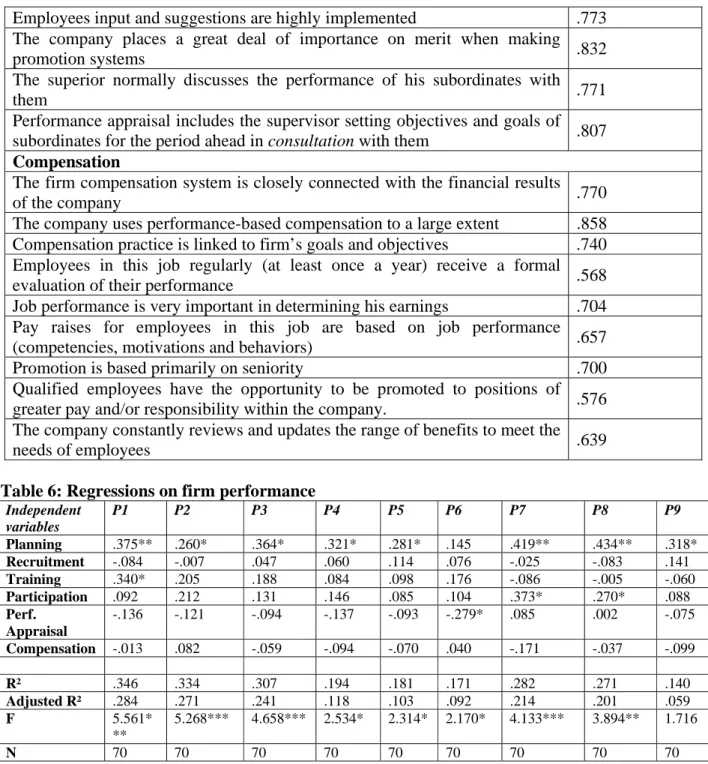
The questionnaire respondents were asked to describe how closely the statements match their current company’s HR policies and practices on a 5-point Likert scale. A principal component factor analysis with varimax rotation was used to determine underlying factors. Factor loadings of 0.5 and above were retained. The results are presented in Table 5. The application of principal component
Social science section
Openly accessible at http://www.european-science.com 509 analysis to the 37 HR practices has lead to six underlying factors that together accounted for 76.8 per cent of the variance.
Table 4: Descriptive Statistics (N=70)
Mean SD Q1.1 3.73 1.372 Q1.2 3.56 1.258 Q1.3 3.37 1.218 Q1.4 3.83 1.142 Q1.5 3.43 1.269 Q1.6 3.40 1.147 Q1.7 3.27 1.166 Q1.8 3.17 1.274 Q2.1 3.44 1.421 Q2.2 3.70 .983 Q2.3 3.50 1.248 Q3.1 3.20 1.358 Q3.2 3.21 1.273 Q3.3 3.24 1.160 Q3.4 3.46 1.163 Q3.5 3.16 1.258 Q4.1 3.16 1.223 Q4.2 3.14 1.289 Q4.3 3.31 1.161 Q4.4 3.23 1.092 Q4.5 3.31 1.234 Q4.6 3.74 1.031 Q5.1 3.30 1.220 Q5.2 3.23 1.194 Q5.3 3.09 1.126 Q5.4 3.17 1.307 Q5.5 3.33 1.151 Q5.6 3.13 1.203 Q6.1 3.26 1.176 Q6.2 3.21 1.141 Q6.3 3.21 1.178 Q6.4 2.80 1.400 Q6.5 3.66 1.214 Q6.6 3.40 1.323 Q6.7 3.06 1.202 Q6.8 3.44 1.258 Q6.10 2.97 1.329
Mourad Mansour
Openly accessible at http://www.european-science.com 510 Table 5: Principal Components Factor Structure of the HRM practices
Factor Loading
Planning
Human resource department is an integral part of the company’s strategic planning process
.852 The formulation and implementation of human resource activities are in line with overall corporate strategy
.886 The human resource department has an explicit statement of its mission and goals
.860 The human resource management function is accorded an important role in the company
.817 All human resource activities in the company (selection, training, compensation, appraisal, and employee relations) are fully integrated with one another
.784
The HR department formally evaluated its selection and staffing policies .684 There exists a formal written HR plan based on the strategic needs of the firm .725 The HR head is involved in the strategic business planning process .699 Recruitment
Applicants for a job in the company take formal tests before being hired. .782 Applicants undergo structured interviews (job related questions, same questions asked for all applicants, rating scales) before being hired.
.838 When new management positions come up, the company normally tries to fill them with people from within the department rather than recruiting from outside
.651
Training
The company places a great deal of importance on training .689 Managers analyze the employee training needs .799 Managers evaluate the effectiveness the organization’s employee training
through behaviors .730
Managers evaluate the effectiveness the organization’s employee training
through results .750
The company conducts cost-benefit analysis to assess the effectiveness of the
training programs .672
Participation
Employees in this job have a reasonable and fair complaint process .891 The firm has a clear strategic mission that is well communicated and understood at every level throughout the firm
.881 Professional staff are briefed about company’s strategies .781 Employees are allowed to make many decisions in their job .858 Employees are often asked by their supervisor to participate in decisions .903 Superiors keep open communication with employees in their job. .775 Performance Appraisal
The employees’ capabilities are viewed as the main source of competitive
advantage .802
Social science section
Openly accessible at http://www.european-science.com 511 Employees input and suggestions are highly implemented .773
The company places a great deal of importance on merit when making
promotion systems .832
The superior normally discusses the performance of his subordinates with
them .771
Performance appraisal includes the supervisor setting objectives and goals of subordinates for the period ahead in consultation with them .807 Compensation
The firm compensation system is closely connected with the financial results
of the company .770
The company uses performance-based compensation to a large extent .858 Compensation practice is linked to firm’s goals and objectives .740 Employees in this job regularly (at least once a year) receive a formal
evaluation of their performance .568
Job performance is very important in determining his earnings .704 Pay raises for employees in this job are based on job performance
(competencies, motivations and behaviors) .657
Promotion is based primarily on seniority .700
Qualified employees have the opportunity to be promoted to positions of greater pay and/or responsibility within the company. .576 The company constantly reviews and updates the range of benefits to meet the
needs of employees .639
Table 6: Regressions on firm performance Independent variables P1 P2 P3 P4 P5 P6 P7 P8 P9 Planning .375** .260* .364* .321* .281* .145 .419** .434** .318* Recruitment -.084 -.007 .047 .060 .114 .076 -.025 -.083 .141 Training .340* .205 .188 .084 .098 .176 -.086 -.005 -.060 Participation .092 .212 .131 .146 .085 .104 .373* .270* .088 Perf. Appraisal -.136 -.121 -.094 -.137 -.093 -.279* .085 .002 -.075 Compensation -.013 .082 -.059 -.094 -.070 .040 -.171 -.037 -.099 R² .346 .334 .307 .194 .181 .171 .282 .271 .140 Adjusted R² .284 .271 .241 .118 .103 .092 .214 .201 .059 F 5.561* ** 5.268*** 4.658*** 2.534* 2.314* 2.170* 4.133*** 3.894** 1.716 N 70 70 70 70 70 70 70 70 70 Notes: *p< .05, **p< .005, ***p< .001 in two-tailed tests
Standardized regression coefficients are shown
HR Practices Correlation with Firm Performance
Finally, regression analysis has been conducted between each HR practice and the firm performance which is measured by the perception of the different respondents as appear in the following question: “Compared to other companies in your industry, please rate your company’s performance over the past three years on the following indicators.” The different measures were: 1. Public Image and Goodwill, 2. Quality of services, 3. Efficiency of operations, 4. Market share
Mourad Mansour
Openly accessible at http://www.european-science.com 512 growth, 5. Profit growth, 6. Sales growth, 7. Staff morale, 8. Staff overall satisfaction, 9. Staff loyalty. Table 6 shows the regression of the HR practices on the performance measures. Results reveal a positive relationship between the overall HR practices and the performance of the firm, and thus, confirming the different hypotheses and past researches.
Conclusions
The purpose of this study was to investigate the existence of a relationship between human resource practices and firm performance. The alignment of HR planning, recruitment, training, participation, performance appraisal, and compensation with firm business strategies could lead to competitive advantage and profit growth. It is interesting to find that HRM practices in the studied companies have a direct causal relationship to performance obtained by asking the different top management about their perception of 9 measures. This can be seen as a significant finding in SHRM research, especially in the Saudi context where, at my knowledge no past research had been conducted. This finding is in conformity with previous studies (Pfeffer, 1994; 1998; Huselid, 1995; Youndt et al., 1996). It follows that these companies should continue in enhancing more the competence of its employees to attain better performance goals. So, it is important to ascertain that the HR function plays its full role in attracting, retaining, motivating and developing the human resources according to personal and group requirements, which will help the company to use effectively its human capital to develop and sustain a competitive advantage, as people remain the unique inimitable resource in the firms.
In spite of the expected good results obtained from the statistical analysis, the limitation of this study can be either theoretical as well as empirical. Theoretically, although in many studies the company strategy appeared to influence the choice of HR strategy, the resource-based view suggests that companies will choose the appropriate business strategies according to the available HR pools. Therefore, the relationship between business and HRM strategies is dynamic and need to be reviewed constantly. Empirically, the causality effect between HR practices and performance is not clear since large companies with good performance usually adapt HR practices of long-term perspective.
Acknowledgements
The author would like to express his thanks and appreciation for the support provided by KFUPM in the preparation of this paper.
References
Abowd, J.M., Milkovich, G.T., and Hannon, J.M. (1990). The effect of human resource management decisions on shareholder value. Industrial and labor Relations Review, 43(3), 203-236.
Addison, J. and Belfield, C.R. (2001). Updating the determinants of firm performance: estimation using the 1998 UK workplace employee relations survey. British Journal of Industrial Relations, 39(3), 341-366.
Ahmad, S. and Schroeder, R.G. (2003). The impact of human resource management practices on operational performance: recognizing country and industry differences. Journal of Operations Management, 21(1), 19-43.
Agarwala, T. (2003). Innovative human resource practices and organizational commitment: an empirical investigation. International Journal of Human Resource Management, 14(2), 175-197.
Social science section
Openly accessible at http://www.european-science.com 513 Amit, R. and Schoemaker, P.J.H. (1993). Strategic assets and organizational rent. Strategic
Management Journal, 14, 33-46.
Appleyard, M.M. and Brown, C. (2003). Employment practices and semiconductor manufacturing performance. Industrial Relations, 40(3), 436-471.
Armstrong, M. and Baron, A. (2002). Strategic HRM: the route to improved business performance, CIPD, London.
Armstrong, M. and Murlis, H. (2007). Reward Management (5th edition). London: Kogan
d’Arcimoles, C.H. (1997). Human resource policies and company performance: a quantitative approach using longitudinal data. Organization Studies, 18(5), 857-874.
Arthur, J.B. (1994). Effects of human resource systems on manufacturing performance and turnover. Academy of Management Journal, 37(7), 670-687.
Bacon, N. and Blyton, P. (2001). Management practices and employee attitudes: a longitudinal study spanning fifty years. Sociological Review, 49(2), 254-274.
Bae, J. and Lawler, J.J. (2000). Organizational and HRM strategies in Korea: imoact on firm performance in an emerging economy. Academy of Management Journal, 43(3), 502-517. Bae, J., Chen, S-J., Wan, T.W.D., Lawler, J.J., and Walumbwa, F.O. (2001). Human resource
strategy anf firm performance in Pacific Rim countries. International Journal of Human Resource Management, 14(8), 1308-1332.
Baird, L. and Meshoulam, I. (1988). Managing two fits of strategic human resource management. Academy of Management Review, 13(1), 116-128.
Baker, D. (1999). Strategic Human Resource Management: Performance, Alignment, Management. Librarian Career Development , 7 (5), 51-63.
Batt, R. (1999). Work organization, technology, and performance in customer service and sales. Industrial and Labor Relations Review, 52(2), 525-543.
Batt, R. (2002). Managing customer services: human resource practices, quit rates, and sales growth, Academy of Management Journal, 45(3), 587-597.
Batt, R., Colvin, A.J.S., and Keefe, J. (2002). Employee voice, human resource practices, and quit rates: evidence from the telecommunications industry. Industrial and Labor Relations Review, 55(4), 573-594.
Becker, B., and Gerhart, B. (1996). The impact of human resource management on organizational performance: Progress and prospects. Academy of Management Journal , 39, 779-802.
Becker, B., & Huselid, M. (1998). High performance work systems and firm performance: a synthesis of research and managerial implications. Research in Personnel and Human Resources Management , 16, 53-101.
Becker, B., & Huselid, M. (2006). Strategic human resource management: where do we go from here? Journal of Management , 32, 898-925.
Beer, M., Spector, B., Lawrence, P., Quinn, M.D., and Walton, R. (1984). Managing Human Assets. Free Press, New York.
Bjorkman, I. and Xiuching, F. (2002). Human resource management and the performance of Western firms in China. International Journal of human Resource Management, 13 (6), 853-864.
Boselie, P., Paauwe, J., and Jansen, P. (2001). Human resource management and performance: lessons from the Netherlands. International Journal of human Resource Management, 12 (7), 1107-1125.
Boselie, P., Paauwe, J., and Richardson, R. (2003). Human resource management, institutionalization and organizational performance: a comparison of hospitals, hotels and
Mourad Mansour
Openly accessible at http://www.european-science.com 514 local government. International Journal of human Resource Management, 14 (8), 1407-1429.
Boxall, P. (1994). The strategic HRM debate and the resource-based view of the firm. Human Resource Management Journa , 6, 59-75.
Boxal, P.F., Purcell, J., and Wright, P. (2007). Human resource management: scope, analysis and significance, in Oxford Handbook of Human Resource Management, Oxford University Press, Oxford.
Bratton, J., and Gold, J. (2007). Human resource management : theory and practice, 4th Edition, Houndmills: Macmillan.
Chang, P-L. and Chen, W-L. (2002). The effect of human resource management practices on firm performance: empirical evidence from high-tech firms in Taiwan. International Journal of Management, 19(4), 622-631.
Cheng, A. and Brown, A. (1998). HRM strategies and labour turnover in the hotel industry: A comparative study of Australia and Singapore. International Journal of human Resource Management, 9 (1), 136-154.
Christiansen, L., & Higgs, M. (2008). How the alignment of business strategy and HR strategy can impact performance. Journal of General Management (UK) , 33 (4), 13-21.
Colbert, B. (2004). The complex resource-based view: implications for theory and practice in strategic human resource management. Academy of Management Review , 29 (3), 341-358. Delaney, J. T., & Huselid, M. A. (1996). The impact of human resource management practices on
perceptions of organizational performance. Academy of Management Journal , 39, 949-970. Dyer, L. and Shafer, R.A. (1999). From human resource strategy to organizational effectiveness:
Lessons from research on organizational agility. Working paper no. 12, School of Industrial and labor Relations, Cornell University.
Fey, C. and Bjorkman, I. (2001). The effect of human resource management practices on MNC subsidiary performance in Russia. Journal of International Business Studies, 32(1), 59-75. Fey, C.F., Bjorkman, I., and Pavlovskaya, A. (2000). The effect of human resource management
practices on firm performance in Russia. International Journal of human Resource Management, 11 (1), 1-18.
Gomez-Mejia, L.R. and Balkin, D.B. (1992). Compensation, organizational strategy and firm performance. Cincinatti: Southwestern College Press.
Guest, D.E. and Peccei, R. (1994). The nature and causes of effective human resource management. British Journal of Industrial Relations, 32, 219-241.
Harel, G.H. and Tzafrir, S.S. (1999). The effect of human resource management practices on the perceptions of organizational and market performance of the firm. Human Resource Management, 38, 185-200.
Harris, L. C., & Ogbonna, E. (2001). Strategic Human resource management, market orientation, and organizational performance. Journal of Business Research , 51, 157-166.
Hendry, C., & Pettigrew, A. (1986). The practice of strategic human resource management. Personal Management , 34 (4), 3-8.
Hill, C., & R.Jones, G. (2008). Theory of strategic management with cases. Cengage Learning. Hoque, K. (1999). Human resource management and performance in the UK hotel industry. British
Journal of Industrial Relations, 37, 419-443.
Huang, T.-C. (1997). The effect of participative management on organizational performance: the case of Taiwan. International Journal of human Resource Management, 8 (5), 677-689.
Social science section
Openly accessible at http://www.european-science.com 515 Huang, T.-C. (2000). Are the human resource practices of effective firms distinctly different from those of poorly performing ones? Evidence from Taiwanese enterprises. International Journal of human Resource Management, 11 (2), 436-451.
Huang, T.-C. (2001). The effects of linkage between business and human resource management strategies. Personal Review , 30 (1/2), 132-151.
Huselid, M. A. (1995). The impact of human resource management practices on turnover, productivity, and corporate financial performance. Academy of Management Journal , 38, 635-672.
Huselid, M. A., Jackson, S. E., & Schuler, R. S. (1997). Technical and strategic human resource management effectiveness as determinants of firm performance. Academy of Management Journal , 40, 171-189.
Ichniowski, C., Shaw, K., and Prennushi, G. (1997). The effects of human resource practices on productivity: a study of steel finishing lines. American Economic Review, 87, 291-313. Kalleberg, A.L. and Moody, J.W. (1994). Human resource management and organizational
performance. American Behavioral Scientist, 37, 948-962.
Khatri, N. (2000). Managing human resource for competitive advantage: a study of companies in Singapore. International Journal of human Resource Management, 11 (2), 336-365.
Knowledge Wharton (2005). Michael Porter Asks, and Answers: Why Do Good Managers Set Bad
Strategies? Retrieved from http://www.knowledgeatwharton.com.cn/index.cfm?fa=viewArticle&articleID=1522&langu
ageid=1
Koch, M.J. and McGrath, R.G. (1996). Improving labor productivity: human resource management policies do matter. Strategic Management Journal, 17(5), 335-354.
Legge, K. (1989). Human resource management: a critical analysis, in new perspectives in human resource management, Storey, J. (ed.). Routledge, London.
Li, J. (2003). Strategic human resource management and MNEs’ performance in China. International Journal of Human Resource Management, 14(2), 157-173.
Lowe, J., Delbridge, R., and Oliver, N. (1997). High-performance manufacturing: evidence from the automotive components industry. Organization Studies, 18, 783-798.
MacDuffie, J.P. (1995). Human resource bundles and manufacturing performance: organizational logic and flexible production systems in the world auto industry. Industrial and Labor Relations Review, 48, 97-221.
McMahan, G., Bell, M.P., and Virik, M. (1998). Strategic human resource management: Employee involvement, diversity and international issues. Human Resources Management Review, 6, 193-214.
McMahan, G., Virik, M., & Wright, P. (1999). “Theoretical perspectives for SHRM. Research in Personnel and Human Resources Management , 4, 99-122.
March, J.G. and Sutton, R.I. (1997). Organizational Performance as a Dependent variable. Organization Science, 8, 698-706.
Martin-Alcazar, F., Romero-Fernandez, P., & Sanchez-Gardey, G. (2005). Strategic human resource management: integrating the universalistic, contingent, configurational and contextual perspectives. International Journal of Human Resource Management , 16 (5), 633-659. Mello, Jeffrey A. (2006). Strategic human resource management. South-Western, Ohio.
Miles, R., & Snow, C.C. (1994). Designing strategic human resource systems. Organizational Dynamics, 31(1), 36-52.
Osterman, P. (1994). How common is workplace transformation and how can we explain who does it? Industrial and Labor Relations Review, 47, 173-188.
Mourad Mansour
Openly accessible at http://www.european-science.com 516 Paauwe, J. (2004). HRM and performance : achieving long-term viability. Oxford: Oxford
University Press.
Paauwe, J. and Richardson, R. (1997). Introduction to special issue on HRM and performance. International Journal of Human Resource Management, 8(3), 257-262.
Panayotopoulou, L., Bourantas, D., and Papalexandris, N. (2003). Strategic human resource management and its effects on firm performance: an implementation of the competing values framework. International Journal of Human Resource Management , 14 (4), 680-699.
Park, H.J., Mitsuhashi, H., Fey, C.F., and Björkman, I. (2003). The effect of human resource management practices on Japanese MNC subsidiary performance: a partial mediating model. International Journal of Human Resource Management , 14 (8), 1391-1406.
Paul, A.K. and Anantharaman, R.N. (2003). Impact of people management practices on organizational performance: analysis of causal model, International Journal of Human Resource Management , 14 (7), 1246-1266.
Pfeffer, J. (1994). Competitive advantage through people : unleashing the power of the work force. Boston: Harvard Business School Press.
Price, A. (2004). Human Resource Management in a Business Context. London, Thomson Learning. Richard, C. and Johnson, N.B. (2001). Strategic human resource management effectiveness and firm
performance. International Journal of Human Resource Management, 12(2), 299-310. Rodriguez, J.M. and Ventura, J. (2003). Human resource management systems and organizational
performance: an analysis of the Spanish manufacturing industry. International Journal of Human Resource Management, 14(7), 1206-1226.
Schuler, R.S. and Jackson, S.E. (1987). Linking competitive strategies with human resource management practices. Academy of Management Executives, 1, 209-213.
Sing, K. (2003). Strategic HR orientation and firm performance in India, International Journal of Human Resource Management, 14(4), 530-543.
Sisson, K. (1990). Introducing the human resource management journal. Human Resource Management Journal, 1(1), 1-11.
Snell, S. A., Youndt, M. A., & Wright, P. M. (1996). Establishing a framework for research in strategic human resource management: Merging resource theory and organization learning. Research in Personnel and Human Resources Management 14, 61-90.
Stavrou, E., & Brewster, C. (2005). The configurational approach to linking strategic human resource management bundles with business performance: myth or reality? Management Revue , 16 (2), 186-201.
Ulrich, D. (1997). Measuring human resources: an overview of practice and a prescription for results. Human Resource Managenet, 36 (3), 303-320.
Ulrich, D. and Lake, D. (1990). Organizational capability: competing from the inside out. Wiley, New York.
Wan, D., Ong, C.H., and Kok, V. (2002). Strategic human resource management and organizational performance in Singapore. Compensation Benefits Review, 34(4), 33-42.
Wattanasupachoke, T. (2009). Strategic human resource management and organizational performance: a study of Thai enterprises. Journal of Global Business Issues, 3(2), 139-148. Wheelen, T. L., & Hunger, J. D. (2003). Strategic Management and Business Policy. London:
Perntice Hall.
Welbourne, T.M. and Andrews, A.O. (1996). Predicting the performance of initial public offerings: Should human resource management be in the equation? Academy of Management Journal, 39: 891-919.
Social science section
Openly accessible at http://www.european-science.com 517 Werner, J.M. and DeSimone, R.L. (2006). Human Resource Development. Ohio: Thomson
South-Western.
Wernerfelt, B. (1984). A resource based view of the firm. Strategic Management Journal, 5, 171-180.
Wright, P. M., McCormick, B., Sherman, W.S. and McMahan, G. C. (1999). The role of human resource practices in petro-chemical refinery performance. International Journal of Human Resource Management, 10(4), 551-571.
Wright, P. M. and McMahan, G. C. (1992). Theoretical perspectives for strategic human resource management. Journal of Management , 18, 292-320.
Wright, P. M., MacMahan, G.C., and McWilliams, A. (1994). Human resources and sustained competitive advantage: a resource-based perspective. International Journal of Human Resource Management, 5, 301-326.
Youndt, M.A., Snell, S.A., Dean, J.W., and Lepak, D.P. (1996). Human resource management, manufacturing strategy and firm performance. Academy of Management Journal, 39(4), 836-866.