1
Effective Beginning Reading
Programs:
A Best-Evidence Synthesis
Robert E. Slavin
Johns Hopkins University
-and-
University of York
Cynthia Lake
Johns Hopkins University
Bette Chambers
University of York
Alan Cheung
Johns Hopkins University
Susan Davis
Success for All Foundation
January, 2009
__________________This research was funded by the Institute of Education Sciences, U.S. Department of Education (Grant No. R305A040082). However, any opinions expressed are those of the authors and do not necessarily represent IES positions or policies.
We thank Marilyn Adams, Steven Ross, and Nancy Madden for comments on an earlier draft.
Abstract
This article systematically reviews research on the achievement outcomes of four types of approaches to improving the beginning reading success of children in
kindergarten and first grade: Reading curricula, instructional technology, instructional process programs, and combinations of curricula and instructional process. Study
inclusion criteria included use of randomized or matched control groups, a study duration of at least 12 weeks, valid achievement measures independent of the experimental
treatments, and a final assessment at the end of grade 1 or later. A total of 62 studies met these criteria. The review concludes that instructional process programs designed to change daily teaching practices have substantially greater research support than programs that focus on curriculum or technology alone. In particular, positive achievement effects were found for Success for All, PALS, phonological awareness training, and other programs focused on professional development.
From the first day of kindergarten to the last day of first grade, most children go through an extraordinary transformation as readers. If all goes well, children at the end of first grade know the sounds of all the letters and can form them into words, know the most common sight words, and can read and comprehend simple texts. The K-1 period is distinct from other stages of reading development because during this stage, children are learning all the basic skills of turning print into meaning. From second grade on, children build fluency, comprehension, and vocabulary for reading ever more complex text in many genres, but the K-1 period is qualitatively different in its focus on basic skills.
Success in beginning reading is a key prerequisite for success in reading in the later years. Longitudinal studies (e.g., Juel, 1988) have shown that children with poor reading skills at the end of first grade are unlikely to catch up later on, and are likely to have difficulties in reading throughout their schooling. It is in the early elementary grades where the gap in performance between children of different races first appears, and this gap is perhaps the most important policy issue in education in the U.S. On the fourth grade National Assessment of Educational Progress (NAEP, 2007), 43% of White children achieved at the “proficient” level on the National Assessment of Educational Progress, but only 14% of African American, 17% of Hispanic, and 8% of American Indian children scored at this level. Effective beginning reading programs are important for children of all backgrounds, but for disadvantaged and minority children and for children with learning disabilities, who particularly depend on school to achieve success, effective beginning reading programs are especially important.
In recent years, there has been a shift in policy and practice toward more of a focus on phonics and phonemic awareness in beginning reading instruction. Based in large part on the findings of the National Reading Panel (2000) and earlier research syntheses, the Bush Administration’s Reading First program strongly favored phonics and phonemic awareness, and a national study of Reading First by Gamse et al. (2008) and Moss et al. (2008) found that teachers in Reading First schools were in fact doing more phonics teaching than were those in similar non-Reading First schools. Yet outcomes were disappointing, with small effects seen on first grade decoding measures and no impact on comprehension measures in grades 1-3. Similarly, a large study of intensive professional development focusing on phonics found no effects on the reading skills of second graders (Garet et al., 2008). The findings of these large-scale experiments imply that while the importance of phonics and phonemic awareness in beginning reading instruction are well established, the addition of phonics to traditional basal instruction is not sufficient to bring about widespread improvement in children’s reading. Other factors, especially relating to the quality of instruction, are also consequential.
Because of the great importance of this stage of development, there have been several reviews of research on beginning reading. Adams (1990) wrote an influential review, which concluded among other things that systematic phonics should be central to early reading instruction. Reviews by Snow, Burns, & Griffin (1998), by the National Reading Panel (NRP, 2000), by Torgeson, Brooks, & Hall (2006), and by the Rose Report in the U.K. (Rose, 2006) have reinforced the importance of phonics. The National Reading Panel (2000) pointed to five factors needed for success in early reading:
phonemic awareness, phonics, fluency, vocabulary, and comprehension. These reviews, however, focused on variables associated with positive outcomes in beginning reading rather than on specific reading programs. The What Works Clearinghouse (2008), in its beginning reading topic report, reviewed research on reading programs evaluated in grades K-3. However, the WWC only reports program ratings, and does not include discussion of the findings or draw generalizations about the effects of types of programs. Further, WWC inclusion standards applied in its beginning reading topic report include very brief studies (as few as 5 hours of instruction), very small studies (as few as 46 students), and measures of skills taught in experimental but not control groups (see Slavin, 2008). The Torgeson et al. (2006) review only included 12 randomized
evaluations contrasting phonetic and non-phonetic approaches, but most of these were also brief (most provided 5 hours or less of instruction), had very small sample sizes, often used measures of objectives not taught at all in the control group, and were mostly supplementary rather than core approaches.
The present article reviews research on the achievement outcomes of practical initial (non-remedial) beginning reading programs for all children, applying consistent methodological standards to the research. It is intended to provide fair summaries of the achievement effects of the full range of beginning reading approaches available to
educators and policy makers, and to summarize for researchers the current state of the art in this area. The scope of the review includes all types of programs that teachers,
principals, or superintendents might consider to improve the success of their children in beginning reading: curricula, instructional technology, instructional process programs, and combinations of curricula and instructional process. The review uses a form of best evidence synthesis (Slavin, 1986), adapted for use in reviewing “what works” literatures in which there are generally few studies evaluating each of many programs (see Slavin, 2008). It is part of a series, all of which used the same methods, with minor adaptations. Separate research syntheses review research on remedial, preventive, and special
education programs in elementary reading (Slavin, Lake, Madden, Chambers, Cheung & Davis, forthcoming), upper-elementary programs (Slavin, Lake, Chambers, Cheung, & Davis, 2008a), middle and high school reading programs (Slavin, Cheung, Groff, & Lake, 2008b), and reading programs for English language learners (Cheung & Slavin, 2005).
The syntheses of upper-elementary reading programs (Slavin et al., 2008a) and middle and high school reading programs (Slavin et al., 2008b) provide the closest background for the present review. The upper-elementary reading review identified 88 studies that met the inclusion standards. These were divided into four categories: reading curricula (core and supplementary textbooks), instructional technology, instructional process programs (such as cooperative learning), and combinations of curricula and instructional process. Effect sizes for curricula (ES=+0.07) and for instructional technology (ES=+0.06) were very low. Larger effect sizes (ES=+0.23) were found for instructional process programs, especially cooperative learning programs in which students help one another master reading comprehension skills in small teams or pairs. The sample-size weighted mean effect size for cooperative learning methods, specifically Cooperative Integrated Reading and Composition (CIRC) and Peer Assisted Learning Strategies (PALS), was +0.21.
The secondary review covered grades 6-12, with most studies focused on grades 6-9. A total of 36 studies met the same criteria applied in the present review. It also concluded that programs designed to change daily teaching practices, providing extensive professional development in specific classroom strategies, had substantially greater support from rigorous experiments than did programs focusing on curriculum or technology alone. No studies of reading curricula met the inclusion criteria, and the sample size-weighted mean effect size for computer-assisted instruction programs was only +0.10. In contrast, the weighted mean effect size for various forms of cooperative learning was +0.28. Studies of mixed method programs (especially READ 180) that combine extensive teacher training and cooperative learning with computer activities also had relatively positive weighted effect sizes (ES=+0.22). The Cheung & Slavin (2005) review of research on (mostly elementary) studies of reading programs for ELLs also found that effective programs were ones that emphasized professional development and changed classroom practices, such as cooperative learning and comprehensive school reform. Based on the findings of the earlier reviews, we hypothesized that in beginning elementary reading, programs focusing on reforming daily instruction would have stronger impacts on student achievement than would programs focusing on innovative textbooks or instructional technology alone.
Focus of the Current Review
The present review uses procedures similar to those used in the upper elementary and secondary reading reviews to examine research on initial (non-remedial) programs for beginning reading. The purpose of the review is to place all types of initial reading programs intended to enhance beginning reading achievement on a common scale, to provide educators and policy makers with meaningful, unbiased information that they can use to select programs most likely to make a difference with their students. The review emphasizes practical programs that are or could be used at scale. It therefore emphasizes large studies done over significant time periods that used standard measures, to maximize the usefulness of the review to educators. The review also seeks to identify common characteristics of programs likely to make a difference in beginning reading achievement. This synthesis was intended to include all kinds of approaches to early reading
instruction, and groups them in four categories: reading curricula, instructional
technology, instructional process programs, and combinations of reading curricula and instructional process. Reading curricula primarily encompass core reading textbooks and curricula, such as Reading Street and Open Court Reading. Instructional technology refers to programs that use technology to enhance reading achievement. This includes traditional supplementary computer-assisted instruction (CAI) programs, in which students are sent to computer labs for additional practice. CAI in reading has been reviewed by Kulik (2003), Murphy et al. (2002), and E. Chambers (2003). Other instructional technology programs include Reading Reels, which provides embedded multimedia in daily lessons, and Writing to Read, which combines technology and non-technology small group activities. Instructional process programs rely primarily on professional development to give teachers effective strategies for teaching reading. These include programs focusing on cooperative learning and phonological awareness.
Direct Instruction, provide specific phonetic curricula as well as extensive professional development focused on instructional strategies. Comprehensive school reform (CSR) programs were included only if they included specific beginning reading programs; for a broader review of outcomes of elementary CSR models, see CSRQ (2006) and Borman et al. (2003).
Methodological Issues Unique to Beginning Reading
While a review of research on beginning reading programs shares methodological issues common to all systematic reviews, there are also some key issues unique to this subject and grade level. The thorniest of these relates to measurement. In the early stages of reading, researchers often use measures such as phonemic awareness that are not “reading” in any sense, though they are precursors. However, measures of reading comprehension and reading vocabulary tend to have floor effects at the kindergarten and first grade level. The present review included measures such as letter-word identification and word attack, but did not accept measures such as auditory phonemic awareness. Measures of oral vocabulary, spelling, and language arts were excluded at all grade levels.
Another problem of early reading measurement is that in kindergarten, it is
possible for a study to find positive effects of programs that introduce skills not ordinarily taught in kindergarten on measures of those skills. For example, until the late 1990’s it was not common in U.S. kindergartens for children to be taught phonics or phonemic awareness. Programs that moved these then first-grade skills into kindergarten might appear very effective in comparison to control classes receiving little or no instruction on those skills, but would in fact simply be teaching skills the children would probably have mastered somewhat later.
Because of the difficulty of defining and measuring early literacy skills, multi-year evaluations that follow children at least through the end of first or second grade are of particular value. By the end of second grade, it is certain that control students as well as experimental students have been seriously taught to read, and it becomes possible to use measures of reading comprehension and reading vocabulary that more fully represent the goals of reading instruction, not just precursors. Multi-year studies solve the problem of early presentation of skills ordinarily taught later. If kindergartners are taught certain first grade reading skills, end of first grade or second grade measures should be able to determine if this early teaching was truly beneficial. For example, a study by Hecht & Close (2002) evaluated the Waterford Early Reading Program in kindergarten classes. Children in experimental and control classes experienced whole language instruction focused on language, not reading. Those in the Waterford group, however, also received 15 minutes a day of phonics and phonemic awareness. At the end of kindergarten
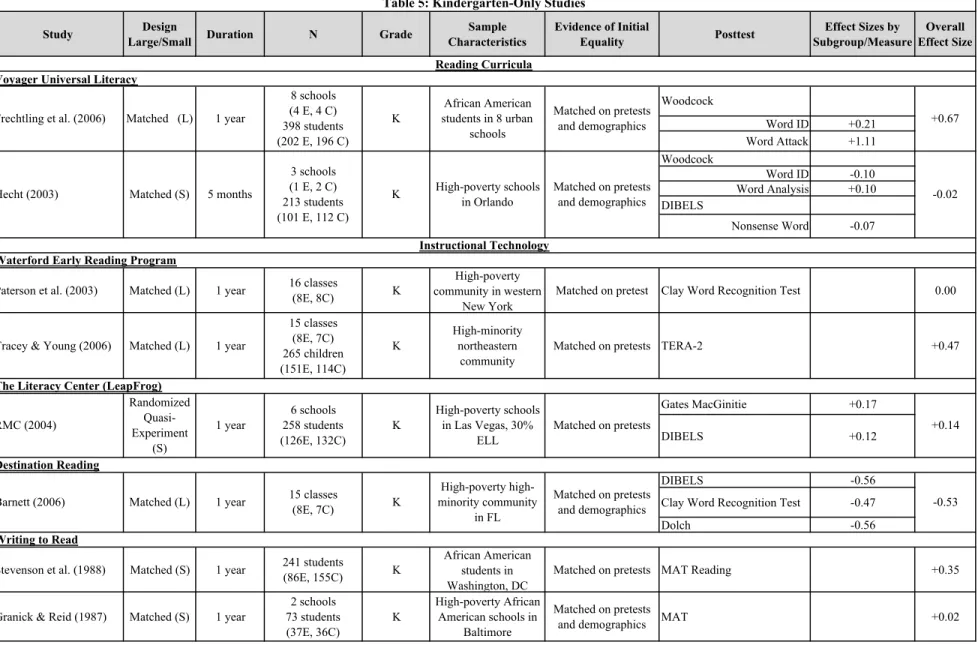
posttest, the Waterford group scored much better than controls. But what does this mean? It may be that early exposure to phonics instruction has a lasting effect, but that cannot be determined until all children have been taught to read, with measures no earlier than the end of the first grade. Due to the unique nature of research on kindergarten-only
programs, studies whose final posttesting took place before spring of first grade are reviewed in a separate section of this article.
Review Methods
As noted earlier, the review methods used here are similar to those used by Slavin, Lake, Cheung, & Davis (2008a) and by Slavin, Cheung, Groff, & Lake (2008b), who adapted a technique called best-evidence synthesis (Slavin, 1986). Best-evidence syntheses seek to apply consistent, well-justified standards to identify unbiased,
meaningful information from experimental studies, discussing each study in some detail, and pooling effect sizes across studies in substantively justified categories. The method is very similar to meta-analysis (Cooper, 1998; Lipsey & Wilson, 2001), adding an
emphasis on narrative description of each study’s contribution. It is similar to the
methods used by the What Works Clearinghouse (2008), with a few important exceptions noted in the following sections. See Slavin (2008) for an extended discussion and
rationale for the procedures used in all of these reviews.
Literature Search Procedures
A broad literature search was carried out in an attempt to locate every study that could possibly meet the inclusion requirements. Electronic searches were made of educational databases (JSTOR, ERIC, EBSCO, Psych INFO, Dissertation Abstracts) using different combinations of key words (for example, “elementary students,” “reading,” “achievement”) and the years 1970-2008. Results were then narrowed by subject area (for example, “reading intervention,” “educational software,” “academic achievement,” “instructional strategies”). In addition to looking for studies by key terms and subject area, we conducted searches by program name. Web-based repositories and education publishers’ websites were also examined. We attempted to contact producers and developers of reading programs to check whether they knew of studies that we had missed. Citations were obtained from other reviews of reading programs including the What Works Clearinghouse (2008) beginning reading topic report, Adams (1990), National Reading Panel (2000), Snow, Burns & Griffin (1998), Torgerson, Brooks, & Hall (2006), Rose (2006), and August & Shanahan (2006), or potentially related topics such as instructional technology (E. Chambers, 2003; Kulik, 2003; Murphy et al., 2002). We also conducted searches of recent tables of contents of key journals. We searched the following tables of contents from 2000 to 2008: American Educational Research Journal, Reading Research Quarterly, Journal of Educational Research, Journal of Educational Psychology, Reading and Writing Quarterly, British Educational Research Journal, and Learning and Instruction. Citations of studies appearing in the studies found in the first wave were also followed up.
Effect Sizes
In general, effect sizes were computed as the difference between experimental and control individual student posttests after adjustment for pretests and other covariates, divided by the unadjusted posttest control group standard deviation. If the control group
SD was not available, a pooled SD was used. Procedures described by Lipsey & Wilson (2001) and Sedlmeier & Gigerenzor (1989) were used to estimate effect sizes when unadjusted standard deviations were not available, as when the only standard deviation presented was already adjusted for covariates or when only gain score SD’s were
available. If pretest and posttest means and SD’s were presented but adjusted means were not, effect sizes for pretests were subtracted from effect sizes for posttests. In multiyear studies, effect sizes may be reported for each year but only the final year of treatment is presented in the tables. However, if there are multiple cohorts (e.g., K-1, K-2, K-3), each with adequate pretests, all cohorts are included in the tables.
Effect sizes were pooled across studies for each program and for various
categories of programs. This pooling used means weighted by the final sample sizes. The reason for using weighted means is to maximize the importance of large studies, as the previous reviews and many others have found that small studies tend to overstate effect sizes (see Rothstein et al., 2005; Slavin, 2008; Slavin & Smith, 2008).
Effect sizes were broken down for measures of decoding (e.g., word attack, letter-word identification, and fluency), vocabulary, and comprehension/total reading. In general, comprehension, which is the ultimate goal of reading instruction, is the most important outcome measure. Very few studies reported separate vocabulary scores, so the tables only show separate outcomes for decoding and comprehension (although
vocabulary measures are included in totals).
Criteria for Inclusion
Criteria for inclusion of studies in this review were as follows.
1. The studies evaluated initial (i.e., non-remedial) classroom programs for beginning reading. Studies of variables, such as use of ability grouping, block scheduling, or single-sex classrooms, were not reviewed. Studies of tutoring and remedial programs for struggling readers are reviewed in a separate article (Slavin et al., in preparation).
2. The studies involved interventions that began when children were in kindergarten or first grade. Multi-year interventions that began in kindergarten or first grade were included even if children were in grades 2-5 by the end of the study. As noted earlier, studies that began and ended in kindergarten are reviewed separately.
3. The studies compared children taught in classes using a given reading program to those in control classes using an alternative program or standard methods.
4. Studies could have taken place in any country, but the report had to be available in English.
5. Random assignment or matching with appropriate adjustments for any pretest differences (e.g., analyses of covariance) had to be used. Studies without control groups, such as pre-post comparisons and comparisons to “expected” scores, were excluded.
6. Pretest data had to be provided, unless studies used random assignment of at least 30 units (individuals, classes, or schools) and there were no indications of initial inequality. Studies with pretest differences of more than 50% of a standard deviation were excluded because, even with analyses of covariance, large pretest differences cannot be adequately controlled for as underlying distributions may be fundamentally different (Shadish, Cook, & Campbell, 2002).
7. The dependent measures included quantitative measures of reading performance, such as standardized reading measures. Experimenter-made measures were accepted if they were comprehensive measures of reading, which would be fair to the control groups, but measures of reading objectives inherent to the
experimental program (but unlikely to be emphasized in control groups) were excluded. Studies using measures inherent to treatments, usually made by the experimenter or program developer, have been found to be associated with much larger effect sizes than are measures that are independent of treatments (Slavin & Madden, 2008), and for this reason, effect sizes from treatment-inherent measures were excluded. The exclusion of measures inherent to the experimental treatment is a key difference between the procedures used in the present review and those used by the What Works Clearinghouse. As noted above, measures of pre-reading skills such as phonological awareness, as well as related skills such as oral vocabulary, language arts, and spelling, were not included in this review.
8. A minimum study duration of 12 weeks was required. This requirement is
intended to focus the review on practical programs intended for use for the whole year, rather than brief investigations. Study duration is measured from the
beginning of the treatments to posttest, so, for example, an intensive 8-week intervention in the fall of first grade would be considered a year-long study if the posttest were given in May. The 12-week criterion has been consistently used in all of the systematic reviews done previously by the current authors. This is another difference between the current review and the What Works Clearinghouse (2008) beginning reading topic report, which included very brief studies.
9. Studies had to have at least 15 students and two teachers in each treatment group.
Appendix 1 lists studies that were considered germane but were excluded according to these criteria, as well as the reasons for exclusion.
Limitations
It is important to note several limitations of the current review. First, the review focuses on experimental studies using quantitative measures of reading. There is much to
be learned from qualitative and correlational research that can add depth and insight to understanding the effects of reading programs, but this research is not reviewed here. Second, the review focuses on replicable programs used in realistic school settings expected to have an impact over periods of at least 12 weeks. This emphasis is consistent with the review’s purpose in providing educators with useful information about the strength of evidence supporting various practical programs, but it does not attend to shorter, more theoretically-driven studies that may also provide useful information, especially to researchers. Finally, the review focuses on traditional measures of reading performance, primarily individually-administered or group-administered standardized tests. These are useful in assessing the practical outcomes of various programs and are fair to control as well as experimental teachers, who are equally likely to be trying to help their students do well on these assessments. The review does not report on experimenter-made measures of content taught in the experimental group but not the control group, even though results on such measures may also be of importance to some researchers or educators.
Categories of Research Design
Four categories of research designs were identified. Randomized experiments (R) were those in which students, classes, or schools were randomly assigned to treatments, and data analyses were at the level of random assignment. When schools or classes were randomly assigned but there were too few schools or classes to justify analysis at the level of random assignment, the study was categorized as a randomized quasi-experiment (RQE) (Slavin, 2008). Matched (M) studies were ones in which experimental and control groups were matched on key variables at pretest, before posttests were known, while matched post-hoc (MPH) studies were ones in which groups were matched
retrospectively, after posttests were known. For reasons described by Slavin (2008), studies using fully randomized designs (R) are preferable to randomized
quasi-experiments (RQE), but all randomized quasi-experiments are less subject to bias than matched studies. Among matched designs, prospective designs (M) were preferred to post-hoc or matched designs (MPH). In the text and in tables, studies of each type of program are listed in this order (R, RQE, M, MPH). Within these categories, studies with larger sample sizes are listed first. Therefore, studies discussed earlier in each section should be given greater weight than those listed later, all other things being equal.
Research on Reading Curricula
The reading curricula category consists of textbooks for initial (non-remedial) reading instruction. It includes only 5 qualifying studies of core basal programs and 3 of supplemental curricula. Some professional development is typically provided with these textbooks, but far less than would be typical of instructional process approaches. The Slavin et al. (2008) review of research on upper-elementary textbooks found few effects on reading measures across 16 qualifying studies, with a weighted mean effect size of +0.08 for core textbooks and +0.06 for supplementary texts.
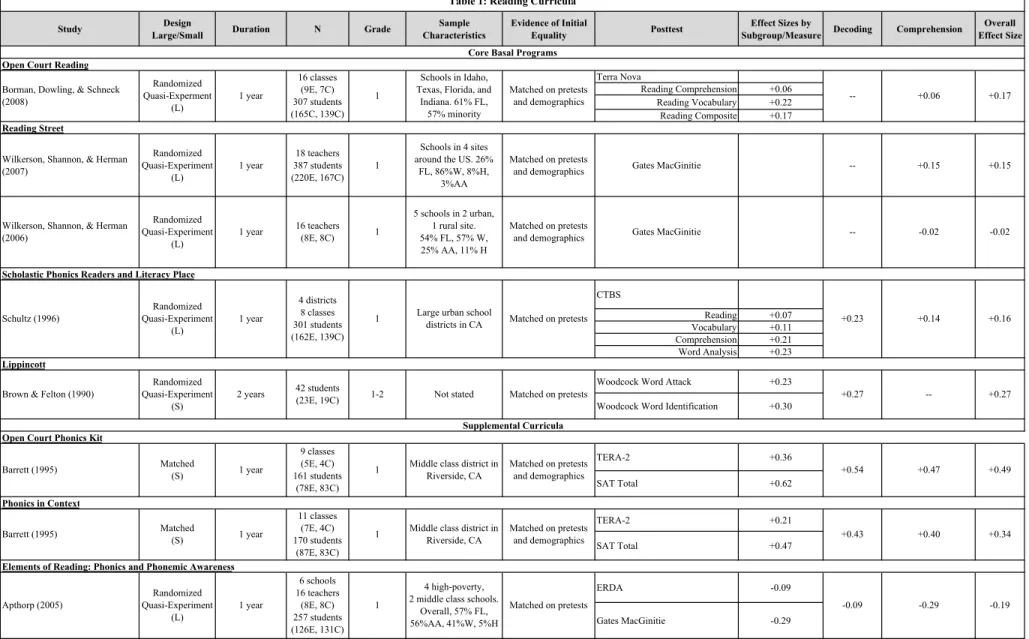
Table 1 summarizes descriptions and outcomes of all studies of textbook programs for beginning reading.
______________ TABLE 1 HERE ______________
Reading Curricula
Open Court Reading
Open Court Reading, published by SRA/McGraw Hill, is one of the most widely used basal textbook series in the US. From the 1960’s to the late 1990’s, Open Court was a phonetically-based alternative to traditional basal textbooks, but in recent years other texts have also adopted more phonics as well. Still, Open Court remains distinctive in its use of phonetic readers in the early grades, a focus on direct instruction of specific skills throughout the program, scripted teacher’s manuals, and more teacher training and follow up than most texts provide. Teachers in the research sites received 2-3 days of initial training and extensive on-site follow-up from Open Court consultants. Typically, Open Court is used in 2.5 hour language arts blocks, meaning that schools using it may spend significantly more time on reading than would students in other programs, where 90 minutes is typical.
Borman, Dowling, & Schneck (2008) carried out a randomized evaluation of the 2005 version of Open Court Reading. They identified a total of 49 grade 1-5 classrooms in which Open Court had not been used previously, and randomly assigned classrooms within schools and grade levels to Open Court or control conditions. Control classes used a variety of traditional texts. Open Court teachers were asked to teach the program 2 ½ hours a day, while control teachers generally spent 90 minutes a day on reading. Not all Open Court classes spent the full 2 ½ hours, but most did, so additional time is
confounded with any curricular effects. Also, the Open Court teachers received extensive training and follow-up beyond that ordinarily provided with the basal text.
At the first grade level, the focus of the present review, there were 9 Open Court classes (n=165) and 7 control classes (n=139). In light of the numbers of classes
involved in first grade, this was considered a randomized quasi-experiment. The schools were located in Idaho, Florida, Texas, and Indiana and averaged 61% free lunch and 57% minority. Open Court and control classes were well matched on Terra Nova pretests and demographics. On Terra Nova posttests, adjusted for pretests, effect sizes were +0.06 for Reading Comprehension, +0.22 for Reading Vocabulary, and +0.17 for Reading Composite. Using HLM, with students nested within classrooms, effects were significant (p<.05) for the entire grade 1-5 sample, but separate analyses were not reported for first graders.
A frequently cited evaluation of an earlier version of Open Court did not meet the standards of this review. Foorman, Fletcher, Francis, Schatschneider, & Mehta (1998)
compared low-achieving first and second graders in Open Court and “implicit code” (i.e, non-phonetic) classes. Unfortunately, the initial comparability of the groups was not adequately established. Posttest analyses combined first and second graders, yet the proportion of each was quite different in Open Court (76% first) and implicit code (50% first). Further, there were sizeable pretest differences favoring the Open Court groups within grades.
Reading Street
Reading Street is a significant revision of the Scott Foresman basal textbook series, one of the most widely used in the U.S. The revision focused on increasing the emphasis on phonics and phonemic awareness, in line with requirements of No Child Left Behind. The publisher contracted with Magnolia Consulting (Wilkerson, Shannon, & Herman, 2006, 2007) to do two one-year randomized evaluations.
The Wilkerson, Shannon, & Herman (2007) evaluation involved a total of 18 first grade teachers, randomly assigned to Reading Street (n=220) or control (n=167) within schools in four sites around the U.S. This sample size made the study a randomized quasi-experiment. Overall, approximately 86% of students were White, 8% Hispanic, and 3% African American, and 26% received free or reduced price lunches. Control schools used a variety of textbooks, including Macmillan Spotlight on Literacy, Harcourt
Trophies, Harcourt Signatures, and Scott Foresman’s 2000 and 2002 editions. On Gates MacGinitie Tests, adjusting for pretests, Reading Street students scored non-significantly higher than controls (ES=+0.15, n.s.).
A similar study of Reading Street by Wilkerson et al. (2006) involved 16 teachers of first grades in five schools. Two urban schools and a rural school were middle-class, non-Title I schools primarily serving White students, with 38-40% of students qualifying for free lunch. The remaining two schools were Title I schools with 67% of students qualifying for free lunch, and 80% of students were African American and 11% were Hispanic. The overall sample was 57% White, 25% African American, and 11% Hispanic, and 54% of students qualified for free lunch. The teachers were randomly assigned within schools to use Reading Street or to continue using other basal textbooks. Adjusting for pretests, individual Gates McGinitie scores were not significantly different (ES = -0.02, n.s.).
Scholastic Phonics Readers with Literacy Place
Scholastic Phonics Readers is a supplementary phonics instructional program designed as an optional addition to Literacy Place, Scholastic’s basal reading text. Scholastic Phonics Readers incorporates phonetic texts to provide intensive phonics practice in the context of engaging stories, with themes and skills aligned to those in Literacy Place. The publisher provides a summary of a study by Schultz (1996) evaluating the combination of Scholastic Phonics Readers and Literacy Place.
San Bernardino, were asked to nominate pairs of similar elementary schools. In each, one member of each pair was randomly assigned to use the Scholastic materials, and then one class within each school was randomly selected to participate. With eight classes and 301 first graders (n=162E, 139C), this is a randomized quasi-experiment. The groups were well-matched on CTBS pretests. On CTBS posttests, effect sizes were +0.07 for reading, +0.11 for vocabulary, +0.21 for comprehension, and +0.23 for word analysis, for an overall mean effect size of +0.16.
Lippincott
The Lippincott Basic Reading Series was a phonetic reading series that taught word attack skills in a systematic way, using step-by-step presentations of letter sounds and sound blending. Children learned to read using phonetically controlled stories to help them learn to apply their knowledge of letter-sound correspondence to meaningful text.
Brown & Felton (1990) carried out a small, longitudinal evaluation of Lippincott as a comparison of code-emphasis and whole language approaches. The 1986 Houghton Mifflin basal textbook served as the whole language method. First graders were identified based on extensive testing as being at risk for reading failure, but were not included if they scored below 80 on the Otis-Lennon Mental Abilities Test. Children were placed in six groups of eight across five schools and randomly assigned to use either Lippincott or Houghton Mifflin texts. This random assignment at the group level makes this a
randomized quasi-experiment (RQE). A member of the project team provided instruction to the eight selected students in each group during daily reading periods in both treatment conditions, over a two-year period from the beginning of first grade to the end of second grade. Ns were 23 E, 19 C. At the end of first grade, scores significantly favored
Lippincott students on Woodcock Word Attack (adjusted ES=+1.33, p<.01), but not on Word Identification (ES=-0.19, n.s.). By second grade, the differences were +0.23 (n.s.) for Word Attack and +0.30 (n.s.) for Word Identification, for an average of +0.27. Importantly, 12 Houghton-Mifflin and only 1 Lippincott child was recommended for retention. However, reading outcomes were modest, with a sample size-weighted mean of only +0.12.
Supplementary Curricula
Open Court Phonics Kit (as a supplement) and Phonics in Context
Barrett (1995) evaluated the Open Court Phonics Kit used as a supplement to a literature-based model that used Houghton Mifflin, Wright, and Rigby books as a base. Open Court Phonics provided teachers with extensive training and materials to teach phonics skills. This program was compared to a similar district-created Phonics in Context program and to a control group that just used the literature series without
supplementary phonics. The study took place in the Riverside, California school district, with mostly middle class first graders. Five classes (n=78) were non-randomly assigned to Open Court Phonics, seven classes (n=87) to Phonics in Context, and four classes (n=83) to control, matching on TERA pretests and demographics. Adjusting for the
TERA pretests, posttests favored the two phonics supplements over the control treatment, but there were no differences between Open Court Phonics and the district Phonics in Context program. Adjusting for pretests, respective effect sizes for Open Court Phonics and Phonics in Context were +0.36 and +0.21 on TERA, +0.53 and +0.33 on SAT Reading Comprehension, +0.47 and +0.40 for SAT Word Reading, +0.79 and +0.67 for Word Study Skills, and +0.62 and +0.47 for SAT Total Reading. Averaging SAT Total Reading and TERA, mean effect sizes were +0.49 for Open Court Phonics and +0.34 for Phonics in Context.
Elements of Reading: Phonics and Phonemic Awareness
Elements of Reading: Phonics and Phonemic Awareness, published by Harcourt, is a commercial supplemental resource that provides 48 weekly lessons to help 5-6-year-olds to master consonant and vowel sounds, vowel patterns, and other phonics skills. Teachers use the program 20 minutes each day in small groups. Under contract to the publisher, Apthorp (2005) carried out an evaluation in 16 first-grade classrooms in 6 schools, four of which were high-poverty (93% free lunch), 95% African American schools and two of which were middle class (22% free lunch) schools in which 78% of students were White, 13% African American, and 6% Hispanic. Eight classes were randomly assigned to EOR (n=126) and 8 to control (n=131). Control classes used
standard McGraw-Hill or Literacy Place basals without supplemental phonics instruction. On three ERDA scales, the mean effect size after adjusting for pretests was -0.09, and the mean of two Gates MacGinitie scales was -0.29, for a mean of -0.19. Patterns were similar in the high-poverty and middle-class sites.
Conclusions: Reading Curricula
Beginning reading curricula have been studied in just a few high-quality
evaluations. There were eight studies, six of which used randomized quasi experiments. These studies evaluated four core basal reading programs, Open Court Reading, Reading Street, Scholastic Phonics Readers with Literacy Place, and the early Lippincott program, plus two supplemental programs, the Open Court Phonics Kit, and Elements of Reading: Phonics and Phonemic Awareness. With the exception of a small study of the Open Court Phonics Kit, none of the programs had effect sizes in excess of +0.20.The sample size-weighted mean effect size across all eight was +0.13, with three studies of
supplementary phonics programs reporting a weighted mean effect size of +0.15 and core programs a weighted mean of +0.12. Effect sizes averaged +0.23 for decoding measures, but only +0.09 for comprehension/total reading measures.
Research on Instructional Technology
The effectiveness of instructional technology (IT) has been extensively debated over the past 20 years, and there is a great deal of research on the topic. Kulik (2003) concluded that research did not support use of IT in elementary or secondary reading, although E. Chambers (2003) came to a somewhat more positive conclusion.
Ten studies of instructional technology met the standards for the present review. These were divided into three categories. Supplemental technology programs, such as Waterford, WICAT, and Phonics-Based Reading, are programs that provide additional instruction at students’ assessed levels of need to supplement traditional classroom instruction. Mixed-method models, represented by Writing to Read, are methods that use computer-assisted instruction along with non-computer activities as students’ core reading approach. Embedded multimedia, represented by Reading Reels, provides video content embedded in teachers’ whole-class lessons.
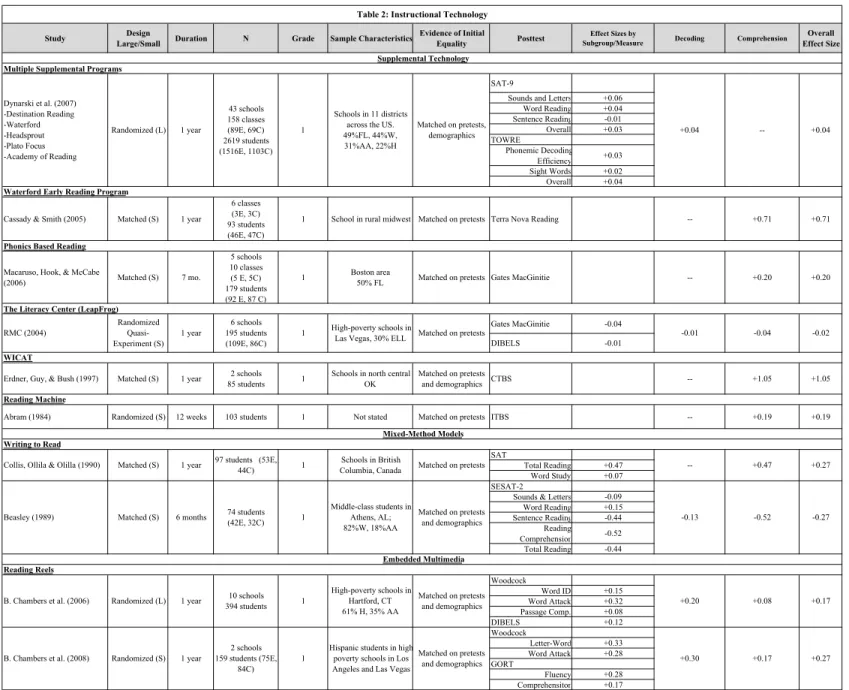
Descriptions and outcomes of all studies of instructional technology in beginning reading that met the inclusion criteria appear in Table 2.
================ TABLE 2 HERE ================
Supplemental CAI
Multiple Supplemental CAI Programs
Dynarski, Agodini, Heaviside, Novak, Carey, & Campuzano (2007) evaluated the use in first grade of five CAI reading programs, Destination Reading, Waterford,
Headsprout, Plato Focus, and Academy of Reading. Outcomes for individual programs were not reported, so this is an evaluation of modern uses of technology in first grade reading in general, not of any particular approach. The study involved 43 schools in 11 districts. A total of 158 teachers (89E, 69C) and their 2619 students (1516E, 1103C) were randomly assigned within schools to CAI or control conditions. CAI students used the programs 94 minutes per week, on average. Control classes also often had computers, and used them for purposes such as reading assessment and practice, averaging 18 minutes per week. Experimental classes also made use of computers for similar purposes beyond the five programs, averaging 25 minutes per week.
Schools involved in the study were very diverse, and were located throughout the U.S. However, they were relatively disadvantaged, with 49% of students eligible for free or reduced-price lunches and 76% of schools receiving Title I. Overall, 44% of students were White, 31% African American, and 22% Hispanic.
Students were pre- and posttested on the SAT-9 and the TOWRE. There were no posttest differences on any subscales. Adjusting for pretests, SAT-9 posttest effect sizes were +0.06 (n.s.) for Sounds and Letters, +0.04 (n.s.) for Word Reading, and -0.01 (n.s.) for Sentence Reading, for an overall effect size of +0.03. On the TOWRE, effect sizes were +0.03 (n.s.) for Phonemic Decoding Efficiency, +0.02 (n.s.) for Sight Word Efficiency, and +0.04 (n.s.) overall. Averaging SAT-9 and TOWRE, the effect size was +0.04.
The Waterford Early Reading Program is a supplemental designed to develop kindergartners’ and first graders emergent literacy skills. Its activities include letter recognition, phonemic awareness, vocabulary and comprehension. Children play games and complete fill-in-the-blank writing activities, presented at the child’s level of
functioning.
Cassady & Smith (2005) carried out a small matched evaluation of Waterford in a rural school in the Midwest. Three first grade teachers used Waterford about 20 minutes a day during regular reading periods, starting in Fall, 2001. The same teachers’ classes the previous year served as the control group. The n’s were 46E, 47C. On Terra Nova
Reading, controlling for pretests, the effect size was +0.71. Effects were particularly large for the children who had the lowest pretest scores.
Phonics-Based Reading
Phonics-Based Reading (PBR), created by Lexia, is computer software designed to help beginning readers learn word-attack skills. Children work independently at computer stations through an individualized, structured series of activities that progress from words in isolation to sentences and paragraphs. When children finish the PBR sequence, they move to a similar series called Strategies for Older Students (SOS).
Macaruso, Hook, & McCabe (2006) evaluated PBR in ten first-grade classes in five urban elementary schools in the Boston area. More than 50% of students received free or reduced-price lunches, and 29% came from homes in which a language other than English was spoken.
One first grade class in each school was designated to use PBR (N=92) and one served as a control group (N=87). All classes used the same Scott Foresman or Bradley basals. PBR was used in a lab setting 2-4 times per week for 20-30 minutes.
Experimental and control students were fairly well matched on Gates MacGinitie pretests given in November of first grade. On June posttests, adjusted for pretests, PBR students scored nonsignificantly better (ES=+0.20, n.s.).
The Literacy Center (Grade 1)
The Literacy Center (TLC), developed by LeapFrog, is a supplemental literacy program that uses technology to teach phonological awareness and phonics. Children use the program 20-30 minutes daily, in addition to their core reading program. Teachers receive four days of training on TLC implementation. The publisher commissioned RMC Research Corporation (2004) to evaluate TLC. Six high-poverty schools in Las Vegas were randomly assigned to TLC or control conditions, making this a randomized quasi-experiment. This section reports only on first grades (n=109E, 86C); kindergarten findings are reported later in this article. Children were pre- and posttested on the Gates MacGinitie and on four DIBELS scales. Adjusting for pretests, there were no differences on Gates (ES= -0.04, n.s.) or on DIBELS (ES= -0.01, n.s.), for a mean of -0.02.
WICAT
WICAT was a traditional supplementary CAI program that provided
individualized reading activities to strengthen students’ skills. It consisted of graphics, animation, and high-quality audio content and was designed to complement and enhance in-class instruction in reading skills such as decoding, contextual analysis, and word identification.
Erdner, Guy, and Bush (1997) carried out a matched evaluation study in two elementary schools in north central Oklahoma. Participants were 85 first graders. The experimental group and the control group were well matched on school size, SES, gender, and pretest scores. Students in the treatment group received 60 minutes per week of computer-assisted instruction in reading for a full academic year. The control school used a traditional instruction method without any CAI support. After 1 year, students in both groups took the standardized CTBS test. Adjusting for pretests, the treatment school scored significantly better than the control school, with an effect size of +1.05.
The Reading Machine
The Reading Machine was an early phonics drill and practice program. Teachers could choose specific objectives and the program kept track of student progress. Abram (1984) conducted a 12-week randomized experiment on the use of the Reading Machine with 103 first-grade students randomly assigned to use the program for either phonics or mathematics, with each group serving as the control group for the other. An analysis of NCE gain scores on the Iowa Test of Basic Skills revealed no significant effects of the program (ES = +0.19, n.s.).
Average Effect Size—Supplemental CAI
The weighted mean effect size across the 6 qualifying studies of supplemental CAI was +0.09.
Mixed-Method Model
Writing to Read
Writing to Read (WTR), originally developed by IBM but now distributed by Bright Blue Software, is a computer-based program created to develop the writing and reading skills of K-1 children. It is based on the premise that children can learn to read by first learning to write anything they can say. Instruction is individualized, allowing students to work at their own pace. Students cycle through computer and non-computer tasks (such as listening to stories, writing stories, and working with the teacher in small groups).
Collis, Ollila, & Ollila (1990) carried out a small evaluation of Writing to Read in first grades in British Columbia, Canada. Children in two schools that used the program
in 1985-86 (N=53) were compared to those in the same school in 1983-84 (N=44) who had similar scores on the Canadian Reading Tests. The posttests were Stanford
Achievement Tests. Adjusted for pretests, the Writing to Read children scored higher on total reading (ES=+0.47); but there were no differences in word study skills (ES=+0.07), for a mean of +0.27.
Beasley (1989) evaluated Writing to Read with first graders in two middle class elementary schools in Athens, Alabama. There were 42 children in the Writing to Read school and 32 in the control school. Overall, 82% of the students were White, 18% African American. On the Stanford Early School Achievement Test (SESAT-2), adjusting for pretests, there were no significant differences on Sounds and Letters (ES= -0.09), Word Reading (ES=+0.15), or Sentence Reading (ES=-0.44). Controlling for Otis-Lennon School Ability Tests, SESAT posttests nonsignificantly favored the control group on Reading Comprehension (ES=-0.52) and Total Reading (ES=-0.44), for an average across the five measures of ES=-0.27. The mean effect size across the two qualifying studies of Writing to Read was +0.04.
Embedded Multimedia
Reading Reels
Reading Reels is a form of multimedia in which video content is embedded within teachers’ lessons. It is used only within the Success for All comprehensive reform
program (discussed later in this article). Brief animations, puppet skits, and live-action video segments, about 5 minutes daily in total, model for children and teachers beginning reading strategies.
B. Chambers, Cheung, Madden, Slavin, & Gifford (2006) evaluated Reading Reels in a year-long randomized experiment with 394 first graders in 10 high-poverty schools in Hartford, Connecticut. The schools served very disadvantaged populations that were approximately 60% Hispanic and 40% African American. The study compared first graders who learned to read using the Success for All program either with or without the embedded video components. In HLM analyses with school as the unit of analysis, controlling for pretests, the study found positive individual level effect sizes for Word Identification (ES=+0.15, n.s.), Word Attack (ES=+0.32, p<.05), Passage Comprehension (ES=+0.08, n.s.), and DIBELS (ES=+0.12, n.s.), for a mean of +0.17.
B. Chambers, Slavin, Madden, Abrami, Tucker, Cheung, & Gifford (2008)
carried out a randomized evaluation of high-poverty Hispanic schools in Los Angeles and Las Vegas. Both were multi-track, year-round Success for All schools. On entry to first grade, children were assigned at random to tracks (groups that follow a particular schedule of attendance and vacations). Then one track was randomly assigned to the experimental group (N=75) and one to the control group (N=84). Tutoring was provided in both conditions as part of Success for All, and in the experimental group tutored children received computer-assisted tutorials as well as Reading Reels. Children were pretested in September 2004 on the Woodcock Letter-Word Identification Scale, and
posttested in the May 2005 on the Woodcock Letter-Word and Word-Attack measures and the Gray Oral Reading Test (GORT) Fluency and Oral Reading scales. Adjusted for pretests, posttest effect sizes were +0.33 (p< .01) for Letter-Word, +0.28 (p<.05) for Word Attack, +0.28 (p<.05) for GORT Fluency, and +0.17 for GORT Comprehension, an average effect size of +0.27. To disentangle effects of the computer-assisted tutoring intervention, effects were computed for non-tutored students. The mean effect size across the four measures was +0.23, indicating a positive effect for children who received only the Reading Reels intervention.
The weighted mean across the two studies of embedded multimedia was +0.20.
Conclusions: Instructional Technology
Across 10 qualifying studies, the weighted mean effect size for all technology approaches was only +0.11. A large, randomized study by Dynarski et al. (2007) found no impact of five current supplemental CAI models. This study’s findings greatly
affected the weighted mean of six studies of supplementary CAI, estimated at +0.09. The weighted mean effect size for decoding measures, also greatly affected by the Dynarski et al. (2007) findings, was only +0.07, although comprehension/total reading effects
averaged +0.20. Large effect sizes were reported in small, matched studies of Waterford and WICAT. A very different approach to technology, Reading Reels, had modest positive effects in two large randomized experiments (weighted mean ES=+0.20). Reading Reels uses videos embedded in core instruction in Success for All. With these potentially promising exceptions, research on the use of technology in beginning reading instruction does not support use of the types of software that have been most commonly used. This conclusion agrees with findings for computer assisted instruction in the upper elementary grades (Slavin et al., 2008a) and with the findings of a review of CAI by Kulik (2003).
Instructional Process Programs
Instructional process programs are methods that focus on providing teachers with extensive professional development to implement specific instructional methods. These fell into three categories. Cooperative learning programs (Slavin, 1995, in press) use methods in which students work in small groups to help one another master academic content. Phonological awareness training is an approach that gives teachers strategies for building phonics and phonemic awareness skills. Phonics-focused professional
development models, including Reading and Integrated Literacy Strategies (RAILS), Sing, Spell, Read, and Write, Ladders to Literacy, and Orton Gillingham, provide training to teachers to help them effectively incorporate phonics, phonemic awareness, and other elements in beginning reading lessons. Note that programs combining instructional process approaches with innovative curricula, such as Success for All and Direct Instruction, are reviewed in a separate section of this article.
Descriptions and outcomes of all studies of instructional process programs meeting the inclusion criteria appear in Table 3.
================= TABLE 3
=================
Cooperative Learning Programs
Classwide Peer Tutoring
Classwide Peer Tutoring, or CWPT (Greenwood, Delquadri, & Hall, 1989), is a cooperative learning approach in which children regularly work in pairs. They engage in structured tutoring activities and frequently reverse roles. The pairs are grouped within two large teams in each classroom, and tutees earn points for their team by succeeding on their learning tasks. A winning team is determined each week, and receives recognition.
A remarkable four-year longitudinal study by Greenwood et al. (1989) evaluated CWPT. In it, six high-poverty schools in Kansas City, Kansas, were randomly assigned to CWPT or control conditions. Because analysis was at the student level, this was a
randomized quasi-experiment. The children and teachers began in Grade 1 and continued through Grade 4. A total of 123 students began in the experimental and control schools in first grade and continued through fourth grade, about half of the initial group.
At posttest, analyses of covariance indicated significantly higher achievement for the CWPT group on the reading section of the Metropolitan Achievement Test
(ES=+0.57, p<.001). A two-year followup, when children were in sixth grade, found that CWPT students maintained their advantage over the control students (ES=+0.55, p<.05) (Greenwood, Terry, Utley, Montagna, & Walker, 1993).
Peer-Assisted Literacy Strategies (PALS)
Peer-Assisted Literacy Strategies, or PALS, is a technique in which children work in pairs, taking turns as teacher and learner, to learn a structured sequence of literacy skills, such as phonemic awareness, phonics, sound blending, passage reading, and story retelling. Children use a simple error-correction strategy with each other, under guidance from the teacher.
Mathes & Babyak (2001) carried out an evaluation of PALS over a 14-week period in a medium-sized district in Florida. Two main treatments, PALS and control, were compared (a third treatment was used for only 6 weeks). The students were 63% White, 36% African American. Ten first grade classes were randomly assigned to PALS (n=61) and 10 to control (n=49) in a randomized quasi-experiment. On Woodcock scales, adjusting for pretests, effect sizes averaged +0.51 for Word Identification, +0.92 for Word Attack, and +0.41 for Passage Comprehension, for a mean of +0.61. Effects were more positive for low achievers (ES=+0.61) and for average achievers (ES=+0.98) than for high achievers (ES=+0.25).
A small 20-week study by Calhoon, Otaiba, Greenberg, King, & Avalos (2006) evaluated PALS in three majority-Hispanic schools in a New Mexico border town. Overall, 68% of first graders were Hispanic and 32% were White; 75% received free lunches. Six classrooms within 3 Title I schools were randomly assigned to conditions, making this a randomized quasi-experiment (RQE). Students were pre- and posttested on the DIBELS. A total of 78 children (n=41 E, 37 C) completed pre- and posttests. Effect sizes were +0.58 (p<.01) for Nonsense Word Fluency, and 0.00 (n.s.) for Oral Reading Fluency, for a mean of +0.29. Patterns for Hispanic and non-Hispanic children varied by subscale, but overall effects were similar.
Calhoon, Al Otaiba, Cihak, King, & Avalos (2007) evaluated PALS in a 16-week experiment among first graders in 3 schools on the US-Mexico border. 79% were
Hispanic, 28% were English language learners, and 88% received free lunches. The schools used a two-way bilingual education approach, in which students received roughly equal amounts of Spanish and English instruction throughout the day. Six classes were randomly assigned to PALS (n=43) or control (n=33), making this a randomized quasi-experiment. On DIBELS scales, adjusting for pretest differences, effect sizes were +0.51 (p<.05) for Nonsense Word Fluency, +0.20 (n.s.) for Letter Naming Fluency, and +0.29 (p<.05) for Oral Reading Fluency, for a mean of +0.33. Outcomes were more positive for ELLs on Nonsense Word Fluency and Letter Naming Fluency, but more positive for English proficient children on Oral Reading Fluency.
In a 16-week experiment, Mathes, Torgesen, and Allor (2001) evaluated PALS among first graders in a southeastern district. Three treatments were compared, but one, a combination of PALS and computerized phonological awareness training, had pretest differences with the control group of more than 50% of a standard deviation. Students were 65% White and 32% African American. Twelve classes were assigned to PALS (n=84) and twelve matched classes were assigned to a control condition (n=56). All students were pre- and posttested on Woodcock and TERA-2 measures. Total Woodcock effect sizes were +0.39 for Word Identification, +0.59 for Word Attack, and +0.56 for Passage Comprehension, and for TERA-2 they were +0.48, for a mean of +0.50. Effects were larger for low achievers (ES=+0.65) than for average achievers (ES=+0.37) or high achievers (ES=+0.30).
Mathes, Howard, Allen, & Fuchs (1998) evaluated PALS in a 16-week study in a southeastern city. Twenty first grade teachers in 6 schools participated. Assignment was partly random and partly matched, so this was considered a matched study. Three low achievers and one average and one high achiever were randomly selected within each class for measurement, so the total sample was 48 children in 10 PALS classes and 48 children in 10 control classes. PALS procedures were used 3 times a week in 35-minute sessions focusing on sounds and words and partner read-alouds, while control classes were described as using traditional whole language models. On Woodcock scales, adjusted for pretests, posttest effect sizes were +0.21 for Word Identification, +0.54 for Word Attack, and +0.37 for Passage Comprehension, for a mean of +0.37. Effects were positive for low achievers (mean ES=+0.60) and average achievers (mean ES=+0.44) but not high achievers (mean ES=+0.08).
Mathes, Torgesen, Clancy-Menchetti, Sani, Nicholas, Robinson, & Grek (2003) evaluated PALS with low-achieving first graders in a 16-week study in a southeastern school district. Teachers were assigned to one of three conditions: PALS (N=7 teachers, 31 students); teacher-directed small-group instruction (TDI), a small group model that used the same curriculum but no peer activities (N=7 teachers, 30 students); and an untreated control group (N=8 teachers, 28 students). Although teachers were randomly assigned to PALS and TDI conditions, and some were randomly assigned to the control group, other controls were matched, so the overall design is considered matched.
Students in PALS classes experienced three 35-minute sessions each week, while those in TDI received three 30-minute sessions each week. The students in the PALS condition gained substantially more than controls on all measures, although not all differences were statistically significant. Averaging across five subtests, shown in Table 3, PALS students averaged an effect size of +0.43 in comparison to controls after adjusting for pretests. However, PALS students scored non-significantly less well than those in the TDI condition.
Across 6 small studies of PALS, the weighted mean effect size was +0.44, and adding in the CWPT study, the mean for seven small studies of cooperative learning was +0.46.
Phonological Awareness Training
Phonological Awareness Training: Norway
In a Norwegian study, Lie (1991) compared two phonological awareness training approaches in first grade in terms of effects on end of grades 1 and 2 reading. One treatment, called “sequential analysis,” focused on teaching children to identify
phonemes in a word in sequence, and to blend phonemes. A second treatment, “positional analysis,” focused on teaching children to identify initial, final, and medial sounds in spoken words. A control group received no phonological awareness training. Ten first-grade classes in Halden, Norway were randomly assigned as follows: Sequential (n=3 classes, 52 students), positional (n=3 classes, 60 students), or control (n=4 classes, 96 students). The small number of classes makes this a randomized quasi-experiment. On standardized Norwegian reading tests, adjusted for pretests, effect sizes for the sequential group were +0.56 (p<.05) at the end of grade 1 and +0.39 (p<.10) at the end of grade 2. Corresponding effect sizes for the positional treatment were +0.12 (n.s.) in first grade and +0.22 (n.s.) in second grade. Averaging across the two phonological awareness
treatments, effect sizes were +0.34 in first grade and +0.30 in second grade.
Phonological Awareness Training: Denmark
Lundberg, Frost, & Petersen (1988) carried out an influential study in which Danish kindergartners were given a year-long training program in phonemic awareness. Children received daily 15-20 minute sessions of metalinguistic exercises and games. The 235 children in the experimental group were in 12 classes on a rural island, while 155
matched control children were in a rural area of the mainland. Control children did not receive any instruction in reading, as consistent with Danish policies.
At the end of kindergarten, the experimental children of course scored much better than controls on tests of phonological skills. Of greater interest was that at the end of Grades 1 and 2, reading scores on a Danish reading test favored the experimental group. Adjusting for pretest differences, effect sizes were +0.40 (p < .10) in first grade and +0.48 (p<.05) in second grade, showing a lasting impact of the phonological awareness training.
Phonological Awareness Training: Germany
Schneider, Küspert, Roth, Visé, & Marx (1997) reported two German studies of the long-term impact of phonological awareness training in kindergarten, replicating a study by Lundberg, Frost, & Petersen (1988) involving Danish kindergartners. In the first of the Schneider et al. studies, 205 children in 11 kindergarten classes in rural Germany received phonological awareness training 15-20 minutes daily for six months. Control children (n=166 in 12 classes) were not taught reading at all, as consistent with German practice at the time. They were matched on pretests and demographics. Not surprisingly, the experimental group scored substantially better at the end of kindergarten. Of greater interest, German reading tests showed significant differences at the end of first grade (ES=+0.29, p<.05) but not at the end of second grade (ES=-0.19, n.s.).
In a replication in a different rural area, 191 children in 11 kindergarten classes were given phonemic awareness training and compared to 155 control children in 7 control classes, matched on pretests and demographics. Again, there were substantial phonemic awareness differences at the end of kindergarten, but in this study there were significant positive effects on a German reading measure at the end of grade 1
(ES=+0.53, p<.05) and at the end of grade 2 (ES=+0.33, p<.05).
Phonological Awareness Training: U.S.
Blachman and her colleagues developed and evaluated a phonological awareness training program in grades K-1. Children in two high-poverty (85% free lunch) schools in Syracuse, New York, received the experimental treatment, while two schools matched on SES, race, free lunch, and pretest scores served as controls. The experimental treatment began in February of kindergarten, and continued through the end of first grade. In kindergarten, children in experimental schools participated in heterogeneous groups of 4-5 taught by teachers and assistants. In first grade, the children in the experimental schools were divided into 11 homogeneous groups of 6-9, each taught by a different teacher. Both experimental and control classes received 30-minute lessons each day. The experimental group received lessons that reviewed phonemic awareness skills, introduced all letter names and letter sounds, and used phoneme analysis and blending to decode phonetically regular words. Lessons also introduced high-frequency sight words, as well as reading of phonetically controlled readers and selected basal stories. In contrast, control classes used the traditional Scott Foresman basal reading program and students read trade books from
their school library. Experimental teachers received 13 2-hour in-service sessions over the first grade year.
The main focus of the evaluation was on end-of-first grade measures (N=66 E, 62 C). The experimental group scored higher on all measures: Woodcock Word
Identification (ES=+0.28), Decoding of Real Words (ES=+0.64), and Decoding of Non-Words (ES=+0.74), for a mean effect size of +0.55. A follow-up assessment at the end of second grade (n=58 E, 48 C) found that positive effects maintained. Effect sizes were +0.31 for Woodcock Word Identification, +0.34 for Decoding of Real Words, and +0.36 for Decoding of Non-Words, for a mean effect size of +0.33.
Across five phonological awareness training studies, weighted mean effect sizes at the end of first or second grade were +0.22.
Phonics-Focused Professional Development Models
Sing, Spell, Read, and Write
Sing, Spell, Read, and Write (SSRW) is a phonetic approach to beginning reading and writing instruction that uses songs, phonetic storybooks, and systematic, step-by-step development of word attack skills. Students’ progress is carefully monitored and
celebrated.
Bond, Ross, Smith, & Nunnery (1995/1996) carried out a large one-year evaluation of SSRW with children in grades K-1 in Memphis. Eight schools using the program were matched with eight control schools, based on percent free lunch, state test scores, and percent African American. Individual classes within SSRW and control schools were matched on state test scores and class size. A random sample of 252 students across schools was individually pretested, and the two groups did not differ. At posttest, a 50% random sample was selected for individual assessments in grades K-1 (kindergarten n=75E, 65C; first grade n=137E, 139C).
Outcomes favored SSRW at both grade levels. On Woodcock Letter Word Identification, ES=+0.44 (p<.01) for kindergarten, ES=+0.22 (p<.01) for first grade. Woodcock Word Attack effect sizes were +0.66 (p<.001) for kindergarten and +0.64 (p<.001) for first grade. On the Durrell Oral Reading Test, however, effect sizes were not significant. For kindergarten the effect size was +0.13 (n.s.) and for first grade it was +0.03 (n.s.). Averaging across the three reading measures, effect sizes were +0.41 for kindergarten and +0.30 for first grade.
Jones (1995) evaluated Sing, Spell, Read, and Write in a 7-month study in an Appalachian Mississippi elementary school. The first graders were 78% White and 22% African American, and 55% received free or reduced-price lunches. The SSRW students (n=50) were in two classes, and two matched classes (n=47) received a “modified whole language” approach that incorporated a phonetic Writing Road to Reading text as well as
big books and writing activities. On Gates MacGinitie Reading Comprehension tests, adjusting for pretests, the SSRW children scored somewhat higher (ES=+0.21).
Reading and Integrated Literacy Strategies (RAILS)
Reading and Integrated Literacy Strategies (RAILS) is a professional
development approach primarily intended for high-poverty schools with many students at risk. It provides children in grades K-2 with a second 20-minute reading period each day to supplement their 60-90 minute regular reading, and provides teachers with extensive professional development focusing on explicit instruction in phonemic awareness, phonics, comprehension, and vocabulary. RAILS was evaluated by Stevens, Van Meter, Garner, Warcholak, Bochna, & Hall (2008) in three low-achieving schools in a small city in central Pennsylvania. Most students were White (94%), and 71% received free or reduced-price lunches. Two cohorts were followed over a two-year period, from K to 1 or 1 to 2. Two schools (n=62 K-1, 50 1-2) used RAILS and one matched school (n=67 K-1, 58 1-2) served as a control group. Students were pre- and posttested on the Metropolitan Achievement Test. Posttest effect sizes adjusted for pretests were +0.39 for the K-1 cohort and +0.43 for the 1-2 cohort, for a mean of +0.41.
Ladders to Literacy
Ladders to Literacy is a professional development program for kindergarten that focuses on phonics and phonemic awareness, rhyming, and letter sounds. Teachers receive extensive training and followup. Most Ladders to Literacy studies have taken place within the kindergarten year, and are described later in this article under
kindergarten-only studies. However, one study, by O’Connor (1999, Study 1) included a follow-up assessment to the end of first grade and is reviewed here. Two Ladders to Literacy schools in a large urban district were compared to two schools matched on pretests, ethnicity, and special education rates. Overall, the schools were approximately 46% African American, 51% White. Analyses were presented for “typical learners” and “children at risk”, but there were too few “children at risk” in the control group to include in this review. N’s for typical learners were 64E, 41C. Controlling for Woodcock
pretests, children in the Ladders to Literacy treatment scored higher than controls on Woodcock Letter Word Identification (ES=+0.92, p<.01). A one year follow-up at the end of first grade (O’Connor, Notari-Syverson & Vadasy, 1996) found that the
differences were no longer statistically significant, and the effect size on Woodcock Letter-Word Identification was near zero (ES =+0.02), adjusting for kindergarten pretests. However, there were non-significant but notable effects on Woodcock Word Attack (ES =+0.38, n.s.), for a mean effect size of +0.20.
Orton Gillingham
Orton Gillingham is a structured, phonetic reading approach that uses
multisensory teaching, emphasizing visual, auditory, kinesthetic, and tactile teaching strategies. An adaption of the Orton Gillingham method called Alphabetic Phonics was evaluated in four inner-city schools in the Southwest by Joshi, Dahlgren, &