Dipartimento di Fisica e Astronomia “Galileo Galilei”
SCUOLA DI DOTTORATO DI RICERCA IN: ASTRONOMIA INDIRIZZO: UNICO CICLO XXVII
HST
AND GROUND-BASED
ANALYSIS OF MULTIPLE
STELLAR POPULATIONS IN
GLOBULAR CLUSTERS
Direttore della scuola: Ch.mo Prof. Giampaolo Piotto
Supervisore: Ch.mo Prof. Giampaolo Piotto
Correlatore: Dr. Antonino P. Milone
M U LT I P L E S T E L L A R P O P U L AT I O N S
I N G L O B U L A R C L U S T E R S
phd thesis
dipartimento di fisica e astronomia
“
g.
galilei”
universit
a degli studi di padova
`
Direttore della scuola: Ch.mo Prof. Giampaolo Piotto
Supervisore: Ch.mo Prof. Giampaolo Piotto
Correlatore: Dr. Antonino P. Milone
, PhD Thesis, cJuly 2015
down the street to the chemist, but that’s just peanuts to space.”
I wish to warmly thank Antonino P. Milone, Giampaolo Piotto, Luigi, R. Bedin, Anna F. Marino, and Andrea Bellini without whom the results presented in this thesis would not have been possible.
In the last decades spectroscopic and photometric evidence has proven that glob-ular clusters host multiple stellar populations characterized by different chemi-cal abundances.
The aim of my thesis is to give a contribution in the analysis of multiple stellar populations in Galactic globular clusters, using observations collected both with ground-based telescopes and with theHubble Space Telescope.
The first part of the thesis presents an overview regarding the topic of multiple stellar populations in Galactic globular clusters, from the first photomet-ric and spectroscopic discoveries to the various theories developed to describe the formation and evolution of different stellar generations in a cluster.
Then a description of my work regarding multiple stellar populations in the globular clusters NGC6121, NGC6397, and NGC6752 is given. Using ground-based FORS2@VLT observations of external regions of these three glob-ular clusters, we identified multiple stellar populations in the main sequence of NGC6121and NGC6752. This work has been possible thanks to high-precision photometry and appropriate combinations of colors and magnitudes. We pre-sented the radial distribution of the two stellar populations hosted by each glob-ular cluster, combining our result for the external regions with the fraction of first and second stellar generation measured in the central regions using Hub-ble Space Telescope data. Both for NGC6121 and for NGC6752, we found that the radial distribution of the number ratio of the blue main sequence to the red main sequence is almost flat inside ∼ 17 arcmin from the center of each clus-ter. Hydrodynamical and N-body simulations for the formation and evolution of multiple stellar populations predict that second generation stars form in the inner regions of the cluster and are initially more concentrated than first genera-tion stars. The subsequent long-term dynamical evolugenera-tion, driven by two-body relaxation, gradually erases the initial differences in the first and second genera-tion spatial distribugenera-tions; this is the reason why, for long relaxagenera-tion-time systems (e.g. ω Cen), second generation stars are concentrated in the globular cluster
in-short (less then1Gyr), and therefore the two populations hosted by each cluster are today well-mixed, as demonstrated by their flat distribution.
In this work, we have also given an estimate of how much the second generation is enriched in helium with respect to the first generation, finding a mild (∆Y ∼0.02) difference between the two sequences for both the clusters.
I am a Co-I of the Hubble Space Telescope Treasury programme “UV Legacy Survey of Galactic Globular Clusters: Shedding Light on Their Popula-tions and Formation” (GO-13297, PI: G. Piotto). The second part of the thesis is based on this project. The aim of theHubble Space Telescopetreasury programme GO-13297 is the characterization and analysis of multiple stellar populations in a sample containing56 globular clusters, using UV/blue and optical filters.
Using theHubble Space Telescopetreasury programme data, we analyzed the multiple stellar populations of the metal-rich globular cluster NGC6352. The combination of UV/blue and optical observations has made possible to split and follow the two stellar populations across all the evolutionary sequences of all color-magnitude diagrams. We estimated the enrichment in helium of the second stellar generation, finding∆Y ∼ 0.03. Moreover, we developed an inno-vative technique to put an upper limit on the relative age between the two stellar generations, with a careful discussion of the impact on relative age of all pos-sible sources of uncertainty in the cluster parameters, such as the error on ∆Y or variations of metallicity andα-enhancement. Considering all these uncertain-ties together, we found that the two stellar populations of NGC6352 are coeval within ∼ 300 Myr. This result will be useful to constraint theoretical models of formation and evolution of multiple stellar populations in globular clusters.
Finally, in the last part of the thesis, I summarize the results presented in this work and present a list of works that I would like to realize in future.
Negli ultimi decenni, prove spettroscopiche e fotometriche hanno dimostrato che gli ammassi globulari ospitano popolazioni stellari multiple caratterizzate da abbondanze chimiche differenti.
Lo scopo della mia tesi `e dare un contributo nell’analisi delle popo-lazioni stellari multiple negli ammassi globulari della nostra Galassia, usando osservazioni acquisite sia con telescopi da terra che con l’Hubble Space Telescope.
La prima parte della tesi `e una panoramica sul tema delle popolazioni stellari multiple negli ammassi globulari galattici, dalle prime scoperte fotome-triche e spettroscopiche alle varie teorie sviluppate per descrivere la formazione ed l’evoluzione delle differenti generazioni stellari in un ammasso.
In seguito, viene data una descrizione del mio lavoro sulle popolazio-ni stellari multiple negli ammassi globulari NGC6121, NGC6397 e NGC6752. Usando le osservazioni da terra effettuate con FORS2@VLT delle regioni esterne di questi tre ammassi globulari, abbiamo identificato popolazioni stellari multi-ple nella sequenza principale di NGC6121 e NGC6752. Questo lavoro `e stato possible grazie a fotometria di alta precisione e combinazioni appropriate di colori e magnitudini. Abbiamo mostrato la distribuzione radiale delle due po-polazioni stellari ospitate da ciascuno ammasso globulare, combinando il nostro risultato per le regioni esterne con la frazione di stelle di prima e seconda gene-razione misurate nelle regioni centrali con i dati dell’Hubble Space Telescope. Per entrambi gli ammassi NGC6121e NGC6752, abbiamo trovato che la distribuzio-ne radiale dei rapporti fra il numero di stelle distribuzio-nella sequenza principale blu e in quella rossa `e abbastanza piatta entro ∼17arcmin dal centro di ogni ammasso. Simulazioni idrodinamiche e a N-corpi riguardanti la formazione ed evoluzione delle popolazioni stellari multiple, predicono che le stelle di seconda generazio-ne si formano generazio-nelle regioni intergenerazio-ne dell’ammasso e sono inizialmente pi `u con-centrate rispetto alla prima generazione. La successiva evoluzione dinamica a lungo termine, guidata dal rilassamento a due corpi, cancella gradualmente le differenze iniziali tra le distribuzioni spaziali della prima e seconda
generazio-te nelle regioni ingenerazio-terne e conservano la memoria della segregazione spaziale iniziale predetta. I tempi di rilassamento degli ammassi globulari NGC6121 e NGC6752 sono abbastanza corti (meno di 1 Gyr), e perci `o le due popolazioni ospitate da ogni ammasso sono oggi ben mescolate, come dimostrato dalla loro distribuzione spaziale piatta.
In questo lavoro, diamo anche una stima di quanto la seconda genera-zione `e arricchita in elio rispetto alla prima generagenera-zione, trovando una leggera differenza (∆Y ∼0.02) tra le due sequenze per entrambi gli ammassi.
Io sono uno dei Co-I del programma Treasury dell’Hubble Space Telesco-pe “UV Legacy Survey of Galactic Globular Clusters: Shedding Light on Their Populations and Formation” (GO-13297, PI: G. Piotto). La seconda parte della tesi `e basata su questo progetto. Lo scopo del programma Treasury GO-13297
dell’Hubble Space Telescope `e la caratterizzazione e analisi di popolazioni stellari multiple in un campione contenente56ammassi globulari, usando filtri UV/blu e ottici.
Sfruttando i dati del programma Treasury dell’Hubble Space Telescope, abbiamo analizzato le popolazioni stellari multiple dell’ammasso globulare, ca-ratterizzato da alta metallicit`a, NGC6352. La combinazione di osservazioni UV/blu e ottiche ha reso possibile individuare e seguire le due popolazioni stellari lungo tutte le sequenze evolutive dei diagrammi colore-magnitudine. Abbiamo stimato l’arricchimento in elio della seconda generazione, trovando ∆Y ∼ 0.03. Inoltre, abbiamo sviluppato una tecnica innovativa per porre un limite superiore sull’et`a relativa tra le due generazioni stellari, considerando at-tentamente l’impatto sull’et`a relativa di tutte le possibili sorgenti di incertezza nei parametri dell’ammasso, come l’errore su ∆Y o le variazioni di metallicit`a e α-enhancement. Considerando tutte queste incertezze insieme, abbiamo trovato che le popolazioni stellari si NGC6352 sono coeve entro ∼ 300 Myr. Questo ri-sultato sar`a utile per vincolare i modelli teorici di formazione ed evoluzione di popolazioni stellari multiple negli ammassi globulari.
Infine, nell’ultima parte della tesi, riassumo i risultati presentati in questo lavoro e presento una lista di lavori che vorrei realizzare in futuro.
1 multiple stellar populations in globular clusters 1
1.1 Introduction . . . 1
1.2 Chemical evidence of multiple stellar populations . . . 2
1.3 Photometric discoveries of multiple stellar populations . . . 5
1.4 Chemical anomalies and multiple sequences . . . 11
1.5 Mechanism of MSPs formation . . . 13
1.5.1 Intermediate-mass asymptotic giant branch stars . . . 14
1.5.2 Fast-rotating massive stars . . . 15
1.5.3 Massive interacting binary stars . . . 17
1.5.4 Super-massive stars . . . 18
1.6 Radial gradients of MSPs . . . 19
1.7 The Hubble Space Telescope UV Legacy Survey of Galactic Glob-ular Cluster . . . 20
1.7.1 Overview and observations . . . 20
1.7.2 WFC3/UVIS’ UV/blue Filters . . . 24
1.7.3 Multiple stellar populations and principal goals of the Trea-sury programme GO13297 . . . 28
1.7.4 Summary . . . 30
1.8 Thesis layout . . . 33
2 ms photometry of ngc 6752, ngc 6397 and m 4 41 2.1 Introduction . . . 41
2.2 Properties of the target GCs . . . 42
2.2.1 NGC6121 . . . 42
2.2.2 NGC6397 . . . 43
2.2.3 NGC6752 . . . 43
2.3 Observations and data reduction . . . 44
2.3.1 Proper motions . . . 51
2.4 The CMDs of the three GCs . . . 53
2.4.1 The fraction of rMS and bMS in NGC6121and NGC6752 . 60 2.5 The radial distribution of stellar populations in NGC6752 and NGC6121. . . 66
2.6 The helium content of stellar populations in NGC6121and NGC6752. 70
2.6.1 NGC6121 . . . 71
2.6.2 NGC6752 . . . 76
2.6.3 Relation between HB morphology and Helium abundance . 78 2.7 Summary . . . 80
3 ∆y & ∆age in ngc 6352 83 3.1 Introduction . . . 83
3.2 Observations and data analysis . . . 84
3.3 The colour-magnitude diagrams of NGC6352 . . . 85
3.3.1 Multiple stellar populations in NGC6352 . . . 86
3.3.2 The chemical composition of the HB stars . . . 89
3.4 Multi-wavelength view of multiple populations . . . 91
3.5 The helium abundance of the two stellar populations . . . 95
3.6 Relative ages of the two stellar populations . . . 99
3.7 Conclusions . . . 105
4 conclusions 109 4.1 Summary of Thesis results and Future Projects . . . 110
4.1.1 Radial distributions of MSPs . . . 110
4.1.2 Relative Ages of MSPs . . . 113
4.1.3 The Helium content of MSPs . . . 115
4.1.4 Searching for AGB Manqu`e Objects . . . 117
1
M U LT I P L E S T E L L A R P O P U L AT I O N S I N G L O B U L A R C L U S T E R S
Up to the end of XX century, astronomers thought they knew everything about the formation and evolution of globular clusters in the early Universe. The recent discoveries of multiple stellar populations has changed the way of seeing the globular cluster as “simple stellar population” formed in a single burst. In this Chapter, we describe how the discovery of multiple stellar populations has revitalized the interest of the astronomers on the globular clusters.
1.1 introduction
Globular clusters (GCs) represent an ideal laboratory to understand stellar for-mation and evolution, and chemical enrichment in the primordial Universe, and, for this reason, these objects are a reference point in cosmologic and stellar evo-lution theories. With an age up to about 13.5Gyr, only ∼ 300 Myr less than the present estimate for the age of the Universe, GCs are the oldest objects in the Milky Way that we can date. They are the principal component of galactic ha-los and bulges, and their stellar population properties are the basis of synthetic models, useful for interpreting the light from distant galaxies, for which it is not possible to resolve the stars.
Until not so long ago, astronomers considered GCs as the perfect exam-ple of “simexam-ple stellar population” (Renzini & Buzzoni1986), i.e., a group of stars at the same distance, born from the same burst, and having the same chemical composition, although spectroscopic observations of individual stars hosted by a GC showed anomalies in the abundances of some elements (see discussion in Gratton, Sneden & Carretta2004). While, on average, in many GCs the stars do not show metallicity variations, they often exhibit large anti-correlations between the abundances of C and N, Na and O, and Mg and Al. These anti-correlations
are due to the presence at the stellar surfaces of material which have undergone H burning at temperatures of a few ten millions K (Prantzos, Charbonnel & Iliadis2007).
Moreover, in sixties, Sandage & Wildey (1967) and van den Bergh (1967) have already demonstrated that some GCs showed anomalous horizontal branch (HB) in their color-magnitude diagrams (CMDs). This problem, usually known as thesecond parameterproblem, tell us that the HB morphology of some GCs is not only driven by the metallicity, but that at least another parameter affects the morphology of the HB.
With the end of the second millennium, we had the first real photo-metric confirmation of the presence of multiple stellar populations in GCs, in particular in the peculiar GC ω Centauri. However, for many years, it was a common perception that not all the Galactic GCs hosted more than one pop-ulation, also thanks to some works, such as that by Richer et al. (2008). The spectacular CMD of NGC6397 they obtained using data collected with the Ad-vanced Camera for Surveys (ACS) of theHubble Space Telescope(HST), reveals an extremely tight main sequence (MS) in the mF606W−mF814W color system, lead-ing to the conclusion that this cluster contained a slead-ingle stellar population (but this result will be refuted later by Milone et al. 2012a, as we will explain in the next sections).
In this Chapter we describe the birth and evolution of the idea of mul-tiple stellar population (MSP), from the beginning, including the most striking discovery of multiple populations in the MS of ω Centauri, to the recent discov-eries both with ground-based andHSTdata. We will briefly present the different theories developed to explain the formation and evolution of MSPs in GCs.
1.2 chemical evidence of multiple stellar populations
Excluding some exceptions, e.g. ωCentauri, M2, M22, M54, Terzan5, NGC1851
and NGC5824, all the Galactic GCs show negligible spread in metallicity distri-bution, i.e. all the stars in a GC have almost the same metallicity. In the case that a GC was formed by a single population, whose stars were born from the same medium, it is expected that all the stars have almost the same chemical properties. Indeed, the stars of all the Galactic GCs show peculiar chemical
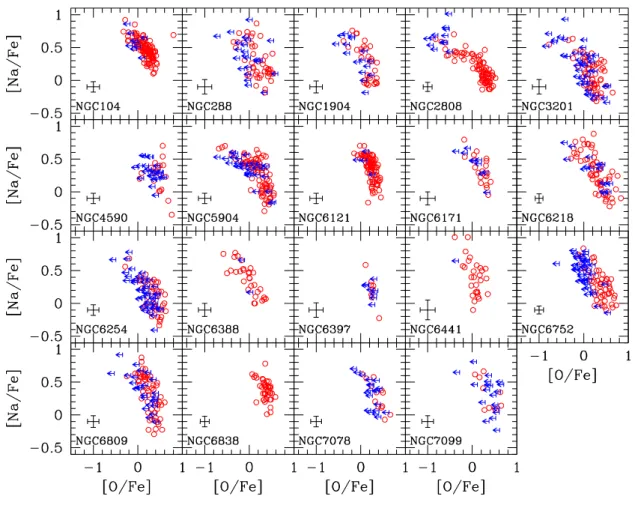
Figure1: The Na-O anticorrelation patterns observed in19GCs by Carretta et al. (2009b)
abundance variations of some specific elements. This was already observed in
1970s and 1980s: many spectroscopic works showed the presence of red giant branch (RGB) stars having strong CN bands (Osborn 1971), in contrast with the stars of the field characterized by weak CN bands; moreover in some GCs a bi-modal distribution of CN strength and anti-correlations between CH and CN strengths was discovered (see for example Norris et al. 1981; Norris 1981; Smith & Norris 1982). Other spectroscopic observations brought to the discov-ery of other peculiar chemical anomalies, as, for example, the large spread in the sodium distribution among stars in M3 and M13 found by Cohen (1978). With the advent of high resolution spectra, other anomalies have surfaced, such as light element variations among the GC stars and well defined chemical pat-tern, such as the anti-correlations Na-O, C-N, and Mg-Al (see Gratton, Sneden & Carretta2004; Gratton, Carretta & Bragaglia2012for a review).
These anti-correlations patterns are different for different GCs and could have different extensions, as shown in Fig. 1 for a sample of 19 GCs (Carretta et al. 2009b). The anti-correlations are the proof that in the stellar surfaces of a fraction of the GC stars is present material which have undergone H burning at temperature of a few ten millions K (Prantzos, Charbonnel & Iliadis 2007; less for the C-N anticorrelation).
While the variations of C and N are observed also in field giant stars and are expected from typical evolution of low mass stars (Sweigart & Mengel
1979), the variations of the other light elements are an exclusive peculiarity of the GCs stars. Moreover, the fact that anti-correlations Na-O have not only been observed for giant stars, but also in the unevolved or slightly evolved stars of some GCs, such NGC6397, NGC6752, or 47Tuc (Gratton et al. 2001; Carretta et al. 2004, 2005; Lind et al. 2011), means that this chemical anomalies were already present in the material out of which the stars formed, because low mass stars are not hot enough to produce this material. Moreover, the fact that the total C+N+O abundance is constant within the errors for almost all the GCs, means that the material out of which the other stellar generations formed has been processed through the hot CNO cycle.
Another chemical peculiarity regarding multiple stellar generations is associated to the helium abundance. While the Na-poor, O-rich population is characterized by primordial helium abundance, the other populations are en-hanced in helium. The explanation is simple: helium is the main product of H-burning, and is released in the medium, from which other stellar populations formed, by the stars that product also light-elements anomalies. Many pho-tometric and spectroscopic works have confirmed the He variations (see, e.g., Villanova, Piotto & Gratton 2009; Dupree, Strader & Smith 2011; Pasquini et al.
2011; Milone et al. 2012d,a, 2013; Marino et al. 2014a), that could vary from ∆Y ∼0.01 dex to ∆Y ∼0.15 in the extreme cases.
The cause of the pollution of the material from which the other stellar generations formed has not been firmly identified yet. Many polluters have been proposed in the last decades, such as, for example, intermediate-mass asymp-totic giant branch (AGB) stars (D’Antona et al.2002), fast rotating massive stars (Decressin et al.2007), and interactive massive binary stars (de Mink et al. 2009; Vanbeveren, Mennekens & De Greve 2012). The associated scenarios for the
for-mation and evolution of multiple stellar populations in GCs will be discussed in the section1.5.
1.3 photometric discoveries of multiple stellar populations
About a decade ago, the idea of GC as simple stellar population has been def-initely wiped out by the discovery of multiple evolutionary sequences in the CMD of ω Centauri (Lee et al.1999; Bedin et al.2004). The first photometric ev-idence of MSPs in a GC was provided by Lee et al. (1999), from their discovery of the discrete nature of the RGBs in ω Centauri. The first evidence of MSPs in the unevolved sequence of ω Centauri was given by Bedin et al. (2004); they found that, 2/3 magnitudes below the turn-off, the MS of ω Centauri splits in two. Indeed, Jay Anderson, in his PhD Thesis (Anderson 1998), already found a first evidence of MS split in ω Centauri, but his CMD was based on only one external HST Wide-Field Planetary Camera 2 (WFPC2) field, and, because this result was unexpected, he decided to wait more accurate photometry to be sure of the MS split.
Now we know that the MS ofω Cen is composed by six or more stellar populations (Bellini et al. 2010), characterized by different metallicity. Indeed, the most “strange” discovery concerning the MSPs in ω Centauri, came from spectroscopic observations, that showed that the bluer MS has twice the metal abundance of the redder (and dominant) MS (Piotto et al. 2005). This combi-nation of color and metallicity could be obtained only if we consider the bluer component extremely enriched in helium (Y ∼ 0.38) relative to the dominant old-population, characterized by primordial helium. Indeed, the scenario of the peculiar GC ω Centauri is more complex: the multiple MSs spread in multi-ple sub giant branches (SGBs) and RGBs (see Fig. 2), characterized by different metallicities and ages (Sollima et al.2005; Villanova et al.2007; Bellini et al.2010). The case of ω Centauri has revitalized the interest on the globular clus-ters and stimulated a large number of investigations, both photometric and spec-troscopic, that have shown that multiple population phenomenon is not a pecu-liarity of a single object. The second object that showed MSPs was NGC2808. While spectroscopic measurements of red giants of this GC showed that these stars have nearly uniform iron content (Carretta et al. 2006), Piotto et al. (2007)
Figure2: Left panel: mF435W versusmF435W−mF625WCMD showing the complex-ity of ω Cen; right panels: Hess diagrams to highlight the four main SGBs (top) and the three MSs (bottom, from Bellini et al.2010)
found that the MS of NGC2808 splits in three discrete components (see Fig. 3), characterized by different helium content (Y∼0.248, 0.31, 0.38). The Helium en-hancement has also been demonstrated by direct spectroscopic observations of helium-rich stars along the RGB and the HB (Pasquini et al. 2011; Marino et al.
2014a). Other peculiarities suggest that NGC2808 hosts multiple populations. For example, the HB is greatly extended blue-ward, well populated to both the blue and red of the instability strip (Dalessandro et al.2011), and the distribution of stars is multimodal (Sosin et al. 1997; Bedin et al.2000). The multi-modality of the RGB has also been demonstrated both with photometric (Lee et al.2009a; Monelli et al.2013) and spectroscopic investigations. The latest has shown star-to-star variations of large number of light elements, Na-O anticorrelation pattern (Norris et al. 1981; Carretta et al. 2006; Gratton et al. 2011; Marino et al. 2014a; Carretta2014), and three distinct groups of O-normal, O-poor and super-O-poor stars.
Figure3: The triple MS of NGC2808in themF814WversusmF475W−mF814WCMD (from Piotto et al.2007)
Another Galactic GC that showed anomalies due to the presence of MSPs is NGC1851. This is one of the most interesting cluster with multiple stellar populations. I also presents small star-to-star abundance dispersion for iron-peak and neutron-capture elements. The first important photometric discov-ery of MSPs in this GC came from the work by Milone et al. (2008), that showed the split of the SGB in two components in themF606W−mF814W color-system (see
Fig.4). It was hypothesized that this split could be due to a difference in age of
∼1 Gyr between the two populations, or, as an alternative, the two SGBs could be nearly coeval but with a different C+N+O content (Cassisi et al. 2008; Ven-tura et al.2009). Recently, it has been demonstrated that there is a large spread in C+N+O abundance sum among RGB stars (Yong, Grundahl & Norris 2015,
Figure4: ThemF606W versusmF606W−mF814WCMD of NGC1851. The inset show
a zoom around the double SGB (from Milone et al. 2009b).
and references therein). These observations confirm that the SGB split is mainly due to the difference in the C+N+O abundance between the two populations, by making this cluster unique. Moreover, spectroscopic observations of the stars in NGC1851 have revealed the Na-O anticorrelation pattern (Villanova, Geisler & Piotto2010), typical of GCs with MSPs.
The split of the SGB in optical bands is a common feature to few GCs. In addition to NGC1851, also NGC6388and NGC6441(Bellini et al.2013a),47Tuc (Milone et al.2012d), NGC362, NGC5286, NGC6656, NGC6715, and NGC7089
(Piotto et al. 2012) show multiple SGBs in optical bands (see Fig. 5 from Piotto et al.2012). This peculiarity is consistent both with the presence of populations with different age, and with a significant difference in the C+N+O abundance of the populations.
After the case of NGC1851, many other investigations have been per-formed to search for multiple populations in GCs, using both HST (see for
Figure5: The mF606W versus mF606W −mF814W CMD of NGC362, NGC5286,
NGC6388, NGC6656, NGC6715, and NGC7089 (from Piotto et al.
Figure6: TheUversus(U−B) CMD of NGC6121from WFI photometry. In the inset there is the distribution of the Na content from the UVES@VLT stellar spectra.The stars belonging to the two different Na groups are represented in two different colors: the red triangles represent the stars with [Na/Fe]≤0.2dex,and the blue circles the stars with [Na/Fe]<0.2dex (from Marino et al.2008).
example the cases of NGC6397, Milone et al. 2012a, or the case of NGC6752, Milone et al. 2013) and ground-based observations (Bellini et al. 2009b) . The work by Monelli et al. (2013), based on ground-based data, is the first evidence that a large sample of GCs in our Galaxy are formed by many stellar popula-tions. Moreover, for a given GC, photometric results reflect the spectroscopic results and vice versa. An example is shown in Fig.6, from the work by Marino et al. (2008): it shows the U versus (U −B) CMD of M4. The blue and red the stars belong to two different groups of stars having [Na/Fe]≤0.2dex and [Na/Fe]<0.2dex, respectively, as shown in the inset. These two groups of stars also form two different RGBs, and in particular, bluer stars are Na-poor (and O-rich), while redder stars are Na-rich (O-poor).
Thanks to UV/blue HST observations from the GO 13297 (see Piotto et al. 2015 for details), we know that all the GCs are composed by multiple stellar populations. There are some exceptions (even if higher precision data is
needed for a confirmation): Rup106, as demonstrated by Villanova et al. (2013), and IC4499as shown by Walker et al. (2011).
All the GCs with MSPs appear to be homogeneous in iron, with some exceptions, i.e., NGC7089 (M2), ωCentauri, M22, Terzan5, M54, NGC 5824, and NGC1851(Norris & Da Costa1995; Da Costa et al.2009; Ferraro et al.2009; Marino et al. 2009; Carretta et al. 2010a,b; Johnson & Pilachowski 2010; Marino et al. 2011a,b; Da Costa, Held & Saviane 2014; Yong et al. 2014; Marino et al.
2014b). These ’anomalous’ GCs, probably, have been a different formation his-tory respect to the ’normal’ GCs, because Supernovae (SNe) must have played a role in the internal chemical-enrichment history.
1.4 chemical anomalies and multiple sequences
As already shown in section 1.3, there is a connection between the chemical pattern observed with spectroscopic data and the presence of multiple sequences in the CMDs of Galactic GCs. Many recent works (e.g., Sbordone et al. 2011; Milone et al. 2012d) based on synthetic spectra, have demonstrated how the observed chemical anomalies translate in the photometric results.
Figure7, from the work by Milone et al. (2012d), shows why the UV and blue photometric bands are most affected by the light-elements variations. In the upper panel there are the synthetic spectra of a star having primordial chemical abundances (in green) and belonging the MSa of47Tuc, and of a C- and O-poor, Na- and N-rich star (in magenta) belonging the MSb of 47Tuc. In the middle panel there are the difference between the two synthetic spectra, while in the bottom panel the response of HST filters. In the figure it is possible to observe that color and magnitude changes are largest when UV and blue filters are used (λ<4500 ˙A).
The combination of BV I filters is useful to split the MS when along the GC stars there is a variation in helium (see, e.g., the case of NGC2808 in Piotto et al.2007), but optical filters are not affected by light-element variations. Instead, a variation of the sum of C+N+O-abundance permits to split the SGB using optical filters (see, e.g., the case of NGC1851in Milone et al.2008).
Figure7: Top panel: synthetic spectra of two stars belonging the MSa (green) and MSb (magenta) of 47Tuc. Middle panel: difference between the two spectra shown in top panel. Bottom panel: normalized responses of the HST filters (from Milone et al.2012d).
The combination of UV/blue and optical filters is the perfect choice to photometrically disentangle the MSPs of GCs, as it will be demonstrated in Section1.7.
1.5 mechanism of msps formation
The idea that GCs are formed by a first generation (FG) of stars, with compo-sition similar to the proto-galactic interstellar matter, and a second generation (SG) of stars (or more stellar generations), characterized by C- and O- poor, N-and Na-rich, N-and He enriched stars, is well established in the astronomical com-munity. This chemical pattern indicates that material out of which GCs formed was exposed to proton-capture processes at high temperatures and must have come from relatively massive FG stars.
In ’normal’ GCs, SG stars have on average the same abundances of iron and other heavy-elements as the FG stars, indicating that SN ejecta are not the responsible of the pollution of material which SG stars formed from. The material come entirely from the stars belonging the first stellar generation, or it is a mixture of processed gas and pristine matter of the initial star forming cloud. Some ’normal’ GCs exhibit small iron abundance spreads, indicating that only a tiny fraction of the SN products from FG were incorporated in SG stars (Renzini
2013).
Usually, the fraction of SG stars is higher than that of the FG (D’Antona & Caloi2008). For this reason, the initial stellar population must have been larger than the stellar content of today’s GCs, in such a way that FG stars produce enough CNO material to form SG stars. The lower fraction of FG stars could be due to dynamic loss in the early evolutionary phases (D’Ercole et al.2008) or to the formation of the GC within a larger stellar environment, such as a dwarf galaxy, where the polluting matter is supplied by the surrounding stars (Bekki & Norris2006).
In these last years, different theories have been developed to explain the mechanism of formation and evolution of MSPs in GCs. All these theories are based on the existence of a progenitor responsible of the pollution of the matter from which the SG formed. An important constraint on the progenitors is given by the fact that in almost all the observed GCs the C+N+O abundance is
constant within the errors, and therefore the progenitors must activate hot CNO cycle and not the He-burning phase.
Different progenitors for the SG stars have been proposed. The most accredited scenarios expect that the material from which SG stars formed comes from intermediate-mass asymptotic giant branch stars (AGB-M model, D’Antona et al. 2002; D’Ercole et al. 2008), fast-rotating massive stars (FRMS model, De-cressin et al. 2007), massive interacting binary stars (de Mink et al. 2009; Van-beveren, Mennekens & De Greve2012), or super-massive stars (Denissenkov & Hartwick2014; Denissenkov et al.2015).
1.5.1 Intermediate-mass asymptotic giant branch stars
The AGB-M scenario is the model that presents fewer problems to explain the presence of multiple populations; indeed, already in 1980s, AGB stars were pro-posed as a possible cause of the observed chemical anomalies (D’Antona, Grat-ton & Chieffi1983). In intermediate AGB stars, the H burning shell can extend into the convective envelope, contaminate the envelope with products of the var-ious H-burning cycles, such as, for example, the CNO cycle. It is important that the CNONa anomalies arise within intermediate mass stars (3-8M⊙), in order to avoid the formation of carbon stars. In these kind of stars the second dredge-up happens shortly before reaching the AGB phase, leading to an He enrichment of the envelope. The slow winds of the intermediate mass AGB stars pollute with the processed material the pristine gas from which the other populations will form.
D’Ercole et al. (2008), using N-body hydrodinamical simulations, found that, initially, the FG must have been10-20 times more massive than at present time. The FG formed from a first episode of star formation, that was followed by a SN explosion era. After this period, the polluted material, generated by the stellar winds of AGB stars (with mass of 5-8 M⊙) and by ejection of plan-etary nebulae, moved toward the center of the cluster at low-velocity (∼ 10-20
km s−1), forming a cooling flow. In the center of the GC a new episode of stel-lar formation started, forming SG stars. The ejected materials of the AGB stars had been processed through H burning at high temperature, hence the material from which SG formed was enriched in He and presented the Na-O and Al-Mg
anti-correlations. The hydrodinamical simulations of this scenario have proved that most of the stars belonging the FG were lost; this is the reason for which GCs are dominated by SG stars. This scenario have some problems; for example, it is not able to reproduce all the chemical anomalies observed in SG stars (e.g., the extreme O depletion observed in some GCs) or the large He enhancement required to reproduce the bluest MSs inω Cen or NGC2808.
1.5.2 Fast-rotating massive stars
Wallerstein, Myckky-Leep & Oke (1987) and Brown & Wallerstein (1993) pro-posed that the massive Wolf-Rayet stars could be a possible source of chemical anomalies observed in GCs. To explain the He-enhanced stars in ω Centauri, Maeder & Meynet (2006) proposed that these stars were formed from wind ma-terial of fast rotating massive stars. Prantzos & Charbonnel (2006) suggested that the winds of massive stars enriched in metallicity the material for the next stel-lar generation and that the SN explosions were the trigger for the star formation; the SN ejecta escape the GC environment along the cavities opened previously by the stellar winds.
In the scenario proposed by Decressin et al. (2007) and Decressin, Char-bonnel & Meynet (2007) the winds of fast rotating massive stars (FRMSs) play an important role in the mechanism of formation of MSPs in GCs.
In this scenario, a FG stars, with mass that run from0.1M⊙ to120 M⊙, formed from proto-cluster gas; these stars have composition similar to that of the field, with a high [O/Na] ratio. The more massive stars, which evolution is shown in Figure 8(Decressin, Charbonnel & Meynet 2007), are also fast rota-tors. These stars reach the critical velocity (i.e. the velocity at the equator such that the centrifugal acceleration balances the gravity) at the beginning of their life, and remain in this status during the MS and part of the central He-burning phase. In this period, they lose material through mechanical wind, that lead to the formation of a Keplerian equatorial disc. The material of this disk presents the chemical anomalies observed in GCs, because the rotational mixing trans-ports the products of all the burning cycles, from the core to the stellar surface. Moreover, the material is released in the circumstellar environment with very low velocity, in such a way that it can fall in the potential well of the GC, where
Figure8: Schematic view of the evolution of fast rotating massive stars. The colors reflect the chemical composition of the various stellar regions: green corresponds to the initial chemical composition, blue and red are respectively for material loaded in H- and He-burning products. (from Decressin, Charbonnel & Meynet2007, see the paper for details).
Figure9: Schematic representation of the massive interacting binary stars sce-nario. Left: a binary system at the onset of mass transfer. The deepest layers in the donor star have been processed by p-capture reactions. The accreting star spins up as it accretes mass and angular momentum until it approaches the break-up limit. Right: the same system after the donor star has been stripped of its envelope. The companion star accreted just a fraction of the transferred mass, mainly unprocessed material originating from the outermost layers of the donor star. Ma-terial originating from deeper layers in the donor star is shed into a circumbinary disk. (from de Mink et al.2010).
SG formed. The wind of massive stars, the SN shocks and the ionization front that these stars produce, trigger star formation in the vicinity of the progenitor. To take into account of the loss of FG low-mass stars and retain the observed proportion SG/FG stars, Decressin et al. (2010) in the FRMS scenario added an initial or very early mass segregation together with quick gas expulsion after the formation of the SG.
Even if the Na-O anticorrelation is well reproduced by this scenario, the expected smooth spread inY distribution is in contrast with the discreteness of the observed helium abundances. Moreover, this scenario has problems relating to the initial mass function and the predicted nucleosynthesis yields.
1.5.3 Massive interacting binary stars
de Mink et al. (2009) and Bastian et al. (2013) proposed and elaborated a sce-nario where massive interacting binaries (MIBs) are the possible source of
abun-dance anomalies in globular clusters. The majority of massive members of a GC are expected to form binary systems. Hydrogen burning processed material could be released by the interacting binaries into their surroundings during non-conservative mass transfer. This material has been part of the envelope of the primary star and is ejected at low velocities, of the order of 30-70 km s−1. Fig-ure9 shows a schematic representation of the scenario. Bastian et al. (2013) sce-nario includes also that the circumstellar disks of young, low mass stars sweep away the MIB ejecta. This model does not invoke the presence of multiple stellar generations.
As discussed in Bastian, Cabrera-Ziri & Salaris (2015), this model does not reproduce well the Na-O anticorrelation, because the models predict less O depletion than observed. Another problem is that the extreme yields of this model are not consistent with the small He enrichment observed in many GCs. Finally, the model does not reproduce the discreteness in the observed helium abundance distribution.
1.5.4 Super-massive stars
Super-massive stars (SMSs) have been proposed by Denissenkov & Hartwick (2014) and Denissenkov et al. (2015) as possible source of abundance anomalies of proton-capture elements observed in GCs. These stars are radiation-pressure-dominated objects with super-Eddington luminosities and mass of ∼ 104M⊙, and lose mass at high rate. The SMSs in young GCs burn H in their core. After this phase, the stars lose greater part of the mass through stellar winds and various instabilities. The material lost from the SMSs is mixed with the pristine gas from which FG formed, and from this polluted medium SG is born. Because the SMSs are chemically homogeneous, the material released in the interstellar medium is enriched in helium and of products of CNO cycling, that are the chemical abundances typical of the 2G stars. Actually, this potential source has not been developed into a full scenario, i.e, how the material released by the SMSs forms new stars.
As discussed in Bastian, Cabrera-Ziri & Salaris (2015), SMSs produce too much helium for a given range in Na-O. Moreover, even if the formation of
SMSs may be stochastic in nature, the resulting yields could not have the same property and reproduce the wide range of observed GC properties.
1.6 radial gradients of msps
Combining observations from HST with ground-based data, it is possible to study the behavior of MSPs in a GC at different radial distances from the clus-ter cenclus-ter. An example could be the work by Milone et al. (2012d) on 47Tuc: combining photometric and spectroscopic data fromHST and ground-based fa-cilities, they found that the second stellar generation of this globular is more centrally concentrated and is He-enriched.
The analysis of the radial distribution of MSPs is an very important issue. Hydrodynamical and N-body simulations for the formation and evolution of MSPs (D’Ercole et al.2008) predict that, SG stars form in the inner regions of the cluster and are initially more concentrated than FG stars. The subsequent long-term dynamical evolution, driven by two-body relaxation, gradually erases the initial differences in the first and second generation spatial distributions, but N-body simulations predict that long relaxation-time GCs should still retain memory of the initial differences in the FG/SG spatial distribution (Vesperini et al.2013).
As mentioned before, observational studies revealed that, for long re-laxation systems, SG stars are indeed concentrated in the GC inner regions and retain some memory of the initial spatial segregation predicted by the forma-tion and dynamical evoluforma-tion models of D’Ercole et al. (2008) and Vesperini et al. (2013). Radial gradients have been found, for example, inωCentauri (Sol-lima et al. 2007; Bellini et al. 2009b), 47Tuc (Milone et al. 2012d), NGC6388, and NGC6411 (Bellini et al. 2013b), while a short relaxation-time GC such as NGC6752does not show any gradient (Nardiello et al.2015a).
1.7 the hubble space telescope uv legacy survey of galactic glob
-ular cluster
The scientific results based on Hubble Space TelescopeTreasury programme “UV Legacy Survey of Galactic Globular Clusters: Shedding Light on Their Popula-tions and Formation” (GO 13297, PI Piotto) will be the cornerstone for under-standing the mechanism of formation and evolution of multiple stellar popula-tions in Galactic Globular Clusters. In this Chapter we describe the survey and why it is very efficient to disentangle the multiple stellar populations in globular clusters.
1.7.1 Overview and observations
The main aim of the Hubble Space Telescope programme “UV Legacy Survey of Galactic Globular Clusters: Shedding Light on Their Populations and Formation” (GO13297, PI Piotto, see Piotto et al. 2015) is a detailed photometric analysis of MSPs in Galactic GCs using the UV/blue WFC3/UVIS filters F275W, F336W, and F438W. This survey is complementary to the HST Treasury programme “An Advanced Camera for Survey (ACS)Survey of Galactic Globular Clusters”
(GO10775, PI Sarajedini, see Sarajedini et al.2007; Anderson et al.2008), whose database consists of observations of GCs in the F606W and F814W bands.
The sample of the HST Treasury programme GO 13297 includes 47
Galactic GCs and a very old and peculiar open cluster (OC), NGC6791 (with an age∼ 8 Gyr, King et al. 2005; Bedin et al. 2008; Geisler et al.2012). 131HST
orbits were allocated to this program.
To test the feasibility of the Treasury survey, two HST pilot projects have been carried out in the past. The data from these programmes repre-sent an important complement to the GO 13297 data. The main pilot project was the “Advances in Understanding Multiple Stellar Generations in Globu-lar Clusters” HST programme (GO 12605, PI Piotto, 22 orbits): a collection of WFC3/UVIS F275W, F336W, and F438W images of seven GCs (M3, M13, M15, M80, NGC288, NGC362, and NGC2808). For these GCs there are F606W and F814W data from GO10775programme, too. An additional, earlier project is the “Multiple Stellar Populations in Galactic Globular Clusters” (GO12311, PI Piotto,
Figure10: Spatial distribution of the target clusters for GO 13297 (black), GO 12605 (red), and GO 12311 (blue), in Galactic XYZ coordinates. The adopted Sun position is indicated by an orange asterisk (from Piotto et al.2015).
Cluster X Y X E(B−V) (m−M)V [Fe/H] MV (kpc) (kpc) (kpc) (dex) NGC104(47Tuc) -6.4 -2.6 -2.7 0.04 13.37 -0.72 -9.42 NGC288 -8.4 0.0 -8.5 0.03 14.84 -1.32 -6.75 NGC362 -5.2 -5.1 -5.8 0.05 14.83 -1.26 -8.43 NGC1261 -8.2 -10.0 -12.5 0.01 16.09 -1.27 -7.80 NGC1851 -12.5 -8.9 -6.5 0.02 15.47 -1.18 -8.33 NGC2298 -12.6 -9.4 -2.6 0.14 15.60 -1.92 -6.31 NGC2808 -6.3 -9.2 -1.5 0.22 15.59 -1.14 -9.39 NGC3201 -7.7 -4.8 1.1 0.24 14.20 -1.59 -7.45 NGC4590 (M68) -4.2 -7.2 6.4 0.05 15.21 -2.23 -7.37 NGC4833 -4.7 -5.4 -0.5 0.32 15.08 -1.85 -8.17 NGC5024 (M53) -5.5 -1.4 18.0 0.02 16.32 -2.10 -8.71 NGC5053 -5.3 -1.4 17.5 0.01 16.23 -2.27 -6.76 NGC5272(M3) -6.8 1.3 10.4 0.01 15.07 -1.50 -8.88 NGC5286 -0.7 -8.6 2.5 0.24 16.08 -1.69 -8.74 NGC5466 -5.0 3.0 15.7 0.00 16.02 -1.98 -6.98 NGC5897 2.0 -3.2 6.7 0.09 15.76 -1.90 -7.23 NGC5904(M5) -3.2 0.3 5.9 0.03 14.46 -1.29 -8.81 NGC5927 -1.9 -4.2 1.1 0.45 15.82 -0.49 -7.81 NGC5986 1.0 -4.0 2.8 0.28 15.96 -1.59 -8.44 NGC6093(M80) 1.1 -1.2 3.7 0.18 15.56 -1.75 -8.23 NGC6101 2.7 -10.0 -3.8 0.05 16.10 -1.98 -6.94 NGC6121(M4) -6.2 -0.3 1.0 0.35 12.82 -1.16 -7.19 NGC6144 0.2 -1.2 2.8 0.36 15.86 -1.76 -6.85 NGC6171 -2.4 0.3 2.9 0.33 15.05 -1.02 -7.12 NGC6205(M13) -5.5 4.6 5.1 0.02 14.33 -1.53 -8.55 NGC6218(M12) -4.1 1.2 2.5 0.19 14.01 -1.37 -7.31 NGC6254(M10) -4.4 1.1 2.1 0.28 14.08 -1.56 -7.48 NGC6304 -2.5 -0.4 1.0 0.54 15.52 -0.45 -7.30 NGC6341(M92) -5.8 6.3 5.1 0.02 14.65 -2.31 -8.21 NGC6352 -3.0 -1.8 -0.3 0.22 14.43 -0.64 -6.47 NGC6362 -2.3 -4.1 -1.9 0.09 14.68 -0.99 -6.95 NGC6366 -5.1 1.1 1.4 0.71 14.94 -0.59 -5.74
Table1: List of the Clusters observed in the GO12311, GO12605, and GO13297
missions and the corresponding main parameters: Galactic XYZ Coor-dinates, Reddening, Distance Modulus, Metallicity, and Absolute visual magnitude
Cluster X Y X E(B−V) (m−M)V [Fe/H] MV (kpc) (kpc) (kpc) (dex) NGC6388 1.3 -2.5 -0.8 0.37 16.13 -0.55 -9.41 NGC6397 -6.2 -0.8 -0.1 0.18 12.37 -2.02 -6.64 NGC6441 3.2 -1.3 -0.6 0.47 16.78 -0.46 -9.63 NGC6496 2.6 -2.3 -1.6 0.15 15.74 -0.46 -7.20 NGC6535 -2.3 3.1 1.6 0.34 15.22 -1.79 -4.75 NGC6541 -1.0 -1.4 -1.1 0.14 14.82 -1.81 -8.52 NGC6584 4.0 -4.0 -3.4 0.10 15.96 -1.50 -7.69 NGC6624 -0.5 0.4 -0.7 0.28 15.36 -0.44 -7.49 NGC6637(M69) 0.3 0.3 -1.2 0.18 15.28 -0.64 -7.64 NGC6652 1.5 0.3 -1.6 0.09 15.28 -0.81 -6.66 NGC6656(M22) -5.1 0.6 -0.0 0.34 13.60 -1.70 -8.50 NGC6681(M70) 0.5 0.4 -1.6 0.07 14.99 -1.62 -7.12 NGC6715(M54) 17.3 2.5 -6.1 0.15 17.58 -1.49 -9.98 NGC6717 -1.5 1.6 -0.9 0.22 14.94 -1.26 -5.66 NGC6723 -0.0 0.0 -2.2 0.05 14.84 -1.10 -7.83 NGC6752 -5.0 -1.4 -1.3 0.04 13.13 -1.54 -7.73 NGC6779(M56) -4.0 8.3 1.8 0.26 15.68 -1.98 -7.41 NGC6791 -3.5 -1.7 1.4 0.12 13.43 0.15 -3.93 NGC6809(M55) -3.4 0.8 -1.7 0.08 13.89 -1.94 -7.57 NGC6838(M71) -6.1 3.4 0.10 0.25 13.80 -0.78 -5.61 NGC6934 0.8 11.7 -4.7 0.10 16.28 -1.47 -7.45 NGC6981(M72) 3.4 8.3 -8.8 0.05 16.31 -1.42 -7.04 NGC7078(M15) -4.4 8.3 -4.4 0.10 15.39 -2.37 -9.19 NGC7089(M2) -2.7 7.5 -6.3 0.06 15.50 -1.65 -9.03 NGC7099(M30) -3.4 2.5 -5.5 0.03 14.64 -2.27 -7.45 Table1.7(Continued)
17 orbits). For this programme WFC3/UVIS F275W images (complementary to the F606W and F814W observations from GO 10775) of five clusters (47Tuc, M4, M22, NGC1851, and NGC6752) have been collected. For NGC1851, M4, and M22 observations in F336W and F438W have been collected during the GO13297.
In summary, all the HST programmes described in this section pro-vide data for56 GCs and an old OC, in five photometric bands: F275W, F336W, F438W, F606W, and F814W. As shown in the next sections, these bands, espe-cially UV/blue are crucial to identify MSPs in all the analyzed GCs. Moreover
the overlaps between the GO 13297 and GO 10775 images, provide a temporal baseline of∼ 7−8 years, enough to compute the relative stellar proper motion and the membership probabilities.
In Fig.10the distribution of the globular clusters in the GalacticXYand
XZ planes is shown. Table1.7lists the57 clusters with some of their properties, such as XYZ Galactocentric coordinates, the reddening, the distance modulus, the metallicity, and the absolute visual magnitude (from Harris 1996, 2010 edi-tion).
1.7.2 WFC3/UVIS’ UV/blue Filters
A great number of spectroscopic works (e.g.,Yong et al.2008; Marino et al.2008; Lee et al.2009b; Lim et al.2015), ground-based photometric works (e.g.,Lee et al.
1999; Han et al.2009; Roh et al.2011; Monelli et al.2013; Lee et al.2013; Nardiello et al. 2015a) and HST photometric works (e.g.,Bellini et al. 2010, 2013a; Milone et al.2012a,c,d,2013; Piotto et al. 2012,2013) have demonstrated that Str ¨omgren and ultraviolet photometries are good tools for separating MSPs across the entire CMD of Galactic GCs.
Figure 11 help understanding why the combinations of UV filters is a powerful tool to disentangle the MSPs in GCs. The upper panel shows, in red, the simulated spectrum of a star of the first stellar generation (N-poor, He-poor) which belongs the RGBa of NGC6752, and in blue the simulated spectrum of a third generation, N-rich, He-rich, RGBc star (Milone et al. 2010); in the middle panel there is the flux ratio of the two spectra reproduced in the upper panel. The lower panel shows the band-passes of WFC/UVIS filters F275W, F336W, and F438W.
As described by Milone et al. (2012d), F275W pass-band includes an OH molecular band, F336W an NH band, and F438W CN and CH bands, as also illustrated in the upper panel of Fig.11. This property of the HST filter system is at the basis of the Treasury programme. The first generation stars, which are oxygen- and carbon-rich and nitrogen-poor, are relatively faint in F275W and F438W, but bright in F336W. Conversely, second generation stars, whose material has been CNO-cycle processed, are oxygen- and carbon-poor, but nitrogen-rich. As a consequence, they are relatively bright in F275W and F438W, but faint in
Figure11: Upper panel: in red the simulated spectrum of a star of the first stellar generation (N-poor) RGBa in NGC6752; in blue the simulated spec-trum of a third generation, N-rich, RGBc star (Milone et al. 2010). Middle panel: flux ratio of the two spectra reproduced in the upper panel. Lower panel: band-passes of WFC3/UVIS with F275W, F336W, and F438W (from Piotto et al.2015).
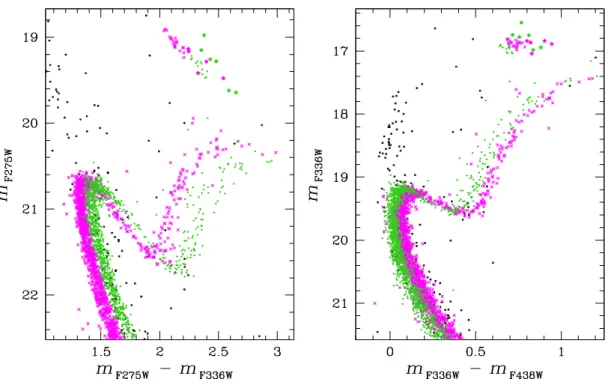
Figure12: The mF275W versus mF275W −mF336W (left panel) and mF336W versus
mF336W−mF438W (right panel) CMDs of NGC6352. In the first CMD, first-generation stars (green dots) are redder than second-generation stars (magenta crosses), while in the second CMD, first-generation stars have, on average, bluer colors than second-generation stars.
F336W. Therefore, first generation stars are bluer then second generation ones in one color (F336W−F438W), but redder in another (F275−F336W), and this inversion is seen in Figure12in the case of NGC6352: the left panel shows that in the mF275W versus mF275W−mF336W CMD first-generation stars (green) are redder than second-generation stars (magenta), while the right panel shows that in themF336W versusmF336W−mF438W CMD first-generation stars are bluer than second-generation ones.
Milone et al. (2013) defined a pseudo-colorCF275W,F336W,F438W = (mF275W−
mF336W)−(mF336W−mF438W), which is quite efficient in the separation of multi-ple sequences because it maximizes the virtue of both F336W-F438W and F275 W-F336W colors.
Figure 13 shows an example for the NGC6352 data. The left panels show the power of the pseudo-color CF275W,F336W,F438W in separating all the se-quences in the pseudo-CMD. The middle panels show that in themF336W versus
Figure13: CMDs of NGC6352 from GO 13297 data. mF336W versus
CF275W,F336W,F438W (left panels), mF336W versusmF275W−mF336W
(mid-dle panels), andmF336W versusmF336W−mF438W (right panels) CMDs. Lower panels show a zoom of the MS. Red dots highlight second-generation stars; blue dots first-second-generation stars (from Piotto et al.
mF275W−mF336WCMDs, firts-generation stars are redder then second-generation ones, but they become bluer in themF336W versus mF336W−mF438W CMDs (right
panels).
Thanks to F275W, F336W, and F438W data, the two stellar generations are clearly distinguished from the MS, through the SGB, the RGB to the HB.
The UV pass-bands are thus able to probe the CNO content of the clus-ter stars. Note that the nuclear processes that produce the light-element (anti-)correlations (e.g., the Na-O or the Mg-Al anti-correlations) also produce helium, and measuring the helium enhancement of each sub-population is particularly important to help pinpoint what kind of stars may have produced the second-generation material. Enhanced helium abundance affects the interior structure of stars, leading to changes in luminosity and effective temperature, while it is irrelevant for the atmospheric structure at fixed logg and Te f f, even for extreme enhancement (e.g., Y = 0.40, Sbordone et al. 2011). The photometric impact of helium is mainly on the optical bands, and, using synthetic spectra, it is possi-ble to measure variations of only a few percent in helium between the different populations (as demonstrated in Chapter2and 3; see also Milone et al.2012d,a,
2013 ). Therefore, combinations of UV and optical colors permit to estimate the content of C, N, O, and He, even for stars that are too faint to pursue with spectroscopy (Milone et al.2012d,a,2013).
When a GC hosts a population enhanced in helium, the HB morphology could be anomalous (bluer and extended HB). These anomalies can be better observed in UV. When Y is increased from 0.23 to 0.38 the blue HB becomes 1
mag brighter in F275W, while the extreme HB becomes 0.5 mag fainter. Thus the UV band is crucial for determining the physical parameters of HB stars and their helium content.
1.7.3 Multiple stellar populations and principal goals of the Treasury programme GO13297
The principal goal of the HST Treasury programme GO 13297 is the analysis of all the phenomena related to the MSPs in GCs. However, the data could be useful also for a large number of other projects.
Combining UV/blue and optical filters, it is possible to distinguish be-tween different effect due to differences in He, C, N, O, Na content. Combining synthetic spectra based on observed (when possible) chemical compositions with the behavior of the multiple stellar populations in different CMDs, it is possible to obtain the relative helium abundance for each stellar population. This tech-nique has been applied to some GCs, such as, for example, 47Tuc (Milone et al.
2012d), NGC6397 (Milone et al. 2012a), NGC288 (Piotto et al. 2013), NGC6752
(Milone et al. 2013), M4 (Nardiello et al. 2015a, see Chapter 2), and NGC6352
(Nardiello et al.2015b, see Chapter 3)
The combination of UV/blue data with optical data permits to compute GC radial star density profiles based on resolved star counts (see Ferraro et al.
2003; Miocchi et al.2013). The radial density profiles are an important tool useful to characterize the structural and dynamical properties of GCs.
A good fraction of the GCs observed during the GO13297mission was also observed during the GO 10775 and other HST programmes. This permits to measure internal proper motions with time baselines between7and 14years. This permits to measure separately the kinematical properties of each different stellar population hosted by a GC and photometrically identified. Kinematical differences between the populations would strongly constraint formation mech-anism of MSPs. With the internal proper motions it is possible to obtain direct measurements of the radial velocity dispersion profiles, the velocity dispersion anisotropy, and possible rotation of many GCs. Moreover, it is possible to cre-ate dynamical models to constrain the mass profiles of the GCs, including the presence of intermediate-mass black holes (see for example van der Marel & Anderson2010for the case of ωCen).
The GO 13297 data set would be useful to obtain the distances of the Galactic GCs. Indeed, GC distances have generally been obtained mostly through isochrone-fitting techniques and the RR Lyrae variables. By comparing high-precision HST proper motions (at the level of mas yr−1) with existing line of sight velocity data (in km s−1), it becomes possible to obtain entirely indepen-dent kinematical distance estimates.
The HB of GCs contains a large number of information about the MSPs. Because optical colors become degenerate at high temperature, the UV bands are useful to characterize the full HB morphology, including the extreme HB.
At higher Y, the HB generally extends to hotter temperature, and also exhibits significant variations in luminosity, with higher luminosity on the blue HB and lower luminosity on the extreme HB. It has already been demonstrated that pe-culiar HB of some GCs are associated to the MSPs phenomenon; some examples are: NGC2808(D’Antona et al. 2005; Piotto et al.2007; Dalessandro et al.2011), NGC6388and NGC6441(Busso et al.2007; Caloi & D’Antona2007; Bellini et al.
2013b). This connection is supported by recent studies, based on spectroscopy of HB stars, which have shown that distinct stellar populations, with different content of light elements and helium, occupy different regions along the HB (Marino et al.2011c; Marino, Milone & Lind2013; Marino et al.2014a; Villanova et al. 2012; Gratton et al. 2011, 2012, 2013). Milone et al. (2014b) analyzed the effects of GC global and local parameters on the HB morphology; the GO13297
data will be useful to extend this investigation.
As demonstrated in Chapter 3, the GO 13297 data are useful to con-straint the ages of the different populations hosted by a GC. Relative ages of
64 GCs were measured in the ACS Treasury Program of Galactic GCs (Mar´ın-Franch et al. 2009). Single stellar populations were assumed, however, and no dependence on chemical abundances was taken into account. As demonstrated in Chapter 3, with GO 13297 data it is possible to distinguish different stellar populations hosted by a GC, that are characterized by different light element and helium contents, and to measure their relative age.
The GO 13297 data set has permitted to confirm that the MSPs phe-nomenon is common to almost all GCs. Figures 14-28 show the mF275W versus
CF275W,F336W,F438W for 45 GCs in the GO 13297 data set. All the GCs are
cor-rected for differential reddening, using the procedure described by Milone et al. (2012d). It is possible to note that all the GCs show multiple sequences, as a photometric evidence of multiple stellar populations.
1.7.4 Summary
In this section we have illustrated the Hubble Space Telescope programme “UV Legacy Survey of Galactic Globular Clusters: Shedding Light on Their Popula-tions and Formation” (GO 13297, PI Piotto), a WFC3/UVIS survey of 56 GCs and an old OC in F275W, F336W, and F438W HST bands. This survey is
com-Figure14: The mF275W versus CF275W,F336W,F438W pseudo-CMDs for NGC288, NGC362, and NGC1261.
plementary to theHSTTreasury programme “An Advanced Camera for Survey (ACS)Survey of Galactic Globular Clusters” (GO 10775, PI Sarajedini), that con-sists of observations of the same clusters in F606W and F814W. In this way, for each cluster it is possible to analyze the color-magnitude and color-color dia-grams combining five photometric bands.
The main goal of the GO 13297 survey is the characterization and the analysis of multiple stellar populations hosted by GCs. Thanks to the “magic trio” of filters, it is possible to disentangle the multiple stellar populations in all the GCs present in the sample of the survey. Indeed, we know that different stel-lar populations, hosted by a GC, are characterized by different C, N, O, Na, and He content, in particular the first generations of stars are N-poor and C- and O-rich, while the second generation is N-rich and C- and O-poor. The reason why the “magic trio” of filter is very efficient is that theHSTWFC3/UV photometric bands are centered on the molecular bands of OH (F275W), NH (F336W), CN, and CH (F438W) and are therefore sensible to C, N, and O variations of these elements among the different stellar populations.
The combination of UV/blue data with optical data permits to compute the relative helium abundance among different stellar populations hosted by a GC. This is possible exploiting the sensitivity of various colors to different
prop-Figure15: The mF275W versus CF275W,F336W,F438W pseudo-CMDs for NGC2298, NGC2808, and NGC3201.
erties of stellar populations and combining the photometric information with grids of synthetic spectra constructed with chemical compositions constrained from spectroscopic observations.
The chance to distinguish different stellar populations across the entire CMD, particularly around the MS turn-off, permits to obtain the ages of different stellar populations. Indeed, in the past the ages of all the GCs in the GO 10775
data set were calculated without taking into account the presence of multiple stellar populations. Now, it is possible to treat the different stellar populations as single stellar populations and compute the age for each of them, and therefore to put constraints on the relative age (see Chapter3).
Finally , the GO13297data set will be useful for a large number of other project, such as, internal proper motion analysis, internal dynamical models, absolute proper motions, modeling of the radial distribution of multiple stellar populations, estimate of GC distances, analysis of CMDs’ regions (RGB bump, HB morphology, AGB star counts), analysis of binaries, blue stragglers, stellar exotica and X-ray sources, differential reddening map and luminosity and mass functions.
Figure16: The mF275W versus CF275W,F336W,F438W pseudo-CMDs for NGC4590, NGC4833, and NGC5024.
1.8 thesis layout
The thesis is structured as follows:
• In Chapter 2, I discuss the results of the ground-based photometric anal-ysis of MS stars of three Galactic GCs: NGC6121 (M4), NGC6397 and NGC6752. We were able to find the presence of MSPs in two of these clusters (M4 and NGC6752), especially thanks to a combination of UBV I
filters. We analyzed the radial distributions of the various stellar popula-tions from the center to the outskirts of each GC and the helium enrichment of the SG stars.
• Chapter 3 regards the analysis of the GC NGC6352 based on GO 13297 HST data. We were able to split all the sequences in the CMDs of this GC, from the MS, to the SGB, RGB, and HB. We computed the helium enrichment of the SG stars. The most important result is the constraint on the relative age between the two populations. Using isochrones, syn-thetic CMDs and considering the uncertainties on [Fe/H], [α/Fe] and Y, we were able to put an upper limit on the difference in age between the two generations.
Figure17: The mF275W versus CF275W,F336W,F438W pseudo-CMDs for NGC5053, NGC5272, and NGC5286.
• in Chapter 4 I present a summary of my works and a list of the future projects that I plan to execute.
Figure18: The mF275W versus CF275W,F336W,F438W pseudo-CMDs for NGC5466,
NGC5904, and NGC5986.
Figure19: The mF275W versus CF275W,F336W,F438W pseudo-CMDs for NGC6093, NGC6101, and NGC6121.
Figure20: The mF275W versus CF275W,F336W,F438W pseudo-CMDs for NGC6144,
NGC6171, and NGC6205.
Figure21: The mF275W versus CF275W,F336W,F438W pseudo-CMDs for NGC6218, NGC6254, and NGC6341.
Figure22: The mF275W versus CF275W,F336W,F438W pseudo-CMDs for NGC6352,
NGC6362, and NGC6397.
Figure23: The mF275W versus CF275W,F336W,F438W pseudo-CMDs for NGC6496, NGC6535, and NGC6541.
Figure24: The mF275W versus CF275W,F336W,F438W pseudo-CMDs for NGC6584,
NGC6624, and NGC6637.
Figure25: The mF275W versus CF275W,F336W,F438W pseudo-CMDs for NGC6652, NGC6681, and NGC6717.
Figure26: The mF275W versus CF275W,F336W,F438W pseudo-CMDs for NGC6723,
NGC6779, and NGC6809.
Figure27: The mF275W versus CF275W,F336W,F438W pseudo-CMDs for NGC6838, NGC6934, and NGC6981.
Figure28: The mF275W versus CF275W,F336W,F438W pseudo-CMDs for NGC7078,
2
M A I N S E Q U E N C E P H O T O M E T R Y I N O U T E R R E G I O N S O F N G C6752, NGC6397 AND NGC6121 (M4)
If we exclude the very particular case of ωCen, all the studies focused on the multiple stellar populations in themain sequenceof globular clusters has been performed until now by using exclusively Hubble Space Telescope data. This Chapter, from the work by Nardiello et al. (2015a), is the prove that, using high-accuracy photometry and appropriate combinations of colors and magnitudes, it is possible to disentangle multiple populations in the main sequence of globular cluster also using ground-based data.
2.1 introduction
In recent years, the discovery that the color-magnitude diagrams (CMDs) of many globular clusters (GCs) are made of multiple sequences has provided overwhelming proof that these stellar systems have experienced a complex star-formation history. The evidence that GCs host multiple stellar populations has reawakened interest in these objects both from the observational and theoretical point of view.
Multiple sequences have been observed over the entire CMD, from the main sequence (MS, e.g., Piotto et al. 2007) through the subgiant branch (SGB, e.g., Piotto et al. 2012) and from the SGB to the red giant branch (RGB, e.g., Marino et al. 2008), and even in the white dwarf cooling sequence (Bellini et al.,2013a).
Multiple populations along the RGB have been widely studied in a large number of GCs (e.g., Yong et al.2008, Lee et al.2009a, Monelli et al.2013) using photometry from both ground-based facilities and from the Hubble Space Tele-scope (HST). In contrast, with the remarkable exception of ωCentauri (Sollima
et al. 2007, Bellini et al. 2009b), the investigation of multiple MSs has been car-ried out with HST only (e.g., Bedin et al. 2004, Piotto et al. 2007, Milone et al.
2012a and references therein, Bellini et al.2013b).
We will exploit the FOcal Reducer and low dispersion Spectrograph 2
(FORS2), mounted at the Very Large Telescope (VLT) of the European Southern Observatory (ESO) to obtain accurateU,B,V,Iphotometry of MS stars in the out-skirts of three nearby GCs, namely NGC6121 (M4), NGC6397, and NGC6752, and we aim to study their stellar populations.
The Chapter is organized as follows: in Section 2.2 we provide an overview of the three GCs we studied. The observations and data reduction are described in Section 2.3. The CMDs are analyzed in Section 2.4, where we also show evidence of bimodal MSs for stars in the outskirts of NGC6121 and NGC6752and calculate the fraction of stars in each MS. In Section2.5, we study the radial distribution of stellar populations in NGC6752and NGC6121. In Sec-tion 2.6, we estimate the helium difference between the two stellar populations of NGC6121and NGC6752. A summary follows in Section2.7.
2.2 properties of the target gcs
Multiple stellar populations have been widely studied in the three GCs analyzed here. In this section, we summarize the observational scenario and provide useful information to interpret our observations.
2.2.1 NGC6121
NGC6121is the closest GC (d∼2.2 kpc) and has intermediate metal abundance ([Fe/H]=−1.16 Harris1996,2010edition).
The RGB stars of this cluster exhibit a large spread in the abundance distribution of some light-elements such as C, N, O, Na, and Al (Gratton, Quarta & Ortolani 1986; Brown, Wallerstein & Oke 1990; Drake, Smith & Suntzeff1992; Smith & Briley 2005). There is evidence of a CN bimodality distribution and Na-O anticorrelation (e.g., Norris1981; Ivans et al.1999).