Conference Paper 02
Institutional Issues in the CBFM-2 Project
Md. Muzaffar Ahmed* and Malcolm Dickson**
* WorldFish Center, Bangladesh and South Asia Office
House # 22/B, Road-7, Block-F, Banani, Dhaka-1213, Bangladesh **1 Pathfoot Drive, Bridge of Allan, Stirling FK9 4SD, UK.
ABSTRACT
A wide range of institutional arrangements were practiced in the Community Based Fisheries Management project in phase-1 (1994-1999) and phase-2 (2001-2007). The project documents stated that there were three main fisheries management approaches; fisher-led, community-led and women-led, however this fails to capture the full diversity of approaches adopted by 10 project partners (including DoF) during implementation. As a part of the institutionalization process, 130 CBOs were developed and established under the project as clear legal entities. In order to achieve sustainable management of the fisheries, efforts have been made towards linking these community-based organizations (CBOs) and local institutions in CBFM-2 sites. Four regional CBO networking committees and a central committee were formed. The central committee is now being officially registered. Project partner NGOs were the main agencies involved in the CBO development process. To improve the likelihood of long-term CBO sustainability, plans have been prepared and are being implemented for project phase-out and post-project sustainability. Another important process was cluster management in CBFM. Overall, it can be concluded that the establishment of CBOs as local level institutions, cluster management and CBO networks made a positive contribution towards project implementation and should help to ensure that CBFM approaches are sustained.
BACKGROUND AND INTRODUCTION
The definition of an institution is an organization or social unit having a complete stratified structure of positions that is systematically coordinated. It is goal-directed and task-oriented as enunciated by its doctrine. It is characterized by a hierarchy of positions and roles, the performance of which is socially regulated according to the goals and tasks undertaken. In one sentence, it can be said that “it is a body of persons organized for a specific purpose”.
In common with many other developing countries, the appropriation of natural resources and in particular, fisheries resources has been carried out by a few people to ensure their livelihoods and consolidate their wealth. With increasing populations, there is even more pressure on these resources. In Bangladesh, there are over 12,000 public water bodies, which have primarily been used by the richer people of the community through highest bidder leasing arrangements thereby excluding the poorer sections of the community.
The concept of community-based fishery management developed in the early 1990s and has been applied for the last 13 years in Bangladesh with the aim of including poor fishers in the resource management system by giving them access rights on these water bodies. Several donor funded projects have been working with this system including the Fourth Fisheries Project, MACH and CBFM.
The Community Based Fisheries Management Project, Phase-2 (CBFM-2) started implementation in September 2001 for the ‘sustainable improvement of the livelihoods of poor people dependent on aquatic resources’. In order to achieve this goal, the project partners have focused on the formation of community groups and organizations, starting from the village and water body level through to the upazila, district, regional and central levels. Several types of institutions have been developed at all levels in order to facilitate the activities. Therefore, the concept of institutionalization is a vital issue in the project to deal it appropriately, so that it sustains for longer times to harness benefits to the poor people, particularly poor fishers in managing the common properties judiciously in the natural resources sector. If these institutions can’t play their roles properly then sustainability will be a bigger issue for the poor fishers in ensuring their livelihoods.
PARTNERSHIPS IN CBFM
The direct project partners were 11 NGOs, the DoF, the WorldFish Center and the CBOs. The WorldFish Center’s role was coordination, research, dissemination of information and reporting to the donor organisation, DFID. The Department of Fisheries were responsible for coordination, formulation of water body policy, research and uptake. The 9 implementing NGOs were more involved in the CBO development process, testing CBFM approaches through organising the communities, development of the CBOs, linking the CBOs through committees and ensuring their sustainability. Apart from these, two specialised partner NGOs were involved in providing legal advice and media support for the project.
The main lessons that were learnt on partnerships were:
• The NGO partners needed to recruit and retain high quality staff with adequate programming experience from the inception of the project. • There should have been more interaction between partner
organizations through cross visits and attending each others meetings and workshops.
• It is important to identify weak areas of each partner organization from inception and then try to improve those gradually.
• NGO partners should be selected with clear capacities in livelihoods and community group formation
• It remains unclear whether the various strategies employed by the partner NGOs produce equally equitable benefits; the exclusion of the very poor may be more likely under fisher-led approaches than under community led initiatives.
• Some NGOs are involved in a range of different projects and approaches to CBFM and become over stretched and/or have less interest in continuing activities without funding.
• The donor requirement was to focus primarily on vulnerable groups - this needed to be clearly communicated to the NGOs as a core aim. • Substantial progress was made in networking the CBOs of various
which CBOs exchanged experiences and debated future strategies for coordination. The CBOs established their successes, failures and constraints to date and discussed opportunities to improve their effectiveness.
• Some cluster committees are functioning, but no higher apex body has yet been formally convened, although CBOs have met to discuss apex establishment in one place.
• PNGOs should document the added value of cluster committees and apex bodies for future reference.
IDENTIFICATION OF COMMUNITY GROUPS
The identification of CBFM community groups was a complex task due to the nature and diverse characteristics of the water bodies, floodplains and the communities. The community groups were identified by the partner NGOs based on their own selection criteria. In the Memorandum of Agreement (MoA) which was agreed for each partner NGO, the WorldFish Center and the DoF, the beneficiary selection criteria was to ensure that a major share of the benefits from project activities reach the poorest members of the community. Direct beneficiaries (eligible for training and credit from the respective partner NGO) were members of groups and community based organizations organized or facilitated by the respective NGOs. The general selection criteria were as follows:
• Persons who catch fish by themselves for their livelihoods;
• Persons who have less than 50 decimals of land including the homestead in floodplain sites, and persons who have up to 100 decimals of land property excluding the homestead in haor areas; • Persons who have an annual income of less than Tk. 30,000, primarily
from manual work; and
• Persons who sell their labour for at least 100 days per year for their livelihoods.
In the case of indirect beneficiaries and wider participants in management bodies, community organizations and decisions were to be residents of the villages using the project water bodies/wetlands but may be from all social classes.
Considering the above as guidelines, the partner NGOs used fishing and land as the two common criteria for direct beneficiary selection. At least four other criteria were also used, including: income, the sale of labour, involvement with other NGOs and/or employment with government, and sex. Banchte Shekha, was the only NGO targeting women as primary group members, but the other NGOs were working with both males and females. It is worth noting that some of the CBFM project groups were modified from the previous NGO groups. After the inception of CBFM-2 project, a single round HH census was done in all water bodies. The main objective of this census was to identify target stakeholders from all HHs living around each water body, and to provide
population data for making more detailed sample surveys. The HH census started in September 2001 and ended in March 2002, except in the new NGO areas, which were carried out in 2003-2004.
From the census, five sub-categories of HHs were identified:
• Category I: Poor fisher household who fishes for income or both for income and food, usually does labouring work, and possesses no agricultural land;
• Category II: Poor fisher household who does not fish for income, has no agricultural land, usually does labouring work, but not service or professional jobs;
• Category III: Moderately poor fisher household, who fishes for income, has some agricultural land (< 100 decimals), or if occupation includes service or professional job and has a thatched house;
• Category IV: Moderate poor household, who does not fish for income, has some agricultural land (< 100 decimals), or if occupation includes service or professional job and has a thatched house;
• Category V: Better off households, who may or may not fish for income, have land more than 100 decimals and/or have someone with a service or professional job and a tin roofed/constructed house.
These classifications were used because any estimates of annual income would be unreliable in a census. The two poor categories approximated to the bottom poor category referred to in poverty studies, but distinguished those fishing for an income from others in the same category. The moderately poor category was widened slightly to include up to 100 decimals of land, and “tomorrow’s poor” were not distinguished. The landholding categories used in the census coincided with those used in national statistics, with the next category being 100-250 decimals.
FORMATION OF COMMUNITY GROUPS
At completion the project covered a total of 116 water bodies including 38 rivers/river sections sites,14 closed beel sites, 28 open beel sites, 28 floodplain beel sites and 8 small beel sites implementing CBFM approaches in 22 districts and 47 upazilas. The project followed three main approaches to CBFM:
• Fisher managed fisheries - form groups among the fishers using each water body and then a committee to represent each group and take management decisions.
• Community managed fisheries – the group formation process involved both fishers and other community members followed by the formation of water body management committees according to the suggestions of all stakeholders.
• Women managed fisheries – women group members take a lead in resource management following participatory planning involving the whole community. The groups may be mixed with men and women.
WATER BODY MANAGEMENT COMMITTEES
Following these approaches, primary groups were formed followed by the establishment of water body management committees. The total number of CBOs at the end of the project was 130 in 116 WBs. Each CBO accomplished the following major tasks:
• Opened bank accounts
• Developed a water body management plan
• Arranged funds for implementing their plans through a combination of local find raising and grants/revolving loan funds from the project
• Established community centres (at most sites) for use as meeting and training places for the community
• Ensured close coordination between the project participants, partner NGO staff and DoF staff
• Ensured that all fishery management measures are followed
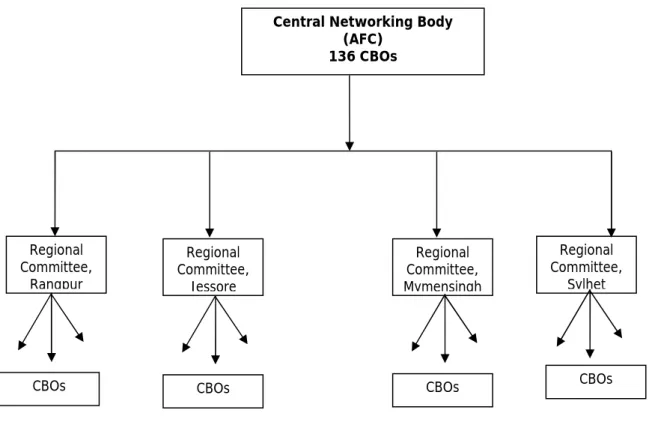
Efforts were made to link community-based organizations (CBOs) and local institutions in CBFM-2 sites. Four regional CBO networking committees and a central committee were formed on an ad-hoc basis.
Fig. 1. A framework for the CBO networking body
Source: CNRS - Concept Note on Strengthening and Capacity Development Support to the CBO Networking System in CBFM
The Central Networking body for CBOs met as an ad-hoc committee in the latter stages of the project and is in the process of being registered as an official body – the Association of Fisheries CBOs (AFC). It a networking body
Central Networking Body (AFC) 136 CBOs Regional Committee, Rangpur Regional Committee, Jessore Regional Committee, Mymensingh Regional Committee, Sylhet
to represent the interests of 136 CBOs formed under the 2 and CBFM-SSEA projects.
The major tasks of the AFC are as follows:
• Create a united force representing the interests of the CBOs, • Deal with the central policy level issues on behalf of the CBOs,
• Ensure support of the DoF (already committed through MoAs) at different levels,
• Monitor and ensure legal support and demarcation,
• Ensure smooth handover of micro-credit funds to the CBOs,
• Provide support and information to allow the replication of CBFM approaches in non-project water bodies,
• Keep contact with relevant stakeholders through coordination and communication,
• Resolve water body level conflicts, and
• Ensure payment of water body lease money in subsequent years.
CLUSTER MANAGEMENT IN CBFM
The broad objective of cluster management is to facilitate ecological management of open-water fisheries resources, with a view to enhancing the livelihoods of poor fishers. The concept is to co-ordinate the management of linked water bodies as fish are mobile resources that need a wide range of habitats at different stages of their life cycle.
In the CBFM-2 project, cluster management concept was followed by CBOs organized by the NGOs, CNRS, Proshika, Caritas, Gharoni, Banchte Shekha and CRED. This was achieved by the formation of cluster management committees dealing with particular watersheds.
The benefits from the cluster management in CBFM were:
• It helps in the identification of the management boundary of a project water-body.
• It can contribute to preventing the use of harmful gears that are being used in the project water-bodies.
• It can contribute in implementing such actions that need the joint initiative of more than one CBO.
• It can play role in habitat restoration and opening of fish migration routes.
• Actions to control fishing effort (closed season, fish sanctuary, reduction of harmful gear use, etc) require intervention in a coordinated manner.
• Cluster committees can play a role in conflict management amongst CBO members and between CBOs.
• Cluster Committees can play a role in developing linkages between the CBOs and different government and development service providers.
However a number of constraints to cluster management were also noted including communication problems between CBOs spread over a larger area, the lack of a clear incentive for committee members to attend meetings and the shortage of scientific information for decision making by the cluster committees.
EMPOWERMENT OF COMMUNITY GROUPS IN CBFM
The community groups in CBFM-2 project areas have been empowered through a series of official agreements so that they have clear access rights to public and privately owned water bodies. For publicly owned water bodies such as closed and open beels, the Ministry of Land agreed to pass over responsibility to the Ministry of Fisheries and Livestock so that the CBOs could utilise the water bodies initially for 10 years with a further extension of 10 years subject to a performance review. In private water bodies, such as floodplains, CBOs access rights and legal rights were established through registration either with the Cooperatives Department or with the Social Welfare Department. The only exception was with Charpara Samity in Daudkandi, Comilla where registration was as a Joint Stock Company.
A Memorandum of Agreement was also made between the local District Fisheries Office and the respective CBOs for the use of the 60 publicly owned water bodies in the project. There was also local handover of the publicly owned water bodies from the Deputy Commissioner (DC) to the Department of Fisheries (DoF) and to the project CBOs for most of these WBs.
In order to further strengthen the position of CBOs, other official agreements have been drawn up for publicly owned water bodies between DCs and District Fisheries Officers which involves a 150 Taka non-judicial stamp and a handover agreement will be made between the respective partner NGOs and CBOs with the support of the Senior Upazila Fisheries Officer/Upazila Fisheries Office.
TRAINING SUPPORT IN CBFM
Training of CBO members played a key role in the process of CBO development. Most CBOs received training on leadership development, good governance in CBOs, accounts management, participatory planning, gender and empowerment, micro-credit management and alternative income generating activities (AIGAs). At the end of the project, 1000 courses have been delivered by partner NGOs to the 130 CBOs at a cost of 11 Million Taka. This represents a cost of around US $ 7 per project primary beneficiary.
AREA TEAM CONCEPT IN CBFM
The Area Team concept was introduced in August 2006 during the extension phase of the project with a special mandate to assess progress and solve the critical issues affecting sustainability of the CBOs. The teams brought together WorldFish Center, PNGO and DoF field-based staff in each area,
greatly facilitating communication and lesson sharing between organizations. Before this there was relatively little contact between staff from different NGOs and WorldFish Center staff had mainly been involved in data collection for research projects.
Each Area Team finalized a strategic training action plan to promote institutional sustainability for each of the CBFM-2 CBOs. At the end of each month the teams met to evaluate progress, and to prepare a ‘To Do List’ for the forthcoming month. A total of six teams worked over the last six months of the project.
CBO SUSTAINABILITY IN CBFM
In order to assess the progress of CBO development under the project and to maximize the likelihood of their future sustainability, a monitoring system was developed by the WorldFish Center and introduced in November 2005. A total of three rounds of assessment have so far been carried out in December 2005, July 2006 and November 2006.
The main assessment tool is a data collection questionnaire, which is filled in through focus group discussions (FGDs) with CBO leaders and other CBO members by a group of staff from WorldFish, DoF and the partner NGOs. The aim of the process is to identify the present status of the CBO, and contribute towards the preparation of strategic and practical action plans to promote the sustainability of the CBO.
Each of the observing points has a series of options which are later scored from 0-5. The numeric data are analyzed in spreadsheets to find the overall score (in percent) which represents the sustainability level of the CBO. The sustainability levels are classified as follows:
Probability of sustainability Required score (%) Very high (VHP) 75 or more
High to medium (HMP) 65-74
Low (LP) 55-64
Unlikely (Unl) 54 or less
As shown in figure 2, there has been a general improvement in the sustainability level of CBOs. More CBOs are shifting towards ‘Very High Probability (VHP)’ and ‘High to Medium (HMP)’. At the 3rd round assessment, 39 and 44 CBOs (out of 128) have reached to VHP and HMP, respectively. This was possible by introducing ‘Area Teams’ in August 2006. The Area Teams included staff from WorldFish, DoF and respective partner NGOs. The prime objective of Area Team formation was to reinforce the efforts of the NGO however, the charter of an Area Team is to coordinate and synchronize the individual efforts of the partner organizations including the CBO.
Most of the better performing CBOs are managing either open beels or floodplains. For instance, 10 open beel CBOs and 18 floodplain CBOs reached VHP (72% of the total number in VHP), in the 3rd round assessment. These are water bodies with seasonal fisheries. Perhaps the year round co-operation between farming communities means that it is easier to establish functioning CBOs. The additional income from fishing, the educational status of household heads and the social capital of the beneficiaries may contribute to generate better coherence, and hence to mobilize the CBO effectively. In contrast, rivers are fished almost year-round, but the CBOs performed much worse than those in open beels and floodplains. It difficult to draw clear conclusions but there are indications that ‘benefit’ is not the only issue affecting the institutional sustainability of a CBO, especially for the most disadvantaged groups of people. In addition, the mobilization of a huge number of beneficiaries and the efficiency level of CBO leaders might be other reasons for their relatively poor performance.
Closed beels are usually managed as stocked fisheries with management regimes very similar to large aquaculture businesses. About half of them (5 out of 11) have reached VHP. In small beels, the ‘benefit’ in terms of fish supply is not impressive, but all but 2 of them were able to reach HMP. The partner NGO for small beel CBOs, (CNRS) helped them to diversify their activities with the assistance of several local government agencies thereby enhancing their institutional sustainability.
Fig. 2. The results of CBO assessments (% age of total CBOs)
63 41 23 1 52 38 36 2 16 29 44 39 5 21 36 55 0% 10% 20% 30% 40% 50% 60% 70% 80% 90% 100% 1st round (Dec 05) 2nd round (July 06) 3rd round (Nov 06) EOP target (March 07) Very high High to Medium Low Unlikely
LESSONS LEARNED ON CBO SUSTAINABIITY
The following lessons have been drawn from the CBO sustainability assessment:
• Court cases (currently 32) and conflicts are negative factors that tend to minimize the probability of sustainability
• The multiple leasing system of the government triggers conflicts.
• The best way to avoid conflicts is to establish and maintain better linkages with the local administration and elites.
• Inadequate leadership is another vital factor. Better leadership development largely relies on better community mobilization. Pro-active initiatives by the field staff add value.
• Distribution of benefits supplements better community mobilization/coherence, and hence leadership development.
• Election helps the leaders to be accountable and hence to develop good leadership.
• Fisheries management largely depends on good leadership.
• Effective coordination ‘is a must’ to synchronize the efforts of partners to attain the common goals and objectives. Coordination can make better progress if the coordination-initiatives are decentralized.
• Following institutionalization, the practical empowerment of the CBOs may require a considerable amount of time (i.e. another couple of years).
• It is critical to understand the biological, physical and technical aspects of the resources, but it is equally important to comprehend the various market attributes and external social, political and institutional forces that influence the behaviour of the various stakeholders and managers. • Other user groups are very active in floodplain and open beel therefore
an integrated resource management (i.e. fisheries, agriculture, etc.) approach should be adopted.
CONCLUSIONS
Institutional sustainability has always been one of the main concerns during implementation of the CBFM projects. There are many examples of projects where the key institutions have not been sustained beyond the project lifetime. In the case of the CBFM-2 project, attaining a clear legal status for the CBOs, cluster management, CBO training and the formation of a management body, the Association of Fisheries CBOs, have all played a part in creating institutions that have a good chance of being sustained. Whether they will be sustained over the longer term will depend very much on what happens in the wider sector. Community based approaches to fisheries management have now been included in official government strategy documents and it appears likely that there will be a widespread expansion of this approach in both publicly-owned and privately owned water bodies. If this happens, the community groups formed under the CBFM projects will almost certainly be sustained under this wider umbrella, indeed they, as the pioneers of this approach, will form a key resource to be used during the replication process. On the other hand, if community managed fisheries approaches do
not expand, the future for CBOs formed during the CBFM projects will be much harder.
ACKNOWLEDGEMENT
The CBO sustainability part of this paper has been written mainly from the “Institutional Sustainability Assessment for the CBOs in CBFM-2 Project” authored by Mr. M.H.M. Mostafa Rahman, Dr. Malcolm Dickson, Mr. Alan Brooks and Mr. Md. Muzaffar Ahmed of CBFM-2 Project, WorldFish Center, Bangladesh and South Asia Office, Dhaka in December, 2007.
REFERENCES
M.A. Rab and Muzaffar Ahmed, 2006. Booklet 3- Institutional Options for Empowering Fisher Communities: Community Based Fisheries Management Phase-2 Project, Dhaka, Bangladesh
M.H.Rahman et.al, December, 2006. Institutional Sustainability Assessment for the CBOs in CBFM-2 Project. Unpublished CBFM-2 Project Report.
A Brief Concept Note on Strengthening and Capacity Development Support to the CBO Networking System in CBFM. CNRS, February 2007.