Implementation and Comparative Analysis of Mobile Phone Application for Learning and
Teaching in Mechanical Engineering Education
Štefanija KLARIĆ,Halima HADŽIAHMETOVIĆ, Daniel NOVOSELOVIĆ, Sara HAVRLIŠAN
Abstract: Increasing student motivation and engagement in classroom (and during the study in general) is the aim of every lecturer. Never stopping development of new digital tools and media present a new challenge in the educational process. The goal of this research is to increase the knowledge and understanding of the influence of Bring Your Own Device (BYOD) approach (and use of the mobile devices in classrooms in general) on: teachers’ practice and students’ classroom activities, students’ attitude about bringing the mobile phones in the class and mobile phone applications in education processes. This research focuses on undergraduate and postgraduate mechanical engineering students. Personal reflection of the lecturers and online survey for students was used as a tool to investigate participants’ attitude towards mobile applications as a method of promotion of active learning in engineering education.
Keywords: Bring Your Own Device (BYOD); engineering education; mobile phones; reflection
1 INTRODUCTION
The growth of mobile-broadband infrastructure and increased mobile phone use is influencing all segments of human life and education system is not an exception. With this development of new technologies, mobile phones become strong multi-media tool. Already there is a large number of mobile applications available for educational purposes. However, H. Farley et al. [1] state in their research that learning is questionable when students try to gain access to contents and activities through mobile devices as these materials are usually not optimized for mobile phone devices.
Problematics of mobile learning introduction into the educational system, as well as problematics of finding efficient way of mobile phone application in the classroom (and for learning purposes in general) as well as risks and benefits related to mobile learning and BYOD approach are the topic of number of researches.
Introduction of mobile learning can bring a few benefits for the learners. J. Traxler and J. M. Wishart [2] describe five characteristics of m-learning that improve learning experience (contingent mobile, situated authentic, context-aware and personalized learning). In [2-4] authors also emphasize that m-learning allows learning without limitation (not just in time and geographical, but also in social or economic sense) and potentiate "bite-sized" learning (possibility of instructions during travel, waiting or leisure time). M. Al-Emran [4] points out that mobile technology assists in:
- Increasing technological awareness,
- Developing communication skills (related to conversations and social media, possible collaboration, knowledge sharing),
- Education of students with disabilities.
As a motivation for improving low learning results, authors J. B. Bottentuit Junior et al. [5] suggested the use of multimedia and mobile applications in education.
Although research shows positive attitude of students towards the use of mobile technology in higher education [4, 6], there are some challenges that educators and students face while dealing with this technology [7-11]:
- Costs of devices and services,
- Available infrastructure (connection) and content (developed platforms and their standardisation), - Privacy issues,
- Device size,
- Teaching style adaptation (the need for short learning modules, adaption to "learn by doing", ensuring student motivation),
- Scepticism of lecturers
- Access to unallowed content (texting, internet browsing, sending images and access to social networks)
Beside described difficulties related to introduction of mobile learning, students, despite problems, according to researches from A. Murphy et al. [12] and I. Simonova [13], still have positive attitude towards mobile learning and desire to apply mobile devices in formal and un-formal learning. However, according to research from A. Muruganet al. [14], in order to ensure successful implementation of mobile learning, lecturers must be aware of students’ background in technological skills.
There are different research areas connected to BYOD in the current literature:
- Readiness, perception, affordances and constraints of BOYD applications from educators’ perspective are investigated by R. Christensen and G. Knezek [15] and G. Cheng at al [16].
- Student’s attitude and engagement regarding BYOD approaches in higher education e.g. P. N. Chou et al. [17] and S. C. Kong and Y. Song [18] and H. Kim etal. [19].
- Approaches, theories and policies related to BYOD and mobile learning are investigated in [2, 20-22] - Security, privacy and health risks related to BYOD are
addressed in [23-25].
Unlike previous researches where significant influence (positive or negative) of mobile learning and BYOD approach on educational process is confirmed, the goal of this research was to analyse and compare the success of implementation of mobile learning and BYOD in mechanical engineering education on three different
universities in three different countries: Australia, Croatia and Bosnia and Herzegovina, as examples of countries outside Europe, the member of the European Union and non-member of EU.
The reflection on lecturers experience to adjustment of their teaching practice to new technology and the students’ attitude regarding the introduction of BOYD in classroom is presented.
2 METHODOLOGY
The goal of this research was to increase the knowledge and understanding of the influence of Bring Your Own Device (BYOD) approach (and use of the mobile devices in classrooms in general) on: lecturers practice and students’ classroom activities, students attitude about bringing the mobile phones in the class and mobile phone application in education process. This research focuses on undergraduate and postgraduate mechanical engineering students.
Researchers used personal reflection of their pedagogy practice and anonymous voluntary online survey for students.
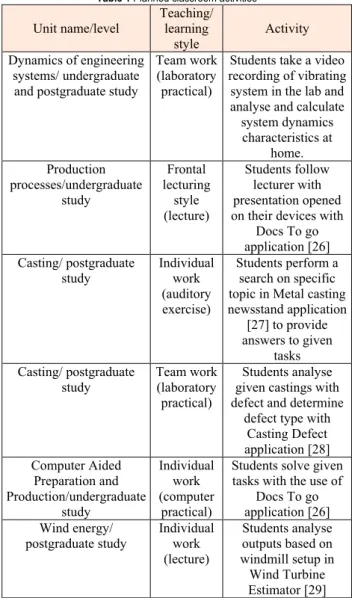
Students were asked to use their mobile phones for conduction of different activities in the classroom. In line with the given task, for certain activities students were asked to install and apply free applications on their devices (Tab. 1). Student survey questions are presented in Tab. 2; collective data details with five-point Likert Scales are used to measure attitudes/habits.
The purpose of survey was to find the answer to research questions:
- What are attitudes and habits regarding the use of mobile phones in classroom in the mentioned Universities among mechanical engineering students? - Is there any significant difference in students’ attitude
and habits regarding the BOYD approach and use of mobile phones in classroom regarding the Universities?
Number of participants and their level of study is shown in Table 3.
Table 1 Planned classroom activities Unit name/level Teaching/ learning
style Activity Dynamics of engineering
systems/ undergraduate and postgraduate study
Team work (laboratory practical)
Students take a video recording of vibrating system in the lab and analyse and calculate system dynamics characteristics at home. Production processes/undergraduate study Frontal lecturing style (lecture) Students follow lecturer with presentation opened on their devices with
Docs To go application [26] Casting/ postgraduate
study Individual work (auditory exercise)
Students perform a search on specific topic in Metal casting newsstand application
[27] to provide answers to given
tasks Casting/ postgraduate
study Team work (laboratory practical)
Students analyse given castings with defect and determine
defect type with Casting Defect application [28] Computer Aided Preparation and Production/undergraduate study Individual work (computer practical)
Students solve given tasks with the use of
Docs To go application [26] Wind energy/
postgraduate study Individual work (lecture) Students analyse outputs based on windmill setup in Wind Turbine Estimator [29]
Table 2 Survey structure
Question Applied scale
1. How often do you bring your mobile phone to classes? Never 1 Rarely 2 Sometimes 3 Most of the time 4 Always 5
2. How often do you use your phone during instructional time (lectures, practicals, workshops) for non-educational purposes (i.e. texting, browsing Internet, social networking)?
Never 1 Almost never 2 Sometimes 3 Fairly often 4 Very often 5 3. To what extent you agree with this statement: "There is a
correlation between low student performance and mobile phone use in classrooms for non-educational purposes"?
Strongly Disagree 1 Disagree 2 Neither Agree or Disagree 3 Agree 4 Strongly Agree 5 4. You were asked to use your mobile phone to complete some tasks
in your unit. Do you think students should use mobile phones during instructional time to carry out tasks in the unit?
Definitely No 1 No 2 Uncertain 3 Yes 4 Definitely Yes 5 5. To what extent you agree with this statement: "Use of mobile
phone applications for educational purposes would encourage my class participation"? Strongly Disagree 1 Disagree 2 Neither Agree or Disagree 3 Agree 4 Strongly Agree 5 6. Please give your thoughts and suggestions about use of mobile
Table 3 Participants
Country University Number of students/level
Croatia Josip Juraj Strossmayer University of Osijek (UNIOS) 85/undergraduate + postgraduate Bosnia and Herzegovina University of Sarajevo (UNSA) 11/postgraduate
Australia Charles Darwin University (CDU) 10/undergraduate + postgraduate
3 RESULTS AND DISCUSSION 3.1 Student Survey Results
The first two questions of the survey are dealing with students habits regarding bringing the mobile phone into class and using it for non-educational purposes. The average score for the first question was 4.23 (with standard deviation of 1.08) and for the second one 2.99 (with standard deviation of 0.99).
The difference among students’ habits regarding the bringing of mobile phone in classrooms (survey question 1) is shown in Tab. 4. Tab. 5 shows the results of one way analysis of variance.
Table 4 Mean value and standard deviation – Survey Question 1
University N Mean St. deviation
UNIOS 85 4.14 1.10
UNSA 11 4.36 1.21
CDU 10 4.8 0.42
Table 5 ANOVA results– Survey Question 1
SS df MS F p-value Between Groups 4.115 2 2.057 1.789 0.172 Within Groups 118.451 103 1.150 Total 122.566 105 Fcrit = 3.085
Results from Tab. 5 show that there is no significant difference between groups (students in different universities) regarding the answers to the first survey question (F < Fcrit and p > 0.05). Tab. 4 indicates that most
of the time students do bring their mobile devices to classroom activities.
The difference among students’ answers regarding the use of mobile phones in classroom for non-educational purposes is presented in Tab. 6 (mean values and standard deviations). One way ANOVA results for survey question 2 are presented in Tab. 7.
Table 6 Mean value and standard deviation – Survey Question 2
University N Mean St. deviation
UNIOS 85 3.00 0.96
UNSA 10 3.60 1.07
CDU 10 2.30 0.82
Table 7 ANOVA results – Survey Question 2
SS df MS F p-value
Between Groups 8.490 2 4.245 4.582 0.012
Within Groups 94.500 103 0.926
Total 102.990 105
Fcrit = 3.085
There is a significant difference between answers to survey question 2 regarding the university of study (F >
Fcrit and p < 0.05). Answers from CDU students indicate
that the habit of the use of mobile phones during classes is rather rare in comparison to students from other two universities.
Students’ attitude toward correlation between performance and mobile phone use in classrooms is covered in survey question 3. The average score for the survey question 3 was 2.94 (with standard deviation of 1.14).
Mean values and standard deviations for survey question 3 are presented in table 8 with one way ANOVA results in Tab. 9.
Table 8 Mean value and standard deviation – Survey Question 3
University N Mean St. deviation
UNIOS 85 2.96 1.09
UNSA 11 2.36 1.12
CDU 10 3.4 1.43
Table 9 ANOVA results – Survey Question 3
SS df MS F p-value Between Groups 5.821 2 2.910 2.273 0.108 Within Groups 131.840 103 1.280 Total 137.660 105 Fcrit = 3.085
ANOVA results from table 9 show that there is no significant difference among groups regarding the answers to question 3 (F < Fcrit and p > 0.05).
The average score for the survey question 4 was 3.99 (with standard deviation of 0.73). This question deals with students’ attitude towards the use of their mobile phones in classroom for educational purposes (mean values and standard deviations are shown in Tab. 10). One way ANOVA results in Tab. 11 show that there is no significant difference among groups regarding the answers to question 4 (F < Fcrit and p > 0.05).
Table 10 Mean value and standard deviation – Survey Question 4
University N Mean St. deviation
UNIOS 85 4 0.71
UNSA 11 3.81 1.08
CDU 10 4.1 0.57
Table 11 ANOVA results– Survey Question 4
SS df MS F p-value
Between Groups 0.454 2 0.227 0.414 0.662
Within Groups 56.536 103 0.549
Total 56.991 105
Fcrit = 3.085
Table 12 Mean value and standard deviation – Survey Question 5
University N Mean St. deviation
UNIOS 85 3.68 0.85
UNSA 11 4.18 0.60
CDU 10 3.4 0.84
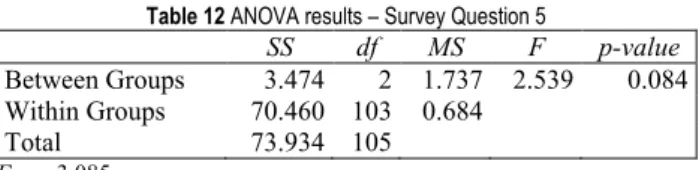
The average value for the answer to survey question 5 related to relation of mobile application and student engagement was 3.71 with standard deviation of 0.84. Mean values and standard deviation for survey question 5 are shown in table 12. One way ANOVA results in table 13 show no significant difference among groups.
Table 12 ANOVA results – Survey Question 5 SS df MS F p-value Between Groups 3.474 2 1.737 2.539 0.084 Within Groups 70.460 103 0.684 Total 73.934 105 Fcrit = 3.085
Regarding the survey question 6, in general students do support the use of mobile phone in classrooms; however they also recognise that it can be distractive for them (i.e. social networking instead of engagement in the classroom).
3.2 Lecturer Reflection
Reflective practice is proved to be a helpful tool in development of lecturers’ practice [30-35]. The procedure implies informed actions (structured questioning, systematic review with documentation) but increase of effectiveness and emotional grounding for the lecturers [34-37]. In this paper the summary of reflection is given for processes of implementation of BYOD regarding classroom activities described in Table 1. Before the implementation, lecturers had several assumptions regarding the introduction of mobile learning in mechanical engineering units:
- Students engagement and activity in classroom will increase,
- Students have sufficient knowledge to use the technology,
- Students are willing to use their personal devices for educational purposes in the classroom,
- Lecturers have sufficient knowledge to use the technology and provide the support if necessary, - Devices that students have are advanced enough to
apply suggested applications,
- There is a risk of inequality/digital divide issues [38], - There might be an issue with connectivity to internet
network,
- Misuse of mobile phones for non-learning purposes in class will be reduced.
3.2.1 Key Aspects of the Classroom Activities and Relation to Assumptions
In general, students responded very well to the given tasks and engagement and motivation of students did increase with introduction of new type of activity.
In cases when tasks involved the use of mobile phone camera students organised the work among themselves even using a few mobile phones; as a source of light, for calculations and one for actual recording of the videos. There were no misuses of cameras for unauthorised recordings of other students or staff.
Tasks that required downloading, installing and application of new mobile applications did not represent an issue for students or for lecturers to explain and assist with the tasks in the classroom. Students were equally engaged and did not show or report any upsetting issues. During mentioned activities the misuse of mobile phones for non-educational purposes was only observed with a small number of students.
Although the introduction of new learning method was welcomed by most of the students, there were a few issues:
- Network problems at one of the sessions made download of the application very difficult.
- Running of the applicationswas problematic on some of the phones (that was sorted out by work in the groups).
- There was a small resistance to the changes in the educating process as a small number of students was not ready to engage actively in learning and be able to use mobile phone for non-educational purposes (especially in a case where mobiles were used for just following lectures or there were larger groups of students in a classroom).
From the observation it was noticed that the response and motivation were better when the use of mobile phone in the classroom did not require downloading and installing the application in the class as this sometimes required more time than expected and became a distraction in the educational process.
Overall it is noticed that lecturers have many possibilities to successfully apply technology in a learning and teaching process.
3.2.2 Future Activities
Based on described students and lecturers experience, there is intention to continue with activities that require the use of mobile phones in classroom.
Regarding the analysis and taking into account values of standard deviation and different group sizes, there is indication of possible differences in attitudes and behaviour of students, but further study is necessary.
However, the tendency will be to use the tasks that do not require the use of specific type of mobile phone (i.e. for recording or measurement), development of own (not device dependent) applications where appropriate, or students will be asked to install the application before coming to the class.
Also, as increased engagement of students for this type of activity (lectures, exercises or practicals) was evident one of the future activities would be a better preparation of lecturers for BYOD approach in their practice and adjustment of teaching materials.
For even more efficient use of mobile applications in teaching it would be valuable to introduce the students with BYOD concept and the methods that will be applied in teaching and learning process at the beginning of the semester. That way they would have enough time to better prepare for certain activities and to avoid problems of installation, starting and learning how to run the applications in the classroom.
As students from all three universities showed solid familiarisation with the use of mobile applications there is an opportunity for development of project tasks where students would build own applications and be able to show their creativity and digital skills.
4 CONCLUSION
We are all witnesses of increased mobile phone applications in everyday life so learning activities are no exception.
Increased student motivation and engagement in the classroom was the goal of lecturers in this research as well as preparation of students for life and active participation in digital age (as today there are already industrial plants with developed applications for mobile devices, it is important for mechanical engineers to know how to use different applications i.e. to control production process). In the paper students’ attitude and lecturers’ reflection on pilot application of mobile phones in the classroom activities was discussed. In this research digital technologies are used as a learning tool to facilitate knowledge transfer to students.
After the analysis it can be concluded that in general, students are in favour of BYOD approach to teaching especially in problem based or practical learning activities (active student-centred learning). However, in pure following of theoretical lecture there was a certain amount of disinterest.
In addition, it is important to mention that to successfully apply BOYD approach in teaching, a certain level of adaptation and preparation of teaching approach is necessary from lecturers as well.
5 REFERENCES
[1] Farley, H., Murphy, A., Johnson, C., Carter, B., Lane, M., Midgley, W., Hafeez-Baig, A., Dekeyser, S., & Koronios, A. (2015). How Do Students Use Their Mobile Devices to Support Learning? A Case Study from an Australian Regional University. Journal of Interactive Media in Education, 14(1), 1-13. https://doi.org/10.5334/jime.ar
[2] Traxler, J. & Wishart, J. M. (2011). Making Mobile Learning Work: Case Studies of Practice. (Discussion Papers in Education). Bristol, UK, ESCalate: HEA Subject Centre for Education.
[3] Hamidi, H. & Chavoshi, A. (2018). Analysis of the Essential Factors for the Adoption of Mobile Learning in Higher Education: A Case Study of Students of the University of Technology. Telematics and Informatics, 35(4), 1053-1070.
https://doi.org/10.1016/j.tele.2017.09.016
[4] Al-Emran, M., Elsherif, H. M., & Shaalan, K. (2016). Investigating attitudes towards the use of mobile learning in higher education. Computers in Human Behavior, 56, 93-102. https://doi.org/10.1016/j.chb.2015.11.033
[5] Bottentuit Junior, J. B., Negretti, R. D., & Coutinho, C. P. (2007). Methodology to use Multimedia Applications and Mobile Devices When Teaching Structural Analysis. Proceedings of the International Conference on
Engineeering Education. Retrieved from:
https://repositorium.sdum.uminho.pt/bitstream/1822/7037/1 /Paper.pdf
[6] Uğur, N. G., Koç, T., & Koç, M. (2016). An analysis of mobile learning acceptance by college students. Journal of Educational and Instructional Studies in the World, 6(2), 39-49.
[7] Crompton, H. (2013). Research windows: The benefits and challenges of mobile learning. Learning and Leading with Technology, 41, 38-39. Retrieved from:
http://www.learningandleading-digital.com/learning_ leading/20130910?pg=40#pg40
[8] Orr, G. (2010). A Review of Literature in Mobile Learning: Affordances and Constraints, 2010 6th IEEE International
Conference on Wireless, Mobile, and Ubiquitous Technologies in Education, 107-111.
https://doi.org/10.1109/WMUTE.2010.20
[9] Koç, T., Turan, A. H., & Okursoy, A. (2016). Acceptance and usage of a mobile information system in higher
education: An empirical study with structural equation modelling. The International Journal of Management Education, 14(3), 286-300.
https://doi.org/10.1016/j.ijme.2016.06.001
[10] Tindell, D. R. & Bohlander, R. W. (2012). The Use and Abuse of Cell Phones and Text Messaging in the Classroom: A Survey of College Students. College Teaching, 60, 1-9.
https://doi.org/10.1080/87567555.2011.604802
[11] Ismail, I., Azizan, S. N., & Azman, N. (2013). Mobile Phone as Pedagogical Tools: Are Teachers Ready. International Education Studies, 6(3), 36-47.
https://doi.org/10.5539/ies.v6n3p36
[12] Murphy, A., Farley, H., Lane, M., Hafeez-Baig, A., & Carter, B. (2014). Mobile learning anytime, anywhere: what are our students doing? Australasian Journal of Information System, 18(3), 331-345. https://doi.org/10.3127/ajis.v18i3.1098
[13] Simonova, I. (2016). Mobile Devices in Technical and Engineering Education with Focus on ESP. International Journal of Interactive Mobile Technologies, 10(2), 33-40.
https://doi.org/10.3991/ijim.v10i2.5466
[14] Murugan, A., Boon Sai, G. T., & Wei Lin, A. L. (2017). Technological Readiness of UiTM students in Using Mobile Phones in The English Language Classroom. Malaysian Online Journal of Education Technology, 5(2), 34-50. [15] Christensen, R. & Knezek, G. (2017). Readiness for
integrating mobile learning in the classroom: Challenges, preferences and possibilities. Computers in Human Behavior, 76 (C), 112-121.
https://doi.org/10.1016/j.chb.2017.07.014
[16] Cheng, G., Guan, Y., & Chau, J. (2016). An empirical study towards understanding user acceptance of bring your own device (BYOD) in higher education. Australasian Journal of Educational Technology, 32(4), 1-17.
https://doi.org/10.14742/ajet.2792
[17] Chou, P. N., Chang, C. C., & Lin, C. H. (2017). BYOD or not: A comparison of two assessment strategies for student Learning, Computers in Human Behavior, 74, 64-71.
https://doi.org/10.1016/j.chb.2017.04.024
[18] Kong, S. C. & Song. Y. (2015). An experience of personalized learning hub initiative embedding BYOD for reflective engagement in higher education. Computers & Education, 88, 227-240.
https://doi.org/10.1016/j.compedu.2015.06.003
[19] Kim, H. J., Lee, J. M., & Rha, J. Y. (2017). Understanding the role of user resistance on mobile learning usage among university students. Computers & Education, 1123, 108-118.
https://doi.org/10.1016/j.compedu.2017.05.015
[20] Afreen, R. (2014). Birng Your Own Device (BYOD) in Higher Education: Opportunities and Challenges. International Journal of Emerging Trends & Technology in Computer Science (IJETTCS), 3(1), 233-236.
[21] Moriera, F., Ferreira, M. J., Santos, C. P., & Durão, N. (2017). Evolution and use of mobile devices in higher education: A case study in Portuguese Higher Education Institutions between 2009/2010 and 2014/2015. Telematics and Informatics, 34(6), 838-852.
https://doi.org/10.1016/j.tele.2016.08.010
[22] Kay, R., Benzimra, D., & Li, J. (2017). Exploring Factors That Influence Technology-Based Distractions in Bring Your Own Device Classrooms. Journal of Educational Computing Research, 55(7), 974-995.
https://doi.org/10.1177/0735633117690004
[23] Adhikari, J., Mathrani, A., & Scogings, C. (2016) Bring Your Own Devices classroom: Exploring the issue of digital divide in the teaching and learning contexts. Interactive Technology and Smart Education, 13(4), 323-343.
https://doi.org/10.1108/ITSE-04-2016-0007
[24] Singh, M. M., Chan, C. W., & Zulkefli, Z. (2017). Security and Privacy Risks Awareness for Bring Your Own Device
(BYOD) Paradigm. International Journal of Advanced Computer Science and Application, 8(2), 53-62.
https://doi.org/10.14569/IJACSA.2017.080208
[25]Merga, M. K. (2015). ’Bring your own device’: Considering potential risks to student health. Health Educational Journal, 75(4), 464-473. https://doi.org/10.1177/0017896915599563
[26] DataViz (2016) Docs to Go™ Free Office Suite. Retrieved from: https://play.google.com/store/apps/details?id=com. dataviz.docstogo&hl=en_US
[27] YUDU Media (2011). Metalcasting Newsstand. Retrieved from: https://appadvice.com/app/metalcasting-newsstand/ 446066037
[28] Foundry Solutions & Metallurgical Services Inc. (2017). Casting Defect. Retrieved from:
https://www.castingdefect.com/
[29] android-design.nl (2011). Wind Turbine estimator. Retrieved from: https://play.google.com/store/apps/ details?id=mwave.windmill_power&hl=en_US
[30] Kennedy, P. & Green, G. (2001). Redefining Engineering Education: The reflective practice of Product Design Engineering. International Journal of Engineering Education, 17(1), 3-9.
[31] Shekar, A. (2007). Active learning and reflection in product development engineering education, European Journal of Engineering Education, 32(2), 125-133.
https://doi.org/10.1080/03043790601118705
[32] Mathew, P., Mathew, P., & Peechattu, P. J. (2017). Reflective practices: a means to teacher development, Asia Pacific Journal of Contemporary Education and Communication Technology (APJCECT), 3(1), 126-131. [33] Farrell, T. S. C. (2012). Reflecting on Reflective Practice:
(Re)Visiting Dewey and Schön, TESOL Journal, 3(1), 7-16.
https://doi.org/10.1002/tesj.10
[34] Pedrosa-de-Jesus, H., Guerra, C., & Watts, M. (2017). Universityteachers’ self-reflection on their academic growth, Professional Development in Education, 43(3), 454-473.
https://doi.org/10.1080/19415257.2016.1194877
[35] Kreber, C. & Cranton, P. A. (2000). Exploring the Scholarship of Teaching. The Journal of Higher Education, 71(4), 476-495. https://doi.org/10.2307/2649149
[36] Brookfield, S. (1995). The Getting of Wisdom: What Critically Reflective Teaching is and Why It's Important. Retrieved from: http://static1.squarespace.com/static/ 51acea8be4b02783f894c272/t/53628f3be4b0bddd58665b7 6/1398968123150/Brookfield-Getting+Wisdom.pdf [37] Ryan, M. & Ryan, M. (2012). Theorising a model for
teaching and assessing reflective learning in higher education, Higher Education Research & Development, 32(2), 244-257.
https://doi.org/10.1080/07294360.2012.661704
[38] PDST Technology in Education (2017) Bring your own Device (BYOD) for Learning, Retrieved from: https://www.pdsttechnologyineducation.ie/en/Technology/ Advice-Sheets/Bring-your-own-Device-BYOD-for-Learning.pdf Contact information: Štefanija KLARIĆ, PhD (Corresponding author)
Charles Darwin University,
CDU Casuarina Campus,
Purple 12.02.08, Ellengowan Drive,
Northern Territory, 0909 Australia [email protected]
Halima HADŽIAHMETOVIĆ, PhD, Assistant Professor
University of Sarajevo,
Faculty of Mechanical Engineering Sarajevo,
Vilsonovo šetalište 9,
71 000 Sarajevo, Bosnia & Herzegovina [email protected]
Daniel NOVOSELOVIĆ, PhD
Josip Juraj Strossmayer University of Osijek,
Mechanical Engineering Faculty in Slavonski Brod,
Trg Ivane Brlić-Mažuranić 2, HR-35000 Slavonski Brod, Croatia [email protected]
Sara HAVRLIŠAN, PhD
Josip Juraj Strossmayer University of Osijek,
Mechanical Engineering Faculty in Slavonski Brod,
Trg Ivane Brlić-Mažuranić 2, HR-35000 Slavonski Brod, Croatia [email protected]