The Effect of Knowledge Management on Accounting
Information Systems at Orange
Dr. Hadeel Sa’ad Al-Hyari
School of Business Administration, Al-Balqa Applied University, PO box 19117, Salt- Jordan Abstract
This paper aims to investigate the effect of knowledge management on accounting information systems at Orange one of Jordanian telecommunication companies. The study population consisted of all the employees working at the company whom count (150) male and female. A questionnaire was developed to collect required data. Descriptive statistical methods were adopted. The results showed that the level of both knowledge management processes and effectiveness of accounting information systems was high. Results also showed that there was significant effect of knowledge management on accounting information systems. The study recommended applying similar studies on more organization in telecommunication sector and other sectors in Jordan.
Keywords: Knowledge, Knowledge Management, Accounting Information System, Orange, Jordan. 1. Introduction
It has become clear that knowledge plays a major role in building and achieving outstanding performance, the latest production factors which is recognized as essential resource for the wealth establishing in the economy and a major source of competitive advantage in organizations.
Moreover, the world is witnessing the emergence of significant forces reshaping the economies and management systems, which requires an essential change in organization strategies. Some of these most important forces are globalization, high degree of complexity, new technology, increased competition, and changes in economic and political structures. These powers are affecting on organizations and creating the need of quick adaptability, and to respond rapidly, take effective and serious initiatives; thus to maintain continuity. This was going along with the emergence of many concepts that seek to develop and improve organization performance, one of those most notably concept is knowledge management (Falak, 2012).
Knowledge management has become one of the most important inputs of development and change in the present era, where it marks a significant jump in performance level of various institutions and organizations (Mahjoub, 2004). This was confirmed by many of previous studies (Al-Malak & Al-Athari, 2002), (Al-Omari, 2004); where the adoption of knowledge management in organizations has achieved many benefits, such as: it has increased efficiency and effectiveness, improved decision-making process, improved performance, increased productivity, improved creativity, achieved competitive advantage and raised the responsibility to surrounding changing environment. There is a large number of organizations who are neglecting the importance of knowledge management and its impact on improving organizational performance, besides the high number of managers who do not realize the meaning of knowledge, how to manage it, what its dimensions, and how these dimensions affect their work; therefore these reasons are the main factors for the failure of many organizations, and reduce their ability to meet the most basic challenges and difficulties faced at surrounding environment or stand against foreign competition (Al-Atwi, 2010).
Services and industrial organizations have become one of the main pillars which are affected by shifts in the environment which are represented by the strong competition between market forces, the lack of restrictions on trade, the spread of production and distribution processes, and the enhancements in information and communication technology. As a result of these rapid changes which was brought by intense competition, it was inevitable for the management of organizations to follow certain methods to ensure the achievement of competitive advantage and customer satisfaction, and to take the right strategic decisions, then to ensure organization survival and continuance. The development of efficient Accounting Information System (AIS) in business organizations in the light of information technology is the essential key for decision-making process generally and strategic decision particularly; where AIS provides detailed, comparative, and analytical information, as well as it delivers an objective and reliable information (Medah, 2009). As a result of technological, economic developments and globalization, information systems have occupied significant position in all areas, where information systems have evolved at a fast pace and numerous applications at all administrative levels, these systems were used in operational, technical and strategic levels, AIS has achieved many advantages through providing important information for all accounting information system users (Al-Dayah, 2009). Information System represents the entrance which deals with the project as a unit, the system consists of a set of systems that work together to provide accurate information in a timely manner to make administrative decisions which lead to achieve the total project objectives. (Mubarak, 2001). Information System reflects a set of components linked with each other on a regular basis in order to produce useful information and
to communicate this information to users appropriately and in a timely manner in order to support them to do their jobs (Qasim, 2003).
AIS contributes in management process success through information availability which contributes in meeting needs of management functions of such as planning and control functions, and supports decision-making process which is one of the basic functions that achieve organizational objectives; this contributes to effective decision making and raises performance level in order to reach organization objectives (Edmond Gel, 2010). This paper explores the effect of Knowledge Management on Accounting Information System at Orange. 2. Study Problem
Accounting Information Systems have become an important part of the Management, an essential source to strengthen plans and operations control, and have a large and important role in the decision-making process in organizations; therefore Accounting Information Systems role should not be ignored.
Nowadays, business organizations live in information revolution era, knowledge influence acceleration and accumulation over time. The world has become a small village thanks to these tremendous technological changes; therefore in the strengths has moved from the power of the material to the information and from the machine to the knowledge (Edmond Gel, 2010). In order to meet these challenges and improve performance, several institutions adopt knowledge management, which is one of the ways in which organizations can rely on. This is done by training and rehabilitation of the workforce on knowledge management, building the knowledge base of the institutions, as well as through by collecting and disseminating knowledge in different management levels, and employing knowledge to reach the maximum possible level of efficiency and effectiveness, with the aim of touching excellency and reaching of the so-called ‘best practice’ (Darwazeh, 2008).
Thus; study problem is presented by answering the following main questions: What is the knowledge management processes’ application level at Orange? What is the accounting information systems’ efficiency level at Orange?
Is there any statistical significant effect of knowledge managements’ application level on the accounting information systems at Orange?
From this main question, the following sub-questions were derived:
Is there a statistical significant effect of the of knowledge acquisition on the accounting information systems at Orange?
Is there a statistical significant effect of knowledge generation on the accounting information systems at Orange? Is there a statistical significant effect of knowledge storing on accounting information systems at Orange?
Is there a statistical significant effect of knowledge distributing on the accounting information systems at Orange? 3. Study Importance:
Study importance is presented by the following:
The importance of the sector studied, representing the telecommunications sector in Jordan a wide range of workers and users of services provided by telecommunications companies, particularly in Orange, which is one of the oldest and largest telecommunications and multinational companies around the world which is operating in the Hashemite Kingdom of Jordan, and other countries worldwide.
The study highlights ‘knowledge management’ concept, under intellectual racing and rapid technological change, which makes it prescribe to maintain the knowledge level in any business organization. In addition to the subject of ‘accounting information systems’, which is one of the most sensitive issues in the accounting domain that represents a fundamental pillar in a successful contemporary business organizations. Throwback the history of Asia big crisis in (1998) and (2008) crisis, it’s evident to take into consideration the knowledge management quality in order to help management to face crises wisely (Kuntjoro, 2013).
Finally, the current study contributes by its results that provide valuable information for decision-makers in the sector considered; by identifying variables of the study and their effectiveness level within the organization. 4. Study Limitations:
The current study is limited by the following:
Time Limits: the current study is conducted during the year (2016).
Place Limits: the current study was conducted in one of the Jordanian communication companies (Orange). Subjective Limits: results of the study are limited by the answers of study sample on the questionnaire items. 5. Litreture Review
With the transformation to the knowledge-based economy, changes have been observed in accounting field as well Knowledge which has been recognized as the most valuable asset in the organization (Choe, 1996). Knowledge management is concerned with the development and utilization of the knowledge assets (Chang, 2001). The human life in the whole world has been transformed from information age to the knowledge age
(Curtis, 1995). “knowledge organization and the knowledge economy generate interdependencies between different research areas – accounting and ecology (Green Accounting), business intelligence, or corporate governance” (Radneantu et al, 2010:307).
Accounting Information System (AIS) is a system which gathers; records, stores, and processes the data to make the concluded information available for decision-making (Al-jabali & Tawfiq, 2014). AIS plays an important role in enhancing organizational effectiveness in a global competitive environment (Chang, 2001). The emerging global economic position described by advancement advancements in all sectors has brought the crucial role of accounting information systems in business organizations especially in relation to administration effectiveness (Curtis, 1995). Resulting information from the AIS can be characterized by: relevant, reliability, complete, understandable, and verifiable. Where AIS components include: system operators and who do the different tasks, data relating to the facility and its operations, the software used for data processing facility, Infrastructure for information technology, which includes computers, peripherals, networks used for the collection, storage, processing and transmission of data and information (Al-jabali & Tawfiq, 2014). (AIS) is a tool which, when incorporated into the field of Information and Technology systems (IT), are designed to help in the management and control of topics related to organization’ economic-financial area
AIS uses computerized accounting system to create the financial statements called income statements, balance sheets and cash flow statement. The system process the data and transform it into accounting information during input, processing and output stages to be used by a wide range of users such as internal and external users (Wilkinson et al., 2000).
The financial statements still remain the most important source of externally feasible information on companies. (Doms, Jarmin & Klimek, 2004). Accounting information system is playing a crucial role in managing an organization and implementing an internal control system. Ponemon and Nagida, (1990) emphasize that the main reason for which accounting information is generated is to facilitate decision making. However, for financial reporting to be effective, among other requirements, it is relevant, complete and reliable. These qualitative characteristics require that the information must not be unfair nor has predisposition of favoring one party over the others. Accounting information should give decision makers the capacity to predict future actions. It should increase the knowledge of the users to identify similarities and differences in information types(Bolon, 1998).
Many studies discussed the relation among knowledge management and accounting information system; Mubarak (2013) debated that one of the old and ever visited approaches is to investigate management accounting as an information system and within that approach, is to analyze it under specific lenses. One of those latter stands is to examine the decision making process in management accounting with a “Knowledge Management” lenses. Knowledge Management has been developed to enable those involved in information sources exploration or delivery of well understanding to access available relevant knowledge related accounting information system when making strategic decisions. Due to unlimited knowledge in universe, it may depends on certain discipline that use this knowledge management as tools of predict the high percentage of certainty and low percentage of uncertainty for decision making (Kuntjuro, 2013).
Knowledge management value affects directly on effectiveness where managed knowledge facilitates dealing with today's situations and encourage the members of the organization to create their future (Andekina & Medeni, 2013). Without on-demand access to the managed knowledge, every situation is addressed individually based on what any person or group has faced. With on-demand access to managed knowledge, every situation is addressed with the sum total of everything has ever learned about a similar situation by anyone in the organization (Andekina & Medeni, 2013).
6. Previous Studies
Nurhayati (2014) conducted a study to conclude the effect of organizational commitment and knowledge management on the successful implementation of accounting information systems. The study used descriptive analysis method. it displayed organizational commitment, knowledge management and the successful implementation of accounting information systems in pension funds employer are basically still inadequate. This is for the reason that some pension funds are late in submitting financial statements that because the systems still not integrated together, resulting in affecting the financial statements where it cannot be delivered in a timely manner. Results shows that organizational commitment and knowledge management are significantly affecting the successful implementation of accounting information systems in employer pension funds that held Benefit Pension definitely. While, Kuntjoro(2013) Identified knowledge management as the bridge of applying accounting information system and strategic management to reach organization objectives, it used meta-analysis approach to find out the indicators for implementing accounting information system and strategic management which is bridged by knowledge management. The results showed that the indicators of accounting information system and strategic management are maintained by the quality of knowledge management for the purpose of reaching organization objectives. On the other hand; Abu Al-Ola (2012) conducted a study aimed at identifying
the degree of knowledge management processes in the Faculty of Education at the University of Ta’if from faculty members’ point of view. The population of the study represented all members in Faculty of Education at the University of Ta’if, the study used descriptive analytical survey method. The study found that the four knowledge management operations include both positive and negative practices. The descending order of the relative importance of knowledge management operations was as follows: (regulation = 0.67), (generation = 0.67), (sharing = 0.63), (application = 0.56). Moreover, (Falak, 2012) conducted a study aimed to identify the impact of knowledge management processes in achieving competitive advantage. The study sample consisted of (84) persons from different management levels in Jordan Telecom Group Company Orange, this effect has been tested using simple regression analysis, and variance analysis. The results of the study indicated the presence of high impact between the independent variable which was knowledge management processes and the dependent variable which was competitive advantage, the results also indicated the existence of significant differences in the impact of knowledge management processes on achieving competitive advantage due to the employment duration, while there were no differences attributed to the job title. Al-Zatma (2011) conducted a study aimed to indicate the role of knowledge management with performance excellence in colleges and technical institutes in Gaza Strip. The study population consisted of all full-time faculty members and heads of departments in five faculties from Ph.D., Master's and Bachelor holders of the academic year (2010-2011), with the number of (455) individuals. The study sample consisted of (279) individuals, were randomly selected; and the random stratified sample consisted of (61.3%) of the total members of the study community. The study found that the degree applying knowledge management processes by workers in colleges was high for (knowledge diagnosing, knowledge generation, knowledge storing, and knowledge distribution), while the level of (knowledge application) was medium. Edmond Gel (2010) also, conducted a study aimed to identify the effectiveness of AIS in Iraq's national commercial banks from management point of view. Questionnaire tool was developed and used to collect the study data from the study sample which consisted of (197) people. The study concluded that the AIS in Iraq's national commercial banks was active in terms of, planning process, and process control, and decision-making process. A study conducted by Amoush (2009) aimed to identify the level of knowledge management practice in the Security Command of the Capital Region; terms of the areas of leadership, information technology, the vision and plan formulation, knowledge generation, transferring and dissemination, knowledge employing, knowledge integration mechanisms, and the environment needed to flourish knowledge. The study population consisted of all working individuals in In the Capital Territory, which includes (4) directorates police, and (24) security stations, in addition to the central departments in the leadership of the region, totaling (3934) soldiers, the study sample consisted of (276) male and female soldiers working in the security command Capital Territory and who represent a rate of (7.01%) of the study population, who were randomly selected. The study found that the level of knowledge management practice in the security command Capital Territory as seen by respondents was high, with average (3.89), their higher estimates were on the level knowledge management practice: knowledge generation and production, vision and plan formulation, knowledge transfer and dissemination, information technology, investment and employment of knowledge, leadership and cognitive integration mechanisms, and the environment for knowledge prosperity respectively. Another study aimed at identifying the factors influencing the accounting information system and its role in strategic decision making in Jordanian industrial companies was conducted by Medah (2009). Data on the study variables were collected through (114) responses answered by the general managers, financial managers and managers of the main activities (production and marketing) in the surveyed companies. The study concluded that there is a relationship between organizational factors, the means of information technology and the environment, and the accounting information system. The study also found that there is no relationship between the accounting information system and the strategic decision-making process. Abu Al Nadi (2009) conducted a study aimed at presenting proposed rules for knowledge management in the official Jordanian universities based on selected models built on theoretical literature of the related subject. The study community is composed of administrators and faculty members of the official Jordanian universities in the academic year (2008-2009). To achieve the study objectives, knowledge management rules in the official Jordanian universities were defined by using questionnaire tool. The study results showed that no rules of knowledge management were used in the official Jordanian universities according to the results of the survey. The study results showed there were statistically significant differences for the variables of the university and the experience, but there were no differences for the variable of job title. Al-Ubaid (2012) conducted a study aimed at identifying the extent to which the accounting information system in Kuwaiti companies can deal with e-commerce operations. The study used the questionnaire tool, which was distributed to the study sample of (125) members of the financial management staff in the Kuwaiti companies listed in the financial market and 63 members of the external auditors of the listed companies. The study resulted in exploring the ability of accounting systems to deal in electronic commerce; in addition to that it may change upon the degree of importance of that ability. Serafeimis & Smithson (2003) conducted a study described organizational initiatives related to information systems assessment, the study was conducted on the top ten British life insurance companies. This study was applied to a sample of 160 employees
working in different information systems departments in the studied companies. The study concluded that the assessment of information systems has social and organizational dimensions that must be taken into account besides the evaluation process. Likewise, the study also concluded that the process of information systems is a complex process that requires great human effort from the employees of the organization because they are the closest to the system and its capabilities.
7. Study Population:
The study population consisted of all the employees working at the Jordanian communication company ‘Orange’, whom occupy the position of general manager, financial manager, production manager, marketing manager, auditor and others who can answer questions about the study tool, counting (150) male and female employees. Due to the small size of the population, all the population members were taken as a study sample counting (150) male and female employee.
8. Study Tool:
A questionnaire was developed and prepared for the purpose of collecting data from study members, the questionnaire included two sections, the first section: relates to measuring the level of application knowledge management processes, and includes four areas: (knowledge acquisition, knowledge generation, knowledge storing, and knowledge distribution). The second part: includes several paragraphs to measure the effectiveness of accounting information systems in Orange.
8.1 Questionnaire Validity and Reliability:
To verify study tool validity; the study was presented to a number of professional academics who are specialized in the study field, in order to make sure that the language formulation of items and their suitability for the field put into it.
While the reliability of study questionnaire was confirmed through testing and re-testing process. The questionnaire was distributed to (15) individuals of the study sample, and then it was distributed after two weeks to those same individuals. and extraction of coefficient values (Chronbach alpha) to make sure the degree of reliability of the study tool, coefficient Chronbach alpha of the study tool was between (0.87-0.91), and this value is acceptable due to being higher than the minimum accepted value of Chronbach alpha which is (0.60). 9. Statistical Analysis:
In this study, descriptive statistical methods were adopted, the statistical averages, standard deviations and simple regression analysis were obtained to determine the response degree of the sample members to the questionnaires and to answer the study questions.
Study Results and Discussion
The arithmetical averages and standard deviations of study sample individuals’ responses to questionnaire sections were extracted, the study questions were answered. It should be noted that (150) questionnaires were distributed to the study sample.
10. Presenting Study Data:
Answering Study First Main Question:
What is the level of knowledge management application processes at Orange?
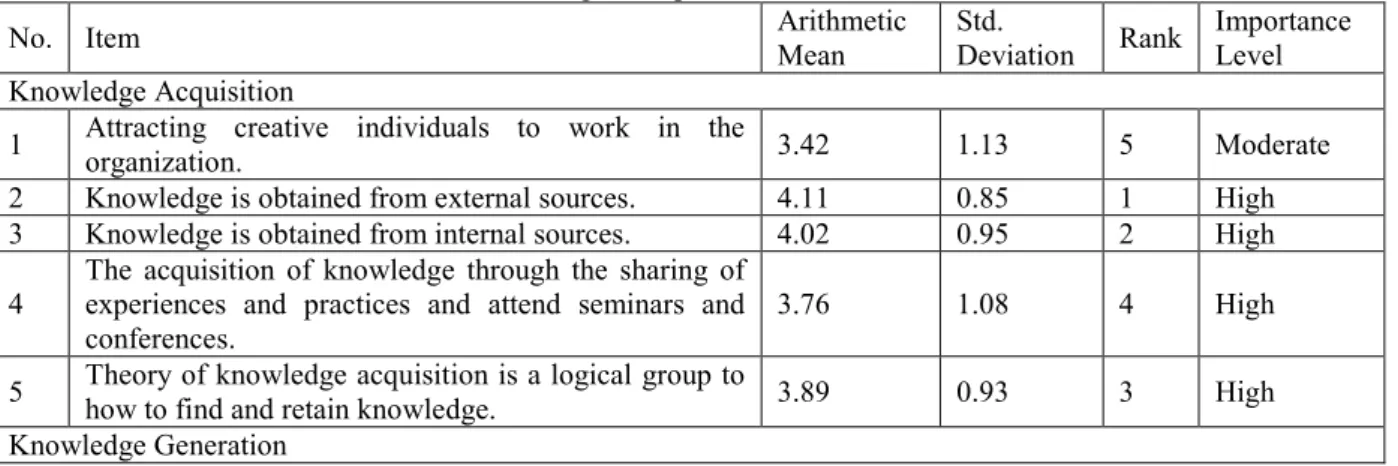
Arithmetic means and standard deviations were derived for the answers of study sample on knowledge management processes items, as shown in table (1):
Table 1. Arithmetic means and standard deviations were derived for the answers of study sample on knowledge management processes items
No. Item Arithmetic Mean Std. Deviation Rank Importance Level
Knowledge Acquisition
1 Attracting creative individuals to work in the organization. 3.42 1.13 5 Moderate
2 Knowledge is obtained from external sources. 4.11 0.85 1 High
3 Knowledge is obtained from internal sources. 4.02 0.95 2 High
4 The acquisition of knowledge through the sharing of experiences and practices and attend seminars and
conferences. 3.76 1.08 4 High
5 Theory of knowledge acquisition is a logical group to how to find and retain knowledge. 3.89 0.93 3 High Knowledge Generation
6 Employs potential employees and their knowledge and skills up to the stage of innovation. 4.01 0.64 6 High
7 Generate new ideas by encouraging teamwork methods. 3.86 0.87 9 High
8 Longer work experience source of knowledge generation. 3.96 0.79 8 High
9 Contributes to the generation of knowledge to increase the ability to excel in achievement. 4.19 0.61 3 High
10 Knowledge and innovation double two-way process. 4.28 0.61 1 High
11 Are integrated through knowledge transfer explicit knowledge to tacit knowledge. 4.00 0.86 7 High 12 Technology is used in the expansion and spread of knowledge and generates new knowledge. 4.19 0.60 4 High 13 Is attracting qualified and experienced human possesses the experience and knowledge capable of
creativity and innovation.
4.28 0.57 2 High
14 Are exploiting the potential of knowledge and transfer to the creation of new activities. 4.19 0.61 5 High 15 Knowledge acquisition and production is employed for the service of development. 3.41 0.99 10 Moderate Knowledge Storing
16 Is to take advantage of information technology to store knowledge. 3.26 1.00 6 Moderate
17 Authentication methods are supported in traditional store of knowledge. 3.60 1.00 3 High
18 Are relying on the tacit knowledge of employees in the store of knowledge. 3.76 0.85 1 High
19 Process of storing knowledge back to the organizational memory. 3.71 0.91 2 High
20 Access to knowledge stored through directory knowledge and document management model. 3.55 0.99 4 High 21 Storing process represents a bridge between knowledge capture scientific knowledge and retrieval. 3.55 0.90 5 Moderate
22 Repositories of knowledge are a central issue in the organization. 3.26 1.00 7 Moderate
Knowledge Distribution
23 People who needs knowledge are linked to the people how own it. 3.60 1.00 3 Moderate
24 Missions are sent to different terms of reference with a view knowledge transfer and indigenization. 3.76 0.85 1 High
25 Imported information technologies to disseminate knowledge. 3.71 0.91 2 High
26
Partnership agreements are supported with scientific documentation institutions and networks for information transfer and translation institutions to the publication and dissemination of knowledge.
3.55 0.99 5 Moderate
27 Is supporting various scientific awareness programs. 3.19 0.97 8 Moderate
28 Is the formation of a knowledge base for the exchange of information, experience and integrity? 2.90 1.04 9 Moderate 29 Knowledge development focuses on increasing the capacity and the skills and competencies of knowledge
workers. 3.56 1.05 4 Moderate
30 If the organization does not distribute knowledge in an efficient manner will not generate a return for the cost. 3.32 1.03 6 Moderate
31 Is to promote the exchange of knowledge among employees. 3.28 1.08 7 Moderate
After extracting the overall average of the knowledge management processes sections, which was (3.71) with a standard deviation of (0.89). Thus; the application extent of knowledge management operations at Orange were high.
Answering Study Second Main Question:
What is the level of accounting information systems efficiency at the Orange?
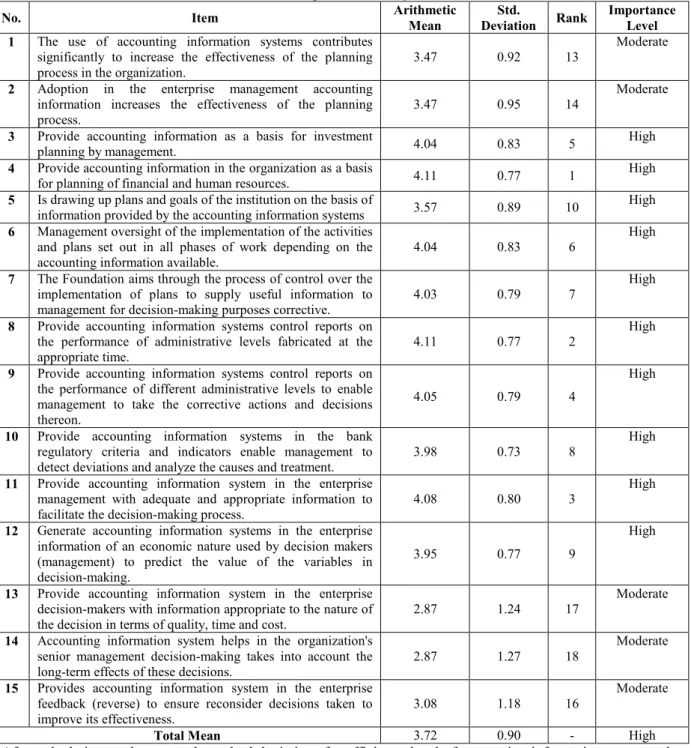
Arithmetic means and standard deviations were derived for the answers of study sample on accounting information systems section items, as shown in table (2):
Table 2. Arithmetic means and standard deviations were derived for study sample answers on the efficiency level of accounting information systems
No. Item Arithmetic Mean Deviation Std. Rank Importance Level
1 The use of accounting information systems contributes significantly to increase the effectiveness of the planning
process in the organization. 3.47 0.92 13
Moderate 2 Adoption in the enterprise management accounting
information increases the effectiveness of the planning
process. 3.47 0.95 14
Moderate 3 Provide accounting information as a basis for investment
planning by management. 4.04 0.83 5 High
4 Provide accounting information in the organization as a basis
for planning of financial and human resources. 4.11 0.77 1 High
5 Is drawing up plans and goals of the institution on the basis of
information provided by the accounting information systems 3.57 0.89 10 High 6 Management oversight of the implementation of the activities
and plans set out in all phases of work depending on the
accounting information available. 4.04 0.83 6
High 7 The Foundation aims through the process of control over the
implementation of plans to supply useful information to
management for decision-making purposes corrective. 4.03 0.79 7
High 8 Provide accounting information systems control reports on
the performance of administrative levels fabricated at the
appropriate time. 4.11 0.77 2
High 9 Provide accounting information systems control reports on
the performance of different administrative levels to enable management to take the corrective actions and decisions thereon.
4.05 0.79 4
High
10 Provide accounting information systems in the bank regulatory criteria and indicators enable management to
detect deviations and analyze the causes and treatment. 3.98 0.73 8
High 11 Provide accounting information system in the enterprise
management with adequate and appropriate information to
facilitate the decision-making process. 4.08 0.80 3
High 12 Generate accounting information systems in the enterprise
information of an economic nature used by decision makers (management) to predict the value of the variables in decision-making.
3.95
0.77 9
High
13 Provide accounting information system in the enterprise decision-makers with information appropriate to the nature of
the decision in terms of quality, time and cost. 2.87 1.24 17
Moderate 14 Accounting information system helps in the organization's
senior management decision-making takes into account the
long-term effects of these decisions. 2.87 1.27 18
Moderate 15 Provides accounting information system in the enterprise
feedback (reverse) to ensure reconsider decisions taken to
improve its effectiveness. 3.08 1.18 16
Moderate Total Mean
3.72 0.90 - High
After calculating total mean and standard deviations for efficiency level of accounting information systems, the total mean was (3.82), and the standard deviation was (0.90), with a high level of importance. This indicates that the efficiency level of accounting information systems at Orange was high.
Answering the third main question:
There is no statistical significant effect of the application level of knowledge management on the accounting information systems efficiency at the Orange?
follows:
To test the main hypothesis, simple regression was derived to investigate the effect of knowledge management processes on the efficiency level of accounting information systems; the following table (3) shows the results of hypothesis:
Table 3. Simple regression to investigate the effect of knowledge management processes on the efficiency level of accounting information systems
Regression R Square F Sig. Tabulated F
0.52 0.27 147.15 0.00 3.87
From the previous table (3), it was shown that the regression value between the knowledge management processes and the efficiency level of accounting information systems was (0.52), this value is significant at the level (0.05). Thus (F) value was (147.15). This means that null hypothesis is refused, and the alternative hypothesis is accepted, which states that: There is a statistical significant effect of knowledge management application level on the accounting information systems efficiency at Orange.
From this main hypothesis, the following sub-hypotheses were derived: The first sub-hypothesis:
There is no statistical significant effect of the knowledge acquisition level on the accounting information systems efficiency at Orange.
To test this hypothesis, simple regression was derived to investigate the knowledge acquisition effect on the accounting information systems efficiency level; the following table (4) shows the results of hypothesis:
Table 4. Simple regression to investigate the effect of knowledge acquisition onthe accounting information systems efficiency level
Regression R Square F Sig.
0.46 0.21 109.28 0.00
Table (4) shows that the value of correlation between the knowledge acquisition and the accounting information systems effectiveness at Orange was to (0.46), this value is a significant at the level of (0.05), where the value of (F) was (109.28). This indicates the rejection of the zero hypotheses and acceptance of the alternative hypotheses, so there is a statistically significant effect of knowledge acquisition level on the accounting information systems effectiveness at Orange.
Second sub-hypothesis:
There is no effect of statistical significant of knowledge generation level on the accounting information systems efficiency at Orange.
To test this hypothesis, simple regression was derived to investigate the effect of knowledge generation on the level of efficiency of accounting information systems; the following table (5) shows the results of hypothesis:
Table 5. Simple regression to investigate the effect of knowledge generation on the level of efficiency of accounting information systems
Regression R Square F Sig.
0.36 0.13 60.24 0.00
From the previous table (5), it was shown that the regression value between the knowledge generation and the level of efficiency of accounting information systems was (0.36), and this value is significant at the level (0.00). Thus (F) value was (60.24). This means that null hypothesis is refused, and the alternative hypothesis is accepted, which state that:
There is a statistical significant effect of knowledge generation level on the accounting information systems efficiency at Orange.
Third Sub-Hypnosis:
There is no statistical significant effect of knowledge storing level on the accounting information systems efficiency at the Orange.
To test this hypothesis, simple regression was derived to investigate the effect of knowledge storing on the accounting information systems efficiency level; the following table (6) shows the results of hypothesis:
Table 6. Simple regression to investigate the effect of knowledge storing on the accounting information systems efficiency level
Regression R Square F Sig.
0.29 0.09 38.05 0.00
From the previous table (6), it was shown that the regression value between the knowledge generation and the accounting information systems efficiency level was (0.29); this value is significant at the level (0.05). Thus (F) value was (38.05). This means that the null hypothesis is refused, and the alternative hypothesis is accepted, which states that:
efficiency at Orange. Fourth Sub-Hypothesis:
There is no statistical significant effect of knowledge distribution level on the accounting information systems efficiency at the Orange.
To test this hypothesis, simple regression was derived to investigate the effect of knowledge distribution on the accounting information systems efficiency level; the following table (7) shows the results of hypothesis:
Table (7)
Simple regression to investigate the effect of knowledge distribution on the accounting information systems efficiency level
Regression R Square F Sig.
0.34 0.11 52.35 0.00
From the previous table (7), it was shown that the regression value between knowledge storing and the accounting information systems efficiency level was (0.34), this value is significant at the level (0.05). Thus (F) value was (52.35). This means that null hypothesis is refused, and the alternative hypothesis is accepted, which states that:
There is a statistical significant effect of knowledge storing level on the accounting information systems efficiency at Orange.
11. Recommendations
In the light of the study results, the following recommendations were listed:
• There is a serious need to encourage operations in order to attract qualified staff and creative to work
within the company; this contributes in supporting the company's human resource and helps in raising the level of the overall organization performance; so it is recommended to apply this study on more organization in telecommunication sector to get more benefits and to generalize the results.
• To develop programs in order to employ the new knowledge gained within the company and to apply
this study in different sectors in Jordan and worldwide.
• To increase reliance on information technology and AIS tools in applying knowledge management
processes, where the world is observing increasing dependence on information technology revolution in all areas of life, which helps organizations in maintaining the required level of competition.
References
Abu Al-Ola, L. (2012). Degree of knowledge management processes in the Faculty of Education at the University of Ta’if from faculty members point of view. International Journal of specialized educational, Volume (1), number (4), pp: 106-126.
Abu Al Nadi, M. (2009). Proposed rules for knowledge management at the Jordanian public universities based on selected models. Unpublished Ph.D. dissertation, Amman, Jordan.
Al-Daya, M. (2009). The impact of the use of accounting information systems on the quality of financial data in the services sector in the Gaza Strip, a field study. Unpublished Master's Thesis, Islamic University, Gaza. Al Malak, S. & Al Athari, A. (2002). Knowledge management and its role in supporting skills development in
organizations, the future of the Arab Education magazine, 8(26), 143-157.
Al Obayd, H. (2012). The ability of the accounting information system in the Kuwaiti companies to deal with e-commerce operations. Unpublished Master's Thesis, University of the Middle East, Amman, Jordan. Amoush, A. (2009). The knowledge management level in the security leadership in Jordan Capital Territory.
Unpublished Master's Thesis, Al al-Bayt University, Karak, Jordan.
Al-Atwi, M. (2010). The role of transformational leadership style in the knowledge management activation and its impact on the organization performance: An Empirical Study on Jordanian plastic companies in Construction Industries. Unpublished Master's Thesis, University of the Middle East Graduate Studies, Amman, Jordan.
Arai, T., Aiyama, Y., Sugi, M. & Ota, J. (2001), “Holonic Assembly System with Plug and Produce”, Computers in Industry 46, Elsevier, 289-299.
Al-jabali M. & Tawfeq R. Z. (2014). The Relationship between the Information Systems of Accounting, Auditing, And How to Provide Reliable Information to Characterize the Service Auditor. Global Journal of Commerce and Management Perspective.3(2):95-101.
Andekina, R. & Medeni, T. (2013). Knowledge Management in Accounting for Firms: Best Practices and Lerning Lessons for Kazakhstan. International Journal of E-business and E-government Studies. 5(2): 122-132.
Bell, G.A., Cooper, M.A., Kennedy, M. & Warwick, J. (2000), The Development of the Holon Planning and Costing Framework for Higher Education Management, Technical Report, South Bank University, 103 Borough Road, London.
Bongaerts, L. (1998), Integration of Scheduling and Control in Holonic Manufacturing Systems, PhD Thesis, PMA Division, K.U.Leuven.
Chang, Y. W. (2001). The Effects of Environment, Strategy and Organizational Characteristics on the Performance of Accounting Information Systems, Unpublished PhD thesis, University of Chicago.
Choe, J. M. (1996). The Relationships among Performance of Accounting Information Systems, Influence Factors, and Eevolution Level of Information Systems, Journal of Management Information Systems, 12(4), 215-239
Curtis, G. (1995). Business Information Systems: Analysis, Design and Practice. Wokingham: Addison-Wesley Publishing Company.
Darwazeh, S. (2008). The relationship between knowledge management requirements and operations and their impact on corporate performance excellence: An Empirical Study on Organizational Performance Excellence. Unpublished Master's Thesis, University of Middle East Graduate Studies, Amman, Jordan. Deen, S.M. (1993), Cooperation Issues in Holonic Manufacturing Systems, Proceedings of DIISM’93
Conference, 410-412
Doms, M. E., Jarmin, R. S. & Klimek, S. D. (2004). "Information Technology Investment and Firm Performance in U.S. Retail Trade," Economics of Innovation and New Technology,13(7), 595-613.
.Edmond, G. (2010). The effectiveness of accounting information systems in Iraq's national commercial banks from management point of view. Unpublished Master's Thesis, University of the Middle East Graduate Studies, Amman, Jordan.
Falak, M. (2012). Knowledge management processes and their impact in achieving competitive advantage: a case study of Jordan Telecom Group. Fourth International Forum on: competition and competitive strategies of the industrial enterprises outside the hydrocarbon sector in the Arab countries, Algeria.
Kuntjoro, V. A. (2013). Knowledge Management as Bridge Of Accounting Information System And Strategic Management. Journal of Energy Technologies and Policy. 3(11), 246-250.
Mahjoub, B. (2004). Knowledge management processes: the entrance of the digital shift to the University, the University of Zaytuna, the Fourth Annual Scientific Conference, Amman, Jordan.
McCall, H. & Arnold, V. & Sutton, S. (2008). Use of Knowledge Management systems and the Impactof Explicit Knowledge Acquisition. Journal of Information Systems, 22(2), 77-101.
Medah, I. (2009). Factors affecting the accounting information system and their role in the strategic decision-making: a field study on the Jordanian industrial companies. Damascus University Journal for Economic and Legal Sciences, 25(1), 525-552.
Mubarak, A. (2013). Knowledge Management and Management Accounting Decisions- Experimental Study, Journal of Organizational Knowledge Management. Vol. 2013 (20113), Article ID 607397, 14 pages. Mubarak, S. (2001). Accounting information systems economics and management, the new University House for
publication, 1st edition.
Nurhayati, N., (2014). Influence of Organizational Commitment and Knowledge Management on Successful Implementation of Accounting Information Systems. International Journal of Economics, Commerce and Management, United Kingdom. 2(12), 1-16.
Omari, Gh. (2004). Shared use of information technology and knowledge management to achieve high value to the work of Jordanian commercial banks, PhD thesis, University of Applied Studies, Amman, Jordan. Qasim, A. (2003). Computer accounting information systems, the first edition, 18-19.
Ponemon, L. A. and Nagoda, R. J. (1990). Perceptual Variation and the Implementation of Accounting Information Systems: An Empirical Investigation. Journal of Information System, 4(2): 1-14.
Serafeimis, V. & Smithson S. (2003). Information system evaluation as an organizational institution: experience from a case study, Information System Journal, 13, 251-274.
Soudani, S. N.(2012). The Usefulness of an Accounting Information System for Effective Organizational Performance. International Journal of Economics and Finance . 4(5): 136-145.
Techawiboonwong, A., Yenradeea, P. & Das, S. (2006). A Master Scheduling Model with Skilled and Unskilled Temporary Workers, Production Economics 103, Elsevier, 798-809.
Valckenaers, P., Van Brussel, H., Bongaerts, L. & Wyns, J. (1997), Holonic Manufacturing Systems, Integrated Computer Aided Engineering 4(3), 191-201.
Van Brussel, H., Wyns, J., Valckenaers, P., Bongaerts, L. & Peters, P. (1998), Reference Architecture for Holonic Manufacturing Systems: PROSA, Computers in Industry 37(3), 255-274.
Wilkinson, J. W., Cerullo, M. J., Raval, V. and Wong-On-Wing, B. (2000). Accounting Information Systems: Essential Concepts and Applications. New York: John Wiley and Sons.