BLED 2020 Proceedings BLED Proceedings
2020
Young Elderly and Digital Coaching: A Quantitative Intervention
Young Elderly and Digital Coaching: A Quantitative Intervention
Study on Exercise Self-efficacy
Study on Exercise Self-efficacy
Eeva KettunenTuomas Kari Markus Makkonen Lauri Frank
Will Critchley
Follow this and additional works at: https://aisel.aisnet.org/bled2020
This material is brought to you by the BLED Proceedings at AIS Electronic Library (AISeL). It has been accepted for inclusion in BLED 2020 Proceedings by an authorized administrator of AIS Electronic Library (AISeL). For more information, please contact [email protected].
DOI https://doi.org/10.18690/978-961-286-362-3.32 ISBN 978-961-286-362-3
Y
OUNGE
LDERLY ANDD
IGITALC
OACHING:
A
Q
UANTITATIVEI
NTERVENTIONS
TUDY ONE
XERCISES
ELF-
EFFICACYKeywords: digital wellness, physical activity, digital coach, self-efficacy, young elderly, sport and wellness technology, intervention.
E
EVAK
ETTUNEN1,
T
UOMASK
ARI1,2,
M
ARKUSM
AKKONEN1,2,
L
AURI FRANK1&
W
ILLC
RITCHLEY11 University of Jyvaskyla, Jyvaskyla, Finland, e-mail: [email protected],
[email protected], [email protected], [email protected], [email protected]
2 Institute for Advanced Management Systems Research, Turku, Finland, e-mail:
[email protected], [email protected]
Abstract Sport and wellness technology devices are becoming an increasingly relevant topic when discussing health and wellness. This study focuses on the use of a “digital coach”, within a specific population, young elderly people. This research explored how the use of a digital coach would affect self-efficacy related to physical activity and exercise among young elderly. This quantitative intervention study provided a digital coaching device to a group of young elderly people ranging from 61-78 in age for 10-weeks. It was found that a digital coach may be useful for this population, particularly in increasing their perceived confidence in exercising independently. However, the participants’ perceptions of the device were more negative after the intervention period, although the overall perception was still positive. These results provide insight for sport technology companies and people who work with the young elderly on the possibilities of digital coaching and its usage for health promotion.
1 Introduction
Use of Sport and wellness technologies has become increasingly popular. There is a wide variety of devices, applications, and services aimed for different target groups and for different needs. Indeed, they are used by various types of users and for various purposes (Kettunen et al., 2017; Moilanen et al., 2014). These technologies can potentially offer many benefits to their users. For example, they can be used to promote physical activity (PA) (e.g., de Vries et al., 2016; Romeo et al., 2019), to support goal-setting (e.g., Gordon et al., 2019), and to increase the awareness of personal PA (e.g., Kari et al., 2017a; Wang et al., 2016). However, these benefits may not maintain the use of sport and wellness technologies (Kari et al., 2017a; Miyamoto et al., 2016), which in turn can lead to reduction in PA levels (Attig & Franke, 2020). A common issue with sport and wellness technologies is that they mainly provide feedback through numbers or charts instead of instructional information. Providing personalized achievable goals, sufficient guidance, and easy to understand information might promote use adherence and help in maintaining PA and exercise routines. Further, feedback on how to promote exercise can make use of the devices more goal-oriented (e.g., Kari et al. 2017b), which can lead to increased motivation (Shilts et al., 2004). Hence, providing the users with actual guidance and personalized workout plans would increase the possibility of making both the use of the technology and the exercise routines more goal-oriented.
One potential solution for this is digital coaching, which refers to a “service on a technological device that not only gives feedback but also offers advice, suggestions and future steps for a user to follow in the pursuit of their wellness and fitness goals” (Kettunen & Kari, 2018, p.3). The potential of digital coaching regarding PA and exercise has been recognized. However, some limitations have also been raised (e.g., Kranz et al., 2013; Kari & Rinne, 2018; Kettunen & Kari, 2018; Kettunen et al., 2018; 2019a; Helmefalk et al., 2020). Thus, it is important to continue studying digital coaching solutions and their use. This study investigates the usage of digital coaches from an exercise psychology perspective. Specifically, the aim is to find out how the use of a sport and wellness technology digital coach affects exercise self-efficacy of the young elderly (i.e., age 60–75). The focus was on self-efficacy, due to its significant relationship with PA performance affecting the choice of activity, effort, persistence, and vulnerability to stress (Bandura, 1997). The main research question
of the study is: “Does the use of a digital coach affect self-efficacy related to PA and exercising within young elderly?”
Young elderly were chosen as the target group as it is imperative to find ways to help them lead a more physically active life before they become elderly. The share of elderly people is increasing: persons aged 65 years or older cover 18–22% of the population in most EU countries (Eurostat, 2019). In addition, the life expectancy at older ages is increasing globally (United Nations, 2019). PA has been shown to be a key component for a healthier life at older age (Hoogendijk et al., 2019) and finding ways to support it is essential.
2 Theoretical Background
This study’s theoretical background is based on Bandura’s (1977) theory of self-efficacy. Self-efficacy relates to a person’s beliefs in their own capability to perform a specific task. If a person has high self-efficacy, they are likely to view difficult tasks as a challenge and an opportunity, while a person with low self-efficacy may tend to avoid difficult tasks. Self-efficacy may also affect motivation, as it impacts the amount of effort a person is willing to put in to overcome a specific task.
The sources of information that affect self-efficacy have been categorized into four aspects: performance accomplishment, vicarious experience, verbal persuasion, and physiological states (Bandura, 1998). Several of these aspects also closely relate to Bandura’s social cognitive theory (1986) which suggested that a person’s actions are influenced by their observations of the world around them and the actions of others. Social cognitive theory highlights how social experience and observational learning in development of personality is used as a framework when studying motivation and PA.
In this study, the theoretical background of self-efficacy could be said to take the form of “exercise self-efficacy”, as the focus is primarily on PA and exercise. Self-efficacy has been shown to have high influence in adopting PA habits (McAuley & Blissmer, 2000), hence why it was chosen for this particular study. It has also shown to be even more important when PA has not become a habit (Bandura, 1986). Self-efficacy has been associated with maintaining long-term PA (McAuley et al., 2011), and hence people with high self-efficacy may participate in PA more frequently and work harder (Bandura, 1986). Self-efficacy is a widely used theory in studying
self-confidence and motivation in sport performance studies, and one of the most researched concepts in the fields of PA (Kroll et al., 2007) and sport performance (Feltz, 1988), which is a key reason for its focus in this study.
Another part of the theoretical framework, proxy agency theory, comes also from the work of Bandura. The proxy agency refers to a situation where a third-party acts as an agent on a person’s behalf (Bandura, 1982; Beauchamp & Eys, 2007). There are three reasons for people to use a proxy agent. Firstly, people might feel they do not have the skills or knowledge to reach their desired outcome. Secondly, even though they would possess those skills they may think that having a proxy agent might lead to better results. Thirdly, using a proxy agent relates to the desire to hand over the responsibility and control to someone else (Bandura, 1997). In PA and exercise settings a proxy agent can refer, for example, to a coach or a personal trainer. In this particular study, the proxy agency theory is studied from the point of view of digital coaching, referring to a sport and wellness technology device consisting of digital coaching features. The interest is whether a digital proxy agent is also able to affect the feelings of competence and confidence by providing instructions, feedback, and persuasion as well as providing performance accomplishments similar to what a human proxy agent can.
3 Methodology
3.1 The Digital Coach Used in the Study
The device used in this study was the Suunto 3 Fitness (Suunto, 2019). The Suunto 3 Fitness is a fitness watch for monitoring daily PA, stress, recovery, and sleep, primarily through the device’s wrist-based heart rate sensor. The watch can also be linked to a smartphone app which provides additional feedback and may also collect movement data by using the phone’s GPS. One particular feature of the Suunto 3 Fitness is “adaptive training guidance” (i.e., a digital coach). The feature creates a customized training plan directly on the watch based on the user’s background and training history. The training guidance provides several days of future workouts with specific details of the duration and intensity of each workout. If the user follows the recommended workout, it will also guide the user through the workout to ensure the session is performed at the correct intensity. This is done by monitoring the user’s heart rate and providing real-time feedback through notifications on the screen, via the watch’s vibration, or by audio. The guidance instructs the user to increase or
decrease the exercise intensity, most obviously by speeding up or slowing down. The training plan adapts after each workout based on the user’s performance during that workout. If the workout is too hard or too easy, the plan may decrease or increase the intensity of future workouts. Criteria are built into the digital coach’s algorithms to ensure that the training plan is also physiologically appropriate, such as by not planning two hard workouts in a row or by following well-known periodization methods when creating the training plan.
3.2 Data collection and analysis
The target population of this study was young elderly. The study was conducted as an intervention study and comprised an intervention group and a control group. The participants were recruited from a Finnish University of the 3rd Age (UTA), which
offers weekly scientific sessions and a meeting spot for elderly people. The participants were recruited via a short presentation during a weekly UTA lecture, which resulted in recruitment of 80% of the participants. The rest were recruited via snowball method. All who volunteered for the study and were in the target age group were selected as participants. In total, 62 people volunteered for the study.
The participants were randomly divided into two sub-groups. The intervention group had 30 participants and the control group had 32 participants. The reason for limiting the number of participants in the intervention group to 30 was due to the number of available digital coach devices. Even though the division of participants into two groups was done randomly, the aim was to make the groups homogenous in terms of the number of men and women in each group. Participants’ level of PA did not influence the sample selection nor the grouping. The 10-week-long intervention period started in June 2019. During the period, participants in the intervention group used the digital coach and participants in the control group continued their exercising without a digital coach. Participants in the intervention group were asked to use the device in the way that best suited them in order to make the user experience as convenient and pleasant as possible.
The data was collected via three online surveys. The first survey was sent to all the participants before the intervention group were given the digital coaches. The second survey was sent after 5 weeks and the third survey at the end of the 10-week intervention. The measurements were conducted identically for both groups in all three surveys: First, the questionnaire included an exercise self-efficacy scale by Kroll et al. (2007), consisting of 10 items on a four-point scale ranging from one (not at
all true) to four (exactly true). Second, there were 13 items concerning the self-efficacy of exercising and improving fitness in general as well as the role of sport and wellness technology in exercising. These statements were presented on a seven-point Likert scale ranging from one (strongly disagree) to seven (strongly agree). These items were not, as such, intended as measures of specific constructs related to self-efficacy, although some of the items shared common themes. Thus, the responses were examined at the item level instead of the construct level. Third, the questionnaire contained five items measuring the attitude towards using a digital coach as a support for training by using a seven-point semantic differential scale ranging from -3 to +3, which was rescaled for the analysis to range from 1 to 7. A lower score suggested a more negative attitude, whereas a higher score suggested a more positive attitude. In all parts of the questionnaire, the order of the items was randomized for each participant. Responding to the items was non-mandatory, meaning that missing values in the data were possible.
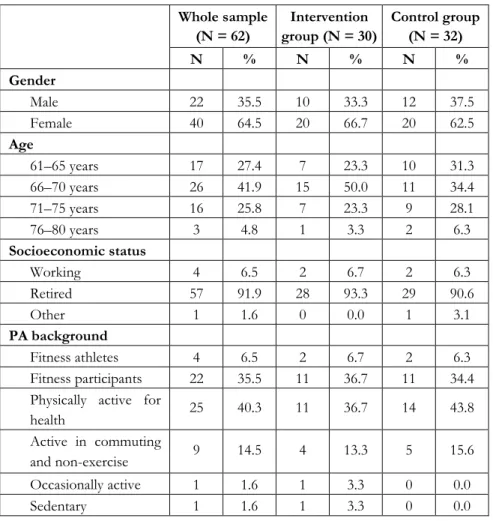
Participants’ age ranged from 61 to 78 years. Information on the participants’ PA background was collected using a categorization based on the Finnish National Sport Survey (Finnish Sports Federation, 2011), which classifies people into seven categories based on their PA level. The categories, in order from the most to least active, were: competition athletes, fitness athletes, fitness participants, physically active for health, active in commuting and non-exercise, occasionally active, and inactive or sedentary. This was enquired retrospectively after the study was finished. None of the intervention group participants had previous experience with a digital coach. However, 60% had at least tested a heart rate monitor or an activity bracelet before, 30% had used a PA application, and 20% had used a pedometer. 37% of the intervention participants had no previous experience with sport and wellness technology. Table 1 displays the descriptive statistics of the participants.
Table 1: Descriptive statistics of the participants and the two sub-groups.
Whole sample
(N = 62) group (N = 30) Intervention Control group (N = 32)
N % N % N % Gender Male 22 35.5 10 33.3 12 37.5 Female 40 64.5 20 66.7 20 62.5 Age 61–65 years 17 27.4 7 23.3 10 31.3 66–70 years 26 41.9 15 50.0 11 34.4 71–75 years 16 25.8 7 23.3 9 28.1 76–80 years 3 4.8 1 3.3 2 6.3 Socioeconomic status Working 4 6.5 2 6.7 2 6.3 Retired 57 91.9 28 93.3 29 90.6 Other 1 1.6 0 0.0 1 3.1 PA background Fitness athletes 4 6.5 2 6.7 2 6.3 Fitness participants 22 35.5 11 36.7 11 34.4
Physically active for
health 25 40.3 11 36.7 14 43.8
Active in commuting
and non-exercise 9 14.5 4 13.3 5 15.6 Occasionally active 1 1.6 1 3.3 0 0.0
Sedentary 1 1.6 1 3.3 0 0.0
The data was analyzed using the IBM SPSS Statistics 24 software. The Wilcoxon (1945) signed-rank test was used because of the small sample size and the non-normal distributions of some of the items. A statistical significance threshold of p < 0.05 was used. If a participant did not answer a particular item in all three surveys, all responses from that participant of that particular item were excluded. Thus, the exact number of respondents (N) may vary slightly between the items.
4 Results
The results are reported in three sub-sections. The first sub-section concentrates on overall self-efficacy. The second sub-section focuses on self-efficacy specifically related to perceptions of sport and wellness technology as it pertains to training and improvement of PA. The third sub-section relates to attitude towards using a digital coach. From left to right, the columns of the tables report the number of respondents (N), the mean and standard deviations of the measures at the three time-points, and the p-values. The p-values are from the Wilcoxon signed-rank tests, and the first p-value is for the test comparing the statistical significance of the change in means between the first and second time-point, whereas the second p-value is for the test comparing the statistical significance of the change in means between the first and third time-point.
4.1 Exercise Self-efficacy
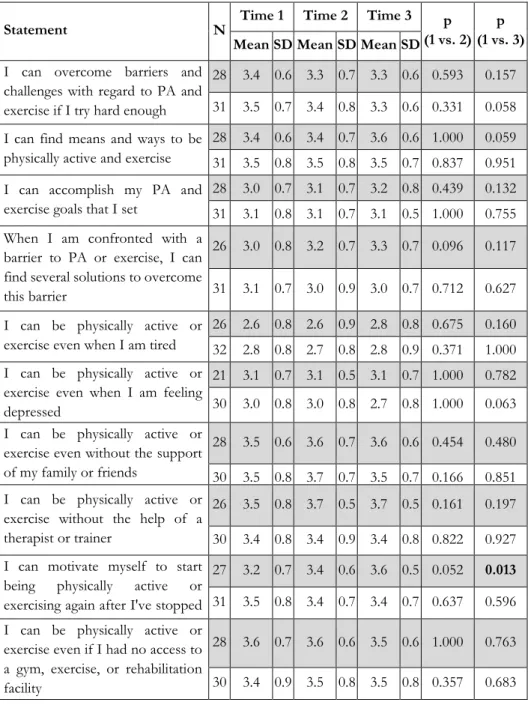
The scale used for measuring exercise self-efficacy (Kroll et al., 2007) included 10 statements regarding personal abilities related to PA (Table 2). The results show almost no statistically significant changes in exercise self-efficacy in either groups. The only time-point and statement where there was a statistically significant change was at the end of the intervention, where the intervention group felt more confident in their abilities to start exercising again after having stopped exercising for a while. The control group did not show any statistically significant changes.
Table 2: Changes in exercise self-efficacy (grey rows: intervention group, white rows: control group, scale: from 1 = “not at all true” to 4 = “exactly true”).
Statement N Time 1 Time 2 Time 3 (1 vs. 2) p (1 vs. 3) p Mean SD Mean SD Mean SD
I can overcome barriers and challenges with regard to PA and exercise if I try hard enough
28 3.4 0.6 3.3 0.7 3.3 0.6 0.593 0.157
31 3.5 0.7 3.4 0.8 3.3 0.6 0.331 0.058
I can find means and ways to be physically active and exercise
28 3.4 0.6 3.4 0.7 3.6 0.6 1.000 0.059
31 3.5 0.8 3.5 0.8 3.5 0.7 0.837 0.951
I can accomplish my PA and exercise goals that I set
28 3.0 0.7 3.1 0.7 3.2 0.8 0.439 0.132
31 3.1 0.8 3.1 0.7 3.1 0.5 1.000 0.755
When I am confronted with a barrier to PA or exercise, I can find several solutions to overcome this barrier
26 3.0 0.8 3.2 0.7 3.3 0.7 0.096 0.117
31 3.1 0.7 3.0 0.9 3.0 0.7 0.712 0.627
I can be physically active or exercise even when I am tired
26 2.6 0.8 2.6 0.9 2.8 0.8 0.675 0.160
32 2.8 0.8 2.7 0.8 2.8 0.9 0.371 1.000
I can be physically active or exercise even when I am feeling depressed
21 3.1 0.7 3.1 0.5 3.1 0.7 1.000 0.782
30 3.0 0.8 3.0 0.8 2.7 0.8 1.000 0.063
I can be physically active or exercise even without the support of my family or friends
28 3.5 0.6 3.6 0.7 3.6 0.6 0.454 0.480
30 3.5 0.8 3.7 0.7 3.5 0.7 0.166 0.851
I can be physically active or exercise without the help of a therapist or trainer
26 3.5 0.8 3.7 0.5 3.7 0.5 0.161 0.197
30 3.4 0.8 3.4 0.9 3.4 0.8 0.822 0.927
I can motivate myself to start being physically active or
exercising again after I've stopped
27 3.2 0.7 3.4 0.6 3.6 0.5 0.052 0.013
31 3.5 0.8 3.4 0.7 3.4 0.7 0.637 0.596
I can be physically active or exercise even if I had no access to a gym, exercise, or rehabilitation facility
28 3.6 0.7 3.6 0.6 3.5 0.6 1.000 0.763
4.2 Self-efficacy Related to Exercising and Improving Fitness, and the Role of Sport and Wellness Technology
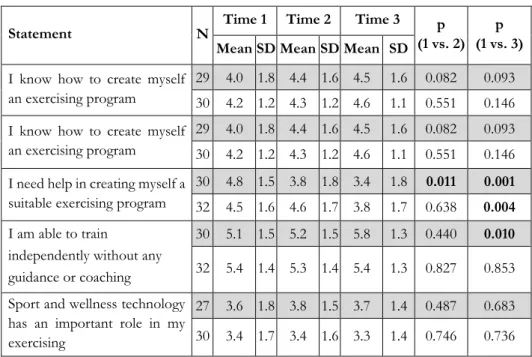
The self-efficacy related to the participants’ overall opinions about their exercising and improving their own fitness was measured by a total of 13 statements, out of which six were related to the role of sport and wellness technology (Table 3). Both the intervention and the control group were more confident at the end of the intervention that they do not necessarily need help in creating themselves a suitable training program. The intervention group also felt more confident to train without any kind of guidance or coaching at the end of the intervention. The intervention group also felt more and more strongly as the intervention went along that it was less hard for them to find out how to improve their fitness. The other statistically significant changes related to the intervention group losing some of their confidence on the truthfulness, accuracy, and reliability regarding the information given by sport and wellness technology. These changes appeared already at the midpoint of the intervention.
Table 3: Changes in self-efficacy related to improving fitness and sport and wellness technology (grey rows: intervention group, white rows: control group, scale: from 1 =
“strongly disagree” to 7 = “strongly agree”).
Statement N Time 1 Time 2 Time 3 (1 vs. 2) p (1 vs. 3) p Mean SD Mean SD Mean SD
I know how to create myself an exercising program
29 4.0 1.8 4.4 1.6 4.5 1.6 0.082 0.093
30 4.2 1.2 4.3 1.2 4.6 1.1 0.551 0.146
I know how to create myself an exercising program
29 4.0 1.8 4.4 1.6 4.5 1.6 0.082 0.093
30 4.2 1.2 4.3 1.2 4.6 1.1 0.551 0.146
I need help in creating myself a suitable exercising program
30 4.8 1.5 3.8 1.8 3.4 1.8 0.011 0.001
32 4.5 1.6 4.6 1.7 3.8 1.7 0.638 0.004
I am able to train
independently without any guidance or coaching
30 5.1 1.5 5.2 1.5 5.8 1.3 0.440 0.010
32 5.4 1.4 5.3 1.4 5.4 1.3 0.827 0.853
Sport and wellness technology has an important role in my exercising
27 3.6 1.8 3.8 1.5 3.7 1.4 0.487 0.683
Sport and wellness technology provides me with important information that I can use in my exercising
30 5.7 1.2 5.0 1.4 5.1 1.2 0.052 0.051
30 4.9 1.5 4.9 1.7 4.5 1.7 0.933 0.113
I am able to improve my fitness with the help of sport and wellness technology
30 5.3 1.4 4.7 1.6 4.8 1.7 0.076 0.116
29 4.8 1.4 4.8 1.5 4.4 1.5 0.977 0.102
I believe that sport and wellness technology provides me with reliable information regarding my own exercising
30 5.9 1.0 5.0 1.4 4.7 1.3 0.011 0.001
29 5.3 1.6 5.5 1.4 5.0 1.5 0.369 0.128
I believe that sport and wellness technology provides me with accurate information regarding my own exercising
29 5.4 1.2 4.8 1.2 4.7 1.5 0.036 0.020
29 5.4 1.4 5.4 1.5 5.2 1.3 0.971 0.231
I believe that sport and wellness technology provides me with truthful information regarding my own exercising
30 5.6 1.0 4.9 1.3 4.8 1.5 0.038 0.054
31 5.4 1.4 5.4 1.5 5.2 1.3 0.805 0.299
It is hard for me to find out how to improve my aerobic fitness
29 3.6 1.8 2.8 1.7 2.6 1.5 0.036 0.019
30 3.5 1.9 3.3 1.7 3.3 1.7 0.838 0.569
I do not know how to increase the level of my aerobic fitness
30 2.8 1.6 2.3 1.5 2.4 1.7 0.147 0.186
29 3.2 2.0 3.1 1.9 2.8 1.5 0.695 0.290
It is hard for me to analyze my aerobic fitness
30 4.1 1.6 4.0 1.5 3.5 1.7 0.681 0.053
30 4.3 1.9 4.2 1.8 3.9 1.6 0.300 0.225
I know how to improve my aerobic fitness
30 5.3 1.4 5.2 1.3 5.7 0.9 0.697 0.071
31 4.8 1.4 4.9 1.1 4.7 1.5 0.882 0.747
4.3 Attitude towards using a digital coach
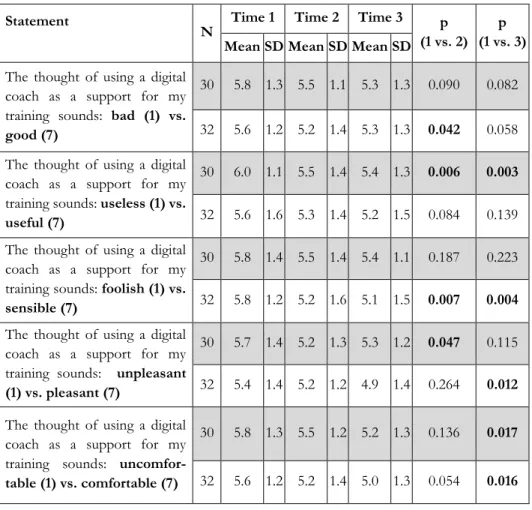
The attitude towards using a digital coach was measured by five statements focusing on the following three aspects of attitudinal evaluations: the overall attitude (bad vs. good), the experimental aspect (unpleasant vs. pleasant and uncomfortable vs. comfortable), and the instrumental aspect (useless vs. useful and foolish vs. sensible) (Table 4). It is noticeable that both the intervention group and the control group
experienced a decline in their attitude towards digital coaching. For most of the statements, a statistically significant decline appeared already at the midpoint of the intervention. However, regarding comfortableness, a statistically significant decline appeared only at the end of the intervention. Despite the decline, the attitude of both the groups towards digital coaching still remained as relatively positive at the end of the intervention.
Table 4: Changes in attitude towards using a digital coach (grey rows: intervention group, white rows: control group, scale: from 1 to 7).
Statement
N Time 1 Time 2 Time 3 (1 vs. 2) p (1 vs. 3) p Mean SD Mean SD Mean SD
The thought of using a digital coach as a support for my training sounds: bad (1) vs. good (7)
30 5.8 1.3 5.5 1.1 5.3 1.3 0.090 0.082
32 5.6 1.2 5.2 1.4 5.3 1.3 0.042 0.058
The thought of using a digital coach as a support for my training sounds: useless (1) vs. useful (7)
30 6.0 1.1 5.5 1.4 5.4 1.3 0.006 0.003
32 5.6 1.6 5.3 1.4 5.2 1.5 0.084 0.139
The thought of using a digital coach as a support for my training sounds: foolish (1) vs. sensible (7)
30 5.8 1.4 5.5 1.4 5.4 1.1 0.187 0.223
32 5.8 1.2 5.2 1.6 5.1 1.5 0.007 0.004 The thought of using a digital
coach as a support for my training sounds: unpleasant (1) vs. pleasant (7)
30 5.7 1.4 5.2 1.3 5.3 1.2 0.047 0.115
32 5.4 1.4 5.2 1.2 4.9 1.4 0.264 0.012
The thought of using a digital coach as a support for my training sounds: uncomfor-table (1) vs. comforuncomfor-table (7)
30 5.8 1.3 5.5 1.2 5.2 1.3 0.136 0.017
5 Discussion
This study focused on the target group of young elderly and examined the changes in self-efficacy regarding PA and exercising. The main research question was: “Does the use of a digital coach affect self-efficacy related to PA and exercising within young elderly?” The study contained 62 participants divided into an intervention group and a control group and was conducted as a 10-week intervention study. The participants in the intervention group used a sport and wellness technology digital coach during the intervention. The data was collected via three online surveys containing items related to exercise self-efficacy, attitude towards using a digital coach, as well as self-efficacy of exercising and improving fitness in general, and the role of sport and wellness technology in exercise.
The 10-week intervention produced the following results: related to exercise self-efficacy, only one item showed a statistically significant change as the members of the intervention group felt more confident that they could restart exercising after having stopped exercising for a while. As to the self-efficacy related to exercising and improving fitness and to the role of sport and wellness technology in exercising, more statistically significant changes could be identified. The perceived need for help for an exercising program was reduced significantly in both the groups. In addition, the intervention group felt more confident to be able to train independently, and it was less hard for them to find out how to improve their fitness. From a theoretical perspective, this result could be seen as an enhancement of the participants’ feeling of autonomy.
However, the perceived reliability, accuracy, and truthfulness of sport and wellness technology were significantly reduced among the participants of the intervention group. Thus, the users of the digital coach device (i.e., the intervention group) had a more positive perception of sport and wellness technology in general before the intervention than after it. This might be a result of initial expectations being too high regarding the exactness of the device used in the study, as the use of it during the intervention might have shown inexact results. Still, the perceptions of sport and wellness technology remained on a relatively high and positive level and, although statistically significant, no dramatic changes (from positive to negative) in attitude occurred. However, as the intervention group felt more confident towards independent exercising after the intervention, it can be reasoned that the use of the digital coach had a positive effect on confidence in this part.
Attitudes towards using a digital coach were found to decline in several respects and in both groups of the study. The control group found the use of a digital coach to be a less pleasant, less sensible, and less comfortable idea after the study period. One potential explanation for this is that the members of the control group might have been able to increase their exercising and exercise motivation without a digital coach, and, as a result, see less use for digital coaching than before the study period. The intervention group found the use of a digital coach as less useful and less comfortable after the intervention. This may reflect that the usefulness and comfortableness of digital coaching device were expected to be higher in advance, but these expectations were not fulfilled by the digital coach used in the intervention. However, the attitudes still remained at a relatively positive level. These results are similar to the results of a previous study (Kettunen et al., 2019b) done with a physically less active and younger target group. Overall, based on these quantitative results alone, it is difficult to say what caused the decline in both groups’ attitude. To conclude, as a proxy agent, digital coaching may be a useful approach to support PA and exercise among young elderly, particularly in increasing their perceived confidence in exercising independently. A digital coach can have potential in making young elderly people more aware of how they should improve their fitness. However, certain limitations need to be noted, and more research is needed on the topic.
6 Limitations and Future Research
The results of this study are limited to the selected age group of young elderly and to the selected technology. The participant groups might also have an ‘activity’ bias as the participants are active participants of the society. The statistically significant declines found in the perceived reliability of sport and wellness technology as well as in the attitude towards using a digital coach call for further research, for example, providing qualitative insights on the topic. It would also be interesting to investigate these effects by using other kinds of digital coaching solutions with different features or different feedback modalities.
References
Attig, C., Franke, T. (2020). Abandonment of personal quantification: a review and empirical study investigating reasons for wearable activity tracking attrition. Computers in Human Behavior, 102, 223-237.
Bandura, A. (1977). Self-efficacy: Toward a unifying theory of behavioral change. Psychological Review 84 (2), 191-215.
Bandura, A. (1982). “Self-efficacy mechanism in human agency.” American Psychology 37, 122-147. Bandura A. (1986). Social Foundations of Thought and Action: A Social Cognitive Theory. Englewood
Cliffs, NJ: Prentice Hall.
Bandura, A., (1997). Self-efficacy: The Exercise of Control. New York, NY: Freeman.
Bandura, A. (1998). Health promotion from the perspective of social cognitive theory. Psychology and Health 13 (4), 623–649.
de Vries, H. J., Kooiman, T. J., van Ittersum, M. W., van Brussel, M., de Groot, M. (2016). Do activity
monitors increase physical activity in adults with overweight or obesity? A systematic review and meta‐analysis. Obesity, 24, 2078-2091.
Eurostat. (2019). Population structure and ageing. https://ec.europa.eu/eurostat/statistics
-explained/index.php/Population_structure_and_ageing, last accessed 7.3.2020.
Feltz, D. (1988) “Self-confidence and sports performance.” Exercise and Sport Sciences Reviews 16 (1), 423-458.
Finnish Sports Federation. (2011). Kansallinen liikuntatutkimus 2009–2010: Aikuis- ja senioriliikunta. [National Sports Study 2009-2010: Adult and Elderly Physical Activity (Report), Helsinki:
Finnish Sports Federation.
Gordon, M., Althoff, T., Leskovec, J. (2019). Goal-setting and achievement in activity tracking apps: a
case study of MyFitnessPal. In Proceedings of the World Wide Web Conference, pp. 571-582. ACM, New York, NY.
Helmefalk, M., Marcusson, L., & Sell, A. (2020). “Who cares about fireworks?”–A Study on Digital
Coaching, Gamification and Exercise Motivation. In Proceedings of the 53rd Hawaii International Conference on System Sciences.
Hoogendijk, E. O., Afilalo, J., Ensrud, K. E., Kowal, P., Onder, G., Fried, L. P. (2019). Frailty: implications for clinical practice and public health. The Lancet, 394, 1365-1375.
Kari, T., Kettunen, E., Moilanen, P. & Frank, L. (2017a). Wellness Technology Use in Everyday Life:
A Diary Study. In Proceedings of the 30th Bled eConference.Bled, Slovenia: University of Maribor, pp. 279-294.
Kari, T., Koivunen, S., Frank, L., Makkonen, M. & Moilanen, P. (2017b). The expected and perceived well-being effects of short-term self-tracking technology use. International Journal of
Networking and Virtual Organisations, 17(4), 354-370.
Kari, T., & Rinne, P. (2018). Influence of Digital Coaching on Physical Activity: Motivation and Behaviour of Physically Inactive Individuals. In Proceedings of the 31st Bled eConference, 17
-20.6.2018 (pp. 127-145). Bled, Slovenia: University of Maribor Press.
Kettunen, E., Critchley, W. & Kari, T. (2019a). Can Digital Coaching Boost Your Performance? – A
Qualitative Study among Physically Active People. In Proceedings of the 52nd Hawaii International Conference on System Sciences, Maui, USA. 14-18.1.2019.
Kettunen, E. & Kari, T. (2018). Can Sport and Wellness Technology be My Personal Trainer? Teenagers and Digital Coaching. In Proceedings of the 31st Bled eConference, 17-20.6.2018 (pp. 463-476). Bled, Slovenia: University of Maribor Press.
Kettunen, E., Kari, T., Makkonen, M. & Critchley, W. (2018). Digital Coaching and Athlete’s Self -Efficacy – A Quantitative Study on Sport and Wellness Technology. In Proceedings of the 12th Mediterranean Conference on Information Systems, Corfu, Greece.
Kettunen, E., Kari, T., Makkonen, M., Critchley, W., & Sell, A. (2019b). Digital Coaching among University Students with Low Levels of Physical Activity: A Quantitative Intervention Study on Exercise Self-efficacy. In Proceedings of the 32nd Bled eConference, 16-19.6.2019 (pp. 861
Kettunen, E., Kari, T., Moilanen, P., Vehmas, H., Frank, L. (2017). Ideal types of sport and wellness
technology users. In Proceedings of the 11th Mediterranean Conference on Information Systems, 12 pages. AIS, Genoa, Italy.
Kranz, M., Möller, A., Hammerla, N., Diewald, S., Roalter, L., Ploetz, T. & Olivier, P. (2013). The
mobile fitness coach: Towards individualized skill assessment using personalized mobile
devices. Pervasive and Mobile Computing, 9, 203-215.
Kroll, T., Kehn, M., Ho, P. S., & Groah, S. (2007). The SCI Exercise Self-Efficacy Scale (ESES):
development and psychometric properties. The international journal of behavioral nutrition
and physical activity, 4, (34).
McAuley E. & Blissmer B. (2000). Self-efficacy determinants and consequences of physical activity. Exercise and Sport Sciences Reviews, 28, 85–88.
McAuley, E., Szabo, A., Gothe, N., & Olson, E. A. (2011). Self-efficacy: Implications for Physical
Activity, Function, and Functional Limitations in Older Adults. American journal of lifestyle medicine, 5(4),
Miyamoto, S. W., Henderson, S., Young, H. M., Pande, A., & Han, J. J. (2016). Tracking health data is
not enough. JMIR mHealth and uHealth, 1, e5.
Moilanen, P., Salo, M., & Frank, L. (2014). Inhibitors, enablers and social side winds Explaining the
use of exercise tracking systems. In proceedings of the 27th Bled eConference, 1-5.6.2014 (pp.
23-37). Bled, Slovenia: University of Maribor Press.
Romeo, A., Edney, S., Plotnikoff, R., Curtis, R., Ryan, J., Sanders, I., ... Maher, C. (2019). Can
smartphone apps increase physical activity? systematic review and meta-analysis. Journal of Medical Internet Research, 21, e12053.
Shilts, M. K., Horowitz, M. & Townsend, M. S. (2004). Goal setting as a strategy for dietary and physical activity behavior change: a review of the literature. American Journal of Health Promotion, 19, 81-93.
Suunto (2019). Suunto 3 Fitness. https://www.suunto.com/en
-gb/suunto-collections/suunto-3-fitness/, last accessed 18.3.2020.
Wang, J. B., Cataldo, J. K., Ayala, G. X., Natarajan, L., Cadmus-Bertram, L. A., White, M. M., …& Pierce, J. P. (2016). Mobile and wearable device features that matter in promoting physical
activity. Journal of Mobile Technology in Medicine, 5, 2-11.
Wilcoxon, F. (1945). Individual Comparisons by Ranking Methods. Biometrics Bulleting. 1 (6), 80-83. United Nations. (2019). World population ageing 2019. https://www.un.org/en/development/desa/