FACULTY OF LAW
Lund University
Elise Krumholz
BEPS Action 13:
Standardized Transfer Pricing Documentation
Does one size fit all?
JURM02 Graduate Thesis
Graduate Thesis, Master of Laws program
30 higher education credits
Supervisor: Christina Moëll
Semester of graduation: Fall 2015
Contents
SUMMARY 1 SAMMANFATTNING 2 PREFACE 3 ABBREVIATIONS 4 1 INTRODUCTION 6 1.1 Purpose 71.2 Method and material 8
1.3 Delimitation 10
1.4 Terminology 10
1.5 Disposition 11
2 TRANSFER PRICING DOCUMENTATION 12
2.1 The arm’s length principle 12
2.2 Transfer pricing guidelines 2010 13 2.2.1 Chapter V of the Transfer pricing guidelines 2010 14 2.3 EU Joint Transfer Pricing Forum 16
2.4 Swedish legal system 17
2.4.1 Arm’s length principle 17
2.4.2 Swedish transfer pricing documentation requirements 19
2.5 Summary 21
3 ACTION 13 22
3.1 Base erosion and profit shifting 22
3.1.1 OECD/G20 BEPS project 23
3.2 Action 13 – Re-examine transfer pricing documentation 24
3.2.1 Discussion Draft 27
3.2.2 Public disclosure 29
3.2.3 Guidance on transfer pricing documentation and CbC reporting 31
3.3 Final Report 32
3.3.1 Chapter V of the Transfer pricing guidelines on documentation 33
3.3.2 Implementation package 35
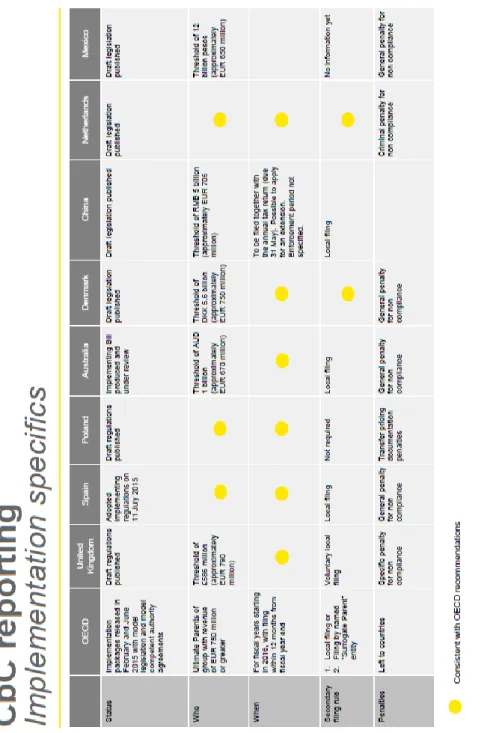
3.3.3 Local implementation 36
4 TRANSFER PRICING DOCUMENTATION IN SWEDEN 40
4.1 Pre BEPS- relevant information and proportionality 40 4.2 Analysis of Swedish transfer pricing documentation requirements 43 4.3 Swedish implementation of Action 13 47
4.3.1 Legislation 48
4.3.2 Swedish Tax Agency’s authority 49
4.3.3 European Union 50
4.3.4 Soft law 51
4.4 Summary 52
5 ANALYSIS 53
5.1 Case study 53
5.2 Global transfer pricing documentation 55
5.3 Conclusions 60
SUPPLEMENT A 62
SUPPLEMENT B 63
6 BIBLIOGRAPHY 64
Summary
In Action 13 of the OECD/G20 Base erosion and profit shifting project, the Organization for Economic Co-operation and Development (OECD) re-examines transfer pricing documentation requirements and updates Chapter V of the Transfer pricing guidelines. Action 13 recommends a new three-tiered transfer pricing documentation structure that includes a master file, a local file, and a country-by-country report. Together, these three documents are intended to simplify taxpayers’ compliance burden, provide tax administrations with more relevant information, and increase transparency. In regulating transfer pricing, Sweden follows the Transfer pricing guidelines and requires transfer pricing documentation. This thesis examines a pending Swedish implementation of Action 13 and addresses the following themes in connection with transfer pricing documentation: (1) proportionality; (2) relevant information; (3) confidentiality; (4) compliance; (5) the factors countries should consider when formulizing new transfer pricing documentation requirements; and (6) the immediate consequences Action 13 has on multinational enterprises. As will be shown, regardless of when Sweden implements Action 13, the majority of Swedish multinational enterprises will already be compelled to compile three-tiered transfer pricing documentation that complies with the transfer pricing requirements in other jurisdictions.
While the OECD contends that Action 13 strikes a balance between taxpayers’ compliance costs and tax administrations information needs, this thesis reveals that the new three-tiered transfer pricing documentation structure increases compliance costs for taxpayers as well as the administrative burden for tax administrations. Since taxpayers have struggled with what constitutes relevant information for the purposes of transfer pricing documentation, Action 13 specifically outlines the contents of the master file, local file, and country-by-country report. The Swedish transfer pricing documentation requirements are not aligned with this list of information and consequently, this thesis recognizes a clear discrepancy between the OECD’s new recommendations and Swedish legislation. Furthermore, the country-by-country report has unleashed a debate about public disclosure of financial information; however, this thesis finds that the country-by-country report should remain confidential. Finally, this thesis analyzes compliance issues from three different perspectives accordingly: taxpayers’ compliance with transfer pricing documentation requirements, tax administrations compliance with following their administrative authority, and Sweden’s compliance with the OECD and the EU. Ultimately, this thesis questions the plausibility of standardized transfer pricing documentation, i.e. ‘one size fits all’.
Sammanfattning
I ljuset av OECD/G20:s ’Base erosion and profit shifting’-projekt har ’Organization for Economic Co-operation and Development’ (OECD) undersökt internprissättningsdokumentation i Punkt 13 i handlingsplanen och har följaktligen publicerat ett reviderat Kapitel V i Transfer pricing guidelines. I Punkt 13 rekommenderas en ny tredelad struktur för internprissättningsdokumentation som inkluderar en master file, en local file och ett land för land-rapport. OECD menar att dessa tre dokument tillsammans kommer att minska skattebetalarnas börda att uppfylla dokumentationskraven, att tillförse skattemyndigheterna med relevant information, och öka transparens. I internprissättning följer Sverige Transfer pricing guidelines och verkställde dokumentationskrav för prissättningen mellan företag i intressegemenskap i 2007. Syftet med denna uppsats är att undersöka den pågående svensk implementering av Punkt 13 samt belyser följande huvudfrågor i anslutning till internprissättningsdokumentationen: (1) proportionalitet; (2) relevant information; (3) sekretess; (4) förenlighet; (5) vad som bör beaktas när länder formulera nya reglerna om dokumentationsskyldighet vid internprissättning; och (6) de omedelbara konsekvenserna som punkt 13 får för multinationella företag. Denna uppsats kommer att visa, att oavsett när Sverige implementerar Punkt 13 kommer de flesta svenska multinationella företag att redan ha utarbetat tredelad internprissättningsdokumentation som följer av regleringen i de andra länder där företaget är verksamt.
Medan OECD påstår att Punkt 13 ger en balans mellan skattebetalarnas börda att uppfylla dokumentationskraven och nyttan av informationen till skattemyndigheterna, framhäver denna uppsats att tredelad internprissättningsdokumentation i verkligheten ökar både skattebetalarnas börda att uppfylla dokumentationskraven och skattemyndigheternas administrativa börda. Eftersom skattebetalarna tycker att det är svårt att avskilja vad som utgör relevant information, Punkt 13 specificerar vad som ska ingå i master file, local file och land för land-rapporten. Sveriges dokumentationsregler skiljer sig från OECD:s riktlinjer och därför görs det gällande att det föreligger en tydlig oförenlighet mellan OECD:s nya rekommendationer och svensk lagstiftning. Därutöver har land för land-rapportering öppnat en offentlighetsdebatt, trots debatten anser denna uppsats att land för land-rapportering borde vara sekretessbelagd även fortsättningsvis. Slutligen analyseras förenlighetsproblemet utifrån tre perspektiv. Den första är skattebetalarnas uppfyllelse av internprissättningsdokumentation, den andra är skattemyndigheternas administrativa auktoritet och den tredje är Sveriges enlighet med OECD och EU. I slutändan problematiseras möjligheten till att införa standardiserad internprissättningsdokumentation, med andra ord; om verkligen ’one size fits all’.
Preface
I moved to Sweden nine years ago and attaining my law degree is something that I have always felt passionate about. My Swedish teacher, Lena Bruzaeus, encouraged me to pursue my dream in Sweden and prepared me for the challenges at law school. Even though I was the first person on the waiting list the first time I applied to the Faculty of Law at Lunds University; I was not accepted into the program. I felt discouraged and assumed that destiny had other plans in store. The following year I spontaneously reapplied and was accepted into the program. After four years of hard work I am proud to publish my Graduate Thesis.
First, I would like to thank my supervisor, Professor of Fiscal Law, Christina Moëll, for her encouragement and continuous feedback throughout the writing process. I looked forward to our interesting discussions and am thankful that I received the opportunity to attend the Transfer Pricing Tax Conference at Copenhagen Business School. I would also like to thank my mentor, Mikael Burlin, for his support and inspiration over the past two years. In addition, I would like to thank my father, David, and Eric Jorgensen for assisting me in the final editing of this thesis. Finally, I would like to thank my other-half, Jonas Lindstrand, for believing in me and not letting me give up. Last, I would like to thank my friends at Juridicum for all their pep-talks and my family for their continuous support.
Elise Krumholz
Abbreviations
Action Plan Action plan on base erosion and profit shifting Action 7 Action 7 – Preventing the artificial avoidance of
permanent establishment status
Actions 8-10 Actions 8-10 – Aligning transfer pricing outcomes with value creation
Action 13 Action 13 – Re-examine transfer pricing documentation
BEPS Base erosion profit shifting
BEPS Report Addressing base erosion and profit shifting
CbC Country-by-country
CCCTB Common consolidated corporation tax base Code of conduct on TPD Resolution on a Code of conduct on transfer
pricing documentation for associated enterprises in the European Union
Discussion Draft Discussion draft on transfer pricing documentation and CbC reporting
EU JTPF European Union Joint Transfer Pricing Forum
EU European Union
EUTPD European Union transfer pricing documentation Final Report Transfer pricing documentation and
country-by-country Reporting, Action 13 – 2015 Final Report
HFD Swedish Supreme Administrative Court
IL Income Tax Act
(Inkomstskattelag, (1999:1229)
LSK Tax Return and Statements of Income Act
(lag (2001:1277) om självdeklarationer om kontrolluppgifter)
Memorandum Memorandum on transfer pricing documentation and country by country reporting
MNE Multinational enterprise
Model Legislation Model legislation related to Country-by-Country Reporting
OECD Organization for Economic Co-operation and Development
OECD Model OECD Model tax convention on income and on capital
Public Comments Comments received on discussion draft on transfer pricing documentation and CbC reporting
Prop. Government bill
(Proposition)
RF Instrument of Government
(Regeringsform (1974:152))
RÅ Regeringsrättens årsbok
SFF Tax Procedures Ordinance
(Skatteförfarandeförordning, (2011:1261))
SFL Tax Procedures Act
(Skatteförfarandelag, (2011:1244))
SKV Swedish Tax Agency
(Skatteverket)
SKVFS Swedish Tax Agency Statute Book
(Skatteverkets författningssamling)
SKV M Swedish Tax Agency Memorandum
(Skatteverkets meddelanden)
TPD Transfer pricing documentation
TP Guidelines Transfer pricing guidelines 2010
White Paper White paper on transfer pricing documentation WP6 OECD Working Party 6 of the Committee of
1 Introduction
“What the BEPS are we talking about?” symbolizes the hallmark logo of the OECD/G20 Base Erosion and Profit Shifting (BEPS) project and on October 5, 2015, the Organization for Economic Co-operation and Development (OECD) informed the public about, “What the BEPS have we done?”.1 Indeed, the BEPS project signifies the largest change in international tax standards within the past century and these changes are occurring right now.2 In order to prevent double non-taxation and the shifting of incomes to low-tax jurisdictions, the BEPS project develops fifteen action plans. Together, these fifteen action plans create coherence between different interactions in domestic law, realign substance and taxation, and increase transparency.3 Unsurprisingly, transfer pricing is one area of concern. Transfer pricing rules generally follow the arm’s length principle, which requires that the pricing of a transaction between two associated entities equates to the price that two independent entities would agree to. In order to verify compliance with the arm’s length principle, multinational enterprises (MNE) document their intra-group cross-border transactions, i.e. transfer pricing documentation (TPD). Further guidance about the arm’s length principle and TPD resides in the
OECD Transfer pricing guidelines for multinational enterprises and tax administrations4 (TP Guidelines).
Action 13 – Re-examine transfer pricing documentation - (Action 13) of the BEPS project focuses on enhancing transparency and updates Chapter V of the TP Guidelines on TPD. In contrast to the previous provisions, the OECD clearly stipulates three objectives of TPD requirements: the taxpayer’s assessment of its compliance with the arm’s length principle, the provision of information for the tax administrations risk assessment, and the provision of information for a transfer pricing audit. In order to fulfil these three objectives, the OECD establishes a new three-tiered TPD standard, which includes a master file, a local file, and a country-by-country (CbC) report. The master file provides tax administrations with a high-level overview of the MNE group, the local file specifies the relevant transactions, and the CbC report assembles the global allocation of income. The OECD’s attempt to
1 Saint-Amans, Pascal & Russo, Raffaele: What the BEPS are we talking about?, OECD
Forum 2013, http://www.oecd.org/forum/what-the-beps-are-we-talking-about.htm,
(Accessed: 2015-10-07). [cit: Saint-Amans & Russo 2013].
BEPS webcast #8: Launch of 2015 BEPS reports, 6 October 2015,
https://www.youtube.com/watch?v=AFtUOMVmovk, (Accessed: 2015-10-06). [cit: Technical Presentation 2015].
2 See Sect. 8 in OECD, Explanatory statement, OECD/G20 Base Erosion and Profit Shifting
Project, OECD, 2015, http://www.oecd.org/ctp/beps-explanatory-statement-2015.pdf, (Accessed: 2015-10-12). [cit: Explanatory statement].
3 OECD, Action plan on base erosion and profit shifting, OECD Publishing, 19 July 2013,
http://dx.doi.org/10.1787/9789264202719-en, (Accessed: 2015-10-12). [cit: Action plan on base erosion and profit shifting], pp. 13-14.
4OECD Transfer pricing guidelines for multinational enterprises and tax administrations
2010, OECD Publishing 2010, Paris, http://dx.doi.org/10.1787/tpg-2010-en. [cit: OECD Transfer pricing guidelines 2010].
standardize TPD requires new legislation and/or amendments to tax administration’s regulations in the majority of countries and Sweden is no exception.
1.1 Purpose
This thesis examines the OECD’s amendment to Chapter V of the TP Guidelines and more specifically explores the impact these amendments will have on an international level and locally in Sweden. Even though the OECD has reached a consensus about TPD’s three-tiered structure, some countries appear reluctant about implementing the OECD’s recommendations. While other countries began implementing the new documentation standards, specifically CbC reporting, before the OECD published the final reports. In the near future, MNEs face the administrative burden of preparing TPD that meets the new documentation standards, with the understanding that their countries of operation will implement/apply the new TPD requirements either through legislation or through the tax authority’s regulations.
In Sweden, TPD requirements became mandatory in 2007. According to Prop. 2005/05:169, Effektivare skattekontroll5, mandatory TPD permits the Swedish Tax Agency (Skatteverket, SKV) to accomplish more effective control and provides a foundation for evaluating if the MNE’s transfer pricing coheres with the arm’s length principle. In addition, TPD increases MNE’s foreseeability, encourages awareness, and creates more uniformity.6 In order to clarify the Swedish TPD rules, the SKV adopted Skatteverkets föreskrifter om dokumentation av prissättning mellan företag i intressegemenskap7
(SKVFS 2007:1), which specify TPD’s content. As acknowledged above, the OECD recommends a new three-tiered TPD standard that significantly defers from the current Swedish legislation. Sweden usually follows the OECD’s recommendations, but there remains uncertainty over to what extent the Swedish legal system will implement the updated Chapter V of the TP Guidelines.
This thesis seeks to analyze a pending Swedish implementation of the updated Chapter V of the TP Guidelines and the subsequent impact Action 13 has on Swedish MNEs. More specifically, this thesis examines four central themes in relation to TPD requirements: proportionality, relevant information, confidentiality, and compliance.
5 More effective tax control. 6 Prop. 2005/06:169 p. 102.
7 Skatteverkets författningssamling – Skatteverkets föreskrifter om dokumentation av
prissättning mellan företag i intressegemenskap (Regulations on the documentation of transfer pricing between associated enterprises), SKVFS 2007:1.
1.2 Method and material
This section describes the selected sources, their respective value, as well as their utilization throughout this thesis. In addition, the author shares the steps of her research process in further detail. The legal dogmatic method8 formally
categorizes the selected method for this thesis. Professor Emeritus, Nils Jareborg describes the legal dogmatic method as a reconstruction of a legal system and emphasizes the importance of contributing to predictability and effective control within a legal system.9 Accordingly, the author has studied the current Swedish transfer pricing rules from a domestic and international perspective. Since TPD has many practical components, law journals provide a practitioners perspective of the current Swedish TPD requirements. In particular, articles from the Svensk Skattetidning conceptualize the responses to the 2007 Swedish implementation of TPD requirements and exemplify their ambiguity in guidance.10
The research process began with a comprehensive study of the 2010 TP Guidelines, the Swedish rules about TPD, as well as the BEPS project. In order to highlight different perspectives and maintain a neutral position, the author studied an array of sources. Some of these sources are considered less traditional sources of information; however, they enhance the authenticity of this thesis. For example, YouTube showcases the OECD’s News Conference11 that publically released the BEPS project. The News Conference provides unique insight about the expectations and projections of the BEPS project. While webcasts from consultancy firms elaborate on the foreseen impact of BEPS on a more practical level. These electronic sources of information add unique perspectives that were simply not found in scholastic sources. Although, the recent publication of the finalized BEPS package also contributes to the sparsity of articles from academia and practitioners.
The next step entailed chronologically organizing the developments of Action 13 from initial proposal to the finalized report, Transfer pricing documentation and country-by-country reporting, Action 13- 2015 Final report12 (Final Report). During this stage of the process, the author analyzed
8 See Kleineman, Jan: “Rättsdogmatisk metod”, in Juridisk metodlära, Studentlitteratur,
Lund 2013, pp. 21-45. [cit: Kleineman 2013].
9 Jareborg, Nils: Rättsdogmatik som vetenskap, Svensk Juristtidning, 2004, pp. 1-10.
[cit: Jareborg 2004], pp. 4-5.
10 In Sweden, there are two main legal journals that focus on tax issues, Svensk Skattetidning
and Skattenytt. While both journals provide substantial information about transfer pricing,
Svensk Skattetidning contains articles that were more suitable for this thesis.
11 News Conference – launch of the 2015 BEPS package, 6 October 2015,
https://www.youtube.com/watch?v=dVRVfIz9c64, (Accessed: 2015-10-06). [cit: News Conference 2015].
12 OECD, Transfer pricing documentation and country-by-country reporting, Action 13-2015
Final Report, OECD/G20 Base Erosion and Profit Shifting Project, OECD Publishing, Paris, http://dx.doi.org/10.1787/9789264241480-en, (Accessed: 2015-10-09).
commentary received by the OECD as well as scholarly articles in order to problematize the materialization of a new TPD standard. One struggle that emerged early on in the research process was the difference between the OECD’s and the Swedish sources of law. The OECD’s documents in this thesis constitute soft law and consequently, they do not have a legally binding status. The OECD utilizes discussion drafts as a literal ‘rough draft’ and as a venue for stakeholders to express their comments. In contrast, Sweden has a strong tradition in respect to the hierarchy of legal sources and recognizes legislative preparatory works as a source of law. However, the OECD drafts and the Swedish preparatory works do share some similarities. For instance, both document types make initial proposals and give the opportunity for constructive feedback prior to issuing the finalized document.
One issue that complicated and delayed parts of the writing process pertained to the uncertainty over the outcomes of the BEPS project. Even though countries and practitioners already considered Action 13 finalized prior to the official publication in October 2015, it remained impossible to foresee when and how fast Sweden would respond. In 2014, the SKV published a report13 that contains a survey about the industries opinions of the Swedish TPD rules. This report provides insightful reflections over the effectiveness of the Swedish TPD rules, as well as the SKV’s analysis of Action 13. However, it was not until December 1, 2015 that the SKV held an official BEPS seminar for the public and formalized the consequences of Action 13 for Swedish MNEs and the SKV.14 Fortunately, the SKV’s BEPS seminar did not cause any drastic changes to this thesis. In the article, BEPS- Implementering i svensk skatterätt, Professors of Law, Anders Hultvist and Bertil Wiman, reflect over the Swedish implications of BEPS.15 Their article is the only article that specifically addresses the implementation of the BEPS project into the Swedish legal system. As a result, their article plays a central role in the author’s analysis of a pending Swedish implementation of Action 13 in section 4.3. The next section clarifies the scope of this thesis, as well as the author’s choice of theme.
13 Skatteverkets rapport – Utvärdering av reglerna om dokumentationsskyldighet vid
internprissättning, 13 October 2014, dnr: 131 662842-13/113. [cit: Skatteverkets rapport 2014-10-13].
14 Skatteverkets seminarium om BEPS- projektet - Skattebaserodering och vinstförflyttning,
Powerpoint, 1 December 2015,
https://www.skatteverket.se/download/18.3810a01c150939e893f8165/1448976174430/Se minarium+p%C3%A5+Skatteverket+om+BEPS+151201.pdf, (Accessed: 2015-12-01). [cit: Seminarium om BEPS 2015, Powerpoint].
Skatteverkets seminarium om BEPS, Webcasts, 1 December 2015,
https://www.skatteverket.se/omoss/press/presseminarier/seminariumombeps.4.3810a01c15 0939e893f7d63.html, (Accessed: 2015-12-01). [cit: Seminarium om BEPS 2015, Webcast].
15 Hultqvist, Anders & Wiman, Bertil: BEPS – Implementering i svensk skatterätt, Svensk
1.3 Delimitation
The BEPS project encompasses 15 Action Points and while they do integrate with each other, this thesis concentrates on Action 13. The author deliberately chose Action 13 due to the unanimous consensus at such an early stage in the BEPS project. Still, the domestic implementation of Action 13 has varied between countries and Sweden has not been an early adopter of the OECD’s new guidance on TPD. Thus, the author cannot account for the forthcoming changes of the Swedish transfer pricing rules. The addition of CbC reporting to TPD raises multiple aspects, such as information exchange and plausible amendments to double tax conventions. Even though these ramifications bear significance, they are not the core of this thesis. Instead, this thesis concentrates on the pending implementation of the updated Chapter V of the TP Guidelines within the Swedish legal system. Due to the CbC reporting threshold of annual consolidated group revenue over EUR 750 million, the author excludes small and medium enterprises from the domain of this thesis. Thus, this thesis focuses solely on enterprises that will probably encounter CbC reporting. Lastly, the author has practical experience in writing TPD, which contributes to the authenticity of this thesis.16
1.4 Terminology
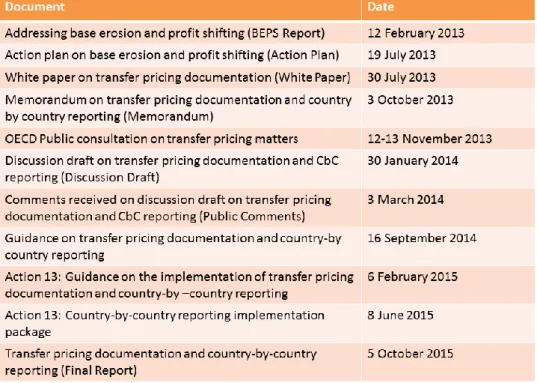
The BEPS project contains an extreme amount of abbreviations and reports that characterize the area of international tax law and especially the OECD. Therefore, the author recommends that readers whom are less familiar with the BEPS project have the abbreviations list readily available. While reading this thesis, the two most important abbreviations to remember are transfer pricing documentation (TPD) and Country-by-Country (CbC) reporting, since these terms embody the core of Action 13. In connection to Action 13, the author simplifies the title of important documents in order to keep the text fluent. This list can be seen in Figure 2. In addition, the Final Report is simply a compilation of the previous three Action 13 reports: Guidance on transfer pricing documentation and country-by-country reporting17, Action 13: Guidance on the implementation of transfer pricing documentation and country-by-country reporting18, and Action 13: Country-by-country reporting implementation package19. Another important point to clarify regards the
16 I would like to especially thank the Tax Department at Stena for giving me invaluable
practical experience in transfer pricing.
17 OECD, Guidance on transfer pricing documentation and country-by-country reporting,
OECD/G20 Base Erosion and Profit Shifting Project, OECD Publishing, 16 September 2014, http:dx.doi.org/10.1787/9789264219236-en, (Accessed: 2015-10-12).
[cit: Guidance on transfer pricing documentation and country-by-country reporting].
18 OECD, Action 13: Guidance on the implementation of transfer pricing documentation and
country-by-country reporting, OECD/G20 Base Erosion and Profit Shifting Project, OECD, 2015, http://www.oecd.org/ctp/beps-action-13-guidance-implementation-tp-documentation-cbc-reporting.pdf, (Accessed: 2015-10-12). [cit: Guidance on the implementation of transfer pricing documentation and country-by-country reporting].
19 OECD, Action 13: Country-by-country reporting implementation package, OECD/G20
http://www.oecd.org/ctp/transfer-reference to Chapter V of the TP Guidelines. In order to avoid redundancy, Chapter V always refers to Chapter V of the TP Guidelines. Since the OECD has not issued new TP Guidelines, the ‘updated Chapter V’ can be found in the Final Report and in Guidance on the implementation of transfer pricing documentation and country-by-country reporting20.
Writing about the Swedish legal system in English may create some confusion for Swedish readers about what legal term or authority is being referred to. In order to avoid misunderstandings, the author includes the Swedish translation in parenthesis for specific Swedish legal terminology or bodies of government. The author also intentionally utilizes the Swedish abbreviation for the Swedish Tax Agency (SKV).
1.5 Disposition
In order to evaluate Sweden’s pending implementation of the updated Chapter V of the TP Guidelines, the remainder of this thesis is organized accordingly.
Chapter 2 establishes the basic principles behind the arm’s length principle and TPD. The chapter introduces the reader to the TP Guidelines and the TPD standard prior to the BEPS project. Chapter 3 highlights the BEPS project and shows the development of Action 13. The implications of the updated Chapter V of the TP Guidelines will also be analyzed on a more international scale. In Chapter 4, the focus shifts to TPD within the context of the Swedish legal system. Chapter 4 begins with exploring the responses to the 2007 implementation of Swedish TPD requirements and then examines the effectiveness of these requirements. The chapter ends with an analysis about the implementation of Action 13 into the Swedish legal system. Chapter 5
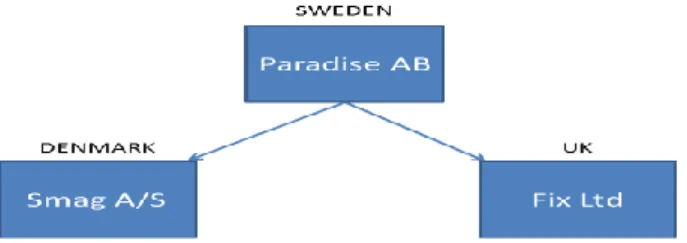
presents a case study about the Paradise Cruises group, which illustrates the immediate effects of three-tiered TPD requirements. This leads into a deeper analysis of TPD in light of Action 13 and the forthcoming Swedish implementation. Finally, four central themes - proportionality, relevant information, confidentiality, and compliance - reoccur throughout this thesis and section 5.2 examines these themes more thoroughly.
pricing/beps-action-13-country-by-country-reporting-implementation-package.pdf, (Accessed: 2015-10-12). [cit: Country-by-country reporting implementation package].
2 Transfer pricing documentation
In simple terms, transfer pricing refers to the pricing of business transactions between related entities. It is assumed that unrelated entities behave according to the market and seek to maximize their own profit. While other behaviors or objectives can influence related entities business decisions, which can hypothetically lead to a disproportionate division of profits between different tax jurisdictions. In order to avoid a skewed division of global profits between countries, tax authorities require that MNEs calculate their intra-group cross-border transactions as if they were two unrelated
entities.21 The remainder of this chapter familiarizes the reader with the arm’s length principle within the context of the OECD and the Swedish legal system. This chapter also examines the purpose and content of TPD from three perspectives: the TP Guidelines, the European Union (EU), and Sweden.
2.1
The arm’s length principle
The 1927 League of Nations addressed the allocation of profits and the 1935 draft model convention referred to an arm’s length methodology.22 The
OECD adopted the arm’s length principle and the first paragraph of Article 9 of the OECD Model tax convention on income and on capital23 (OECD
Model) states that:
[When] conditions are made or imposed between…two [associated] enterprises in their commercial or financial relations which differ from those which would be made between independent enterprises, then any profits which would, but for those conditions, have accrued to one of the enterprises, but by reason of those conditions, have not so accrued, may be included in the profits of that enterprise and taxed accordingly.24
In 1979, the OECD issued the TP Guidelines, which clarify the application of the arm’s length principle.25 In the Commentaries to Article 9 of the OECD Model, the Council of the OECD reiterates that the TP Guidelines represent internationally agreed principles and provide recommendations for the application of the arm’s length principle.26 Some OECD Members have incorporated the TP Guidelines into domestic legislation, while other
21 Henshall, John: Global transfer pricing: principles and practice, 2. ed., Bloomsbury
Professional, Haywards Heath, 2013. [cit: Henshall 2013], pp. 1-5.
22 Henshall 2013, p. 11. Miller, Angharad & Oats, Lynne: Principles of international
taxation, 4. ed., Bloomsbury Professional, Haywards Heath, 2014. [cit: Miller & Oats 2014], p. 356.
23 OECD Model tax convention on income and capital, condensed version 2014, OECD
Publishing 2014, Paris, http://dx.doi.org/10.1787/mtc_cond-2014-en. [cit: OECD Model Convention 2014].
24 Article 9.1 of the OECD Model Convention 2014. 25 Henshall 2013, p. 6. Miller & Oats 2014, p. 357.
jurisdictions, such as Sweden, utilize the TP Guidelines as a means for interpreting the domestic legislation of the arm’s length principle.27
Professor of International Tax Law, Michael Lang, at Vienna University of Economics and Business emphasizes that the TP Guidelines provide an international interpretation of the arm’s length principle. According to international public law, double tax conventions can only limit tax liabilities, but they cannot generate them.28 Similarly, the TP Guidelines do not justify a
legal basis for a transfer pricing adjustment; instead, tax authorities apply the domestic rules when performing transfer pricing adjustments.29 The next section presents the TP Guidelines with a focus on Chapter V, since Action 13 amends this chapter.
2.2 Transfer pricing guidelines 2010
The OECD published the most recent version of the TP Guidelines in 2010 and it is this version that section 2.2 describes. Chapter I of the TP Guidelines explains the arm’s length principle more explicitly and emphasizes that it promotes the growth of international trade and investment. The TP Guidelines clarify that the arm’s length approach treats the members of the MNE group as separate entities, as if they were independent entities. More specifically, a comparability analysis focuses on whether the nature of controlled transactions, i.e. between associated entities, differs from comparable uncontrolled transactions, i.e. between independent entities. Since transfer pricing is not an exact science, the OECD recognizes the challenges of finding comparable transactions. As a result, transfer pricing necessitates that both taxpayers and tax authorities utilize sound judgment. For example, associated enterprises may engage in transactions that reflect other circumstances, such as group synergies. Thus, finding adequate information that shows that the controlled transactions fulfil the arm’s length principle can be challenging for taxpayers.30
Chapter II of the TP Guidelines describes the different transfer pricing methods: comparable uncontrolled price, resale price, cost plus, profit split, and transactional net margin method. The chapter begins with clarifying the selection of the most appropriate method and reiterates that no one method is suitable in every possible situation. Due to the complexity and nature of certain transactions, the TP Guidelines permit the application of more than one method. Taxpayers also have the option of selecting a non-OECD
27 Henshall 2013, p. 12.
28 In the Swedish legal system, Gustaf Lindencrona has coined the expression, ’gyllene
regeln.’ See Hultqvist & Wiman 2015, p. 315 for a further explanation.
29 Lang, Michael: Introduction to the law of double taxation conventions, 2. ed., Linde, Wien,
2013. [cit: Lang 2013], Sect. 46 & 478.
30 Chap. 1, Sect. B, Sects. 1.6-1.13 of the OECD Transfer pricing guidelines 2010. Kindly
note that Chap. 1, Sect. D of the TP Guidelines has recently been replaced in its entirety. Please see, OECD, Aligning transfer pricing outcomes with value creation, Actions 8-10: 2015 Final Reports, OECD/G20 Base Erosion and Profit Shifting Project, OECD Publishing, Paris, http://dx.doi.org/10.1787/9789264241244-en, (Accessed: 2015-11-15).
recognized transfer pricing method, as long the chosen method fulfils the following two conditions. The selected method cannot substitute the OECD-recognized methods and it must comply with the arm’s length principle.31 After selecting the most appropriate transfer pricing method, the next step entails applying the selected method through a comparability analysis. Chapter III of the TP Guidelines explains the comparability analysis, which involves the identification of potential comparables. In addition, the comparability analysis contains a conclusion about whether the controlled transactions are consistent with the arm’s length principle referred to in Article 9.1 of the OECD Model. In order to verify that the controlled transactions comply with the arm’s length principle, taxpayers document information, i.e. TPD, which then facilitates tax administrations transfer pricing inquiries.32
2.2.1 Chapter V of the Transfer pricing guidelines 2010
In order for the reader to grasp the differences between the previous and updated version of Chapter V of the TP Guidelines, this sub-section solely reviews Chapter V of the 2010 TP Guidelines.33 Chapter V provides general guidance about TPD for tax administrations and taxpayers. More specifically, it outlines what tax administrations should take into account when developing TPD rules and what type of information taxpayers should include in their documentation. Since tax administrations generally bear the burden of proof, TPD supplies them with adequate information and allows them to perform transfer pricing assessments. The TP Guidelines even suggest that incomplete TPD may shift the burden of proof to the taxpayer.34 Thus, taxpayers have a good incentive to complete TPD.The following sections in Chapter V, elaborate on the formation of TPD rules and procedures. When taxpayers assess their transfer pricing, the OECD refers to utilizing ‘prudent business management principles’. This principle entails that taxpayers should be able to provide a written explanation about the nature of their business activities and transfer pricing upon the tax administration’s request. The TP Guidelines also articulate that there should also be a balance between the tax administration’s need for the documents and the taxpayer’s administrative burden of creating or obtaining them. At the time of filing tax returns, the TP Guidelines suggest that information disclosure about transfer pricing should be limited to what is necessary to determine the need for a further transfer pricing inquiry. Therefore, tax administrations should not require TPD at the commencement of the tax return filing stage. As long as the costs are not disproportionately high, taxpayers should provide tax administrations with reasonable documents for transfer pricing assessments. Thus, Chapter V encourages taxpayers to keep adequate records, especially since the voluntary provision of TPD increases
31 Sects. 2.1-2.11 of the OECD Transfer pricing guidelines 2010. 32 Sects. 3.1-3.3 of the OECD Transfer pricing guidelines 2010. 33 Section 3.3 discusses the updated Chapter V of the TP Guidelines. 34 Sects. 5.1-5.2 of the OECD Transfer pricing guidelines 2010.
the likelihood that tax administrations will accept their transfer price. Correspondingly, tax administrations should request documents that are reasonably accessible after the relevant transaction has incurred. Finally, tax administrations should ensure confidentiality of the taxpayer’s information.35 The next section in Chapter V clarifies what constitutes relevant information for assessing transfer prices and suggests what should be included in TPD. First, the TP Guidelines acknowledge that the extent and nature of information in TPD depends on the individual circumstances. Therefore, the TP Guidelines recommendations should not be interpreted as a minimum level of compliance or as an exhaustive list of information. Chapter V makes the following suggestions for the content of TPD.
- A company analysis that includes information related to each associated enterprise involved in the controlled transaction under review, such as an organizational and operational structure of the business.
- An industry analysis that explains the market conditions that affect the taxpayer, this could include regulations and competitors. - A functional analysis that explains the functions performed, risks
assumed and assets owned.
- Any financial information that may be useful for comparing profit and loss between the associated enterprises.
- An explanation of the selection and application of the transfer pricing method used to establish the transfer price and its consistency with the arm’s length principle. This should also reflect the OECD’s recommendations in Chapter II and III of the TP Guidelines.36
Chapter V concludes with reiterating the balance between taxpayers’ costs for producing TPD and the tax administrations’ need for the documents. ‘Prudent business management principles’ steer the extent of the documentation process and reflect the same sound principles when enterprises evaluate a business decision. Finally, to ensure that taxpayers provide tax administrations with adequate information for a transfer pricing assessment, while at the same time avoiding excessive documentation requirements, the TP Guidelines encourage cooperation between tax administrations and taxpayers.37
35 Sects. 5.3-5.15 of the OECD Transfer pricing guidelines 2010. 36 Sects. 5.16-5.27 of the OECD Transfer pricing guidelines 2010. 37 Sects. 5.28-5.29 of the OECD Transfer pricing guidelines 2010.
2.3 EU Joint Transfer Pricing Forum
While the OECD focuses on tax treaty law and allocating taxing rights between countries, the EU works towards establishing a Single Market.38 This important difference means that the EU focuses on establishing greater harmony between Member States than the OECD does.39 Since mutual agreement procedures in tax treaties failed to eliminate double taxation, the European Commission formed the EU Joint Transfer Pricing Forum (EU JTPF) in 2002. The EU JTPF consists of representatives from the tax administrations of the fifteen Member States and ten representatives from the European business community. The original intent of the EU JTPF was to ratify the Arbitration Convention40, which only applies to transfer pricing
disputes and guarantees the elimination of double taxation.41
In regards to TPD, businesses struggled with fulfilling country specific documentation requirements in the different Member States. Therefore, the EU JTPF originally believed that a single documentation package would alleviate the compliance costs for businesses. The EU JTPF agreed upon a two-part package, consisting of a master file and a country-specific file. In 2006, the Council issued a Resolution on a Code of conduct on transfer pricing documentation for associated enterprises in the European Union42
(Code of conduct on TPD). Contrary to EU directives, which Member States have to implement into national law by a specific deadline, a Code of conduct signifies a political commitment. Therefore, Member States are not obligated to incorporate a Code of conduct into legislation.43
The Code of conduct on TPD states that Member States will accept European Union transfer pricing documentation (EUTPD). Thus, MNEs can follow the EUTPD format in the majority of cases within the EU. EUTPD also allows tax administrations to perform risk assessments and select which inter-company transactions require further review. When requesting information, the Council advises against Member States imposing an unreasonable administrative burden on MNEs.44
38 Miller & Oats 2014, p. 130. 39 Author’s observation.
40 Code of conduct for the effective implementation of the Convention on the elimination of
double taxation in connection with the adjustment of profits of associated enterprises, 28 July 2006, C176/8. [cit: 2006/C176/02].
41 Gillett, Philip: “Transfer pricing disputes in the European Union”, in Resolving transfer
pricing disputes: a global analysis, Cambridge University Press, Cambridge, 2012, pp. 165-187. [cit: Gillett 2012], pp. 170-171.
42 Resolution of the Council and of the representatives of the governments of the Member
States, meeting within the Council, on a Code of Conduct on transfer pricing documentation for associated enterprises in the European Union, 20 June 2006, nr. 9738/06. [cit: 2006/C 176/01]. For more information about the Code of conduct on transfer pricing documentation see: http://europa.eu/rapid/press-release_MEMO-05-414_en.htm, (Accessed: 2015-10-01).
43 Gillett 2012, pp. 173-175. 44 2006/C 176/01.
EUTPD consists of a master file and a country-specific file. The master file contains standardized information that seems relevant for all Member States and provides a ‘blueprint’ of the MNE group.45 While the country-specific file
supplements the master file and addresses the specific transactions under review.46 In contrast to Chapter V of the TP Guidelines, EUTPD contains
concise information about the content of TPD. Even though the Code of conduct on TPD is a soft-law initiative, the EU JTPF encourages the application of EUTPD within the EU. At a recent meeting, the EU JTPF recognizes that the structure and contents in the Code of Conduct on TPD largely reflects the OECD’s development of TPD in Action 13.47 The EU- JTPF continues to monitor the BEPS project, evaluate strategies that allow tax administrations to perform effective assessments, and develop information technology tools to minimize taxpayers’ compliance burden.48
2.4 Swedish legal system
Even though the TP Guidelines do not formally constitute Swedish legislation, the Swedish Supreme Administrative Court (Högsta förvaltningsdomstolen, HFD) declares in the Shell-case49 that the TP Guidelines present a fair and well-balanced view of transfer pricing issues that provide guidance for the application of the arm’s length principle. In Prop. 2005/06:169, the Ministry of Finance (Finansdepartementet) reiterates the HFD’s statement and pronounces that the TP Guidelines represent international principles within the area of transfer pricing, where the SKV as well as taxpayers can retrieve invaluable guidance.50 This entails that the Swedish courts, the SKV, and taxpayers can apply and retrieve guidance from the TP Guidelines. The following two sub-sections describe the context of the arm’s length principle in Swedish law, in addition to providing background information about the 2007 Swedish implementation of TPD requirements.
2.4.1
Arm’s length principle
Sect. 19 of Chap. 14 of the Income Tax Act (Inkomstskattelag, (1999:1229), IL) articulates the arm’s length principle, also known as the correction rule (korrigeringsregeln). According to Sect. 19 of Chap. 14 of the IL, if an enterprise has reduced taxable income due to conditions that differ from what two independent enterprises would have agreed to, then the SKV may adjust the enterprise’s income. However, this only applies if the enterprise fulfils the following three conditions:
45 Sects. 4.1-4.2, 2006/C 176/01. 46 Sects. 5.1-5.2, 2006/C 176/01.
47 Section 3.2 of this thesis also demonstrates how EUTPD influenced the OECD’s
development of the updated Chapter V of the TP Guidelines.
48 JTPF Program of Work 2015-2019, EU Joint Transfer Pricing Forum, Meeting 25 June
2015, DOC: JTPF/005/FINAL/2015/EN. [cit: JTPF/005/FINAL/2015/EN], pp. 8-9.
49 RÅ 1991 ref. 107. 50 Prop. 2005/06:169, p. 89.
- the enterprise, which due to the conditions made between the enterprises receives an increased income will not be liable to tax in Sweden according to IL or according to a tax treaty;
- it can be reasonably established that the enterprises are associated; and
- it is not evident from the circumstances that the conditions were made for other reasons than for the reason of the enterprises being associated.
Sect. 20 of Chap. 14 of the IL defines when enterprises are associated and requires that the enterprise satisfy one of the following conditions:
- an enterprise participates directly or indirectly in the management, control or capital of another enterprise, or
- the same persons participate directly or indirectly in the management, control or capital of both enterprises.
As noted in the above stipulations, enterprises are not obliged to document their transfer prices or submit documentation to the SKV. The IL requires that enterprises acknowledge and follow the arm’s length principle when they assess their pricing of intra-group cross-border transactions. Therefore, in Prop. 2005/06:169, the Ministry of Finance recommends implementing formal TPD requirements in the Tax Return and Statements of Income Act (lag om självdeklarationer och kontrolluppgifter, (2001:1277), LSK). Prop. 2005/06:169 recognizes the complexity of transfer pricing and acknowledges that other countries require MNEs to compile documentation for the tax agencies transfer pricing controls. Furthermore, Swedish TPD rules should not have an adverse effect on the application of the Swedish correction rule or the SKV’s initial burden of proof. The Ministry of Finance postulates that TPD alleviates double taxation and permits a thorough analysis of an enterprises transfer prices. Therefore, the Ministry of Finance conceives that obligatory TPD requirements would benefit both the SKV and Swedish enterprises. In conclusion, formal documentation requirements: increase the effectivity of tax controls, contribute to enterprises foreseeability, and create more uniformity.51
The Ministry of Finance proposes that the regulations follow an acceptable international standard and only require essential information for performing a transfer pricing assessment. Since TPD regulations seek to expedite a thorough transfer pricing risk assessment, it deems sufficient for enterprises to send in their TPD upon the SKV’s request. In addition, Prop. 2005/06:169 articulates enforcing stricter demands on the documentation of complex, higher valued transactions in comparison to simple everyday transactions.52
51 Prop. 2005/06:169 pp. 88, 99-102. 52 Prop. 2005/06:169 pp. 103, 110.
In accordance with Chapter V of the TP Guidelines53, Prop. 2005/06:169 recommends that TPD consist of five main parts:
- a legal and operational description of the company, including an industry analysis and relevant business strategies;
- a description of the relevant intra-group cross-border transactions, for example services, products, intangible assets, financial transactions;
- a functional analysis which serves as a basis for identifying comparable transactions and selecting an appropriate transfer pricing method;
- a description of the applied transfer pricing method; and - a comparability analysis.54
2.4.2 Swedish
transfer
pricing
documentation
requirements
Prop. 2005/06:169 led to the stipulation of Sects. 2a-2b of Chap. 19 of the LSK, which require that MNEs have written documentation explaining the MNE’s transfer pricing, i.e. TPD. Sect. 2b of Chap. 19 of the LSK outlines the contents of TPD and these correspond to the five previously named components in Prop. 2005/06:169. In addition, the government, or whom the government authorizes, could decide on additional regulations (föreskrifter) that specify the required content of TPD.
There remains controversy over the extent in which the SKV can implement regulations that complement legislation, i.e. fill out the law. Professor of Tax Law, Robert Påhlsson at the University of Gothenburg analyzes the depth of the SKV’s authority to stipulate regulations in his book, Konstitutionell Skatterätt. It is crucial to remember that the right to tax has to be based on legislation (föreskriftskravet), in simplified terms no law, no tax. Sect. 2 of Chap. 8 of the Instrument of Government (Regeringsform (1974:152), RF) states that legislation about the relationship between the private and public sector has to be implemented through legislation. Thus, in the area of tax law, the Riksdag (Swedish Parliament) exercises absolute legislative power and cannot delegate their legislative authority to the Government (Regeringen).55 However, Sect. 7 of Chap. 8 of the RF contains an exception, which allows the Government to delegate certain regulations to authorities (verkställighetsföreskrifter), including the SKV. The Government exercises the authority to delegate two categories of regulations; the first category pertains to administrative discrepancies and the second category encompasses materialistic supplements to legislation.56 This infers that the Government can delegate the SKV the authority to clarify legislation through administrative regulations. Based on the preparatory works, the SKV’s regulations should
53 See Sects. 5.16-5.27 of the OECD Transfer Pricing Guidelines 2010. 54 Prop. 2005/06:169 pp. 103-107.
55 See Sect. 3 of Chap. 8 of the RF.
56 Påhlsson, Robert: Konstitutionell skatterätt, 3. ed., Iustus, Uppsala, 2013.
not add something essentially new to the law or anything that a taxpayer perceives as a new enforcement.57
Professor Påhlsson presents SKVFS 2007:1 as an example of when the SKV has received criticism for going outside the scope of their administrative authority. However, the courts have never taken a stance to this position.58 Professor of Financial Law, Anders Hultqvist, at Stockholm University, questions the SKV’s regulations on TPD. Professor Hultqivst notes that if the SKV’s regulations go outside their delegation authority, then taxpayers can interpret the regulations as guidelines rather than obligations. Consequently, Professor Hultqvist is a proponent of formal legislation, since it increases taxpayers’ foreseeability.59 This thesis considers that SKVFS 2007:1 remains
inside the scope of the SKV’s authority. Prop. 2005/06:169 specifically postulates that the TP Guidelines provide guidance for the SKV as well as taxpayers. In addition, SKVFS 2007:1 signifies a Swedish translation of Chapter V of the TP Guidelines; consequently, the author perceives the administrative regulations as a Swedish codification of the TP Guidelines. The reader needs to distinguish between the SKV’s regulations (föreskrifter) and memorandums (meddelanden). The SKV’s regulations are legally
binding rules that the SKV receives the authority to implement. In contrast, memorandums send signals to taxpayers about what the SKV accepts and clarifies how the SKV interprets their regulations. Memorandums build upon the SKV’s administrative praxis, but they are not legally binding.60 In the area
of transfer pricing, the SKV has produced the memorandum, Skatteverkets information om dokumentation av prissättning av transaktioner mellan företag i intressegemenskap61 (SKV M 2007:25) about how to interpret SKVFS 2007:1.62 Professor of Tax Law (Emeritus), Sven-Olof Lodin, adds
that the SKV’s memorandum represents how tax officials would like taxpayers to format TPD, but not how they have to.63
Lastly, SKVFS 2007:1 and SKV M 2007:25 remain applicable, but Sects. 15-16 of Chap. 39 of the Tax Procedures Act (Skatteförfarandelag (2011:1244), SFL) have replaced Sect. 2a of Chap. 19 of the LSK. The new stipulations require that enterprises document international transactions between associated enterprises, as defined in Sect. 20 of Chap. 14 of the IL. Furthermore, TPD needs to contain adequate information for a transfer
57 Prop. 1973:90 p. 211. 58 Påhlsson 2013, pp. 32-33.
59 Hultqvist, Anders: Om föreskriftsregleringen angående dokumentationskravet vid
internprissättning, Svensk Skattetidning, vol. 6-7, 2007, pp. 404-411. [cit: Hultqvist 2007], pp. 406-407.
60 Påhlsson 2013, pp. 106-107.
61 Skatteverkets meddelanden – Skatteverkets information om dokumentation av prissättning
av transaktioner mellan företag i intressegemenskap, (Information on the documentation of transfer pricing between associated entities), SKV M 2007:25.
62 Section 4.1 of this thesis examines the specific stipulations in SKVFS 2007:1 in connection
to the legal doctrine from the time era.
63 Lodin, Sven-Olof: En kommentar till en kommentar om internprissättningsdokumentation,
pricing assessment, such that an adjustment in accordance to Sect. 19 of Chap. 14 of the IL can materialize. In addition, Sect. 9 of Chap. 9 of the Tax Procedures Ordinance (Skatteförfarandeförordning (2011:1261), SFF) has replaced Sect. 2b of Chap. 19 of the LSK. Sect. 9 of Chap. 9 of the SFF complements the stipulations in SFL and explicitly allows the SKV to issue further regulations about the information in TPD.
2.5 Summary
In summary, the TP Guidelines provide recommendations for the application of the arm’s length principle as stipulated in the Commentaries to Article 9 of the OECD Model. Accordingly, MNEs document their intra-group cross-border transactions as evidence of their compliance with the arm’s length principle. Chapter V of the TP Guidelines clarifies the content and purpose of TPD. In addition, Chapter V briefly explains what constitutes relevant information and advises taxpayers to use their ‘prudent business management principles’ when compiling TPD. The EU JTPF has adopted EUTPD as an alternative for Member States in the EU. In contrast to the TP Guidelines, EUTPD divides documentation into a master file and a country-specific file; thereby, providing an overview of the MNE group and specifics of the relevant transactions respectively.
In the Swedish legal system, Sect. 19 of Chap. 14 of the IL declares the arm’s length principle and is also known as the correction rule. The Shell-case and Prop. 2005/06:169 confirm that the TP Guidelines provide guidance about the application of the Swedish correction rule. According to Sects. 15-16 of Chap. 39 of the SFL, associated enterprises are obliged to document intra-group cross-border transactions. Sect. 9 of Chap. 9 of the SFF specifies the five components of TPD – a legal and operational description of the company, information about the relevant transactions, a functional analysis, a description of the applied transfer pricing method, and a comparability analysis. In addition, the SKV provides further guidance about TPD in SKVFS 2007:1 and SKV M 2007:25. It remains controversial whether SKVFS 2007:1 goes outside the scope of the SKV’s authority. According to Professors Påhlsson and Hultqvist, the regulations have nevertheless created some uncertainty.
3 Action 13
This section begins with background information about the OECD/G20 BEPS Project and highlights the development of Action 13. In contrast to other action points64, Action 13 was relatively finalized at an early stage in the BEPS Project; thus, indicating the strong international consensus to make CbC reporting an international standard. The comments in response to the
Discussion draft on transfer pricing documentation and CbC reporting65
(Discussion Draft) demonstrate the industries major issues and concerns about Action 13; therefore, sub-section 3.2.1 elaborates specifically on the Discussion Draft. In addition, sub-section 3.2.2 examines the effectiveness of CbC reporting and the possibility of public disclosure. Chapter 3 concludes with an overview of the Final Report and expectations about local implementation.
3.1 Base erosion and profit shifting
The OECD defines BEPS66 as tax planning strategies that reduce corporate taxes by optimizing the interaction of domestic tax systems to achieve double non-taxation or by shifting profits to jurisdictions with low taxation. It is crucial to remember that the gaps between two tax systems exists within the domestic tax rules; thus, many tax planning strategies are technically legal. Just as a collusion of two jurisdictions tax rules can lead to double taxation, they can also lead to double non-taxation.67 The following example highlights this issue:
The interaction of withholding tax rules in one country, the territorial taxation system in another country, and the entity characterisation rules in a third country may combine to make it possible for certain transactions to occur in a way that gives rise to no current tax and have the effect of shifting income to a jurisdiction where, for various reasons, no tax is imposed.68
64 For example, the transactional profit split methods will not be finalized until the first half
of 2017. See Sect. 67 in OECD, BEPS - frequently asked questions, OECD,
http://www.oecd.org/ctp/beps-frequentlyaskedquestions.htm#DCs, (Accessed: 2015-10-08). [cit: BEPS – frequently asked questions].
65 OECD, Discussion draft on transfer pricing documentation and CbC reporting, Public
consultation, OECD, 30 January 2014, http://www.oecd.org/ctp/transfer-pricing/discussion-draft-transfer-pricing-documentation.pdf, (Accessed: 2015-09-24).
[cit: Discussion draft 2014].
66 If you would like to read more about the implications and measuring of BEPS, please see:
OECD, Measuring and monitoring BEPS, Action 11 – 2015 Final Report, OECD/G20 Base
Erosion and Profit Shifting Project, OECD Publishing, Paris,
http://dx.doi.org/10.1787/9789264241343-en, (Accessed: 2015-10-09). [cit: Action 11, Final Report 2015].
67 OECD, Addressing base erosion and profit shifting, OECD Publishing, 12 February 2013,
http://dx.doi.org/10.1787/9789264192744-en, (Accessed: 2015-10-12).
[cit: Addressing base erosion and profit shifting], p. 39. BEPS – frequently asked questions contains a similar in Sects. 117-119.
As this example demonstrates, BEPS results from the interaction of different jurisdictions, which is why a domestic, unilateral approach would not combat BEPS. The OECD estimates that BEPS accounts for revenue losses of USD 100 to 240 billion annually. In addition, the OECD recognizes that unilateral approaches may exacerbate the situation by undermining international tax principles and deterring international trade and investment. Since taxation stands as a national sovereignty, international coordination deems necessary to effectively protect domestic tax bases.69
3.1.1 OECD/G20 BEPS project
During 2012, the G20 Leaders70 agreed upon the urgent need to prevent BEPS and the necessity of strengthening international tax standards. The G20 Leaders called upon the OECD to investigate the existence and cause of BEPS. This led to the OECD’s report, Addressing base erosion and profit shifting (BEPS Report), which stresses the need for a comprehensive action plan that provides countries with instruments to align taxation with real economic activity. The BEPS Report observes that even though corporate income tax rates decreased between 2000 and 2011 in OECD member countries, this did not correspond to a decline in the corporate tax burden. The OECD measures the corporate tax burden as corporate income tax receipts as a percentage of GDP. Figure 1 exemplifies the OECD’s observation.71
FIGURE 172. TAXES ON CORPORATE INCOME AS A
PERCENTAGE OF GDP IN OECD COUNTRIES
In addition, the BEPS Report reconsiders transfer pricing issues and questions the practicality of contractual risks. Therefore, the BEPS report focuses on
69 Sect. 2 & 5, Explanatory statement.
70 The G20 is a forum of 19 countries plus the European Union, see the following link for
more information: http://www.oecd.org/g20/about.htm, (Accessed: 2015-10-14).
71 Addressing base erosion and profit shifting, pp. 8, 16.
risk allocation and economic substance, i.e. the managerial capacity to control risks and the financial capacity to bear risks.73 Due to the complexity of BEPS, the OECD suggests an internationally co-ordinated approach in order to protect tax bases. The BEPS Report encourages all stakeholders, especially G20 economies, to participate and proposes the delivery of an action plan that identifies the necessary actions to address BEPS.74
As promised on July 19, 2013, the OECD issued a second report, Action plan on base erosion and profit shifting (Action Plan). In the Action Plan, the OECD recognizes the need for new international standards, realignment of taxation and relevant substance, increased transparency, and greater predictability for business. As a result, the OECD proposes fifteen action points and Action 13 focuses on enhancing transparency for tax administrations while simultaneously reconsidering the compliance costs for MNEs. Furthermore, the Action Plan advocates implementing a common template that presents information on MNE’s global allocation of income, economic activity, and taxes paid among countries. This common template is the CbC report in later drafts. Another important component of the Action Plan pertains to a timeline of deliverables. The Action Plan states that the OECD will deliver Action 13 by September 2014 and foresees changes to Chapter V of the TP Guidelines, as well as recommendations for domestic legislation. 75 In order to meet this deadline, the OECD has issued a series of
documents within a short time spam. The next section guides the reader through the steps that ultimately led to the Final Report.
3.2 Action 13 – Re-examine transfer pricing
documentation
In order to understand the local and international impacts of Action 13, it deems necessary to analyze the development of the Final Report. Especially since the Discussion Draft and the Comments received on discussion draft on transfer pricing documentation and country-by-country reporting76 (Public Comments) reveal the OECD’s objectives and stakeholders concerns. The diagram below chronologically depicts the key documents pertaining to Action 13.
73 Addressing base erosion and profit shifting, pp. 42-43.
74 See Executive Summary in Addressing base erosion and profit shifting, pp. 5-11. 75 Action plan on base erosion and profit shifting, pp. 13-14, 23, 34.
76 OECD, Comments received on discussion draft on transfer pricing documentation and
country-by-country reporting published today, 3 March 2014, http://www.oecd.org/tax/transfer-pricing/comments-discussion-draft-transfer-pricing-documentation.htm, (Accessed: 2015-10-14). [cit: Public Comments 2014].