University of North Dakota
UND Scholarly Commons
Theses and Dissertations Theses, Dissertations, and Senior ProjectsJanuary 2015
Visualization And Mining Of Phasor Data From
Optimally Placed Synchrophasors In A Smart-Grid
Ranganath VallakatiFollow this and additional works at:https://commons.und.edu/theses
This Thesis is brought to you for free and open access by the Theses, Dissertations, and Senior Projects at UND Scholarly Commons. It has been accepted for inclusion in Theses and Dissertations by an authorized administrator of UND Scholarly Commons. For more information, please contact
Recommended Citation
Vallakati, Ranganath, "Visualization And Mining Of Phasor Data From Optimally Placed Synchrophasors In A Smart-Grid" (2015). Theses and Dissertations. 1846.
VISUALIZATION AND MINING OF PHASOR DATA FROM OPTIMALLY PLACED SYNCHROPHASORS IN A SMART-GRID
by
Ranganath Vallakati
Bachelor of Technology, Jawaharlal Nehru Technological University, 2012
A Thesis
Submitted to the Graduate Faculty of the
University of North Dakota in partial fulfillment of the requirements
for the degree of Master of Science
Grand Forks, North Dakota August
This thesis, submitted by Ranganath Vallakati in partial fulfillment of the
requirements for the Degree of Master of Science from the University of North Dakota, has been read by the Faculty Advisory Committee under whom the work has been done and is hereby approved.
__________________________________________ Prakash Ranganathan, Ph.D., Chairperson
__________________________________________ Saleh Faruque, Ph.D.
__________________________________________ Arash Nejadpak, Ph.D.
This thesis meets the standards for appearance, conforms to the style and format requirements of the Graduate School of the University of North Dakota, and is hereby approved.
_______________________________________________ Wayne Swisher,
Dean of the Graduate School
_______________________________________________ Date
PERMISSION
Title Visualization and Mining of Phasor Data from Optimally Placed Synchrophasors in a Smart-Grid
Department Electrical Engineering Degree Master of Science
In presenting this thesis in partial fulfillment of the requirements for a graduate degree from the University of North Dakota, I agree that the library of this University shall make it freely available for inspection. I further agree that permission for extensive copying for scholarly purposes may be granted by the professor who supervised my thesis work or, in his absence, by the chairperson of the department or the dean of the Graduate School. It is understood that any copying or publication or other use of this thesis or part thereof for financial gain shall not be allowed without my written permission. It is also understood that due recognition shall be given to me and to the University of North Dakota in any scholarly use which may be made of any material in my thesis.
Ranganath Vallakati July 2015
TABLE OF CONTENTS
LISTOFFIGURES……….. viii
LISTOFTABLES………... x ACKNOWLEDGEMENTS………... xi ABBREVIATIONS………... xii ABSTRACT………. xiv CHAPTER I. INTRODUCTION………... 1 1.1 Synchrophasors………. 2
1.2 Advantages of Synchrophasors over SCADA Measurements……….. 4
1.3 Challenges with Synchrophasors Measurements……….. 5
1.3.1 Economics of Synchrophasor Units………. 5
1.3.2 Reliability of Synchrophasor Data……… 6
1.3.3 Utilization of Synchrophasor Data……… 7
1.4 Thesis Contributions……….. 7
1.5 Thesis Organization………... 8
II. OPTIMAL PLACEMENT OF PHASOR MEASUREMENT UNITS (PMU)…………... 9
2.1 Need for Optimal Placement Problem for Synchrophasors……… 9
2.2 Literature Review……… 11
2.3.1 Problem Formulation………... 13
2.4 System Observability Redundancy Index (SORI)………... 19
2.5 Optimal Redundancy Criterion (ORC)……… 20
III. VISUALIZATION AND CLUSTERING OF SYNCHROPHASOR DATA………. 23
3.1 Need for Visualizing and Analyzing the Synchrophasor Data……… 23
3.2 Modeling of IEEE 14 Bus Test System………... 25
3.2.1 IEEE 14 Bus System………... 25
3.2.2 IEEE 14 Bus System with Faults……… 28
3.3 openPDC Data Source………. 31
3.4 Data Visualization………... 31
3.4.1 Unit Circle Representation of Phasor Data………. 33
3.5 Data Mining………. 34
3.5.1 Density based Clustering Technique (DBSCAN)………... 36
3.5.2 Pseudo code for DBSCAN clustering………. 38
IV. RESULTS AND DISCUSSIONS………... 41
4.1 Optimal Placement of Phasor Measurement Units (PMU) Problem……... 41
4.1.1 Test Systems (IEEE and other grid systems)……….. 41
4.1.2 Advanced Modeling and Programming Language (AMPL)……... 48
4.1.3 Zero-Injection Buses………... 50
4.1.4 Enforcing Optimal Redundancy Criterion (ORC)………... 53
4.1.5 SORI Index……….. 56
4.1.6 PMU Placement Costs………. 56
4.1.8 Time Computation Using LP……….. 63
4.1.9 Forecasting the scalability Using Linear Regression……….. 64
4.2 Visualization of Synchrophasor Data……….. 66
4.3 Synchrophasor Data Mining……… 69
4.3.1 Case 1: Under steady State Conditions………... 69
4.3.2 Case 2: Heavy-Load Condition………... 71
4.3.3 Case 3: Light-Load Condition………. 72
4.3.4 Case 4: Fault Condition………... 74
V. CONCLUSION &FUTURE WORK………... 76
RESEARCHPUBLICATIONS…...……….. 78
APPENDICES………... 79
LIST OF FIGURES
Figure page
1. Smart-Grid Network ... 1
2. Wide Area Monitoring System (WAMS) ... 3
3. Synchrophasor Hardware at Ground Level... 4
4. SCADA Vs PMU Measurements... 5
5. 4-Bus System ... 9
6. IEEE 14 Bus System ... 14
7. IEEE 14 Bus System with Zero-Injection Bus ... 18
8. IEEE 14 Bus System ... 24
9. Simulink Model of IEEE 14 Bus System ... 26
10. Voltage and Current Waveforms at Bus 4 ... 27
11. 14 Bus System with Faults ... 29
12. Voltage and Current Waveforms at Bus 4 During Fault Conditions ... 30
13. Unit Circle Representation ... 33
14. DBSCAN and its Points ... 38
15. Cluster Formations of DBSCAN ... 40
16. IEEE 14 Bus System ... 42
17. IEEE 30 Bus System ... 43
18. IEEE 57 Bus System ... 44
20. SRIPG 208 Bus System ... 46
21. IEEE 300 Bus System ... 47
22. Functional Diagram of AMPL ... 49
23. IEEE 118 Bus System with Contingency Cases ... 61
24. Case (1): Loss of PMU at Bus 40 (left) and with ORC Enforced……….63
25. Unit Circle Representation of 14 bus 3-ϕ Voltage Phasors ... 67
26. Unit Circle Representation of 14 Bus 3-ϕ Current Phasors ... 68
27. Unit Circle Representation of Voltage from openPDC Data Source ... 68
28. 3-ϕ Voltage Data from IEEE Test System during Steady-State ... 70
29. Voltage Phasor Data from openPDC during Steady-State ... 70
30. 3-ϕ Voltage Data from IEEE Test System during Heavy-Load ... 71
31. Voltage Phasor Data from openPDC during Heavy-Loads ... 72
32. 3-ϕ Voltage Data from IEEE Test System during Light-Loads ... 73
33. Voltage Phasor Data from openPDC during Light-Loads ... 73
34. 3-ϕ Voltage Data from IEEE Test System during Fault ... 74
LIST OF TABLES
Table Page
1. Typical Approximation of Synchrophasor Costs ... 6
2. Case Studies of PMU Placement on Four Bus System ... 10
3. Observability Index for Various Placement Solutions in IEEE 14 Bus System ... 20
4. 3-ϕ Voltage Magnitudes and Phase Angles ... 28
5. Zero-Injection Buses ... 50
6. Optimal Number of PMUs without Zero-Injections ... 51
7. Optimum Number of PMUs while Considering Zero-Injection Constraints ... 52
8. Optimal Number of PMUs Enforcing ORC... 54
9. Number of PMUs with ORC Enforced without Zero-Injection Buses ... 55
10. Number of PMUs with ORC Enforced Zero-Injection Buses ... 55
11. System Observability Redundancy Index ... 56
12. Costs Associated with PMU Placement ... 57
13. System Observability Redundancy Index with ORC ... 58
14. Contingency Cases in IEEE 118 Bus System with and without ORC ... 59
15. Computation Time for LP Method ... 64
16. Estimation of Number of PMUs Required... 65
17. Bus Data of IEEE 14 Bus System ... 103
ACKNOWLEDGEMENTS
First of all, I want to thank my parents, Bhaskar and Umadevi Vallakati and my sister Swetha for supporting me throughout my life for my happiness. I am forever indebted to them.
I would like to express my sincere gratitude to my advisor, Dr. Prakash Ranganathan for his continuous guidance, support and advice which he had provided from the day 1. I’m very fortunate to have him as my advisor which happened accidentally. This is where
I felt “Everything Happens for a Reason…”
I am thankful to the members of my committee, Saleh Faruque and Arash Nejadpak for their acceptance of being in my committee as well as their guidance. I would also like to acknowledge the role of the Department of Electrical Engineering at University of North Dakota (UND), Grand Forks, North Dakota for providing me the opportunity to study and conduct research.
My thanks also goes to my friends and colleagues here in Grand Forks for supporting me both academically and socially. They gave me a whole new life.
Above all, I am grateful to the Almighty God for giving me the capability and the chance to finish my thesis.
ABBREVIATIONS
RES Renewable Energy Sources
SG Smart Grid
KVL Kirchhoff’s Voltage Law KCL Kirchhoff’s Current Law DG Distributed Generation SE State Estimation
WAMS Wide Area Monitoring System UTC Universal Time Frame
SCADA Supervisory Control and Data Acquisition GPS Global Positioning System
ISO Independent System Operator RTU Remote Terminal Units PMU Phasor Measurement Unit PDC Phasor Data Concentrator
IEEE Institute of Electrical and Electronics Engineers AEP American Electric Power
OPP Optimal placement Problem
SORI System Observability Redundancy Criteria ORC Optimal Redundancy Criterion
SQL Structured Query Language
DBSCAN Density-based spatial clustering of applications with noise DENCLUE Density based Clustering
CURE Clustering using representatives
OPTICS Ordering Points to Identify the Clustering Structure CLARA Clustering Large Applications
CLARANS Clustering Algorithm based on Randomized Search GRIDCLUS Grid based clustering
STING Statistical information grid based CLIQUE Clustering in quest
ENCLUS Entropy clustering OPTIGRID Optimal Grid Clustering
db Data base
SRIPG Southern Region Indian Power Grid
ABSTRACT
Synchrophasors, or also known as Phasor Measurement Units (PMUs), are the state- of-the-art measurement sensor that gather key sensor parameters such as voltage,
frequency (𝑓), current (𝑖), and phase angle (𝜙) to monitor the state of an electric grid. The significant feature of a synchrophasor is in its ability to provide real-time streaming data from smart grid. The sampling rate of PMUs ranges from 30 samples to a maximum of 120 samples per second. With such large date-rate, the operations of the power-grid is known with high granularity. However, utilities face certain challenges with
synchrophasor measurements. One of the common challenge with synchrophasor is the selection of location to place them in the grid. A synchrophasor placed on a bus is capable of measuring currents, voltages, phasor and frequency information on the entire transmission line incident to that bus. Furthermore, neighboring buses also become observable (i.e. adjacent bus voltage equations are solvable) using Ohm’s law,
Kirchhoff’s Voltage Law (KVL) and Kirchhoff’s Current Law (KCL). Thus, it is not
necessary to place PMUs on every single bus of the power-grid.
Synchrophasors are expensive units and depending on vendor type, the number of measurement channels and features, the cost per unit can increase. There are several optimal solutions proposed to minimize the cost function to place the synchrophasors. Studies often ignored other metrics such as reliability, and security. This can jeopardize the reliability of the power-grid.
Thus, this thesis work focus on a multi-objective problem that include reliability, cost, energy, and distance. This research proposes a criteria called as Optimal
Redundancy Criterion (ORC) based on Linear Programming (LP) methods to find an optimal solution for the placement problem. Although, synchrophasors provide real-time information about the grid, the system operators need to identify, classify and analyze fault or anomalies in the power-grid. Such detection of the faults will improve the situational awareness of the power-grid. This research addresses such challenges by developing data mining algorithms for effective visualization and control of data. The secondary goal is accomplished by implementing a Density-Based Spatial Clustering of Applications with Noise (DBSCAN) algorithm to IEEE test system and phasor data from openPDC framework. The scalability and decision making process for large scale utility test systems using DBSCAN is also investigated.
CHAPTER 1
INTRODUCTION
The dependency of human lives on electrical power is increasing exponentially. Our lives have become so much reliant on electricity that a brownout situation in the grid could mean life and death conditions. Thus, a stable power-grid is important. Electricity possess two important qualities. They are reliability and continuity. The goal of an electric utility is to supply power continuously and reliably. We need a reliable electricity rather than electricity without reliance. Continuity and reliability go hand-in-hand, one can be achieved only, if the other is achieved. With increased injection of Renewable Energy Sources (RESs) or Distributed Generations (DGs), various problems are showing up more often than normal. The problems include deterioration in grid characteristics such as power quality, supply efficiencies, and reliability. Re-routing of excess power becomes a concern due to lack of transporting the energy
infrastructure. This is due to the fact that existing transmission and distribution infrastructures are designed only for uni-directional power flows rather than bi-directional power flows. This means that power flow starts from high voltage lines to medium voltage lines and then to low voltages distribution lines. As penetration of DGs increases, the current unidirectional flow infrastructure doesn’t work due to the power following into the low voltage lines from the DGs. Thus, an effective management, monitoring and forecasting methods are needed in order to maintain the stability of the grid. A Smarter-Grid provides management solutions for a stable operation.
A Smart-grid (SG) is simply a conventional power grid that is integrated with intelligent sensing, and software technologies. SG contains, automated sub-stations, switch gears, sensors for
intelligent monitoring and control, technologies for improvising generator, and load efficiencies that ultimately keep the power system running in a stable conditions. Figure 1 show the
complete framework for a Smart-grid [1]. It contains conventional sources such as coal fired power plants and DGs such as wind farms and solar panels. There are intelligent monitoring sensors on transmission lines, buildings and homes at DG locations. Sensors can take decisions on their own and are needed to be well-connected for better monitoring and situational
awareness. Data sensed in a SG are collected for various functionalities such as real-time monitoring, off-line analysis, load flow studies, generation and load shedding schemes.
Figure 1 Smart-Grid Network [1]
The electric utilities currently use Supervisory Control and Data Acquisition (SCADA) for controlling and monitoring operations in power systems. There are several drawbacks with
and phase angle parameters are estimated than measured. The magnitudes were not time- synchronized, so difficult to relate to timing and occurring of an event. The limitations of SCADA system are overcome with the invention of Phasor Measurement Units by Dr. Arun G. Phadke and Dr. James S. Thorp in 1988. Synchrophasors are the modern-day measurement tools that gather key sensor parameters such as voltage, frequency and phase angle information which can be utilized to monitor the power grid [2]. With these sensors, each and every detail of the grid is observed which would assist system operators to supply reliable electricity.
Synchrophasors provide time-synchronized measurements of the power system such as voltage and current phasors used to calculate active power, reactive power, and frequency. The data then utilized for applications such as State Estimation (SE), transient analysis, capacitor bank
monitoring, load shedding schemes, Inter-area oscillations, and micro-grid operations [3], [4]. Typical micro grid operations include islanding and anti-islanding, and identifying fault locations on transmission lines [5]–[7].
1.1 Synchrophasors
To avoid blackouts, parameters such as frequency, voltages, currents, and phase angles are analyzed with respect to time and location of occurrence. The key advantage of synchrophasor is its ability to time stamp the measured data with a high data rate. Synchrophasors utilize Global Positioning System (GPS) time clocks in order to time stamp their measurements.
Synchrophasors helped Independent System Operators (ISO) in realizing the Wide Area Measurement Systems (WAMS). WAMS are an essential an upgrade for SCADA systems by using synchrophasors to monitor power system conditions over large geographical areas with an aim to stabilize the grid. The recent model of synchrophasors has a sampling rate of around 240 samples per second. This level of high-granularity is much required because the quantities such
as frequency, and phasor values vary at a sub-seconds time-intervals. ISO utilize synchrophasor data collected from different geographical locations at the same time and take critical decisions in real-time to maintain the grid. Figure 2 represents the WAMS framework.
Figure 2 Wide Area Monitoring System (WAMS)
There are different components which form a WAMS network as shown in the Figure 2. They are as follows:
1. Phasor Measurement Unit (PMU) 2. Phasor Data Concentrator (PDC) 3. GPS Clock
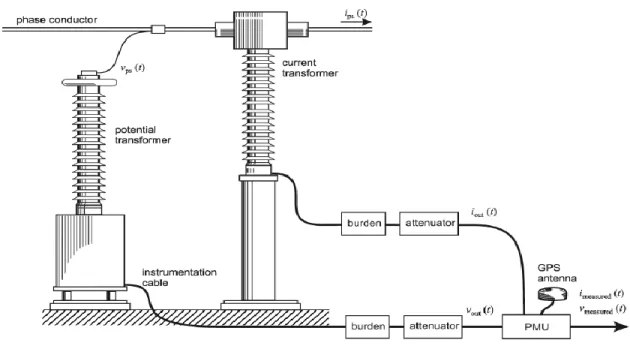
PMU uses the most common technique for determining the phasor representation of a signal i.e. by taking the samples from the waveforms and then applying the Discrete Fourier Transform (DFT) to compute the phasors [8]. The AC waveforms are digitized by an Analog to Digital converter for each phase. A Phase-lock oscillator along with GPS source provides the needed synchronization for the samples.
Figure 3 Synchrophasor Hardware at Ground Level
Waveforms are obtained through a line of components such as transformers and filters as shown in Figure 3. These measured signals are time synchronized using the GPS clock. The GPS clocks allow synchronization of signals into an Universal Time Frame (UTC) to assist the wide area system operations. The time synchronized phasor measurements are aggregated in Phasor Data Concentrator (PDC) as per IEEE Standard C37.118 [9]. PDC acts as a centralized main-stream data server that collects and stores the streaming information from various synchrophasors across the grid as per IEEE Standard C37.244 [10]. The data stored can then be extracted and used for various applications.
1.2 Advantages of Synchrophasors over SCADA Measurements
SCADA provides information about voltage magnitude, active and reactive power flows, load measurements, generator outputs, the breaker status, and performances of capacitor banks and transformers as calculated estimates from SE. When power system state is changing quickly, conventional SE fail to capture certain situations, as SCADA scan is inefficient.
In addition, analog measurements are proportional to the time differences between the measurements and the rate at which states of system change [11], [12]. With synchronized measurements, variables such as phase angles need not be estimated as PMU capture all measurements that are synchronous to universal time frame. Also, the quickly changing states can be captured for accurate SE. Figure 4 provides a comparative analysis of SCADA and PMU measurements [11].
Figure 4 SCADA Vs PMU Measurements
1.3 Challenges with Synchrophasors Measurements
1.3.1 Economics of Synchrophasor Units
PMUs deployed across utilities to improve the SE of power system. However, the major constraint for utilities is the cost of PMUs. In real-world applications, utilities need to setup a number of things before PMUs can be placed on the grid. These include but are not limited to construction of communication infrastructure, procurement of PMUs, phasor data concentrators (PDC) for data aggregation, and synchronization clocks. Thus, it is an expensive issue for utilities to upgrade their monitoring systems. Table 1 shows the cost of installing a
Synchrophasor [13]. The total cost is approximately US$30,000 excluding any infrastructure, operational, and labor costs. However, devices such as PDC may collect data from a number of
PMUs. Therefore, a small or mid-size utility can install only a few PDCs, since a typical PDC can handle data up to 40 PMUs.
Table 1 Typical Approximation of Synchrophasor Costs
Type of Equipment Cost (US$)
PMU with protection, automation & controls ~15,000
PDC (up to 40 PMU’s) ~ 8,000
Synchronization clocks ~ 2,000
Digital equipment (firewalls, cables, and routers) ~ 5,000
However, there’s a solution. By applying the fundamental Ohm’s law on the transmission lines, a
PMU is placed on a bus allows for observation of the neighboring buses; i.e., adjacent bus voltages are easily computable. Thus, the placement of PMUs in a grid became a challenge for the utilities so as to reduce the cost as well as improve the power system situation to maintain reliability and continuity in the system. This problem of reducing the cost factor as well as to increase the reliability of the grid using PMU placement is addressed in Chapter 2 by using the method of Linear Programming (LP).
1.3.2 Reliability of Synchrophasor Data
With the objective of PMU placement problems is to minimize cost, optimization methods s would try to make the buses measurable or observable as less as possible number of times thus, the system remains without redundancy. During contingency situations such as failure of a PMU or a communication line the system loses its observability and the system becomes unobservable affecting operators ability in decision making. Thus, optimal methods for PMU placement problem should include the concept of redundancy in its measurements to keep the system stable
during contingencies. This research proposes a criterion for including such a concept of redundancy into the PMU placement algorithm.
1.3.3 Utilization of Synchrophasor Data
Synchrophasors generate around 30 to 120 samples per second that contain information about the state of power system. Thus, ISO are bombarded with nearly 108,000 samples/hour, which equates to 25,92,000 samples/a day or 7,76,60,000 samples a month. These numbers grow
exponentially and approximately around 1.5 Tera Bytes (TB) of data is accumulated in a month’s span. With all such big data accumulated, ISO make use of the data for meaningful applications. It is neither possible to monitor every data point nor unmonitored. A visualization technique had been developed using an unit-circle representation of phasor data. Unit-circle visualization type will help ISO to monitor the incoming data with ease of understanding. The data representation is stored in the database (db) prior to data mining tasks. ISO uses synchrophasor data for predictive analytics to forecast the system behavior. Any forecasting task require knowledge of past history of data. Data Mining (DM) is the process of extracting useful information to understand more meaningful interpretation about the system. A density based clustering
algorithm called as Density-Based Spatial Clustering of Applications with Noise, (DBSCAN) is used to cluster the synchrophasor data. The results of clustering is stored in the db after the initial stage of visualization.
1.4 Thesis Contributions
1. Identifying a fastest and an efficient way to solve the OPP of PMUs by including a reliability constraint in terms of Optimal Redundancy Criterion (ORC). The ORC is a novel metric that assists ISO in keeping the grid reliable.
2. Test the scalability of LP formulations in large test systems such as IEEE 14, 30, 57, 118, 300 and SRIPG 208 bus systems.
3. Development an Unit Circle Representation for the phasor data for visualizing SG data. 4. Implementation a clustering technique to detect anomalies in the grid. This technique
will capture different types of fault scenarios such as steady state, heavy-load, light-load conditions.
I strongly believe that my contributions will assist ISO in making critical decisions that increases situational awareness and the reliability of modern power-grids alias Smart-grids.
1.5 Thesis Organization
The thesis is organized as follows. Chapter 2 introduces the optimal placement problem followed with a review of available solutions to the problem. A solution based on Linear Programming (LP) is modeled in the thesis using Advanced Modeling and Programming Language (AMPL) with an aim to keep the power system completely observable enforcing a reliability constraint called as Optimal Redundancy Criteria. Chapter 3 describes recent work published on literatures on the various visualization and clustering techniques. The development of an unit-circle representation of the phasor data and its application of DBSCAN clustering technique on synchrophasor data is also described. Chapter 4 discusses solutions obtained from optimal placement problem with various contingency situations taken into consideration. It also discusses the benefits obtained from the unit-circle representations and the DBSCAN clustering algorithm followed by the Conclusion.
CHAPTER 2
OPTIMAL PLACEMENT OF PHASOR MEASUREMENT UNITS (PMU)
PMUs provide time-synchronized voltage and current measurements when placed on a bus. These time-synchronized values are critical for continuous operation of Wide Area Monitoring Systems (WAMS) in the smart-grids. As discussed in Chapter 1, it is not required to place a PMU on every bus in the system to get full observability. Using Ohm’s law, a PMU placed on specific bus can be used to measure the voltage and current phasors at that point. It can also be used to calculate the voltage and current phasors on the lines that are connected to the placed bus. Also, it is not feasible for the utilities to afford a PMU for every bus in their grid due to its costs. Thus, there is a need to find a solution for Optimal Placement Problem (OPP) for PMUs.2.1 Need for Optimal Placement Problem for Synchrophasors
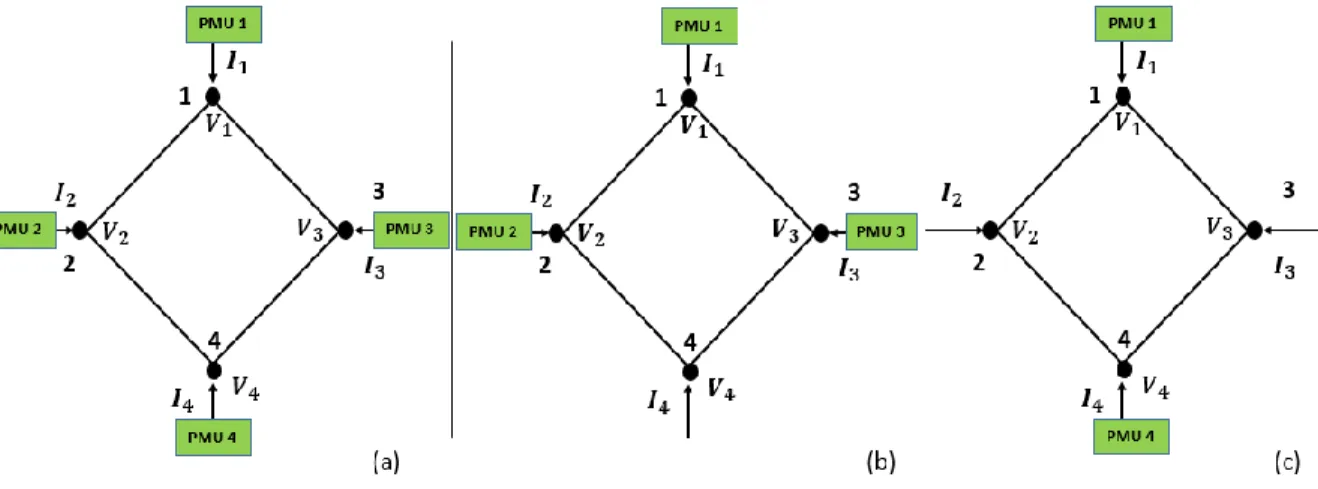
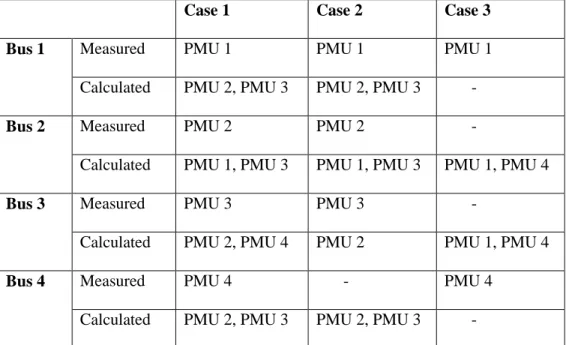
Case 1: In Figure 5(a), all four bus points are accompanied with PMUs for complete observability. The situation is shown in Table 2. There exist many solutions of redundant observabilities than required. Thus, it would be useless to have a PMU on every bus.
Case 2: The Figure 5(b) show how three PMUs on buses 1, 2, and 3 are sufficient to cover the full-observability of system. This situation is given in Table 2. There’s a reduced redundancy in the measurements but the system is yet fully-observable.
Case 3: Figure 5(c) show a 4 bus system with only two PMUs placed on the buses 1 and 4. By analyzing case 3 column of Table 2, we can say that the values at the buses 2 and 3 without the PMU can be calculated using the line parameters (𝑅, 𝑋) and measured parameters at buses 1 and 4. In this way, even with two PMUs, the system remains fully-observable.
Table 2 Case Studies of PMU Placement on Four Bus System
Case 1 Case 2 Case 3
Bus 1 Measured PMU 1 PMU 1 PMU 1
Calculated PMU 2, PMU 3 PMU 2, PMU 3
-Bus 2 Measured PMU 2 PMU 2
-Calculated PMU 1, PMU 3 PMU 1, PMU 3 PMU 1, PMU 4
Bus 3 Measured PMU 3 PMU 3
-Calculated PMU 2, PMU 4 PMU 2 PMU 1, PMU 4
Bus 4 Measured PMU 4 - PMU 4
Calculated PMU 2, PMU 3 PMU 2, PMU 3
-Thus, we conclude that the placing the PMUs using known topology in a certain manner could provide complete observability of system with cost savings that include operational costs and hardware (equipment and infrastructure) costs. In addition, this research includes the
zero-injection buses of the power systems to further reduce the number of PMU required for full observability. Zero-injection buses are similar to transshipment nodes in the OPP algorithm that reduce the minimum number of PMUs. Details about zero-injection buses are explained in later section of the thesis. An index called as Optimal Redundancy Criterion (ORC) is proposed to address the issue of reliability that is very important for the power systems. ORC assist in identifying the best solution for OPP, while enforcing some conditions to maintain redundancy and full-observability of critical buses.
2.2 Literature Review
Various approaches have been proposed to find optimal solutions for the OPP of PMUs [14-34]. In [14], [15], the solution for OPP are found through a dual search algorithm which uses both a modified bisecting search and a simulated-annealing-based method. The bisecting algorithm fixes the number of PMUs, while the latter looks for an optimal solution for the fixed number of PMUs. [16] provides a solution based on Simulated Annealing technique where a novel concept of depth of un-observability is introduced and its impact on the number of PMU placements is explained by drawing the spanning trees for the power systems. A Graph theory approach is proposed to solve the problem of placement in [17]. Reference [18] proposed an easy way to find the solution for placing the PMUs using a generalized Integer Linear Programming (ILP). The problem of minimizing PMUs was considered as an objective using topology based constraints were formed to obtain an ILP based solution for the OPP. A specially tailored non-dominated sorting genetic algorithm for the OPP is proposed with two conflicting objective functions such as maximization of measurement redundancies and minimization of PMUs are considered in [19]. [20] proposes a solution for OPP using immunity genetic algorithm. A modified binary
number of PMUs with the help of topological observability rules in [21]. Using similar BPSO technique, a solution for OPP is proposed by considering the factor of cost for the installation of PMU as an additional objective to minimize the number of PMUs in [22]. In [5], a scheme is proposed to detect the fault locations on the transmission line in addition to the complete
observability of the system with PMUs. [23] proposes a novel method for a power system that is suffering from random outages. The minimal set of PMUs using this novel method is obtained with an aim to minimize the state estimation error covariance. Using the similar ILP method proposed in [17], a method is proposed in [24] to further reduce the minimal set of PMUs by considering zero-injection buses as constraints. Also, two indices namely, Bus Observability Index (BOI) and System Observability Redundancy Index (SORI) were proposed to choose the best solutions, if multiple solutions are available. For utilities with economic limitations, a multi-stage placement problem has been formulated in [24], [25]. In [26], a ILP methodology is proposed for multistaging of PMU placement in a given time horizon, while in [25], a mixed-integer programming is proposed for PMU placement problem in a multi-year planning horizon along with network expansion scenarios. [27] proposed a pre-processing method that includes where real power system conditions. A national inter-connected power system is used to formulate the practical conditions and to find the solution for OPP. An Iterated Local Search (ILS) metaheuristic approach is proposed in [28] to minimize the size of the PMU configuration required for a given system. [29] presents an unified approach using Binary ILP approach to find solution for OPP by integrating the impacts of conventional measurements present in the system. Using similar ILP methodology and by considering conventional measurements, an approach is developed in [30] to find the optimal placements during all possible line and measurement contingencies. [31] proposes an information-theory approach that presents a mutual information
criterion between PMU measurements and its power system states. An unconstrained non-linear weighted least squares (WLS) approach is proposed in [32]. A solution for OPP is proposed in [7] by considering a system that needs to be observable both under normal conditions and islanding conditions. In [33], a reliability based incremental OPP problem is proposed by evaluating the proposed reliability indices of node and system observability. A placement
scheme that ensures the observability of critical buses is proposed in [34]. Here, critical buses are differentiated from the non-critical buses by considering high voltages, and topological
connectivity.
2.3 PMU Placement Problem Formulation using Linear Programming (LP)
In this research, the OPP of PMU is solved using the Linear Programming (LP) techniques. In any LP method, the problem is defined by having an objective function that maximizes or minimizes a linear function subject to set of linear constraints. The constraints include combination of equalities or inequality constraints. LP models are commonly used for its reliability and finding the optimized solution for the placement problem as our goal is to reduce the minimum number of PMUs without losing the complete observability of the system.
2.3.1 Problem Formulation
For a system with 𝑁 buses, the OPP of synchrophasors can be formulated as shown in the equation (1).
𝑚𝑖𝑛𝑖𝑚𝑖𝑧𝑒 ∑ 𝑊𝑖 ∗ 𝑋𝑖
𝑁
𝑖
Where 𝑿𝒊 is a binary decision variable vector, whole entries are defined using the binary variables as follows:
𝑋𝑖 = {1 𝑖𝑓 𝑎 𝑃𝑀𝑈 𝑖𝑠 𝑖𝑛𝑠𝑡𝑎𝑙𝑙𝑒𝑑 𝑎𝑡 𝑏𝑢𝑠 𝑖0 𝑜𝑡ℎ𝑒𝑟𝑤𝑖𝑠𝑒 }
1̂ is a vector whose entries are all ones
(2)
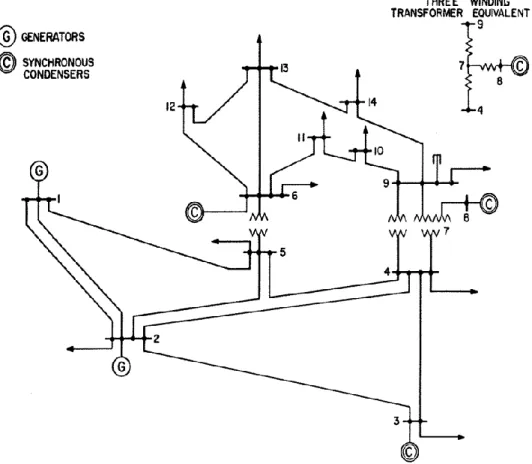
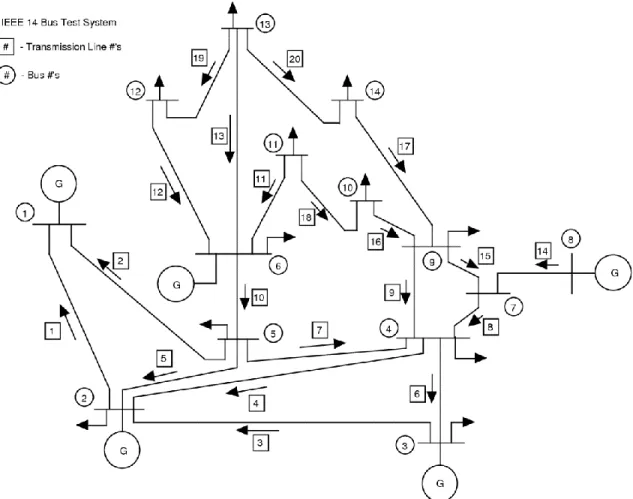
𝑊𝑖 is the cost associated with the installation of PMU at that bus 𝑖. Figure 6 shows a single
line diagram of an IEEE 14 bus system. There are 5 generation points at buses 1, 2, 3, 6 and 8. Of these, only generators at bus 1 and 2 generate both active and reactive power, while
generators at 3, 6, and 8 generate reactive power. There are 11 load points connected at bus 2, 3, 4, 5, 6, 9, 10, 11, 12, 13, and 14 that consume the active and reactive power. Using the LP approach, the system is evaluated to find the PMU placement locations.
Figure 6 IEEE 14 Bus System
The two cases of the system that is considered to determine the OPP solution are as follows: A. By considering regular test-bus system with any zero-injection buses
2.3.1.1 System with No Zero-Injection Buses
Assuming all of the fourteen buses in the IEEE 14 bus system are regular ones having at least a load or a generation point. There is a requirement to measure or observe all the buses because of the changes that happen at each of them due to the generation and load points. A binary connectivity matrix is formed to indicate links between the buses. The entries of 𝐴𝑖,𝑗 are
defined as follows in equation (3):
Matrix 𝐴𝑖,𝑗can be directly obtained from the bus admittance matrix by transforming its
entries into binary form as shown in (4):
𝐴𝑖,𝑗 = [ 1 1 0 1 1 1 0 1 1 0 1 01 1 0 0 0 0 0 0 00 0 0 0 0 0 0 0 00 0 0 0 0 0 0 00 0 0 0 0 1 1 1 1 0 0 0 0 1 1 00 1 0 1 0 1 1 0 10 0 0 0 0 0 0 0 00 0 0 0 1 1 0 00 0 1 0 0 0 0 0 0 0 0 0 0 0 0 01 0 0 0 0 0 1 1 11 1 0 1 0 1 0 0 00 0 0 1 0 0 0 00 0 0 1 0 0 0 0 0 0 0 0 0 1 0 00 0 1 0 0 1 0 0 10 0 0 0 0 0 1 1 01 1 0 0 0 1 0 00 0 1 0 0 0 0 0 0 0 0 0 10 0 0 0 0 00 0 1 0 0 10 0 0 1 11 1] (4)
Here, a zero in the connectivity matrix derived from the admittance matrix implies that there is no connection between buses 𝑖 and 𝑗. While one (1) in the matrix implies that there is a connection. Once the binary connectivity matrix is formed, the LP constraints for all the 14 buses from the 14 connections is shown in equations from (5) to (18):
𝐴𝑖,𝑗= {
1 𝑖𝑓 𝑖 = 𝑗
1 𝑖𝑓 𝑖 𝑎𝑛𝑑 𝑗 𝑎𝑟𝑒 𝑐𝑜𝑛𝑛𝑒𝑐𝑡𝑒𝑑
𝐵𝑢𝑠 1: 𝑥1+ 𝑥2+ 𝑥5 ≥ 1 (5) 𝐵𝑢𝑠 2: 𝑥1+ 𝑥2+ 𝑥3+ 𝑥4+ 𝑥5 ≥ 1 (6) 𝐵𝑢𝑠 3: 𝑥2+ 𝑥3+ 𝑥4 ≥ 1 (7) 𝐵𝑢𝑠 4: 𝑥2+ 𝑥3+ 𝑥4 + 𝑥5+ 𝑥7 + 𝑥9≥ 1 (8) 𝐵𝑢𝑠 5: 𝑥1+ 𝑥2+ 𝑥4+ 𝑥5 ≥ 1 (9) 𝐵𝑢𝑠 6: 𝑥6+ 𝑥11+ 𝑥12+ 𝑥13 ≥ 1 (10) 𝐵𝑢𝑠 7: 𝑥4+ 𝑥7+ 𝑥8 + 𝑥9≥ 1 (11) 𝐵𝑢𝑠 8: 𝑥7+ 𝑥8 ≥ 1 (12) 𝐵𝑢𝑠 9: 𝑥4+ 𝑥7+ 𝑥9+ 𝑥10+ 𝑥14 ≥ 1 (13) 𝐵𝑢𝑠 10: 𝑥9+ 𝑥10+ 𝑥11≥ 1 (14) 𝐵𝑢𝑠 11: 𝑥6+ 𝑥10+ 𝑥11 ≥ 1 (15) 𝐵𝑢𝑠 12: 𝑥6+ 𝑥12+ 𝑥13 ≥ 1 (16) 𝐵𝑢𝑠 13: 𝑥6+ 𝑥12+ 𝑥13+ 𝑥14 ≥ 1 (17) 𝐵𝑢𝑠 14: 𝑥9+ 𝑥13+ 𝑥14≥ 1 (18)
The operator (+) in the formulation is a logical “OR” operation, while the inequality
operator (≥) ensures that at least one of the variables appearing in the sum will be non-zero. For example, consider the following constraints (5) and (6) associated with bus 1 and bus 2:
𝐵𝑢𝑠 1: 𝑥1+ 𝑥2+ 𝑥5 ≥ 1 (19)
𝐵𝑢𝑠 2: 𝑥1+ 𝑥2+ 𝑥3+ 𝑥4+ 𝑥5 ≥ 1 (20)
The constraint 𝑓1 ≥ 1 , equation (19) indicate that at least one PMU must be placed on at least one of the three buses bus 1 (𝑥1), bus 2 (𝑥2), or bus 5 (𝑥5). Similarly, 𝑓2 ≥ 1 i.e. the
equation (20) implies that at least one PMU should be installed on any one of the buses 1, 2, 3, 4, or 5 in order to make bus 2 observable (i.e., to satisfy 𝑓2 constraint).
2.3.1.2 System with Zero-Injection Measurements
Zero-injection buses are buses where no currents are neither injected nor withdrawn into/from the system (i.e., a buses which have neither load nor generation units). In the power systems, there are few bus locations where there is no requirement for measuring. The use of Kirchhoff’s current law (KCL) to include zero-injection buses in modeling the OPP further
reduces the number of PMUs required. Each zero-injection node in a system creates an additional constraint. Thus, the number of PMUs required for complete observability of the system can be reduced. For a zero injection bus 𝑖, let 𝐴𝑖 indicate the set of adjacent buses to bus 𝑖. Let 𝐵𝑖 = 𝐴𝑖∪ {𝑖}. Let the number of zero injections be 𝑍. Since there is no change in current (𝑖) values at a zero-injection bus, the variables related to the zero-injection buses are eliminated from all the constraining equations. The model formulation in an ILP framework, therefore, selectively allow some of the buses to be un-observable. However, there are additional constraints that need to be included for a fully-observable system. They are:
The un-observable buses must be adjacent to zero-injection buses.
The number of un-observable buses in the set (zero-injection bus and its adjacent buses) is at mostly as one (1) in the matrix.
In the IEEE 14-bus system shown in Figure 6, bus 7 is a zero-injection bus. Thus, and the new constraining equation can be written as,
𝐵𝑢𝑠 1: 𝑥1+ 𝑥2+ 𝑥5 ≥ 1 (21)
𝐵𝑢𝑠 2: 𝑥1+ 𝑥2+ 𝑥3+ 𝑥4+ 𝑥5 ≥ 1 (22)
𝐵𝑢𝑠 3: 𝑥2 + 𝑥3 + 𝑥4 ≥ 1 (23)
𝐵𝑢𝑠 4: 𝑥2 + 𝑥3+ 𝑥4 + 𝑥5+ 𝑥8 + 𝑥9 ≥ 1 (24)
𝐵𝑢𝑠 6: 𝑥6 + 𝑥11+ 𝑥12+ 𝑥13≥ 1 (26) 𝐵𝑢𝑠 8: 𝑥4 + 𝑥8+ 𝑥9 ≥ 1 (27) 𝐵𝑢𝑠 9: 𝑥4+ 𝑥8+ 𝑥9+ 𝑥10+ 𝑥14 ≥ 1 (28) 𝐵𝑢𝑠 10: 𝑥9+ 𝑥10+ 𝑥11≥ 1 (29) 𝐵𝑢𝑠 11: 𝑥6 + 𝑥10+ 𝑥11 ≥ 1 (30) 𝐵𝑢𝑠 12: 𝑥6 + 𝑥12+ 𝑥13 ≥ 1 (31) 𝐵𝑢𝑠 13: 𝑥6 + 𝑥12+ 𝑥13+ 𝑥14≥ 1 (32) 𝐵𝑢𝑠 14: 𝑥9+ 𝑥13+ 𝑥14≥ 1 (33)
Figure 7 IEEE 14 Bus System with Zero-Injection Bus
The constraints (21) – (33) are the updated (or modified) connections obtained from the bus connectivity matrix formed from the modified 14 bus system as shown in Figure 7. There are only 13 constraints, as the bus 7 which is a zero-injection bus is removed and thereby reduce the number of PMUs. In this way, the number of PMUs required is thus reduced, if a system has zero-injection nodes.
2.4 System Observability Redundancy Index (SORI)
If there are multiple solutions for an OPP placement problem, then identifying an optimal solution is often a challenge. To solve this problem, a SORI index is used [24]. If a bus 𝑖 is observed by a PMU ‘𝑛’ number of times, then the SORI (γ) is given by equation (34):
𝛾𝑖 = ∑ 𝑛𝑖 (34)
Choosing an optimal solution will provide a maximum redundancy enabling complete observability rather than choosing an optimal solution that might be less redundant. The SORI index help in choosing the best solution. In general, larger redundancy values yield higher SORI values. Thus, maximizing the SORI index is a good measure of success for the OPP placement problem, as the approach keeps system observable during any contingency situations. For example, let us consider the IEEE 14 bus system in Figure 6. The system is made completely observable with 4 PMUs either being placed at 2, 6, 7, and 9 bus locations or at 2, 6, 8, and 9 bus locations. In both the cases, all 14 buses are fully-observed. Table 3 provide a comparison of bus-observabilities for both the solutions. Using equation (34), the SORI index is calculated by simply adding all bus observabilities in a system. In the first case (2nd column of Table 3) when the PMUs are placed at 2, 6, 7, and 9 locations, the SORI index is calculated as follows:
𝑆𝑂𝑅𝐼 = 1 + 1 + 1 + 3 + 1 + 1 + 2 + 1 + 2 + 1 + 1 + 1 + 1 + 1 = 18 (35)
While in the second case (3rd column of Table 3), the SORI index will be:
𝑆𝑂𝑅𝐼 = 1 + 1 + 1 + 2 + 1 + 1 + 2 + 1 + 1 + 1 + 1 + 1 + 1 + 1 = 16 (36)
Thus, even though with same number of PMUs, full-observability is obtained in both the cases, It is recommended that placing the PMUs at buses 2, 6, 7, and 9 would yield better results and better observability. In addition, a complete redundancy is attained which is critical for contingency scenarios or events.
Table 3 Observability Index for Various Placement Solutions in IEEE 14 Bus System PMU Placement at Buses : 2, 6, 7, 9 PMU Placement at Buses : 2, 6, 8, 9
Bus 1 PMU at bus 2 PMU at bus 2
Bus 2 PMU at bus 2 PMU at bus 2
Bus 3 PMU at bus 2 PMU at bus 2
Bus 4 PMU at buses 2, 7, and 9 PMU at buses 2 and 9
Bus 5 PMU at bus 2 PMU at bus 2
Bus 6 PMU at bus 6 PMU at bus 6
Bus 7 PMU at buses 7 and 9 PMU at buses 8 and 9
Bus 8 PMU at bus 7 PMU at bus 8
Bus 9 PMU at buses 7 and 9 PMU at bus 9
Bus 10 PMU at bus 9 PMU at bus 9
Bus 11 PMU at bus 6 PMU at bus 6
Bus 12 PMU at bus 6 PMU at bus 6
Bus 13 PMU at bus 6 PMU at bus 6
Bus 14 PMU at bus 9 PMU at bus 9
2.5 Optimal Redundancy Criterion (ORC)
Although the OPP problem yields solutions for full-observability, there is a likelihood of uncertainty during contingency situations which may result in partial or zero observability of the system. Contingency here, refers to a situation in the power system where,
There is a loss of PMU measurements from the observing bus. This would result in the loss of PMU measurements from all the connected buses.
There is a loss in communication channel that is transmitting information from the observing bus.
There is a loss of PMU measurements from the observable bus.
The above contingency cases can be caused through physical damage of an equipment,
infrastructure, and cyber-physical damages. This means, in certain cases, it is better to include a certain number of buses to be observed by multiple PMUs. Thus, the loss of PMU measurements from one device will not affect the observability of any other bus. The factor of percentage or observability weights of buses can be considered in different ways. Some literature studies consider high voltage buses to be more critical than other buses, while others consider all
generating buses to be critical buses [34]. We propose a new index called “Optimal Redundancy Criterion” (ORC) which is based on the number of connections to each bus. ORC is defined as
the ratio of the total number of connections between buses to the total number of buses in the system. We can select the buses that have more connections or links by adapting the following criterion (37). 𝑂𝑅𝐶 =∑ ∑ 𝐵𝑖,𝑗 𝑛 𝑗=1,𝑖≠𝑗 𝑛 𝑖=1 𝑛 (37)
Where 𝑖 and 𝑗 represent the buses, 𝐵𝑖,𝑗 represent connections between 𝑖 and j, and 𝑛 is the
total number of buses in the system. The ORC conditions are enforced as follows: Step 1: ORC is calculated using the formula provided in (24).
Step 2: Based on ORC, the critical bus constraints are selected from all the constraints. Step 3: Increase the minimum observability requirement of the selected critical buses. Let us consider constraints (5) to (18), where each constraint represent a bus in the IEEE 14 bus system. Here, the total number of connections for all 14 buses is the sum of their connections.
𝐵1+ 𝐵2+ ⋯ 𝐵14= 56 (38)
The number of buses are in the test system is. Thus, ORC for the 14 bus system is given by,
𝑂𝑅𝐶 = 56
14= 4 (39)
Therefore, from the constraints formed earlier, we consider equations (6), (8), and (13), and increase the weights, as these buses have a greater number of connections than ORC values (five, six, and five connections respectively). The weights in constraints appear on the right hand side of the equation. Now, the updated constraints would be as shown in (40) to (42).
𝐵𝑢𝑠 2: 𝑥1 + 𝑥2 + 𝑥3+ 𝑥4+ 𝑥5 ≥ 2 (40)
𝐵𝑢𝑠 4: 𝑥2+ 𝑥3+ 𝑥4+ 𝑥5+ 𝑥7+ 𝑥9 ≥ 2 (41)
𝐵𝑢𝑠 9: 𝑥4+ 𝑥7+ 𝑥9+ 𝑥10+ 𝑥14≥ 2 (42)
For full-observability, a ”1” is placed on the right-hand side of the constraint equation of each critical bus, indicating that each bus is observed at least once. Based on system and individual utility need or requirements, one can adjust the observability weights. For our test system, we chose to make the critical buses observable twice. This will provide sufficient redundancy, and help increase the reliability of the system. Chapter 4 discusses the various advantages gained in terms of grid reliability while enforcing ORC by using the test case systems.
CHAPTER 3
VISUALIZATION AND CLUSTERING OF SYNCHROPHASOR DATA
This chapter discusses the need of Data Visualization (DV) and Data Mining (DM) for synchrophasor data. The first part of this chapter is dedicated for modeling of a system that mimics synchrophasor data. The second part discusses the circle representation for the synchrophasor data thus obtained from the system and the final part would discuss the data clustering technique, DBSCAN.3.1 Need for Visualizing and Analyzing the Synchrophasor Data
A basic PMU provide a minimum of 30 samples of data per second. With so many samples per second, the state of the power system at any given time is studied and observed easily. The ISO can actively observe any system anomalies, or outages in the grid, and respond to them in the event of malfunctioning or problems in the power system. Although PMUs provide
Situational Awareness (SA) of the system using large number of its samples, the ISO’s need to gather, classify, and analyze the streaming PMU data. PMUs with high-sampling data rate, flood the data concentrators with streaming data every sub-seconds. Neither it is possible to monitor each and every data point (~120 samples/second) nor leave the data unmonitored. Thus, visualization forms an important aspect for quick analysis of data. There also needs to be some mechanism which will assist system operators in decision making process to analyze the data from the PMUs thereby keeping the grid online without any un-stable conditions.
Data Mining (DM) or data analysis will assist ISO in performing off analysis of the power system parameters which will impact the future decision-making of the ISO. For my research, to perform the DV and DM, I need to have a synchrophasor data which was practically impossible without having a PMU. Thus, I was in pursuit of synchrophasor data. I was in search of acquiring the source of synchrophasor data with-out having an actual PMU installed in our Data Sciences laboratory. The two sources that I have considered for providing synchrophasor data are:
A. A MATLAB based IEEE 14 bus system model.
A MATLAB based simulink model can provide me data that resembles as real synchrophasor data. Even though, it might not actually represent a PMU, the model provides me the voltage and current phasor values which in general represents the synchrophasor data.
B. A openPDC data source
3.2 Modeling of IEEE 14 Bus Test System
The IEEE 14-bus test case represents a portion of the American Electric Power (AEP) System (in the Midwestern US) as of February, 1962. A much-xeroxed paper version of the data was kindly provided by Iraj Dabbagchi of AEP and entered in IEEE Common Data Format by Rich Christie at the University of Washington in August 1993 [35]. Once this was accepted as an IEEE Test Case, it became a standard system for all power system experiments such load flow studies, and economic dispatch problems and is now widely accepted. Basically, the 14 bus system has 14 buses, 5 generators and 11 loads. All generators, loads and its branches are shown in Figure 8. The complete 14 bus system has been modeled in MATLAB/SIMULINK. Also, fault conditions are modeled in the IEEE 14 bus system realize the ideal power system conditions.
3.2.1 IEEE 14 Bus System
Figure 8 show the simulink model of an ideal fourteen bus model in MATLAB using the bus and branch parameters [35]. This model depicts the ideal conditions where there is sufficient supply available to meet the demand units. The model shown in Figure 8 uses the three-phase constant voltage sources as generators. The voltage sources provide power at the specified voltage levels all the time. So, they vary current in order to achieve the required power output. All parameters such generation and load levels, line parameters ( 𝑅, 𝐶, and 𝑋), transformer tap ratios are simulated in the 14 bus system.
26
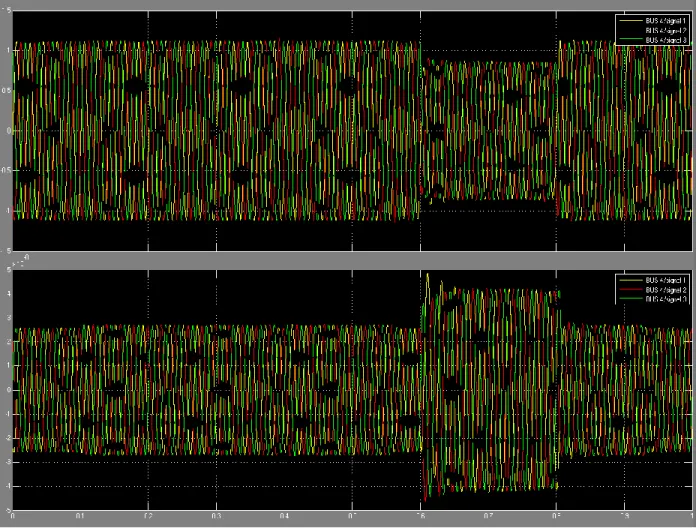
The voltage and current waveforms at all the buses are observed individually using scope block in MATLAB. The two waveforms in Figure 10 represents voltage and the current plots at a zoomed in level. The three phase voltages and currents at bus 1 are represented with three colors, they are: red, yellow, and green. The X-axis is shown in time (in seconds) and the Y-axis shown in voltage and current magnitudes respectively. As this system is constructed in per unit (p.u.) system representing an ideal case scenario, the voltage always remains to be constant at 1 p.u. and the currents are at very low-level with respect to the voltage values.
Table 4 3-ϕ Voltage Magnitudes and Phase Angles A - phase magnitude B - phase magnitude C- phase magnitude A - phase angle B - phase angle C - phase angle 1.020223859 1.02022386 1.020223859 -5.908535586 -125.9085356 114.0914644 1.020223859 1.02022386 1.020223859 -5.908535586 -125.9085356 114.0914644 1.020223859 1.02022386 1.020223859 -5.908535586 -125.9085356 114.0914644 1.020223859 1.02022386 1.020223859 -5.908535586 -125.9085356 114.0914644
3.2.2 IEEE 14 Bus System with Faults
This case represents a 14 bus system with fault conditions. The realistic model is built using few generator blocks and load points that are added and removed to some specific buses during the simulation time. Figure 11 represents the 14 bus system with faults. The model described is similar to original IEEE fourteen bus system except with the following additions 1. A random generator included at bus 4 in addition to the existing load.
2. A random load attached at bus 3 in addition to the existing load. 3. A three-phase fault modeled on a branch between bus 4 and bus 9.
This fault is a three-phase-to-ground fault that happens to occur during the time frame of 0.6 to 0.8 seconds. Figure 12 shows the scope of waveforms from the bus 4. In comparison with the Figure 8, the differences can be easily seen. The changes from ideal waveforms are due to the additional conditions modeled in this case. During the ideal case, the voltages were always at 1 p.u, while during the case of fault (Figure 12), voltage reduces while the current maximizes during 0.6 to 0.8 seconds of fault condition.
Figure 12 Voltage and Current Waveforms at Bus 4 During Fault Conditions
As explained earlier, PMU can measure electrical signals such as voltage and current at a data- rate of 30, 60, 120, 240 samples/second. My initial goal was to build a model that will simulate a realistic power system model that allow bus measurements. Our simulink model will provide similar values as an actual PMU. Each of the models will provide us the values of magnitude and phase angle of both current and voltage at all the 14 buses. A PMU placed at a bus does include the time-stamped phasor values. The measured phasor values and unit-circle representation is discussed in Chapter 4. This representation will enable a sub-station operators to visualize the parameters in the power system in near real-time.
3.3 openPDC Data Source
openPDC, an open-source software, developed by the Tennessee Valley Authority (TVA) and administered by the Grid Protection Alliance (GPA), is a complete Phasor Data Concentrator software system that is designed to process streaming time-series data in real time[36]. openPDC functions by receiving data broadcast by a PMU and concentrating it, enabling archiving,
rebroadcasting, and analyzing of the phasor data [37]. Generally, openPDC archives the data as they are received. Synchrophasor data that are stored in openPDC can be mined by extraction. For this task, a C# code using Microsoft Visual Studio [38] has been developed. OpenPDC is a virtual software that has a PMU data generator developed with the Microsoft Visual C# platform. An Structured Query Language (SQL) database has been set up for the Open PDC environment; the database produces PMU data using a PDC connection tester file. The data are produced according to the Grid Protection Alliance directives. The generated data are stored in an Archives folder as “.dat” files: “ppa_archive.dat”. There are separate virtual ports to access
frequency, magnitude, and phase-angle data. The streaming data are stored in a “.dat” format file with a port number as an identifier. To record the data for a post-event analysis or a near real-time analysis, the port numbers corresponding to the fields can be utilized. A data-extraction code is required to extract the data from the “.dat” files and to transfer them to an “.xls” or “.csv”
file format.
3.4 Data Visualization
Visualization is a useful medium for examining, understanding, and transmitting information because,
It leverages the incredible capabilities and bandwidth of the visual system to move a huge amount of information into the brain quickly.
It takes advantage of our brains that has the capability to identify patterns and communicate relationships and meaning.
Data Visualization will identifying trends and outliers, discovering or searching for interesting or specific data points in a larger field, etc.
Data visualization is the study of the visual representation of data that is, 1. Data points are drawn algorithmically
2. Easy to represent complex-data form 3. Often aesthetically barren
4. Relatively data-rich
Data representation in any form need to communicate the information of data with visual cues accurately. There are two types of data visualization: exploration and explanation. Exploration is generally best done at a high level of granularity. There may be a whole lot of noise in your data, but if we oversimplify or strip out too much information, we could end up missing something important. This type of visualization is typically part of the data analysis phase, and is used to find the story the data has to tell you. Explanatory data visualization is appropriate when we already know what the data has to say, and you are trying to tell that story to somebody else.
There are a number of forms such as maps, flow-animation, graphical alarms, area-tie diagrams, contour plots, 3-D displays, and GreenGrid etc [39], [40] are used to represent power system data. Data generated from the models represents PMU data needs to be visually best-represented for system operators to make decisions. This will helps ISO can
monitor the changes in the grid. This research chose to use a circle representation of the streaming PMU data.
3.4.1 Unit Circle Representation of Phasor Data
The voltage in an AC circuit is oscillating and represented as follows,
𝑉 = 𝑉𝑜∗ (cos(𝜃) + 𝑗 ∗ sin (𝜃))
𝑤ℎ𝑒𝑟𝑒, 𝜃 = 𝜔 ∗ 𝑡 + 𝛷 (43)
cos(𝜃) represents the real part and sin (𝜃) represents the imaginary part of the signal.
Figure 13 Unit Circle Representation
As phase angle varies between -π to+π (in radians) or between 0° to 360° (in degrees) and the magnitudes are always above 0 for the electric signals, the “unit-circle diagram” as our visualization tool. The trigonometric representations are functions of angle θ. Therefore, any value of radius can be chosen, and the simplest is a circle of radius 1, the unit circle. Figure 13 represents the basic unit circle diagram. The magnitude and phase angle information is
represented better visually using unit-circle where the radius of the line and the angle θ it makes with the horizontal axis 𝑋. Therefore, this is a perfect match for our type of data and
3.5 Data Mining
Databases are always rich in hidden information that is used for intelligent decision making. Data Mining (DM) is the discovery of “models” for data. Some commonly used models are
statistical modelling, machine learning, artificial intelligence, neural-networks, pattern recognition and computational approaches. The other approaches include markov chains, graphical models, cluster analysis, factor analysis, linear and non-linear regression analyses, time-series analysis, and classification trees. Classification and prediction are two forms of data analysis used to extract model properties describing important data classes or to predict future trends. Such analysis can provide a better understanding of the data at large. The classification approaches predicts categorical (discrete, unordered) labels, prediction models continuous valued functions. Few methods of data classification include: neural networks, SVM classifiers, decision trees, and probabilistic methods [41], [42]. Imagine that you are given a set of data objects for analysis where the class label of each object is not known. This is quite common in large databases, because assigning class labels to a large number of objects is an expensive process. Classification techniques need class labels for classifying the data objects but unsupervised learning techniques do not require such inputs. Clustering is the process of grouping data into classes or clusters, so that objects within a cluster have high degree of similarity in comparison to another but they are dissimilar to objects in other clusters [43]. Dissimilarities are assessed based on the attribute values describing the objects. Often, distance measures are used [44], [45]. There are a number of clustering algorithms that have been developed in the past. All such algorithms are classified into different types [46]. They are:
1. Partitioning methods: k-Means [47], Minimization of Sum of Squared Errors, K-Mediods, K-Medians, K-Modes [48], Fuzzy k-Means [49], Kernel k-Means [50], Weighted k-means, Genetic k-means clustering.
2. Hierarchical methods: Agglomerative clustering and Divisive clustering [44]. 3. Density based methods: DBSCAN[51], DENCLUE [52], OPTICS [53], CLARANS
[54], BIRCH [55], and CURE [56].
4. Grid methods: GRIDCLUS [57], BANG, WaveCluster, STING, CLIQUE, ENCLUS, and OptiGrid clustering.
5. Spectral methods: Spectral clustering, normalized spectral, and graph cut view. Synchrophasor data consists of voltage magnitude and its corresponding phase-angle, current magnitude and it’s corresponding phase-angle. To analyze this phasor data, various
DM techniques are deployed. However, each algorithm has its own advantages and dis-advantages. It is not certain that every algorithm suits all data types. Some work on large sets of data and some work with small data-sets. Some DM techniques can work well with large monotonic data and very few on multi-data variations. To mine the data and obtain
meaningful information, a correct algorithm selection is very important. Synchrophasor data require large database sizes to store, and mine large number of samples. Clustering
algorithms are attractive for the task of class identification in spatial databases. However, the application to large spatial databases rises the following requirements for clustering
algorithms:
Minimal requirements of domain knowledge to determine the input parameters, because appropriate values are often not known in advance when dealing with large databases.
Discovery of clusters with arbitrary shape, because the shape of clusters in spatial databases may be spherical, drawn-out, linear, elongated etc.
Good efficiency on large databases, i.e. on databases of significantly more than just a few thousand objects.
To achieve the following requirements, a Density Based Spatial Clustering of
Applications with Noise, DBSCAN can be used [51]. DBSCAN is a density based clustering approach which is designed to discover the clusters and the noise in a spatial db. The
advantages of the DBSCAN are:
Its requires only two parameters as inputs to cluster the entire-data.
It can discover clusters of arbitrary shapes.
3.5.1 Density based Clustering Technique (DBSCAN)
DBSCAN basically deal with the density or concentration of points. The fundamental principle of DBSCAN is to expect each cluster is defined through a probability distribution that is darker in center and lighter near the edges of cluster. In other words, the probability of selecting a sample near the central core of the distribution should be much higher. If we
randomly select a large number of samples from the distribution, we’ll get points from both the
central core and the outer edges, but we should be able to tell the difference between them because the outer edge points will be farther apart from each other. In other words, we can tell the difference by how dense the points are. So the idea behind DBSCAN is to try and ignore the data points that are more spread-out and focus on the dense parts, which should be the central cores of the clusters. The output cluster of the DBSCAN can contain three type of points that form three clusters. They are: Core points, Border points, and Noise points.
There are few definitions which define DBSCAN. They are as follows:
DBSCAN requires two parameters as its input values to cluster the data. They are: ε (𝐸𝑝𝑠) and 𝑀𝑖𝑛𝑃𝑡𝑠. ε: 𝐸𝑝𝑠 is the neighborhood of a point 𝑝, denoted by 𝑁𝐸𝑝𝑠(𝑝), defined by
𝑁𝐸𝑝𝑠(𝑝) = {𝑞Є𝐷|𝑑𝑖𝑠𝑡(𝑝, 𝑞) ≤ 𝐸𝑝𝑠}. (43)
A point 𝑝 is 𝑑𝑖𝑟𝑒𝑐𝑡𝑙𝑦 𝑑𝑒𝑛𝑠𝑖𝑡𝑦 − 𝑟𝑒𝑎𝑐ℎ𝑎𝑏𝑙𝑒 from a point 𝑞wrt. 𝐸𝑝𝑠, 𝑀𝑖𝑛𝑃𝑡𝑠 if a. 𝑝Є𝑁𝐸𝑝𝑠(𝑞)
b. |𝑁𝐸𝑝𝑠(𝑝)| ≥ 𝑀𝑖𝑛𝑃𝑡𝑠 (core point condition)
A point 𝑝 is 𝑑𝑒𝑛𝑠𝑖𝑡𝑦 − 𝑟𝑒𝑎𝑐ℎ𝑎𝑏𝑙𝑒 from a point 𝑞 wrt. 𝐸𝑝𝑠, 𝑀𝑖𝑛𝑃𝑡𝑠 if there is a chain of points 𝑝1, … 𝑝𝑛, 𝑝1 = 𝑞, 𝑝𝑛 = 𝑝 such that 𝑝𝑖+1 is directly density-reachable from 𝑝𝑖.
Let 𝐶1, … , 𝐶𝑘 be the cluster centers of the db 𝐷wrt. parameters 𝐸𝑝𝑠𝑖, 𝑀𝑖𝑛𝑃𝑡𝑠𝑖, 𝑖 =
1, … , 𝑘. Then, noise can be defined as the set of points in the db 𝐷 that do not belong to
any of the cluster 𝐶𝑖 i.e. 𝑛𝑜𝑖𝑠𝑒 = 𝑝 ∈ 𝐷|∀𝑖: 𝑝 ∉ 𝐶𝑖.
A point 𝑝 become a 𝑐𝑜𝑟𝑒 point if it has more than a specified number of points (𝑀𝑖𝑛𝑃𝑡𝑠) within a radius 𝐸𝑝𝑠 (these points are the interior of a cluster). A 𝑏𝑜𝑟𝑑𝑒𝑟 point 𝑝 has fewer than 𝑀𝑖𝑛𝑃𝑡𝑠 within 𝐸𝑝𝑠, but is in the neighborhood of a core point. A 𝑛𝑜𝑖𝑠𝑒 point 𝑝 is any point that is not a 𝑐𝑜𝑟𝑒 point or a 𝑏𝑜𝑟𝑑𝑒𝑟 point. In general, an 𝐸𝑝𝑠 - neighborhood of a 𝑏𝑜𝑟𝑑𝑒𝑟 point contains
significantly less points than an Eps-neighborhood of a 𝑐𝑜𝑟𝑒 point. Therefore, we would have to set the minimum number of points to a relatively low value in order to include all points
belonging to the same cluster. Figure 14 visually defines the different points in the DBSCAN and their definitions. The following are the steps on how DBSCAN forms clusters:
Step 1: Initially, select a point 𝑝 arbitrarily.
Step 3: If point 𝑝 is a 𝑐𝑜𝑟𝑒 point, a cluster is formed.
Step 4: If point 𝑝 is a 𝑏𝑜𝑟𝑑𝑒𝑟 point and no points are density reachable from 𝑝 , then DBSCAN visits the next point of the db.
Step 4: This process from step 1 to step 4 is continued till all the points have been processed or when no new point can be added to any cluster.
All points are clustered into three types that are called as 𝐶𝑜𝑟𝑒, 𝐵𝑜𝑟𝑑𝑒𝑟, 𝑎𝑛𝑑 𝑛𝑜𝑖𝑠𝑒 points.
Figure 14 DBSCAN and its Points
3.5.2 Pseudo code for DBSCAN clustering
The pseudo code for DBSCAN can be written as follows:
Input: 𝑋 = {𝑥1, 𝑥2, … , 𝑥𝑛} (Set of entities to be clustered)
𝑒𝑝𝑠 = Minimum distance between two points to be clustered (𝐷). 𝑀𝑖𝑛𝑃𝑡𝑠 = Minimum number
Output: L= { 1(𝑥)|𝑥 = 1,2, … 𝑛} (Set of cluster labels of 𝑥)
DBSCAN (Input Set (X), Pt, D) foreach xi in the Input set do If (xi is not in any cluster) then
If (xi is a core point) then Generate a new clusterID.
Label xi with clusterID.
expandCluster (xi, X, Pt, D, clusterID) else label (xi, NOISE) end end end end expandCluster (xi, X, Pt, D, clusterID) put xi in seed queue
while the queue is not empty
extract c from the queue (where c ϵ X and c ≠ xi) retrieve the neighborhood (eps) of c.
If there are atleast minPts neighbors foreach neighbor n
If n is labeled NOISE Label n with clusterID If n is not labeled
Label n with clusterID Put n in the queue end
end end end
Figure 15 Cluster Formations of DBSCAN
The advantages of DBSCAN are that this method is resistant to 𝑛𝑜𝑖𝑠𝑒 and can handle clusters of different sizes and shapes. The limitation lie with right selection of 𝐸𝑝𝑠 and 𝑀𝑖𝑛𝑃𝑡𝑠 parameters.
![Figure 1 Smart-Grid Network [1]](https://thumb-us.123doks.com/thumbv2/123dok_us/1459008.2695141/18.918.135.790.524.897/figure-smart-grid-network.webp)