Journal of eScience Librarianship
Journal of eScience Librarianship
Volume 7 Issue 2 Article 1
2018-03-16
The Data Engagement Opportunities Scaffold: Development and
The Data Engagement Opportunities Scaffold: Development and
Implementation
Implementation
Abigail GobenUniversity of Illinois at Chicago Et al.
Let us know how access to this document benefits you.
Follow this and additional works at: https://escholarship.umassmed.edu/jeslib
Part of the Scholarly Communication Commons, and the Scholarly Publishing Commons
Recommended Citation Recommended Citation
Goben A, Sapp Nelson MR. The Data Engagement Opportunities Scaffold: Development and Implementation. Journal of eScience Librarianship 7(2): e1128. https://doi.org/10.7191/ jeslib.2018.1128. Retrieved from https://escholarship.umassmed.edu/jeslib/vol7/iss2/1
Creative Commons License
This work is licensed under a Creative Commons Attribution 4.0 License.
This material is brought to you by eScholarship@UMMS. It has been accepted for inclusion in Journal of eScience Librarianship by an authorized administrator of eScholarship@UMMS. For more information, please contact
Correspondence: Abigail Goben: [email protected]
Keywords: research data management, data engagement, RDM, research data, data librarians, engaged liaisons
Rights and Permissions: Copyright Goben and Sapp Nelson © 2018
EScience in Action
The Data Engagement Opportunities Scaffold: Development and Implementation
Abigail Goben
1and Megan R. Sapp Nelson
21
University of Illinois at Chicago, Chicago, IL, USA
2Purdue University, West Lafayette, IN, USA
All content in Journal of eScience Librarianship, unless otherwise noted, is licensed under Abstract
While interest in research data management (RDM) services have grown, clarifying the path between traditional library responsibilities and RDM remains a challenge. While the literature has provided ideas about services and student-/researcher-focused data information literacy (DIL) competencies, nothing has yet brought these skill sets together to provide a pathway for librarians engaging in RDM. The Data Engagement Opportunities scaffold was developed to provide a strategic trajectory relating information science skills, the DIL competencies, the stages of the data life cycle, three levels of RDM engagement activities, and potential measurable outcomes. This scaffold provides direction for librarians looking to identify their current abilities and explore new opportunities.
The Data Engagement Opportunities Scaffold JeSLIB 2018; 7(2): e1128 doi:10.7191/jeslib.2018.1128 Introduction
Research data management (RDM) services have emerged as an area of increasing importance at many academic libraries. However, clarifying the interrelationship between traditional library services and RDM remains a challenge for both librarians and library administrators. When faced with overwhelming lists of possible services, skill sets, and ways to engage, it can be difficult for an individual librarian to identify where they currently have expertise, where they may wish to add new skills, and what steps might be next when expanding a service or adding capacity with a new hire. This is complicated by the varying needs of institutions and the limitations of staffing and budget that any individual library can commit. The Data Engagement Opportunities scaffold was created in order to assist librarians in identifying research data management activities; affiliating those activities with the data information literacy competencies and similar information literacy competencies; locating themselves on a progressively deeper level of RDM engagement; and determining opportunities for growth and partnership.
Literature Review
Even prior to the release of the National Science Foundation Data Management Plan requirement in late 2010, research data services were emerging in academic libraries. While initial development was frequently the purview of scholarly communications or institutional repository librarians (Salo 2010), more libraries approached RDM as a liaison area. Meanwhile subject librarians began to be identified as stakeholders (Raboin, Reznik-Zellen, and Salo 2012) and an appropriate target for continuing education in order to repurpose their activities (Cox, Verbaan, and Sen 2012).
As these services began, data information literacy (DIL) emerged as an outgrowth of traditional information literacy instruction applied to the specialized skills required for data management. Five sets of competencies have been proposed in the literature that generally describe skills needed to manage and organize data; apply metadata; and curate data for long-term preservation and re-use (Calzada Prado and Marzal 2013; Carlson et al. 2011; Qin and D’ignazio 2010; Schneider 2013; Piorun et al. 2012). The competencies developed have been platforms for a variety of learning objectives and educational curricula targeted to a number of educational disciplines (Shorish 2015; Frank and Pharo 2016; Whitmire 2015).
Recent literature on research data management services has moved beyond foundational awareness of the data management life cycle and a sole focus on the research data management plan for grant development. While resources are available that provide descriptions of potential services and what partnerships or staffing may be needed (Zilinski, Goben, and Briney 2016), there lacks a systematic way for librarians and administrators interested in research data services to identify current activities and how they might grow their skills or introduce new activities as they relate to the DIL competencies. Additionally, there has been no strategic attempt to link DIL instruction to existing information literacy instruction, or mapping of scaffolded competencies from IL competencies to DIL competencies to highlight areas of propinquity.
Scaffolding is a proven pedagogical technique that supplies specific supports needed to move students through progressively complex practice of a skill from novice to mastery (Van de Pol,
Volman, and Beishuizen 2010). The authors identified that librarians embarking on research data management services were similarly in need of strategic supports and guidance as they articulated how their existing skills translated into research data services and how their existing information literacy instruction could be leveraged into data information literacy instruction. Additionally, library administrators could use a tool to identify the range of existing skills available among their existing staff members.
Scaffold Development
As a result, the Data Engagement Opportunities scaffold (Association of College and Research Libraries, Sapp Nelson, and Goben 2016) was developed as a supplementary tool and exercise material for the Association of College and Research Libraries’ RDM Roadshow:
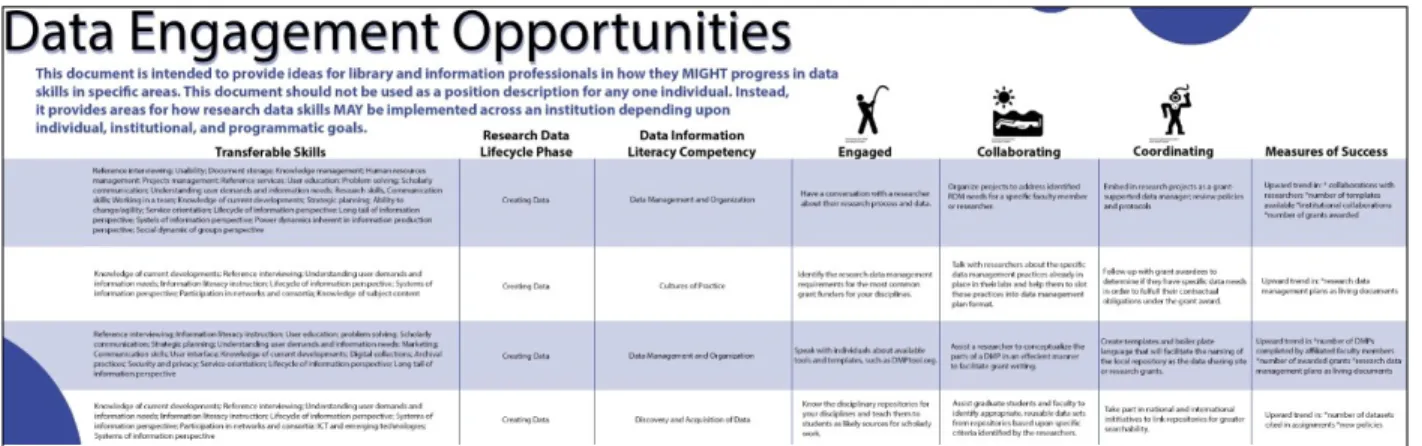
Building Your Research Data Management Toolkit: Integrating RDM into Your Liaison Work. The scaffold consists of five sections: transferable librarian skills, the research data life cycle stages, correlating data information literacy competencies; three levels of engagement activities; and measure of success. This matrix was devised so that each section would ground liaison librarians within their existing practice, research data management theory and best practice, and evidence-based librarianship. These sections assist liaison librarians in navigating between their current abilities and new information that is addressed in the Roadshow and in other RDM educational offerings. Each piece of the scaffold serves an entry point for users to navigate to research data management activities in which they could engage. The transferable skills were drawn from Gerolimos (2009), which is a list of qualifications and skills generated through a study of the curricula of 49 institutions granting LIS degrees. This list includes items such as liaison duties, collection development work, and reference interviewing. The purpose in including these was to identify the myriad strengths that liaison librarians may bring to research data management services and improve their confidence levels by bringing to light relevant pre-existing skills.
The research data life cycle was drawn from the U.K. Data Archives’ Research Data Lifecycle (2013). As many training programs for liaison librarians encourage familiarity with a research data life cycle and as it was part of the ACRL Roadshow curriculum, it was beneficial to reiterate where an RDM activity might fall in a researcher’s activities.
The DIL competencies were drawn from Carlson et al. (2011), one of the five competency lists published in the literature at the time the tool was developed. The five competency lists do not substantially deviate from each other. The Carlson et al. list is the most expansive of the existing lists and all of the other competency lists are subsumed within the Carlson et al list (Sapp Nelson 2017). Given the comprehensive nature of the list, the fact that one of the co-authors helped to create this list of 12 competencies, and the list of competencies is a tool that will be referred to in multiple ways throughout the ACRL Roadshow, they were included as a reference point for the Data Engagement Opportunities document to enable users to understand how the engagement technique might fit within an education paradigm.
The engagement opportunities were divided into three levels. Originally, these were intended to focus on skills that all liaison or subject librarians at an academic library might have, advanced skills for a liaison, and skills that might be specific to a focused data librarian. However, this did not allow for the myriad types of engagement seen at smaller institutions nor
The Data Engagement Opportunities Scaffold JeSLIB 2018; 7(2): e1128 doi:10.7191/jeslib.2018.1128 the progression of liaisons who have a variety of job responsibilities or interests in the data management skills arena. In consultation with a small institution advisory committee comprised of Kristin Partlo, Matt Schultz, Trevor Riley, and Aaron Albertson, we reframed these levels by potential depth of engagement—recognizing that institutions and individuals may be participating to different depths for each type of engagement. A given individual may aspire to primarily stay at a low level of engagement for one skill or they may wish to advance their skills from one column to another. By not limiting to titles, individuals may also identify where they have a deeper engagement or can make particular impact in an area that is of greater importance to their institution.
Ultimately, the levels were labeled Engaged, Collaborating, and Coordinating. These levels reflect that individuals are engaged in research data management, collaborating in research data management projects, or coordinating research data management services at a broader library or instructional level. Figure 1 provides an example of rows included in the scaffold. Due to ACRL’s copyright in the original piece, we cannot replicate the entire scaffold in this article; however, the full version may be viewed and downloaded on the ACRL Scholarly Communication Toolkit (http://acrl.libguides.com/scholcomm/toolkit/RDMWorkshop).
With the increasing requirements that libraries demonstrate the impact of services in higher education, it was useful to identify potential measures of success so as not to rely on vague notions of “more” or “better” (Hinchliffe, Oakleaf, and Davis 2010). The measures of success were intended as possible short-term activities which could be measured from year to year. (Crumley and Koufogiannakis 2002) These again will vary based on the number of librarians at an institution, the level to which they are engaged, and the responsiveness of the campus community. For example, while the creation of a data policy may be a particular measure for one year, it is unlikely that the policy will need to be recreated every year, and the measure may need to change to improving faculty compliance with the policy. Due to the variety of ways institutions could implement parts of the scaffold, long-term measures of success will need to be customized on an institutional basis.
Using the Scaffold
This scaffold is intended as a self-reflective tool for individuals. Individuals can develop a skills-improvement plan by identifying existing transferable skills that they have in the first column if they would like to enter research data services but don’t know how to get started.
If librarians are already involved in information literacy instruction but are unsure about how to integrate research data management instruction, they can scan down the transferable skills column for the term “Information Literacy Instruction” and look at the Engaged and Collaborating columns for ideas on getting started in data information literacy instruction.
If librarians are already engaged in research data management but need ideas for how to extend their work in the area, finding the rows that describe their current level of engagement and looking across to the Collaborating and Coordinating columns will give ideas for how to build skills or outreach programs that build on their current engagement. For data librarians who are looking to engage with liaison peers at their institution, using the Engaged and Coordinating columns may help provide context and scope of the data librarian’s role as well as identifying how RDM can fit into liaisons’ current workflow without a significant change in responsibilities.
For administrators, asking librarians to identify their current levels of engagement across the libraries will give a general perspective on available resources for programs and outreach as well as potential areas of need for staff development. A Word of Caution
A specific concern in the profession is the propensity of academic libraries to dump data services on an individual librarian, often a new hire, who is insufficiently supported. Job ads for new areas frequently are extended wish lists which even seasoned professionals cannot fully undertake (Library Loon 2016; Salo 2008). The Data Engagement Opportunities scaffold, therefore, is explicitly described as activities that a fully mature research data services department and engaged library comprised of multiple individuals of varying skills sets might offer, with multiple caveats that this document was never be intended and should not be used as a job ad for a single individual. While the authors recognize the presence of several such fully fledged data services departments, many libraries must work within their financial constraints and myriad obligations, and selective service targeting will continue to be a necessity.
Future Opportunities
The Data Engagement Opportunities scaffold moves the library profession forward in being able to strategically think about the array of skills that persons currently possess and how those skills can be retooled for research data services. Liaison librarians can use the scaffold in order to find a pathway between their current skills and their expertise in information science to engage with RDM. The flexibility of the scaffold and the levels of engagement allow librarians across a variety of institutions to target the needs of their specific population effectively. Where one library may choose to embrace a Coordinating Task to create a campus
The Data Engagement Opportunities Scaffold JeSLIB 2018; 7(2): e1128 doi:10.7191/jeslib.2018.1128 policy that impacts all faculty in one shot, another may choose to stay with Engaged tasks and implement teaching data set citation alongside citing books and scholarly articles.
The scaffold can also serve as guidance for pursuit of continuing education in RDM. Used in conjunction with professional development and the array of available research data management training tools available to the profession (Goben and Raszewski 2015), an individual or institution can begin to specifically direct their time and professional development to specific engagement activities.
Disclosure
The authors report no conflict of interest. References
Association of College and Research Libraries, Megan Sapp Nelson and Abigail Goben. 2016. “Data Engagement Opportunities Scaffold.” Association of College and Research Libraries.
https://acrl.libguides.com/scholcomm/toolkit/RDMWorkshop
Calzada Prado, Javier, and Miguel Ángel Marzal. 2013. “Incorporating Data Literacy into Information Literacy Programs: Core Competencies and Contents.” Libri 63(2): 123-134. https://doi.org/10.1515/libri-2013-0010 Carlson, Jacob, Michael Fosmire, C.C. Miller, and Megan Sapp Nelson. 2011. “Determining Data Information Literacy Needs: A Study of Students and Research Faculty.” Portal: Libraries and the Academy 11(2): 629-657.
http://doi.org/10.1353/pla.2011.0022
Cox, Andrew, Eddy Verbaan, and Barbara Sen. 2012. “Upskilling Liaison Librarians for Research Data Management.” Ariadne issue70. http://www.ariadne.ac.uk/issue70/cox-et-al
Crumley, Ellen and Denise Koufogiannakis. 2002. “Developing Evidence-Based Librarianship: Practical Steps for Implementation” Health Information and Libraries Journal 19(2): 61-70.
http://doi.org/10.1046/j.1471-1842.2002.00372.x
Frank, Emily P. and Nils Pharo. 2016. “Academic Librarians in Data Information Literacy Instruction: A Case Study in Meteorology.” Oslo and Akershus University College Open Digital Archive. http://hdl.handle.net/10642/3470 Gerolimos, Michalis. 2009. “Skills Developed through Library and Information Science Education.” Library Review 58(7): 527-540. https://doi.org/10.1108/00242530910978217
Goben, Abigail and Rebecca Raszewski. 2015. “Research Data Management Self-Education for Librarians: A Webliography.” Issues in Science and Technology Librarianship Fall 2015. https://doi.org/10.5062/F4348HCK
Hinchliffe, Lisa J., Megan Oakleaf, and Mary Ellen Davis. 2010. “The Value of Academic Libraries: Findings and Implications for the Profession.” In Proceedings of the 2010 Library Assessment Conference: Building Effective, Sustainable, Practical Assessment, Baltimore, Maryland, October 24-27, 2010, 485-498. Washington, DC: Association of Research Libraries. https://www.libqual.org/publications
Library Loon. 2016. “The Hybrid Job.” Gavia Libraria (the Library Loon).Published March 25.
https://gavialib.com/2016/03/the-hybrid-job
Piorun, Mary E., Donna Kafel, Tracey Leger-Hornby, Siamak Najafi, Elaine R. Martin, Paul Colombo, and Nancy R. LaPelle. 2012. “Teaching Research Data Management: An Undergraduate/Graduate Curriculum.” Journal of eScience Librarianship 1(1): e1003. https://doi.org/10.7191/jeslib.2012.1003
Qin, Jian, and John D’ignazio. 2010. “The Central Role of Metadata in a Science Data Literacy Course.” Journal of Library Metadata 10(2-3): 188-204. https://doi.org/10.1080/19386389.2010.506379
Raboin, Regina, Rebecca Reznik-Zellen, and Dorothea Salo. 2012. “Forging New Service Paths: Institutional Approaches to Providing Research Data Management Services.” Journal of eScience Librarianship 1(3): e1021. https://doi.org/10.7191/jeslib.2012.1021
Salo, Dorothea. 2008. “Innkeeper at the Roach Motel.” Library Trends 57(2): 98-123.
http://doi.org/10.1353/lib.0.0031
———. 2010. “Retooling Libraries for the Data Challenge.” Ariadne issue64. http://www.ariadne.ac.uk/issue64/salo
Sapp Nelson, Megan. 2017. “A Pilot Competency Matrix for Data Management Skills: A Step toward the Development of Systematic Data Information Literacy Programs.” Journal of eScience Librarianship 6(1): e1096. https://doi.org/10.7191/jeslib.2017.1096
Schneider, René. 2013. “Research Data Literacy.” In ECIL 2013: Worldwide Commonalities and Challenges in Information Literacy Research and Practice, edited by Serap Kurbanoğlu, Esther Grassian, Diane Mizrachi, Ralph Catts, and Sonja Špiranec,134-140. Cham: Springer. https://doi.org/10.1007/978-3-319-03919-0_16 Shorish, Yasmeen. 2015. “Data Information Literacy and Undergraduates: A Critical Competency.” College & Undergraduate Libraries 22(1): 97-106. https://doi.org/10.1080/10691316.2015.1001246
UK Data Archive. 2013. “Research Data Lifecycle.” http://www.data-archive.ac.uk/create-manage/life-cycle
Van de Pol, Janneke, Monique Volman, and Jos Beishuizen. 2010. “Scaffolding in Teacher–Student Interaction: A Decade of Research.” Educational Psychology Review 22(3): 271-296. https://doi.org/10.1007/s10648-010-9127-6
Whitmire, Amanda. 2015. “Implementing a Graduate-Level Research Data Management Course: Approach, Outcomes, and Lessons Learned.” Journal of Librarianship and Scholarly Communication 3(2): p.eP1246.
https://doi.org/10.7710/2162-3309.1246
Zilinski, Lisa, Abigail Goben, and Kristin Briney. 2016. “Going Beyond the Data Management Plan.” In The Medical Library Association Guide to Data Management for Librarians, edited by Lisa Federer, Chapter 10. Lanham, MD: Rowman and Littlefield. https://rowman.com/ISBN/9781442264267