Teaching and Learning in a Digital Context Higher Education in Transformation Conference, Ontario, 2016
2016
Developing Learning Communities in Fully Online Spaces:
Developing Learning Communities in Fully Online Spaces:
Positioning the Fully Online Learning Community Model
Positioning the Fully Online Learning Community Model
Todd Blayone
University of Ontario Institute of Technology, [email protected]
Roland van Oostveen
University of Ontario Institute of Technology, [email protected]
Wendy Barber
University of Ontario Institute of Technology, [email protected]
Maurice DiGiuseppe
University of Ontario Institute of Technology, [email protected]
Elizabeth Childs
Royal Roads University, [email protected]
Follow this and additional works at: https://arrow.tudublin.ie/heit162
Part of the Higher Education Commons
Recommended Citation Recommended Citation
Blayone, T., van Oostveen, R., Barber, W., DiGiuseppe, M., & Childs, E. (2016, November 2-6). Developing Learning Communities in Fully Online Spaces: Positioning the Fully Online Learning Community Model. Paper presented at the Higher Education in Transformation Symposium, Oshawa, Ontario, Canada. Retrieved from [hyperlink]
This Conference Paper is brought to you for free and open access by the Higher Education in Transformation Conference, Ontario, 2016 at ARROW@TU Dublin. It has been accepted for inclusion in Teaching and Learning in a Digital Context by an authorized administrator of
ARROW@TU Dublin. For more information, please contact [email protected],
[email protected], [email protected].
This work is licensed under a Creative Commons Attribution-Noncommercial-Share Alike 3.0 License
Developing Learning Communities in Fully Online Spaces: Positioning the Fully Online Learning Community Model
Todd Blayone Roland van Oostveen
Wendy Barber Maurice DiGiuseppe
University of Ontario Institute of Technology
Elizabeth Childs Royal Roads University
Presented at the Higher Education in Transformation Symposium November 2 - 4, 2016 in Oshawa, Ontario, Canada
Abstract
The Fully Online Learning Community (FOLC), developed at the University of Ontario Institute of Technology (UOIT), is a social-constructivist model, addressing a paradigm shift in
employment skills, and supporting key elements of transformational learning. Adopting a Problem-based Learning (PBL) approach to activity design, FOLC has served as basis for both undergraduate and graduate, fully online degree programs for almost a decade. In this time, it has demonstrated its ability to facilitate richly collaborative, socially cohesive, and
constructively critical, learning communities supported by a flexible array of synchronous and asynchronous digital affordances.
FOLC represents a “divergent fork” of the Community of Inquiry (CoI) design to foreground the synergistic dynamics of social and cognitive presence, the role of professional educators as co-learners, the community-oriented nature of knowledge construction, the mediating role of digital competence and open technologies in fully online learning, and the transformational potential of democratized communication and assessment practices. Having positioned FOLC conceptually, a developing research agenda, aimed at grounding the FOLC on a broader body of empirical data, is presented. The underlying argument is that rich, transformative learning communities can be established in fully online programs, and these communities can have a significant democratizing effect on participants and the broader social context.
Keywords: fully online learning community, social-constructivist, digital, inquiry, cognitive, presence, empirical, data
Developing Learning Communities in Fully Online Spaces: Positioning the Fully Online Learning Community Model
Introduction
Online learning is a fast-growing phenomenon. Allen and Seaman (2014) report that in the U.S. in 2013, approximately 33% of higher education students took at least one online
course. In Canada, Contact North, a Government of Ontario funded, non-profit organization lists just over 20,000 online courses available through the province’s colleges and universities
(Contact North, 2016).
Online learning is also richly heterogeneous. Blendedorhybrid models ask participants to complete some tasks using online tools in addition to attending in-class lectures or tutorials.
Fully online programs do not require participants to be on campus for course-related purposes, except by choice to use extra-curricular resources. Instead, individuals build friendships,
establish learning communities, share feelings and experiences, collaborate in solving problems, engage in debate, and publish multi-media artifacts in a shared “digital space” using a variety of synchronous and asynchronous affordances. Among fully online programs and models
themselves, some focus on supporting individualized modes of learning with optional forms of cooperation (Dalsgaard & Paulsen, 2009; Paulsen, 2003, 2008). Others emphasize transactional learning in which social interaction and collaboration is essential for combating confirmation bias and building socially meaningful knowledge (Garrison, 2016; Garrison & Archer, 2000).
The Fully Online Learning Community (FOLC) model (Childs, van Oostveen, Flynn, & Clarkson, 2015) was developed at the University of Ontario Institute of Technology (UOIT), a mid-sized, Canadian technology-oriented university. This transactional model originated as a modification of the Community of Inquiry (CoI) model (Garrison, Anderson, & Archer, 2000).
However, as we argue below, FOLC has evolved a distinct and progressive alternative to the CoI.
Why FOLC?
FOLC is a direct response to the limitations of distance learning, MOOCs and realist epistemologies (van Oostveen, DiGiuseppe, Barber, Blayone, & Childs, 2016). FOLC embraces the constructivist notion that reality, including virtual reality, is something that is created, rather than discovered (Johnson, 2014), and it incorporates the idea that communities are dynamic (not static) “co-creations.”
Focused on facilitating the development of critical thinking, problem-solving,
communication, creativity and collaboration skills in current online environments, FOLC also focusses on the development of 21st century competencies desired by (international and local)
economic and government organizations such as the World Economic Forum (2016), the
Conference Board of Canada (2016) and the Ontario Ministry of Advanced Education and Skills Development (2016). Importantly, FOLC’s activity, control and community orientations are also consistent with Human Rights Education (Tibbitts, 2005; Tibbitts & Kirchschlaeger, 2010); Social Justice Education (Grant & Gibson, 2013); and other forms of transformative, emancipatory, and socially-engaged learning. Several specific conditions fostering
transformative learning identified by Taylor (2007, 2008, 2016), and strongly aligned with FOLC, include:
• An environment that promotes a sense of safety, openness, and trust, encouraging the sharing of emotions as preparation for critical reflection.
• Activities that facilitate the exploration of divergent perspectives, problem solving, and critical thinking.
• A community that promotes each member’s sense of autonomy, engagement, and collaboration.
• The use of feedback, self-assessment, and self-dialogue that are used to assist the process of transformative learning.
FOLC’s emphasis on democratized learning processes is related to its use as the guiding model for a pilot, educational-transformation project in Ukraine. Highly collaborative and participatory learning is associated with higher levels of self-efficacy and greater levels of social engagement (Tibbitts & Kirchschlaeger, 2010), and these outcomes are coveted by many educators in transitioning economies.
Origins
FOLC originated as an offshoot of the CoI model, and as such, builds upon several shared foundations. Most importantly, FOLC, like the CoI, is a social-constructivist learning model addressing those processes considered central to deep learning. These processes are construed as interactions or transactions (Garrison, Anderson, & Archer, 2000) categorized by several presences. According to Richardson et al. (2012), the term “presence” highlights the essential quality of learning transactions as shared functions rather than exchanges involving specific actors (e.g., teacher, student), and it suggests a community-orientation in which participants share responsibility and control of the experience. In fact, this community
orientation to inquiry, well-articulated by Lipman (Lipman, 2003), sets FOLC and the CoI apart from generic e-learning models like that of Anderson (2004), which seek to be inclusive of all forms of distance education. It also places FOLC in tension with models that emphasize individual freedom and optional cooperation as core values (Dalsgaard & Paulsen, 2009; Paulsen, 2008) because these models view community discourse, often facilitated through synchronous online activity, as impinging upon the freedoms of individual learners.
Such tension springs directly from the foundations FOLC shares with the CoI, of which Dewey’s fusion of the personal and social dimensions of learning is central (Dewey, 1897). This fusion is well-developed in the work of Garrison (2011, 2016) who, as an expositor of Dewey,
explains that learning becomes meaningful when it builds directly on the experience and culture of an individual learner, and is encountered through personal reflection. Moreover, learning becomes worthwhile when it is expressed, submitted to processes of collaborative critical discourse (an essential aspect of personal cognitive development), and survives as a knowledge artifact deemed useful by a CoI.
Dimensions
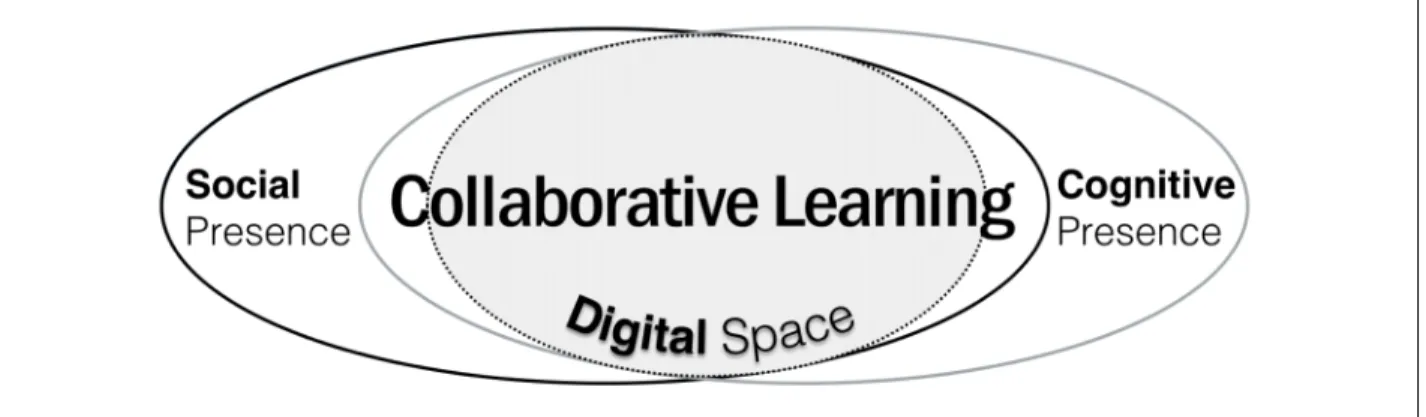
As an offshoot of the CoI, FOLC diverges in several ways. Firstly, although CoI theorizes a Social Presence (SP), Cognitive Presence (CP), and Teaching Presence (TP), FOLC incorporates SP and CP only (Figure 1 below). It subsumes TP fully within the other presences. This move, rooted in a democratized approach to learning, places greater emphasis on the community and the nurturing of learner empowerment and social engagement. Secondly, FOLC introduces the “digital space” as a dynamic, negotiated, contextual construct with potential to extend the scope and amplify the richness of SP and CP. Thirdly, FOLC is conceptually inclusive, explicitly incorporating several subsidiary models, which address additional “layers” of the learning experience (e.g., learning activities and goals, digital devices and competencies, responsibility and control, community formation and assessment).
To date, in the originating context of UOIT, the following sub-models have been used to enrich and adapt FOLC in specific contexts of practice and research:
• Problem and inquiry-based learning (Savin-Baden, 2000, 2007)
• General Technology Competency and Use (Desjardins, 2005; Desjardins, Lacasse, & Belair, 2001; Desjardins & van Oostveen, 2015)
• Teaching Learning Paradigm (Coomey & Stephenson, 2001; Layne & Ice, 2014)
• Community of Practice (Lave, 1991; Wenger, 1998; Wenger & Snyder, 2000)
Social Presence
Within CoI research, SP was conceptualized and empirically explored through discourse analysis of asynchronous (text-based) discussion transcripts. This methodology demonstrated the ability of text-based computer conferencing to support "affective interpersonal interactions," a sense of immediacy and group cohesiveness (Rourke, Anderson, Garrison, & Archer, 1999). SP was defined originally as “the ability of learners to project themselves socially and
emotionally in a community of inquiry” (Rourke et al., 1999) or as “real people” (with their full personality) through digital technology (Garrison et al., 2000). Subsequent research triggered a redefinition of SP as “the ability of participants to identify with the group or course of study, communicate purposefully in a trusting environment, and develop personal and affective relationships progressively by way of projecting their individual personalities” (p. 34). This
Figure 1. The Fully Online Learning Community Model.
The synergistic dimensions of the Fully Online Learning Community (FOLC) model are conceptualized as Social Presence (SP) and Cognitive Presence (CP) occurring primarily within a Digital Space comprised of
community-selected, asynchronous and synchronous affordances. Successful Collaborative Learning occurs at
the intersection of these dimensions as the learners develop their sense of community, and requisite digital competencies are applied to support critical inquiry. Recognizing that not all social and cognitive interactions are digitally mediated, even in fully online courses/programs, FOLC may be adapted to hybrid-learning environments by strategically resizing/repositioning the Digital Space in relation to SP and CP.
shifts emphasis from interpersonal relationships to the creation of a cohesive learning community.
FOLC finds conceptual alignment with the current CoI definition of SP. At the same time, the issue of whether learners in an online environment are perceived as “real”—based on the work of Gunawardena (1995)—continues to inform FOLC’s conceptualization and empirical exploration of SP (van Oostveen, Childs, Clarkson, & Flynn, 2015) because this perception is thought to influence the quality of relationships in a learning community.
Cognitive Presence
The CoI commits to an operationalization of CP using Dewey’s model of Practical Inquiry (Dewey, 1933). This four-phase model begins with a triggering event and subsequently moves through phases of exploration, integration, and resolution (Garrison, 2016). The key idea is that knowledge constructed in the mind must become a contestable external artifact, thus addressing confirmation bias (Garrison, 2016). This idea finds a conceptual analog in Popper’s cosmology in which World II objects (internal, individualistic schema) are translated into World III public thought products, so as to facilitate discussion and negotiation (Popper, 1978).
FOLC recognizes the merits of Dewey’s model, particularly the focus on rigorous inquiry, and the responsibility of every learner to transform potentially useful ideas into socially contestable knowledge. However, FOLC is more flexible regarding what specific sub-models a particular learning community may wish to incorporate. To date, FOLC learning communities have incorporated: (a) Popper’s Three Worlds model, which creates a conceptual space (“World Three”) for publically contestable knowledge artifacts; (b) the constructivism-informed Science & Technology Education framework (Bencze, 2008); and (c) Problem-based Learning models
and accompanying Problem-based Learning Objects (PBLOs) emphasizing the analysis of contexts rather than teacher-defined problems.
Digital Space
CoI views digital technologies and competencies as extraneous to the core model. It was thought that to include the digital context as a dimension would make the CoI model
unreasonably complex. FOLC resists this reduction, conceptualizing the digital space as a key sub-context for immersive online learning. According to FOLC, SP and CP cannot be fully conceptualized without considering the mediating influences of the digital space.
In FOLC learning environments, digital spaces are co-created by all members of a
learning community. Typically, within the ESDT program at UOIT, the learner/designer initially begins to define the space by posting videos (constructed as PBLOs) to YouTube and providing facilitated tutorial sessions in a browser-based, audio-video conferencing suite. Subsequently, when working collaboratively in small groups, Open Educational Resources (OER) and other web-based applications are chosen by the learners according to two specific principles: (a) resources used must be shareable, and (b) the URL for the site(s) must be provided to everyone in the learning community. The tools and applications selected incorporate a mixture of
synchronous and asynchronous environments (including creative synchronous/asynchronous merging), allowing for greater clarity and effectiveness of the interactions than can be achieved using asynchronous technologies alone (Trevino, Lengel, & Daft, 1987; Rockinson-Szapkiw & Wendt, 2015).
In particular, the use of a browser-based audio-video conferencing tool, in which each individual is represented by a “real time” (web-cam-generated) image, and by audio interactions through a microphone headset, provides a strong semblance of face-to-face interactions which
allow participants to “present themselves to others as real people” (Garrison et al., 2000). The use of visual cues, such as facial expressions and body language; audio cues from direct speech; and the incorporation of text-based backchannels allow for the promotion of SP, community, and ultimately, collaborative learning (Hrastinski, 2008; Rockinson-Szapkiw, Baker, Neukrug, & Hanes, 2010; Rockinson-Szapkiw & Wendt, 2015).
Importantly, FOLC’s digital space is an oftentimes unpredictable context for online learning. It is not a neutral space but rather a space inhabited by applications and platforms that shape interactions. Even platforms such as Facebook or LinkedIn may be chosen by learners owing to their level of comfort using the application. However, the discussion functionality was not designed for sustained collaborative inquiry, and therefore, limits are placed on CP. In a FOLC environment, this situation becomes a learning experience rather than a situation to be avoided.
Democratized Learning Melding of Roles
Bringing a sense of democracy to the digital class environment often challenges previous notions of what learning online can or should be. This requires adopting a shared collective identity, as learners become committed to rigorous forms of problem-solving and inquiry that are valued by the community as a whole. The FOLC model is based on the development of a
learning environment that (a) respects interpersonal relationships; (b) is able to provide critical feedback to community members; and (c) celebrates a diversity of opinion. The definitive power structure where a lecturer directs the class has been replaced with a collaborative approach where the learning “playing field” is levelled. Thus, students and instructors choose technology
resources that most benefit their learning, and the roles of teacher and student are regularly exchanged as each member of the community shares responsibility for providing feedback.
Problem based learning, authentic assessment, adult learning approaches, and opportunities for meaning-making provide a powerful combination of tools that online
instructors can use to facilitate the development of FOLC. These factors work together in the model to elicit a transformational effect between the nature of learning itself, the instructors’ role, and the learner’s evolution towards self-directed learning. Far from reforming students, who may then revert to past methods of learning, these four elements combine to change instructor/student roles, and shape learners’ development to take greater ownership for the learning, both as individuals and as a collective group. Learners begin to exhibit greater competence and confidence in using open source digital resources; need less direction from the instructor and become more engaged with their own learning.
Structure and Control
As individuals co-design their collaborative learning environment, there is an emphasis on personalizing the learning environment within the community. In this way, adults share both structure and control of the digital space, respecting diverse personal learning needs and working together to improve performance. Personalizing the learning environment also can allow for a sense of safety and trust from which critical feedback is welcomed and seen as a tool for challenging and improving thinking. Johnson and Liber (2011) discuss the importance of a personal learning environment which provides a “learner-driven model of education, where the traditional provider-centric of institutions is challenged,” and ascribe this importance to “the rise in personal technology, particularly the emerging situation where the power of personal
Given institutions are increasingly adopting a Bring your Own Device, (BYOD) policy, more responsibility is placed on the learner and less on the institution to provide “training” in particular digital tools. This mimics what happens in real world situations, where individuals learn what they need to know just-in-time by using the internet or other digital tools.
Authentic Activities
The FOLC learning environment requires that individuals take ownership of their learning and that they contribute to the group as well as engage with the chosen tasks.
Consequently, it is imperative that the learning activities are authentic. Herrington and Parker (2013) state that a pedagogical framework and learning environment within which authentic learning activities exist possess the nine parameters: (1) an authentic context (2) authentic tasks and activities (3) access to expert performances (4) multiple perspectives (5) collaboration (6) reflection (7) articulation (8) coaching and (9) authentic assessment (p. 610). Including students in the design and choice of learning activities allows the opportunity for autonomy,
independence, risk taking and collaboration with others. If students do not see their learning as having real world integrity, they tend to become disengaged. This is of particular concern in online environments, where students might otherwise become disinterested and feel isolated.
Flint and Johnson (2011) concur, and indicate that “if students do not see the relevance of a task, they get frustrated and annoyed” (p. 74). Thus, authentic learning activities are those that include students in selecting the technical tools they wish to employ and learn with; the ideas they want to discover; and the problems that are relevant to their real-world experiences. Chen, Wang, Yang, Lu, and Chang (2013) refer to a “digital playground” (p. 172), and they state that ideal and interactive learning activities have ten basic design elements including “real world relevance, ill-defined problems, sustained investigation, multiple perspectives, collaboration,
reflection, interdisciplinary perspectives, integrated assessment, polished products and multiple interpretations” (p. 173). These elements align well with Savin-Baden’s (2007) criteria for problem-based learning and the role of ill-structured problems in ideal learning situations. Assessment
FOLC encourages instructors to use more integrative assessment, and to include
assessment as a ubiquitous and seamless part of the learning process. When engaging in FOLC-structured environments, learners and instructor/facilitators not only co-design the digital learning space, but they also co-design the means, timing, methods and types of assessment that most accurately indicate learner success. As McCarthy (2013) states, “one of the distinctive characteristics of the millennial generation is the desire for continuous feedback and rewards for achievement, and they continue to seek feedback both in their studies and the workplace” (p. 81). McCarthy (2013) further indicates that instructors must “encourage students to take ownership of their own learning and to use each assignment to develop and grow” (p. 82). Thus, the design of assignments in learning modules requires learner input to have relevance and meaning. Co-developing assignments and success criteria address the principles for authentic assessment as discussed in Herrington and Herrington (1998) and the notion that instructors should consider “situated learning and the social context of assessment” (p. 306).
Furthermore, in terms of designing assignments and learning tasks, McCarthy (2013) further states:
Our assessments are designed not only to assess students’ learning but to encourage student learning, in other words assessments are not only intended to assess the standard which students have reached but form an integral part of the curriculum and learning experience. We do this by creating assignments which are relevant both to the
course content and to the workplace. We incorporate reflection in each assignment to ensure that students not only engage critically with the theory but understand how it applies in their own practice. (p. 83)
Thus, democratized learning environments need to be fundamentally based on key principles of adult learning (Mezirow, 1991; Knowles et al., 2005; McCarthy, 2010).
Community
“Community” is frequently encountered in the online-learning literature, but its meaning requires some unraveling. Veletsianos (2016) distinguishes between “groups,” “networks,” and “communities,” arguing that communities are made distinct by their focus on commitment, coherence and continuity. Jezegou (2010) argued that the CoI lacked sufficient theorization regarding its community construct. Garrison (2013) addressed this gap partly through the work of Rovai (2002a, 2002b), who finds that the most essential elements of community relate to mutual interdependence among members, connectedness, trust, interactivity, and shared values and goals. However, Garrison (2013) inserts pedagogic leadership as an essential force for creating meaningful, academic communities. This emphasis on directive leadership is aligned with CoI’s incorporation of TP, and is envisioned as a safeguard against low levels of
community criticality or “groupthink” (Garrison, 2016).
Although FOLC takes seriously a concern for criticality, it is also concerned with a latent colonial impulse built into the idea that meaningful learning requires leaders to enforce specific cognitive processes and educational values. Therefore, FOLC aligns itself with Rovai’s (2002a, 2002b) definition of a strong community, particularly its emphasis on sense of connection and low transactional distance. More specifically, in an effort to provide a clear and parsimonious
definition of its ideal organizational structure, FOLC incorporates the Community of Practice (CoP) as a sub-model. A CoP defines itself along three dimensions (Wenger, 1998):
• Joint enterprise understood and continually renegotiated by its members
• Relationships of mutual engagement
• Shared repertoire of resources that members enthusiastically share Research Agenda
To date, formal research related to the FOLC model has focused on (a) the effects of providing digital tools in the form of Tablet-PCs but without any direction regarding
development of competence or use (van Oostveen, Muirhead, & Goodman, 2011); (b) implementing PBL online in a Collaborative Online Learning Environment, the COLE
(Desjardins & vanOostveen, 2008a; Desjardins & van Oostveen, 2008b); (c) moving towards a definition of teacher professional development using Problem Based Learning Objects, PBLOs (van Oostveen, Desjardins, Bullock, DiGiuseppe, & Robertson, 2010); (d) integration of PBL into online courses and programs (van Oostveen, Childs, Flynn, & Clarkson, 2014); (e) faculty and student use of digital technologies (Desjardins & van Oostveen, 2015); (f) distributed community building in online courses (van Oostveen, Childs, Clarkson, & Flynn, 2015), and (g) digital learning and competencies across cultures (Blayone et al., 2016; Mykhailenko et al., 2016).
Going forward, four avenues of research have been articulated. The first relates directly to FOLC’s technology dimension: the digital space. In order to participate in the creation of the digital space, members of a FOLC community require the ability to conceptualize, access and effectively use available Web 2.0 and Web 3.0 applications to support collaborative learning. Bower (2015) suggests that professional educators often have a narrow conception of Web technologies and consequently, many promising applications are not appropriated as learning
tools. It is suspected that this is also the case for the broader community of learners. Therefore, this project will explore learner perceptions of the digital space in relation to collaborative learning, and work towards fuller conceptualization and operationalization of the digital space.
A second study in this group explores relationships between self-reported digital
competencies and observed performance based on several activity designs. The research focus is on gaining a richer understanding of the relationship between reported frequency of technology use and technology-related confidence, and the levels of skill and comfort demonstrated by individuals engaged in learning activities using a variety of digital devices.
Of course, the effective co-creation of a learning community in a digital space requires that all members achieve a functional level of digital competencies. Therefore, a third study will explore relationships between specific types and levels of competencies, and processes of
effective collaborative learning. Through a mixed-methods research design, the research team will seek to conceptualize “readiness to undertake an online course” (as described by the FOLC Model), and prototype “digital readiness” instruments that will be administered to students and professors at UOIT, and we expect, at partner institutions around the world.
A fourth avenue of inquiry leverages the extensive observational affordances of the Educational Informational Informatics Lab (EI LAB) to explore dynamics of SP in relation to community formation and development in FOLC-based learning. These investigations will focus on physical attributes of SP using both synchronous and asynchronous communication
modalities. These include the emotional content of our interactions, as communicated through facial expressions, body language, as well as words used within the context of the fully online courses.
Conclusion
The Fully Online Learning Community is a transactional model of digital learning built on extensive praxis and a growing body of empirical inquiry. Although originally derived from the CoI model, and sharing a collaborative-constructivist foundation, FOLC has moved in a number of divergent directions. Perhaps most importantly, it subsumes the CoI’s TP fully into the SP and CP as part of a broader effort to support a form of democratized learning that (a) decreases transactional distance, (b) build community, and (c) in line with a constructivist epistemology, refuses to privilege particular experiences in pursuit of meaningful and socially-useful knowledge. Beyond this, it recognizes the digital context (and related competencies) as endogenous variables vital to the successful functioning of a fully online community.
Of course, FOLC remains a dynamic conjecture and the subject of ongoing empirical research. FOLC researchers continue to explore synergies with models aligned with its foundations. In this regard, the work of Gilly Salman (2013) on “e-tivities” provides praxis-oriented insights that have not yet been formally incorporated. The recent efforts of others to explore contextual reformulations (Armellini & De Stefani, 2015) and cross-model “mash-ups” (Layne & Ice, 2014) using the richly generative CoI model are also noted.
References
Allen, I.E. & Seaman, J. (2014). Grade change: Tracking online education in the United States. Retrieved from http://www.onlinelearningsurvey.com/reports/gradechange.pdf
Armellini, A., & De Stefani, M. (2015). Social presence in the 21st century: An adjustment to the Community of Inquiry framework. British Journal of Educational Technology.
doi:10.1111/bjet.12302
Anderson, T. (2004). Towards a theory of online learning. Theory and practice of online learning, 2, 15-44.
Bencze, J.L. (2008). Science & Technology Learning Cycles: Teaching & learning based on constructivist learning principles. Retrieved from
http://webspace.oise.utoronto.ca/~benczela/Constructivist_SandTed.html#ConstructivistEd_ Model
Blayone, T., Mykhailenko, O., vanOostveen, R., Grebeshkov, O., Hrebeshkova, O., &
Vostryakov, O. (2016). Surveying digital competencies of university students and professors in Ukraine for transformative online learning. Manuscript submitted for publication.
Chen, G., Wang, C., Yang, S/, Lu, W & Chang, C. (2013). Digital learning playground: supporting authentic learning experiences in the classroom. Interactive Learning Environments, 21(2), 172-183. doi:10.1080/10494820.2012.705856
Childs, E., vanOostveen, R., Flynn, K. & Clarkson, J. (2015, March). Community building in online PBL courses: Instigating criticality. A paper presented at the Higher Education in Transformation Symposium, Dublin, Ireland.
Coomey, M. & Stephenson, J. (2001). Online learning: It is all about dialogue, involvement, support and control – according to the research. In Stephenson, J. (Ed.) Teaching and learning online: Pedagogies for new technologies (pp. 37-52). London: Kogan Page. Conference Board of Canada (2016). Employability Skills 2000+. Retrieved from
http://www.conferenceboard.ca/topics/education/learning-tools/employability-skills.aspx Contact North (n.d.). Database of online courses in Ontario. Retrieved from http://studyonline.ca/ Dalsgaard, C., & Paulsen, M. F. (2009). Transparency in cooperative online education. The
International Review of Research in Open and Distributed Learning, 10(3). doi:10.19173/irrodl.v10i3.671
Desjardins, F. J. & vanOostveen, R. (2015, June). Faculty and student use of digital technology in a “laptop” university. Paper presented at the Ed-Media 2015 World Conference on Educational Media and Technology, Montreal, Quebec, Canada.
Desjardins, F. J. & vanOostveen, R. (2008a). Implementing PBL online as a collaborative learning strategy for teachers: The COLE. In Proceedings of The Eleventh IASTED International Conference on Computers and Advanced Technology in Education, Crete, Greece.
Desjardins, F. J. & vanOostveen, R. (2008b). Collaborative Online Learning Environment: Towards a process driven approach and collective knowledge building. In Proceedings of the Ed-Media Conference on Education Multimedia, Hypermedia & Telecommunications, Vienna, Austria, p. 2563-2570.
Dewey, J. (1897). My pedagogical creed. School Journal, 54(3), 77-80.
Dewey, J. (1933). How we think, a restatement of the relation of reflective thinking to the educative process. Boston: D.C. Heath
Edmundson, A. (Ed.) (2007). Globalized e-learning cultural challenges. Hershey, PA: Information Science Publishing.
eWeek.com (2015). How the skills gap is threatening the growth of app economy. Retrieved from http://www.eweek.com/developer/slideshows/how-the-skills-gap-is-threatening-the-growth-of-app-economy.html
Flint, N.R.A. & B. Johnson (2011). Towards fairer university assessment” recognizing students’ concerns. Abingdon: Routledge.
Garrison, D. R. (2011). E-learning in the 21st century: A framework for research and practice
(2nd ed.). New York: Taylor & Francis.
Garrison, D. R. (2016). Thinking collaboratively: Learning in a community of inquiry. New York: Routledge.
Garrison, D. R., Anderson, T., & Archer, W. (2000). Critical inquiry in a text-based environment: Computer conferencing in higher education. The Internet and Higher Education, 2(2), 87-105. doi:10.1016/s1096-7516(00)00016-6
Goodfellow, R., & Lamy, M.-N. (2009). Learning cultures in online education. London, UK: Continuum.
Grant, C. A., & Gibson, M. L. (2013). “The path of social justice”: A human rights history of social justice education. Equity & Excellence in Education, 46(1), 81-99.
doi:10.1080/10665684.2012.750190
Gunawardena, C. N. (1995). Social presence theory and implications for interaction and collaborative learning in computer conferences. International Journal of Educational Telecommunications, 1(2/3), 147-166.
Gunawardena, C. N., Wilson, P. L., & Nolla, A. C. (2003). Culture and online education. In M. G. Moore & W. G. Anderson (Eds.), Handbook of distance education (3rd ed., pp. 753-775). Mahwah, New Jersey: Lawrence Erlbaum Associates.
Herrington, J. & Herrington, A. (1998). Authentic assessment and multi-media: how university students response to a model of authentic assessment. Higher Education Research & Development, 17(3), 305-322. doi: 10:1080/0729436980170304
Herrington, J. & Parker, J. (2013). Emerging technologies as cognitive tools for authentic learning. British Journal of Educational Technology, 44(4), 607-615.
Hofstede, G. (2001). Culture's consequences: Comparing values, behaviors, institutions and organizations across nations (Second ed.). London: Sage Publications.
Jézégou, A. (2010). Community of Inquiry in e-learning: A critical analysis of the Garrison and Anderson model. International Journal of E-Learning & Distance Education, 24(3), 1-12. Johnson, M. & Liber, O. (2008). The Personal Learning Environment and the human conditions:
from theory to teaching practice, Interactive Learning Environments, 16(1), 3-15. Kearney, M., Schuk, S., Burden, K. & Aubusson, P. (2012). Viewing mobile learning from a
pedagogical perspective. Research in Learning Technology, 20(14406). doi:10.3402/rlt.v2010.14406
Knowles, M.S., E.F. Holton III, et al. (2005). The adult learner. San Diego, CA: Elsevier. Lave, J., & Wenger, E. (1991). Situated learning: Legitimate peripheral participation. New
York: Cambridge University Press.
Layne, M., & Ice, P. (2014). Merging the best of both worlds: Introducing CoI-TLP model. In B. Sutton & A. Basiel (Eds.), Teaching and learning online: New models of learning for a connected world (Vol. 2, pp. 3-20). New York: Routledge.
Lehman, R.M. & Conceição, S.C.O. (2014). Concerns and Opportunities for Online Student Retention. In Lehman, R.M. & Conceição, S.C.O. Motivating and retaining online students: Research-based strategies that work. San Francisco: Wiley & Sons.
McCarthy, G. (2010). Virtual teams, eLearning and developing coaches. Paper presented at the 4th Australian Conference on Evidence-Based Coaching. Sydney.
McCarthy, G. (2013). Authentic assessment – key to learning. In E. Doyle, P. Buckley & C. Carroll (Eds.), Innovative Business School Teaching – Engaging the Millennial Generation
(pp. 81-92 ). United Kingdom: Routledge.
Mezirow (1991). Transformative dimensions in adult learning. San Francisco:CA: Jossey-Bass Miller, M.D. (2014). Minds online: Teaching effectively with technology. Cambridge
Massachusetts: Harvard University Press.
Moore, M.G. (1993). Theory of transactional distance. In Keegan, D. (Ed.) Theoretical principles of distance education. New York, NY: Routledge.
Mykhailenko, O., Blayone, T., & VanOostveen, R. (2016, October). Exploring democratized learning and dimensions of culture for educational transformation in Ukraine. Paper presented at the RIDRU Conference Higher Education Reforms in Post-Maidan Ukraine, Alberta, Canada.
Ontario Ministry of Advanced Education and Skills Development (2016). Essential Employability Skills. Retrieved from
http://www.tcu.gov.on.ca/pepg/audiences/colleges/progstan/essential.html
Paulsen, M. F. (2008). Cooperative online education. Seminar.net: International Journal of Media, Technology and Lifelong Learning, N(N), 1-20.
Richardson, J. C., Arbaugh, J. B., Cleveland-Innes, M., Ice, P., Swan, K. P., & Garrison, D. R. (2012). Using the community of inquiry framework to inform effective instructional design. In L. Moller & J. B. Huett (Eds.), The next generation of distance education: Unconstrained learning (pp. 97-125). New York: Springer-Verlag.
Rourke, L., Anderson, T., Garrison, D. R., & Archer, W. (1999). Assessing social presence in asynchronous text-based computer conferencing. Journal of Distance Education, 14(2), 50-71.
Rovai, A. P. (2002a). Building sense of community at a distance. The International Review of Research in Open and Distributed Learning, 3(1), 1-16. doi:10.19173/irrodl.v3i1.79 Rovai, A. P. (2002b). Sense of community, perceived cognitive learning, and persistence in
asynchronous learning networks. The Internet and Higher Education, 5(4), 319-332. doi:10.1016/s1096-7516(02)00130-6
Savin-Baden, M. (2000). Problem-Based Learning in higher education: Untold stories. Philadelphia, PA: Open University Press.
Savin-Baden, M. (2007) "Challenging models and perspectives of problem-based learning." In De Graaff, E. & Kolmos, A. (Eds.) Management of change: Implementation of problem-based and project-problem-based learning in engineering (pp. 9-30). Rotterdam, The Netherlands: Sense Publishing.
Taylor, E. W. (2007). An update of transformative learning theory: A critical review of the empirical research (1999–2005). International Journal of Lifelong Education, 26(2), 173-191. doi:10.1080/02601370701219475
Taylor, E. W. (2008). Transformative learning theory. New directions for adult and continuing education, (119), 5-15.
Taylor, E. W. (2016). Teacher transformation: a transformative learning perspective. Italian Journal of Educational Research (15), 17-26.
The Conference Board of Canada. (2016). Employability Skills 2000+. Retrieved from http://www.conferenceboard.ca/Libraries/EDUC_PUBLIC/esp2000.sflb
Tibbitts, F. (2005). Transformative learning and human rights education: Taking a closer look.
Intercultural Education, 16(2), 107-113. doi: 10.1080/14675980500133465
Tibbitts, F., & Kirchschlaeger, P. G. (2010). Perspectives of research on human rights education.
Journal of Human Rights Education, 2(1), 8-29.
vanOostveen, R. (2013). Bachelor of Arts in Educational Studies and Digital Technology Handbook, Version 1, July 9, 2015. Unpublished manuscript.
vanOostveen, R., Childs, E., Clarkson, J. & Flynn, K. (2015, June). Becoming close with others online: Distributed community building in online PBL courses. Paper presented at EdMedia 2015 World Conference on Educational Media and Technology, Montreal, Quebec, Canada. vanOostveen, R., Childs, E., Flynn, K. & Clarkson, J. (2014, July). Integration of PBL
methodologies into online learning course and programs. Paper presented at IADIS e-Learning 2014 Conference, Lisbon, Portugal.
vanOostveen, R., Desjardins, F., Bullock, S., DiGiuseppe, M. & Robertson, L. (2010). Towards a reconceptualization of online teacher professional learning: Problem-based learning objects (PBLOs). In Proceedings of the Ed-Media Conference on Education Multimedia,
Hypermedia & Telecommunications, Toronto, ON.
vanOostveen, R., DiGiuseppe, M., Barber, W., Blayone, T., & Childs, E. (2016, June). New conceptions for digital technology sandboxes: Developing a Fully Online Learning
Communities (FOLC) model. Paper presented at EdMedia 2016 World Conference on Educational Media and Technology, Vancouver, B.C., Canada.
vanOostveen, R., Muirhead, W. & Goodman, W. (2011). Tablet PCs and reconceptualizing learning with technology. Interactive Technology and Smart Education, 8(2), 78-93. doi: 10.1108/17415651111141803
Veletsianos, G. (2016). Digital learning environments. In N. Rushby & D. Surry (Eds.), Wiley
Handbook of Learning Technology (pp. 242). Oxford, UK: John Wiley & Sons.
Watts, Mike. The science of problem solving: A practical guide for science teachers. London: Cassell, 1991.
Wenger, E. (1998). Communities of practice: Learning as a social system. Systems Thinker, 9(5), 2-3.
Wenger, E. C., & Snyder, W. M. (2000). Communities of practice: The organizational frontier.
Harvard Business Review, 78(1), 139-146.
World Economic Forum (2016). The 10 skills you need to thrive in the Fourth Industrial Revolution. Retrieved from http://www.weforum.org/agenda/2016/01/the-10-skills-you-need-to-thrive-in-the-fourth-industrial-revolution