Biodiversity and ecosystem
functioning in angiosperm
communities in the Baltic Sea
This PhD-thesis describes the effects of submerged plant diversity on ecosystem functioning in angio-sperm communities in the Baltic Sea. It shows that diverse plant communities sustain higher primary production than comparable monocultures, affect faunal communities positively and enhance stabil-ity. Thus, diverse meadows add to coastal ecosystem functioning and may provide with services essential for human well-being.The author graduated from Gymnasiet Lärkan, Helsingfors, in 2001. She received her MSc in Environ-mental Biology from Åbo Akademi University in May 2008. Since June 2008, she has been working as a PhD-student at Åbo Akademi University.
Camilla Gustafsson
Biodiversity and ecosystem
functioning in angiosperm
communities in the Baltic Sea
Camilla Gustaf sson | Biodiv ersit y and ecosyst em func tioning in ang iosper
m communities in the Baltic S
ea | 2013
ISBN 978-952-12-2840-7 © C. Gustafsson, Painosalama Oy, Åbo 2013
Biodiversity and ecosystem
functioning in angiosperm
communities in the
Baltic Sea
Camilla Gustafsson
Environmental and Marine Biology
Department of Biosciences
Åbo Akademi University
Åbo, Finland, 2013
Supervisor
Docent Christoffer Boström Åbo Akademi University
Environmental and Marine Biology Biocity, Artillerigatan 6
20520 Åbo, FINLAND
Reviewer
Professor J. Emmet Duffy
The College of William and Mary
School of Marine Science & Virginia Institute of Marine Science Gloucester Point, VA 23062-1346, USA
Reviewer
Professor Veijo Jormalainen University of Turku
Department of Biology Section of Ecology 20014 Turku, FINLAND
Opponent
Associate Professor Birgit Olesen Aarhus University
Department of Bioscience, Plant Biology Ole Worms Allé 1
8000 Aarhus C, DENMARK
Author’s address
Åbo Akademi University
Environmental and Marine Biology Biocity, Artillerigatan 6
20520 Åbo, FINLAND
e-mail: [email protected]
© Camilla Gustafsson 2013 ISBN 978-952-12-2840-7
Electronic version: https://www.doria.fi/handle/10024/87827 Painosalama Oy
“We take a tiny colony of soft corals from a rock in a little water world. And that isn’t terribly im-portant to the tide pool.
Fifty miles away the Japanese shrimp boats are dredging with overlapping scoops, bringing up tons of shrimps, rapidly destroying the species so that it may never come back, and with the species destroy-ing the ecological balance of the whole region.
That isn’t very important in the world.
And thousands of miles away the great bombs are falling and the stars are not moved thereby. None of it is important or all of it is.”
The biological variation in nature is called biodiversity. Anthropogenic pressures have led to a loss of biodiversity, alarming scientists as to what consequences declin-ing diversity has for ecosystem functiondeclin-ing. The general consensus is that diversity (e.g. species richness or identity) affects functioning and provides services from which humans benefit.
The aim of this thesis was to investigate how aquatic plant species richness and identity affect ecosystem functioning in terms of processes such as primary produc-tion, nutrient availability, epifaunal colonization and properties e.g. stability of
Zos-tera marina subjected to shading. The main work was carried out in the field and
ranged temporally from weeklong to 3.5 months-long experiments. The experimental plants used frequently co-occur in submerged meadows in the northern Baltic Sea and consist of eelgrass (Z. marina), perfoliate pondweed (Potamogeton perfoliatus), sago pondweed (P. pectinatus), slender-leaved pondweed (P. filiformis) and horned pond-weed (Zannichellia palustris).
The results showed that plant richness affected epifaunal community variables weakly, but had a strong positive effect on infaunal species number and functional diversity, while plant identity had strong effects on amphipods (Gammarus spp.), of which abundances were higher in plant assemblages consisting of P. perfoliatus. De-pending on the starting standardizing unit, plant richness showed varying effects on primary production. In shoot density-standardized plots, plant richness increased the shoot densities of three out of four species and enhanced the plant biomass produc-tion. Both positive complementarity and selection effects were found to underpin the positive biodiversity effects. In shoot biomass-standardized plots, richness effects on-ly affected biomass production of one species. Negative selection was prevalent, counteracting positive complementarity, which resulted in no significant biodiversity effect. The stability of Z. marina was affected by plant richness in such that Z. marina
growing in polycultures lost proportionally less biomass than Z. marina in monocul-tures and thus had a higher resistance to shading. Monoculture plants in turn gained biomass faster, and thereby had a faster recovery than Z. marina growing in polycul-tures. These results indicate that positive interspecific interactions occurred during shading, while the faster recovery of monocultures suggests that the change from shading stress to recovery resulted in a shift from positive interactions to resource competition between species.
The results derived from this thesis show that plant diversity affects ecosystem functioning and contribute to the growing knowledge of plant diversity being an im-portant component of aquatic ecosystems. Diverse plant communities sustain higher primary productivity than comparable monocultures, affect faunal communities posi-tively and enhance stability. Richness and identity effects vary, and identity has gen-erally stronger effects on more variables than richness. However, species-rich com-munities are likely to contain several species with differing effects on functions, which renders species richness important for functioning. Mixed meadows add to coastal ecosystem functioning in the northern Baltic Sea and may provide with ser-vices essential for human well-being.
Key words: Species richness, species identity, primary production, selection effect, comple-mentarity, angiosperm assemblage, multitrophic effects, resistance, recovery, Baltic Sea
Sammanfattning
Biologisk mångfald eller biodiversitet innefattar den naturliga variation som finns från molekylära skalor till landskap. På grund av antropogena effekter har förlusten av biologisk mångfald ökat och samtidigt också oron över hur detta påverkar ekosy-stem och kopplingen till ekosyekosy-stemfunktioner. Diversitet (t.ex. artantal eller artsam-mansättning) anses allmänt påverka ekosystemfunktioner och således även förse människan med ekosystemtjänster.
Syftet med denna avhandling var att studera hur akvatiska växters artantal och art-sammansättning påverkar ekosystemprocesser såsom primärproduktion, kolonisering av epifauna och ekosystemegenskaper såsom stabilitet hos Zostera marina under skuggning. Delarbetena bestod av fältexperiment (1 vecka till 3,5 månad långa). Växtarterna som användes i experimenten; ålgräs (Z. marina), ålnate (Potamogeton
perfoliatus), borstnate (P. pectinatus), trådnate (P. filiformis) och hårsärv (
Zannichel-lia palustris) är vanligt förekommande arter i undervattensängar i norra Östersjön.
Resultaten visar på att växtartantal endast hade svaga effekter på samhällsvariabler hos epifauna men stor betydelse för antalet arter och funktionell diversitet hos in-fauna. Växtartsammansättningen däremot påverkade märlkräftors (Gammarus spp.) densitet som var högre i växtbestånd där P. perfoliatus förekom. Beroende på start-standardiseringsenheten så hade växtartantal olika effekter på primärproduktion. Då skottäthet användes som startstandardiseringsenhet, ökade växtartantalet på skottät-heten hos tre av fyra arter och även på växtbiomassaproduktionen. Positiva komple-mentaritets- och selektionseffekter var bakomliggande mekanismer som påverkade den positiva biodiversitetseffekten för biomassaproduktion. Då startbladbiomassan standardiserades påverkade artantal endast en arts biomassaproduktion. Positiv kom-plementaritet neutraliserades av negativ selektion och positiva biodiversitetseffekter kunde inte urskönjas. Växtartantalet påverkade stabiliteten hos Z. marina i och med
att Z. marina i flerartsbestånd förlorade mindre biomassa i proportion till Z. marina i
enartsbestånd och hade därmed en högre motståndskraft mot skuggning. Däremot så ökade Z. marina sin biomassa fortare i enartsbestånd än i flerartsbestånd och hade således en snabbare återhämtning efter skuggning. Resultaten tyder på att positiva mellanartsinteraktioner var rådande under skuggning men eftersom Z. marina åter-hämtade sig snabbare i enartsbestånd är det möjligt att mellanartskonkurrens domine-rade under återhämtningsperioden.
De erhållna resultaten visar att växtartsdiversitet är viktig för ekosystem och kopp-lingen till ekosystemfunktioner och de bidrar till den ökande kunskapen om växtarts-diversitet som en viktig komponent i akvatiska ekosystem. Artrika växtsamhällen upprätthåller en högre primärproduktion än jämförbara enartsbestånd, påverkar djur-samhällen positivt och ökar stabiliteten. Effekter av artantal och artsammansättning varierar dock och artsammansättningen påverkar fler variabler än artantal. Artrika bestånd innehåller emellertid sannolikt fler arter som kan upprätthålla flera funktioner och utgör därför också en viktig del i hur väl ekosystem fungerar. Undervattensängar med hög växtmångfald har en viktig roll i kustekosystemens koppling till funktioner i norra Östersjön. Således, kan de bidra till upprätthållandet av ekosystem-tjänster som är nödvändiga för människans välmående.
Nyckelord: Artantal, artsammansättning, primärproduktion, selektion, komplementaritet, frö-växtbestånd, multitrofiska effekter, motståndskraft, återhämtningsförmåga, Östersjön
Biodiversity and ecosystem functioning in angiosperm communities in the Baltic Sea 1
Contents
List of original papers ... 3
1. INTRODUCTION ... 5
1.1 Biodiversity and ecosystem functioning ... 6
1.2 Marine biodiversity and ecosystem functioning ... 7
1.2.1 The functioning of submerged plant communities ... 7
1.3 Interactions in plant communities ... 8
1.4 Aquatic plant communities in the Baltic Sea ... 9
1.5 Anthropogenic threats to benthic vegetation ... 9
1.6 Knowledge gaps ... 11
1.7 Aims of the thesis ... 11
2. MATERIALS AND METHODS ... 13
2.1 Study site ... 13
2.2 Experimental plant species ... 14
2.2.1 Zostera marina ... 15
2.2.2 Potamogeton perfoliatus ... 15
2.2.3 Potamogeton pectinatus ... 16
2.2.4 Potamogeton filiformis ... 16
2.2.5 Zannichellia palustris ... 17
2.3 Field and laboratory work ... 17
2.4 Data analysis ... 18
3. MAIN FINDINGS ... 21
3.1 Plant growth in species-rich plant assemblages ... 22
3.2 Effects of plant diversity on nutrient availability and resource use ... 23
3.3 Multitrophic responses to increasing plant diversity ... 23
3.4 Stability of Z. marina subjected to shading ... 24
4. DISCUSSION ... 25
4.1 Plant diversity and ecosystem functioning ... 25
4.1.1 Effects of plant diversity on plant-related processes ... 25
4.1.2 Effects of plant diversity on faunal communities ... 27
4.2 Diversity patterns in time ... 29
4.3 Food webs and plant community functioning ... 31
4.4 The future of angiosperm meadows in the northern Baltic ... 32
4.5 Issues in BEF research ... 33
5. CONCLUSIONS AND LOOKING AHEAD ... 34
References ... 38
Original publications (I-IV)………...53
Biodiversity and ecosystem functioning in angiosperm communities in the Baltic Sea 3
List of original papers
The thesis is based on the following articles, which are referred to by their Roman numerals in the text
I Gustafsson C & Boström C (2009) The effects of plant diversity and compo-sition on epifaunal colonization in brackish angiosperm assemblages. J Exp Mar Biol Ecol 382: 8-17
II Gustafsson C & Boström C (2011) Biodiversity affects ecosystem function-ing in aquatic angiosperm communities.Oikos 120:1037-1046
III Salo T, Gustafsson C & Boström C (2009) Effects of plant diversity on pri-mary production and species interactions in brackish water angiosperm com-munities. Mar Ecol Prog Ser 396: 261-272
IV Gustafsson C & Boström C Neighboring plants influence the stability of eelgrass (Zostera marina) subjected to shading. Manuscript.
The original papers have been reprinted with the kind permission of Elsevier (paper I), John Wiley and Sons (paper II) and Inter-Research Science Publisher (paper III).
Biodiversity and ecosystem functioning in angiosperm communities in the Baltic Sea 5
1. INTRODUCTION
In this thesis, the relationship between biodiversity and ecosystem functioning in aquatic angiosperm communities was investigated. Specifically, the ef-fects of plant species richness and iden-tity on ecosystem processes such as primary production, nutrient availabil-ity and epifaunal colonization were scrutinized. In addition, the stability of a plant species subjected to shading was studied. In the following summary biodiversity and ecosystem functioning is discussed, further addressing how this topic links to aquatic plant com-munity functioning in the Baltic Sea.
Biodiversity is defined as all natural variation within and among different biological levels ranging from mole-cules to biomes (Huston 1994). Thus, diversity components may include genes, traits, species or habitats, alt-hough research has mostly focused on species richness (Diaz & Cabido 2001), as it is a simple and convenient meas-ure of biodiversity (Tilman et al. 2001). Diversity can be divided into α diversi-ty, which is defined as local richness, for example populations in patches or communities within-habitats, β diversi-ty, which is the change in diversity in local populations or communities be-tween habitats, and γ diversity that in-corporates both α and β diversity and refers to regional diversity (Magurran 2004). Ecosystem functioning is de-fined as the “activities, processes, or properties of ecosystems that are influ-enced by its biota” (Naeem et al. 2002) with biota including all living things ranging from specific elements of di-versity to the complex web of biotic factors, such as species interactions and community structure. Often, ecosystem functions are defined as being
ecosys-tem processes that are stocks and fluxes of energy and material, e.g. biomass production, resource use and nutrient cycling, ecosystem properties such as stability of ecosystem processes and ecosystem values (goods and services) for example provisioning of food and climate regulation that are beneficial to humans (Naeem et al. 2002, Giller et al. 2004, Paterson et al. 2012).
The relationship between biodiversi-ty and ecosystem functioning is thought to result from species richness and identity effects (Hooper et al. 2005, Stachowicz et al. 2007). A richness effect can be observed as a polyculture performing better or worse than the average performance of its component species in monocultures and it can be divided into selection and complemen-tarity effects. The selection effect can be observed when species with a par-ticular trait or set of traits dominate a certain function through a selective process (Loreau 2000, Diaz & Cabido 2001), thus assuming that there is a positive relationship between competi-tive success and how dominantly spe-cies perform a process (Hooper et al. 2005). Complementarity effects consist of positive interactions between species such as facilitative mechanisms and resource partitioning (Loreau 2000). Resource partitioning may arise from the fact that a diverse community has a larger range of different traits that ren-ders it possible for species to be tempo-rally and spatially more efficient in their resource use (Diaz & Cabido 2001).
Identity (composition) effects occur when species assemblages with equal richness but differing composition, per-form differently (Stachowicz et al.
2007). Such effects may arise when a species drives a certain process due to a specific trait. For example, the N2
-fixing ability among legumes may in-crease the community biomass produc-tion (Hooper & Vitousek 1997, Mar-quard et al. 2009). Consequently, the presence of such species therefore af-fects a certain function to a greater ex-tent than species richness in itself (Benedetti-Cecchi & Maggi 2012).
One definition of ecosystem stabil-ity is that a system is stable if variables of interest return to an initial equilibri-um after a perturbation (Pimm 1984). Stability of ecosystem functioning can be measured in several ways and the most frequently measured are for ex-ample the variability in time (temporal stability) or resistance and recovery of processes to perturbations (Griffin et al. 2009). The impact of diversity on sta-bility may be mediated by positive in-teractions (Hughes & Stachowicz 2011) and facilitative mechanisms in particular, can be important in main-taining stability of individuals of spe-cies (Mulder et al. 2001).
1.1 Biodiversity and ecosystem func-tioning
In the early 1990s, the anthropogenical-ly induced global loss of biodiversity alarmed scientists because the conse-quences of such loss for ecosystem functioning were unknown. Thus, re-searchers from various ecological dis-ciplines begun collaborating, and an ecological paradigm on biodiversity and ecosystem functioning (BEF) was born (Naeem 2002, Cardinale et al. 2012).
Experimental findings from micro-cosms and grasslands showed that pri-mary production and nutrient
utiliza-tion were enhanced by increasing di-versity (Tilman et al. 1996, Hooper & Vitousek 1997). Theoretical work in-cluded mathematical models that ex-plained mechanistically how plant di-versity affects functioning in grassland communities (Tilman et al. 1997, Lo-reau 1998) and how diversity and eco-system stability is related (Doak et al. 1998). The stability-relationship was further examined and diversity was proposed to act as insurance in such that species redundancy increases the reliability of a community in case of disturbance or species loss when re-maining redundant species step up and continuously maintain a function or a process (Yachi & Loreau 1999).
Based on several reviews (Hooper et al. 2005, Balvanera et al. 2006, Cardi-nale et al. 2006, Worm et al. 2006), the conclusion is that biodiversity has posi-tive effects on processes such as prima-ry production and nutrient utilization but responses are variable and usually ecosystem- and disturbance-specific (Balvanera et al. 2006, Cardinale et al. 2011). Diversity also affects food web functioning, but depending on whether top-down or bottom-up mechanisms are considered, the effects are variable (Schmid et al. 2009). Regarding the relationship between biodiversity and stability properties (e.g. stability of ecosystem processes, see Giller et al. 2004), the evidence points to diversity enhancing the temporal stability of communities, while the stabilizing ef-fect of diversity on populations and on resistance and recovery is more equiv-ocal (Griffin et al. 2009). Gradually, the focus of research is switching from species and functional diversity to trait-based research and from within-trophic levels to multi-trophic studies that in-corporate diversity effects across
Biodiversity and ecosystem functioning in angiosperm communities in the Baltic Sea 7 trophic levels (Hector & Bagchi 2007,
Naeem et al. 2009a). So far, multifunc-tionality, which means that species provide multiple ecosystem processes simultaneously, has seldom been incor-porated in studies but has increasingly been highlighted as an essential part of future BEF research (Hector & Bagchi 2007, Naeem et al. 2009a).
1.2 Marine biodiversity and ecosys-tem functioning
The accelerating loss of key ecosys-tems and species in oceans has in-creased the demand for marine biodi-versity studies. After the beginning of the new millennium, BEF research in marine ecosystems increased (Covich et al. 2004, Worm et al. 2006, Stachow-icz et al. 2007) but to date, experi-mental marine BEF work still lags be-hind and only constitutes a fraction of the total number of studies (Schmid et al. 2009). Due to the different features of marine (aquatic) and terrestrial eco-systems such as greater openness be-tween and within habitats in terms of material and energy transport and the biogeochemical processes being more dynamic, it was previously believed that biodiversity and ecosystem func-tioning-relationships would also clearly differ between these systems (Giller et al. 2004). The present consensus is that despite the intrinsic differences be-tween terrestrial and aquatic environ-ments, similar processes underlie BEF relationships (Schmid et al. 2009).
Generalities derived from marine work show that diversity does affect ecosystem functioning but when sepa-rating the effects, richness effects are usually weak, while species identity is of greater importance (Stachowicz et al. 2007). According to Gamfeldt &
Bracken (2009), most marine BEF re-search has focused on consumers; per-haps the role of species identity has been emphasized because a few species such as habitat providers (foundation species) and keystone species have substantial effects on consumers in benthic ecosystems. However, as rich-ness effects become stronger on longer timescales via complementarity mech-anisms, generalities have been ques-tioned (Stachowicz et al. 2008), and an increasing need for longer-term exper-iments has arisen. High richness of di-versity entities also affects the stability of marine ecosystems and for example functional group richness enhances the recovery of macroalgal communities subjected to thermal stress (Allison 2004) and genotypic richness increases seagrass resistance and recovery to stress (Hughes & Stachowicz 2004, 2011, Reusch et al. 2005).
1.2.1 The functioning of submerged plant communities
Aquatic plants are considered to be ecosystem engineers because they modify their abiotic surroundings (Jones et al. 1997) and physically affect the environment by, for example, re-ducing current velocities, wave action and sediment resuspension (Gambi et al. 1990, Boström & Bonsdorff 2000, Madsen et al. 2001). In addition, they enhance biogeochemical processes such as O2-cycling, nitrification and
denitrification rates and thus enhance the biogeochemical cycling in vegetat-ed areas (Caffrey & Kemp 1990, 1991, Borum et al. 2006). Under a changing climate, seagrass beds in particular, have also been recognized as crucial CO2 sinks (Duarte et al. 2010,
Seagrasses and other aquatic plants add structural complexity to unvegetat-ed bottoms and increase the primary and secondary production (Duffy 2006, Warfe & Barmuta 2006) through provi-sioning of substratum for epiphytic growth and shelter for fauna (Orth et al. 1984, Duffy 2006). Diverse macro-phyte assemblages (plants and algae) are hypothesized to harbor high faunal diversity through the formation of structurally heterogeneous habitats (Stachowicz et al. 2007). Consequently, structurally complex habitats are likely to sustain high animal diversity by providing more vacant ecological nich-es to occupy (Parker et al. 2001, Warfe & Barmuta 2006). Structural compo-nents of plants e.g. plant biomass, root-rhizome density and shoot area affect the predation pressure and food availa-bility (Orth et al. 1984), as well as in-crease community attributes such as macroinvertebrate abundances (Warfe & Barmuta 2006, Boström et al. 2010). Complex aboveground plant morphol-ogy also increases the accumulation of drift algae (Bell and Hall, 1997) and may thus facilitate both faunal passive settlement and active colonization
(Holmquist 1994, Boström &
Bonsdorff 2000).
1.3 Interactions in plant communities
Aquatic plants frequently reproduce clonally and compared to terrestrial plants, they are more phenotypically plastic, which has lead to a wider array of structural modifications (Sculthorpe 1967, Kautsky 1988). The environ-mental variables affecting terrestrial and aquatic plant communities differ greatly; terrestrial plants are often wa-ter-limited or temperature-stressed, while light availability, nutrient
limita-tion and sediment condilimita-tions are more crucial for aquatic plants (Kautsky 1988). Therefore, many aquatic plants are shade-tolerant and adapted to anox-ic sediment conditions (Santamaría 2002). However, irrespective of the environment, plants compete for the same basic resources i.e. light, space and nutrients (Kautsky 1991).
Biotic interactions range from com-petitive to complementary mechanisms that often work simultaneously (Bert-ness & Callaway 1994, Holmgren et al. 1997, Brooker et al. 2008). As commu-nities are not static, both interactions and biodiversity-functioning relation-ships are likely to change in strength depending on time and scale for in-stance during different successional stages or in environments with varying productivity (Tilman 1993, Mouquet et al. 2003). In later successional stages diversity may decrease due to the com-petition of available resources and only a few dominating species persist (Mou-quet et al. 2003). However, after a per-turbation, competitive species are usu-ally absent, often due to trade-offs be-tween competitive ability and coloniza-tion rate (Tilman 1993) and pioneer species are able to colonize.
Interspecific competition is pro-posed to be more prevalent in produc-tive environments, whereas posiproduc-tive interactions, such as facilitation, in-crease in both frequency and strength when the physical environment be-comes harsher and disturbances like high grazing pressure or severe drought occur (Bertness & Callaway 1994, Mulder et al. 2001, Brooker et al. 2008). In harsh environments, positive interactions may include habitat ame-lioration by increasing the oxidization of anoxic sediments or by enhancing the nutrient availability and soil
moist-Biodiversity and ecosystem functioning in angiosperm communities in the Baltic Sea 9 ness (Brooker et al. 2008). Pioneer
spe-cies may also facilitate conditions pre-vailing in primary successional states enabling other species to colonize (Tilman 1993).
The strength of biotic interactions also depends on species traits. Compet-itive abilities can be enhanced by traits such as individual plant biomass and height (Gaudet & Keddy 1988, Kautsky 1991), while traits such as ni-trogen fixation ability can increase spe-cies complementarity through resource use (Diaz & Cabido 2001). How these traits are manifested depends on how plants respond to various abiotic and biotic factors i.e. how phenotypically plastic they are (Callaway et al. 2003). Neighboring species can have strong effects on trait plasticity (Callaway et al. 2003), and plastic traits such as re-source requirement and uptake (Berg & Ellers 2010), may allow species to co-exist in communities despite resource competition, thus leading to niche complementarity (Ashton et al. 2010). Traits that determine how a species interacts with its environment can be divided into response and effect traits (Violle et al. 2007) e.g. how tolerant a species is to shading or drought (re-sponse traits) and which traits in a spe-cies reflect its effects on ecosystem processes and properties (effect traits) (Diaz & Cabido 2001, Violle et al. 2007).
1.4 Aquatic plant communities in the Baltic Sea
The seagrass meadows in the Baltic Sea often occur as mixed communities with plant species of both marine and limnic origin (> 10 species) (Kautsky 1988). The high plant diversity makes them more analogous to tropical
mead-ows (Duarte 2000) than to temperate meadows that often consist of mono- or bicultures (Marbá et al. 1996, Duffy 2006).
In the Baltic Sea, only a few seagrass species occur, namely eelgrass
(Zostera marina), and widgeongrasses
(Ruppia cirrhosa, R. spiralis) but
whether Ruppia spp. are true seagrass species is unclear (den Hartog & Kuo 2006). Pondweeds (e.g. Potamogeton
perfoliatus, P. pectinatus, P. filiformis)
and horned pondweeds (Zannichellia
palustris, Z. major) are widespread and
often grow mixed with Z. marina and
Ruppia spp. These species differ in
their morphological and physiological characteristics (Kautsky 1988) leading to different life strategies ranging from fast-growing competitors (P.
perfolia-tus, P. pectinatus) to stress-tolerant
bi-omass storers (Z. marina) (Kautsky 1988). However, especially
Potamo-geton spp. are plastic and depending on
the exposure they can switch from a competitive to a more stress-tolerant strategy (Kautsky 1987). The different characteristics of the plants also affect interspecific interactions, and species having for example similar rooting depths may compete for nutrients and thus affect each other negatively. On the other hand, the large variation in the rooting depths of species may allow for a wider array of co-existing species and thus promote resource complemen-tarity (Kautsky 1991).
1.5 Anthropogenic threats to benthic vegetation
During the past decades, the Baltic Sea has become increasingly eutrophicated (Bonsdorff et al. 1997). The water transparency in coastal areas has signif-icantly decreased during the past 30
years, while the occurrence of cyano-bacterial and macroalgal blooms has increased (HELCOM 2009). The re-duced light attenuation has lead to se-vere light-limitation stress for benthic vegetation, and this has been especially noticeable in the changing depth limits of the belt-forming macroalgae, blad-derwrack Fucus vesiculosus (Torn et al. 2006). Historical data (pre-1950s, Bos-tröm & Bonsdorff 1997) on vascular plant distribution from the northern Baltic Sea are non-existing, but data on
Z. marina from the southern Baltic Sea
stretching from the early 20th century to
the millennia have shown that eutroph-ication has decreased the depth limits
of Z. marina as well, likely due to
re-duced light attenuation (Boström et al. 2003). The impact of reduced light at-tenuation has cascading effects on plants, affecting physiology, morphol-ogy and biogeochemistry (Fig. 1). For example, the photosynthetic capacity of plants is reduced, which further leads to decreased oxygen-flow from leaves to roots (Hemminga & Duarte 2000). Less oxygen transport in turn, can result in increasing root anoxia and sediment
sulfides (Hemminga 1998, Holmer & Laursen 2002) (Fig. 1). Not only re-duced light, but also the increasing amounts of loose-drifting macroalgal mats (Berglund et al. 2003) pose a seri-ous threat for submerged vegetation (den Hartog 1994, Hauxwell et al. 2001). These mats shade (Hauxwell et al. 2001, Rasmussen et al. 2012) and if thick enough (> 9 cm, Rasmussen et al. 2012) suffocate both benthic vegetation and fauna through hypoxia (den Hartog 1994, Norkko & Bonsdorff 1996). In addition to light-limitation, increasing concentrations of ammonium and ni-trite in the water column may pose a threat for aquatic vegetation (van Kat-wijk et al. 1997, Touchette & Burkholder 2007). Submerged plants may not have efficient nitrogen uptake regulation mechanisms in aboveground tissue (van Katwijk et al. 1997). As water column nitrogen concentrations increase, plants must use more carbon (i.e. carbohydrates) to assimilate the accumulated nitrogen and may eventu-ally become carbon-limited, which can ultimately lead to plant death (Touchette & Burkholder 2007).
Biodiversity and ecosystem functioning in angiosperm communities in the Baltic Sea 11
Fig. 1 A schematic picture of plant responses to light reduction. +/- sign denotes general increase/decrease in a varia-ble. Modified from Hemminga (1998). Plant drawing by Tracey Saxby (ian.umces.edu/imagelibrary/).
1.6 Knowledge gaps
BEF studies on marine benthic plant ecosystems to date are few and limited to a couple of studies conducted on seaweeds (Bruno et al. 2005, Boyer et al. 2009) and seagrass (Parker et al. 2001, genetic diversity: Hughes & Stachowicz 2004, Reusch et al. 2005). Thus, there is still a large knowledge gap in how plant diversity affects the functioning of submerged plant com-munities. Since most of the work con-cerning plants has been carried out in terrestrial settings, the question whether similar patterns found in terrestrial en-vironments can be observed in sub-merged grass meadows has risen. The fact that one of the most productive aquatic ecosystems, kelp forests, fre-quently occur as monospecific stands (Paine 2002) has also brought up the
question whether other aquatic macro-phyte communities function analogous-ly. With increasing anthropogenic pres-sures threatening marine plant commu-nities globally, gaining knowledge of their importance for coastal ecosystem functioning and furthermore for the provisioning of ecosystem services has become an important topic (Waycott et al. 2009). As the Baltic Sea plant meadows most often occur as multi-species assemblages they form a setting that enables experiments to test the re-lationship between plant diversity and ecosystem functioning in an aquatic ecosystem.
1.7 Aims of the thesis
To fill the abovementioned knowledge gaps, the main aim of this thesis was to investigate how aquatic plant diversity
Light reduction
Photosynthesis
Oxygen flow leaves to roots
Oxygen release roots to rhizosphere
Sediment sulfides
Root anoxia
Root sucrose depletion Leaf turnover
Leaf N Leaf sucrose depletion
affects ecosystem functioning in sub-merged plant communities in the north-ern Baltic Sea. The overall hypothesis was that plant species rich assemblages have a positive effect on ecosystem functioning. Functioning was measured as several ecosystem processes and as the stability of a plant species subjected to shading. Multitrophic effects of plant diversity, i.e. the influence of plant di-versity on epifaunal colonization and infaunal community structure were also investigated.
Specifically, the aims were to inves-tigate:
(1)Whether short-term epifaunal colo-nization, i.e. the abundance, biomass and diversity of epifauna was affected by plant species diversity (I).
(2) The effects of plant diversity on ecosystem processes (primary
produc-tion and nutrient availability) when standardizing experimental units by initial shoot density. The multitrophic effects of plant diversity, i.e. how plant diversity affected the community struc-ture and functional diversity of second-ary producers (macroinfauna) were also assessed (II).
(3) Plant diversity effects on primary production and nutrient availability when standardizing experimental units by initial aboveground biomass (III). (4) The influence of neighboring plants on the stability and performance (growth, physiology) of Z. marina sub-jected to shading (IV).
More specific aims and hypotheses are found in the published articles and manuscript.
Biodiversity and ecosystem functioning in angiosperm communities in the Baltic Sea 13
2. MATERIALS AND METHODS
2.1 Study site
The Archipelago Sea in the northern Baltic Sea, SW Finland, is character-ized by an extensive amount of islands and skerries (>25.000 islands, Granö et al. 1999) (Fig. 2). Especially in the middle and outer archipelago, the shores are often rocky but sandy beaches also occur. Aquatic vascular plants are common in shallow soft-bottomed inner archipelago areas, but also in sheltered and semi-exposed bays in the middle and outer archipela-go. The primary study site Fårö Island
(59° 55, 219’ N, 21° 47, 711’ E, WGS 84) is located in the transition zone be-tween the middle and outer archipelago (Fig. 2) with annual water temperatures ranging between 0–20°C, and salinity between 6–7 psu. The experimental area is semi-exposed with average wa-ter depths of 1.5 (I, II, III) – 2.0 m (IV). The nearshore area consists of a sandy, mostly unvegetated bottom with sediment dominated by fine (~ 70% 0.125 mm) and very fine (~5% 0.0062 mm) sand with low organic content.
Fig. 2.Map showing the Archipelago Sea, northern Baltic Sea with the red circle marking the experimental site (Fårö Island).
A seagrass meadow dominated by eel-grass Zostera marina (L.), perfoliate
pondweed Potamogeton perfoliatus
(L.) and sago pondweed Potamogeton
pectinatus (L.) grows from 2–5 m
depth, while stands of slender-leaved
pondweed Potamogeton filiformis
(Pers.) and horned pondweed
Zan-nichellia palustris (L.) grow both
with-in the meadow and as monospecific stands on bare sand. Patchy occurrenc-es of Eurasian water-milfoil
Myriophyl-lum spicatum L. and ditchgrass Ruppia
cirrhosa (Petagna) Grande are also
found within the meadow.
2.2 Experimental plant species
Five different vascular plant species were used; Z. marina, P. perfoliatus, P.
pectinatus, P. filiformis and Z.
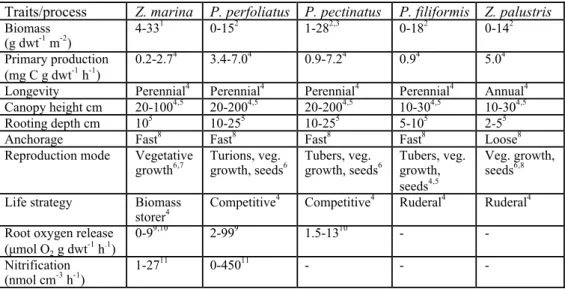
palus-tris, and all of them propagate through clonal growth in the northern Baltic Sea (Kautsky 1990). These plants were chosen because of their frequent co-occurrence within the depth interval 1-2 m across the study area (pers. obs.), their varying morphologies (Fig. 3), different biomass allocation strategies and productivity patterns (Kautsky 1988). By choosing plant species with such trait differences (Table 1) strong complementary and/or competition ef-fects were expected in II and III. Dif-ferences in above- and belowground structures were also expected to in-crease the structural diversity of mixed plant assemblages with possible posi-tive effects on colonizing epifauna and infauna (I, II).
Fig. 3. A polyculture plot consisting of Zostera marina (Zmar),Potamogeton perfoliatus (Pperf), Po-tamogeton pectinaus (Ppect) and Potamogeton filiformis (Pfil). The plant abbreviations mark each plant species.
Pperf
Ppect
Pfil
Biodiversity and ecosystem functioning in angiosperm communities in the Baltic Sea 15
Table 1. Trait differences among the experimental plant species and differences in provisioning of eco-system processes. Plant species: Zostera marina, Potamogeton perfoliatus, Potamogeton pectinatus, Potamogeton filiformis and Zannichellia palustris.
1Boström et al. 2004, 2Wallentinus 1979, 3Kautsky 1987, 4Kautsky1988, 5pers. obs., 6Kautsky 1990, 7Boström 1995, 8Idestam-Almquist 2000, 9Caffrey&Kemp 1991, 10Sand-Jensen et al. 1982, 11Caffrey&Kemp 1990
2.2.1 Zostera marina
Z. marina is a cosmopolitan marine
species found in temperate areas. In fully marine areas it often grows in mono- or bicultures (Hughes & Stachowicz 2004), but in the Baltic Sea it co-occurs with numerous limnic plant species (Kautsky 1988). In the south and southwestern parts of the Baltic, Z.
marina can be found in both exposed
and sheltered areas, but in the northern parts it is only found in exposed and semi-exposed sites (Baden & Boström 2001). Z. marina has an extensive root-rhizome mat that is used as anchorage (Kautsky 1988). Characteristic for north Baltic populations is the lack of sexual reproduction, i.e. Z. marina
mainly propagates clonally in this area (Boström 1995, Table 1) The above-ground morphology of Z. marina is simple with long ribbon-like leaves, while the belowground parts consist of
a structurally complex rhizome-root mat. It has relatively slower growth (see primary production-rates in Table 1) compared to more competitive spe-cies with high production rates such as
Potamogeton spp. (Table 1). In the
northern Baltic Sea, Z. marina has the lowest biomass values found through-out its range, which may be due to the low nutrient levels in the sediment (Boström et al. 2004, Baden et al. 2010), low availability of inorganic carbon (Hellblom & Björk 1999) or /and due to lower salinities than the salinity optimum of the species (Nejrup & Pedersen 2008).
2.2.2 Potamogeton perfoliatus
P. perfoliatus is a widely distributed
species of limnic origin but it survives in salinities up to 12 psu (Wallentinus 1979). In the Baltic Sea, it can be found from sheltered areas with low
Traits/process Z. marina P. perfoliatus P. pectinatus P. filiformis Z. palustris Biomass (g dwt-1 m-2) 4-33 1 0-152 1-282,3 0-182 0-142 Primary production (mg C g dwt-1 h-1) 0.2-2.7 4 3.4-7.04 0.9-7.24 0.94 5.04 Longevity Perennial4 Perennial4 Perennial4 Perennial4 Annual4 Canopy height cm 20-1004,5 20-2004,5 20-2004,5 10-304,5 10-304,5 Rooting depth cm 105 10-255 10-255 5-105 2-55 Anchorage Fast8 Fast8 Fast8 Fast8 Loose8 Reproduction mode Vegetative
growth6,7 Turions, veg. growth, seeds6 Tubers, veg. growth, seeds6 Tubers, veg. growth, seeds4,5
Veg. growth, seeds6,8 Life strategy Biomass
storer4 Competitive
4 Competitive4 Ruderal4 Ruderal4 Root oxygen release
(µmol O2 g dwt -1 h.1) 0-9 9,10 2-999 1.5-1310 - - Nitrification (nmol cm-3 h-1) 1-27 11 0-45011 - - - !
wave exposure (Kautsky 1988) to semi-exposed areas. It hibernates with win-tering organs, turions that originate from the rhizome (Wallentinus 1979). It reproduces both sexually and vegeta-tively (Table 1). The morphology of P.
perfoliatus consists of a robust rhizome
with numerous ramets (shoots) having alternate oviform leaves, but morpho-logical characteristics such as branch-ing and rhizome spacer length can vary widely depending on both abiotic and biotic factors (Wolfer & Straile 2004). The extensive rhizome may grow at >20 cm depth in the sediment (Table
1). P. perfoliatus is competitive, but it
may also be advantageous for neigh-boring plants due to its elevated capaci-ty of oxygen release to the rhizosphere, which further affects sediment nitrifica-tion- denitrification processes (Caffrey & Kemp 1990, Marbá et al. 2006, Ta-ble 1). Caffrey & Kemp (1991) showed that the oxygen content in porewater remains high 0.5 mm away from the rhizome and the oxic layer extends to 2 mm from the rhizome, while it only reaches ∼ 50 µm around roots of Z. ma-rina (Borum et al. 2006). Thus, dense stands of P. perfoliatus may oxidize large areas of the immediate rhizo-sphere.
2.2.3 Potamogeton pectinatus
P. pectinatus is a cosmopolitan
euryha-line species that is often found in brackish waters with its upper salinity tolerance around 15 psu (Wallentinus 1979). Similarly to P. perfoliatus, it hibernates as seeds and tubers (Kautsky 1990) and has various reproduction modes (Table 1). P. pectinatus has a robust rhizome with proportionally small roots (Kantrud 1990), but its
aboveground morphology is complex with several branching ramets growing from the rhizome. (Kautsky 1988). The leaves are linearly formed and narrow.
P. pectinatus is a phenotypically plastic
species that can shift its biomass allo-cation depending on abiotic factors such as wave exposure (Kautsky 1987, Idestam-Almquist & Kautsky 1995). Thus, when occurring in semi-exposed and exposed sites it allocates propor-tionally more biomass to its below-ground compartments (Kautsky 1987), which in turn may increase the oxygen release from rhizomes and roots (Sand-Jensen et al. 1982), and facilitate the anoxic circumstances found in bottom substrates.
2.2.4 Potamogeton filiformis
A small species found in the northern hemisphere that tolerates moderate sa-linities (≤8 psu, Kautsky 1988). It is more exposure-tolerant than the previ-ously mentioned Potamogeton spp. and mainly grows on stony or sandy sub-strate (Wallentinus 1979). P. filiformis
hibernates through the formation of tubers (Kautsky 1988) and it reproduc-es varyingly (Table 1). Morphological-ly it resembles P. pectinatus but it is smaller and more slender, having threadlike leaves and frail belowground parts that only penetrate the upper parts of the sediment (Table 1). It has rela-tively slow growth and low productivi-ty (Kautsky 1988, Table 1). Due to its shallower rooting depths compared to the other species mixed communities with P. filiformis may show for exam-ple comexam-plementary resource use (Kautsky 1991).
Biodiversity and ecosystem functioning in angiosperm communities in the Baltic Sea 17
2.2.5 Zannichellia palustris
Z. palustris is a euryhaline species that
occurs in large parts of the world from brackish to freshwater environments (den Hartog & Kuo 2006). It is a short-lived ruderal species (Table 1) that tol-erates disturbances such as ice and wave erosions by reproducing rapidly, shedding its seeds and dying (Kautsky 1988). Thus, it reproduces sexually, but during the growing season it also spreads laterally (Idestam-Almquist 2000, Table 1). Z. palustris is often a pioneer species on bare bottoms, where it modifies the habitat through particle trapping and possibly facilitates the succession of other species (Wallenti-nus 1979). It has numerous short shoots with threadlike leaves that rise from a slender rhizome and it is only loosely attached to the sediment (Table 1) mak-ing it susceptible to wind and wave erosion (Idestam-Almquist 2000). As
Z. palustris also has a shallow rooting
depth, mixed communities with this species may show complementary re-source use (Kautsky 1991).
2.3 Field and laboratory work
Field experiments were conducted to investigate how plant diversity affects different ecosystem processes in natu-ral settings by manipulating plant rich-ness and identity. Specifically, the re-search focused on how the faunal colo-nization was affected by varying plant diversity (I), and how primary produc-tion and nutrient utilizaproduc-tion was related to increasing plant diversity (II, III). In addition, the stability of Z. marina
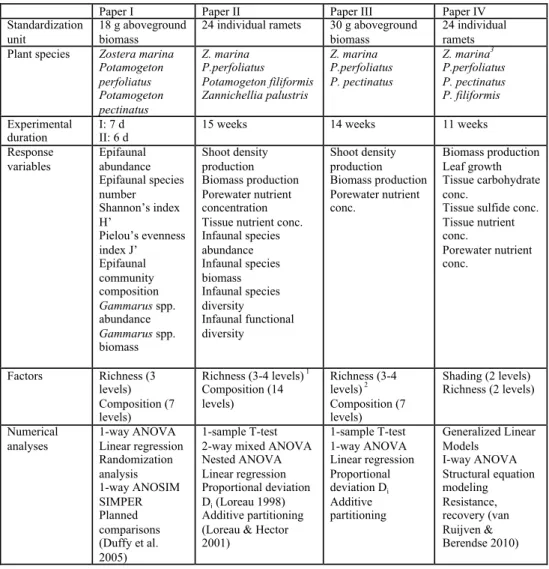
when subjected to shading was studied in field settings (IV) (Table 2).
All experimental units were stand-ardized according to a substitutive re-placement design (Harper 1977, Table
2). Plants were collected from a nearby meadow, kept submerged during the handling, tied to plastic grids and transplanted within six hours. The plants were tied to a grid in a non-random, spatially even pattern and to avoid groupings of the same species, neighboring plants were always heter-ospecific. The experimental units were then planted ∼ 5 cm deep into the sed-iment using SCUBA. The plots were positioned in a randomized block (I, II, III) or in a completely randomized de-sign (IV). In I, two experiments were carried out; the first in early July and the second in late August to capture temporal differences in epifaunal colo-nization. In IV, half of the plots were subjected to shading, which was done by installing shading screens (1m2) 60 cm above the sediment. The shading level was ∼ 90 % of ambient levels.
One month prior to the termination of the experiments in II and III, sedi-ment cores were sampled to analyze the sediment organic content. Porewater nutrients were also sampled before bi-omass harvesting in II, III and IV and analyzed for NH4+ and PO43- (II, III) in
a certified lab. In addition, water col-umn samples (total N and total P) were sampled during the experimental dura-tion.
At the termination of the experi-ments in II and III or at each sampling event (see Materials and Methods in
IV) all plant material (above- and be-lowground biomass) was harvested and plants of each species were cleansed, counted, divided into above- (shoots) and belowground biomass (roots, rhi-zomes) and dried to a constant weight (60°C, 48 h). The youngest parts of different plant compartments were sep-arated for CNP-determination (II, IV), total sulfur content and stable isotopic
composition (δ34S) (IV). Furthermore, to determine carbohydrate concentra-tions (IV), a whole shoot with attached rhizome and roots was separated, freeze-dried, ground to a fine powder and extracted for soluble sugars (su-crose).
In I, epifauna was sampled by en-closing whole plots in net bags, and fauna was sieved (0.5 mm), counted, identified and dried to constant weight (dwt, 60°C, 48 h). In II, infaunal cores were collected from plots simultane-ously with biomass harvesting. Sam-ples were sieved (0.5 mm), sorted and fauna was identified to the lowest taxo-nomical level. Animal biomass (dwt) was determined after drying (60°C, 48 h).
2.4 Data analysis
In II, III, IV the biomass production was calculated as the relative biomass change (dwt) from the experimental initiation to termination (II, III) or sampling events (IV) by converting percentage values to log-ratios. To par-tition diversity effects into richness and identity (I, II) planned comparisons (I) or nested ANOVA (II) were used (Ta-ble 2). Linear regression was used to explore the relationship between plant species richness and response variables (I, II, III) (Table 2). In addition, the multivariate tests ANOSIM and SIM-PER were utilized in I to describe dif-ferences in epifaunal community com-position. Response variables in IV
showed both normal and gamma distri-butions and generalized linear models that allow for other probability distribu-tion types (Quinn & Keough 2002) were used to investigate the effects of shading on response variables (Table 2). Models with lower deviance values
were chosen and the goodness-of-fit was assessed by checking for AIC and AICC (Norušis 2010). The models were based on the Maximum-Likelihood Method and the hypothesis testing on the Wald χ2-test. Normally
distributed variables with heterogene-ous variances were tested in a 2-way heterogeneous variance model (Littell et al. 2006). Based on lower goodness-of-fit statistics (AIC, AICC) and signif-icantly smaller -2 Residual Log Likeli-hood-values, heterogeneous variance models were chosen over the original model (Littell et al. 2006).
To investigate how shading and plant richness affected the performance (growth, physiology) of Z. marina and how different responses were causally related in IV, structural equation mod-eling (SEM) was conducted (Grace 2006). First, a null model was built without pathways, where after paths were added one at a time. After gaining a model with high fit, it was trimmed to the most parsimonious model by re-moving pathways based on a χ2-test and
by comparing goodness-of-fit values (Grace 2006). Statistical analyses were performed on SPSS 13.0, 19.0, Amos 19.0, Primer 6.1.6 and SAS 9.2.
To assess plant performance, pro-portional deviations, Di, of plant
spe-cies’ yield from expected values were calculated (Loreau 1998) (II, III) and to partition net biodiversity effects, the additive partitioning method by Loreau & Hector (2001) was used (II, III, Ta-ble 2). Both calculations were based on the above- and belowground and total biomass production. In the additive partitioning method, the expected yields of species in polycultures are compared to observed yields of species in polycultures. The expected values are derived from monoculture yields.
Biodiversity and ecosystem functioning in angiosperm communities in the Baltic Sea 19 The method identifies to what extent
complementarity and selection effects underlie a net biodiversity effect and all mechanisms can be either positive or negative (Loreau & Hector 2001), e.g. a positive net effect implies that the production is higher in polycultures than expected from the production in monocultures. In IV, the stability of Z.
marina subjected to shading was
as-sessed by calculating the resistance to shading and recovery after shading
(van Ruijven & Berendse 2010) (Table 2) when growing in mono- and poly-cultures, respectively.
To investigate how plant diversity affected the functions of the infaunal community, species were divided into functional groups (Pearson & Rosen-berg 1987) (II). Species were classi-fied according to their feeding habit, feeding mode and mobility type.
Table 2. Summary of the experimental settings of the different field experiments and the numerical anal-yses of results from papers I-IV
1 = 3 (plant responses), 4 (infauna, porewater nutrients), 2 = 3 (plant responses), 4 (porewater nutrients), 3 = responses measured of this species
!
Paper I Paper II Paper III Paper IV
Standardization unit
18 g aboveground biomass
24 individual ramets 30 g aboveground biomass
24 individual ramets Plant species Zostera marina
Potamogeton perfoliatus Potamogeton pectinatus Z. marina P.perfoliatus Potamogeton filiformis Zannichellia palustris Z. marina P.perfoliatus P. pectinatus Z. marina3 P.perfoliatus P. pectinatus P. filiformis Experimental duration I: 7 d II: 6 d
15 weeks 14 weeks 11 weeks
Response variables Epifaunal abundance Epifaunal species number Shannon’s index H’ Pielou’s evenness index J’ Epifaunal community composition Gammarus spp. abundance Gammarus spp. biomass Shoot density production Biomass production Porewater nutrient concentration Tissue nutrient conc. Infaunal species abundance Infaunal species biomass Infaunal species diversity Infaunal functional diversity Shoot density production Biomass production Porewater nutrient conc. Biomass production Leaf growth Tissue carbohydrate conc.
Tissue sulfide conc. Tissue nutrient conc. Porewater nutrient conc. Factors Richness (3 levels) Composition (7 levels) Richness (3-4 levels) 1 Composition (14 levels) Richness (3-4 levels) 2 Composition (7 levels) Shading (2 levels) Richness (2 levels) Numerical analyses 1-way ANOVA Linear regression Randomization analysis 1-way ANOSIM SIMPER Planned comparisons (Duffy et al. 2005) 1-sample T-test 2-way mixed ANOVA Nested ANOVA Linear regression Proportional deviation Di (Loreau 1998) Additive partitioning (Loreau & Hector 2001) 1-sample T-test 1-way ANOVA Linear regression Proportional deviation Di Additive partitioning Generalized Linear Models I-way ANOVA Structural equation modeling Resistance, recovery (van Ruijven & Berendse 2010)
Biodiversity and ecosystem functioning in angiosperm communities in the Baltic Sea 21
3. MAIN FINDINGS
Plant richness and identity both affect-ed the functioning of angiosperm communities and for most ecosystem processes, the effects were positive (Fig. 4). Some response variables e.g. total shoot density of plots, amphipod population structure and plant commu-nity biomass production were strongly affected by the identity of plants (I, II, III), while plant richness was of more importance for the individual shoot
densities of species and for the struc-tural and functional diversity of infau-na (II). Plant diversity (not separated into richness or identity effects) also had a positive effect on the resistance
of Z. marina to shading (IV). The
re-sults demonstrate that both plant rich-ness and identity have important ef-fects on plant community functioning and both play a role in maintaining these processes
Fig. 4. Effects of plant diversity (richness or identity or both) on ecosystem processes and properties. + = significantly positive effect, - = significantly negative effect, ns = non-significant. Stability refers to resistance to shading of Zostera marina growing in polycultures (IV). Epifaunal abundance only showed a significantly positive relationship to plant richness during one time event (August, see Fig. 1 in I). Plant species in the drawing represent Z. marina, Potamogeton perfoliatus, P. pectinatus and Zannichel-lia palustris. Plant and animal drawings from www. ian.umces.edu/imagelibrary/.
Epifauna: abundance (+/ns) diversity (-) amphipods (+) Infauna: abundance (ns) species number (+) functional diversity (+) Nutrient availability (-) Primary production: shoot density (+)
3.1 Plant growth in species-rich plant assemblages
The investigated plant species showed varying effects on increasing plant di-versity. Depending on whether the standardized start unit was above-ground biomass or shoot density, the additive partitioning of diversity mech-anisms revealed that the net biodiversi-ty effects differed in strength (Fig. 5).
When initial starting biomass was used as a standardization unit (III), negative selection effects were preva-lent, counteracting the positive com-plementarity effects resulting in no sig-nificant net effects (Fig. 5a,b). Based on biomass production, plant species performance (Di) showed positive
val-ues for some treatments but the signifi-cance disappeared after correcting for multiple comparisons (see Table 3 in
III). In general, richness effects were species-specific, affecting biomass and vegetative propagule production of on-ly specific species, while species iden-tity affected total community perfor-mance and e.g. Z. marina increased both the belowground and the total bi-omass production in plant assemblages (III).
In II, three of four investigated plant species had a higher change in
shoot densities in polycultures com-pared to monocultures. Thus, richness had strong effects on the species-specific ramet production, while the total shoot density in plots was deter-mined by species identity. However, richness did not enhance the change in above- and belowground biomass pro-duction of individual species. Never-theless, when pooling bi- and triculture biomasses, both complementarity and selection effects lead to significantly positive net effects in tricultures (Fig. 5d). Based on biomass production, the individual species performed different-ly (Di) and Z. marina showed a
signifi-cantly better performance, while the performance of Z. palustris was lower than expected (see Table 2 in II). P.
perfoliatus also showed positive values
but these differences became borderline significant after correcting for multiple comparisons. The significant values indicated that Z. marina and P. perfoli-atus to some extent benefited from growing with heterospecifics, while the opposite was true for Z. palustris. Pos-sibly, some of the species had higher production in polycultures than ex-pected because of less competition among heterospecifics compared to conspecifics.
Biodiversity and ecosystem functioning in angiosperm communities in the Baltic Sea 23
Fig. 5. Additive partitioning of aboveground, belowground and total biomass production in the biomass standardized experiment (III) in (a) bicultures and (b) tricultures and in the shoot density standardized experiment (II) in (c) bicultures and (d) tricultures. Asterisks denote significant deviations from 0 (p < 0.016, corrected for multiple comparisons), while asterisks in parentheses show borderline significant differences (0.05 < p > 0.016) after multiple comparisons.
3.2 Effects of plant diversity on nu-trient availability and resource use
The porewater NH4+ availability
de-creased with increasing richness, sug-gesting that the resource uptake was more efficient in diverse plant assem-blages (II). However, the relationship was curvilinear and the lowest average nutrient concentration was found in bicultures (Fig. 4 in II). Despite a cur-vilinear relationship in III, the lowest nutrient availability was found in mon-ocultures, thus implying that plant richness had no clear effect on the sed-iment ammonium concentrations (Fig. 7 in III). The PO43- -availability did not
decrease with richness in either study, though there was a decreasing trend in porewater concentrations in II.
For three of four plant species, the leaf tissue became more depleted in nutrients (N, P) with increasing rich-ness, suggesting less available nutrients for the plants. The leaf tissue of Z. ma-rina, however, showed an opposite pat-tern, and increased in N and P with in-creasing richness (II), suggesting that nutrients became more available for this species with increasing richness.
3.3 Multitrophic responses to in-creasing plant diversity
Plant richness weakly affected epifau-nal community variables and showed strong temporal variability. The epifau--0.5 0.0 0.5 1.0 1.5 B io d iv e rs ity e ffe ct s iz e (*) (c)
Aboveground Belowground Total -0.5
0.0 0.5 1.0 1.5 (*) * * (d)
Aboveground Belowground Total
-4 -2 0 2 4 6 8 B io d iv e rs ity e ffe ct s iz e
Complementarity Selection Net effect (a) (*) * * * * -4 -2 0 2 4 6 8 (b) (*) (*)
nal community composition did not vary between treatments but differed temporally and two dominating taxa;
Cerastoderma glaucum and Hydrobia
spp., contributed most to the temporal dissimilarity (17% and 13 % respec-tively). In general, epifaunal diversity (H’) decreased with increasing rich-ness. This was mainly due to the nu-merical domination by the two above-mentioned taxa during each experiment (>80 %, see Table 2 in I). In July, the colonization study coincided with the settlement of C. glaucum and in Au-gust, faunal abundances were dominat-ed by Hydrobia spp. (see Fig. 2 in I). Total abundance showed a positive trend in July and increased in August (Fig. 1 in I). In contrast to plant rich-ness and community variables, plant identity had strong effects on amphi-pods (Gammarus spp.), of which abun-dances were higher in plant assemblag-es with P. perfoliatus (see Fig. 4 and Table 4 in I).
Infaunal abundance and biomass were unaffected by plant richness and identity, but total species and taxon richness increased with increasing plant richness (Fig. 5a in II). Likewise, the total number of functional groups re-sponded to plant richness, having high-er numbhigh-er of functional groups present in bicultures compared to monocultures (11 % increase). The average number of species and taxa per functional group ranged from 1.38 in unvegetated treatments to 1.46 in bi- and tricultures, with no significant differences between treatments (nested ANOVA: species richness F3,60 = 1.21, p > 0.05, species
identity F12,60 = 0.65, p > 0.05). This
was incorrectly shown in Fig. 5c in II
(erratum Fig. 5c in beginning of II), which in fact shows the sum of species and taxa representing functional
groups. The sum of species and taxa increased with plant richness in such that the pool of species and taxa com-prising the functional groups found was higher in polycultures than monocul-tures. The sum of species and taxa was higher than the total species and taxon richness because some species repre-sented several functional groups (e.g.
Macoma baltica, which is both a
sus-pensivore and a surface-feeding detri-vore). As plant richness did not in-crease the average number of species and taxa per functional group, infaunal species redundancy was not enhanced. Hypothetically, this could occur when increasing plant richness would support a higher infaunal diversity, and thus increase the chance of more species belonging to the same functional groups
3.4 Stability of Z. marina subjected to shading
Z. marina grown in both mono- and
polycultures lost biomass during shad-ing (Fig. 3 in IV) but in mixed assem-blages Z. marina had a greater re-sistance to shading than monoculture plants. However, after a recovery time of 4 weeks, the monoculture plants had gained biomass faster, i.e. their recov-ery was faster than the recovrecov-ery of pol-yculture plants (Fig. 4 in IV). Shading reduced plant carbohydrate contents in both diversity treatments by 80-95 % (Fig. 5 in IV). However, the recovery to pre-shading levels was discernible after 4 weeks, suggesting that the plants recovered fast from shading.
The SE model demonstrated that shading affected several response vari-ables both directly and indirectly, while plant richness only had a direct effect on root sulfide content (Fig. 6 in IV).