2014
Farm to School programs: is there a connection to
the implementation of wellness policies at the
elementary school building level?
Lynn HeussIowa State University
Follow this and additional works at:https://lib.dr.iastate.edu/etd
Part of theHuman and Clinical Nutrition Commons, and thePublic Policy Commons
This Thesis is brought to you for free and open access by the Iowa State University Capstones, Theses and Dissertations at Iowa State University Digital Repository. It has been accepted for inclusion in Graduate Theses and Dissertations by an authorized administrator of Iowa State University Digital Repository. For more information, please [email protected].
Recommended Citation
Heuss, Lynn, "Farm to School programs: is there a connection to the implementation of wellness policies at the elementary school building level?" (2014).Graduate Theses and Dissertations. 13981.
policies at the elementary school building level? by
Lynn Heuss
A thesis submitted to the graduate faculty
in partial fulfillment of the requirements for the degree of MASTER OF ARTS
Major: Political Science Program of Study Committee: David Peterson, Major Professor
Mariana Medina Catherine Strohbehn
Craig Chase
Iowa State University Ames, Iowa
TABLE OF CONTENTS
ACKNOWLEDGEMENTS iii
LIST OF FIGURES iv
ABSTRACT v
CHAPTER 1: INTRODUCTION 1
CHAPTER 2: REVIEW OF LITERATURE 7
School Local Wellness Policy 9
Farm to School 19
Connection between Farm to School and School Local Wellness Policy 29
CHAPTER 3: METHODOLOGY 34
Survey Instrument and Procedure 34
Measures and Data Analysis 35
Demographic Information 36
CHAPTER 4: RESULTS AND DISCUSSION 42
CHAPTER 5: CONCLUSION 49
REFERENCES 52
APPENDIX A: INSTITUTIONAL REVIEW BOARD 56
EXEMPTION LETTER
APPENDIX B: ONLINE STATE ELEMENTARY SCHOOL 57
PRINCIPAL SURVEY
APPENDIX C: WELLNESS POLICY TEMPLATE 63
ACKNOWLEDGEMENTS
I want to thank my committee chair, David Peterson, for his incredible patience and ability to encourage me to maintain perspective through the entire thesis process. I also want to thank my committee members, Mariana Medina, Catherine Strohbehn and Craig Chase, for their guidance, support and contributions throughout the course of this research. In addition, thank you to Chelsea Lepley, for her help with the editing and formatting that made this a much better project.
Finally, thanks to my co-workers, friends, family and partner, Paul, for their interest, encouragement, and consistent reminders that there was not only a tunnel with a light at the end, but a road to follow after getting through the tunnel.
LIST OF FIGURES
Figure 1. Local School Wellness Policies (LWP): Comparison Chart
of 2004 vs. 2010 Requirements 2-3
Figure 2. Ethnicity of Respondents 37
Figure 3. Age of Respondents 37
Figure 4. Number of Years as Principal 37
Figure 5. Respondents School Location by City Size (Graph) 38 Figure 6. Respondents School Location by City Size (Chart) 38
Figure 7. Iowa Cities by Size 39
Figure 8. Student Body Size of Respondent Schools 39
Figure 9. Size of Respondents’ School District 40
Figure 10. Size of Iowa School Districts 40
Figure 11. Percentage of Free and Reduced Lunches in Respondents’
Schools for 2013-14 41
Figure 12. Percentage of Free and Reduced Lunches in Iowa Schools
For 2013-14 41
Figure 13. School Local Wellness Policy Assessment Team 46 Figure 14. Farm to School Programs Currently Implemented 47 Figure 15. Implementation of School Local Wellness Policy before
Farm to School Program Implementation 47
Figure 16. Respondents’ Choice(s) of Farm to School Programs to Add
To Building Priorities 48
ABSTRACT
The Child Nutrition and WIC Reauthorization Act of 2004 mandated all schools districts with federal meal programs to establish school local wellness policies (LWP), to be implemented in the 2006-07 school year, in order to provide standards for nutrition
education, physical activity, a plan to measure implementation and the assurance that all foods in the school environment were not less restrictive than the United States Department of Agriculture (USDA). Farm to School is a program that has broad appeal and a growing record of success to introduce healthy nutrition information and healthy food choices through curriculum and many different types of hands-on activities. The question in this research project is whether the Iowa elementary schools that have a Farm to School program find them to be a part of their strategy to meet the objectives of the school LWP.
A survey was sent to all Iowa elementary school principals to: confirm the presence of a school LWP and their compliance with all the objectives, to ask about Farm to School participation and its impact on the school LWP, questions about the school environment and culture, and demographic information.
The data received from respondents who have a Farm to School program in their school confirm they believe it positively impacts compliance and implementation of their school LWP.
CHAPTER 1: INTRODUCTION Background: School Local Wellness Policy
Over the past decade, the rate of obesity in children surged, which prompted Congress to enact legislation that would formalize and encourage the role schools play in children’s nutrition. Because schools are a place where children spend a significant amount of time each weekday, they have the potential to be a critical component of promoting health through appropriate nutrition and physical exercise. Section 204 of the Child Nutrition and WIC Reauthorization Act of 2004 (Pub. L. 108-265), required each local educational agency (LEA) participating in the National School Lunch Program (NSLP) and/or the School Breakfast Program (SBP) to establish a school local wellness policy (LWP) by school year 2006. This policy is a written document of official policies that provide guidance to the local school district’s efforts to establish an environment that “promotes students’ health, well-being, and ability to learn by supporting healthy eating and physical activity” (USDA 2014a). Additional requirements were added through the Healthy, Hunger-Free Kids Act of 2010 (HHFKA)
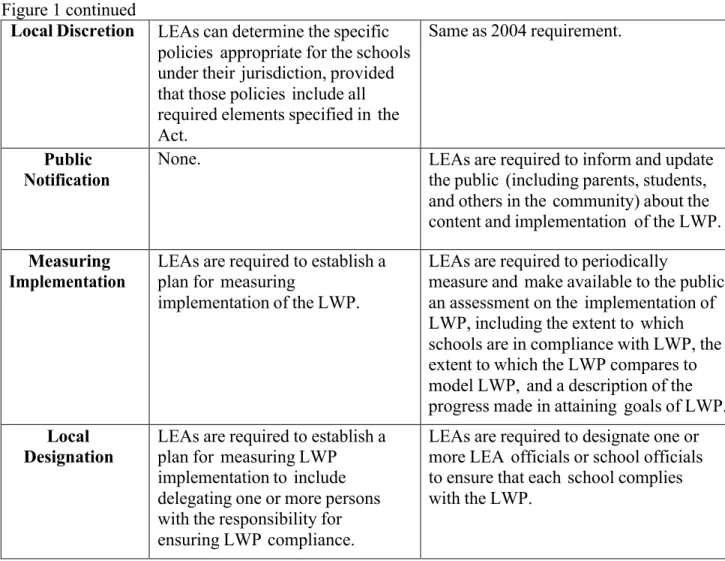
(http://www.fns.usda.gov/sites/default/files/Local_School_Wellness_Proposed_Rule_022614 .pdf). The main components of the plan are to include: public involvement in the process of establishment and implementation; specific goals on nutrition promotion, education, physical activity and other activities that promote student wellness; nutrition guidelines for all foods and beverages; policies for food and beverage marketing; annual progress reports with public updates; updates when appropriate; and a triennial assessment to monitor compliance and progress made. The chart below provides more detailed information.
Local School Wellness Policies (LWP): Comparison Chart of 2004 vs. 2010 Requirements 2004 Requirements Child Nutrition WIC Reauthorization Act 2010 Requirements
Healthy, Hunger‐Free Kids Act
Overview Directs local educational agencies (LEAs) to have a LWP in place for each school under its jurisdiction.
Strengthens LWPs and adds requirements for public
participation, transparency, and implementation. Elements of the Local School Wellness Policy LWP to include, at a
minimum, goals for nutrition education, physical activity, and other school‐based activities to promote student wellness, as well as nutrition guidelines for all foods available on school campus.
In addition to the 2004 requirements, the LWP is also to include goals for nutrition promotion.
Stakeholder Involvement
LEAs are required to involve parents, students, and
representatives of the school food authority, the school board, school administrators, and the public in the
development of LWP.
In addition to the 2004 requirements, LEAs are now required to permit teachers of physical education and school health professionals to participate in the development of LWP.
Stakeholder Participation
The stakeholders named above are required to participate in the
development of the LWP.
In addition to the 2004 requirements, LEAs are now required to permit all stakeholders named above and in 2004 to participate in the implementation and periodic review and update of LWP.
Figure 1 continued
Created by US Department of Agriculture’s Food and Nutrition Service (USDA FNS); US Department of Education (ED); and US Department of Health and Human Services, Centers for Disease Control and Prevention (CDC). (9/11; rev 6/17/13)
In addition, in Iowa, in 2008 the legislature passed The Healthy Kids Act (HKA). The specifics are below:
• Established nutritional content standards for food and beverages sold or provided
on school grounds during the school day.
Effective July 1, 2010.
• Requires school districts and accredited non-public schools to ensure every
student in grades K-5 has 30 minutes per day of physical activity and every Local Discretion LEAs can determine the specific
policies appropriate for the schools under their jurisdiction, provided that those policies include all required elements specified in the Act.
Same as 2004 requirement.
Public Notification
None. LEAs are required to inform and update
the public (including parents, students, and others in the community) about the content and implementation of the LWP. Measuring
Implementation LEAs are required to establish a plan for measuring implementation of the LWP.
LEAs are required to periodically
measure and make available to the public an assessment on the implementation of LWP, including the extent to which schools are in compliance with LWP, the extent to which the LWP compares to model LWP, and a description of the progress made in attaining goals of LWP. Local
Designation LEAs are required to establish a plan for measuring LWP implementation to include delegating one or more persons with the responsibility for ensuring LWP compliance.
LEAs are required to designate one or more LEA officials or school officials to ensure that each school complies with the LWP.
student in grades 6-12 has 120 minutes per week of physical activity.
Effective July 1, 2009.
• Requires every student to complete a course that leads to certification in
cardiopulmonary resuscitation (CPR) by the end of grade 12. Effective for the class of 2011-2012.
• Requires Iowa’s Area Education Agencies (AEAs), or a consortium of two or
more AEAs, to contract with a licensed dietitian.
Effective July 1, 2009 (
https://www.educateiowa.gov/documents/healthy-kids-act/2013/04/healthy-kids-act-brochure-editable).
Iowa has many resources that provide information to create a much more healthful school food and activity environment. It is essential to continue to work on changing the school food environment and on providing nutrition education to every student. The introduction of a school LWP is a vital first step. It supports change by providing healthier standards for the food served in school lunches and snacks. The components that address nutritional education can include everything from information in the curriculum to farm tours or visits from farmers to on-site Farmers Markets. The components of the HKA provide additional ways to establish and implement policies that will support a healthier school environment.
Background: Farm to School Program
The National Farm to School Network began in 1996-97 from the desire to strengthen community food systems, strengthen family farms and improve student health by helping reduce childhood obesity. It was formally established in 2007 as a collaborative of the Urban and Environmental Policy Institute, Occidental College and the Community Food Security Coalition. In 2011, as a result of its growth, it became its own organization under the fiscal sponsorship of the Tides Center. Farm to School provides resources and support for schools to source food locally and they provide agriculture, health and nutrition education
opportunities, such as school gardens, farm field trips and cooking lessons. Farm to School programs are specific to each community or school, which provide the opportunity to tailor them to meet their specific needs. Farm to School programs also empower children and families by providing information that helps them make informed food choices. This creates the possibility of actual tangible and measureable change evidenced by positive student behavior and better food choices (http://www.farmtoschool.org/aboutus.php).
The mission of Farm to School aligns very well with that of the school LWP mandate from Congress. Farm to School has many resources that can be used in classrooms, by food service directors and workers, and by administrators and parents alike. In addition, there is now a competitive grant program whose funding will be of assistance to schools looking to make changes that cannot be addressed within their current budget.
The Connection
School LWPs are now mandated. They have to be created, implemented and evaluated, and the results need to be available to the public. In Iowa, there is an excellent template that can be used for the creation of the school LWP (See Appendix C). However,
while Congress did create a certain minimal set of objectives that must be met, they also left open the opportunity for schools to be creative when it comes to implementation. That is where the Farm to School program could play a vital role. The Farm to School Network and the USDA’s Farm to School Program have a broad spectrum of resources, many free, which could be used for each area of the required mandate. Items available include: curriculum, how to connect with local farmers, recipes, newsletter templates, school garden information, menu planning for food service directors, market suggestions and many others. They
continue to work on evaluation templates.
Thesis Background and Organization
This research project will focus on determining whether the Farm to School program can help achieve school LWP objectives. The benefit of this research project is to
demonstrate a connection between a Farm to School program and school LWP.
The thesis will begin with a review of current literature on the school LWP and Farm to School programs as well as information connecting the programs. The next section will describe methodology for the project. The following section will provide information on the results of the survey instrument and discussion of those results, followed by a conclusion.
CHAPTER II: REVIEW OF LITERATURE
v Only 15% of school age children eat the recommended servings of vegetables each day and less than one-third eat the recommended servings of fruit.
v 32% of children and adolescents are overweight or obese.
v 1 in 3 children born in 2000 will become diabetic; 1 in 2 in the case of children of color.
v 1 in 5 Americans now die from obesity-related factors.
v Today’s children may be the first generation in American history to have a shorter life expectancy than their parents due to obesity, unhealthy eating habits and physical inactivity (Berkenkamp 2014).
Overview
This paper will focus on the question of whether having a Farm to School program in an Iowa elementary school contributes to meeting the objectives of the applicable school LWP. My interest in connecting Farm to School projects to implementation is an initial attempt to look into ways to identify realistic and effective school practices and outcomes. Despite many challenges, schools are making progress in the area of nutrition education (Metos and Murtaugh 2011).
Schools must have healthy, fit students if they hope to achieve their educational objectives. They have an unparalleled opportunity to promote children’s health by creating an environment where they have access to healthy food, participate in regular physical activity, and learn lifelong skills for healthy eating and active living (Story et al. 2008).
“Because two of the required components [of the school LWP] addressed the process
of developing and implementing wellness policies (implementation plan/person and
stakeholder involvement), the process may be as important as the product. Additionally, the specific content of nutrition guidelines, which was not analyzed, may be more important than simply having guidelines or not” (Hood et al. 2013, p.147). Farm to School could be part of the process that can help meet the school LWP objectives. Another author put it more directly: “The impact of any policy directed at the school food environment is likely to be affected by how well the policy is written” (Fox 2010, p. 1011). Again, since Farm to School has many goals that align with the objectives of the school LWP, those linkages could be contributing factors in meeting the goals of the policy.
Collaboration between all stakeholders is critical to ensuring that policies and practices to healthier eating are implemented. Having a diverse coalition will provide a broad level of knowledge and resources that will help support the coordinated approach necessary for success
(http://www.cdc.gov/healthyyouth/shpps/2012/pdf/shpps-results_2012.pdf).
Elementary schools often have healthier food environments than either middle schools or high schools. Experts use a 17-point scale to assess the health of food
environments and in a 2008 report by Finkelstein and colleagues, the average elementary school food environment score was 9.2 on this 17-point scale, which was significantly higher (healthier) than in middle schools and high schools. The survey items were related to
childhood obesity (e.g. vending machine sales and school meals) and were chosen by
reviewing prior published work, adopting items from existing secondary school surveys, and seeking expert advice (Turner and Chaloupka 2012).
Children currently receive more than one fourth (26%) of their total energy intake from food they obtain and consume at school. This indicates that no other institution has the level of influence and access to students as their school does. That being the case, schools have the significant potential to influence children to make healthful dietary choices (Fox 2010).
A press release issued by United States Secretary of Agriculture Tom Vilsack
indicates he recognizes the importance of Farm to School programs in offering healthy, local food to school children. In it he says that “through these efforts, schools continue to enhance the health of the school food environment, meet the new meal standards implemented last school year”
(http://www.usda.gov/wps/portal/usda/usdahome?contentid=2013/10/0197.xml&contentidon ly=true) [emphasis by author]. The Secretary of Agriculture sees a direct connection
between the Farm to School program and the implementation of school LWPs. School Local Wellness Policy Legislation – History
Because of the exponential growth of childhood obesity and the increased opportunity to choose competitive foods that have not met federal guidelines, school children today are in a much different situation than previous generations. The school food environment is very different today than it was even a decade ago. It can, however, have a large impact on the dietary intake of students (Story et al. 2008). Because of the obesity epidemic in children, more attention is being paid to the role of schools in promoting healthier diets (Jaime and Lock 2009). A different school environment does present challenges but recognizing its importance to a child’s nutrition also opens up many positive options for change.
Creation and implementation of a school LWP is a mandate of The Child Nutrition and WIC Reauthorization Act of 2004 and the Healthy, Hunger-Free Kids Act of 2010. The policy states that each school LWP must include goals for nutrition education and physical activity, nutrition guidelines for all foods available, minimal standards at least as stringent as USDA regulations, and a plan for measuring implementation that included different
stakeholders. In 2010, the HHFKA added requirements for schools to share results of school LWP implementation with the public, making it critically important that they show
compliance.
Planning a school LWP requires a significant amount of effort from stakeholders, including volunteers and advocates. Advocates in community-based agencies, school Parent Teacher Associations/Parent Teacher Organizations, and on local school district wellness policy committees are necessary to ensure that the schools are planning and implementing efforts to maintain nutrition integrity district wide. Volunteer opportunities also exist, which help shape the nutrition integrity of schools (Bergman 2010). In Iowa, schools have access to a template that can be used to help them draft their own school LWP (Appendix C).
School Local Wellness Policy – Benefits
Schools have the potential to have a large impact on students’ diets because children consume between 19 and 50 percent of their total daily calories at school (Story et al. 2008). More than 30 million youth participate in the NSLP, and an average of 10 million participate in the School Breakfast Program (SBP), and over half (59%) of the students receive free or reduced price meals so these are potent tools to improve their diets (Story et al. 2008). Because they are disproportionately affected by obesity, meals and snacks at school may be the only opportunity some low-income or minority students have to get healthful food.
Better choices and education about why they should make those choices could positively impact them immediately and in the future.
Nearly all schools have completed their school LWP. With the policy in place and a requirement of public disclosure of compliance with the policy, it seems likely that school LWP councils will be looking for ways to fulfill the objectives, of which Farm to School could be one. This, then, brings us back to the reason for this research project.
Food service directors believe that additional benefits of the school LWP has increased nutrition education and efforts to limit access to competitive food, defined as unhealthy snacks at school social events, food from vending machines, school stores, a la carte and snack carts, for example. A positive unintended consequence is that staff nutrition also improves, which provides a positive model to students. While peer influence is
important, so is modeled behavior by persons of authority. Students observing teachers eating more healthfully can provide additional reinforcement to make good choices for meals and snacks.
Nutrition education, one of the main components of a school LWP, is being shown to make significant immediate change and to open up the potential for children to learn how and why they should make certain food choices. In light of the billions of dollars spent on food advertising, it will be important to give children (and parents) the knowledge they need to choose the most healthful options. Also, because of the nature of peer support or pressure, learning and practicing in a community of peers offers a greater likelihood of lasting change. The American Dietetic Association’s position is that strong school LWPs create settings where children can learn about healthy nutrition and create the beginnings of lifelong healthy behaviors (Bergman 2010). It also holds that one way the policies support nutrition integrity
is through coordinating nutrition education. Funding remains one of the primary needs to support nutrition education in school curricula (Bergman 2010). Because Farm to School is one program that has curriculum available, it can address the challenge of a coordinated strategy and funding. Many of the resources through the Farm to School Network are free.
Having already seen the strong effect that schools can have on students’ diet, it is easy to see why experts advocate for school policies that will teach children behaviors that can reduce obesity and associated health issues. School gardens, local food options in the a la carte menu, cooking lessons and farm field trips are just a few of the ways students are connecting with their food and learning about more healthful choices.
School LWPs are associated with lower availability of less-healthy foods and beverage types and higher availability of healthful food types, according to another study,
School Wellness Policies and Foods and Beverages Available in Schools. Several studies
have shown a positive effect of school LWP on nutrition education. They are aligning with a set of state standards and nutrition education is being included in the curriculum. Having a consistent set of objectives will also allow for evaluation and shared measurements, which will provide supportive data for those things that are successfully impacting students’ diets and lifestyles (Hood et al. 2013). Nutrition guidelines do make a positive impact showing a decrease in total and saturated fat, an increase in fruit and vegetable availability and
improvement in students’ dietary intake (Jaime and Lock 2009). Again, the creation and implementation of school LWPs is having a marked impact on the actual food that children are being provided for meals and snacks by mandating that it meet healthier USDA
Whenever legislation is mandated, there needs to be good supporting evidence to encourage implementation. The obesity epidemic in children is one reason to make change. However, it is not the only reason. From another American Dietetic Association article we learn that with the childhood obesity levels reaching epidemic proportions and a need for more healthful meals and more activity, elevating the importance of nutrition education and how it connects to academic achievement is another powerful connection that can impact support from teachers, parents and others (Belansky et al. 2010). The school LWP
legislation was largely driven by a need to address a negative issue, childhood obesity, but there are also positive impacts, including the one stated above, better academic achievement, along with better student behavior.
School Local Wellness Policy Legislation – Challenges
A consistent obstacle to successful implementation of school LWPs is their inherent complexity. Some believe that a local health council made up of additional stakeholders, for example, the food service director, school nurse, parents, teachers, public health officials, etc., could be the best mechanism to facilitate school-level policy development because a local school administrator may not know how to establish and implement a nutrition policy (Longley and Sneed 2009). Having a diverse group of stakeholders invested in the local school LWP also presents the opportunity for more buy-in, which could certainly provide more long-term support.
The professionals tasked with school LWPs admit to needing guidance: Food service directors and school administrators need strategies to improve adherence to the Institute of Medicine Nutrition standards, especially in relation to long-term sustainability and funding for the ingredients (Metos and Murtaugh 2011). This was not considered an unfunded
mandate, but even prior to this legislation there were issues of the financial constraints put on school meal programs by current budget levels. This is an issue that needs consideration, but will not be addressed in any substantive fashion within the scope of this research project.
Impediments are not limited to lack of guidance, of course: some of the most significant barriers cited are competition from other school priorities (63%), lack of time in the school day (54%), resources available to implement the school LWP (46%), and tracking and monitoring of policy implementation (42%) (AFHK 2008). Some of these barriers have created significant difficulties to implementation of the school LWP. The American Dietetic Association lists some additional barriers: the need to use food in fundraising, competition for the time of teachers and administrators, perception that school LWP is unnecessary, lack of staff and family support, lack of connection to power structure and lack of organizational structure (Longley and Sneed 2009).
It is possible that diverse perspectives can alleviate some of the burden of complexity. The literature suggests that having a diverse group of stakeholders, including parents, public health officials, and physicians or other healthcare personnel, is more likely to create a scenario for success. As stated in the legislation, there is a requirement for monitoring the implementation and success of the school LWP, but due to funding constraints and other competing priorities, it rarely happens (Metos and Murtaugh 2011). Despite some of the initial benefits from the changes in the policy, it is also important to have a more developed plan for implementation and a way to monitor and report progress.
Student eating behaviors are impacted by school policy. When creating their school LWP, the nutrition standards could include student access to competitive food offerings. If vending machines, a la carte lines, snacks and school celebrations permit food that does not
meet school meal standards it could create a double standard and also provide students with unhealthy choices which would work against the objectives of the school LWP.
Financial issues also have a profound impact on school lunch decisions. For districts that have 60% or more students eligible for free and reduced priced lunches, the federal reimbursement rates for the 2013-14 school year are $2.95 for free, $2.55 for reduced price and $0.30 per paid lunch. HHFKA reimbursement: Districts that have been certified as meeting the new standards under the Healthy Hunger Free Kids Act are eligible for an additional six-cent reimbursement per meal. According to USDA, 80% of School Food Authorities (SFAs) have been certified as meeting the new meal pattern and are receiving the 6 cents reimbursement as of September 2013 (Eating Our Peas and Carrots: Strategies for Expanding K-12 Access to Fruits and Vegetables Through Supply Chain Innovation and Investment, JoAnne Berkenkamp). Regardless of whether schools receive the additional 6 cent reimbursement through the HHFKA or not, meeting nutrition guidelines with the budget is still one of the biggest challenges.
School Local Wellness Policy Legislation – Evaluation
In Metos and Murtaugh’s study, Words or Reality: Are School District Wellness
Policies Implemented? A Systematic Review of the Literature, there are no consistent
characteristics within types of schools that indicate what makes them most likely to implement the school LWP. And, although school LWPs have been mandated for all schools, research focusing on results from the implementation of the policy is currently non-existent (Metos and Murtaugh 2011).
As with all evaluation, it is important to have the right instrument from which to gather information. In a study of Virginia schools, Smith, Capogrossi and Estabrooks
examined the effects of using standard templates for consistent policies. They found that even among schools using templates, only a small number (17%) of all school LWPs met federal guidelines. Even with limitations (policies random but not evaluated; the possibility that the template was part of policy development training process; and, the only assessment was written documents with no evaluation of school environments to determine policy implementation), their findings suggest that simple templates are not the answer (Smith, Capogrossi and Estabrooks 2012). Smith et al do conclude, however, that “school wellness policies may provide the spark to implement environmental changes” and that “local
engagement in the creation of these policies may be most important” (Smith, Capogrossi and Estabrooks 2012, p. 304 and 308). That bodes well for programs like Farm to School, which could help schools meet the requirements more easily and thus create real change in the nutrition children are getting through school. So many of the programs and objectives of Farm to School already align with the mandates in the school LWP to provide healthier food choices and education to support the reason for those choices. Along with that, there are many resources that can also help many of the stakeholders, including food service directors, extension professionals, farmers, administrators and others whose support will be vital to the successful implementation of not just the policy but the practices that will change the school lunch system.
While it is true that nearly all schools have a school LWP in place, it is also true that there are many stakeholders and competing interests that impact the actual implementation of the written policy. Having a school LWP in place is necessary and valuable, but if the
requirement for implementing the objectives is to be fulfilled, there will need to be more attention given to providing the resources to do so. In a 2006 School Health Policies and
Programs Study (SHPPS), teachers ranked nutrition and dietary behavior as the topic for which they most wanted staff development and training (Story et al. 2008). The willingness to implement the nutrition education component of the school LWP is evident, but educators need the tools to do so.
It is important to note that policy development has not translated to successful implementation and monitoring. Only 12-14 percent of students were in a district where reporting to the public on implementation efforts was required (Chriqui et al. 2013). Nationwide, much less than half (44%) of the districts evaluated the implementation of school LWPs and even fewer (39%) made the information available to the public. Seventeen percent of the districts have no evaluation plan
(http://www.cdc.gov/healthyyouth/shpps/2012/pdf/shpps-results_2012.pdf). A significant problem right now is that we only have half the picture.
There are also discrepancies in how staff assesses their own school LWPs. Action for Healthy Kids did a survey that showed the majority of superintendents (77%) thought their school was implementing their school LWP but only 54% of school principals felt the same (AFHK 2008). It also states that tracking of the school LWP is as important as the
development of the policy, but it is not given the necessary attention in most districts, and in some there is no intent to track progress. Only Kansas has enacted ongoing monitoring of school LWPs (AHFK 2008). If stakeholders were evaluating data on a regular basis, it would allow them to assess their progress and then develop and improve strategies. This would, in turn, hopefully translate into a better food environment for students.
Ongoing monitoring is an area where many school LWPs can improve. To have truly effective evaluation that would provide data not only for the local school, but also for the
entire school LWP mandate from Congress, there must be a good foundation laid, with all required information in place in order to create a replicable set of measurements. However, based on a 2010-11 study, less than half of the students were in a district with a school LWP that included all the required elements, which was a decrease from the 2009-10 school year (54%) (Chriqui et al. 2013). While there is still a wide gap in compliance, mainly because many (39%) districts have not adopted competitive food and beverage guidelines, there has been progress to implement, strengthen or increase the strength of all the required policy elements. The most comprehensively addressed component of the wellness policies is nutrition education. They are also increasingly addressing school meal provisions.
However, policy provisions for competitive foods and beverages are the weakest components (Chriqui et al. 2013). For this research project, the nutrition education component is one of the most important and the competitive food and beverage component is less important, but for a good overall evaluation, all objectives should be addressed equally.
Both the development of the school LWP and the mandate to evaluate and share results publicly are still relatively new practices (only in place since 2006 and 2010,
respectively), but in order to determine the value of the school LWPs, it is imperative to have data by which they can be measured. Since there were only a few years between the
requirement to develop and begin to implement a school LWP and the additional mandate for evaluation and public disclosure was added, the literature indicates that little has been done with the evaluation component.
In one study in which school food practices were examined, it was shown that between school years 2006-07 and 2009-10, there was only minimal change (from 50.1 on a 100-point scale to 53.3). Practices like offering healthier lunch items improved over time,
but a prevalence of key practices is still low (Turner and Chaloupka 2012). In addition, four years after the wellness policy mandate, there are still many schools that have not
implemented changes to improve the school food environment (Turner and Chaloupka 2012). There is little scientific evidence for policymakers about whether school LWPs are effective and if they are, which ones have the potential to most significantly impact dietary behavior (Briefel et al. 2009). Studying environmental and policy influences on nutrition and eating behaviors is a new and growing science. At this juncture in time, there are few well-articulated theoretical models to test the interactions among personal, social and
environmental factors. And, little research has been done on which parts of the food environment are more influential than others or which will be most feasible, effective or influential to improve the food environment (Story et al. 2008).
Farm to School – History
The National Farm to School Network (NFSN) started with a handful of schools in the late 1990s. It was initially led by staff from the Community Food Security Coalition (CFSC) and the Urban and Environmental Policy Institute (UEPI) at Occidental College. It is now a project of the Tides Center. In 2007, the NFSN was formally launched by a
collaborative of over 30 organizations. There are currently approximately 38,629 schools in all 50 states, along with a national staff, eight Regional Lead Agencies, 51 State Leads, a 17-member advisory board and thousands of Farm to School supporters. This translates to 43% of United States schools with over 21 million students engaged. In addition, there are 26 states with supportive policies and over $355 million was spent on local food through connection with this program (http://www.farmtoschool.org/about).
Farm to School focuses on the connection between communities and local food producers by targeting schools and preschools to advocate for purchasing local products. Along with local food procurement and promotion, the NFSN also supports school gardens and education activities related to agriculture, food, health or nutrition. Schools also
incorporate nutrition-based curriculum and provide experiential learning opportunities. Farm to School in California is seen as a vehicle for nutrition education
(http://www.farmtoschool.org/Resources/Growing_Movement_%20Decade_of_F2S_in_Cali fornia.pdf).
Farm to School programs are premised on the assumption that if students are personally connected to their food, either through school gardens or getting to know the producers for some of the products they eat at school, that will translate into positive attitudes about healthy food and they will develop healthy eating habits at an early age (Joshi, Azuma and Feenstra 2008). Even before the mandate of school LWPs, Farm to School programs were being used to develop comprehensive food and nutrition policies through mandating preferential purchasing of local foods when possible, supporting nutrition education or school gardens, and establishing strict standards for foods offered at school (Joshi, Azuma and Feenstra 2008).
Farm to School can provide a platform for a diverse group of stakeholders (parents, teachers, food service, farmers, school nurses, gardeners, school board members) to come together on common issues. Furthermore, policies at the school, district and state levels can play a significant role in the development and sustainability of Farm to School programs. In Davis Joint Unified School District (DJUSD), they have moved ahead with the creation of a comprehensive Wellness Policy that will help support the goals of Farm to School
(http://www.farmtoschool.org/Resources/Growing_Movement_%20Decade_of_F2S_in_Cali fornia.pdf).
The importance of offering children nutritious food that they will eat was emphasized by all of the school food service personnel (SFSP) with whom the authors spoke. In addition to their need to comply with federal and local nutrition guidelines, the SFSPs talked about their goals to “‘encourage healthier choices at schools,’ to provide children with the ‘freshest possible,’ and to ‘provide the best quality and nutritious food we can get to the kids we serve’” (Izumi, Alaimo and Hamm 2010). Nationwide support for Farm to School programs is increasing – more than 1,900 programs in 2010 (up from 400 in 2005) by connecting students to local food.
Farm to School – Benefits
The recent USDA Survey shows that one third (31%) of Iowa’s school districts have a Farm to School program and another 15% plan to start one in the future. This information coincides with the percentage of respondents from the survey for this research project who replied affirmatively to having a Farm to School program at their school. Iowa school districts that bought local in 2011-12 spent an estimated $19,521,905 on school food, with $1,083,050 of that directed locally. Forty-six percent of the districts will buy local again. In addition, 11% of the schools have a school garden on site
(http://www.fns.usda.gov/farmtoschool/census#/state/ia).
Some general benefits for students include: increased fruit and vegetable
consumption; increased physical activity; increased knowledge about gardening, agriculture, healthy food, local food, seasonality; willingness to try new and healthy food and choosing healthier options in the cafeteria and at home; overall academic achievement; and, improved
life skills, self-esteem and social skill. Benefits to the school can be increased meal
participation, increased offerings of fruits and vegetables, better waste management policies, improved morale, increased knowledge of food service staff and positive diet and lifestyle changes of teachers (http://www.farmtoschool.org/Resources/BenefitsFactSheet.pdf).
In addition, supporters of Farm to School claim there are diverse benefits of the program. One decade-long study of Farm to School in California found the following:
• Understanding the impacts of the cost benefit analysis of beginning and
sustaining a Farm to School program to determine if it will be financially viable.
• Increase in local food procurement. • Increase in farmer income.
• Ready-made curriculum to help initiate and expand a Farm to School
program.
(http://www.farmtoschool.org/Resources/Growing_Movement_%20Decade_of_F2S_in_Cali fornia.pdf).
Advocates assert that Farm to School programs can improve children’s diets, which helps meet nutrition guidelines in school LWPs without straining school food service
budgets. This is supported by a study of school food service professionals (SFSPs) and other participants in Farm to School programs; the results show the SFSPs do so to help them meet their school food program’s financial and nutrition objectives (Izumi, Alaimo and Hamm 2008; Izumi et al. 2006). SFSPs are interested in a Farm to School project because it helps them meet their food service program goals and it allows them to support their community (Izumi, Alaimo and Hamm 2010).
As part of the new legislation around school meals, SFSPs must comply with strict standards and having resources that help them with menu planning and procurement issues is very valuable information. Most are willing to prioritize making local purchases, but with limited time for ordering and processing, they need resources to help them learn how to resolve these issues and Farm to School has them.
Although not formally considered a Farm to School program, The School Lunch Initiative is a project by likeminded non-profit organizations with many of the same
objectives, including “…bringing young people into a new relationship with food as part of their educational experience in school…[being] involved in the growing, cooking and sharing of food at the table – as well as learning about it in the curriculum – and it is reinforced with a healthy, nutritious school lunch, [so that] they will develop not only lifelong habits of healthy eating but also values that support a sustainable future” (Rauzon et al. 2010, p. 7). This is one concrete example of a program that is utilizing many of the same principles and objectives espoused by the NFSN and showing how they can help create success through nutritious meals and education that comply with the school LWP.
The School Lunch Initiative showed that students attending the elementary schools with highly developed School Lunch Initiative components had higher nutrition knowledge scores than those attending the schools with the lesser-developed School Lunch Initiative components (Rauzon et al. 2010). When students are taught nutrition education by trained staff, offered meals with fresh fruits and vegetables served in an appealing way and have information about nutrition and environment integrated in their curriculum – they increase their food knowledge and preference for healthy foods (Rauzon et al. 2010). A program like this (similar to Farm to School) shows the immediate benefit in changes to the current food
environment and alludes to certain metrics that could be created for the evaluation component.
Along with a “learning laboratory,” school garden programs are often linked to academic curriculum (science, nutrition, writing), so they can have a two-fold benefit of giving students a hands-on opportunity to grow some of their own food, and educating them about the benefits of doing so. Hands-on activities have been shown to increase preference for vegetables (Izumi et al. 2006). “School gardens are another strategy for improving nutrition and educational outcomes in school settings, but scant research has been conducted to evaluate outcomes associated with gardening programs” (Joshi, Azuma and Feenstra 2008, p. 31). There is evidence that teachers perceive gardens to be somewhat to very effective at positively impacting academic performance, physical activity, language arts, and healthful eating habits. There was clear benefit when students received nutritional education and the hands-on gardening, as opposed to simply receiving the nutritional education.
Farm to School can provide a strategy for helping meet the nutrition standards from the USDA, which are in all likelihood, also in the school LWP. It also has the potential to positively influence students’ eating behaviors, and provide curricular connections, which further encourages the desired behaviors to occur (Colasanti, Matts and Hamm 2009). In Farm to School schools, there is direct benefit to the children through having more direct access to fresh foods, experiential nutrition education and role modeling of healthful food choices (Carlsson and Williams 2008).
Farm to School – Challenges
Every five years, Congress passes The Agricultural Act of (insert year) 2014, which covers food, agriculture and nutrition policy. The 2008 Farm Bill allowed, and encouraged,
schools and other institutions to use geographic preference to purchase local food. This was good news for the SFSPs who expressed interest in purchasing local (if price and quality were equal); however, federal and state procurement regulations are still the barriers to buying local they cite most frequently (Colasanti, Matts and Hamm 2009).
A significant challenge to starting and maintaining a Farm to School program in a local school is having a champion willing to provide oversight and support to all the stakeholders. Addressing something as comprehensive as the school meal and snack program takes many resources, including time for research, partnership development, strategic planning and support for the implementation and evaluation of the program.
Farm to School posits that nutrition education, hands-on activities and well-planned meals with local ingredients will lead to better choices and less food waste. However, a current issue facing Congress is whether to relax standards and allow schools to implement the new regulations incrementally because they have been told children are not eating the meals that meet the new criteria and there is more waste. From the School Nutrition
Association, there is information that indicates revenue from school lunches has declined, as has participation and trying to meet the nutrition standards is extremely difficult because they are so complex (http://www.schoolnutrition.org/Blog2.aspx?id=20479&blogid=564).
In Iowa, some school kitchens have been turned into reheating stations where food is no longer prepared on site, but arrives fully cooked so it only needs to be warmed and served. This can save time and money on staffing, but does not always provide the most healthful option. Lengthy transportation time, or overcooking can decrease the nutritional value of the food and also impact the quality and taste. In addition, there are financial issues that impact the school meal program, including revenue that would be required for new cooking
facilities, equipment and staff training, and potential increase in price for local products (although geographic preference does help mitigate this issue).
Many local producers have not scaled up and this makes them much more difficult to work with from the business perspective. Most SFSPs are able to order the products they need from a company that provides them consistent product, ease of ordering, timely distribution, product that is already processed and which has professional invoicing. Many local producers are still not able to provide those amenities, and this makes working with them much more time-consuming for the SFSPs.
Farm to School – Evaluation
It is clear that more evaluation needs to be done to provide data and evidence to support the premise that Farm to School is actually contributing to meeting the guidelines of a school LWP. Peer-reviewed research evaluating Farm to School programs is limited. However, anecdotal reports suggest that Farm to School may be an effective way to promote healthy eating. Food service directors report that including local produce in school meals and snacks increases their students’ fruit and vegetable intake. Hands-on activities like taste tests and school gardens give students a chance to try new food and learn how their food is grown (Izumi et al. 2006).
Evaluation studies are still few and far between, and have many different designs, but the findings are consistent. Farm to School programs result in students eating more fruits and vegetables per day (cafeteria, classroom, home), making positive lifestyle changes, and increasing their knowledge about healthful eating (Joshi, Azumi and Feenstra 2008). From the HHFKA of 2010 adding a required evaluation that can be provided to the public, this is a challenge that will need to be addressed immediately.
Some important results from this study:
• Of 15 studies reviewed for this article, 11 assessed student dietary behavior
changes from Farm to School programs.
• Of 8 salad bar programs, 7 found an increase in the range of 25% to 84%
more fruit and vegetable servings consumed by students.
• One study reported that 75% of students with the Farm to School salad bar
chose a balanced meal with adult interventions compared to 46% of control students.
• Another of the 8 salad bar programs reported a reduction in the amounts of
total calories, cholesterol, and total fat in students’ daily diets as a result of the Farm to School program.
• The program with the non-salad bar model still found that 60% of the students
reported eating more fruit as compared to a previous year when the Farm to School program was not operational.
• Of the two programs using local foods in classroom-based education, one
demonstrated that 51% of the students reported eating more fruits and vegetables as a result, while the other reported no change.
• A total of 7 studies reported a substantial increase in student participation in
the school meal program (from 1.3% to 16%). Along with a more healthful meal, this can also provide more revenue for the school food service program, which can help purchase more local products.
• One study interviewed students and found that 44% preferred the Farm to
school (meal participation rates in Farm to School programs typically peak when the program is started, then decline somewhat, but are maintained at levels higher than pre-Farm to School program.
• Three Farm to School programs that included nutrition education also reported
positive changes in student attitudes about trying out new, healthy foods.
• Up to 71% of surveyed teachers at a school with an operational Farm to
School program reported making changes to their dietary behaviors as a result of the program.
• Teacher and staff participation in the school meal program increased markedly
at one school from 1.9% (6 lunches per month) to 28.8% (133 lunches per month).
• At another site, teachers and school staff chose Farm to School salad bar an
average of 14 to 1 times more often than the hot lunch.
• Although limited, there are some indications that children who attend a school
with a Farm to School program are exhibiting changes at home, i.e. improved family diet, buying more local foods, willingness to pay more for a school lunch that included local products, and the belief that nutrition lessons would impact their long-term food choices.
There were limitations to these findings: lack of rigorous evaluation design, data gathered by people who participated in the Farm to School program, limited number of study designs with a control group, few had statistical analyses. But, the studies were chosen because the evaluation findings were backed up by clearly described methodologies and data (Joshi, Azuma and Feenstra 2008).
Despite the mandated changes to the school LWP to include evaluation and public dissemination of progress made in meeting the objectives, this still is not happening on a regular basis in the majority of the schools (Story et al. 2008). As with the school LWP, Farm to School programs find it challenging “to devise common evaluation indicators that are relevant to programs across the spectrum” (Joshi, Azuma, Feenstra 2008, p. 5). However, should schools choose to implement a Farm to School program, there is a resource that would enable them to do so, titled, Bearing Fruit: Farm to School Program Evaluation Resources
and Recommendations. Even though there may not be a significant body of information
about the impacts of the Farm to School program at this time, in this publication, the topics covered could clearly assist in evaluating a school LWP. They include: student impacts (knowledge, attitudes and behavior); teacher impacts; policy impacts; food service impacts; parent impacts; and, farmer impacts (Joshi, Azuma and Feenstra 2008).
Summary: What’s the Connection?
Every school is unique, and every project, program or policy is unique, but there are common themes between them that warrant exploration (Carlsson and Williams 2008). It seems imperative that one of the next steps should include development of a set of common measurements that could be used to determine progress of the how the objectives of the school LWP are being met. There is still little empirical research, but theoretical and logical reasons indicate they do impact individual, family, school, or community food security (Carlsson and Williams 2008). And, “For Farm to School programs, more research is needed to determine the specific benefits to students, schools, and farmers; how to overcome
Several objectives in the school LWPs could be met through a Farm to School program at the local level. For instance, to help meet the nutrition education objective - professional development days using resources from Farm to School can provide great opportunities to educate teachers and school administrators on the educational and nutritional benefits of healthful food choices (Carlsson and Williams 2008). To actually provide
ingredients that meet the new USDA guidelines, Farm to School would be valuable because they can help link local farmers providing fresh locally grown produce to school food service cafeterias and school gardening programs. For long-term change, classroom nutrition
education can be used to complement changes in the school environment to increase students’ skills for adopting healthy lifestyles (Story et al. 2008).
Current agricultural policies have helped make food environments less healthy for Americans because they are not currently aligned with national public health and nutrition goals. Food and farming policies should advance the health and well-being of Americans (Story et al. 2008). Farm to School is a leading resource for information about national, state and local policies, and they provide information designed to empower families to make informed choices that strengthen their local economy.
Summary: What’s the Problem?
Neither the school LWPs nor the Farm to School programs are being adequately evaluated – separately or as they relate to each other. It is clear, say Longley and Sneed (2009) that further research is needed to establish how school LWP implementation progresses and is evaluated. In addition, “…there are few research reports of successful multi-component, community-driven, school-based programs that integrate lessons about food, the environment and nutrition taught in garden and cooking classes within the academic
school day while simultaneously making extensive changes to the school food environment” (Rauzon et al. 2010, p. 5)
There is currently no template with a set of metrics for evaluation for either program. However, here is a short list of indicators that could help establish a baseline of activity in the school food environment:
• School that has a Farm to School program that meets one or more of the
school LWP objectives
• Parents and the community who are engaged in nutrition education and the
school’s LWP.
• A school LWP that establishes goals for nutrition education, physical activity,
and other activities that promote student health.
• A school LWP that is being implemented and addresses evaluation and
revisions.
Indicators for Nutrition education being incorporated into the curricula could include the following:
• School gardens and other local food production are integrated into the
curricula.
• Nutrition information about food items and menus is readily available. • School nutrition staff, administrators, and teachers participate in staff
development to learn more about scientifically factual nutrition.
• Nutrition integrated into all subject areas, including language arts, science,
• Nutrition education messages target specific behaviors, using multiple
components, such as policy change and social marketing.
• Nutrition education strategies are innovative and appeal to students’ interests
and motivations.
• School cafeteria is sued as a learning laboratory where students can apply
nutrition content learned in the classroom.
• School nutrition personnel are actively involved in nutrition education at the
school level (Bergman 2010).
This study specifically states that “Farm to School may be an innovative solution to improving the school environment and the quality of foods served” and goes on to say “the integration of nutrition and agriculture in the curriculum successfully increased nutrition awareness among students as well as faculty and staff” (Bergman 2010, p. 1249).
Taking a creative approach to delivering messages about healthful lifestyles, including nutrition choices, increases the probability of success. Some of these creative approaches were mentioned above in the listing about curricula. “Fifty hours of nutrition education in the classroom that is based on sequential instruction and skill-building, and that incorporates family involvement, is needed to impact behavior change” (Bergman 2010, p. 1250). In addition, it has been documented that innovative, hands-on, and behaviorally-focused teaching strategies enhance healthful eating. An evidence-based, collaborative approach requires a well-funded and comprehensive nutrition education and promotion platform (Bergman 2010).
In summary, additional research questions to consider as a result of data from this thesis are: 1) to confirm that the principals are the right target audience, and 2) to explore
what specific components of Farm to School would help Iowa elementary schools meet their LWP and the best way to get that message to the appropriate school LWP administrator.
CHAPTER III: METHODOLOGY Survey Instrument and Procedure
Iowa elementary schools were identified for participation by using the Iowa
Department of Education’s 2013-2014 Iowa Public School Building Directory spreadsheet. Schools were excluded if they were a charter school or a regional education agency. An exemption from the IRB was received for the survey (see Appendix A). While
acknowledging that the school LWP are required at a district level, in the survey the respondents were asked to reply based on the policy used in their building.
A census survey (targeting the entire population of interest rather than only a sample) (see Appendix B) was sent through Qualtrics to 588 single school building administrators and 64 multiple school-building administrators for a total of 720 elementary school
buildings. They were chosen because they were most likely to be involved with the school LWP development and implementation because of their administrative responsibilities at the school. They have the most to lose or gain by participating in, or not participating in the school LWP. The questions were exactly the same, and the only difference was in the introductory paragraph. The multiple-school principals were asked to respond for the school at which they spent the most time. The survey included an introductory email with the hyperlinked URL for the survey. The majority of the questions were close-ended. A few questions were copied from the USDA Farm to School Census
(http://www.fns.usda.gov/farmtoschool/census/#/page/about). The 25-question survey was generally broken into three parts:
1. Information requested about applicable School LWP 2. Information requested about their Farm to School program
3. Demographic information
Two follow-up reminders were sent through Qualtrics. The survey was activated on April 22, 2014 and closed on May 9, 2014. There were 91 surveys returned surveys, which is an overall response rate of 12.6%. There were 86 responses to Question 1, which asked them if they were willing to participate. 98% said yes (84 respondents) and 2% said no (2 respondents).
Measures, Data Collection and Data Analysis
Information on school LWPs was gathered to determine if the school had a policy currently on file, and if that policy included the requisites from the USDA and HHFKA 2010 which included the objectives of the policy and the means to provide public access to the results of the evaluation of the implementation. It also asked about the people involved in the development and ongoing management of the policy.
The first question in the Farm to School section was to determine if they had a Farm to School program at their building. If so, they were asked for additional details including if they would be increasing the frequency of numbers or types of activities. If they did not have a program, they were asked if they would consider having one in the future. I did use 4 questions from the USDA Farm to School Survey to ask about the specific Farm to School programs/activities the school currently had in place, or was anticipating implementing in the future.
The respondents were then asked to give their best opinion on behavioral changes in children and parents since the implementation of Farm to School. They were also asked if the lunch program participation increased with local products included.
The final section asked demographic questions, about the respondents’ role in the school, the student body, the school district and about free and reduced lunch percentages.
Data analysis was through Qualtrics. Chi-square tests were performed from cross tabulations. Cross tabulations and Chi-squared will tell you whether classification on one nominal variable is related to classification on a second nominal variable. This test will show whether there is a statistically significant relationship, but it does not prove causation.
Demographic Information
Data indicate that 73 surveys were completed and 64 of the respondents answered they were the person responsible for the implementation of the school LWP (Question 2). Of that number, 47, or 73% indicated they are the principal and 8, or 13% indicated they are the superintendent (Question 2). Ninety-seven percent are white (Figure 2), with only slightly more (2) female than male respondents. Over three quarters of the respondents were between 41 and 60 (Figure 3). All respondents had a terminal degree, Masters or Ph.D. The majority (72%), have been principals less than 10 years (Figure 4), and for 60% this was not their first assignment as principal. The largest number of respondents (72%) were from small
towns/cities (<11,000), followed by urban cities (>35,001) at 21%. Only 7% were from suburban size cities (between 11,001 and 35,000) (Figures 5 and 6). The proportions are not exact in relation to the percentage of cities in each category, but the survey was a small sample (Figure 7). Sixty-nine percent had a student body between 251-500 students, followed by 16% with 101-250, 9% over 500 and 6% with less than 100 (Figure 8). Again, although not in proportion, the size of school districts gathered from respondents (Figure 9) and all Iowa school districts (Figure 10) was not completely skewed. All buildings had multiple grades. And, like with the size of districts, while not exact, the respondents’ percentage of
free and reduced lunches (Figure 12) had similar proportions to the figures on state use of the program (Figure 11). Ethnicity of Respondents: # Answer Response % 1 African American 4 6% 2 Native American 1 2% 3 Hispanic or Latino 3 5% 4 White 63 97% 5 Asian/Pacific Islander 2 3% 6 Other 1 2%
Figure 2 indicates the different ethnicities of respondents Age of Respondents: # Answer Response % 1 20-30 1 2% 2 31-40 12 18% 3 41-50 24 36% 4 51-60 27 41% 5 61-70 2 3% 6 71-80 0 0% Total 66 100%
Figure 3 indicates the different age groups of respondents Number of Years as Principal:
Respondents School Location by City Size (Graph): # Answer Response % 1 Rural - town/city size < 11,000 48 72% 2 Suburban - town/city size 5 7%
3 Urban - city size >35,001 14 21%
Total 67 100%
Figure 5 provides data on the size of city in which the respondents’ school is located Respondents School Location by City Size (Chart):
Iowa Cities by Size:
Figure 7 shows percentage of cities in each of the categories used in the survey. From http://www.iowa-demographics.com/cities_by_population
Student Body Size of Respondent Schools:
Size of Respondents’ School District:
Figure 9 shows the percentage of the respondents’ school district per size category
Size of Iowa School Districts:
Percentage of Free/Reduced Lunches in Respondents’ Schools for 2013-14:
Figure 11 indicates the percentages of free and reduced lunches served
Percentage of Free and Reduced Lunches in Iowa Elementary Schools for 2013-14:
Figure 12 shows the percentage of free and reduced lunches served in Iowa elementary schools. Information from: https://www.educateiowa.gov/document-type/building-level-1
CHAPTER 4: RESULTS AND DISCUSSION
My literature review indicated that evaluation on either of the two subjects of my paper – the applicable school LWP and the Farm to School program – is still infrequent and has not specifically targeted the connection between Farm to School programs and the school LWP implementation. Neither program (school LWPs or Farm to School) has a clear and consistent plan for evaluation. In one article regarding Farm to School evaluation, it said, “Thirty-eight farm-to-school evaluation reports and studies were reviewed for this article. Most of them were written as progress or evaluation reports to funding agencies. Only 4 were peer-reviewed, though 3 of those did not address program outcomes and impacts” (Joshi, Azuma and Feenstra 2008, p. 232).
From the first section on the school LWP, the fact that nearly 20% of the respondents’ school buildings do not have a school LWP that meets the requirements will create the first problem in looking for implementation assessment and evaluation data. It is unknown whether they incorporate nutrition education into other areas of their curriculum, if it is simply absent or if the principal did not understand the question.
Over half (58%) of the respondents do not have a system in place for assessment, which is one of the requirements from the HHFKA of 2010. This study did not ask for reasons to be given if the answer was “no,” so it is unknown why they have not implemented an assessment plan. But, thirty respondents provided information about the person or team that makes up the team that is assigned to assess the school LWP (see Figure 13), which gives them the infrastructure necessary to begin the process at sometime in the future. The following is a breakdown of the number of members on a school LWP assessment team: