Publication forthcoming in Enterprise Development and Microfinance, December, 2008
Closing the gap: Reaching the missing middle and rural poor through value
chain finance
Author:
Brian Milder
1Abstract
Recent gains in microfinance have yet to reach the majority of the rural poor in developing countries. Additionally, a market gap exists for small and medium enterprises (SMEs) caught between microfinance and corporate banking. Standard banking practices for analyzing risk and requirements for fixed asset collateral are critical barriers in reaching these markets. However, value chain finance – either from actors within the value chain itself or from external financial institutions – offers alternatives to these restrictive practices. This article focuses on external financial institutions operating in Africa and Latin America that are using innovative approaches to value chain finance to serve both small-scale rural producers and the SMEs that link them to urban and export markets. These unconventional methods for assessing risk and evaluating collateral present promising models for extending basic financial services to SMEs in the missing middle and to the rural poor. They also highlight opportunities for local financial institutions to enter profitable new markets and bring value chain finance models to scale, but doing so will require a change in traditional lending practices and, in some cases, policies regulating local banking industries.
I. Value chain finance needs and opportunities
Despite remarkable growth in the microfinance sector over the past two decades, only a small minority of the estimated 2.6 billion people living on less than $2 a day have access to financial services (Latifee, 2006). The percentage is even smaller for the rural poor, who make up three-quarters of those living in poverty worldwide (UNDP, 2008). Microfinance reaches more than 1% of the total population in only a handful of developing countries, and the vast majority of those served by microfinance continues to be residents in urban, peri-urban, or densely populated rural areas in regions such as South Asia (IMF, 2007). New technologies for wireless transfers via mobile phones are accelerating microfinance innovations and enabling urban migrants to send money quickly and reliably to rural family members. While these remittances inject much-needed cash into rural economies, the rural poor still lack direct access to financial services. Barriers include rural inhabitants’ physical distance from urban-based financial institutions, their lack of formal land title or other hard collateral required by lenders, and the riskiness – both real and perceived – of their predominant economic activity, agriculture. When it comes to basic financial services, millions of rural poor around the world must resort to local moneylenders, who typically replace formal collateral requirements with usurious interest rates.
With traditional avenues for credit closed to them, a growing number of rural producers are turning to another source: value chains. A value chain consists of the series of actors – in the case of agriculture, actors include suppliers of material inputs, producers, processors, brokers, wholesalers, and retailers – that brings a good from production to the final consumer. The exchange of goods for payment along the value chain creates opportunities for extending credit and other financial services to otherwise “unbankable” populations. Frequently referred to as value chain finance, these loans often take the form of direct advances by an agribusiness firm providing seeds and fertilizer as in-kind credit to smallholder farmers. Loans are typically repaid by deducting subsequent payment to farmers upon product delivery. In an alternate arrangement, a third-party financial institution provides credit secured against either warehouse receipts or assignment of payment for future product deliverables (USAID, 2005).
1
Brian Milder is the Director of Strategy & Innovation for Root Capital. This article has benefited from comments from Constatine Kandie and Sammi Nderitu of Kenya Gatsby Trust, Ellen Bogers of Rabobank Agri Fund, Antony Bugg-Levine and Brinda Ganguly of Rockefeller Foundation, Erastus Kibugu of TechnoServe Uganda, and Brandon Boyle, Roselle Croitoru, Patricia Devaney, William Foote, and José Luis Rojas of Root Capital.
Publication forthcoming in Enterprise Development and Microfinance, December, 2008
Direct value chain finance is often easier to set up than financing from a third party because actors can draw upon existing relationships and transfer points (e.g., a centralized warehouse where material inputs are distributed and product is delivered). However, it also has drawbacks, such as muddling commercial and financial transactions for farmers who may not understand how much they are being paid for their product and how much they are paying for financing; pulling agribusinesses into financing activities beyond their expertise; and tying up much-needed working capital for processors and brokers. Introducing financial institutions to the equation can benefit all sides: agribusinesses get to focus on their core strength without stretching their working capital in credit advances to suppliers; producers obtain access to finance at competitive rates without having to meet traditional bank requirements for hard collateral; and financial institutions are introduced to new markets with established value chains offering a built-in risk mitigation.
II. The rural finance gap and the missing middle
Commercial banks in developing countries have traditionally overlooked rural markets for reasons including the common perceptions among urban bankers that there are few viable businesses to finance and that the agricultural sector is inherently high-risk, low-return; cultural biases held by middle-class urbanites against rural producers; and the basic challenge of physically reaching remote areas. Furthermore, banks that are willing to lend in rural areas typically require hard collateral in the form of deeds of land and buildings and coverage ratios of two to three times loan value. These practices exclude all but the most formal, best capitalized (i.e., largest), and often most politically connected companies. If a rural business such as an association of 500 smallholder coffee farmers or a cashew processor needs a loan of $200,000 to bring in the crop or invest in processing machinery, it is considered too large to be served by microfinance institutions but too small, too risky, and too remote to secure financing from conventional banks. This dynamic highlights a dual vacuum in the capital markets: 1) location - rural finance gap and 2) size – missing middle between microfinance and corporate banking.
Diagram 1. Rural finance gap and the missing middle*
Publication forthcoming in Enterprise Development and Microfinance, December, 2008
The remainder of this article examines innovative applications of value chain finance with an emphasis on models tailored to grassroots businesses – those small and medium enterprises that fall within the missing middle and rural finance gap. This underserved market segment includes farmer and artisan cooperatives, and private businesses that aggregate hundreds or even thousands of small-scale producers who do not otherwise have access to financial services.
The first example focuses on the U.S.-based social investment fund Root Capital, which lends directly to rural grassroots businesses collateralized by signed purchase orders from buyers in Europe and North America. Additional examples include Rabobank’s Agri Fund, which provides partial guarantees to local banks so that they will begin applying a similar form of cash flow lending against export sales rather than requiring fixed asset collateral; Kenya Gatsby Trust, whose factoring program for small enterprises in Kenya enables them to sell into formal markets without tying up their working capital while awaiting payment; and finally TechnoServe’s work aligning incentives for mutual benefit through value chains linking smallholder matooke farmers to brokers and urban institutions in Uganda.
III. Applying value chain finance to high-value export markets
Cash flow lending: Root Capital
Since 2000, Root Capital has disbursed 506 loans totalling $100 million to 210 grassroots businesses representing more than 340,000 small-scale producers in 30 countries across Latin America, Africa, and Asia.2 Its loans range in size from $25,000-$1,000,000, and it targets enterprises with environmentally sustainable practices that are exporting high-value products in the following sectors: agriculture, timber and non-timber forest products, fisheries, and handcrafts. The vast majority of these businesses had never received a loan prior to working with Root Capital. The repayment rate on Root Capital’s loans is over 99%, yet most of its clients continue to have few, if any, alternatives for affordable credit. Over time, Root Capital’s objective and expectation is that local financial institutions recognize profitable lending opportunities and apply similar strategies based on value chain relationships to serve this market.
Types of loans. The most common type of loan is trade credit, which is available for up to one year and oriented around a production cycle such as a harvest. Trade credit loans are typically used by borrowers to purchase product from their farmer and artisan members or suppliers and to cover costs during the months between purchasing raw product and receiving payment from buyers. Root Capital also offers long-term loans that extend up to five years and are used for investment in equipment and infrastructure and for general operations. Interest rates range from 9-10% per annum for loans up to one year and 10-12% per annum for long-term loans, and all loans have a closing fee of up to 1%.
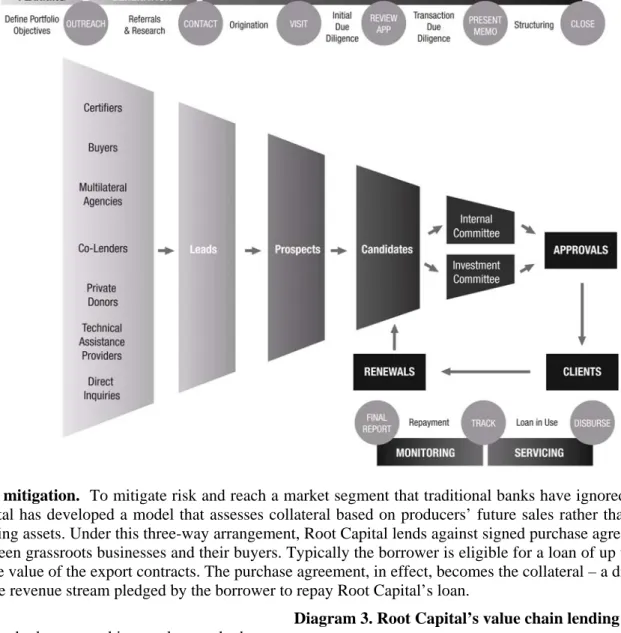
Lending Process: Root Capital identifies new clients through referrals from partners (e.g., buyers, clients, certifiers) and direct inquiries from prospective borrowers. It screens prospective borrowers based on their social and environmental impact and financial solidity, and visits those that are a strong fit with its lending criteria. During and after the field visit, it gathers information, evaluates the viability of loan proposals, structures terms for the deals, and presents those that meet its requirements either to an external Investment Committee or for internal approval based on review policies set by the Investment Committee. Upon approval, Root Capital completes closing documentation with both the borrower and the buyer (see description of lending model below), makes disbursements to the borrower, and monitors the loan until it is repaid in full. Borrowers in good standing that apply for a loan in subsequent years are considered “renewals.” They enter the process at the “candidate” stage and are reviewed using a streamlined approach that maximizes efficiency while still managing risk.
2
Publication forthcoming in Enterprise Development and Microfinance, December, 2008
Diagram 2. Root Capital Lending Process
Risk mitigation. To mitigate risk and reach a market segment that traditional banks have ignored, Root Capital has developed a model that assesses collateral based on producers’ future sales rather than their existing assets. Under this three-way arrangement, Root Capital lends against signed purchase agreements between grassroots businesses and their buyers. Typically the borrower is eligible for a loan of up to 60% of the value of the export contracts. The purchase agreement, in effect, becomes the collateral – a discrete, future revenue stream pledged by the borrower to repay Root Capital’s loan.
Diagram 3. Root Capital’s value chain lending model
When the borrower ships product to the buyer, the buyer makes payment directly to Root Capital, which, in turn, deducts the loan principal and interest and remits the difference to the borrower. Root Capital’s due diligence and monitoring processes are designed to identify any challenges that might derail this transaction, such as weather issues, a strike at port that prevents product from shipping, or the buyer going out of business. However, as long as the product is shipped and the buyer does not renege on its payment obligation, Root Capital can be confident that it will recover the loan. This approach redefines risk assessment, placing value on supply chains that emphasize product quality and long-term relationships.
Publication forthcoming in Enterprise Development and Microfinance, December, 2008
Root Capital has applied this factoring model with over 75 buyers – ranging from specialty importers such as Equal Exchange and Sustainable Harvest to large global buyers like Home Depot, Pier 1, Starbucks, and Whole Foods Market – in 17 countries.
Diagram 4. Lending capital under management v. total disbursements
Capital turnover. A
significant portion of Root Capital’s portfolio consists of short-term loans for working capital that are repaid in less than 12 months. The geographic diversity of its client base and the complementary timing of harvests in Central and South America allows Root Capital to turn its capital more than once each year, resulting in total disbursements greater than loan capital under management. For example, the money Root
Capital lends to borrowers in Guatemala in January is repaid in June so that it can then immediately lend the same capital to borrowers in Peru for repayment in December.
Sources of Funding: Root Capital’s loan fund is comprised of 1) equity that the organization has accumulated from operating surpluses and 2) debt in the form of three-five year loans issued at 0-4% interest by private foundations, individuals, corporations, public agencies, and religious organizations. As of July 31, 2008, the loan fund was capitalized with over $25 million, including $19 million in low-interest debt from 70 different social investors. Root Capital draws upon this capital base to on-lend to grassroots businesses in Latin America, Africa, and Asia that meet its lending criteria along social, environmental, and financial dimensions. In addition to the risk mitigation strategies outlined earlier, Root Capital maintains a 10% loan loss reserve on its loans receivable. It is not exposed to foreign exchange risk since its dollarized loans are matched with export sales and repayment in dollars. To date, Root Capital has a 100% repayment rate on loans to its investors.
How the model works: The implications of providing finance through an established value chain for a business, its buyer, and a third-party lender are described in the following three scenarios.
Scenario 1: Six month trade credit loan. A grassroots business in Guatemala receives a purchase order for premium quality, organic coffee valued at $300,000 from a buyer in the United States. The business, a farmer-owned association comprised of 500 smallholder farmers in the western highlands of the country, must purchase coffee from its members, process and export it, and wait to be paid for each shipment thirty days after the buyer receives it. In order to secure product from its members, the cooperative must pay them cash upon delivery or risk that they will sell to a local intermediary. However, the association lacks working capital, does not have sufficient collateral for a formal bank loan, and cannot afford the 4% monthly interest rate charged by the local lender.
Publication forthcoming in Enterprise Development and Microfinance, December, 2008
Diagram 5. Cash flow for 180K six month trade credit loan
The association applies for a loan from Root Capital, which finances 60% of the value of the purchase order, or $180,000. The borrower chooses to receive three equal disbursements of $60,000 (Months 4-6 in the diagram) to minimize finance costs since it pays its members as they deliver product in successive waves over the course of the harvest. Often a farmers’ association or cooperative issues its members a partial payment for product upon delivery followed by a second payment at the end of the season from the sales revenue net of the loan repayment to Root Capital. The association purchases and processes the coffee over the course of Months 5-8 and makes monthly export shipments in Months 7-9. The buyer issues three payments of $100,000 via Root Capital, which deducts the $60,000 principal associated with each loan disbursement and an additional $2,000 in interest fees. The interest calculation for each $60,000 disbursement in this example is based on the following calculation: $60,000 disbursement x 10% per year x 4 months/12 months (since the disbursement in Month 4 is repaid in Month 8) = $2,000. By Month 10, the transaction is complete, with the buyer receiving its product in exchange for $300,000, the grassroots business receiving $294,000 after paying $6,000 in interest to Root Capital, which ends up with $186,000.
In this scenario, the buyer does not take on any financing risk because it pays its supplier – the grassroots business and Root Capital borrower – upon receipt of product. The borrower is able to complete the transaction and benefits since the sales price net of financing costs and additional costs associated with exporting is significantly greater than its margin selling on the local market. The price premium is passed on to the members of the association, so while the loan from Root Capital does not go directly to them, they ultimately benefit both by being able to complete an export transaction for a higher price, and by having a stronger association that can continue to negotiate attractive prices and provide other ancillary benefits. In addition to market access and premium prices, benefits of participating in an association or cooperative may include technical assistance to improve yields and land management; access to material inputs at discounted prices; access to education, health, and other social services; and a voting role in determining the future direction for the enterprise and surrounding community.
Publication forthcoming in Enterprise Development and Microfinance, December, 2008
Scenario 2: Nine month trade credit loan. In the previous example, Root Capital’s loan went directly to the farmers’ association for use in purchasing, processing, and exporting coffee. The loan covered the critical bridge period between when the association needed capital to purchase product and when it received payment from its buyer. However, it did not address the pre-harvest financing needs of the association’s members, who work in the fields for several months prior to receiving payment during the harvest. Farmers must carry over their earnings from the previous year to reinvest in their land and support their families, and they rarely have access to credit from local financial institutions.
To meet their members’ needs for basic financial services, many farmer-owned enterprises have developed their own internal credit funds to provide off-season and pre-harvest loans to their members. In Scenario 2, Root Capital issues a loan under the same structure and terms as in Scenario 1 but three months earlier. The loan is to the association, which remains the obligor throughout the course of the loan. In the short term, the loan is used to increase the pool of capital in its internal credit fund and enables it to issue short-term microloans to its members at rates well below those charged by local moneylenders. These microloans are repaid to the association in the form of a deduction on the payment farmers receive when they deliver their coffee in Months 4-6. At this point, Root Capital’s loan effectively resides with the association for use in processing and exporting its product. As in Scenario 1, loan repayment remains tied to coffee shipments.
Diagram 6. Cash flow for 180K nine month trade credit loan
This loan is riskier for Root Capital than a six month trade credit loan because it comes earlier in the growing season when the results of the year’s harvest are more uncertain. However, the longer loan term compensates for this risk by yielding a higher interest repayment ($10,500 compared with $6,000 in Scenario 1). For its part, the borrower incurs higher financing costs, paying a total of $10,500 in interest and ending the transaction with $289,500, but it is able to make up this cost on the interest it charges its members on their microloans. An important impact is at the farm level, where small-scale producers have
Publication forthcoming in Enterprise Development and Microfinance, December, 2008
access to microfinance to invest in production and cover basic family needs during the pre-harvest period. These loans help to smooth the cash flow for families who often go hungry during the off-season.
Scenario 3: Eleven month trade credit loan. Example 3 builds upon the previous scenario and highlights opportunities for mutual gain among borrower, buyer, and lender in a value chain where there is open communication among all parties. In this scenario, the buyer issues a purchase order for $300,000 at the beginning of the season and the borrower applies for and receives a loan for $180,000 to complete this transaction. Over the course of the season, the buyer revises its sales projections, determines that it will need additional volume, and issues a second purchase order for $200,000 in Month 5. At this point, the harvest is already in full swing and the farmer association must find cash immediately to purchase more coffee from its members, who would otherwise sell excess supply on the local market at a lower price. Rather than spend time searching for new sources of financing that would not be able to respond immediately, the association requests additional financing from Root Capital.
Diagram 7. Cash flow for 180K eleven month trade credit loan
Root Capital could issue a second loan to the association, but this would require additional paperwork and processing time. Instead, when the first payment is made from the buyer to Root Capital in Month 8, Root Capital allows the full amount to “pass thru” (rather than deducting loan principal and interest from this payment as in the previous examples). The association still owes Root Capital $180,000, but it now has an additional $100,000 to purchase and process more coffee. The same thing is repeated in Month 9. This pass thru mechanism allows the association to rotate its working capital and extend its loan from Root Capital for two more months. The additional period on the loan increases its financing cost from $10,500
Publication forthcoming in Enterprise Development and Microfinance, December, 2008
to $15,000, but this is more than made-up for by the $200,000 increase in sales. For its part, Root Capital collects additional interest with minimal risk – before allowing the first payment to pass thru, it assesses the progress in the harvest based on monthly reports from its monitoring team. At the end of the season, Root Capital’s $180,000 loan has facilitated $485,000 in revenues net of financing costs, as opposed to $289,500 in Scenario 2.
Shifting local lending practices: Rabobank Agri Fund
Beyond directly addressing an unmet need for affordable credit among rural grassroots businesses, Root Capital demonstrates the bankability of this long-ignored asset class so local financial institutions will enter the market. Rabobank’s Agri Fund pursues the same long-term objective through a similar value chain approach, but rather than lend directly, Agri Fund provides loan guarantees and risk sharing to local banks with the dual objective of 1) attracting local capital providers to this underserved market and 2) getting them to use export contracts as collateral instead of requiring fixed assets. Over the course of its four-year partnerships with local financial intermediaries, Agri Fund aims to shift standard practices within commercial banks so that they serve rural businesses in the missing middle on a large scale.
Agri Fund was founded by Rabobank International, a Dutch-based bank focusing on the agriculture sector. One of the investors in the Fund is Rabobank Foundation, an affiliated philanthropic foundation that, among other things, provides trade credit using a model very similar to Root Capital’s. Agri Fund launched operations in early 2008 with the aim to reach $30 million in annual credit guarantees during an initial phase of 2008-2010. Target products include coffee, cocoa, nuts, oil seeds, and horticulture.
Guarantee Structure. Agri Fund forms relationships with 2-4 local banks in a target country. The banks enter into a risk-sharing agreement whereby Agri Fund guarantees a portion of any losses from loans that pertain to the agreement. Agri Fund and its local bank partners each identify new borrowers, conduct due diligence, and approve loans in coordination through their respective internal processes. The loan is then disbursed in dollars by the local bank against signed purchase orders from international buyers, as in the examples with Root Capital described above. For its part, Agri Fund provides a Stand-By Letter of Credit, which is ruled by the standards (UCP600) of the International Chamber of Commerce, for a maximum of 90% of the value of the loan in the first year. The risk mitigating instrument decreases on a step-by-step basis, phasing out during a period of three to four years while the local financial intermediary increases its share in the risk (phasing in). The risk sharing is structured along the following lines:
Year Agri Fund maximum risk exposure
Local Financial Intermediary minimum risk exposure
1 90% 10%
2 70% 30%
3 50% 50%
4 0% 100%
The Stand-By Letter of Credit conforms to business practices in the target country and is backed up by a Memorandum of Understanding. To date, Agri Fund has facilitated four loans – one in Tajikistan and three in Peru with Banco Internacionl del Perú (Interbank) – by issuing credit guarantees for a total of $3 million. It is in the process of closing transactions with another Peruvian bank, Banco Interamericano de Finanzas, as well as with local financial intermediaries in Costa Rica Honduras, Nicaragua and India. Participating borrowers pay Agri Fund a small upfront fee (1.5-2.5% p.a) as well as the interest rate charged by the local bank. Fees and interest are typically a combined 9-12%, while the range for each loan guarantee is $300,000-$1,200,000. In addition to its primary guarantee product, Agri Fund can co-finance deals with its partners or arrange syndicated loans if the requested amount by the borrower is higher than $1,200,000.
Publication forthcoming in Enterprise Development and Microfinance, December, 2008
IV. Value chain finance in local markets
Though targeted to export value chains, the models described above are applicable to value chains linking rural producers to urban buyers within developing countries. In East Africa, two development organizations are applying similar value chain techniques to connect small-scale producers and grassroots businesses to more profitable markets. In both examples, market inefficiencies, a lack of communication and trust, and the established system of payment were obstacles for the value chain to function effectively.
Factoring: Kenya Gatsby Trust
Kenya Gatsby Trust (KGT) is a Nairobi-based nonprofit organization that aims to eradicate poverty and spur economic development by supporting micro and small enterprises (MSEs) in Kenya. In 2002, KGT’s Financial Services Department established a factoring program to bridge the gap between commercial banks and microfinance. The facility pays participating MSEs cash against delivery of product to customers in good standing whose payment terms would otherwise overextend the seller’s working capital. This facility enables MSEs that were previously selling their products to brokers for cash, to cut out these intermediaries and sell product directly into formal markets that pay higher prices but on 30, 60, or 90 day terms.
MSEs register with KGT and pay a fee in order to utilize the factoring service. When an MSE delivers its product to its buyers, KGT immediately pays the seller 70-95% of the invoice value. After collecting payment from the buyer on the pre-agreed terms, KGT remits the remaining 5-30% to the seller. This system smoothes cash flow for small and growing businesses and removes the uncertainty of having to collect accounts receivable from larger private companies or institutions. In doing so, it enables MSEs to source from smallholder farmers, who typically require cash payment on delivery, without overextending their working capital.
The arrangement also has benefits to buyers such as hospital and universities, many of which would like to support local MSEs and the smallholder farmers that supply them, but that are unable to tie up their own working capital with advance payments or cash upon delivery. The program currently serves 25 MSEs sourcing from over 4,000 small-scale farmers and artisans. One challenge to growing the program has been the reluctance of bureaucratic government institutions to change their established practices and make payment to an entity other than the seller.
Aligning value chains through aggregation and communication: TechnoServe Uganda
The international development organization TechnoServe began working with matooke (green banana) farmers in Uganda in 2005 to establish value chains linking them to urban institutions such as universities and hospitals. At the time, overproduction had driven prices so low that desperate farmers were on the verge of destroying their matooke plants and starting over with new crops. Several inter-related problems compounded the situation. Disaggregated farmers sold their matooke to brokers on a volatile open market. Brokers could not rely on a steady source of matooke so they had to rent trucks for three to four days and drive around the countryside to collect enough product to fulfil orders. There were typically five or six intermediaries between the farmers and the end buyers, resulting in slim margins for farmers and brokers alike. Brokers that sold to urban institutions received good prices but often had to wait several months for payment until students paid their semester bills or hospitals received their government allocations. As a result, many brokers went out of business since they lacked working capital to maintain high turnover.
Publication forthcoming in Enterprise Development and Microfinance, December, 2008
To address these issues and align incentives along the value chain, TechnoServe began setting up village-based groups of 30-50 farmers. It identified brokers that were entrepreneurial and honest and personally introduced them to staff who made purchasing decisions at urban universities and hospitals. Buyers complained that when their matooke suppliers failed to deliver product their students or patients went hungry. Brokers explained that they could not afford to make three deliveries of product per week, each valued at $3,000-4,000, and wait another three-six months for payment.
TechnoServe was able to convince managers at Centenary Bank to offer financing at two levels: 1) factoring for brokers against their sales to universities and hospitals; and 2) microloans to individual farmers. The factoring system functioned much along the lines of the Kenya Gatsby Trust model described above. Once brokers were able to collect payment immediately upon delivery, they could invest in purchasing their own trucks. Entrepreneurs who had been running threadbare operations were able to establish thriving businesses. At the other end of the supply chain, organized groups of farmers began selling larger volumes of fresh matooke to brokers who could now drive in one day from the city to a single collection point to source product efficiently. Brokers paid farmers in cash and, having cut out the rest of the intermediaries, were able to pay higher prices. Within a year, farmer incomes had increased 70-100% and by 2008, 12,000 matooke farmers were participating in the system via 300 village-based farmers’ groups that had not existed three years earlier.
Whereas low prices previously meant that it did not make economic sense to invest in improving yields, farmers responded to the higher prices for matooke by demanding finance to increase production. Though initially hesitant to lend to smallholder farmers, Centenary Bank agreed to a three-year risk-sharing program backed by a $500,000 credit guarantee from the Rockefeller Foundation to cover up to 50% of losses from loans within the matooke value chain. By the time the facility closed in 2008, Centenary Bank had lent out a total of $1.6 million and claimed losses of less than $21,000, far lower than the loss rate on its lending book overall. Although Centenary Bank applied traditional requirements for fixed asset collateral in its microloans to farmers, the bank would not have entered into the facility without an established value chain where purchase commitments from brokers and end buyers mitigate the risks of lending to smallholder farmers.
V. Conclusion
The examples described in this article offer insights into the opportunities and challenges for applying value chain finance on a larger scale in both domestic and export markets. First and foremost, lenders must be willing to shift their approach to risk assessment and collateral. Although value chains can facilitate traditional forms of lending, as in the case with Centenary Bank lending to smallholder matooke farmers, much greater opportunities lie in replacing fixed asset collateral with a claim on future sales. Lending against movements of product and payment in the value chain requires a degree of familiarity and comfort with both borrowers and buyers; transparency and open communication on all sides are fundamental.
While this article focused on innovations in value chain finance facilitated by nonprofit development organizations with social objectives, competitive pricing and high repayment rates suggest that there are profitable opportunities for commercial financial institutions. As these players begin applying value chain finance, it is likely that they will identify and respond to market demand for a broader range of financial services, including weather and crop insurance, hedging, and equity investments. In doing so, they will close the gap by extending basic financial services to the missing middle and rural poor.
Publication forthcoming in Enterprise Development and Microfinance, December, 2008
References
International Monetary Fund (2007) “Rural and Microfinance Institutions: Regulatory and Supervisory Issues” in Financial Sector Assessment: A Handbook,
http://www.imf.org/external/pubs/ft/fsa/eng/pdf/ch07.pdf, accessed March, 2008.
Latifee, H.I. (2006) “The Future of Microfinance: Visioning the Who, What, When, Why, and How of Microfinance Expansion Over the Next 10 Years,” Grameen Trust http://www.grameen-
info.org/grameen/gtrust/The%20Future%20of%20Microfinance.pdf, accessed March, 2008.
UNDP, UNEP, The World Bank, and World Resources Institute (2008) “Roots of Resilience: Growing the Wealth of the Poor,” http://pdf.wri.org/world_resources_2008_roots_of_resilience.pdf, accessed August, 2008.
USAID (2005) “Value Chain Finance,”
http://www.ruralfinance.org/servlet/BinaryDownloaderServlet/26544_USAID_Note.pdf?filename=11277 40844537_RAFI_note_2.pdf&refID=26544, accessed August, 2008.