Customer Interaction in Service
Innovation
A Checklist for Service Innovators
Arja Kuusisto, Lappeenranta University of Technology, Finland ([email protected]) Mikko Riepula, Helsinki School of Economics, Finland ([email protected])
Abstract
The purpose of this study was to develop the yet limited empirical knowledge on the intensity of customer interaction and on specific customer roles in service innovation processes. An empirical study of twelve (12) business service innovation projects was conducted in cleaning and security, financial, and ICT services. We examined both ad hoc and formalised innovation processes. Overall in these service sectors, which offer support services to their customers, direct customer interaction in service development can be characterised as being limited and focused on specific, well-defined tasks.
In the analysis, three highly important customer roles emerged: 1. Customers act as catalysts of service development processes. 2. Customer feedback is often decisive in nature, allowing for go/kill decisions and directing other key decisions. 3. Customers have a key role in internal marketing of the new service idea within the provider organisation. We outline a set of questions relating to knowledge management that managers can use to better benefit from customer involvement in new service development. Customers’ motivation and abilities as well as project organisation are in key focus in such an assessment, but one should also give thought to overall goals and how to measure the results in the end. We also try to give practical guidance on how to ensure that sufficient customer input is received before making critical go/kill decisions.
Keywords: service innovation, innovation process, business-to-business services, customer roles, customer-driven development
The Challenge
Industrial Context
Direct interaction with customers has been argued to be a key feature of service innovation activities (Gadrey et al. 1995; Sundbo & Gallouj 2000). The interaction between the service provider and the customer is an important locus of new service ideas and their development into new valuable solutions. In particular, this is true in case of knowledge-intensive business services (such as management consulting, legal services, and industrial design), in which the client’s concrete problem is often the starting point of the innovation process: service provider and customer literally co-produce a new solution, which can later be further developed and formalised into a new service offering to a wider customer market (Sundbo & Gallouj 2000). However, not all services are alike: Services cover a highly diverse set of activities with different patterns of innovation (Tether 2003). This paper deliberately looks into services, which do not involve intensive person-to-person interaction in the service process. Case examples were taken
from three business service sectors: cleaning and security, financial services industry (FSI), and information and communications technology (ICT) services. In these service sectors, the role of the customer can often be characterised as one of making use of a service solution organised and supplied by the service provider. In some cases the customer may even wish not to be directly involved at all if and when the service is running smoothly. Further, such services are typically in the role of a support service to the customer company, which also reduces customer motivation to invest resources into service development activities.
The basic challenge can be summarised as follows: What does only limited person-to-person interaction between the service provider and the customer imply for new service development? How do the service innovators obtain customer input? Can service innovators still find ways to integrate customers directly into service innovation activities?
Service Innovation Problems
There are two broader issues that deserve to be discussed here. First, is direct integration of customers into innovation activities something that is intrinsic to high quality new service development? The second issue deals with the fact that service innovation processes are multiform.
The first question is connected to the debate on customer driven versus technology driven innovation (for instance, Berthon et al. 2004). At least in practical innovation situations, customer and technological innovation orientations need not be seen as mutually exclusive: Even when the new service is based on knowledge that existing customers are not able to provide, for instance on new type of technology, direct customer interaction can have an important role in the innovation process. For instance, close customer dialogue has been shown to be a key element in building insight on how the new service might fit into the customer’s current practices (Heiskanen et al. 2007). Direct integration of customers in innovation activities can yield many kinds of benefits: help generate new ideas, increase value of the new service, speed up and energize the development process, contribute to customer relations and improve customer loyalty (Alam & Perry 2002; Magnusson 2003; Heiskanen et al. 2007; Kuusisto & Riepula 2008). Hence, even though integrating customers in the process may not be a prerequisite for developing successful new services, it does offer such an important forum for learning that its potential should be carefully considered in each case.
As to the second issue, for many firms, service innovation activities are ad hoc (Gallouj & Weinstein 1997; de Jong et al. 2003). This means that innovation activities are not guided by a structured, formally managed process, but they ‘happen’ as a response to a particular situation. For some firms and service sectors, a formalised approach to new service development is typical: In financial services companies, new service development often follows a sequential activity-stage -model, resembling the ones in use in manufacturing firms (de Jong et al. 2003; Alam & Perry 2002). Overall, service innovation seems to become more systematic, and it is often argued that systematic processes tend to have higher chances of successful outcome. However, structured and formal does not automatically mean more efficient or more suitable. We should keep in mind that for the success of many (especially smaller) companies, ad hoc processes can be more effective than even the best available formalised approaches.
The Potential Solution
Key Requirements
We studied 12 cases of innovation in the three service sectors to increase our yet limited empirical understanding of customer integration into service innovation activities. The aim was to first look in detail into the intensity and significance of customer interaction as well as to understand the different roles of customers. As said, we specifically analysed services with limited person-to-person interaction in the service process. This analysis forms a basis for reflecting on questions such as when direct customer interaction into innovation activities should be encouraged, and how this can be made.
1) The study explores 12 innovation cases:
• How do service innovators obtain customer input, or do they obtain it at all? • How do customers become integrated into service innovation activities? • How does customer participation in service innovation activities shape the
development process? 2) The objective is to learn more on:
• When should the service innovator attempt to integrate customers into the
NSD process?
• How can customer integration be implemented?
• How can the service innovator assess the reliability of customer input?
Knowledge Management for Service Innovation
We did not look for, nor identify, any one method or best practice of how to integrate customers in new service development (NSD). Rather, the purpose is to provide the reader with a set of key questions that need to be asked and carefully answered in order to start developing company practices.
Obviously, companies with a well-articulated, formally managed NSD process are more likely to have a shared understanding of these key issues. However, at times, asking basic questions - for instance, on the objectives of customer participation, or on the ways knowledge created in individual projects accumulates and shapes the NSD process – can prove fruitful. In companies with a more ad hoc pattern of developing new services, the sheer act of asking such questions and articulating answers to them is a prerequisite for any systematic development of current practices.
Thus, we suggest that a detailed consideration of the following questions – both in terms of service providers’ current as well as their preferred state of affairs – provides a sound basis for developing more successful strategies of integrating customers in new service development.
1. What do we do now?
• How do we integrate customers in NSD currently? • Or, how do customers become integrated in practice?
• Are customers’ roles planned in advance or are decisions made along the way?
2. What are our objectives?
• Do we have clear, shared objectives in integrating customers in NSD? • What kind of impact are we looking for? For instance,
o Should we view the customers mainly as
informants and evaluators (helping us make decisions),
sources of new insights and information, or
development partners, providing resources and/or sharing risks.
o Is customer integration part of sales and marketing? For example,
part of sales process (e.g., requirements gathering for providing a quote; signalling capabilities by involving the client), or
a means of nurturing customer relations?
o Is customer integration part of internal marketing (e.g. to convince important internal stakeholders of the value of the new service to the customer)?
o Or, is it more important for us to go to market quickly, and do we have the time or possibility to rectify things after launch, so that involving customers early in the development would only be countereffective?
3. How do we motivate customers to participate in NSD?
• Do we understand how the new service and its development create value for the
customer? For example, one or more of the following motivational factors may be present:
o Learning on its own can be a sufficient motivator for the customer (knowledge creation within the customer organisation); or
o The main value of participation comes from ensuring that the service truly fits the customer’s needs (higher certainty of process outcome); or
o The customer finds it easier and less resource-consuming to be involved from the early beginning than to try to formalise requirements through comprehensive documentation (lower cost of knowledge transfer).
• Who in the customer organisation should we try to engage in the process?
o If the new service provides value that is distributed in a new way in the customer organisation, the person(s) we should be co-operating with may also change.
• How do we share the value of a new service with the customer (when the customer
invests his time and other resources into the development process)?
o Are benefits for the service innovator in balance with the benefits the customer reaps? If the (perceived) benefits are positive but small for the customer and much larger for the service innovator, the customer may ask the service provider, “Why should we be doing your work?”
o Should or could we develop new types of incentives for customer participation – for instance, rewarding the customer based on the future success of the service with other customers?
4. How do we assess a customer’s ability to provide the input we are looking for?
• Does the customer have the knowledge, skills, and resources relevant to the task?
o Ideally, customers contribute by providing the service innovator with important complementary resources.
o What is the customer’s organisational readiness to co-innovate? For example, is the customer
Likely to share useful, important information?
Capable of selling the project internally and contributing to governance of the project?
Likely to exhibit the “not invented here” syndrome?
• Is the customer representative of a broader clientele?
o Is the customer, at least when guided by the innovating organisation, capable of generalising beyond their own immediate needs? Or should we perhaps involve more than one client simultaneously?
5. How do we organise customer integration into NSD? For example,
• Do we need some entry/exit criteria for customers to enter/exit the process?
• Shall we account for separate stages in the process for customer acceptance/review
for example, or could the very fact that the customer is involved all along do away with the need for some of such stages?
• When should we use separate contracts to govern customer involvement in NSD?
When not?
• Are there such aspects of or issues with our internal processes that we need to keep
the customer away from? (e.g. costing vs. pricing of our services…) This may have important implications to composition of joint teams, for example.
6. How do we assess the value and outcomes of customer integration in NSD?
• In individual projects, for individual customers or customer groups?
o Some means of evaluation and measurement are needed, also to be able to reward and thus motivate specific customers for their contributions in the NSD process.
• Does knowledge created in individual projects cumulate so that it can be utilized in
future projects?
o Even in the lack of much learning in the business domain, the knowledge relating to the specific customer relationship can be useful in its own right, both ways: it helps the vendor better organise future projects with the same customer and provides a level of lock-in; for the customer, it provides greater transparency and thus reduces agency and search costs.
The above set of questions is a non-exhaustive list intended to make the innovating organisation reflect on how customer input in NSD is currently obtained and what would be the preferred state of affairs. Obviously, any executive group can make more detailed questions to their situation, but we suggest that the six main questions (numbered from 1 to 6) should be carefully considered. Reflecting on these questions provides the organisation with a tool for discussing and identifying the common view of ’where we are now’ and ’where we should be in the future’. It should also permit managers to better see interdependences between key decisions: In particular, that the objectives for customer integration need to be clear and well-articulated (even though they may be different for different customers and projects), as it is these objectives that should guide other decisions – such as, which customers and resources should be sought for in each case.
The Approach
The key questions identified above are partly based on insights provided by a study of 12 service innovation cases. In this empirical study, we set out to examine the intensity and significance of customer interaction, and the different roles of customers in NSD processes.
The research was exploratory in nature. We thus opted for the extensive case study method (Yin, 1994; Eisenhardt, 1989). Data was obtained by retrospectively interviewing key persons who had been involved in the development of service innovations.
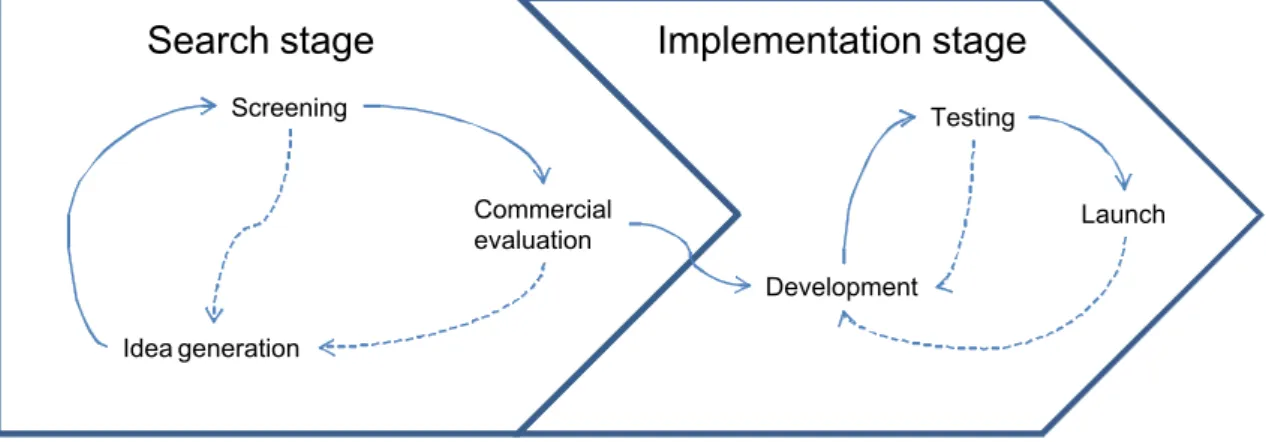
The choice of the service sectors – cleaning and security, financial services, and ICT-services – was guided by our goal of examining services that do not typically involve intensive person-to-person interaction in service production. By May 2008, we had pursued 12 cases in the 3 service sectors and conducted 22 semi-structured interviews. All the interviews were conducted in Finland and in the Finnish language. Each interview was transcribed. The internal validity of the method was strengthened by the fact that most interviews, in their unabridged form, were read by both researchers. The data was further indexed, coded and analysed in tabular displays, in which we reused constructs from earlier literature, most notably from de Jong et al. (2003), Alam & Perry (2002), Toivonen & Tuominen (2006), and Sundbo (2006). The constructs used by de Jong et al. (2003) formed the initial framework for the research (see Figure 1).
Search stage Implementation stage
Idea generation Screening Commercial evaluation Development Testing Launch
Figure 1. A model for new service development (de Jong et al., 2003, 33).
The Analysis
This section presents the findings: key customer roles in service innovation activities in the examined 12 cases.
Types of Innovation Processes
We expected to find mainly innovation processes that would be organised ‘in-house’ by the service provider and in which customers would rather be asked or persuaded to participate than be engaged in on their own initiative. This assumption seemed to hold well in the data: In 11 out of the 12 cases the service development process can be characterised as being organised and driven by the service company, while customers were invited to provide their input.
The degree of formality of the innovation processes varied significantly. In three FSI cases and in two ICT cases new service development followed relatively well a pre-defined structure. In the majority of the cases the innovation process was set up as a multifunctional project development team on an ad hoc basis (Coombs & Miles 2000). Typically, this project team was made up of the service provider’s own employees, and customers were not included. Decisions on the roles and participation of customers in innovation activities were done in the course of the project.
The key phases of idea generation, evaluation, development, and implementation can be identified in the examined innovation processes. Also, they were basically in this order, with some precisions that will be discussed below.
Customer Roles in Key Innovation Activities
Initiation
The idea was more often generated or born within the innovating firm than initiated by customers, partners or other actors. It can be inferred that in most cases the need for innovation was part of the strategy rather than reaction to a particular customer’s needs. Key driving forces included increasing opportunities created by technology and market development, competitive pressures, pressures to try out new ways of generating revenue, and pressures to reduce costs. In three of the ICT cases, partners took the role of surrogate customers to some extent.
The above does not mean that customers would not have an important role in the early phase of service innovation. The empirical case analysis reveals quite the opposite: customers act as important catalysts of service development processes. In particular, customer feedback, suggestion or request often triggers the initiation of the new service development project, which means that a project team with concrete objectives is established. Sometimes the customer directly suggests what it would like to see in the future; in some other cases, customer trigger is indirect (e.g., in one case, a long-term contract with an important customer was coming to an end, and there was a threat of loosing this customer). It seems that even in service firms, where the speed of innovation activities has been argued to be critical (Alam & Perry 2002), there is certain inertia until an outside actor or impulse triggers the innovation project. As one of the interviewees said, “This has been in back of our minds for years, yet, in the end, it was a client comment which galvanised us into action.”
Evaluation
Unlike often suggested in literature, we found out that evaluation was not a separate activity but an overarching one. When service development followed a pre-structured model, market size and profitability were evaluated before a separate development stage. In other cases, however, evaluation of the new service was very much done along the way. In practice, customer commitment to take in use or buy the new service was often needed for the service innovator to make the ‘go’ decision. Indeed, getting early customer commitment to the idea could be essential for the innovating team to secure resources to development: to convince important stakeholders, such as managers, and to overcome resistance to change from employees (and partners) responsible for the new service implementation. Hence, customers can have a key role in internal marketing of the service in the innovating firm.
When the new service needed to be offered to customers at an early stage, as outlined above, this led to a high pressure to quickly define key service elements and the service process. Here, a ‘pre-development’ phase existed before evaluation. One of the interviewees characterised this as follows, “What we had was no more than a power-point presentation, but the customer ‘bought’ the idea. Then we really started to put flesh on the bones of the idea.”
Thereafter, profitability of the service continued to be evaluated when the service was implemented for the first customer. After that, the service provider had a proof of concept that they could (better) price and start offering to other customers as well, but still opportunistically. On the whole it seems that no such up-front investments were made in these development projects that would necessitate careful investment calculations: instead, small steps are taken whenever there is a paying customer at close range. In case of small firms in particular, they may have to try to opportunistically do business with any service concept they find traction for, and then try to replicate that.
Development and Testing
Two FSI cases with a pre-structured development process differed from the rest of the cases in terms of customer involvement in development. In the former, customers did not have role in the actual development phase; their feedback had been obtained by earlier screening of desirable features.
In all the other cases, customers were involved in development. In some of the cases, development was first conducted within the innovating firm, and then pilot customers were sought and used to assess and provide feedback for further specification of the service. In other cases, development, testing and actually providing the service for the customer very much took place simultaneously. This resembles the ad hoc model of innovation typical of professional services. However, these were not necessarily ‘innovation projects tailored for a customer’ in a sense that the “client’s problem in its concrete sense [would have been] the starting point of the innovation project” (Sundbo & Gallouj 2000, 55). Rather, the decision to merge development with implementation in a real customer context was viewed by the service provider as the best way to develop the new service. Sometimes customers were willing to pay for a project involving development and testing activities and thus shared some development risks. In one instance, the customer was not even aware that the service process included extensive development. As the interviewee said, “You don’t want to say to the customer, ‘This is the first time we do this, so you are a kind of guinea pig here.’ No, that’s not possible.”
In case of ICT services, concrete work input from customers was needed in development: detailed requirements have to be captured from customers, and ultimately customers have to test the service—either explicitly (when errors or mismatches are found) or implicitly (when things run smoothly for the first time in real life).
Launch
The activity of launching was rather ambiguous. There was often no clear separation between testing, implementation, and launching of the service to a wider market. When development was intertwined with implementation of the service for the ‘first’ customer, subsequent launch could mean offering the service ‘one by one’ to most potential customers – and further development of the service continued to take place while ‘spreading’ the new service to the market (as also indicated by ‘after-innovation’ in Sundbo 2006; and, ‘the model of rapid application’ in Toivonen & Tuominen 2006). Here, launch is a gradual process, not something taking place at a particular point in time. Often, after the service had been tested with potential customers or implemented for the first time, the service provider formalised the service a bit more, produced marketing material and, together with its partners, made publicity for it. The most concrete signs of something being launched onto the market included: pushing out a press release, adding the
service to the company’s web site, and starting to offer the service for customers as a part of normal tendering process.
Results and Business Impacts
Key Findings
The key phases of idea generation, evaluation, development, and implementation could all be observed in our data. However, there was interesting overlap between the phases: For instance, the new service idea was in several cases evaluated or tested by actually selling the idea to the customer before any significant development took place. Also, the way some companies were able to merge development and testing with actually providing the service for the customer is highly interesting. In all of the cases examined, the new service idea was generated before the implementation – that is, in none of the cases was the innovative idea ‘found’ in the actual service practice.
Overall, direct customer interaction in service development tends to be limited and focused on specific tasks in these service sectors, which offer support services for their customers. However, customer input in service development can often be highly useful for the service innovator – even decisive in many cases. The study confirms that customer involvement is most important at the early stages of the innovation process (Alam & Perry 2002), even if it was not extensive. We identified two particularly important customer roles in the ‘search stage’ (de Jong et al. 2003) of service innovation activity. First, customers act as catalysts of innovation processes. The new service idea may have been incubated within the innovating service firm, but a concrete customer trigger is needed to initiate the innovation as a formal project. Second, customers have a key role in the internal marketing of the new service idea within the provider organisation. The study shows that not only is the speed of innovation activities important (e.g., Alam & Perry 2002; de Jong et al. 2003), but right timing is essential as well. When a concrete customer action triggers the innovation process, customers are more likely to be receptive to the new service idea. Further, evaluation should not be a priori regarded as a separate stage in a development process. In many cases evaluation is an overarching activity: Evaluation can very much become intertwined with the selling of the service to a potential customer, and evaluation continues throughout service implementation with pilot customers. On the whole, it seems that when no extensive up-front investments are needed in development, new services can be implemented more opportunistically.
Business Impacts
In services, where only limited person-to-person interaction occurs between the vendor and the customer, managers should realise that they are receiving relatively little direct feedback for their new service development as part of the service process. Hence, to benefit from customer potential, managers need to make conscious choices of how to organise, manage and motivate customer participation in their innovation activities. As always, the primary issue is setting clear objectives for customer integration. This seems to be a point worth emphasising, as recent research findings show that direct integration of customers into innovation activities can indeed yield several kinds of benefits for the service innovator – for the new service, for the development process, for customer relations. Some type of customer potential goes easily unnoticed if it is not specifically looked into – for example, the longer term impact of mutual learning resulting from customer integration in individual projects. And, if objectives are not clear and well-articulated, it is difficult to make other well-informed choices.
On a more practical level, considering how even the weak signals from clients can be often critical in the early stages, managers should use available methods not only to amplify the signals but also to improve the “signal-to-noise ratio”, either by quantitative analysis or qualitative, deeper probing of a single case. This is important to avoid wasting of resources on the one hand, and to be able to more receptively capture new opportunities on the other. Motivating customers to get involved more and earlier in the process is an issue managers should pay attention to, and can be done, as demonstrated by one case company, by trying a more consultative approach with pilot customers rather than adopting a sales attitude in the beginning. Since customers can be given a key role in the internal marketing of the new service idea within the provider organisation, managers should make use of this opportunity to gain support and acceptance by senior management early on.
Particularly in the ICT sector, managers need to carefully consider when partners can provide
valid ‘customer feedback’. It seems that in the ICT sector it is more common than in other sectors to use partners as surrogate customers. Such a practice can be effective and lead to faster time to market but it can also be deceptive in cases when the partner is not truly representative of a typical customer or does not truly understand their needs and the vendor’s capabilities.
When organising its innovation activity and deciding how to better benefit from customer input, managers can use our list of questions (see “Knowledge Management for Service Innovation” above). Whatever the approach the firm ends up taking, it is a result of conscious choices by the firm’s management, thus increasing the chances of success compared to NSD “just happening” with or without clients.
Reflections
Retrospective - What Has Been
The purpose of the case study reported above was to increase our yet limited empirical knowledge on integration of customers into new service development. Customer intensity has been argued to be a key feature of service innovation activities. However, as services are highly heterogeneous, the role of customers in service innovation is likely to reflect this heterogeneity. We examined services with limited person-to-person interaction in the service process, to see whether and how service innovators integrate customers into new service development in these cases.
Overall, direct customer interaction in service development can be characterised as limited. However, even limited interaction seems to be consequential as it helps the service innovator make important choices. The way some companies were able to merge development and testing with actually providing the service for the customer is highly interesting, and this deserves more attention in future studies.
One of the difficulties in making a deeper analysis here is the fact that the cases examined were still highly heterogeneous. In particular, in terms of company size (some were small Finnish companies with less than 10 employees, some major branches of international groups) and in terms of the degree of formality in their NSD process. The number of cases is too small to take into account such important variation. The study shows, however, that the degree of formality in the NSD process does not dictate whether and how customers are integrated in service innovation: In formally managed development processes with pre-determined stages and responsibilities, decisions on customer participation and their specific roles can be pre-planned, or alternatively, decision on customer integration may be made ‘along the way’. The question of which strategy is more successful or more appropriate for the market the company faces, or in terms of the customer input that is sought for, remains to be examined.
One shortcoming in the data should be mentioned: Initially, our purpose was to gather information from both the service provider as well as from the customer side. Although we tried to include the customer views in many cases, the service providers were not forthcoming for the idea to take place in practice. Hence, only a few customers’ views are included in the data. On the one hand this reflects service providers’ genuine concern that their customers are too busy to get engaged in any ‘extra’ discussions, and on the other hand it could be inferred that service innovators do not think their customers actually benefit very much from participation in their service development. In any case, a future study should include both the service provider’s and the customer’s views and experiences to further improve the reliability of inquiry as well as practical value of the results.
In the interviews, we asked the interviewees to characterise chronologically the actual development process (what was done, by whom, etc.). In some cases, when the person characterised the process, our first impression as researchers was that ‘customers did not have much of a role in this case’. In the course of one such interview, one of us intuitively asked, ‘On a scale from 0 to 100, how would you rate the importance of direct customer interaction in this new service development process?’ The answer was, surprisingly, as high as ‘70’. This incident made us see how easy it is to confuse intensity with significance. Indeed, it seems that the intensity of interaction is not linked in any straightforward way to perceived significance of customer contribution in NSD. Rather, different types of objectives for customer integration may better explain the intensity aspect of customer interaction in the process.
Prospective - What Could Be
In this chapter we addressed the issue of the role of direct customer interaction in service innovation activities. Overall, it seems that service innovators could often benefit from a thorough situation analysis and assessment of whether their current situation is as intended and what un-used potential there could be in integrating customers into new service development. Ideally, customer inputs in different forms can be obtained and utilised throughout the development process. However, this is a challenging task since the sources and users of customer input, as well as the nature of such input, are often changing over the course of the project. What type of customer interaction is most relevant and how it can be best obtained, organised and integrated in different stages of an individual development project – as well as into the organisation’s overall services “R&D” – provide important themes for further exploration. One of the issues that has been much discussed in literature is the degree of formality – or lack of formal processes – in service development. It has been argued that structured, formally managed processes tend to result in more successful outcomes. The empirical study reported above did not specifically address this question. However, our study suggests that well-articulated practices of customer integration are useful. Further, even ‘good’ processes need to be assessed from time to time. There is a real risk that any highly formalised process starts too much controlling what can be done at the expense of changing company needs or signals from the market.
The finding that some companies successfully develop a new service during the course of actually providing the service for the customer is very interesting. While it can be seen as a low cost strategy mainly in use in small companies, this approach can be valid in other contexts as well. As von Hippel (2005, 64-76) argues, information about need or use environment may be otherwise very expensive to acquire. The question on when such learning in a customer ‘lab’ can be successfully implemented, and when customers actually welcome extensive development as a part of the service process, deserves careful analysis.
Practical Tips
Consider if the following is applicable in your company:
Bring in “live” clients to sell an idea internally early in the evaluation phase.
Use partners as surrogate clients when obtaining direct client involvement is
difficult.
Try to obtain deeper customer feedback using ‘quid pro quo’, i.e. giving clients free services, such as consulting, in exchange of the time they devote to evaluation or idea generation of the new service.
Consider new innovative ways to motivate customer participation, i.e. rewarding
the customer based on future success of the service with other customers.
Make an effort to find ‘right’ persons in the customer organisation: those who are
likely to benefit most from the new value of your service and those who are prone to try out new things.
Consider the different phases of NSD more as parallel activities varying in
intensity, rather than as strictly sequential.
Make sure that you have a clear, shared understanding of the objectives of
customer interaction in NSD.
Try to push development and testing activities into a service process paid by the
client when this seems to benefit the customer as well.
Acknowledgements
We sincerely thank all the interviewees for their time and willingness to share their knowledge and insights with us.
We are grateful for the funding and support from the Finnish Funding Agency for Technology and Innovation.
References
Alam, I. and Perry, C. (2002) A customer-oriented new service development process, The Journal of Services Marketing, Vol. 16 No. 6, pp. 515-534.
Berthon, P., Hulbert, J.M. and Pitt, L. (2004) Innovation or customer orientation? An empirical investigation, European Journal of Marketing, Vol. 38 No. 9/10, pp. 1065-1090.
Coombs, R. and Miles, I. (2000) Innovation, measurement and services: the new problematique. In, Metcalfe, J.S. and Miles, I. (eds.), Innovation Systems in the Service Economy,
Measurement and Case Study Analysis, Boston: Kluwer Academic Publishers, pp. 85-103. De Jong, J.P.J., Bruins, A., Dolfsma, W. and Meijaard, J. (2003) Innovation in service firms
explored: what, how and why? Zoetermeer, the Netherlands: EIM Business & Policy Research.
Eisenhardt, K. (1989) Building Theories from Case Study Research, The Academy of Management Review, Vol. 14 No. 4, pp. 532-550.
Gadrey, J., Gallouj, F. and Weinstein, O. (1995) New Modes of Innovation: How Services Benefit Industry, International Journal of Service Industry Management, Vol. 6 No. 3, pp. 4-16.
Gallouj, F. and Weinstein, O. (1997) Innovation in services, Research Policy, Vol. 26 No. 4-5, pp. 537-556.
Heiskanen, E., Hyvönen, K., Niva, M., Pantzar, M., Timonen, P. and Varjonen, J. (2007) User involvement in radical innovation: are consumers conservative? European Journal of Innovation Management, Vol. 10 No. 4, pp. 489-509.
Kuusisto, A. and Riepula, M. (2008) Customer interaction in service innovation: Seldom intensive but often decisive. Case studies in three business service sectors, in Proceedings of the 9th International CINet Conference, Radical Challenges in Innovation Management, 5-9 Septermber, Valencia, Spain.
Magnusson, P.R. (2003) Benefits of involving users in service innovation, European Journal of Innovation Management, Vol. 6 No. 4, pp. 228-238.
Sundbo, J. and Gallouj, F. (2000) Innovation as a loosely coupled system in services. In, Metcalfe, J.S. and Miles, I. (eds.), Innovation Systems in the Service Economy,
Measurement and Case Study Analysis, Boston: Kluwer Academic Publishers, pp. 43-68. Sundbo, J. (2006) Customer-based innovation of e-knowledge services. The importance of
after-innovation, in Proceedings of the XVI International RESER Conference, 28-30 September, Lisbon, Portugal.
Tether, B.S. (2003) The sources and aims of innovation in services: variety between and within sectors, Economics of Innovation and New Technology, Vol. 16, pp.481-506.
Toivonen, M. and Tuominen, T. (2006) Emergence of Innovations in Services: Theoretical Discussion and Two Case Studies. Paper in International ProACT Conference:
“Innovation Pressure – Rethinking Competitiveness, Policy and the Society in a Globalised Economy,” 15-17 March, Tampere, Finland.
Von Hippel, E. (2005) Democratizing Innovation. The MIT Press, London, England.
Yin, R. K. (1994) Case study research: design and methods (2nd ed). Thousand Oaks, CA: Sage.
Author Biographies
Dr. (Econ.) Arja Kuusisto is a senior researcher at SC-Research – a research institute specialising in service innovation studies at Lappeenranta University of Technology, Finland. She holds a PhD at the Helsinki School of Economics, in the field of marketing communications. Currently, she is working on research projects on service development. She has contributed to several research reports, conference proceedings, and is involved in in-company training and consultancy.
MSc (Eng.) Mikko Riepula is a researcher and doctoral student of information systems science at Helsinki School of Economics, Finland. His interests include customer-driven development in both service and software product companies. Before re-engaging in academic work, Mr. Riepula worked internationally for more than ten years in the ICT industry for companies such as Nokia, Accenture and then as a software entrepreneur.