University of Dayton
eCommons
Political Science Faculty Publications Department of Political Science
3-2015
Thin vs. Thick Morality: Ethics and Gender in
International Development Programs
Richard K. Ghere
University of Dayton, [email protected]
Follow this and additional works at:https://ecommons.udayton.edu/pol_fac_pub
Part of theAmerican Politics Commons,Comparative Politics Commons,International
Relations Commons,Models and Methods Commons,Other Political Science Commons,Political Theory Commons, and thePublic Affairs, Public Policy and Public Administration Commons
This Article is brought to you for free and open access by the Department of Political Science at eCommons. It has been accepted for inclusion in Political Science Faculty Publications by an authorized administrator of eCommons. For more information, please [email protected], [email protected].
eCommons Citation
Ghere, Richard K., "Thin vs. Thick Morality: Ethics and Gender in International Development Programs" (2015).Political Science Faculty Publications. 28.
1
Thin vs. Thick Morality:
Ethics and Gender in International Development Programs Richard K. Ghere, University of Dayton
Accepted for publication in the journal
Public Integrity 17(2), March 2015 (Taylor & Francis) http://dx.doi.org/10.1080/10999922.2015.1000101
Abstract. This study examines the ethical dimensions of gender-focused international development initiatives undertaken by non-governmental organizations (NGOs) and similar agencies. Specifically, it presents three case studies that depict how specific development initiatives (respectively) in India, Tanzania, and Senegal address gender disparities and power relationships. These case studies support a general conclusion that ethically-committed
development NGOs find difficulty in encouraging women (and men) to reverse oppressive power status-quos in messy contexts.
In her assessment of Islamist women’s circumstances amid twenty-first century globalization, Haleh Afshar relates a personal experience:
Many years ago, when I was working in an Iranian village, a sad old peasant came to me for advice. He had married a difficult wife and was desperate to divorce her. But to do so he had to repay her mehrieh [a payment of an agreed-upon fee to the bride]. Like many Iranian women, she had agreed [to] the consummation sum but had deferred the payment until such time that the husband wished to divorce her. His difficulty was that she had stipulated that he should pay her a pillowcase full of flies’ wings. The old man had been killing flies for nearly 40 years and was yet to fill the pillow! (2000, 530)
In this story, a strategic choice sets the marital agenda to empower the woman in a patriarchal society. In large part, Afshar characterizes gender empowerment as a matter of women’s
strategic choices to maintain control over their lives in the shadows of two deterministic regimes. First, Iranian women have confronted the regime of Islamic radicalism that (in her view) has corrupted the Koran’s non-negotiable rights of women since the 1979 Khomeini Revolution. But
2
it is the second regime, that of globalization and the norms that global institutions sanction as conditions for development assistance, which is more germane to Afshar’s concern for Islamist women’s priorities.
Regarding gender, the irony Afshar poses is hard to miss. On one hand, concerns for gender are embedded in global norms, policies, and management systems that guide international development programs; but on the other, those global standards can exploit women in particular contexts1. In asserting that regimes need to be legitimized within local settings, Afshar implies that women can exact a price, set an agenda, and demand trade-offs in negotiating with regime elites. Many international organizations, for example, have adopted what is known as a “Gender and Development” (or GAD) approach to development (formulated at the 1995 Fourth World Conference on Women in Beijing and the Beijing at Ten follow-up conference a decade later) as a means of legitimizing their efforts. Through its integrative focus (see Moser 1993), GAD calls for a stronger commitment to gender inclusion than does the alternative “Women in
Development” (or WID) approach that simply addresses a “concern for women” typically as a separate (perhaps symbolic) add-on to an existing program (see Mitchell 1996; Lekskes 1998). That said, an organization’s pledge to GAD merely provides women a platform for advancing their strategic, practical needs within particular situations.
If gender empowerment enables one to take control of her circumstances, analysis should disaggregate among divergent needs, interests, and power-relationships in particular settings. In other words, the analyst should not lose sight of gendered particulars even though they may relate to broad, perhaps universal, moral themes. This inquiry relies upon three case studies to assess how specific program initiatives implemented by non-governmental organizations
3
follow offers conceptual overviews on (1) a distinction between morality and ethics as it relates to gender and (2) the core values associated with alternative program strategies in international development. A second section presents three case studies that depict how specific development initiatives (respectively) in India, Tanzania, and Senegal address gender disparities and power relationships. A final analytical section compares the case experiences in reference to their ethical implications and gender outcomes.
Ethics, Gender, and International Development: Background and Questions
This section incorporates two discussions intended to identify significant linkages between ethics and gender issues that emerge in international development contexts. The first introduces a conceptual distinction between “morality” and “ethics” that helps clarify the gendered dimensions of particular development initiatives. The second focuses on prevalent belief systems associated with specific development technologies that NGOs (or similar organizations) follow as they relate to gender. Each concludes by posing a question to guide comparison of the three case studies.
Morality and Ethics as Related to Gender Issues
More often than not, the terms “morality” and “ethics” are used interchangeably both within general conversation and in the college classroom, in the latter case with the blessings of “vulgar ethics” proponents (e.g., Mainzer 1994; Frederickson 2009) who value professional relevance and eschew philosophical hairsplitting.2 Nonetheless, to the extent they are grounded in robust explanation, conceptual distinctions may be warranted in analysis. Robert Schwartz, for example, calls attention to two political philosophers who differentiate between universal moral concerns for unknown others and ethical care within close-knit communities (2013). Jurgen Habermas associates morals with universal questions of justice upon which good societies ought
4
to be organized but understands ethics in regard to relationships within community affiliation (1998). Schwartz argues that public administration attends primarily to the “moral pulls” of impersonal obligation (consistent with a Weberian orientation toward the universal) but neglects concerns of familiar relationships close at hand (often viewed as corruptive influences—e.g., nepotism, patronage, and special interests).
Schwartz’s second reference is to Avashai Margalit who, as a Jewish philosopher, is especially concerned with the ethics of community, and of memory in community, as they elucidate members’ obligations to each other. For Margalit, ethical obligations are understood as a “thick” texture of caring relationships within community. This is not to suggest that “thin” morality is discounted. Rather, he argues that “[a]gainst the claim that caring belongs to morality and even constitutes its core, I would like to present a counterclaim, according to which we need morality precisely because we do not care” (2002, 32; italics his), inferring that we only care within the specific contextual relationships of families, communities, and other significant groups.
Posing the difference another way, Margalit asserts that “morality is long on geography [extending toward the universal or “whole of humanity”] and short on memory [a community’s cultural “knowledge from the past”; 14]. Ethics is typically short on geography but long on memory.” (8; italics his) Moreover, he associates “thin” (morality) with particular attributes of “being human” (such as “being a woman or being sick”) and “thick” with relational attributes (“such as parent, friend, lover, or fellow-countryman”; 7). Margalit anticipates that some might contest his terminology, particularly those who believe that “morality, properly understood, can handle all thick relations as well as thin ones” (45). Although he concedes that this point has merit, Margalit nonetheless suggests that these quarrels generally amount to “quibbling about the
5
word morality.” (46; his italics) In that regard, some theorists speak of two “moralities” (or two “ethics”), one dealing with universal justice and the other with caring in a particular context (see Schwickert and Miller 2005,165-171); indeed, Schwickert and Miller quote Carol Gilligan’s claim that “[d]etachment is considered the hallmark of mature moral thinking within a justice perspective...From a care perspective, detachment is the moral problem.” (166; Gilligan’s italics). Whether referring to Margalit’s “thin morality” or others’ “morality (or “ethic”) of justice”, it follows that the ideal of gender equality (at least when it implies “women’s equality”) relates to an attribute of “being human” and extends to the “whole of humanity” or the universal. Semantics aside, the (“thin” in Margalit’s words) gender equality ideal demands universal justice that rejects appeals for accommodations (or exceptions) that would justify gender inequalities based upon (“thick”) cultural knowledge or experience3
(see Song 2005 for a discussion of “majority norms, multicultualism, and gender equality”).
Following Margalit’s terminology, the twin domains of morality and ethics relate to whether international development programs attend to gender concerns either in relation to (1) broad (universal) principles such as gender parity or equality, (2) power status-quos in local contexts, (3) both, or (4) neither. In this regard, it is telling that the United Nations Development Program articulates the third (of eight) Millennium Development Goal(s)4 as “to promote gender equality and to empower women.” Although these aspirations may appear comparable, they delineate two distinct lines of inquiry. On one hand, “gender equality” represents a universal ideal relating to all people (as discussed above); on the other, “empowerment” is referential to a power context within a particular marital relationship, village, religious enclave, social group, etc.
6
In Development as Freedom, economist Amartya Sen differentiates between women’s
rights of “well-being” (entitlements or a “squarer deal” regarding a particular amenity such as education or healthcare) and women’s “agency,” or capability to bring about change within a social or political context. From his open-ended (and humanistic5) approach to economics, Sen understands that agency and well-being overlap and intersect, both as ends and means to each other. Although agency implies gaining control over one’s circumstances within context, it may be catalyzed by some external (e.g., development program) intervention intended to enhance well-being (1999, 190-192). Moreover, Sen makes the case that women’s agency reverberates positively for children, men, and ultimately the whole of society:
The lives that women save through more powerful agency will certainly include their own. That, however, is not the whole story. There are other lives—men’s and
children’s—also involved. Even within the family, the lives affected may be those of children, since there is considerable evidence that women’s empowerment within the family can reduce child mortality significantly. Going well beyond that, women’s agency and voice, influenced by education and employment, can influence the nature of the public discussion on a variety of social subjects…and environmental priorities (1999; 193)
Sen’s differentiation between “women’s well-being” and “agency” generally parallels Margalit’s twin domains of moral principle and ethical context (again, his conceptualizations) but extends further in suggesting that each can enhance the other. In this regard, it is instructive to analyze how development programs address gender issues, whether as matters of broad moral principle or of (dis)empowerment in a particular circumstance. Thus, inquiry here incorporates the following question: How (if at all) do gender-focused development programs negotiate
7
priorities toward advancing moral principles with those attending to ethical concerns in immediate contexts? In particular, it is helpful to determine whether these priorities conflict or (as Sen suggests) “spill over” to enhance each other.
“Doing Good” Amid Divergent Approaches to International Development
A diversity of development approaches can be found among NGOs and related organizations within the international development community. Attention here focuses upon three perspectives, those of technicians (i.e., project managers and technical experts), behavioral economists, and development reformers who advocate for the poor. For some professional managers and other technical experts (for example, those offering assistance in technical areas such as agro-forestry or aquaculture farming), development is understood as a production process whereby inputs (e.g., donor aid assistance) convert to outcomes corresponding to an established goal within the time constraints of the project’s (relatively brief) life. Upwardly accountable to institutional donors, managers in NGOs or other development organizations are often obliged to assemble “logical frameworks” (or “logframes”) to document project design, implementation, and evaluation to support a proposal for funding and subsequently to monitor the planning-management-evaluation cycle (see e.g., Fowler 1996; Dale 2003; Dearden and Kowalski 2003). Essentially embodying POSDCORB for international development
administrators, the logical framework “blueprint” (see Korten 1980, 496-498) requires officials (in descending order) to (1) establish a goal, (2) define a purpose to be achieved, (3) articulate outputs indicating achievement of the purpose, and (4) identify activities for achieving each purpose (University of Wolverhampton n.d., 6-8). Without elaborating on a host of additional “logframe” specifications, the development logic here becomes apparent; it is both possible and
8
necessary to pre-program how people’s conditions will be improved (for example, how certain
women will be empowered) through sound managerial procedures.
Unlike technicians, behavioral economists acknowledge that development initiatives address the inherent complexities of lives and circumstances that should not be reduced to simple models or sweeping (i.e., ideologically-based) generalizations.6 Referring to one of their mentors who advances “The O-Ring Theory of Economic Development” (Kremer 1993), Karlan and Appel explain:
Kremer’s point is that the Challenger, a mechanical wonder comprising thousands upon thousands of moving parts, millions of horsepower, and three fifteen-story-high fuel tanks, relied completely on a flimsy piece of rubber much like one found in your
bathroom faucet...Like space shuttles, development programs are complex systems with many potential blowout points—prices, credit, infrastructure, technology, law, trust, and even weather. (2011, 188-189)
Thus, behavioral economists like Karlan and Appel “cast a wide net for solutions” as choice architects who “nudge” people toward choices that will make their lives better (222; Thaler and Sunstein 2008, 6) in an array of areas such as buying, borrowing, cooperating in groups, saving, farming, learning, staying healthy, and even mating (Karlan and Appel 2011). As choice
designers, behavioral economists gently nudge with interventions in ways that make the preferred option easiest (as the default) and then test numerous program variations (using
random control procedures) to determine what works or can be improved. For example, a savings program for poor women (to compensate for the prohibitive account fees that banks charge) might be developed on the premise that many women want to put their money “out of reach” to resist temptation or to keep it from spouses who would spend it indulgently (a premise testable
9
through random control techniques). Such a program could become moreattractive with heavy penalties for early withdrawal (again testable) and especiallyeffective if deposit reminders are communicated by cell phone (testable as well; 162-166). Political and economic ideologies aside, behavioral economists have confidence that, nudged in appropriate directions, the poor can make “right” decisions for themselves to compensate for the good decisions that strong
(administrative) states make for the affluent (Banerjee and Duflo 2011, 269).7
Although it is dangerous to stereotype development reformers who advocate for the poor, many embrace the ideas of Robert Chambers that emerged from his work in India and elsewhere. Chambers is especially critical of professionals such as economists, technical experts, and
administrators—in his words, the “uppers” as polarized from the ”lowers” or the poor
themselves. In Whose Reality Counts: Putting the First Last (1997), he attacks a “development establishment” that pursues its vested (professionally privileged) interests and top-down modes of practice. Specifically, he charges that for these professionals, “poverty” becomes that which has been quantified (as well as reduced, controlled, and simplified) and thus (mis)understood “under the lamp-post where they can see the numbers in the light.” (1997, 54) This metaphorical lamp-post represents a pervasive bias (or normal error) that, according to Chambers, is
embedded in development practices (15-32) leading to concerns “either with things or with people as though they were things” (36), which have clear gender implications: “In the things-people contrast, the gender dimension is pervasive. Men are socialized to deal with things, and [women with] people.” (37)
But beyond its polemic against the “development institution,” Whose Reality Counts proposes a development approach that focuses on people, which Chambers calls “participatory rural8 appraisal” (or PRA; 1994). Norman Uphoff suggests that Chambers’ PRA can be better
10
understood as “participatory learning and action…for reversing the power and status
differentials” in what is known about development (1997, 759-760). In Chambers’ own words: The PRA can be empowering for lowers, and especially when gender-sensitive, it can be and has been empowering for women…People can learn through PRA, expressing and sharing what they know but earlier had not expressed and shared. Through diagramming, mapping, investigating, and observing, they can add to their knowledge. Through their analysis, they become yet more aware and reach new understanding. Those who plan and then implement what they have planned take command, and further learn through the experience of action.” (1997, 216-217)
While there is little debate about Chambers’ influence among development reformers who advocate for the marginalized, questions remain as to whether lowers can meaningfully affect conventional top-down planning and management approaches (e.g., see Aune 2000; Kelly et al. 2004; Willetts and Crawford 2007). For example, how could non-literate people participate in preparing “logframe” documents (discussed above)? Chambers maintains that they could indeed do this by drawing maps and diagrams on the ground (1997, 151-155).
As evident in Chambers’ writings, strident advocacy for participatory empowerment infuses a measure of moral absolutism into the development discourse that discourages candor in grappling with problematic, operational questions like how exactly should an NGO leader define ‘participation?’ and how can it realistically happen in organizations under pressure (by donors) to formalize operations? (see Smillie and Hailey 2007, 167-170).9
At the risk of pigeonholing NGOs and other agencies with regard to their development perspectives, there is reason to associate the ways organizations go about work (or technologies) with their core convictions (Padaki 2000) and ultimately how they deal with values. The second
11
question in this inquiry probes the connection between the ways organizations approach the development task and how they “do good,” either through concern for thin moral principle or thick ethical relationship: How well do NGOs or other organizations “do good” (generally and particularly as related to gender) given how they “do development”?
Three Cases
The three case presentations below have been condensed from articles previously published in Development in Practice, an Oxfam GB-affiliated journal that focuses on practice-relevant research in international development and humanitarian work. Although they each characterize particular development programs that impinge on gender, these cases depict initiatives that vary in terms of both program design and the nature of associated gender concerns: the first extends micro-credit to poor Indian women engaged in the silk-reeling industry, the second introduces gender mainstreaming in an existing agricultural assistance initiative in Tanzania, and the third offers continuing adult education for women in Senegal. Each was selected as representative of a programmatic “type”10
differentiated by the particular change agent expected to facilitate women’s empowerment: money or capital (pertaining to the experience in rural India), technical assistance (Tanzania), and awareness through education (Senegal).
Microfinance for Silk-Reeling in Rural India
Fiona Leach and Shashikala Sitaram describe the efforts of an (unidentified11) NGO in implementing a microfinance program intended to empower lower-caste Indian women to become entrepreneurs in the silk-reeling industry. This project that involved twenty women in Karnataka State in South India was undertaken as part of a four-country initiative (along with comparable projects in Ethiopia, Peru, and Sudan), funded by the UK Department for
12
International Development (DFID) during 1997-1998. The project objectives focused upon “develop[ing] the women’s skills and confidence in managing all aspects of silk-reeling and enabl[ing] them as entrepreneurs to earn three to four times their present income.” (2002, 577) The women were required to participate within microfinance groups that would provide them access to loaned working capital to purchase reeling units for their homes and silk cocoons to be processed. The NGO required the women to attend an intensive 28-day training course that emphasized motivation and self-confidence and included visits to various industry sites such as the silk exchange in Bangalore. On one occasion, the NGO invited husbands or male relatives to participate in discussions about the project rationale, family changes to be expected, and ways they could contribute to project success; most appeared supportive of the project. Subsequently, the women followed a production process in their work groups that involved rotation among specific functions such as buying at the cocoon market, reeling the silk at home, and selling the finished product on the Bangalore Silk Exchange.
Ranging in age between twenty and forty, the women (each non-literate and all but two married) had engaged in silk-reeling as casual laborers as a means of primary support for their families. In this regard, Leach and Sitaram relate that these women were not only expected to provide for household expenses but also to subsidize their husbands’ indulgences (tobacco, alcohol, and so forth). In most of these extremely poor households, men worked sporadically if at all, and families contended with significant indebtedness. Early on, the women’s participation in the microfinance program affected their lives both positively and negatively. In large part, the women perceived themselves as “business people;” some had in fact become employers (having hired their own laborers) and as having gained economic and social status within the community (580-581). But on the downside, they became frustrated by the excessive work of combining
13
vocation with family responsibilities and by husbands’ complaints about having to escort them to the cocoon market and Silk Exchange and about their long and frequent absences from the household.
Over the longer term, the NGO’s training sessions did not provide the women sufficient entrepreneurial know-how to weather the precipitous decline in the price of silk on the volatile Silk Exchange. Leach and Sitaram detail the women’s “descent into despair” that occurred two months into the project when it became increasingly difficult to generate proceeds needed to cover working-group’s financial obligations to the NGO as lender. In response, the NGO demanded that husbands sign over house deeds, thus fueling spouses’ animosities toward the women’s participation in a program that led them further into debt. The authors characterize the program’s effects on marital relationships as follows:
The men continually interfered with the [working-] group’s activities by assembling outside the meeting place, encouraging the women to fight among themselves, and participating in the women’s arguments when they arose. One woman reported being beaten by her husband, who was trying to convince her to withdraw from the scheme, although she was now president of the group. More ominously, another woman said that her husband had tried to drown her by plunging her head in the water tank. (582)
Such extreme reactions can be in part attributed to programmatic inconsistencies concerning both the extent of men’s program involvement and women’s collective responsibility for loan
repayment. Aside from the initial counseling session for husbands and male relatives, the NGO expected little from the men in terms of participation but held them financially responsible for wives’ liabilities related to the collective work-group.
14
Two months later, new loans became available as a result of the NGO’s hold on the house mortgages. But at this point, women willing to remain in the program insisted that they be permitted to function independently as individual borrowers and silk-reeling operators. After the NGO acquiesced to this, the women enjoyed greater flexibility in their business dealings and family responsibilities, but they still worked cooperatively with each other. Initially this program adjustment stimulated renewed self-confidence in the ability to repay debt and in business
empowerment, but this optimism proved to be short-lived as entrepreneurial success could not be sustained. Returning to Karnataka State three years later, one of the authors (Leach) found that all of the women except one (who continued trading on the Silk Exchange) had returned to casual labor working for others in the silk industry. For the most part, life reverted to as it had been prior to program involvement, except for the heightened indignation of their spouses, or in the authors’ words, “[t]he men blamed the women for what they saw as a disastrous experiment and clearly did not intend to let them forget it.” (Leach and Sitaram 2002, 584)
Dairy Cattle-Raising in Tanzania
As an agricultural economist, Vera Mkenda-Mugittu writes about the problems and possibilities of mainstreaming gender into the program structures of technical agricultural projects such as the effort to import strains of cattle into Tanzania to improve dairy production. Since the late 1970s the Swiss Development Agency had funded governmental efforts to improve dairy farming in the Southern Highlands of Tanzania. The project’s rationale was to provide Tanzanian dairy farmers imported cattle (promising higher yields than indigenous breeds) and related technical assistance. In addition to distributing the animals, this joint Swiss-Tanzanian effort offered assistance related to fodder production, shed building, animal
15
breeds. Project implementation during the early years depended upon teams of technical experts that, as Mkenda-Mugittu suggests, were unaware of the project’s gender implications.
Originally the initiative, known as the Small Scale Dairy Development Project, focused specifically on dairy production and on the farmer as an individual. Some fifteen years into the program, it became apparent that the program had fallen considerably short of its intended yields and was in need of substantial redesign. A subsequent reassessment process provided the
opportunity to develop a gender strategy that would systematically track how the program impacts gender relationships in households and establish gender parity goals. Strategy formulation was prompted by discussions of various questions stemming from past
implementation realities, such as: “[W]hy did all the animals go to men? Why were most of the clients male? Why were most [farmers association] group members male as well? Why were women not attending the extension meetings/sessions?” (2003, 461) Subsequently, a revised program emerged in 1996, renamed the Southern Highlands Dairy Development Project that incorporated a holistic approach that focused on the household rather than the individual and committed to gender parity goals and monitoring program impacts on gender relationships. Regarding gender, program officials resolved to increase women’s participation generally, to set a target quota of 30 percent of animals to be owned by women, and to monitor gender effects through an improvised logical framework. Reactions from the male-dominated dairy farmers’ association were predictably derisive reflecting a culture of male ownership, as Mkenda-Mugittu relates:
[H]ow can a landless woman think about buying a dairy cow? Where will she build the shed? Where will she cultivate fodder? These questions implied that even if a woman had signed a contract for a cow, a male relative would have a strong sense of control over the
16
animal because of the woman’s dependence on accessing ‘his’ resources for feed production and shelter. Clearly, ownership of large capital items, and especially cattle, was a complex issue that could not be addressed by the signing of a contract. (461) The tone of these questions posed a fundamental challenge for those charged with
integrating gender-mainstreaming into the SHDDP (and particularly for Mkenda-Mugittu herself as a senior officer responsible for economics, gender, and monitoring)—how to monitor gender changes that are attitudinal, interpretive, subtle, and nearly “invisible” (the author’s term) that are incompatible with quantifiable outputs as a basis for evaluation? For Mkenda-Mugittu, the tasks of developing and implementing a gender strategy are formidable and therefore require frequent staff sessions devoted to organization learning and revision. The implicit message here is that desired results can be achieved through conventional program structures with a strong focus on methodology. In particular, Mkenda-Mugittu emphasizes the importance of the following tasks:
Identifying constraints on the implementation of an equitable gender policy;
Identifying expected changes [attitudinal] at the client, project service, and project staff levels;
[Comparing] project logframes before and after gender mainstreaming [defining specific gender-bases objectives with suitable results and indicators]; and
Monitoring support for gender changes in the dairy farmers group (464-467). Adherence to this methodology accounted for success within program implementation as gender-based information served as feedback that energized organization learning. Nonetheless, that information flow remained separate from routine program monitoring that relied on
quantitative indicators. Mkenda-Mugittu’s comments about the social outcomes of gender-mainstreaming in the SHDDP are noticeably measured: “the project learn[ed] that
over-17
ambitious plans for change...need to be avoided. Realistic expectations, bearing in mind the local situation and the project’s lifespan, are essential.” (470) In this regard, nothing is said about progress toward the goal of 30 percent of animals to be owned by women.
Adult Education and Literacy Programming in Senegal
As external evaluators of an educational and community development initiative in Senegal, Peter Easton and his colleagues chronicle the efforts of Tostan (an in-country NGO) in leveraging adult education to promote the formulation of social policy “from the bottom up.” Tostan—meaning “breaking through” or “coming out of the egg” in the indigenous Wolof language (2003, 446)—commits to development that evolves through grassroots dialog and that generally resists intricate planning as conventionally understood. Regarding its efforts in
Senegal, Easton et al. explain, “[t]he initiative got underway in the late 1980s as an attempt to develop non-formal education and literacy programming for Senegalese women grounded in their own perception of problems and based on their own learning styles.” (446) Supported by UNICEF and endorsed by the Senegalese government, Tostan has benefited from major funding from the Wallace Global Foundation, an international aid philanthropy that values program flexibility and experimentation, as long as aid recipients submit to external evaluations (hence the involvement of Easton and colleagues).
Tostan targeted its literacy initiatives toward women in specific Wolof-speaking,
agricultural villages in Senegal (and also in Pulaar-speaking communities in Gambia) and invited men to participate as well. Consistent with Tostan’s problem-solving approach, program
participants were called upon to design a curriculum that met their needs and that was
“anchored…in a Senegalese version of women’s ways of knowing” (447) in workshop settings. Thus, the Tostan curriculum was collaboratively designed as an 18-month study consisting of six
18
modules: hygiene, oral re-hydration, immunization, leadership skills, feasibility studies for local projects, and project management techniques; literacy instruction in the native language was interwoven within each of these modules.
Easton et al. relate that the six-module program proved so popular that participants requested further continuing education after the 18-month study concluded. In response, participants and the Tostan staff developed four subsequent modules of local interest: human rights, women’s health, early childhood development, and sustainable natural resources
management. Discussions relating to the first two broached issues of women’s sexuality that had been taboo and thus generated record attendance at the sessions; awareness of these activities spread by word-of-mouth within the villages. Especially sensitive discussions arose concerning the oppressive experiences endured through the ritual of female genital cutting (FGC). As Easton et al. report,
[T]he concept of human rights and the evidence of its international endorsement seem to have struck a chord with a rural population quite aware of its disadvantage compared to urban areas and the industrial world and not far removed from a history of oppression. Programme designers realized that the human rights component provided a means for addressing health issues as well and of fostering consciousness-raising, empowering experiences that allowed women to open up for the first time about topics that had been traditionally taboo and created a platform for involving both women and men in social problem solving. (2003, 448)
Further, the authors suggest that male participants were especially curious about human rights and their implications for themselves, so men’s attendance increased as well.
19
Tostan officials were then caught off-guard by the direction of discussion in the follow-up sessions concerning “what to do” as a basis for community action—the obvious course of action for participants was to publicly renounce the practice of FGC and to lobby local officials to do the same. Easton et al. relate that the group assembled twenty Senegalese journalists to convey their demand to abandon FGC, and that message in turn was transmitted via television and other media. Although space limitations here preclude a full account of the group’s mobilizing efforts, two events merit particular attention. First, the Tostan participants
successfully co-opted a woman—a traditional “cutter” having depended upon the ritual for her livelihood—who was moved to offer public testimony of the abuse inflicted upon girls that she had witnessed first-hand. Second, the group negotiated with a much-respected imam who had come forward to protest its actions. Tostan participants heeded the religious leader’s appeal to conduct their efforts in a more diplomatic fashion to reference FGC more generally as “the custom” and to avoid outright condemnation12
of those performing it. The group was receptive to the imam’s prudence in these matters because “the custom” was so closely associated with “marriageability” and therefore had to be dealt with delicately to avoid families’ hostilities on behalf of their daughters’ futures.
Easton et al.’s account of development assistance through education leading to social action characterizes the power of bottom-up participation given the number of villages in Senegal and elsewhere that abandoned “the custom.” Nonetheless, Tostan was left to grapple with two unintended consequences of its successes. First, spurred on by Tostan’s
accomplishments, Senegal’s Assemble Nationale adopted a law prohibiting the practice of FGC and meting out severe punishments on violators. Although many NGOs would likely celebrate their advocacy forged into public law, this was not the case with Tostan that had in fact testified
20
against the legislation as inimical to its bottom-up mission to motivate community action through program participation. Second, Tostan’s successes attracted the attention of several donor agencies eager to have the NGO scale-up (or replicate) its efforts elsewhere, provided that it could formalize a streamlined (meaning cost-effective) model. In this regard, Easton et al. conclude their discussion by exploring “the perils and possibilities of philanthropic marketing.” (2003, 456)
Analysis
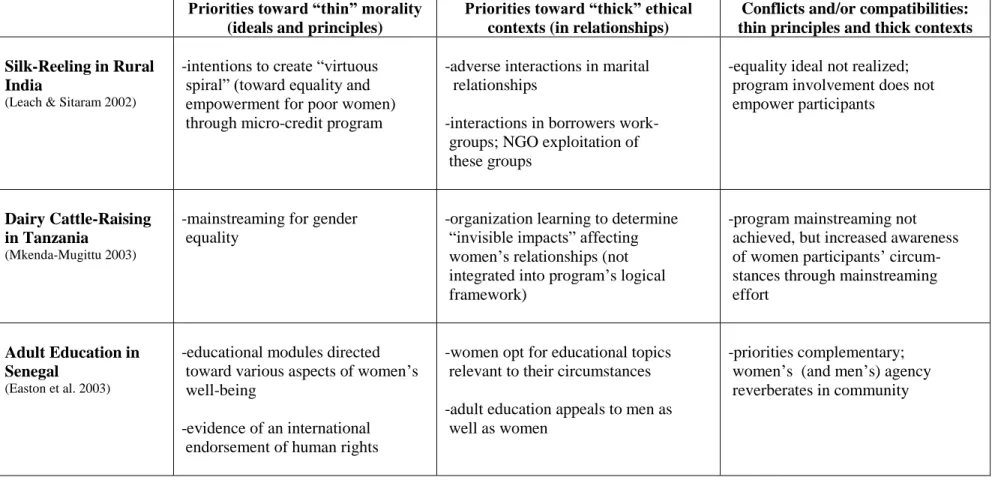
This analysis revisits the two questions posed above to compare the international development experiences related to silk-reeling in rural India, dairy cattle-raising in Tanzania, and adult continuing education in Senegal. Since the first question—concerning how programs negotiate priorities toward moral principles with attention to immediate ethical contexts— addresses Margalit’s (2002) “twin domains” of morality and ethics as applied to gender issues in development initiatives, table 1 below summarizes tensions between these priorities evident within these program experiences.
table 1 about here
Tensions emerge in the silk-reeling case wherein the NGO uses micro-credit in pursuit of what some call a “virtuous spiral” (see Mayoux 1998) of economic, political, and social
empowerment for women by encouraging them to assume roles as entrepreneurs rather than casual laborers in a home-based industry. Notwithstanding the theoretical possibility that these women could find agency within the contexts of marital or community relationships through the micro-credit program, Leach and Sitaram’s (2002) account emphasizes the faulty cause-and-effect implementation assumptions undergirding expectations of program success. Although the NGO did in fact conduct one orientation session for men, there is little evidence that it placed a
21
high priority upon women’s empowerment in meaningful contextual relationships. Rather, it appears that the NGO exploited social contexts as it benefited from information economies that the mandatory borrowing group afforded. Although Leach and Sitaram do not elaborate on this ploy, other commentators13 explain that group-borrowing offers micro-credit organizations an inexpensive source of client information (revealed weekly in meetings) and a coercive
enforcement mechanism that exerted peer-pressure within the group. Ironically, it was the women’s success in pressing demands for individual borrowing (casting off the coercive
pressures of joint-liability) that fostered group solidarity among them as cooperative partners. In all, it is difficult to assess the validity of the “virtuous spiral” effect for poor women through a micro-credit strategy given the severity of implementation flaws (most notably, inattention to the silk market’s volatility) reported by the authors. And in view of the NGO’s insensitivity to ethical contexts, its program efforts nonetheless impacted relationships within women’s work-groups and marriages for the worse.
By contrast, “thin morality versus thick ethics” tensions arose in the Tanzanian dairy cattle case not because of inattention to either but due to difficulties legitimizing the
methodologies used to track “the invisible” program impacts on gendered relationships, especially within the farmers association. Mkenda-Mugittu (2003) reports that the information flowing from elaborate procedures to monitor program impacts on women’s family and
community relationships ultimately stood apart from the project’s “official” logical framework. Thus from Mkenda-Mugittu’s account, it can be inferred that attempts to gender mainstream the Southern Highlands Dairy Development Program suffered from an inability to mainstream the program’s internal organization.
22
Tostan’s approach to development, as described in the third case relating to adult
education in Senegal, differs from the others with regard to its non-formal, participatory strategy that encouraged women to take the lead in developing curricula relevant to their lives—and thereby addressing meaningful contextual relationships. The fortuitous choice to include the universal ideal of human rights as a study module fostered consciousness-raising that empowered women (and men) to enact meaningful change within their local setting. Thus, Tostan’s
deference to participants allowed women to integrate goals (or ideals) into thick relational contexts. It is noteworthy that this NGO’s small donors (particularly the Wallace Global Foundation) valued flexibility and innovation in development and thus encouraged Tostan to experiment outside the constraints of a logical framework as a funding pre-requisite. As Easton et al. conclude, it is likely that subsequent funding from more conventional donors will require Tostan to pursue more tightly-coupled development initiatives in the future (2003, 456).
The far-right column in table 1 denotes “conflicts and compatibilities” between the “thin morality” and “thick ethics” priorities evident in the three cases; in particular, “compatibilities” here refers to Sen’s beneficial synergies wherein accomplishment related to one “spills over” to enhance the other. No such synergies emerge in the silk-reeling case since the NGO’s efforts led to more inequality than equality and exploited the women participants’ relationships with each other and with their spouses. By contrast, the glass appears half-full in the dairy development case—although the SHDDP staff did not succeed in integrating their gender monitoring procedures into the program’s logical framework, it enhanced gender awareness within the context of the household. Tostan intentionally coupled its priorities toward gender equality and empowering relationships by virtue of its strategy of deferring to women participants’ judgments concerning educational curricula relevant to their particular circumstances. Here Sen’s ideas
23
about the complementarities of ends and means, and of women’s well-being and agency,
materialize as Tostan’s efforts reverberate positively among Senegalese men and women as well as within that society.
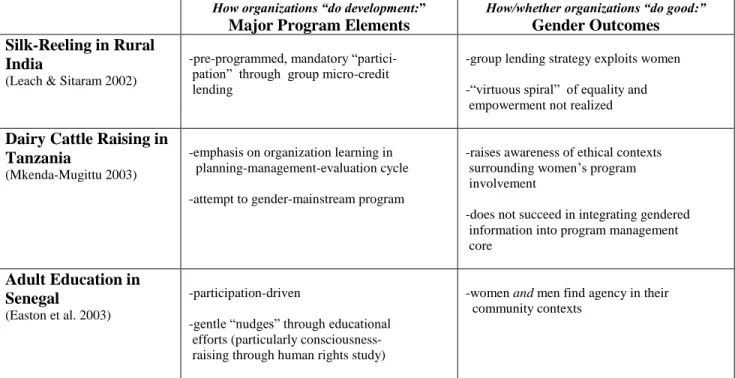
The second question raised above—regarding how well organizations “do good” related to how they “do development”—directs attention toward gender outcomes associated either with advancing a principled ideal (e.g., bringing about gender equality) and/or encouraging people (women and men) to exercise agency over their particular circumstances. Table 2 therefore aligns the major program elements described in the three cases with the extents of moral/ethical accomplishment related to gender. Combinations of the three development approaches
(emphasizing strong managerial control, behavioral nudges, and participatory empowerment) are evident among these program experiences, at least in some adapted (or corrupted) forms.
Respective NGO implementation efforts related to the silk-reeling case and the dairy cattle venture both rely strongly on management controls albeit in different ways. In the former, micro-credit managers commandeer the participatory ideal (putting the uppers first) in establishing coercive, mandatory work-groups that offer operating efficiencies for the NGO while exploiting the “participants.” By contrast, staff members in the dairy development project extended
considerable effort monitoring the invisible effects of the program upon the lives of women associated with the program. Although these endeavors promoted gender sensitivity among staff members, they ultimately fell short of intentions to integrate gender-specific monitoring into the program’s logical framework.
table 2 about here
Tostan’s participation-driven approach to development in Senegalese villages clearly led to empowerment outcomes in facilitating “social policy from the bottom-up” that curtailed the
24
custom of FGC that had victimized women for centuries. Although it is unlikely that Tostan officials were well-versed in behavioral economics (much of that work had yet to surface), they nonetheless served as “choice architects” through their participatory initiatives in formulating adult education curricula. Specifically, it is revealing how an exposure to human rights, in the context of group discussions relating to personal experiences of “the custom’s” debilitating effects, offered a gentle nudge that encouraged people to take control over their lives,
communities, and culture. The informative nature of gentle nudges, that enlighten yet encourage people as agents to draw their own conclusions, in essence disarms some critics who worry that development interventions undermine cultures. Rather, Tostan’s educational efforts nudged people toward making strategic choices for themselves.
Conclusion
In summarizing how international development programs attend to gender issues, it can be said that there is “empowerment” and then there is empowerment. In the “thin” language spoken within global institutions and among some development professionals, gender
empowerment translates as principled (e.g., good governance) reform that materializes through formulaic blueprints within logical frameworks, mainstreaming procedures, and other established practices. Clearly, prestigious global institutions play important roles as moral actors in
promoting development norms related to gender. Yet it is often the case that understandings of gender empowerment are narrowly framed within ideological or technical assumptions of economic improvement (as in the silk-reeling micro-credit case) or broadened inclusion (as with the dairy development program). These “recipes for success” generally depend upon strong
upward accountability that short-leashes development NGOs on behalf of donors (some
25
empowerment. In the “thicker,” more ethically-pertinent language of contextual complexity, gender empowerment means that—in the words of the founder of the (India-based)
Self-Employed Women’s Association14—“[w]e not only want a piece of the pie, we want to chose the flavor, and know how to make it ourselves.” Given this visionary demand, it appears that
ethically-committed development NGOs often find themselves overly-constrained and under-equipped to initiate improvisational efforts (as did Tostan in Senegalese villages) that nudge women (and men) to reverse oppressive power status-quos in messy contexts. Such is the ethical challenge that international development organizations confront in addressing gender indignities. Notes
1. For example, Sebastian Charles argues that “a radical modernity characterized by the exacerbation and intensification of that modern logic by which human rights and
democracy have been made into mandatory values, by the market having become a global economic reference system reaching into the remotest places on the planet and invading every sphere of our existence..” (2009, 392).
2. The author is such a proponent.
3. However, following Gilligan’s reasoning, the detachment of the abstract, universal ideal of gender equality poses a tactical problem for women’s advocacy in particular contexts. Notably, it is argued that the abstraction of the ideal depoliticizes gender empowerment in ways that support the institutional status quo in development agencies (see Badin and Goetz 1997, 9; Feldman 2003, 13-15).
4. All 192 UN member nations and many international organizations have agreed to meet the eight Millennium Development Goals by 2015. The other seven call for eradicating extreme poverty and hunger; achieving universal primary education; reducing child
26
mortality rates; improving maternal health; combating HIV/AIDS, malaria, and other diseases; ensuring environmental sustainability; and developing a global partnership for development.
5. Recipient of the Nobel Prize for Economic Science in 1998, Sen distinguishes himself from his neo-liberal colleagues as a traditional economist (in the company of Aristotle, Lavoisier, and others) “motivated by the need to study the assessment of, and causal influences on, the opportunities that people have for good living [economists whose] attention was never confined to one concept [i.e., income] as instrumental and
circumstantially contingent.” (1999, 24-25) Sen drafted Development as Freedom from his lectures to World Bank economists in Fall of 1996 as a visiting fellow there; in the “Preface,” he relates: “The World Bank has not invariably been my favorite organization. The power to do good goes almost always with the possibility to do the opposite…All this made it particularly welcome to have the opportunity to present at the Bank my own views on development and on the making of public policy.” (1999, xiii)
6. In this regard, Banerjee and Duflo maintain that “most vocal experts tend to be fixated on the ‘big questions’: What is the ultimate cause of poverty? How much faith should we place in free markets? Is democracy good for the poor? Does foreign aid have a role to play? And so on.” (2011, 3) They characterize “answers” on the ideological left as underscoring the necessity of foreign aid and on the right as relying on free markets and appropriate incentives.
7. Banerjee and Duflo argue that, although no magic bullets are available to eradicate global poverty, certain lessons have been learned. One such lesson is that “the poor bear
27
decisions are made for you. [For example] the poor have no piped water, and therefore do not benefit from the chlorine that the city government puts into the water supply. If they want clean drinking water, they have to purify it themselves.” (2011, 268; italics added) 8. Chambers indicates that this participatory approach is applicable in urban populations as
well: “[The PRA] has been described as a growing family of approaches and methods to enable local (rural or urban) people to express, enhance, share and analyze their
knowledge of life and conditions, to plan and to act.” (1994, 1253) In his article that predated the publication of Chambers’ Whose Reality Counts by nearly two decades, David Korten recommended a community-based rural development approach (that closely paralleled Chambers’ PRA) as an alternative to conventional development practices (or “blueprints”). In fact, Korten took note of enthusiastic support for “new directions” toward participatory approaches for the poor within both the U.S. Congress (regarding USAID priorities) and World Bank during the early 1970s —enthusiasm that subsequently waned due to institutional inertia (1980, 482-483).
9. Anothercommentator poses irony somewhat differently in her critical examination of the participatory approach:
Why is so little debate about these tensions [inherent in the participatory
approach] seen in the development literature? Is it that development practitioners fear criticizing local practices and being seen as the professionals roundly
condemned in Chambers’ work? Is there not a danger from swinging from one untenable position (‘we know best’) to an equally untenable and damaging one (‘they know best’)? (Cleaver 2002, 233)
28
Among her other criteria for critiquing participation, Frances Cleaver elaborates on “myths of community” common in the participation discourse, that communities are unitary and easily identifiable, units of power solidarity, resourceful, and foundations of social cohesion (2002, 231-233). Regarding the myth of a unitary community, Cleaver asserts, “[t]he very definition of community in development projects involves defining those who are ‘included’ in rights, activities, benefits and those who are excluded because they do not belong to the defined entity” (2002, 231).
10.Elsewhere I formulate a program typology that can assist NGO leaders anticipate the effects of development program logics on gender politics in impacted locales. This typology is predicated on my hypothesis that the prospects of women’s empowerment lessen to the extent that access to money (fungible and easily diverted within family and community systems) is at the core of the “empowerment” strategy (Ghere 2012, 215-220). Along this scale, the microfinance (rural India) and adult education (Senegal) cases represent the expected extremes. Empowerment success in the Tanzanian case is more difficult to predict given the attempt to institutionalize gender planning into a technical assistance program (see Moser 1993, 108-138). There is however some evidence that influential men in particular development locales can successfully lobby (or cajole) NGO officials to direct the use of technical assistance money toward their preferences (e.g., see Makhoul and Harrison 2002).
11.Although Leach and Sitaram do not identify the NGO, archival records of the UK
Department for International Development (DFID) show that the Chamarajanagara Parish Society was responsible for the day-to-day implementation of this micro-credit program.
29
See http://sleekfreak.ath.cx:81/3wdev/HDLHTML/EDUCRES/H0695E/CH09.HTM; accessed July 15, 2011.
12.Easton et al. relate that the imam advised the group not to “tell the villagers what to do, but rather what [other villages] had done, and why. Then let them tell their own stories and make their own decisions.” (2003, 449)
13.For example, Karlan and Appel maintain that cheap information and coercive
environments through borrowing groups compensate for the unavailability of credit rating information on poor women (2011, 74). Mallick reports on extreme coercion whereby a microcredit organization in Bangladesh (the Grameen Bank) physically incarcerated women overnight in the bank for non-payment on loans that in turn led to stigmatization within their community (2002, 154).
14. Suzette Mitchell quotes Ela Bhatt in her commentary on gender and development (1996, 140).
References
Adams, Guy B. and Danny L. Balfour. 2013. “The Prospects for Reconciling Sector-Specific Ethics in a Context of Blurred Boundaries, Ubiquitous Networks and Hypermodernity.”
In Ethics and Public Management 2nd edition, edited by H. George Frederickson and
Richard K. Ghere. Armonk NY: M.E. Sharpe.
Afshar, Haleh. 2000. “Gendering the Millennium: Globalising Women.” Developmemt in Practice. 10: 527-534.
Badin, Salle and Anne Marie Goetz. 1997. “Who Needs [Sex] When You Can Have [Gender]?” Feminist Review. 56: 3-25.
Aune, Jens B. 2000. "Logical Framework Approach and PRA: Mutually Exclusive or Complementary Tools for Project Planning?" Development in Practice 10: 687-90. Banerjee, Abhijit V. and Esther Duflo. 2011. Poor Economics: A Radical Rethinking of the Way
30
Chambers, Robert. 1994. “Participatory Rural Appraisal (PRA): Analysis of Experience.” World
Development. 22: 1253-1268.
---. 1997. Whose Reality Counts: Putting the First Last. Warwickshire, UK: Practical Action Publishing.
Charles, Sebastien 2009. “For a Humanism Amid Hypermodernity: From a Society of Knowledge to a Critical Knowledge of Society,” Axiomathes. 19: 389-400.
Cleaver, Frances. 2002. “Paradoxes of Participation: Questioning Participatory Approaches to Development.” In The Earthscan Reader on NGO Management, edited by Michael Edwards and Alan Fowler, 225-240. London: Earthscan.
Dale, Reidar. 2003. "The Logical Framework: An Easy Escape, a Straitjacket, Or a Useful Planning Tool?" Development in Practice 13.1: 57-70.
Dearden, Philip N., and Bob Kowalski. 2003. "Programme and Project Cycle Management (PPCM): Lessons from South and North." Development in Practice 13.5: 501-14. Easton, Peter, Karen Monkman, and Rebecca Miles. 2003. "Social Policy from the Bottom Up:
Abandoning FGC in Sub-Saharan Africa." Development in Practice 13.5: 445-58. Feldman, Shelley. 2003. "Paradoxes of Institutionalisation: The Depoliticisation of Bangladeshi
NGOs." Development in Practice 13.1: 5-26.
Fowler, Alan. 1996. “Demonstrating NGO Performance: Problems and Possibilities.” Development in Practice 6.1: 58-65.
Frederickson, H. George. 2009. “Searching for Virtue in the Public Life: Revisiting the Vulgar Ethics Thesis.” Public Integrity. 12: 239-246.
Ghere, Richard K. 2012. NGO Leadership and Human Rights. Sterling VA: Kumarian Press. Gilligan, Carol. 1987. “Moral Orientation and Moral Development.” In Women and Moral
Theory, eds. Eva Feder Kittay and Diana T. Meyers. Totowa NJ: Rowan and Littlefield.
Karlan, Dean and Jacob Appel. 2011. More Than Good Intentions: How a New Economics Is
Helping to Solve Global Poverty. New York: Dutton.
Korten, David C. 1980. “Community Organization and Rural Development: A Learning Process Approach.” Public Administration Review. 40: 480-503.
Kremer, Michael. 1993. “The O-Ring Theory of Economic Development.” The Quarterly
31
Leach, Fiona and Shashikala Sitaram. 2002. “Microfinance and Women’s Empowerment: A Lesson from India.” Development in Practice. 12: 575-588.
Lekskes, Jeannette. 1998, “Gender-Awareness and Policies: Theory and Practice among Small NGOs.” Development in Pracice. 8: 478-482.
Mainzer, Lewis C. 1991. “Vulgar Ethics for Public Administration.” Administration and Society. 23: 3-28.
Makhoul, Jihad and Linsey Harrison. 2002. “Development Perspectives: Views from Rural Lebanon.” Development in Practice 12.5: 613-624.
Mallick, Ross. 2002. “Implementing and Evaluating Microcredit in Bangladesh.” Development in Practice 12.2: 153-163.
Margalit, Avishai. 2002. The Ethics of Memory. Cambridge MA: Harvard University Press. Mayoux, Linda. 1998. “Women’s Empowerment and Micro-Finance Programmes: Strategies for
Increasing Impact.” Development in Practice 8.2: 235-241.
Mitchell, Suzette. 1996. “Gender and Development: A SAFE Recipe.” Development in Practice. 6: 140-143.
Mkenda-Mugittu, Vera F. 2003. “Measuring the Invisibles: Gender Mainstreaming and
Monitoring Experience from a Dairy Development Project in Tanzania.” Development in Practice. 13: 459-473.
Moser, Caroline O. 1993. Gender Planning and Development: Theory, Practice, and Training. London: Routledge.
Padaki, Vijay. 2000. "Coming to Grips with Organisational Values." Development in Practice 10: 420-35.
Schwartz, Robert. 2013. “Public Service Morals and Ethics: Thin/Thick Dilemmas in Routine and Critical Situations.” In Ethics and Public Management 2nd edition, edited by H. George Frederickson and Richard K. Ghere. Armonk NY: M.E. Sharpe.
Schwickert, Eva-Marie and Sarah C. Miller. 2005. “Gender, Morality, and the Ethics of Responsibility: Complementing Teleological and Deontological Ethics.” Hypatia. 20” 164-187.
Sen, Amatrya. 1999. Development as Freedom. New York: Anchor Books.
Smillie, Ian and John Hailey. 2002. Managing for Change: Leadership, Strategy, and
32
Song, Sarah. 2005. “Majority Norms, Multicultualism, and Gender Equality.” American Political Science Review. 99: 473-489.
Thaler, Richard H. and Cass R. Sunstein. 2008. Nudge: Improving Decisions about Health,
Wealth, and Happiness. New Haven: Yale University Press.
University of Wolverhampton. nd. A Guide for Developing a Logical Framework. Walsall UK: Centre for International Development and Training.
Uphoff, Norman. 2002 “Robert Chambers, Whose Reality Counts: Putting the First Last.”
Economic Development and Cultural Change. 50: 759-762
Willetts, Julia and Paul Crawford. 2007. “The Most Significant Lessons about the Most Significant Change Technique.” Development in Practice 19.6: 367-79.
33
Table 1. Tensions and Compatibilities Between Thin Moral Principles and Thick Ethical Contexts in Three Gender-Relevant International Development Programs
Priorities toward “thin” morality (ideals and principles)
Priorities toward “thick” ethical contexts (in relationships)
Conflicts and/or compatibilities: thin principles and thick contexts Silk-Reeling in Rural
India
(Leach & Sitaram 2002)
-intentions to create “virtuous spiral” (toward equality and empowerment for poor women) through micro-credit program
-adverse interactions in marital relationships
-interactions in borrowers work- groups; NGO exploitation of these groups
-equality ideal not realized; program involvement does not empower participants
Dairy Cattle-Raising in Tanzania
(Mkenda-Mugittu 2003)
-mainstreaming for gender equality
-organization learning to determine “invisible impacts” affecting women’s relationships (not integrated into program’s logical framework)
-program mainstreaming not achieved, but increased awareness of women participants’ circum- stances through mainstreaming effort
Adult Education in Senegal
(Easton et al. 2003)
-educational modules directed toward various aspects of women’s well-being
-evidence of an international endorsement of human rights
-women opt for educational topics relevant to their circumstances -adult education appeals to men as well as women
-priorities complementary; women’s (and men’s) agency reverberates in community
34
Table 2. Major Program Elements Affecting the Moral/Ethical Implications of Gender Outcomes in Three Gender-Focused International Development Programs
Bio
Richard K. Ghere is associate professor at the University of Dayton. He received Ph.D in political science (1975) from Wayne State University. His books include Ethics and Public Management 1st ed.(2005); 2nd ed. (2013) both co-edited with H. George Frederickson, NGO
Leadership and Human Rights (2012) and articles on public ethics and public–private
partnerships.
How organizations “do development:”
Major Program Elements
How/whether organizations “do good:”
Gender Outcomes Silk-Reeling in Rural
India
(Leach & Sitaram 2002)
-pre-programmed, mandatory “partici- pation” through group micro-credit lending
-group lending strategy exploits women -“virtuous spiral” of equality and empowerment not realized
Dairy Cattle Raising in Tanzania
(Mkenda-Mugittu 2003)
-emphasis on organization learning in planning-management-evaluation cycle -attempt to gender-mainstream program
-raises awareness of ethical contexts surrounding women’s program involvement
-does not succeed in integrating gendered information into program management core
Adult Education in Senegal
(Easton et al. 2003)
-participation-driven
-gentle “nudges” through educational efforts (particularly consciousness- raising through human rights study)
-women and men find agency in their community contexts