12th International Conference on Wirtschaftsinformatik, March 4-6 2015, Osnabrück, Germany
Measuring IT Service Management Capability:
Scale Development and Empirical Validation
Jochen Wulf1, Till J. Winkler2, Walter Brenner1 1
Universität St.Gallen, Institut für Wirtschaftsinformatik, St. Gallen, Switzerland
{jochen.wulf,walter.brenner}@unisg.ch
2 Copenhagen Business School, Department of IT Management, Frederiksberg, Denmark
Abstract. This paper conceptualizes IT service management (ITSM) capability, a key competence of today’s IT provider organizations, and presents a survey instrument to facilitate the measurement of an ITSM capability for research and practice. Based on the review of four existing ITSM maturity models (CMMI-SVC, COBIT 4.1, SPICE, ITIL v3), we first develop a multi-attributive scale to assess maturity on an ITSM process level. We then use this scale in a survey with 205 ITSM key informants who assessed IT provider organizations along a set of 26 established ITSM processes. Our exploratory factor analysis and measurement model assessment results support the validity of an operationali-zation of ITSM capability as a second-order construct formed by ITSM
pro-cesses that span three dimensions: service planning, service transition, and
ser-vice operation. The practical utility of our survey instrument and avenues for future research on ITSM capability are outlined.
Keywords: IT service management, Organizational capability, Process maturity models, Scale development, Survey instrument, Factor analysis.
1
Introduction
As internal IT providers are increasingly becoming independent service units within the company, and external providers are facing growing competition, the assessment of an IT provider’s service management capability is becoming increasingly im-portant and popular (e.g., [1]). IT service management (ITSM) is a widely recognized approach that organizes IT processes and functions around customer-oriented units of delivery, rather than around technology-oriented management tasks, which has been shown to aid in achieving numerous benefits (see [2]). Several frameworks for ITSM have evolved, such as the IT Infrastructure Library (ITIL), which by now has become very widely used [3, 4]. IT service providers—both internal and external—spend significant sums on implementing ITSM and assessing themselves against the practic-es suggpractic-ested by thpractic-ese frameworks.
While the advantage of such commercial ITSM assessments is their reliance on in-depth, process-specific questions and the expert judgment through an ITSM specialist,
they are evidently very detailed, time-consuming, and thus hardly feasible in case a company is looking for a simple, yet reliable indication of its current ITSM maturity status. A service management professional, for example, might at times want to look at the next areas of improvement in his/her organization’s ITSM capability using a more generic and lightweight process maturity scale.
The academic literature has, despite significant theoretical groundwork around the concepts of organizational capability (e.g., [5-9]) and maturity (e.g., [10, 11]), so far only incidentally touched upon the subject of measuring ITSM-related capabilities. The few existing studies have either employed single-item measures for an overall ‘ITSM maturity’ [12], or simply measured the ‘implementation stage’ of different ITSM processes on an ordinal scale [13, 14]. Both of these approaches, however, appear to fall short to adequately conceptualize and capture the nature of such abstract and broad concept as the organizational capability for practicing ITSM, which devel-ops during and beyond the implementation stage.
Given the practical and theoretical relevance of ITSM capability for today’s IT provider organizations as well as for research, we believe there are good reasons to venture a theoretically grounded conceptualization and an empirical validation of this construct. Therefore, this research aims to address the question: How can we parsi-moniously operationalize and reliably measure ITSM capability?
The resource-based view of the firm [7-9] provides a theoretical perspective to un-derstand ITSM capability as the ‘routines’ of IT service providers that make use of different IT assets in order to achieve desirable outcomes. Due to the existence of several established ITSM frameworks, we first follow Becker et al.’s [10] methodolo-gy to synthesize a generic ITSM process maturity scale from four existing process maturity frameworks. This maturity scale unites six process attributes (1. awareness and stakeholder communication, 2. plans and procedures, 3. tools and automation, 4. skills and expertise, 5. responsibility and accountability, 6. goal setting and meas-urement), whose traits jointly determine the maturity of a specific process. We then use this scale for several ITSM process items in a survey with key informants from 205 companies and apply standard instrument development procedures (e.g., [15]). The factor analysis and measurement model validation results suggest that the ITSM capability construct is composed of three sub-dimensions and that this instrument is psychometrically valid. Besides providing a parsimonious and reliable way to assess an IT provider’s ITSM capability for practice, we argue that this measurement in-strument also opens avenues for future research on the influences on and outcomes of ITSM capability.
In the remainder, we review related work on the theoretical foundation of organiza-tional capability, IT service management and maturity models (Section 2), before we explain our methodology (Section 3), describe our process maturity scale (Section 4), present the results of our empirical validation (Section 5), and conclude the paper by outlining practical and theoretical implications (Section 6).
2
Related Work
2.1 Organizational Capability in the IS Literature
The resource-based view (RBV) of the firm [9] provides a perspective to conceptual-ize organizational capabilities as the application of the firm’s assets to a desired end. According to the RBV, competitive advantage of a firm is determined by the utiliza-tion of its resources, which are inherently firm-specific, distributed heterogeneously across organizations, and costly to imitate [9]. One can broadly classify a firm’s re-sources into assets, i.e. “anything tangible or intangible the firm can use in its pro-cesses for creating, producing, and/or offering its products (goods or services) to a market” and capabilities, i.e. “repeatable patterns of actions in the use of assets to create, produce, and/or offer products to a market” [7, p. 109]. In a similar vein, Amit and Schoemaker [8, p. 35] define capabilities as “a firm’s capacity to deploy re-sources, usually in combination, using organizational processes, to effect a desired end.” Kishore et al. [16] emphasize that capabilities therefore do not only capture the codification of routines, e.g. through standardized process descriptions (ostensive aspect), but also their actual execution, i.e. the use of assets to achieve performance outcomes (performative aspect).
Organizational capability has also been characterized as a high-level construct that can have different sub-capabilities (or competences) [6]. Different models have been proposed to measure IT-related capabilities of IT user organizations. For example, Bharadwaj et al. [5] propose an IT capability construct consisting of six dimensions; Peppard and Ward [6] propose a different model using six ‘competences’ emphasiz-ing that not all of these competences are solely located in the IS function. Literature on the capabilities of IT provider organizations, in contrast, focuses on particular types and lifecycle stages of the IT service provided. For example, Feeny et al. [17] study the core capabilities of business process outsourcing providers and identify three capability areas. Ethiraj et al. [18] study the project performance of software service providers and identify two classes of capabilities. Kishore et al. [16] build on the CMM-framework [19] and provide a model with four capabilities that can help IT vendors to ensure distinctive software quality.
Our study contributes to the emerging IT capability literature that focuses on spe-cific IT provider capabilities. We seek a conceptualization of an ITSM capability that complements prior models in that it has a specific focus on IT services covering the entire IT service lifecycle. The need for such conceptualization is motivated by the increasing proliferation of ITSM frameworks that span the application of routines related to the strategy, design, transition, and operation of IT services [1]. Analogous-ly to prior definitions of organizational capabilities [7, p. 109] we define ITSM capa-bility as repeatable patterns of actions in the use of assets (such as people, knowledge, technology, tools, plans, etc.) to provide IT services to a customer organi-zation.
2.2 IT Service Management and ITIL
ITSM is an approach to the management of an IT provider’s daily activities with a specific emphasis on service-, customer- and user-orientation [12, 20]. In contrast to more technology oriented approaches to IT operations, ITSM considers its primary goal to design and provide IT services which meet the customers’ requirements [2]. IT provider organizations utilize ITSM to achieve numerous benefits, such as an im-proved level of IT services [21-25], better financial control [21, 26], and better busi-ness/IT alignment [27].
ITIL is a set of defined practices which can be employed to implement ITSM [28]. A first version was published in the 80s and 90s. The second version (ITIL v2), pub-lished between 1999 and 2003, particularly the Service Support and Service Delivery books, became highly popular among practitioners. Service Support was the first book published in the v2 series and focusses on operating IT services [29] through five processes: incident management, problem management, configuration management, change management, and release management. Service Delivery, the second book, covers processes for planning IT services: service level management, financial man-agement, IT service continuity manman-agement, availability management and capacity management [30]. The third version of ITIL was published in 2007 and consists of five domains, which describe the planning and operational processes required to man-age IT services more comprehensively along its entire lifecycle: Service Strategy, Service Design, Service Transition, and Service Operation. It emphasizes the idea of a Continual Service Improvement by a dedicated section [31], even though practitioners still often focus on the core ITIL v2 processes [4].
In the course of ITIL’s history, it has become a reference for ITSM concepts and terminology. While ITIL by now has become a de-facto standard [3, 4], there are a number of other frameworks with different emphases that firms can use alternatively or in addition, e.g. the Microsoft Operations Framework, HP IT Service Management Reference Model and IBM`s IT Process Model, the Control Objectives for Infor-mation and Related Technology (COBIT) [32], the Capability Maturity Model Inte-gration for Services (CMMI-SVC) [33], and the ISO/IEC 20000 standard [34]. [32-34] particularly provide useful concepts for assessing the maturity of ITSM processes, which are discussed in the following.
2.3 Maturity Models for IT Service Management
Maturity models describe stages of evolutionary improvement in a specific process or domain [35]. For each stage of maturity they typically provide a general description and formally specify a number of specific characteristics along a set of well-defined attributes [36]. In the context of “repeatable patterns of action,” maturity can be de-fined as the degree to which such pattern is explicitly dede-fined, managed, measured, controlled, and effective as a process [19]. Maturity models not only cover the osten-sive definition of organizational routines, but also the performative perspective and are therefore also used to describe the level of organizational capability (e.g., CMM [19]).
Process maturities can be aggregated to a domain level maturity either by a staged logic (i.e., certain processes need to be in place for a certain domain level), or a con-tinuous logic (i.e., the domain-level maturity is reflected in the aggregate levels of process maturity). Maturity models can also be differentiated by the specificity of their process prescriptions. Some models define goals and attributes for each ITSM process individually (high specificity). Others only define generic attributes, which are applicable for all ITSM processes (low specificity). A third class of maturity mod-els provides a mix of generic and specific process goals and attributes (which we label as medium specificity). Table 1 provides an overview of the four maturity models that are discussed briefly in the following.
Table 1. Comparison of maturity models
Framework CMMI-CVS COBIT 4.1 SPICE ITIL
Maturity levels Incomplete; Performed; Managed; Defined Non-existent; Initial/ad hoc; Repeatable but intui-tive; Defined pro-cess; Managed and measurable; Optimized Incomplete; Performed; Managed; Established; Predictable; Optimizing Initial; Repeatable; Defined; Managed; Optimizing
Attributes Achieve Specific Goals; Institu-tionalize a Man-aged Process; Institutionalize a Defined Process Awareness and Communication; Policies, Standards and Procedures; Tools and Automa-tion; Skills and Expertise; Respon-sibility and Ac-countability; Goal Setting and Meas-urement Process mance, Perfor-mance Mgt., Work product Mgt., Process definition, Process deploy-ment, Process measurement, Process control, Process innova-tion, Process optimization Vision and steering; Process; People; Technology; Culture Aggregation logic
Staged None None None
Process specificity
Medium Medium Medium Low
The capability maturity model (CMM) was originally designed to measure maturi-ty in the domain of software development [19]. An extension of CMM, the Capabilimaturi-ty Maturity Model Integration for Services (CMMI-SVC) has a specific focus on a set of processes required to manage service provider organizations [33]. COBIT, a frame-work with a focus on IT governance, in its version 4.1 [32] defines a generic scale for the assessment of process maturity and further provides control objectives for the individual COBIT processes. ISO/IEC 15504 [37], also referred to as the Software
Process Improvement and Capability Determination (SPICE) framework, is an inter-national standard for the assessment of software development processes. It is also applied for ITSM certification as specified in the ISO/IEC 2000 standard [34]. ITIL [38] since version 3 also provides some recommendations on how to assess the ma-turity of either the individual service management processes or the entire ITSM do-main.
In summary, all reviewed maturity models define generic process attributes that can inform our own model development, while prior literature does not offer a syn-thesis of the different attribute perspectives. The six generic process attributes speci-fied by COBIT 4.1 [32] are compatible with all four maturity models. CMMI-CSV [33], SPICE [37] and COBIT 5 [39] in addition cover specific goals and work prod-ucts per ITSM process.
3
Methodology
To address our research objective of developing and validating an ITSM capability construct, we combined two different methodological approaches: In a first stage, we followed Becker et al.’s [10] recommended procedure to synthesize a model for as-sessing maturity on a process level from the different models we reviewed. In a sec-ond stage, we then applied standard procedures (e.g., [15, 40]) to develop a survey instrument that employs this multi-attributive maturity scale, and assessed its psy-chometric validity in a survey study. We argue that this two-stage approach is an ap-propriate one due to the abstract nature of our focal construct. That is, traditional in-strument development procedures typically focus on the selection from a pool of items, whose sub-dimensions are known from theory and whose scales and are as-sumed a priori (e.g., Likert scales). In the case of the ITSM capability construct, how-ever, the pool of items was given a priori (by established ITSM process taxonomies such as ITIL), while their dimensions were not known and their maturity scale is a non-trivial one with multiple attributes. This makes our first stage an indispensable prerequisite to the second stage.
As a starting point of our maturity scale development, we performed a comparison of the four process maturity frameworks reviewed earlier [32, 33, 37, 38] and gener-ated brief textual descriptions for six CMM-based process maturity levels. In a first validation interview with an ITSM expert (ITIL expert level certification, 20 years of professional experience) our attention was called on the need to provide more fine-grained specifications for these maturity levels in order to ensure reliability of the measurement. In a second iteration, we therefore carried out a detailed comparison of the four frameworks regarding their generic attributes for ITSM process maturity. This comparison asserted the completeness of the six generic process attributes pro-vided by the COBIT framework [32]. We then specified the detailed traits for each attribute on each maturity level in the course of a structural comparison of the scales provided in [33, 37, 38]. In the second iteration, we interviewed two further ITSM experts (both practitioner level, 15 and 5 years of experience) and received feedback that affirmed these attribute definitions despite some minor corrections. A third
itera-tion of the attribute model was validated in a focus group interview with three ITSM auditors, who asserted the fitness for purpose of a self-assessment through this pro-cess maturity scale.
In stage 2, we used this multi-attributive process maturity scale to assess common ITSM processes in an online survey study with ITSM key informants from 205 com-panies. The survey used the 26 processes of the four domains of ITIL v3 as items (including Continual Service Improvement as one separate process). In the online survey, each process was annotated with a short description (realized as a mouse-over pop-up box) and was assessed on the six-point maturity scale. The scale’s levels and attributes (Table 1 with detailed descriptors), were provided on the previous question-naire page (and as mouse-over descriptions during the assessment), where respond-ents had to confirm their understanding of this scale through a mandatory checkbox.
Throughout late 2013 and early 2014, members of the itSMF, a global association of Service Management professionals, from the regional chapters in Germany, Den-mark, and Switzerland were invited via newsletters to participate in this study. Over this period, we received valid responses from 205 ITSM professionals with an aver-age of 5.4 years of work experience. 83% stated to possess an ITIL/ITSM qualifica-tion of at least foundaqualifica-tion level (foundaqualifica-tion 34%, practiqualifica-tioner 12%, expert 36%, mas-ter level 1%). The median size of assessed IT provider organizations was 135 em-ployees (mean 2,431).
In consonance with prior conceptualizations of organizational capability [5-9], we regard ITSM capability as a second-order construct that can be composed of multiple first-order dimensions (sub-capabilities). These sub-capabilities, in turn, are reflected in the multi-attributive measure of maturity of their associated ITSM processes, which corresponds to a continuous maturity aggregation logic. To assess the ITSM capabil-ity instrument regarding its (unknown) dimensionalcapabil-ity, we first performed an explora-tory factor analysis on the 26 process maturity items (KMO .94, cutoff eigenvalue>1). Only items with a loading of higher than 0.60 from their substantial factor and cross-loadings less than 0.40 from other factors were kept as measurements. These relative-ly strict thresholds for item selection have also been used in previous studies (e.g., [41]).
In the sense of a multi-trait validity check [42], we also compared our ITSM pro-cess maturity means with the implementation stage means reported in a global itSMF survey [4] (scale: not planned, planned next year, planned next quarter, in progress, in place) and in previous research [13] (scale: not started, early, halfway, advanced, completed). We then assessed the psychometric reliability and validity of the resulting three sub-dimensions with the 14 items that remained. Finally, we also tested the ef-fect of these three sub-dimensions on a mean-indexed measure of all 26 items. The results of these measurement model and structural model tests are presented in Sec-tion 5.
4
A Process Maturity Scale for Measuring ITSM Capability
The process maturity scale, which is the result of stage 1 of our instrument develop-ment approach, is summarized in Table 2, with brief descriptors for each attribute and maturity level. A full version with detailed descriptors can be supplied on request.
The first attribute, awareness and stakeholder communication, addresses the need to recognize all process requirements and communicate them throughout the organiza-tion and to external stakeholders. On level 0, there is no perceived necessity for the process (no awareness). On level 1, issues impacting process performance are sporad-ically reported to relevant stakeholders in a reactive, informal manner (partial aware-ness). On level 2, management communicates observed overall process issues regular-ly (wide awareness). On level 3, there is a formal and structured communication of all process performance issues and requirements (full awareness). On level 4, there are regular reviews of process and function effectiveness completed by process managers and discussed with stakeholders to validate continued effectiveness (comprehensive reporting). On level 5, process management communicates proactively to all relevant stakeholders based on trends.
Table 2. Process maturity scale
Attribute 0. None 1. Initial 2.
Repeat-able 3. De-fined 4. Man-aged 5. Opti-mized Awareness and stakeholder communication No aware-ness Partial awareness Wide awareness Full aware-ness Compre-hensive reporting Proactive communica-tion Plans and procedures No pro-cess Ad hoc process Informal process Process formally defined Robust process execution Good prac-tice process Tools and automation No tools Only standard desktop tools Tools individual-ly man-aged Tools centrally managed Tools fully integrated End-to-end automation Skills and expertise Required skills unknown Required skills iden-tified Informal ad hoc training Formal training plan Long-term training program Continuous skill im-provement Responsibility and accounta-bility Respon-sibilities unknown No respon-sibility allocation Informal responsi-bilities Defined respon-sibilities Responsi-bilities fully dis-chargeable Responsi-bilities fully harmonized
Goal setting and measurement No goals Unclear goals Partial goals Goals defined globally Goals enforced Proactive control
Plans and procedures covers the adoption of good practices, the documentation of processes and the institutionalization of regular improvements to policies, standards
and procedures to increase process efficiency. On level 0, there is no identified pro-cess (no propro-cess). On level 1, parts of the propro-cess activities are performed ad hoc when needed without identification of the overall process (ad hoc process). On lev-el 2, key process work products are created informally. Parts of the process are re-peatable depending on individual expertise (informal process). On level 3, formal plans and policies are commonly established and include all key process descriptions and outputs (process formally defined). On level 4, the process is operating effective-ly with little deviations (robust process execution). On level 5, the process is executed and controlled according to external good practice (good practice process).
Tools and automation addresses the level of automation of the process, the tools which are applied to increase process efficiency and their level of integration. On level 0, all activities are executed manually (no tools). On level 1, desktop tools are sporadically used for single purposes (only standard desktop tools). On level 2, there is some use of dedicated or self-developed tools owned by individuals (tools individ-ually managed). On level 3, tool use is coordinated within a defined, central plan (tools centrally managed). On level 4, tools usage is linked to all key process areas to automate the process and monitor critical activities (tools fully integrated). On level 5, tools are fully integrated to automatically detect exceptions and proactively control the process (end-to-end automation).
Skills and expertise covers how skill requirements are defined and documented as well as how training and further education is organized. On level 0, minimum skill requirements for critical process areas are unknown (required skills unknown). On level 1, minimum skill requirements for process are identified but there is no training available (required skills identified). On level 2, informal on-the-job training is pro-vided when needed (informal ad hoc training). On level 3, a formal training plan is defined outlining all required skills (formal training plan). On level 4, a training pro-gram is implemented planning, assessing and monitoring all process skill require-ments (long-term training program). On level 5, a continuous improvement of skills through leading learning concepts and systems is in place, including use of external experts (continuous skill improvement).
Responsibility and accountability addresses whether responsibilities and accounta-bilities are defined and accepted and whether process owners are empowered to make decisions. On level 0, process responsibilities and accountabilities are not identified (responsibilities unknown). On level 1, responsibility is broadly unclear and assumed situationally (no responsibility allocation). On level 2, responsibilities are informally defined and allocated (informal responsibilities). On level 3, a formal definition of process ownership, responsibilities and accountabilities is in place (defined responsi-bilities). On level 4, defined persons have full authority to discharge responsibility (responsibilities fully dischargeable). On level 5, responsibilities are accepted and cascaded down throughout the organization in a consistent fashion (responsibilities fully harmonized).
Goal setting and measurement covers whether clear goals are defined for the IT process and activities. Further it is assessed whether the achievement of the objectives is measured and whether the measurement is applied for continuous improvement of the process and the efficient delivery of process results. On level 0, no process goals
are defined (no goals). On level 1, the objectives of the process remain broadly un-clear and are not embedded within the organization's overall strategy (unun-clear goals). On level 2, goals are only defined for selected activities and stakeholders (partial goals). On level 3, goal setting is routinely performed for all process stakeholder and process outcomes are linked to business goals (goals defined globally). On level 4, formal measurement and control is fully established to assess process performance and take corrective actions (goals enforced). On level 5, goal setting, measurement and control is integrated linking IT performance to business goals by a global applica-tion of causal analysis techniques (proactive control).
These attributes were used by the survey participants to assess the maturity of the 26 ITSM processes described by ITIL. To avoid a tendency of overestimating, partic-ipants were asked to assess the maturity level of the process by taking the lowest ma-turity level of all six process attributes.
5
Empirical Validation Results
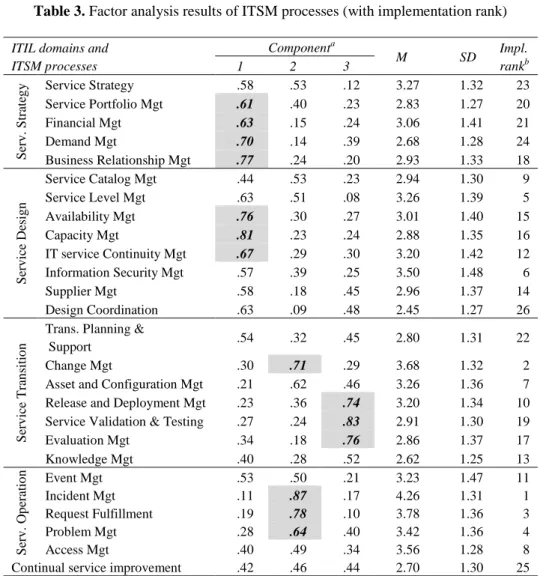
Table 3 presents the exploratory factor analysis results together with mean and stand-ard deviation per process and, for illustrative purposes, an implementation rank calcu-lated from [4, p. 15]. The multi-trait comparison to the implementation stage measures shows that the 26 maturity means are highly correlated both with the im-plementation stage means reported in [4] (r=0.86) and those reported in [13] (r=0.85). This suggests that those ITSM processes implemented at an earlier stage generally also possess a higher maturity, for which our scale provides more fine-grained levels. The results of the exploratory factor analysis indicate that the 26 ITSM process maturity items can be explained by just three underlying factors (Table 3). After varimax rotation, it shows that the first extracted factor, primarily loads on the items of the two ITIL domains Service Strategy and Service Design. On the one hand, this finding fits the ITIL logic, in which these two categories stand at the beginning of the Service Lifecycle. On the other hand, it also makes clear that organizations imple-menting ITSM do not at all distinguish between these two categories. This motivates us to label this first ITSM sub-capability jointly as service planning capability. The ranked implementation stages (right column) inform us that these are processes with a generally lower stage of implementation.
The second emerging factor loads distinctively on most items of the Service Opera-tion domain as well as on the change management process item, which is part of the Service Transition category (Table 3). While this appears remarkable at first sight, it becomes more conceivable when looking at the implementation rank. In fact, change management is, together with the core Service Operation processes among the first and most maturely implemented processes and thus part of day-to-day IT operations.1 This motivates us to view the change management process, de facto, as a part of the second ITSM sub-capability, which we label service operation capability.
1
Also note that in ITIL’s previous version 2, change management was part of the Service Sup-port category, together with the other mentioned Service Operation processes.
A third factor emerges that loads distinctively on three of the processes in the Ser-vice Transition domain (Table 3). These processes have in common to deal with the preparation, deployment and post-implementation evaluation of IT services. This ITSM sub-capability, which we label accordingly service transition capability, might be particularly relevant for IT providers that regularly implement changes to their system landscape, e.g. custom software and application management providers (as opposed to pure IT infrastructure providers).
The exploratory factor analysis also shows that the remaining processes lay some-what ‘in-between’ these three important ITSM sub-capabilities. Thus, while this does not lessen their importance for implementing ITSM, we may drop them from our survey instrument for the benefit of obtaining a parsimonious and clear-cut measure-ment instrumeasure-ment.
Table 3. Factor analysis results of ITSM processes (with implementation rank)
ITIL domains and ITSM processes Componenta M SD Impl. rankb 1 2 3 S er v . S tr ate g y Service Strategy .58 .53 .12 3.27 1.32 23 Service Portfolio Mgt .61 .40 .23 2.83 1.27 20 Financial Mgt .63 .15 .24 3.06 1.41 21 Demand Mgt .70 .14 .39 2.68 1.28 24 Business Relationship Mgt .77 .24 .20 2.93 1.33 18 S er v ice D es ig n Service Catalog Mgt .44 .53 .23 2.94 1.30 9 Service Level Mgt .63 .51 .08 3.26 1.39 5 Availability Mgt .76 .30 .27 3.01 1.40 15 Capacity Mgt .81 .23 .24 2.88 1.35 16 IT service Continuity Mgt .67 .29 .30 3.20 1.42 12 Information Security Mgt .57 .39 .25 3.50 1.48 6 Supplier Mgt .58 .18 .45 2.96 1.37 14 Design Coordination .63 .09 .48 2.45 1.27 26 S er v ice T ran si ti o n
Trans. Planning &
Support .54 .32 .45 2.80 1.31 22
Change Mgt .30 .71 .29 3.68 1.32 2
Asset and Configuration Mgt .21 .62 .46 3.26 1.36 7
Release and Deployment Mgt .23 .36 .74 3.20 1.34 10
Service Validation & Testing .27 .24 .83 2.91 1.30 19
Evaluation Mgt .34 .18 .76 2.86 1.37 17 Knowledge Mgt .40 .28 .52 2.62 1.25 13 S er v . O p er at io n Event Mgt .53 .50 .21 3.23 1.47 11 Incident Mgt .11 .87 .17 4.26 1.31 1 Request Fulfillment .19 .78 .10 3.78 1.36 3 Problem Mgt .28 .64 .40 3.42 1.36 4 Access Mgt .40 .49 .34 3.56 1.28 8
Continual service improvement .42 .46 .44 2.70 1.30 25
b ranked stages of implementation (lower number ≡ higher stage), from [4, p. 15]
We assess the psychometric properties of these three factors spanned by the 14 items (the measurement model) by using the quality metrics recommended by the partial least squares (PLS) method, see Table 4. Criteria for convergent validity and internal reliability are above the recommended thresholds (Alpha>0.70; AVE>0.50; CR>.70), indicating that the process maturities for each competence are sufficiently related [43] . Factor correlations are below the square root of AVE and item-to-factor cross-loadings are also clear-cut (table available on request), so that we are also con-fident that the three dimensions are sufficiently unrelated, i.e. discriminantly valid.
Table 4. Construct validity and reliability assessment
ITSM competence
Quality criteria Correlations (diagonal sqrt AVE)
Alpha AVE CR 1 2 3
1 Planning .895 .657 .920 .811 - -
2 Transition .876 .802 .924 .644 .895 -
3 Operation .861 .705 .905 .609 .583 .840
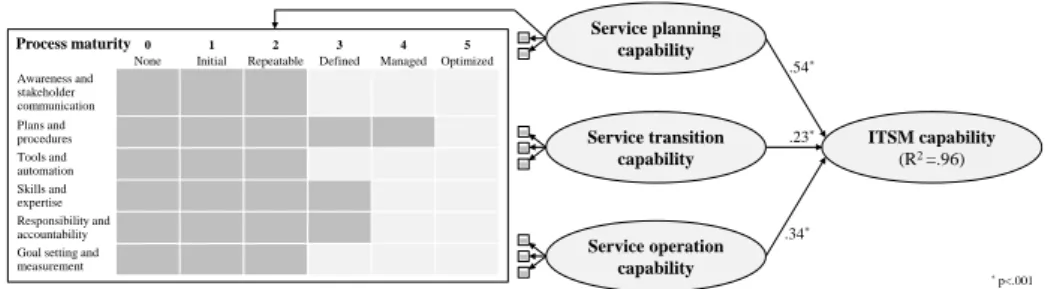
Finally, we assess the structural properties of the three factors and their relation-ship to an overall ITSM capability. For the purpose of comparison, we operationalize the ITSM capability variable as a mean index over all 26 process items. The three factors jointly explain R2=96.1% of the variance of the ITSM capability index varia-ble, which supports validity of this second-order construct. This high value also sug-gests that the 12 items that had been dropped are in fact negligible to measure ITSM capability. Figure 1 summarizes the structural model test results and illustrates how the developed process maturity scale feeds into this ITSM capability model.
Fig. 1. ITSM Capability Model
6
Conclusion
The need for a parsimonious, yet reliable way to measure the capability of IT service providers led us to theoretically conceptualize and develop a measurement instrument
ITSM capability (R2 =.96) Service transition capability Service operation capability *p<.001 .54* .23* .34* 0 1 2 3 4 5
None Initial Repeatable Defined Managed Optimized Awareness and stakeholder communication Plans and procedures Tools and automation Skills and expertise Responsibility and accountability Goal setting and measurement
Service planning capability
for ITSM capability, defined as repeatable patters of actions in the use of assets to provide IT services to a customer organization. This instrument comprises a multi-attributive maturity scale and suggests the existence of three service management sub-capabilities crucial for today’s IT service providers: service planning capability, ser-vice transition capability, and serser-vice operation capability. Our empirical validation provides support for the psychometric reliability of the maturity scale and the adequa-cy of the three-dimensional model to sufficiently represent an organization’s overall ITSM capability.
ITSM practitioners can use this instrument to benchmark organizations in a simple and reliable way and thereby obtain a comprehensive overview of their ITSM capabil-ities, potentially in comparison to others. Due to its inward perspective on key attrib-utes of process maturity, this can also unveil potential areas of improvement, which makes it more flexible and less heavyweight than most commercial ITSM assess-ments. As one of the interviewed ITSM experts phrased it: “I think this [process ma-turity scale] is some of the best stuff I have seen in a self-assessment, because if you go to other self-assessment things, it’s very much like this [pointing at the simple description of maturity levels]. But now you have it [i.e., a detailed multi-attribute scale] in here, […] and that could give a much better basis for having a more precise assessment.”
At the same time, this second-order ITSM capability construct is theoretically grounded in a resource-based view and includes ostensive and performative aspects, which makes it considerably broader and more sophisticated than the measurements previously employed in academic ITSM studies (e.g. [12, 13]). This opens promising avenues for future research on the emerging field of ITSM, which despite high practi-cal relevance is still regarded to be in its infancy [12]. For example, research designed at explaining the antecedents and outcomes of ITSM capability can be facilitated by our measurement instrument. Future research may also investigate potential interac-tion between the three ITSM capabilities, e.g. whether they simply add up or even reinforce each other.
The following limitations merit consideration: First, our validation based on self-reports of ITSM professionals, which may or may not have introduced certain biases. Second, we solely focus on ITIL as a taxonomy for ITSM processes. Although ITIL has been co-developed by numerous stakeholders and widely been accepted, one might find additional facets of ITSM capability that did not enter our factor analysis. Finally, building on the resourced-based view, we measure only inward traits of ITSM capability, not outcomes. Other researchers might also find it helpful to meas-ure how capability is reflected in different dimensions of strategic goal attainment.
References
1. Cots, S., Casadesús, M.: Exploring the service management standard ISO 20000. Total Quality Management & Business Excellence 1-19 (2014)
2. Iden, J., Eikebrokk, T.R.: Implementing IT Service Management: A systematic literature review. International Journal of Information Management 33, 512-523 (2013)
3. ITGI: Global Status Report on the Governance of Enterprise IT (GEIT) - 2011. IT Gov-ernance Institute, Meadows, IL, US (2011)
4. itSMF: itSMF 2013 Global Survey On IT Service Management. IT Service Management Forum international (2013)
5. Bharadwaj, A.: A Resource-based Perspective on Information Technology Capability and Firm Performance: An Empirical Investigation. MIS Quarterly 24, 169-196 (2000) 6. Peppard, J., Ward, J.: Beyond strategic information systems: towards an IS capability.
The Journal of Strategic Information Systems 13, 167-194 (2004)
7. Wade, M., Hulland, J.: Review: The resource-based view and information systems re-search: Review, extension, and suggestions for future research. MIS Quarterly 28, 107-142 (2004)
8. Amit, R., Schoemaker, P.: Strategic assets and organizational rent. Strategic Management Journal 14, 33-46 (1993)
9. Barney, J.: Firm Resources and Sustained Competitive Advantage. Journal of Manage-ment 17, 99-120 (1991)
10. Becker, J., Knackstedt, R., Pöppelbuß, J.: Developing Maturity Models for IT Man-agement. Business & Information Systems Engineering 1, 213-222 (2009)
11. Becker, J., Niehaves, B., Poeppelbuss, J., Simons, A.: Maturity Models in IS Research. In: Proceedings of 18th European Conference on Information Systems (ECIS 2010). (Year)
12. Marrone, M., Kolbe, L.: Impact of IT Service Management Frameworks on the IT Or-ganization. Business & Information Systems Engineering 3, 5-18 (2011)
13. Iden, J., Eikebrokk, T.R.: Using the ITIL Process Reference Model for Realizing IT Governance: An Empirical Investigation. Information Systems Management 31, 37-58 (2014)
14. Cater-Steel, A., Tan, W.G.: Implementation of IT infrastructure library (ITIL) in Aus-tralia: progress and success factors. In: IT Governance International Conference, Auck-land, NZ, pp. 14-16. (Year)
15. MacKenzie, S., Podsakoff, P., Podsakoff, N.: Construct measurement and validation procedures in MIS and behavioral research: Integrating new and existing techniques. MIS Quarterly 35, 293-334 (2011)
16. Kishore, R., Swinarski, M.E., Jackson, E., Rao, H.R.: A quality-distinction model of IT capabilities: conceptualization and two-stage empirical validation using CMMi processes. Engineering Management, IEEE Transactions on 59, 457-469 (2012)
17. Feeny, D., Lacity, M., Willcocks, L.P.: Taking the Measure of Outsourcing Providers. MIT Sloan Management Review 46, 41-48 (2005)
18. Ethiraj, S.K., Kale, P., Krishnan, M.S., Singh, J.V.: Where do capabilities come from and how do they matter? A study in the software services industry. Strategic Management Journal 26, 25-45 (2005)
19. Paulk, M.C., Weber, C.V., Garcia, S.M., Chrissis, M.B.C., Bush, M.: Key practices of the Capability Maturity Model version 1.1. Software Engineering Institute, Carnegie Mellon University, Pittsburgh, Pennsylvania (1993)
20. Conger, S., Winniford, M., Erickson-Harris, L.: Service Management in Operations. In: American Conference on Information Systems 2008 Proceedings. Paper 362. (Year) 21. Cater-Steel, A., Toleman, M., Tan, W.-G.: Transforming IT service management-the
ITIL impact. In: Proceedings of the 17th Australasian Conference on Information Systems (ACIS 2006). (Year)
22. Cervone, F.: ITIL: a framework for managing digital library services. OCLC Systems & Services 24, 87-90 (2008)
23. Hochstein, A., Tamm, G., Brenner, W.: Service oriented IT management: Benefit, cost and success factors. In: Proceedings of the 15th European Conference on Information Sys-tems (ECIS 2005). (Year)
24. Marrone, M., Kießling, M., Kolbe, L.: Are we really innovating? An exploratory study on innovation management and service management. IEEE International Conference on Management of Innovation and Technology, pp. 378-383, Singapore (2010)
25. Potgieter, B., Botha, J., Lew, C.: Evidence that use of the ITIL framework is effective. In: Proceedings to the 18th Annual Conference of the National Advisory Committee on Computing Qualifications, pp. 160-167. (Year)
26. Cater-Steel, A., Tan, W.-G., Toleman, M.: Challenge of adopting multiple process im-provement frameworks. In: Proceedings of 14th European Conference on Information Sys-tems (ECIS 2006), pp. 1375-1386. (Year)
27. Kashanchi, R., Toland, J.: Can ITIL contribute to IT/business alignment? An initial in-vestigation. Wirtschaftsinformatik 48, 340-348 (2006)
28. McNaughton, B., Ray, P., Lewis, L.: Designing an evaluation framework for IT service management. Information & Management 47, 219-225 (2010)
29. OGC: Service Support. Stationery Office, London (2000) 30. OGC: Service Delivery. Stationery Office, London (2001)
31. OGC: The Official Introduction to the ITIL Service Lifecycle. The Stationary Office for the Office of Government Commerce. London (2007)
32. ITGI: COBIT 4.1–Control Objectives, Management Guidelines and Maturity Models. Information Technology Governance Institute (2009)
33. CMMI Product Team: CMMI for Services, version 1.3. Software Engineering Institute (2010)
34. ISO/IEC: ISO/IEC 20000-4:2010 Process reference model. International Organization for Standardization (2010)
35. Mettler, T.: Thinking in Terms of Design Decisions When Developing Maturity Mod-els. International Journal of Strategic Decision Sciences (IJSDS) 1, 76-87 (2010)
36. Fraser, P., Moultrie, J., Gregory, M.: The use of maturity models/grids as a tool in as-sessing product development capability. In: Engineering Management Conference, 2002. IEMC '02. 2002 IEEE International, pp. 244-249 vol.241. (Year)
37. ISO/IEC: ISO/IEC 15504. 2006. Information Technology—Process Assessment. (2006) 38. OGC: ITIL Service Design. The Stationary Office for the Office of Government
Com-merce. London (2011)
39. ISACA: COBIT 5: A Business Framework for the Governance and Management of En-terprise IT. ISACA (2012)
40. Churchill, G.A., Iacobucci, D.: Marketing research: methodological foundations. South-Western Pub (2009)
41. Chin, W., Gopal, A., Salisbury, D.: Advancing the theory of adaptive structuration: The development of a scale to measure faithfulness of appropriation. Information Systems Re-search 8, 342-367 (1997)
42. Campbell, D., Fiske, D.: Convergent and discriminant validation by the multitrait-multimethod matrix. Psychological bulletin 56, 81 (1959)
43. Hair, J., Ringle, C., Sarstedt, M.: PLS-SEM: Indeed a Silver Bullet. The Journal of Marketing Theory and Practice 19, 139-152 (2011)