Properties of straight
line segments
mc-TY-lineseg-2009-1 In this unit we use a system of co-ordinates to find various properties of the straight line between two points. We find the distance between the two points and the mid-point of the line joining the two points.
In order to master the techniques explained here it is vital that you undertake plenty of practice exercises so that they become second nature.
After reading this text, and/or viewing the video tutorial on this topic, you should be able to:
• find the distance between two points;
• find the co-ordinates of the mid-point of the line joining two points;
Contents
1.
Introduction
2
2.
The distance between two points
3
1. Introduction
In this unit we use a system of co-ordinates to find various properties of the straight line between two points. We find the distance between the two points and the mid-point of the line joining the two points. Let’s start by revising some facts about the coordinates of points.
Suppose that a point O is marked on a plane, together with a pair of perpendicular lines which pass through it, each with a uniform scale. We shall label the lines with the letters xand y, and we call them the x and y axes. The fixed point O is called theorigin, and it is the intersection point of the two axes. This is shown in Figure 1.
O A(x,y) x y x y
Figure 1. The x and y axes intersect at the origin
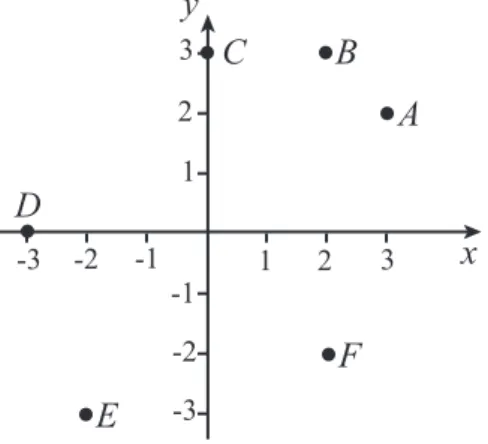
Any point, A say, can be described by an ordered pair of numbers (x, y), where we measure the distance ofAfirst from theyaxis, and then from thexaxis. The ordered pair(x, y)are called the coordinates of the point A. Any points to the left of they, orvertical axiswill have a negative x coordinate. Any points below the x or horizontal axis, will have a negative y coordinate. To see an example of this, consider the points shown in Figure 2.
A x y F E D C B 1 2 3 -1 -2 -3 1 2 3 -1 -2 -3
Figure 2. Some points plotted in the xy plane.
A is the point (3,2), as it is 3 units along in the x direction and 2 units up in the y direction. Similarly, B is the point (2,3), with the same numbers but in a different order: 2 units along in the x direction and 3 up in the y direction. You should remember that the x co-ordinate comes first, followed by they co-ordinate, just like the order in the alphabet. The remaining points are found in the same way, so that we have C(0,3), D(−3,0), E(−2,−3) and F(2,−2).
Exercise
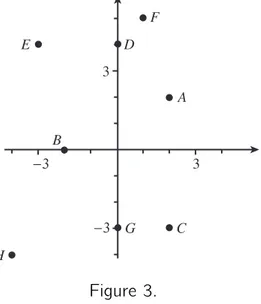
1. State the co-ordinates of each of the points A to H in Figure 3.
3 3 −3 −3 A B C D E H F G Figure 3.
2. The distance between two points
Suppose that we want to find the distance between two points A(1,3)and B(4,5). How might we do it? We can start by drawing a sketch as shown in Figure 4.
A(1, 3)
x y
B(4, 5)
C
Figure 4. Finding the length of the line AB.
We join A and B to form a line segment. Then to find the length AB we use Pythagoras’ Theorem. So we make AB the hypotenuse of an appropriate right-angled triangle ABC. This means that C must be the point (4,3).
Now we can work out the distances. The distance AC is 4−1 = 3, and the distance BC is 5−3 = 2. Also, Pythagoras’ Theorem tells us that
AB2 =AC2+BC2. So, substituting the values for AC and BC, we obtain
AB2 = 32+ 22
giving
AB =√13.
Now we can use this method whenever we have a problem like this, but it will be easier if we can derive a general formula to use instead.
Let us take two general points A(x1, y1)andB(x2, y2)as shown in Figure 5. To find the distance between them, we need to form a right angled triangle ABC such that AB is the hypotenuse. When we do this, C will be the point (x2, y1)
A(x1, y1)
x y
B(x2, y2)
C
Figure 5. The length of AB can be found using Pythagoras’ theorem.
In order to use Pythagoras’ Theorem we need to find the lengths AC and BC. Now AC is the difference of the x values, so AC = x2−x1. And BC is the difference of the y values, so BC =y2−y1. But Pythagoras’ Theorem gives us
AB2 =AC2+BC2, so when we substitute the values we obtain
AB2 = (x2−x1)2+ (y
2−y1)2. Taking the square root of both sides then gives us the formula
AB =p(x2−x1)2+ (y
2−y1)2.
In short, the distance between any two points is the square root of the sum of the x difference squared and the y difference squared.
Key Point
The length of the line segment joining the points A(x1, y1) and B(x2, y2)is given by AB =p(x2−x1)2+ (y
Example
Suppose we wish to find the distance between the points A(−1,3) and B(2,−4). We just use the formula
AB =p(x2−x1)2+ (y
2−y1)2. Substituting the values, we obtain
AB = p(2−(−1))2+ (−4−3)2
= p32+ (−7)2
= √9 + 49 = √58.
So the distance between the points A and B is √58 units. Exercise
2. Find the distance between each pair of points given below:
(a) (1,4) and (5,7); (b) (2,0)and (4,0); (c) (5,−1) and (3,2) (d) (−1,2) and (−4,−1); (e) (1,7)and (1,−4).
3. The midpoint of the line joining two points
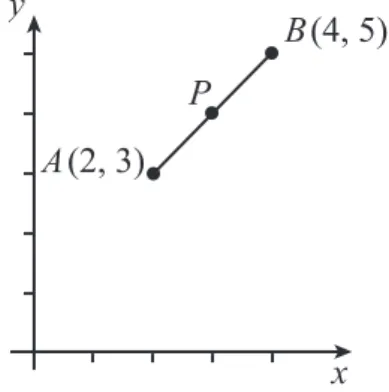
Suppose that we want to find the midpoint of two points A(2,3)and B(4,5). Let us start with a sketch as shown in Figure 6.
A(2, 3)
x y
B(4, 5)
P
Figure 6. Finding the midpoint of the line joining two points
Let P be the midpoint of the line segment. To find the coordinates of P we construct two right-angled triangles as shown in Figure 7. Notice that one side (the hypotenuse) and two angles in the first triangle are equal and similarly located to one side and two angles in the second. This condition is sufficient to ensure that the two triangles are congruent. In turn, this means that AC =P D and P C =BD. In other words the x coordinate of P must be the average of the x coordinates of A and B. The y coordinate of P must be the average of the y coordinates of A
A(2, 3) x y B(4, 5) P C D Figure 7. Therefore the x coordinate is 1
2(2 + 4) = 3 and the y coordinate is 1
2(3 + 5) = 4. We conclude that P has coordinates (3,4).
Now we can derive a general formula for the midpoint of the line shown in Figure 8.
A(x1, y1) x y B(x2, y2) P Figure 8.
In the general case, if the two points are A(x1, y1) and B(x2, y2) then the midpoint P must be equal to 1 2(x1+x2), 1 2(y1+y2) .
Key Point
The midpoint P of the two points A(x1, y1) and B(x2, y2) is given by P 1 2(x1 +x2), 1 2(y1+y2) .
Example
Suppose we wish to find the midpoint P of CD, where C is the point (2,−4)and Dis the point (−4,3). We know that
P(1
2(x1+x2), 1
2(y1+y2)), so that when we substitute the values we obtain
P = 1 2(2 + (−4)), 1 2(−4 + 3) = (1 2 ×(−2), 1 2 ×(−1)) = (−1,−1 2). Exercise
3. Find the mid-point of the line segment joining each pair of points in Exercise 2. Answers 1. A(2,2), B(−2,0), C(2,−3), D(0,4), E(−3,4), F(1,5), G(0,−3), H(−4,−4). 2. (a) 5, (b) 2, (c) √13, (d) √18 = 3√2, (e) 11. 3. (a) (3,5.5), (b) (3,0), (c) (4,0.5), (d) (−2.5,0.5), (e) (1,1.5).