The SAREC/SAMVAL Companion Volume Conference Emperors Palace, 17–18 May 2016
Southern African Institute of Mining and Metallurgy
87
The valuation of an exploration project having
Inferred Resources
S. Rupprecht 1* and G. Njowa2 1Senior Lecturer, University of Johannesburg2Venmyn Deloitte (Pty) Limited
Mineral Asset valuation of Mineral Resources and Mineral Reserves as the single fundamental asset for a mining company, according to the SAMVAL Code, CIMVAL Code or the VALMIN code, can be carried out using three valuation approaches, namely; the Cash Flow (Income) Approach, Market Approach, and Cost Approach. Under the 2009 SAMVAL Code the Market and Cost approaches are viewed as the preferred approaches to the valuation of Exploration Properties with mainly only Inferred Mineral Resources, with the Cash Flow Approach ’not generally used’. The updated 2016 SAMVAL Code has split Exploration Properties into two categories; early stage and advanced stage Exploration Properties. For both stages of Exploration Properties the Market and Cost Approach is ‘widely used’, while the Income Approach is ’not generally used’ for early stage Exploration Properties and ’less widely used’ for advanced stage Exploration Properties. In both versions of the SAMVAL Code the Income Approach is the least preferred method for valuations of exploration projects, with only Mineral Resources and without any credible studies to assess the technical and economic viability.
Under the 2016 SAMVAL Code, an advanced Exploration Property is defined as a project that has undertaken considerable exploration and a Mineral Resource estimate has been defined and a Scoping Study has been applied to determine whether there are reasonable prospects for eventual economic extraction.
This paper looks at the valuation of early Exploration Properties, especially those with mainly Inferred Mineral Resources, with particular attention on the use of the Income Approach. It will discuss circumstances where Inferred Mineral Resources could be or should not be valued using in the Income Approach-based valuation methodologies.
INTRODUCTION
The fundamental question that we should ask ourselves is whether Inferred Mineral Resources have a value and how they should be valued. It seems obvious that, during the development of a mineral deposit, changes occur along the mine development life cycle as the level of geological confidence in the Mineral Resources increases from Inferred to Measured. The Inferred Mineral Resources in many cases represent the future of the mining operations. This will depend on the level of maturity of the mineral project. Hence this category of Mineral Resources should be assigned a value and should be valued appropriately taking into consideration the low level of geological confidence. To our dismay, the US Securities Exchange Commission (SEC) still does not believe that Mineral Resources have a value. (Lawrence, 2012) The SAMVAL, CIMVAL, and JORC codes are internationally recognized valuation codes that are acceptable to the HKSE Listing Rules [Rule 18.34(1)]. The only exception to these codes that is included in the HKSE Listing Rules is the fact that Inferred Mineral Resources should not be valued or included in the evaluation models. According to rule 18.30 (3) of the HKSE listing rules, Indicated Resources and Measured Resources are included in economic analyses only if the basis on which they are considered to be economically extractable is explained and they are appropriately discounted for the probabilities of their conversion to Mineral Reserves. All assumptions must be clearly disclosed. Valuations for Inferred Resources are not permitted.
The rest of the world might view this differently and there is adequate market evidence that Mineral Resources (even Inferred Resources) have a value, but due care and professional judgement must be exercised in determining that value and how this is disclosed to the stakeholders.
One of the common tenets among the mineral asset valuation reporting codes and the associated securities regulators is that the overarching obligation is to not mislead the investors, and to provide all the information in a transparent and objective manner to enable the investors and their advisors to make professional judgements and investment decisions. (Lawrence, 2012) All the associated risks, uncertainties, and potential should be clearly highlighted in the report in order to enable investors making an investment decision fully aware of the risks and uncertainty associated with assigning value to the lowest level of geological confidence (being Inferred Mineral Resources). Securities regulators aim to strictly regulate Public Reporting in order to inhibit exaggerated claims at the early stages of exploration, especially when only Inferred Mineral Resources are involved
Although the Income Approach is recognized as the least appropriate method to perform mineral asset valuations, some Competent Valuators in recent years have used the Income Approach as a preferred method for valuing Inferred Resources without appropriate technical mine design and application of modifying factors being applied to the Mineral Resources.
VALUATION OF EXPLORATION PROPERTIES
The 2016 SAMVAL Code has identified (as quoted) instances and applications where it is required to conduct a valuation on Inferred Resources, Exploration Properties and/or Exploration Targets. This may be done in circumstances such as the following (but not limited to):
• The valuation of exploration assets in terms of IFRS 6; [IFRS 6 is part of the IFRS group of accounting standards and was specifically developed for the extractive industries. The objective of IFRS 6 is limited to specifying the financial reporting of exploration for and evaluation of mineral resources, that is the expenditure spent for exploration and the evaluation of mineral resources before the commercial viability has been demonstrated (IFRS, 2012)];
• The valuation of Exploration Properties for sale or acquisition, or other valuation purposes; • The valuation of Inferred Resources in the case of a merger or acquisition;
• The Valuation of Prospecting or Mining Rights that include Inferred Resources and/or Exploration Targets;
89
• A need to upgrade Inferred Resources to higher confidence levels;
• Valuations that are required to justify expenditure to increase the level of confidence in Exploration
Targets or Mineral Resources; and
• Valuation for estate considerations, taxation, royalties, litigation etc.
While not included in Mineral Reserve estimation, markets attach value to Inferred Resources during the exploration process. Many operations mine Inferred Resources in practice and these needs should be taken into account in the valuation of going concerns as set out in the respective specific scope.
These aspects may or may not be published in public reports, depending on the nature of the valuation and its purpose.
Furthermore, these aspects may not be reliant on a Mineral Resource statement (in the case of Exploration Targets), particularly where a Market or Cost Approach is applied, as decided by the CV.
Clearly, in such cases, there are material risks associated with the valuation, in terms of the level of accuracy and level of confidence of the estimates, or the approach/method. The CV should therefore qualify any such valuation with the following:
• A clear statement of the level of confidence, and the risks associated with the valuation; • The reason for the application of the approach and method;
• The reasons why the valuation may or may not be based on a SAMREC compliant report; • The application of more than one approach and associated method; and
• The modifying factors that have been applied in the assignment.
It is not considered acceptable to use, in the Income Approach, “potential resources”, “hypothetical resources”, or any other such categories that do not conform to the definitions of Mineral Resources and Mineral Reserves within SAMREC or the CRIRSCO definitions. Where Inferred Resources are being valued, if, in the opinion of the CV, an Income Approach could be applied, the CV should justify the usage, and indicate the risks associated with the valuation.
From the above excerpt, Inferred Mineral Resources are useable only if included in a mine design, plan, or economic study and only if there exists a mine plan and a statement of Mineral Reserves. The valuating of Inferred Resources requires caution even when applied in a mine plan, let alone when not supported by a mine plan. The valuation of Inferred Mineral Resource should become more stringent so as to prevent investors from being misled. Notably, an Inferred Mineral Resource may does not necessarily mean be converted to a Mineral Reserve, either wholly or in part. A conservative view may be that if owners want to realize the full value of a project its economic viability should be demonstrated, which results in the Mineral Resource being converted to a Mineral Reserve.
Valuation Methods are essentially a subset of the various Valuation Approaches. The choice of the Valuation Method(s) applied is a matter for the judgement of the CV, and the decision to use any particular method (and approach) should be justifiable to the CV’s peers.
The results from the Valuation Approaches and Methods employed should be weighted and reconciled into a concluding opinion of value in accordance with Figure 1. The reasons for giving a higher weighting to one method or approach over another should also be stated and justified.
Certain valuation methodologies are more widely used and may be more generally acceptable as industry practice than others, although this could change over time. This is illustrated in Figure 1, which shows how the various approaches are generally applied to different stages of exploration and mining properties. This, however, is for guidance only, and is not prescriptive. Ultimately, the CV should stipulate the quality and level of confidence in the various inputs, in deciding which approach and method to apply.
Use of Inferred Resources in the Cash Flow approach
Clause 26 of the SAMVAL Code provides guidance in using Inferred Mineral Resources in valuating mineral projects:
For Valuation, it is accepted that mine design and mine planning may include a proportion of Inferred Mineral Resources. If this category of Mineral Resource is included in mine design, planning or economic studies for Public Reporting, full disclosure and the effect on the results of the studies must be stated. Inferred Mineral Resources may be included in mine design, mine planning, or economic studies only if there exists a mine plan and a statement of Mineral Reserves making clear that Inferred Mineral Resources have been used. Where a material amount of mining in the mine plan includes Inferred Mineral Resources, a comparison of the results with and without those resources must be shown, and the rationale behind their inclusion must be explained.
Modifying factors and assumptions that were applied to the Indicated and Measured Mineral Resources to determine the Mineral Reserves must be equally applied to the Inferred Mineral Resources.
The above excerpt indicates that Inferred Mineral Resources may be included in a mine design, plan, or economic study only if a mine plan exists and only if a statement is provided that acknowledges the use of Inferred Mineral Resources in the LOM plan. However, the valuation of Inferred Mineral Resource requires caution (see Clause 20 of the SAMREC Code) even when applied in a mine plan, let alone when not supported by a mine plan. The valuation of Inferred Mineral Resources should be conducted with care, and applying modifying factors to Inferred Mineral Resources that are not inclusive of a Pre-Feasibility Study is undesirable and may be misleading to the public. The authors propose that Inferred Mineral Resources should be valued utilising the Cost and Market approaches, as the declaration of an Inferred Mineral Resource does not necessarily mean that all or a portion of the Mineral Resource will be converted to a Mineral Reserve. The risk of utilising discounted cash flow (DCF) to value an Inferred Mineral Resources is that mineralised material may be valued based on modifying factors when there remains a reasonable chance that some, or all, of the Inferred Mineral Resource may not ever be economically viable to mine. The CP/CV must fundamentally understand that an Inferred Resource is inferred from geological evidence and sampling and assumed, but not verified geologically or through analysis, to display grade continuity.
In the case of a Scoping Study, it is common to apply modifying factors to the Mineral Resource to indicate viability for technical evaluation purposes or to demonstrate a reasonable expectation for eventual economic extraction. However, the level and detail of work conducted is in no means sufficient to declare a Mineral Reserve. As a guide, the Society for Mining and Metallurgical and Exploration (2014) suggests that Scoping Studies have a capital accuracy of 50%, an operating cost accuracy of 35%, with a contingency of 25% for items not specified in the scope of the study. When conducting or utilising Scoping Studies it is prudent to provide cautionary advice to the reader as to the limitations of the study. The following provides an example of such advice.
The study reports a Run-of-Mine (ROM) head grade and tonnage. The reader is cautioned that the ROM tonnage reported does not constitute a mineral reserve or provide assurance of an economic development case at this stage, as there is insufficient confidence to allow the application of Modifying Factors in sufficient detail to support mine planning and evaluation of the economic viability of the deposit. The work presented is an order of magnitude technical study (Scoping Study) on the potential viability of the Mineral Resources. It includes appropriate assessments of realistic modifying factors together with other relevant mining operational factors that are necessary to demonstrate at the time of reporting that progress to a prefeasibility or feasibility study can be reasonably justified.
Scoping Studies, also commonly referred as Preliminary Economic Assessments (PEAs), are useful in assisting mining professionals and advisors to understand the potential viability of a project and in making decisions regarding project development. Scoping Studies, however, do not prove economic viability and therefore it is advisable not to apply the Cash Flow Approach to valuate mineral projects that have completed a Scoping Study.
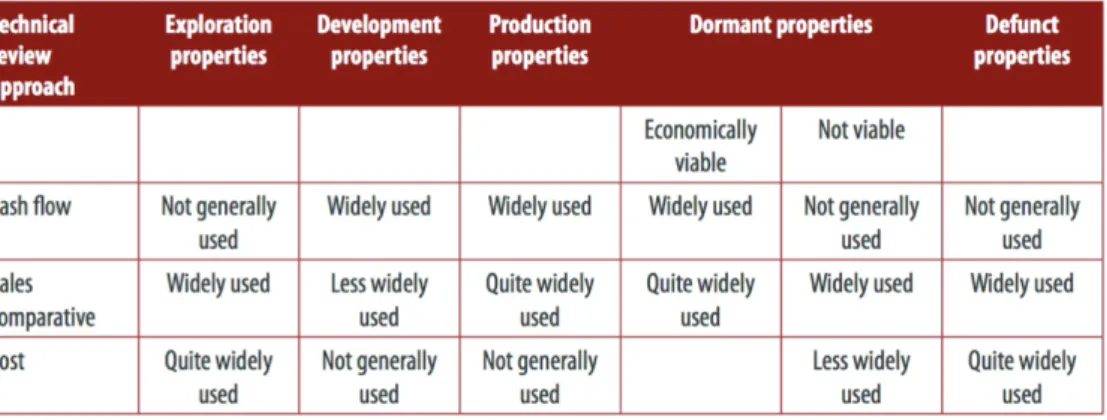
91 It is becoming common practice for CVs to apply modifying factors to resources and thereby generate a DCF, both in cases where a Scoping Study has been conducted and has not been undertaken. The authors regard this as poor practise, especially in the second case. The intention of the SAMVAL Code, through its definition of ‘Exploration’ and ‘Development’ properties, is that the Cash Flow Approach should be applied to projects where the economic viability has already been established, and that the Market and Cost Approaches are the preferred valuation methods for projects requiring further work to establish viability (Table I). For ease of reference, the definitions of ‘Exploration’ and ‘Development’ properties as provided in the SAMVAL Code (2009) are defined below.
Table I. Relationship between stages of development and Valuation approaches for mineral properties (SAMVAL, 2009).
An Exploration Property is defined as follows:
A Mineral Asset that is being actively explored for mineral deposits but for which economic viability has not been demonstrated. Exploration Properties have asset values derived from their potential for the discovery of economically viable mineral deposits. Exploration property interests are bought and sold in the market. Many of these transactions involve partial-interest arrangements, such as farm-in, option or joint venture arrangements.
A Development Property is defined as follows:
A Mineral Asset that is being prepared for mineral production and for which economic viability has been demonstrated by a Feasibility Study or Pre-Feasibility Study and includes a Mineral Asset which may not be financed or under construction.
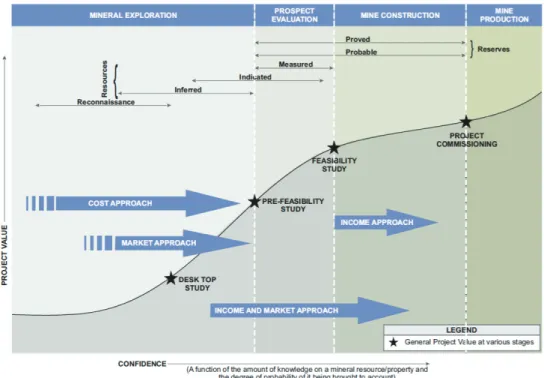
Figure 1.Project lifetime valuation methodology curve (Telfer et. al., 2013).
The project lifetime valuation methodology curve (Figure 1) indicates the preferred valuation techniques during project development. In this example, the Income Approach is advocated before a Pre-Feasibility Study. However, the authors do not agree, and recommend that the Income Approach be used only at a Pre-Feasibility Study level and beyond. The following quote emphasizes the caution that should be applied when valuating Inferred Mineral Resources.
Be careful not to confuse “resources” with “reserves”. Measured and Indicated resources are reliable as a resource. “Inferred resources” are very speculative mineral inventories, so be careful when “inferred” is used. A resource still has a long way to go to become an economic deposit, as opposed to “reserves” which are deemed to be proven economic and mineable ounces calculated by very strict
engineering and government rules (Kenneth J. Gerbino and Company - 12 Guidelines for
Buying Gold Mining Stocks).
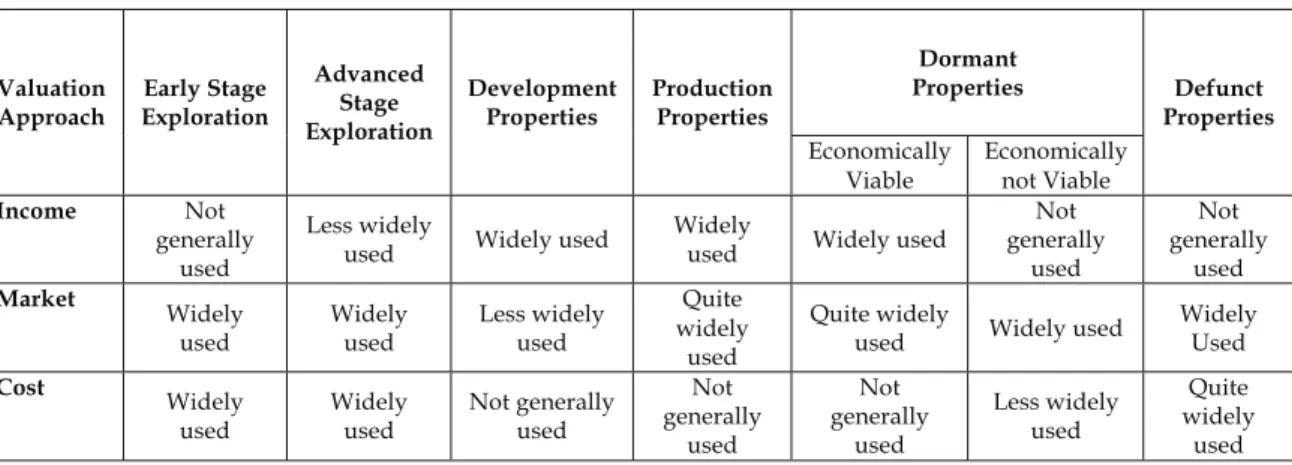
The 2016 SAMVAL Code has modified the 2009 relationship between stages of development and valuation approaches introducing ‘Early Stage Exploration Property’ and ‘Advanced Stage Exploration Property’ as defined in Table III.
93
Table II. Relationship between stages of development and valuation approaches for Mineral Properties (SAMVAL 2016).
Valuation
Approach Exploration Early Stage
Advanced Stage Exploration
Development
Properties Production Properties
Dormant Properties Defunct Properties Economically Viable Economically not Viable Income Not generally used Less widely
used Widely used Widely used Widely used
Not generally used Not generally used Market Widely used Widely used Less widely used Quite widely used Quite widely
used Widely used
Widely Used Cost Widely used Widely used Not generally used Not generally used Not generally used Less widely used Quite widely used
Table III. Definition of early and advanced stage Exploration Property (SAMVAL 2016).
Early Stage Exploration
Property Early stage means tenure holdings where mineralisation may or may not have been identified, and where Mineral Resources have not been defined.
Advanced Stage Exploration Property
Advanced means tenure holdings where considerable exploration has been undertaken and specific targets have been identified that warrant further detailed evaluation, usually by drill testing, trenching or some other form of detailed geological sampling.
A Mineral Resource estimate has been defined and a scoping study has been applied to determine whether there are reasonable prospects for eventual economic extraction
Based on the 2016 interpretation, exploration projects still reflect Mineral Resources with Scoping Studies conducted to ’determine whether there are reasonable prospects for eventual economic extraction’. Table II states highlights that the Income Approach is ‘not generally used’ for early stage exploration and ‘less widely used’ for advanced stage exploration projects, with the Market and Cost approaches ‘widely used’ for all stages of exploration. It is only when a project reaches a ‘development property or feasibility stage’ that the Income Approach is ‘widely used”. The reader should note that a
development property is ‘a Mineral Asset that is being prepared for mineral production and for which
economic viability has been demonstrated by a Feasibility Study or Pre-Feasibility Study and includes a Mineral Asset which may not be financed or is under construction.’
CONCLUSION
The SAMVAL Code is intended to provide guidance to the Competent Valuator and is not meant to be prescriptive. The Competent Valuator should be able to defend their decisions to their peers. The authors have presented a case that urges Competent Valuators to be cautious in utilizing the Income Approach to valuate Inferred Mineral Resources. The updated 2016 SAMVAL Code has attempted to better qualify Exploration Properties, but the fact remains that the Market and Cost Approaches represent the more reliable valuation methods for Exploration Properties.
In conclusion, Inferred Mineral Resources should not be used in DCF as the main Mineral Resources category that is being considered in the mineral asset valuation. This approach would lack the engineering input in terms of how the deposit would be extracted, and consideration of mine design and planning, mine ventilation, geotechnical issues, extraction factors, and mine dilution would be ignored. Furthermore, a high level of confidence in the economic assumptions cannot be established because of the lack of technical information, and a conceptual mine plan and design would not suffice.
REFERENCES
IFRS. (2012). Technical Summary: IFRS 6 Exploration for and Evaluation of Mineral Resources. http://www.ifrs.org/IFRSs/Documents/IFRS6en.pdf [Accessed 12 July 2013].
Lawrence, M.J. (2012). Consideration in Valuing Inferred Resources. Valmin Seminar Series.
https://www.ausimm.com.au/publications/content/minval_series_2012.pdf [accessed 26 May 2016].
Rupprecht, S.M. (2014). The SAMREC Code 2015 – Some thoughts and concerns. Surface Mining 2014.
Southern African Institute of Mining and Metallurgy, Johannesburg.
SAMVAL. (2009). South African Mineral Asset Valuation (SAMVAL) Working Group. The South African Code for the Reporting of Mineral Asset Valuation (The SAMVAL Code). 2008 Edition as amended July 2009. http://www.samcode.co.za/downloads/SAMVAL2009.pdf
SAMVAL. (2016). South African Mineral Asset Valuation (SAMVAL) Working Group. The South African Code for the Reporting of Mineral Asset Valuation (The SAMVAL Code). [Draft]. Telfer, C.A., Njowa, G., McKenna, N., Myburgh, JA., Dyke, S., Dikogle, L., and Orford, T.C. (2013).
Independent Competent Persons’ Report on the Material Mineral Assets of Continental Coal Limited South Africa. 16 September 2013. p. 63.
Godknows Njowa
Snr Manager
Deloitte
Mr Njowa started his mining career as graduate learner mine at AA Mines (Shabanie mine) in Zimbabwe, and moved on to join Rio Tinto Zimbabwe in various capacities in Mine Finance and Project Evaluation. After completing his master’s degree at Wits he joined Venmyn Deloitte. His key areas of expertise lie the combination of skills in Mining Engineering Financial Management and Accounting. Currently he leads a team in financial valuation of mineral and mining projects, technical and economic review, due diligences, MRM and mineral resources and mineral reserve estimation.