by
Adam James Chlipala
B.S. (Carnegie Mellon University) 2003 M.S. (University of California, Berkeley) 2004
A dissertation submitted in partial satisfaction of the requirements for the degree of
Doctor of Philosophy in Computer Science in the GRADUATE DIVISION of the
UNIVERSITY OF CALIFORNIA, BERKELEY
Committee in charge:
Professor George C. Necula, Chair Professor Sanjit A. Seshia
Professor Jack H. Silver
Chair Date
Date
Date
University of California, Berkeley
Type Theory
Copyright 2007 by
Abstract
Implementing Certified Programming Language Tools in Dependent Type Theory
by
Adam James Chlipala
Doctor of Philosophy in Computer Science
University of California, Berkeley
Professor George C. Necula, Chair
I present two case studies supporting the assertion that type-based methods enable effective certified programming. By certified programming, I mean the development of software with formal, machine-checked total correctness proofs. While the classical formal methods domain is most commonly concerned with after-the-fact verification of programs written in a traditional way, I explore an alternative technique, based on using dependent types to integrate correctness proving with programming. I have chosen the Coq proof assistant as the vehicle for these experiments. Throughout this dissertation, I draw attention to features of formal theorem proving tools based on dependent type theory that make such tools superior choices for certified programming, compared to their competition.
In the first case study, I present techniques for constructing certified program ver-ifiers. I present a Coq toolkit for building foundational memory safety verifiers for x86
require-ments with the traditional types of functions, and I mix standard programming practice with tactic-based interactive theorem proving to implement programs of these types. I de-compose verifier implementations into libraries of components, where each component is implemented asa functor that transforms a verifier at one level of abstraction into a veri-fier at a lower level. I use the toolkit to assemble a veriveri-fier for programs that use algebraic
datatypes using only several hundred lines of code specific to its type system.
The second case study presents work in certified compilers. I focus in particular on type-preserving compilation, where source-level type information is preserved through several statically-typed intermediate languages and used at runtime for such purposes as guiding a garbage collector. I suggest a novel approach to mechanizing the semantics of programming languages, based on dependently-typed abstract syntax and denotational se-mantics. I use this approach to certify a compiler from simply-typed lambda calculus to an
idealized assembly language that interfaces with a garbage collector through tables listing the appropriate root registers for different program points. Significant parts of the proof effort are automated using type-driven heuristics. I also present a generic programming sys-tem for automating construction of syntactic helper functions and their correctness proofs, based on an implementation technique called proof by reflection.
Professor George C. Necula Dissertation Committee Chair
Contents
List of Figures iv
1 Verification in Context 1
1.1 The State of Formal Software Engineering . . . 1
1.2 The Verification Landscape . . . 3
1.2.1 Classical Interactive Theorem Proving . . . 4
1.2.2 Automated Theorem Proving . . . 6
1.2.3 Classical Program Verification with Automated Theorem Proving . . 7
1.2.4 Model Checking . . . 8
1.2.5 Logical Frameworks . . . 9
1.2.6 Theorem Proving and Program Verification via Type Theory . . . . 10
2 An Introduction to Coq 15 2.1 The Calculus of Constructions . . . 16
2.2 Inductive Types . . . 18
2.3 Coq Features and Idioms . . . 21
3 Certified Programming Language Tools 23 3.1 Case Studies in this Thesis . . . 25
I Certified Program Verifiers 30 4 Programming with Specifications in Coq 31 4.1 Types and Extraction in Coq . . . 31
4.2 Modules and Correctness-by-Construction . . . 37
4.2.1 Dependent Types and Composition . . . 38
4.2.2 Modules and Proofs . . . 41
5 A Certified Verifier Toolkit 44 5.1 Introduction . . . 44
5.1.1 Applications to Proof-Carrying Code . . . 45
5.2 Preliminaries . . . 48
5.2.1 Problem Formulation . . . 48
5.2.2 An Example Input . . . 51
5.3 Components for Writing Certified Verifiers . . . 55
5.3.1 ModelCheck . . . 63 5.3.2 Reduction . . . 75 5.3.3 FixedCode . . . 77 5.3.4 TypeSystem . . . 78 5.3.5 StackTypes . . . 83 5.3.6 SimpleFlags . . . 87 5.3.7 WeakUpdate . . . 90 5.3.8 Architecture Summary . . . 94
5.4 Case Study: A Verifier for Algebraic Datatypes . . . 95
5.5 Implementation . . . 99
5.5.1 The Asm Library . . . 100
5.5.2 Proof Accelerator . . . 101
5.5.3 Certified Verifiers Library . . . 102
5.6 Related Work . . . 103
5.7 Conclusion . . . 106
II Certified Compilers 107 6 A Language Formalization Methodology 108 6.1 An Evolutionary Example: The Simply-Typed Lambda Calculus . . . 112
6.1.1 A Nominal Representation . . . 113
6.1.2 De Bruijn Index Representation . . . 114
6.1.3 Higher-Order Abstract Syntax . . . 114
6.1.4 De Bruijn with Dependent Types . . . 121
6.2 Compilation . . . 123
6.3 Related Work . . . 126
7 A Certified Type-Preserving Compiler 127 7.1 Introduction . . . 127 7.1.1 Task Description . . . 129 7.1.2 Contributions . . . 131 7.1.3 Outline . . . 132 7.2 The Languages . . . 132 7.2.1 Source . . . 133 7.2.2 Linear . . . 135 7.2.3 CPS . . . 137 7.2.4 CC . . . 137 7.2.5 Alloc . . . 138 7.2.6 Flat . . . 143 7.2.7 Asm . . . 144
7.3 Implementation Strategy Overview . . . 147
7.4 Representing Typed Languages . . . 150
7.5 Representing Transformations . . . 152
7.6 Generic Syntactic Functions . . . 154
7.6.1 Generic Correctness Proofs . . . 156
7.7 Representing Logical Relations . . . 157
7.8 Proof Automation . . . 159
7.9 Further Discussion . . . 165
7.9.1 Logical Relations for Closure Conversion . . . 165
7.9.2 Explicating Higher-Order Control Flow . . . 168
7.9.3 Garbage Collection Safety . . . 168
7.9.4 Putting It All Together . . . 169
7.10 Implementation . . . 170
7.11 Related Work . . . 172
7.12 Conclusion . . . 173
8 Generic Programming and Proving 176 8.1 Introduction . . . 176
8.1.1 Outline . . . 179
8.2 Background: Proof by Reflection . . . 180
8.3 Generic Programming and Proving for Simply-Typed Data Structures . . . 182
8.3.1 Reflecting Constructors . . . 183
8.3.2 Reflecting Recursion Principles . . . 185
8.3.3 Generic Proofs . . . 189
8.3.4 A Word on Trusted Code Bases . . . 192
8.4 Managing de Bruijn Indices . . . 193
8.4.1 Dynamic Semantics . . . 194
8.5 A Taste of Manual Implementation . . . 196
8.5.1 Implementinglift . . . 196
8.5.2 ProvingliftSound . . . 200
8.5.3 The Prognosis . . . 202
8.6 The Lambda Tamer AutoSyntax System . . . 203
8.6.1 Restricting Denotations . . . 204
8.6.2 Reflecting Denotations . . . 206
8.6.3 Sketch of a GenericliftSound00 Proof . . . 207
8.6.4 Mutually-Inductive AST Types . . . 208
8.6.5 Evaluation . . . 209
8.7 Related Work . . . 210
8.8 Conclusion . . . 212
III Conclusion 214
List of Figures
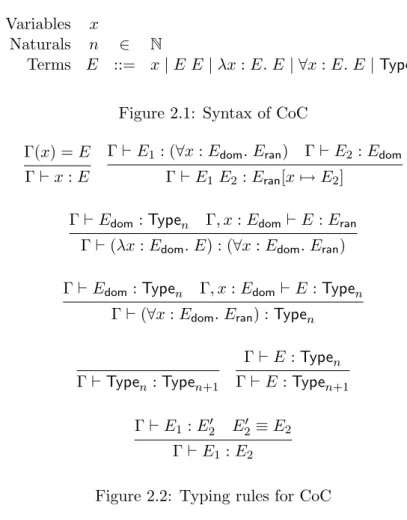
2.1 Syntax of CoC . . . 16
2.2 Typing rules for CoC . . . 16
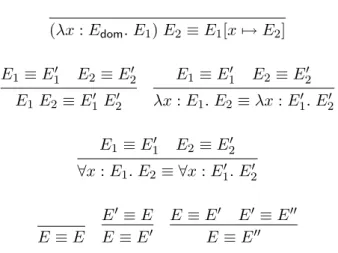
2.3 Definitional equality rules for CoC . . . 17
5.1 length.c . . . 52
5.2 firstorder.h. . . 53
5.3 intlist.h. . . 53
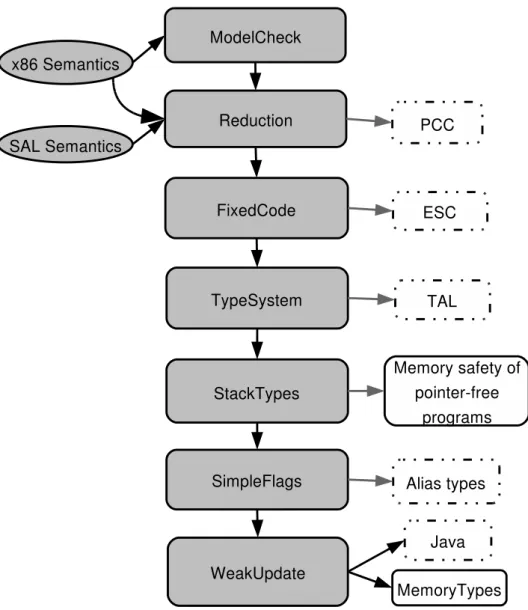
5.4 A component structure for certified verifiers . . . 56
5.5 Input and output signatures of ModelCheck . . . 62
5.6 Example program for Section 5.3.1 . . . 68
7.1 Source language syntax . . . 129
7.2 Target language syntax . . . 129
7.3 Source language dynamic semantics . . . 134
7.4 Syntax of the Linear language . . . 135
7.5 Dynamic semantics of the Linear language . . . 136
7.6 Syntax of the CPS language . . . 137
7.7 Syntax of the CC language . . . 137
7.8 Syntax of the Alloc language . . . 138
7.9 Domains for describing tagged heaps . . . 140
7.10 Dynamic semantics of operands for the Alloc language . . . 141
7.11 Dynamic semantics of terms for the Alloc language . . . 141
7.12 Dynamic semantics of programs for the Alloc language . . . 142
7.13 Syntax of the Flat language . . . 143
7.14 Type language for the first two term languages . . . 149
7.15 Coq definition of syntax and static semantics for Linear . . . 150
7.16 Coq source code of Source syntax and semantics . . . 151
7.17 Continuation composition operator . . . 152
7.18 Linearization translation . . . 152
7.19 Coq source code of the main CPS translation . . . 154
7.20 Coq source code for the first-stage CPS transform’s logical relation . . . 159
7.22 Project lines-of-code counts . . . 171
8.1 Simplifying one application of the genericsizefunction . . . 188
8.2 Correct definition of lift00 . . . 199
Acknowledgments
I thank my advisor George Necula, a true hacker who hasn’t let tenure rob him of that distinction. George combines a comprehensive knowledge of formal methods with a friendly skepticism about the ability of particular methods to change the world. I’ve benefited greatly from both his criticism of the over-ambitiousness or impracticality of the ideas I’ve thought up and from his acceptance of my idealism for those I chose to stick with.
My interest in certified programming sprang from the Open Verifier project, which I worked on with George, Robert Schneck, Evan Chang, and Kun Gao. If Robert hadn’t become interested in this whole “interactive theorem proving” business, I can guarantee you that this dissertation would be sporting a different title. Evan has helped me on projects we’ve collaborated on and with papers I asked him to critique too many times for me to keep count.
I thank “the types people” at Carnegie Mellon University, known at various times as “The Fox Project,” “The ConCert Project,” or what have you. In particular, I took enlightening and engaging classes on programming languages from Karl Crary, Bob Harper, and Peter Lee, and Bob and his then-student Leaf Petersen served as my guides in my first research experience. It should become apparent how types have invaded this thesis.
I’ve benefited continuously from being part of the Open Source Quality Project here at Berkeley. I thank everyone who has attended the group lunches for conversations whose tortuous effects on this thesis should not be underestimated.
Part II of this dissertation sprang directly from the POPLmark Challenge. Thanks go to everyone on thepoplmarkelectronic mailing list and the attendees of the first
Work-shop on Mechanizing Metatheory, for making clear the importance of mechanized high-level language semantics and challenging me to defend my ideas against a dogmatic but friendly crowd.
I wouldn’t be writing this dissertation if it weren’t for my father, who learned programming during a detour from physics and thought it would be a good idea to pass his knowledge on to a six-year-old. I joined the world of “serious programmers” thanks almost entirely to Teen Programmers Unite, one of the earliest Internet-based organizations targeted at and run by young people. I hope that today’s new generations manage to overcome the allure of designing flashy web pages and find the same fun in programming that my compatriots and I did at the dawn of the commercial Internet.
I direct a much-deserved thanks to the development team of the Coq proof assis-tant, for providing such a wonderful playground for a thesis like this one to inhabit.
Finally, thanks to Sanjit Seshia and Jack Silver for their help with this dissertation and for the excursions outside my accustomed world of constructive logic that their graduate classes offered.
Part I of this dissertation is based on a paper [16] presented at ICFP’06, copyright the ACM; and an expanded version currently under revision for publication in the Journal of Functional Programming, copyright Cambridge University Press. Part II is based on a paper [17] presented at PLDI’07, copyright the ACM.
My thesis work was supported in part by a National Defense Science and Engi-neering Graduate Fellowship, along with National Science Foundation grants CCF-0524784 and CCR-0326577.
Chapter 1
Verification in Context
1.1
The State of Formal Software Engineering
Building software systems that work is notoriously difficult. Though our hard-ware systems improve dramatically in quantitative performance and capacity from year to year, software seems, if anything, to fail more often. It is often observed that modern computer systems involve more complexity and levels of abstraction than any other human-constructed artifacts in history. The existing body of engineering knowledge has not proved very helpful in taming this complexity, and so the forging of a true discipline of “software engineering” has remained elusive. The prospects seem grim of practicing engineers ever making software reliability guarantees on par with what we expect from other engineering disciplines.
In the 1970’s and 1980’s, there was a mood of optimism about the power of math-ematical methods to solve this problem. In the previous decade, Floyd [36] and Hoare [46] had set out one of the most practically attractive mathematical accounts of program
be-havior. Not only did their work result in a clear formulation of what a program means, but this meaning was given by a system for building program correctness proofs. That is, what came to be called Hoare logic is a tool ready to use in certifying real programs. Building on these ideas, Edsger Dijkstra advocated the technique ofprogram derivation [32], where software programs are always developed in concert with their mathematical specifications and correctness proofs. If a programmer starts with an adequate specification for his pro-gram, then there is no longer any possibility for bugs to exist at any phase of development, with respect to that specification.
Unfortunately, upon returning our attention to the present day, we see almost zero adoption of program derivation, or even of formal program correctness techniques of any kind. What went wrong? Computing has only become more pervasive, creating greater need to know that our computer systems do their jobs. Yet somehow the best intentions and efforts of a generation of computer scientists failed to yield practical tools and their associated methodology for building certified correct software.
At this point, I want to suggest that such a conclusion is drawn too hastily. We should take another look at the state of the art today, this time not neglecting an important kind of “stealth formalism” that has become absolutely standard in software development. This isstatic type systems. In mainstream programming languages, we have become dulled to the novelty of writing proofs (type annotations) inline in our program source code and requiring that our programs satisfy mechanized proof checkers (type checkers) before we would even think about running them. The theorems we prove are of a particular mundane kind, often called by the names “type safety” and “memory safety,” but they are non-trivial
theorems nonetheless, as would probably be obvious to a programmer in the early days of assembly language. While most formal methods advocates today find memory safety theo-rems dull, these theotheo-rems have an important role to play: They make it possible to reason about programs modularly. Since non-memory-safe programs may overwrite segments of memory arbitrarily, one buggy component may break the key invariants of all the other components with which it coexists. Thus, whether the reasoning to be applied is formal or informal, the ability to exercise it strikes an important blow in the battle against software system complexity.
The techniques of type systems have succeeded in producing usable systems for cer-tifying memory safety with programmer cooperation. Can we learn from what has worked in “the real world” (type systems) and what hasn’t (Hoare logic and classical program veri-fication) to bring ourselves closer to the 1970’s vision of full verification? In this thesis, I argue that richer type systems enable practical total correctness verification of real systems, and I demonstrate this through two significant certified program-ming projects performed with a type-based computer proof assistant.
In the next section, I will briefly survey which sorts of tools are available today. I will critique the approaches and motivate why I chose a particular tool, the Coq proof assistant [8], for this thesis work.
1.2
The Verification Landscape
Formal verification has been a part of computer science from the field’s early days. As such, it’s not surprising that many different tools have sprung up with different
strengths and weaknesses. As the title of this dissertation may have given away, I will be describing experiments in total correctness verification of programming languages tools, such as compilers and program analyzers. In this section, I will survey the verification approaches that exist today, with language tool verification in mind. I will be able to dismiss some techniques outright as not equal to such a complex task, and others will remain, leading up to a final weighing of their pros and cons and a decision of which tool to use.
1.2.1 Classical Interactive Theorem Proving
One of the earliest interactive theorem proving tools, or “proof assistants,” was Milner’s LCF system [61]. It was described as a “smart blackboard,” where operators could perform mathematical proofs in a way that precluded invalid leaps of reasoning. The concrete interaction model was a loop alternating between the operator entering atactic, a short command describing a proof step; and the system updating a display summarizing the state of the proof effort. Each tactic was checked by the proof assistant for logical validity before being used to update proof state.
Tactic-based theorem proving has endured to the present day, with many academic users but no appreciable amount of industrial adoption. A confusing profusion of proof assistants exists today. However, they can mostly be divided into two broad categories: the “LCF-style” provers, where a proof is a sequence of tactics; and type-theoretical provers, where a proof is a term of a typed lambda calculus, usually constructed with the aid of tactics. Type-theoretical provers are the subject of Section 1.2.6, and I elaborate on LCF-style provers in rest of this subsection.
retaining the historical association of the LCF approach with the ML family of programming languages; and PVS [70], a Lisp-based proof assistant developed at SRI. Isabelle is a frame-work for supporting new proof systems, though it is most often used in its “Isabelle/HOL” guise, which uses a classical higher-order logic HOL [38]. The dedicated user communities of Isabelle/HOL and PVS may grumble at my lumping them together, as HOL features a much smaller and simpler set of primitive tactics than PVS does, but they are more similar than different compared to any of the alternatives I discuss later.
The LCF approach is no doubt the most widely used among practical interactive theorem proving efforts today. This is probably due to the ease of extending a proof assistant with new reasoning tricks: one simply adds new proof rules that embody them. The proof assistant developer can certainly make soundness mistakes in implementing new rules, but, if he doesn’t, users can rest assured that they aren’t producing bogus proofs. As a result, Isabelle/HOL and PVS are remarkably effective out-of-the-box at automating large parts of proofs, while still providing good support for solicitation of human insight.
However, there is a dark side to this convenience. To trust in the soundness of an LCF-style prover, you must trust in the correct implementation of each of its primitive proof rules. If one of these rules implements the simplex method for deciding linear arithmetic formulas, then you need to trust that the simplex algorithm was implemented correctly. In today’s networked world of computing, we prefer to minimize the amount of code that we need to trust to obtain suitable security guarantees. In applications like proof-carrying code [67], which is the setting for Part I of this dissertation, any bug in proof-checking machinery opens opportunities for attackers to run malicious code.
There are also many benefits associated with type-theoretical representation of proofs that are lost in the LCF style. We will meet these benefits throughout this disserta-tion, and I sketch their major elements in Section 3.1. The main idea can be summarized as: By choosing a simple proof representation embeddable in a statically-typed programming language, we gain the ability to verify our proof-generating and -manipulating programs by type-checking them.
1.2.2 Automated Theorem Proving
A competing theorem proving tradition is that of automated provers, perhaps most widely associated with Nqthm, or “the Boyer-Moore prover” [10]. The system was designed for the verification of Lisp programs, but it and its modern successor ACL2 [50] have come to be used as general-purpose theorem proving tools, with applicative Common Lisp serving as a modeling language for wider domains.
These tools have been used to accomplish some impressive certifications, including the verification of a stack from a high-level programming language to a machine architec-ture [63]. Nonetheless, the drawbacks I listed for LCF-style provers apply only more strongly here. Since proofs are expected to be much more automatic, there are onlymore fundamen-tal reasoning steps whose implementations must be trusted, and the lack of wide industrial adoption of ACL2, a quite dynamically-typed system, opens the door to speculation on how types may be put to good use here.
1.2.3 Classical Program Verification with Automated Theorem Proving The most successful family of tools implementing classical, Hoare logic-style ver-ification has been the Extended Static Checking (ESC) family [35]. Implemented for such languages as Modula-3 and Java, the technique depends on programmers annotating their functions with preconditions and postconditions and their loops with invariants. This bur-den is light compared to interactive theorem proving, as an automated, first-order theorem prover is called to fill in the blanks. The traditional theorem prover of choice has been Simplify [30], developed by the same group of authors and evolved in parallel. It uses the Nelson-Oppen architecture [69] for cooperating decision procedures, which was designed specifically to handle the kinds of proof obligations arising from ESC-style verification.
This approach has been successful at what I’ll call “laundry list” verification, where one wants to check that a program satisfies a list of standard, generic properties, such as absence of out-of-bounds array accesses. Effective automated proving for the theories of equality, linear arithmetic, and arrays supports such verifications. However, ESC has not been shown to scale to total correctness proofs for such complicated programs as compilers. It seems believable that a human user is going to have to write something that looks like a proof to facilitate such an in-depth verification, where the necessary structure of the proof is more complicated than the structure of the underlying program. The ESC approach in essence makes exactly the opposite assumption, requiring that a program is proved correct by an inductive argument mirroring its control structure, with annotations providing induction hypotheses. As I am interested in this thesis in verifying symbolic programs with subtle correctness arguments, I will abandon the ESC approach here.
1.2.4 Model Checking
A very different approach that first appeared in the early 1980’s is model check-ing [18, 80], which traditionally has been centered around temporal logic specifications and verification of finite-state systems by exhaustive enumeration. Brute force search is obvious enough when designing algorithms that need only terminate in theory, but many innova-tions have been necessary to make such search practical on real machines, with milestones including the use of ordered binary decision diagrams in “symbolic model checking” [11].
More recently, the early 2000’s saw the expansion of model checking for soft-ware beyond finite-state programs, through integration with automated first-order theorem provers, especially using the techniques of predicate abstraction and counterexample-guided abstraction refinement [5, 43]. While this kind of tool has traditionally only been effective for verification of safety properties describable by finite-state monitors over sequential pro-grams, recent work has branched into concurrency [42], liveness properties [19], and heap shape analysis [26].
Model checking has made many important inroads, and it is probably the most used formal verification technique outside of academia. However, for the total correctness verification of complicated symbolic programs, the situation is even worse than for ESC, as model checking generally assumes lack of programmer annotations. Exhaustive exploration of abstracted state spaces can be one useful decision procedure among many in interactive verification, but few would predict that a model checker will ever perform a total correctness verification of a compiler.
1.2.5 Logical Frameworks
The idea of “logical frameworks” has been proposed for distilling the essential fea-tures required for formalization of programming languages, logics, and their metatheories. The Edinburgh Logical Framework (LF) [41] is the most well-known of these, and its most popular tool implementation today is Twelf [76]. LF provides a tiny dependently-typed lambda calculus that is parameterized on a signature that lists, for instance, the logical constants used to describe the syntax and semantics of a programming language. Some of these constants are types, while others inhabit those types. Twelf provides a logic program-ming interpretation of signatures that can be used to deduce that certain types represent total logic programs. These logic programs can, in turn, be treated as “meta-theorems” about the programming language or logic that has been formalized, otherwise known as the object language, in contrast to themeta language LF.
LF is a simple enough language that it supports the idea of higher-order abstract syntax (HOAS)[75] soundly, in contrast to the languages we will meet in the next subsection. As Part II will highlight, dealing withvariable bindingis one of the most pervasive challenges in proving theorems about high-level programming languages, and HOAS makes many of the important theorems therein implicit in the meta language.
However, Twelf provides no significant proof automation support; users must write out every detail of every proof. Part of this can be attributed to social accident, with more engineering effort having been put into proof assistants proper than into Twelf. There are also significant Twelf design decisions that make automation comparable to that found in LCF-style provers unlikely. Twelf’s logic program “meta-proofs” are not first-class objects
that may be passed around. Rather, the user writes out a signature and then asks Twelf to check it for totality. Within Twelf, it’s not possible to write anything like a program that generates a meta-proof (as tactic languages allow), let alone verify such programs statically (as is possible in the tools we meet in the next subsection). For these reasons, as well as Twelf’s historical lack of support for program verification, I abandon it here.
1.2.6 Theorem Proving and Program Verification via Type Theory The broad approaches surveyed so far in this section take the (intuitively reason-able) tack of labeling programming and theorem proving as two distinct tasks, motivating the development of separate mechanisms in support of each. An alternative philosophy is based on the so-called “Curry-Howard correspondence” [86], an idea quite popular in the functional programming community. The original correspondence provided a precise connection between propositional constructive logic and a simply-typed lambda calculus. Constructive logic contrasts with classical logic, the almost universal formal foundation of mathematics outside of isolated areas of mathematics and computer science, by defining truth as provability. Common surprises upon moving from classical to constructive logic
in-clude the invalidity of the law of the exin-cluded middle and the inability to prove existentially quantified facts without demonstratingconcrete instantiations for the quantifiers. In clas-sical logic, you might be able to prove that there exists a program that performs a certain function, but still be unable to present any such concrete program. In constructive logic, you need not worry about such situations; from any proof, you can read off the program that exists via a mechanical procedure.
Curry-Howard makes the surprising claim that everytheorem statement of the logic can be inter-preted as a type of the lambda calculus, and vice versa; and that every proof of the logic can be interpreted as aprogram of the lambda calculus, and vice versa.
The connection becomes obvious in retrospect when we set some constructive logic proof rules and lambda calculus typing rules side by side. For instance, we can consider the rules governingimplication and function types.
Γ, φ1`φ2 Γ`φ1 ⊃φ2 ⊃I Γ`φ1 ⊃φ2 Γ`φ1 Γ`φ2 ⊃E Γ, x:τ1 `e:τ2 Γ`λx:τ1. e:τ1 →τ2 →I Γ`e1:τ1→τ2 Γ`e2:τ1 Γ`e1 e2 :τ2 →E
We use a standard natural deduction proof theory for constructive logic, where the primary way of deducing a formula built from a connective is to use that connective’s intro-duction rule, and a connective is used through its elimination rule. In programming, these have their counterparts in program constructs thought of as constructors and destructors, respectively. In fact, the Curry-Howard correspondence is so deeply entrenched in today’s functional programming community that the terminology “introduction and elimination rules” is used more commonly, and so I label both kinds of rules with names ending in I and E to signify their sorts.
There are two important differences between the two very similar pairs of rules. First, the proof judgment Γ`φmerely declares that the truth of formulaφfollows from the truth of the formulas in the list, or context, Γ. In contrast, the program typing judgment
Γ`e:τ does more than just assert that there exists a program of typeτ with free variables whose types are given by context Γ; the judgment also provides a concrete programeof that type. In the context of program type-checking, it’s obvious that we need to think about concrete programs, but it’s less obvious that transplanting the idea to the logical setting suggests a concrete proof format. We can use typed lambda calculus programs as a concrete format for writing proof terms that witness the constructive validity of formulas.
The other important difference is that, in the natural deduction proof system, we can simply add formulas to what are effectively sets of known formulas. These formulas in the context are thought of ashypotheses in proofs with nested hypothetical structure. Any hypothesis establishing a formula is as good as any other, so there’s no reason to assign hypotheses names in rule⊃I. In contrast, in programming, we’re quite used to the idea that one integer needn’t be as good as any other, so we assign bound variables names in rule
→I. In using lambda calculus terms as proofs, it is also useful to name hypotheses, to make proof checking programs easier to write.
It turns out that this exercise can be continued for all of the usual logical con-nectives and their type system counterparts. We arrive at a convenient computer format for storing constructive proofs, with the foundations of programming language semantics available to guide us in the various design decisions. Though this is already a useful trick, we can push even further and make the surprising decision tounify programming and prov-ing completely. Since each program type matches up with a logical connective and vice
some-times as proving, and somesome-times as doing both at once. We canprogram with specifications and proofs, enhancing traditional programs with types that express arbitrary correctness
specifications. To call such a function, pass it a proof that its “precondition” holds; and you can expect it to return a proof of its “postcondition” along with the traditional result. This result itself can involve nested uses of rich types.
A good number of proof assistants have been implemented along these lines, in-cluding Agda [20], Coq [31], and Lego [33]. Through the Curry-Howard lens, each can
be thought of as not just a formal proof construction environment, but also a development environment for an expressively-typed functional programming language. As rich types can make program construction as difficult as proof construction, the theorem proving tools can come in handy even in tasks that seem best classified as “programming.”
I chose to use Coq for the projects described in this dissertation, as it has the most mature type-theoretical proof assistant implementation. Many useful tools have been developed in the Coq ecosystem and eventually integrated into the main distribution. This includes excellent support for the development of certified programs via a procedure for compiling Coq terms to native code through a partially-type-erasing translation to OCaml. It is possible to develop in Coq proof-manipulating programs whose types guarantee that they always produce correct proofs when given correct proofs as inputs. That idiom is at the core of this thesis, and I will argue that it combines the strengths of classical type-based programming and classical theorem proving, when used with a robust proof assistant like Coq.
on an introduction to the pertinent aspects of Coq’s mathematical foundations and usage. Chapter 3 introduces the domain of certified programming language tools, motivates their utility as case studies in certified programming, and summarizes the cases studies that make up my thesis. Parts I and II present these case studies in detail: a certified machine code analysis system and a certified compiler for a functional programming language.
Chapter 2
An Introduction to Coq
The Coq proof assistant [8] is a type-theoretical theorem proving and certified programming tool based on an underlying logic/programming language, the Calculus of Inductive Constructions (CIC). CIC is alogicbecause it can be used to state approximately all theorems and express approximately all proofs that show up in mathematics.1 CIC is a programming language because it is a typed lambda calculus that can be used to write certified programs, using the language’s mathematical capabilities to express strong specifications through typing.
In this chapter, I give an overview of CIC, starting with its simpler subset, the Calculus of Constructions (CoC) [21], in Section 2.1. CIC builds on CoC by adding a primitiveinductive type definition facility, which I describe less formally in Section 2.2.
1I write “approximately” not to indicate formal incompleteness, but rather to acknowledge that there are
many choices to be made in the foundations of mathematics, and CIC hard-codes some of these choices. In practice, this only affects esoteric results that don’t bear directly on practical engineering problems, which are my focus in this thesis.
Variables x
Naturals n ∈ N
Terms E ::= x|E E|λx:E. E| ∀x:E. E|Typen Figure 2.1: Syntax of CoC
Γ(x) =E
Γ`x:E
Γ`E1 : (∀x:Edom. Eran) Γ`E2 :Edom
Γ`E1E2 :Eran[x7→E2]
Γ`Edom:Typen Γ, x:Edom`E :Eran
Γ`(λx:Edom. E) : (∀x:Edom. Eran)
Γ`Edom:Typen Γ, x:Edom`E :Typen Γ`(∀x:Edom. Eran) :Typen
Γ`Typen:Typen+1
Γ`E :Typen Γ`E :Typen+1 Γ`E1 :E20 E20 ≡E2
Γ`E1:E2
Figure 2.2: Typing rules for CoC
2.1
The Calculus of Constructions
Figure 2.1 presents the abstract syntax of CoC. We can recognize the elements of the simply-typed lambda calculus and System F [77], but CoC has an important difference from these systems. “Terms” and “types” are collapsed into a single syntactic class. Thus, alongside variables and function abstraction and application, we find the function type form
∀x:E1. E2, denoting a function with domainE1and rangeE2. This is adependent function
type because the variablex is bound in E2 to the value of the function argument. I write
E1 →E2 as a shorthand for∀x:E1. E2 when x is not free inE2.
(λx:Edom. E1)E2 ≡E1[x7→E2] E1≡E10 E2 ≡E20 E1 E2 ≡E10 E20 E1 ≡E10 E2≡E20 λx:E1. E2≡λx:E10. E20 E1≡E10 E2 ≡E20 ∀x:E1. E2 ≡ ∀x:E10. E20 E≡E E0 ≡E E≡E0 E ≡E0 E0≡E00 E≡E00
Figure 2.3: Definitional equality rules for CoC
of Figure 2.2 is the last rule, which says that if two terms aredefinitionally equal, then, when considered as types, they describe the same set of terms. Figure 2.3 presents the definitional equality relation≡, an equivalence relation that models usual computational reduction rules. A crucial property of this definition of≡is that it is decidable when restricted to well-typed terms. Here we see a standard property of dependently-typed languages like CoC: each of the static and dynamic semantics depends on the other in a key way.
We also have terms Typen denoting different levels in an infinite type hierarchy. Figure 2 shows that any Typen has type Typem for any m > n. That is, types themselves are first-class entities that are classified by other types. Because of this, we don’t need separate constructs for normal functions and parametric polymorphism, as in System F. Rather, we can write System F-style terms using CoC restricted to using only type level 0 in our definitions. For instance, λτ :Type0. λx:τ. x is the polymorphic identity function and has type ∀τ :Type0. τ →τ.
Readers accustomed to System F may be growing irritated at the necessity to calculate the rightTypeindices to include in various places. System F supportsimpredicative
type quantification, where quantified types may be instantiated with themselves. Type indices in CoC as presented here forbid such circularities. There is an impredicative variant of CIC that may be turned on in Coq by way of a command-line flag, and, in fact, even the standard language supports a special impredicative sort for logical propositions. I stick to the completelypredicative version here for simplicity of exposition.
2.2
Inductive Types
If we are just concerned with “programming” of the traditional kind, then CoC is quite sufficient for encoding a wide variety of features, following the standard trick of “encoding types with their polymorphic elimination forms.” However, we run into trouble when we attempt to use the same system to encode formal proofs about these programs, let alone proof-manipulating, dependently-typed programs of the kinds that will appear later. Basic properties of data structures turn out unprovable, and we encounter algorithmic inefficiencies with encoding schemes that try to fit so many features into so simple a base language. Additionally, it sometimes turns out that the natural encodings of data types are inhabited by more terms than we expected them to be. For these reasons, Coq was enriched with special support for what are called inductive types [72], a very general type definition mechanism that can be used to define all of the standard data types and logical connectives. The enhanced logic is called the Calculus of Inductive Constructions (CIC).
Rather than provide an exhaustive formalization, I will demonstrate inductive types by example, relating the examples to the formalization of CoC.
ML that disallow infinite data structures and non-terminating programs, as demonstrated by this definition of the natural numbers:
Inductive nat:Type0 :=
|O:nat
|S:nat→nat
We define a type named nat at type level 0 by describing how its values may be built. Its twoconstructors areO, the natural number 0; andS, the function from a natural number to its successor. Thus, the natural numbers are denoted O,S O,S(S O), etc..
We can perform pattern matching on nats:
pred = λx:nat.matchxwith
|O⇒O
|Sn⇒n
...and we can write recursive functions over them:
plus = fixf (n:nat) :nat→nat.matchnwith
|O⇒λn0 :nat. n0
|Sn⇒λn0 :nat.S(f n n0)
Coq enforces that every recursive call in one of these fix expressions passes a recursive argument that is a syntactic subterm of the current argument. This retains the important property of CoC that every program “terminates” in a suitable sense, allowing us to keep the relation ≡ decidable and preclude such tricks as presenting an infinite loop as a “proof” of any proposition.
We can also define parameterized inductive types, such as lists: Inductive list(T :Type0) :Type0 :=
|nil:listT
|cons:T →listT →listT
length = fixf (T :Type0) (`:listT) :nat.match`with
|nil⇒O
|cons `0 ⇒S(f T `0)
Inductive types also generalize the generalized algebraic datatypes (GADTs) [81] that have recently crept into reasonably wide use through a popular extension to Haskell. For example, consider this definition of a list-like type family indexed by natural numbers providing strict bounds on list lengths.
Inductive listN(T :Type0) :nat→Type0:=
|nilN:listNT O
|consN:∀n:nat. T →listNT n→listNT (Sn)
The only value of listNT O is the nil list, every value of listN T (S O) is a one-element list, etc.. In contrast to the case of GADTs, where all parameters of the type being defined must be types, inductive types allow arbitrary “term-level” data to appear in type indices. This lets us use the types of functions to be much more specific about their behavior than in traditional programming:
countdown = fixf (n:nat) :listN natn.matchnwith
|O⇒nilN nat
|Sn0⇒consN natn0 n(f n0)
Actual Coq code must be a bit more verbose about this, with extra type anno-tations to make type inference tractable. However, I will omit those details here in the interest of clarity.
We can also take advantage of the possibility to create data structures that contain types. Here’s an example of defining the type of lists of types, followed by the type family
of tuples whose component types are read off from particular type lists. Inductive listT:Type1:=
|nilT:listT
|consT:Type0 →listT→listT Inductive tuple:listT→Type2 :=
|Nil:tuple nilT
|Cons:∀T :Type0.∀`:listT. T →tuple`→tuple(consTT `)
As an example, one value with type tuple(consT nat(consT(nat →nat)nilT)) is Cons nat(consT(nat→nat)nilT)O(Cons(nat→nat)nilT(λx:nat. x)Nil). Coq supports an implicit argument facility that lets us write this term as ConsO (Cons(λx:nat. x)Nil). Though I won’t explain the details of implicit arguments here, I will trust in the reader’s intuition as I freely omit inferable arguments in the following discussion.
Note that both inductive type families that I define here exist at type levels above 0. The rule in effect here is that an inductive type must live at at least type leveln+ 1 if one of its constructors’ types itself has typeTypen+1 but not type Typen. The intuition is that inductive definitions end up at higher type levels as they employ more sophisticated uses of “types as data.” In actual Coq code, Type indices are inferred automatically, and the user only needs to worry about them when the Coq system determines that no feasible solution exists to an induced set of constraints on index variables. Following that discipline, I will use Type unadorned in the remainder of this dissertation.
2.3
Coq Features and Idioms
Rather than attempt to lay out all Coq background material in this chapter, I’ve opted to defer the discussion of each further topic until directly before it is used in the
following chapters. In summarizing my case studies, Section 3.1 provides an index for which chapters describe which Coq idioms, including tactic-based proving, specification types, modules, and proof by reflection.
Chapter 3
Certified Programming Language
Tools
I began this work with the motivation of optimizing extensible proof-carrying code [67] architectures. Part I provides more background on that topic, but, by the time I’d completed the work described in this dissertation, my focus had shifted to discovering techniques for effective construction of certified, dependently-typed programs. This new problem is closer to the center of the software engineering crisis that is on the minds of many researchers in programming languages and elsewhere today. Serendipitously enough, it turns out that programming language tools tend to share a number of features that make them particularly good candidates for formal certification case studies.
First, certifying tools that manipulate code provides a foundation for certifying applications. By proving that compilers preserve semantics, we can prove theorems about source code instead of machine code, without sacrificing guarantees about the programs
that wereally run. By proving that machine code analyzers enforce memory safety, we are free to use modular reasoning about those programs, without needing to worry that a buffer overrun somewhere ignores well-specified interfaces.
Second, there are well-established, rigorous standards of what it means for various programming language tools to be correct. We have the standard methodologies of abstract interpretation [23] and structured operational semantics [77], for instance. The promise of formal verification is often challenged with the canonical “But how do you write a specifi-cation for Microsoft Word?” objection, but we have no such trouble specifying compilers and analysis tools, some of formal semanticists’ favorite examples since the early days.
Finally, programming language tools are frequently written in a purely functional style with no non-terminating functions. We’ve seen that it is important that Coq forces termination, since proofs are intermixed freely with programs, and a non-terminating proof generator ought not to be treated as a universal prover. While Coq enforces this by forcing all recursive function definitions to follow very regular recursion schemes, almost all of the kinds of functions we associate with programming language tools tend to be written via simple recursive case analysis in the first place. A common exception is a main loop that explores a state space or calculates a fixed point, but it is easy to express these as recursive in a new “time-out” parameter, which counts how many more steps we are willing to allow. In practice, we can start these processes with very large time-outs and notice no difference from unbounded implementations, and the bothersome reasoning about time-outs is confined to the final steps of correctness proofs.
3.1
Case Studies in this Thesis
The bulk of the rest of this dissertation is divided into two parts, describing two concrete certified tool implementations. Each of these can be read as something like a fable, where the moral at the end of the story is that a particular set of idioms for using dependent types can play a critical role in making certified programming practical.
Part I deals with certified program verifiers; specifically, machine code memory safety verifiers useful in the context of extensible proof-carrying code systems. We want to know that programs downloaded from an untrusted source are memory safe before run-ning them. We could fix a particular verification strategy, as used in bytecode verification approaches, but then we could only validate programs prepared with that narrow verifica-tion algorithm in mind. When the next big thing in programming languages arrives with its fancy new compilation strategy, the existing fixed verifier will most likely be unable to cope. Instead, we’d like to allow language implementors to distribute their own customized verifiers. To allow us to trust these verifiers’ results, we require that each verifier come with a proof of correctness.
This idea is simple enough to describe, and, in theory, it helps us reach a sweet spot between verification flexibility and run-time efficiency. Standing in the way of a practical deployment are the software engineering and proof engineering issues of building such things. In Part I, I describe the implementation of a toolkit for modular construction of certified verifiers in Coq. Chapter 4 introduces the two main idioms that make this feasible.
First, we havespecification types, including thesubset types from the Coq standard library. A subset type pairs a base type with a predicate over that type. The new type
is inhabited by pairs of base values and proofs that they satisfy the predicate. I extend the repertoire of specification-oriented types with alternatives suitable for representing the results ofincomplete decision procedures and incomplete functions in general, which pop up unavoidably in writing tools that compute approximate solutions to undecidable verification problems. I demonstrate how Coq’s macro facility and tactic library can be put to good use in enabling a programming style based on treating specification type families asfailure monads, helping to alleviate the burden associated with threading proofs through a certified
program.
Second, we have Coq’s ML-style module system. By working with functors that manipulate proofs as well as programs, we can construct a library of components for building
certified verifiers. I adopt a particular novel decomposition of the problem. From the compilers literature, we’re familiar with compiling from high-level languages to low-level languages through a succession of intermediate languages. In my verifier toolkit, I provide the tools to “decompile” a machine code program to the level where a simple set of typing rules can be used to validate it. In fact, the program stays the same; what really evolves is what abstraction we use to analyze it. The lowest level abstraction models a real machine
architecture, while the progression to higher level abstractions adds more and more state that we assume is provided by an “oracle.” At every stage, correctness proofs are provided that are parametric in the proof obligations of higher-level abstractions yet to be chosen.
Chapter 5 uses these ideas to complete a concrete case study within a case study, a memory safety verifier for x86 machine code programs compiled from a fictitious language that supports algebraic datatypes.
Part II deals with certified compilers, a more well-known subject. Proofs that compilers preserve program behavior have been part of computer science lore for decades. All of the past projects that I know of end with proclamations that some compiler has been proved correct, without much attention to how the proof engineering process can be streamlined. It seems fair to say that a non-researcher looking to certify his compiler today has no guidance or tool support strong enough to make certification less than a PhD thesis worth of effort. In the work described in Part II, I have been concerned largely with working toward a standard set of tools that makes compiler verification as easily as we realistically can expect it to be. The result is embodied in an open source software package called Lambda Tamer.
Chapter 6 presents my new methodology for formalizing high-level programming languages in Coq, a prerequisite for tool certification. Two main design decisions distin-guish my approach from all prior formal verification work that I’m aware of. First, I use dependently-typed abstract syntax to encode typing rules in the abstract syntax trees of languages. This makes it possible to validate that compilation passes are type-preserving without writing any “proofs” of the usual kind. Second, I use a kind of denotational se-mantics to express what programs mean. Specifically, a language’s dynamic semantics is a function compiling its terms into CIC, Coq’s “native” programming language. The trans-lation itself is a term of CIC, a critical ingredient that enables us to prove formal theorems about how code translations affect meaning.
Chapter 7 presents the total correctness certification of a type-preserving compiler from simply-typed lambda calculus to an assembly language. The compiler istype-preserving
because static type information is threaded through the compiler from the source level to the resulting assembly programs, where it is used to build tables telling a garbage collector which registers to treat as roots. As a result, values stored in registers need no “dynamic typing” scheme along the lines of tagging or boxing. I present the particular intermediate languages that I use and the main ideas of their semantics. I spend some time discussing interesting aspects of the certification process, including a surprising opportunity to use a very simple heuristic decision procedure to prove many lemmas automatically.
Chapter 8 goes into detail on a particular tool introduced in Chapter 7, the Au-toSyntax system. Today’s standard typing judgment definition style suggests many “ob-vious,” generic lemmas, such as how weakening and permutation of typing contexts don’t break existing typing facts. Proving these lemmas again for each new type system can be very tedious. Following the formalization approach from Chapter 6, the situation is even worse, as typing judgments are combined with syntax; any change to the context in which a term is considered requires a change in the term’s representation. I developed the AutoSyn-tax system to automate the generation of functions for reorganizing terms to use in new contexts, as well as to proveautomatically lemmas that characterize how these reorganiza-tions affect terms’ denotational meanings. This code and proof generation is implemented in CIC itself, so that static typing guarantees valid code generation, using a technique called
proof by reflection. The technique generalizes to other problems in generic programming.
One final note before diving into the case studies: This dissertation contains no appendices with painstakingly detailed proofs. All of my proofs are formalized in Coq, so I’ve felt free to focus here on providing pedagogically useful sketches, often including
descriptions that aren’t correct in full formality. The proofs can always be looked up online. I’ll repeat the precise URLs again in the contexts of the individual projects, but here they are in one place. All of the code is under CVS version control at SourceForge, where it should be preserved indefinitely with full version history. Any references to the code in this dissertation should be taken to refer to the most recent CVS versions as of August 15, 2007.
Project URL
Certified program verifiers http://proofos.sourceforge.net/ Certified compilers http://ltamer.sourceforge.net/
Part I
Chapter 4
Programming with Specifications
in Coq
Before discussing certified program verifiers in particular, I will use this chapter to introduce the basics of programming with specifications and proofs in Coq. In Section 4.1, I demonstrate how to combine “values” and “proofs” in unified packages, and I show how Coq’s extraction facility neatly erases proof components so that they don’t contribute to runtime inefficiency. Section 4.2 introduces Coq’s module system and provides some general motivation and recipes for effective composition of certified software components.
4.1
Types and Extraction in Coq
The most basic Coq type for mixing programs and proofs is thesubset type of the standard library:
Inductive sig(T :Set) (P :T →Prop) :Set:=
|exist:∀x:T. P x→sigT P
A type sigT (λx:T. P) would more commonly be written{x:T |P}. It is often thought of as “the subset of the values of typeT that satisfy predicateP.” In type theory, it can be described more concretely as the type of pairs of values (of type T) and proofs that they satisfy a predicate (of type T →Prop).
Here we use an inductive definition of a family of Sets. I go beyond the simplified formalism from Chapter 2, where the only types of types were the Typeis. To support the extraction facility that I will introduce shortly, Coq features two other sorts besides Type: SetandProp. The high-level intuition is that runnable programs with computational content belong to Set, while mathematical proofs belong to Prop. The types of programs are introduced withInductivedefinitions withSetspecified immediately before the :=, while propositions (i.e., the types of proofs) are introduced with Propin that position.
Subset types are the basic ingredient in folding functions’ preconditions and post-conditions into their types. However, we need another key ingredient to support certified programming language tools. We need specification types that admit the possibility of failure. I’ll lead into the first example of this with a definition for the Coq version of
the polymorphic option type familiar to ML programmers (and Haskell programmers as Maybe):
Inductive option(T :Set) :Set:=
|Some:T →optionT |None:optionT
Inductive poption(P :Prop) :Set:=
|PSome:P →poptionP |PNone:poptionP
Here I’ve changed theargument type of the polymorphicpoptiontype toProp, but left the result type the same at Set. A poption is a package that might contain a proof of a particular proposition or might contain nothing at all. The interesting thing about it is that, while it may contain a proof, it itself exists as a program. A helpful way to think aboutpoption is as the rich return type of a potentially incomplete decision procedure that either determines the truth of a proposition or gives up. Such types will show up often in describing the building blocks of a system that tackles an undecidable problem like program verification.
As a concrete example, consider this function in concrete Coq syntax that deter-mines if its argument is even:
Definition isEven : forall (n : nat), poption (even n). refine (fix isEven (n : nat) : poption (even n) :=
match n return (poption (even n)) with | O => PSome _ _
| S (S n) =>
match isEven n with
| PSome pf => PSome _ _ | PNone => PNone _ end | _ => PNone _ end); auto. Qed.
I’m using a lot of Coq notation here, but only a few details are relevant. First, the type of isEvenis given as a dependent function type, where Coq uses forallin place of the more usual Π. A typeforall (x : T1), T2describes functions taking arguments
of typeT1 and returning results of typeT2, where the variablexis bound inT2, providing the opportunity for the function’s result type to depend on thevalue of the argument.
Second, we provide a partial implementation for the function. We don’t want to fill in the proofs manually; as Coq is designed for formalizing math, we rightfully expect that it can do this dirty work for us. By using a Definition command (terminated with a period) without providing an expansion for our new definition, we declare that we will construct this value with Coq’s interactive proof development mode. In this mode, proof goals are iteratively refined into subgoals known to imply the original, until all subgoals can be eliminated in atomic proof steps. Individual refinements are expressed astactics, small, untyped programs in the language that Coq provides for scripting proof strategies [29]. Theorem proving with tactics isn’t my focus in this work, so I will just describe the two simple tactics that I’ve used in the example.
At any stage in interactive proof development, the goal is expressed as a search for a term having a particular type. The refinetactic specifies apartial term; it contains underscores indicating holes to be filled in, and we believe that there is some substitution for these holes that leads to a term of the proper type. Some holes are filled in automatically using standard type inference techniques, while the rest are added as new subgoals in the proof search.
In the use of refine in the example, I suggested a recursive function definition, filling in all of the computational content of the function and leaving out the details of constructing proofs. The holes standing for proofs turn out to be the only ones that Coq doesn’t fill in through unification, and I invoke the auto automation tactic to solve these
goals through Prolog-style logic programming.
We can make the code nicer-looking through some auxiliary definitions and by extending Coq’s parser, which is built on “camlp4,” the Caml Pre-Processor and Pretty Printer:
Definition isEven : forall (n : nat), [[even n]]. refine (fix isEven (n : nat) : [[even n]] :=
match n return [[even n]] with | O => Yes | S (S n) => pf <- isEven n; Yes | _ => No end); auto. Qed.
I introduce the syntax [[P]]forpoption P, along withYesandNo for thePSome and PNone forms from the earlier example version. There’s also the pf <- isEven n; Yes code snippet, which treats poption as a failure monad in the style familiar from Haskell programming [88]. The meaning of that code is thatisEven nshould be evaluated. If it returnsPNone, then the overall expression also evaluates toPNone. If it returnsPSome, then bind the associated proof to the variable pf in the body Yes. Here, it looks like the proof is not used in the body, but remember thatYesis syntactic sugar for aPSomewith a hole for a proof. refinewill ask us to construct this proof in an environment where pf is bound.
We construct terms like this to use in programs that we eventually hope to execute. With Coq, efficient compilation of programs is achieved throughextraction to computation-ally equivalent OCaml code. With the right settings, our example extracts to:
match n with | O -> true
| S (S n) -> isEven n | _ -> false
Notice that the proof components have disappeared. In general, extraction erases all terms with sortProp, leaving us with only the OCaml equivalents of Coq terms that we designated as “programs.” Thanks to some subtle conditions on legal Coq terms, Coq can guarantee that the extraction of any Coq term inSethas the same computational semantics as the original.
Besides poption, there is another type of similar flavor that will show up often in what follows. Thesoption type, which is an optional package of a value and a proof about that value, is defined as
Inductive soption(T :Set) (P :T →Prop) :Set:=
|SSome:∀x:T. P x→soptionT P |SNone:soptionT P
The type soption is the return type of a potentially incomplete procedure that searches for a value satisfying a particular predicate. For instance, a type inference proce-dureinfer for some object language encoded in Coq might have the type
∀e:exp.soption type(λt:type.hasTypee t)
We could then use this function in failure monad style with expressions like t : pfT <- infer e; ..., which attempts to find a type for e. If no type is found, the expression evaluates to SNone; otherwise, in the body tis bound to the value found, and pfT is bound to a proof that t has the property we need. The important difference of soption with respect topoptionis that the value found by a function likeinfer is allowed to
have computational content and is preserved by extraction, while the only computational content of apoption is a yes/no answer.
In the bulk of Part I, I’ll use a more eye-friendly notation for these types. I’ll denote poptionP as [[P]] andsoptionT (λx:T. P) as {{x:T |P}}.
4.2
Modules and Correctness-by-Construction
The development strategy that I just outlined is certainly not the fastest route to certified functions. More traditionally, the programmer writes his function in a standard programming language with a relatively weak type system. He next uses a verification condition generator to produce a logical formula whose truth implies that the function satisfies its specification. Finally, he proves this verification condition, maybe even using an automated first-order theorem prover.
Such techniques tend to be geared towards views of software as static artifacts. While the tools driving traditional verifiers do often exploit modularity, support for this tends to be viewed as an optimization. With an appropriately efficient theorem proving black box, we would be just as happy to verify whole programs from scratch after each change to their source code. Systems like those in the ESC family [35] exemplify this sort of approach. They tend to be focused more on the “prove shallow properties of large programs” end of the verification spectrum, rather than the “prove deep properties of modestly-sized programs” tasks that concern me here.
There doesn’t seem to be much hope of automating the tricky parts of a proof of verifier soundness. This means that a human must take an active role as proof architect.
Just as in software engineering, the inevitable consequence is that abstraction and modu-larity techniques are critical in enabling this human architect to do his job. It has been my experience that adding formal certification to a software project increases its difficulty by at least an order of magnitude, so many varieties of corner-cutting that we often use as programmers are no longer feasible. In particular, I’ve found it invaluable to have a strong specification associated with each piece of code throughout its entire existence.
In theory, classical verification supports this practice as well as dependent type systems do. Again, the problem appears in considering the evolution of certified programs. We want to write code by the repeated composition of smaller pieces. ESC-style verification can handle such programs in theory, but in practice, when it comes to deep properties, the automated prover behind the scenes will get stuck. What we really need is a convenient way of composing proofs about software components in parallel to the components themselves. I turn now to some examples demonstrating the value of this idea, which takes a variety of forms in idiomatic Coq code.
4.2.1 Dependent Types and Composition
First, a trivial example based on the isEven function from the last subsection. Imagine that we had elected to code isEven in a more traditional way, with no dependent types, leading to:
isEven : nat→bool
Now we want to build a new function to check that both components of a pair of natural numbers are even.
pairEven(n1, n2) = isEven(n1) &&isEven(n2)
Next, we write down the obvious specification for pairEven:
∀n1, n2∈N,pairEven(n1, n2) =true→(∃k1 ∈N, n1 = 2k1)∧(∃k2 ∈N, n2 = 2k2)
How should we go about proving this theorem? We can prove a similar correctness theorem for isEven and use it to derive our goal straightforwardly. This verification style seems natural, but in practice it has a serious flaw. What happens as a certified program built in this way from components evolves? We have many ad-hoc, implicit connections between parts of programs and parts of proofs. For instance, the inductive argument used to prove the correctness of a recursive function will usually mirror the recursive structure of that same function. When we modify the function’s source code, we need to hunt down the affected proof pieces and rewrite them, in a quite unprincipled way. In traditional software, we see such implicit dependencies as evidence of poor use of abstraction and modularity. There’s no reason to be more forgiving when we move to certified programming.
To see a better approach, we return to the original version of isEven, having type:
isEven : ∀n:nat.[[∃k∈N, n= 2k]]
Now we can writepairEvenlike this, using the monadic notation introduced in the last subsection:
pairEven(n1, n2) =
pf1←isEven(n1);
pf2←isEven(n2);
The final “Yes” adds a logical subgoal to be proved using tactics.
Why is this version superior? First, we’ve made explicit the connection between each function and its correctness proof. This helps us in the same way that grouping related program pieces into modules or classes helps. It establishes a machine-checked convention that can help keep a lone developer honest and facilitate collaboration between multiple developers with a reduced need for informal documentation.
Second, the explicit program-proof connection makes it easier to express com-piler/prover error messages with the traditional idiom of type errors. Proof-related error messages can signal not only a point within a proof with ad-hoc structure, but also the particular line of code in the program where that proof was built. When a program modi-fication leads to incompatibilities in transitive dependencies, this kind of error message can be much more effective in determining what needs changing.
Another very compelling advantage isn’t illustrated directly by our example. To build a new function by composing old functions, we had to do some new tactic-based proving. However, in many cases, dependent types let us write new certified code without ever writing anything we would call a “proof.” For instance, say we generalized the basic idea ofpairEvenwith a library function:
pairCheck : ∀τ :Set.∀P :τ →Prop.
(∀x:τ.[[P(x)]])→ ∀y:τ ×τ.[[P(π1y)∧P(π2y)]]
pairCheck is a polymorphic function for lifting a test on values of type τ to a test on values of typeτ×τ, where it should be verified that the original property holds for both
components of the pair. Now we can write a complete implementation ofpairEven with:
pairEven = pairCheckN(λn.∃k∈N, n= 2k)isEven
We get the same strong type that we came up with originally, without doing any more work than we would in traditional programming. Here I give the evenness predicate as an explicit argument that the programmer must type, but Coq can actually infer such arguments automatically, in this case from the type ofisEven, giving us this simple definition:
pairEven = pairCheck isEven
4.2.2 Modules and Proofs
The quest for “correctness theorems for free” has driven the design of much of the certified software architecture that I will present in this dissertation. In practice, most of the interesting cases do require some new proof inputs. It is beneficial to seek out re-usable idioms for soliciting these proofs. Analogous problems in traditional programming have been solved quite elegantly by ML-style module systems [58]. Coq features a natural extension of such systems to its dependently-typed setting, and I make essential use of modules for structuring certified components.
As an example, we can revisit the standard example of functorized containers. A container family implemented with balanced trees requires a comparison operation over the type of keys that it stores. In ML, additional requirements on the comparator are stated in documentation but not checked. One reasonable requirement is that the comparator implement a total order. In Coq, we can make this requirement explicit and enable machine