University of Central Florida University of Central Florida
STARS
STARS
Electronic Theses and Dissertations, 2004-2019
2016
Decision Making in Corporate Taxation
Decision Making in Corporate Taxation
Bonnie BrownUniversity of Central Florida
Part of the Accounting Commons, and the Taxation Commons
Find similar works at: https://stars.library.ucf.edu/etd University of Central Florida Libraries http://library.ucf.edu
This Doctoral Dissertation (Open Access) is brought to you for free and open access by STARS. It has been accepted for inclusion in Electronic Theses and Dissertations, 2004-2019 by an authorized administrator of STARS. For more information, please contact [email protected].
STARS Citation STARS Citation
Brown, Bonnie, "Decision Making in Corporate Taxation" (2016). Electronic Theses and Dissertations, 2004-2019. 5062.
DECISION MAKING IN CORPORATE TAXATION
by
BONNIE J. BROWN
B.S.B.A. Appalachian State University, 2005 M.S.A. Appalachian State University, 2006
A dissertation submitted in partial fulfillment of the requirements for the degree of Doctor of Philosophy
in the Kenneth G. Dixon School of Accounting in the College of Business Administration
at the University of Central Florida Orlando, Florida
Summer Term 2016
ii ABSTRACT
This dissertation is comprised of three experimental studies that examine corporate tax aggressiveness through an investigation of judgment and decision making in the corporate tax environment. Studies 1 and 2 examine individual judgment involved in decision making (i.e., assessments of tax positions based upon tax scenario facts and tax authority). Study 1 examines how advice from external tax advisors and a tax advisor’s association with the company’s audit firm influences the aggressiveness of experienced in-house corporate tax decision makers. Study 2 examines how situational factors in the corporate tax environment interact with individual traits to affect individual-level tax aggressiveness, focusing in greater depth upon the process of individual judgment and decision making. Study 3 extends the investigation of situational factors from individual-level decision making to a group-level analysis, examining individual-level and group-level decision making in a tax setting (i.e., tax compliance decisions).
Overall, results reflect the complexity of the corporate tax environment. The effects of the situational factors examined in the dissertation generally influence decision makers’ own perceptions. For example, Study 1 results suggest that tax advisor identity influences how corporate tax directors weight advice only if the advice is conservative and if the tax directors agree with the advice. Additionally, in Studies 2 and 3, decision maker perceptions are found to mediate the effects of manipulated situational factors. In Study 2, regulatory focus state
indirectly influences individual tax aggressiveness through the perception of the tax advisor’s level of client advocacy. In Study 3 decision maker type, a situational factor, affects tax compliance decision riskiness indirectly through feelings of responsibility for the possible
iii
outcomes of the decision. Collectively these studies contribute to the nascent literature on
decision making in a corporate tax environment, helping to lay the groundwork for future studies in this area.
iv
ACKNOWLEDGMENTS
The guidance and support of several individuals have made the completion of this dissertation possible. I wish to thank my dissertation committee, Donna Bobek Schmitt, Vicky Arnold, Charles Kelliher, Timothy Rupert, and Yu Tian. I am grateful for the committee’s feedback and wish to thank each of them for sharing their valuable time and wealth of
knowledge. Not often does one receive the opportunity to benefit from such a talented group of individuals. I especially wish to thank my dissertation co-chairs, Donna and Vicky. I struggle for words that can adequately express the depth of my gratitude for their mentorship. I am thankful for Donna’s commitment as she continues to provide not only academic guidance from afar but also unwavering attention to my personal growth. I am grateful for Vicky’s steadfast support, and I endeavor to maintain her same level of genuine enthusiasm for the research process throughout my career. Additionally, I consider myself fortunate to have received the substantial guidance of Steve Sutton, Ph.D. Program Director, during the doctoral program.
I wish to thank the following faculty for data collection assistance: Anthony Amoruso, Charles Kelliher, Darryl Allen, Donna Bobek Schmitt, Leigh Rosenthal, and Marcye Hampton. The following individuals provided feedback on my studies and experimental materials: Amy Donnelly, Anis Triki, Bradley Lang, Irina Malaescu, Jared Eutsler, Martin Weisner, Ethan LaMothe, Jared Koreff, Kazeem Akinyele, and Wioleta Olczak. Finally, I am most grateful for the enduring support and encouragement of my family. I especially wish to thank my husband, Erik, and daughter, Violet, as they are my continued source of motivation, and my mom for being a strong role model and for providing constant encouragement and inspiration.
v
TABLE OF CONTENTS
LIST OF FIGURES ... xi
LIST OF TABLES ... xii
GENERAL INTRODUCTION ... 1
Study One: Accounting Professionals, Tax Advice, and Corporate Tax Aggressiveness ... 2
Study Two: Corporate Tax Aggressiveness: The Effects of Promotion and Prevention Focus on Individual Decision Making ... 3
Study Three: Self-Other and Multi-Agent Decision Making in Taxation ... 4
Overall Contribution ... 5
References ... 7
STUDY ONE: ACCOUNTING PROFESSIONALS, TAX ADVICE, AND CORPORATE TAX AGGRESSIVENESS ... 8
Introduction ... 8
Theory and Hypotheses ... 12
Tax Risk Preferences and Corporate Tax Aggressiveness... 12
Corporate Tax Advisors ... 15
The Influence of Advice ... 20
vi
Participants ... 23
Materials and Design ... 24
Independent Variables... 27
Tax Advisor Identity ... 27
Nature of Advice ... 28
Additional Measures ... 29
IRS Permits ... 29
Perceived Client Advocacy ... 29
Tax Risk Preference ... 30
Agreement with Advice ... 30
Dependent Variable... 31
Results ... 32
Manipulation Checks ... 32
Tests of Hypotheses ... 32
Supplemental Analysis – Weight of Advice ... 33
Supplemental Analysis – Likelihood ... 34
Conclusion ... 36
vii
STUDY TWO: CORPORATE TAX AGGRESSIVENESS: THE EFFECTS OF PROMOTION
AND PREVENTION FOCUS ON INDIVIDUAL DECISION MAKING ... 43
Introduction ... 43
Theory and Hypotheses ... 46
Corporate Tax Aggressiveness ... 46
Regulatory Focus ... 48
Regulatory Fit ... 51
Tax Professionals ... 53
Research Method ... 54
Participants ... 54
Materials and Design ... 55
Independent Variables... 58
Tax Advisor Role ... 58
Trait Regulatory Focus ... 59
Additional Measures ... 60
Perceived Client Advocacy ... 60
IRS Permits ... 61
viii Dependent Variable... 62 Results ... 62 Manipulation Check ... 62 Descriptive Statistics ... 63 Tests of Hypotheses ... 64 Supplemental Analysis ... 64 Conclusion ... 69 References ... 72
STUDY THREE: SELF-OTHER AND MULTI-AGENT DECISION MAKING IN TAXATION ... 75
Introduction ... 75
Theory and Hypotheses ... 78
Group Decision Making and the Diffusion of Responsibility ... 78
Self-Other Decision Making ... 80
Research Method ... 83
Participants ... 83
Materials and Design ... 84
ix
Decision Maker ... 92
Decision Target ... 92
Additional Measures ... 94
Felt Responsibility ... 94
Relative Perceived Risk ... 95
Fear of Negative Outcome ... 95
Risk Attitude ... 96 Dependent Variable... 96 Results ... 97 Manipulation Checks ... 97 Descriptive Statistics ... 98 Tests of Hypotheses ... 99 Supplemental Analysis ... 100 Conclusion ... 102 References ... 105 GENERAL CONCLUSION ... 108
APPENDIX A: STUDY 1 TABLES ... 112
x
Condition 1: Tax-Nonaudit / Conservative ... 124
Condition 2: Tax-Nonaudit / Aggressive ... 142
Condition 3: Tax-Audit / Conservative ... 160
Condition 4: Tax-Audit / Aggressive ... 178
APPENDIX C: STUDY 2 TABLES... 196
APPENDIX D: STUDY 2 EXPERIMENTAL MATERIALS ... 203
Condition 1: Advocate ... 204
Condition 2: Overseer ... 228
APPENDIX E: STUDY 3 TABLES ... 252
APPENDIX F: STUDY 3 EXPERIMENTAL MATERIALS... 259
Condition 1: Individual / Self ... 260
Condition 2: Individual / Other ... 283
Condition 3: Group / Self ... 306
Condition 4: Group / Other ... 329
APPENDIX G: STUDY 3 ADDITIONAL MEASURES ... 352
xi LIST OF FIGURES
Figure 1: Diagram of Experimental Procedures ... 25
Figure 2: Diagram of Surprising and Unsurprising Advice ... 28
Figure 3: Conceptual Model of Regulatory Fit ... 52
Figure 4: Diagram of Experimental Procedures ... 56
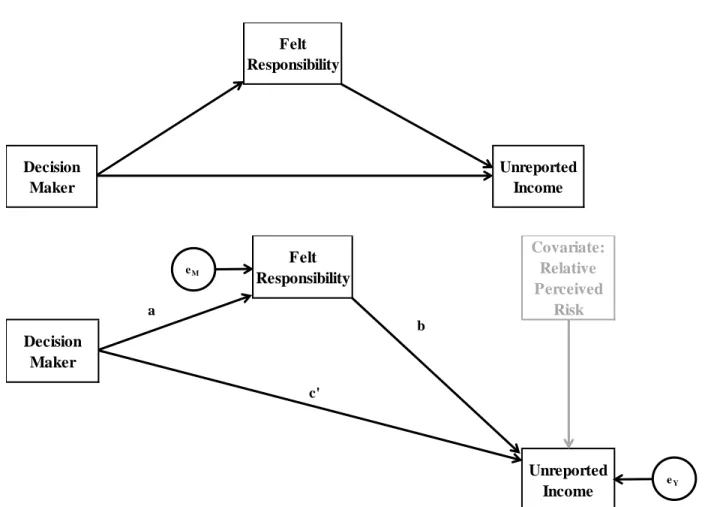
Figure 5: Mediation Model ... 66
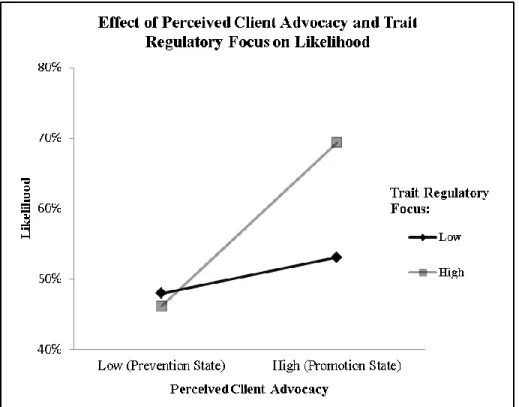
Figure 6: Presentation of Continuous Predictor Variables Split upon Median Values: Effect of Perceived Client Advocacy (Induced Regulatory Focus State) and Trait Regulatory Focus on Dependent Variable Likelihood ... 69
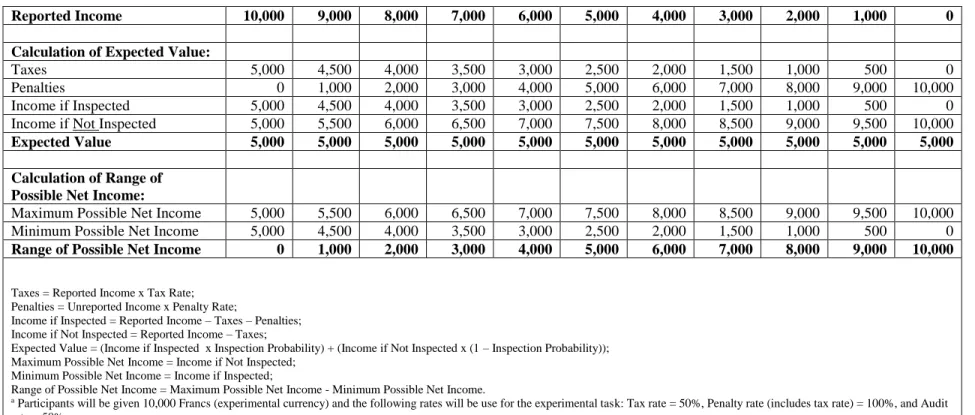
Figure 7: Expected Value and Range of Possible Net Income by Reported Income ... 87
Figure 8: Diagram of Experimental Procedures ... 88
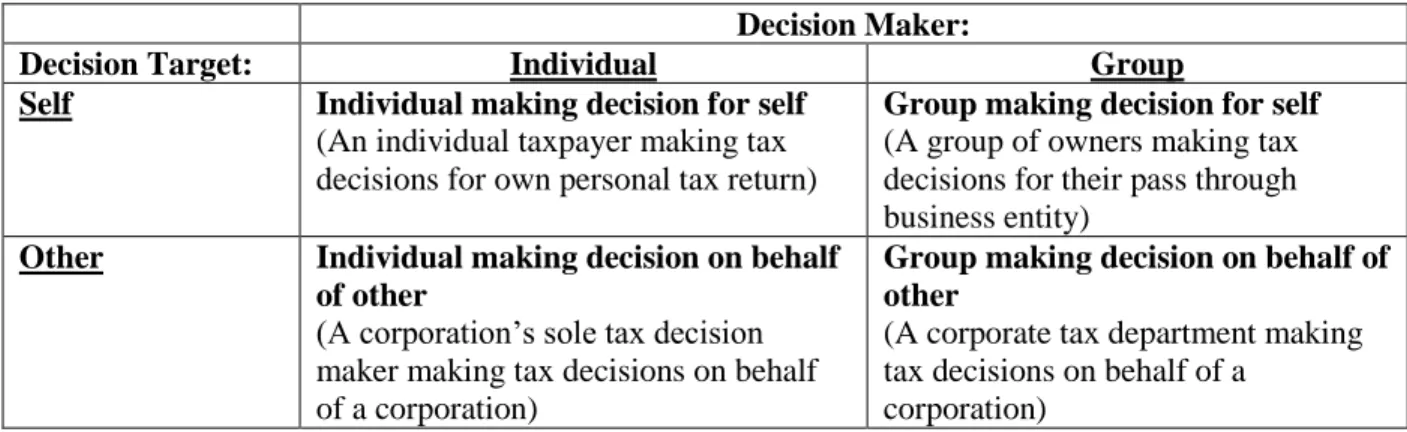
Figure 9: Alignment of Experimental Manipulations with Tax Decision-Making Contexts ... 93
xii LIST OF TABLES
Table 1: Demographics ... 113
Table 2: Main Analysis ... 115
Table 3: Supplemental Analysis of Weight of Advice when Agreement with Advice is High.. 116
Table 4: Supplemental Analysis of Weight of Advice when Agreement with Advice is Low .. 117
Table 5: Supplemental Analysis of Likelihood ... 118
Table 6: Supplemental Analysis of Likelihood when Agreement with Advice is High ... 119
Table 7: Supplemental Analysis of Likelihood when Agreement with Advice is Low ... 120
Table 8: Variable Definitions... 121
Table 9: Demographics ... 197
Table 10: Descriptive Statistics by Tax Advisor Role: Means (Standard Deviation) ... 198
Table 11: Correlation Coefficients... 199
Table 12: Regression Results: Dependent Variable – Likelihood ... 200
Table 13: Supplemental Analysis: Mediation Analysis Using PROCESS Procedure ... 201
Table 14: Demographics ... 253
Table 15: Descriptive Statistics by Decision Maker: Means (Standard Deviation) ... 255
Table 16: Correlation Coefficients... 256
Table 17: Results of ANOVA: Effect of Decision Maker on Unreported Income ... 257
1
GENERAL INTRODUCTION
This dissertation is comprised of three studies investigating judgment and decision making in the corporate tax environment. Hanlon and Heitzman (2010, p. 145) note that little is known about who is making corporate tax decisions and how these decisions are made,
lamenting that “tax avoidance may be highly idiosyncratic and determined by a number of factors and interactions, not all of which can be measured.” This complexity combined with the fact that most experimental tax compliance research to date looks only at individual (rather than corporate) taxpayer decision making suggests a need for investigating decision making in a corporate tax setting.
Navigating the corporate tax environment requires tax decision makers to use
professional judgment to interpret complex tax authority (e.g., tax law, regulations, and court cases) (Magro 1999; McGuire et al. 2012). Tax professionals may identify differing tax positions that vary in how much they affect a taxpayer’s tax calculation, forming a range of possible tax minimization opportunities (Slemrod 2007; Hanlon and Heitzman 2010; Lisowsky 2010). This dissertation employs the relative term “tax aggressiveness” to describe where a tax position falls along a range of possible tax minimization. More aggressive tax positions have weaker
underlying facts, are not clearly supported by relevant tax authority, and reduce taxes to a greater extent than less aggressive tax positions (Cuccia et al. 1995; Roberts 1998; Hanlon and Heitzman 2010). This dissertation investigates corporate tax aggressiveness by examining both individual judgment involved in decision making (i.e., assessments of tax positions based upon tax scenario facts and tax authority in Study 1 and Study 2) as well as individual-level and group-level decision making (i.e., tax compliance decisions in Study 3). The first study in this dissertation
2
examines the influence of external tax advisor recommendations on the tax aggressiveness of decisions made by in-house corporate tax professionals (e.g., tax directors). The second study focuses on the judgment and decision making processes of individuals in a corporate tax environment, investigating how individual traits and contextual factors interact to affect individual-level tax aggressiveness. The third study extends the investigation of contextual factors from individual-level decision making to a group-level analysis, examining decision making in individual and group tax compliance settings. The following subsections describe the manner in which each study approaches the investigation of decision making in corporate taxation. The final subsection contains the overall contribution of this dissertation.
Study One: Accounting Professionals, Tax Advice, and Corporate Tax Aggressiveness The first study investigates corporate tax aggressiveness through an examination of individual-level judgment and decision making, specifically the influence of advice on individual tax aggressiveness. The primary individuals of interest in this study are corporate tax decision makers, such as tax directors, that have authority to make tax compliance and planning decisions on behalf of the corporation. The study draws upon social categorization theory and the belief-adjustment model to explore how tax advice may influence tax directors’ judgments differently depending upon whether or not the tax advisor is from the corporation’s audit firm. I conduct an experiment in which the identity of the tax advisor and the nature of tax advice are manipulated. Experienced corporate tax directors are asked to make an assessment of a tax position based on an ambiguous tax scenario. The external tax advisor is described within the scenario as either from the accounting firm engaged to audit the corporation or from a different accounting firm. Tax directors make their judgment about the tax position after receiving either conservative or
3
aggressive advice from the external tax advisor. Social categorization theory, client advocacy roles, and the belief-adjustment model are used to interpret the influence of advice, leading to predictions that the effect of advice depends upon the nature of the advice and the identity of the tax advisor. Results suggest the nature of advice and tax advisor identity influence how tax directors weight conservative advice when they are in agreement with the advice. However, the nature of advice and tax advisor identity do not appear to influence the weight of advice when tax directors agree with aggressive tax advice.
Study Two: Corporate Tax Aggressiveness: The Effects of Promotion and Prevention Focus on Individual Decision Making
The second study investigates the tax aggressiveness of business entities through an examination of individual-level judgment and decision making. The study draws upon Regulatory Focus Theory to examine the process through which individuals make tax compliance decisions on behalf of the corporation. Regulatory Focus Theory suggests that individuals have two fundamentally different self-regulatory mindsets that influence the way in which they pursue their goals: promotion regulatory focus (i.e., motivated to maximize
successful outcomes) and prevention regulatory focus (i.e., motivated to minimize failed outcomes) (Higgins 1997; Higgins et al. 2001). Regulatory focus is exhibited as an individual trait (i.e., trait promotion focus or trait prevention focus); however, situational factors in the decision environment can activate a regulatory focus state (i.e., promotion state or prevention state) (Higgins 2000). Corporate tax decision makers with a trait promotion focus are predicted to be more tax aggressive than those with trait prevention focus. However, induced regulatory focus state is predicted to moderate this relationship so that inducing a regulatory state may
4
amplify the effects of trait regulatory focus on the tax aggressiveness of corporate tax decision maker judgment when trait and state align. I conduct an experiment in which participant trait regulatory focus (promotion trait or prevention trait) is measured and state regulatory focus is manipulated by framing corporate management’s view of the external tax advisor as either an advocate (positive frame activating a promotion state) or an overseer (negative frame activating a prevention state). Results do not support study hypotheses; however, supplemental analysis suggests that regulatory focus state indirectly influences individual tax aggressiveness through the perception of the tax advisor’s level of client advocacy. Decision makers perceive tax advisors to be stronger client advocates when management views the tax advisor as an advocate (promotion state) than when management views the tax advisor as an overseer (prevention state). Furthermore, perceiving the tax advisor to be more of an advocate amplifies the influence of “fit” between regulatory focus trait and state: compared to individuals with a lower trait promotion focus, tax decision makers with a greater trait promotion focus react more strongly to the induced promotion state.
Study Three: Self-Other and Multi-Agent Decision Making in Taxation
The third study investigates risky decisions made in different tax compliance contexts. Prior research on taxpayer judgment and decision making has typically examined individual taxpayer compliance; however, little is known about how components of the decision making environment influence compliance in business tax settings. The study draws upon diffusion of responsibility theory (i.e., how feelings of responsibility differ in individual and group decision making) to examine the effect of the type of decision maker on the riskiness of tax compliance decisions. Additionally, construal level theory and social value theory are used to explore how
5
self-other decision making (i.e., whether decisions are made for oneself or on behalf of others) and decision maker type (i.e., individual or group decision maker) influence tax compliance. I conduct an experiment in which decision makers are asked to make a tax compliance decision. Decision maker type (individual or group) and decision target (self or other) are manipulated through the structure of the tax compliance task. I use a compliance task with minimal context to intentionally minimize the differences between conditions to determine the effect of only the specific contextual factors of interest.
Taxpayers making decisions in a group are predicted to make riskier tax compliance decisions than taxpayers making decisions individually. Self-other decision making is predicted to influence tax compliance differently depending upon whether or not the decision is made individually or in a group. Results do not support study hypotheses; however supplemental analysis suggests decision maker type affects tax compliance decision riskiness indirectly through feelings of responsibility for the possible outcomes of the decision. Group members report feeling lower levels of personal responsibility than individual decision makers, and feeling less personally responsible for the decision leads to riskier tax decisions.
Overall Contribution
Collectively these studies contribute to both the tax professional judgment and decision making literature and taxpayer compliance research by examining decision making in a corporate tax setting. Fair and objective evaluation of tax positions should reduce unmeasured tax risk. Corporate tax decision makers should be made aware of how components of the decision making environment (e.g., situational factors, dispositional characteristics, advice, and advisor
6
possible tax positions. Additionally, this dissertation also contributes to the corporate tax avoidance/aggressiveness literature, given that these studies are some of the first to employ experimental methods to examine why and how these specific components of the decision making environment influence the tax aggressiveness of corporate tax director judgment. This dissertation also has policy implications as policies designed to influence firm-level corporate tax aggressiveness should be grounded in a solid understanding of the underlying judgment and decision making processes of individuals acting on behalf of the corporation.
7 References
Cuccia, A. D., K. Hackenbrack, and M. W. Nelson. 1995. The ability of professional standards to mitigate aggressive reporting. The Accounting Review 70(2): 227-248.
Hanlon, M. and Heitzman. 2010. A review of tax research. Journal of Accounting and Economics 50: 127-178.
Higgins, E. T. 1997. Beyond pleasure and pain. American Psychologist 52(12): 1280-1300. Higgins, E. T. 2000. Making a good decision: Value from fit. American Psychologist 55(11):
1217-1230.
Higgins, E. T., R. S. Friedman, R. E. Harlow, L. C. Idson, O. N. Ayduk, and A. Taylor. 2001. Achievement orientations from subjective histories of success: Promotion pride versus prevention pride. European Journal of Social Psychology 31: 3-23.
Lisowsky, P. 2010. Seeking shelter: Empirically modeling tax shelters using financial statement information. The Accounting Review 85(5): 1693-1720.
Magro, A. 1999. Contextual features of tax decision-making settings. Journal of the American Taxation Association 21(Supp.): 63-73.
McGuire, S. T., T. C. Omer, and D. Wang. 2012. Tax avoidance: Does tax-specific industry expertise make a difference? The Accounting Review 87(3): 975-1003.
Roberts, M. L. 1998. Tax accountants’ judgment/decision-making research: A review and synthesis. Journal of the American Taxation Association 20(1): 78-121.
Slemrod, J. 2007. Cheating ourselves: The economics of tax evasion. Journal of Economic Perspectives 21(1): 25-48.
8
STUDY ONE: ACCOUNTING PROFESSIONALS, TAX ADVICE, AND CORPORATE TAX AGGRESSIVENESS
Introduction
Corporations are separate legal entities; however, given that corporations function based upon decisions made by individuals, this study investigates the tax aggressiveness of business entities through an examination of individual-level judgment and decision making. The primary individuals of interest in this study are corporate tax decision makers, such as tax directors,1 that have authority to make tax compliance and planning decisions on behalf of the corporation. Tax rules are complex, particularly those for corporate taxation (Barney et al. 2012; Sullivan 2011). Corporations have the option of conducting tax planning and compliance internally or engaging external tax professionals (i.e., tax advisors2 such as public accounting firms) for assistance with some or all of the tax work to achieve objectives while managing tax risk (Donohoe et al. 2014; EY 2014).
Tax advisors provide corporate tax directors with additional resources and expertise through the provision of tax advice. The decision to outsource some or all of the corporate tax function to a tax advisor has been linked to a greater focus on tax planning than on tax
compliance (Dunbar and Phillips 2001). A corporation may have options for outsourcing tax work. A corporation may engage its audit firm to provide tax services, subject to audit committee approval for publicly traded companies, or the corporation may hire an alternate tax advisor
1 This study is focused on the judgment and decision making of individuals within the corporation that are involved in corporate tax matters. These individuals are labeled as tax directors for purposes of this study. The term “tax director” is intended to also represent individuals who could have other job titles such as CFO, controller, tax senior manager, or tax manager.
2 The term “tax advisor” is used throughout this study to describe the individuals that assist taxpayers such as corporations with their tax work. Tax advisors are accounting professionals, external to the corporation, engaged to provide tax services to the corporation. “Tax advisor” is intended to encompass alternate terms such as tax preparer, tax service provider, and tax consultant.
9
(PCAOB 2014). Corporate tax aggressiveness3 appears to be associated with the party that signs the corporate tax return. Corporations that sign their own tax returns or whose returns are signed by an external non-auditor tax advisor are associated with more aggressive positions than
corporations whose returns are signed by an external auditor tax advisor (Klassen et al. 2015). However, it is unclear if the identity of a corporation’s tax advisor shapes a corporate tax director’s aggressiveness. If a corporation’s tax aggressiveness is influenced by the identity of the tax advisor, as suggested by Klassen et al. (2015), does tax advisor identity influence how advice affects internal corporate tax decision making? This study employs an experimental design that enables controlled testing of targeted factors in this relationship. Specifically, the purpose of this study is to draw upon social categorization theory and the belief-adjustment model to investigate how tax advice may differentially influence corporate tax director judgment depending upon both the identity of the tax advisor and the nature of the advice.
Social categorization is the cognitive process underlying how individuals perceive and make sense of an overwhelming number of sensory inputs in a complex and ever-changing environment (Hogg 2001). Corporate tax directors may categorize a tax advisor from the accounting firm engaged to audit the corporation (“tax-audit” category) differently than a tax advisor from an accounting firm that is not the audit firm (nonaudit” category). The “tax-nonaudit” category may be more strongly associated with a tax advisor’s client advocacy4 role.
The different categorization may lead to differing perceptions about a tax advisor’s function and
3 As explained in more detail later, the present study considers tax aggressiveness to be a relative term used to describe where a tax position falls along the range of possible tax minimization. Tax positions that are more aggressive have weaker underlying facts and are not clearly supported by relevant tax authority (Cuccia et al. 1995; Roberts 1998).
4 Mason and Levy (2001, 127) define client advocacy as “a state of mind in which one feels one’s primary loyalty belongs to the taxpayer. It is exhibited by a desire to represent the taxpayer zealously within the bounds of the law, and by a desire to be a fighter on behalf of the taxpayer.”
10
expected behavior, which may influence corporate tax director judgment. This study predicts that advice affects tax director judgment differently depending on both tax advisor identity and whether or not the advice is surprising, given the tax advisor’s identity. In this study, advice is considered to be surprising if incongruent with the tax advisor’s identity (i.e., conservative advice from a non-auditor tax advisor or aggressive advice from an auditor tax advisor). Specifically, the study predicts that aggressive advice from the audit firm tax advisor (i.e., surprising advice) will have a stronger effect on the corporate tax director’s judgment than aggressive advice from the non-audit firm tax advisor (i.e., unsurprising advice). Likewise, conservative advice from the non-audit firm tax advisor (i.e., surprising advice) is predicted to have a stronger effect on the tax director’s judgment than conservative advice from the audit firm tax advisor (i.e., unsurprising advice).
One hundred and nineteen experienced corporate tax professionals (Vice Presidents of Tax, Tax Directors, and Tax Managers) are included in the study. As suggested by their job titles, the vast majority have a great deal of tax experience and most are employed by multi-national US-based corporations. An experimental design is used to examine how the identity of the tax advisor and the nature of advice influence how corporate tax directors weight advice. Participants are given a corporate tax scenario with ambiguous underlying case information and relevant tax authority. The tax advisor’s identity is manipulated in the tax scenario information as a tax advisor either from the audit firm or from a different accounting firm. Participants receive advice from a tax advisor and then make a judgment about their likelihood of taking the aggressive tax position. The advice is manipulated as either aggressive or conservative, which is considered to be surprising or unsurprising based upon the identity of the tax advisor. The study does not find evidence overall that nature of advice and tax advisor identity influence the weight
11
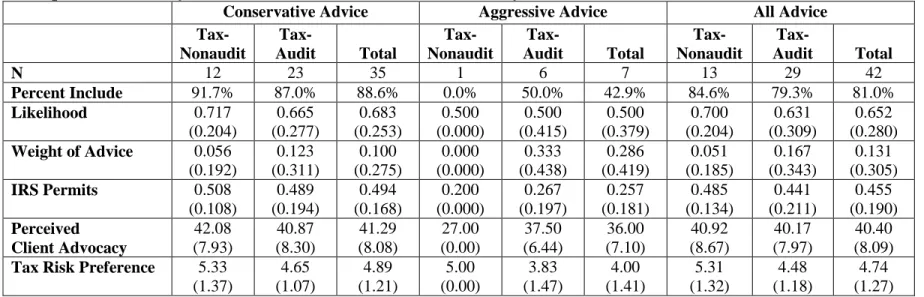
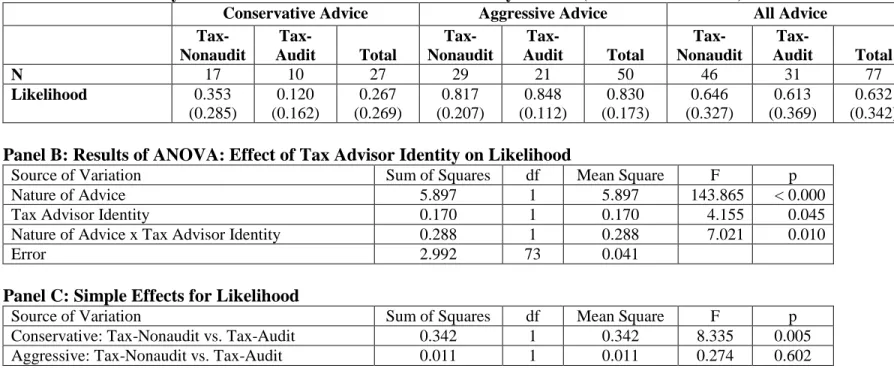
of advice. However, more interesting findings emerge when examining the weight of advice when tax directors agree with the advice. The study finds that tax advisor identity influences the weight of conservative advice when the tax director agrees with the conservative advice. Tax directors in agreement with conservative tax advice weighted advice from the audit firm tax advisor (“tax-audit”) more heavily than when advice came from a tax advisor from a different firm (“tax-nonaudit”). However, when tax directors agree with aggressive advice, tax advisory identity does not appear to influence the weight of advice.
The study contributes to both the tax professional judgment and decision making literature and taxpayer compliance research by examining decision making in the corporate tax environment. Corporate tax directors are sophisticated decision makers, attuned to many components of the corporation’s overarching tax risk management (Donohoe et al. 2014;
Graham et al. 2014). As a component of the tax risk management process, corporate tax directors should be made aware of how the identity of the tax advisor may affect their judgment and evaluation of potential tax positions. Tax directors need to make unbiased risk assessments in order to accurately align tax positions with a corporation’s tax risk appetite (COSO 2004; Donohoe et al. 2014). Failure to accurately assess tax positions may expose the corporation to unmeasured tax risk, which could have implications for tax compliance, accounting for income taxes in financial reporting, and reputational concerns (Donohoe et al. 2014).
The study also contributes to the corporate tax avoidance/aggressiveness literature, as this study is one of the first to employ an experimental design to investigate corporate tax
aggressiveness by examining the judgment and decision making of tax directors who make tax decisions on behalf of corporations. An experimental design enables this study to examine why particular factors influence aggressive tax behavior in a business entity context. The study uses
12
an experimental method to address this issue by isolating tax advisor identity and the nature of advice to examine the effect on tax director judgment. Prior research on corporate tax
aggressiveness has examined firm-level characteristics of corporations that engage in aggressive tax reporting behavior (Chen et al. 2010; Lisowsky 2010; Lanis and Richardson 2011; Rego and Wilson 2012; Honaker 2013; Higgins et al. 2014; Klassen et al. 2015), as well as performance measures and incentive structures for key decision makers (Phillips 2003; Robinson et al. 2010; Armstrong et al. 2012; Gaertner 2014). Recently, studies have focused on key individuals to investigate the association of individual-level characteristics with corporate tax aggressiveness (Cleaveland et al. 2010; Dyreng et al. 2010; Chyz 2013; Honaker 2013; Koester et al. 2013; Laws and Mills 2014). These studies have treated firm-level and individual-level characteristics as determinants of aggressive tax reporting; however, as a result of using an archival
methodology, these studies are more appropriately described as showing an association between these characteristics and the presumed outcomes of aggressive corporate tax decisions. Thus, these prior studies provide information about corporations that are tax aggressive, but they do not unravel the why behind the factors thought to influence aggressive corporate tax behavior.
The following section of this research study contains a review of the relevant literature and development of the hypotheses. The second section describes the research method. The third section presents results. The final section draws conclusions.
Theory and Hypotheses
Tax Risk Preferences and Corporate Tax Aggressiveness
Tax advisors use professional judgment to navigate the tax law (Magro 1999; McGuire et al. 2012). Due to the complexity of the tax rules, a definitively “correct” tax position may not
13
always be determinable, so tax advisors may identify differing tax positions using the same set of information (Slemrod 2007). These differing tax positions could vary in how much they affect a taxpayer’s tax calculation; forming a range of possible tax minimization (Hanlon and Heitzman 2010; Lisowsky 2010). The present study considers tax aggressiveness to be a relative term used to describe where a tax position falls along the range of possible tax minimization. Tax positions that are more aggressive have weaker underlying facts and are not clearly supported by relevant tax authority (Cuccia et al. 1995; Roberts 1998). Given any one issue, a more aggressive tax position reduces taxes to a greater extent than a less aggressive tax position (Hanlon and Heitzman 2010).
The corporate tax rules are complex and often ambiguous, creating uncertainty (Slemrod 2007; Barney et al. 2012). The current convention in practice is to refer to this uncertainty in terms of managing tax risk5 (Donohoe et al. 2014). Borrowing from the COSO definition of
enterprise risk management, tax risk management can be equated to a corporation’s process of identifying potential events with tax implications and managing risk to be within its “risk
appetite” (COSO 2004; Donohoe et al. 2014). For each individual corporation there is an optimal level of tax aggressiveness that most benefits the shareholders (Armstrong et al. 2014).
Theoretically, after risk preference has been identified, the tax aggressiveness of tax director judgment should be guided by the overarching tax risk preference. Thus, corporate tax aggressiveness may be viewed as the operationalization of a corporation’s tax risk preference (aka “risk appetite”).
5 Big 4 public accounting firms produce publications targeted at corporate tax risk and tax risk management. See for example EY’s 2014 tax risk and controversy survey (EY 2014).
14
Several factors have been shown to be associated with corporate tax aggressiveness. At the organizational level, overall corporate business strategy has been linked to corporate tax strategy (Higgins et al. 2014). Corporations that structure their business around a strategy of innovation are more tax aggressive than corporations focused on stability and defending market share (Higgins et al. 2014). Relatedly, evaluating the tax department as either a cost center or a profit center is also associated with tax aggressiveness, with the latter having been shown to be correlated with lower cash effective tax rates (ETR) (Robinson et al. 2010). Also, companies can effectively incentivize the tax aggressiveness of decision makers through executive
compensation arrangements (Phillips 2003; Hanlon et al. 2005; Rego and Wilson 2012; Gaertner 2014). Recent studies have begun to examine associations between individual corporate decision makers and tax aggressiveness. Tracking the movement of individual corporate executives between companies suggests that tax aggressiveness may be attributable to individual decision makers (Dyreng et al. 2010). Further, an executive’s personal tax aggressiveness may be
associated with corporate tax aggressiveness (Chyz 2013). Additionally, decision maker gender appears to be related to corporate tax aggressiveness; female CFOs have been associated with less tax aggressiveness than male CFOs (Francis et al. 2014). Management may choose to seek corporate tax directors with likeminded tax risk preferences.
Top management and the corporate tax department are not the only individuals involved in corporate tax decisions. Corporations may engage tax professionals from public accounting firms to provide or assist the corporate tax function. The interactions of internal corporate tax directors, tax advisors, and tax authorities collectively shape corporate tax aggressiveness (Gracia and Oats 2012). Tax advisors perform an important function of serving as interpreters of
15
tax rules by drawing upon firm-wide experiences interacting with tax authorities (Picciotto 2007).
Corporate Tax Advisors
Companies may choose whether or not to receive tax services from the same accounting firm that is engaged to audit their financial statements. U.S. publicly traded companies must first receive preapproval from their audit committee before the audit firm is engaged to provide tax services; however, if preapproval is granted, even publicly traded corporations may engage their audit firm for tax services (PCAOB 2014). The audit committee is specifically tasked with oversight of financial reporting and disclosure (SOX 2002). The requirement for preapproval from the audit committee stems from concerns that auditor independence could be threatened by sizeable revenues from non-audit services that could unduly influence auditor judgment
(PCAOB 2014, SOX 2002).
The existence of publicly traded companies that continue to engage the same accounting firm for both audit and tax services suggests that in some instances the benefits of this
arrangement outweigh the costs (Gleason and Mills 2011). Indeed, investors perceive the benefits of enhanced financial reporting due to knowledge spillover from auditor-provided tax services to be greater than the potential threat to auditor independence (Krishnan et al. 2013). Collaborations between same-firm audit and tax functions can generate tax strategies for optimizing outcomes for both tax reporting and financial reporting. McGuire et al. (2012) only examine companies that engage the same accounting firm for both audit and tax services; they find that companies engaging an audit firm with tax-specific industry expertise are linked to
16
greater tax aggressiveness compared to other companies in their sample6 (McGuire et al. 2012). The sample for the McGuire et al. (2012) study contains only companies that engage the same accounting firm for both audit and tax services. Though companies may choose to engage the same accounting firm for both audit and tax services, many companies do not (Klassen et al. 2015). Companies using their audit firm as their tax advisor are associated with less tax
aggressiveness than companies using non-auditor tax advisors (Klassen et al. 2015). Klassen et al. (2015) use confidential IRS data to classify a company’s tax advisor as an auditor, a
nonauditor, or the internal tax department. The Klassen et al. (2015) study is able to observe the association between tax advisor identity and tax aggressiveness through the use of confidential IRS data, a relationship which had been previously inaccessible using only publicly available information. However, the data in the Klassen et al. (2015) study do not reveal why using a tax advisor from the audit firm is associated with less tax aggressiveness, more specifically if knowing whether or not the tax advisor is from the company’s audit firm influences how advice affects tax director judgment.
ASC 740 requires that companies evaluate tax positions for financial reporting purposes (FASB 2009). A corporation’s tax accounts are included in the audit of the corporation’s
financial statements. Thus, a tax director may consider the financial reporting implications when assessing potential tax positions. One perspective could be that corporate tax directors perceive a tax advisor from the audit firm as more likely to favorably assess a tax position due to reduced independence or a knowledge spillover effect. The knowledge spillover literature examines whether auditor provided tax services impair independence (possibly impacting audit quality) or
6 The McGuire et al (2012) study uses the term tax avoidance, but I have consistently used the term tax aggressiveness to avoid confusion generated by the use of multiple terms.
17
whether using a tax advisor from the corporation’s audit firm allows knowledge to be transferred between tax and audit functions, generating potential benefits such as increased audit
effectiveness and audit efficiency. Prior research has found support for the knowledge spillover effect (Kinney et al. 2004; Gleason and Mills 2011; Krishnan and Visvanathan 2011). Joe and Vandervelde (2007) examine knowledge transfer between audit tasks and nonaudit tasks, and note that auditors performing both services display less professional skepticism.7 Choudhary et al. (2015) also find reduced professional skepticism when a corporation’s auditor also provides the corporation’s tax services.
Joe and Vandervelde (2007) and Choudhary et al. (2015) focus on the effects of the provision of nonaudit services on auditor judgments. Tax services are one type of non-audit services provided by auditors. Auditor-provided tax services may be associated with reduced auditor skepticism. If auditor-provided tax services are associated with reduced auditor
skepticism, then the corporation’s tax director may view the option to use the same accounting firm for both tax and audit services as an opportunity to lessen auditor scrutiny of the
corporation’s tax positions during the audit of the tax accounts. Consistent with a knowledge spillover effect, the tax director may also expect a tax advisor from the audit firm to have greater knowledge of the corporation. Thus, a tax director could expect a tax advisor from the audit firm to be more comfortable with seemingly more aggressive tax positions than a tax advisor from a different accounting firm. However, this inference is inconsistent with the Klassen et al. (2015) study which finds that corporations using their audit firm as their tax advisor appear to engage in less tax aggressiveness than corporation using non-auditor tax advisors. Rather than viewing a
7 Though the Joe and Vandervelde (2007) study examines knowledge transfer between audit and nonaudit tasks, the particular nonaudit task examined in the study is not the provision of tax services.
18
tax advisor from the audit firm as more likely to accept aggressive tax positons due to knowledge spillover or reduced skepticism, corporate tax directors may perceive the differing professional roles for tax and audit professionals to be more influential on tax advisor judgment, which may lead the tax director to interpret evidence in accordance with a tax advisor’s professional role.
Tax advisors and auditors have differing objectives and responsibilities. A tax advisor has the responsibility to act as an advocate on behalf of taxpayers when recommending a tax position or preparing a tax return (AICPA 2009). Though a client advocate, a tax advisor is also required to exercise due diligence in determining the accuracy of tax information furnished to the Internal Revenue Service (IRS 2014). Thus, a tax advisor has a dual role: taxpayer advocate and overseer of tax information. Auditors have the responsibility to obtain reasonable assurance about whether the financial statements are free of material misstatement (AICPA 1972a). Auditors are tasked with maintaining a questioning mind and critically assessing evidence (AICPA 1972b).
This study draws upon social categorization theory to examine how differing professional roles associated with the identity of the tax advisor (either from the audit firm or a different firm) influence tax director judgments. As this study investigates the influence of advice from two categories of tax advisors with differing professional roles, social categorization theory and professional roles are used to interpret a tax director’s categorization of the tax advisor and how this categorization may affect tax director judgment. Categorization is the cognitive process through which individuals perceive and interpret stimuli in their surroundings (Hogg 2001). Perception is accomplished via the categorization process (Bruner 1957). Individuals receive stimuli input and unconsciously form mental categories based on defining attributes (Bruner 1957). Accumulated stimuli input is stored in memory and used to categorize subsequent input by comparing the new input to stored individual exemplars or prototypes (Smith and Zarate
19
1990). Categories function as mental shortcuts, enabling individuals to perceive their
surroundings and quickly process information to inform individual judgment and behavior (Hogg 2001). Within the broad concept of categorization, social categorization specifically involves the categorization of individuals by a perceiver (Hogg 2001). The way in which a perceiver
categorizes an individual may lead to selective processing of relevant information, which influences interpretation of evidence and ultimately biases judgment (Bodenhausen and Wyer 1985; Bodenhausen 1988).
The knowledge spillover/reduced skepticism perspective presented earlier involves auditor judgment and the possible effects on audit quality; however, it does not consider the impact of differing professional roles on the tax director’s perception of tax advisors. Corporate tax directors may categorize a tax advisor from the audit firm (“tax-audit”) differently than a tax advisor from an accounting firm that is not the audit firm (“tax-nonaudit”). The different
categorization of the tax advisor may lead to differing perceptions about a tax advisor’s function and predicted behavior and may influence how tax directors interpret evidence in making
judgments about the likelihood that a corporation should take an aggressive tax position. When the corporate tax director categorizes the tax advisor as “tax-audit,” this categorization may be associated with the tax advisor’s obligation regarding the accuracy of tax information. The corporate tax director may perceive a tax advisor in the “tax-audit” category as having more of an oversight function due to the tax advisor’s affiliation with the audit firm engaged to attest to the appropriateness of information reported in the corporation’s financial statements. Conversely, when the corporate tax director categorizes the tax advisor as “tax-nonaudit,” an advisor in the “tax-nonaudit” category may be more strongly linked to a client advocacy function than an advisor in the “tax-audit” category. The corporate tax director may perceive a tax advisor in the
20
“tax-nonaudit” category as more of a client advocate due to the absence of affiliation with the corporation’s audit firm. The tax director’s categorization of a tax advisor as either “tax-audit” or “tax-nonaudit” may affect the lens through which the tax director interprets a tax advisor’s recommendation and how the advice influences tax director judgment.
The Influence of Advice
Little research has examined the influence of advice on professional decision making in the accounting domain. Research on advice in the tax context is particularly sparse. The demand for advice increases as uncertainty increases, which is compatible with a tax risk management perspective (Beck et al. 1996). However, demand for advice does not necessarily translate into utilization of advice (Beck et al. 1996). This study employs the belief-adjustment model to examine the influence of advice received by corporate tax directors. The belief-adjustment model posits that belief revision occurs through an anchoring-and adjustment process of evidence evaluation (Hogarth and Einhorn 1992). An anchor, the initial belief, is adjusted in response to additional evidence, forming a new anchor, the revised belief (Hogarth and Einhorn 1992). Each piece of evidence adjusts the previous belief, forming a series of revised beliefs. Belief
adjustment depends upon both the level of the anchor and the direction of subsequent evidence (Hogarth and Einhorn 1992). The level of the anchor (e.g., a larger anchor versus a smaller anchor) is the strength of the initial belief regarding a hypothesis (Hogarth and Einhorn 1992). For example, if in response to Hypothesis A, an individual believing that Hypothesis A is 80 percent likely to be true would have a larger anchor compared to an individual believing that Hypothesis A is 20 percent likely to be true. The direction of subsequent evidence can be positive or negative; subsequent positive evidence increases the degree of an individual’s initial
21
belief and subsequent negative evidence decreases the degree of an individual’s initial belief (Hogarth and Einhorn 1992). The model posits that a large anchor (initial belief) will have a larger adjustment in response to negative evidence than in response to positive evidence. The model also predicts the converse: a small anchor (initial belief) will have a larger adjustment in response to positive evidence than in response to negative evidence (Hogarth and Einhorn 1992). Thus, a recency effect is predicted such that the most recent evidence is more influential than previous evidence when evidence is surprising (Ashton and Ashton, 1988; Hogarth and Einhorn 1992). Evidence is surprising when it is inconsistent with previous evidence (e.g., positive evidence followed by negative evidence), and evidence is unsurprising when it is consistent with previous evidence (e.g., positive evidence followed by positive evidence) (Ashton and Ashton, 1988; Hogarth and Einhorn 1992).
The present study is interested in how tax advisor identity and the nature of advice influence tax director judgment due to input of both of these factors as evidence in the anchoring-and-adjusting process. As agents of the corporation, tax directors should have a default preference for tax minimizing positions. Social categorization theory suggests that tax directors will perceive tax advisors differently, categorizing tax advisors from the audit firm as “tax-audit” and tax advisors from a different firm as “tax-nonaudit.” The categorization of a tax advisor as “tax-audit” may adjust the tax director’s default anchor towards a more conservative tax position. Likewise, the categorization of a tax advisor as “tax-nonaudit” may adjust the tax director’s default anchor towards a more aggressive tax position.
The amount of belief adjustment is determined by both the level of the anchor and the direction of subsequent evidence (Hogarth and Einhorn 1992). The level of the anchor is the strength of the initial belief regarding a hypothesis, theoretically dichotomized as either a large
22
anchor or a small anchor (Hogarth and Einhorn 1992). Regarding the tax aggressiveness of corporate tax director judgment, the hypothesis at issue concerns the likelihood that an aggressive tax position is the appropriate position. Thus, a large anchor represents a greater likelihood that an aggressive tax position is appropriate and a small anchor signifies a lesser likelihood that an aggressive position is appropriate.
Advice received from the tax advisor is expected to act as a subsequent piece of evidence in the tax director’s anchor-and-adjusting process. The belief-adjustment model describes a contrast or surprise effect in which a large anchor will move more in response to negative evidence than in response to positive evidence (Hogarth and Einhorn 1992). Thus, a tax director receiving advice from a tax advisor not from the audit firm (“tax-nonaudit” category) will have a greater belief adjustment if the tax advisor gives conservative advice (negative evidence) than if the tax advisor gives aggressive advice (positive evidence). Likewise, a tax director receiving advice from a tax advisor from the audit firm (“tax-audit” category) will have a greater belief adjustment if the tax advisor gives aggressive advice (positive evidence) than if the tax advisor gives conservative advice (negative evidence). Consistent with the belief-adjustment model, pairing either a large anchor with negative evidence or a small anchor with positive evidence creates a surprise (Hogarth and Einhorn 1992). A recency effect is predicted such that the most recent evidence is more influential than previous evidence when evidence is surprising (Ashton and Ashton 1988; Hogarth and Einhorn 1992). Thus, a tax director receiving surprising advice will be more heavily influenced by the advice than by the advisor; however, whether the advice is surprising depends upon the identity of the tax advisor. Stated formally:
23
H1a: Conservative advice from the non-audit firm tax advisor (i.e., surprising advice)
will have a stronger effect on the corporate tax director’s judgment than conservative advice from the audit firm tax advisor (i.e., unsurprising advice).
H1b: Aggressive advice from the audit firm tax advisor (i.e., surprising advice) will have
a stronger effect on the corporate tax director’s judgment than aggressive advice from the non-audit firm tax advisor (i.e., unsurprising advice).
Research Method Participants
Corporate tax professionals with job titles such as VP Tax, Tax Director, Head of Tax, etc. were contacted via email to request participation in the study.8 Email addresses were obtained from an academic research database. Participants were recruited using a multi-contact method (Dillman et al. 2009). As an incentive for participating, I offered to make a contribution of $2 on behalf of each participant to one of three national-level charities. Screening questions were used to insure that potential participants had adequate experience for inclusion in the study. In order to be eligible to participate in the study, participants must have had experience making in-house corporate tax decisions on behalf of a company. Screening questions assessed the following types of experience: supervision of a company’s income tax return preparation and filing, researching income tax matters on behalf of a company, conducting income tax planning
8 This study collects potentially sensitive information about a company’s tax aggressiveness; thus, corporate tax executives were assured any responses would be anonymous (i.e., responses would not be linkable to their identity or the identity of their corporate employer). I sent a recruitment email containing an anonymous link to the study to 4,579 email addresses. 269 emails were undeliverable. It is unclear how many emails may have been blocked by company filters. 243 participants clicked the link to view information about the study; 139 actually completed the study.
24
on behalf of a company, and preparing or reviewing a company’s tax provision calculations. The screening questions instructed potential participants to consider only their experience while they were employed in-house by a company and not to consider any experience they may have had working for a public accounting firm.
One hundred and nineteen experienced corporate tax professionals completed the experiment, with 115 participants (96.7 percent) having more than seven years of experience in taxation. Participants with more than seven years of experience were asked to specify total years of experience; 96 responded with a mean (standard deviation) of 23.9 years (7.87). Participants were primarily employed by multi-national US-based corporations (79.9 percent), with others employed by domestic US multistate corporations (15.1 percent) and multi-national foreign-based (5.0 percent). The vast majority of participants indicated their corporation’s financial statements were audited by a public accounting firm (99.2 percent). Regarding the percentage of tax services outsourced (rather than conducted in-house), responses ranged from 0 percent to 100 percent with mean (standard deviation) of 33.0 percent (22.5). Additionally, some corporations chose to outsource tax services to the same accounting firm that conducted their audit (43.7 percent) and other corporations used different accounting firms for tax and audit services (55.5 percent). Table 1 presents demographic data. Study 1 tables are presented in Appendix A.
Materials and Design
The experiment was computer-based and administered via Qualtrics software. Participants were first provided with a link to begin the study. The opening screen of the
Qualtrics study presented the explanation of research (general study overview, estimated time to complete, contact information for the experimenters, etc.). Individuals that agreed to participate
25
proceeded to the next screen to answer screening questions before beginning the study.
Participants were asked to work independently and complete the study in one continuous sitting, without outside interruptions.
The experimental materials consisted of five sections: background information and tax scenario about a hypothetical corporation (Maylor Corp), select guidance relevant to the tax scenario and the in-house tax staff opinion, a recommendation from Maylor Corp’s tax advisor regarding the tax scenario, the participant’s response section, and demographics. See Figure 1 for a diagram of the experimental procedures.
Figure 1: Diagram of Experimental Procedures Background Information and Tax Scenario
(Tax Advisor Identity Manipulated:
Tax-Nonauditor Tax-Audit)
Relevant Tax Authority and In-House Staff Opinion
Tax Advisor's Recommendation (Nature of Advice Manipulated:
Aggressiveor Conservative)
Measure Tax Aggressiveness (Likelihood)
Measure IRS Permits, Perceived Client Advocacy, Tax Risk Preference, Agreement
26
Participants were presented with background information for a hypothetical scenario in which they were asked to assume the role of Maylor Corp’s Tax Director. Each participant received one of two possible variations of background information, differing only in who was said to sign Maylor Corp’s tax returns and review research projects conducted in-house by Maylor Corp’s tax department: tax professionals from an accounting firm that is not Maylor Corp’s audit firm or tax professionals from Maylor Corp’s audit firm. After reading through the background information for Maylor Corp, all participants then received the same tax scenario. The tax scenario involved the Research and Development (R&D) Credit and the qualification of certain research expenses for the R&D Credit. Specifically, participants were told that Maylor Corp had incurred costs for supplies related to a new research and development project and provided with facts about the new project. The tax scenario was derived from an actual court case on the proper treatment of supplies for the R&D Credit.9
Following the tax scenario, participants were provided with relevant information from the Internal Revenue Code and Regulations. The potential classification of the supplies as “qualified research expenses” for the R&D Credit was a matter of judgment as it was not directly addressed in the tax guidance provided in the experimental materials.10 Participants were informed that Maylor Corp’s in-house tax department staff had compiled the tax authority and provided a preliminary opinion that, should Maylor Corp include the supplies in the R&D Credit calculation, there was a 60% likelihood that the position would be successfully upheld. The purpose of the 60% likelihood was to anchor the participants on the same starting point prior to receiving advice from Maylor Corp’s external tax advisors.
9Union Carbide Corp. TCM 2009-50.
10 Despite recent legislative activity, the tax rules for claiming the R&D Credit for supplies remain complex and ambiguous (Frank et al. 2010).
27
After participants had read the relevant tax authority and the preliminary opinion of Maylor Corp’s tax department staff, they were given advice from the party designated as Maylor Corp’s tax advisor in the background information. Participants were provided with either a recommendation that Maylor Corp should include the supplies in the R&D credit calculation (aggressive advice) or that Maylor Corp should not include the supplies in the R&D credit calculation (conservative advice). After receiving the tax advisor’s recommendation, participants were asked the likelihood of including the supplies as qualified expenses for the R&D Credit. The study also included an adapted measure of client advocacy, a measure of tax risk preference, manipulation checks, and demographic information. Experimental materials are included as Appendix B.
Independent Variables Tax Advisor Identity
Tax advisor identity is manipulated within the background information for Maylor Corp that participants receive early in the experiment. The experimental materials indicate that Maylor Corp’s tax advisors are either tax professionals from an accounting firm that is not the same as Maylor Corp’s audit firm (Tax-Nonaudit) or tax professionals from Maylor Corp’s audit firm (Tax-Audit). The materials state that research projects are often conducted in-house by Maylor Corp’s tax department and then reviewed by Maylor Corp’s tax advisor. After participants read through the tax scenario about Maylor Corp’s research and development and view the tax department staff’s preliminary opinion and relevant tax authority, participants view the tax advisor’s recommendation on the appropriate tax treatment. In both the Nonaudit and Tax-Audit conditions, the accounting firm is described as a Big 4 public accounting firm.
28 Nature of Advice
Maylor Corp’s tax advisor provides a recommendation about the treatment of the supplies for purposes of the R&D credit. The materials indicate that the tax advisor’s recommendation is based upon analysis of the facts and interpretation of the same relevant tax authority that was provided earlier in the study. The relevant tax authority is inconclusive regarding the appropriate treatment of the supplies for the R&D Credit, representing a grey area in the tax law. The tax advisor’s recommendation is either a Conservative or an Aggressive position. In the
Conservative position, Maylor Corp’s tax advisor recommends that Maylor Corp should not include the supplies in the R&D credit calculation. In the Aggressive position, Maylor Corp’s tax advisor recommends that Maylor Corp should include the supplies in the R&D credit calculation.
The nature of the advice (Conservative or Aggressive) is surprising or unsurprising given the identity of the tax advisor. Surprising tax advice is either conservative advice from a non-auditor tax advisor or aggressive advice from an non-auditor tax advisor. Unsurprising tax advice is either aggressive advice from a non-auditor tax advisor or conservative advice from an auditor tax advisor. See Figure 2 for a diagram of surprising and unsurprising advice given the 2x2 design manipulating the nature of advice and the identity of the tax advisor.
Nature of Tax Advice
Conservative Aggressive Tax Advisor Identity Tax-Nonaudit Surprising Unsurprising
Tax-Audit Unsurprising Surprising
29 Additional Measures IRS Permits
IRS Permits is a measure of the perceived likelihood that the IRS will permit the position that the UltraX supplies are qualified research expenses for Maylor Corp’s Research and
Development credit. IRS Permits is measured with an eleven-point scale with labeled points ranging from 0% “Not At All Likely” to 100% “Extremely Likely.” A lower perceived
likelihood that the IRS would permit the tax position of including the expenses represents greater perceived riskiness of the tax position. A participant’s assessment of the likelihood that the IRS will permit the position is expected to covary with the dependent variable, Weight of Advice.
Perceived Client Advocacy
A nine item scale was adapted from the Mason and Levy (2001) measure of client advocacy. Similar to Stephenson (2007), the instructions were modified so that participants are asked to answer the questions as they think a corporation’s external tax professionals would respond. Specifically, participants in the Tax Advisor Identity – Tax-Nonaudit condition are asked to “please answer the following items as you think a corporation’s external tax
professionals would respond in arrangements such as this when the corporation’s external tax professionals are not from the audit firm.” Participants in the Tax Advisor Identity – Tax-Audit condition are asked to “please answer the following items as you think a corporation’s external tax professionals would respond in arrangements such as this when the corporation’s external tax professionals are from the audit firm.”
The original Mason and Levy (2001) items were worded to measure a participant’s client advocacy. The items used for this study have been rephrased so that each item measures
30
Advocacy is expected to help explain how participants are differentially influenced by the identity of the corporation’s tax advisor and how they respond to aggressive versus conservative tax advice from auditor and non-auditor tax advisors.
Tax Risk Preference
Tax Risk Preference is a tax risk measure of how certain an individual would want to be of his or her tax position within the experimental scenario. Participants are asked “how certain would you want to be of your tax position before including the UltraX supplies as qualified research expenses for the R&D Credit?” Tax Risk Preference is measured with an eleven-point scale ranging from 0% “Not At All Certain” to 100% “Extremely Certain.” An individual who prefers a higher degree of certainty is considered to have a lower tax risk preference. Thus, responses are reverse coded such that a greater score reflects a greater tax risk preference. Tax Risk Preference is measured for use as a possible control variable.
Agreement with Advice
Agreement with Advice is measured as the extent to which a participant agrees with the advice provided by Maylor Corp’s tax advisor in the scenario. Specifically, participants are asked, “To what extent do you agree or disagree with the recommendation of the external tax professionals?” Agreement with Advice is measured on a seven-point Likert-type scale with labeled points ranging from 1 “Strongly Disagree” to 7 “Strongly Agree.” Responses are dichotomized based upon the mid-point of the scale into High or Low Agreement with Advice; the mid-point 4 “Neither Agree nor Disagree” is categorized as Low. The extent to which a participant agrees with the advice is expected to influence the weight of the advice.
31 Dependent Variable
The tax aggressiveness of tax director judgment is operationalized as the likelihood of taking an aggressive tax position (Likelihood). The aggressive tax position is the likelihood of including the cost of specific supplies (described in the tax scenario) as qualified research expenses for the Research and Development (R&D) credit calculation. The authoritative
guidance provided in the experimental materials is ambiguous as to the appropriate tax treatment of supplies for the R&D credit.11 Including the supplies in the R&D credit calculation would be advantageous for tax purposes. Thus, a greater likelihood of including the cost of supplies in R&D credit research expenses reflects more aggressive tax reporting.
Likelihood is used to calculate Weight of Advice. Weight of Advice is calculated as the absolute value of the difference between the 60% anchor from the in-house tax department and Likelihood, divided by the absolute value of the difference between the tax advisor’s
recommendation and the 60% anchor.12 Weight of Advice is used to evaluate how much the tax advisor’s recommendation influenced the participant’s likelihood of taking an aggressive tax position.
11 The tax scenario in this study was intentionally designed such that the appropriate tax treatment is ambiguous. Conversations with a senior manager from a national firm suggest that, as anticipated, the tax scenario does not generate a clear-cut solution. Additionally, a few of the experienced corporate tax professionals contacted me after participating in the study to share their thoughts and opinions. Feedback suggests the tax treatment is subject to interpretation (i.e., ambiguous) and the case had sufficient detail and realism to engage the experienced corporate tax professionals.
12 The weight of advice (WOA) is calculated as follows: WOA = |(Likelihood – Initial Anchor)| / |(Recommendation – Initial Anchor)| (Bonaccio and Dalal 2006). Initial Anchor equals 60%. In the Conservative Nature of Advice condition, Recommendation equals 0%. In the Aggressive Nature of Advice condition, Recommendation equals 100%. WOA values for Likelihood assessments falling outside the range bounded by the tax advisor’s