
ETSI GS ISI 002
V1.1.1
(2013-04)
Information Security Indicators (ISI);
Event Model
A security event classification model and taxonomy
Disclaimer
This document has been produced and approved by the Information Security Indicators (ISI) ETSI Industry Specification Group (ISG) and represents the views of those members who participated in this ISG.
It does not necessarily represent the views of the entire ETSI membership.
Reference
DGS/ISI-002
Keywords
ICT, security
ETSI
650 Route des Lucioles
F-06921 Sophia Antipolis Cedex - FRANCE
Tel.: +33 4 92 94 42 00 Fax: +33 4 93 65 47 16
Siret N° 348 623 562 00017 - NAF 742 C Association à but non lucratif enregistrée à la
Sous-Préfecture de Grasse (06) N° 7803/88
Important notice
Individual copies of the present document can be downloaded from:
http://www.etsi.org
The present document may be made available in more than one electronic version or in print. In any case of existing or perceived difference in contents between such versions, the reference version is the Portable Document Format (PDF). In case of dispute, the reference shall be the printing on ETSI printers of the PDF version kept on a specific network drive
within ETSI Secretariat.
Users of the present document should be aware that the document may be subject to revision or change of status. Information on the current status of this and other ETSI documents is available at
http://portal.etsi.org/tb/status/status.asp
If you find errors in the present document, please send your comment to one of the following services:
http://portal.etsi.org/chaircor/ETSI_support.asp Copyright Notification
No part may be reproduced except as authorized by written permission. The copyright and the foregoing restriction extend to reproduction in all media.
© European Telecommunications Standards Institute 2013. All rights reserved.
DECTTM, PLUGTESTSTM, UMTSTM and the ETSI logo are Trade Marks of ETSI registered for the benefit of its Members.
3GPPTM and LTE™ are Trade Marks of ETSI registered for the benefit of its Members and of the 3GPP Organizational Partners.
Contents
Intellectual Property Rights ... 5
Foreword ... 5
Introduction ... 6
1 Scope
... 8
2 References
... 8
2.1 Normative references ... 8 2.2 Informative references ... 83 Definitions
and
abbreviations
... 9
3.1 Definitions ... 9
3.2 Abbreviations ... 13
4
Positioning of the proposed event classification model ... 15
4.1 Relationship with the ISO 27004 standard ... 15
4.2 The critical importance of positioning the model appropriately ... 15
4.3 The necessity for the model to rest on a detailed taxonomy ... 17
4.4 Description of the taxonomy ... 17
4.5 Complex security incidents versus basic security incidents ... 19
4.6 The key drivers underlying the representation proposed ... 20
4.7 The general description of the representation ... 20
4.8 Link between the event model representation and the list of indicators (and related families) ... 21
5
Comparison with other event classification models ... 21
5.1 Risk analysis methods classifications ... 22
5.2 CAPEC classification ... 22
5.3 FIRST classifications ... 23
6
Detailed description of the proposed representation of the different categories and sub-categories ... 23
6.1 Intrusions and external attacks (Category IEX)... 23
6.2 Malfunctions (Category IMF) ... 25
6.3 Deviant internal behaviours (Category IDB) ... 27
6.4 Behavioural vulnerabilities (Category VBH) ... 29
6.5 Software vulnerabilities (Category VSW) ... 31
6.6 Configuration vulnerabilities (Category VCF) ... 32
6.7 General security (technical & organizational) vulnerabilities (Category VTC and Category VOR) ... 33
7
Practical uses of the event classification model ... 34
7.1 The classification model pivotal role... 35
7.2 The objective shared with operational risks ... 36
7.3 The link with existing studies on cybercrime motivation (threat intelligence) ... 36
7.4 Other uses of the classification model ... 39
Annex A (informative):
Overview of the ISO 27004 standard measurement model ... 41
Annex B (informative):
Field dictionary for the taxonomy ... 42
B.1 Incidents
... 42
B.1.1 Who and/or Why ... 42
B.1.1.1 Accident ... 42
B.1.1.2 Unwitting or unintentional act (error) ... 42
B.1.1.3 Unawareness or carelessness or irresponsibility ... 43
B.1.1.4 Malicious act ... 43
B.1.2 What ... 44
B.1.2.1 Unauthorized access to a system and/or to information ... 44
B.1.2.2 Unauthorized action on the information system and/or against the organization ... 45
B.1.2.7 Physical intrusion or illicit action ... 47
B.1.2.8 Illicit activity carried out on the public Internet (harming an organization) ... 47
B.1.2.9 Various errors (administration, handling, programming, general use) ... 48
B.1.2.10 Breakdown or malfunction ... 49
B.1.2.11 Environmental events (unavailability caused by a natural disaster) ... 49
B.1.3 How ... 49
B.1.3.1 Unauthorized access to a system and/or to information ... 49
B.1.3.2 Unauthorized action on the information system and/or against the organization ... 50
B.1.3.3 Installation of unauthorized software programs (malware) on a system (without the owner's consent) ... 52
B.1.3.4 Information system remote disturbance ... 52
B.1.3.5 Social engineering attacks ... 53
B.1.3.6 Personal attack on organization's personnel or organization disturbance ... 53
B.1.3.7 Physical intrusion or illicit action ... 53
B.1.3.8 Illicit activity carried out on the public Internet network (harming an organization) ... 54
B.1.3.9 Various errors (administration, handling, programming, general use) ... 54
B.1.3.10 Breakdown or malfunction ... 54
B.1.3.11 Environmental events (unavailability caused by a natural disaster) ... 54
B.1.4 Status ... 55
B.1.4.1 Security event attempt (or occurrence) underway ... 55
B.1.4.2 Succeeded (or performed) security event ... 55
B.1.4.3 Failed security event ... 55
B.1.5 With what vulnerability(ies) exploited (up to 3 combined kinds of vulnerabilities) ... 55
B.1.5.1 Behavioural vulnerability ... 55
B.1.5.2 Software vulnerability... 55
B.1.5.3 Configuration vulnerability ... 55
B.1.5.4 General security vulnerability ... 55
B.1.5.5 Conception vulnerability ... 55
B.1.5.6 Material vulnerability ... 55
B.1.6 On what kind of asset ... 56
B.1.6.1 Data bases and applications ... 56
B.1.6.2 Systems ... 56
B.1.6.3 Networks and telecommunications ... 58
B.1.6.4 Offline storage devices ... 59
B.1.6.5 End-user devices ... 59
B.1.6.6 People ... 60
B.1.6.7 Facilities and environment ... 61
B.1.7 With what CIA consequences ... 61
B.1.7.1 Loss of confidentiality (with types of loss and with the amount of data as a possible complement) ... 61
B.1.7.2 Loss of integrity (with types of loss) ... 63
B.1.7.3 Loss of availability (with types of loss and with the duration as a possible complement) ... 63
B.1.8 With what kind of impact ... 63
B.1.8.1 Direct impact ... 63 B.1.8.2 Indirect impact ... 64
B.2 Vulnerabilities
... 64
B.2.1 What ... 64 B.2.1.1 Behavioural vulnerabilities ... 64 B.2.1.2 Software vulnerabilities ... 67 B.2.1.3 Configuration vulnerabilities ... 67B.2.1.4 General security (organizational) vulnerabilities ... 68
B.2.1.5 Conception vulnerability ... 70
B.2.1.6 Material vulnerability ... 70
B.2.2 On what kind of assets ... 71
B.2.3 Who (only for behavioural vulnerabilities) ... 71
B.2.4 For what purpose (only for behavioural vulnerabilities) ... 71
B.2.5 To what kind of possible exploitation ... 71
Annex C (informative):
Authors & contributors ... 72
Annex D (informative):
Bibliography ... 73
Intellectual Property Rights
IPRs essential or potentially essential to the present document may have been declared to ETSI. The information pertaining to these essential IPRs, if any, is publicly available for ETSI members and non-members, and can be found in ETSI SR 000 314: "Intellectual Property Rights (IPRs); Essential, or potentially Essential, IPRs notified to ETSI in respect of ETSI standards", which is available from the ETSI Secretariat. Latest updates are available on the ETSI Web server (http://ipr.etsi.org).
Pursuant to the ETSI IPR Policy, no investigation, including IPR searches, has been carried out by ETSI. No guarantee can be given as to the existence of other IPRs not referenced in ETSI SR 000 314 (or the updates on the ETSI Web server) which are, or may be, or may become, essential to the present document.
Foreword
This Group Specification (GS) has been produced by ETSI Industry Specification Group (ISG) Information Security Indicators (ISI).
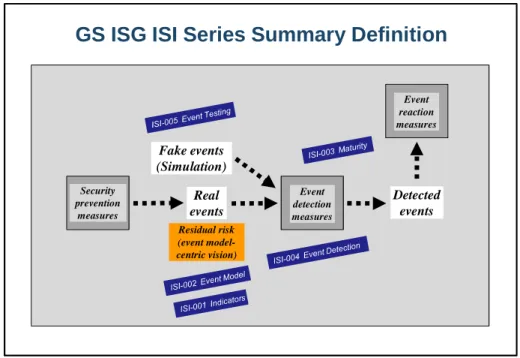
The present document is included in a series of 6 ISI 00x specifications. These 6 specifications are the following (see figure 1 summarizing the various concepts involved in event detection and interactions between all parts):
• GS ISI 001-1 [3] addressing (together with its associated guide GS ISI 001-2 [4]) information security indicators, meant to measure application and effectiveness of preventative measures.
• The present document (GS ISI 002) addressing the underlying event classification model and the associated taxonomy.
• GS ISI 003 [i.5] addressing the key issue of assessing organization's maturity level regarding overall event detection (technology/process/ people) in order to weigh event detection results.
• GS ISI 004 [i.6] addressing demonstration through examples how to produce indicators and how to detect the related events with various means and methods (with a classification of the main categories of use
cases/symptoms).
• GS ISI 005 [i.7] addressing ways to produce security events and to test the effectiveness of existing detection means within organization (for major types of events), which is a more detailed and a more case by case approach than GS ISI 003 one [i.5] and which can therefore complement it.
GS ISG ISI Series Summary Definition
Real events Security prevention measures Event detection measures Fake events (Simulation) Event reaction measures Detected events Residual risk (event model-centric vision)Figure 1: Positioning the 5 GS ISI 00x against the 3 main security measures
Introduction
An overall corporate Cyber Defence and SIEM approach is intended to implement continuous security improvement within large organizations, with the main following goals:
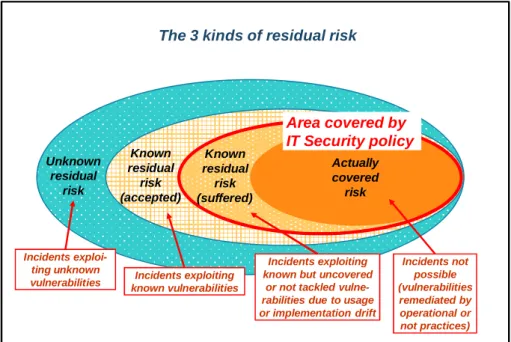
• operationally and constantly reduce the residual risk incurred by their Information Systems (see chart below, which highlights the 2 associated types of events – incidents and vulnerabilities –, and the joint area covered by IT security policy through the concept of usage or implementation drift); and
• to assess the actual application and real effectiveness of their security policies (or of their ISMS, if they have one), for the purpose of their constant improvement.
Such an approach, which to a large extent relies on using the traces available in the Information System's various components, is necessarily organized around an "event-model centric" vision, and can also be tied up to the PDCA model that is commonly used in quality and security areas. As such, this primarily involves implementing this model's PDCA "Check" step on the basis of very detailed knowledge of threats and vulnerabilities.
The 3 kinds of residual risk Known residual risk (accepted) Unknown residual risk Actually covered risk Incidents exploiting known vulnerabilities Incidents exploi-ting unknown vulnerabilities Incidents not possible (vulnerabilities remediated by operational or not practices) Area covered by IT Security policy Known residual risk (suffered) Incidents exploiting known but uncovered
or not tackled vulne-rabilities due to usage or implementation drift
Figure 2: The 3 kinds of residual risks
The recent worldwide trends in ICT security show that significant progress can be accomplished within a few years with the deployment of an organization-wide operational Cyber Defence approach and SIEM approach. Also, a recent survey by a major consulting firm of 15 major companies and organizations brings to light 9 key success criteria. It is worth mentioning the two most important criteria:
• The reliance of the Cyber Defence and SIEM approach on a security event classification model that takes into account both incidents and vulnerabilities, and that notably stresses particular attention to malicious and intentional acts, the monitored events themselves being selected on the basis of main relevant CIA risks and associated metrics (e.g. statistics).
• Training with this model for the relevant people using the Information System, with particular attention to the presentation of concrete examples of disasters associated with inventoried security event main types.
As such, the present document's objective is to build a full taxonomy to thoroughly describe all IT security events (and when appropriate and necessary non-IT security events) and, based on it, to present an original representation that leverages the current international best practices and enables diversified and complex uses. The choice of a detailed taxonomy, which describes security events through a set of attributes (different for incidents and vulnerabilities), ensures that all possible situations can be taken into account with the required flexibility (especially thanks to the provided open dictionary), while the representation chosen for the taxonomy, highlighting the main categories generally accepted by industry consensus, makes the event classification model easier to understand and embrace for
stakeholders. And this representation is key because acceptance by all will depend mainly on it.
It should be finally mentioned that the present document rests in part on work carried out by Club R2GS (see Annex D – Bibliography), a French association created by the end of 2008, specializing in Cyber Defence and Security
Information and Event Management (SIEM) and gathering most very large companies and organizations (mainly users) amongst the most advanced ones in France regarding these topics. The present document (GS ISI 002), as well as all other GS ISI 00x, is therefore based on a strong experience, this community of users having adopted and used the event classification model and the related reference framework for indicators for sometimes over 3 years, and in some cases on a world-wide scale.
1 Scope
The present document provides a comprehensive security event classification model and the associated taxonomy (based on already existing results and hands-on user experience), covering both security incidents and vulnerabilities. These 2 latter ones become nonconformities when they violate organization's security policy. The present document (GS ISI 002) is meant mainly to support operational security staff in their effort to qualify and categorize the detected security events, and more generally to all stakeholders (especially CISOs and IT security managers) in their needs to establish a common language.
2 References
References are either specific (identified by date of publication and/or edition number or version number) or
non-specific. For specific references, only the cited version applies. For non-specific references, the latest version of the referenced document (including any amendments) applies.
Referenced documents which are not found to be publicly available in the expected location might be found at
http://docbox.etsi.org/Reference.
NOTE: While all hyperlinks included in this clause were valid at the time of publication, ETSI cannot guarantee their long term validity.
2.1 Normative
references
The following referenced documents are necessary for the application of the present document.
[1] NIST SP 800-126 Revision 2 (September 2011) : "The Technical Specification for the Security Content Automation Protocol (SCAP Version 1.2)".
[2] MITRE CCE List Version 5.20120314 (March 2012): "Common Configuration Enumeration". [3] ETSI GS ISI 001-1: "Information Security Indicators (ISI); Indicators (INC); Part 1: A full set of
operational indicators for organizations to use to benchmark their security posture".
[4] ETSI GS ISI 001-2: "Information Security Indicators (ISI); Indicators (INC); Part 2: Guide to select operational indicators based on the full set given in part 1".
[5] ISO/IEC 27000:2012: "Information technology -- Security techniques -- Information security management systems -- Overview and vocabulary".
2.2 Informative
references
The following referenced documents are not necessary for the application of the present document but they assist the organization with regard to a particular subject area.
[i.1] ISO 27002:2005: "Information technology - Security techniques - Code of practice for information security management".
[i.2] ISO 27004:2009: "Information technology - Security techniques - Information security management - Measurement".
[i.3] ISO 27005:2011: "Information technology - Security techniques - Information security risk management".
[i.4] FIRST Classification (November 2004): "CSIRT Case Classification (Example for enterprise CSIRT)".
[i.5] ETSI GS ISI 003: "Information Security Indicators (ISI); Indicators; Part 3: A set of Key Performance Security Indicators (KPSI) for security event detection maturity evaluation".
[i.6] ETSI GS ISI 004: "Information Security Indicators (ISI); Event Detection; Part 4: Guidelines for event detection implementation".
[i.7] ETSI GS ISI 005: "Information Security Indicators (ISI); Event Testing; Part 5: Event Testing".
3 Definitions
and
abbreviations
3.1 Definitions
For the purposes of the present document, the following terms and definitions apply (ISO 27000 [5] compliant where applicable):
NOTE: See also the summary chart at the end of this list.
asset: information asset that has value to the organization and that can be broken down in primary assets (such as
business activities, data, application software, etc. which hold the business value) and secondary/supporting assets (network or system infrastructure, which host primary assets)
assurance: refers to the planned and systematic activities implemented in a management system so that management
requirements for a service will be fulfilled
NOTE: It is the systematic measurement, comparison with a standard, monitoring of processes and an associated feedback loop that confers error prevention. This can be contrasted with Management "Control", which is focused on process outputs.
base measure: regarding the "indicator" issue, a base measure is defined in terms of an attribute and the specified
measurement method for quantifying it (e.g. number of trained personnel, number of sites, cumulative cost to date) NOTE: As data is collected, a value is assigned to a base measure.
continuous auditing: periodic verification and collection of a series of controls identified within the Information
System, corresponding with the detection of incidents and of software, configuration, behavioural or global security framework vulnerabilities and/or non-conformities
NOTE: There are three checking levels (in principle, hierarchy notably implemented within banking and financial institutions):
Detailed behavioural, global security framework or technical checking at the security software or equipment level (network, system, application software).
Level 1 checking via monitoring of trends and deviations of a series of significant measurement points.
Level 2 checking (verification of existence of a satisfactory assurance and coverage level of the chosen control and measurement points, and of implementation of regulatory requirements). Continuous auditing can be either manual or automatic (for example, monitoring by means of tools appropriate for a SIEM approach). Finally, continuous auditing is generally associated with statistical indicators (levels of application and effectiveness of security controls), that provide information regarding the coverage and assurance level of the security controls in question.
criticality level (of a security event): level defined according to the criteria which measures its potential impact
(financial or legal) on the company assets and information, and which make it possible to evaluate the appropriate level of reaction to the event (incident treatment or vulnerability or nonconformity removal)
NOTE: The criticality level of a given event is determined by the combination of its severity level (inherent to the event itself – see definition below) and of the sensitiveness of the target attacked or concerned (linked to the asset estimated value for the company – whose value concerns confidentiality, integrity or
derived measure: regarding the "indicator" issue, a measure that is derived as a function of two or more base measures effectiveness (of security policy or of ISMS): as a supplement to the actual application of security policy (or of ISMS)
and of its measures assessment, it is necessary to assess its level of effectiveness, that can be estimated through identified residual risk (that corresponds with the residual vulnerabilities that are actually exploited and that have led to security incidents)
NOTE: It should be added that the term "efficiency" is sometimes also used, but generally with a different meaning of economy in the use of resources (not addressed here for reasons of lesser relevancy).
(security) incident: single unwanted or unexpected security event, or series thereof, that correspond to the exploitation
of an existing vulnerability (or attempt to), and with an actual or potential threat (attempt underway), that have a significant probability of compromising business operations and threatening information security
NOTE: In case of success, an incident affects nominal operations of all or part of an information system
(according to the Confidentiality, Integrity and Availability criteria - English acronym CIA). An incident that manifests itself through previously unseen phenomena, or is built as a complex combination of elementary incidents often cannot be qualified and therefore inventoried or categorized easily; such an incident will often be referred to as an anomaly.
indicator: measure that provides an estimate or evaluation of specified attributes derived from an analytical model with
respect to a defined information need
NOTE: Indicators are the basis for analysis and decision making.
log: continuous recording of software usage computer data, with specific characteristics: detailed and specified
structure, time-stamping, recording as soon as they occurs in files or other media NOTE: Logs are a kind of trace (more general concept – see definition below.
non-conformity: security event that indicates that organization's required security rules and regulations have not been
properly enforced, and are therefore the consequence of a usage or implementation drift
NOTE: Continuous monitoring of non-conformities (similar to continuous auditing - Cf. this term above) enables to better ensure that an organization's security policy is being enforced. Non-conformity can be further refined according to their kind: configuration, behaviour, global security (technical and organizational) and material. Non-conformities are also vulnerabilities or incidents, depending on the situation (see definition).
periodic audit (Periodic scanning): using isolated audit means, periodic acquisition and verification of security
controls
NOTE: A periodic audit can also be either manual or automatic (for example, carried out through scanner type tools). Finally, a periodic audit is generally Boolean (all or nothing compliance level).
risk:product of the probability of occurrence of a security incident involving a specific asset by its impact on this asset (impact assessed according to the CIA sensitivity level)
NOTE: The level of risk exposure (concept which is used in risk assessment methods) corresponds to the product of the vulnerability level of the asset in question by the threat level hanging over it.
risk not covered (by existing security measures):risk sometimes also referred to as "residual", which breaks down into 3 shares:
• Known and realized suffered risk, corresponding to the impact suffered by the organization under attack when the security policy is not applied (configuration, behavioural or global security non-conformities), and when known and critical software vulnerabilities are not appropriately addressed
• Known and accepted risk that corresponds to a risk taken by choice by an organization, by comparing the risk associated with attacks with economic, usage and security level considerations
security event: information about a change of state in a system that may be security relevant and that indicates the
appearance of a risk for the organization
NOTE: A security event is either an incident or a vulnerability occurrence or detection (see definition of these terms). 500 security events have been inventoried within the industry, and are grouped into 9 different major categories, with the 3 first corresponding to incidents, and the 4 last to vulnerabilities: external attacks and intrusions, malfunctions, internal deviant behaviours, behavioural vulnerabilities, software vulnerabilities, configuration vulnerabilities, general security (technical or organizational) vulnerabilities.
severity level (of security incident): level (generally defined on a 4-element scale) inherent to the event itself and that
depends on several criteria that vary according to the types of events (in decreasing order of importance):
• Dangerousness is the result of multiple factors with variable combinations according to circumstances or types of incidents: propagation speed for a worm, virulence, effectiveness, importance and number of impacted assets, capability of harm, target reachability, capability of remote action, persistence, weakness or lack of curative means, and extend of compromise (depth of component which is can be or has been reached, concept of Defence in Depth or DiD)
• Stealthiness covers the level to which the incident can be hidden to the defender: obvious visibility, visible through simple and easy to use mechanisms, detection requires advanced technical tools, almost invisibility. It is a key factor for monitoring and detection. Anonymization and camouflage, or active and passive masking techniques are stealthiness techniques. Stealthiness takes on an indirect meaning when it applies to similar not yet detected incidents
• Feasibility relates to the attacker's motivation and skills. It increases proportionally to all the necessary prerequisites (regarding skills, tools, financial means, collusion, initial access, etc.) combined with the presence of exploitable vulnerabilities; feasibility can be tied often to the frequency of attacks that can be detected in the world. Its assessment is not simple, because it is subject to change. For example, it may be difficult to create a hacking tool for a given vulnerability. However, once the tool is released on the Internet, it can be used by unskilled attackers. Feasibility takes on an indirect meaning when it applies to a potential threat (see definition of this term), as the analysis of its factors required to evaluate it provides an interesting
evaluation of the risk
NOTE: This notion appeared in the mid-1990s within the framework of the ITSEC certification, then towards the end of this decade with the issue of global and public management of vulnerabilities and "malware" (security software vendors and CERTs). It is once again being developed at the present time with the recent release of log analysis and correlation tools that completely integrate this concept along with criticality.
severity level (of vulnerability or of nonconformity): the severity level definition is about the same as the one for
incidents, with a few small differences:
• Dangerousness: impact of the related attacks, weakness of protective techniques, possible remote exploitation, scope of the target / victim population (number of machines, of services, …), importance to organization of the security rule that was violated
• Stealthiness: same definition as for incident
• Exploitability (by attackers), is the opposite definition of incident feasibility
NOTE: The proposed definition is in line with the CVSS (NIST 800-126 [1] or SCAP) standard for software vulnerabilities.
security policy: overall intention and requirements as formally expressed by management
NOTE: Two levels are used: general statement and detailed rules. Rules apply to network and systems configuration, user interaction with systems and applications, and detailed processes and procedures (governance, operational teams, and audit). Violation of a rule brings about nonconformity, which is either an incident or vulnerability.
SIEM (Security Information and Event Management): SIEM solutions are a combination of the formerly disparate
product categories of SIM (security information management) and SEM (security event management). SEM deals with real-time monitoring, correlation of events, notifications and console views. SIM provides long-term storage, analysis and reporting of log data
NOTE: The present document extends these two notions under the generic SIEM acronym, which encompasses all organizational, processes and human aspects necessary to deploy and operate these tools, and which include vulnerability and nonconformity management; we may refer to Cyber Defence approaches in the most complex case.
taxonomy: science of identifying and naming species, and arranging them into a classification
NOTE: The field of taxonomy, sometimes referred to as "biological taxonomy", revolves around the description and use of taxonomic units, known as taxa (singular taxon). A resulting taxonomy is a particular classification ("the taxonomy of ..."), arranged in a hierarchical structure or classification scheme.
threat: potential cause of an unwanted incident, which may result in harm to a system or organization
NOTE: There are 4 categories of threats: Natural threats:
- Environmental causes: public service outage, fire, and other disasters - System failure: physical or software computer or network breakdowns Human threats:
- Unintentional (error, carelessness, irresponsibility, unawareness, etc.): conception and design, development, operation and usage, due to chance, hasty development and deployment, tiredness, gullibility, incompetence
- Internal or external malice: theft, economic spying, sabotage, intrusion, fraud, etc. The frontier between error, carelessness and malice is often fuzzy: it is always possible for an unscrupulous employee to plead error even though he has been negligent or malicious. However the difference between unintentional and malicious actions can often be found with the following clues: An unintentional action is not hidden (so not stealthy), it tends to impact availability rather than confidentiality and integrity, and it has a low dangerousness and a high feasibility. The resulting severity is often low to fairly low.
A malicious action is stealthier (notably to enable the attacker to remain anonymous and allow him to sustain the advantages obtained for a longer period of time), with an impact on confidentiality and integrity rather than on availability, and with high dangerousness.
trace: computer data that proves the existence of a business operation
NOTE: As an example, logs (see definition elsewhere) are traces, but traces are not necessarily logs.
vulnerability: undesirable state of a system whose occurrence or detection is a security event
NOTE: It corresponds to a flaw or weakness of an asset or group of assets (at the level of a technical system, process or behaviour) that can be exploited by a threat. Occurrence and actual detection of a vulnerability (often delayed in time) are considered the same in the present document. There are 6 types of
vulnerabilities, but only the first four are in the scope of a SIEM approach and are being dealt with in the present document:
Behavioural.
Software (that can lead to malicious exploitation by an attacker via an "exploit"). Security equipment or software configuration (same as above).
General security technical or organizational (vulnerabilities defined as having a global and major effect on Information System's security level, and having a level equivalent to the 133
ISO 27002 [i.1] standard reference points).
Conception (overall system design at architecture and processes levels).
Material level (corresponding with vulnerabilities which enable physical incidents – of an accidental, negligent or malicious kind).
A behavioural, configuration, global security (technical and organizational) or material vulnerability becomes a nonconformity (see definition above) when it violates the organization's security policy and rules. The present document uses the terms "usage or implementation drift" in this case.
Summary of some terms at the heart of
a Cyber Defence or SIEM approach
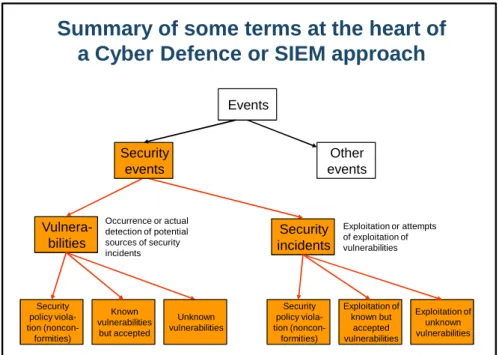
Events Security events Other events Vulnera-bilities Security incidents Occurrence or actual detection of potential sources of security incidents Security policy viola-tion (noncon-formities) Known vulnerabilities but accepted Unknown vulnerabilities Exploitation or attempts of exploitation of vulnerabilities Security policy viola-tion (noncon-formities) Exploitation of known but accepted vulnerabilities Exploitation of unknown vulnerabilities
Figure 3: Relationships between different kinds of events
3.2 Abbreviations
For the purposes of the present document, the following abbreviations apply:
AD Active Directory
ADSL Asymmetric Digital Subscriber Line
AMA Advanced Management Approach
APT Advanced Persistent Threat
ATM Automatic (or Automated) Teller Machine
AV Anti Virus
BYOD Bring Your Own Device
CAG Consensus Audit Guidelines
CAPEC Common Attack Pattern Enumeration and Classification (Mitre)
CCE Common Configuration Enumeration
CEE Common Event Expression (Mitre)
CIA Confidentiality Integrity Availability CISO Chief Information Security Officer
COBIT Control OBjectives for Information and related Technology CRAMM CCTA Risk Analysis and Management Method
CWE Common Weakness Enumeration
DAT Digital Audio Tape
DHCP Dynamic Host Configuration Protocol
DNS Domain Name System
EBIOS Étude de Besoin et Identification des Objectifs de Sécurité EDI Electronic Data Interchange
ERP Enterprise Resource Planning FTP File Transfer Protocol FTPS File Transfer Protocol Secure FW FireWall
HR Human Resources
HTTP HyperText Transfer Protocol
HVAC Heating, Ventilation, and Air Conditioning IAM Identity and Access Management
ICT Information and Communication Technology IDB Incident regarding Deviant internal Behaviour
IE Internet Explorer
IEX Incident coming from External IMF Incident regarding Malfunction
IP Internet Protocol
ISMS Information Security Management System ISO International Organization for Standardization
IT Information Technology
ITIL Information Technology Infrastructure Library
LAN Local Area Network
LDAP Lightweight Directory Access Protocol MMI Man Machine Interface
NIST National Institute of Standards and Technology (USA)
OS Operating System
PABX Private Automatic Branch eXchange
PC Personal Computer
PDA Personal Digital Assistant
PDCA Plan Do Check Act
PII Personally Identifiable Information PIN Personal Identification Number PKI Public Key Infrastructure
POS Point Of Sale
RAT Remote Administration Tool
SAN Storage Area Network
SANS SysAdmin, Audit, Network, Security (SANS Institute) SCADA Supervisory Control And Data Acquisition
SCAP Security Content Automation Protocol SIEM Security Information and Event Management SMS Short Message Service
SOAP Simple Object Access Protocol
SOC Security Operations Centre
SP Special Publication
SQL Structured Query Language
SSL Secure Sockets Layers
SSO Single Sign-On
US United States
USB Universal Serial Bus (USB stick) VBH Vulnerability regarding Behaviour VCF Vulnerability regarding ConFiguration VOR Vulnerability with Organizational security VPN Virtual Private Network
VSW Vulnerability regarding SoftWare
VTC Vulnerability with Technical general security WEP Wired Equivalent Privacy
4
Positioning of the proposed event classification
model
4.1
Relationship with the ISO 27004 standard
The ISO 27004 [i.2] information security measurement model is a structure linking an information need to the relevant objects of measurement and their attributes (see Annex A for an overview of this link). The information needed generally relates to high level data used by IT security governance for decision support and improvements, whereas the objects of measurement (especially those related to technical controls) are often low level data produced by prevention and detection systems. Establishing a link between these two different worlds is easier when using an intermediate level of abstraction such as an event classification model. Building indicators consists therefore simply in counting events during intervals of constant time (see GS ISI 001-1 [3] and GS ISI 001-2 [4]).
As main outlines, the model should meet the following requirements:
• Be positioned at the appropriate level of abstraction (see clause 4.2).
• Be applicable equally to vulnerabilities and incidents (see clause 4.2).
• Include both a taxonomy – ensuring comprehensiveness and rigor (see clauses 4.3 and 4.4), and a related
representation model – ensuring easy understanding and use by all stakeholders and enabling the link with
indicators (see clauses 4.6, 4.7 and 4.8).
• Deal with complex security incidents represented as a combination of smaller elementary security incidents (see clause 4.5).
4.2
The critical importance of positioning the model
appropriately
It is key in events and categories design and development to approach the model from the perspective of dealing with
residual or not-covered risks hanging over the Information System. This implies that the model has to deal with the
2 components that constitute risk exposure (namely incidents and vulnerabilities, covering both detection and recovery). The model should thus be structured according to its many uses. This leads to express the two following major
requirements:
• In an effort to establish state-of-the-art figures regarding the rate of incidents and of vulnerabilities, that are relevant, consistent and usable, the model main event types should be applicable to all sectors of industry, and should correspond with events aggregates that, for a large portion of them, can be understood by the current technical detection tools.
• It should be possible to associate the major types of categorized events with response and/or reaction plans (for purposes of effectiveness and of readiness).
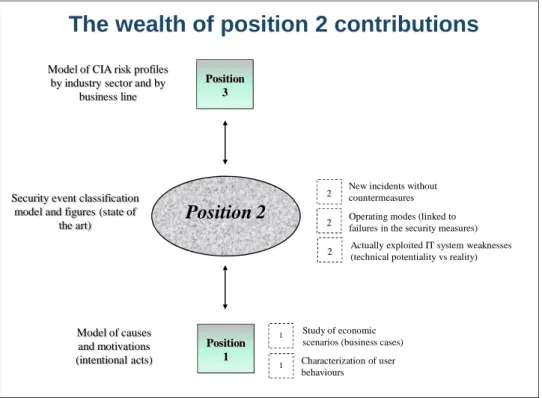
These 2 key requirements lead to positioning the model (see diagram below) on an intermediate position between:
• The 1st position, a model that organizes and deals with the causes and reasons behind the events themselves (while explaining and notably helping with an understanding of the immense and extremely active field of malice and of the underground world that supports it).
• The 3rd position, a classification of risks closely associated with the Information System according to business lines profiles, that can be uniformly broken down into CIA risks and their associated impacts (financial, legal, image, etc.), with each risk described using a precise Top 10 (representing annual potential operational losses). This position applies only to incidents, not to vulnerabilities.
These 3 positions respectively correspond with the "who or why", the "how" and the "what and consequences" of the three (or two for vulnerabilities) previously mentioned aspects that can be used to completely describe a security event.
Security event classification model and figures (state of
the art) Model of causes and motivations (intentional acts) Position 3 Position 1 Model of CIA risk profiles
by industry sector and by business line
2
2
Operating modes (linked to failures in the security measures)
Actually exploited IT system weaknesses (technical potentiality vs reality)
1
2 New incidents without countermeasures
1
Study of economic scenarios (business cases) Characterization of user behaviours
Position 2
The wealth of position 2 contributions
Figure 4: Positioning of the security event model The relation between the third and the second position makes it possible to:
• Establish a very accurate link between the event classification model and the risk profiles model.
• Describe the link between the incidents categorized in the former, and the resulting disasters in the latter.
• Progressively get closer to an accurate and exhaustive knowledge of IT systems disasters (notably
Confidentiality and Integrity, which are not sufficiently and accurately measured) and to an ability to quantify them for internal purposes.
The challenge for companies or organizations is thus to implement their own genuine business-oriented IT security
observatory. Such an advanced security approach, which is focused on strategy rather than on costs, brings to light IT
security aspects that impact the success or image of the corresponding business line (also influenced by the geography, the local market and the competitors). Moreover, each risk profile includes two distinct parameters (the event's frequency of occurrence and the event's impact level). Using the classification model and the related reference
frameworks for indicators (and its associated statistics – see GS ISI 001-1 [3]) enables evaluation and benchmarking of the first parameter. The 2nd parameter is highly dependent on the sector of industry in which the IT organization
operate; more mature industry sectors and/or organizations can provide sector-specific drafts and templates (notably the banking and financial world under the impetus of the Basel 2/3 AMA approach).
The relation between the first and the second position makes it possible to:
• Allow a simple link between the event model and the methods used in order to generate the events. This procedure significantly enhances the model and enables improvement of the link between the 1st position
(notably malice trends) and the 2nd position (evolution of operating modes).
• Identify IT system's weaknesses that are being currently and actively exploited by attackers, which can be notably different from the ones that would in principle appear to be the most serious from a purely technical viewpoint (according to the CVSS scale, for example).
The analysis of position three combined with the two others enables a detailed characterization of the targets selected by attackers, i.e. to highlight the preferred types of systems and/or data (for example, private data in order to support the underground world or for blackmailing, or systems to be attacked in order to disturb a country's economy insofar as possible).
We would finally add that the security events included in the position 2 event model are often descriptions that can consist of a combination or sequence of elementary technical events. Each of these elementary technical events, considered on its own, does not represent an IT security event. For example, a repeatedly unsuccessful attempt to access an account becomes an IT security event only if it involves an attack focusing on the identifiers and passwords, but is not an IT security event in the case of the usual authorized user making typing errors. Elementary events are typically forwarded into logs that can be retrieved from the Information System various components, and only part of these events are later qualified as IT security events or alarms, after correlation with other elementary events or with a reference database, and very often after human and manual assessment and validation.
4.3
The necessity for the model to rest on a detailed taxonomy
To make sure that the model is exhaustive, and given that it is almost impossible to describe all possible situations, it is necessary to figure out how to define as accurately as possible security events with all the flexibility required. This leads to the definition of a detailed taxonomy (using distinct attributes for incidents and vulnerabilities), and to a complete and open dictionary of acceptable values for these attributes. With such an approach, the model needs however a way to highlight the main categories and sub-categories, to make it as understandable and usable as possible by all stakeholders. And this representation is key to acceptance by all, as explained in clause 4.6.
4.4
Description of the taxonomy
The model structure and taxonomy used to describe incidents is as follows (8 areas required to fully describe a change in a system):
1) Who and/or why (subject) 2) What (verb1)
3) How (verb 2)
4) Status of incident (attempt underway or success or failure) 5) Which vulnerability is being exploited
6) On what kind of asset (complement) 7) With what CIA consequence 8) With what kind of business impact
Each area may include up to three fields. Three areas are mandatory (who and/or why, what, status, asset) and the others being optional (how, vulnerability exploited, CIA consequence, impact).
The model structure and taxonomy used to describe vulnerabilities is as follows (5 areas required to fully describe a state):
1) What
2) On what kind of assets
3) Who (only for behavioural vulnerabilities)
4) For what purpose (only for behavioural vulnerabilities) 5) To what kind of possible exploitation
Each area may include up to 3 fields. Three areas are mandatory (what, asset, who) and the others are optional (purpose, exploitation). This description of vulnerabilities has a direct link with the NIST 800-126 [1] (SCAP) standard – namely CWE (Common Weakness Enumeration) – for software vulnerabilities, and the MITRE CCE (Common Configuration Enumeration) List for configuration vulnerabilities. Given the maturity and widespread use of these standards or frameworks for these 2 categories within the IT security community, the present document will only include a limited description to explain their appropriate use.
The rich information available in these descriptions (especially the cross-referencing of incidents and vulnerabilities) makes it possible to retrieve multiple results when querying a repository of detected incidents and vulnerabilities. Annex B gives a full dictionary of possibilities for each field. The objective is to provide as many choices as possible based on diversified combinations of the different fields and on today's available state-of-the-art within the profession. The top-level choices provided by this dictionary for incidents areas can be summarized as follows:
• Who and/or why: accident, unwitting or unintentional act (error), unawareness or carelessness or irresponsibility, malicious act (external or internal)
• What: unauthorized access to a system and/or to information, unauthorized action on the information system and/or against the organization, installation of unauthorized software programs on a system (without owner's consent), information system remote disturbance, personal or organization disturbance to induce stress, physical intrusion or illicit action, illicit activity carried out on the public Internet network (harming an organization), various human errors (administration, handling, programming, general use), breakdown or malfunction of equipment, environmental events (information system component unavailability due to a natural disaster)
• How: for each abovementioned "what" possibility, list of the methods and tools used (especially for attacks)
• Status of incident: security event attempt underway, successful security compromise, failed security compromise
• Vulnerability exploited: see below the detailed description of the 6 possible types of vulnerabilities (behavioural, software, configuration, general security, conception, material)
• Asset type: data bases and applications (perimeter, internal, public cloud, outsourcing), systems (perimeter, internal, public cloud, outsourcing), networks and telecommunications (low level devices, high level communication, middleware, wireless devices, security), offline storage devices (paper, electronic devices, magnetic devices, optical devices), end-user devices (local application software – user or organization-owned, multipurpose-se workstations – user or organization-owned), people (employee, business partner, on-premises or off-premises service provider), facilities and environment (real estate, physical security devices or systems, various utilities, office furniture)
• CIA consequences: loss of confidentiality (Personal Identifiable Information (PII), trade secrets, sensitive data, intellectual property, (military)-classified material, network and systems, security), loss of integrity (many diversified cases), loss of availability (performance decrease, full breakdown or malfunction, deletion, physical destruction, physical loss including theft)
• Impact type: direct impact (disruption to business operations, loss of productivity, fraud, incident recovery costs, life or health consequences), indirect impact (loss of competitive advantage, reputation damage, loss of market share, legal and regulatory costs)
The top-level choices provided by this dictionary for vulnerabilities areas can be summarized as follows:
• What: behavioural vulnerabilities (further broken down into 10 different sub-groups), software vulnerabilities (see CWE), configuration vulnerabilities (see CCE), general security (organizational and technical)
vulnerabilities, conception vulnerabilities (software, general design, environment), physical vulnerability (hardware, network and systems, personnel and site, environment)
• On what kind of assets: see incidents above
• Who (only for behavioural vulnerabilities): see incidents above
• For what purpose (only for behavioural vulnerabilities): see incidents above (what)
This taxonomy can be used in different ways:
• As a basis for a concise and easy-to-understand representation model to be used by all stakeholders within the organization (see clauses 4.8 and 6).
• To maintain a data base of detected incidents and vulnerabilities (according to a comprehensive and rich structure).
• To build up new organization-specific indicators based on the previously mentioned data base (different of the standard list of indicators – see GS ISI 001-1 [3]).
• As a rich and relevant knowledge-management tool to understand in detail the threats that need to be detected, and to configure detection tools by looking for the correct symptoms (see GS ISI 004 [i.6]).
• As an input for security event testing, to assess the effectiveness of the detection measures (see GS ISI 005 [i.7]).
Many other uses of the present event model (including the representation model) are detailed in clause 7.
4.5
Complex security incidents versus basic security incidents
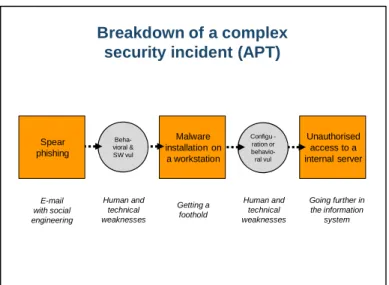
One of the difficulties in describing security events (mainly security incidents) is the possible complexity of the events themselves. The present document will use the now famous example of the so-called APTs (Advanced Persistent Threats), to explain how it can be broken down in more elementary security incidents (see figure below, with incidents represented by squares and vulnerabilities exploited by circles).
Unauthorised access to a internal server Configu -ration or behavio-ral vul Malware installation on a workstation
Breakdown of a complex
security incident (APT)
E-mail with social engineering Beha-vioral & SW vul Human and technical weaknesses Getting a foothold Human and technical weaknesses Going further in the information system Spear phishing
Figure 5: Description of a complex security incident
To register such a complex incident in an internal data base (for various purposes), it may be important to register each associated basic incident to gather the richest information possible on such attacks, especially:
• Know more precisely the attack vectors used (for example for malware installation, which kind of media – to be filled in the "vulnerability" field).
• In case of not fully successful attacks, know where they failed or stopped.
Other examples of (less) complex security incidents are Website defacement (intrusion followed by defacement), mis-appropriation of resources by external attackers (intrusion followed by mismis-appropriation), backdoor on externally accessible servers acting as a foothold for future intrusions (intrusion followed by malware installation).
4.6
The key drivers underlying the representation proposed
The Club R2GS' members' experience and feedback points out the following major factors as being decisive for a well received and successful representation. They can be summarized as follows (in ascending order of importance):• Be simple ("elevator test" with less than one minute to explain, etc.).
• Be structured according to incidents causes and/or motivations.
• Be immediately understandable by both field IT security experts and top executives.
• Be detailed and accurate enough regarding malicious incidents.
• And last (but not the least), clearly separate internal incidents from external incidents, these two types of incidents are in almost all cases completely different, e.g. most of the internal incidents are non-technical, and sensitiveness and priorities of monitoring are quite different (see HR and social issues).
4.7
The general description of the representation
The proposed representation scheme is inspired by the one designed and used by the Club R2GS' members, which is to date the only one to associate statistical figures with the main event types. It also builds on international advanced Cyber Defence and SIEM projects, as well as on input from academic researchers that are active in IT security research. This representation is structured into 7 major categories of security events. The first three categories describe security incidents that materialize threats to the Information System. The four remaining categories describe vulnerabilities and involve four of the six major types of vulnerabilities that can be exploited in order to implement an attack and create an IT security incident (see definition in clause 3.1).
The first three categories describing security incidents are as follows:
• The 1st category, called "Intrusions and external attacks", includes all types of incidents of a malicious nature
coming from the outside.
• The 2nd category, called "Malfunctions", includes all types of accidental (failures or breakdowns or natural disasters) or unintentional (human error) incidents.
• The 3rd category, called "Deviant internal behaviours", includes all types of incidents of a malicious or intentional nature (negligence, recklessness and irresponsibility) originating within the company's or organization's security perimeter.
The last four categories describing vulnerabilities are as follows:
• The 1st category, called "Behavioural vulnerabilities", includes events which are close to some classified in
the 3rd category for incidents, however without immediate CIA consequences, but where the deviant human
origin of vulnerabilities needs to be pointed out.
• The 2nd category, called "Software vulnerabilities", includes events stemming from upstream in-house or standard software development.
• The 3rd category, called "Configuration vulnerabilities", includes events indicating a deviation from the accepted state-of-the-art in security policies or best practices, or a weakness which is exploited in attacks.
• The 4th category, called "General security (technical or organizational) vulnerabilities" includes
vulnerabilities that can be defined as having an overall and significant effect on the Information System's security level and being positioned on a level equivalent with one of the ISO 27002 [i.1] standard 133 control points.
It should be added that all security events (either incidents or vulnerabilities) become non-conformities when they violate the company's or organization's security policy and rules (not including software vulnerabilities that are of a somewhat different nature).
Relative to the total incidents and based on figures gathered by the Club R2GS (Year 2011), the various categories break down as follows:
• Intrusions and external attacks account for 52 % of the incidents observed by members of Club R2GS, of which:
- 2/5 involve malicious software programs (malware) - 3/5 for the other types of incidents
• Malfunctions account for 18 % of the incidents observed by members of Club R2GS
• Deviant internal behaviours account for 30 % of the incidents observed by members of Club R2GS, of which: - 3/4 are linked to malicious activity
- 1/4 are linked to negligence, recklessness and irresponsibility
The proportion of malicious acts in the whole incidents database is therefore about 75 % of the total number of incidents, with the ratio between internal and external malicious acts being around 30/70 in Year 2011.
Vulnerabilities (behavioural, software, configuration and general security) are involved in 80 % of the incidents of a malicious nature (see the detailed breakdown between the various types of vulnerabilities in clauses 6.4 to 6.7).
4.8
Link between the event model representation and the list of
indicators (and related families)
As explained above, one of the main goals of the model representation is to provide an easy way for all stakeholders to communicate with each other, including the top governance level (ensuring that top management has access to easily understand IT security).
To identify more easily the major elements of the proposed representation, the present document proposes an organization structured in 3 levels (categories or classes, sub-categories or sub-classes and families), associated to a naming scheme identifying categories and families (sub-categories omitted for the sake of reduction): Category
ID_Family ID with 3 capital letters for each of Category ID and Family ID.
Moreover, given that almost all standard indicators described in GS ISI 001-1 [3] count numbers of security events that occurred in a given time interval, there is a strict similarity between the representation and the list of indicators. As a result, the naming scheme for the representation and the list of indicators will be the same. This will significantly ease the gateways between the governance level (indicator-oriented) and the field operations level (more model tied up taxonomy-oriented). These current shortcomings regarding gateways between field operations and governance are widely recognized as one of the main discrepancies in the SIEM domain.
5
Comparison with other event classification models
Several alternative or associated classifications are currently available around the world within the framework of risk analysis and/or security objectives definition methods (EBIOS, Mehari, CRAMM, Octave, etc.), ISO reference frameworks (for example ISO 27005 [i.3]), MITRE reference frameworks (CAPEC), or recommendations within IT security communities (for example FIRST). These classifications generally cover all security incidents (and often vulnerabilities too), including hardware or software aspects, and whether they relate to breakdowns, malfunctions, human errors or malicious acts. This clause will thus compare this existing state of the art with our model, in order to benefit from their feedback and experience.
5.1
Risk analysis methods classifications
Relatively to the three positions presented in clause 4.2, the risk assessment methods classifications are positioned mostly between position 2 and position 3, sometimes on position two. From a Cyber Defence standpoint, these classifications exhibit limitations (primarily due to their objectives), in comparison with the model presented herein:
• Absence of industry-wide statistics at the level of detail of the major event categories (and sometimes impossibility to obtain consistent figures for some events since they apply only to specific industry sectors).
• Very short list of events, lacking sufficient details for widespread use, and sometimes far from the current reality of cybercrime.
• Focus sometimes primarily on incidents at the expense of vulnerabilities.
• Difficulty in establishing a link with the events described in SIEM tools used to analyse and correlate logs.
• Great difficulty to associate a consistent set of reaction plans with its various categories.
In short, these classifications are structured primarily by the "complement" and the "who" (so from the point of view of upstream risk analysis), whereas the model presented in the present document is primarily structured by the "how" and the "who" (so from the point of view of a downstream operational Cyber Defence and SIEM approach focused on detecting residual risk and reacting towards the "who" in question).
5.2 CAPEC
classification
The CAPEC (Common Attack Pattern Enumeration and Classification) reference framework, which is clearly positioned on position 2, deals with the same kinds of security incidents and complements the NIST SP 800-126 [1] (SCAP) standard. The first CAPEC specifications were published at the end of 2007 under contract to Department of Homeland Security in the US. They have been later included by The MITRE Corporation in the complete series of Information Security Data Standards under the label "Making Security Measurable". CAPEC is a catalogue of attack patterns, along with a comprehensive classification taxonomy. By providing a standard mechanism for identifying, collecting, refining, and sharing attack patterns among the software community, CAPEC provides for a more complete and thorough review of the security level of information systems. There are however main differences with the ISG ISI approach:
• Security events are limited to malicious activity; the model does not take into account carelessness, accidents and vulnerabilities.
• The model does not include attributes related to the probability of the different types of attacks; thus the associated notion of priority is lacking, due to the absence of link to indicators and up-to-date statistical figures, so that it is not possible to emphasize the most frequent events (for example Top 50) that could make communication within an organization easier.
• As another consequence, it is impossible to extract from CAPEC a clear hierarchy and structure (for example, internal vs external attacks), and this lack of a tree structure together with an unstructured list of incidents leads to difficulties to use it on a whole organization scale.
• The lack of a top-down support finally leads to a focus on the technical description of security incidents, which is difficult to understand by non-experts.
The contribution of CAPEC to the security community is to enable understanding of the huge diversity of attack methods, thus leading to more structured approaches to develop secure software and systems, and supporting for example product certification.
5.3 FIRST
classifications
The FIRST classifications [i.4] (first introduced in 2004) are being used to communicate between the CERTs and CSIRTs around the world, and they are therefore mainly focused on external security incidents. Regarding the main criteria developed in clause 4, they exhibit obvious limitations that restrict their use in a Cyber Defence and SIEM approach:
• Heterogeneous classification (see for example "Unlawful activity" and "Compromised information" categories)
• Ill-positioned model (variable depending on categories, between positions 2 and 3)
• Difficult to build a link with a structured and homogeneous reaction scheme
• Indicator-related up-to-date statistical figures impossible to collect
• Poor or missing distinction between external and internal incidents for some of them
6
Detailed description of the proposed representation
of the different categories and sub-categories
Below is a description of the proposed representation of the different categories and sub-categories (and the various families identified by the naming structure Category ID_Family ID). This representation can also be considered from a
legal viewpoint; viewing it from this related angle makes it possible to obtain accurate indications on the types of
events that fall within the remit of the law, whether for the organization's benefit or detriment, and thus to obtain an estimate of the possible legal risks that organization faces. Moreover, this representation generally fits with major kinds of computer-related cases tackled today in the world by various jurisdictions.
6.1
Intrusions and external attacks (Category IEX)
Who and/or
Why
What How Status
Which vulnerability(ies) is (are) been exploited On what kind of asset
With what CIA consequences With what kind of impact Malicious act / External agent X (many choices) Only sometimes X (incident attempt underway or incident success) Only sometimes and when required for clarification X (various choices) Only sometimes and when able to be determined -
This category includes all types of malicious security incidents originating outside of the company's or organization's security perimeter. It involves actions committed by persons unknown to company, and that are outside of its circle of existing employees, business partners, external service providers and customers. 8 sub-categories of different security incidents gathered into more distinct families are identified (see summary in the below table).
Sub-categories Description Comments
1 Unauthorized access to organization's information system or inter professional network
Both human motivation and use of technical means
2 Various unauthorized actions against organization's servers or applications
Both human motivation and use of technical means
3 External installation of unauthorized software programs on organization's workstations or servers
Primarily use of technical means 4 Organization's information system remote disturbance Primarily use of technical means 5 Social engineering attacks Primarily use of social engineering 6 Verbal act of stress External attacker without physical action 7 Physical intrusion or action Personal and physical intervention of
attacker on an organization's technical capabilities
8 Illicit activity carried out on the public Internet, which harms an organization
External and almost out of the organization's control
1) Unauthorized access to organization's information system or interprofessional network
This sub-category includes the following families (with main types of incidents listed):
- Family IEX_INT (Technical intrusion attempt, access to a Web server via a pre-established backdoor, technical intrusion through software or configuration vulnerability on a Web server, technical intrusion on messaging accounts, illicit wireless network access, attack of VoIP protocol and internal applications, attack of a voice system – PABX mainly)
- Family IEX_UID (User's identity usurpation to get access to their account)
- Family IEX_RGH (Privileges escalation from a unauthorized access to a first usurpated account) - Family IEX_APT (Advanced Persistent Threat – A combination of several basic incidents) - Other families
2) Various unauthorized actions against organization's servers or applications
This sub-category includes the following families (with main types of incidents listed): - Family IEX_DFC (Website defacement)
- Family IEX_MIS (Misappropriation of organization on-line resources i.e. connectivity, bandwidth or storage)
- Family IEX_RPL (Transaction replay) - Other families
3) External installation of unauthorized software programs on organization's workstations or servers
This sub-category includes the following family (with main types of incidents listed):
- Family IEX_MLW (Malware installation attempt, virus and worm, Trojan horse and keylogger, bot, scareware, spyware and adware, logic bomb, backdoor, RAT, etc.)
4) Organization's information system remote disturbance
This sub-category includes the following families (with main types of incidents listed): - Family IEX_DOS (Denial of service – DoS or DDoS)
- Family IEX_SPM (Spam) - Other families
![Figure A.1: GS ISI 001 [3], [4] and ISI 002 positioned against ISO 27004 [i.2]](https://thumb-us.123doks.com/thumbv2/123dok_us/1807032.2759711/41.892.116.770.226.758/figure-gs-isi-isi-positioned-iso-i.webp)