Claremont Colleges
Scholarship @ Claremont
CMC Senior Theses CMC Student Scholarship
2019
The Transition Tax: Why it was Created and How it
Could be Altered
Ryan Motter
This Open Access Senior Thesis is brought to you by Scholarship@Claremont. It has been accepted for inclusion in this collection by an authorized administrator. For more information, please [email protected].
Recommended Citation
Motter, Ryan, "The Transition Tax: Why it was Created and How it Could be Altered" (2019).CMC Senior Theses. 2095. https://scholarship.claremont.edu/cmc_theses/2095
Claremont McKenna
College
The Transition Tax: Why it was Created and How it
Could be Altered
submitted to
Professor Andrew Finley
by Ryan Motter for Senior Thesis Fall 2018 December 10th, 2018
Abstract
In this paper, I talk about Section 965, also known as the transition tax, enacted in the Tax Cuts and Jobs Act (TCJA). First, I examine loopholes under the old tax regime that allowed for the accumulation of offshore earnings and how the TCJA closes those loopholes. After detailing the legislation of the transition tax and a comparison with Section 965 included in the American Jobs Creation Act in 2004, I compare firms’ recorded provisions of the transition tax with an estimation based on the past
disclosures of firms’ permanently reinvested earnings and finds that the transition tax will generate an estimated $308 billion in tax revenue. Lastly, I propose three alternate scenarios to the transition tax: taxing all offshore earnings under the GILTI regime, treating offshore cash as eligible for the 21% corporate rate, and a ratable payment plan compared to the current phase-in payment plan.
1. INTRODUCTION
The Tax Cuts and Jobs Act (TCJA) was signed into law in December 2017 and was the largest tax reform since 1986. The TCJA changed the ways that the U.S.
government taxes international earnings in an effort to fix loopholes in the old international tax regime. This overhaul of international tax law gave rise to Section 965, also known as the transition tax, which taxes international earnings that have never been repatriated to the U.S. Prior to Section 965, firms had been able to avoid paying U.S. income tax on substantial amounts of earnings. This paper will discuss the issues that created profit-shifting loopholes under the old international tax regime and how the new regime addresses those issues. Then, there will be an analysis of the transition tax legislation and how firms calculate their transition tax liability, a
comparison with the 2004 Section 965 repatriation tax, and a transition tax projection for the firms that hold the most substantial amounts of offshore earnings that escaped U.S. income tax since 1986. Finally, there will be an analysis of alternative scenarios to the transition tax and a comparison of projected transition tax revenues from the same sample with these alternative scenarios.
Section 2 describes several issues within the old tax regime that allowed firms to shift their profits overseas in order to avoid paying U.S. income tax at the previous 35 percent corporate tax rate. Loose corporate residence definitions in the US and several low-tax foreign jurisdictions allowed firms to set up subsidiaries in foreign
countries, resulting in an exemption from both U.S. and foreign income taxes. To capitalize on this loophole, major firms sold the intellectual rights of their intangible assets to their foreign subsidiaries, which under the old U.S. tax law allowed the foreign subsidiaries to claim the revenues generated from those intangible assets, and therefore avoided paying income taxes. Legislation enacted in 1997 created the check-the-box method, which opened up a major loophole in the Controlled Foreign
Corporation (CFC) regime and allowed for firms to sidestep Subpart F taxation. The TCJA tries to limit future profit shifting by creating new international tax regimes including the Foreign Derived Intangible Income (FDII) regime, the Global Intangible Low Tax Income (GILTI) regime, and the Base Erosion and Antiabuse Tax (BEAT) regime. The FDII regime creates incentives for firms to keep intangible assets in the U.S. Previously, moving intangible assets offshore had been a key component of firms’ profit shifting strategies. The GILTI regime is designed to capture foreign earnings that had previously escaped Subpart F earnings due to the check-the-box regime. The BEAT regime imposes a tax liability for U.S. corporations that make payments to foreign subsidiaries of the U.S. corporation in an effort to prevent intercompany transactions that had been crucial in profit shifting strategies.
Section 3 compares Section 965 of the TCJA with Section 965 released in the American Jobs Creation Act (AJCA) in 2004. The legislation behind the current Section 965 is intricate but can be summarized as two rates imposed on all permanently reinvested earnings (PRE) since 1986: 15.5 percent on cash and cash equivalents and
eight percent on noncash assets. Firms have to report all of their PRE on the following year’s tax return, but the firms do not have to bring these assets back to the US. The transition tax also stipulates a non-ratable payment plan for firms to pay off their liability in eight years. Through the use of several notices throughout the past year, the IRS has helped clarify important measurement due dates, cash equivalent asset definitions, and other rules that are necessary for firms as they calculate their total transition tax liability. The Section 965 repatriation tax in 2004 is a stark contrast to the TCJA transition tax, as the 2004 version was a voluntary, one-time deduction on all foreign earnings repatriated to the US and lowered the effective tax rate on the foreign earnings to approximately 5.25 percent. The 2004 repatriation tax also
restricted the ways in which firms used the repatriated funds and led to an increase in share repurchases within the firms who elected to repatriate their offshore earnings.
The first analysis compares the actual transition tax provision from firms with greater than $10 billion of PRE with an estimated provision using PRE and foreign cash listed on their recent 10-K financial statements. It takes the total PRE in 2017, for some of the firms in the sample, their most recent disclosure of PRE was in 2016 and for those firms total PRE is their 2016 PRE combined with pre-tax foreign earnings of 2017, and breaks the total PRE into two categories: cash and noncash. The majority of the firms in the sample disclosed their cash and cash equivalents held in offshore subsidiaries and this disclosed total is the assumed amount of total cash eligible for the 15.5 percent rate for the transition tax. The total noncash asset amount was
calculated by subtracting foreign cash from total PRE. The 15.5 percent and eight percent rates were applied to foreign cash and foreign noncash assets, respectively, in order to generate a projected transition tax liability. This estimation was compared to the actual transition tax provisions listed on the firms’ 2017 financial statements. The average effective tax rate based off of the transition tax provisions listed by the firms was 9.3 percent, which translates to an estimated $173 billion in tax revenue
generated from the transition tax from the selected firms. This $173 billion would be a significant revenue source for the government, and while it gives firms an extremely low effective tax rate, the transition tax allows the government to collect taxes on earnings that may have never been repatriated to the U.S. under the previous law.
Section 4 lays out three alternatives to the transition tax. The first scenario is a complete removal of the transition tax and taxes all PRE under the GILTI regime. This analysis was calculated by taking the firms’ pretax foreign income dating back to 1986, subtracting the deemed ten percent return on foreign long-lived assets – in this
scenario foreign PPE disclosed in 2017 was held constant back to 1986 – and applying the 10.5 percent rate on the difference per year. The total pretax foreign income was reduced for most firms under the assumption that any amount of total post-1986 pretax foreign income in excess of total PRE indicates that the firms repatriated that difference to the U.S. This excess amount is excluded because if the firm repatriated these funds, they would have already paid U.S. income tax on these amounts, which excludes these amounts from the GILTI regime. Taxing PRE under the GILTI regime
drops the projected tax revenues from these firms by 62.7 percent when compared to the Section 965 legislation. This scenario would be impractical for implementation, as it would be difficult for firms to calculate exact totals of foreign earnings and long-lived assets for each year dating back to 1986.
The second scenario keeps the transition tax in place but raises the rate on cash and cash equivalents to 21 percent. The rationale behind the increased cash rate lies under the assumption that firms with substantial amounts of foreign cash will take advantage of the transition tax to bring the cash back to the US. This 21 percent tax rate would be equivalent to how much the firms would pay on similar earnings generated within the U.S., compared to the 35 percent rate under which the earnings were eligible to be taxed had they been repatriated to the U.S. This scenario raises the effective tax rate on total PRE to 13 percent and increases projected tax revenues by $32 billion. While a material boost in revenue, this raised cash rate could place financial strain on firms with large amounts of offshore cash. This would be at odds with the overarching goal of the TCJA to bring investments and jobs back to the U.S. in order to stimulate the economy.
The final scenario looks at the transition tax payment plan allowed under Section 965, which every firm in the sample elected to use. The payment plan states that 8 percent of the net transition tax liability is owed each year for the first five years, followed by 15 percent, 20 percent, and 25 percent in years six, seven, and eight, respectively. This approach is known as phase-in legislation, and the low rates in the
near future allow for future legislation to extend the payment plan or even eliminate the liability altogether. This payment plan lowers the net present value of the total estimated transition tax liability of these firms from $173 billion to $150 billion. An alternative to this phase-in payment plan would be to ratably spread the liability over an eight-year period, where 12.5 percent of the net liability is due each year. Under this scenario, the present value increases from $150 billion to $154 billion, or a rough two percent increase in present value. This theoretical ratable payment plan may not have been elected due to lobbying from the firms most impacted by the transition tax, or Congress may have believed that the 4.5 percent increase per year for the first five years could have placed financial strain on these firms.
This paper is limited in its scope, as the numbers pulled does not give a complete sense of what these firms hold in their total PRE between cash and noncash assets, and does not consider the possible offsetting effects of tax credits allowed under the current legislation. This paper is intended to give a detailed discussion on a significant aspect of the new tax code that is frequently overlooked because it is a one-time tax on past earnings. The transition tax will have a material impact on government revenue in the near future, and this paper can help introduce the subject to anyone that is unfamiliar to such a significant source of revenue under the TCJA. The analysis conducted on firms’ prior disclosures to calculate an estimated transition tax liability found that the transition tax will generate an estimated $308 billion. Yet the Joint Committee on Taxation estimated that this transition tax would generate $338.8
billion in revenue. This significant gap of about $30 billion could indicate that firms are using significant amounts of foreign tax credits to reduce their liability, or that firms are finding new loopholes within the transition tax.
2. A COMPARISON OF THE OLD TAX REGIME WITH THE TAX CUTS AND JOBS ACT (TCJA)
2.1 The Old Regime: Significant Flaws With Regards to Foreign Earning Repatriation
Large multinational corporations (MNC’s) were able to avoid paying taxes by shifting their earnings offshore, then permanently reinvesting these foreign earnings. By the end of 2016, Fortune 500 companies had an estimated $2.6 trillion of
permanently reinvested earnings in foreign countries (ITEP, 2017). These MNC’s were able to avoid the 35 percent US tax rate through loopholes created in the U.S. tax legislation. Some of the largest loopholes include:
a. Loose corporate residence definitions;
b. Rules regarding transfer pricing and profit sharing; c. Issues with the CFC regime;
d. Check-the-box regulations.
2.1a Corporate Residence Definition Variability
The United States Internal Revenue Code §7701(a)(5) states that a foreign corporation is a corporation created or organized in a jurisdiction other than the United States. 26 US Code §861(a) and §245(b) state that an MNC headquartered in the U.S. that owns a foreign corporation did not have to pay income taxes on the foreign corporation’s income until the foreign corporation repatriated its net income as a dividend to its parent corporation in the United States. This single factor
country and avoid paying U.S. income tax on that subsidiary’s income until it decides to repatriate the income.
Setting up a subsidiary in a low-tax foreign jurisdiction was the first step for MNCs to shift their profits abroad. Next, MNCs sold intangibles developed in the US to their wholly owned foreign subsidiaries (Levin, 2012). Under the U.S. Internal Revenue Code (IRC), the subsidiary must pay for these assets at an “arm’s length” price, but since these intangibles were developed internally by the MNC, it was extremely difficult to determine what a third-party purchaser should pay for the assets (Levin, 2013). The U.S. parent corporation would then set the prices artificially low, which would minimize its U.S. taxable income from the sale of the intangible assets.
When MNCs sold their intangibles outright, the foreign subsidiary would owe royalties to the parent corporation in the U.S. To avoid this, MNCs set up a cost sharing agreement with the foreign subsidiary (Levin, 2013). These cost sharing agreements were designed to limit the amount of revenue generated in the U.S. that would be eligible for U.S. taxation. A typical cost sharing agreement consisted of a U.S. parent and one or more of its wholly owned foreign subsidiaries designating a
percentage of R&D costs to each party. The portion of these R&D costs performed within the U.S. significantly outweighed the percentage designated to the U.S. parent. This would allow U.S. parent corporations to write off the R&D expenditures in the U.S. for a greater tax benefit, but the profits would be recognized in low-tax foreign jurisdictions. For example, a U.S. parent corporation and its foreign subsidiary could
agree on a 50-50 split. This would imply that the subsidiary would contribute 50 percent of the development costs of the intellectual property, which would be funded by the U.S. parent. These funds now held by the foreign subsidiary would then be paid back to the U.S. parent as development costs (Ting, 2014). This arrangement would allow the subsidiary to claim 50 percent of the profits that were attributed to the intellectual property. This two-part strategy was the most common tax planning method for MNCs to avoid or delay paying U.S. income tax.
2.1b Complications with the CFC Regime
In order to prevent MNCs from deferring revenue, the U.S. created the
controlled foreign corporation (CFC) regime in 1962, defined in IRC §951-965. The CFC regime was designed to limit the tax deferral on Subpart F income, which includes royalties, interest, and dividend income, by imposing immediate taxation on passive income. An exception called the “manufacturing exception” was included, which states that a CFC can avoid immediate taxation if substantial value is added to the goods (McCain, 2013). This exception was included presumably to prevent the CFC regime from discouraging MNCs’ international manufacturing expansion. However, as mentioned above, it is difficult for outside parties to determine what value should be assigned fairly to R&D projects or intellectual property. This loophole was exploited by MNCs until 1997 with the creation of the check-the-box regime, which opened the door for even more profit shifting abroad.
MNCs were limited in their U.S. income tax deferral of their offshore business activity with the establishment of Subpart F in 1986. Subpart F states that companies are not allowed to defer income tax for passive income listed above in section 2.1a, which was the type of income that MNCs were avoiding paying U.S. income tax on. However, the political context of 1997 led to the creation of the check-the-box regime under the Treasury Regulations §301, which formed a major loophole for MNCs. This new regime allowed business enterprises to choose which type of legal entity they wanted to be for U.S. federal tax purposes (Levin, 2012). MNC subsidiaries became hybrid entities, meaning that under foreign tax law the subsidiary is a separate entity, but a pass-through entity for U.S. tax purposes (OECD Publishing, 2013). MNCs used the check-the-box regime to sidestep Subpart F taxation in intricate ways, as
illustrated by the following example. In this example, an MNC with the name “Parent” creates and incorporates a subsidiary named “Sub 1” in a low-tax foreign country. Parent and Sub 1 would enter into a cost-sharing agreement that transferred the intellectual rights of intangible assets to Sub 1. Sub 1 would then create and incorporate their own subsidiaries, “Sub 2” and “Sub 3”, in other low-tax foreign jurisdictions, with Sub 3 being the primary vendor of products to customers and the collector of sales revenue. Sub 3 would accomplish this by paying royalties to Sub 1 for the use of the intellectual property held by Sub 1, and Sub 2 would act as the
intermediary between Sub 1 and Sub 3, and aid in the marketing the product. Subs 1, 2, and 3 would then engage in intra-company transactions that involved a transfer of products and revenues that would qualify them for the CFC regime. The sales income
earned by Sub 3 would be distributed back to Sub 1 through Sub 2, since Sub 1 had the intellectual rights and Sub 2 aided in the marketing strategy. That income would be eligible for Subpart F as a type of passive income. The Parent would be forced to report the revenues and transactions on their income tax statements. However, with the check-the-box regime, Subs 2 and 3 would elect themselves as passthrough entities. Under U.S. tax law, this choice would effectively make Subs 2 and 3 transparent, and all intra-company transactions that were occurring between the three subsidiaries would seem to be solely occurring within Sub 1. The sales income earned from Sub 3 would then be classified as sales income directly earned by Sub 1 under an exception known as the active business exception.1 By appearing to be
earned directly under Sub 1, the sales income is no longer eligible for Subpart F, and through this strategy foreign subsidiaries were able to engage in intra-company transactions without triggering the CFC regime for their parent corporation (Ting, 2014).
2.1d How Corporations Took Advantage of these Flaws
Large MNCs used every loophole given to them under the old regime in order to lower their U.S. income tax liability. First, the MNCs would establish subsidiaries and
1 The active business exception under Section 954(c)(1)(A) states that if a CFC acquires the intangible
property and actively engages in marketing and servicing, the income earned from royalties would not be eligible for Subpart F. In this example, Sub 2 would be engaging in marketing and servicing in order to sell the product and would have paid royalties to Sub 1 to sell products using the intellectual rights held by Sub 1. Yet with Check-the-box, for U.S. tax purposes it appears that Sub 1 not only holds the intellectual rights, but actively markets for the sale of the products, which is how this regime enabled firms to sidestep Subpart F.
incorporate them in countries with favorable tax laws, such as Ireland. Ireland’s corporate residence definition is single factor, like the United States, but their factor stipulates that any corporation within Ireland that is owned or managed by a foreign corporation is not subject to Irish income tax (Ting, 2014). Firms like Microsoft and Apple set up their subsidiaries in Ireland in order to take advantage of the double non-taxation created between Ireland and the U.S.
For firms to capitalize on the double non-taxation, they had to sell intangible assets to their newly-established foreign subsidiaries, usually in the form of cost sharing agreements as mentioned above. A more practical example including both profit shifting and the sale of intangibles to a foreign subsidiary involves Microsoft U.S. and Microsoft Puerto Rico in 2011. Microsoft U.S. sold the rights to its intellectual property to Microsoft Puerto Rico (Levin, 2012). Microsoft U.S. would then buy back the distribution rights from Microsoft Puerto Rico, and then also buy a portion of the intellectual rights back. The specific agreement allowed for 47 percent of Microsoft’s U.S. sales to be shifted to Puerto Rico, which meant that in 2011 Microsoft avoided paying U.S. income taxes on 47 cents for every dollar of sales made in the U.S., a total of $4.5 billion in tax savings (Levin, 2012). By selling back a portion of the intellectual rights, Microsoft Puerto Rico avoided paying Microsoft U.S. royalties for their
intellectual property.
When Congress passed the check-the-box regime in 1997, the regime change allowed MNCs to change the tax status of the subsidiaries of their foreign subsidiaries
to pass-through entities. As mentioned above, the intra-company transactions subject to CFC taxation made between foreign subsidiaries and its own subsidiaries no longer appeared to be intra-company transactions and instead were just within a single foreign subsidiary. This allowed for MNCs to engage in intra-company transactions that would shift profits through multiple foreign countries without qualifying for the CFC regime’s immediate taxation. From years 2009-2011, the firms Apple, Google, and Microsoft were able to defer taxes on $35.4 billion, $24.2 billion, and $21 billion, respectively (Levin, 2012).
2.2 How the TCJA Addresses Foreign Revenue Repatriation
The old regime of U.S. international taxation was frequently used by
corporations to lower their effective income tax rate. Congress was aware of the need for change within the TCJA. However, the closing of past loopholes opens the
possibility for new ones to arise. Some important areas to focus on when looking at how the TCJA impacts international tax planning include:
a. Effects on profit shifting;
b. Foreign Derived Intangible Income (FDII) regime;
c. The Global Intangible Low Tax Income (GILTI) regime;
d. The Base Erosion and Antiabuse (BEAT) regime.
The strategies employed by MNCs to shift their profits are well-known to
Congress, as shown in its Budget and Economic Outlook: 2018 to 2028 (Congressional Budget Office, 2018). The Congressional Budget Office (CBO) groups the various forms of profit shifting into three categories, two of them being the artificially low transfer prices and low-taxed foreign corporate residency mentioned in Section (2)(a)
(Congressional Budget Office, 2018). The CBO also projects that with the
implementation of the TCJA, profit shifting will be reduced by $65 billion per year, on average, for the next eleven years. Conversely, later in the report the CBO states that roughly 80 percent of the current profit shifting will still occur, due to changes enacted by the TCJA (Congressional Budget Office, 2018). Because of issues that the CBO does not account for, such as investor reactions to the instability of the FDII regime
(addressed in the next section) as well as the vulnerability of the legislation as a whole, the TCJA’s limiting effect on profit shifting may be even smaller than forecasted.
2.2b The FDII Regime
The FDII regime was drafted to keep intangible assets in the U.S. by using a lower tax rate as an incentive, rather than shifting the intangibles abroad. FDII is generally income generated from export sales or services. The exchange, license, lease, sale or other disposition of property sold by a U.S. taxpayer to a non-U.S. entity for foreign use, or services provided by a U.S. taxpayer to any person or entity not located in the U.S., are two examples of FDII. The provision itself is a deduction, with §250 (a)(1)
stating that the taxpayer can deduct 37.5 percent of FDII, which leaves the remaining 62.5 percent subject to normal corporate taxation at the 21 percent rate. This lowers the effective tax rate to 13.125 percent. The provision is effective immediately and does not sunset. However, from 2026 onwards the deduction is reduced to 21.875 percent, raising the effective tax rate on FDII to 16.41 percent. This deduction is available only to domestic C-corporations.2
The FDII regime targets MNCs who shift income from activity within the U.S. to abroad. When defining FDII, the Joint Committee on Taxation states, “Deduction for foreign-derived intangible income derived from trade or business within the United States [emphasis added]” (Joint Committee on Taxation, 2018). The provision tries to create an incentive for MNCs to shift intangible property back to the U.S. by
eliminating “foreign branch income” from FDII deduction, as stipulated in
§250(b)(3)(A)(VI). This “foreign branch income, which is introduced by the TCJA, is composed of business profits from “qualified business units in 1 or more foreign countries”.3 In order to receive the deduction, the business must move the work to
2Domestic implies incorporation in the U.S. as defined in §7701 (a)(4). This deduction is not extended to
subchapter S-corporations, as stated, “An S corporation’s taxable income is computed in the same manner as an individual so that deductions allowable only to corporations, such as FDII and GILTI, do not apply”. House Report 115-466, Tax Cuts and Jobs Act, Conference Report to Accompany H.R. 1, December 15, 2017. P. 626, 626 fn 1524.
3 §250(b)(3)(A)(VI) references §904(d)(2)(J) which defines foreign branch income, §904(d)(2)(VI) defines
the U.S., rather than abroad. The FDII regime also eliminates the deduction of any pass-through income earned by foreign subsidiaries, specifically CFC income.4
2.2c The GILTI Regime
The GILTI regime is also designed to prevent MNCs from shifting profits abroad. §250(a)(1) states that this regime is imposed on CFC income, by taxing certain income at the regular domestic rate of 21 percent, but then reduces the effective tax rate to 10.5 percent through a 50 percent deduction. This “certain income” refers to income that under pre-TCJA law was the earnings of a CFC that were not subject to Subpart F income, and therefore were not subject to U.S. income tax until the CFC distributed the income back to the U.S. as a dividend. Also, there is a deemed ten percent return on foreign assets that are excluded from the GILTI calculation, leading to additional income from being excluded from taxation. This new regime stipulates that U.S. taxpayers with at least a 10 percent share of a CFC will be required to list the CFC’s GILTI as taxable income regardless of whether the earnings are repatriated to the U.S. Theoretically, the motivation behind the GILTI regime was to move tangible assets back to the U.S., yet it remains to be seen if this regime will work as desired.
2.2d The BEAT Regime
4 §957. Domestic corporations are not allowed to deduct any income of a CFC in which the domestic
corporation is a United States shareholder as defined by §951(b). This includes subpart F income, GILTI, and dividends from the CFC. Pulled from Sanchirico, Chris William. “The New US Tax Preference for ‘Foreign-Derived Intangible Income.’” The New US Tax Preference for "Foreign-Derived Intangible Income", 30 Apr. 2018, ssrn.com/abstract=3171091.
The BEAT regime is one of the more intriguing provisions introduced by the TCJA. The BEAT legislation applies to all MNCs, regardless of whether they are owned by a U.S. or foreign parent. 26 USC §9A imposes tax liability on U.S. corporations that make payments to a foreign affiliated company in which the U.S. corporation owns 25 percent of the company, and the company owns this share to reduce their U.S. tax liability. An interesting aspect of the BEAT is a minimum tax based off an expanded tax basis titled “modified taxable income”. Modified taxable income does not account for tax benefits that stem from “base erosion payments”, or the deductible payments made by a U.S. corporation to a foreign affiliate. The minimum tax rate is 10 percent and is imposed on the modified taxable income over the taxpayer’s regular tax liability.
3. SECTION 965: THEN AND NOW 3.1 Section 965 Under the TCJA
Section 965 of the TCJA, more commonly known as the transition tax, allows companies to start fresh with regards to the new regimes that the Act puts into place. It is written to directly address the large amounts of offshore earnings held by many U.S. corporations due to the profit shifting incentives of the old regime, by requiring these firms to include any previously-untaxed earnings in their taxable income. After the TCJA, the IRS and the Treasury have issued numerous notices in order to clarify areas of the legislation.
3.1a Section 965 at the Time of the TCJA Passing
The transition tax’s legislation is broken down into 15 sections in order to capture firms’ offshore earnings without creating loopholes. §965 states that accumulated post-1986 deferred foreign income up until November 2, 2017, or December 31, 2017, whichever is greater, for the last taxable year of a deferred foreign income corporation (DFIC) before the start of 2018 is eligible for the transition tax. This tax affects U.S. shareholders’ pro rata earnings and profits (E&P) that had not been previously subject to U.S. taxation of specified foreign corporations (SFC). An SFC includes all CFCs and any other foreign corporation-excluding passive foreign
investment corporations with at least one U.S. corporation that is a U.S. shareholder. The tax is imposed with Subpart-F rules, and the tax rate is 15.5 percent for foreign earnings deemed to be held in cash and cash equivalents. Any remaining earnings are
taxed at eight percent. The provision also stipulates that the taxpayer can elect to pay this transition tax over a period of eight years, with eight percent owed year in years one through five, 15 percent in year six, 20 percent in year seven, and the final 25 percent in year eight.
3.1b Notices Released by the IRS and Treasury Within the Last 12 Months
Since the transition tax is intended to encapsulate all post-1986 earnings held offshore, the IRS wants to ensure that there is no confusion over the specific definition of the terms included in Section 965. There have been a total of three notices issued: Notice 2018-07, Notice 2018-13, and Notice 2018-26. The IRS then released REG-104226-18, which are proposed regulations for Section 965.5
3.1b (i): Notice 2018-07
The first notice issued was Notice 2018-07, released on December 29, 2017. The notice lists various regulations that the IRS and Treasury intend to issue (Sites et. al, 2018). One such regulation clarifies Section 965(b)(5), or the prevention of double counting of intercompany cash amounts in order to determine the aggregate foreign cash position that is taxed at the 15.5 percent rate. The notice also specifies the determination of post-1986 foreign E&P in Section 965(a), and discusses whether cash distributions that occur in the same year as the transition tax are included in the E&P
5 REG-104226-18 also proposes reforms for Sections 962 and 986 (c). These regulations will be discussed
below, but do not significantly alter the overall landscape for the transition tax. Instead, they provide examples and extensive rules on the repatriation tax.
calculation. Further, the IRS restates that the transition tax would be applicable to foreign corporations in the first taxable year under the TCJA.
3.1b (ii): Notice 2018-13
Notice 2018-13 was released exactly three weeks after Notice 2018-07 on January 19, 2018. Two of the statements within the notice apply to the rules that classify what cash is included in the 15.5 percent rate. The notice states that an SFC’s cash position is equal to the combination of cash held by the SFC, net accounts receivable of the SFC, and the fair market value of liquid assets. While Section 965 does not directly define accounts receivable, the IRS issued the definition of accounts receivable as the same definition described in Section 1221 (a)(4).
Not only did the notice spell out further regulations, but it also amended statements from the prior notice 2018-07. One of these reclassifications relates to the “section 965(a) inclusion amount,” which applies to U.S. shareholders that have less than 100 percent ownership of a DFIC. Previously, the inclusion amount referred to the total amount of deferred income. This notice clarifies the inclusion amount as the amount included in the gross income of the U.S. shareholder with respect to the DFIC. In other words, a U.S. shareholder is only responsible for listing its pro rata share of the DFIC’s deferred income. The notice also states that if an SFC is classified as a DFIC, then it cannot also be an E&P deficit foreign corporation. Furthermore, the IRS
realized that the inclusion date of November 2, 2017, is impractical for many companies since that date does not coincide with a financial close date. So, the IRS
created a new way to calculate post-1986 E&P (Sites et. al, 2018b). This new method is as follows: the post-1986 of an SFC as of November 2, 2017, will be the foreign
corporation’s post-1986 E&P as of October 31, 2017, combined with its “annualized E&P amount”. This “annualized E&P amount” is equal to two times the amount of daily earnings. Daily earnings refers to the post-1986 E&P earned by the SFC in the taxable year ending October 31, 2017, divided by the number of days that has passed in the taxable year ending October 31, 2017.
3.1b (iii): Notice 2018-26
Notice 2018-26 was the last notice released before the proposed regulations. Some of the highlights from this notice include:
a. E&P-reducing transactions;
b. The accruing of foreign income taxes between measurement dates;
c. Cash measurement dates.
The IRS states in this notice that it intends to regulate transactions that reduce a shareholder’s Section 965 liability, or the reduction of an SFC’s E&P. This is known as the anti-avoidance rule, and three requirements must be fulfilled in order to trigger this rule: the transaction takes place on or after November 2, 2017,6 the primary
6 The IRS states that the transaction can occur wholly or in part after November 2, 2017. This means that if
any part of the transaction takes place on or after November 2, 2017, it is eligible to trigger the anti-avoidance rule.
purpose of the transaction is to reduce the shareholder’s Section 965 liability, and the shareholder’s Section 965 liability would be reduced due to this transaction. If the three requirements are satisfied, then the anti-avoidance rule states that the
transaction is ignored when determining the Section 965 liability. The IRS details three categories of transactions that are speculated to be initiated with the principal
purpose of reducing a U.S. shareholder’s Section 965 liability: pro-rata share
transactions, E&P reduction transactions, and cash reduction transactions. A pro rata share transaction occurs when a U.S. shareholder receives a transfer of stock from an SFC with the purpose of lowering the shareholder’s Section 965 liability. E&P
reduction transactions are transactions undertaken by an SFC that reduce its post-1986 undistributed earnings outside of transactions that arise through the ordinary course of business. A cash reduction transaction is defined as the transfer of cash, cash equivalents, or accounts receivable by an SFC to a U.S. shareholder or relative to the U.S. shareholder if said transaction reduces the shareholder’s foreign cash
position.
The other major element discussed in this notice is the cash measurement dates. The IRS spells out three cash measurement dates for SFC shareholders, stating that the shareholder’s total cash position is either the greater of the U.S. shareholder’s aggregate pro rata share of its SFCs determined on the last measurement day
described below, or the average of the shareholder’s pro rata share of the SFC’s cash position of the prior two years. The last day for cash measurement is the close of the
taxable year ending on or after November 2, 2017 and beginning before January 1, 2018. The first cash measurement date for the averaging method is the close of the last taxable year between November 1, 2015 and November 1, 2016. The second date for the averaging method is the close of the taxable year between November 1, 2016 and November 2, 2017.
3.1b (iv): Regulation 104226-18
The regulation, titled REG-104226-18, was released by the IRS and the Treasury Department on August 9, 2018. In it, the IRS confirms the guidance of the notices issued throughout the past year (Dabrowski et al., 2018). The notices released before this regulation did not change any legislation regarding the transition tax, they instead clarified gray areas from the original legislation. This regulation effectively enacted the guidance issued from the prior notices, yet did not meaningfully change the overall foundation of the transition tax, and the changes it enacted do not have a material impact for the purposes of this paper.
3.2 Section 965 in 2004
3.2a What was the 2004 Section 965?
The 2004 Section 965 was part of the American Jobs Creation Act (AJCA). It allowed a one-time deduction in either 2004 or 2005 of 85 percent of repatriated foreign earnings in the form of cash dividends to U.S. parent corporations. The specific application of the tax is discussed below in Section 3.2c. This was back when the
corporate tax rate was 35 percent, so the effective tax rate that companies would be paying on these repatriated earnings would be 5.25 percent.7 The main reason for
creating this deduction was that receiving tax on 15 percent of offshore earnings would be more tax revenue for the U.S. government than if firms continued to keep their foreign earnings offshore (150 Congressional Record S11017, S11038, 2004). 678 public corporations reported positive dollar amounts of pretax income in their 2002 financial statements which totaled to around $426 billion (Albring et. al, 2005). Of these 678 firms, 282 firms had a combined $318 billion of permanently reinvested earnings, and these 282 firms would have paid $46 billion in tax on these earnings if they had repatriated 100 percent of their earnings prior the creation of Section 965. Once Section 965 was enacted, the same firms would pay about $7 billion in taxes if they repatriated 100 percent of their permanently reinvested earnings. In late 2004, Business Week cited a J.P. Morgan survey from 2003 that states that 50 percent of the survey’s respondents would repatriate nearly all of their foreign earnings if the ACJA included Section 965, and that the bank expected approximately $300 billion to be repatriated in 2005 (Mehring, 2004). A response that positive would have been enough for Congress to include this repatriation deduction, but the legislation was set in motion years earlier due to strong lobbying efforts.
3.2b Why Section 965 was Created
7 The effective rate of 5.25% is equal to the effective rate of 35% multiplied by (1-0.85). It was estimated
that most firms would not have an effective tax rate as low as 5.25% due to legislation specifying that by taking the 85% deduction would lose any foreign tax credits on the repatriated earnings.
The lobbying for a reduced tax on repatriated foreign earnings began several years prior to the passage of the ACJA. The effort was led by a lobbying group named the Homeland Investment Coalition and was unsurprisingly composed of mostly big pharma and tech companies, as these companies had the majority of offshore earnings. Their reasoning for advocating for this law, as cited by the Wall Street Journal, argued that, “the law would create ‘hundreds of billions of dollars in private investment…allowing U.S. companies to remake themselves and create new and better jobs within the United States” (Simpson & Zuckerman, 2004). These types of companies could exploit profit shifting of intangibles abroad, and were more likely to postpone repatriating earnings in order to avoid paying higher US income tax.
3.2c How Section 965 was Applied
As stated above, the effective tax rate on these foreign earnings was 5.25 percent. IRC Section 965(b)(1) stated that the 85 percent deduction could not exceed $500 million, the dollar amount of the permanently reinvested earnings disclosed in the U.S. parent corporation’s financial statements, or the potential tax liability of the company’s permanently reinvested earnings divided by 0.35.8 Section 965(c)(1)
specifies that the most recent audited financial statements on or before June 30, 2003, would be the financial statements used to determine the total amount eligible for the deduction. Notice 2005-10, released in 2005, stated that repatriated funds are
8 The 0.35 was due to the deferred tax liability being reported at the U.S. corporate rate of 35 percent. By
dividing by 35 percent, the reinvested earnings would be materially understated, and would therefore lower the maximum potential reinvested earnings eligible for the 85 percent deduction.
required to be invested within the U.S. in a domestic reinvestment plan approved by the parent corporation’s management before fund repatriation occurred. Eligible investments included debt repayment, infrastructure, research and development, and capital investments. Stock redemptions, dividends, or executive compensation were not considered eligible investment programs.
3.2d Results of the 2004 Section 965
Congress’ intentions for creating such a massive deduction was to bring offshore earnings back in to the U.S. to spur the economy, create jobs, and encourage domestic investment and R&D expenditures. Yet firms that repatriated their offshore earnings in 2004 had an increase of $60.85 billion more in share repurchases in 2005 than firms that did not repatriate their offshore earnings (Blouin & Krull, 2009). This result was the opposite of Congress’ intentions, as Congress had constricted the use of funds for reasons listed above. The same study found that mean quarterly dividends increased from $8.98 billion in 2004 to $51.28 billion in 2005, or a 471 percent increase. These foreign repatriations increased GDP over one percent during this period.9 A different
study, conducted by Dharmapala, Foley, and Forbes in 2010, found no evidence proving the increase in repatriations due to the ACJA tax holiday in 2004 had any effect on domestic investment, employment, or R&D in the years following the AJCA. However, the study did find that for every $1 repatriated, there was a $0.60-$0.92
9 This one percent increase is calculated by taking the total dividends from foreign subsidiaries over the
total U.S. GDP for that year. In 2004, this was 0.31 percent of U.S. GDP, and 2005 represented 1.63 percent of total US GDP.
increase in shareholder payouts (Dharmapala, Foley, & Forbes, 2010). While it can be argued that shareholder payouts do boost the economy, it appears that the primary stated intentions for the tax break, including job creation, increased R&D, and increased domestic investment, did not occur as planned.
3.3 Comparing the Old with the New: How Section 965 Changed From 2004 to 2017
There are several similarities between the ACJA Section 965 and the TCJA Section 965, including the factors that spurred their creation as well as the primary targets of the one-time tax. Yet there are many more differences between the two, as it appears that Congress is trying to learn from its mistakes and prevent history from repeating itself.
The economic factors that led to the creation of the Section 965s are very similar. In both cases, large multinational tech and pharmaceutical corporations were using similar profit shifting strategies by selling intangible assets abroad into low-tax jurisdictions, leading to massive amounts of permanently reinvested offshore earnings by these MNCs. Congress also had similar intentions during 2004 and 2017. In creating these taxes, Congress was trying to directly address these tech and pharmaceutical MNCs who were employing the profit shifting strategies discussed above. Congress also was trying to spur the US economy with these taxes through domestic
investment, R&D expenditures, and job creation.
Comparing the two Section 965s creates the idea that Congress is trying to avoid the pitfalls of 2004 and create a better Section 965. The 2004 Section 965 was a major
deduction on offshore earnings, leading to a 5.25 percent effective tax rate on these permanently reinvested earnings. The scope of investment opportunities was limited for MNCs, and led to a large increase of share repurchases, which did not have the intended direct effect on the U.S. economy that Congress had hoped. The 2017 Section 965 states a higher effective tax rate of eight percent on noncash assets and 15.5 percent on cash and cash equivalents. The current transition tax also does not limit what corporations can do with the foreign earnings in order to encourage other types of direct investment in the economy. Congress also released more notices to clarify the various terms and phrases used in the 2017 TCJA. The newer Section 965 takes away the choice to bring back offshore earnings, forcing firms to report all permanently reinvested post-1986 earnings, whereas the 2004 version allowed firms to choose. A final major difference is that the 2004 version required that all
repatriations be made in cash, while the 2017 version taxes all foreign assets, cash or noncash, regardless of whether the firm brings the assets back into the U.S. The 2017 version allows for other assets to be brought back, presumably to try and get firms to shift back the rights of intangibles back to the US to try and prevent a future build-up of offshore earnings from occurring.
3.4 Section 965 Government Revenue Prediction
3.4a Precursor to Data Analysis
The purpose of obtaining this data is to compare what the firms record as their provision for the transition tax with an estimated transition tax liability calculated by
using firms’ prior disclosures of total PRE and foreign cash. This comparison can show whether or not there is a possibility that firms are manipulating their foreign cash positions in order to lower their transition tax liability and bring back more offshore earnings without paying U.S. income tax.
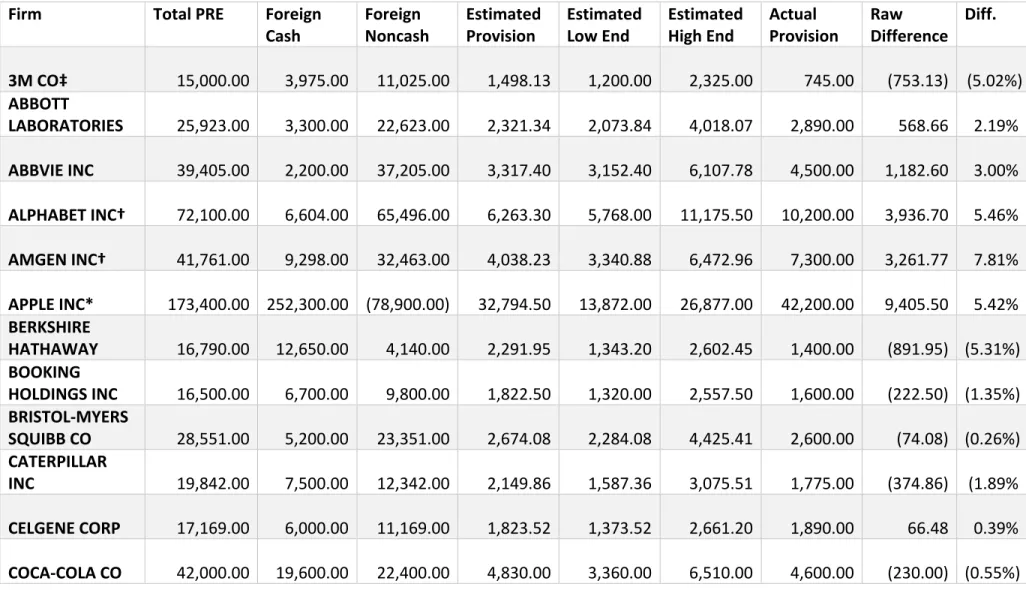
In order to estimate the transition tax revenue generated, I first collected an adequate sample size of firms that reported permanently reinvested earnings (PRE) on their 10-K financial statements in recent fiscal years, either 2016 or 2017 depending on which year the firm last disclosed their total PRE. From there, I filtered the sample down to the firms with greater than $10 billion in PRE since these firms aggregate PRE accounts for 57 percent of all firms that disclose PRE on their financial statements. There were a total of 50 firms that reported more than $10 billion of PRE on their most recent financial statements.
For Table 1, the variables were calculated as follows. The column labeled “Total PRE” represents the firms’ total PRE on the measurement dates of the transition tax. Some of the firms PRE was given on their 10-K for fiscal year 2017. However, the majority of the firms selected did not list their PRE on their 2017 financial statements. The total PRE for these firms were calculated by taking the PRE listed on their fiscal year 2016 financial statements and adding the total foreign pretax income for fiscal year 2017, with the assumption that the firms will delay repatriation on foreign earnings from 2017 in order to take advantage of the discounted rate offered by the transition tax. Since these firms did not disclose PRE in 2017, the assumption is that
these firms would use the latest possible measurement date in order to capture more 2017 foreign income as PRE. Additionally, there were 10 firms that did not end their fiscal year on December 31st10. The total PRE for these firms were taken from their
10-K financial statements and could differ from the 12/31 measurement date. The next two columns, “Foreign Cash” and “Foreign Noncash” represent the firms’ breakdown of their PRE between cash and cash equivalents, and noncash assets, respectively. Many firms reported on their fiscal year 2017 10-K the amount of foreign cash they held in foreign subsidiaries, which is the amount that would be subject to the higher 15.5 percent tax rate for the transition tax. The 2017 foreign cash amount was used due to all firms disclosing that they were still finalizing their calculations pertaining to the cash measurements. The firms did not disclose which cash calculation method they used between the 2017 measurement or the average between 2015 and 2016, so I uniformly applied the same 2017 measurement method to all firms. Eight firms did not disclose the amount of foreign cash held, so for these firms, foreign cash was calculated by taking a ratio of foreign PPE to total PPE and applying that percentage to the firm’s total cash and cash equivalents.11 The assumption here is that firms would
hold foreign cash in proportion to their foreign PPE. To calculate the firms’ foreign noncash assets, the foreign cash was subtracted from the total PRE. The column labeled “Estimated Provision” is a projection of what the firms’ Section 965 tax liability
10 These 10 firms are: Apple Inc, Hewlett Packard Enterprise, HP Inc, Micron Technology Inc, Microsoft
Corp, Nike Inc, Oracle Corp, Procter & Gamble Co, Walmart Inc, and Western Digital Corp.
11 These 8 firms include: Alphabet Inc, Amgen Inc, Danaher Corp, Dowdupont Inc, Du Pont De Nemours,
should be. It is calculated using the formula: (Foreign Cash) (0.155) + (Foreign Noncash) (0.08). Next, “Estimated Low End” and “Estimated High End” denote the range that the firms’ provisions should fall into, the low end calculated by assuming 100 percent of the total PRE is noncash assets and therefore multiplied by the eight percent tax rate, and the high end assumes that 100 percent of total PRE is cash and cash equivalents, and therefore subject to the 15.5 percent rate. The column “Actual Provision” is taken from the firms’ most recent financial statements in which they disclose their estimated transition tax liability. The provision is a combination of current and noncurrent tax liabilities, as all the firms are electing to pay their transition tax liability over an eight-year period and are only listing eight percent of their total liability as current. The firms only list a provision and not a finalized number as all firms state that they are still undergoing the final calculation of their PRE cash and noncash assets and will be giving an exact number for their fiscal year 2018 financial statements. Next is the column “Raw Difference” which denotes the
difference between the firms’ estimated and actual provisions for the transition tax in U.S. dollars. The final column, “Difference” is a comparison of the firms’ actual
provisions with the estimated provision in percentage form to make easy comparisons between firms with varying amounts of PRE. It is effectively a comparison of the effective tax rate on the firms’ PRE, with the number shown is calculated by: (Actual Provision/PRE)- (Estimated Provision/PRE). A negative number could imply the use of foreign tax credits by the firms. It is difficult to measure the impact of foreign tax credits on this calculation, as firms with negative numbers paid foreign income tax on
their PRE, which would generate a specific amount of foreign tax credits that are eligible for use in offsetting the total transition tax liability. Since firms would incorporate foreign tax credits in their provisions, their U.S. transition tax liability would be significantly lower that the numbers in this calculation, and this calculation effectively ignores the effects of foreign tax credits.
Based on the methods listed above for calculating the estimated transition tax liability, several firms were excluded due to complications. Six of the firms are within the financial services industry with focuses on banking and trading.12 These firms were
excluded from the sample because their industry relies on the firms holding liquid cash reserves in their institutions worldwide, and their reserves are a key component of their business. Therefore, these firms did not disclose the amount of foreign cash held. These firms also do not own many long-lived PPE, so it would not be accurate to apply the foreign PPE/total PPE method to these firms. Further, an additional six firms were excluded from the sample due to their financial statements disclosing that the transition tax does not have a material impact on their financials, and therefore did not report a provision for their transition tax liability.13 After filtering out these firms,
the total number of firms analyzed was thirty-seven.
3.4b Data Analysis
12 These 6 firms are: American Express Co, Bank of America Corp, Goldman Sachs Group Inc, JPMorgan
Chase & Co, Morgan Stanley, and Visa Inc.
13 These 5 firms that decided the transition tax did not have a material impact were: Chevron Corp, Exxon
The average of the difference in actual and estimated effective transition tax rates is equal to -0.77 percent, which could imply the use of foreign tax credits. When excluding the unique case of Apple, which reported higher foreign cash than total PRE, the average difference drops to -0.95 percent.
From the thirty-seven firms in the sample, which are the firms with the highest amount of PRE, their combined transition tax liability is $172.5 billion to be paid over the next eight years based on the actual provisions listed by the firms. From the perspective of the U.S. government, this is $172.5 billion that will be available for the government to use in their budget. Yet for the individual firms, they are paying an average effective transition tax rate of 9.3 percent. If the transition tax mandated the firms’ PRE be taxed at the corporate 21 percent, the total tax liability would be about $321 billion. Under the old regime, it would have been possible for these firms to continue to indefinitely reinvest their offshore earnings, which would not generate any tax revenue for the U.S. government. This transition tax benefits the U.S. government, as the government receives around $300 billion14 in tax revenue that
otherwise might not have been brought back into the country. Also, firms that have been permanently reinvesting earnings to delay paying U.S. income tax now get the opportunity to bring back these earnings at a rate lower than the old 35 percent corporate tax rate that the firms would have paid if they had repatriated immediately.
14 As mentioned above, these firms represent 57 percent of the PRE disclosed. Applying the ETR found in
this analysis of firms’ stated provisions of 9.301 percent, the total amount of government revenue totals around $307.917 billion.
However, it is difficult to estimate the ETR if the firms repatriated under the old regime as the firms would have received foreign tax credits, which would lower the ETR below 35 percent.
There are several factors that may impact the results of this analysis of comparing actual transition tax provisions with an estimated transition tax liability based on the past disclosures of PRE and foreign cash. The firms that did not disclose their total PRE on their 2017 financial statements may have total PRE’s different from the total calculated in this estimation if the firms elected not to permanently reinvest all of their 2017 foreign pretax earnings. Also, a total of eight firms did not disclose their foreign cash and cash equivalents, and their calculations could differ than the estimation provided in this sample.
4. ALTERNATIVES TO THE TRANSITION TAX
This section will compare the tax liability calculated under the current legislation with alternative scenarios. The first comparison will look at what these firms would pay on their PRE if there were no transition tax and all PRE were eligible for the GILTI regime. The second area of speculation involves adding an additional tax to the assets that these firms elect to bring back into the United States. The third scenario
compares how the legislation allows firms to pay off their transition tax liability in an eight-year phase-in plan, and speculates the total liability if the legislation detailed a phase-out plan.
4.1 Scenario 1: No Transition Tax and All PRE is Eligible for GILTI
Scenario 1 eliminates the transition tax and instead looks at all PRE to be taxed under the GILTI Regime. See Table 2 for this scenario. As discussed in Section 2, the GILTI (Global Intangible Low-Tax Income) Regime enacts a 10.5 percent tax on the firms’ foreign pre-tax income in excess of ten percent of its foreign PPE. The
calculation of the tax liability for the GILTI regime on PRE starts with looking at a firm’s pretax foreign income (Total PIFO) from the years 1986 until either 2016 or 2017 depending on when the firm last disclosed their total PRE. Three firms included in the prior analysis are excluded because there was no data available for their PIFO,
including Berkshire Hathaway, Oracle Corp, and Praxair Inc.15 The difference was then
taken between total PIFO and total PRE from the firms’ last disclosure of PRE. This difference is assumed to be the amount that the firms repatriated since 1986, and therefore would be excluded from the GILTI calculation. This estimated repatriation amount is excluded from PIFO ratably from 1986 until the last year the firm disclosed their PRE. Some firms had a negative difference, implying that their PRE was greater than their accumulated PIFO. For these firms, there was no adjustment made for repatriated earnings. The Total Foreign PPE lists the amount of foreign PPE held by the firm in 2017. Here it is assumed that firms held their foreign PPE constant from 1986 to 2017, which might bias this calculation due the possibility of an increase of foreign PPE, likely due to inflation. The Total GILTI represents the amount of tax the firms would pay on their total PRE if it was taxed under the GILTI regime.16
Under this scenario, these firms would pay an estimated $55.206 billion on their total PRE. Compared to the total transition tax liability reported on the firms’ 10-Ks of $148.113 billion, this scenario would cost the government an additional $92.907 billion, or a 62.7 percent decrease from the current Section 965 of the TCJA. A major reason for this difference is the ten percent return on foreign assets. If the GILTI legislation did not include this provision, the tax liability would increase to $142.454
15 These firms had an effective transition tax rate of eight percent, 14 percent, and four percent, and had
PRE of $16.79 bil, $56.575 bil, and $13.284 bil, respectively, under Section 965. Together, these firms represented 11.7 percent of the total amount of PRE in the Section 3 analysis and will be excluded from comparisons in this section.
billion. Even then, the total tax liability under GILTI is still below the total for the transition tax, which shows that the actual transition tax is more effective for higher tax revenues than if PRE was taxed under new regime laws. Also, while this scenario could be plausible if this method were implemented going forward, it would be challenging to enact for the transition tax because it would be difficult for firms to get their exact numbers on their total foreign PPE dating back to 1986.
4.2 Scenario 2: Taxing Cash and Cash Equivalents at 21 Percent U.S.
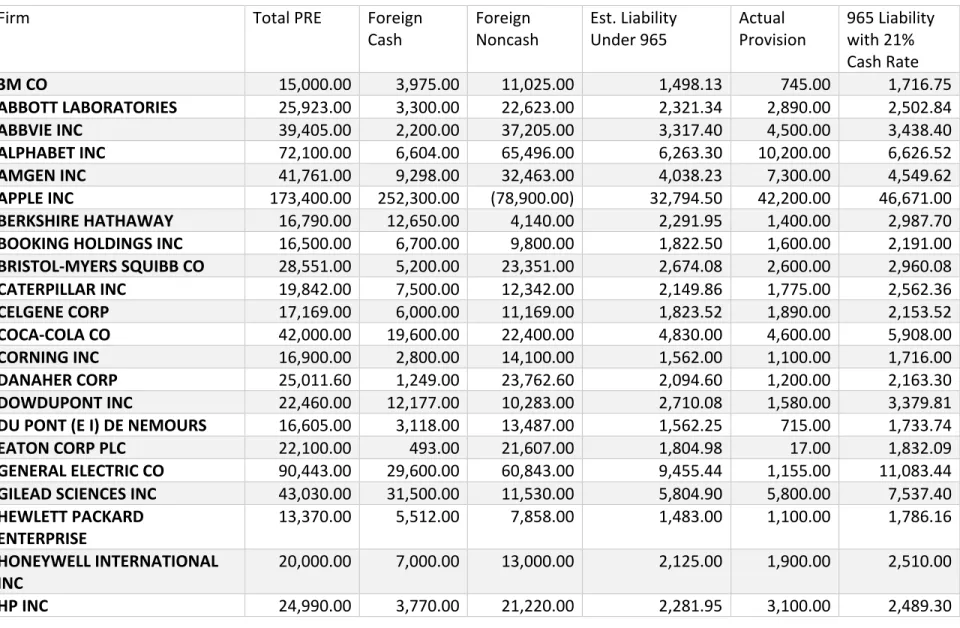
This scenario keeps in place the current legislation of Section 965 and raises the rate on cash and cash equivalents to 21 percent. The theory behind this raised cash tax rate lies in interviews with the CEO of Apple, Tim Cook, who in early 2018 stated that Apple would bring back the majority of their $252 billion in offshore cash due to the transition tax (Wakabayashi and Chen, 2018). Bringing back offshore cash due to the transition tax is a strategy that is being used by other major firms included in the sample, including Microsoft and Alphabet. Taxing cash assets at 21 percent would not be unreasonable, as that is the tax rate imposed on earnings within the U.S. under the new tax law, as opposed to the old corporate rate of 35 percent. Almost every firm included in the earlier analysis did not disclose how much they would bring back to the U.S., nor whether the assets would be cash or noncash. As shown in Table 3, cash and cash equivalents make up a slight minority of total PRE, so this raised tax rate would not have too much of a negative impact on firms.
Table 3 lists the same variables as Table 1 but with the estimated total liability for the firms if their cash and cash equivalents were taxed at 21 percent as opposed to the current 15.5 percent. Under this assumption, there would be an extra $32.3 billion included in the tax liability, and $26.1 billion more than the total provisions recorded by the firms. This would also raise the ETR for the transition tax, as this raises the average ETR for firms to 13 percent. While the raised average ETR would result in additional revenue for the government as opposed to the current legislation, Congress may not have included a tax like this because they already felt like they were getting a major revenue boost by receiving taxes on previously untaxed earnings. Also, raising the effective transition tax rate could place financial strain on some of the firms eligible for the transition tax. The primary purpose of the TCJA act was to stimulate the economy and create more jobs and placing a large financial strain on firms would effectively do the opposite of the legislation’s main intentions.
4.3 Scenario 3: Phase-In Versus Phase-Out
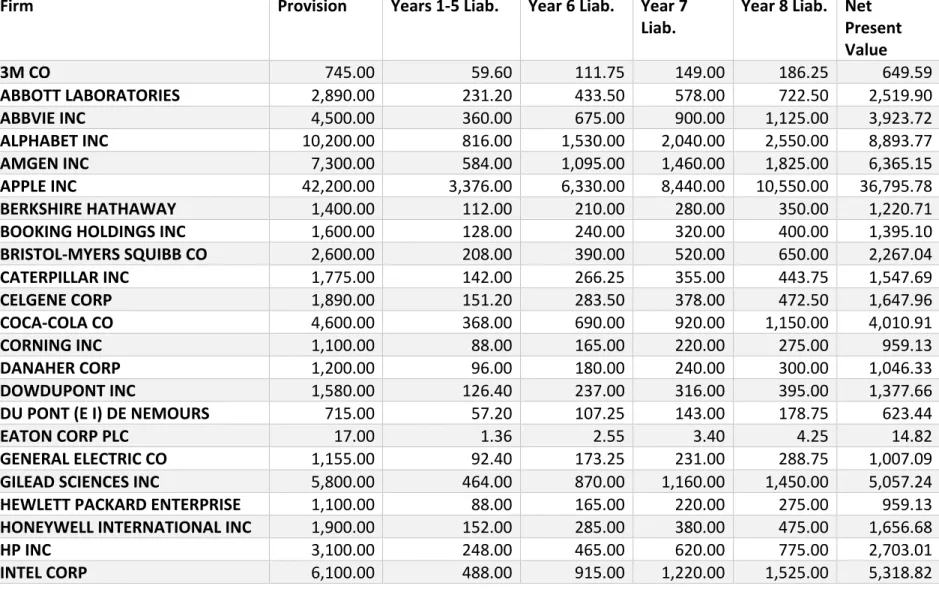
This scenario will explore the transition tax liability payment plan. As stated in Section 3, the payment plan is eight percent of the net liability in Years One through Five, 15 percent in Year Six, 20 percent in Year Seven, and the final 25 percent in Year Eight. This method of legislation is more commonly known as a phase-in plan, in which the preliminary years have a lighter payment that steadily increases over the years. This type of plan is also a strategy used to delay most of the total liability to future years, effectively lowering the amount owed today due to the time value of money,
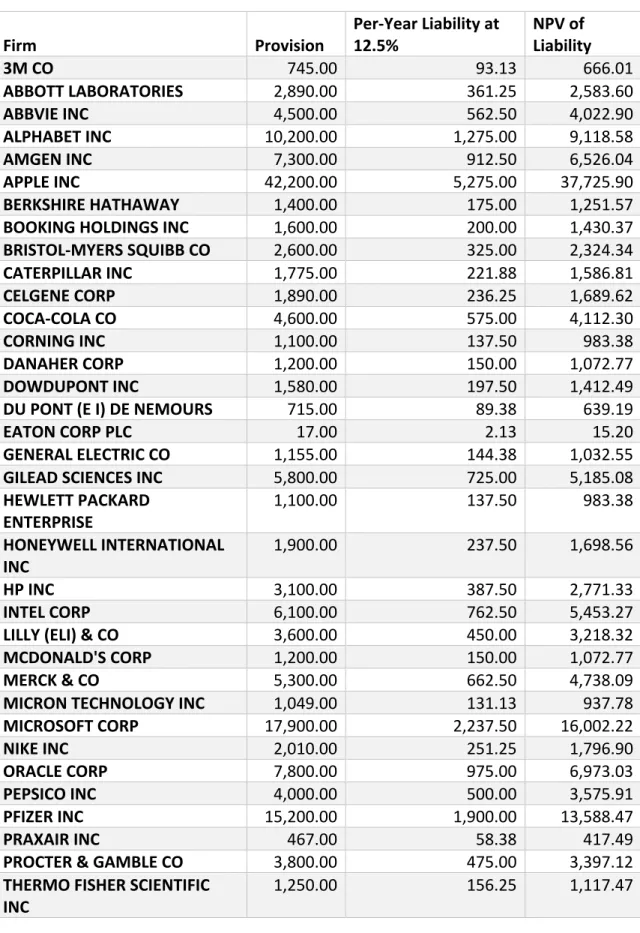
the effect of which is shown in Table 4. Also, it creates the opportunity for future legislation to be passed that will further delay the payments or even remove them altogether. An alternative to a phase-in plan is a phase-out plan, in which the early years have larger percentages of the total liability, which shrinks as the years go on. This strategy is less applicable for the transition tax, as a phase-out plan is used on already-existing plans that are being discontinued in the future. A happy medium between these two strategies would be to have each year be equal, in this case, 12.5 percent per year over eight years. Table 5 shows the effect of equal payment years. The discount rate used in either case is the 2.56 percent. This rate is used because the going rate on five and ten year government bonds is 2.34 percent and 2.77 percent respectively, and since this payment plan falls close to halfway between five and ten years, 2.56 percent falls close to halfway between the two going rates.
The effect of the current phase-in payment plan in Table 4 lowers the present value of the transition tax by $22.1 billion, from $172.5 billion to $150.4 billion. Using a ratable payment plan like in Table 5, the present value of the transition tax liability increases to $154.2 billion, which is a $3.8 billion increase for the U.S. government, or roughly a two percent increase. Two percent is significant when referring to an amount as large as this, and Congress should have included a ratable rather than phase-in payment plan in order to generate a higher NPV on the transition tax.
However, a potential issue with the current phase-in payment plan is that at any point in the future, there is the possibility that a change in legislation could further delay
these payments. Any delay in payments would decrease the present value of the transition tax further. Another possibility is that due to increased lobbying efforts from the firms with the largest transition tax liabilities, there could be an elimination of the liability altogether, allowing firms to avoid paying even more income tax. These firms have already used lobbying to weaken U.S. international tax law, as shown in 1997 with the passing of the check-the-box regime due to lobbying from tech and pharmaceutical firms. Congress may not have included this ratable payment plan due to lobbying efforts to try and decrease the current portion owed with the possibility of delaying future payments, or Congress may not have wanted to place extra financial strain on these firms with a 4.5 percent increase per year for the first five years.
5. CONCLUSION
Under the current legislation, the transition tax will generate an estimated $172.5 billion in tax revenue from the firms included in the sample. Scenario 1 shows that taxing all PRE under the new GILTI regime would decrease tax revenues by 62.7 percent when compared to the current transition tax. Under Scenario 2, an increased cash rate to 21 percent would provide an extra $32.3 billion but may place financial strain on firms that would counter the rationale behind the TCJA. Scenario 3 would raise the present value of the transition tax liability from the sample by $4 billion, yet by increasing the payments for the first five years could also place firms under
financial stress.
There are several shortcomings with the analyses conducted in this paper. Pertaining to the current legislation calculations, it is impossible to have access to the information available to the firms about their PRE classifications, which could skew the total PRE that all calculations are based off of. The lack of disclosures of foreign cash could also impact the total calculations, as changes in cash have a more substantial impact due to the higher rate imposed on cash. Also, it is extremely difficult to analyze the impact of foreign tax credits in the overall calculation. The total PRE, which has not been taxed under U.S. law but has been taxed under some foreign jurisdictions, has created unused foreign tax credits. Since the firms did not disclose the effects of foreign tax credits on their provisions, the total effect of these foreign tax credits will be unknown until firms declare their total transition tax liability, which could further
decrease the transition tax revenues. With regards to the alternate scenarios, several assumptions lead to possible shortcomings. Under Scenario 1, applying a constant foreign PPE from 2017 back to 1986 understates the GILTI tax owed in earlier years due to firm growth and inflation. Scenario 2 assumes that all foreign cash will be brought back to the US, and as explained earlier, the total foreign cash held by some firms was an estimated amount.
Table 1: Estimated Transition Tax Liability vs. Actual Provision for the Transition Tax
Firm Total PRE Foreign
Cash Foreign Noncash Estimated Provision Estimated Low End Estimated High End Actual Provision Raw Difference Diff. 3M CO‡ 15,000.00 3,975.00 11,025.00 1,498.13 1,200.00 2,325.00 745.00 (753.13) (5.02%) ABBOTT LABORATORIES 25,923.00 3,300.00 22,623.00 2,321.34 2,073.84 4,018.07 2,890.00 568.66 2.19% ABBVIE INC 39,405.00 2,200.00 37,205.00 3,317.40 3,152.40 6,107.78 4,500.00 1,182.60 3.00% ALPHABET INC† 72,100.00 6,604.00 65,496.00 6,263.30 5,768.00 11,175.50 10,200.00 3,936.70 5.46% AMGEN INC† 41,761.00 9,298.00 32,463.00 4,038.23 3,340.88 6,472.96 7,300.00 3,261.77 7.81% APPLE INC* 173,400.00 252,300.00 (78,900.00) 32,794.50 13,872.00 26,877.00 42,200.00 9,405.50 5.42% BERKSHIRE HATHAWAY 16,790.00 12,650.00 4,140.00 2,291.95 1,343.20 2,602.45 1,400.00 (891.95) (5.31%) BOOKING HOLDINGS INC 16,500.00 6,700.00 9,800.00 1,822.50 1,320.00 2,557.50 1,600.00 (222.50) (1.35%) BRISTOL-MYERS SQUIBB CO 28,551.00 5,200.00 23,351.00 2,674.08 2,284.08 4,425.41 2,600.00 (74.08) (0.26%) CATERPILLAR INC 19,842.00 7,500.00 12,342.00 2,149.86 1,587.36 3,075.51 1,775.00 (374.86) (1.89% CELGENE CORP 17,169.00 6,000.00 11,169.00 1,823.52 1,373.52 2,661.20 1,890.00 66.48 0.39% COCA-COLA CO 42,000.00 19,600.00 22,400.00 4,830.00 3,360.00 6,510.00 4,600.00 (230.00) (0.55%)