Recovery Algorithms for In-memory OLTP
Databases
by
Nirmesh Malviya
ARCHIVES
MASSACHUSETTS INSTiiTii RF TECHNOLOGYJLBR1A2012
B.Tech., Computer Science and Engineering, Indian Institute of Technology Kanpur (2010)
Submitted to the Department of Electrical Engineering and Computer Science in partial fulfillment of the requirements for the degree of
Master of Science in Electrical Engineering and Computer Science
at the
MASSACHUSETTS INSTITUTE OF TECHNOLOGY
June 2012
@
Massachusetts Institute of Technology 2012. All rights reserved.Author ...
Department of Electrical Engineering and Computer Science May 18, 2012 Certified by..
Certified by..
. . . .. . . .
Associate Professor of cal
...
/
/
Samuel Madden Engineering and Computer Science Thesis Supervisor
Michael Stonebraker Adjunct Professor of Electrical Engineering and Computer Science Thesis Supervisor
Accepted by...
Leslie A. Kolodziejski Chair, EECS Committee on Graduate Students
Recovery Algorithms for In-memory OLTP Databases
by
Nirmesh Malviya
Submitted to the Department of Electrical Engineering and Computer Science on May 18, 2012, in partial fulfillment of the
requirements for the degree of
Master of Science in Electrical Engineering and Computer Science
Abstract
Fine-grained, record-oriented write-ahead logging, as exemplified by systems like
ARIES, has been the gold standard for relational database recovery. In this the-sis, we show that in modern high-throughput transaction processing systems, this is no longer the optimal way to recover a database system. In particular, as transaction
throughputs get higher, ARIES-style logging starts to represent a non-trivial fraction
of the overall transaction execution time.
We propose a lighter weight, coarse-grained command logging technique which only records the transactions that were executed on the database. It then does
re-covery by starting from a transactionally consistent checkpoint and replaying the commands in the log as if they were new transactions. By avoiding the overhead of fine-grained, page-level logging of before and after images (and substantial associated I/O), command logging can yield significantly higher throughput at run-time. Re-covery times for command logging are higher compared to ARIES, but especially with the advent of high-availability techniques that can mask the outage of a recovering node, recovery speeds have become secondary in importance to run-time performance for most applications.
We evaluated our approach on an implementation of TPC-C in a main memory database system (VoltDB), and found that command logging can offer 1.5x higher throughput than a main-memory optimized implementation of ARIES.
Thesis Supervisor: Samuel Madden
Title: Associate Professor of Electrical Engineering and Computer Science
Thesis Supervisor: Michael Stonebraker
Acknowledgments
I would like to thank my advisors, Sam Madden and Mike Stonebraker, for guiding
me throughout the course of this work. This thesis would not have been possible without the mentoring and encouragement I received from both of them throughout the past academic year.
Sam's willingness to discuss research problems in detail just about any time I needed his help has been a source of great support to me ever since I started graduate school at MIT. There is much I have learned from him about research: he has been greatly instrumental in helping me improve my presentation and writing skills.
Mike's subtle insights into database research problems and his ability to keep the big picture in mind at the same time have constantly amazed me. I particularly thank him for suggesting that I work on this problem for my thesis.
I also thank my many friends in CSAIL - particularly Alvin, Eugene, Adam, Evan,
Carlo, Arvind and Lenin for all the great help and advice.
Finally, I thank my parents and family for their love and unwavering belief in me and my abilities.
Contents
1 Introduction
1.1 Command Logging: An Alternative Approach to Logging
1.1.1 Comparison with ARIES . . . . 1.2 Why the Data Durability Problem Needs to be Revisited 1.3 Thesis Contributions . . . . 1.3.1 High-level Overview . . . . 1.4 R oad M ap . . . . and Recovery 2 Vo1tDB Overview 2.1 Architecture . . . .
2.2 Transactions as Stored Procedures . . . . . 2.3 Concurrency Control and Durability . . . 2.3.1 Checkpoint Mechanism . . . .
3 Command Logging
3.1 Logging Transactions as Stored Procedures 3.1.1 Writing a Log-record . . . . 3.1.2 Optimizing for Performance . . . . 3.1.3 Log-record Structure . . . . 3.1.4 Transaction Rollbacks . . . . 3.2 Recovery . . . . 3.2.1 Transaction Replay . . . . 3.2.2 Correctness . . . . 13 14 14 15 17 17 18 19 19 19 20 20 23 23 24 24 25 25 26 26 26
4 ARIES for Main Memory 27
4.1 Supporting Main Memory ... 27
4.1.1 Identifying a Modified Tuple ... ... 28
4.1.2 Dirty Record Table . . . . 29
4.1.3 Other Optimizations . . . . 30
4.1.4 Log-record Structure . . . . 30
4.2 Recovery for Main-memory . . . . 31
4.2.1 REDO Phase . . . . 31 4.2.2 UNDO Phase . . . . 31 5 Performance Evaluation 33 5.1 Benchm arks . . . . 34 5.1.1 V oter . . . . 34 5.1.2 T P C-C . . . . 35 5.2 Experimental Setup . . . . 35 5.3 R esults . . . . 36 5.3.1 Throughput . . . . 36 5.3.2 Latency . . . . 38
5.3.3 Number of Bytes Logged . . . . 39
5.3.4 Log Record Size vs. Performance . . . . 43
5.3.5 Recovery Times . . . . 44
5.3.6 Group Commit Frequency . . . . 46
5.3.7 Transaction Length . . . . 48
5.4 D iscussion . . . . 52
6 Generalizing Command Logging 55 6.1 Transactionally-consistent Snapshotting . . . . 55
6.2 Equivalent Transaction Replay Order . . . . 56
7 Related Work 57
List of Figures
1-1 Illustration of when command logging is preferred over ARIES.
3-1 Command logging record structure. . . . .
4-1 ARIES log record structure. . . . . 5-1 Voter benchmark schema. . . . .
5-2 Voter throughput vs. client rate (both tps)... 5-3 TPC-C throughput (tpmC) vs. client rate (tps). 5-4 Voter latency in milliseconds vs. client rate (tps).
5-5 TPC-C latency in milliseconds vs. client rate (tps). 5-6 Number of data tuples modified per transaction for
tables. Note that the y-axis is on a log scale... 5-7 Number of bytes written per ARIES log record for
tables. . . . .
different TPC-C
different TPC-(
5-8 Number of bytes written per log record by command logging for
dif-ferent stored procedures. . . . .
5-9 Logging mode's TPC-C throughput does not merely depend on the
number of log bytes written to disk. . . . .
5-10 Voter log replay rates (tps). . . . . 5-11 TPC-C log replay rates (tpmC). . . . . 5-12 Voter latency (ms) vs group commit frequency (ms). . . . . 5-13 TPC-C latency (ms) vs group commit frequency (ms). . . . .
5-14 Voter run-time throughput (tps) vs. added transaction length (ms). .
16 25 31 . . . . 34 . . . . 37 . . . . 37 . . . . 39 . . . . 40 41 41 42 43 45 46 47 48 49 . .
5-15 TPC-C run-time throughput (tpmC) vs. added transaction length (ms). 50
5-16 Voter replay rates (tps) on log scale vs. added transaction length. . . 51
5-17 TPC-C replay rates (tpmC) on log scale vs. added transaction length
(m s). . . . . 5 2 5-18 Illustration of when command logging is preferred over write-ahead
Chapter 1
Introduction
Database systems typically rely on a recovery subsystem to ensure the durability of committed transactions. If the database crashes while some transactions are in-flight, a recovery phase ensures that updates made by transactions that committed pre-crash are reflected in the database after recovery, and that updates performed by uncommitted transactions are not reflected in the database state.
The gold standard for recovery is write-ahead logging during transaction execu-tion, with crash recovery using a combination of logical UNDO and physical REDO, exemplified by systems like ARIES [26]. In a conventional logging system like ARIES, before each modification of a page in the database is propagated to disk, a log entry containing an image of the state of the page before and after the operation is logged. Additionally, the system ensures that the tail of the log is on disk before a commit returns. This makes it possible to provide the durability guarantees described above.
Below we propose an alternative to the well accepted ARIES logging and recovery technique.
1.1
Command Logging: An Alternative Approach
to Logging and Recovery
Suppose during transaction execution, instead of logging modifications, the trans-action's logic (such as SQL query statements) is written to the log instead. For transactional applications that run the same query templates over and over, it may in fact be possible to simply log a transaction identifier (e.g., a stored procedure's name) along with query parameters; doing so also keeps the log entries small.
Such a command log captures updates performed on the database implicitly in the commands (or transactions) themselves, with only one log record entry per command. After a crash, if we can bring up the database using a pre-crash transactionally-consistent snapshot (which may or may not reflect all of the committed transactions from before the crash), the database can recover by simply re-executing the transac-tions stored in the command log in serial order instead of replaying individual writes as in ARIES.
1.1.1
Comparison with ARIES
Compared to ARIES, command logging operates at a much coarser granularity. This leads to important performance differences between the two. Generally, command logging will write substantially fewer bytes per transaction than ARIES, which needs to write the data affected by each update. Command logging simply logs the incoming transaction text or name, while ARIES needs to construct before and after images of pages, which may require differencing with the existing pages in order to keep log records compact.
Run-time
The differences mentioned above mean that ARIES will impose a significant run-time overhead in a high throughput transaction processing (OLTP) system. For example, prior work has shown that a typical transaction processing system (Shore) spends
10-20% of the time executing TPC-C transactions (at only a few hundred transactions per second) on ARIES-style logging [11].
As transaction processing systems become faster, and more memory resident, this will start to represent an increasingly larger fraction of the total query processing time. For example, in our work on the H-Store
[35]
system, and in other high throughput data processing systems like RAMCloud [28] and Redis[34],
the goal is to process many thousands of transactions per second per node. To achieve such performance, it is important that logging be done efficiently.Recovery
It is also relevant to look at recovery times for the two logging approaches. One would expect ARIES to perform recovery faster than command logging; because in
command logging, transactions need to be re-executed completely at recovery time whereas in ARIES, only data updates need to be re-applied.
However, given that failures are infrequent (once a week or less), recovery times are generally much less important than run-time performance. Additionally, any production OLTP deployment will likely employ some form of high-availability (e.g., based on replication) that will mask single-node failures. Thus, failures that require recovery to ensure system availability are much less frequent.
1.2
Why the Data Durability Problem Needs to
be Revisited
As CPUs have gotten faster compared to disks and main memory capacities have grown, many OLTP applications have become memory-resident and thus the run-time of an OLTP transaction has shrunk. However, logging run-times have not improved as dramatically, because logging still involves substantial disk I/O and many CPU instructions. As such, in modern OLTP systems, command logging is an increasingly attractive alternative logging approach.
-o
0Command
n
Logging
2Preferred
00
.
1 ,1
C
''
f0 0t~d
Wie
Ahead
Cn
nIl
(ARIES)
E
-Preferred
z'
Transaction Length
Figure 1-1: Illustration of when command logging is preferred over ARIES.
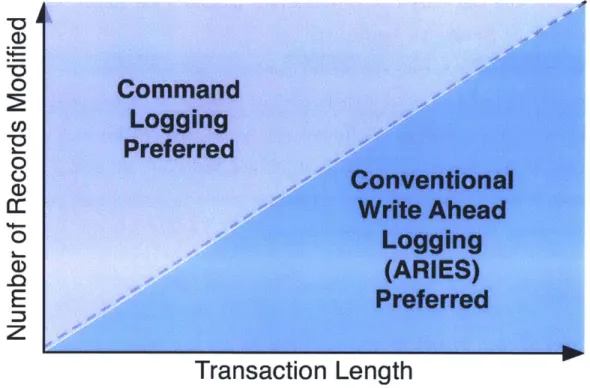
Figure 1-1 shows a conceptualization of this idea. The region on the right below the diagonal contains both complex transactions involving lots of computation per data write, as well as low-throughput applications. In this region, the overhead of logging in ARIES is small relative to command logging, so it may be preferred due to lower recovery times. In high throughput settings with simple transactions (left
region in the plot, above the diagonal), command logging is preferable, especially so when the transactions update many database tuples (leading to lots of logging in
ARIES).
Increasingly, the trend in modern transaction processing applications is to be at the left side of Figure 1-1. This is because of two reasons:
1. First, transaction processing applications inherently involve simple, update
in-tensive transactions.
2. Second, as RAM capacities of modern machines continue to grow ever larger, transaction processing is becoming memory resident, meaning that transaction latencies are becoming shorter and shorter.
Even systems not tuned for high throughput, like MySQL and Postgres, are now capable of running real-world transactional applications at throughputs of thousands of transactions per second, while specialized systems like H-Store and RAMCloud report numbers that are an order of magnitude higher.
1.3
Thesis Contributions
In this thesis, our goal is to study the discussed performance trade-offs between ARIES
and command logging in detail.
We describe how command logging works, and discuss our implementation of both command logging and a main-memory optimized version of ARIES in the VoltDB main memory open-source database system [37] (VoltDB is based on the design of H-Store [35]).
We compare the performance of both the logging modes on two transactional benchmarks, Voter and TPC-C.
1.3.1
High-level Overview
Our experimental results show that command logging has a much lower run-time overhead compared to ARIES when:
(a) transactions are not very complex, so that disk I/O due to logging represents a substantial fraction of transaction execution time, and
(b) the ratio of command log record size to number of data tuples updated by a
transaction is small, because ARIES does much more work in this case.
For example, TPC-C has short transactions that update a moderate number of records and it falls in the left region of Figure 1-1. In our experiments, we found that command logging can achieve about 1.5x the throughput of ARIES for TPC-C when running at maximum throughput (about 4K transactions per second (tps) per core), a result which is in line with the plot's prediction. Also for TPC-C, we found that
recovery times, as expected, are better for ARIES than command logging, by a factor of about 1.5.
1.4
Road Map
The rest of this thesis is organized as follows. We begin with a discussion of VoltDB's system architecture in Chapter 2. We then describe our approach to command log-ging in Chapter 3, followed by a detailed description of our main-memory adaptation of ARIES in Chapter 4. Subsequently, we report extensive performance experiments in Chapter 5 and discuss possible approaches to generalize command logging in Chap-ter 6. ChapChap-ter 7 provides an overview of relevant past work in this area, and Chapter 8 summarizes the thesis.
Chapter 2
Vo1tDB Overview
VoltDB is an open source main memory database system whose design is based on that of the H-Store system [35], with some differences. In this thesis, we compare performance of ARIES and command logging in VoltDB.
2.1
Architecture
In VoltDB, the database is horizontally partitioned on keys and these partitions reside in main memory of nodes in a cluster. Partitions are replicated across different nodes for high availability. All associated indexes are also kept in main memory along with the partitions. Every node in the cluster runs multiple execution sites (e.g., one per
CPU core), and each partition residing on the node is assigned to only one such site.
Each cluster node has an initiator site which sends out transactions to the appropriate partition(s)/replicas.
By employing careful, workload-aware partitioning, most transactions can be
made single-sited (run on just a single partition) [31].
2.2
Transactions as Stored Procedures
Transactions in VoltDB are issued as stored procedures that run inside of the database system. Rather than sending SQL commands at run-time, applications register a set
of SQL-based procedures (the workload) with the database system, and each trans-action is a single stored procedure. Although this scheme requires all transtrans-actions to be known in advance, for OLTP applications that back websites and other online systems, such an assumption is reasonable. Encapsulating all transaction logic in a single stored procedure prevents application stalls mid-transaction and also allows VoltDB to avoid the overhead of transaction parsing at run-time. At run-time, client applications invoke these stored procedures, passing in just the procedure names and parameters.
2.3
Concurrency Control and Durability
Because OLTP transactions are short, typically touching only a small number of database records and do not experience application or disk stalls, transactions for a given partition can simply be executed in serial order on that partition, often without any concurrency control at all [15].
These mechanisms result in very high transaction throughputs (about 4K transac-tions per second per core on TPC-C), but durability is still a problem. In the event of a single node failure, replicas provide availability of database contents. VoltDB uses command logging (described in Chapter 3), along with a non-blocking transaction-consistent checkpointing mechanism to avoid loss of database contents in the event of power failure or other cluster-wide outage.
2.3.1
Checkpoint Mechanism
VoltDB's checkpoint mechanism periodically writes all committed database state to disk, but index updates are not propagated to the disk. At the start of a checkpoint, the database executor goes into a copy-on-write mode. Next the snapshotting thread goes through memory, using the dirty bit to determine whether to snapshot a tuple or back it up in the shadow table. When one such sweep is done, the executor returns to regular mode. Thus, there is no need to quiesce the system and the checkpoint can be written asynchronously in the background. The checkpointing is asynchronous in
order to prevent checkpoints from being slow.
This checkpointing mechanism, although somewhat VoltDB specific, can be easily generalized to any database system that uses snapshots for isolation, since the copy-on-write mode is very similar to the way that transaction isolation is implemented in snapshot-isolation based systems.
Given this overview of VoltDB, we next describe how our implementation of com-mand logging in VoltDB works.
Chapter 3
Command Logging
The idea behind command logging is to simply log what command was issued to the database before the command (a transaction for example) is actually executed. Command logging is thus a write-ahead logging approach meant to persist database actions and allow a node to recover from a crash. Note that command logging is an extreme form of logical logging, and is distinct from both physical logging and record-level logical logging. As noted in Chapter 1, the advantage of command logging is that it is extremely lightweight, requiring just a single log record to be written per transaction.
3.1
Logging Transactions as Stored Procedures
For the rest of this thesis, we assume that each command is a stored procedure and that the terms command logging and transaction logging are equivalent. The commands written to the log record in command logging then consist of the name of a stored procedure and the parameters to be passed to the procedure.
Generally speaking, stored procedures are likely to be substantially smaller than entire SQL-queries, so this serves to reduce the amount of data logged in com-mand logging in our implementation. Specifically, an entry in the log is of the form
com-mand logging does not support transaction savepoints [26]. As OLTP transactions are short, this is not likely to be a significant limitation.
3.1.1
Writing a Log-record
Writing a log record to the command log for a new single-node transaction is relatively straightforward. However for a distributed transaction, a write to the command log is more involved, requiring a two-phase commit-like protocol to ensure that participating sites have accepted the transaction. In our VoltDB implementation of command logging, this write is done as follows.
At the beginning of a transaction, the coordinator site (specific to this transac-tion as there is no global cluster coordinator) sends out the transactransac-tion to all sites participating in the transaction and to other replicas of itself. Each execution site writes the transaction to its command log on disk; note that multiple execution sites on the same node write to a shared command log. Once a command C is in the log of a site S, S guarantees that it will execute C before any other commands that appear after C in S's log. A distributed agreement protocol based on special queues per
execution site is used to agree on a single global order of execution of transactions that all partitions and replicas see. Even if one or more sites do not respond to the coordinator (e.g., because of a crash), the transaction will be executed as long as a covering set of replicas is available. The cluster halts when there is no replica covering a partition.
3.1.2
Optimizing for Performance
Command logging can either be synchronous or asynchronous. When the command logging is asynchronous, the database server can report to the transaction coordinator that the transaction committed even if the corresponding log record has not yet prop-agated to disk. In the event of a failure however, asynchronous logging could result in the system losing some transactions. Hence, we focus on synchronous logging, where a log record for a transaction is forced to disk before the transaction is acknowledged
Checksum LSN Record Transaction-id Site-id Transaction Parameters
type type
Figure 3-1: Command logging record structure.
as committed.
To improve the performance of command logging, we employ group-commit. The system batches log records for multiple transactions (more than a fixed threshold or few milliseconds worth) and flushes them to the disk together. After the disk write has successfully completed, a commit confirmation is sent for all transactions in the batch. This batching of writes to the command log reduces the number of writes to the disk and helps improve synchronous command logging performance, at the cost of a small amount of additional latency per-transaction.
3.1.3
Log-record Structure
In our VoltDB implementation of command logging, log records written out have the structure shown in Figure 3-1.
3.1.4
Transaction Rollbacks
To deal with scenarios where a transaction must be rolled back mid-execution, VoltDB maintains an in-memory undo log of compensating actions for a transaction. This list is separate from the command log and is never written to disk. It is discarded on transaction commit/abort because it can be regenerated when the transaction is replayed.
3.2
Recovery
Recovery processing for a command logging approach is straightforward. First, the latest database snapshot on disk is read to initialize database contents in memory. Because the disk snapshot does not contain indexes, all indexes must be rebuilt at start-up (either parallelly or after the snapshot restore completes).
3.2.1
Transaction Replay
Once the database has been loaded successfully and the indexes have been rebuilt, the command log is read. Because there are multiple execution sites per VoltDB server node, one of the sites takes the role of an initiator and reads the shared log into memory in chunks. Starting from the log record for the first transaction not reflected in the snapshot the database was restored from, log entries are processed
by the initiator site. For a command log, one log record corresponds to a single
transaction, and as log entries are processed, each transaction is dispatched by the initiator to the appropriate site(s). This ensures the same global transaction ordering as the pre-crash execution, even if the number of execution sites during replay is different from the number of sites at run-time.
3.2.2
Correctness
This recovery process is guaranteed to be correct in VoltDB because (a) transactions are logged and replayed in serial order, so re-execution replays exactly the same set of transactions as in the initial execution, and (b) replay begins from a transactionally-consistent snapshot that does not contain any uncommitted data, so no rollback is necessary at recovery time.
We discuss how command logging could be extended to other database systems in Chapter 6.
Chapter 4
ARIES for Main Memory
ARIES [26] was originally intended as a recovery algorithm for a disk-based database
system. In a traditional ARIES style data log, each operation (insert/delete/update)
by a transaction is written to a log record table before the update is actually performed
on the data. Each log entry contains the before and after images of modified data. Recovery using ARIES happens in several passes, which include a physical REDO pass and a logical UNDO pass.
While the core idea behind traditional ARIES can be used in a main-memory database, substantial changes to the algorithm are required for it to work in a main memory context. In addition, the main-memory environment can be exploited to make ARIES logging more efficient.
We discuss both these aspects to main-memory ARIES in detail below.
4.1
Supporting Main Memory
In a disk based database, inserts, updates and deletes to tables are reflected on disk as updates to the appropriate disk page(s) storing the data. For each modified page,
ARIES writes a separate log record with a unique logical sequence number (LSN) (a write to a page is assumed to be atomic
[33]).
These log records contain disk specific fields such as page-id of the modified page along with length and offset of change. This is stored as a RID, or record ID, of the form (page #, slot #). Adirty page table, capturing the earliest log record that modified a dirty page in the
buffer pool is also maintained. In addition, a transaction table keeps track of the state of active transactions, including the LSN of the last log record written out by each transaction. The dirty page and transaction tables are written out to disk along with periodic checkpoints.
4.1.1
Identifying a Modified Tuple
In an main-memory database like VoltDB, a data tuple can be accessed directly by probing its main-memory location without any indirection through a page-oriented buffer pool. Thus, ARIES features optimized for disk access such as the various buffer pool and disk mechanisms can be stripped off. Specifically, all disk related fields in the log record structure can be removed. For each modification to a database tuple, we can simply write a unique entry to the log with serialized before and after images of the tuple. Instead of referencing a tuple through a (page #, slot #) RID, the tuple is referenced via a (table-id, primary-key) pair that uniquely identifies the modified data tuple. If a table does not have a unique primary key and the modification operation is not an insert, the entire before-image of a tuple must be used to identify the tuple's location in the table either via a sequential scan or a non-unique index lookup. For the both the Voter and TPC-C benchmarks we use in our study, all tables written to have primary keys except the TPC-C History table which only has tuples inserted into it (see Section 5.1 for schema details).
Note that the virtual address of a modified in-memory data tuple is not a good choice as a unique identifier for two reasons: (1) the database periodically performs compaction over the table memory layout to minimize data fragmentation, (2) the database is not guaranteed to load a table and all its records at the same virtual address on restart after a crash.
Much like disk-based ARIES uses RIDs to identify the location of a change be-fore it re-applies an update at recovery time, in-memory ARIES uses (table-name, primary-key) to identify the data tuple's location at recovery time, and the serialized after-image bytes in the log are used to modify the in-memory data tuple
appropri-ately. For the primary-key lookup identifying a tuple's location to be fast, an index on the primary key must be present at replay time. In VoltDB, index modifications are not logged to disk at run-time, so all indexes must be reconstructed at recovery time prior to replay.
Wide Tuples
For tables with wide rows, a large amount of ARIES log space can be saved by additionally recording which columns in the tuple were updated by a transaction, with before and after images for only those columns instead of the entire tuple (this optimization does not apply to inserts). We found that that this optimization led to a significant reduction in a log record's size for the TPC-C benchmark.
4.1.2
Dirty Record Table
An in-memory database has no concept of disk pages, and thus ARIES does not need to maintain a dirty page table. One option is to create a dirty record table to keep track of all dirty (updated or deleted) database records. For a write-heavy workload, such a table can grow fairly large within a short duration of execution; regular snapshotting would keep the table size bounded however. Alternatively, we could eliminate the separate dirty record table and instead simply associate a dirty bit with each database tuple in memory. This dirty bit is subsequently unset when the dirty record is written out to disk as a part of a snapshot. Not storing the dirty record table results in space savings, but depending on the checkpoint mechanism in use, doing so can have significant performance impacts, as we discuss next.
Disk-based ARIES assumes fuzzy checkpointing [21] to be the database snapshot mechanism. Fuzzy checkpoints happen concurrently with regular transaction activity, and thus updates made by uncommitted transactions can also get written to disk as a part of the checkpoint. Both the dirty page and transaction tables are flushed to disk along with each checkpoint in disk based ARIES, the main memory equivalent of this would be to write out the dirty record and transaction tables with a checkpoint.
Not having an explicit dirty record table in such a scenario is inefficient, because each
ARIES checkpoint would need to scan the in-memory database to construct the dirty
record table before it can be written along with the checkpoint.
Alternatively, we could use transaction-consistent checkpointing [32] instead of fuzzy checkpointing. VoltDB already uses non-blocking transaction-consistent check-pointing (see Chapter 2), so we leveraged it for our ARIES implementation. With transaction consistent checkpointing, only updates from committed transactions are made persistent, so that ARIES can simply keep track of the oldest LSN whose updates have not yet been reflected on disk. Thus, the dirty records table can be eliminated altogether for this checkpointing scheme.
4.1.3
Other Optimizations
Because OLTP transactions are short, the amount of log data produced per update in the transaction is not enough to justify an early disk write given that the final update's log record must also be flushed before the transaction can commit. For this reason, its best to buffer all log records for a single transaction and write them all to the log together. Our implementation of ARIES does not support partial rollbacks or
savepoints, so that this optimization can be applied without repercussions.
ARIES has traditionally been a synchronous logging technique in the sense that log
writes of a committed transaction are forced to disk before the server reports back the transaction's status as committed. Similar to command logging, ARIES uses group commit; writes from different transactions are batched together to achieve better disk throughput and to reduce the logging overhead per transaction.
4.1.4
Log-record Structure
In our VoltDB implementation of ARIES, execution sites on the same node write to a shared ARIES log with arbitrary interleaving of log records from different sites.
The ordering of log records per site is still preserved. A field in the ARIES log record identifies the site/partition to which the update corresponds. The log record structure
Insert/ Modified
Check- LSN Record Update/ Transaction- Site-id Table Primary Column Before After
sum type Delete id Name Key List Image Image
Figure 4-1: ARIES log record structure.
for our ARIES implementation in VoltDB is shown in Figure 4-1.
4.2
Recovery for Main-memory
Recovery using disk-based ARIEs happens in three phases: an analysis phase, a redo phase and an undo phase. The redo pass is physical and allows for independent recovery of different database objects and parallelism during recovery. The undo pass
in ARIES is logical.
4.2.1
REDO Phase
ARIES recovery in a main-memory database also begins with the analysis phase, the goal of which is to identify the LSN from which log replay should start.
The redo pass then reads every log entry starting from this LSN and reapplies updates in the order the log entries appear. For each log entry, the data tuple that needs to be updated is identified and the serialized after-image bytes in the log record are used to modify the tuple (this covers insert and delete operations as well). Because log records corresponding to different partitions of the database can be replayed in any order, the redo phase is highly parallelizable. This optimization yielded linear scale up in recovery speeds with the number of cores used for replay (see Chapter 5 for performance numbers).
4.2.2
UNDO Phase
After the redo pass comes the undo pass. For transactions which had not committed at the time of the crash, the undo phase simply scans the log in reverse order using
the transaction table and uses the before image of the data record to undo the update (or deletes the record in case it was an insert).
ARIES recovery can be simplified for an in-memory database such as VoltDB
that uses transaction consistent checkpointing and only permits serial execution of transactions over each database partition. In such a system, no uncommitted writes will be present on disk. Also, because transactions are executed in serial order by the run-time system, log records for a single transaction writing to some partition on an execution site S are never interleaved with log records for other transactions executed
by S. Hence for each site, only the transaction executing at the time of crash will
need to be rolled back (at most one per site).
Optimizing UNDO
Even a single rollback per site can be avoided by simply not replaying the tail of the log corresponding to this transaction; doing so necessitates a one transaction look-ahead per partition at replay time. Then during crash recovery, no rollbacks are required and the undo pass can be eliminated altogether. This makes it possible to reduce log record sizes by nearly a factor of two, as the before image in update records can now be omitted. Also, with no undo pass, the transaction table can be done away with.
Note that in databases other than VoltDB which use transaction-consistent check-pointing but run multiple concurrent transactions per execution site, the idea of
sim-ply not reapsim-plying the last transaction's updates for each site does not work and an
undo pass is required. This is because there could be a mixture of operations from committed and uncommitted transactions in the log.
Chapter 5
Performance Evaluation
We implemented synchronous logging for both command logging and main-memory optimized ARIES inside VoltDB. Because the logging is synchronous, both logging
techniques issue an f sync to ensure that a transaction's log records are written to disk before returning the transaction's results. We implemented group-commit for both the logging techniques, with the additional ARIES optimization that all the log records for each transaction are first logged to a local buffer, and then at commit time, written to the disk in a batch along with records of other already completed transactions. For OLTP workloads, this optimization adds a small amount of latency but amortizes the cost of synchronous log writes and substantially improves throughput. Also, we ensured that the ARIES implementation group-commits with the same frequency as command logging.
In this chapter, we show experimental results comparing command logging against
ARIES. We study several different performance dimensions to characterize the
cir-cumstances under which one approach is preferable over the other: run-time overhead (throughput and latency), recovery time and bytes logged per transaction.
We also look at the variation of throughput and latency with group-commit fre-quency. Results on how throughput and recovery times vary as transaction lengths go up for a fixed amount of logging are also presented.
In Section 5.1, we briefly discuss the benchmarks we used in our study. Then we describe our experimental setup in Section 5.2 followed by performance results in
contestants (contestantname STRING, contestantnumber INTEGER)
areacodestate (areacode INTEGER, state STRING)
votes (voteid INTEGER, phone-number INTEGER, state STRING, contestantnumber INTEGER)
Figure 5-1: Voter benchmark schema.
Section 5.3. Finally, we summarize our results and discuss their high level implications
in Section 5.4.
5.1
Benchmarks
We use two different OLTP benchmarks in our study, Voter and TPC-C. These two benchmarks differ considerably in their transaction complexity. The work done by each transaction in the Voter benchmark is minimal compared to TPC-C transactions. TPC-C database tables are also much wider and exhibit complex relationships with each other compared to that of the tables in the Voter database.
The two benchmarks are described below.
5.1.1
Voter
The Voter benchmark simulates a phone based election process. The database schema is extremely simple and is shown in Figure 5-1.
Given a fixed set of contestants, each voter can cast multiple votes up to a set maximum. During a run of the benchmark, votes from valid telephone numbers randomly generated by the client are cast and reflected in the votes table. At the end of the run, the contestant with the maximum number of votes is declared the winner.
This benchmark is extremely simple and has only one kind of transaction, the stored procedure vote. This transaction inserts one row into the votes table and commits. There are no reads to the votes table until the end of the client's run, the
other two tables in the database are read as a part of the vote transaction but not written to. In addition, the width of all the tables is very small (less than 20 bytes each).
The number of contestants as well as the number of votes each voter is allowed to cast can be varied. For our experiments, these are set to values of 6 and 2 respectively.
5.1.2
TPC-C
TPC-C
[36]
is a standard OLTP system benchmark simulating an order-entry envi-ronment.The TPC-C database consists of nine different tables: Customer, District, History, Item, New-Order, Order, Order-Line, Stock and Warehouse. These tables are between
3 and 21 columns wide and are related to each other via foreign key relationships.
The Item table is read-only.
The benchmark is a mix of five concurrent transactions of varying complexity, namely New-Order, Payment, Delivery, Order-Status and Stock-Level. Of these, Order-Status and Stock-Level are read-only and do not update the contents of the database. The number of New-Order transactions executed per minute (tpmC) is the metric used to measure system throughput.
Our implementation of TPC-C does not take think times into account.
5.2
Experimental Setup
In all our experiments, the database server was run on a single Intel Xeon 8-core server box with a processor speed of 2.4GHz, 24GB of RAM, 12TB of hard disk in a RAID-5 configuration and running Ubuntu Server 10.10. To improve disk throughput without sacrificing durability, the disk was mounted as an ext4 filesystem with the additional flags
{noatime,nodiratime,
data=writeback}. Note that ext4 has write barriers enabled by default which ensures that
f syncs are not acknowledged until the data hits the disk. However, our disk had a
ARIES and command logging, log files were pre-allocated to prevent additional seeks
resulting from the OS updating the file metadata while flushing the log to disk.Such a careful setup is necessary to optimize either recovery system.
Because the VoltDB server process runs on a multi-core machine, we can partition the database and run several execution sites concurrently, with each site accessing its own partition. For an 8-core machine, we experimentally determined that running 5 sites works best for the Voter benchmark and more sites did not lead to increased throughput. For the TPC-C benchmark, we found that best performance is achieved
by using all possible sites (one per core). Each site corresponds to one warehouse, so
that the results to follow are for a TPC-C 8-warehouse configuration.
The client was run on a machine of the same configuration. We simulated sev-eral clients requesting transactions from the server by running a single client issuing requests asynchronously at a fixed rate.
5.3
Results
All the experimental results we present below were obtained by running our
bench-marks against three different modes of VoltDB: (a) command logging on and ARIES turned off, (b) ARIES logging on and command logging turned off, and (c) both command logging and ARIES turned off.
5.3.1
Throughput
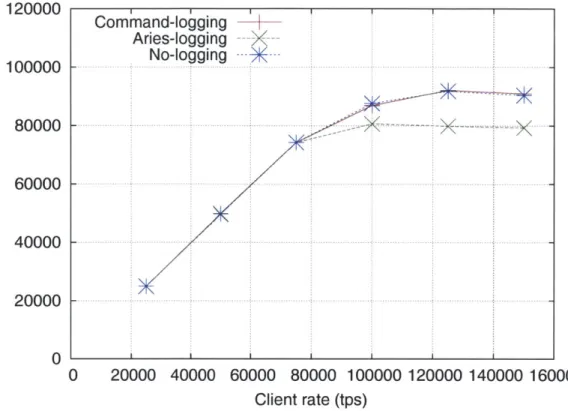
Figure 5-2 shows the variation in system throughput for the voter benchmark as the client rate is varied from 25,000 transactions per second up to 150,000 transactions per second. All three logging modes (no-logging, ARIES-logging and command-logging) are able to match the client rate until 80K tps at which ARIES tops out while the other two saturate at 95K tps. We observe that the overhead of command logging is nearly zero. Due to the extra CPU overhead of creating a log record during the transaction, ARIES suffers about 15% drop in maximum throughput at run time. For more complex transactions, the ARIES performance penalty is higher as we see next.
120000 100000 80000 60000 40000 20000 0 1e+06 800000 600000 400000 200000 0 0 20000 40000 60000 80000 100000 120000 140000 160000 Client rate (tps)
Figure 5-2: Voter throughput vs. client rate (both tps).
Command-logging Aries-logging No-logging
0 10000 20000 30000 40000 50000 60000
Client rate (tps)
Figure 5-3: TPC-C throughput (tpmC) vs. client rate (tps).
Command-logging Aries-logging No-logging
-X
U, I-CM 0 E CL 4 -c,) 0-I I I I IFigure 5-3 shows throughput measured in tpmC achieved by the three logging modes for the TPC-C benchmark, as the client rate varies from 10K up to 60K tps. Similar to the results for the voter benchmark, command logging achieves nearly the same throughput as the no logging scenario. However, here ARIES caps out at about
66% of the throughput achieved by the other two.
In other words, command logging provides about 1.5x more throughput than
ARIES for the TPC-C benchmark. This is expected behavior because TPC-C
trans-actions are much more complex than voter transtrans-actions, and each one potentially updates many database records. Extra CPU overhead is incurred in constructing log record for each of these inserts/updates, and the amount of logged data also increases (see Section 5.3.3 for numbers). The penalty on Voter is lower because the number of log writes for the vote transaction is small (just one).
Using the two dimensions of Figure 1-1, both approaches have short transactions, and operate in the "command logging preferred" region of the graph, but TPC-C performs more updates per transaction, and is favored more heavily by command logging.
5.3.2
Latency
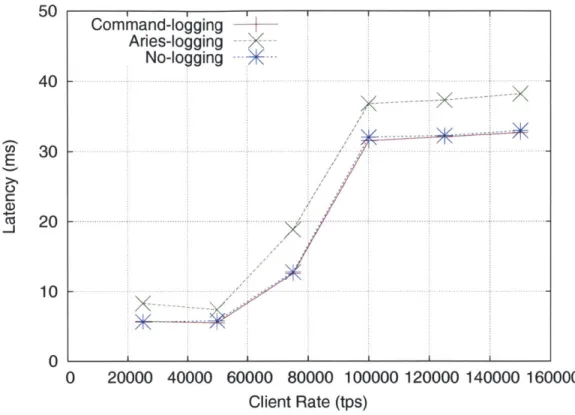
The variation of transaction latency with client rates for the voter benchmark is shown in Figure 5-4. For client rates less than 50K tps, the system runs well under its capacity and all logging methods result in a 5-7ms latency. Note that this latency is dependent on the group commit frequency, which was fixed at 5ms for this experiment
(the effect of varying group commit frequencies is studied in a later experiment). The latencies for all methods gradually increase as the database server approaches saturation load. Command-logging has almost the same latency as no logging and
ARIES's latency is about 15% higher. The higher transaction latencies for client
rates greater than the saturation load result from each transaction waiting in a queue before it can execute. The queue itself only allows a maximum of 5,000 outstanding transactions, and the admission control mechanism in VoltDB refuses to accept new transactions if the queue is full.
50 40 30 0 0 20000 40000 60000 80000 100000 120000 140000 160000 Client Rate (tps)
Figure 5-4: Voter latency in milliseconds vs. client rate (tps).
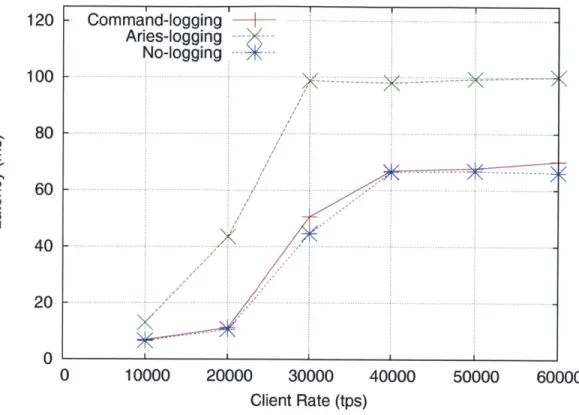
In Figure 5-5, we see that TPC-C performs similarly, except that ARIES reaches saturation at about 21K tps, so that its latency also jumps higher much earlier. The other two logging modes hit saturation latencies at client rates higher than 30K tps and both have about the same latency. Due to extra logging overhead, ARIES latencies are consistently at least 45% higher for all client rates.
5.3.3
Number of Bytes Logged
As noted earlier, the voter benchmark only has one transaction (the stored procedure
vote). For each transaction initiated by the client, command logging writes a log
record containing the name of this stored procedure and necessary parameters (phone number and state) along with a log header. We found that the size of this log record is always 55 bytes. On the other hand, ARIES directly records a new after-image (insert to the votes table) to the log along with a header, and writes 81 bytes per invocation of vote. This transaction only inserts data, so that the before-image does
Command-logging Aries-logging
120 100 1 0 0 ---- ---- . .. . __ 80 - -- -E 40....--. -- ---0 CU 40X 0 10000 20000 30000 40000 50000 60000 Client Rate (tps)
Figure 5-5: TPC-C latency in milliseconds vs. client rate (tps).
not exist. Moreover, as discussed in Chapter 4, before images can be done away with in any case. For voter, both the logging techniques only write one log record per transaction.
The TPC-C benchmark has three different transaction types which update the database: delivery, neworder and payment. The above mentioned three different transaction types for TPC-C together modify 8 out of 9 tables in the TPC-C database (the item table is read-only). Modifications include insert, update as well as delete operations on tables. Figure 5-6 shows on a log scale the number of rows affected in each table for the different operations. In many cases, only 1 record is modified per transaction for each table, but the neworder, orders, order-line and stock tables have either 10 or 100 records modified per transaction for certain operations.
Whenever an insert, delete or update is performed on a database tuple, ARIES writes a log record identifying the tuple, the table in question as well as the operation (along with a log header). In case of an insert, the entire tuple contents are recorded
C-) 0, 0) 0 L aO U)
Figure 5-6: Number of data tuples modified per transaction for different TPC-C tables. Note that the y-axis is on a log scale.
0 . 0 C) L> 0 . a1) 0. E z 250 200 150 100 50 0
Figure 5-7: Number of bytes written per ARIES log record for different TPC-C tables.
A -- - - - -- -t
-Insert
Update
Delete
100 10 1 0.1 -- - --...
1'I1
I-I I1
Q 0.
I200 a, 150 0 00 0 0 U) CD .0 CD, 50. .0 E Z 0 44-0,.
Figure 5-8: Number of bytes written per log record by command logging for different stored procedures.
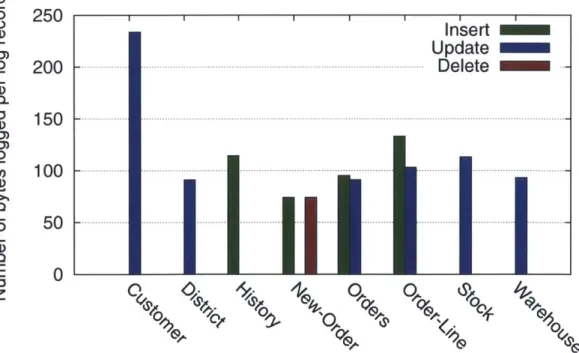
in the after image. For an update, only modifications to the tuple are recorded. Depending on the table that is updated, ARIES log record sizes vary from 70 bytes (New-Order table) to 240 bytes (Customer table) per record, with most log records being less than 115 bytes as can be seen in Figure 5-7.
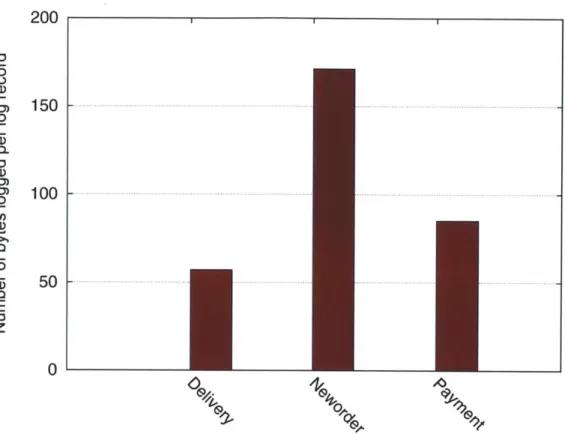
For command logging, Figure 5-8 shows that the three transactions write between
50 (delivery) and 170 (neworder) bytes per transaction (there is only one log record
for each transaction). The neworder transaction logs the highest number of bytes, which is not surprising given that neworder is the backbone of the TPC-C workload.
Overall, on TPC-C, in comparison to command logging, ARIES logs about 10x more data per transaction (averaged over the three transaction types).
1e+06 800000 E 3 600000 0 400000-- 200000--0 00 00 b- 7.
Figure 5-9: Logging mode's TPC-C throughput does not merely depend on the num-ber of log bytes written to disk.
5.3.4
Log Record Size vs. Performance
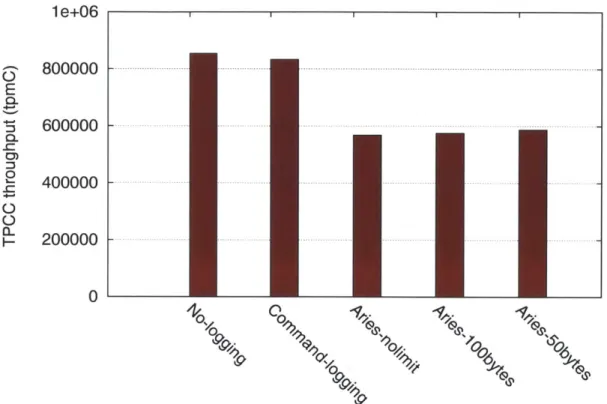
Because ARIES writes so much more data than command logging on TPC-C, we wanted to test to see if the run-time performance difference between the two systems on this benchmark was completely attributable to I/O time.
We ran an experiment to see if this was the case by truncating the size of ARIES log records written out per transaction to a fixed number of bytes. The resulting recovery log is unrecoverable/corrupt, but this is not important for the purposes of this experiment.
Figure 5-9 shows the results. In addition to bars for the three logging modes, we have bars for two synthetic cases where ARIES does the same amount of CPU work creating log records but only writes a maximum of either 50 or 100 bytes to the log for the entire transaction (here 100 bytes is approximately what command logging writes on an average for a TPC-C transaction). In both cases, we see that ARIES throughput slightly increases yet remains lower than command logging by nearly the
same factor.
Thus, the performance gap at run-time between command logging and ARIES is a result of not only the extra disk I/O that ARIES needs to do to write larger records to disk, but also of the higher CPU overhead incurred in logging activities during transaction execution.
5.3.5
Recovery Times
After a server node crashes and is brought up again, it must recover to its initial state by first reading the latest database snapshot into memory, then rebuilding all indexes and finally replaying log records. For both voter and TPC-C, snapshot restore and index reconstruction take the same amount of time irrespective of the logging mode being used. If no logging was done at run-time, all transactions executed after the last snapshot was written to disk will be permanently lost. Hence, our recovery performance numbers are for command logging and ARIES only. Our implementations
for both the logging modes are optimized to do parallel log replay, each execution site reads from the shared recovery log and replays all log records corresponding to its site.
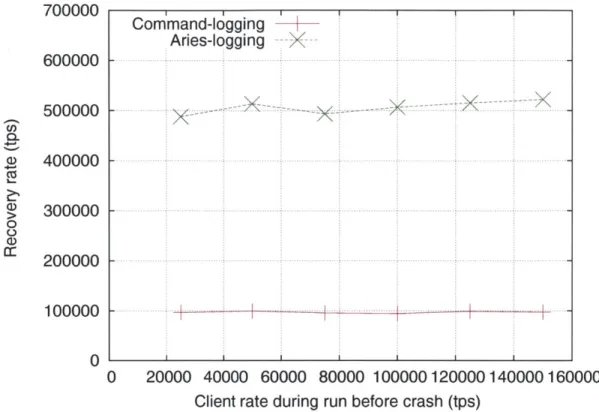
Figure 5-10 shows the log replay times for the two logging modes for voter. During recovery, the system replays the log at maximum speed but does not serve new client transactions simultaneously. Command logging must actually re-execute each trans-action, and we see that its 100K tps recovery rate is about the same as the maximum throughput it can achieve at run-time (seen earlier in Figure 5-2). On the other hand, ARIES is able to replay the log almost 5 x faster at about 500K tps. This difference is due to the fact that ARIES directly records each transaction's modifications to the log at run-time. It does not have to repeat its reads or transaction logic during recovery and is able to recover much faster. The simplicity of Voter transactions ensures that the ARIES overhead of parsing each log record and reapplying the relevant updates is small.
In Figure 5-11, we see that even for the TPC-C benchmark, ARIES log replay is faster compared to command logging. Command logging can only recover at about
700000 Command-logging Aries-logging
X
600000 500000 ..x
X ---- X . 400000 > 300000 0 200000 100000 -0 0 20000 40000 60000 80000 100000120000140000160000 Client rate during run before crash (tps)Figure 5-10: Voter log replay rates (tps).
865K tpmC, which is also its maximum run-time throughput on an average (Figure 5-3). However owing to the increased complexity of TPC-C transactions, ARIES must
now pay a much higher cost of parsing its more sophisticated log records for each transaction compared to command logging. This is reflected in the reduced gap between command logging and ARIES recovery speeds; ARIES replay is only about 1.5x faster for TPC-C as opposed to the 5x speedup for voter.
Recovery numbers in the two plots just discussed are for log replay only and do not include log read times. Once a database snapshot has been restored from disk, the log is read in chunks by a single execution site and thereafter shared by all sites on the node during replay; this applies for both command logging and ARIES.
For both benchmarks, the log read in case of command logging added less than 1% extra overhead to the replay time. The reasons for this were two-fold: (a) the amount of data written per transaction by command logging is rather small (as seen earlier in Section 5.3.3), and (b) re-execution of transactions is expensive compared to the
1.6e+06 Command-logging Aries-logging
X--1.4e+06... 1.2e+06 -1e+06 S 800000 600000 cc~ 400000 200000 0 0 10000 20000 30000 40000 50000 60000 Client rate during run before crash (tps)
Figure 5-11: TPC-C log replay rates (tpmC).
amortized I/O cost of reading a transaction's log records. In contrast, the numbers look very different for ARIES; log read now accounted for an additional 30% overhead to the replay time for voter and about 8% added overhead to the replay time for
TPC-C. Because ARIES replay can happen in parallel, it appears that a single core
read of the log adds to the faster ARIES replay times substantially; the high 30% added overhead for the simpler voter benchmark attests to this.
5.3.6
Group Commit Frequency
The idea behind group commit is to batch together log records for different transac-tions and flush them to the disk together. In this way, synchronous disk writes are amortized across many transactions, at the cost of additional latency per transac-tion. Group commit is essential for obtaining high throughput from a transactional database system that employs logging. It is important that both command logging and ARIES group-commit at the same frequency for an apples-to-apples comparison.
C a) 4-D CO 16 14 12 10 8 6 4 2 0 0 2 4 6 8 10 12 14 16
Group commit frequency (ms)
Figure 5-12: Voter latency (ms) vs group commit frequency (ms).
We ran an experiment to study the effect varying group commit frequency has on transaction latency when the server is running well below maximum capacity. This is important so that the increased wait latency for a saturated server does not mask the effect that group commit frequency has on latency. From Figures 5-12 and 5-13, we see that for both voter and TPC-C, as the group commit frequency is varied from 1 ms to 15 ms, average latencies for ARIES and command logging increase linearly. It appears that larger group commit frequency values linearly hurt latency.
To observe the effect of group commit frequency on system throughput, we ensured that the database servers were saturated otherwise throughput will not depend on group commit frequency.
For voter, because each transaction is extremely short and touches only one database record, every millisecond of extra time spent waiting for group commit decreased throughput as the frequency varied from 1 ms to 15 ms. At a group-commit frequency of 15 ms, throughput was down by 10% compared to the saturation
Command-logging Aries-logging
X
-. ....
Command-logging 20 Aries-logging
X
15 E C a 10 0 0 2 4 6 8 10 12 14 16Group commit frequency (ms)
Figure 5-13: TPC-C latency (ms) vs group commit frequency (ms).
throughput we saw in Figure 5-2.
TPC-C transactions are more complex and we observed that varying the group
commit frequency from 1 ms to 15 ms had negligible effect on both command logging and ARIES TPC-C throughputs. In fact, for extremely high frequency flush rates of
1 ms to 2 ms, we saw that the performance actually took a slight dip, suggesting that
we may be hitting hardware limits.
Based on the effect of group commit frequency on latency and throughput for both benchmarks, we believe that setting the group commit frequency to a 3 ms-5 ms value leads to good performance.
5.3.7
Transaction Length
As we noted in Chapter 1, OLTP transactions have become shorter as processors have gotten faster and RAM sizes of tens of gigabytes have become routine. To simulate slower machines and longer OLTP transactions of the era in which ARIES