Flisi Sara
Meroni Elena Claudia Vera-Toscano Esperanza
Educational outcomes
and immigrant background
This publication is a technical report by the Joint Research Centre (JRC), the European Commission’s science and knowledge service. It aims to provide evidence-based scientific support to the European policy-making process. The scientific output expressed does not imply a policy position of the Commission. Neither the Commission nor any person acting on its behalf is responsible for the use that might be made of this publication.
Contact information Name: Elena Claudia Meroni
Address: Joint Research Centre, Unit B4 — Human Capital & Employment. Via Enrico Fermi 2749, TP 361, I-21027 Ispra (VA), Italy
E-mail: [email protected] Tel.: +39 0332 78 5608 JRC Science Hub https://ec.europa.eu/jrc JRC102629 EUR 28195 EN
PDF ISBN 978-92-79-63485-7 ISSN 1831-9424 doi:10.2791/026577 Luxembourg: Publications Office of the European Union, 2016
© European Union, 2016
Reproduction is authorised provided the source is acknowledged.
How to cite: Flisi, S., Meroni, E.C., Vera-Toscano, E. (2016). Educational outcomes and immigrant background. EUR 28195 EN. doi:10.2791/026577
Contents
Abstract ... 1
1. Introduction ... 2
2. Definitions of migrants, data sources and country coverage ... 3
3. Children’s education and skills ... 5
3.1 A look at the skills distribution ... 5
3.2 Low-achievers in maths, reading and science... 7
3.3 Disentangling the differences in performance between native and migrant students ... 10
3.4 Beyond cognitive outcomes: differences in non-cognitive skills ... 12
4. The performance of young adults ... 15
4.1 Early school leaving ... 16
4.2 NEETs ... 19
4.3 Tertiary education attainment ... 21
4.4 Employment rate of recent graduates ... 24
5. A snapshot of skills among adult native and migrant populations in some EU countries ... 26
5.1 Natives’ and migrants’ literacy and numeracy skills ... 28
5.2 How are generation 1.5 and the second generation doing? ... 30
5.3 Migrants’ skills and labour market outcomes ... 32
6. Summary: main ideas for policy-making ... 36
References ... 37
Appendix A ... 38
Appendix B ... 41
List of figures ... 46
Abstract
This technical brief aims to answer questions such as:
How do the skills and educational outcomes of foreign-born young people compare with those of the native-born?
Do immigrants’ outcomes differ depending on whether they are EU foreign-born or non-EU foreign-born?
How do the educational outcomes of second-generation immigrants compare with those of first-generation immigrants?
How does the performance of recently arrived migrants compare with that of long-established immigrants? and with that of natives?
Is there a correlation between educational outcomes and age of arrival or duration of stay?The brief thus seeks to contribute to analysis of the qualifications and skills composition of migrants in EU countries, as compared with that of their native counterparts. We take a life-cycle approach, focusing in turn on children, young adults and the overall working-age population. We start by looking at the skills of 15-year-old pupils. We then move on to the performance of young adults, in terms of a number of education-related indicators: early school leaving (ESL), young people neither in employment nor in education and training (NEETs), tertiary education attainment (TEA) and employment rate of recent graduates. Finally, we present a snapshot of the skills of the adult population.
The results show that second-generation migrant students are systematically more disadvantaged than their native peers across EU countries; however, adults who arrived in the country when still young generally perform at levels closer to those of their native counterparts (or at least better than first-generation migrants), showing that education systems (including vocational training) have a key role to play in the integration process. Nonetheless, there still seems to be a significant under-used stock of migrant human capital. Being aware of this situation is crucial to putting in place policies and active measures to ensure that adult migrants are fully integrated.
1.
Introduction
Over the past two decades, immigration flows across the EU have become significantly greater and more diverse – as regards not only immigrants’ countries of origin (1) and their destinations, but also levels of education and skills, and the various categories of entry (i.e. to work, as a result of free movement within the EU, or for humanitarian reasons). This diversity poses extraordinary challenges for EU migration and integration policymakers seeking to ensure that immigrants and their families (young children especially) are integrated into the labour force and society overall.
If we want to ‘make the most of migration’, a detailed knowledge of migrants’ education and skill levels, how they differ from those of the natives, and their use in the labour market and everyday life, becomes essential. It has been widely acknowledged that education and skills, together with research and innovation, are major sources of economic prosperity (Aghion and Howitt, 2009; Hanushek and Woessmann, 2012). Empirical evidence on migration issues is long and extensive (for a recent input see OECD/European Union, 2015), so this brief seeks specifically to contribute to analysis of the qualifications and skills composition of migrants in EU countries, as compared with that of their native counterparts. A life-cycle approach is followed, focusing in turn on children, young adults and the overall working-age population. We start by looking at the skills of 15-year-old pupils. We then move on to the performance of young adults, in terms of a number of education-related indicators: early school leaving, young people neither in employment nor in education and training, tertiary education attainment and employment rates among recent graduates. Finally, we present a snapshot of the skills of the adult population.
We expect this empirical evidence to be helpful as a basis for education, labour market, migration and integration policies.
(1) Immigration takes place when an individual or a family move to a new country from their country of origin; migration denotes the act of moving from one place to another — within a country or across borders – and usually refers not to a single individual or family, but a larger demographic group.
2.
Definitions of migrants, data sources and country
coverage
This brief will analyse the performance of two different groups of migrants, namely first- and second-generation migrants, in comparison with natives as a reference category; the definitions adopted for each of the groups is presented in the box below.
Data sources for the analysis include:
1. the 2012 OECD Programme of International Student Assessment (PISA) survey, which covers pupils aged 15 at the time
of the survey;
2. the 2012 Survey of Adult Skills of the OECD Programme for the International Assessment of Adult Competencies (PIAAC), where a sub-sample of individuals aged 25 to 65 will be analysed; and
3. the 2014 Labour Force Survey (LFS) ad hoc module on the labour market situation of migrants and their immediate descendants (2).
Despite the uniqueness of these surveys for the purpose of this brief, they have at least two limitations worth highlighting: - a few of the migrant sub-samples under
investigation are particularly small in some countries, preventing us from using results for them in some sections of the brief; and
- a certain language competence is needed to participate in the PISA and PIAAC surveys. While young children covered by PISA may already have some language proficiency, this is often not the case for adults, especially if they have not spent a long time in the host country; these migrant adults with language difficulties are more likely to be excluded from PIAAC, so migrants who speak the language of the host country (e.g. Latin Americans in Spain,
as opposed to Moroccans, who also represent a major migrant group there) may be over-represented.
In order to better understand and characterise both migrants and natives across countries, while simultaneously allowing cross-national comparisons, we have clustered the Member States in seven groups on the basis of immigrant background characteristics as proposed in OECD/European Union (2015). The groups are:
Group 1 — Longstanding destinations with many recent and highly educated migrants: Luxembourg (LU) and the United Kingdom (UK);
(2) The available data do not cover incoming asylum-seekers in 2015-2016.
Definitions of migrant background
Non-migrant (native): individuals
born in the country of
assessment/survey, or those with at least one parent born in that country; individuals who were born abroad with at least one parent born
in the country of
assessment/survey;
Second-generation migrants: those born in the country of
assessment/survey, but whose
parents were born in another country. In this case, it is not the individuals who move, but their
parents (definition based on
previous generation’s move);
First-generation migrants: those
born outside the country of
assessment/survey and whose
parents were also born in another country. Among these individuals we further define ’generation 1.5’ migrants as those who arrive at the age of 15 or before.
Group 2 — Longstanding destinations with many settled low-educated migrants: Austria (AT), Belgium (BE), France (FR), Germany (DE) and the Netherlands (NL);
Group 3 — Destination countries with significant recent and humanitarian migration: Denmark (DK), Finland (FI) and Sweden (SE);
Group 4 — New destination countries with many recent low-educated migrants: Greece (EL), Italy (IT), Portugal (PT) and Spain (ES);
Group 5 — New destination countries with many recent highly educated migrants: Cyprus (CY), Ireland (IE) and Malta (MT);
Group 6 — Countries with an immigrant population shaped by border changes and/or national minorities: Croatia (HR), Czech Republic (CZ), Estonia (EE), Hungary (HU), Latvia (LV), Lithuania (LT), Poland (PL), Slovakia (SK) and Slovenia (SI);
Group 7 — Emerging destination countries with small immigrant populations: Bulgaria (BG) and Romania (RO).
3.
Children’s education and skills
3.1 A look at the skills distribution
To get a first glimpse of the skills differences between natives and migrants across EU countries, we compare the PISA mathematics proficiency scores of 15-year-olds for the three groups under investigation. BG, CZ, HU, LT, PL, RO and SK were excluded from the analysis due to the very limited sample size of the migrant population; the same applies to first-generation migrants in EE and LV (3). Figure 1 shows the mean and median maths proficiency scores, and scores at the top and bottom of the distribution (95th and 75th, and 25th and 5th percentiles, respectively, to capture the performance of the best and worst achievers in each country) (4).
(3) For PISA analysis, we take 100 as the threshold for a country’s inclusion. See Table A1 in Appendix A for sample sizes in the PISA survey.
(4) A similar pattern emerges when considering reading scores (see Figure A1 in Appendix A). The PISA Survey assesses whether students who are about to finish compulsory schooling have acquired the skills and knowledge needed (in maths,
reading and science) to participate fully in society. These students have completed at least six years of formal education, regardless of the kind of establishment they attended, whether it was public, private or a foreign school
in the host country, whether they attended on a full- or part-time basis, and whether the curricula were academic or vocational.
Figure 1: Distribution of mathematics proficiency scores (PISA 2012)
NB: Percentiles in mathematics proficiency: mean (black line), median (yellow line), 25th and 75th (dark bars) and 5th and 95th (lighter bars). Countries are presented by group.
Source: Own elaboration using PISA data.
The results in Figure 1 show that:
in the UK, a country from Group 1 with a long tradition of highly educated migrants, the overall distribution for both generations of migrants resembles that for natives (blue compared with orange and green vertical bars). This does not hold for LU, where both first- and second-generation migrants are worse off than natives, not only in the mean and median, but also at the 25th and 75th percentiles (lower and upper parts of the dark vertical bars). The same broadly holds for IE, which is included in Group 5 as a newer destination for highly educated migrants. It should be noted, however, that the top performers (95th percentile, i.e. the light green bar) among first-generation migrants in LU and UK have scores that are comparable with or even higher than those of natives;
in Group 2 and 4 countries (receiving low-educated migrants), migrant students from both generations do worse than natives. Nevertheless, we observe two different situations:
in DE, FR, ES and IT, second-generation migrants perform slightly better than first-generation migrants, suggesting that being born in the host country has a positive effect on school performance;
on the other hand, in AT, BE, NL, EL and PT, the two groups perform similarly (on average). This is surprising, since we would have expected the performance of second-generation migrants in all these countries (which are traditional receivers of low-educated individuals) to be closer to that of their native peers, as they have always been involved in the education system of the host country;if we compare these two groups of countries, average Italian, Spanish and Portuguese natives have similar scores to average first-generation migrants in countries like NL; this provides an indication of the composition of the human capital pool in these countries;
results on mean and median performance are poorer for the Group 3 countries (DK, FI and SE) hosting humanitarian migration. Here the top-performing migrants of both generations (95th percentile)
have similar scores to the top 75th percentile of natives, and the average native scores higher than the top 75th percentile of migrants. As for Groups 2 and 4, migrants
(both first- and
second-generation) do worse
than their native
counterparts;
results are mixed for Group 6, with SI showing larger differences between migrants and natives than the
other countries. In SI, first-generation migrants perform worse than second-generation migrants, while in HR the two groups perform similarly.
3.2 Low-achievers in maths, reading and science
Across the EU, there are serious concerns about young people’s education, including whether they are developing sufficient abilities in reading, mathematics and/or science to cope with everyday-life situations. Accordingly, the strategic framework for European cooperation in education and training (ET 2020) (5) recognised the need to pay greater attention to raising the level of basic skills and set a benchmark in an effort to reduce the incidence of low
achievement in such skills. Low achievement is computed using PISA data. Low achievement in mathematics means that a 15-year-old student is unable to extract relevant information from a single source, employ basic algorithms, formulae procedures, conventions, or direct reasoning, or arrive at
literal interpretations of the results. In science, low achievers fail to demonstrate the scientific knowledge and skills that will enable them to participate actively in daily-life situations related to science and technology. Low performance in reading means not being capable of solving basic reading tasks, such as locating straightforward information, making low-level inferences, working out what a well-defined part of a text means and using some outside knowledge to understand it.
(5) OJ C 119, 28.5.2009, p. 2.
LOW-ACHIEVERS
The proportion of individuals with insufficient abilities in reading, mathematics and science, expressed as the proportion scoring below
level 2 in PISA, should be less than 15 % across all EU countries.
The distribution of mathematics proficiency scores among students varies widely across
and within countries, but in general migrants tend to perform worse than their
native counterparts at the mean, median, bottom and top parts of the score distribution. Only countries with a long tradition as receivers of highly educated migrants (Group 1) have first-generation migrant students who perform better than
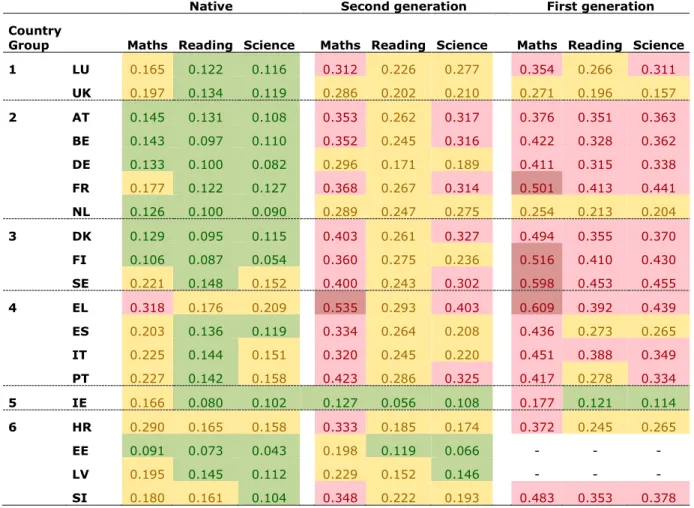
In Table 1 we present the proportion of low achievers in maths, reading and science using PISA data for each migrant background group (natives and first- and second-generation migrants). The results are acceptable for the native sub-sample, at least for science and reading, with the proportion of low achievers slightly exceeding 15 % in a few countries only (EL, HR, SI for reading, and HR, PT and SE for science). In contrast, the proportion of low achievers in mathematics is above 15 % in most countries, although it exceeds 30 % only in EL (31.8 %).
On the other hand, the figures are worse for both second- and first-generation migrants. In all countries except IE, migrants perform worse than natives and have a low-achievement rate of over 15 % in all subjects. The incidence of low achievers is generally higher among first-generation than among second-generation migrants, with rates well above 30 % in all subjects. Participation in the education system of the host country seems to benefit second-generation migrants in terms of reading performance; nevertheless, individuals in this group are still performing significantly worse than their native peers with native parents, suggesting that going through the whole school system cycle in the host country is not enough to close the gap.
Table 1: Proportion of low-achievers in maths, reading and science by country group
Native Second generation First generation
Country
Group Maths Reading Science Maths Reading Science Maths Reading Science
1 LU 0.165 0.122 0.116 0.312 0.226 0.277 0.354 0.266 0.311 UK 0.197 0.134 0.119 0.286 0.202 0.210 0.271 0.196 0.157 2 AT 0.145 0.131 0.108 0.353 0.262 0.317 0.376 0.351 0.363 BE 0.143 0.097 0.110 0.352 0.245 0.316 0.422 0.328 0.362 DE 0.133 0.100 0.082 0.296 0.171 0.189 0.411 0.315 0.338 FR 0.177 0.122 0.127 0.368 0.267 0.314 0.501 0.413 0.441 NL 0.126 0.100 0.090 0.289 0.247 0.275 0.254 0.213 0.204 3 DK 0.129 0.095 0.115 0.403 0.261 0.327 0.494 0.355 0.370 FI 0.106 0.087 0.054 0.360 0.275 0.236 0.516 0.410 0.430 SE 0.221 0.148 0.152 0.400 0.243 0.302 0.598 0.453 0.455 4 EL 0.318 0.176 0.209 0.535 0.293 0.403 0.609 0.392 0.439 ES 0.203 0.136 0.119 0.334 0.264 0.208 0.436 0.273 0.265 IT 0.225 0.144 0.151 0.320 0.245 0.220 0.451 0.388 0.349 PT 0.227 0.142 0.158 0.423 0.286 0.325 0.417 0.278 0.334 5 IE 0.166 0.080 0.102 0.127 0.056 0.108 0.177 0.121 0.114 6 HR 0.290 0.165 0.158 0.333 0.185 0.174 0.372 0.245 0.265 EE 0.091 0.073 0.043 0.198 0.119 0.066 - - - LV 0.195 0.145 0.112 0.229 0.152 0.146 - - - SI 0.180 0.161 0.104 0.348 0.222 0.193 0.483 0.353 0.378
NB: We highlight in green proportions below 0.15, in yellow those between 0.15 and 0.30, in red those between 0.3 and 0.5, and in dark red those above 0.5.
Source: Own elaboration using PISA data.
Table 1 shows that the performance of migrants in IE and UK is quite similar to that of their native counterparts. This can be explained by the fact that these countries are usually characterised by highly skilled migration. Nonetheless, this pattern is not observed in LU — also a high-skill migration country — where the rate of low-achievement among migrants is up to twice as high as that among native students.
On the other hand, countries characterised by humanitarian migration (Group 3 – DK, FI and SE) and those in Groups 2 and 4 (destinations of low-educated migrants) show significant differences between native and migrant sub-populations. While the proportion of native low-performers in any subject is generally low (especially in Group 2 and 3 countries), the rate of low-achievement among migrants is systematically above the 15 % target, with around half of the first-generation migrant population lacking basic skills in mathematics in many countries. In most countries, the proportion of low performers is 20 percentage points (p.p.) higher among first-generation migrants than among natives, with the biggest differences (close to 40 p.p.) in countries in Group 3.
First- and second-generation migrants have a much higher rate of low-achievement than
natives. The figures are particularly striking for first-generation migrants, for
whom the low-achievement rate exceeds 30 % in maths,
science and reading in most countries.
Countries with an immigrant population shaped by border changes and national minorities (Group 6) are those where the performance gap between natives and second-generation migrants is smallest. While HR is one of the countries with the highest incidence of low-achievers, no big differences are found between natives and (even first-generation) migrants. On the other hand, SI shows no consistent gaps between second-generation migrants and natives (especially in reading and science), while a more worrying picture emerges for first-generation migrants.
3.3 Disentangling the differences in performance between native
and migrant students
The differences in performance between native and migrant students across different EU countries in subjects like maths, reading or science could be due to various factors, e.g. a lack of socioeconomic and cultural resources. We therefore calculate the migrant ‘residual’ achievement gap (i.e. net of socioeconomic background) to isolate the differences in performance from the component that is due to differences in parental background characteristics. To do so, we focus on the synthetic measure provided by PISA, i.e. the index of economic, social and cultural status (6). We run an ordinary least squares (OLS) regression controlling for gender and socioeconomic status, including dummies for first- and second-generation migrants. The coefficients associated with the dummies can be interpreted as the achievement gaps net of socioeconomic background and are reported in Figure 2 for the three subjects.
(6) This index is derived from three indices: highest occupational status of the parents, highest educational level of the parents and home possession (which comprises measures of family wealth, cultural possession and educational resources).
Figure 2: Gap in PISA score points between natives and first- and second-generation migrants, after controlling for socioeconomic status and gender
NB: In the three graphs we report the coefficient associated with the dummies for first-generation migrants and second-generation migrants in a regression where the dependent variable is the PISA score in the relevant subject, controlling for socioeconomic status and gender. Empty bars are coefficients not significant at 5 %. Countries are presented by group.
Source: Own elaboration using PISA data.
-100 -80 -60 -40 -20 0 UK LU AT BE DE FR NL DK FI SE EL ES IT PT IE HR EE LV SI 1 2 3 4 5 6 Science -100 -80 -60 -40 -20 0 UK LU AT BE DE FR NL DK FI SE EL ES IT PT IE HR EE LV SI 1 2 3 4 5 6 First generation Second generation Mathematics -100 -80 -60 -40 -20 0 UK LU AT BE DE FR NL DK FI SE EL ES IT PT IE HR EE LV SI 1 2 3 4 5 6
Reading
Results show that the achievement gap between natives and both generations of migrants persists in all countries except UK, IE, HR and LV, even after controlling for socioeconomic status. This suggests that the lower performances of the migrant population are not simply due to poorer socioeconomic conditions in the household, but that other mechanisms contribute significantly to the native/migrant gap.
3.4 Beyond cognitive outcomes: differences in non-cognitive skills
It is well documented that cognitive abilities are an important predictor of wages, schooling and overall success. Nevertheless, non-cognitive abilities (perseverance, motivation, risk aversion, self-esteem, self-control, self-discipline, leisure preferences) also appear to have a direct effect on wages (after controlling for schooling), schooling, teen pregnancy, smoking, crime, performance on tests and many other aspects of social and economic life (Almlund et al., 2011; Kautz et al., 2014). Non-cognitive abilities may be linked to the individual’s education path. Heckman et al. (2010) estimate a model of sequential educational choice and note that non-cognitive skills, as measured by young individuals’ participation in risky behaviour, primarily affect age-30 earnings through their effects on education. Borghans et al. (2011) found that a substantial part of the variance in test scores and grades, which are often used as measures of cognition, are explained by personality (non-cognitive) variables.Therefore, we move now from students’ achievement to their non-cognitive abilities and examine how migrants and natives differ in terms of these outcomes. In PISA, we can measure three main types of non-cognitive outcome:
(1) engagement with and at school; (2) drive and motivation; and
(3) mathematics self-beliefs, disposition and participation in mathematics activities (7).
While most of these measures are based on subjective questions, it is well documented that the responses are meaningful and comparable among individuals at least at ordinal level (Ferrer-i-Carbonell, 2002; Sen, 1999).
(7) See Appendix B for a detailed description of how these outcomes are measured in PISA.
Even after controlling for socioeconomic status, the gap between natives and first- and second-generation migrants remains.
For each of these outcomes, we run an OLS regression, including migrant status (first and second generation) as the main independent variable and further controlling for gender and socioeconomic status. These regressions allow us to assess how migrants differ from natives in non-cognitive abilities, netting off the effect of gender and socioeconomic background.
Table 2: Gap in PISA non-cognitive skills between natives, first- and second-generation migrants, after controlling for socioeconomic status and gender
NB: (1) refers to first-generation migrants and (2) to second-generation migrants in relation to natives (the reference category). Green cells indicate significantly better performance in the non-cognitive skills measured (by higher positive non-cognitive skills ‘+’ or lower negative ones ‘-’) for the group in question. Red cells indicate worse performance in the non-cognitive skills measured (by higher negative non-cognitive skills ‘+’ or lower positive ones ‘-’). Empty cells are not statistically significant results.
Source: Own elaboration using PISA data.
In a number of countries, the results for natives and migrants in Table 2 do not seem very different (i.e. significant results are found only for a small number of non-cognitive skills measured). This is the case for DE, EL, PT, HR and EE for first- and
Group Country 1 2 1 2 1 2 1 2 1 2 1 2 1 2 1 2 1 2 1 2 1 2 1 2 1 2 1 2 1 2 1 2 1 2 1 2 1 2 Lack of punctuality + + + + + + + + + + + + + + + + + + + + + + + + + + + + + : : + Absenteeism + + + + + + + + + + + - + + + + + + - + Sense of belonging + - - + + + + + + - - - -
-Attitude (learning outcomes) + + + + + + - - -
-Attitude (learning activities) + + + + + + + + + + + + + + + - +
Perseverance + + + + + + + + + + + + + + + + - + +
Openess to problem solving + + + + + + + + + + + + - + +
Attribute to failure - + - - - + - - -Maths interest + + + + + + + + + + + + + + + + + + + - + + + Instrumental motivation + + + + + + + + + + + + + + + + + + + + Subjective norms + + + + + + + + + + + + + + + + + + + + + + + + + + + + Maths self-concept + + + + + + + + + + + - - + + - - + -Maths anxiety - + + - + + + + + + + + + + + + + Maths behaviour + + + + + + + + + + + + + + + + + + + + + + + + + Maths self-efficacy + + + + + + + + - - - + Maths intention + + + + + + + - + + + + + UK LU AT BE DE FR NL DK FI SE PT IE 4 5 6 D R IV E A N D M O TI V A TI O N M A TH EM A TI C S SE LF-B EL IE FS 1 2 3 HR EE LV SI EN G A G EM EN T EL ES IT
Students’ engagement, drive and self-beliefs (PISA 2012)
Engagement with and at school
1. Lack of punctuality
2. Absenteeism
3. Sense of belonging
4. Attitude towards school
a. Learning outcome b. Learning activities Maths self-beliefs, disposition and participation in maths activities 1. Maths self-efficacy 2. Maths anxiety 3. Maths self-concept 4. Maths behaviours 5. Maths intentions 6. Subjective norm in maths
Drive and motivation 1. Perseverance 2. Openness to problem solving 3. Locus of control 4. Intrinsic and instrumental motivation to learn mathematics
second-generation migrants, and AT, IE, LV and SI for second-generation only. However, some interesting results apply to a majority of countries, in particular:
in terms of engagement, migrants (both first- and second-generation) in most countries tend to arrive late or skip school (absenteeism) more often than their native peers. However, in countries with a long tradition of low-educated migrants (AT, BE, DE, FR and NL) and those receiving recent humanitarian migrants (DK, FI and SE), migrants from both generations generally have a positive attitude to learning, i.e. they seem to understand that trying hard at school is important for getting a job and succeeding in life. In contrast, migrants in countries which are recent receivers of low-educated migrants (ES, IT and, to a lesser extent, EL) perform worse in terms of a sense of belonging and attitudes towards the importance of school;
results for the group of measures relating to drive and motivation show that longstanding destination countries for highly and low-educated migrants (Groups 1 and 2) and countries hosting humanitarian migrants (Group 3) have on average significantly higher values of perseverance, openness, maths interest and motivation, and the same applies to the set of measures relating to maths self-beliefs, in particular subjective norms, maths self-concept and maths behaviour. These dimensions relate to whether students feel that maths is important for their future career and how comfortable they feel studying it. It should also be noted, however, that migrants seem to suffer from a higher level of maths anxiety in some countries. While migrants show less engagement (they are more likely to skip classes or days of school), we can conclude that (first- and second-generation) migrants still show high perseverance and attachment to school in countries with a longstanding tradition of migration (whether low- or highly educated) and those receiving new humanitarian migrants.
4.
The performance of young adults
Having looked at the skills of 15-year-old pupils, we now turn to the performance of young adults, which we consider on the basis of four main indicators:
early school leaving (ESL);
young people neither in employment nor in education and training (NEETs);
tertiary education attainment (TEA); and
employment rate (ER) among recent graduates.ESL and TEA are the focus of the Europe 2020 dual headline target on education and training, and (with the ER of recent graduates) among the six operational benchmarks in the ET 2020 framework. The NEET indicator features on the scoreboard of key employment and social indicators, which identifies major employment and social imbalances within the EU.
The LFS is the official source of statistics on all four indicators. For this part of the technical brief, we rely on a special extraction provided by Eurostat with information from the ad hoc module (AHM) of LFS 2014 on the labour market situation of migrants and their immediate descendants, which allows us to characterise the immigrant groups as defined above (8).
Since the AHM provides information on parents’ country of birth, in a second stage we introduce a further distinction among first- and second-generation individuals:
second generation:
o native-born with foreign background but at least one parent born in an EU or
European Free Trade Association (EFTA) country;
o native-born with foreign background and both parents born outside the EU and
EFTA;
first generation:
o foreign-born in an EU or EFTA country;
o foreign-born outside the EU and EFTA.
Within the first generation, we alternatively distinguish between those who arrived before age 15 (generation 1.5 migrants) and at age 15 or later.
AHM data are available for 24 EU countries (9), but once we disaggregate according to the above categories, sample sizes often become too small to provide publishable results. The next sections will therefore show, for each indicator, only the countries for which data can be published (in some cases with an unreliability flag) (10). Countries are again clustered in groups as proposed in OECD/European Commission (2015).
(8) As explained by Eurostat, the 2014 AHM aimed to compare the labour market situation for first-generation migrants, second-generation migrants and nationals, and to analyse the factors affecting integration in and adaptation to the labour market. Compared with the standard questionnaire, the AHM provides more detailed information on the background of migrants and their descendants, and in particular on the parents’ country of birth; this allows us not only to identify second-generation migrants (i.e. native-born with non-native background, according to the Eurostat definition), but also to distinguish between those with a mixed and those with a foreign background. Eurostat defines the former as persons who are born in the country of interview (native-born) and have one foreign-born parent and one native-born parent, and the latter as persons who are native-born, with both parents being foreign-born. Starting from this information, we re-classify individuals to follow the same comparable classification of natives, first- and second-generation migrants as presented above.
(9) AT, BE, BG, CY, CZ, EE, EL, ES, FI, FR, HR, HU, IT, LT, LU, LV, MT, PL, PT, RO, SE, SI, SK and UK. (10) It should also be noted that information for SE is available only for the tertiary education attainment
4.1 Early school leaving
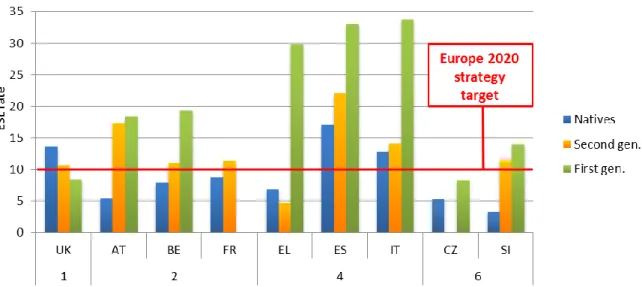
Figure 3 shows ESL rates among natives, first- and second-generation migrants. It is clear how different patterns affect the different groups of countries; in the UK (a traditional destination of highly educated migrants), the lowest incidence of ESL is found among first-generation
migrants, with natives showing the worst outcomes. In countries in the other groups, the opposite applies, with natives performing much better than second-, but especially first-generation, migrants. The situation for first-generation migrants is particularly negative in AT and BE, with ESL rates above 15 %, and even more so in the Group 4 countries (EL, ES and IT, traditional destinations for low-educated migrants), where one in three foreign-born individuals is an early school leaver. In all these countries except EL, the
performances of second-generation migrants fall between those of natives and first-generation migrants.
Figure 3: ESL rates – 18-24 age group (LFS AHM 2014)
NB: Figures lack reliability due to small sample size for SI, for BE, EL and FR for second-generation migrants and for CZ for first-generation migrants. For the missing countries/migrant groups for some countries, figures are not reported because they are below confidentiality limits or due to sample size issues.
Source: Eurostat special extraction from LFS AHM 2014.
It is likely that individual first-generation and second-generation migrants’ performances vary a lot depending on their background. While limited sample sizes do not allow us to
pieces of information for the other indicators (namely whether the individual is neither in formal education nor in non-formal education and training) is missing.
EARLY SCHOOL LEAVERS
An early leaver from education and training is a person aged 18 to 24 who has finished no more
than lower secondary education and is not involved in further education or training; the ESL rate is expressed as a percentage of the total population aged 18 to 24. Lower secondary
education refers to the International Standard Classification of Education (ISCED) 2011
level 0-2.
Reducing the ESL rate to less than 10 % is part of the Europe 2020 headline target on education
and training, and one of the ET 2020 benchmarks.
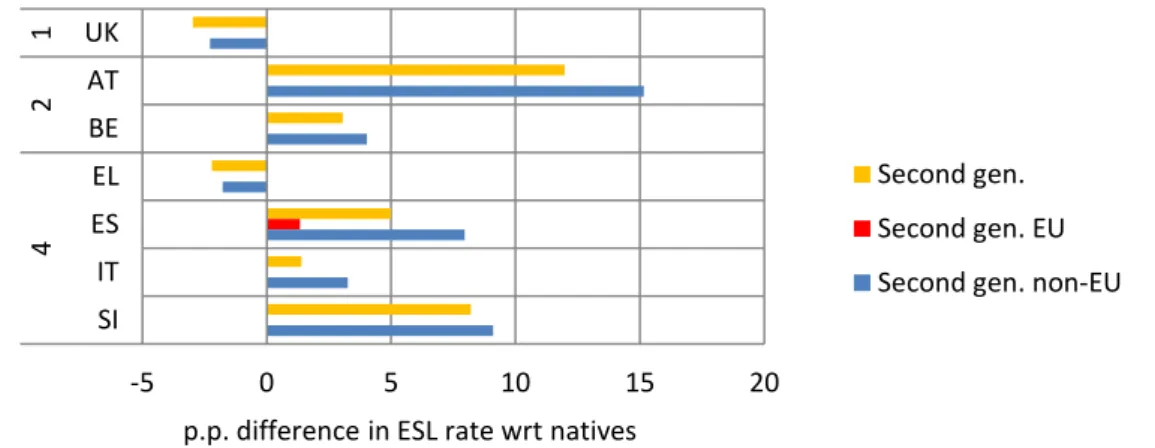
go into as much detail on parents’ socioeconomic background as we have for most of the brief, we can use the individual’s or (for second-generation migrants) the parents’ country of origin to look for systematic differences between young people of EU and non-EU origin (11). The figures below show percentage-point (p.p.) differences in ESL rates between the relevant group and natives. Values under 0 show lower ESL rates, and therefore better performance as compared with natives, while positive values show the opposite. When one adds another factor in the breakdown, sample sizes are reduced further and it is not possible to show figures for all categories due to reliability issues. The precise rate cannot be relied upon, but it is still possible to compare rates for the available sub-groups with the overall rate to see how missing sub-groups are performing as compared with the available ones.
Figure 4 shows ESL rates for different sub-groups of second-generation migrants and Figure 5 presents results for first-generation migrants. Within both groups, individuals from EU origins perform better on average than their non-EU counterparts. In Group 6 countries, first-generation migrants from within the EU even show lower ESL rates than natives (see Figure 5). The exceptions are EL (where the gap between EU and non-EU migrants is very small) and especially the UK, where the better performance of first-generation migrants as compared with natives is entirely driven by individuals from non-EU origins. Otherwise, the results suggest that, overall, EU migrants (both first- and second-generation) find it easier to integrate in the host country.
Figure 4: Gap in ESL rates between natives and second-generation migrants by EU/non-EU origin
NB: Figures lack reliability due to small sample size for BE, EL, ES and SI. For the missing countries/migrant groups for some countries, figures are not reported because they are below confidentiality limits or due to sample size issues.
Source: Eurostat special extraction from LFS AHM 2014. The bars show the p.p. difference between the rates (migrant group considered — native).
(11) As mentioned above, EFTA countries are included in the same group as EU countries.
-5 0 5 10 15 20 UK AT BE EL ES IT SI 1 2 4
p.p. difference in ESL rate wrt natives
Second gen. Second gen. EU Second gen. non-EU
Figure 5: Gap in ESL rates between natives and first-generation migrants by EU/non-EU origin
NB: Figures lack reliability due to small sample size for BE, CZ, EL, SI and UK. For the missing countries/migrant groups for some countries, figures are not reported because they are below confidentiality limits or due to sample size issues.
Source: Eurostat special extraction from LFS AHM 2014. The bars show the p.p. difference between the rates (migrant group considered — native).
To determine whether participation in the host country’s education system is an integration tool for first-generation migrants, we distinguish between the foreign-born who arrived as children and those who arrived as adults. As explained above, we set the threshold at 15 years of age on arrival; those who arrived before that age make up ‘generation 1.5’. Given their age, they are very likely to join the compulsory education system in the host country. Figure 6 shows that, on average, those who arrived as children perform better than those who arrived as adults (with the sole exception of AT, where the rates are very close). This is especially true for Group 4 countries, where the difference in ESL rates between the two sub-groups is 15-37 p.p., suggesting that the education system plays a fundamental role in the integration of the foreign-born.
Figure 6: Gap in ESL rates between natives and first-generation migrants by age at arrival
NB: Figures lack reliability due to small sample size for AT, BE, CZ, SI and UK. For the missing countries/migrant groups for some countries, figures are not reported because they are below confidentiality limits or due to sample size issues.
Source: Eurostat special extraction from LFS AHM 2014. The bars show the p.p. difference between the rates (migrant group considered — native).
-20 -10 0 10 20 30 UK AT BE EL ES IT CZ SI 1 2 4 6
p.p. difference in ESL rate wrt natives
First gen. First gen. EU First gen. non-EU
-20 0 20 40 60 UK AT BE EL ES IT CZ SI 1 2 4 6
p.p. difference in ESL rate wrt natives
First gen. First gen. 1-14 First gen. 15+
4.2 NEETs
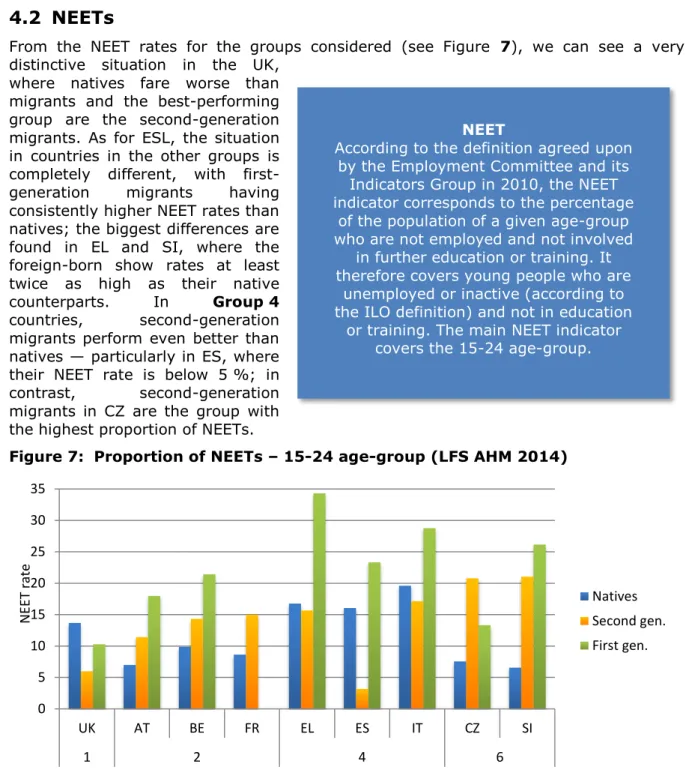
From the NEET rates for the groups considered (see Figure 7), we can see a very distinctive situation in the UK,
where natives fare worse than migrants and the best-performing group are the second-generation migrants. As for ESL, the situation in countries in the other groups is completely different, with first-generation migrants having consistently higher NEET rates than natives; the biggest differences are found in EL and SI, where the foreign-born show rates at least twice as high as their native counterparts. In Group 4 countries, second-generation migrants perform even better than natives — particularly in ES, where their NEET rate is below 5 %; in contrast, second-generation migrants in CZ are the group with the highest proportion of NEETs.
Figure 7: Proportion of NEETs – 15-24 age-group (LFS AHM 2014)
NB: Figures lack reliability due to small sample size for FR for second-generation migrants and for CZ and SI for first- and second-generation migrants. For the missing countries/migrant groups for some countries, figures are not reported because they are below confidentiality limits or due to sample size issues.
Source: Eurostat special extraction from LFS AHM 2014.
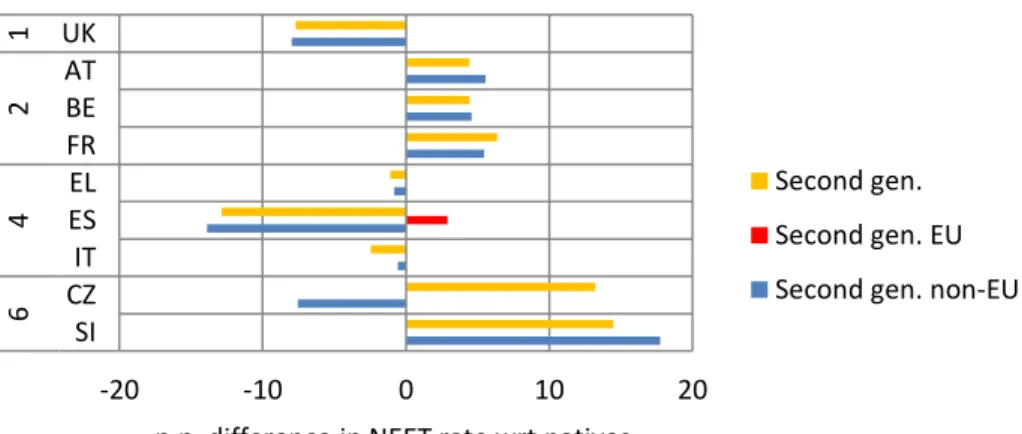
Interestingly, in both ES and CZ, second-generation migrants from non-EU backgrounds are performing much better than their EU counterparts. As shown in Figure 8 (12), the
(12) As for ESL, it is not possible to present exact figures for second-generation individuals from EU origins because of reliability issues, but a comparison between the overall rate and that for those from non-EU backgrounds allows us to infer the relative position of the missing group.
0 5 10 15 20 25 30 35 UK AT BE FR EL ES IT CZ SI 1 2 4 6 N EE T ra te Natives Second gen. First gen. NEET
According to the definition agreed upon by the Employment Committee and its
Indicators Group in 2010, the NEET indicator corresponds to the percentage
of the population of a given age-group who are not employed and not involved
in further education or training. It therefore covers young people who are
unemployed or inactive (according to the ILO definition) and not in education
or training. The main NEET indicator covers the 15-24 age-group.
ESL is a serious problem among first-generation migrants in Group 4 countries (EL, ES and IT), especially if they arrive when they are 15 or older.
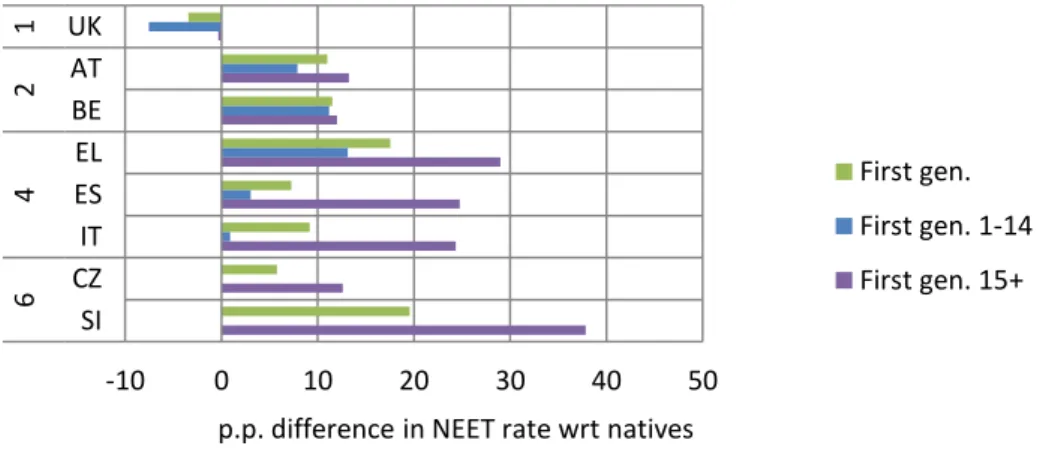
positive performance of second-generation migrants in ES appears to be driven entirely by individuals from non-EU backgrounds (those from EU backgrounds have higher NEET rates than natives), while the poor outcomes of the same group in CZ is explained by the EU component (those from non-EU backgrounds have lower NEET rates than natives). The performance of the two groups is quite similar in the other countries, except SI, where an EU background seems to be associated with a lower NEET rate. As regards first-generation migrants, the situation in Group 2 and 4 countries is more clearly in favour of those born in the EU, while in Group 1 and 6 countries (in particular, UK and CZ) NEET rates are much lower for the foreign-born from non-EU origins than for their EU peers.
Figure 8: Gap in NEET rates between natives and second-generation migrants by EU/non-EU origin
NB: Figures lack reliability due to small sample size for AT, CZ, FR, ES and SI. For the missing countries/migrant groups for some countries, figures are not reported because they are below confidentiality limits or due to sample size issues.
Source: Eurostat special extraction from LFS AHM 2014. The bars show the p.p. difference between the rates (migrant group considered — native).
Figure 9: Gap in NEET rates between natives and first-generation migrants by EU/non-EU origin
NB: Figures lack reliability due to small sample size for AT, BE, CZ, EL and SI. For the missing countries/migrant groups for some countries, figures are not reported because they are below confidentiality limits or due to sample size issues.
Source: Eurostat special extraction from LFS AHM 2014. The bars show the p.p. difference between the rates (migrant group considered — native).
-20 -10 0 10 20 UK AT BE FR EL ES IT CZ SI 1 2 4 6
p.p. difference in NEET rate wrt natives
Second gen. Second gen. EU Second gen. non-EU
-10 0 10 20 30 UK AT BE EL ES IT CZ SI 1 2 4 6
p.p. difference in NEET rate wrt natives
First gen. First gen. EU First gen. non-EU
In Spain, despite the high ESL rate, the proportion of second-generation NEETs is surprisingly small.
Finally, among those born abroad, Figure 10 shows a clear and consistent trend of better performance for generation 1.5 as compared with those who arrived as adults; differences in NEET rates are especially pronounced in Group 4 countries.
Figure 10: Gap in NEET rates between natives and first-generation migrants by age at arrival
NB: Figures lack reliability due to small sample size for AT, CZ and SI. For the missing countries/migrant groups for some countries, figures are not reported because they are below confidentiality limits or due to sample size issues.
Source: Eurostat special extraction from LFS AHM 2014. The bars show the p.p. difference between the rates (migrant group considered — native).
4.3 Tertiary education attainment
Figure 11 shows TEA rates for the various groups. Since this indicator covers a rather narrow age-group, sample sizes are more
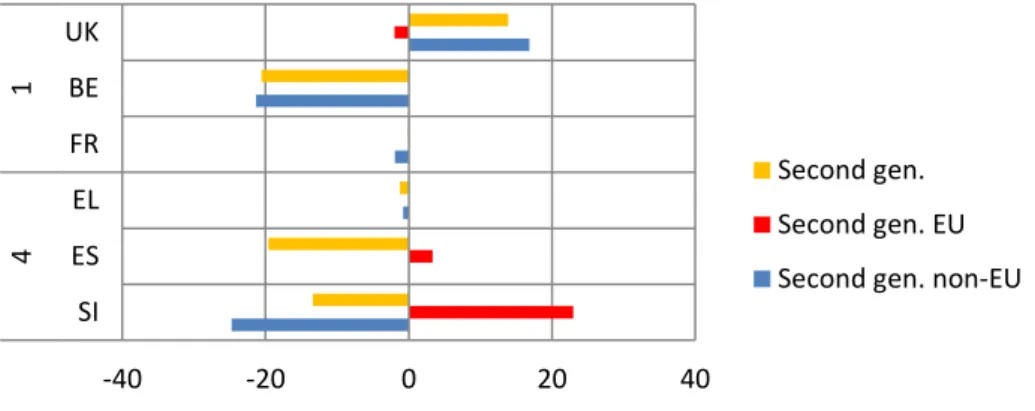
of an issue, forcing us to drop second-generation migrants in four of the 10 available countries. Once again, the UK shows a quite distinctive pattern, with higher TEA rates among first- and especially second-generation migrants than their native peers. In contrast, TEA rates for the foreign-born are consistently lower than those for natives in Group 2 and 4 countries and in SI, while in SE and CZ the rates are very similar. Second-generation migrants in FR and EL perform basically no differently from natives; on the other hand, those in BE perform significantly worse than both natives and first-generation migrants and those in ES and SI perform somewhere in between. Interestingly, in both ES and SI, the negative gap vis-à-vis natives is driven entirely by
second-generation migrants from non-EU backgrounds, while TEA rates are actually higher among migrants from EU origins than among natives (see Figure 12). The opposite holds for the UK (13).
(13) As mentioned above, sample size issues affect TEA data more severely than the indicators shown until now, so very few countries can be taken into account when disaggregating by EU/non-EU origin.
-10 0 10 20 30 40 50 UK AT BE EL ES IT CZ SI 1 2 4 6
p.p. difference in NEET rate wrt natives
First gen. First gen. 1-14 First gen. 15+
TERTIARY GRADUATES The second component of the Europe 2020 dual headline target on education and training is geared
to increasing the proportion of the population aged 30 to 34 having completed tertiary or equivalent education to at least 40 % by 2020. This refers to ISCED 2011
level 5-8 for data from 2014 onwards (ISCED 1997 level 5-6 for
Figure 11: TEA rates – 30-34 age-group (LFS AHM 2014)
NB: Figures lack reliability due to small sample size for SI for first- and second-generation migrants. For the missing countries/migrant groups for some countries, figures are not reported because they are below confidentiality limits or due to sample size issues.
Source: Eurostat special extraction from LFS AHM 2014.
Figure 12: Gap in TEA rates between natives and second-generation migrants by EU/non-EU origin
NB: Figures lack reliability due to small sample size for ES, SI and UK. For the missing countries/migrant groups for some countries, figures are not reported because they are below confidentiality limits or due to sample size issues.
Source: Eurostat special extraction from LFS AHM 2014. The bars show the p.p. difference between the rates (migrant group considered — native).
As regards first-generation migrants, the pattern in favour of individuals born in the EU rather than outside is quite clear, with most countries showing higher TEA rates for the former than the latter. The exceptions are again the UK and, to a lesser extent, EL (where rates are very similar). As shown in Figure 13, the biggest differences between the foreign-born from EU and non-EU countries are found in Group 3 and 6 countries, where TEA rates among the former are even higher than for natives.
-40 -20 0 20 40 UK BE FR EL ES SI 1 4
p.p. difference in TEA rate wrt natives
Second gen. Second gen. EU Second gen. non-EU
Figure 13: Gap in TEA rates between natives and first-generation migrants by EU/non-EU origin
NB: Figures lack reliability due to small sample size for CZ and SI. For the missing countries/migrant groups for some countries, figures are not reported because they are below confidentiality limits or due to sample size issues.
Source: Eurostat special extraction from LFS AHM 2014. The bars show the p.p. difference between the rates (migrant group considered — native).
Surprisingly, there is no clear pattern in favour of the foreign-born who arrived as children (see Figure 14); if anything, the opposite seems to be true in Group 1, 2 and 3 countries and CZ. Only in EL, ES and SI do generation 1.5 migrants appear to be on average more highly educated than the foreign-born who arrived as adults.
Figure 14: Gap in TEA rates between natives and first-generation migrants by age at arrival
NB: Figures lack reliability due to small sample size for EL, ES and SI. For the missing countries/migrant groups for some countries, figures are not reported because they are below confidentiality limits or due to sample size issues.
Source: Eurostat special extraction from LFS AHM 2014. The bars show the p.p. difference between the rates (migrant group considered — native).
-40 -20 0 20 UK AT BE FR SE EL ES IT CZ SI 1 2 3 4 6
p.p. difference in TEA rate wrt natives
First gen. First gen. EU First gen. non-EU
-40 -20 0 20 UK AT BE FR SE EL ES IT CZ SI 1 2 3 4 6
p.p. difference in TEA rate wrt natives
First gen. First gen. 1-14 First gen. 15+
4.4 Employment rate of recent graduates
The third ET 2020 benchmark we take into account in this section is the employment
rate of recent graduates.
As Figure 15 shows, in Group 2 and 4 countries (except IT, where the results are very similar) and SI, employment rates (ER) among recent graduates tend to be lower for first-generation migrants than for natives. In the UK, IT and CZ, on the other hand, the foreign-born show rates comparable to those of natives. As is clear from Figure 17, however, this result conceals different underlying trends for those born in the EU and outside the EU, with rates higher for the former than for natives, and the latter having much lower employment chances. While EU-born first-generation migrants perform better than those not born in the EU in all countries for which data are available, these are the only three cases of different relative positions as compared with their native counterparts.
Figure 15: Employment rate of recent graduates – 20-34 age-group (LFS AHM 2014)
NB: Figures lack reliability due to small sample size for BE and ES for second-generation migrants, for CZ for first-generation migrants and for EL and SI for first- and second-generation migrants. For the missing countries/migrant groups for some countries, figures are not reported because they are below confidentiality limits or due to sample size issues.
Source: Eurostat special extraction from LFS AHM 2014.
The situation of second-generation migrants varies a lot between countries. In ES, they have even higher ER than natives (although, as shown in Figure 16, this is entirely driven by the group of EU origin), while in EL the performance of the two groups is very
EMPLOYMENT OF RECENT GRADUATES
By 2020, the proportion of employed graduates (20-34 year olds) having left
education and training no more than three years before the reference year should be at least 82 %. The indicator
is defined as the percentage of the population aged 20-34 with at least upper secondary education, who were
employed according to the ILO definition, not in further education or (formal or non-formal) training in the four weeks preceding the survey, and
who successfully completed their highest educational attainment 1, 2 or
similar. In BE and SI, on the other hand, their ER is consistently lower than those for both natives and first-generation migrants.
Figure 16: Gap in ERs of recent graduates between natives and second-generation migrants by EU/non-EU origin
NB: Figures lack reliability due to small sample size for all countries but UK. For the missing countries/migrant groups for some countries, figures are not reported because they are below confidentiality limits or due to sample size issues.
Source: Eurostat special extraction from LFS AHM 2014. The bars show the p.p. difference between the rates (migrant group considered — native).
Figure 17: Gap in ERs of recent graduates between natives and first-generation migrants by EU/non-EU origin
NB: Figures lack reliability due to small sample size for all countries but UK. For the missing countries/migrant groups for some countries, figures are not reported because they are below confidentiality limits or due to sample size issues.
Source: Eurostat special extraction from LFS AHM 2014. The bars show the p.p. difference between the rates (migrant group considered — native).
-20 -10 0 10 20 30 UK AT EL ES 1 2 4
p.p. difference in ER of recent graduates wrt natives
Second gen. Second gen. EU Second gen. non-EU
-40 -30 -20 -10 0 10 20 UK AT BE ES IT CZ 1 2 4 6
p.p. difference in ER of recent graduates wrt natives
First gen. First gen. EU First gen. non-EU
5.
A snapshot of skills among adult native and migrant
populations in some EU countries
One of the aims of this section is to provide a snapshot of migrant adults’ literacy and numeracy skills as compared with those of their native counterparts. We do so in three steps:
1.
we test the significance of the skills gap between natives and migrants once we control for age, gender and educational attainment;2.
we explore the effect of the education system in the host country as an ‘equal opportunity tool’, analysing the gap between the native population and migrants who settled in the host country before their 15th birthday and were able to benefit from the system (i.e. generation 1.5, see Portes and Rumbaut, 2006) (14); and3.
we investigate the skills gap between natives and second-generation migrants so as to test the social reproduction theory (15).In addition, we look at the extent to which migrants’ skills are used in the labour market of the host country, more specifically:
whether they find a job; and
the extent to which they are able to make best use of their skills.As mentioned earlier, despite its uniqueness, PIAAC has its limits. First, the migrant samples, in particular for generation 1.5 and second-generation migrants, are particularly small in some countries (see Table 3). As a result, PL and SK have been excluded from our analysis. Only AT, DK, EE, FR, NL, SE and UK have been included for the analysis of generation 1.5 migrants (sample size above 80), while AT, EE, FR, DE, SE and UK are used for the comparison of natives, second-generation migrants and other migrants (16). Secondly, it is important to bear in mind the influence of language proficiency, which may, in some countries, lead to an over-representation of migrants who speak the language of the host country at the expense of other migrants.
(14) When we do so, the remaining group of first-generation migrants is referred to as ‘other migrants’. (15) The social reproduction theory argues that schools are not institutions of equal opportunity, but
mechanisms for perpetuating social inequalities. See Bourdieu and Passeron (1977) for an introduction to the topic.
(16) Belgian data refer only to Flanders and British data to England and Northern Ireland. By ‘other migrants’, we mean first-generation migrants who arrived in the host country when they were 15 years old or older. The Survey of Adult Skills is an
international survey conducted as part of the Programme for the International
Assessment of Adult Competencies
(PIAAC). It measures key cognitive and workplace skills that are needed for individuals to participate in society and for economies to prosper. Using household interviews, it directly assesses the skills of approximately 150 000 working-age adults (16-65 years old) surveyed in 24 countries (17 EU Member States). For the purposes of our analysis, we restrict the sample to individuals aged 25 or more, so as to focus on the group that has already completed schooling (and is not very likely to acquire any further formal education).
Table 3: Sample size and proportions by migration status and country of residence (adults aged 25-65)
Natives Second-generation migrants First-generation migrants TOTAL Generation 1.5 Other migrants
AT 3 478 0.81 102 0.03 88 0.02 465 0.14 4 133 BE 3 703 0.92 71 0.02 43 0.01 236 0.06 4 053 CY 3 462 0.91 7 0 25 0.01 247 0.08 3 741 CZ 4 370 0.93 91 0.02 34 0.01 127 0.04 4 622 DE 3 556 0.81 250 0.06 0 0 510 0.13 4 316 DK 5 009 0.89 27 0.01 130 0.01 1 064 0.09 6 230 EE 4 823 0.75 633 0.12 275 0.05 510 0.09 6 241 ES 4 433 0.89 20 0 24 0 505 0.1 4 982 FI 4 415 0.95 8 0 13 0 133 0.04 4 569 FR 4 890 0.82 283 0.05 190 0.04 486 0.09 5 849 IE 4 439 0.84 28 0.01 30 0 717 0.15 5 214 IT 3 802 0.93 7 0 9 0 275 0.07 4 093 NL 3 804 0.86 57 0.02 80 0.03 258 0.09 4 199 PL 4 840 0.99 51 0.01 1 0 1 0 4 893 SE 2 945 0.8 91 0.03 101 0.03 490 0.14 3 627 SK 4 484 0.98 44 0.01 9 0 31 0.01 4 568 UK 6 671 0.83 243 0.05 91 0.02 583 0.11 7 588
Source: PIAAC data.
The proportion of participating first-generation migrants aged 25-65 ranges from 0 % in PL and 1 % in SK to 15 % in IE, 16 % in AT and 17 % in SE (see Table 3). In DK, ES, FR, NL and UK, 10-13 % of the interviewed population were born abroad, with a significantly lower percentage in other countries, e.g. 4 % in FI.
Figure 18 shows the distribution of the migrant and native populations by education level. Following the same country classification used in the rest of the study, we see how, as traditional receivers of low-educated migrants, ES and IT have the largest proportions of low-educated individuals both among natives and first- and second-generation migrants: about 50 % of Spanish natives and migrants are low-educated, while the same is true for about 40 % of their Italian counterparts. High-education rates among migrants are highest, even above those for natives, in countries that receive highly educated migrants — whether traditionally, such as the UK, or more recently, such as IE or CY. To a lesser extent, education levels among migrants in CZ and EE are also higher than among natives. It may be that these countries’ strategic location and economic characteristics are attracting better-educated migrants. Interestingly, DK, FI and SE are also receivers of highly educated migrants, in contrast to countries such as ES and IT, which have a high proportion of low-educated native workers and are welcoming even more low-educated migrants. This is clearly an indication of the capacity of labour markets to absorb labour resources and of the countries’ potential to develop further.
Figure 18: Distribution by level of education and migrant status
Source: Own elaboration using PIAAC data.
5.1 Natives’ and migrants’ literacy and numeracy skills
As we did for students, we look first at the distribution of skills among migrant and native adults. Figure 19 presents the distribution of their literacy proficiency scores (17), which mostly resemble those of younger people:
Group 5 countries, mainly receivers of highly educated migrants, have a native population that differs little from first-generation migrants (although a wider gap can be found at the bottom of the distribution);
in contrast, Group 2 and 4 countries, mainly receivers of low-educated migrants, have a native population which is on average considerably more skilled than their first-generation migrants. However, the gap is smaller for second-generation migrants. It is important to highlight the overall low performance of individuals in Group 4 countries; not only has their native population the lowest average level of literacy skills, but they are also attracting lower-skilled migrants;
surprisingly, the UK, traditionally a destination for highly educated migrants, shows gaps between natives and migrants closer to those of Group 2 than of Group 5; and mean and median performances are even worse for Group 3 countries (DK, FI and SE), which are mainly hosts for humanitarian migration. Even more striking gaps are found at the bottom of the distribution, with first-generation low-achievers showing the lowest performance of all countries in the analysis. Interestingly, the performance of second-generation migrants in SE tends to be quite close to that of
the native population, suggesting that participation in the education system contributes to integration.
Very similar patterns can be found for numeracy proficiency.
Figure 19: Distribution of literacy proficiency scores among individuals aged 25-65, by migrant status
NB: Percentiles in literacy proficiency: mean (black line), median (yellow line), 25th and 75th (dark bars) and 5th and 95th (lighter bars). Countries are presented by group.
Source: Own elaboration using PIAAC data.
It seems that the skills level of the migrant population is related to that of the native population and somehow adapts to it. In general, literacy and numeracy scores are higher in the native population than among migrants, although the gap varies significantly across countries.
Figure 20 represents average country scores in literacy and numeracy for natives and first-generation migrants. These are calculated on a scale of up to 500 points, so the countries in the upper right square (over 250 points) are those in which both natives and migrants score more highly. The diagonal line indicates the area where natives and migrants have a similar level of proficiency and the farther away the countries are from the diagonal, the greater the differences between the two groups. NL, FI, SE and, to a lesser extent, FR show the biggest differences between natives and migrants; at the opposite end of the scale, IE has the smallest differences. ES and IT have the lowest proficiency levels for natives and among the lowest for first-generation migrants.
Figure 20: Literacy and numeracy skills – first-generation migrants and natives
Source: Own elaboration using PIAAC data.
Figure 21 shows literacy proficiency differences between natives and first-generation migrants after controlling for age, gender and educational attainment. The disadvantage for migrants does not disappear when one takes these factors into account; the biggest gap is found in FI, where migrants’ skills level is 34 % lower than that of their native counterparts. Big gaps are also found in SE, DK, NL, BE (Flanders) and UK. In contrast, CZ has the smallest gap in literacy skills (5.2 % less for migrants).
Figure 21: Native/migrant gap in literacy skills
NB: The figure shows the estimated coefficients for the first-generation migrant dummy at country level in a regression where the dependent variable is the logarithm of the literacy score, controlling for age, gender and level of education. Countries are presented by group.
Source: Own elaboration using PIAAC data.