OpenBU http://open.bu.edu
Theses & Dissertations Boston University Theses & Dissertations
2019
Grounding deep models of visual
data
https://hdl.handle.net/2144/34810
BOSTON UNIVERSITY
GRADUATE SCHOOL OF ARTS AND SCIENCES
Dissertation
GROUNDING DEEP MODELS OF VISUAL DATA
by
SARAH ADEL BARGAL
B.Sc., Kuwait University, Kuwait, 2005
M.Sc., The American University in Cairo, Egypt, 2007
Submitted in partial fulfillment of the
requirements for the degree of
Doctor of Philosophy
2019
Approved by
First Reader
Stan Sclaroff, PhD
Professor of Computer Science
Second Reader
Margrit Betke, PhD
Professor of Computer Science
Third Reader
Kate Saenko, PhD
Foremost, I would like to thank my advisor Prof. Stan Sclaroff for his tremendous and continuous support during my PhD studies. I am grateful for all the time and effort he invested in my professional growth and career development, and I cannot thank him enough for his patience and motivation. I really appreciate how he supported my ideas, and how available, welcoming, and friendly he has been during this journey. Being an exceptionally inspiring researcher, teacher, and advisor, I have learned a lot from him. I have also learned many values by experiencing how humble and remarkably respectful he is towards his students and collaborators. I consider myself very lucky to have been his student, and this has greatly influenced the researcher and person I am today.
I would like to thank my committee members Prof. Margrit Betke, Prof. Kate Saenko, Prof. Aude Oliva, and Prof. Evimaria Terzi for their valuable feedback on my work and their valuable career advice. I would also like to thank Dr. Rana el Kaliouby for sparking my interest in Computer Vision and Machine Learning.
I would like to extend my gratitude to all my dear collaborators for all the great work we accomplished together, for their complementary skills, and for their splendid team spirit. I would like to specifically thank Prof. Vittorio Murino, Dr. Andrea Zunino, Dr. Fatih Cakir, Dr. Kun He, and Dr. Shugao Ma for their great collaboration on multiple research projects and Dr. Jianming Zhang for his great mentoring over the years.
I am very grateful for all the opportunities I have been presented with being part of the Image and Video Computing Group, and part of the Computer Science Department at Boston University. I am also very grateful for all my lab mates who have been a great source of support and inspiration. I thank them for their great company, for the numerous research and career planning discussions, and most importantly, for all the fun times we have had together.
I would like to thank my dear family to whom I am forever indebted. I thank my parents Dr. Adel Bargal and Dr. Hemmat Attia for their continuous support and motivation and for who they brought us up to be, and thank my lovely sisters Basma and Salma for being the wonderful supportive friends they are. I would like to thank my baby girl Fayrouz for filling my life with joy and for taking my time management skills to a whole new level :) I would like to immensely thank Ahmad my husband and his lovely family for their encouragement and support. And last, but not least, I owe the perseverance I needed to complete this journey to my dear grandmother, may she rest in peace.
This work was supported in part by NSF grants 1551572 and 1029430, an IBM PhD Fellowship, a Hariri Graduate Fellowship, gifts from Adobe and NVidia, and Intelligence Advanced Research Projects Activity (IARPA) via Department of Interior/ Interior Business Center (DOI/IBC) contract number D17PC00341. The U.S. Government is authorized to reproduce and distribute reprints for Governmental purposes notwithstanding any copyright annotation thereon. Disclaimer: The views and conclusions contained herein are those of the authors and should not be interpreted as necessarily representing the official policies or endorsements, either expressed or implied, of IARPA, DOI/IBC, or the U.S. Government.
SARAH ADEL BARGAL
Boston University, Graduate School of Arts and Sciences, 2019
Major Professor: Stan Sclaroff, Professor of Computer Science
ABSTRACT
Deep models are state-of-the-art for many computer vision tasks including object classi-fication, action recognition, and captioning. As Artificial Intelligence systems that utilize deep models are becoming ubiquitous, it is also becoming crucial to explain why they make certain decisions: Grounding model decisions. In this thesis, we study: 1)Improving Model Classification. We show that by utilizing web action images along with videos in training for action recognition, significant performance boosts of convolutional models can be achieved. Without explicit grounding, labeled web action images tend to contain discriminative action poses, which highlight discriminative portions of a video’s temporal progression. 2)Spatial Grounding.We visualize spatial evidence of deep model predic-tions using a discriminative top-down attention mechanism, called Excitation Backprop. We show how such visualizations are equally informative for correct and incorrect model predictions, and highlight the shift of focus when different training strategies are adopted. 3)Spatial Grounding for Improving Model Classification at Training Time. We pro-pose a guided dropout regularizer for deep networks based on the evidence of a network prediction. This approach penalizes neurons that are most relevant for model prediction. By dropping such high-saliency neurons, the network is forced to learn alternative paths in order to maintain loss minimization. We demonstrate better generalization ability, an increased utilization of network neurons, and a higher resilience to network compression.
4) Spatial Grounding for Improving Model Classification at Test Time. We propose Guided Zoom, an approach that utilizes spatial grounding to make more informed pre-dictions at test time. Guided Zoom compares the evidence used to make a preliminary decision with the evidence of correctly classified training examples to ensure evidence-prediction consistency, otherwise refines the evidence-prediction. We demonstrate accuracy gains for fine-grained classification. 5)Spatiotemporal Grounding. We devise a formulation that simultaneously grounds evidence in space and time, in a single pass, using top-down saliency. We visualize the spatiotemporal cues that contribute to a deep recurrent neural network’s classification/captioning output. Based on these spatiotemporal cues, we are able to localize segments within a video that correspond with a specific action, or phrase from a caption, without explicitly optimizing/training for these tasks.
1 Introduction 1
1.1 Problems of Visual Grounding . . . 2
1.1.1 Improving Model Classification . . . 2
1.1.2 Spatial Grounding: Background and Applications . . . 4
1.1.3 Spatial Grounding for Improving Model Classification at Training Time . . . 5
1.1.4 Spatial Grounding for Improving Model Classification at Test Time 7 1.1.5 Spatiotemporal Grounding . . . 8
1.2 Contributions . . . 9
1.3 Roadmap of Thesis . . . 11
1.4 List of Related Papers . . . 13
2 Related Work 15 2.1 Improving Model Classification for Action Recognition . . . 15
2.2 Spatial Grounding . . . 17
2.3 Spatial Grounding for Improving Model Classification at Training Time . 19 2.4 Spatial Grounding for Improving Model Classification at Test Time . . . 20
2.5 Spatiotemporal Grounding . . . 22
2.6 Discussion . . . 23
3 Do Less and Achieve More: Training CNNs for Action Recognition Utilizing
Action Images from the Web 25
3.1 Web Action Image Datasets . . . 29
3.2 Training CNNs with Web Action Images . . . 32
3.3 Image-Frame Overlap Study . . . 38
3.4 Conservative Filters . . . 39
3.5 Experiments . . . 45
3.5.1 Implementation . . . 45
3.5.2 Results . . . 47
3.6 Application to Facial Emotion Recognition . . . 51
3.6.1 Datasets . . . 51
3.6.2 Experimental Setup and Results . . . 52
4 Excitation Backprop 55 4.1 Example Applications . . . 57
4.1.1 Model Interpretation and Data Annotation . . . 57
4.1.2 Domain Analysis . . . 60
4.2 Discussion . . . 61
5 Excitation Dropout: Using Spatial Saliency to Encourage Plasticity in Deep Neural Networks 65 5.1 Method . . . 67
5.2 Experiments . . . 69
5.2.1 Datasets and Architectures . . . 69
5.2.2 Setup and Results: Generalization . . . 70
5.2.3 Setup and Results: Utilization of Network Neurons . . . 73
5.2.4 Setup and Results: Resilience to Compression . . . 75
5.3 Discussion . . . 78
6 Guided Zoom: Questioning Network Evidence for Fine-grained Classifica-tion 83 6.1 Method . . . 85
6.1.1 Guided Zoom . . . 86
6.1.2 Ensemble Guided Zoom . . . 92
6.2 Experiments . . . 93
6.3 Discussion . . . 98
7 Excitation Backprop for RNNs 99 7.1 Method . . . 101
7.2 Grounding: Video Action Recognition . . . 105
7.3 Grounding: Video Captioning . . . 105
7.4 Experiments: Action Grounding . . . 107
7.4.1 Spatial Localization . . . 108
7.4.2 Temporal Localization . . . 109
7.5 Experiments: Caption Grounding . . . 114
7.6 Application: Reflecting the Abstraction Capability of Models . . . 117
7.7 Discussion . . . 120
8 Conclusions and Future Work 122 8.1 Main Contributions . . . 122
8.2 Limitations and Interesting Directions for Future Work . . . 125
8.2.1 Spatial Grounding . . . 125
8.2.2 Spatiotemporal Grounding . . . 127
Bibliography 129
Curriculum Vitae of Sarah Adel Bargal 143
3.1 Comparison of BU101 with existing image datasets . . . 30
3.2 Accuracy on UCF101 split1 using three different CNN architectures . . . 35
3.3 Filteredvs.unfiltered web images . . . 38
3.4 Effect of using web action images on conservative filters . . . 42
3.5 Mean accuracy of spatial CNNs on UCF101 . . . 48
3.6 Mean accuracy of combining spatial CNNs with motion features for UCF101 49 3.7 Performance improvement for ActivityNet using web action images . . . 50
3.8 Reducing training data while maintaining accuracy for ActivityNet . . . . 51
3.9 Emotion category distribution of the image dataset . . . 52
3.10 Using web images to augment video frames for EmotiW’16 . . . 54
5.1 Leastvs. most relevant neurons . . . 72
5.2 Accuracy comparison of drop-out variants . . . 73
5.3 Network capacity utilization of drop-out variants . . . 74
5.4 Run-time Analysis of Excitation Dropout . . . 77
5.5 Hyper-parameter sensitivity analysis . . . 78
6.1 Fine-grained classification accuracy for the CUB-200-2011 Birds Dataset 95 6.2 Fine-grained classification accuracy for the Stanford Dogs Dataset . . . . 96
6.3 Fine-grained classification accuracy for the FGVC-Aircraft Dataset . . . . 97
7.1 Pointing game spatial accuracy results . . . 109
7.2 Action detection results on synthetic data . . . 113
7.3 Pointing game temporal accuracy results . . . 113
7.4 Action detection results onTHUMOS14 . . . 114
7.5 Evaluation of spatial saliency on Flickr30kEntities . . . 116
1.1 Variations of thePedestrainCrossingaction . . . 2
1.2 Sample Misclassification . . . 4
1.3 Spatial grounding . . . 5
1.4 Spatiotemporal Grounding . . . 9
3.1 Sample action images from BU101 . . . 26
3.2 Sample images from BU101 . . . 31
3.3 Top accuracy improvement for different architectures . . . 34
3.4 Performance gain as more images are used to augment the video modality 36 3.5 Performance gain replacing video frames with images . . . 37
3.6 Overlap between images of BU101 and video frames of UCF101 . . . 39
3.7 Top activations for 8 example conservative filters . . . 41
3.8 Sample video sequence of the AFEW 6.0 Dataset . . . 51
3.9 Pipeline for the emotion recognition system . . . 53
4.1 Excitation Backprop . . . 57
4.2 Excitation Backpropvs. contrastiveExcitation Backprop . . . 58
4.3 Correctvs.incorrect classification evidence . . . 59
4.4 Visualizing domain evidence in images of the source domain . . . 62
4.5 Visualizing domain evidence in images of the target domain . . . 63
4.6 Visualizing evidence before and after domain adaptation . . . 64
5.1 Training pipeline of Excitation Dropout . . . 66
5.2 The proposed retaining probability . . . 69
5.3 Accuracy of different dropout training strategies . . . 71
5.4 Saliency maps as more neurons are dropped-out forHorseRiding . . . 76
5.5 Predicted probability for the GT class as more neurons are dropped-out . 80 5.6 Cifar10: Network utilization metrics over training iterations . . . 81
5.7 Cifar100: Network utilization metrics over training iterations . . . 81
5.8 Caltech256: Network utilization metrics over training iterations . . . 82
5.9 UCF101: Network utilization metrics over training iterations . . . 82
6.1 Pipeline of Guided Zoom . . . 85
6.2 Consistency with pool evidence . . . 86
6.3 Spatial grounding forEvidence CNN . . . 87
6.4 Implicit part detection . . . 88
6.5 Patch extraction using adversarial erasing . . . 89
6.6 Saliency resulting from various grounding techniques . . . 93
7.1 cEB-R proposed framework . . . 100
7.2 Grounding action recognition . . . 106
7.3 Grounding captioning . . . 107
7.4 Comparison of attention maps of EB-R andcEB-R . . . 110
7.5 Grounding different actions in the same video . . . 111
7.6 Saliency map behavior over time . . . 112
7.7 Grounding different words in the same video . . . 115
7.8 Grounding different caption words in the same image . . . 116
7.9 Sample Video frames from the Moments in Time Dataset . . . 118
7.11 Sample grounding of the classSpinningfrom the Moments in Time Dataset 120 7.12 Sample grounding of the classOpeningfrom the Moments in Time Dataset 121
List of Abbreviations
AFEW . . . Acted Facial Expressions in the Wild AI . . . Artificial Intelligence
BU . . . Boston University
cEB . . . contrastive Excitation Backprop
cEB-R . . . contrastive Excitation Backprop for Recurrent Neural Networks
Caltech . . . California Institute of Technology CAM . . . Class Activation Maps
Cifar . . . Canadian Institute for Advanced Research c-MWP . . . Contrastive Marginal Winning Probability CNN . . . Convolutional Neural Network
COCO . . . Common Objects in Context Dataset conv . . . convolutional layer
CPU . . . Central Processing Unit D . . . Dimensional
EB . . . Excitation Backprop
EB-R . . . Excitation Backprop for Recurrent Neural Networks ED . . . Excitation Dropout
fc . . . fully-connected layer
FV . . . Fisher Vector encoding
Grad-CAM . . . Gradient-weighted Class Activation Mapping GT . . . Ground-Truth
IDT . . . Improved Dense Trajectories LSTM . . . Long Short Term Memory mAP . . . mean Average Precision MRI . . . Magnetic Resonance Imaging rand . . . random
NLP . . . Natural Language Processing ReLU . . . Rectified Linear Unit
ResNet . . . Residual Network RGB . . . Red Green Blue
RISE . . . Randomized Input Sampling for Explanations RNN . . . Recurrent Neural Network
SFEW . . . Static Facial Expressions in the Wild SVM . . . Support Vector Machine
TDD . . . Trajectory-pooled Deep-convolutional Descriptor UCF . . . University of Central Florida
VisDA . . . Visual Domain Adaptation VGG . . . Visual Geometry Group WTA . . . Winner-Take-All
Chapter 1
Introduction
Visual grounding is about explaining the evidence, within a visual input, upon which Artificial Intelligence (AI) systems are making their decisions. As AI systems are becoming integrated into crucial applications, it is also becoming crucial to explain why they make certain decisions. It may be obvious why we would need an explanation for why an AI system makes a mistake, but it is equally important to be able to explain why it makes a correct decision.
Autonomous vehicles are one of AI’s current crucial applications. Self-driving cars use cameras as one of their sensory input modalities, and use computer vision algorithms to generate predictions from this modality. One important action such a system learns to predict isPedestrianCrossing(Figure 1.1(a)). If the computer vision system classifies every instance of its training data forPedestrianCrossingcorrectly only because it models the periodic motion of the legs, then there will clearly be a problem when the pedestrians have their legs completely occluded as demonstrated in the example of Figure 1.1(b). It is therefore essential to visualize why models make certain predictions, whether such predictions are correct or incorrect.
In this thesis, we explore how AI algorithms, particularly deep neural networks, can benefit from an improved generalization ability, first without grounding, then with ground-ing.
Figure 1.1: Modeling the periodic motion of the human legs for thePedestrianCrossing (left) action may not be sufficient for autonomous vehicles. Surprise variations (right) can happen at test time where the legs are completely occluded. Since it is difficult to make sure that all variations are covered by a training set, visualizing evidence of actions can help alleviate this problem.
1.1
Problems of Visual Grounding
In the following sections we will describe the challenges related to the problems of im-proving model predictions. First, we describe the challenges of training deep models for the action recognition task and propose one way to improve model prediction without grounding. We then demonstrate limitations of such approaches demonstrated in the diffi-culty of interpretation of resulting predictions. Next, we present how spatial grounding can help interpret and visually explain a model’s prediction. Next, we present challenges of improving model predictions and propose techniques to do so utilizing spatial grounding at training and test times. Finally, we present the spatiotemporal grounding challenge, and propose a formulation to extend grounding to become spatiotemporal.
1.1.1 Improving Model Classification
Recently, attempts have been made to collect millions of videos [55,1] to train CNN models for action classification in videos. However, curating such large-scale video datasets requires immense human labor, and training CNNs on millions of videos demands huge
3
computational resources. In contrast, collecting action images from the Web is much easier and training on images requires much less computation. In addition, labeled web images tend to contain discriminative action poses, which highlight discriminative portions of a video’s temporal progression. Through extensive experiments, we explore the question of whether we can utilize web action images to train better CNN models for action recognition in videos. We collect 23.8K manually filtered images from the Web that depict the 101 actions in the UCF101 action video dataset. We show that by utilizing web action images along with videos in training, significant performance boosts of CNN models can be achieved. We also investigate the scalability of the process by leveraging crawled web images (unfiltered) for UCF101 and ActivityNet. Using unfiltered images we can achieve performance improvements that are on-par with using filtered images. This means we can further reduce annotation labor and easily scale-up to larger problems. We also shed light on an artifact of finetuning CNN models that reduces the effective parameters of the CNN and show that using web action images can significantly alleviate this problem.
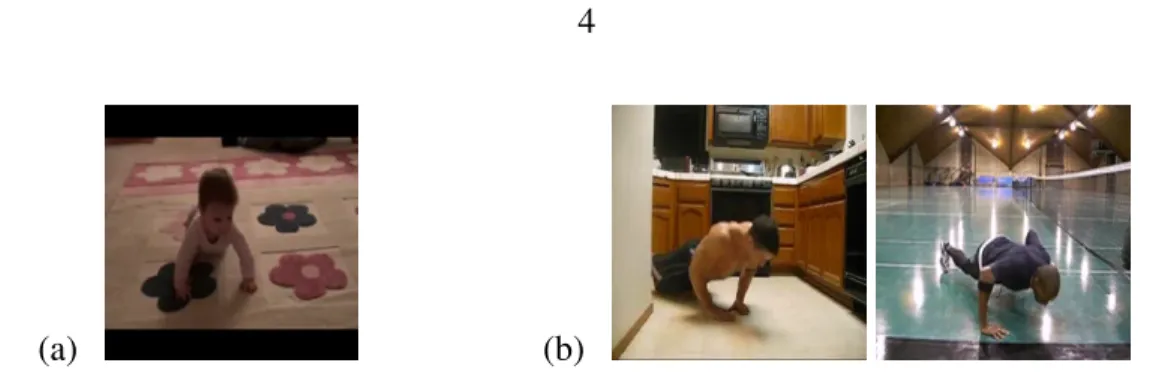
Improving a model’s classification accuracy has benefits, but some misclassifications will persist. For example, Figure 1.2 shows a sample frame from aBabyCrawlingvideo classified as PushUps. It is very interesting to compare frames from this misclassified video to frames from training videos ofPushups, where we see analogous body poses. It is not possible from the current setup to confirm if the similar body pose is the reason for the misclassification, it may just be that the training data had samples of pushups being performed on a similar carpet as that in (a). In the next section, we explain the problem of spatial grounding of deep models, which could help provide an explanation for such a misclassification.
(a) (b)
Figure 1.2: (a) BabyCrawling misclassified as Pushups (b) Training video frames for Pushups. Note: These frames were not randomly selected; they were selected to illustrate visual similarity.
1.1.2 Spatial Grounding: Background and Applications
Deep convolutional neural network models make predictions based on evidence in visual data. Grounding model decisions in visual data has the benefit of being clearly interpretable by humans. Sample spatial grounding for the task of facial emotion recognition is presented in Figure 1.3. The evidence upon which a model participates in the class conditional probability for a specific class is highlighted in the form of a saliency map.
Various methods have been proposed for grounding the prediction of a convolutional neural network. Some grounding techniques assume knowledge of the network architecture and weights such as [157], and others use randomized masks to infer saliency maps from black-box models whose architectures and weights are unknown such as Petsiuket al.[93]. Some grounding techniques use sliding masks together with monitoring of the output class conditional probabilities to predict salient regions [145,155]. Other techniques rely on error backpropagation [106,145,111]. A recent class of approaches alter the network’s architecture before creating such saliency maps [15,156].
Excitation Backprop (EB) is inspired by a top-down human visual attention model, to pass along top-down signals downwards in the network hierarchy via a probabilistic Winner-Take-All process [118]. EB models the top-down attention of a convolutional neural network classifier for generating task-specific attention maps. EB visualizes the evidence
5
Figure 1.3: In this figure we present how Excitation Backprop can highlight evidence for a ground-truth class (middle;Happy), and a non-ground-turth class (right;Neutral). Model training: A VGG16 pretrained on VGG-face image dataset [89] was then finetuned on Facial Expression Recognition (FER) Challenge image dataset [10].
of a model’s classification decision by computing top-down attention maps using an inter-pretable probabilistic formulation. It does not require modifying a network’s architecture or performing additional training. EB also introduces the concept of contrastive attention, making the top-down attention maps more discriminative for localization purposes.
EB is capable of visualizing evidence for a class whether or not the class is a ground-truth class as demonstrated in Figure 1.3. EB highlights the evidence it would use for making a prediction of the facial emotionHappy, and the evidence it would use for making a prediction of the facial emotionNeutral.
We demonstrate applications of EB in model interpretation and data annotation assis-tance for facial expression analysis and medical imaging tasks. We demonstrate how EB can be used to explain model predictions and as a diagnostic tool for model misclassifications. We also demonstrate means of visualizing how deep models differentiate between domains, and how the attention of a model shifts before and after domain adaptation.
1.1.3 Spatial Grounding for Improving Model Classification at Training Time
Deep neural networks optimize for millions of parameters during training time. This huge number of parameters, together with large datasets, and computational resources that allow
training on many epochs of such datasets, can all easily lead to models that overfit the training data and do not generalize well to test examples. Model averaging is a popular regularization technique; however, performing model averaging through training many deep neural networks is a huge waste of resources. A way to execute model averaging that is better-suited for such deep models is: Dropout.
Dropout [40,112] is a classical regularization technique that is used in many state-of-the-art deep neural networks. Standard Dropout selects a fraction of neurons to randomly drop out by zeroing their forward signal. Curriculum dropout [83], a recent variant of dropout, improves generalization by adjusting the dropout rate during training, answering the questionHow many neurons to drop out over time? Both Standard and Curriculum Dropout select neurons to be dropped randomly. In this work, we target at determining how the dropped neurons are selected, answering the questionWhich neurons to drop out?
We propose a guided dropout regularizer for deep networks that biases the selection of neurons to be dropped-out. Our scheme utilizes the contribution of neurons,i.e.evidence, to the prediction made by the network at a certain training iteration. We do so by utilizing the evidence at each neuron to determine the probability of dropout; neuron dropout probability is sampled according to probability defined in the saliency map rather than uniformly at random as in standard dropout. In essence, we dropout with higher probability neurons that contribute more to decision making at training time. This approach penalizes high saliency neurons that are most relevant for model prediction,i.e. those having stronger evidence.
By dropping such high-saliency neurons, we deliberately, and temporarily, paralyze/injure neurons such that a deep network is forced to learn alternative paths in order to maintain loss minimization. This results in a plasticity-like behavior, a characteristic of human brains too [38,109,80,79].
7
neurons using several metrics over four image/video recognition benchmarks. We also study network resilience to neuron dropping at test time. We observe that training with Excitation Dropout leads to models that are a lot more robust when layers are compressed by removing units to make models lighter at test time.
1.1.4 Spatial Grounding for Improving Model Classification at Test Time
Spatial grounding is being widely used for many computer vision tasks including spatial semantic segmentation [71,158,132], spatial object localization [150,147], and temporal action localization [8]. However, it has been less exploited for improving model classifica-tion. Caoet al.[15] use weakly supervised saliency to feedback highly salient regions into the same model that generated them to get more prediction probabilities for the same image and improve classification accuracy at test time. In contrast, we use weakly supervised saliency to question whether the obtained evidence is coherent with the evidence used at training time for correctly classified examples. In Section 1.1.3 we use spatial grounding at training time to improve model classification by dropping neurons corresponding to high-saliency patterns for regularization. In contrast, we now propose an approach to improve model classification at test time.
We proposeGuided Zoom, an approach that utilizes spatial grounding to make more informed predictions. It does so by making sure the model has “the right reasons" for a prediction, being defined as reasons that are coherent with those used to make similar correct decisions at training time. The reason/evidence upon which a deep neural network makes a prediction is defined to be the spatial grounding, in the pixel space, for a specific class conditional probability in the model output.
Guided Zoom estimates how reasonable the evidence used to make a prediction is. In state-of-the-art deep single-label classification models, the top-k (k = 2,3,4, . . .)
accuracy is usually significantly higher than the top-1accuracy. This is more evident in fine-grained datasets, where differences between classes are quite subtle. We show that Guided Zoomresults in the refinement of a model’s classification accuracy on three fine-grained classification datasets. We also explore the complementarity of different grounding techniques, by comparing their ensemble to an adversarial erasing approach that iteratively reveals the next most discriminative evidence.
1.1.5 Spatiotemporal Grounding
Deep recurrent models are state-of-the-art for many vision tasks including video action recognition and video captioning. Models are trained to caption or classify activity in videos, but little is known about the evidence used to make such decisions. Grounding model decisions in visual data has the benefit of being clearly interpretable by humans. Sample spatiotemporal grounding for the task of action recognition is presented in Figure 1.4.
Grounding decisions made by deep networks has been studied in spatial visual content, giving more insight into model predictions [101,30,111,145,156,148]. Such approaches are mainly devised for image understanding and can identify the importance of class-specific image regions by means of saliency maps in a weakly-supervised way. For example, Zhang et al. [148] generated class activation maps from any CNN architecture that uses non-linearities producing non-negative activations.
However, such studies are relatively lacking for models of spatiotemporal visual content – videos. Karpathy et al. [54] visualized interpretable LSTM cells that keep track of long-range dependencies such as line lengths, quotes, and brackets in a character-based model. Liet al.[70] visualized a unit’s salience for NLP. Selvarajuet al.[103] qualitatively present grounding for captioning and visual question answering in images using an RNN. Ramanishkaet al.[97] explored visual saliency guided by captions in an encoder-decoder
9
(a)
(b)
Figure 1.4: Spatiotemporal grounding of (a) the evidence of the actionCliffDiving, and (b) the evidence of the actionHorseRiding, in a video containing a concatenation of the two actions. This is a sample result from our formulation devised in Chapter 7.
model. In contrast, our approach models the top-down attention mechanism of CNN-RNN models to produce interpretable and useful task-relevant spatiotemporal saliency maps that can be used for action localization in videos.
We introduce a formulation that simultaneously grounds evidence in space and time, in a single pass, using top-down saliency. We are the first to formulate top-down saliency in deep recurrent models for space-time grounding of videos. We do so using a single contrastiveExcitation Backprop pass of an already trained model. Although we are not directly optimizing for localization, we show that the internal representation of the model can be utilized to perform coarse localization.
1.2
Contributions
The contributions of this thesis are summarized as follows:
• We show that by utilizing web action images along with videos in training for action recognition, significant performance boosts of convolutional models can be achieved. Without explicit grounding, labeled web action images tend to contain
discriminative action poses, which highlight discriminative portions of a video’s temporal progression.
• We visualize grounded spatial evidence of deep model predictions using a discrimi-native top-down attention mechanism, called Excitation Backprop. We show how such visualizations are equally informative for correct/incorrect model predictions, and with/without adoption of various training strategies.
• We propose a guided dropout regularizer for deep networks. We dropout with higher probability neurons that contribute more to decision making at training time. This approach penalizes neurons that are most relevant for model prediction. By dropping such high-saliency neurons, the network is forced to learn alternative paths in order to maintain loss minimization. We demonstrate better generalization ability, an increased utilization of the network, and a higher resilience to network compression.
• We proposeGuided Zoom, an approach that utilizes spatial grounding to make more informed predictions at test time.Guided Zoomcompares the evidence used to make a preliminary class prediction with evidences for class predictions seen during training. We show that this results in the refinement of model classification accuracies for three fine-grained classification datasets.
• We devise a formulation that simultaneously grounds evidence in space and time, in a single pass, using top-down saliency. We visualize the spatiotemporal cues that contribute to a deep recurrent model’s classification/captioning output using the model’s internal representation. Based on these spatiotemporal cues, we are able to localize segments within a video that correspond with a specific action, or phrase from a caption, without explicitly optimizing/training for these tasks.
11
1.3
Roadmap of Thesis
The rest of the thesis is organized as follows:
Chapter 2: Related Work
This chapter presents related works for improving deep models for classification without grounding, improving deep model classification at training time using spatial grounding, improving deep model classification at test time using spatial grounding, and extending grounding to become spatiotemporal for recurrent neural networks.
Chapter 3:
This chapter describes how the image modality can be utilized to boost the perfor-mance of the video modality for the task of classifying human actions. This is an example of improving model performance without grounding. We analyze the effect of adding web images to the training data of deep convolutional neural networks that are trained to perform action recognition from video frames, and demonstrate the complementarity of the two domains. We also demonstrate that due to the rich subject and clothing variation innweb images compared to that ofnvideo frames, web action images can be used to replace millions of video frames in training time, maintaining performance.
Chapter 4:
This chapter gives a review of Excitation Backprop, a top-down spatial saliency approach for visual grounding. First, the assumptions, formulation, and contrastive variant of Excitation Backprop are discussed. Then, applications of the approach for model interpretation, data annotation, and domain analysis are presented. Such appli-cations range from facial expression recognition, to medical imaging, to visualizing domain shifts.
Chapter 5:
This chapter describes our approach to utilizing model grounding for improving a model’s classification ability at training time. We argue for a different dropout scheme that is guided in the way it selects neurons to be dropped, and is biased to drop neurons that contribute most to a prediction using a higher probability. Grounding is used to select such high-contribution neurons. We demonstrate that the deliberate damaging of such highly excited paths forces a network to learn alternative paths exhibiting plasticity-like behavior. We then quantitatively evaluate how this proposed regularization scheme improves generalization, increases network utilization, and makes models more robust to network compression.
Chapter 6:
In this chapter, we devise a methodology that utilizes explicit spatial grounding to refine a model’s prediction at test time. Our refinement module selects one of the top-kpredictions of a model based on which has the most consistent (evidence, prediction) pair with respect to (evidence, prediction) pairs of a reference pool. The reference pool is populated by evidence obtained using various spatial grounding techniques for correctly classified training data.
Chapter 7:
In this chapter, we extend spatial saliency to the temporal dimension. We present our formulation that models the top-down attention mechanism of generic CNN-RNN models to produce interpretable and useful task-relevant spatiotemporal saliency maps which enable us to visualize how recurrent models ground their decisions in images and videos. We demonstrate that such saliency maps can be used for action/caption localization in videos without explicit supervision.
13
Chapter 8: Conclusions and Future Work
In this chapter we summarize our contributions and discuss their strengths, limitations, and possible future directions.
1.4
List of Related Papers
Material for this thesis is based on the following papers:
1. S.A. Bargal*, A. Zunino*, V. Petsiuk, J. Zhang, K. Saenko, V. Murino, S. Sclaroff. “Guided Zoom: Questioning Network Evidence for Fine-grained Classification.”In Submission. arXiv preprint: 1812.02626, 2018.
2. A. Zunino*,S.A. Bargal*, P. Morerio, J. Zhang, S. Sclaroff, V. Murino. “Excitation Dropout: Encouraging Plasticity in Deep Neural Networks.”In Submission. arXiv preprint: 1805.09092, 2018.
3. S.A. Bargal*, A. Zunino*, D.Kim, J. Zhang, V. Murino, S. Sclaroff. “Excitation Backprop for RNNs.” InProc. of the IEEE Conference on Computer Vision and Pattern Recognition(CVPR), 2018.
4. M. Monfort, B. Zhou,S.A. Bargal, A. Andonian, T. Yan, K. Ramakrishnan, L. Brown, Q. Fan, D. Gutfruend, C. Vondrick, A. Oliva. “Moments in Time Dataset: one million videos for event understanding.” In Submission. arXiv preprint: 1805.09092, 2018.
5. J. Zhang,S.A. Bargal, Z. Lin, J. Brandt, X. Shen, S. Sclaroff. “Top-down Neural Attention by Excitation Backprop.” International Journal of Computer Vision(IJCV), 2017.
6. S. Ma,S.A. Bargal, J. Zhang, L. Sigal, S. Sclaroff. “Do Less and Achieve More: Training CNNs for Action Recognition Utilizing Action Images from the Web.” The Journal of the Pattern Recognition Society(PR), 2017.
7. S.A. Bargal, E. Barsoum, C. Canton, C. Zhang. “Emotion Recognition in the Wild from Videos using Images.” InProc. of the International Conference on Multimodal Interaction(ICMI), 2016.
Chapter 2
Related Work
In this chapter, we review related work for each of the following chapters.
2.1
Improving Model Classification for Action Recognition
Action recognition is an important model classification problem for which a large number of methods have been proposed [133]. Among these, due to promising performance on realistic videos including web videos and movies, bag-of-words approaches that employ expertly-designed local space-time features have been widely used. Some representative works include space-time interest points [68] and dense trajectories [123]. Advanced feature encoding methods,e.g. Fisher vector encoding [92], can be used to further improve the performance of such methods [124]. Besides bag-of-words approaches, other works make an effort to explicitly model the space-time structures of human actions [98,127,131] by using, for example, HCRFs and MRFs.
CNN models learn discriminative visual features at different granularities, directly from data, which may be advantageous in large-scale problems. CNN models may implicitly capture higher-level structural patterns in the features learned at the last layers of the CNN model. In addition, CNN features may also be used within structured models like HCRFs and MRFs to further improve performance.
[47,55,84,108]. Jiet al. [47] and Tranet al. [116] use 3D convolution filters within a CNN model to learn space-time features. Karpathyet al.[55] construct a video dataset of millions of videos for training CNNs and also evaluate different temporal fusion approaches. Simonyan and Zisserman [108] use two separate CNN streams: one CNN is trained to model spatial patterns in individual video frames and the other CNN is trained to model the temporal patterns of actions, based on stacks of optical flow. Wanget al. [128] extract trajectory-pooled deep-convolutional descriptors (TDD) from convolutional feature maps of trained two-stream ConvNets and improved trajectories to pool convolutional features centered at the trajectory. Our approach could further improve the spatial stream of the two-stream ConvNet, and therefore the TDD of Wang et al.. Lanet al. [67] introduce Multi-skIp Feature Stacking (MIFS) that utilizes multiple time skips to mimic multiple time-scales, stacking features of different frequencies, which are then Fisher encoded. Ng et al. [84] use a recurrent neural network that has long short-term memory (LSTM) cells. In all of these works, the CNN models are trained only on videos. Our findings regarding the use of web action images in training may help in further improving the performance of these works.
Web action images have been used for training non-CNN models for action recognition [17,44] and event recognition [27,125] in videos. Ikizler-Cinbiset al. [44] use web action images to train linear regression classifiers for small-scale action classification tasks (5 or 8 action classes). Chenet al.[17] use static action images to generate synthetic samples for training SVM action classifiers and evaluate on a small test set of 78 videos comprising 5 action classes. In [27], Duanet al.use SVMs trained on SIFT features of web action images in their video event recognition system and evaluate on datasets with 5∼6 different events. Wanget al. [125] exploit semantic groupings of Web images for video event recognition and evaluate on the same datasets as [27]. Sun et al. [114] localize actions temporally
17
using a domain transfer from web images. Sultani and Shah [113] leverage action proposals in web images to construct action proposals in videos for the task of action localization in videos. In contrast, our work gives the first thorough study on combining web action images with videos for training CNN models for large-scale action recognition.
2.2
Spatial Grounding
There is a rich literature about modeling the top-down influences on selective attention in the human visual system (see [7] for a review). It is hypothesized that top-down factors like knowledge, expectations and behavioral goals can affect the feature and location expectancy in visual processing [135,117,60,23], and bias the competition among the neurons [100,118,23,22,12]. Our attention model is related to the Selective Tuning model of [118], which proposes a biologically inspired attention model using a top-down WTA inference process.
Various methods have been proposed for grounding a CNN classifier’s prediction. [145,155] use masking-based methods to predict salient image regions. This method slides a mask over the receptive field and uses the score/response decrease as the indicator of the importance of the masked area. Recently,[30] use a meta-learning paradigm to predict the minimally salient region by editing the image and learning from the corresponding changes to its output. In [106,145,111], error backpropagation based methods are used for visualizing relevant regions for a predicted class or the activation of a hidden neuron. Recently, a layer-wise relevance backpropagation method is proposed by [5] to provide a pixel-level explanation of CNNs’ classification decisions. [15] propose a feedback CNN architecture for capturing the top-down attention mechanism that can successfully identify task-relevant regions. The architecture requires the addition of a binary neuron feedback layer after every ReLU layer. Neurons in the feedback layer pass dominant features to
upper layers and propagate high level semantics to lower layers to create attention maps. In [156], it is shown that replacing fully-connected layers with an average pooling layer can help generate coarse class activation maps that highlight task relevant regions.
Unlike these previous methods, Excitation Backprop is based on the WTA principle, and has an interpretable probabilistic formulation. It is also conceptually simpler than [15,155] as ir does not require modifying a network’s architecture or performing additional training. The ultimate goal of this method goes beyond visualization and explanation of a classifier’s decision [145,111,5], as it aims to maneuver CNNs’ top-down attention to generate highly discriminative attention maps for the benefits of localization.
Training CNN models for weakly supervised localization has been studied by [87, 90,88, 95,29, 106,35, 11]. In [87, 29,95], a CNN model is transformed into a fully convolutional net to perform efficient sliding window inference, and then Multiple Instance Learning (MIL) is integrated in the training process through various pooling methods over the confidence score map. Due to the large receptive field and stride of the output layer, the resultant score maps only provide very coarse location information. To overcome this issue, a variety of strategies,e.g. image re-scaling and shifting, have been proposed to increase the granularity of the score maps [87,95,94]. Image and object priors are also leveraged to improve the object localization accuracy in [90,88,95]. [35] perform weakly supervised localization using appearance models of previously localized (segmented) classes to select and segment a new class, thereby deriving a binary segmentation mask for each image. Compared with weakly supervised localization, the problem setting of our task is essentially different. We assume a pre-trained deep CNN model is given, which may not use any dedicated training process or model architecture for the purpose of localization. Our focus, instead, is to model the top-down attention mechanism ofgenericCNN models to produce interpretable and useful task-relevant attention maps.
19
2.3
Spatial Grounding for Improving Model Classification at
Train-ing Time
Dropout was first introduced by Hintonet al. [40] and Srivastavaet al. [112] as a way to prevent neural units from co-adapting too much on the training data by randomly omitting subsets of neurons at each iteration of the training phase.
Some follow-up works have explored different schemes for determining how much dropout is applied to neurons/weights. Wageret al. [120] described the dropout mech-anism in terms of an adaptive regularization, establishing a connection to the AdaGrad algorithm. Inspired by information theoretic principles, Achille and Soatto [2] propose Information Dropout, a generalization dropout which can be automatically adapted to the data. Kingmaet al. [59] showed that a relationship between dropout and Bayesian inference can be extended when the dropout rates are directly learned from the data. Kang et al. [52] introduces Shakeout which instead of randomly discarding units as dropout does, it randomly enhances or reverses each unit’s contribution to the next layer. Wanet al. [121] introduced the DropConnect framework, adding dynamic sparsity on the weights of a deep model. DropConnect generalized Standard Dropout by randomly dropping the weights rather than the neuron activations in the network. Rennieet al. [99] proposed a time scheduling for the retaining probability for the neurons in the network. The presented adaptive regularization scheme smoothly decreased in time the number of neurons turned off during training. Recently, Morerioet al. [83] proposed Curriculum Dropout to adjust the dropout rate in the opposite direction, exponentially increasing unit suppression rate during training, leading to a better generalization on unseen data.
Other works focus on which neurons to drop out. Dropout is usually applied to fully-connected layers of a deep network. Conversely, Wu and Gu [136] studied the effect of dropout in convolutional and pooling layers. The selection of neurons to drop depends on
the layer where they reside. In contrast, we select neurons within a layer based on their contribution. Wang and Manning [129] demonstrate that sampling neurons from a Gaussian approximation gave an order of magnitude speedup and more stability during training. Liet al. [72] proposed to use multinomial sampling for dropout,i.e. keeping neurons according to a multinomial distribution with specific probabilities for different neurons. Ba and Frey [4] jointly trained a binary belief network with a neural network to regularize its hidden units by selectively setting activations to zero accordingly to their magnitude. While this takes into consideration the magnitude of the forward activations, it does not take into consideration the relationship of these activations to the ground-truth. In contrast, we drop neurons based on how they contribute to a network’s decision.
We compare our results against Morerioet al. [83], which is the current state-of-the-art. To the best of our knowledge, we are the first to probabilistically select neurons to dropout based on their task-relevance.
2.4
Spatial Grounding for Improving Model Classification at Test Time
Fine-grained classification is an important model classification problem for which a large number of approaches have been proposed. The key module in fine-grained classification is finding discriminative parts. Some approaches use supervision to find such discriminative features,i.e.use annotation for whole object and/or for semantic parts. Zhanget al.[149] train part models such that the head/body can be compared, however this requires a lot of annotation of parts. Krauseet al.[62] use whole annotations and no part annotations. Bransonet al.[13] normalize pose of object parts before computing a deep representation for them. Zhanget al. [146] introduce part-abstraction layers in the deep classification model, enabling weight sharing between the two tasks. Huang et al. [41] introduce a part-stacked CNN which encodes part and whole object cues in parallel based on supervised21
part localization. Wanget al.[130] retrieve neighboring images from the dataset, those having similar object pose, and automatically mine discriminative triplets of patches with geometric constraints as the image representation. Denget al.[21] include humans in the loop to help select discriminative features. Subsequent work of Krauseet al. [63] does not use whole or part annotations, but augments fine-grained datasets by collecting web images and experimenting with filtered and unfiltered versions of them. Wanget al.[122] use the ontology tree to obtain hierarchical multi-granularity labels. In contrast to such approaches, we do not require any whole or part annotations at train or test time and do not use additional data or hierarchical labels.
Other approaches are weakly supervised. Such approaches only require an image label, and our approach lies in this category. Linet al. [73] demonstrate the applicability of a bilinear CNN model in the fine-grained classification task. Sunet al.[115] implement an attention module that learn to localize different parts and a correlation module to coherently enforce correlations among different parts in training. Fuet al.[31] learn where to focus by recurrently zooming into one location from coarse to fine using a recurrent attention CNN. In contrast, we are able to zoom into multiple image locations. Zhanget al.[151] use convolutional filters as part detectors since the responses of distinctive filters usually focus on consistent parts. Zhaoet al.[152] use a recurrent soft attention mechanism that focuses on different parts of the image at every time step. This work enforces a constraint to minimize the overlap of attention maps used in adjacent time steps to increase the diversity of part selection. Zhenget al.[154] implement a multiple attention convolutional neural network with a final fully-connected layer combining the softmax for each part with one classification loss function. Cuiet al.[19] introduce a kernel pooling scheme and also demonstrate benefit to the fine-grained classification task. Jaderberget al.[45] introduce spatial transformers for convolutional neural networks which results in models which learn
invariance to translation, scale, rotation and more generic warping, showing improvement for the task of fine-grained classification.
In contrast, our approach assesses whether the network evidence used to make a prediction is reasonable, i.e. if it is coherent with the evidence of correctly classified training examples of the same class. We use multiple salient regions eliminating error propagation from incorrect initial saliency localization, and implicitly enforce part-label correlations enabling the model to make more informed predictions at test time.
2.5
Spatiotemporal Grounding
Spatiotemporal grounding is grounding the evidence of a model’s prediction both in space and time. Several works in the literature give more insight into CNN model predictions, i.e., theevidencebehind deep model predictions in space. Such approaches are mainly devised for image understanding and can identify the importance of class-specific image regions by means of saliency maps in a weakly-supervised way.
Spatial Grounding. Ribeiroet al.[101] explained classification predictions with appli-cations on images. Fonget al.[30] addressed spatial grounding in images by exhaustively perturbing image regions. Guided Backpropagation [111] and Deconvolution [145,106] used different variants of the standard backpropagation error and visualized salient parts at the image pixel level. In particular, starting from a high-level feature map, [145] inverted the data flow inside a CNN, from neuron activations in higher layers down to the image level. Guided Backpropagation [111] introduced an additional guidance signal to standard backpropagation preventing backward flow of negative gradients. Simonyanet al.[106] directly computed the gradient of the class score with respect to the image pixel to find the spatial cues that help the class predictions in a CNN. CAM [156] removed the last fully connected layer of a CNN and exploited a weighted sum of the last convolutional feature
23
maps to obtain the class activation maps. Zhanget al.[148] generated class activation maps from any CNN architecture that uses non-linearities producing non-negative activations. Oquabet al.[86] used mid-level CNN outputs on overlapping patches, requiring multiple passes through the network.
Spatiotemporal Grounding. Weakly-supervised visual saliency is much less explored for temporal architectures. Karpathyet al.[54] visualized interpretable LSTM cells that keep track of long-range dependencies such as line lengths, quotes, and brackets in a character-based model. Liet al. [70] visualized a unit’s salience for NLP. Selvarajuet al. [103] qualitatively present grounding for captioning and visual question answering in images using an RNN. Ramanishka et al. [97] explored visual saliency guided by captions in an encoder-decoder model. In contrast, our approach models the top-down attention mechanism of CNN-RNN models to produce interpretable and useful task-relevant spatiotemporal saliency maps that can be used for action/caption localization in videos.
2.6
Discussion
In this chapter we present related work for this thesis. In Section 2.1 we review different approaches for action recognition in videos. We also review various work that utilizes web action images to aid several vision tasks including action recognition. Such approaches improve model classification, but lack the capability of explaining classification decisions made by the model. Section 2.2 introduces approaches used to visually ground why deep models make certain predictions for spatial visual data,i.e.when the input to the model is an image. We demonstrate various applications on how grounding techniques can differentiate between domains and how they can be used to highlight the shift of focus using different training strategies. Section 2.3 reviews variants of a regularization scheme that is widely used in deep models, and introduces our variant that performs regularization in a manner
that is guided by spatial grounding. Our proposed scheme results in improved network generalization on unseen test data, increased network utilization, and increased robustness to network compression. Section 2.4 reviews approaches to fine-grained classification of images and introduces how we approach the problem using spatial grounding. Our approach refines the classification accuracy for fine-grained datasets at test time by evaluating how coherent a grounded evidence of a prediction is compared to (evidence, prediction) pairs of correctly classified training examples. Section 2.5 demonstrates how spatiotemporal grounding for visual data is much less explored compared to spatial grounding,i.e.when the input to the model is a video. We present a formulation for top-down attention in recurrent neural networks for spatiotemporal grounding. In the next chapters, we will present our contributions to the areas of the literature summarized here.
Chapter 3
Do Less and Achieve More: Training CNNs for
Action Recognition Utilizing Action Images
from the Web
Deep neural network models are state-of-the-art for many Computer Vision tasks. Recent works [55,107] show that deep convolutional neural networks (CNNs) are promising for action recognition in videos. However, CNN models typically have millions of parameters [16,66,108], and usually large amounts of training data are needed to avoid overfitting. For this purpose, work is underway to construct datasets consisting of millions of videos [55]. However, the collection, pre-processing, and annotation of such datasets can require a lot of human effort. Moreover, storing and training on such large amounts of data can consume substantial computational resources.
In contrast, collecting and processing images from the Web is much easier. For example, one may need to look through all, or most, video frames to annotate the action, but often a single glance is enough to decide on the action in an image. Videos and web images also have complementary characteristics. A video of 100 frames may convey a complete temporal progression of an action. In contrast, 100 web action images may not capture the temporal progression, but do tend to provide more variations in terms of camera viewpoint, background, body part visibility, clothing, etc. Moreover, videos often contain many
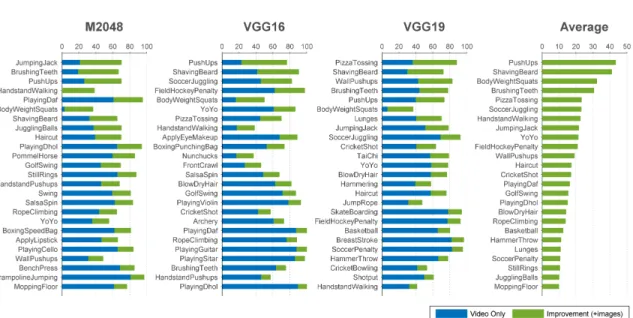
Figure 3.1: Sample action images from BU101. Action images on the Web often capture well-framed descriminative poses of the actions they represent. Left to right: Hammer Throw,Body Weight Squats,Jumping Jack,Basketball,Tai Chi,Cricket Shot,Lunges,Still Rings. Utilizing web action images in training CNNs, for all these action classes, results in more than 10% absolute increase in recognition accuracy in videos compared to CNNs trained only on video frames (see Fig. 3.3).
redundant and uninformative frames,e.g., standing postures, whereas action images tend to focus on discriminative portions of the action (Fig. 3.1). This property can further focus the learning, making action images inherently more valuable.
In summary, two intuitions emerge about why web action images may be useful in training CNNs for action classification of videos:
• Complementarity: Action images may complement training videos when video data is scarce, particularly since images may be easier to collect and process.
• Efficiency: Web action images usually contain discriminative poses of the actions, making them intrinsically higher-quality training data compared to video frames, which may be redundant or contain less relevant poses.
However, it is not enough to stop at these seemingly natural intuitions: scientific verification is necessary. In this work, we analyze and empirically evaluate these intuitions. To our best knowledge, we are the first to perform an in-depth analysis of this problem by extensive and large-scale empirical evaluation.
We start by collecting large web action image datasets. The first dataset, BU101, contains 23.8K images of 101 action classes. It is more than double the size of the largest previous action image dataset [141], both in the number of images and the number of actions. And, to the best of our knowledge, this is the first action image dataset that has
27
one-to-one correspondence in action classes with the large-scale action recognition video benchmark dataset, UCF101 [58]. Images of the dataset are carefully labeled and curated by human annotators; we refer to them asfiltered images. Two other, even larger, web image datasets are also collected: BU101-unfiltered and BU203-unfiltered, which are crawled automatically by querying action class names on multiple image search engines, e.g. Google Image Search. The BU101-unfiltered dataset contains∼0.2M images crawled by querying the 101 action class names of UCF101, and BU203-unfiltered contains∼0.4M images crawled by querying the 203 activity names of ActivityNet [14]. All these datasets will be made publicly available to the research community1.
We train CNN models of different depths and analyze the effect of adding web action images of BU101 to the training set of video frames. We also train and evaluate models with varying numbers of action images to explore the marginal gain as a function of the web image set size. We find that by combining web action images with video frames in training, a spatial CNN can achieve an accuracy of 83.5% on UCF101, which is more than a 10% absolute improvement over a spatial CNN trained only on videos [107]. When combining with motion features, we can achieve 91.1% accuracy, which is the highest result reported to-date on UCF101. We also replace videos by images to demonstrate that our performance gains are due to images providing complementary information to that available in videos, and not solely due to additional training data.
We further investigate at a larger scale, i.e. use many more web action images as additional training data, where these action images are simply automatically crawled and without further annotation. We compare the performance of using BU101 and BU101-unfiltered images on UCF101. Using BU101-BU101-unfiltered we obtain similar performance to that obtained using BU101, even though collecting BU101-unfiltered requires much less
human labor. We also obtain comparable performance when replacing half the training videos in ActivityNet (which correspond to 16.2M frames) by∼400K images of BU203-unfiltered.
We then delve deeper and examine one major mechanism which may deliver the benefits of web action images in training the CNN models. We bring to light an artifact of finetuning a pre-trained CNN:conservative filters– CNN filters that undergo small changes during fine-tuning and make little, if any, contribution to the target task. These conservative filters reduce the number of effective parameters in the CNN model and are potentially harmful to the modeling capacity of the CNN. We illustrate that, by using web action images as additional training data, the number of conservative filters is greatly reduced,e.g. by an order of magnitude. This enables re-targeting more filters of the pre-trained CNN to visual patterns of the new task,i.e. action recognition.
In summary, ourcontributionsare:
• We collect three large web action image datasets: BU101, BU101-unfiltered and BU203-unfiltered. These datasets are in one-to-one correspondence with the actions in the UCF101 or ActivityNet benchmark datasets.
• By extensive experimental evaluation, we verify the intuition that web action images are complementary to video training data. This complementarity appears to be insensitive to the CNN depth and is evident in many kinds of actions. Benefits are observed even when only a few filtered images are used in training and the benefits grow with number of web images.
• We illustrate that both filtered and unfiltered web action images are complementary to video training data. This points to an approach that requires little human annotation labor and is especially useful for large-scale problems.
29
• We show that using web action images can boost the efficiency of CNN training. With the same number of training samples, the trained model can achieve significantly higher recognition performance if half of the samples are web images. Moreover, to achieve the same recognition performance, we can greatly reduce the number of training videos and use unfiltered web action images instead.
• We provide insight into an artifact of finetuning a pre-trained CNN model for a new task: conservative filters. We show that, in our action recognition task, by using web action images as additional training data, the number of conservative filters can be significantly reduced. This reveals an underlying mechanism that brings in the benefits of web action images in the CNN model finetuning.
3.1
Web Action Image Datasets
To study the usefulness of web action images for learning better CNN models for action recognition, we collect action images that correspond with the 101 action classes in the UCF101 video dataset and the 203 activities in the ActivityNet dataset (version 1.1). This leads to 3 large image datasets: BU101, BU101-unfiltered and BU203-unfiltered. All three datasets will be made publicly available for research.
We collect images by crawling the web using the action class names of UCF101 or ActivityNet as queries on image search engines (Google Image Search, Flickr, etc.). Some queries are augmented by the wordsexercise,trainandplaywhen appropriate,e.g.,juggling ballsto play juggling balls. BU101-unfiltered and BU203-unfiltered, containing 204K images and 387K images respectively, are simply compiled by this crawling procedure using action (activity) names of UCF101 (ActivityNet), without any further human annotation. We conducted a study to ensure that our curated datasets do not include frames of the
Dataset # Actions # Images Clutter? Poses vary? Visibility varies?
Gupta [36] 6 300 Small Small No
Ikizler [43] 5 1727 Yes Yes Yes
VOC2012 [28] 11 4588 Yes Yes Yes
PPMI [140] 24 4800 Yes Yes No
Standford40 [141] 40 9532 Yes Yes Yes
BU101 101 23800 Yes Yes Yes
Table 3.1: Comparison of BU101 with existing action image datasets. Visibility varies? refers to variance in the partial visibility of the human bodies.
corresponding video datasets (Section 3.3).
In the following text, we focus our discussion on the dataset BU101. For BU101, we inspect each crawled image and remove images that do not contain the action or are cartoons or drawings. We also include 2769 images of relevant actions from the Standford40 dataset [141]. The resulting dataset comprises 23.8K images. Because the images are automatically collected, and then filtered for irrelevant ones, the number of images per category varies. Each class has at least 100 images and most classes have 150-300 images.
Table 3.1 compares existing action image datasets with our new dataset, BU101. Both in the number of images and the number of actions, our dataset exceeds double the scale of existing datasets. More importantly, to the best of our knowledge, this is the first action image dataset that has one-to-one action class correspondence with a large-scale action recognition benchmark video dataset. We believe that our dataset will enable further study of the relationship between action recognition in videos and in still images.
UCF101 action classes are divided into five types: Human-Object Interaction, Body-Motion Only,Human-Human Interaction,Playing Musical Instruments, andSports[110]. Fig. 3.2 shows sample images in BU101 for five action classes, one in each of the five action types.
These action images collected from the Web are originally produced in a variety of settings, such as amateurvs.professional photos, artisticvs.educationalvs.commercial
31
Figure 3.2: Sample images from BU101. Each row shows images of one action. Top to bottom: Hula Hoop, Jumping Jack, Salsa Spin, Drumming, Frisbee Catch. Variations in background, camera viewpoint and body part visibility are common in web images of the same action.
photos, etc. For images collected in each action category, wide variation can exist in viewpoint, lighting, human pose, body part visibility, and background clutter. For example, commercial photos may have clear backgrounds while backgrounds of amateur photos may contain much more clutter. Such variance also differs for different types of actions. For example, forSports, there is significant variance in body pose among images that capture different phases of the actions, whereas body pose variance is minimal in images ofPlaying Musical Instruments.
Many of the collected action images significantly differ from video frames in camera viewpoint, lighting, human pose, and background. One interesting thing to notice is that action images often capturedefining posesof an action that are highly discriminative,e.g. standing with both hands over head and legs spread in jumping jack (Fig. 3.2, row 2). In contrast, videos may have many frames containing poses that are common to many actions,e.g.injumping jackthe upright standing pose with hands down. Also,nimages
will have more unique content thannvideo frames, for example more clothing variation. Clearly there exists a compromise between temporal information available in videos and discriminative poses and variety of unique content in images.
3.2
Training CNNs with Web Action Images
Spatial CNNs trained on single video frames for action recognition are explored in [107]. Karpathy et al. [55] observe that spatio-temporal networks show similar performance compared to spatial models. A spatial CNN effectively classifies actions in individual video frames, and action classification for a video is accomplished via fusion of the spatial CNN’s outputs over multiple frames,e.g.via voting or SVM. Because the spatial CNN is trained on single video frames, its parameters can be learned by fine-tuning of a CNN that was trained for a different task,e.g., using a CNN that is pre-trained on ImageNet [20]. The fine-tuning approach is especially beneficial in training a CNN model for action classification in videos, since we often only have limited training samples; given the large number of parameters in a CNN, initializing the parameters to random values leads to overfitting and inferior performance as shown in [107]. In this work, we study improving the spatial CNN for action recognition using web action images as training data. This is then combined with motion features via state-of-the-art techniques.
In our experiments and analysis, we explore the following key questions:
• Is it beneficial to train CNNs with web action images in addition to video frames and, if so, which action classes benefit most?
• How do different CNN architectures, in particular ones with different depths, perform when web action images are used as additional training data?