Doctoral Thesis
Optimization in computational
systems biology via high
performance computing
techniques
David Rodr´ıguez Penas
2017
Optimization in computational
systems biology via high
performance computing techniques
David Rodr´ıguez Penas
Doctoral Thesis
March 2017
PhD Advisors:
Julio Rodr´ıguez Banga
Patricia Gonz´
alez G´
omez
Ram´
on Doallo Biempica
Dr. Julio Rodr´ıguez Banga
Profesor de investigaci´on
Instituto de Investigaci´ons Mari˜nas Consejo Superior de Investigaciones Cient´ıficas (CSIC).
Dra. Patricia Gonz´alez G´omez
Profesora Titular de Universidade
Dpto. Enxe˜nar´ıa de Computadores
Universidade de A Coru˜na
Dr. Ram´on Doallo Biempica
Catedr´atico de Universidade
Dpto. de Enxe˜nar´ıa de Computadores
Universidade de A Coru˜na
CERTIFICAN
Que a presente memoria titulada “Optimization in computational systems biology
via high performance computing techniques” foi realizada por D. David Rodr´ıguez
Penas baixo nosa direcci´on no Departamento de Enxe˜nar´ıa de Computadores da
Universidade da Coru˜na, e concl´ue as´ı a Tese Doutoral que presenta para optar ao
grado de Doutor en Enxe˜nar´ıa Inform´atica coa Menci´on de Doutor Internacional.
En A Coru˜na, a 30 de Marzo do 2017
Fdo.: Julio Rodr´ıguez Banga Director da Tese Doutoral
Fdo.: Patricia Gonz´alez G´omez
Directora da Tese Doutoral
Fdo.: Ram´on Doallo Biempica
Director da Tese Doutoral
Fdo.: David Rodr´ıguez Penas Autor da Tese Doutoral
A Tamara e a eses sobri˜
nos
que est´
an por vir: Sergio e Marinha.
Agradecementos
En primeiro lugar, gustar´ıame especialmente agradecer ´os meus directores Julio,
Patricia e Ram´on, tanto a oportunidade que me deron para desenvolver a presente
tese, como a dedicaci´on, axuda e apoio que me ofreceron durante todos estes anos.
Foi un honor traballar ´o voso lado, e o m´ais prezado que me levo desta tese ´e t´odalas cousas que aprend´ın convosco.
Por outro lado, tam´en quero reco˜necer a t´odolos meus compa˜neiros do Grupo de
Enxe˜nar´ıa de Procesos do Instituto de Investigaci´ons Mari˜nas, toda a axuda e apoio
que me ofreceron durante todo este tempo. Quedo moi agradecido a todos v´os pola
convivencia do d´ıa a d´ıa, o compa˜neirismo, e os bos momentos vividos.
Tam´en quero facer referencia a toda a axuda recibida por: David Henriques,
compa˜neiro do grupo co que m´ais traballei e que me proporcionou os problemas
de biolox´ıa de sistemas a optimizar nesta tese; ´o profesor Jose Egea, tanto polas
s´uas contribuci´ons durante a creaci´on dos m´etodos propostos no Cap´ıtulo 3, como
polo seu asesoramento en toda a estad´ıstica utilizada na presente tese; e tam´en ´o
profesor Julio S´aez, tanto pola colaboraci´on durante a elaboraci´on do Cap´ıtulo 4,
como a estupenda acollida e trato recibido por parte del e dos membros do seu grupo
durante a mi˜na estancia en Aquisgr´an.
Quero engadir os meus agradecementos ´o Grupo de Arquitectura de
Computa-dores da Universidade da Coru˜na, e ´o Departamento de Inform´atica do Instituto de
Investigaci´ons Mari˜nas pertencente ao CSIC en Vigo, polo uso da s´ua infraestrutura
e todo o soporte recibido.
E sobre todo, m´ais al´a do terreo acad´emico, te˜no que dar as grazas a mi˜na
familia por todo ese ´animo e cari˜no que me deron desinteresadamente durante todo
este tempo. Primeiro a mi˜na Tamara, m´aximo apoio dende o inicio e at´e o final
desta aventura; ti fuches e ser´as a mi˜na m´axima motivaci´on. Tam´en ´os meus pais,
por padecer as mi˜nas frustraci´ons e aledarse dos meus logros; sempre ser´an os meus
mellores mestres e co seu apoio incondicional todo ´e moito m´ais f´acil. E por ´ultimo,
´
os meus irm´ans, os cales durante toda a mi˜na vida son e ser´an un exemplo a seguir.
Por ´ultimo, agradezo ´os seguintes organismos o financiamento e apoio a este
tra-ballo: Ministerio de Econom´ıa e Competitividade, a trav´es dos proxectos
DPI2011-28112-C04, DPI2014-55276-C5, TIN2013-42148-P e TIN2016-75845-P (todos
cofi-nanciados con fondos FEDER), e do programa de axudas para a formaci´on de
per-soal de investigaci´on FPI (Ref: BES-2012-059201, vinculada ´o proxecto
DPI2011-28112-C04);Xunta de Galicia, polas axudas para a consolidaci´on e estruturaci´on de
unidades de investigaci´on competitivas (Redes ref. R2014/041 e ref. R2016/045, e
os Grupos de Referencia Competitiva GRC2013/055); Centro de Supercomputaci´on
de Galicia (CESGA)eEuropean Bioinformatics Institute (EBI), polo acceso ´os seus
recursos de computaci´on; e Microsoft Research, polo acceso ´a plataforma Microsoft
Resumo
O obxectivo da biolox´ıa de sistemas computacional ´e xerar co˜necemento sobre
complexos sistemas biol´oxicos a trav´es da combinaci´on de datos experimentais con
modelos matem´aticos e t´ecnicas avanzadas de computaci´on. O desenvolvemento de
modelos din´amicos (cin´eticos), tam´en co˜necidos como enxe˜ner´ıa inversa, ´e un dos
temas chave nesta ´area. Nos ´ultimos anos, moitas investigaci´ons centr´aronse no
es-calado destes modelos, facendo da estimaci´on dos par´ametros destes modelos, tam´en
co˜necida como calibraci´on de modelos, unha tarefa complexa. Esa complexidade
re-quire o uso de ferramentas e m´etodos eficientes para acadar bos resultados nun
tem-po c´alculo razoable. En xeral, para resolver este tipo de problemas ´usanse m´etodos
de optimizaci´on global, e en particular as metaheur´ısticas xurdiron como m´etodos
eficientes para resolver os problemas m´ais custosos. Con todo, para a maior´ıa das
aplicaci´ons reais, as metaheur´ısticas a´ında requiren moito tempo de c´alculo para
obter resultados acept´abeis.
Nesta tese pres´entase o dese˜no, implementaci´on e avaliaci´on de novas
metaheur´ısti-cas paralelas, especializadas en resolver problemas de estimaci´on de par´ametros
den-tro do contexto da biolox´ıa de sistema. En concreto, prop´o˜nense novas
metaheur´ısti-cas baseadas nos algoritmos de avaliaci´on diferencial e de procura dispersa. As
no-vas propostas te˜nen como obxectivo acadar un equilibrio entre as capacidades de
exploraci´on e explotaci´on dos algoritmos. Ademais, demostran como a cooperaci´on
entre procuras concorrentes mellora o comportamento dos algoritmos, mellorando
a calidade das soluci´ons e diminu´ındo o tempo de execuci´on. Tam´en estud´
aron-se estratexias adaptativas para aumentar a robustez das propostas. Na avaliaci´on
us´aronse tanto arquitecturas HPC tradicionais como novas infraestruturas na nube.
Obtiv´eronse moi bos resultados con problemas de optimizaci´on de grande dimensi´on
e complexidade.
Resumen
El objetivo de la biolog´ıa de sistemas computacional es generar conocimiento
sobre complejos sistemas biol´ogicos mediante la combinaci´on de datos
experimen-tales con modelos matem´aticos y t´ecnicas avanzadas de computaci´on. El desarrollo
de modelos din´amicos (cin´eticos), tambi´en conocido como ingenier´ıa inversa, es uno
de los temas clave en este campo. En los ´ultimos a˜nos, ha surgido un gran inter´es
en el escalado de estos modelos cin´eticos, haciendo de la estimaci´on de par´ametros,
tambi´en conocida como calibraci´on de modelos, una tarea con una gran dificultad,
que requiere el uso de herramientas y m´etodos eficientes para alcanzar buenos
re-sultados en un tiempo razonable. En general, para resolver estos problemas se usan
m´etodos de optimizaci´on global. En concreto, las metaheur´ısticas surgen como
al-goritmos eficientes a ser utilizado en los problemas m´as complejos. Sin embargo, en
la mayor´ıa de las aplicaciones reales, las metaheur´ısticas todav´ıa requieren mucho
tiempo de c´alculo para obtener resultados aceptables.
Esta tesis presenta el dise˜no, implementaci´on y evaluaci´on de nuevas
metaheur´ıs-ticas paralelas, especializadas sobretodo en resolver problemas de estimaci´on de par´
a-metros en biolog´ıa de sistemas. En concreto, se proponen nuevas metaheur´ısticas
ba-sadas en los algoritmos de evoluci´on diferencial y de b´usqueda dispersa. Las nuevas
propuestas tienen como objetivo lograr un equilibrio entre las capacidades de
explo-raci´on y explotaci´on de los algoritmos. Adem´as, demuestran como la cooperaci´on
entre b´usquedas concurrentes mejora el comportamiento del algoritmo, mejorando
la calidad de las soluciones y disminuyendo el tiempo de ejecuci´on. Tambi´en se han
estudiado estrategias adaptativas para aumentar la robustez de las propuestas.
Pa-ra la evaluaci´on se han usado tanto arquitecturas HPC tradicionales como nuevas
infraestructuras en la nube. Se han obtenido muy buenos resultados en problemas
de gran dimensi´on y complejidad.
Abstract
The aim of computational systems biology is to generate new knowledge and understanding about complex biological systems by combining experimental data with mathematical modeling and advanced computational techniques. The devel-opment of dynamic models (also known as reverse engineering) is one of the current key issues in this area. In recent years, research has been focused on scaling-up these kinetic models. In this context, the problem of parameter estimation (model calibration) remains a very challenging task. The complexity of the underlying models requires the use of efficient solvers to achieve adequate results in reasonable computation times. Global optimization methods are used to solve these types of problems. In particular, metaheuristics have emerged as an efficient way of solving these hard global optimization problems. However, in most realistic applications, metaheuristics still require a large computation time to obtain acceptable results.
This Thesis presents the design, implementation and evaluation of novel parallel metaheuristics with the focus on parameter estimation problems in computational systems biology. In particular, we propose new cooperative metaheuristics based on the well known Differential Evolution and Scatter Search algorithms. The design of the novel approaches aim to achieve a proper balance between exploration (global search) and exploitation (local search) abilities. We show how the cooperation be-tween parallel searches improves the behavior of the individual optimizers, improving the quality of the obtained solutions while decreasing the time-to-solution. We also explore adaptive strategies in order to increase the robustness of the algorithms. We present encouraging results for the proposed metaheuristics considering very chal-lenging large-scale benchmark problems. Both traditional high performance com-puting (HPC) parallel and distributed architectures and new cloud infrastructures have been used to evaluate the proposals.
Preface
Many key problems in computational systems biology and bioinformatics can be formulated and solved using a global optimization framework. The complex-ity of the underlying mathematical models requires the use of efficient solvers in order to obtain satisfactory results in reasonable computation times. Metaheuris-tics are popular stochastic methods which are able to locate the vicinity of the global solution without having to explore all the search space, reducing the number of evaluations and, thus, the computational time. However, these stochastic al-gorithms still require excessive computational effort in many realistic applications, such as those considered in this Thesis, where we try to solve non-linear program-ming problems (NLP) and mixed-integer non linear problems (MINLP) subject to nonlinear dynamic equality and inequality constraints, a very complex task due to the multi-modal and non-convex nature of these optimization processes.
Current multiprocessor infrastructures such as computational clusters, super-computers, clouds facilities or GPUs, and, furthermore, classical parallelization strategies such as MPI or openMP, offer great opportunities to improve the per-formance of classical metaheuristics. The parallelization of metaheuristics pursues one or more of the following goals: increase the size of the problems that can be solved, speed-up the computations, and/or attempt a more thorough exploration of the solution space. However, achieving an efficient parallelization of metaheuristics is usually a complex task, since the search for new solutions depends on previous iterations of the algorithm, which not only complicates the parallelization itself but also limits its scalability.
This Thesis proposes and evaluates different distributed metaheuristics, modified through high performance computing (HPC) techniques, and applied to address NLP
or MINLP problems in current challenging optimization processes within the field of computational systems biology.
Work methodology
This Thesis follows a classical approach in scientific and technological research: analysis, design, implementation and evaluation. Thus, the Thesis starts with the analysis of the importance of global optimization processes in computational systems biology, in general, and parameter estimation problems, in particular; the state-of-the-art of metaheuristics applied to these kinds of problems; and the feasibility and impact analysis of using HPC solutions.
The first proposed parallel metaheuristic is based on an evolutionary method called Differential Evolution (DE), which has received a lot of attention during the last decade. In this Thesis, we present several enhancements to DE based on the introduction of additional algorithmic steps and the exploitation of parallelism. In particular, we propose an asynchronous parallel implementation of DE which has been extended with improved heuristics to exploit the specific structure of parameter estimation problems in computational systems biology. The proposed method is evaluated with different types of benchmarks problems, obtaining excellent results both in terms of quality of the solution and regarding speedup and scalability.
Then, a novel distributed metaheuristic is proposed, extending in several ways another popular algorithm, enhanced Scatter Search (eSS). We propose a self-adaptive asynchronous Cooperative enhanced Scatter Search (saCeSS) based on the parallel execution of different eSS threads and the asynchronous cooperation between them, the exchange of information being driven by quality of the solution obtained in each process, rather than by an elapsed time. This method incorporates several new key mechanisms: asynchronous cooperation between parallel processes; coarse and fine-grained parallelism; and self-tuning strategies, where the different settings of the metaheuristic change in execution time depending of the successes and failures of each distributed process. Several challenging parameter estimation problems from the domain of computational systems biology are used to assess the efficiency of the proposal, obtaining encouraging results in the scalability, robustness
Preface xvii
and performance of the method.
Furthermore, a set of modifications are applied to the proposed saCeSS algorithm to handle MINLP and mixed-integer dynamic optimization (MIDO) problems, two extremely challenging classes of problems. The new proposal obtains a good scal-ability and an important reduction in the distribution dispersion of the achieved results for these problems.
Finally, besides the evaluation in local clusters, the proposed techniques have also been assessed in a cloud infrastructure, the Azure Microsoft public cloud. Thus, the results obtained can be particularly useful, not only for the computational systems biology community, but also for those interested in the potential of cloud frameworks and platforms for developing metaheuristic methods in global optimization problems in general.
Structure of the Thesis
The Thesis is organized into five chapters:
Chapter 1 summarizes background information pertinent to the research dis-cussed in the remainder of this Thesis. This chapter describes basic concepts about global optimization methods in general, parameter estimation problems in particular, metaheuristics, and HPC architectures and programming mod-els.
Chapter 2 presents an improved DE algorithm designed to solve complex opti-mization problems within the field of parameter estimation problems in com-putational systems biology, since the improved local search is implemented by means of several heuristics which exploit the structure of these kinds of problems. The chapter describes the proposed method that also improves the global search through an asynchronous solution based on a cooperative island-model.
Chapter 3 describes the novel parallel metaheuristic named saCeSS, based
on an enhanced Scatter Search (eSS) method. Besides a coarse and
during execution time, which results in a key mechanism to achieve a good scalability in very difficult problems. The chapter also provides an exhaustive evaluation of the performance obtained with the proposed saCeSS method, and a comparison with other parallel implementations.
Chapter 4 focuses on applying saCeSS method to MINLP problems. The chapter describes the required modifications to be performed in the method with the aim to handle these specific kinds of optimization problems. It also provides an evaluation of the scalability and the robustness of the algorithm in very challenging case studies.
Chapter 5 explores and presents the performance evaluation of the previous proposed methods in a cloud infrastructure, comparing it with the results ob-tained in local clusters. Additionally, a preliminary comparison of the MPI solutions proposed, that are HPC oriented, with other implementations us-ing throughput oriented computus-ing models, like Spark, is also shown in this chapter.
Finally, the work is concluded by summarizing the main contributions of this Thesis and the future research lines that can be derived from it.
Funding and Technical Means
The necessary means to carry out this Thesis have been the following:
Working material, human and financial support primarily by the (Bio)Process Engineering Group at IIM-CSIC and by the Computer Architecture Group of
the University of A Coru˜na, along with a Fellowship funded by the Spanish
Ministerio de Econom´ıa y Competitividad under the FPI programme.
Access to bibliographical material through the libraries of the University of A
Coru˜na and IIM-CSIC library and archives network.
Preface xix
• The Spanish Ministerio de Econom´ıa y Competitividad and the FEDER,
under Projects DPI2011-29112-C04 and DPI2014-55276-C5 (Bioprocess Engineering Group) and Projects TIN2013-42148-P and TIN2016-75845-P (Computer Architecture Group).
• Regional funding by the Galician Government (Xunta de Galicia) under
the Consolidation Program of Competitive Research Groups: Computer Architecture Group, ref. GRC2013/055, and Network of Cloud and Big Data Technologies for HPC, Ref. R2014/041, and Network of Cloud and Big Data Technologies for HPC (II), ref. R2016/045.
• Microsoft Research through a sponsored Azure account.
Access to clusters, supercomputers and cloud computing platforms:
• Pluton cluster (Computer Architecture Group, University of A Coru˜na,
Spain): 16 nodes powered by two octa-core Intel Xeon E5-2660 CPUs with 64 GB of RAM, connected through an InfiniBand FDR network.
• NEMO cluster (Bioprocess Engineering Group, The Spanish National
Research Council, Spain): 4 nodes powered by two quadcore Intel Xeon E5420 CPUs with 16 GB of RAM, 8 nodes powered by two quadcore Intel Xeon E5520 CPUs with 24 GB of RAM, and three nodes powered with two deca-core Intel Xeon E5-2650 CPUs with 30GB of RAM, connected through a Gigabit Ethernet network.
• SVG Linux cluster (Galicia Supercomputing Center, CESGA, Spain): 18
nodes powered by two dodeca-core Intel Haswell E5-2680 CPUs with 64 GB of RAM, 10 nodes powered with one tetra-core Intel Haswell E5-1240 with 32 GB of RAM, and 8 nodes powered by two octa-core Intel Sandy Bridge E5-2670 with 64 GB of RAM, connected through an InfiniBand FDR network.
• EBI Cluster (European Bioinformatics Institute): 222 nodes powered by
two octa-core Intel Xeon E5-2680 CPUs with 30GB of RAM, connected through a Gigabit Ethernet network.
• Microsoft Azure cloud platform. Several instance types have been used:
(1) A-3 instances, with 4 cores with 7 GB of RAM per node; (2) intensive-compute A-11 instances, with 16 cores with 112 GB of RAM per node;
and (3) intensive-compute A-9 instances, also with 16 cores with 112 GB of RAM per node, that, in addition to the standard Azure network inter-face available to the other instances, features a second network interinter-face for remote direct memory access (RDMA) connectivity.
A three-month research visit to Joint Research Center for Computational Biomedicine (RWTH Aachen), Germany from 11/04/16 to 10/07/16. This research visit was funded by FPI visit program.
Contents
1. Background 1
1.1. Introduction to high performance computing . . . 1
1.1.1. Trends in HPC architectures . . . 2
1.1.2. Parallel programming models . . . 8
1.1.3. Cloud Computing . . . 10
1.2. Optimization in computational systems biology . . . 13
1.2.1. Optimization problems . . . 14 1.2.2. Optimization methods . . . 22 1.3. Parallel metaheuristics . . . 28 1.3.1. Classification of parallel metaheuristics . . . 29 1.3.2. Metaheuristics parallelization goals . . . 31
1.3.3. Performance evaluation . . . 32
2. Enhanced parallel Differential Evolution 41
2.1. Differential Evolution algorithm . . . 42
2.2. Related work . . . 43
2.3. Improving global search . . . 46
2.4. Improving local search . . . 49 2.4.1. Logarithmic space . . . 49 2.4.2. Local solver . . . 50 2.4.3. Tabu list . . . 50 2.5. Experimental results . . . 53 2.5.1. Performance evaluation of the parallel strategy . . . 54 2.5.2. Results for parameter estimation problems . . . 61 2.6. Concluding remarks . . . 68
3. Self-adaptive Cooperative enhanced Scatter Search 71
3.1. Scatter Search algorithm . . . 72
3.2. Related work . . . 80
3.3. Improving eSS through parallel cooperative searching . . . 82
3.3.1. Fine-grained parallelization . . . 84
3.3.2. Coarse-grained parallelization . . . 84 3.3.3. Comprehensive overview of the saCeSS method . . . 94 3.4. Experimental results . . . 99 3.4.1. Performance evaluation of the parallelization . . . 101 3.4.2. Performance evaluation of the hybrid proposal . . . 106 3.4.3. Comparison with other parallel metaheuristics . . . 112 3.5. Concluding remarks . . . 113
4. Extending saCeSS for mixed integer optimization 117
4.1. Mixed-integer dynamic optimization . . . 118
Contents xxiii
4.3. Extending saCeSS for mixed integer optimization . . . 121 4.4. Applications in computational systems biology . . . 125
4.4.1. Reverse engineering of cell signalling . . . 126
4.4.2. Logic-based dynamic models . . . 127
4.4.3. Problem statement as a MIDO . . . 129
4.5. Experimental results . . . 130 4.5.1. Case Study 1: SSP . . . 132
4.5.2. Case Study 2: HePG2 . . . 136
4.5.3. Case Study 3: HPN-DREAM . . . 141 4.6. Concluding remarks . . . 143
5. Evaluation on a Public Cloud Infrastructure 145
5.1. Related work . . . 146
5.2. Parallel DE in the cloud . . . 148
5.2.1. Spark island-based Parallel DE . . . 148
5.2.2. Key differences between MPI and Spark implementations . . . 151 5.2.3. Experimental results . . . 152
5.2.3.1. Performance/cost evaluation . . . 159
5.3. Evaluation of saCeSS method in the cloud . . . 160 5.3.1. Experimental results . . . 160 5.4. Concluding remarks . . . 164
Conclusions and Future Work 167
A. Released codes 199
A.1. asynPDE library . . . 199
A.2. saCeSS library . . . 200 A.3. saCeSS2 library . . . 203
List of Tables
1.1. Examples of applications of optimization problems in computational systems biology . . . 23
2.1. Subset of BBOB-2009 benchmark functions . . . 55 2.2. Parallel implementation parameters in asynPDE . . . 56 2.3. asynPDE vs seqDE in function f-22 . . . 57 2.4. Quality value test in BBOB benchmarks . . . 59 2.5. Execution time table of the experiments in Figure 2.5 . . . 66 2.6. Wilcoxon signed ranks test . . . 67 3.1. Performance of the coarse-grained parallelization and the self-adaptive
scheme proposed . . . 102
3.2. p-values of the pairwise comparisons provided by the Dunn’s test . . 105
3.3. Group classification of the optimization methods at 95% confidence level . . . 105 3.4. Performance of the hybrid MPI+OpenMP version of saCeSS . . . 108
4.1. Relation between functionsB(x1, x2) and ¯BI( ¯x1,x¯2) . . . 128
4.2. Case study 1: horizontal view . . . 133 4.3. Case study 1: vertical view . . . 133
4.4. Case study 2: horizontal view . . . 137 4.5. Case study 2: vertical view . . . 138 5.1. Performance evaluation of asynPDE and eSiPDE in local cluster Pluton 154 5.2. Performance evaluation of asynPDE and eSiPDE in Azure public cloud 156 5.3. Comparison of asynPDE versus eSiPDE with local solver and tabu
list enabled . . . 158
5.4. Performance of saCeSS for SSP and HePG2 case studies . . . 161
List of Figures
1.1. Microprocessors trend data over the past 40 years . . . 3
1.2. Development over time according to the Top500 list . . . 4
1.3. Supercomputing performance evolution according to the Top500 list . 5
1.4. Example of shared-memory architecture . . . 6
1.5. Example of distributed-memory architecture . . . 7
1.6. Example of hierarchical (hybrid) scheme . . . 7
1.7. Growth of IaaS market . . . 11 1.8. Example of unimodal and multimodal surfaces . . . 16 1.9. Classification of mathematical programming . . . 16 1.10. Model building loop . . . 21 1.11. Classification of popular metaheuristics . . . 26
1.12. Vertical and horizontal views illustrated in a convergence graph . . . 34
1.13. Example of hybrid violin/boxplot . . . 37
1.14. Example of convergence curves . . . 37
1.15. Statistical methods . . . 38 2.1. Asynchronous parallel DE with improved heuristics (asynPDE IH) . . 52
2.2. Predefined effort test in BBOB benchmarks . . . 60
2.3. Best convergence curves for parameter estimation problems . . . 63 2.4. Boxplot of the execution time for parameter estimation problems with
asynPDE IH . . . 64 2.5. Speedups with respect to the execution time of seqDE IH . . . 65
3.1. Schematic representation of a basic Scatter Search algorithm . . . 73
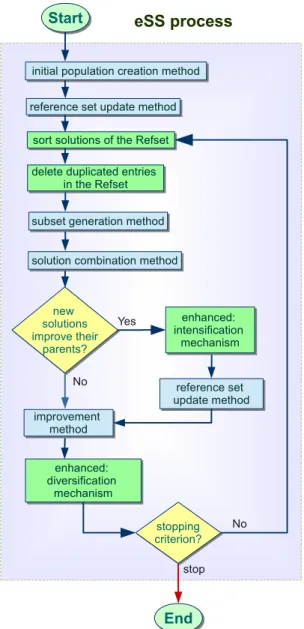
3.2. Schematic representation of the enhanced Scatter Search algorithm . 74
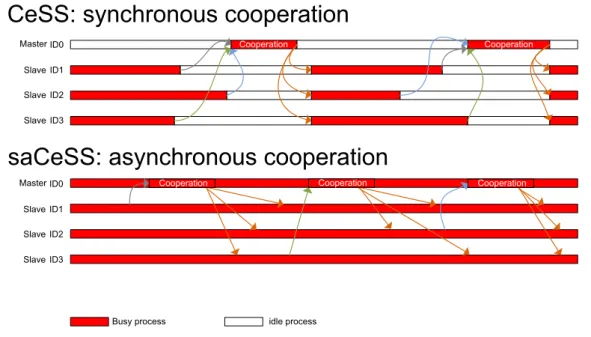
3.3. Hybrid MPI+OpenMP proposed algorithm . . . 83 3.4. Comparing synchronous versus asynchronous cooperation schemes . . 89
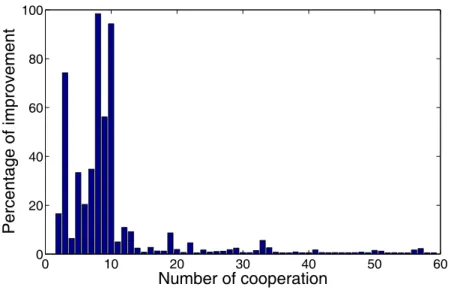
3.5. Improvement as a function of cooperation . . . 90
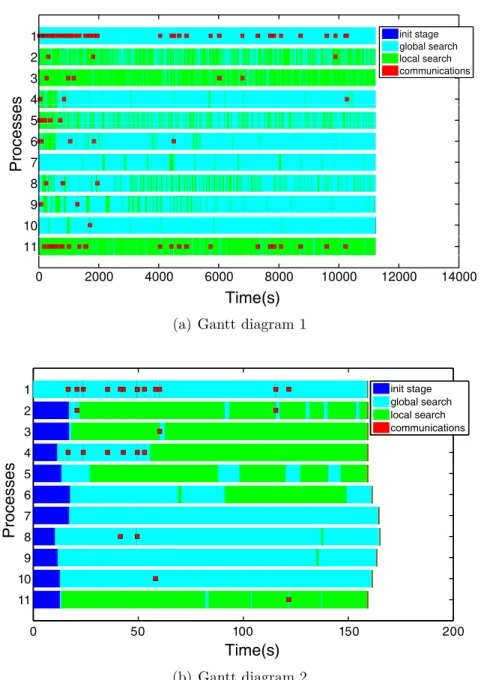
3.6. Gantt diagrams representing the tasks and cooperation . . . 93 3.7. saCeSS: an illustrative representation . . . 98
3.8. Hybrid violin/box plots of the execution times using 10 processes . . 104
3.9. Scalability of saCeSS using 1, 10, 20 and 40 processors . . . 107
3.10. Comparative between non-cooperative eSS and saCeSS . . . 110 3.11. Violin/box plots of the execution times of different MPI/OpenMP
combinations . . . 111
3.12. Performance acceleration of saCeSS versus eSS . . . 112
3.13. Convergence curves of asynPDE and saCeSS using 10 processes . . . 113
3.14. Convergence curves of asynPDE and saCeSS using 20 processes . . . 114
4.1. Schematic representation of saCeSS2 algorithm . . . 123
4.2. Case study 1: hybrid violin/boxplots . . . 134 4.3. Case study 1: convergence curves . . . 135 4.4. Case study 1: convergence curves corresponding to the runs in the
List of Figures xxix
4.5. Case study 2: hybrid violin/boxplots . . . 139 4.6. Case study 2: convergence curves corresponding to the runs in the
median values . . . 139 4.7. Case study 2: convergence curves . . . 140
4.8. Case study 3: Convergence curves of sequential eSS vs saCeSS2 . . . 142
5.1. Spark implementation of the island-based DE algorithm . . . 149 5.2. Schematic representation of asynPDE . . . 151 5.3. Speedup achieved by asynPDE vs eSiPDE in Pluton . . . 155 5.4. Eval/s/core achieved by asynPDE vs eSiPDE in Pluton and Azure . . 157 5.5. Comparison of asynPDE results in local cluster Pluton with results
in a cluster of A3 instances and a cluster of A11 instances in Azure . 159 5.6. Violin/boxplots comparing results in terms of execution time in Azure
vs local cluster . . . 162
List of Algorithms
1. Generic metaheuristic . . . 25
2. Differential Evolution . . . 43
3. Asynchronous island-based parallel Differential Evolution (asynPDE) . 48
4. Local Search and Tabu List in DE . . . 51
5. Basic pseudocode of eSS . . . 77
6. Pseudocode of go-beyond strategy . . . 78
7. Pseudocode of the local search procedure . . . 79
8. Parallel solutions’ evaluation . . . 85
9. saCeSS algorithm, master process . . . 95
10. saCeSS algorithm, slave processes . . . 96
List of Abbreviations
aCeSS asynchronous Cooperative enhanced Scatter Search
API Application Programming Interface
asynPDE asynchronous Parallel Differential Evolution
asynPDE IH asynchronous Parallel Differential Evolution with
Improved Heuristics
CeSS Cooperative enhanced Scatter Search
DE Differential Evolution
DO Dynamic Optimization
eSiPDE enhanced Spark island-based Parallel Differential Evolution
eSS enhanced Scatter Search
GO Global Optimization
GPU Graphic Processor Unit
HDFS Hadoop Distributed File System
HPC High Performance Computing
LP Linear Programming
MIDO Mixed-Integer Dynamic Optimization
MIMD Multiple Instruction Multiple Data
MINLP Mixed Integer Non-Linear Programming
MIOC Mixed-Integer Optimal Control
MISQP Mixed-Integer Sequential Quadratic Programming
MPI Message-Passing Interface
MPP Massively Parallel Processing
NL2SOL Adaptive Nonlinear Least-Squares Algorithm
NLP Non-Linear Programming
OC Optimal Control
ODE Ordinary Differential Equation
PGAS Partitioned Global Address Space
RDD Resilient Distributed Dataset
RDMA Remote Direct Memory Access
saCeSS self-adaptive Cooperative enhanced Scatter Search
saCeSS2 self-adaptive Cooperative enhanced Scatter Search version 2
seqDE sequential classic version of Differential Evolution
seqDE IH sequential version of Differential Evolution with Improved
Heuristics
SIMD Simple Instruction Multiple Data
SiPDE Spark island-based parallel Differential Evolution
SMP Shared Memory Multiprocessors
SmsPDE Spark-based master-slave Parallel Differential Evolution
SMT Simultaneous Multi-Threading
SS Scatter Search
List of Abbreviations xxxv
synPDE synchronous Parallel Differential Evolution
synPDE IH synchronous Parallel Differential Evolution with Improved
Heuristics enabled
TS Tabu Search
VLIW Very Long Instruction Word
Chapter 1
Background
This chapter presents some background related to the research presented in this Thesis. We start with a review of the state-of-the-art in high performance computing (HPC) architectures and programming models. Then, we present a brief review of optimization problems and methods in computational systems biology. Finally, a section on parallel metaheuristis aims to introduce the target of this Thesis, as well as the strategies followed in the design, implementation and evaluation of the proposals.
This chapter intends to provide a brief yet important context for the kind of problems that this Thesis aims to solve and the means to achieve this objective. Take note that the related work covering alternative solutions to the ones proposed in this Thesis is not included in this chapter, but rather presented in next chapters.
1.1.
Introduction to high performance computing
Since the appearance of the first digital computers, computer engineers have targeted increasing the speed of computer operations as one of their primary ob-jectives. Obtaining higher operating speeds may be achieved in different ways [93]: improving the technology used for the implementation of the computer components, modifying the logical design of the subsystems, or improving algorithms for
prob-lem solving. A different approach to attain this goal is parallel processing [119],
whose main principle is to split the computational cost of a problem into a set of tasks that can be performed concurrently. High performance computing (HPC) can be described as the use of parallel processing for solving complex computational problems. The number of research fields demanding HPC solutions, such as cli-mate science, high-energy physics, chemistry, bio-technology, etc., are continuously increasing [86].
Employing HPC as a research tool demands at least a basic understanding of the hardware concepts and software issues involved. The following subsections aim to give the reader an introduction to current HPC architectures and programming models. Also, the term cloud computing is introduced, focusing in the concept of
Infrastructure as a Service, as a way of provisioning HPC resources.
1.1.1.
Trends in HPC architectures
In early computer architectures, processor operation was very simple and strictly sequential. Soon, different approaches to parallel processing arose [93], by means of
exploiting Instruction-Level Parallelism (ILP), Data-Level Parallelism (DLP), and
Thread-Level Parallelism (TLP). In the ILP approach the various operations in-volved in executing a single instruction can be separated into different stages, over-lapping the execution of instructions when they are independent of one another. Additionally, functional units can be also replicated, further enabling the execution
of instructions in parallel, such as in the superscalar and VLIW (Very Long
Instruc-tion Word) architectures. However, the improvement in the performance with this kind of parallelism is limited. The DLP approach pursues parallelism by means of
vector architectures, and more recently graphic processor units (GPUs), that apply
a single instruction to a collection of data in parallel. The TLP approach, exploits thread concurrency either at a core level (such as simultaneous multithreading
-SMT), or at a multicore level on a chip.
In the early XXI century, the trend to improve the performance of micropro-cessors focused in increasing the clock speed. At this time, micropromicropro-cessors started
to be limited by the heat barrier: switching and leakage power of several
hundred-million transistor chips are so large that cooling becomes a primary effort. This
1.1 Introduction to high performance computing 3
Figure 1.1: Microprocessors trend data over the past 40 years. Source: [110].
with several cores on a single socket. Figure 1.1 illustrates how gains in frequency and single-thread performance have stagnated in recent years. Thus, multicore pro-cessors have taken over, aiming to exploit the number of transistors in the chip, that still grows exponentially following Moore’s law [142]. The multicore approach allows performance scaling without pursuing new clock frequency increments, which would exacerbate the heat barrier issue.
The bi-annual list of the world’s fastest, most powerful supercomputers, the Top500 list [206], gives an interesting historical overview regarding HPC architec-tures and performance evolution. In the 1980s, vector supercomputing dominated HPC. The 1990s saw the rise of massively parallel processing (MPPs) and shared memory multiprocessors (SMPs). In turn, clusters of commodity and purpose-built processors dominated the previous decade. Today, these clusters are expanded with computational accelerators in the form of coprocessors, such as the Intel Xeon Phi or the GPUs. Figure 1.2 shows the evolution of the systems architecture in the Top500 list (Figure 1.2(a)), including a demonstration of the accelerator incursion (Figure 1.2(b)). Moreover, Figure 1.3 outlines the historical and projected per-formance development of the systems in the Top500 list. Just a few years ago,
ad-(a) Architecture evolution.
(b) Accelerator incursion.
1.1 Introduction to high performance computing 5
Figure 1.3: Supercomputing performance evolution according to the Top500
list [206].
vanced computing. Today, these values represent a desktop PC with a GPU or Xeon
Phi accelerator. Supercomputing is now defined by multiple petaflops (1015 flops).
If the projections hold we can expect an exaflop system at around 2020.
Most of the current parallel computational infrastructures are classified, following
the Flynn taxonomy [73], as MIMD (Multiple Instruction Multiple Data) machines.
There are a large variety of MIMD systems, that is to say, the way in which the processors communicate with the memory subsystem, that significantly determines the performance of a multiprocessor system, the usual way to classify multiprocessor systems [93]:
Shared-memory computers. These are systems with multiple cores/processors, sharing among them the same physical address space. Figure 1.4 shows an
CACHE CACHE
Figure 1.4: Example of shared-memory architecture. Adapted from [86].
example for this type of machine. The user is not concerned with where the data is stored, as there is only one memory accessed by all cores on an equal basis.
Distributed-memory computers. This scheme has multiple cores, each of them with its own associated memory. Figure 1.5 shows a simplified block diagram of a distributed-memory parallel computer. The cores are connected by some network and may exchange data among their respective memories when re-quired. In contrast to shared memory machines, the user must be aware of the location of the data and will have to move these data explicitly when needed.
Hierarchical (hybrid) computers. Multiprocessors can also be designed neither of the shared-memory nor of the distributed-memory type but a mixture of both. That is, shared-memory building blocks are connected via a fast network (see Figure 1.6), configuring a global distributed-memory multiprocessor where each node has shared-memory properties. The concept is actually more generic and can also be used to describe any system with a mixture of different hard-ware layers. Examples are clusters built from nodes that contains, besides the
multi-core processors, additional accelerator hardware, such as GPUs, FPGAs
1.1 Introduction to high performance computing 7
Figure 1.5: Example of distributed-memory architecture. Adapted from [86].
CACHE CACHE CACHE CACHE
CACHE CACHE
CACHE CACHE
CACHE CACHE CACHE CACHE
CACHE CACHE
CACHE CACHE
1.1.2.
Parallel programming models
Though the compiler and hardware work together to exploit instruction-level parallelism implicitly without the programmer’s attention, the efficient programming of modern hierarchical computers requires the restructuring of the application so that it can exploit explicit parallelism at higher levels, such as threads, processes or programs. Sometimes this could be an easy task, however, in many instances, it requires a significant effort from programmers.
Parallel applications should be written following a programming model. The simplest case of parallel execution consists of the multiprogramming model, where several sequential programs are executed concurrently on different processors with-out any interaction among them. However, the most interesting case is that of the parallel programs, that consists of multiple tasks running on multiple processors requiring cooperation between them. Basically, the following are the most popular alternatives to develop a parallel program, nowadays:
Message-passing model: The message-passing model consists of a set of pro-cesses that are able to communicate with each other by sending and receiving messages. In the message-passing model of parallel computation, the processes executing in parallel have separate address spaces. Communication occurs when a portion of one process’s address space is copied, in a cooperative way, into another process’s address space. This model provides the programmer with explicit control over the location of memory in a parallel program, specif-ically, the memory used by each process. This ability to manage memory location can allow the programmer to achieve high performance. However, the main drawback of message passing is that the programmer needs to pay attention to details such as data placement on memory and the ordering of communication. The Message-Passing Interface (MPI) [145, 161] is a library that allows developers to write robust and efficient parallel and distributed applications using the message-passing paradigm. MPI is, probably, the most widely used programming framework in the HPC community.
Shared-memory model: Parallel programs running on shared memory systems
are split into several processes, called threads, that share data related to a
1.1 Introduction to high performance computing 9
implicitly by reading and writing shared variables. Typically, each process can carry out the execution of a subset of iterations from a common loop, or, more generally, each process can get its tasks from a shared queue. Currently, openMP [203] is the de-facto standard for shared-memory parallel program-ming.
Data Parallel Programming Model: This is a programming model inherited
from SIMD (Simple Instruction Multiple Data, following the Flynn
taxon-omy [73]) machines. Currently it may also be referred to as Partitioned Global Address Space (PGAS) model. In this approach, address space is treated glob-ally. Most of the parallel work focuses on performing operations on a data set. A set of tasks work collectively on the same data structure, however, each task works on a different partition of the same data structure. There are currently several relatively popular parallel programming implementations (at different levels of development) based on this model, such as Unified Parallel C (UPC) [210], Global Arrays [79], X10 [234], and Chapel [43].
Automatic Parallelization: In this case, the compiler assumes all strategies and decisions, generating the parallel version of the original sequential code automatically. In general, the current automatic parallelisers provide good re-sults when the codes to be parallelized are simple, with regular access patterns to data. However, the automatic parallelization of complex and/or irregular codes is an extremely hard task and there is not an efficient solution at the moment. Several research groups are working in this field, giving rise to in-teresting tools such as Paralax [211], Helix [39], KIR [12], TRACO [162], and Sambamba [195].
Besides the programming model, an important feature related to the design
of parallel programs is the granularity. This is a way of measuring the degree
of parallelism exploited by the system. This property represents the number of computations performed by processes without needing cooperation between them.
Thus, in acoarse granularity parallelization, the computational load of the program
is split into several tasks that usually requires a moderate number of communications
between them. On the contrary, fine granularity parallelization is characterized
by more intensive communication between processes, where usually relatively few instructions are performed without needed communications.
In this Thesis we have designed parallel algorithms to be executed in MIMD distributed-memory multiprocessors composed of shared-memory nodes. For code development C and Fortran languages have been used together with the MPI mes-sage passing routines and openMP directives, so that the codes are portable to most current machines and architectures. Depending on the algorithm at hand, either coarse grain parallel solutions (using the MPI library) or hybrids solutions where coarse grain strategies were combined with fine grain intensifications (using MPI+OpenMP) have been proposed.
1.1.3.
Cloud Computing
Cloud computing [14,38] is the evolution of a collection of technologies that have been gathered together to redefine the approach for building an IT infrastructure. Nothing is essentially new in any of the technologies employed in cloud computing, since most of them have been already used. The cloud computing term describes a computing paradigm, where a large pool of systems are connected in private or pub-lic networks, to provide dynamically scalable infrastructure for apppub-lication, data and file storage. To this end, clouds are built using virtualized infrastructure technol-ogy. Virtualization is the process of converting a physical IT resource into a virtual one. Thus, cloud computing follows a very fundamental principal of reusability of IT capabilities, relying on the sharing of various resources (e.g., networks, servers, storage, applications, and services). With the advent of this technology, the cost of computation, application hosting, content storage and delivery is reduced signif-icantly.
A public cloud offers access to external users who are usually billed by
con-sumption using the pay-as-you-go model. Cloud Providers offer services that can
be grouped into three categories [100]: Software as a Service (SaaS), where a
com-plete application is offered to the customer as a service on demand; Platform as a
Service (PaaS), where a layer of software is encapsulated and offered as a service; and Infrastructure as a Service (IaaS), which provides basic storage and computing capabilities as standardized services over the network. Public IaaS cloud providers typically make huge investments in data centers and then hire it out, allowing con-sumers to avoid substantial capital investments and to obtain both cost-effective
1.1 Introduction to high performance computing 11
Figure 1.7: Growth of IaaS market. Source: [77]
and energy-efficient solutions [180]. IaaS accounts for less than ten percent of the cloud market in 2016 [77]. However, it was the fastest growing cloud-based service (see Figure 1.7), and it is expected to repeat the strong growth in 2017 as well.
Considering the demanding and dynamic nature of HPC applications, Cloud Computing technologies represent a powerful approach to managing technical com-puting resources [178]. The elastically scaling out to meet increased capacity de-mands is the obvious benefit of the cloud. Besides, other features make cloud com-puting an attractive option for meeting the needs of HPC applications. The cost savings in the cloud can be significant. The cloud supports rapid provisioning for particular workloads. The ability to rapidly provision new environments/clusters in minutes is key to the success and practicality of many HPC applications, compared to the time it can typically take to provision new hardware on-premise. Summa-rizing, combining scale and elasticity creates a capability for HPC cloud users that does not exist for centralized shared HPC resources. Each HPC user in the cloud can have access to their own set of HPC resources, such as compute, networking, and storage resources for their own specific applications with no need to share the resources with other users. They have zero queue time and can create systems architectures that their applications need.
In spite of the previous commented benefits, some challenges still remain for the adoption of cloud in HPC applications [178]. The most important are security and performance. Security remains a significant barrier to adoption, however the issue resides primarily in users’ trust and perception rather than limitations in ca-pability and architecture of various cloud platforms. Regarding performance, in the last decade, several researchers have studied the performance of HPC applications in cloud environments [63, 66, 70, 102, 147]. Most of these studies use classic MPI benchmarks to compare the performance of MPI on public cloud platforms. These works conclude that the lack of high-bandwidth, low-latency networks, as well as the virtualization overhead, has a large effect on the performance of HPC applications on the cloud. It is in response to these issues that some cloud providers, such as Amazon [11] or Microsoft Azure [139], have recently provided compute nodes which utilize hardware found in HPC clusters and that assert to be optimized for running HPC applications.
Programming frameworks in the cloud
New programming environments are being proposed to deal with large scale computations on the cloud. These new distributed frameworks provide high-level programming abstractions that simplify the development of distributed applications including implicit support for deployment, data distribution, parallel processing and run-time features like fault tolerance or load balancing.
From the new programming models that have been proposed to deal with large scale computations on cloud systems, MapReduce [53] is the one that has attracted more attention since its appearance in 2004. In short, MapReduce executes in
par-allel several instances of a pair of user-provided map and reduce functions over a
distributed network of worker processes driven by a single master. Executions in
MapReduce are made in batches, using a distributed filesystem (typically HDFS) to take the input and store the output. MapReduce has been applied to a wide range of applications, including distributed pattern-based searching, distributed sorting, graph processing, document clustering or statistical machine translation among oth-ers. However, when it comes to iterative algorithms MapReduce has shown serious performance bottlenecks [64] mainly because there is no way of efficiently reusing data or computation from previous iterations. New proposals, not based on
MapRe-1.2 Optimization in computational systems biology 13
duce, like Spark [235] or Flink, which has its roots in Stratosphere [9], are designed from the very beginning to provide efficient support for iterative algorithms.
Spark provides a language-integrated programming interface to resilient dis-tributed datasets (RDDs), a disdis-tributed memory abstraction for supporting fault-tolerant and efficient in-memory computations. According to [235] the performance of iterative algorithms can be improved by an order of magnitude when compared to MapReduce.
In Chapter 5 of this Thesis we explore the feasibility of deploying our experi-ments on clouds, specifically on the Microsoft Azure public cloud. A performance evaluation has been carried out, comparing the obtained results with those of the local clusters. Besides, a preliminary comparison of one of the metaheuristics pro-posed, that is HPC oriented, with other similar implementation using Spark, that is throughput oriented, is also performed.
1.2.
Optimization in computational systems
biology
Molecular biology has achieved great progress since the middle of the last cen-tury, produced by the advent of new technologies and techniques. These advances have allowed identifying and studying those components which are part of biolog-ical systems, such as genes, nucleic acids, proteins, etc. However, this knowledge is not enough to provide an understanding of the relationships between molecu-lar components of the entire system, such as in the metabolic networks or cell
signaling networks. Hence, systems biology arises to be in charge of
accomplish-ing the study of biological systems as an entire system, studyaccomplish-ing those complex interplays among molecular components via the developing of mathematical mod-els, which are analysed with the aim of obtaining biological predictions and new knowledge. The concept of systems biology has been widely used from year 2000 onwards [56, 114, 115, 233], being a very multidisciplinary field, where several tech-niques and methods from systems engineering, statistics, computational science, computational biology, and molecular biology, are combined to obtain results in areas such as genomic, bioinformatics or analysis of systems’ dynamics.
The emergence of systems biology contributes to develop a system-level abstrac-tion to understand biological systems, using new advances in software and computa-tion which have enabled the creacomputa-tion and analysis of very useful biological models. In
this Thesis, we focus on problems ofcomputational systems biology, that is, a branch
of systems biology that analyses biological data via computational techniques to ob-tain system-level approaches.
One of the main targets in systems biology is understanding the typical cell functions, such as division, differentiation, growth and apoptosis, which are temporal processes that can be handled as dynamic systems. Dynamical systems theory and control theory, commonly used in many branches of engineering and mathematics, can then be applied to these dynamical systems, so that they can be described by means of mathematical models. In particular, optimization plays a key role in many problems related to the modeling and design of biological systems [19]. Thus, we begin this section with an introduction to several basic concepts, related to optimization problems in computational systems biology applications, that can help readers unfamiliar with mathematical optimization. Then, we will describe the most popular global optimization methods to solve these optimization problems, focusing on metaheuristics.
1.2.1.
Optimization problems
The optimization process consists in locating the best solution oroptimum inside
of a topology or search space described by one or more mathematical functions.
Optimization problems [130, 196] can be defined through the couple (S, f), being S
the set of all feasible solutions, andf :S→Rthefunction cost orobjective function,
obtaining a fitness value for each solutions∈S. The objective functions are subject
to constraints, these being requirements that must be met, usually expressed as equalities and inequalities.
Each solutions∈Scontains a set ofdecision variables, which can be continuous,
if they are represented by real numbers, or discrete, if they are represented by integer numbers. In many cases, there is a mix of continuous and integer decision variables. These variables can adopt different values within search space during the search of the optimum, determining the fitness value returned by objective function. The
1.2 Optimization in computational systems biology 15
objective function is optimized (searching for a minimum or maximum) locating
their global optimum: being s∗ ∈ S, solution s∗ is a global optimum if it has a
better objective function than all the solutions of the search space, that is, ∀s ∈
S, f(s∗)≤f(s) (in minimization case).
Optimization problems can be categorized in different models, such as combi-natorial optimization models, constraint satisfaction models, non-analytic models, or mathematical programming models. Those based on mathematical programming are the most popular ones, and can be further classified in linear and nonlinear models, depending if the objective function and the constraints were linear or not with respect to the decision variables.
In mathematics, when a function is lineal, the surface defined is a convex polyhe-dron, with a unique optimum solution (unimodality), i.e. with a unique maximum or minimum. However, when a function presents nonlinearities, that might imply nonconvexity, results in potential presence of multiple local solutions (multimodal-ity) in the search space. Simple examples of unimodal and multimodal surfaces are shown in Figure 1.8.
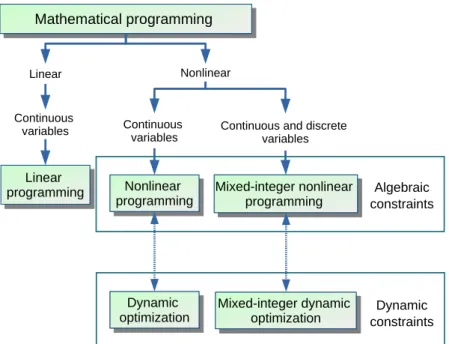
Mathematical programming problems can be classified (see Figure 1.9) according to the properties described by their functions, such as the existence of nonlinearities, the domain of the variables, or the presence of differential equations as constraints and time dependent decision variables.
Linear programming
Mathematical optimization problems based on linear programming (LP) can be
stated as:
minimize cTx
subject to A x =b
x ≥0
wherex is an-dimensional vector of decision variables, cTxis the objective function
to minimize, cT is the transpose of coefficient matrix of the cost function, A and
-0.14 20 -0.12 -0.1 15 20 -0.08 -0.06 15 10 -0.04 10 5 5 0 0 global optimum z y x (a) Unimodal. -10 -5 2 3 0 2 0 1 5 0 -1 -2 -2 -3 z z y x global minimum local minimum local maxima global maximum (b) Multimodal.
Figure 1.8: Example of unimodal and multimodal surfaces. The z-coordinate of the surface represents the value of the objective function for each pair of decision.
Algebraic constraints
Dynamic constraints
1.2 Optimization in computational systems biology 17
a LP problem presents a very simple scheme. The feasible region of the problem is convex, so that every local optimum represents a global optimum (unimodality), and the cost function is easy to solve.
Nonlinear programming
In models based on nonlinear programming (NLP), the complexity increases
due to the nonlinearity of the objective function and constraints. A NLP problem consists in:
minimize f(x)
subject to hi(x) = 0, i=1,2, ..., m
gj(x) = 0, j=1,2, ..., p
x∈S
wherexis an-dimensional vector of continuous decision variables, containing values
within the continuous subsetS. Then, f is the cost function of the problem and the
functions hi and gj are constraints. The presence of nonlinearities in the objective
and constrains might imply nonconvexity, which can induce multimodality in the topology.
NLP problems are much more difficult to solve than LP problems, specially for large dimensions. The appropriate algorithms for solving LP problems, will obtain little success when applied to NLP problems, even for a medium or a small problem dimension. Due to non-linearity, non-convexity, multi-modality, and ill-conditioning
in the topology described by the objective functions, many NLP problems are
NP-hard (non-deterministic polynomial-time hard), and thus, very difficult to solve.
Mixed-integer nonlinear programming
When an optimization problem presents nonlinearity and the domain of the
variables can be discrete or continuous, we talk about mixed integer nonlinear
minimize f0(x, y) subject to fj(x, y)≤0,j= 1,2,...,p x∈Zn + y∈Rm +
wheref0(x, y) is the objective function, fj are a set of pconstraints, xis a vector of
decision discrete variables with dimensionn, andyis a vector of decision continuous
variables with dimensionm. Besides, MINLP can be convex when all the functionsfj
are convex, or non-convex otherwise. Both convex and non-convex MINLP problems are NP-hard. However, non-convex MINLPs are extremely hard to solve compared to NLP and convex MINLP problems.
Dynamic optimization problems
In addition to the problems described above, a new type of optimization is de-manded to handle dynamic behaviors appearing in important phenomenas in many
real-life applications. Dynamic optimization [21] problems (DO), also called
opti-mal control (OC) problems, arises to obtain the optiopti-mal solution in systems whose dynamics are mapped by differential equations as constraints and time-dependent decision variables.
DO problems consider the computation of time-dependent conditions (controls,
stimuli) and time-independent parameters so as to optimize (minimize or
maxi-mize) a performance index J(x,u) while satisfying a set of dynamic and algebraic
constraints. Mathematically, it may formulated as follow:
J(x,u) = Θ(x(tf)) + Z tf t0 Φ(x(t),u(t), t)dt (1.1) subject to: dx/dt= Ψ(x(t),u(t), t) (1.2) h(x(t),u(t)) = 0 (1.3) g(x(t),u(t))≤0 (1.4)
1.2 Optimization in computational systems biology 19
xL ≤x(t)≤xU (1.5)
uL ≤u(t)≤uU (1.6)
where J(x,u) is the cost function, dx/dt is a set of ordinary differential equality
constraints,xis the vector of state variables with initial conditionsx(t0) = x0, u(t)
is the vector of real valued control variables,handga set of algebraic and inequality
constraints, and xL, xU, uL, uU correspond to the lower and upper bounds for the
control variables and state parameters.
Mixed-integer dynamic optimization
When part of the decision variables of a DO problem includes discrete
val-ues, these formulations belong to the class of mixed-integer dynamic optimization
(MIDO) problems, also called mixed-integer optimal control problem (MIOC). The general MIDO problem considers the computation of time dependent conditions
(controls,stimuli), discrete decisions (binary or integer), and time-independent
pa-rameters, so as to minimize (or maximize) a performance index (cost functional) while satisfying a set of dynamic and algebraic constraints. In mathematical form, it is usually formulated as follows:
Find u(t),i(t), p and tf so as to minimize (or maximize):
J =Gtf(x,u,i,p, tf) + Z tf t0 F(x(t),u(t),i(t),p, t)dt (1.7) subject to: f( ˙x(t),x(t),u(t),i(t),p, t) = 0, x(t0) = x0 (1.8) g(x(t),u(t),i(t),p, t)≤0, l = 1, me+mi (1.9) uL≤u(t)≤uU, (1.10) iL≤i(t)≤iU, (1.11) pL≤p≤pU, (1.12)
wherex(t)∈X ⊆Rnxis the vector of state variables,u(t)∈U ⊆Rnuis the vector of real valued control variables,i(t)∈I ∈Zni is the vector of integer control variables,
p∈P ⊆Rnp is the vector of time-independent parameters, t
f is the final time of the
process, me,mi represent the number of equality and inequality constraints, fis the
set of ordinary differential equations describing the dynamics of the system (plus the
corresponding initial conditions), g is the set of state constraints (path, pointwise
and final time constraints), and uL,iL, pL, uU, iU,pU correspond to the lower and upper bounds for the control variables and the time-independent parameters.
Parameter estimation problems
A particular type of dynamic optimization problem which needs a detailed
ex-planation is parameter estimation in dynamic systems, i.e. calibration of models
composed of differential equations. Building a dynamic biological model is an iter-ative process [20], usually represented as a cycle (see Figure 1.10). It starts with the definition of the purpose of the model and the selection of a model framework. Then, a mathematical structure is proposed with a set of non-measurable param-eters. After that, these parameters are estimated in order to obtain quantitative predictions. Finally, the model is (in)validated with new experiments, obtaining feedback which can be subsequently used in a refinement process.
The parameter estimation step is key in this iterative model building process and can be formulated as a mathematical optimization problem subject to the dy-namic constraints which describe the time-dependent behavior of the system. Most biological models are highly non-linear dynamical systems, resulting in challenging multi-modal problems which are very difficult to solve, as described in [218].
In computational systems biology, parameter estimation seeks to obtain a
deci-sion vector p, that optimizes the cost function in order to obtain quantitative
pre-dictions which match a given set of experimental time-series data, satisfying other
possible constraints. Finding the optimal values of this decision vector p can be
represented as a NLP problem, where the objective is to minimize the cost function:
J = nε X ε=1 nε o X o=1 nε,os X s=1
(ymε,os −ysε,o(p))TW(ymε,os −yε,os (p)) (1.13)
where nε is the number of experiments, nε is the number of the observables (state
1.2 Optimization in computational systems biology 21
Figure 1.10: Model building loop. Adapted from [20].
per observable per experiment, ymε,o
s are the measured data,ysε,o(p) are the model
predictions, and W is a scaling matrix that balances the results of the observables.
This optimization is also subject to the following constraints:
˙ x=f(x,p, t) (1.14) x(to) =xo (1.15) y=g(x,p, t) (1.16) heq(x, y,p) = 0 (1.17) hin(x, y,p)≤0 (1.18) pL≤p≤pU (1.19)
where x is the vector of state variables, xo are the initial conditions, f is the
non-linear dynamic problem with the differential-algebraic constraints, g corresponds
and pL and pU are lower and upper bounds for the decision vector p. The equality dynamic constraints, Eqn. 1.14-1.15, are solved as an inner initial value problem for each decision vector. Note that Eqn. 1.17-1.18 constraints could be handled using differential-algebraic solvers and suitable penalty functions, as described in [21]. Up-per and lower bounds for the parameters (Eqn. 1.19) could be handled by a reflection strategy [172] during the global phase.
All of the optimization problems described above may be applied to the field of systems biology. Some examples of theses applications are given in Table 1.1. A detailed discussion about optimization in computational systems biology and more examples can be found in [19].
Most of the optimization problems handled in this Thesis are considered within the parameter estimation procedure in dynamic models described by determinis-tic nonlinear ordinary differential equation models. The optimization problem ob-tained in the calibration of the model has also a NP-hard complexity, due to the non-linearity, non-convexity, multi-modality, and ill-conditioning in the topology de-scribed by its associate function. Thus, efficient methods are needed to solve this problem in practice.
1.2.2.
Optimization methods
As shown above, most of the problems in computational systems biology are highly constrained and exhibit nonlinear dynamics. These properties often result in non-convexity and multi-modality. Therefore, there is a great demand for suitable optimization solvers for these problems.
Global optimization (GO) methods are robust alternatives to solve complex op-timization problems, playing an increasingly important role in computational
bi-ology [84], bioinformatics [121] and systems bibi-ology [20]. They can be roughly
classified into the following classes:
Deterministic GO methods. These algorithms usually explore the entire search space, the solution retrieved being the global optimum. However, the associ-ated computational effort to ensure global optimality might be extremely large, making them impractical.
1.2 Optimization in computational systems biology 23
Table 1.1: Examples of applications of optimization problems in computational systems biology. Adapted from [19].
Type Description Examples
LP Linear objective and constrains Metabolic flux balancing [163, 212]; genome scale models [173]; inference of regulatory networks [224, 225]
NLP The objective function, or some
of the constrains, are nonlinear
Parameter estimation and
metabolic engineering [136]; analy-sis of energy metabolism [221]
MINLP Nonlinear problem with both
dis-crete and continuous decision variables
Develop of metabolic reaction net-works and their regulatory architec-ture [89, 90]; inference of regulatory interactions using time-course DNA microarray expression data [204]
DO Optimization with differential
equations as constraints and possible time-dependent decision variables
Optimal experimental design [16]; discovery of biological network de-sign strategies [2]; dynamic flux bal-ance analysis [134]
MIDO Optimization with differential
equations as constraints and both discrete and continuous, and possible time-dependent, de-cision variables
Computational design of genetic cir-cuits [49]
Parameter estimation in ODEs
Model calibration minimizing differences between predicted and experimental values
Parameter estimation using global and hybrid methods [18, 141, 181]; parameter estimation in stochastic methods [179]
![Figure 1.6: Example of hierarchical (hybrid) scheme. Adapted from [86].](https://thumb-us.123doks.com/thumbv2/123dok_us/9900902.2483514/47.892.187.751.655.1064/figure-example-hierarchical-hybrid-scheme-adapted.webp)