AERIAL REMOTE SENSING
[TENDER DOCUMENT]
NATIONAL REMOTE SENSING CENTRE
INDIAN SPACE RESEARCH ORGANISATION
Department of Space, Govt. of India Balanagar, Hyderabad 500037, AP, India
2
Contents
1.INTRODUCTION ... 3
2. GENERAL INSTRUCTION FOR SUBMISSION OF PROPOSALS ... 4
2.1 ELIGIBILITY CRITERIA ... 4
2.2 THE TECHNICAL BID SHOULD ALSO CONTAIN ... 4
3. AIRCRAFT REQUIREMENTS & SPECIFICATIONS ... 7
4. AIRCRAFT MODIFICATIONS ... 11
5.TERMS & CONDITIONS ... 19
6. DETAILS OF TECHNICAL INFORMATION ... 23
ANNEXURE-1: TECHNICAL COMPLIANCE STATEMENT ... 25
3
1.INTRODUCTION
1.1 Indian Space Research Organization (ISRO), Department of Space (DOS), Government of India (GoI) is the premier organisation in the country responsible for developing space based systems comprising launch vehicles, satellites and ground segment facilities to meet the country’s applications requirements in communication, broadcasting, meteorology and remote sensing.
1.2 National Remote Sensing Centre (NRSC) is one of the centers under the Indian Space
Research Organisation (ISRO), Department of Space (DOS), Government of India, with the mandate of providing Earth observation data from space and aerial platforms to users, develop technologies for the management of natural resources, support disaster monitoring and management and capacity building for utilization of Earth Observation data. Aerial Services & Digital Mapping Area (AS&DMA) of NRSC is the only civilian Government entity in the country with end-to-end state-of-the-art infrastructure and capability in the domain of aerial photography, Laser Scanner and Synthetic Aperture Radar surveys. It is a premier national facility for airborne data acquisition and large geospatial database generation in India.
1.3 NRSC owns & operates two SKA B200 aircraft for aerial data acquisition. These aircraft
have modifications suitable for installation of airborne sensors which are being used for Aerial Surveys for Remote Sensing applications.
1.4 Currently, the following activities are carried out with sensors like Aerial Cameras, Laser
Scanners and Synthetic Aperture Radar. The different types of aerial remote sensing services offered are:
a. Aerial photographic surveysusing Large Format Digital Camera System.
b. Airborne LiDAR and digital camera surveys for close contouring /DEM generation.
c. Airborne Synthetic Aperture Radar (ASAR) surveys.
d. Aerial Services for range calibration and instrument validation.
e. Airborne data acquisition services for atmospheric research.
1.5 NRSC invites proposals from Vendors for supplying of two new aircraft of same model
customized and certified for aerial remote sensing operations.
4
2. GENERAL INSTRUCTION FOR SUBMISSION OF PROPOSALS
2.1 ELIGIBILITY CRITERIA2.1.1 The Vendors submitting their proposals should be either the manufacturer or an
authorised dealer of the aircraft. In case of authorised dealers, documentary proof of authorisation valid as on date to be submitted in the technical proposal. Since the aircraft procurement involves manufacturing, modifications and certification of the new aircraft, NRSC has no objection for bidding with one company as a sole representative of all parties involved, substantiated with appropriate authorization by all the parties involved.
2.1.2 The vendor must have an authorised Maintenance Repair Overhaul Organisation
(MRO) in India or must have an agreement with an Indian MRO for carrying out scheduled and unscheduled maintenance, warranty support, etc, preferably in NRSC hangar in Hyderabad
2.1.3 The Bidder should have at least 5 years experiencein supplying aircraft and providing
maintenance.
2.2 The technical bid should also contain
2.2.1 Filled in Technical compliance statement as given in Annexure-I.
2.2.2 Authorisation certificates from the OEMs for Engine, Propeller, Avionics and all major
sub-systems indicating the willingness to provide technical & maintenance support during warranty and extended warranty period.
2.2.3 Detailed data sheets giving all the specifications and performance parameters/type
Certificate and Type certificate data sheet of the aircraft.
2.2.4 List of deliverables (including the list of continued airworthiness support
documents/aircraft post delivery documents like Airplane Flight Manual(AFM), Structural Inspection and Repair Manual(SRM), Illustrated Parts Catalogue (IPC), Maintenance Manual (MM)) etc
2.2.5 Contain the following undertaking by the vendor. QUOTE
I / we have gone through all the terms and conditions indicated in RFP TENDER No: NRSC ___________________ and accept all of them. The information contained in this submitted proposal is true to the best of my / our knowledge.
5
Signature of authorised representative With Office Seal Date :_______________
Place :_______________ UNQUOTE
2.3 The commercial bid must contain all the pricing details in the format provided in
Annexure-II. Don’t indicate actual commercial details anywhere in the technical bid. The pricing
details should be entered only in the entries provided against each item in the enclosed format. No attachment submitted in the technical or the commercial bid shall have the pricing details except in the entries in the price bid. If the commercial details are mentioned either in part or full in the technical bid, NRSC reserves the right to reject the bid. The empty commercial bid format should be enclosed in the technical bid. The empty commercial bid format should indicate the complete details of all the items whose price is given in the commercial bid.
2.4 Offers must be valid for 18 months from the last date for submission of the bids.
2.5 Prebid Meeting: Pre Bid Meeting between NRSC and the vendors interested in submitting proposals will be held at NRSC Hyderabad on ………. from ………..hrs. It is strongly recommended that all the vendors attend the pre-bid meeting to avoid further queries and clarifications later. It also is advisable that the OEM representatives of the aircraft attend the pre-bid meeting along with their Indian partners (if any). Those who wish to participate should send their willingness regarding their participation with name, designation, address and contact details before ………... Foreign nationals must indicate their nationality,
passport details. The Visa must be a Business Visa. Tourist Visa is not acceptable. A copy of
the passport must be sent to Head, Purchase and Stores, National Remote Sensing Centre,
ISRO, Balanagar, Hyderabad-500037, AP, India. email: [email protected]
2.6 Interested vendors can be present at NRSC during opening of Technical bids. Technical bids
will be opened in the presence of the attending vendors or their authorised representatives. Authorised representatives must carry a proper identification proof and an authorisation letter. The commercial bids will be opened in the presence of the attending vendors or their authorised representatives on a date that will be notified individually to the vendors whose technical bids are found to be suitable.
6
2.7 PROPOSAL FOR EACH MODEL SHOULD BE SUBMITTED IN TWO SEPARATE (TECHNOCOMMERCIAL
AND PRICE) SEALED COVERS. Each cover should be suitably superscribed as `TECHNO‐COMMERCIAL BID’ or `PRICE BID’ along with `TENDER NUMBER’ and `MODEL NAME’. All the sealed covers can be sent as a single package by post (or delivered by hand at NRSC). However, the package must be superscribed with `TENDER NUMBER’. DO NOT SEND PROPOSALS BY e‐mail. DO NOT INCLUDE ANY PRICING DETAILS IN THE TECHNICAL BID.
2.8 All the proposals and communications must be addressed to :
The Head, Purchase & Stores Division, National Remote Sensing Centre, Indian Space Research Organisation, Balanagar, Hyderabad - 500 037 AP, INDIA Phone : +91-40-23884065, 23884071
Fax : +91-40-23878695 E-mail : [email protected]
7
3. AIRCRAFT REQUIREMENTS & SPECIFICATIONS
3.1 The aircraft should be currently in series production with assured maintenance and spares
support in India over the expected life of 25 years. Pre owned aircraft will not be considered.
3.2 The aircraft is intended for remote sensing applications and hence vendor has to supply
aircraft with modifications as described in the subsequent chapters.
3.3 The vendor should get the aircraft certified to operate under rules and regulations of the
Indian aviation regulatory authority, currently, Directorate General of Civil Aviation (DGCA), India. NRSC will support for providing the necessary documentation as an Operator.
3.4 Cabin area of Aircraft should be adequate to accommodate six persons (excluding pilots),
sensor equipments and the modifications as described in Chapter-4(Aircraft Modifications).
3.5 The aircraft should be supplied with six operator chairs to conveniently monitor the airborne
sensor equipments.
3.6 Aircraft Type : Pressurized Twin turbo prop
3.7 Engines : Twin turbo prop
3.8 Service ceiling : 31000 ft MSL or higher
3.9 Maximum Cruise Speed : 290 knots or higher
3.10 Stall Speed : 95 knots or lower
3.11 Maximum Payload Weight(MPW)
(Sensor + 2Pilots + Pax + Luggage)
: 1200 Kg or higher
3.12 Endurance with Maximum Payload
Configuration(MPC)--MPW+Empty Aircraft Weight+ Maximum fuel with MPW
: 6 hours or higher
3.13 Seating Configuration ( Pilot + Pax) : 2 + 6
3.14 Avionics : Collins Proline / Honeywell / Garmin
Integrated Avionics Suite including auto-pilot coupled Flight Management System, Moving Map LCD Display
8
3.15 Aircraft Environment control System (Cabin air-conditioning):
3.15.1 Air conditioning in the aircraft is required to cater to environment conditions in
the flight with the ASAR equipment operating with 4 pax onboard excluding pilots.
3.15.2 Cabin temperature should not exceed 30° C during flying.
3.15.3 Innovative heat dissipative mechanism with customizable environmental
management system is preferable as the sensor equipments are likely to dissipate more heat.
3.15.4 Environmental management system should effectively support both pressurized
and unpressurized cabin conditions.
3.16 Aircraft Navigation instrumentation: Standard instrumentation should include,
3.16.1 VHF Omni range (VOR)
3.16.2 Automatic Direction Finder(ADF)
3.16.3 Distance Measuring Equipment(DME)
3.16.4 Instrument Landing System(ILS)- Category III B
3.16.5 Global Navigation Satellite System(GNSS) to support for Category III B ILS
3.16.6 Electronic Flight Bag (EFB) with iPad having flight planning and navigation app for
pilots.
3.16.7 Radio Altimeter
3.16.8 Weather RADAR with avoidance range of 300nm or higher
3.16.9 ATC Transponders ( Mode-S)
3.16.10 Autopilot and Full Authority Digital Engine Control(FADEC)
All the above instruments should be provided with dual system except FADEC, EFB and weather radar. Also, Autopilot may be quoted as dual system (Optional). Additionally, Integrated Standby Instrumentation System (ISIS) should be provided to aid in case of primary display failure.
3.17 Aircraft Communication instrumentation: Standard instrumentation should include,
3.17.1 VHF Communication –Dual configuration
3.17.2 HF Communication
3.18 Aircraft Safety Instrumentation: Standard instrumentation should include,
9
combination set with solid state Memory supporting a minimum of 2 hours recording. FDR should be of Category IA with Minimum of 32 parameters
monitored.
3.18.2 Traffic Collision Avoidance System (TCAS II) with Traffic Advisory (TA) and
Resolution Advisory (RA).
3.18.3 Water Activated and Impact Activated Emergency Locator Transmitter (ELT) with
operating frequency of 406 MHz
3.18.4 Reduced Vertical Separation Minima (RVSM) compliance systems
3.18.5 Enhanced Ground Proximity Warning System (EGPWS) including wind shear
warning.
3.18.6 Automatic Dependent Surveillance System ( ADS)
3.19 Instrument data Outputs(Optional): The following parameters along with Digital/ Analog
outputs from aircraft instruments or as additional installation should be made available in the cabin for logging and Analysis purpose. Provision for onboard storage of data with GPS time stamping and download after aircraft landing is also acceptable.
3.19.1 RADAR Altimeter
3.19.2 Radio Altimeter supporting upto 35000ft.
3.19.3 Barometric Altitude
3.19.4 Inertial Navigation system (lNS)
3.19.5 Global Navigation Satellite System (GNSS) position
3.19.6 Cabin Temperature and Humidity
3.19.7 Outside Pressure, temperature and Humidity
3.20 Voice and data communication system (optional) from aircraft, while in flight, to ground with
reasonable bandwidth for transmitting few images to ground in case of disaster scenario.
3.21 The vendor shall supply the complete set (both softcopy and three sets of hardcopy) of flight
manuals, maintenance manuals, pilots check lists, etc.. that are mandatory along with each aircraft.
3.22 The vendor shall provide the complete drawings and documentation of the modifications
carried out in softcopy and one set of hardcopy, at the time of delivery of the aircraft, to facilitate installation of equipment, and to carry out any repair in the event of failure of the parts used in modification.
10
implemented for carrying out the modifications in both the aircraft.
3.24 Power Console:
Aircraft should provide about 125A at 28V, (3500W) DC power for sensor operations. A power console (2Nos) with outlets of 10, 20, 50, 60, 100 amps, 28 V DC to be provided in the cabin limited to maximum of 125A at a time. Provision for A 2000 W Inverter (with a 75 amps outlet from 28 V DC supply) to provide 230V AC/50Hz output for operating other test instruments.
3.25 Other Facilities in the Cabin:
3.25.1 Intercom system between pilots, navigator/system engineers
3.25.2 Baggage Compartment with baggage net or Cage provision
3.25.3 Toilet seat
3.26 TRAINING: The vendor should provide training to four pilots identified by NRSC at vendor’s
facility. The price of training per pilot shall be given in the commercial bid. The payment for the pilot training shall be made depending on the actual number of pilots identified by NRSC for training. Training to DGCA officials if required shall also be the responsibility of vendor. All the expenses for the travel and accommodation of the DGCA officials during the training shall be borne by the vendor
11
4. AIRCRAFT MODIFICATIONS
4.1 Modifications to the aircraft for installation of payloads such as airborne sensors,
atmospheric probes and Airborne Synthetic Aperture Radar(ASAR) antenna has to be carried out by the aircraft supplier. The modifications include cutouts suitable for scientific payloads, optical wells, radome, pressure box, GPS antennas etc. Suitable EMI/EMC shielding to be made to aircraft wiring such that the airborne remote sensing equipment and aircraft avionics does not interfere with each other.
4.2 Antenna, Radome and Racks will be permanently fitted in the aircraft. Required modification
to be done duly certified by FAA/EASA and approved by DGCA. The modifications required aircraft wise is given in the table below.
Sl. No
Provision/ Modification Aircraft1 Aircraft2
1 First Camera well with Optical flat with
electrically operated door
2 Second Camera well with Optical flat with
electrically operated door
X
3 Cutout for Waveguide for ASAR Sensor X
4 Cutout for Atmospheric sensor probes
5 Radome at the belly for ASAR Sensor X
6 Pressure box X
7 Two Additional GPS Antenna for interfacing to
airborne sensors
4.3 The approximate dimensions & Location for Aircraft modifications are described in the table
below. Cabin height, length and width should be capable of accommodating these airborne sensor equipment racks.
12 4.4
Sl.no Item Dimensions in mm
(LxBxH)
Location Application
1. Cutout well for ASAR with
a bottom plate for waveguide (for antenna feed) of size 240 X 240mm
390 X 470 X 220 Belly ASAR
2. Cutout with well for
Camera
(for both cutouts)
700 X 700 Belly Camera
3. Radome 2500 X 750 X 650 Belly ASAR
4. Pressure Box 450 X 450 X 500 Belly Direct exposing
sensors 5. Cutout 240 X 240 Window or Belly Atmospheric Probes 6. Cutout
(for both antennas)
50 X 50 Roof GPS
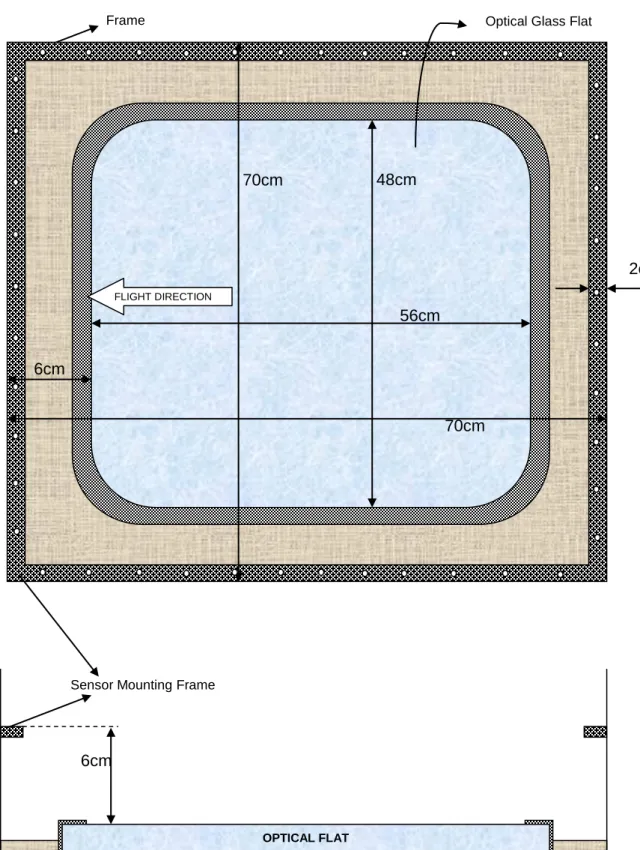
4.5 Specifications of Camera Well and Optical Flat
The camera well should have an optical flat and a motor driven shutter to protect the glass during takeoff and landing. One camera well should have an optical flat in the visible and NIR region. The second optical well should have an optical flat with two ports, one for SWIR region and another for TIR region.
4.5.1 Specifications of the Optical flat for Visible & NIR region(to be supplied in both Aircraft)
4.5.1.1 Material : Grade A BK-7 or S-BSL7 Borosilicate Glass
4.5.1.2 Wavelength : 370nm to 1600nm
4.5.1.3 Internal Transmittance : Greater than 99%
4.5.1.4 Surface Quality(Scratch/Dig) : 60/40
4.5.1.5 Durability : MIL-C-675A
4.5.1.6 Wedge : better than 1 arc min
4.5.1.7 Parallelism : Less than 2 arc seconds
4.5.1.8 Flatness : 2 waves per 7 inch diameter transmitted
waveform @ 632nm
4.5.1.9 AR Coating : High Efficiency Anti Reflective Coating at
1064 nm both sides
4.5.1.10 Angle of incidence : 0-38deg
13
4.5.1.12 Dimensions : About 55cm X 60cm
4.5.1.13 Should have thermal and structural Stability to withstand differential
temperatures and pressures at all altitudes up to the ceiling of the aircraft
4.5.2 Specifications of the Optical flat for SWIR(to be supplied in Aircraft-2)
4.5.2.1 Material : Material suitable for SWIR region
4.5.2.2 Wavelength : 1.2 μm to 2.5μm
4.5.2.3 Internal Transmittance : Greater than 95%
4.5.2.4 Surface Quality(Scratch/Dig) : 80/50
4.5.2.5 Durability : MIL-C-675A
4.5.2.6 Wedge : better than 1 arc min
4.5.2.7 Parallelism : Less than 2 arc seconds
4.5.2.8 Dimensions : Circular port of 25cm diameter
4.5.2.9 Should have thermal and structural Stability to withstand differential
temperatures and pressures at all altitudes up to the ceiling of the aircraft
4.5.3 Specifications of the Optical flat for TIR region(to be supplied in Aircraft-2)
4.5.3.1 Material : Suitable for Thermal region
4.5.3.2 Wavelength : 8μm to 14μm
4.5.3.3 Internal Transmittance : Greater than 95%
4.5.3.4 Surface Quality(Scratch/Dig) : 80/50
4.5.3.5 Durability : MIL-C-675A
4.5.3.6 Wedge : better than 1 arc min
4.5.3.7 Parallelism : Less than 2 arc seconds
4.5.3.8 Dimensions : Circular port of 25cm diameter
4.5.3.9 Should have thermal and structural Stability to withstand differential
temperatures and pressures at all altitudes up to the ceiling of the aircraft
4.5.4 Dimensions of the Camera well
4.5.4.1 NRSC uses Somag GSM3000 mount as the stabilizing platform for its imaging
sensors. The dimensions of the camera well should be able to accommodate the mount in its full operational capability.
4.5.4.2 Length and Width: 700mm X 700mm
4.5.4.3 The minimum gap between sensor mounting flange in the well and the upper
14
Fig 1: The well and optical flat arrangement for optical sensors
2cm
Frame Optical Glass Flat
48cm 56cm 6cm 70cm 70cm 6cm
Sensor Mounting Frame
OPTICAL FLAT
15
4.6 Specifications for Cutout for Waveguide and Radome for ASAR Sensor
4.6.1 The ASAR antenna will be mounted as and when required below the waveguide well
at the belly of the aircraft as shown in Fig.2 below.
4.6.2 The well will be of the dimension 390mm (L) X 470mm (w) X 220mm (D).
4.6.3 This will be a part of the cabin and will contain wave guides coming from C band
antenna along with subsystems like IMU, polarization switch etc. The material used for the radome should be transparent to C and X band frequencies and should withstand the differential temperatures and pressures upto to the ceiling height of aircraft. The ASAR antenna radome should not block the view through optical flat meant for optical sensors.
4.6.4 The bottom plate of well will have a cutout of 240 mm X 240 mm that will be
accessible from the outside.
4.6.5 The C-band antenna will be of the size 1.5 m X 0.32 m (under the belly of the
aircraft).
4.6.6 ASAR antenna will be covered by Radome. The Radome should be symmetric about
the bottom cut-out and should have usable flat of dimensions of about 2500 mm (L) X 750mm (W) X 650mm (D).
4.6.7 In mounted condition, gap between bottom of the Radome and ground should be
sufficient to protect the radome in the event of tyre burst condition.
4.6.8 Cutouts and well along with associated structural reinforcement to aircraft and
radome should be provided by the vendor with FAA/EASA/DGCA approval.
16 4.7 Specifications for Atmospheric sensor probes:
4.7.1 The aircraft should have suitable cutout for mounting atmospheric sensor inlets on the
fuselage or window with STC from FAA/EASA and approval from DGCA. The required arrangement is shown in Fig.3 below
Fig.3 Typical Air Inlet-Outlet Tube Assembly
4.8 Specification for pressure box: Pressure Box with approx dimensions 45 cm X 45 cm X 50 cm, to accommodate airborne multispectral/thermal sensors, and having cutout looking downward with electrically operated door (without optical flat). This is required for sensors which require access to the outside environment directly and at the same time providing isolation between the outside environment and the pressurized aircraft cabin.
17 4.9 Tentative Floor Layout of the Aircraft cabin:
18
4.10 Details of the Sensor racks placed in the Aircraft Cabin( Racks shall be provided by NRSC)
Sl
No: Rack
Dimensions in
mm(HxDxW) Aircraft I Aircraft 2 Payload
1 Rack I 1240 X 800 X 600 X ASAR
2 Rack II 900 X 650 X 550 X ASAR
3 Sensor Rack 860 X450 X 540 Camera
4 Sensor Rack 860 X450 X 540 X Camera
5 Sensor Rack 860 X450 X 540 Atmospheric suit
19
5.TERMS & CONDITIONS
5.1 The terms & conditions defined in this RFP shall be considered for this procurement and
supersede the general terms & conditions enclosed if any.
5.2 DELIVERY: The vendor shall deliver( including supply, permissions from the regulatory authorities (like DGCA and WPC and final acceptance) the aircraft with all the modifications, certified by FAA/EASA & approved by DGCA at NRSC Hangar, Begumpet Airport, Hyderabad
within 12 months from the date of release of Purchase Order.
5.3 REGULATORY AUTHORITIES PERMISSIONS: All the permissions from the regulatory authorities for importing, registration, airworthiness and flying of the aircraft in India has to be obtained by the vendor. Any expenses incurred for the above has to be borne by the vendor. NRSC shall provide documentary support wherever required and feasible. In case vendor fails to obtain permission, NRSC reserves the right to cancel the order and reject the aircraft.
5.4 INSURANCE: Any expenses for the insurance from the OEM factory to NRSC shall not be borne by NRSC.
5.5 INSTALLATION: The vendor shall prepare an Acceptance Test Procedure (ATP) document which shall be sent to NRSC after the PO is placed. The ATP document shall be finalised on mutual agreeable basis and will be used for acceptance of the aircraft at NRSC Hyderabad.
5.5.1 In case of foreigners visiting NRSC, Hyderabad for installation and acceptance, the
passport and VISA details of the personnel have to be sent to NRSC well in advance to get necessary approvals from Dept. of Space and Bureau of Civil Aviation Security (BCAS) clearances.
5.5.2 The vendor is responsible for problem free demonstration of aircraft in NRSC & any
onsite issues should be appropriately resolved by the vendor.
5.6 Factory Acceptance Test: The expenses for the test flights during factory acceptance test of the aircraft by NRSC engineers shall be borne by the vendor. The travel & accommodation expenses will be borne by NRSC.
20
5.7 Site Acceptance Test: The Site acceptance test at NRSC shall be carried out with the Pilots from the vendor and all the expenses for these test flights shall be borne by the vendor. 5.8 WARRANTY AND MAINTENANCE :
5.8.1 The warranty will start from the date of issue of On-site Acceptance Certificate by
NRSC.
5.8.2 The vendor shall provide three years onsite comprehensive maintenance for the
aircraft and subsystems for all scheduled & unscheduled maintenance through the authorised Indian MRO(CAR-145) and DGCA approved Continuing Airworthiness Maintenance Organisation (CAMO) services
5.8.3 The vendor should provide TWO engineers (A&C) at Hyderabad base. The vendor
must also position a R,E,I and any other engineers recommended by the Aircraft manufactures or send one within 24 hours on need/ request basis to the place where NRSC aircraft is positioned. The vendor must also position sufficient number of technicians at NRSC hanger to cater to the maintenance of the Aircraft. These engineers/ technicians will be deployed on to the field when the aircraft is outstation for survey task. The vendor has to separately quote for the daily allowance (all inclusive) for both technicians and engineers.
5.8.4 Each sub system of the aircraft like airframe, engines, propellers, avionics come with
a standard warranty. The vendor shall provide the standard warranty applicable for each of these systems from the date of acceptance. Accordingly, the warranty should be quoted keeping this in view. Any subsystem warranty that the OEM provides for greater than three years shall be transferred to NRSC.
5.8.5 The price details for the maintenance should be given in the commercial bid with
year wise break up. The payment during this three year maintenance period shall be paid at the end of each year on satisfactory performance during that year on an annual basis.
5.8.6 The down time for the aircraft shall not be more than one day for lack of availability
of maintenance crew and fault diagnosis. If the down time exceeds the specified period, the warranty charge will be deducted at 1/360th of the yearly payment per day for the delayed period.
21
circumstances caused by the act of God, natural calamities, riots or other such situations over which there cannot be any control either by the NRSC or by the Vendor
5.8.8 The vendor should submit necessary authorisation from the OEM substantiating that
the OEM shall support the vendor for installation, maintenance and the warranty for the total three years.
5.8.9 The maintenance shall be extendable for a further period of 2 or more years on
mutually agreeable terms & conditions.
5.8.10 The vendor shall be the maintenance provider for the subsystems including
modifications along with all the third party sub-systems which as a total constitute the aircraft system delivered to NRSC.
5.8.11 The vendor shall provide 24x7 support during the maintenance period of 3 years.
5.9 CUSTOMS DUTY EXCEMPTION: NRSC is entitled for concessional Customs Duty payment ([email protected]%) and shall provide Customs Duty Exemption Certificate for availing the
same upon submission of necessary documentation by the vendor.
5.10 PAYMENT TERMS: NRSC normal payment terms are 90% payment after receipt, installation
and acceptance of the aircraft and balance 10% after submission of performance bank guarantee. However, If any advance payment is required by the vendor, a maximum of 30% of base price (aircraft cost + cost of modifications) excluding warranty and training cost can be paid against bank guarantee from a nationalized bank as per the format provided by NRSC. This bank guarantee shall be valid till the completion of supply and acceptance of the aircraft. NRSC decision in this aspect shall be final.
5.11 PERFORMANCE BANK GUARANTEE: The supplier has to provide a performance bank
guarantee for 10% of base price (aircraft cost + cost of modifications), valid till the completion of warranty period plus three months as claim period as per the Proforma which shall be sent along with the PO.
5.12 ACCEPTANCE: The aircraft will be accepted only after successful test flights at NRSC
Hyderabad, meeting all the requirements including modifications and obtaining approvals from regulatory authorities. A mutually agreeable acceptance document shall be prepared
22 and used for acceptance.
5.13 During acceptance testing with sensors installed, the vendor should carryout field
modification on the aircraft (if required) and obtain DGCA approvals for resolving the EMI/EMC/other compatibility issues if any.
5.14 LIQUIDADTED DAMAGES: For delays attributable to vendor in completion of entire supply
beyond 12 months (including supply, permissions from the regulatory authorities like DGCA and WPC and final acceptance), Liquidated Damages (LD) shall be applicable at 0.5% per week or part there of subject to a maximum of 10% of the order value.
5.15 FORCE MAJEURE: Neither NRSC nor the supplier shall be liable to the other for any delay in
or failure of their respective obligations under this procurement caused by occurrences beyond the control of NRSC or the supplier because of fire, floods, power, acts of God, acts of public enemy, wars, insurrection, sabotage, any law, statute or ordinance Agreement, action or regulations of the Governments or any compliance therewith similar to the above. Either party shall promptly. but not later than thirty(30) days thereafter notify the other of the commencement and cessation of such contingency and prove that such is beyond the control and affects the implementation of this procurement adversely and if such contingency continues beyond six(6) months, both parties may mutually agree to discuss and agree upon an equitable solution for cancellation of this purchase order or otherwise decide the course of action to be adopted.
5.16 ARBITRATION: Settlement of disputes shall be through arbitration
a) If Indian supplier, the arbitration shall be as per Indian Arbitration and conciliation Act, 1996.
b) If foreign supplier, the supplier has the option to choose Indian Arbitration and Reconciliation Act, 1996 or United Nations Commission on international Trade law Arbitration rules or as mutually agreed.
c) Arbitration proceedings will be held in Hyderabad, India only
5.17 NRSC, during technical evaluation, may decide to visit the facility of the vendor (or any
customer site maintained by the vendor) at NRSC cost, to ascertain their authenticity and capability. NRSC shall have the right to reject the proposal of the vendor based on its findings during the visit. The vendor should facilitate the above visit by NRSC team.
23
6. DETAILS OF TECHNICAL INFORMATION
Thefollowing technical details have to be provided by Vendor
6.1 The scheme for modifications should be spelled out in detail. A drawing of the layout
showing the various racks, optical wells, cut outs, antenna positions, pressure box and radome overlaid on the aircraft structural drawing.
6.2 The scheme for meeting the other requirements including power supply, air conditioning,
installation of GPS antenna, recording parameters etc .
6.3 A list of aircraft instruments that are required to be supplied as part of this RFP and their
performance specifications and model numbers
6.4 Vendors should provide Lead time for delivery of aircraft and modifications.
6.5 Vendors should provide a detailed plan for aircraft maintenance during the warranty period
and also thereafter in the post warranty period.
6.6 Proposal should mention the aircraft model suggested by the vendor and provide detailed
specifications and drawing of the aircraft.
Sl.No Parameter Details
1. Aircraft Model name.
2. Model Number.
3. Serial Number
4. Year Type Certified
5. RVSM certification 6. Cabin Volume 7. Baggage Compartment Volume 8. Ramp Weight 9. Takeoff Weight(MTOW)
10. Zero Fuel Weight
11. Payload Weight (including pilots) with full fuel 12. Range with max. payload (as per NRSC payload
requirement)
13. Usable Fuel Quantity 14. IFR fuel reserves 15. Engines Manufacturer
24
Sl.No Parameter Details
16. Engines Model 17. Engine TBO 18. Propellers Manufacturer 19. Propellers Model 20. Propellers Type
21. Thrust Reverser mechanism if applicable 22. Take-off Distance 23. Landing Distance 24. Rate of Climb 25. Service Ceiling 26. Maximum Speed 27. Stall Speed 28. Differential Pressure 29. Time to Cruise Altitude 30. Cabin Noise Levels
31. Cabin altitude @ certified ceiling 32. List of standard avionics items 33. List of optional avionics items 34. Seats – Crew
Passengers (typical) 35. Passengers( maximum)
36. Volume of Passenger cabin(Dimensions) 37. Maintenance Schedules of the aircraft
(list of phase inspections propeller overhaul timings) 38. Manufacturer and Address with contact Details
39. Tender Reference Number
25
Annexure-1: Technical Compliance Statement
Sl. No.
RFP
Clause Item Compliance
Reference Page No of bid
Remarks
1. 2.1.1 Manufacturer or Dealer?
Submitted proof of authorised dealership
YES/NO 2. 2.1.2 Has an MRO or has an agreement with an Indian
MRO? Details provided?
YES/NO 3. 2.1.3 5 years experience in supplying aircraft and
providing maintenance and proof
YES/NO 4. 2.2.2 Authorisation from subsystem OEMs as per 2.2.2
attached?
YES/NO 5. 2.2.3 All details & datasheets as per 2.2.3 attached? YES/NO 6. 2.2.4 List of deliverables as per 2.2.4 attached? YES/NO 7. 2.4 Validity of the bids as per Clause 2.4 YES/NO 8. 3.1 Aircraft in series production with assured
maintenance and spares support in India over the expected life of 25 years?
YES/NO
9. 3.3 Acceptance and Commitment to clause 3.3 YES/NO 10. 3.4 Conformance to clause 3.4 YES/NO 11. 3.5 Provision of chairs as per 3.5 YES/NO 12. 3.6 Compliance to clause 3.6 YES/NO 13. 3.7 Compliance to clause 3.7 YES/NO 14. 3.8 Compliance to clause 3.8 YES/NO 15. 3.9 Compliance to clause 3.9 YES/NO 16. 3.10 Compliance to clause 3.10 YES/NO 17. 3.11 Compliance to clause 3.11 YES/NO 18. 3.12 Compliance to clause 3.12 YES/NO 19. 3.13 Compliance to clause 3.13 YES/NO 20. 3.14 Compliance to clause 3.14 YES/NO 21. 3.15 Compliance to provide air conditioning system as
per clause 3.15
YES/NO 22. 3.16 Compliance to clause 3.16 with all the
instruments listed. Details provided?
YES/NO 23. 3.17 Compliance to clause 3.17 with all the
communication equipment listed. Details provided?
YES/NO
26 Sl.
No. RFP
Clause Item Compliance
Reference Page No of bid
Remarks
25. 3.18.2 TCAS-II with Traffic Advisory and Resolution Advisory provided?
YES/NO 26. 3.18.3 Water Activated and Impact Activated Emergency
Locator Transmitter (ELT) with operating frequency of 406 MHz provided?
YES/NO
27. 3.18.4 RVSM compliant? YES/NO 28. 3.18.5 Enhanced Ground Proximity Warning System
(EGPWS) including wind shear warning provided?
YES/NO 29. 3.18.6 Automatic Dependant Surveillance System
provided?
YES/NO 30. 3.19 Details of optional interfaces as given in 3.19
given?
YES/NO 31. 3.20 Optional communication equipment with ground
provided? If so, details given?
YES/NO 32. 3.21 Acceptance of clause 3.21 YES/NO 33. 3.22 Acceptance of clause 3.22 YES/NO 34. 3.23 Acceptance of clause 3.23 YES/NO 35. 3.24 Provision of power console as per 3.24 YES/NO 36. 3.25 Facilities in the Cabin as listed in 3.25 YES/NO 37. 3.26 Acceptance of clause 3.26 YES/NO 38. 4.1 Acceptance to supply the aircraft with
modifications as given in clause 4.1
YES/NO 39. 4.2 Acceptance of clause 4.2 YES/NO 40. 4.4 Acceptance to supply the aircraft with
modifications as given in table 4.4
YES/NO 41. 4.5 Acceptance to supply Aircraft 1 with one camera
well and Aircraft-2 with two camera wells as specified in Clause 4.5
YES/NO
42. 4.5.1 Acceptance to supply the camera wells in both the aircraft with Optical flat for VNIR region as per the specifications given in para 4.5.1
YES/NO
43. 4.5.2 Acceptance to supply the camera well in Aircraft-2 with Optical flat suitable for SWIR region as per the specifications given in para 4.5.2
YES/NO
44. 4.5.3 Acceptance to supply the camera well in Aircraft-2 with Optical flat suitable for SWIR region as per the specifications given in para 4.5.3
YES/NO
45. 4.5.4 Acceptance to carry out the Camera well modification as per the details specified in 4.5.4
YES/NO 46. 4.6 Acceptance to provide provision for ASAR antenna
and Radome installation. Acceptance to provide the Radome as per the specifications given in Clause 4.6
YES/NO
47. 4.6.2 Acceptance of clause 4.6.2 YES/NO 48. 4.6.4 Acceptance of clause 4.6.4 YES/NO 49. 4.6.6 Acceptance of clause 4.6.6 YES/NO
27 Sl.
No. RFP
Clause Item Compliance
Reference Page No of bid
Remarks
50. 4.6.8 Acceptance of clause 4.6.8 YES/NO 51. 4.7 Acceptance of clause 4.7 YES/NO 52. 4.8 Acceptance of clause 4.8 YES/NO 53. 5.2 Acceptance to delivery as per clause 5.2 YES/NO 54. 5.3 Acceptance to clause 5.3 YES/NO 55. 5.4 Acceptance of clause 5.4 YES/NO 56. 5.5 Acceptance to clause 5.5 YES/NO 57. 5.6 Acceptance of clause 5.6 YES/NO 58. 5.7 Acceptance of clause 5.7 YES/NO 59. 5.8 Acceptance to Warranty & Maintenance clause
5.8
YES/NO 60. 5.8.2 Acceptance to provide three years onsite
comprehensive maintenance as per 5.8.2
YES/NO 61. 5.8.3 Acceptance to provide manpower as per 5.8.3 YES/NO 62. 5.8.4 Acceptance to clause 5.8.4 YES/NO 63. 5.8.5 Details of price breakup for maintenance given in
the price bid? Acceptance to payment terms for maintenance as per 5.8.5
YES/NO
64. 5.8.6 Acceptance to LD Clause 5.8.6 during three years maintenance
YES/NO 65. 5.8.7 Acceptance to clause 5.8.7 YES/NO 66. 5.8.8 Details provided as given in 5.8.8 YES/NO 67. 5.8.9 Acceptance to clause 5.8.9 YES/NO 68. 5.8.10 Acceptance to clause 5.8.10 YES/NO 69. 5.8.11 Acceptance to clause 5.8.11 YES/NO 70. 5.9 Acceptance to clause 5.9 YES/NO
71. 5.10 Acceptance to payment terms as per clause 5.10 YES/NO
72. 5.11 Acceptance to provide PBG as per clause 5.11 YES/NO
73. 5.12 Acceptance to clause 5.12 for acceptance plan YES/NO
74. 5.13 Acceptance to clause 5.13 YES/NO
75. 5.14 Acceptance to LD clause during supply, approvals and acceptance Clause 5.14
YES/NO
28 Sl.
No. RFP
Clause Item Compliance
Reference Page No of bid
Remarks
77. 5.16 Acceptance to Arbitration Clause 5.16 YES/NO
78. 5.17 Acceptance of clause 5.17 YES/NO
79. 6.1 Details as per clause 6.1 Confirm
80. 6.2 Details as per clause 6.2 Confirm
81. 6.3 Details as per clause 6.3 Confirm
82. 6.4 Details as per clause 6.4 Confirm
83. 6.5 Details as per clause 6.5 Confirm
29
ANNEXURE-II: COMMERCIAL BID FORMAT
Sl.
No. Item
Price
Remarks
1 Price of Aircraft-1
2 Price of the modifications on Aircraft-1
3 Price for maintenance for 1st year of Aircraft-1
4 Price for maintenance for 2nd year of Aircraft-1
5 Price for maintenance for 3rd year of Aircraft-1
6 Price of Aircraft-2
7 Price of the modifications on Aircraft-2
8 Price for maintenance for 1st year of Aircraft-2
9 Price for maintenance for 2nd year of Aircraft-2
10 Price for maintenance for 3rd year of Aircraft-2
11 TA/DA for the engineers on outstation during the 3yrs maintenance period. Will be multiplied by 300 for a total period of 3ys. 12 TA/DA for the technicians on outstation
during the 3yrs maintenance period. Will be multiplied by 300 for a total period of 3ys. 13 Training cost per Pilot
14 Cost of Dual Autopilot as per clause 3.16 ( Optional item)
15 Cost of Data outputs as per Clause 3.19 ( Optional item)
16 Cost of Voice & Data communication system as per Clause 3.20 ( Optional item) 17 Any other relevant/mandatory item
(Please specify complete details of the additional items in the technical bid)