Software development: do good manners matter?
Giuseppe Destefanis, Marco Ortu, Steve Counsell, Michele Marchesi, Roberto TonelliA successful software project is the result of a complex process involving, above all,
people. Developers are the key factors for the success of a software development process,
not merely as executors of tasks, but as protagonists and core of the whole development
process. This paper investigates social aspects among developers working on software
projects developed with the support of Agile tools. We studied 22 open source software
projects developed using the Agile board of the JIRA repository. All comments committed
by developers involved in the projects were analyzed and we explored whether the
politeness of comments affected the number of developers involved and the time required
to fix any given issue. Our results showed that the level of politeness in the communication
process among developers does have an effect on the time required to fix issues and, in
the majority of the analysed projects, it had a positive correlation with attractiveness of
the project to both active and potential developers. The more polite developers were, the
less time it took to fix an issue. In the majority of the analysed cases, the more developers
wanted to be part of a project, the more they were willing to continue working on the
project over time.
Software Development: Do Good Manners
1Matter?
2Giuseppe Destefanis
1, Marco Ortu
2, Steve Counsell
3, Michele Marchesi
4,
3and Roberto Tonelli
5 41Brunel University, London, [email protected]
5
2DIEE, Cagliari, [email protected]
6
3Brunel University, London, [email protected]
7
4DIEE, Cagliari, [email protected]
8
5DIEE, Cagliari, [email protected]
9
ABSTRACT
10A successful software project is the result of a complex process involving, above all, people. Developers are the key factors for the success of a software development process, not merely as executors of tasks, but as protagonists and core of the whole development process. This paper investigates social aspects among developers working on software projects developed with the support of Agile tools. We studied 22 open source software projects developed using the Agile board of the JIRA repository. All comments committed by developers involved in the projects were analyzed and we explored whether the politeness of comments affected the number of developers involved and the time required to fix any given issue.
Our results showed that the level of politeness in the communication process among developersdoes
have an effect on the time required to fix issues and, in the majority of the analysed projects, it had a positive correlation with attractiveness of the project to both active and potential developers. The more polite developers were, the less time it took to fix an issue. In the majority of the analysed cases, the more developers wanted to be part of a project, the more they were willing to continue working on the project over time.
11
Keywords: social and human aspects, politeness, mining software repositories, issue fixing time, software development
12
1 INTRODUCTION
13High-level software development is a complex activity involving a range of people and activities; ignoring 14
human aspects in the software development process or managing them in an inappropriate way can, 15
potentially, have a huge impact on the software production process and team effectiveness. Increasingly, 16
researchers have tried to quantify and measure how social aspects affect software development. Bill Curtis 17
claimed that “the creation of a large software system must be analyzed as a behavioural process (Curtis 18
et al. (1988)).” Coordinating and structuring a development team is thus a vital activity for software 19
companies and team dynamics have a direct influence on group successfulness. Open-source development 20
usually involves developers that voluntarily participate in a project by contributing with code-development. 21
In many senses, the management of such developers is more complex than the management of a team 22
within a company - developers are not in the same place at the same time and coordination therefore 23
becomes more difficult. Additionally, the absence of face-to-face communication mandates the use of 24
alternative technologies such as mailing lists, electronic boards or issue tracking systems. In this context, 25
being rude or aggressive when writing a comment or replying to a contributor can affect the cohesion of 26
the group, its membership and the successfulness of a project. On the other hand, a respectful environment 27
provides an incentive for new contributors to join the project and could significantly extend the lifetime 28
and usefulness of a project to the community. 29
According to VersionOne (2013): “more people are recognising that agile development is beneficial 30
to business, with an 11% increase over the last 2 years in the number of people who claim that agile 31
helps organisations complete projects faster”. A main priority reported by users was to accelerate time 32
to market, manage changing priorities more easily and better align IT and business objectives. Agile 33
project management tools and Kanban boards experienced the largest growth in popularity of all agile tool 34
categories, with use or planned use increasing by 6%. One of the top five ranked tools was Atlassian JIRA1,
35
with an 87% recommendation rate. Agile boards represent the central aspect of communication in the 36
Agile philosophy. According to Perry (2008) “the task board is one of the most important radiators used 37
by an agile team to track their progress.” The JIRA board is a good solution for bridging the gap between 38
open-source software development and the Agile world. It is the view of many that agile development 39
requires a physical aspect, i.e. developers working together in the same room or building, or at the same 40
desk; the pair programming paradigm, for example, requires at least two people working simultaneously 41
on the same piece of code. By using tools such as the JIRA board it is possible to use an agile board for 42
development of a project by developers in different physical places. Working remotely, in different time 43
zones and with different time schedules, with developers from around the world, requires coordination 44
and communication. When a new developer joins a development team, the better the communication 45
process works, the faster the new developer can become productive and the learning curve reduced. The 46
notion of an agile board therefore places emphasis on the know-how and shared-knowledge of a project 47
being easily accessible for the development team throughout the development process. Fast releases, 48
continuous integration and testing activities are directly connected to the knowledge of the system under 49
development. The potential for agile boards to simplify development across geographically disparate 50
areas is in this sense relatively clear. In a similar vein, the social and human aspects of the development 51
process are becoming more and more important. The Google work style has become a model for many 52
software start-ups - a pleasant work environment is important and affects the productivity of employees. 53
One important contributor to a healthy work environment is that each employee is considerate and polite 54
towards their fellow employees. More specifically “Politeness is the practical application of good manners 55
or etiquette. It is a culturally defined phenomenon and what is considered polite in one culture can 56
sometimes be quite rude or simply eccentric in another cultural context. The goal of politeness is to make 57
all of the parties relaxed and comfortable with one another.”2The last part of this definition is what we 58
consider in our analysis. In this specific work, we do not take different cultures into account (although 59
developers involved in a specific project could be from all around the world); we focus on the politeness 60
of the comment-messages written by the developers. The research aims to show how project management 61
tools such as agile boards can directly affect the productivity of a software development team and the 62
health of a software project. 63
Our research focuses around the concepts developed by Yamashita et al. (2014) who introduced the 64
concepts of magnetism and stickiness for a software project. A project is classified asMagneticif it has 65
the ability to attract new developers over time.Stickinessis the ability of a project to keep its developers 66
over time. We measured these two metrics by considering the period of observation of one year. Figure 1 67
shows an example of the evaluation of Magnet and Sticky metrics. In this example, we were interested in 68
calculating the value of Magnetism and Stickiness for 2011. From 2010 to 2012, we had a total of 10 69
active3developers. In 2011, there were 7 active developers and 2 of them (highlighted with black heads) 70
were new. Only 3 (highlighted with grey heads) of the 7 active developers in 2011 were also active in 71
2012. We can then calculate the Magnetism and Stickiness as follows: 72
• Magnetismis the fraction of new active developers during the observed time interval, in our example 73
2/10 (dev 6anddev 7were active in 2011 but not in 2010). 74
• Stickinessis the fraction of active developers that were also active during next time interval, in our 75
example 3/7 (dev 1,dev 2,dev 3were active in 2011 and in 2012). 76
We considered 22 open source projects from one of the largest datasets of issues reports openly 77
available (Ortu et al. (2015d)). This paper aims to answer the following research questions: 78
• Does politeness among developers affect issues fixing time? 79
Issue fixing time for polite issues was found to be faster than issue fixing time for impolite issues 80
for 17 out of 22 analysed projects. 81
1https://www.atlassian.com/software/jira 2en.wikipedia.org/wiki/Politeness
3We consider active all developers that posted/commented/resolved/modified an issue during the observed time (from dev 1 to dev 10)
Figure 1.Example of Magnet and Sticky metrics computation in 2011
• Does politeness among developers affect the attractiveness of a project? 82
We concluded that politeness is positively correlated with Magnetism and Stickiness metrics in 83
subsequent years for the systems in our corpus. 84
• Does politeness among developers vary over time? 85
Average politeness does vary over time and in some cases it changes from negative values (impolite) 86
to positive (polite) from two consecutive observation intervals. Regarding average politeness over 87
individual work days, we did not find great differences. 88
• How does politeness vary with respect to JIRA maintenance types and issue priorities? 89
Comments related to issues with maintenance Bug, priority Minor and Trivial, tend to have a higher 90
percentage of impolite comments. Issues with maintenance New Feature, priority Blocker and 91
Critical tend to have a higher percentage of polite comments. 92
This paper is an extended version of earlier work by the same authors (Ortu et al. (2015b)). We added 93
8 new systems to the original corpus analzyed in Ortu et al. (2015b), and two new research question 94
(RQ3 and RQ4). The remainder of this paper is structured as follows: In the next section, we provide 95
related work. Section 3 describes the dataset used for this study and our approach/rationale to evaluate 96
the politeness of comments posted by developers. In Section 4, we present the results and elaborates on 97
the research questions we address. Section 5 discusses the threats to validity. Finally, we summarize the 98
study findings and present plans for future work in Section 6. 99
2 RELATED WORK
100A growing body of literature has investigated the importance and the influence of human and social 101
aspects, emotions and mood both in software engineering and software development. Research has 102
focused on understanding how the human aspects of a technical discipline can affect final results (Brief 103
and Weiss (2002), Capretz (2003), Cockburn and Highsmith (2001), Erez and Isen (2002), Kaluzniacky 104
(2004)), and the effect of politeness (Novielli et al. (2014), Tan and Howard-Jones (2014), Winschiers and 105
Paterson (2004), Tsay et al. (2014)). 106
Feldt et al. (2008) focused on personality as a relevant psychometric factor and presented results 107
from an empirical study about correlations between personality and attitudes to software engineering 108
processes and tools. The authors found that higher levels of the personality dimension “conscientiousness” 109
correlated with attitudes towards work style, openness to changes and task preference. 110
IT companies are also becaming more conscious of social aspects. Ehlers (2015) evaluated the 111
efforts of IT companies in acquiring software engineers by emphasizing socialness in their job ads. The 112
research analyzed 75,000 jobs ads from the recruiting platform Indeed and about 2,800 job ads from 113
StackoverflowCareers to investigate correlations between social factors and the employee satisfaction of a 114
work place. The findings showed that many companies advertise socialness explicitly. The Manifesto for 115
Agile Development indicates that people and communications are more essential than procedures and 116
tools (Beck et al. (2001)). 117
Steinmacher et al. (2015) analyzed social barriers that obstructed first contributions of newcomers (new 118
developers joining an open-source project). The study indicated how impolite answers were considered as 119
a barrier by newcomers. These barriers were identified through a systematic literature review, responses 120
collected from open source project contributors and students contributing to open source projects. 121
Roberts et al. (2006) conducted a study which revealed how the different motivations of open-source 122
developers were interrelated, how these motivations influenced participation and how past performance 123
influenced subsequent motivations. 124
Rigby and Hassan (2007) analyzed, using a psychometrically-based linguistic analysis tool, the five 125
big personality traits of software developers in the Apache httpd server mailing list. The authors found 126
that the two developers that were responsible for the major Apache releases had similar personalities 127
and their personalities were different from other developers. Bazelli et al. (2013) analyzed questions and 128
answers on stackoverflow.com to determine the developer personality traits, using the Linguistic Inquiry 129
and Word Count (Pennebaker et al. (2001)). The authors found that the top reputed authors were more 130
extroverted and expressed less negative emotions than authors of down voted posts. 131
Tourani et al. (2014) evaluated the use of automatic sentiment analysis to identify distress or happiness 132
in a team of developers. They extracted sentiment values from the mailing lists of two mature projects of 133
the Apache software foundation, considering developers and users. The authors found that an automatic 134
sentiment analysis tool obtained low precision on email messages (due to long size of the analyzed text) 135
and that users and developers express positive and negative sentiment on mailing lists. Murgia et al. 136
(2014b) analyzed whether issue reports carried any emotional information about software development. 137
The authors found that issue reports contain emotions regarding design choices, maintenance activity or 138
colleagues. G´omez et al. (2012) performed an experiment to evaluate whether the level of extraversion 139
in a team influenced the final quality of the software products obtained and the satisfaction perceived 140
while this work was being carried out. Results indicated that when forming work teams, project managers 141
should carry out a personality test in order to balance the amount of extraverted team members with 142
those who are not extraverted. This would permit the team members to feel satisfied with the work 143
carried out by the team without reducing the quality of the software products developed. Acu˜na et al. 144
(2008), performed empirical research examining the work climate within software development teams. 145
The authors attempted to understand if team climate (defined as the shared perceptions of team work 146
procedures and practices) bore any relation to software product quality. They found that high team vision 147
preferences and high participative safety perceptions of the team were significantly related to better 148
software. In a study conducted by Fagerholm et al. (2014), it was shown that software teams engaged in 149
a constant cycle of interpreting their performance. Thus, enhancing performance experiences requires 150
integration of communication, team spirit and team identity into the development process. 151
3 EXPERIMENTAL SETUP
1523.1 Dataset
153
We built our dataset collecting data from one of the JIRA4largest public dataset available (Ortu et al. 154
(2015d)). An Issue Tracking System (ITS) is a repository used by software developers to support the 155
software development process. It supports corrective maintenance activity like Bug Tracking systems, 156
along with other types of maintenance requests. We mined the dataset (Ortu et al. (2015d)) collecting 157
issues from October 2002 to December 2013. To create our corpus, we selected projects for which the 158
JIRA Agile board contained a significant amount of activity (e.g., projects with the highest number of 159
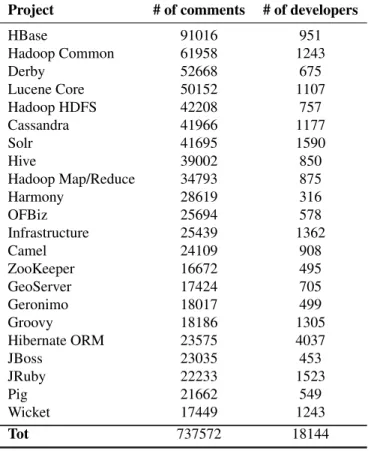
comments). Table 1 shows the corpus of 22 projects selected for our analysis, highlighting the number of 160
comments recorded for each project and the number of developers involved. 161
3.2 Comment Politeness
162
Danescu-Niculescu-Mizil et al. (2013) proposed a machine learning approach for evaluating the politeness 163
of a request posted in two different web applications: Wikipedia5and Stackoverflow6. Stackoverflow is 164
4https://www.atlassian.com/software/jira 5https:en.wikipedia.orgwikiMain Page 6http:stackoverflow.com
Project # of comments # of developers HBase 91016 951 Hadoop Common 61958 1243 Derby 52668 675 Lucene Core 50152 1107 Hadoop HDFS 42208 757 Cassandra 41966 1177 Solr 41695 1590 Hive 39002 850 Hadoop Map/Reduce 34793 875 Harmony 28619 316 OFBiz 25694 578 Infrastructure 25439 1362 Camel 24109 908 ZooKeeper 16672 495 GeoServer 17424 705 Geronimo 18017 499 Groovy 18186 1305 Hibernate ORM 23575 4037 JBoss 23035 453 JRuby 22233 1523 Pig 21662 549 Wicket 17449 1243 Tot 737572 18144
Table 1.Selected Projects Statistics
well known in the software engineering field and is largely used by software practitioners (Rekha and 165
Venkatapathy (2015), Choi et al. (2015), Rosen and Shihab (2015)); hence, the model that authors used in 166
Danescu-Niculescu-Mizil et al. (2013) was suitable for our domain based on Jira issues, where developers 167
post and discuss technical aspects of issues; the authors provide a Web application7and a library version 168
of their tool. Given some text, the tool calculates the politeness of its sentences, providing one of two 169
possible labels:politeorimpolite. Along with the politeness label, the tool provides a level of confidence 170
related to the probability of a comment being labeled aspoliteorimpolite. We thus considered comments 171
whose level of confidence was less than 0.5 as neutral (namely, the text did not convey either politeness or 172
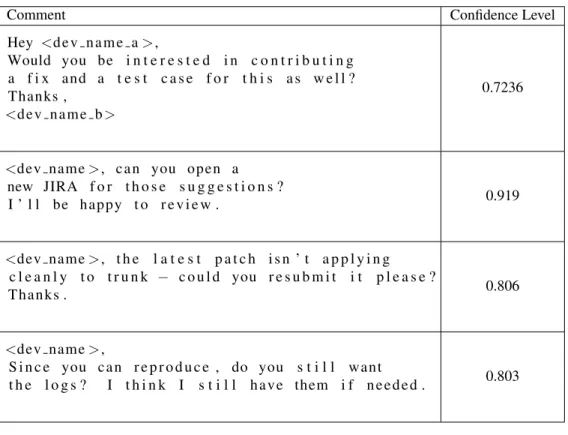
impoliteness). Tables 2 and 3 show some examples of polite and impolite comments as classified by the 173
tool8, respectively.
174
We evaluated the average politenesspermonth considering all comments posted in a certain month. 175
For each comment, we assigned a value according to the following rules: 176
• Value of +1 for those comments marked as polite by the tool (confidence level>0.5); 177
• Value of 0 for those comments marked as neutral (confidence level<0.5); 178
• Value of -1 for those comments marked as impolite (confidence level>0.5); 179
Finally, we averaged the assigned values for a certain month. In total, we analyzed the politeness of about 180
500K comments. 181
3.3 Issue Politeness
182
We inferred the politeness of issues from the knowledge of comments politeness and grouped issues 183
together as follows: 184
• by dividing comments into two sets: polite and impolite, ignoring neutral comments; 185
7http://www.mpi-sws.org/ cristian/Politeness.html
Comment Confidence Level Hey <d e v n a m e a>, Would you be i n t e r e s t e d i n c o n t r i b u t i n g a f i x and a t e s t c a s e f o r t h i s a s w e l l ? Thanks , <d e v n a m e b> 0.7236
<dev name>, c a n you o p e n a new JIRA f o r t h o s e s u g g e s t i o n s ? I ’ l l be h a p p y t o r e v i e w . 0.919 <dev name>, t h e l a t e s t p a t c h i s n ’ t a p p l y i n g c l e a n l y t o t r u n k − c o u l d you r e s u b m i t i t p l e a s e ? T h a n k s . 0.806 <dev name>, S i n c e you c a n r e p r o d u c e , do you s t i l l w a n t t h e l o g s ? I t h i n k I s t i l l h a v e them i f n e e d e d . 0.803
Table 2.Examples of polite comments.
Comment Confidence Level
Why a r e you c l o n i n g t i c k e t s ? Don ’ t do t h a t . 0.816 s h o u l d n ’ t i t c h e c k f o r e x i s t e n c e o f t a r b a l l e v e n b e f o r e i t t r i e s t o a l l o c a t e and e r r o r o u t ? ? ? 0.701 <d e v n a m e a>, why no u n i t t e s t ? <d e v n a m e b>, why d i d n ’ t you w a i t f o r +1 f r o m Hudson ? ? ? 0.942 > t h i s i s n ’ t t h e f o r u m t o c l a r i f y Why n o t ? The q u e s t i o n i s w h e t h e r t h i s i s r e d u n d a n t w i t h C a s c a d i n g , s o c o m p a r i s o n s a r e c e r t a i n l y r e l e v a n t , no ? 0.950
• by dividing issues into two sets: polite issues, commented only with polite comments and impolite 186
issues, commented only by impolite comments. 187
• by ignoring issues with both polite and impolite comments and ignoring issues with neutral 188
comments. 189
For each issue, we evaluated the politeness expressed in its comments (removing neutral comments as 190
discussed in Section 3.2) and then divided issues in two groups: polite issues containing polite comments 191
and impolite issues containing impolite comments. For each of this two groups of issues, the issue fixing 192
time as the difference between resolution and creation time was evaluated. 193
4 RESULTS AND DISCUSSION
1944.1 Does politeness among developers affect issues fixing time?
195
Motivation. Murgia et al. (2014a) demonstrated the influence of maintenance type on issue fixing time, 196
while Zhang et al. (2013) developed a prediction model for bug fixing time for commercial software. 197
There are many factors able to influence issue fixing time; in this case, we were interested in finding out if 198
politeness, expressed by developers in comments, had an influence on that time. 199
Approach. To detect differences among the fixing time of polite and impolite issues, we used the 200
Wilcoxon rank sum test. This test is non-parametric and unpaired (Siegel (1956), Wilcoxon and Wilcox 201
(1964), Weiss et al. (2007)) and can be used without restriction on the statistical distribution of the sample 202
populations. The test is suitable for comparing differences among the averages or the medians of two 203
populations when their distributions are not gaussian. For the analysis, we used the one-sided Wilcoxon 204
rank sum test using the 5% significance level (i.e., p-value<0.05) and we compared issue fixing time 205
between polite and impolite issues. 206
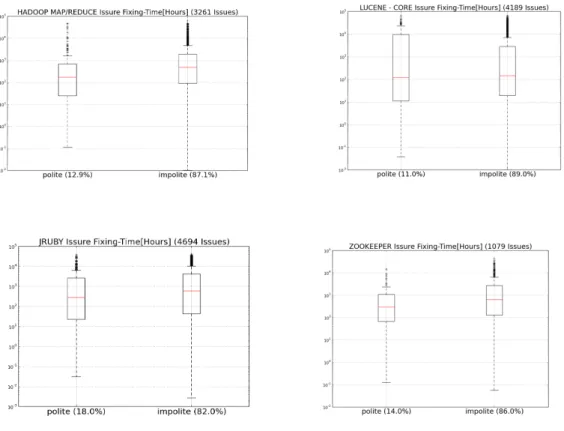
Findings.Issue fixing time for polite issues is faster than issue fixing time for impolite issues for 17 207
out of 22 analysed projects. 208
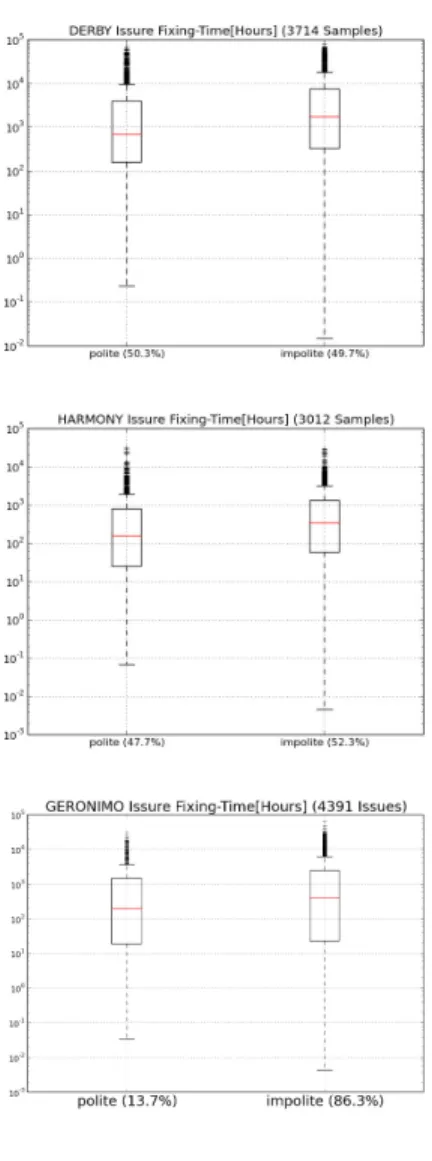
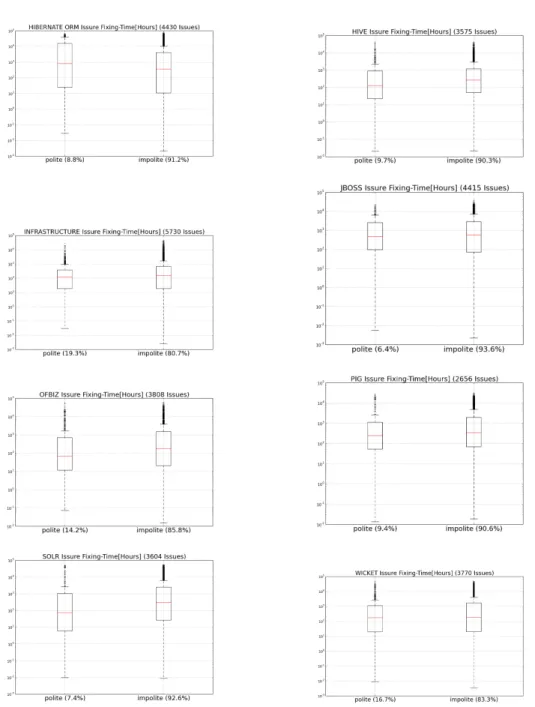
Figure 3 shows the box-plot of the issues fixing time for the two groups of issues considered (polite 209
and impolite) for all the projects analyzed. The issue fixing time is expressed in hours on a logarithmic 210
scale. It can be seen that the median of issues fixing time for polite issues is shorter than that for impolite 211
issues, for the majority of considered projects. Table 4 shows the Wilcoxon test results. The Test column 212
indicates whether the median of the first group (polite issues containing polite comments) is larger or 213
smaller than the second group (impolite issues containing impolite comments). Table 4 shows that for 17 214
of the 22 projects analysed, issue fixing time for polite issues is faster than that for issue fixing time for 215
impolite issues. 216
There are however two projects,CamelandHibernate ORM, which behave differently. In these cases 217
issue fixing time for impolite issues is faster than the issue fixing time for polite issues. Furthermore, 218
for Infrastructure, Lucene Core and Cassandra projects, theTestfailed, indicating that polite issue fixing 219
time is less than the impolite issue fixing time; however, with ap-value>0.05 for these projects, we 220
cannot conclude that the two distributions are statistically different. We also considered the effect size, a 221
quantitative measure of the strength of a phenomenon, finding that is generally small with a maximum of 222
0.19 for Hadoop HDFS and a minimum of 0.007 for Infrastructure. 223
4.2 Does politeness among developers affect the attractiveness of a project?
224
Motivation. Magnetism and Stickiness are two metrics capable of describing the general health of a 225
project; namely, if a project is able to attract new developers and keep them over time, we can conclude 226
that the project is healthy. On the other hand, if a project is not magnetic and is not sticky we can conclude 227
that the project is losing developers and is not attracting new developers over time. Although there may be 228
many factors influencing magnetism and stickiness values, we were interested in analysing the correlation 229
between politeness expressed by developers in their comments and these two metrics. 230
Approach. To detect if there was a direct correlation between magnetism and stickiness of a project 231
and politeness, we considered an observation time of one year. During this time interval, we measured 232
magnetism, stickiness and percentage of comments classified by the tool as polite. Politeness in the 233
observed time could affect magnetism and stickiness in the subsequent observation time. This fact causes 234
a form of “reputation” for a given project. Developers can share an a idea about other developers involved 235
in a project and newcomers can decide whether or not to join the project. To understand if a correlation 236
Figure 2.Box-plot of the fixing-time expressed in hours. The number in parentheses next to polite/impolite indicates the percentage of impolite and polite issues.
Figure 3.Box-plot of the fixing-time expressed in hours. The number in parentheses next to polite/impolite indicates the percentage of impolite and polite issues.
Figure 4.Box-plot of the fixing-time expressed in hours
Project Test p-value effect size
ZooKeeper lesser *** 0.14 Camel greater *** 0.089 Infrastructure lesser 0.67 0.007 OFBiz lesser *** 0.15 Harmony lesser *** 0.133 Hive lesser *** 0.061 Solr lesser *** 0.089 Cassandra lesser 0.51 0.012 Hadoop HDFS lesser *** 0.192
Lucene Core lesser 0.492 0.01
Derby lesser *** 0.15
Hadoop Common lesser *** 0.11
HBase lesser *** 0.144
Hadoop Map/Reduce lesser *** 0.11
GeoServer lesser *** 0.11
Geronimo lesser *** 0.04
Groovy lesser *** 0.04
Hibernate ORM greater *** 0.07
JBoss lesser *** 0.007
JRuby lesser *** 0.06
Pig lesser *** 0.03
Wicket lesser *** 0.01
exists between Magnet, Sticky and Politeness, we evaluated the cross-correlation coefficient. 237
Findings.In the majority of projects, Magnet and Sticky were positively correlated with politeness. 238
Table 5 shows the cross-correlation coefficient between the percentage of polite comments and magnetism 239
and stickiness during the observation period. The two columns represent the cross-correlation coefficient 240
between Magnetism and Stickiness and the percentage of politeness comments during the same observation 241
time. The correlation values are positive in all cases. 242
Considering the results obtained with cross correlation, we conclude that Politeness is positively 243
correlated, for the majority of the systems in our corpus with Magnetism and Stickiness metrics in 244 subsequent years. 245 Project Cross-Correlation Magnet Sticky HBase 0.581 0.667 Hadoop Common 0.848 0.641 Derby 0.126 0.240 Lucene Core 0.494 0.705 Hadoop HDFS 0.716 0.627 Cassandra 0.876 0.631 Solr 0.602 0.773 Hive 0.714 0.802 Hadoop Map/Reduce 0.631 0.697 Harmony 0.142 0.372 OFBiz 0.692 0.498 Infrastructure 0.479 0.610 Camel 0.120 0.293 ZooKeeper 0.319 0.497 GeoServer 0.7 0.5 Geronimo 0.43 0.42 Groovy 0.35 0.4 JBoss 0.54 0.52 Hibernate ORM 0.40 0.37 JRuby 0.58 0.46 Pig 0.49 0.45 Wicket 0.28 0.69
Table 5.Politeness Vs Magnet and Sticky Cross-Correlation Coefficient
4.3 Does politeness among developers vary over time?
246
Motivation. Politeness has an influence on the productivity of a team (Ortu et al. (2015b), Ortu et al. 247
(2015a), Ortu et al. (2015c)). Thus, it is interesting to understand if there are periods of time in which the 248
level of politeness decreases (potentially affecting the productivity of a team). 249
Approach. We calculated the level of politeness for any given issue and then plotted the average politeness 250
permonth grouping issuesperproject. For politeness over week days (Figure 6), we grouped all the 251
commentsperday of the week (checking the posting date); we then averaged politenessperday. 252
Findings. Average politeness does vary over time and in some cases it changes from negative values 253
(impolite) to positive (polite) from two consecutive observation intervals. Regarding average polite-254
ness over week days, we did not find great differences.This fact could be related to the composition 255
of our corpus. We considered only open source systems, hence there are no strict deadlines or particular 256
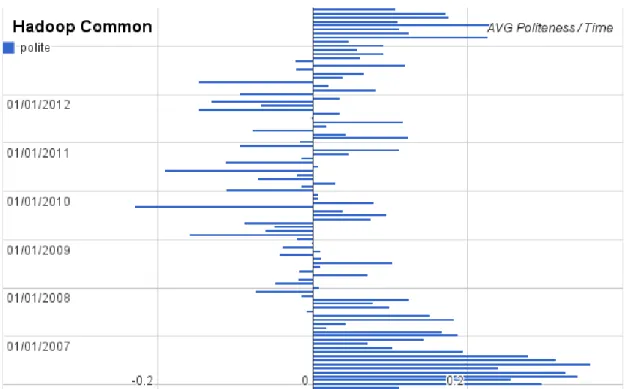
busy days (such as Fridays, as suggested by Silwersky et al. Sliwerski et al. (2005)). Figure 5 shows the 257
the average politenesspermonth for Hadoop Common. 258
It is interesting to note that there are variations in the average politeness over time. This is by no 259
means a representation of a time dynamics, but simply the representation of random variation of average 260
politeness over time. In Hadoop HDFS for example, we see how the average politeness is negative (the 261
majority of comments are impolite) for some time interval and positive for some others. As we have 262
Figure 5.Average Politeness per month
seen, for those projects, polite issues are solved faster, so monitoring the average politeness over time 263
could help during software development. If there is a time period with a negative politeness, then the 264
community may take action to drive the average politeness back to positive values. 265
4.4 How does politeness vary with respect to JIRA maintenance types and issue
priori-266
ties?
267
Motivation. Understanding which typology of issue attracts more impolite comments could help man-268
agers better understand the development process and take action to better manage the distribution of issues 269
within development teams. A classification of the type of issues, is provided on the JIRA wiki9. The
270
following list gives a brief introduction: 271
• Bug: this type of issue indicate a defect in the source code, such as logic errors, out-of-memory 272
errors, memory leaks and run-time errors. Any failure of the product to perform as expected and 273
any other unexpected or unwanted behaviour can be registered as type Bug. 274
• SubTask: this type of issue indicates that a task must be completed as an element of a larger and 275
more complex task. Subtask issues are useful for dividing a parent issue into a number of smaller 276
tasks, more manageable units that can be assigned and tracked separately. 277
• Task: this type of issue indicates a task that it is compulsory to complete. 278
• Improvement: this type of issue indicates an improvement or enhancement to an existing feature of 279
the system. 280
• New Feature: this type of issue indicates a new feature of the product yet to be developed. 281
• Wish: this type of issue is used to track general wishlist items, which could be classified as new 282
features or improvements for the system under development. 283
• Test: this type of issue can be used to track a new unit or integration test. 284
• New JIRA Project: this type of issue indicates the request for a new JIRA project to be set up. 285
• Brainstorming: this type of issue is more suitable for items in their early stage of formation not yet 286
mature enough to be labelled as a Task or New Feature. It provides a bucket where thoughts and 287
ideas from interested parties can be recorded as the discussion and exchange of ideas progresses. 288
Once a resolution is made, a Task can be created with all the details defined during the brainstorming 289
phase. 290
• Umbrella: this type of issue is an overarching type comprised of one or more sub-tasks. 291
Issues on JIRA are also classified, considering the level of priority, as Major, Minor, Blocker (e.g., an 292
issue which blocks development and/or testing work), Critical and Trivial. 293
Approach. To detect the level of politeness for each kind of issue, we grouped the issue comments for 294
type of maintenance and priority. We calculated for each group, the percentage of polite, impolite and 295
neutral comments. 296
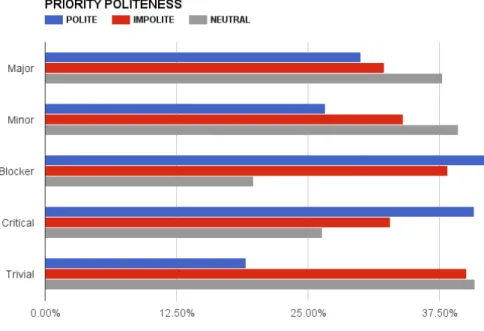
Findings. Comments related to issues with maintenance Bug, priority Minor and Trivial, tended 297
to have a higher percentage of impolite comments. Issues with maintenance New Feature, priority 298
Blocker and Critical, tend to have a higher percentage of polite comments. 299
Figures 7 and 8 show the percentage of polite, impolite and neutral comments for each type of issue 300
maintenance and priority. Issues with maintenance Bug are related to defects and software failures. This 301
category presents the higher percentage of impolite comments. Issues with maintenance New Feature are 302
proposals made by developers and it is interesting to see that when proposing something new, developers 303
tend to be more polite. 304
305
Figure 7. Priority
5 THREATS TO VALIDITY
306This work is focused on sentences written by developers for developers. To illustrate the influence of 307
these comments, it is important to understand the language used by developers. We believe that the tool 308
used for measuring politeness Danescu-Niculescu-Mizil et al. (2013) is valid in the software engineering 309
domain, since the developers also used requests posted on Stackoverflow to train the classifier. 310
Threats to external validity correspond to the generalization of our results (Campbell and Stanley 311
(1963)). In this study, we analyzed comments from issue reports from 22 open source projects. Our results 312
cannot be representative of all environments or programming languages, we considered only open-source 313
systems and this could affect the generality of the study. Commercial software is usually developed using 314
different platforms and technologies, by developers with different knowledge and background, with strict 315
deadlines and cost limitation. Replication of this work on other open source systems and on commercial 316
projects are needed to confirm our findings. Also, the politeness tool can be subject to bias due the domain 317
used to train the machine learning classifier. We used a threshold of 0.5 for the confidence level to label a 318
comment as neutral, but other values of this threshold may lead to different results. 319
Threats to internal validity concern confounding factors that can influence the obtained results. Based 320
on empirical evidence, we suppose a causal relationship between the emotional state of developers and 321
what they write in issue reports (Pang and Lee (2008)). Since the main goal of developer communication is 322
the sharing of information, the consequence of removing or camouflaging emotionsmaymake comments 323
less meaningful and cause misunderstanding. The comments used in this study were collected over an 324
extended period from developers unaware of being monitored. For this reason, we are confident that the 325
emotions we analyzed were genuine. We do not claim any causality between politeness and the issue 326
resolution time, but we built an explanatory model to understand the characteristics of issues with short 327
and long fixing time. 328
Threats to construct validity focus on how accurately the observations describe the phenomena 329
of interest. The detection of emotions from issue reports presents difficulties due to vagueness and 330
subjectivity. The politeness measures are approximated and cannot perfectly identify the precise context, 331
given the challenges of natural language and subtle phenomena like sarcasm. 332
6 CONCLUSIONS AND FUTURE WORK
333Software engineers have been trying to measure software to gain quantitative insights into its properties 334
and quality since its inception. In this paper, we present the results about politeness and attractiveness on 335
22 open-source software projects developed using the Agile board of the JIRA repository. Our results 336
show that the level of politeness in the communication process among developers does have an effect 337
on both the time required to fix issues and the attractiveness of the project to both active and potential 338
developers. The more polite developers were, the less time it took to fix an issue. In the majority of cases, 339
the more the developers wanted to be part of project, the more they were willing to continue working on 340
the project over time. This work is a starting point and further research on a larger number of projects is 341
needed to validate our findings especially, considering proprietary software developed by companies and 342
different programming languages. The development of proprietary software follows different dynamics 343
(e.g., strict deadlines and given budget) and this fact could lead to different results. The takeaway message 344
is that politeness can only have positive effect on a project and on the development process. 345
346
REFERENCES
347Acu˜na, S. T., G´omez, M., and Juristo, N. (2008). Towards understanding the relationship between 348
team climate and software quality—a quasi-experimental study. Empirical software engineering, 349
13(4):401–434. 350
Bazelli, B., Hindle, A., and Stroulia, E. (2013). On the personality traits of stackoverflow users. In 351
Software Maintenance (ICSM), 2013 29th IEEE International Conference on, pages 460–463. IEEE. 352
Beck, K., Beedle, M., Van Bennekum, A., Cockburn, A., Cunningham, W., Fowler, M., Grenning, J., 353
Highsmith, J., Hunt, A., Jeffries, R., et al. (2001). Manifesto for agile software development. 354
Brief, A. P. and Weiss, H. M. (2002). Organizational behavior: Affect in the workplace.Annual review of 355
psychology, 53(1):279–307. 356
Campbell, D. T. and Stanley, J. C. (1963).Experimental and quasi-experimental designs for generalized 357
causal inference. Houghton Mifflin. 358
Capretz, L. F. (2003). Personality types in software engineering. International Journal of Human-359
Computer Studies, 58(2):207–214. 360
Choi, E., Yoshida, N., Kula, R. G., and Inoue, K. (2015). What do practitioners ask about code clone? a 361
preliminary investigation of stack overflow.9th Internl Work. on Soft. Clones, IWSC. 362
Cockburn, A. and Highsmith, J. (2001). Agile software development: The people factor. Computer, 363
(11):131–133. 364
Curtis, B., Krasner, H., and Iscoe, N. (1988). A field study of the software design process for large 365
systems.Communications of the ACM, 31(11):1268–1287. 366
Danescu-Niculescu-Mizil, C., Sudhof, M., Jurafsky, D., Leskovec, J., and Potts, C. (2013). A computa-367
tional approach to politeness with application to social factors. InProceedings of ACL. 368
Ehlers, J. (2015). Socialness in the recruiting of software engineers. InProceedings of the 12th ACM 369
International Conference on Computing Frontiers, page 33. ACM. 370
Erez, A. and Isen, A. M. (2002). The influence of positive affect on the components of expectancy 371
motivation.Journal of Applied Psychology, 87(6):1055. 372
Fagerholm, F., Ikonen, M., Kettunen, P., M¨unch, J., Roto, V., and Abrahamsson, P. (2014). How do 373
software developers experience team performance in lean and agile environments? InProceedings 374
of the 18th International Conference on Evaluation and Assessment in Software Engineering, page 7. 375
ACM. 376
Feldt, R., Torkar, R., Angelis, L., and Samuelsson, M. (2008). Towards individualized software engi-377
neering: empirical studies should collect psychometrics. InProceedings of the 2008 international 378
workshop on Cooperative and human aspects of software engineering, pages 49–52. ACM. 379
G´omez, M. N., Acu˜na, S. T., Genero, M., and Cruz-Lemus, J. A. (2012). How does the extraversion of 380
software development teams influence team satisfaction and software quality?: A controlled experiment. 381
International Journal of Human Capital and Information Technology Professionals (IJHCITP), 3(4):11– 382
24. 383
Kaluzniacky, E. (2004).Managing psychological factors in information systems work: An orientation to 384
emotional intelligence. IGI Global. 385
Murgia, A., Concas, G., Tonelli, R., Ortu, M., Demeyer, S., and Marchesi, M. (2014a). On the influence 386
of maintenance activity types on the issue resolution time. InProceedings of the 10th International 387
Conference on Predictive Models in Software Engineering, pages 12–21. ACM. 388
Murgia, A., Tourani, P., Adams, B., and Ortu, M. (2014b). Do developers feel emotions? an exploratory 389
analysis of emotions in software artifacts. InProceedings of the 11th Working Conference on Mining 390
Software Repositories, pages 262–271. ACM. 391
Novielli, N., Calefato, F., and Lanubile, F. (2014). Towards discovering the role of emotions in stack 392
overflow. InProceedings of the 6th International Workshop on Social Software Engineering, pages 393
33–36. ACM. 394
Ortu, M., Adams, B., Destefanis, G., Tourani, P., Marchesi, M., and Tonelli, R. (2015a). Are bullies more 395
productive? empirical study of affectiveness vs. issue fixing time. InProceedings of the 12th Working 396
Conference on Mining Software Repositories, MSR 2015. 397
Ortu, M., Destefanis, G., Kassab, M., Counsell, S., Marchesi, M., and Tonelli, R. (2015b). Would you 398
mind fixing this issue? InAgile Processes, in Software Engineering, and Extreme Programming, pages 399
129–140. Springer. 400
Ortu, M., Destefanis, G., Kassab, M., and Marchesi, M. (2015c). Measuring and understanding the 401
effectiveness of jira developers communities. InProceedings of the 6th International Workshop on 402
Emerging Trends in Software Metrics, WETSoM 2015. 403
Ortu, M., Destefanis, G., Murgia, A., Marchesi, M., Tonelli, R., and Adams, B. (2015d). The jira 404
repository dataset: Understanding social aspects of software development. InProceedings of the 11th 405
International Conference on Predictive Models and Data Analytics in Software Engineering, page 1. 406
ACM. 407
Pang, B. and Lee, L. (2008). Opinion Mining and Sentiment Analysis. Foundations and Trends in 408
Information Retrieval, 2(1-2):1–135. 409
Pennebaker, J. W., Francis, M. E., and Booth, R. J. (2001). Linguistic inquiry and word count: Liwc 2001. 410
Mahway: Lawrence Erlbaum Associates, 71:2001. 411
Perry, T. (2008). Drifting toward invisibility: The transition to the electronic task board. InAgile, 2008. 412
AGILE’08. Conference, pages 496–500. IEEE. 413
Rekha, V. S. and Venkatapathy, S. (2015). Understanding the usage of online forums as learning platforms. 414
Procedia Computer Science, 46:499–506. 415
Rigby, P. C. and Hassan, A. E. (2007). What can oss mailing lists tell us? a preliminary psychometric text 416
analysis of the apache developer mailing list. InProceedings of the Fourth International Workshop on 417
Mining Software Repositories, page 23. IEEE Computer Society. 418
Roberts, J. A., Hann, I.-H., and Slaughter, S. A. (2006). Understanding the motivations, participation, 419
and performance of open source software developers: A longitudinal study of the apache projects. 420
Management science, 52(7):984–999. 421
Rosen, C. and Shihab, E. (2015). What are mobile developers asking about? a large scale study using 422
stack overflow.Empirical Software Engineering, pages 1–32. 423
Siegel, S. (1956). Nonparametric statistics for the behavioral sciences. 424
Sliwerski, J., Zimmermann, T., and Zeller, A. (2005). Don’t program on fridays! how to locate fix-inducing 425
changes. InProceedings of the 7th Workshop Software Reengineering. 426
Steinmacher, I., Conte, T. U., Gerosa, M., and Redmiles, D. (2015). Social barriers faced by newcomers 427
placing their first contribution in open source software projects. InProceedings of the 18th ACM 428
conference on Computer supported cooperative work & social computing, pages 1–13. 429
Tan, S. and Howard-Jones, P. (2014). Rude or polite: Do personality and emotion in an artificial 430
pedagogical agent affect task performance? In2014 Global Conference on Teaching and Learning 431
with Technology (CTLT 2014), page 41. 432
Tourani, P., Jiang, Y., and Adams, B. (2014). Monitoring sentiment in open source mailing lists -– 433
exploratory study on the apache ecosystem. InProceedings of the 2014 Conference of the Center for 434
Advanced Studies on Collaborative Research (CASCON), Toronto, ON, Canada. 435
Tsay, J., Dabbish, L., and Herbsleb, J. (2014). Let’s talk about it: Evaluating contributions through 436
discussion in github.FSE. ACM. 437
VersionOne (2013). 8th annual state of agile survey report. 438
Weiss, C., Premraj, R., Zimmermann, T., and Zeller, A. (2007). How long will it take to fix this bug? 439
InProceedings of the Fourth International Workshop on Mining Software Repositories, page 1. IEEE 440
Computer Society. 441
Wilcoxon, F. and Wilcox, R. A. (1964). Some rapid approximate statistical procedures. Lederle 442
Laboratories. 443
Winschiers, H. and Paterson, B. (2004). Sustainable software development. InProceedings of the 444
2004 annual research conference of the South African institute of computer scientists and information 445
technologists on IT research in developing countries, pages 274–278. South African Institute for 446
Computer Scientists and Information Technologists. 447
Yamashita, K., McIntosh, S., Kamei, Y., and Ubayashi, N. (2014). Magnet or sticky? an oss project-by-448
project typology. InMSR, pages 344–347. 449
Zhang, H., Gong, L., and Versteeg, S. (2013). Predicting bug-fixing time: an empirical study of commercial 450
software projects. InProceedings of the 2013 International Conference on Software Engineering, pages 451
1042–1051. IEEE Press. 452