Individual Security, Contagion, and Network Design
∗
Diego A. Cerdeiro
†Marcin Dziubi´
nski
‡Sanjeev Goyal
§Abstract
Individuals derive benefits from their connections, but these may expose them to external threats. Agents therefore invest in security to protect themselves. What are the network architectures that maximize collective welfare? We propose a model to explore the tension between connectivity and exposure to an external threat when security choices are decentralized. We find that both over-investment and under-investment in security are possible, and that optimal network architectures depend on the prevailing source of inefficiencies. Social welfare may be maximized in sparse connected networks when under-investment pressures are present, and fragmented networks when over-investment pressures prevail.
Keywords: Network design; Individual security; Inefficiencies; Networks
JEL: D85; D62; C72
1
Introduction
Individuals derive benefits from being connected to others. These connections may, at the same time, transmit external threats. Online networks reflects this tension: connec-tivity facilitates communication but is also used by hackers, hostile governments, firms, and ‘botnet’ herders to spread viruses and worms which compromise user privacy and jeopardize the functioning of the entire system.1 2
∗This paper is based on a chapter in Diego Cerdeiro’s doctoral thesis submitted to Cambridge
Uni-versity in June 2014, titled “Individual Security and Network Design”.
†International Monetary Fund. E-mail: [email protected]
‡Institute of Informatics, Warsaw University. E-mail: [email protected]
§Faculty of Economics & Christ’s College, University of Cambridge. E-mail: [email protected]
1In the United States, the Department of Homeland Security (DHS) is responsible for cybersecurity.
Its mission statement reads,“Our daily life, economic vitality, and national security depend on a stable, safe, and resilient cyberspace. We rely on this vast array of networks to communicate and travel, power our homes, run our economy, and provide government services.”
2Moore et al. (2009) estimate that in 2009, roughly 10 million computers were infected with malware
A prime example of networks that are subject to malicious intelligent and contagious attacks are overlay (logical) networks built on top of the Internet. These networks form the backbone for international trade and global capital flows, enable digital currencies, support production chains and research and development, and facilitate content sharing. We mention three leading examples to illustrate this point. SWIFT, the leading global router of private proprietary financial messages, is estimated to be responsible for over $6 trillion (about 8% of world GDP) in transfers every day (see e.g. Scott and Zachariadis (2013)). Bitcoin, the world’s first decentralized digital currency, does not have a central monetary authority and relies instead on a peer-to-peer network to verify and process all transactions (“How does Bitcoin work?” The Economist, April 11, 2013). GitHub provides a suite of tools used not only to store and share documents, but also to organize workflow and manage business processes in (mostly, but not only) software development companies, from open-source projects to private businesses, and large organizations, such as NASA.
These networks help to generate a value that increases with their size but at the same time are the target of malicious attacks by hackers, hostile governments, and criminal organizations. There are four distinctive features of cyber risks: the presence of an active, persistent and sometimes sophisticated adversary, the broad range of entry points, the potential to cause significant disruptions to the broader financial system, and the ability to propagate rapidly within a network of systems BIS-IOSCO (2016).3
Security of these networks depends crucially on individual investments in security. Individual security requires using the right software (e.g. anti-virus, firewall), the right equipment (e.g. reliable Internet routers), and following the right security procedures (e.g. making software updates and backups, ensuring passwords updates, staying up to date with existing threats). All this entails costs and often requires employing specialized workforce. Individual incentives to invest in protection depend on exposure in the network and will generally depart from what is collectively desirable.4
the annual costs of identity theft are estimated at 2.8 billion USD. These large costs have led to the emergence of a large software security sector. As an example, we note that Intel bought McAfee in 2010, for 7.68 billion USD (bbc.co.uk; 19 August 2010).
3 A recent prominent case is the February 2016 infiltration into Bangladesh central bank’s servers
to route fake payment orders via SWIFT, in an attempted $1bn heist involving (through a chain of correspondent banks) accounts in Philippines, Sri Lanka, and at the Federal Reserve Bank of New York (The Wall Street Journal, 15 August 2016). In 2014 Bitcoin was targeted in 22% of financial malware attacks CoinDesk (2014), with the objective of forging Bitcoins, jeopardizing transactions or stealing users’ money. This was done by reducing access of “healthy” users to other “healthy” users (over the Bitcoin network) and, by restricting access to actual transaction logs. Content sharing networks like GitHub or Dropbox are also susceptible to attacks by adversaries who aim to jeopardize their functionality.
4As an example of how much individual protection decisions may depart from first best, it has been
reported that the bank through which SWIFT was infiltrated in February 2016 “did not have a firewall, which is designed to block unauthorized access requests [and] used second-hand routers, which had cost $10, to connect to global financial networks” (BBC News, 13 May 2016).
The topology of networks such as those described above can be influenced by an external designer. Like other types of organizations, financial institutions and related frastructures (including systemically important messaging systems) have the ability to in-fluence online interactions between employees, services providers, and vendors.5 Similarly, the underlying communications and production networks of organizations will influence the topology of connections in the GitHub network. In the case of peer-to-peer networks (like that underlying BitCoin), connections can be influenced by protocols designed to enforce a particular topology among peers. Designers can potentially use their ability to influence connections in a way that minimizes protection externalities.
Motivated by these considerations, we consider the following setting. There are (n+ 2) ‘players’. A designer first chooses the network over then nodes. Given this network, each of the n nodes (simultaneously) chooses whether to protect or not, where protection carries a fixed cost. Finally, an adversary chooses a node to attack. If the attacked node is protected, then all nodes survive the attack. If the attacked node is not protected, then this node and all nodes with a path to the attacked node through unprotected nodes are eliminated. Central to the problem is that nodes are assumed to derive benefits from their connectivity. More specifically, node’s payoff is increasing in the size of its surviving component. Node’s net payoffs are equal to its connectivity payoffs less the amount spent on protection. To study the optimal design problem from a collective welfare point of view, we assume that the designer is utilitarian: he seeks to maximize the sum of nodes’ payoffs. The adversary is intelligent, purposefully choosing the attacked node so as to minimize connectivity-related payoffs.
We start by analyzing the optimal design of a network when the the planner chooses the defence profile as well as the network structure. If protection is sufficiently cheap, all nodes are protected and any connected network is optimal. For intermediate costs of protection, the designer achieves first best payoffs with minimal defence outlays by choosing a star network and only protecting its centre. If protection costs are high, the designer splits the network into equal size components and leaves all nodes unprotected. A number of problems arise when defence decisions are decentralized. Firstly, a node does not internalize the benefits accruing to others from its own protection. Thus, it is possible that the center-protected star is optimal and, at the same time, it is a strictly dominant strategy for the hub not to protect. Under-protection arises naturally as a result of positive externalities. Secondly, nodes may have incentives to protect to divert the adversary’s attack to other parts of the network. In this case, protection decisions involve negative externalities: there are ranges of costs of protection for which a centre protected star is the first best while, at the same time, full protection is the unique equilibrium of the star network. How can the designer induce some nodes to be eliminated
5Acknowledging this, BIS-IOSCO (2016) states e.g. that “[c]yber considerations should be integral
part of the [financial market infrastructures’] arrangements for managing vendors and vendor products in the areas of contracts, performance, relationships and risk.”
in equilibrium? We show that the over-protection problem is pervasive: any optimal connected network has full protection as unique equilibrium. Thus, the designer must disconnect the network and sacrifice some nodes (as well as network connectivity) if he is to avoid the over-protection problem.
Thirdly, nodes may have incentives to protect only if sufficiently many other nodes protect as well. Thus it is possible that a fully protected clique is optimal but, at the same time, equilibria exist where no nodes protect. Protection has features of threshold public good and under-protection results from the strategic complementarity of defence decisions. We show that this problem can be solved by choosing the right network architecture. The idea is to create a cascade of incentives to protect in the network. That is, the network should be such that at least one node has incentives to protect in it. Then, for every such node, there should exist subsequent nodes that have incentives to protect, if one of the former nodes protects, etc. A network where such a cascade leads to full protection needs to have acritical node which has incentives to protect even if no other node protects.
Lastly, a more subtle under-protection problem arises due to interplay between nodes only reaping off benefits from their components and the strategic nature of the attack. More specifically, if one of the eliminated nodes protected, the adversary would disconnect the network and leave the deviating node in too small a component to make protection profitable. This is caused by component balancedness of nodes’ gross utilities: even though choosing protection increases the overall value of the network, it may decrease the value of node’s own component. The network architecture which is sufficiently “tight” prevents this problem.
The analysis summarized thus far focuses on networks that achieve maximum equilib-rium welfare under some equilibrium. In general, however, some of these networks may feature multiple equilibria, each achieving vastly different welfare levels. How can the designer tackle potential coordination problems? To illustrate the issue at hand, suppose that the costs of protection are such that maximum equilibrium welfare is achieved via full protection on a connected network. The network where nodes are arranged on a cycle has a full protection equilibrium. However, there is another equilibrium on this network where no node protects and the adversary brings down the entire network. We provide a partial characterization of networks that induce full protection as the unique equilibrium. Such networks aresparse in the following sense: they must feature a node that can block the adversary’s attack, thus saving a large part of the network.
The results summarized above show how to manipulate individual incentives through the network structure to maximize welfare. Our third result moves to the welfare impli-cations of decentralization. We show that network design goes a long way in limiting the costs of decentralization: by appropriately choosing the network, the designer can put a limit on the potential negative effects of decentralization. It is important to note that our main results are robust to changes of the model. In the appendix we consider an extension where investments in protection are continuous. The main result there is that
it is still possible to mitigate the under-protection problem and enforce full protection by choosing a network which creates a cascade of incentives to protect. Like in the case of our main model, such networks must have a critical node that can block the adversary’s attack and save sufficiently large fragment of the network. In a follow up that builds on our paper, Goyal et al. (2016) consider a model where both the protection decisions and the linking decisions are decentralized. They show that there is a pressure to create critical nodes, although the inefficiencies due to decentralization may become unbounded. They also show that there exist non-trivial equilibrium networks with very low cost of decentralization.
Our paper is a contribution to the theory of security in interconnected systems. The central tension here is that connections confer value but also bring with them the the threat of negative contagion. We study the extent to which appropriate network design can help resolve this tension. Earlier research on decentralized protection in environments has assumed that there is no value in being connected, i.e. nodes only care about their own survival (Kunreuther and Heal (2003),Varian (2004), Aspnes et al. (2006), Lelarge and Bolot (2008a,b), Acemoglu et al. (2016)). In particular, Aspnes et al. (2006) study a setting on a fixed network when nodes only care about their own survival, attack is random, protection is perfect and contagion is perfect: infection spreads to unprotected nodes with probability 1. The focus is on computing the Nash equilibria of the game. They show that the problem is NP-hard and provide approximation algorithms for finding the equilibria. Similarly, Lelarge and Bolot (2008a,b) use techniques based on local mean field analysis to study the problem of incentives and externalities in network security on random networks. More recently, Acemoglu et al. (2016) consider individual investments in a model of network attacks. Their focus is on the strategic structure of the security decisions across individuals and how the network shapes the choices under random versus targeted attacks. Our paper introduces two innovations: one, it assumes that there is a value to more connections, and two, it studies the optimal design of networks. In particular, the assumption that connectivity is valuable, helps us uncover a wealth of effects that influence the possible equilibrium outcomes.
Our paper builds on an earlier paper by Goyal and Vigier (2014): they consider the problem of security in a settings where security and network design are both chosen by a single planner. The results in the present paper highlight the large effects of decentralized defence for optimal design. In Goyal and Vigier (2014) the optimal design is a star network and optimal allocation of resources is exclusively on the central node. By contrast, when individual nodes choose security, the optimal design has to address problems of too much as well as too little protection. Such inefficiencies may lead the designer to disconnect the network and sacrifice some nodes (when over-protection pressures prevail), or create sparse connected networks to stave off coordination problems.6
The rest of the paper is organized as follows. Section 2 presents the model. Section 3 presents the results and Section 4 provides discussion and highlights the key messages of the paper. We conclude in Section 5. Proofs not given in the main text are provided in the Appendix. In the second part of the Appendix, we consider an extension of the model where security investments are continuous.
2
The model
Players There are (n+ 2) players: the designer (D), the nodes (V), and the adver-sary (A).
The timing There are three rounds of the game:
1. D chooses a network G ∈ G(V), where G(V) is the set of all undirected networks over V.
2. Nodes fromV observeGand choose, simultaneously and independently, whether to protect (1) or not (0). This determines the set of protected nodes ∆.
3. Aobserves the protected network (G,∆) and chooses a lottery over the set of nodes, ξ ∈ L(V), amixed attack strategy. A realization of this lottery is the node to infect, i ∈ V. The infection spreads and eliminates all the unprotected nodes reachable fromiinGvia a path that does not contain a protected node from∆. This leads to the residual network obtained fromGby removing all the infected nodes. An attack strategy ξ infecting one node with probability 1 is called apure attack strategy.
Payoffs Payoffs to the players are based on the residual network and costs of defence. The returns from a network are measured by a network value function
Φ : [
U⊆V
G(U)→R
that assigns numerical value to each of the networks that can be formed over a subsetU of nodes fromV.
Acomponent of network Gis a maximal set of nodesC ⊆V such that for alli, j ∈C, i 6= j, i and j are connected (directly or indirectly) in G. The set of components of G is denoted by C(G). Given network G and node i ∈ V, Ci(G) denotes the component
C∈ C(G) such that i∈C. NetworkG is connected if |C(G)|= 1.
criminal organization, exploring the tradeoff between cooperation enforcement and potential detection by an external authority. However, no protection technology is available to agents; the choice of security is central to our study.
We consider the following family of network value functions:
Φ(G) = X
C∈C(G)
f(|C|),
wheref :R→R is increasing, strictly convex andf(0) = 0. In other words, the value of a connected network is an increasing and strictly convex function of its size. The value of a disconnected network is the sum of values of its components. This form of network value functions is in line with Metcalfe’s law, where the value of a connected network over xnodes is equal tox2, as well as with Reed’s law, where the value of a connected network is of exponential order with respect to the number of nodes (e.g. 2x−1). It reflects the idea that each node derives additional utility from every node it can reach in the network. The gross payoff to node j ∈ V in a network G is equal to f(|Cj(G)|)/|Cj(G)|, i.e.
each node gets the equal share of the value of its component. Given the assumptions onf, this creates a tension between being connected and being exposed to contagious risk. The net payoff of a node is equal to the gross payoff minus protection spending. A removed node gets payoff 0. Defence has costsc∈R++.
Before defining payoff to a node from a given network, defence and attack, we need to define the residual network formally. A network is modelled by an undirected graph G= (V, E), where V is a finite set of nodes,|V|=n≥0, and E ⊆ {ij :i, j ∈V}is a set of undirected edges. The set of all networks over the set of nodes V is denoted byG(V). Apath in Gbetween nodes i, j ∈V is a sequence of nodes i0, . . . , im ∈V such thati=i0,
j =im, m≥2, andik−1ik ∈E for allk = 1, . . . , m. Nodej is reachable from nodei inG
if i=j or there is a path between them in G.
Given network G= (V, E) and a set of nodes Z ⊆ V, let G−Z denote the network obtained from G by removing the nodes from Z and their connections from G. Thus G−Z = (V \Z, E[V \Z]), whereE[V \Z] ={ij ∈E :i, j ∈V \Z}. Notice that infecting nodei∈V in networkGwith protected nodes∆, the adversary removes the set of nodes Ci(G−∆) from G. Hence the residual network after such an attack is G−Ci(G−∆).
Nodej’s payoff in network Gwith defended nodes, ∆, and infected node, i, is then equal to: uj(G,∆, i) = f(|Cj(G−Ci(G−∆))|) |Cj(G−Ci(G−∆))| −c, if j ∈∆ 0, if j ∈Ci(G−∆)\∆ f(|Cj(G−Ci(G−∆))|) |Cj(G−Ci(G−∆))| , otherwise. (1)
The expected net payoff of node j in network G with defended nodes, ∆, and mixed attack,ξ, is equal to:
Uj(G,∆, ξ) =X
i∈V
ξiuj(G,∆, i). (2)
The designer aims to maximize social welfare, i.e. the sum of nodes’ utilities, which is equal to the value of the residual network minus total costs of defence. Formally, the
designer’s payoff from network Gunder defence ∆ and infected node i is equal to: uD(G,∆, i) =W(G,∆, i) = X j∈V uj(G,∆, i) = X C∈C(G−Ci(G−∆)) f(|C|) − |∆|c. (3)
The expected payoff of the designer from networkGunder defence∆and mixed attack ξ is:
UD(G,∆, ξ) =X
i∈V
ξiuD(G,∆, i). (4)
The adversary is intelligent and aims to minimize gross welfare, i.e. the sum of nodes’ gross payoffs, equal to the value of the residual network. GivenG, ∆and i, payoff to the adversary is:
uA(G,∆, i) = − X
C∈C(G−Ci(G−∆))
f(|C|). (5)
and the expected payoff to the adversary when mixed attack ξ is used is: UA(G,∆, ξ) =X
i∈V
ξvuA(G,∆, i). (6)
To summarize, the set of players is P = V ∪ {D,A}. The set of strategies of player
D is SD = G(V). A strategy of each node j is a function δ
j : G(V) → {0,1} which,
given networkG∈ G(V), provides the defence decisionδj(G) of the node. The individual
strategies of the nodes determine a function ∆ : G(V) →2V providing, given a network
G∈ G(V), the set of defended nodes ∆(G) ={j ∈ V :δj(G) = 1}. The set of strategies
of each nodej ∈V isSj = 2G(V).7
A strategy of player A is a function ξ : G(V)×2V → L(V) which, given network G∈ G(V) and set of protected nodes ∆ ⊆V, provides the lottery over the set of nodes, ξ(G,∆), determining the probability of infection for each node. The set of strategies of player Ais SA =L(V)G(V)×2V.
Players D and A are expected utility maximisers. In the case of nodes we make an additional tie breaking assumption that in the case of expected utilities being equal, each node prefers to choose defence and stay uninfected. Similarly, we assume that in the case of expected utilities being equal, D prefers strategy profiles where less network value is lost. We are interested in subgame perfect equilibria of game Γ, called equilibria, for short. Pure strategy equilibria are equilibria in which the adversary uses a pure attack strategy in every subgame.
Throughout the paper we will also refer to the subgame ensuing after network G is chosen. We will denote this subgame by Γ(G). We will abuse the notation by using the
7We will represent the strategies of the nodes with the function providing the set of defended nodes,
same letters to denote the strategies inΓ(G) and in Γ. The set of strategies of each node i∈V in gameΓ(G) is{0,1}and we will identify each strategy profile (δi)i∈V of the nodes
with the set of protected nodes∆ ={i∈V :δi = 1}. The set of strategies of Ain Γ(G)
isL(V)2V.
2.1
Remarks on the model
As far as we know, our work is the first attempt to study how inefficiencies due to defence decentralization can be mitigated by network design. To make progress, we make a num-ber of simplifying assumptions that we now discuss. Firstly, we assume that protection decisions are binary and protection is perfect. This assumption is justified in scenar-ios where following good security practices provides full or nearly full protection against (most of) the attacks. The nodes then either follow the good practices or they do not (e.g. protect insufficiently well) in which case they are (nearly) certain to get infected in case of the attacks. It is possible that reliability of protection depends on the invest-ment level or that protection is perfect, but users randomize when using it. We address this extension in the Appendix. Secondly, we assume that connection between nodes are chosen in a centralized way, by the designer. This is justifiable in some applications (like the examples mentioned in introduction), where the central planner can either directly decide on the connection between the nodes, or he can affect it indirectly by designing protocols that ensure desirable properties of the network topology. In other applications, however, the network is chosen in a decentralized way, by the nodes (examples include the network of e-mail contacts, Facebook contact, or Skype contacts). This extension is studied by Goyal et al. (2016) in a follow up that builds on our paper. Thirdly, we assume that all connections are equally important to every node and that all nodes contribute in the same way to the overall value of the network. This is a common assumption in the literature, but it is possible that some nodes (like servers in computer network or workers having different functions in organizations) are more important than others. Different values of nodes would affect the first best design, as there are more incentives to protect such nodes and, if protection is too costly, the network would be split in such a way that values of components are equalized. In particular, very high value nodes would be put in different components. Individual incentives of nodes to protect themselves would also be affected, because more important nodes contribute more to the value of a components and so choosing protection they are able to secure more value of the network. Thus to create a cascade of incentives to protect, in order to avoid underprotection, the designer should either make one of very high value nodes a critical node, or distribute the high value nodes appropriately across the subnetworks connected to the critical node. A more general intuition is that having more important nodes should (almost by definition) re-duce inefficiencies, as the bigger a node is the more s/he internalizes externalities. In the limit, if instead ofn nodes we have a single node with valuef(n), then inefficiencies
van-ish. In this sense, the model with equal values of nodes should bring out in the sharpest possible way the potential inefficiencies, which in turn makes the result on the bounds of decentralization costs even starker. Fourthly, we restrict attention to scenarios where the adversary attacks only one node in the network. This can be justified in situations where a coordinated attack on many nodes is very costly or hard to conduct (the attack on Bangladesh central bank using SWIFT network is an example), but in general coordi-nated attacks on several nodes in the network are possible. Lastly, the spread of infection in the network may decay stochastically so that nodes which are further from the initially infected node are less likely to get infected. Arguably, perfect spread of infection is a good abstraction of scenarios where infection spreading to subsequent nodes is very likely. This is the case for computer networks and was assumed by other authors as well (e.g. Aspnes et al. (2006)).
3
The analysis
We start the analysis with characterizing the optimal choice if the network and nodes’ protection both are chosen by the designer. We then move to comparing thus obtained payoffs to the payoffs that can be obtained in the equilibria of the game.
Main difficulties in the analysis follow from a generality of the framework. We allow for a very general class of component value functions and do not restrict the considered topologies of networks. Technical results providing key properties of convex functions are Observations 1–3 and Lemma 6. These results might be useful for other problems involving the analysis of convex functions, as studied in this paper. Main difficulties when network topologies are concerned lied in providing the required constructions of graphs, particularly π-windmill graphs, as used in Proposition 3 for generating the cascade of incentives to protect and the network in Figure 1, used to demonstrate under-protection due to miscoordination.
3.1
First best
Before we state the proposition characterizing the first best, we need the following four quantities. Givenn ∈N, let
Q∗(n) = arg maxq∈{1,...,bn 2c} n q f(q) +f(n modq). (7) To understand the quantity Q∗(n) consider the following problem. Find the optimal size of component, q ∈ {1, . . . ,bn/2c}, such that partitioning the network over n nodes into components of sizeq with, possibly, one additional smaller component (in the case where q does not divide n) maximises the sum of values of all the components. Given q ∈ {1, . . . ,bn/2c} and n, there are bn/qc components of size q and, possibly, one additional
component of size nmodq. Since the size of larger components varies from 1 to bn/2c, the number of components varies from 2 (or 3 in the case of oddn) to n.
Moreover, let c1(n) = f(n)−f(n−1) n−1 (8) c2(n) = c2(n, q) = f(n)−jn q k −1 f(q)−f(n modq) n (9) c3(n) = c3(n, q) =f(n−1)− n q −1 f(q)−f(nmodq) (10) whereq ∈Q∗(n).
Notice that for allq ∈N,
(n−1)(c2(n, q)−c1(n)) = c3(n, q)−c2(n, q) (11)
and, consequently, we either havec1(n)≤c2(n)≤c3(n) or c3(n)≤c2(n)≤c1(n).
Quantityc1(n) is a threshold value for costs of protection below which fully protected
connected network is better to D than centrally protected star. Quantity c2(n) is a
threshold value for costs of protection below which fully protected connected network is better to D than optimal disconnected network without protection. Finally, c3(n) is a
threshold value for costs of protection below which centrally protected star is better toD
than optimal disconnected network without protection.
Proposition 1. Let c > 0, q ∈ Q∗(n), and let (G,∆) be a first best protected network. Then
1. G is connected and ∆=V, if 0< c <min(c1(n), c2(n)).
2. G is a star and ∆={i}, where i is the centre of the star, if c1(n)< c < c3(n).
3. Ghasbn
qccomponents of sizeqand one component of sizenmodq(ifn modq > 0),
and ∆ =∅, if max(c2(n), c3(n))< c.
The responses of the adversary to the first best protected networks are as follows: (1) A chooses any lottery ξ ∈ L(V), (2) A chooses any lottery over the set of spokes, ξ ∈ L(V \ {i}), (3) A chooses any lottery over the set of nodes in maximal components, ξ∈ L({i∈V :Ci(G) = q}).
Note that iff is such that for all integerx≥2, f 3x 2 +f(xmod 2) >2f(x), (12) then Q∗(n) = {bn
2c} for any integer n ≥ 1. In other words, the network in (1) consists
of two components of size bn
for example, by f(x) = xa with a > 2, and f(x) = ax −1 for a ≥ 2. In the case of f(x) = x2, Q∗(n) = {3} for any integer n /∈ {9,15}. In a sense, value functions that satisfy (12) entail sufficiently high connectivity payoffs so that a central planner is willing to compromise (roughly) half of the nodes for the remaining half to survive connected.
According to Proposition 1, when defence is sufficiently cheap, all nodes should be protected, and the maximum gross payoff of D, f(n), is achieved through any connected network. For intermediate values of c, protecting all the nodes is too costly but the damage caused by the adversary can be brought to a minimum with a centre-protected star. When the costs of protection are large, no node is protected and a disconnected network is optimal.
Note that if f is such that marginal benefits from adding new nodes to the network grow very fast, it is possible that c1(n) > c3(n),8 in which case first best involves either
full protection (when c < c2(n)) or no protection (when c > c2(n)).
3.2
Decentralized defence
To illustrate the inefficiencies that arise if protection decisions are decentralized, suppose that network G ∈ G(V) is a clique. Let f(x) = x2 and 1 < c < c
1(n) = 2nn−1−1. In this
range of costs it is optimal to protect all the nodes. However, when the decision costs are decentralized, there are two equilibrium outcomes possible. One, where all nodes protect (attaining the social optimum), and another, where no node protects. The latter is due to the fact that it is not profitable for a node to protect if no other node survives in the network. Protection in this setting has features of threshold public goods: it is only profitable for the nodes to protect if there are sufficiently many other nodes protecting in the network. This is the under-protection problem due to strategic complementarities in protection.
Another source of inefficiencies are positive and negative externalities affecting the protection decisions. Suppose that G ∈ G(V) is a star. Let f(x) = x2, n −1 < c <
c3(n) = n
2
4 +nmod 2, and n ≥ 16. In this range of costs it is optimal to protect the
centre of the star. However, in any equilibrium for this range of costs no node protects. This is the usual under-protection due to positive externalities: the centre of the star fails to internalize benefits accruing to others from its own protection and does not protect. On the other hand, suppose thatc1(n) < c < n. In this case it is optimal to protect the
centre of the star, however, there are equilibria where all nodes protect. This is the over-protection problem due to negative externalities: nodes may have incentives to protect to divert the adversary’s attack to other parts of the network.
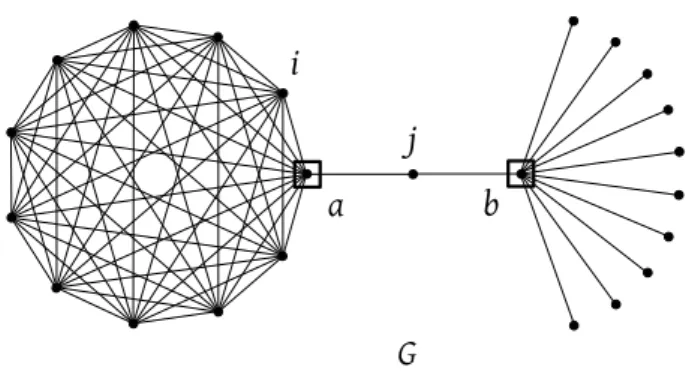
Lastly, let us consider the network in Figure 1. Let f(x) = x4 and f(11)11 = 1,331 < c < c1(23) ≈ 2,072. Since c < c1(23), full protection is the first best defence. However,
a strategy profile where only nodesa and b protect, and the adversary attacks the nodes
Figure 1: Network G, over 23 nodes, that features an equilibrium where only two nodes protect, while full protection is the first best.
to the left of a is an equilibrium. None of the protected nodes has incentives to deviate, because any of them would get eliminated by the adversary obtaining payoff 0 instead of f(13)13 −c = 2,197− c > 0. None of the eliminated nodes has incentive to protect either. This is because if any one of them protected, say node i, then the adversary would deviate to attackingj, reducing the network value to 2·f(11) = 29,282 instead of f(14) = 38,416. In effect, payoff to i is f(11)11 −c <0. Thus i does not have an incentive to deviate. Under-protection here results from the fact that gross utilities of the nodes are component balanced (every node derives benefits from own component only). Notice that i’s decision to protect has both positive and negative externalities: payoffs to all its unprotected neighbours (that would otherwise be eliminated) increase and payoffs to all the other nodes decrease.
Our interest is in analysing how the social welfare maximising designer can mitigate the decentralization problems by choosing the right topology of the network. We start by noting that for any network G and costs of protection c, there exists a pure strategy equilibrium in the subgame Γ(G).
Lemma 1. For any network G ∈ G(V) and costs of protection c > 0, Γ(G) has a pure strategy equilibrium. Moreover, for any costs of protection c > 0, Γ has a pure strategy equilibrium.
Proof. Letξ be a strategy of A inΓ(G) such that for all ∆⊆V, ξ(∆) is a best response to ∆ and ξ is a pure attack strategy, infecting node x(∆) with probability 1. Clearly such a strategy exists. networkG and strategy ξ define gameΓ(G, x) with set of players V such that, given defence ∆ induced by a strategy profile of the nodes (δ1, . . . , δn), the
utility of playeri is ˜ui(∆) = Ui(G,∆, x(∆)).
We will show that Γ(G, x) has a Nash equilibrium. To show that we will construct a set of defended nodes, ∆∗, such that the corresponding strategy profile of the nodes is Nash equilibrium ofΓ(G, x).
f(|C|)
|C| ≥c. In this case ∆
∗ =V is an equilibrium protection of Γ(G, x), as any node that
would deviate and drop protection, would obtain payoff 0≤ f(||CC||) −c.
Second, suppose that there exists C∈ C(G) such that f(||CC||) < c. LetA(G|c) ={C ∈ C(G) : f(|C|)/|C| < c} be the set of all such components. We construct ∆∗ using the following algorithm.
• ∆∗ :=V \S
A(G|c), i.e. ∆∗ protects all the nodes in components where protection yields non-negative payoffs to the protected nodes; For any C ∈ A(G|c), C∩∆∗ = ∅; note that x(∆∗) removes C ∈ A(G|c) of maximal size.
• While there exists i∈∆∗ such that x(∆∗\ {i})∈ A(G|c) do
– ∆∗ :=∆∗\ {i}
Clearly the algorithm stops, as in every step at least one node is removed from ∆∗. Moreover, x(∆∗) removes C ∈ A(G | c) of maximal size and no node in C has incentive to protect. The algorithm ensures that no node in ∆∗ has incentive to drop protection either. Hence∆∗ is an equilibrium protection of Γ(G, x) and (∆∗, x) is an equilibrium of
Γ(G).
For pure strategy equilibrium existence in game Γ, let (G,∆, ξ) be a strategy pro-file such that for any G0 ∈ G(V), (∆(G0), ξ(G0)) is a welfare maximising equilibrium of
Γ(G0) andG∈arg maxG0∈G(V)(∆(G0), ξ(G0,∆(G0)). Clearly (G,∆, ξ) is a subgame perfect
equilibrium of Γ.
Given network G ∈ G(V), the set of all equilibria of Γ(G) under costs of protection c >0 is denoted by E(c| G). As the examples above show, depending on the network,
Γ(G) may feature multiple equilibria. Those of them that maximise social welfare, i.e. (∆, ξ) such that
(∆, ξ)∈arg max(∆0,ξ0)∈E(c|G)W(G,∆, ξ(∆)), (13)
are called welfare maximising. Those of them that minimise social welfare, i.e. (∆, ξ) such that
(∆, ξ)∈arg min(∆0,ξ0)∈E(c|G)W(G,∆, ξ(∆)) (14)
are called welfare minimising.
The set of all equilibria of Γ under costs of protection c > 0 is denoted byE(c). The equilibria ofΓ that maximise social welfare, i.e. (G,∆, ξ) such that
(G,∆, ξ)∈arg max(G,∆0,ξ0)∈E(c)W(G,∆(G), ξ(G,∆)), (15)
are called welfare maximising. The equilibria of Γ that minimise social welfare, i.e. (G,∆, ξ) such that
are called welfare minimising.
To account for the inefficiencies resulting from defence decentralization, we will use two measures: the price of stability and the price of anarchy.
The price of stability is defined as the fraction of payoff to the designer in the first best over the maximal payoff to the designer that can be attained in equilibrium ofΓ (for the given costs of protection c):
PoS(n, c) = W(G
fb,∆fb, ξfb)
max(G,∆,ξ)∈E(c)W(G,∆(G), ξ(G,∆(G)))
, (17)
where (Gfb,∆fb) is a first best protected network andξfb is a best response to it by A. The price of anarchy is defined as the fraction of payoff to the designer in the first best over the minimal payoff to the designer that can be attained in equilibrium ofΓ (for the given costs of protectionc):
PoA(n, c) = W(G
fb,∆fb, ξfb)
min(G,∆,ξ)∈E(c)W(G,∆(G), ξ(G,∆(G)))
. (18)
3.2.1 Welfare maximising equilibria
The study of welfare maximising equilibria allows us to identify inefficiencies due to de-centralization of protection decisions that cannot be mitigated through network design, even if nodes and the adversary coordinate on the best possible equilibrium outcome. The main departure from the first best in the case of these equilibria derives from the fact that centrally protected star may no longer be an equilibrium. As highlighted earlier, this is due to positive externalities. Depending on the costs of protection, either all or no nodes protect in equilibrium on a star network.
Let d2(n) = f(n−1) n−1 (19) d3(n) = f(n) n . (20)
Notice that since f is strictly convex and strictly increasing, so d2(n) < d3(n), for all
n ∈ N. As we show in the Appendix, when costs of protection are between d2(n) and
d3(n), then the only equilibrium protection that can be obtained on any network is either
full protection or no protection. When costs of protection are above d3(n) then no node
finds it profitable to protect, on any network, and no protection is the only equilibrium outcome. The proposition below characterizes the optimal networks when nodes and the adversary choose welfare maximising equilibria.
Proposition 2. Let c > 0. q∈Q∗(n), and let (G,∆, ξ) be a welfare maximising equilib-rium. Then
1. G is connected and ∆=V, if 0< c <min(c1(n), c3(n)) or d2(n)< c < c2(n).
2. G is a star and ∆={i}, where i is the centre of the star, if c1(n)< c < d2(n).
3. Ghasbn
qccomponents of sizeqand one component of sizenmodq(ifn modq > 0),
where q∈Q∗(n), and ∆ =∅, if max(d2(n), c2(n))< c or max(c2(n), c3(n))< c.
By Proposition 2, first best defence can be attained in equilibrium on first best net-works, if costs of protection are small,c <min(c1(n), c3(n)) (so that full protection is the
first best), low intermediate,c∈(c1(n), d2(n)) (so that centrally protected star is the first
best),9 or largec > max(c
2(n), c3(n)) (so that no protection is the first best).
Inefficiencies due to defence decentralization cannot be avoided when costs of protec-tion are high intermediate,c∈(max(d2(n), c1(n)), c3(n)). Due to positive externalities, a
centrally protected star cannot be obtained as an equilibrium outcome. The designer can mitigate the inefficiencies in two different ways, depending on the costs, the number of nodes,n, and functionf. Ifc∈(d2(n), c2(n)) (so that a connected network with full
pro-tection is better than any network with no propro-tection), then choosing a connected network with full protection in equilibrium is optimal. On the other hand, if c ∈ (c2(n), c3(n)),
then choosing the first best disconnected network with no protection in equilibrium is optimal.10
3.2.2 Welfare minimising equilibria
The study of welfare minimising equilibria allows us to identify optimal network topologies that are, in an equilibrium sense, robust to coordination failures by the nodes and the adversary (from the point of view of the designer). Departures from the first best arise under welfare minimizing equilibria at various ranges of costs of defence. Firstly, if costs of defence are small, so that connected and fully protected network is the first best, there is a potential under-protection problem due to negative externalities: there are connected networks where full protection is not the only equilibrium outcome. Secondly, if costs of defence are intermediate, so that a centrally protected star is the first best, apart from under-protection problem due to negative externalities, identified already under welfare maximising equilibria, there is also an over-protection problem due to negative externalities. Finally, if costs of defence are high, so that a disconnected network with
9 Note that the range (c
1(n), d2(n)) may be empty if marginal benefits from adding the last node to
the network are sufficiently large (e.g. whenf(n)−f(n−1)> f(n−1)). This is true, for example, when f is exponential, e.g. f(x) =ax−1, witha >2.
10Note that range (d
2(n), c2(n)) may be empty when marginal benefits from new nodes in the network
are not high enough (e.g. iff(x) = x2). It is non empty for faster growing f, e.g. f(x) = xa, a ≥3
(whenxis not too large) as well asf(x) = 2x−1 (for anyx≥2). For such functions there is range of costs where the designer would rather have all nodes protected than loose a component of an optimal disconnected network.
no protection is the first best, over-protection problem due to negative externalities is possible: all nodes protect in equilibrium, even if the network is fully disconnected.11
Let us begin by discussing the limits to what network design can achieve when all possible equilibria are considered. Let
d0 =f(1). (21)
Since f is strictly convex and increasing, d0 < d2(n), for all n ∈ N. When costs of defence are below d0, an equilibrium with full protection exists on any network. Thus
if max(c2(n), c3(n)) < d0 or c1(n) < d0, the over-protection problem cannot be avoided
under welfare minimizing equilibria by choosing the network topology. As we show in the Appendix, the interval (max(c2(n), c3(n)), d0) is empty for any f, if n is sufficiently
large. However, the interval (c1(n), d0) may be non-empty for any (sufficiently large)n if
marginal benefits from adding new nodes to the network are small (e.g. whenf(x) =xa
with a <2).
When costs of defence are below d3(n), then every connected network has an
equilib-rium where all nodes protect. This suggests that the over-protection problem in the range (c1(n), d3(n)) can only be addressed by disconnecting the network. Observe that this
in-terval is non-empty, as long as the inin-terval (c1(n), c2(n)) is non-empty. Thus sacrificing
some nodes to avoid excessive protection is necessary in the intermediate range of costs, where centrally protected star is the first best.
When costs of protection are aboved2(n), it is not profitable for any node to protect if
all other nodes do not protect. Thus ifc > d2(n), any network has an equilibrium where
no nodes protect. Whend2(n)< c < c3(n), in which case at least one node is protected in
the first best, we face under-protection problem due to positive externalities that cannot be eliminated by network design. Thus if d2(n) < c < c3(n) (in which case at least one
node is protected in the first best) there is always an equilibrium where no nodes protect, regardless of what network is chosen by the designer.
We divide the study of how inefficiencies under welfare minimizing equilibria can be addressed by network design into three cases corresponding to three different types of first best outcomes.
Low costs of defence: securing full protection. When costs of defence are low, c < min(c1(n), c2(n)), a fully protected connected network is the first best. The most
important result of this section is that full protection in equilibrium can be enforced by network design, when costs of protection are sufficiently low. When the costs are low-intermediate, then full protection cannot be enforced and the best we can do is to choose a star where the centre protect in equilibrium. Lastly, when the costs are in the upper
11 This last problem requires the marginal benefits from adding new nodes to the network to be
sufficiently small. Due to convexity of functionf, there is always a size of network,n, where this ceases to be the case.
range of the considered interval, then no protection cannot be avoided and the first best unprotected network is the best choice.
Suppose thatc <min(c1(n), c2(n), d2(n)). If costs of protection are very low: c < f(1)n ,
then any attacked node is better off by protecting, independent of the protection decisions of other nodes. Therefore in any equilibrium outcome full protection is secured, regardless of the network. ThusDcan attain the first best by choosing any connected network.
What if costs of protection are low but not very low: f(1)n < c <min(c1(n), c2(n), d2(n))?
As we discussed already, there are connected networks were inefficient equilibrium out-comes are possible, as nodes may fail to coordinate on the efficient equilibria (e.g. no protection on the clique, when full protection is the first best, or a more subtle under-protection illustrated in Figure 1). However, this problem can be solved by choosing the right topology of the network. The idea is to create a cascade of incentives to protect in the network. That is, the network should be such that at least one node has incentives to protect in it. Then, for every such node, there should exist subsequent nodes that have incentives to protect, if one of the former nodes protects, etc. A network where such a cascade leads to full protection needs to have a critical node which has incentives to protect even if no other node protects. Critical node is defined as follows.
Definition 1(k-critical node). Nodei∈V isk-critical in a connected networkG∈ G(V) if minC∈C(G−{i})|V \C|=k.
Loosely speaking, the importance of a node as a barrier against contagion is increasing in its criticality. For example, any node in a d-connected network, d ≥ 2, is 1-critical.12
When protected, it secures one node from being infected. On the other hand, the centre of a star is (n−1)-critical. When protected, it secures n−1 nodes from being infected.
Let h(x) = f(xx) denote the gross payoff of a node in a component of size x. Since f is increasing and strictly convex, h is increasing and has well defined inverse, h−1(x), which is also increasing. As we show in the Appendix, existence of k-critical node with k ≥ h−1(c) in a connected network G ∈ G(V) is a necessary condition for having full protection in any equilibrium outcome of Γ(G). In essence, the presence of a k-critical node, withk > h−1(c), rules out equilibrium outcomes where no node protects: each such k-critical node has incentive to protect, regardless of what other nodes choose. However, it is not sufficient for having full defence in any equilibrium outcome. Consider the following example.
Example 1. Let f(x) = x2, V = {1, . . . ,6}, and suppose that 1 < c ≤ 11
5 = min(c1(6),
d2(6), c2(6)). Let G be a star network with centre 1. Consider the strategy profile (∆, ξ)
of Γ(G) such that ∆ = {1}, i.e. only the centre protects, and ξ(∆) mixes uniformly on all the spokes. Payoff to a spokej from this strategy profile is 45·5 = 4. If j protects,
12 A network isd-connected if there is no set of l < dnodes whose removal disconnects the network
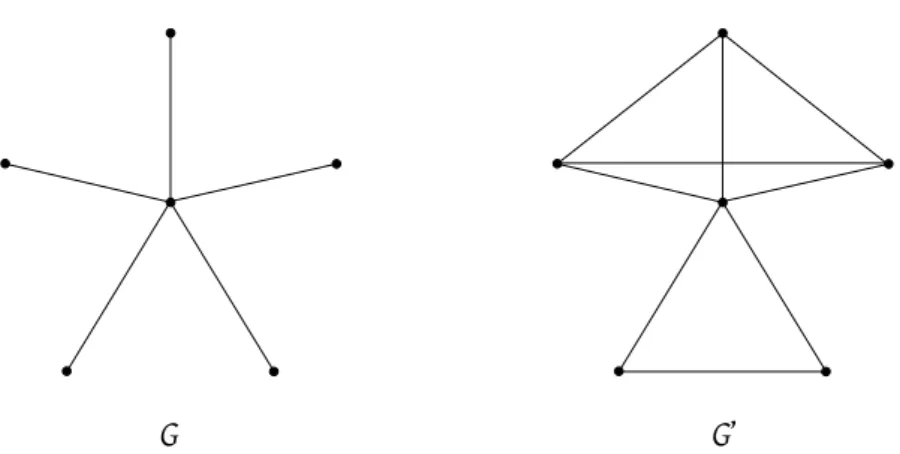
Figure 2: NetworksG, a star over 6 nodes, and G0, obtained by fully connecting three of the spokes in one group and the remaining two in another group.
the payoff is 5−c, which is less than 4 for anyc∈(1,115 ). Hence there is an equilibrium where only one node protects in Γ(G). When the centre protects, player A chooses a maximal component of G− {i} to eliminate. In the case of the star network the number of the maximal components is large and if A mixes across them with equal probability, each spoke prefers not to protect, as the probability of being eliminated is relatively low. To trigger a cascade of incentives to protect, the designer has to create imbalance in the sizes of components ofG− {i}. This increases the chances for the nodes to be eliminated and gives them more incentives to protect.
In the example above, letG0 be network obtained fromGby forming a clique over the spokes{2,3,4}and a clique over the spokes{5,6}(c.f. Figure 2). Node 1 is 3-critical and since 3> c, so it protects even if no other node protects. When 1 protects, the adversary attacks the group of three interconnected spokes,{2,3,4}, with probability 1. Because of that any of the spokes from the group has incentive to protect when 1 protects. Suppose that 1 and 2 protects. Then the adversary is indifferent between attacking the group {3,4} and {5,6}. If A chooses one of the groups uniformly, payoff from protecting for any of the unprotected nodes is 4−c while payoff from not protecting is 12·4. Thus it is profitable for the node to protect if 1< c ≤ 2 and it is not if 2 < c < 11
5. Suppose
that nodes{1,2,3} protect. It is straightforward to verify that then all other nodes find it profitable to protect as well. Hence full protection is the only equilibrium outcome on G0 when 1< c≤2. In the case of 2 < c≤ 11
5, full protection cannot be secured and the
optimal network is a star where, in the worst equilibrium, the centre protects and one of the spokes is destroyed by the adversary.
The example above illustrates that along with a critical nodei in networkG, it is also necessary to have the right sizes of components in C(G− {i}). It is related to existence of properly balanced partition of n−1 nodes. Given quantity q ∈ N++, a partition of q
is a sequenceπ(q) = (s1, . . . , sm) such thatsj ∈N++, for allj ∈ {1, . . . , m},Pmj=1sj =q,
{1, . . . , m}:sr ≥j} be the number of parts of size at least j.
Definition 2 ((h, c)-partition). A partition π(q) = (s1, . . . , sm) of q is a (h, c)-partition
if for all j ∈ {1, . . . , m} it holds
Lj(π(q))≤
h(q−j)
c (22)
Existence of (h, c)-partition of n−1 nodes depends on the cost,c, functionf, and the number of nodes. Let
d1(n) = max ( c∈R++: n−1 X j=1 h(j) c ≥n−1 ) (23)
Notice that d0 ≤ d1(n) ≤ d2(n). To see that observe that Pn −1
j=1b
h(j)
c c is (weakly)
de-creasing in c. Since h(j) ≥ f(1) = d0, for all j ≥ 1 with strict inequality for j > 1, so
Pn−1
j=1b
h(j)
f(1)c ≥ n −1 (with strict inequality for n ≥ 3) and, consequently, d0 ≤ d1(n).
Since Pn−1
j=1b
h(j)
c c is less than n−1, for all c > d2(n), so d1(n) ≤ d2(n). As we show in
the Appendix, an (h, c)-partition of n−1 exists if and only if c < d1(n).
Lastly, to prevent under-protection due to component balancedness of nodes’ gross payoffs, the network topology should be “tight” enough to avoid equilibria such as the one illustrated in Figure 1. In further analysis, the following networks, defined for a given non-empty sequence of positive integers,π, will be important.
Definition 3(π-windmill networks). Given a sequence of positive integers,π= (s1, . . . , sm),
let G be a network over n = 1 +Pm
j=1sj nodes defined as follows. Put one node, say
i, aside and partition the remaining nodes into groups of sizes s1, . . . , sm. Connect the
nodes within each group to form m cliques. Lastly, connect all the nodes in the cliques to nodei
As we show in the Appendix, if π is an (h, c)-partition of n−1 then any π-windmill network has full protection as the unique equilibrium outcome if c < d1(n).
Definition 4 (Family Gf(n, c)). Given function f, the number of nodes n, and cost of
protection c, let Gf(n, c) denote the set of networks over n nodes such that in every
equilibrium (∆, ξ) of Γ(G), all nodes protect, i.e. ∆=V.
Notice that if 0 < c < f(1)n then Gf(n, c) is the set of all connected networks over n
nodes. Moreover, if f(1)n < c < d1(n), then Gf(n, c) is non-empty and containsπ-windmill
networks withπ being an (h, c)-partition of n−1.
If costs of protection are in the upper range of the considered interval, d2(n) < c <
min(c1(n), c2(n)) then every network has an equilibrium where no node protects. As we
observed above, this cannot be addressed by network design. The optimal choice of the designer is the first best unprotected network. The following proposition characterizes welfare minimising equilibria for low costs of defence.
Proposition 3. Let 0< c < c1(n).
1. If 0< c < d1(n)then Gf(n, c)6=∅ and(G,∆, ξ)such that G∈ Gf(n, c) and ∆=V
is a welfare minimising equilibrium.
2. If d1(n)< c < min(c1(n), c2(n), d2(n)) then (G,∆, ξ) such that G is a star network
with centre i, ∆ = {i}, and ξ is a probability distribution on V \ {i}, is a welfare minimising equilibrium.
3. If d2(n)< c < min(c1(n), c2(n)) then (G,∆, ξ) such that G has bnqc components of
size q and one component of size n modq (if nmodq >0), where q ∈ Q∗(n), and ∆ =∅, is a welfare minimising equilibrium.
Intermediate costs of defence: addressing over-protection and under-protection.
When costs of defence are intermediate, c1(n) < c < c3(n), a centrally protected star is
the first best. As we discussed above, two types of inefficiencies appear when defence is decentralized and costs of defence are intermediate, c1(n) < c < c3(n). In the upper
range of the interval, when d2(n) < c < c3(n), there is an under-protection problem due
to positive externalities. When c1(n) < c < d2(n), there is an over-protection problem
due to negative externalities.
The most important result of this section is that the only way to mitigate over-protection by network design is by splitting the network, while under-over-protection is un-avoidable. The optimal topology of the network that mitigates over-protection is closely tied to the shape of function f. We end the section by an example of optimal design for Metcalf’s law, f(x) =x2.
Consider the upper range of costs of protection, d2(n) < c < c3(n). When d3(n) <
c3(n), then no node protects in any equilibrium on any network. Thus in this range of
costs of defence, the only thing the designer can do is choosing the first best disconnected network with no protection. If d2(n) < c < min(d3(n), c3(n)), then the centre of the
star finds it unprofitable to protect, unless all the nodes in the network protect. Thus the designer could address the problem in two ways: enforce excessive protection, by choosing a network where all nodes protect in the welfare minimising equilibrium, or enforce no protection, by choosing a network where no nodes protect in welfare minimising equilibrium. Whenc2(n)< c <min(d3(n), c3(n)), first best disconnected network is better
for the designer than any fully protected network, and no protection is the only equilibrium outcome on the first best disconnected network. Hence it is optimal for the designer to choose the first best disconnected network with no protection. Whend2(n)< c < c2(n),
full protection is the preferred equilibrium outcome. However, withc > d2(n), any network
has an equilibrium where no nodes protect. Hence full protection cannot be secured by network design. Therefore the best choice of the designer is again a first best disconnected network, which has no protection in any equilibrium when c > d2(n).
Second, consider the lower range of costs of protection,c1(n)< c <min(d2(n), c3(n)).
Whenc1(n)< c < d2(n), a star network has two possible equilibrium outcomes: only the
centre protects, or all nodes protect. Thus under-protection is no longer an issue and a new problem arises: over-protection due to negative externalities. If c1(n)< c < d0, full
protection is an equilibrium outcome on any network. Therefore this range of costs the over-protection problem cannot be avoided and an optimal choice is a connected network where full protection is the worse equilibrium outcome. This motivates the definition of the following family of networks.
Definition 5 (Family Gw(n, c)). Given function f, the number of nodes n, and cost of
protectionc, let Gw(n, c) denote the set of connected networks over n nodes such that in
the worse equilibrium (∆, ξ) of Γ(G), all nodes protect, i.e. ∆=V.
Notice that if 0 < c < f(1)n then Gw(n, c) is the set of all connected networks over n
nodes. Moreover, if f(1)n < c < d0, thenGw(n, c) is non-empty and contains star networks
overn nodes.
If max(c1(n), d0)< c < d2(n) then any connected network has an equilibrium with full
protection. Therefore over-protection cannot be avoided on the connected network and the inefficiencies due to over-protection can only be mitigated by splitting the network and sacrificing some nodes. In particular, any such network must have a component small enough so that no node in it finds it profitable to protect. The discussion above is summarized in the following proposition.
Proposition 4. Let c1(n)< c < c3(n).
1. If c1(n)< c < d0 then (G,∆, ξ)with G∈ Gw(n, c)and ∆=V is a welfare
minimis-ing equilibrium.
2. If max(c1(n), d0)< c < d2(n)and(G,∆, ξ)is a welfare minimising equilibrium with
∆(G) ( V, then either G is a disconnected network and contains a component of size m such that f(mm) < c or G∈ Gw(n, c) and ∆=V.
3. If d2(n) < c < c3(n) then (G,∆, ξ) such that G has bnqc components of size q and
one component of size n modq (if nmodq >0), where q ∈ Q∗(n), and ∆=∅, is a welfare minimising equilibrium.
Notice that the second bullet of the proposition does not specify the number of compo-nents and their topology, in the case were over-protection can be mitigated by splitting the network. It only states that splitting the network is the only thing we can do to address over-protection in this case and that it requires separating at least one components from the network which is sufficiently small to make individual protection unprofitable for any node. These small components can have any topology. The number of components and the topology of the larger components depends on the shape of function f. An example
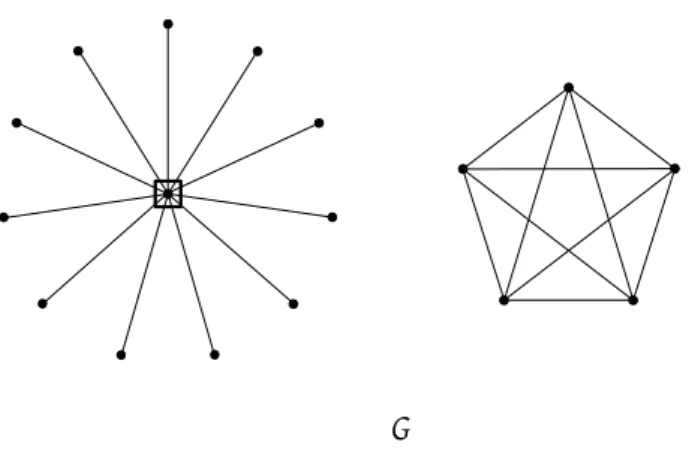
Figure 3: Network G consisting of a star over 12 nodes, and a clique over 5 nodes. below illustrates how splitting the network can be used to mitigate the over-protection problem in the case of f(x) = x2, i.e. in the case of network value function consistent with Metcalfe’s law.
Example 2. Let f(x) = x2 and n = 17. Suppose that c ∈ (10,16) ⊆ (33
16,16) =
(min(c1(n), d0), d2(n)). In this range of costs, centrally protected star is the first best
and yields payoff 256−c∈(240,246) to player D. An equilibrium outcome from welfare minimising equilibrium on the star network is full protection, which results in payoff 289 −17c ∈ (17,119) to D. The first best disconnected network with no protection consists of two components of size 8 and one component of size 1, and yields payoff 65 to
D.
Consider network G consisting of two components: one a star over 12 nodes and another one, a clique, over 5 nodes (c.f. Figure 3). It is easy to verify that in the unique equilibrium outcome inΓ(G) in the range of costs under consideration, the centre of the star protects and the adversary removes the clique. This yields payoff 144−c >289−17c, if c ≥ 10. Thus G is better to D than the star network. It is also better than the first best disconnected network, as 144−c >65 if c <16.
High level of costs: no inefficiencies for large networks. No node has incentive to protect in components of size q ∈ Q∗(n) if c > max(c2(n), c3(n)), as long as q ≥ 2.
Thus if d0 < max(c2(n), c3(n)), then first best equilibrium outcome is attained in every
equilibrium for high level of costs of defence. Sinced0 < c3(n), for sufficiently high n, so
the first best equilibrium for high costs of protection can be attained if the number of nodes is large enough. In the case ofc∈(max(c2(n), c3(n)), d0) there is a problem of
over-protection. In this case it is optimal for the designer to choose a connected network which features full protection in the worst equilibrium outcome, i.e. a network in Gw(n, c). The
following proposition characterizes optimal networks under welfare minimising equilibria.
Proposition 5. Let c >max(c2(n), c3(n)). Let (G,∆, ξ)be a welfare minimising
1. If c < d0 then G∈ Gw(n, c) and ∆=V.
2. If c > d0 then G has bnqc components of size q and one component of size n modq
(if nmodq >0), where q∈Q∗(n), and ∆ =∅.
Moreover, for sufficiently high n, d0 < c3(n) and only point 2 applies.
3.3
The price of decentralization
The analysis in Section 3.2 allows us to measure the costs of decentralization in terms of the price of anarchy (PoA) and the price of stability (PoS). Notice first that, by Proposition 2, PoS(n, c) = 1, unless c ∈ (d2(n), c3(n)). In this case the centrally protected star is the
first best, but, due to positive externalities, this outcome cannot be obtained in any equilibrium on any network. It is easy to see that the threshold costd2(n) is increasing.
If it is unbounded, then for any fixedc, if the network is sufficiently large, c < d2(n) and
PoS(n, c) = 1. That is, the first best can be attained as an equilibrium outcome if the number of nodes is sufficiently large. However, if d2(n) is bounded, there might exists
levels of costs of protection c for which PoS(n, c) > 1 even if the network is very large. Take for example f(x) = x−ln(x+ 1). This function is strictly increasing and convex, but the marginal benefits from subsequent nodes in the network, although increasing, are bounded from above by 1. Because of that, utility of a node, f(mm), converges to 1 when its component grows.
Consider now the worst case scenario, where nodes and the adversary coordinate on welfare minimising equilibria. Firstly, we note that if costs of protection are sufficiently low, c < min(c1(n), c2(n), d1(n)), or sufficiently high, c > max(c2(n), c3(n), d0) then, by
Propositions 3 and 5 the designer can fully prevent the inefficiencies due to decentralization by the right network design. Hence PoA(n, c) = PoS(n, c) = 1 in this case.
We show in the Appendix that lim
n→+∞d1(n) = limn→+∞d2(n) = limn→+∞d3(n) = limn→+∞
f(n)
n . (24)
Thus, given fixed costs of protection, c, when n is sufficiently large then either the gross payoff to a node in a connected network is higher thanc(in which case, by Proposition 3, full protection can be secured by network design) or it is lower than c (in which case no node protects in every equilibrium, on any network). In the former case the relative loss from possible over-protection converges to a constant value when the number of the nodes increases. In particular, it vanishes if the gross payoff is unbounded and the number of the nodes grows. The latter case implies thef(n)< ncin which case choosing a first best unprotected network to mitigate the effects of under-protection leads to small relative loss from defence decentralization. The theorem below summarizes the asymptotic behaviour of the inefficiencies due to decentralization.
Theorem 1. Let c >0 be costs of protection and |V|=n be the number of nodes.
1. Ifc <min(c1(n), c2(n), d1(n))orc >max(c2(n), c3(n), d0), thenPoA(n, c) = PoS(n, c) =
1.
2. If limn→+∞f(nn) =p≤c, then PoS(n, c),PoA(n, c). f(1)p when n→+∞.
3. Iflimn→+∞f(nn) =p < +∞withp > c, thenlimn→+∞PoS(n, c),limn→+∞PoA(n, c).
p
p−c when n→+∞.
4. If limn→+∞f(nn) = +∞ then limn→+∞PoS(n, c) = limn→+∞PoA(n, c) = 1.
As a corollary from Theorem 1, note that if f(x) =xa, with a >1, or f(x) =ax−1,
with a >1, then limn→+∞f(n)/n= +∞ and
lim
n→+∞PoA(n, c) = limn→+∞PoS(n, c) = 1. (25)
In particular, in the case of Metcalfe’s law and Reed’s law inefficiencies due to decentral-ization can be mitigated arbitrarily well by network design for sufficiently large number of nodes.
4
Discussion
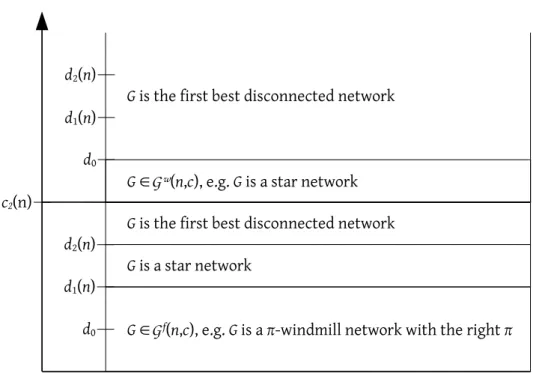
In this section we summarize the results from Section 3 and highlight the main messages of the paper. We focus on welfare minimizing equilibria. To make the presentation clearer we distinguish two cases: (1) one where f does not grow extremely fast, so that c1(n)< c3(n), and (2) one where f grows extremely fast, so that c1(n)> c3(n).
We start with case (1). This is the richer case and it covers all functions of the form f(x) = xa with a > 1 as well as all functions of the form f(x) = ax−1 with a > 1. As the analysis in Section 3 shows, we have two sets of thresholds for costs of protection: one set for the first best and one for the decentralized protection. For the first best we have two key thresholds,c1(n)< c3(n), and
(i). if c < c1(n) then connected fully protected network is the first best outcome,
(ii). if c1(n)< c < c3(n) then centrally protected star is the first best outcome, and
(iii). if c > c3(n) then first best outcome is disconnected unprotected network,
For the decentralized protection we have three key thresholds, d0 ≤d1(n)≤d2(n), and
(i). if c < d0 then any network has an equilibrium outcome where all nodes protect,
(ii). if c < d1(n) then there exist connected networks which have full protection as the
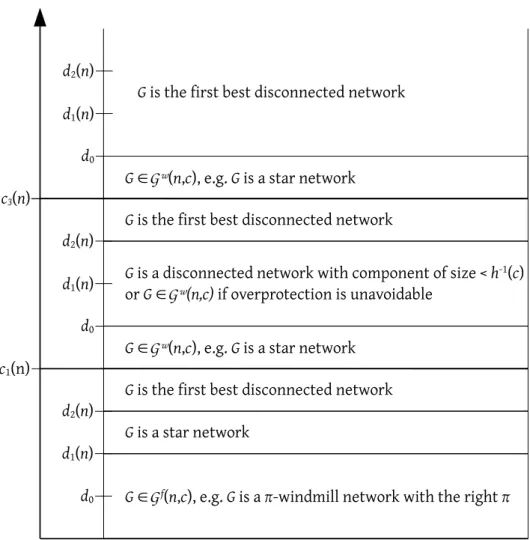
Figure 4: Welfare minimizing equilibria for different values of costs and f not growing extremely fast.
(iii). ifd1(n)< c < d2(n) then any connected network has an equilibrium outcome where
at least one node does not protect,
(iv). if c > d2(n) then two equilibrium outcomes are possible: no node protects (this
is an equilibrium outcome on any network), or all nodes protect (this equilibrium outcome is possible on connected networks only, and it exists on any connected network).
Depending on how the above sets of thresholds interleave (which depends on function f), we have different problems and different design choices. Let us analyse the design decisions, asc changes (which is summarized in Figure 4).
Consider firstc < c1(n). In this case full protection in a connected network is the first
best equilibrium outcome and the only inefficiencies that may appear when protection decisions are decentralized is the under-protection problem. Ifc < d1(n) then, by point 1
of Proposition 3, first best outcome can be attained as a unique equilibrium outcome if the network topology is properly chosen: givenc,n, andf, we can get a partition of nodes