supine, with the wrist and hand resting com-fortably at the patient’s side and the targeted area facing upward.
Carpal Tunnel Syndrome ANATOMY
The carpal tunnel is formed by the carpal bones dorsally, and the transverse carpal liga-ment (flexor retinaculum), ventrally. The con-tents of the tunnel include the median nerve and flexor tendons of the hand. The median nerve sensory and motor distribution in-cludes the palmar aspect of the thumb and the index and middle fingers, and it allows oppo-sition of the tip of the thumb with the tips of the fingers.
INDICATIONS AND DIAGNOSIS
Diagnosis of carpal tunnel syndrome is clinical. Electrodiagnostic studies (nerve con-duction and electromyography) may assist in confirming the diagnosis, but they have signif-icant false-positive and negative results.4 Weakness of thumb abduction is a specific and reliable sign.5 The major indication for carpal tunnel injection is the syndrome of median nerve compression, which may result
T
his article, the next in a series on diagnostic and therapeutic injections, covers the wrist and hand region. The rationale, indications, contraindications, and general approach to this technique are covered in the first article of the series.1The wrist and hand are sites of multiple injuries and inflammatory conditions that lend them-selves to diagnostic and therapeutic injec-tion.2,3In this article, we review the anatomy, pathology, diagnosis, and injection technique of common sites for which this skill is applic-able. Specific indications include carpal tun-nel syndrome, arthritis of the first carpo-metacarpal joint, de Quervain’s tenosynovitis, wrist ganglion cysts, and digital flexor tenosynovitis (trigger finger). For injection of the hand and wrist, the patient should beJoint injection of the wrist and hand region is a useful diagnostic and therapeutic tool for the family physician. In this article, the injection procedures for carpal tunnel syndrome, de Quervain’s tenosynovitis, osteoarthritis of the first carpometacarpal joint, wrist gan-glion cysts, and digital flexor tenosynovitis (trigger finger) are reviewed. Indications for carpal tunnel syndrome injection include median nerve compression resulting from osteoarthritis, rheumatoid arthritis, diabetes mellitus, hypothyroidism, repetitive use injury, and other traumatic injuries to the area. For the first carpometacarpal joint, injec-tion may be used to treat pain secondary to osteoarthritis and rheumatoid arthritis. Pain associated with de Quervain’s tenosynovitis is treated effectively by therapeutic injection. If complicated by pain or paresthesias, wrist ganglion cysts respond to aspiration and injection. Painful limitation of motion occurring in trigger fingers of patients with dia-betes or rheumatoid arthritis also improves with injection. The proper technique, choice and quantity of pharmaceuticals, and appropriate follow-up are essential for effective outcomes. (Am Fam Physician 2003;67:745-50. Copyright© 2003 American Academy of Family Physicians.)
The use of local corticosteroid injection for carpal tunnel syn-drome has been shown to provide greater clinical improve-ment in symptoms one month after injection, compared with placebo.
Diagnostic and Therapeutic Injection
of the Wrist and Hand Region
ALFRED F. TALLIA, M.D., M.P.H., and DENNIS A. CARDONE, D.O., C.A.Q.S.M. University of Medicine and Dentistry of New Jersey–Robert Wood Johnson Medical School, New Brunswick, New Jersey
OFFICE PROCEDURES
This article is one in a series of “Office Proce-dures” articles coordi-nated by Dennis A. Cardone, D.O., C.A.Q.S.M., associate professor, and Alfred F. Tallia, M.D., M.P.H., associate professor, Department of Family Medicine, UMDNJ– Robert Wood Johnson Medical School, New Brunswick, N.J.
from osteoarthritis, rheumatoid arthritis, dia-betes mellitus, hypothyroidism, repetitive use injury or other traumatic injuries to the area, and pregnancy. The use of local corticosteroid injection for carpal tunnel syndrome has been shown to provide greater clinical im-provement in symptoms one month after injection, compared with placebo.6,7 Long-term randomized controlled trials have not
been performed, particularly comparing sur-gical or nonsursur-gical approaches with cortico-steroid injection.
TIMING AND OTHER CONSIDERATIONS
Injection of the carpal tunnel is considered a later modality after appropriate nonsurgical therapeutic interventions have been under-taken. These include the use of nonsteroidal anti-inflammatory drugs (NSAIDs), splinting, and avoidance of precipitating activities.8 TECHNIQUE
Pharmaceuticals and equipment are de-scribed in Table 1. Essential landmarks to pal-pate before performing this injection include the proximal wrist crease and the palmaris longus tendon when present. The palmaris longus tendon is best identified by having the patient pinch all the fingertips together while the wrist is in a neutral position.
APPROACH AND NEEDLE ENTRY
The injection is performed at a site just ulnar to the palmaris longus tendon and at the
prox-First carpometacarpal joint 3 mL 25 gauge, 0.5 mL of 1% lidocaine or 0.25% 0.25 to 0.5 mL Celestone Soluspan 1 inch or 0.5% bupivacaine or methylprednisolone
de Quervain’s tenosynovitis 5 mL 25 gauge, 2 mL of 1% lidocaine or 0.25% 1 mL Celestone Soluspan or 1.5 inch or 0.5% bupivacaine methylprednisolone Ganglion cysts† 20 to 30 mL 18 or 22 gauge, 1 to 2 mL of 1% lidocaine or 1 mL Celestone Soluspan or
1 or 1.5 inch 0.25% or 0.5% bupivacaine methylprednisolone Trigger finger 3 mL 25 gauge, 0.5 to 1 mL of 1% lidocaine or 0.5 mL Celestone Soluspan or
1 or 1.5 inch 0.25% or 0.5% bupivacaine methylprednisolone *—One mL of Celestone Soluspan is 3 mg each of betamethasone sodium phosphate and betamethasone acetate. †—A hemostat is needed to immobilize the needle when performing injection following aspiration.
The Authors
ALFRED F. TALLIA, M.D., M.P.H., is associate professor and vice chair in the Department of Family Medicine at the University of Medicine and Dentistry of New Jersey (UMDNJ)–Robert Wood Johnson Medical School, New Brunswick, N.J. Dr. Tallia is a graduate of the UMDNJ–Robert Wood Johnson Medical School and completed his res-idency at the Thomas Jefferson University Family Medicine Resres-idency, Philadelphia. He received his public health degree at Rutgers University, New Brunswick, N.J. DENNIS A. CARDONE, D.O., C.A.Q.S.M., is associate professor and director of sports medicine and the sports medicine fellowship in the Department of Family Medicine at UMDNJ–Robert Wood Johnson Medical School. Dr. Cardone is a graduate of the New York College of Osteopathic Medicine, Old Westbury, N.Y., and completed his resi-dency at the UMDNJ–Robert Wood Johnson Medical School Family Medicine Resi-dency. He completed his sports medicine fellowship at UMDNJ.
Address correspondence to Alfred F. Tallia, M.D., M.P.H., Dept. of Family Medicine, UMDNJ, 1 Robert Wood Johnson Place, MEB288, New Brunswick, NJ 08903 (e-mail: [email protected]). Reprints are not available from the authors.
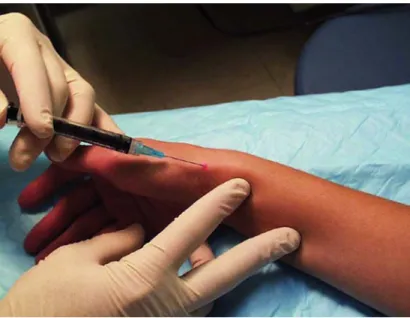
imal wrist crease. For those few patients with-out a palmaris longus tendon, the needle is inserted just ulnar to the midline of the wrist. The needle is inserted at a 30-degree angle and directed toward the ring finger (Figure 1). If the needle meets obstruction or if the patient expe-riences paresthesias, the needle should be with-drawn and redirected in a more ulnar fashion. Another injection site is at the volar side of the forearm, 4 cm proximal to the wrist crease between the tendons of the radial flexor muscle and the palmaris longus muscle.7 In this approach, the angle of insertion is between 10 and 20 degrees depending on the thickness of the wrist. As with any injection, aspirate to ensure that the needle has not been placed in a blood vessel. Inject slowly, but with consistent pressure.
First Carpometacarpal Joint ANATOMY
The movements of the thumb are dictated by the saddle-shaped articular surface of the base of the first metacarpal, which articulates with the trapezium.
INDICATIONS AND DIAGNOSIS
Pain associated with arthritis or overuse is the most common indication for injection of this joint.9,10Diagnosis is determined by limi-tation of motion and palpation of crepitus and tenderness over the joint. Diagnosis may be confirmed by radiographs.
TIMING AND OTHER CONSIDERATIONS
Injection is usually performed after other more conservative therapies, including use of NSAIDs and a brief period of immobiliza-tion, have been tried.11,12As with any arthritic joint, relief after injection may only be tem-porary, and surgical intervention may need to be considered.
TECHNIQUE
Pharmaceuticals and equipment are de-scribed in Table 1. Palpate the joint space be-tween the trapezium and the first metacarpal.
APPROACH AND NEEDLE ENTRY
The needle enters just proximal to the first metacarpal on the extensor surface. Care must be taken to avoid the radial artery and the extensor pollicis tendons. To avoid the radial artery, the needle should enter toward the dor-sal (ulnar) side of the extensor pollicis brevis tendon. The needle, a 25 gauge, should fall into the joint space (Figure 2). Traction can be
Wrist and Hand Injection
FIGURE 1. Injection for carpal tunnel syndrome. The needle is inserted at a 30-degree angle just medial to the palmaris longus tendon.
FIGURE 2. Injection for first carpometacarpal joint. The needle should enter on the ulnar side of the extensor pollicis brevis tendon. The 25-gauge needle should fall into the joint space.
de Quervain’s Disease ANATOMY
This disorder, a stenosing tenosynovitis, in-volves the abductor pollicis longus and ex-tensor pollicis brevis tendons.
INDICATIONS AND DIAGNOSIS
de Quervain’s disease usually occurs with repetitive use of the thumb.13 Thickening is noted, and tenderness is elicited just distal to the radial styloid process over the site of the involved tendon sheath. The Finkelstein test is performed by having the patient make a fist with the thumb inside while simultaneously ulnar deviating the hand. Pain over the affected area is elicited in de Quervain’s disease.
described in Table 1. With the thumb ab-ducted and extended, palpate the course of the tendons distal to the radial styloid process. APPROACH AND NEEDLE ENTRY
The needle is placed into the first extensor compartment, directed proximally toward the radial styloid process and sliding in parallel to the abductor and extensor tendons (Figure 3). Do not inject directly into a tendon.
Ganglion Cysts ANATOMY
Ganglion cysts account for approximately 60 percent of soft tissue, tumor-like swelling affecting the hand and wrist. They usually develop spontaneously in adults 20 to 50 years of age. There is a female-to-male preponder-ance of 3:1.14 The dorsal wrist ganglion arises from the scapholunate joint and con-stitutes about 65 percent of ganglia of the wrist and hand. The volar wrist ganglion arises from the distal aspect of the radius and accounts for about 20 to 25 percent of ganglia. Flexor tendon sheath ganglia make up the remaining 10 to 15 percent. The cys-tic structures are found near or are attached to tendon sheaths and joint capsules. The cyst is filled with soft, gelatinous, sticky, and mucoid fluid.
INDICATIONS AND DIAGNOSIS
Cysts are self evident, being soft and bal-lotable, and occur along the dorsal and volar aspects of the wrist. Most ganglia resolve spontaneously and do not require treatment. If the patient has symptoms, including pain or paresthesias, or is disturbed by the appear-ance, aspiration with or without injection of a
FIGURE 3. Injection for de Quervain’s tenosynovitis. The needle is placed into the first extensor compartment and directed proximally toward the radial styloid.
corticosteroid is effective (no recurrence of the cyst) in 27 to 67 percent of patients.15,16 TIMING AND OTHER CONSIDERATIONS
Aspiration and injection are performed on an elective basis determined by symptoms and patient request.
INJECTION TECHNIQUE
Pharmaceuticals and equipment are de-scribed in Table 1. Boundaries of the cyst should be palpated.
APPROACH AND NEEDLE ENTRY
An 18- or 22-gauge needle inserted directly into the cyst should be used to aspirate the cyst after local anesthesia is given. A 20- or 30-mL syringe should be used to provide optimal suction for aspiration. If injecting a cortico-steroid after aspiration, a hemostat is used to stabilize the needle while the syringe is changed.
Trigger Finger (Digital Flexor Tenosynovitis) ANATOMY
All flexor tendons of the hand may develop a tenosynovitis.
INDICATIONS AND DIAGNOSIS
Symptoms develop when a tendon cannot glide within its sheath because of a thickening or nodule that catches at the site of the first annular pulley, preventing smooth extension or flexion of the finger. Patients complain of catching or locking and discomfort with grasping activity of the hand. Trigger finger occurs commonly in patients who have rheumatoid arthritis, diabetes mellitus, and repetitive use injuries.17
TIMING AND OTHER CONSIDERATIONS
Compared with previously described disor-ders, corticosteroid injection is performed earlier in the course of treatment in this dis-order.18,19 Alternatives to injection include splinting and modification of activity.20
INJECTION TECHNIQUE
Pharmaceuticals and equipment are de-scribed in Table 1. A nodule secondary to the tenosynovitis is usually palpable in the region of the metacarpal head of the affected tendon.
APPROACH AND NEEDLE ENTRY
A 25-gauge, 1-inch, or 1.5-inch needle is inserted over the palmar aspect distal to the metacarpal head at a 30-degree angle and then directed proximally, almost parallel to the skin, toward the nodule (Figure 4).
Follow-Up Care
The patient should remain in the supine position for several minutes after the injec-tion. To ascertain whether the pharmaceuti-cals have been injected into the appropriate location, move the joint through passive range of motion. For tenosynovitis, stress the finger flexors to ascertain the same. A compression dressing should be applied after aspirating a ganglion cyst. To monitor for any adverse reactions, the patient should remain in the office for 30 minutes after the injection. In general, patients should avoid strenuous activ-ity involving the injected region for 48 hours.
Wrist and Hand Injection
FIGURE 4. Trigger finger injection. The needle is inserted at a 30-degree angle toward the nodule in the direction of the metacarpal head.
Patients should be cautioned that they may experience worsening symptoms during the first 24 to 48 hours related to a possible steroid flare, which can be treated with ice and NSAIDs. A follow-up appointment should be arranged within three weeks.
The authors indicate that they do not have any con-flicts of interest. Sources of funding: none reported.
REFERENCES
1. Cardone DA, Tallia AF. Joint and soft tissue injec-tion. Am Fam Physician 2002;66:283-8.
2. Owen DS Jr. Aspiration and injection of joints and soft tissues. In: Ruddy S, Harris ED, Sledge CB, Kel-ley WN. KelKel-ley’s Textbook of rheumatology, 6th ed. Philadelphia: W.B. Saunders, 2001:583-604. 3. Grillet B. Dequeker J. Intra-articular steroid injection.
A risk-benefit assessment. Drug Saf 1990;5:205-11. 4. Katz JN, Simmons BP. Carpal tunnel syndrome.
N Engl J Med 2002;346:1807-12.
5. D’Arcy CA, McGee S. The rational clinical examina-tion. Does this patient have carpal tunnel syn-drome? JAMA 2000;283:3110-7.
6. Marshall S, Tardif G, Ashworth N. Local cortico-steroid injection for carpal tunnel syndrome. Cochrane Database Syst Rev 2002;2:CD001554. 7. Dammers JW, Veering MM, Vermeulen M. Injection
with methylprednisolone proximal to the carpal tunnel: randomised double blind trial. BMJ 1999; 319:884-86.
8. Bracker MD. Ralph LP. The numb arm and hand. Am Fam Physician 1995;51:103-16.
9. Rettig AC. Wrist problems in the tennis player. Med Sci Sports Exerc 1994;26:1207-12.
10. Creamer P. Intra-articular corticosteroid injections in osteoarthritis: do they work and if so, how? Ann Rheum Dis 1997;56:634-6.
11. Buckwalter JA, Stanish WD, Rosier RN, Schenck RC Jr, Dennis DA, Coutts RD. The increasing need for nonoperative treatment of patients with osteoarthritis. Clin Orthop 2001;385:36-45. 12. Lane NE, Thompson JM. Management of
osteo-arthritis in the primary-care setting: an evidence-based approach to treatment. Am J Med 1997; 103:25-30S.
13. Rettig AC. Wrist and hand overuse syndromes. Clin Sports Med 2001;20:591-611.
14. Thornburg LE. Ganglions of the hand and wrist. J Am Acad Orthop Surg 1999;7:231-8.
15. Esteban JM, Oertel YC, Mendoza M, Knoll SM. Fine needle aspiration in the treatment of ganglion cysts. South Med J 1986;79:691-3.
16. Richman JA, Gelberman RH, Engber WD, Salamon PB, Bean DJ. Ganglions of the wrist and digits: results of treatment by aspiration and cyst wall puncture. J Hand Surg 1987;12:1041-3.
17. Sheon RP. Repetitive strain injury. 2. Diagnostic and treatment tips on six common problems. The Goff Group. Postgrad Med 1997;102:72-8,81,85. 18. Marks MR, Gunther SF. Efficacy of cortisone
injec-tion in treatment of trigger fingers and thumbs. J Hand Surg [Am] 1989;14:722-7.
19. Patel MR, Bassini L. Trigger fingers and thumb: when to splint, inject, or operate. J Hand Surg [Am] 1992;17:110-3.
20. Quinnell RC. Conservative management of trigger finger. Practitioner 1980;224:187-90.